VOLUME VII SLICE VI Coucy-le-Château to Crocodile (continued 6)
Reading edition
See A. C. Buel, Memoirs of C. H. Cramp (Philadelphia, 1906).
CRAMP, a painful spasmodic contraction of muscles, most frequently occurring in the limbs, but also apt to affect certain internal organs. This disorder belongs to the class of diseases known as local spasms, of which other varieties exist in such affections as spasmodic asthma and colic. The cause of these painful seizures resides in the nervous system, and operates either directly from the great nerve centres, or, as is generally the case, indirectly by reflex action, as, for example, when attacks are brought on by some derangement of the digestive organs.
In its most common form, that of cramp in the limbs, this disorder comes on suddenly, often during sleep, the patient being aroused by an agonizing feeling of pain in the calf of the leg or back of the thigh, accompanied in many instances with a sensation of sickness or faintness from the intensity of the suffering. During the paroxysm the muscular fibres affected can often be felt gathered up into a hard knot. The attack in general lasts but a few seconds, and then suddenly departs, the spasmodic contraction of the muscles ceasing entirely, or, on the other hand, relief may come more gradually during a period of minutes or even hours. A liability to cramp is often associated with a rheumatic or gouty tendency, but occasional attacks are common enough apart from this, and are often induced by some peculiar posture which a limb has assumed during sleep. Exposure of the limbs to cold will also bring on cramp, and to this is probably to be ascribed its frequent occurrence in swimmers. Cramp of the extremities is also well known as one of the most distressing accompaniments of cholera. It is likewise of frequent occurrence in the process of parturition, just before delivery.
This painful disorder can be greatly relieved and often entirely removed by firmly grasping or briskly rubbing the affected part with the hand, or by anything which makes an impression on the nerves, such as warm applications. Even a sudden and vigorous movement of the limb will often succeed in terminating the attack.
What is termed cramp of the stomach, or gastralgia, usually occurs as a symptom in connexion with some form of gastric disorder, such as aggravated dyspepsia, or actual organic disease of the mucous membrane of the stomach.
The disease known as Writer’s Cramp, or Scrivener’s Palsy, is a spasm which affects certain muscles when engaged in the performance of acts, the result of education and long usage, and which does not occur when the same muscles are employed in acts of a different kind. This disorder owes its name to the relative frequency with which it is met in persons who write much, although it is by no means confined to them, but is liable to occur in individuals of almost any handicraft. It was termed by Dr Duchenne Functional Spasm.
The symptoms are in the first instance a gradually increasing difficulty experienced in conducting the movements required for executing the work in hand. Taking, for example, the case of writers, there is a feeling that the pen cannot be moved with the same freedom as before, and the handwriting is more or less altered in consequence. At an early stage of the disease the difficulty may be to a large extent overcome by persevering efforts, but ultimately, when the attempt is persisted in, the muscles of the fingers, and occasionally also those of the forearm, are seized with spasm or cramp, so that the act of writing is rendered impossible. Sometimes the fingers, instead of being cramped, move in a disorderly manner and the pen cannot be grasped, while in other rare instances a kind of paralysis affects the muscles of the fingers, and they are powerless to make the movements necessary for holding the pen. It is to be noted that it is only in the act of writing that these phenomena present themselves, and that for all other movements the fingers and arms possess their natural power. The same symptoms are observed and the same remarks apply mutatis mutandis in the case of musicians, artists, compositors, seamstresses, tailors and many mechanics in whom this affection may occur. Indeed, although actually a rare disease, no muscle or group of muscles in the body which is specially called into action in any particular occupation is exempt from liability to this functional spasm.
The exact pathology of writer’s cramp has not been worked out, but it is now generally accepted that the disease is not a local one of muscles or nerves, but that it is an affection of the central nervous system. The complaint never occurs under thirty years of age, and is more frequent in males than females. Occasionally there is an inherited tendency to the disease, but more usually there is a history of alcoholism in the parents, or some neuropathic heredity. In its treatment the first requisite is absolute cessation from the employment which caused it. Usually, however, complete rest of the arm is undesirable, and recovery takes place more speedily if other actions of a different kind are regularly practised. If a return to the same work is a necessity, then Sir W. R. Gowers insists on some modification of method in performing the act, as writing from the shoulder instead of the wrist.
CRAMP-RINGS, rings anciently worn as a cure for cramp and “falling-sickness” or epilepsy. The legend is that the first one was presented to Edward the Confessor by a pilgrim on his return from Jerusalem, its miraculous properties being explained to the king. At his death it passed into the keeping of the abbot of Westminster, by whom it was used medically and was known as St Edward’s Ring. From that time the belief grew that the successors of Edward inherited his powers, and that the rings blessed by them worked cures. Hence arose the custom for the successive sovereigns of England each year on Good Friday formally to bless a number of cramp-rings. A service was held; prayers and psalms were said; and water “in the name of the Father, Son and Holy Ghost” was poured over the rings, which were always of gold or silver, and made from the metal that the king offered to the Cross on Good Friday. The ceremony survived to the reign of Queen Mary, but the belief in the curative powers of similar circlets of sacred metal has lingered on even to the present day.
For an account of the ceremony see F. G. Waldron, The Literary Museum (London, 1792); see also Notes and Queries, vol. vii., 1853; vol. ix., 1878.
CRANACH, LUCAS (1472-1553), German painter, was born at Cronach in upper Franconia, and learnt the art of drawing from his father. It has not been possible to trace his descent or the name of his parents. We are not informed as to the school in which he was taught, and it is a mere guess that he took lessons from the south German masters to whom Mathew Grunewald owed his education. But Grunewald practised at Bamberg and Aschaffenburg, and Bamberg is the capital of the diocese in which Cronach lies. According to Gunderam, the tutor of Cranach’s children, Cranach signalized his talents as a painter before the close of the 15th century. He then drew upon himself the attention of the elector of Saxony, who attached him to his person in 1504. The records of Wittenberg confirm Gunderam’s statement to this extent that Cranach’s name appears for the first time in the public accounts on the 24th of June 1504, when he drew 50 gulden for the salary of half a year, as pictor ducalis. The only clue to Cranach’s settlement previous to his Wittenberg appointment is afforded by the knowledge that he owned a house at Gotha, and that Barbara Brengbier, his wife, was the daughter of a burgher of that city.
Of his skill as an artist we have sufficient evidence in a picture dated 1504. But as to the development of his manner prior to that date we are altogether in ignorance. In contrast with this obscurity is the light thrown upon Cranach after 1504. We find him active in several branches of his profession,—sometimes a mere house-painter, more frequently producing portraits and altar-pieces, a designer on wood, an engraver of copper-plates, and draughtsman for the dies of the electoral mint. Early in the days of his official employment he startled his master’s courtiers by the realism with which he painted still life, game and antlers on the walls of the country palaces at Coburg and Lochau; his pictures of deer and wild boar were considered striking, and the duke fostered his passion for this form of art by taking him out to the hunting field, where he sketched “his grace” running the stag, or Duke John sticking a boar. Before 1508 he had painted several altar-pieces for the Schlosskirche at Wittenberg in competition with Dürer, Burgkmair and others; the duke and his brother John were portrayed in various attitudes and a number of the best woodcuts and copper-plates were published. Great honour accrued to Cranach when he went in 1509 to the Netherlands, and took sittings from the emperor Maximilian and the boy who afterwards became Charles V. Till 1508 Cranach signed his works with the initials of his name. In that year the elector gave him the winged snake as a motto, and this motto or Kleinod, as it was called, superseded the initials on all his pictures after that date. Somewhat later the duke conferred on him the monopoly of the sale of medicines at Wittenberg, and a printer’s patent with exclusive privileges as to copyright in Bibles. The presses of Cranach were used by Luther. His chemist’s shop was open for centuries, and only perished by fire in 1871. Relations of friendship united the painter with the Reformers at a very early period; yet it is difficult to fix the time of his first acquaintance with Luther. The oldest notice of Cranach in the Reformer’s correspondence dates from 1520. In a letter written from Worms in 1521, Luther calls him his gossip, warmly alluding to his “Gevatterin,” the artist’s wife. His first engraved portrait by Cranach represents an Augustinian friar, and is dated 1520. Five years later the friar dropped the cowl, and Cranach was present as “one of the council” at the betrothal festival of Luther and Catherine Bora. The death at short intervals of the electors Frederick and John (1525 and 1532) brought no change in the prosperous situation of the painter; he remained a favourite with John Frederick I., under whose administration he twice (1537 and 1540) filled the office of burgomaster of Wittenberg. But 1547 witnessed a remarkable change in these relations. John Frederick was taken prisoner at the battle of Mühlberg, and Wittenberg was subjected to stress of siege. As Cranach wrote from his house at the corner of the market-place to the grand-master Albert of Brandenburg at Königsberg to tell him of John Frederick’s capture, he showed his attachment by saying, “I cannot conceal from your Grace that we have been robbed of our dear prince, who from his youth upwards has been a true prince to us, but God will help him out of prison, for the Kaiser is bold enough to revive the Papacy, which God will certainly not allow.” During the siege Charles bethought him of Cranach, whom he remembered from his childhood and summoned him to his camp at Pistritz. Cranach came, reminded his majesty of his early sittings as a boy, and begged on his knees for kind treatment to the elector. Three years afterwards, when all the dignitaries of the Empire met at Augsburg to receive commands from the emperor, and when Titian at Charles’s bidding came to take the likeness of Philip of Spain, John Frederick asked Cranach to visit the Swabian capital; and here for a few months he was numbered amongst the household of the captive elector, whom he afterwards accompanied home in 1552. He died on the 16th of October 1553 at Weimar, where the house in which he lived still stands in the market-place.
The oldest extant picture of Cranach, the “Rest of the Virgin during the Flight into Egypt,” marked with the initials L.C., and the date of 1504, is by far the most graceful creation of his pencil. The scene is laid on the margin of a forest of pines, and discloses the habits of a painter familiar with the mountain scenery of Thuringia. There is more of gloom in landscapes of a later time; and this would point to a defect in the taste of Cranach, whose stag hunts are otherwise not unpleasing. Cranach’s art in its prime was doubtless influenced by causes which but slightly affected the art of the Italians, but weighed with potent consequence on that of the Netherlands and Germany. The business of booksellers who sold woodcuts and engravings at fairs and markets in Germany naturally satisfied a craving which arose out of the paucity of wall-paintings in churches and secular edifices. Drawing for woodcuts and engraving of copper-plates became the occupation of artists of note, and the talents devoted in Italy to productions of the brush were here monopolized for designs on wood or on copper. We have thus to account for the comparative unproductiveness as painters of Dürer and Holbein, and at the same time to explain the shallowness apparent in many of the later works of Cranach; but we attribute to the same cause also the tendency in Cranach to neglect effective colour and light and shade for strong contrasts of flat tint. Constant attention to mere contour and to black and white appears to have affected his sight, and caused those curious transitions of pallid light into inky grey which often characterize his studies of flesh; whilst the mere outlining of form in black became a natural substitute for modelling and chiaroscuro. There are, no doubt, some few pictures by Cranach in which the flesh-tints display brightness and enamelled surface, but they are quite exceptional. As a composer Cranach was not greatly gifted. His ideal of the human shape was low; but he showed some freshness in the delineation of incident, though he not unfrequently bordered on coarseness. His copper-plates and woodcuts are certainly the best outcome of his art; and the earlier they are in date the more conspicuous is their power. Striking evidence of this is the “St Christopher” of 1506, or the plate of “Elector Frederick praying before the Madonna” (1509). It is curious to watch the changes which mark the development of his instincts as an artist during the struggles of the Reformation. At first we find him painting Madonnas. His first woodcut (1505) represents the Virgin and three saints in prayer before a crucifix. Later on he composes the marriage of St Catherine, a series of martyrdoms, and scenes from the Passion. After 1517 he illustrates occasionally the old gospel themes, but he also gives expression to some of the thoughts of the Reformers. In a picture of 1518 at Leipzig, where a dying man offers “his soul to God, his body to earth, and his worldly goods to his relations,” the soul rises to meet the Trinity in heaven, and salvation is clearly shown to depend on faith and not on good works. Again sin and grace become a familiar subject of pictorial delineation. Adam is observed sitting between John the Baptist and a prophet at the foot of a tree. To the left God produces the tables of the law, Adam and Eve partake of the forbidden fruit, the brazen serpent is reared aloft, and punishment supervenes in the shape of death and the realm of Satan. To the right, the Conception, Crucifixion and Resurrection symbolize redemption, and this is duly impressed on Adam by John the Baptist, who points to the sacrifice of the crucified Saviour. There are two examples of this composition in the galleries of Gotha and Prague, both of them dated 1529. One of the latest pictures with which the name of Cranach is connected is the altarpiece which Cranach’s son completed in 1555, and which is now in the Stadtkirche (city church) at Weimar. It represents Christ in two forms, to the left trampling on Death and Satan, to the right crucified, with blood flowing from the lance wound. John the Baptist points to the suffering Christ, whilst the blood-stream falls on the head of Cranach, and Luther reads from his book the words, “The blood of Christ cleanseth from all sin.” Cranach sometimes composed gospel subjects with feeling and dignity. “The Woman taken in Adultery” at Munich is a favourable specimen of his skill, and various repetitions of Christ receiving little children show the kindliness of his disposition. But he was not exclusively a religious painter. He was equally successful, and often comically naïve, in mythological scenes, as where Cupid, who has stolen a honeycomb, complains to Venus that he has been stung by a bee (Weimar, 1530; Berlin, 1534), or where Hercules sits at the spinning-wheel mocked by Omphale and her maids. Humour and pathos are combined at times with strong effect in pictures such as the “Jealousy” (Augsburg, 1527; Vienna, 1530), where women and children are huddled into telling groups as they watch the strife of men wildly fighting around them. Very realistic must have been a lost canvas of 1545, in which hares were catching and roasting sportsmen. In 1546, possibly under Italian influence, Cranach composed the “Fons Juventutis” of the Berlin Gallery, executed by his son, a picture in which hags are seen entering a Renaissance fountain, and are received as they issue from it with all the charms of youth by knights and pages.
Cranach’s chief occupation was that of portrait-painting, and we are indebted to him chiefly for the preservation of the features of all the German Reformers and their princely adherents. But he sometimes condescended to depict such noted followers of the papacy as Albert of Brandenburg, archbishop elector of Mainz, Anthony Granvelle and the duke of Alva. A dozen likenesses of Frederick III. and his brother John are found to bear the date of 1532. It is characteristic of Cranach’s readiness, and a proof that he possessed ample material for mechanical reproduction, that he received payment at Wittenberg in 1533. for “sixty pairs of portraits of the elector and his brother” in one day. Amongst existing likenesses we should notice as the best that of Albert, elector of Mainz, in the Berlin museum, and that of John, elector of Saxony, at Dresden.
Cranach had three sons, all artists:—John Lucas, who died at Bologna in 1536; Hans Cranach, whose life is obscure; and Lucas, born in 1515, who died in 1586.
See Heller, Leben und Werke Lukas Cranachs (2nd ed., Bamberg, 1844); Chr. Schuchard, Lukas Cranachs des älteren Leben und Werke (3 vols., Leipzig, 1851-1871); Warnecke, Cranach der ältere (Görlitz, 1879); M. B. Lindau, Lucas Cranach (1883); Lippmann, Lukas Cranach, Sammlung, &c. (Berlin, 1895), reproductions of his most notable woodcuts and engravings; Woermann, Verzeichnis der Dresdener Cranach-Ausstellung von 1899 (Dresden, 1899); Flechsig, Tafelbilder Cranach’s des ältern und seiner Werkstatt (Leipzig, 1900); Muther, Lukas Cranach (Berlin, 1902); Michaelson, L. Cranach der ältere (Leipzig, 1902).
(J. A. C.)
CRANBERRY, the fruit of plants of the genus Oxycoccus, (natural order Vacciniaceae), often considered part of the genus Vaccinium. O. palustris (or Vaccinium Oxycoccus), the common cranberry plant, is found in marshy land in northern and central Europe and North America. Its stems are wiry, creeping and of varying length; the leaves are evergreen, dark and shining above, glaucous below, revolute at the margin, ovate, lanceolate or elliptical in shape, and not more than half an inch long; the flowers, which appear in May or June, are small and stalked, and have a four-lobed, rose-tinted corolla, purplish filaments, and anther-cells forming two long tubes. The berries ripen in August and September; they are pear-shaped and about the size of currants, are crimson in colour and often spotted, and have an acid and astringent taste. The American species, O. macrocarpus, is found wild from Maine to the Carolinas. It attains a greater size than O. palustris, and bears bigger and finer berries, which are of three principal sorts, the cherry or round, the bugle or oblong, and the pear or bell-shaped, and vary in hue from light pink to dark purple, or may be mottled red and white. O. erythrocarpus is a species indigenous in the mountains from Virginia to Georgia, and is remarkable for the excellent flavour of its berry.
Air and moisture are the chief requisites for the thriving of the cranberry plant. It is cultivated in America on a soil of peat or vegetable mould, free from loam and clay, and cleared of turf, and having a surface layer of clean sand. The sand, which needs renewal every two or three years, is necessary for the vigorous existence of the plants, and serves both to keep the underlying soil cool and damp, and to check the growth of grass and weeds. The ground must be thoroughly drained, and should be provided with a supply of water and a dam for flooding the plants during winter to protect them from frost, and occasionally at other seasons to destroy insect pests; but the use of spring water should be avoided. The flavour of the fruit is found to be improved by growing the plants in a soil enriched with well-rotted dung, and by supplying them with less moisture than they obtain in their natural habitats. Propagation is effected by means of cuttings, of which the wood should be wiry in texture, and the leaves of a greenish-brown colour. In America, where, in the vicinity of Cape Cod, Massachusetts, the cultivation of the cranberry commenced early in the last century, wide tracts of waste land have been utilized for that purpose—low, easily flooded, marshy ground, worth originally not more than from $10 to $20 an acre, having been made to yield annually $200 or $300 worth of the fruit per acre. The yield varies between 50 and 400 bushels an acre, but 100 bushels, or about 35 barrels, is estimated to be the average production when the plants have begun to bear well. The approximate cranberry crop of the United States from 1890 to 1899 varied from 410,000 to 1,000,000 bushels.
Cranberries should be gathered when ripe and dry, otherwise they do not keep well. The darkest-coloured berries are those which are most esteemed. The picking of the fruit begins in New Jersey in October, at the close of the blackberry and whortleberry season, and often lasts until the coming in of cold weather. From 3 to 4 bushels a day may be collected by good workers. New York, Philadelphia, Boston and Baltimore are the leading American markets for cranberries, whence they are exported to the West Indies, England and France in great quantities. England was formerly supplied by Lincolnshire and Norfolk with abundance of the common cranberry, which it now largely imports from Sweden and Russia. The fruit is much used for pies and tarts, and also for making an acid summer beverage. The cowberry, or red whortleberry, Vaccinium Vitis-Idaea, is sometimes sold for the cranberry. The Tasmanian and the Australian cranberries are the produce respectively of Astroloma humifusum and Lissanthe sapida, plants of the order Epacridaceae.
For literature of the subject see the Proceedings of the American Cranberry Growers’ Association (Trenton, N. J.). There is a good article on the American cranberry in L. H. Bailey’s Cyclopaedia of American Horticulture (1900).
CRANBROOK, GATHORNE GATHORNE-HARDY, 1st Earl of (1814-1906), British statesman, was born at Bradford on the 1st of October 1814, the son of John Hardy, and belonged to a Yorkshire family. Entering upon active political life in 1847, eleven years after his graduation at Oxford, and nine years after his call to the bar, he offered himself as a candidate for Bradford, but was unsuccessful. In 1856 he was returned for Leominster, and in 1865 defeated Mr Gladstone at Oxford. In 1866 he became president of the Poor Law Board in Lord Derby’s new administration. When in 1867 Mr Walpole resigned, from dissatisfaction with Mr Disraeli’s Reform Bill, Mr Hardy succeeded him at the home office. In 1874 he was secretary for war; and when in 1878 Lord Salisbury took the foreign office upon the resignation of Lord Derby, Viscount Cranbrook (as Mr Hardy became within a month afterwards) succeeded him at the India office. At the same time he had assumed the additional family surname of Gathorne, which had been that of his mother. In Lord Salisbury’s administrations of 1885 and 1886 Lord Cranbrook was president of the council, and upon his retirement from public life concurrently with the resignation of the cabinet in 1892 he was raised to an earldom. He died on the 30th of October 1906, being succeeded as 2nd earl by his son John Stewart Gathorne-Hardy, previously known as Lord Medway (b. 1839), who from 1868 to 1880 sat in parliament as a conservative for Rye, and from 1884 to 1892 for a division of Kent.
See Gathorne Hardy, 1st earl of Cranbrook, a memoir with extracts from his correspondence, edited by the Hon. A. E. Gathorne-Hardy (1910).
CRANBROOK, a market-town in the southern parliamentary division of Kent, England, 45 m. S.E. of London on a branch of the South-Eastern & Chatham railway from Paddock Wood. Pop. (1901) 3949. It lies on the Crane brook, a feeder of the river Beult, in a pleasant district, hilly and well wooded. It has a fine church (mainly Perpendicular) dedicated to St Dunstan, which is remarkable for a baptistery, built in the early part of the 18th century, and some ancient stained glass. As the centre of the agricultural district of the Kentish Weald, it carries on an extensive trade in malt, hops and general goods; but its present condition is in striking contrast to the activity it displayed from the 14th to the 17th century, when it was one of the principal seats of the broadcloth manufacture. Remains of some of the old factories still exist. The town has a grammar school of Elizabethan foundation, which now ranks as one of the smaller public schools. In the neighbourhood are the ruins of the old mansion house of Sissinghurst, or Saxenhurst, built in the time of Edward VI.
CRANDALL, PRUDENCE (1803-1889), American school-teacher, was born, of Quaker parentage, at Hopkinton, Rhode Island, on the 3rd of September 1803. She was educated in the Friends’ school at Providence, R. I., taught school at Plainfield, Conn., and in 1831 established a private academy for girls at Canterbury, Windham county, Connecticut. By admitting a negro girl she lost her white patrons, and in March 1833, on the advice of William Lloyd Garrison and Samuel J. May (1797-1871), she opened a school for “young ladies and little misses of colour.” For this she was bitterly denounced, not only in Canterbury but throughout Connecticut, and was persecuted, boycotted and socially ostracized; measures were taken in the Canterbury town-meeting to break up the school, and finally in May 1833 the state legislature passed the notorious Connecticut “Black Law,” prohibiting the establishment of schools for non-resident negroes in any city or township of Connecticut, without the consent of the local authorities. Miss Crandall, refusing to submit, was arrested, tried and convicted in the lower courts, whose verdict, however, was reversed on a technicality by the court of appeals in July 1834. Thereupon the local opposition to her redoubled, and she was finally in September 1834 forced to close her school. Soon afterward she married the Rev. Calvin Philleo. She died at Elk Falls, Kansas, on the 28th of January 1889. The Connecticut Black Law was repealed in 1838. Miss Crandall’s attempt to educate negro girls at Canterbury attracted the attention of the whole country; and the episode is of considerable significance as showing the attitude of a New England community toward the negro at that time.
See J. C. Kimball’s Connecticut Canterbury Tale (Hartford, Conn., 1889), and Samuel J. May’s Recollections of Our Anti-Slavery Conflict (Boston, 1869).
CRANE, STEPHEN (1870-1900), American writer, was born at Newark, New Jersey, on the 1st of November 1870, and was educated at Lafayette College and Syracuse University. His first story, Maggie, a Girl of the Streets, was published in 1891, but his greatest success was made with The Red Badge of Courage (1896), a brilliant and highly realistic, though of course imaginary, description of the experiences of a private in the Civil War. He was also the author of various other stories, and acted as a war correspondent in the Greco-Turkish War (1897) and the Spanish American War (1898). His health became seriously affected in Cuba, and on his return he settled down in England. He died at Badenweiler, Germany, on the 5th of June 1900.
CRANE, WALTER (1845- ), English artist, second son of Thomas Crane, portrait painter and miniaturist, was born in Liverpool on the 15th of August 1845. The family soon removed to Torquay, where the boy gained his early artistic impressions, and, when he was twelve years old, to London. He early came under the influence of the Pre-Raphaelites, and was a diligent student of Ruskin. A set of coloured page designs to illustrate Tennyson’s “Lady of Shalott” gained the approval of William James Linton, the wood-engraver, to whom Walter Crane was apprenticed for three years (1859-1862). As a wood-engraver he had abundant opportunity for the minute study of the contemporary artists whose work passed through his hands, of Rossetti, Millais, Tenniel and F. Sandys, and of the masters of the Italian Renaissance, but he was more influenced by the Elgin marbles in the British Museum. A further and important element in the development of his talent, was the study of Japanese colour-prints, the methods of which he imitated in a series of toy-books, which started a new fashion. In 1862 a picture of his, “The Lady of Shalott,” was exhibited at the Royal Academy, but the Academy steadily refused his maturer work; and after the opening of the Grosvenor Gallery in 1877 he ceased to send pictures to Burlington House. In 1864 he began to illustrate for Mr Edmund Evans, the colour printer, a series of sixpenny toy-books of nursery rhymes, displaying admirable fancy and beauty of design, though he was limited to the use of three colours. He was allowed more freedom in a delightful series begun in 1873, The Frog Prince, &c., which showed markedly the influence of Japanese art, and of a long visit to Italy following on his marriage in 1871. The Baby’s Opera was a book of English nursery songs planned in 1877 with Mr Evans, and a third series of children’s books with the collective title, A Romance of the Three R’s, provided a regular course of instruction in art for the nursery. In his early “Lady of Shalott” the artist had shown his preoccupation with unity of design in book illustration by printing in the words of the poem himself, in the view that this union of the calligrapher’s and the decorator’s art was one secret of the beauty of the old illuminated books. He followed the same course in The First of May: A Fairy Masque by his friend John R. Wise, text and decoration being in this case reproduced by photogravure. The “Goose Girl” illustration taken from his beautiful Household Stories from Grimm (1882) was reproduced in tapestry by William Morris, and is now in the South Kensington Museum. Flora’s Feast, A Masque of Flowers had lithographic reproductions of Mr Crane’s line drawings washed in with water colour; he also decorated in colour The Wonder Book of Nathaniel Hawthorne, and Margaret Deland’s Old Garden; in 1894 he collaborated with William Morris in the page decoration of The Story of the Glittering Plain, published at the Kelmscott press, which was executed in the style of 16th-century Italian and German woodcuts; but in purely decorative interest the finest of his works in book illustration is Spenser’s Faerie Queene (12 pts., 1894-1896) and the Shepheard’s Calendar. The poems which form the text of Queen Summer (1891), Renascence (1891), and The Sirens Three (1886) are by the artist himself.
In the early ’eighties under Morris’s influence he was closely associated with the Socialist movement. He did as much as Morris himself to bring art into the daily life of all classes. With this object in view he devoted much attention to designs for textile stuffs, for wall-papers, and to house decoration; but he also used his art for the direct advancement of the Socialist cause. For a long time he provided the weekly cartoons for the Socialist organs, Justice and The Commonweal. Many of these were collected as Cartoons for the Cause. He devoted much time and energy to the work of the Art Workers’ Guild, and to the Arts and Crafts Exhibition Society, founded by him in 1888. His own easel pictures, chiefly allegorical in subject, among them “The Bridge of Life” (1884) and “The Mower” (1891), were exhibited regularly at the Grosvenor Gallery and later at the New Gallery. “Neptune’s Horses,” which, with many other of Mr Crane’s pictures, came into the possession of Herr Ernst Seeger of Berlin, was exhibited at the New Gallery in 1893, and with it may be classed his “The Rainbow and the Wave.”
His varied work includes examples of plaster relief, tiles, stained glass, pottery, wall-paper and textile designs, in all of which he applied the principle that in purely decorative design “the artist works freest and best without direct reference to nature, and should have learned the forms he makes use of by heart.” An exhibition of his work of different kinds was held at the Fine Art Society’s galleries in Bond Street in 1891, and taken over to the United States in the same year by the artist himself. It was afterwards exhibited in the chief German, Austrian and Scandinavian towns, arousing great interest throughout the continent.
Mr Crane became an associate of the Water Colour Society in 1888; he was an examiner of the science and art department at South Kensington; director of design at the Manchester Municipal school (1894); art director of Reading College (1896); and in 1898 for a short time principal of the Royal College of Art. His lectures at Manchester were published with illustrated drawings as The Bases of Design (1898) and Line and Form (1900). The Decorative Illustration of Books, Old and New (2nd ed., London and New York, 1900) is a further contribution to theory.
A well-known portrait of Mr Crane by G. F. Watts, R.A., was exhibited at the New Gallery in 1893. There is a comprehensive and sumptuously illustrated book on The Art of Walter Crane, by P. G. Konody; a monograph (1902) by Otto von Schleinitz in the Künstler Monographien series (Bielefeld and Leipzig); and an account of himself by the artist in the Easter number of 1898 of the Art Journal.
CRANE, WILLIAM HENRY (1845- ), American actor, was born on the 30th of April 1845, in Leicester, Massachusetts, and made his first appearance at Utica, New York, in Donizetti’s Daughter of the Regiment in 1863. Later he had a great success as Le Blanc the Notary, in the burlesque Evangeline (1873). He made his first hit in the legitimate drama with Stuart Robson (1836-1903), in The Comedy of Errors and other Shakespearian plays, and in The Henrietta (1881) by Bronson Howard (1842-1908). This partnership lasted for twelve years, and subsequently Crane appeared in various eccentric character parts in such plays as The Senator and David Harum. In 1904 he turned to more serious work and played Isidore Izard in Business is Business, an adaptation from Octave Mirbeau’s Les Affaires sont les affaires.
CRANE (in Dutch, Kraan; O. Ger. Kraen; cognate, as also the Lat. grus, and consequently the Fr. grue and Span. grulla, with the Gr. γέρανος), the Grus communis or G. cinerea of ornithologists, one of the largest wading-birds, and formerly a native of England, where William Turner, in 1544, said that he had very often seen its young (“earum pipiones saepissime vidi”). Notwithstanding the protection afforded it by sundry acts of parliament, it has long since ceased from breeding in England. Sir T. Browne (ob. 1682) speaks of it as being found in the open parts of Norfolk in winter. In Ray’s time it was only known as occurring at the same season in large flocks in the fens of Lincolnshire and Cambridgeshire; and though mention is made of cranes’ eggs and young in the fen-laws passed at a court held at Revesby in 1780, this was most likely but the formal repetition of an older edict; for in 1768 Pennant wrote that after the strictest inquiry he found the inhabitants of those counties to be wholly unacquainted with the bird. The crane, however, no doubt then appeared in Britain, as it does now, at uncertain intervals and in unwonted places, having strayed from the migrating bands whose movements have been remarked from almost the earliest ages. Indeed, the crane’s aerial journeys are of a very extended kind; and on its way from beyond the borders of the Tropic of Cancer to within the Arctic Circle, or on the return voyage, its flocks may be descried passing overhead at a marvellous height, or halting for rest and refreshment on the wide meadows that border some great river, while the seeming order with which its ranks are marshalled during flight has long attracted attention. The crane takes up its winter quarters under the burning sun of Central Africa and India, but early in spring returns northward. Not a few examples reach the chill polar soils of Lapland and Siberia, but some tarry in the south of Europe and breed in Spain, and, it is supposed, in Turkey. The greater number, however, occupy the intermediate zone and pass the summer in Russia, north Germany, and Scandinavia. Soon after their arrival in these countries the flocks break up into pairs, whose nuptial ceremonies are accompanied by loud and frequent trumpetings, and the respective breeding-places of each are chosen.
The nest is formed with little art on the ground in large open marshes, where the herbage is not very high—a tolerably dry spot being selected and used apparently year after year. Here the eggs, which are of a rich brown colour with dark spots, and always two in number, are laid. The young are able to run soon after they are hatched, and are at first clothed with tawny down. In the course of the summer they assume nearly the same grey plumage that their parents wear, except that the elongated plumes, which in the adults form a graceful covering of the hinder parts of the body, are comparatively undeveloped, and the clear black, white and red (the last being due to a patch of papillose skin of that colour) of the head and neck are as yet indistinct. During this time they keep in the marshes, but as autumn approaches the different families unite by the rivers and lakes, and ultimately form the enormous bands which after much more trumpeting set out on their southward journey.
The crane’s power of uttering its sonorous and peculiar trumpet-like notes is commonly ascribed to the formation of its trachea, which on quitting the lower end of the neck passes backward between the branches of the furcula and is received into a hollow space formed by the bony walls of the carina or keel of the sternum. Herein it makes three turns, and then runs upwards and backwards to the lungs. The apparatus on the whole much resembles that found in the whooping swans (Cygnus musicus, C. buccinator and others), though differing in some not unimportant details; but at the same time somewhat similar convolutions of the trachea occur in other birds which do not possess, so far as is known, the faculty of trumpeting. The crane emits its notes both during flight and while on the ground. In the latter case the neck and bill are uplifted and the mouth kept open during the utterance of the blast, which may be often heard from birds in confinement, especially at the beginning of the year.
As usually happens in similar cases, the name of the once familiar British species is now used in a general sense, and applied to all others which are allied to it. Though by former systematists placed near or even among the herons, there is no doubt that the cranes have only a superficial resemblance and no real affinity to the Ardeidae. In fact the Gruidae form a somewhat isolated group. Huxley included them together with the Rallidae in his Geranomorphae; but a more extended view of their various characters would probably assign them rather as relatives of the Bustards—not that it must be thought that the two families have not been for a very long time distinct. Grus, indeed, is a very ancient form, its remains appearing in the Miocene of France and Greece, as well as in the Pliocene and Post-pliocene of North America. In France, too, during the “Reindeer Period” there existed a huge species—the G. primigenia of Alphonse Milne-Edwards—which has doubtless been long extinct. At the present time cranes inhabit all the great zoogeographical regions of the earth, except the Neotropical, and some sixteen or seventeen species are discriminated. In Europe, besides the G. communis already mentioned, the Numidian or demoiselle-crane (G. virgo) is distinguished from every other by its long white ear-tufts. This bird is also widely distributed throughout Asia and Africa, and is said to have occurred in Orkney as a straggler. The eastern part of the Palaearctic Region is inhabited by four other species that do not frequent Europe (G. antigone, G. japonensis, G. monachus, and G. leucogeranus), of which the last is perhaps the finest of the family, with nearly the whole plumage of a snowy white. The Indian Region, besides being visited in winter by four of the species already named, has two that are peculiar to it (G. torquata and G. indica, both commonly confounded under the name of G. antigone). The Australian Region possesses a large species known to the colonists as the “native companion” (G. australis), while the Nearctic is tenanted by three species (G. americana, G. canadensis and G. fraterculus), to say nothing of the possibility of a fourth (G. schlegeli), a little-known and somewhat obscure bird, finding its habitat here. In the Ethiopian Region are two species (G. paradisea and G. carunculata), which do not occur out of Africa, as well as three others forming the group known as “crowned cranes”—differing much from other members of the family, and justifiably placed in a separate genus, Balearica. One of these (B. pavonina) inhabits northern and western Africa, while another (B. regulorum) is confined to the eastern and southern parts of that continent. The third (B. ceciliae), from the White Nile, has been described by Dr P. Chalmers Mitchell (P.Z.S., 1904).
With regard to the literature of this species, a paper “On the Breeding of the Crane in Lapland” (Ibis, 1859, p. 191), by John Wolley, is one of the most pleasing contributions to natural history ever written, and an admirably succinct account of all the different species was communicated by Blyth to The Field in 1873 (vol. xl. p. 631, vol. xli. pp. 7, 61, 136, 189, 248, 384, 408, 418). A beautiful picture representing a flock of cranes resting by the Rhine during one of their annual migrations is to be found in Wolf’s Zoological Sketches.
(A. N.)
CRANES (so called from the resemblance to the long neck of the bird, cf. Gr. γέρανος, Fr. grue), machines by means of which heavy bodies may be lifted, and also displaced horizontally, within certain defined limits. Strictly speaking, the name alludes to the arm or jib from which the load to be moved is suspended, but it is now used in a wider sense to include the whole mechanism by which a load is raised vertically and moved horizontally. Machines used for lifting only are not called cranes, but winches, lifts or hoists, while the term elevator or conveyor is commonly given to appliances which continuously, not in separate loads, move materials like grain or coal in a vertical, horizontal or diagonal direction (see Conveyors). The use of cranes is of great antiquity, but it is only since the great industrial development of the 19th century, and the introduction of other motive powers than hand labour, that the crane has acquired the important and indispensable position it now occupies. In all places where finished goods are handled, or manufactured goods are made, cranes of various forms are in universal use.
Cranes may be divided into two main classes—revolving and non-revolving. In the first the load can be lifted vertically, and then moved round a central pivot, so as to be deposited at any convenient point within the range. The type of Classification. this class is the ordinary jib crane. In the second class there are, in addition to the lifting motion, two horizontal movements at right angles to one another. The type of this class is the overhead traveller. The two classes obviously represent respectively systems of polar and rectangular coordinates. Jib cranes can be subdivided into fixed cranes and portable cranes; in the former the central-post or pivot is firmly fixed in a permanent position, while in the latter the whole crane is mounted on wheels, so that it may be transported from place to place.
The different kinds of motive power used to actuate cranes—manual, steam, hydraulic, electric—give a further classification. Hand cranes are extremely useful where the load is not excessive, and the quantities to be dealt with are not Motive powers. great; also where speed is not important, and first cost is an essential consideration. The net effective work of lifting that can be performed by a man turning a handle may be taken, for intermittent work, as being on an average about 5000 foot-lb per minute; this is equivalent to 1 ton lifted about 2¼ ft. per minute, so that four men can by a crane raise 1 ton 9 ft. in a minute or 9 tons 1 ft. per minute. It is at once evident that hand power is only suitable for cranes of moderate power, or in cases where heavy loads have to be lifted only very occasionally. This point is dwelt upon, because the speed limitations of the hand-crane are often overlooked by engineers. Steam is an extremely useful motive power for all cranes that are not worked off a central power station. The steam crane has the immense advantage of being completely self-contained. It can be moved (by its own locomotive power, if desired) long distances without requiring any complicated means of conveying power to it; and it is rapid in work, fairly economical, and can be adapted to the most varying circumstances. Where, however, there are a number of cranes all belonging to the same installation, and these are placed so as to be conveniently worked from a central power station, and where the work is rapid, heavy and continuous, as is the case at large ports, docks and railway or other warehouses, experience has shown that it is best to produce the power in a generating station and distribute it to the cranes. Down to the closing decades of the 19th century hydraulic power was practically the only system available for working cranes from a power station. The hydraulic crane is rapid in action, very smooth and silent in working, easy to handle, and not excessive in cost or upkeep,—advantages which have secured its adoption in every part of the world. Electricity as a motive power for cranes is of more recent introduction. The electric transmission of energy can be performed with an efficiency not reached by any other method, and the electric motor readily adapts itself to cranes. When they are worked from a power station the great advantage is gained that the same plant which drives them can be used for many other purposes, such as working machine tools and supplying current for lighting. For dock-side jib cranes the use of electric power is making rapid strides. For overhead travellers in workshops, and for most of the cranes which fall into our second class, electricity as a motive power has already displaced nearly every other method. Cranes driven by shafting, or by mechanical power, have been largely superseded by electric cranes, principally on account of the much greater economy of transmission. For many years the best workshop travellers were those driven by quick running ropes; these performed admirable service, but they have given place to the more modern electric traveller.
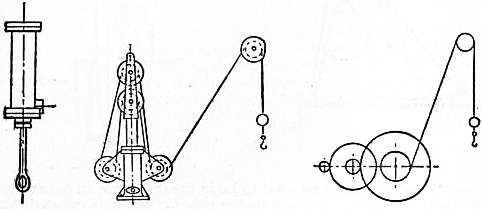
Fig. 1. Fig. 2. Fig. 3.
The principal motion in a crane is naturally the hoisting or lifting motion. This is effected by slinging the load to an eye or hook, and elevating the hook vertically. There are three typical methods: (1) A direct pull may be applied to Lifting mechanisms. the hook, either by screws, or by a cylinder fitted with piston and rod and actuated by direct hydraulic or other pressure, as shown diagrammatically in fig. 1. These methods are used in exceptional cases, but present the obvious difficulty of giving a very short range of lift. (2) The hook may be attached to a rope or chain, and the pulling cylinder connected with a system of pulleys around which the rope is led; by these means the lift can be very largely increased. Various arrangements are adopted; the one indicated in fig. 2 gives a lift of load four times the stroke of the cylinder. This second method forms the basis of the lifting gear in all hydraulic cranes. (3) The lifting rope or chain is led over pulley to a lifting barrel, upon which it is coiled as the barrel is rotated by the source of power (fig. 3). Sometimes, especially in the case of overhead travelling cranes for very heavy loads, the chain is a special pitch chain, formed of flat links pinned together, and the barrel is reduced to a wheel provided with teeth, or “sprockets,” which engage in the links. In this case the chain is not coiled, but simply passes over the lifting wheel, the free end hanging loose. All the methods in this third category require a rotating lifting or barrel shaft, and this is the important difference between them and the hydraulic cranes mentioned above. Cranes fitted with rotating hydraulic engines may be considered as coming under the third category.
When the loads are heavy the above mechanisms are supplemented by systems of purchase blocks suspended from the jib or the traveller crab; and in barrel cranes trains of rotating gearing are interposed between the motor, or manual handle, and the barrel (fig. 3).
When a load is lifted, work has to be done in overcoming the action of gravity and the friction of the mechanism; when it is lowered, energy is given out. To control the speed and absorb this energy, brakes have to be provided. The Brakes. hydraulic crane has a great advantage in possessing an almost ideal brake, for by simply throttling the exhaust from the lifting cylinder the speed of descent can be regulated within very wide limits and with perfect safety. Barrel cranes are usually fitted with band brakes, consisting of a brake rim with a friction band placed round it, the band being tightened as required. In ordinary cases conduction and convection suffice to dissipate the heat generated by the brake, but when a great deal of lowering has to be rapidly performed, or heavy loads have to be lowered to a great depth, special arrangements have to be provided. An excellent brake for very large cranes is Matthew’s hydraulic brake, in which water is passed from end to end of cylinders fitted with reciprocating pistons, cooling jackets being provided. In electric cranes a useful method is to arrange the connexions so that the lifting motor acts as a dynamo, and, driven by the energy of the falling load, generates a current which is converted into heat by being passed through resistances. That the quantity of heat to be got rid of may become very considerable is seen when it is considered that the energy of a load of 60 tons descending through 50 ft. is equivalent to an amount of heat sufficient to raise nearly 6 gallons of water from 60° F. to boiling point. Crane brakes are usually under the direct control of the driver, and they are generally arranged in one of two ways. In the first, the pressure is applied by a handle or treadle, and is removed by a spring or weight; this is called “braking on.” In the second, or “braking off” method, the brake is automatically applied by a spring or weight, and is released either mechanically or, in the case of electric cranes, by the pull of a solenoid or magnet which is energized by the current passing through the motor. When the motor starts the brake is released; when it stops, or the current ceases, the brake goes on. The first method is in general use for steam cranes; it allows for a far greater range of power in the brake, but is not automatic, as is the second.
In free-barrel cranes the lifting barrel is connected to the revolving shaft by a powerful friction clutch; this, when interlocked with the brake and controller, renders electric cranes exceedingly rapid in working, as the barrel can be detached and lowering performed at a very high speed, without waiting for the lifting motor to come to rest in order to be reversed. This method of working is very suitable for electric dock-side cranes of capacities up to about 5 or 7 tons, and for overhead travellers where the height of lift is moderate. Where high speed lowering is not required it is usual to employ a reversing motor and keep it always in gear.
In steam cranes it is usual to work all the motions from one double cylinder engine. In order to enable two or more motions to be worked together, or independently as required, reversing friction cones are used for the subsidiary motions, especially the slewing motion. With the exception of a few special cranes in which friction wheels are employed, it is universally the practice, in steam cranes, to connect the engine shaft with the barrel shaft by spur toothed gearing, the gear being connected or disconnected by sliding pinions. In electric cranes the motor is connected to the barrel, either in a similar manner by spur gear or by worm gear. The toothed wheels give a slightly better efficiency, but the worm gear is somewhat smoother in its action and entirely silent; the noise of gearing can, however, be considerably reduced by careful machining of the teeth, as is now always done, and also by the use of pinions made of rawhide leather or other non-resonant material. When quick-running metal pinions are used they are arranged to run in closed oil-baths. Leather pinions must be protected from rats, which eat them freely. Worm wheel gearing is of very high efficiency if made very quick in pitch, with properly formed teeth perfectly lubricated, and with the end thrust of the worm taken on ball bearings. Much attention has been paid to the improvement of the mechanical details of the lifting and other motions of cranes, and in important installations the gearing is now usually made of cast steel. In revolving cranes ease of slewing can be greatly increased by the use of a live ring of conical rollers.
Electric motors for barrel cranes are not essentially different from those used for other purposes, but in proportioning the sizes the intermittent output has to be taken into consideration. This fact has led to the introduction of the “crane rated” Power required. motor, with a given “load factor.” This latter gives the ratio of the length of the working periods to the whole time; e.g. a motor rated for a quarter load factor means that the motor is capable of exerting its full normal horse-power for three minutes out of every twelve, the pause being nine minutes, or one minute out of every four, the pause being three minutes. The actual load factor to be chosen depends on the nature of the work and the kind of crane. A dock-side crane unloading cargo with high lifts following one another in rapid succession will require a higher load factor than a workshop traveller with a very short lift and only a very occasional maximum load; and a traveller with a very long longitudinal travel will require a higher load factor for the travelling motor than for the lifting motor. In practice, the load factor for electric crane motors varies from 1⁄3 to 1⁄6. In steam cranes much the same principle obtains in proportioning the boiler; e.g. the engines of a 10-ton steam crane have cylinders capable of indicating about 60 horse-power when working at full speed, but it is found that, in consequence of the intermittent working, sufficient steam can be supplied with a boiler whose heating surface is only 1⁄3 to ¼ of that necessary for the above power, when developed continuously by a stationary engine.
In well-designed, quick-running cranes the mechanical efficiency of the lifting gear may be taken as about 85%; a good electric jib crane will give an efficiency of 72%, i.e. when actually lifting at full speed the mechanical work of lifting represents about 72% of the electric energy put into the lifting motor. A very convenient rule is to allow one brake horse-power of motor for every 10 foot-tons of work done at the hook: this is equivalent to an efficiency of 662⁄3%, and is well on the safe side.
The motor in most common use for electric cranes is the series wound, continuous current motor, which has many advantages. It has a very large starting torque, which enables it to overcome the inertia of getting the load into motion, and it lifts heavy loads at a slower speed and lighter loads at a quicker one, behaving, under the action of the controller in a somewhat similar manner to that in which the cylinders of the steam crane respond to the action of the stop-valve. Three-phase motors are also much used for crane-driving, and it is probable that improvements in single and two-phase motors will eventually largely increase their use for this class of work.
Tests of the comparative efficiencies of hydraulic and electric cranes tend to show that, although they do not vary to any very considerable extent with full load, yet the efficiency of the hydraulic crane falls away very much more rapidly than that of the electric crane when working on smaller loads. This drawback can be corrected to a slight extent by furnishing the hydraulic crane with more than one cylinder, and thus compounding it, but the arrangement does not give the same economical range of load as in an electric crane. In first cost the hydraulic crane has the advantage, but the power mains are much less expensive and more convenient to arrange in the electric crane.
The limit of speed of lift of hand cranes has already been mentioned; for steam jib cranes average practice is represented by the formula V = 30 + 200/T, where V is the speed of lift in feet per minute, and T the load in tons. Where electric Speed. or hydraulic cranes are worked from a central station the speed is greater, and may be roughly represented by V = 5 + 300/T; e.g. a 30-cwt. crane would lift with a speed of about 200 ft. per minute, and 100-ton crane with a speed of about 8 ft. per minute, but these speeds vary with local circumstances. The lifting speed of electric travellers is generally less, because the lift is generally much shorter, and may in ordinary cases be taken as V = 3 + 85/T. The cross-traversing speed of travellers varies from 60 to 120 ft. per minute, and the longitudinal from 100 to 300 ft. per minute. The speed of these two motions depends much on the length of the span and of the longitudinal run, and on the nature of the work to be done; in certain cases, e.g. foundries, it is desirable to be able to lift, on occasions, at an extremely slow speed. In addition to the brakes on the lifting gear of cranes it is found necessary, especially in quick-running electric cranes, to provide a brake on the subsidiary motions, and also devices to stop the motor at the end of the lift or travel, so as to prevent over-running.
There are many other important points of crane construction too numerous to mention here, but it may be said generally that the advent of electricity has tended to increase speeds, and in consequence great attention is paid to all details that reduce friction and wear, such as roller and ball bearings and improved methods of lubrication; and, as in all other quick-running machinery, great stress has to be laid on accuracy of workmanship. The machinery, thus being of a higher class, requires more protection, and cranes that work in the open are now fitted with elaborate crane-houses or cabins, furnished with weather-tight doors and windows, and more care is taken to provide proper platforms, hand-rails and ladders of access, and also guards for the revolving parts of gearing.
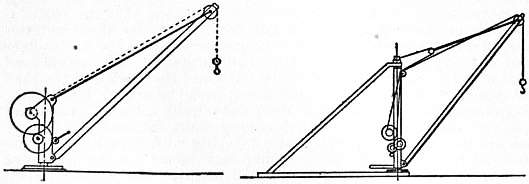
Fig. 4. Fig. 5.
Typical Forms of Cranes.—Fig. 4 is a diagram of a fixed hand revolving jib crane, of moderate size, as used in railway goods yards and similar places. It consists of a heavy base, which is securely bolted to the foundation, and which carries the Fixed Cranes. strong crane-post, or pillar, around which the crane revolves. The revolving part is made with two side frames of cast iron or steel plates, and to these the lifting gear is attached. The load is suspended from the crane jib; this jib is attached at the lower end to the side frames, and the upper end is supported by tie-rods, connected to the framework, the whole revolving together. This simple form of crane thus embodies the essential elements of foundation, post, framework, jib, tie-rods and gearing.
Fig. 5 shows another type of fixed crane, known as a derrick crane. Here the crane-post is extended into a long mast and is furnished with pivots at the top and bottom; the mast is supported by two “back ties,” and these are connected to the socket of the bottom pivot by the “sleepers.” This is a very good and comparatively cheap form of crane, where a long and variable radius is required, but it cannot slew through a complete circle. Derrick cranes are made of all powers, from the timber 1-ton hand derrick to the steel 150-ton derrick used in shipbuilding yards. The derrick crane introduces a problem for which many solutions have been sought, that of preventing the load from being lifted or lowered when the jib is pivoted up or down to alter the radius. To keep the load level, there are various devices for automatically coupling the jib-raising and the load-lowering motions.
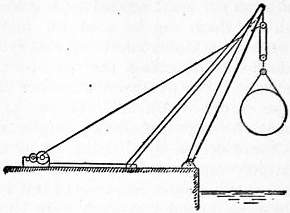
Fig. 6.
Somewhat allied to the derrick are the sheer legs (fig. 6). Here the place of the jib is taken by two inclined legs joined together at the top and pivoted at the bottom; a third back-leg is connected at the top to the other two, and at the bottom is coupled to a nut which runs on a long horizontal screw. This horizontal movement of the lower end of the back leg allows the whole arrangement to assume the position shown in fig. 7, so that a load can be taken out of a vessel and deposited on a quay wall. The same effect can be produced by shortening the back leg by a screw placed in the direction of its length. Sheer legs are generally built in very large sizes, and their use is practically confined to marine work.
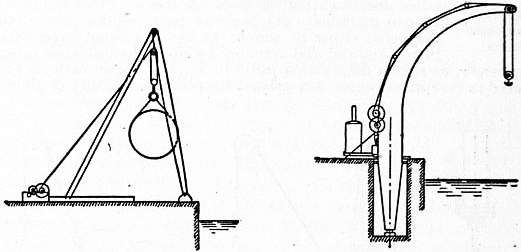
Fig. 7. Fig. 8.
Another type of fixed crane is the “Fairbairn” crane, shown in fig. 8. Here the jib, superstructure and post are all united in one piece, which revolves in a foundation well, being supported at the bottom by a toe-step and near the ground level by horizontal rollers. This type of crane used to be in great favour, in consequence of the great clearance it gives under the jib, but it is expensive and requires very heavy foundations.
The so-called “hammer-headed” crane (fig. 9) consists of a steel braced tower, on which revolves a large horizontal double cantilever; the forward part of this cantilever or jib carries the lifting crab, and the jib is extended backwards in order to form a support for the machinery and counter-balance. Besides the motions of lifting and revolving, there is provided a so-called “racking” motion, by which the lifting crab, with the load suspended, can be moved in and out along the jib without altering the level of the load. Such horizontal movement of the load is a marked feature of later crane design; it first became prominent in the so-called “Titan” cranes, mentioned below (fig. 14). Hammer-headed cranes are generally constructed in large sizes, up to 200 tons.
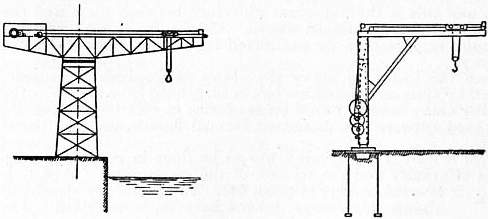
Fig. 9. Fig. 10.
Another type of fixed revolving crane is the foundry or smithy crane (fig. 10). It has the horizontal racking motion mentioned above, and revolves either on upper and lower pivots supported by the structure of the workshop, or on a fixed pillar secured to a heavy foundation. The type is often used in foundries, or to serve heavy hammers in a smithy, whence the name.
Portable cranes are of many kinds. Obviously, nearly every kind of crane can be made portable by mounting it on a carriage, fitted with wheels; it is even not unusual to make the Portable cranes. Scottish derrick portable by using three trucks, one under the mast, and the others under the two back legs.
Fig. 11 represents a portable steam jib crane; it contains the same elements as the fixed crane (fig. 4), but the foundation bed is mounted on a truck which is carried on railway or road wheels. With portable cranes means must be provided to ensure the requisite stability against overturning; this is done by weighting the tail of the revolving part with heavy weights, and in steam cranes the boiler is so placed as also to form part of the counterbalance. Where the rail-gauge is narrow and great weight is not desired, blocking girders are provided across the under side of the truck; these are arranged so that, by means of wedges or screws, they can be made to increase the base. In connexion with the stability of portable cranes, it may be mentioned that accidents more often arise from overturning backwards than forwards. In the latter case the overturning tendency begins as soon as the load leaves the ground, but ceases as soon as the load again touches the ground and thus relieves the crane of the extra weight, whereas overturning backwards is caused either by the reaction of a chain breaking or by excessive counterweight. When portable cranes are fitted with springs and axle-boxes, drawgear and buffers, so that they can be coupled to an ordinary railway train, they are called “breakdown” or “wrecking” cranes.
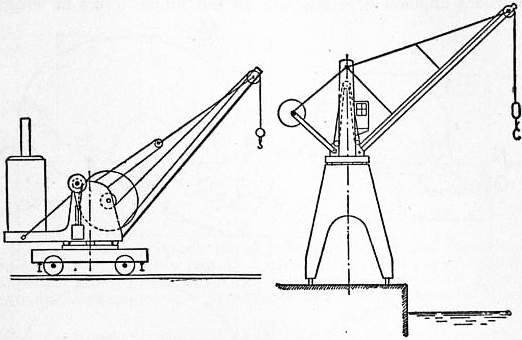
Fig. 11. Fig. 12.
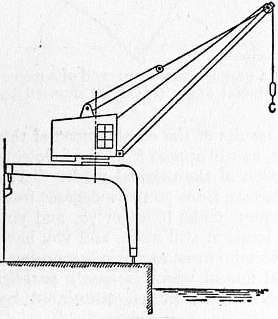
Fig. 13.
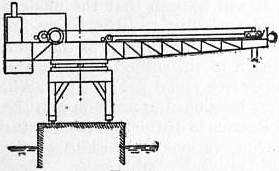
Fig. 14.
Dock-side jib cranes for working general cargo are almost always made portable, in order to enable them to be placed in correct position in regard to the hatchways of the vessels which they serve. Fig. 12 shows an ordinary hydraulic dock-side jib crane. This type is usually fitted with a very high jib, so as to lift goods in and out of high-sided vessels. The hydraulic lifting cylinders are placed inside the revolving steel mast or post, and the cabin for the driver is arranged high up in the front of the post, so as to give a good view of the work. The pressure is conveyed to the crane by means of jointed “walking” pipes, or flexible hose, connected to hydrants placed at regular intervals along the quay. It is often very desirable to have the quay space as little obstructed by the cranes as possible, so as not to interfere with railway traffic; this has led to the introduction of cranes mounted on high trucks or gantries, sometimes also called “portal” cranes. Where warehouses or station buildings run parallel to the quay line, the high truck is often extended, so as to span the whole quay; on one side the “long leg” runs on a rail at the quay edge, and on the other the “short leg” runs on a runway placed on the building. Cranes of this type are called “half-portal” cranes. Fig. 13 shows an electric crane of this class. They give the minimum of interference with quay space and have rapidly come into favour. Where the face of the warehouse is sufficiently close to the water to permit of the crane rope plumbing the hatches without requiring a jib of excessive radius, it is a very convenient plan to place the whole crane on the warehouse roof.
A special form of jib crane, designed to meet a particular purpose, is the “Titan” (fig. 14) largely used in the construction of piers and breakwaters. It contains all the essential elements of the hammer-headed crane, of which it may be considered to be the parent; in fact, the only essential difference is that the Titan is portable and the hammer-head crane fixed. The Titan was the first type of large portable crane in which full use was made of a truly horizontal movement of the load; for the purpose for which the type is designed, viz. setting concrete blocks in courses, this motion is almost a necessity.
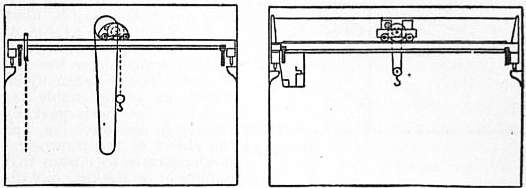
Fig. 15. Fig. 16.
As types of non-revolving cranes, fig. 15 shows an overhead traveller worked by hand, and fig. 16 a somewhat similar machine worked by electric power. The principal component parts of a traveller are the main cross girders forming the Non-revolving cranes. bridge, the two end carriages on which the bridge rests, the running wheels which enable the end carriages to travel on the longitudinal gantry girders or runway, and the crab or jenny, which carries the hoisting mechanism, and moves across the span on rails placed on the bridge girders. There are numerous and important variations of these two types, but the above contain the elements out of which most cranes of the class are built.
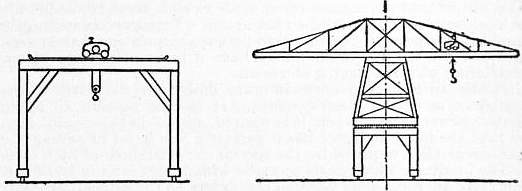
Fig. 17. Fig. 18.
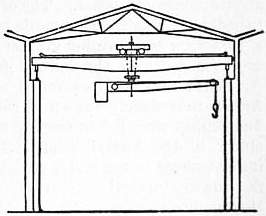
Fig. 19.
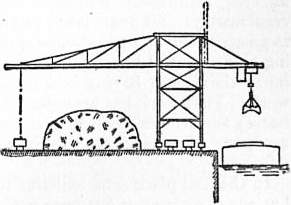
Fig. 20.
One variation is illustrated in fig. 17, and is called a “Goliath” or “Wellington.” It is practically a traveller mounted on high legs, so as to permit of its being travelled on rails placed on the ground level, instead of on an elevated gantry. Of other variations and combinations of types, fig. 18 shows a modern design of crane intended to command the maximum of yard space, and having some of the characteristics both of the Goliath and of the revolving jib crane, and fig. 19 depicts a combination of a traveller and a hanging jib crane.
When the cross traverse motion of a traveller crab is suppressed, and the longitudinal travelling motion is increased in importance we come to a type of crane, the use of which is rapidly increasing; it goes by the name of “transporter.” Transporters can only move the load to any point on a vertical Transporters. surface (generally a plane surface); they have a lifting motion and a movement of translation. They are of two kinds: (1) those in which the motive power and lifting gear are self-contained on the crab; and (2) those in which the motive power is placed in a fixed position. A transporter of the first class is shown in fig. 20. From the lower flange of a suspended runway, made of a single I section, run wheels, from the axles of which the transporter is suspended. The latter consists of a framework carrying the hoisting barrel, with its driving motor and gearing, and a travelling motor, which is geared to the running wheels in such a manner as to be able to propel the whole machine; a seat is provided for the driver who manipulates the controllers. A transporter of this kind, when fitted with a grab, is a very efficient machine for taking coal from barges and depositing it in a coal store.
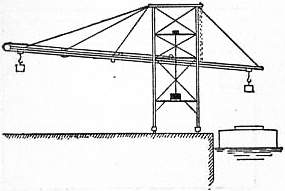
Fig. 21.
In the other class of transporter the load is not usually moved through such long distances. It consists essentially of a jib made of single I-sections, and supported by tie-rods (fig. 21), the load to be lifted being suspended from a small travelling carriage which runs on the lower flange. The lifting gear is located in any convenient fixed position. In order that only one motor may be used, and also that the load may be lifted by a single part of rope, various devices have been invented. The jib is usually inclined, so as to enable the travel to be performed by gravity in one direction, and the object of the transporter mechanism is to ensure that pulling in or slacking out the lifting rope shall perform the cycle of operations in the following order:—Supposing the load is ready to be lifted out of a vessel on to a quay, the pull of the lifting rope raises the load, the travelling jenny being meanwhile locked in position. On arriving at a certain height the lift ceases and the jenny is released, and by the continued pull of the rope, it runs up the jib; on arriving at an adjustable stop, the jenny is again locked, and the load can be lowered out; the hook can then be raised, when the jenny is automatically unlocked, and on paying out the rope the jenny gravitates to its first position, when the load is lowered and the cycle repeated. The jibs of transporters are often made to slide forward, or lift up, so as to be out of the way when not in use. Transporters are largely used for dealing with general cargo between vessels and warehouses, and also for coaling vessels; they have a great advantage in not interfering with the rigging of vessels.
Nearly all recent advances in crane design are the result of the introduction of the electric motor. It is now possible to apply motive power exactly where it is wanted, and to do so economically, so that the crane designer has a perfectly free hand in adding the various motions required by the special circumstances of each case.
The literature which deals specially with cranes is not a large one, but there are some good German text-books on the subject, amongst which may be mentioned Die Hebezeuge by Ernst (4th ed., Berlin, 1903), and Cranes, by Anton Böttcher, translated with additions by A. Tolhausen (London, 1908).
(W. P.*)
CRANIOMETRY. The application of precise methods of measurement marks a definite phase in the development of most branches of modern science, and thus craniometry, a comprehensive expression for all methods of measuring the skull (cranium), provides a striking landmark in the progress of anthropological studies. The origin of craniometry appears to be twofold. Certain artists made measurements of heads and skulls with a view to attaining greater accuracy in their representation of those parts of the human frame. Bernard de Palissy and A. Dürer may be mentioned as pioneers in such researches. Again, it is clearly shown in the literature of this subject, that anatomists were led to employ methods of measurement in their study of the human skull. The determining cause of this improvement in method is curious, for it appeared at the end of a famous anatomical controversy of the later middle ages, namely the dispute as to whether the Galenic anatomy was based on the study of the human body or upon those of apes. In the description of the dissection of a chimpanzee (in 1680) Tyson explains that the measurements he made of the skull of that animal were devised with a view to exhibiting the difference between this and the human skull.
The artists did not carry their researches very far. The anatomists on the contrary continued to make measurements, and in 1764 Daubenton published a noteworthy contribution to craniometry. Six years later, Pieter Camper, distinguished both as an artist and as an anatomist, published some lectures containing an account of his craniometrical methods, and these may be fairly claimed as having laid the foundation of all subsequent work. That work has been described above as anthropological, but as the studies thus defined are very varied in extent, it is necessary to consider the subdivisions into which they naturally fall.
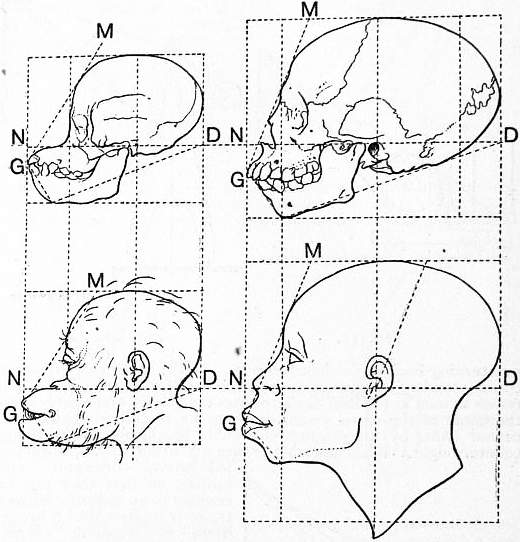
Fig. 1.—The Skull and head of a young orang-utan, and of a negro, showing the lines including the facial angle (MGND) devised by Pieter Camper.
In the first place (and omitting further reference to the contributions of artists), it has been explained that the measurements were first made with a view to elucidating the comparison of the skulls of men with those of other animals. This wide comparison constitutes the first subdivision of craniometric studies. And craniometric methods have rendered the results of comparison much more clear and comprehensible than was formerly the case. It is further remarkable that among the first measurements employed angular determinations occur, and indeed the name of Camper is chiefly perpetuated in anthropological literature by the “facial angle” invented by that artist-anatomist (fig. 1). It appears impossible to improve on the simple terms in which Camper describes the general results of the employment of this angle for comparative purposes, as will appear from the following brief extract from the translation of the original work: “The two extremities of the facial line are from 70 to 80 degrees from the negro to the Grecian antique: make it under 70, and you describe an ourang or an ape: lessen it still more, and you have the head of a dog. Increase the minimum, and you form a fowl, a snipe for example, the facial line of which is nearly parallel with the horizon.” (Camper’s Works, p. 42, translated by Cogan, 1821.)
In the 19th century the names of notable contributors to the literature of craniometry quickly increase in number; while it is impossible to analyse each contribution, or even record a complete list of the names of the authors, it must be added that for the purposes of far-reaching comparisons of the lower animals with mankind, craniometric methods were used by P. P. Broca in France and by T. H. Huxley (figs. 2 and 3) in England, with such genius and success as have not yet been surpassed.
The second division of craniometric studies includes those in which the skulls of the higher and lower races of mankind are compared. And in this domain, the advent of accurate numerical methods of recording observations brought about great advances. In describing the facial angle, it will be seen that the modern European, the Greek of classical antiquity and the Negro are compared. Thus it is that Camper’s name appears as that of a pioneer in this second main division of the subject. Broca and Huxley cultivated similar comparative racial fields of research, but to these names that of Anders Retzius of Stockholm must be added here. The chief claim of Retzius to distinction rests on the merits of his system of comparing various dimensions of the skull, and of a classification based on such comparisons. These indices will be further defined below. It is convenient to mention here that the first aim of all these investigators was to obtain from the skull reliable data having reference to the conformation or size of the brain once contained within it. Only in later days did the tendency to overlook this, the fundamental aim and end of craniometry, make its appearance; such nevertheless was the case, much to the detriment of craniometric science, which for a time seems to have become purely empirical.
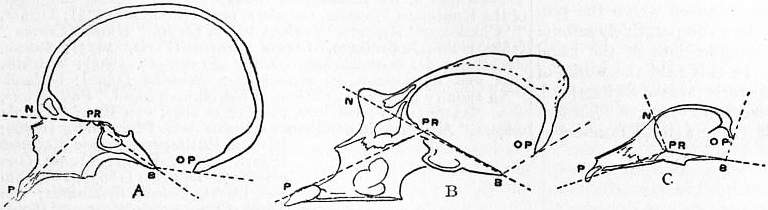
Fig. 2.—The spheno-ethmoidal, spheno-maxillary and foramino-basal angles are shown in the crania of:—A, a New Britain native (male); B, a gorilla (male) C, a dog. N.Pr.B, Spheno- ethmoidal angle; P.Pr.B, Spheno-maxillary angle; Pr.B.Op, Foramino-basal angle. The spheno- ethmoidal and spheno-maxillary angles were first employed by Huxley.
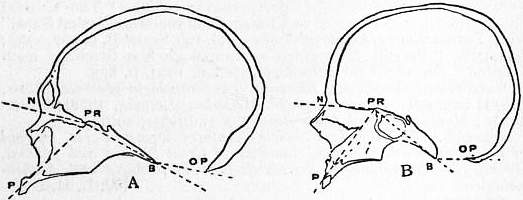
Fig. 3.—The spheno-ethmoidal, spheno-maxillary and foramino-basal angles are shown in the crania of:—A, a New Guinea native (male); B, a European woman. N.Pr.B, Spheno-ethmoidal angle; P.Pr.B, Spheno-maxillary angle; Pr.B.Op, Foramina-basal angle.
The third subdivision of craniometric researches is one in which the field of comparison is still further narrowed. For herein the various sub-racial types such as the dark and fair Europeans are brought together for the purposes of comparison or contrast. But although the range of research is thus narrowed and restricted, the guiding principles and the methods remain unchanged. In this department of craniometry, Anders Retzius has gained the foremost place among the pioneers of research. Retzius’s name is, as already mentioned, associated not with any particular angle or angular measurement, but rather with a method of expressing as a formula two cranial dimensions which have been measured and which are to be compared. Thus for instance one skull may be so proportioned that its greatest width measures 75% of its greatest length (i.e. its width is to its length as three to four).
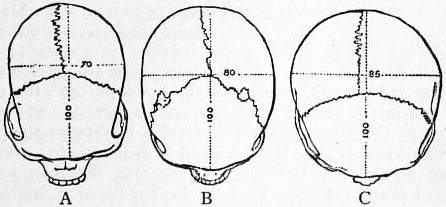
From Tylor's Anthropology, by permission of Macmillan & Co., Ltd.
Fig. 4.—Top view of skulls. (A) Negro, index 70, dolichocephalic; (B) European, index 80, mesaticephalic; (C) Samoyed, index 85, brachycephalic.
This ratio (of 75%) is termed the cephalic or breadth-index, which in such an instance would be described as equal to 75. A skull providing a breadth-index of 75 will naturally possess very different proportions from another which provides a corresponding index equal to 85. And in fact this particular index in human skulls varies from about 58 to 90 in undistorted examples (fig. 4). Such is the general scheme of Retzius’s system of classification of skulls by means of indices, and one of his earliest applications of the method was to the inhabitants of Sweden. One striking result was to exhibit a most marked contrast in respect of the breadth-index of the skull, between the Lapps and their Scandinavian neighbours, and thus a craniometric difference was added to the list of characters (such as stature, hair-colour and complexion) whereby these two types were already distinguished. Since the publication of Retzius’s studies, the cephalic or breadth-index of the skull has retained a premier position among its almost innumerable successors, though it is of historical interest to note that, while Retzius had undoubtedly devised the method of comparing “breadth-indices,” he always qualified the results of its use by reference to other data. These qualifications were overlooked by the immediate successors of Retzius, much to the disadvantage of craniometry. In addition to the researches on the skull forms of Lapps and Swedes, others dealing with the comparison of Finns and Swedes (by Retzius) as well as the investigation of the form of skull in Basques and Guanches (by Broca) possess historic interest.
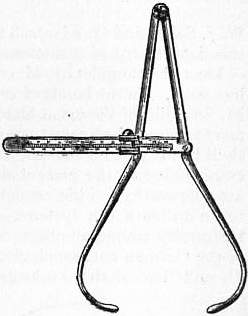
Fig. 5.—Callipers used in Craniometry, Professor Martin’s (P. Hermann, Zürich) model.
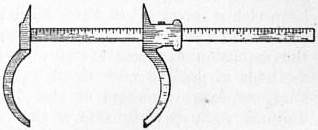
Fig. 6.—Flower’s Craniometer as modified by Dr W. L. H. Duckworth.
Thus far little or nothing has been said with regard to instruments. Camper devised a four-sided open frame with cross-wires, through which skulls were viewed and by means of which accurate drawings could be projected on to paper. The methods of Retzius as here described require the aid of callipers of various sorts, and such instruments were quickly devised and applied to the special needs of the case. Such instruments are still in use, and two forms of simple craniometer are shown in the accompanying illustrations (figs. 5 and 6). For the more accurate comparison required in the study of various European types, delicate instruments for measuring angles were invented by Anthelme in Paris (1836) and John Grattan in Belfast (1853). These instruments enabled the observer to transmit to the plane surface of a sheet of drawing paper a correct tracing of the contour of the specimen under investigation. A further modification was devised by the talented Dr Busk in the year 1861, and since that date the number and forms of these instruments have been greatly multiplied. With reference to contributors to the advance of knowledge in this particular department of craniometry, there should be added to the foregoing names those of Huxley, Sir W. H. Flower and Sir W. Turner in England, J. L. A. de Quatrefages in France, J. C. G. Lucae and H. Welcker in Germany. Moreover, the methods have also been multiplied, so that in addition to angular and linear measurements, those of the capacity or cubical contents of the cranium and those of the curvature of its surface demand reference. The masterly work of Cleland claims special mention in this connexion. And finally while two dimensions are combined in the cephalic index of Retzius, the combination of three dimensions (in a formula called a modulus) distinguishes some recent work, although the employment of the modulus is actually a return to a system devised in 1859 by Karl E. von Baer.
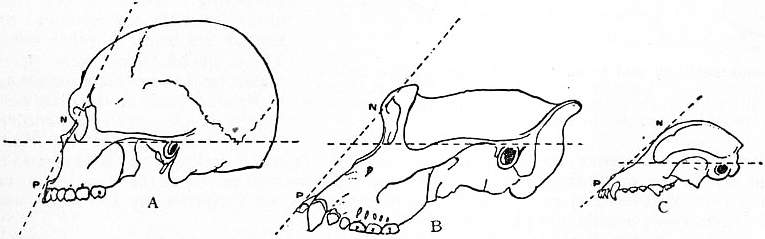
Fig. 7.—The facial angle of the Frankfort Agreement is shown in the crania of:—A, a New Britain native (male) 62°; B, a gorilla (male) 50°; C, a dog 42°. This angle has now replaced the facial angle of Camper (cf. fig. 1).
The fourth subdivision of craniometry is closely allied to that which has just been described, and it deals with the comparison of the prehistoric and the recent types of mankind. The methods are exactly similar to those employed in the comparison of living races; but in some particular instances where the prehistoric individual is represented only by a comparatively minute portion of the skull, some special modifications of the usual procedures have been necessitated. In this field the works of W. His and L. Rütimeyer on the prehistoric races of Switzerland, those of Ecker (South Germany), of Broca in France, of Thurnam and Davis in England, must be cited. G. Schwalbe, Kramberger, W. J. Sollas and H. Klaatsch are the most recent contributors to this department of craniometry.
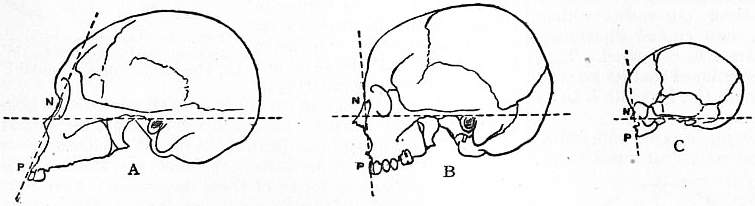
Fig. 8.—The facial angle of the Frankfort Agreement is shown in the crania of:—A, a Guinea native (male) 75°; B, a European (woman) 93°; C, a new-born infant (93°).
Thus the complexity of craniometric studies has inevitably increased. In the hands of von Török of Budapest, as in those of M. Benedikt of Vienna at an earlier date, the number of measurements regarded as necessary for the complete “diagnosis” of a skull has reached a colossal total. Of the trend and progress of craniometry at the present day, three particular developments are noteworthy. First come the attempts made at various times to co-ordinate the systems of measurements so as to ensure uniformity among all observers; of these attempts two, viz. that of the German anthropologists at Frankfort in 1882 (figs. 7 and 8), and that of the Anthropometric Committee of the British Association (1906) seem to require at least a record. In the second place, the application of the methods of statistical science in dealing with large numbers of craniometric data has been richly rewarded in Prof. Karl Pearson’s hands. Thirdly, and in connexion with such methods, there may be mentioned the extension of these systems of measurement, and of the methods of dealing with them on statistical principles, to the study of large numbers of the skulls of domestic and feral animals, such as white rats or the varieties of the horse. And lastly no account of craniometry would be complete without mention of the revolt, headed by the Italian anthropologist Sergi, against metrical methods of all kinds. It cannot, however, be alleged that the substitutes offered by the adherents of Sergi’s principles encourage others to forsake the more orthodox numerical methods.
Literature.—Tyson, The Anatomy of a Pygmie (London, 1699); Daubenton, “Sur la différence de la situation du tron occipital dans l’homme et dans les animaux,” Comptes rendus de l’académie des sciences (Paris, 1764); Camper, Works (1770, translated by Cogan, 1821); Broca, Mémoires (1862 and following years); Huxley, Journal of Anatomy and Physiology, vol. 1 (1867); Retzius, Über die Schädelformen der Nordbewohner (Stockholm, 1842); Anthelme, Physiologie de la pensée (Paris, 1836); Grattan, Ulster Journal of Archaeology, vol. 1 (1853); Busk, “A System of Craniometry,” Transactions of the Ethnological Society (1861); Flower, Catalogue of the Hunterian Museum, Osteology, part 1 (London, 1879); Turner, “’Challenger’ Reports,” Zoology, vol. x. pt. 29, “Human Crania” (1884); de Quatrefages, Crania ethnica (Paris, 1873); Lucae, Architectur des menschlichen Schädels (Frankfort, 1855); Welcker, Bau und Wachsthum des menschlichen Schädels (1862); Cleland, “An Inquiry into the Variations of the Human Skull,” Phil. Trans. Roy. Society (1870), vol. 160, pp. 117 et seq.; von Baer, “Crania selecta,” Académie impériale des sciences de S. Pétersbourg (1859); His and Rütimeyer, Crania Helvetica (Basel, 1866); Ecker, Crania Germaniae meridionalis (1865); Thurnam and Davis, Crania Britannica; von Török, Craniometrie (Stuttgart, 1890); Benedikt, Manuel technique et pratique d’anthropométrie cranio-céphalique (Paris, 1889); Pearson, Biometrika, from vol. 1 (in 1902) onwards; Sergi, “The Varieties of the Human Species,” English translation, Smithsonian Institution (Washington, 1894); Schwalbe, “Der Neanderthalschädel,” Bonner Jahrbücher, Heft 106; also Sonderheft der Zeitschrift für Morphologie und Anthropologie; Kramberger, Der paläolithische Mensch von Krapina (Nägele, Stuttgart, 1901); Sollas, “The Cranial Characters of the Neanderthal Race,” Phil. Transactions of the Royal Society, vol. 199, Series B, p. 298, 1908; Klaatsch, “Bericht über einen anthropologischen Streifzug nach London,” Zeitschrift für Ethnologie, Heft 6, 1903, p. 875.
Handbooks.—Topinard, Éléments d’anthropologie générale (Paris, 1885); Schmidt, Anthropologische Methoden (Leipzig, 1888); Duckworth, Morphology and Anthropology (Cambridge, 1904).
Journals.—Bulletins de la Société d’Anthropologie de Paris, Journal of the Royal Anthropological Institute of Great Britain and Ireland, Archiv für Anthropologie, Zeitschrift für Morphologie und Anthropologie.
(W. L. H. D.)
CRANK, a word of somewhat obscure etymology, probably connected with a root meaning “crooked,” and appearing in the Ger. krank, ill, a figurative use of the original word; among other words in English containing the same original meaning are “cringe” and “crinkle.” In mechanics, a crank is a device by which reciprocating motion is converted into circular motion or vice versa, consisting of a crank-arm, one end of which is fastened rigidly at right angles to the rotating shaft or axis, while the other end bears a crank-pin, projecting from it at right angles and parallel to the shaft. When the reciprocating part of a machine, as the piston and piston-rod of a steam engine, is linked to this crank by a crank-rod or connecting rod, one end of which works on the crank-pin and the other on a pin in the end of the reciprocating part, the to-and-fro motion of the latter imparts a circular motion to the shaft and vice versa. The crank, instead of being made up as described above, may be formed by bending the shaft to the required shape, as sometimes in the handle of a winch. A bell-crank, so called because of its use in bell-hanging to change the direction of motion of the wires from horizontal to vertical or vice versa, consists of two arms rigidly connected at an angle, say of 90°, to each other and pivoted on a pin placed at the point of junction.
Crank is also the name given to a labour machine used in prisons as a means of punishment (see Tread-mill). Other uses of the word, connected with the primary meaning, are for a crooked path, a crevice or chink; and a freakish turn of thought or speech, as in Milton’s phrase “quips and cranks.” It is also used as a slang expression, American in origin, for a harmless lunatic, or a faddist, whose enthusiasm for some one idea or hobby becomes a monomania. “Crank” or “crank-sided” is a nautical term used of a ship which by reason of her build or from want of balance is liable to overturn. This strictly nautical sense is often confused with “crank” or “cranky,” that is, rickety or shaky, probably derived direct from the German krank, weak or ill.
CRANMER, THOMAS (1489-1556), archbishop of Canterbury, born at Aslacton or Aslockton in Nottinghamshire on the 2nd of July 1489, was the second son of Thomas Cranmer and of his wife Anne Hatfield. He received his early education, according to Morice his secretary, from “a marvellous severe and cruel schoolmaster,” whose discipline must have been severe indeed to deserve this special mention in an age when no schoolmaster bore the rod in vain. The same authority tells us that he was initiated by his father in those field sports, such as hunting and hawking, which formed one of his recreations in after life. To early training he also owed the skilful horsemanship for which he was conspicuous. At the age of fourteen he was sent by his mother, who had in 1501 become a widow, to Cambridge. Little is known with certainty of his university career beyond the facts that he became a fellow of Jesus College in 1510 or 1511, that he had soon after to vacate his fellowship, owing to his marriage to “Black Joan,” a relative of the landlady of the Dolphin Inn, and that he was reinstated in it on the death of his wife, which occurred in childbirth before the lapse of the year of grace allowed by the statutes. During the brief period of his married life he held the appointment of lecturer at Buckingham Hall, now Magdalene College. The fact of his marrying would seem to show that he did not at the time intend to enter the church; possibly the death of his wife caused him to qualify for holy orders. He was ordained in 1523, and soon after he took his doctor’s degree in divinity. According to Strype, he was invited about this time to become a fellow of the college founded by Cardinal Wolsey at Oxford; but Dean Hook shows that there is some reason to doubt this. If the offer was made, it was declined, and Cranmer continued at Cambridge filling the offices of lecturer in divinity at his own college and of public examiner in divinity to the university. It is interesting, in view of his later efforts to spread the knowledge of the Bible among the people, to know that in the capacity of examiner he insisted on a thorough acquaintance with the Holy Scriptures, and rejected several candidates who were deficient in this qualification.
It was a somewhat curious concurrence of circumstances that transferred Cranmer, almost at one step, from the quiet seclusion of the university to the din and bustle of the court. In August 1529 the plague known as the sweating sickness, which prevailed throughout the country, was specially severe at Cambridge, and all who had it in their power forsook the town for the country. Cranmer went with two of his pupils named Cressy, related to him through their mother, to their father’s house at Waltham in Essex. The king (Henry VIII.) happened at the time to be visiting in the immediate neighbourhood, and two of his chief counsellors, Gardiner, secretary of state, afterwards bishop of Winchester, and Edward Fox, the lord high almoner, afterwards bishop of Hereford, were lodged at Cressy’s house. Meeting with Cranmer, they were naturally led to discuss the king’s meditated divorce from Catherine of Aragon. Cranmer suggested that if the canonists and the universities should decide that marriage with a deceased brother’s widow was illegal, and if it were proved that Catherine had been married to Prince Arthur, her marriage to Henry could be declared null and void by the ordinary ecclesiastical courts. The necessity of an appeal to Rome was thus dispensed with, and this point was at once seen by the king, who, when Cranmer’s opinion was reported to him, is said to have ordered him to be summoned in these terms: “I will speak to him. Let him be sent for out of hand. This man, I trow, has got the right sow by the ear.”