VOLUME VII SLICE VI Coucy-le-Château to Crocodile (continued 10)
Reading edition
“Français, rendons grâce à Bellone; Notre bonheur est sans égal; Nous avons conservé Cremoneé, Et perdu notre général.”
In the 18th century the prosperity of Cremona revived. In the Italian republic it was the capital of the department of the upper Po. Like the rest of Lombardy it fell under Austria in 1814, and became Italian in 1859.
See Guida di Cremona (Cremona, 1904).
(T. As.)
CREMORNE GARDENS, formerly a popular resort by the side of the Thames in Chelsea, London, England. Originally the property of the earl of Huntingdon (c. 1750), father of Steele’s “Aspasia,” who built a mansion here, the property passed through various hands into those of Thomas Dawson, Baron Dartrey and Viscount Cremorne (1725-1813), who greatly beautified it. It was subsequently sold and converted into a proprietary place of entertainment, being popular as such from 1845 to 1877. It never, however, acquired the fashionable fame of Vauxhall, and finally became so great an annoyance to residents in the neighbourhood that a renewal of its licence was refused; and the site of the gardens was soon built over. The name survives in Cremorne Road.
CRENELLE (an O. Fr. word for “notch,” mod. créneau; the origin is obscure; cf. “cranny”), a term generally considered to mean an embrasure of a battlement, but really applying to the whole system of defence by battlements. In medieval times no one could “crenellate” a building without special licence from his supreme lord.
CREODONTA, a group of primitive early Tertiary Carnivora, characterized by their small brains, the non-union in most cases of the scaphoid and lunar bones of the carpus, and the general absence of a distinct pair of “sectorial” teeth (see Carnivora). In many respects the Lower Eocene creodonts come very close to the primitive ungulates, or Condylarthra (see Phenacodus), from which, however, they are distinguished by the approximation in the form of the skull to the carnivorous type, the more trenchant teeth (at least in most cases) and the more claw-like character of the terminal joints of the toes. The general character of the dentition in the more typical forms, such as Hyaenodon (see fig.), recalls that of the carnivorous marsupials, this being especially the case with the Patagonian species, which have been separated as a distinct group under the name of Sparassodonta (q.v.). The skull, however, is not of the marsupial type, and in the European forms at any rate there is a complete replacement of the milk-molars by pre-molars, while the minute structure of the enamel of the teeth is of the carnivorous as distinct from the marsupial type. The head is large in proportion to the body, the lumbar region is unusually rigid, owing to the complexity of the articulations, and the tail and hind-limbs are relatively long and powerful. In life the tail probably passed almost imperceptibly into the body, as in the Tasmanian thylacine.
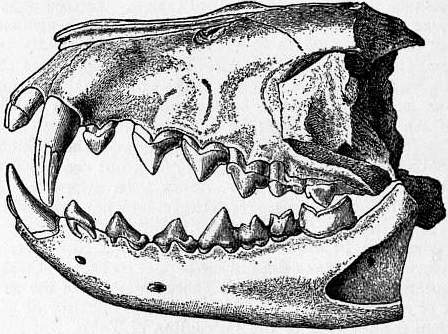
Dentition of Hyaenodon leptorhynchus, from the Lower Oligocene of France. The last upper molar is concealed by the penultimate tooth.
That the Creodonta are the ancestors of the modern Carnivora is now generally admitted. They are apparently the most generalized and primitive of all (placental?) mammals, and probably the direct descendants of the mammal-like anomodont or theromorphous reptiles of the Triassic epoch; the evolution from that group having perhaps taken place in Africa or in the lost area connecting that continent with India. The relationship of the creodonts to the carnivorous marsupials is not yet determined, but it seems scarcely probable that the remarkable resemblance existing between the teeth of the two groups can be solely due to parallelism; and it has been suggested by Dr L. Wortman that both creodonts and marsupials are descended from a common non-placental stock. In other words, the latter are a side-branch from the anomodont-creodont line of descent. Dr C. W. Andrews has pointed out that certain of the Egyptian creodonts appear to have been aquatic or subaquatic in their habits; and it is possible that from such types are derived the true seals, or Phocidae.
With the exception of Australasia, and perhaps South Africa, creodonts (on the supposition that the Patagonian forms are rightly included) appear to have had a nearly world-wide distribution. In Europe and North America they date from the Lowest Eocene and lived till the early Oligocene, while in India they apparently survived till a much later epoch. Some of the Oligocene forms, alike as regards dentition, the union of the scaphoid and lunar of the carpus, and the complexity of the brain, approximated to modern Carnivora.
As regards classification Mr W. D. Matthew includes in the typical family Hyaenodontidae not only the widely spread genera Hyaenodon and Pterodon, but likewise Sinopa (Stypolophus), Cynohyaenodon and Proviverra; but Viverravus (Didymictis) and Vulpavus (Miacis) are assigned to a separate family (Viverravidae). It is these latter forms which come nearest to modern Carnivora, most of them being of Oligocene age. The American and European Oxyaena apparently represents a family by itself, as does the American Oxyclaena; and Palaeonictis and Patriofelis are assigned to yet another family; while the North American Lower Eocene and Eocene Arctocyon typifies a family characterized by the somewhat bear-like type of dentition. Mesonyx is also a very distinct type, from the North American Eocene and Oligocene. Some of the species of Patriofelis and Hyaenodon attained the size of a tiger, although with long civet-like skulls. In the earlier forms the claws often retained somewhat of a hoof-like character.
The South American Borhyaenidae include Borhyaena, Prothylacinus, Amphiproviverra, and allied forms from the Santa Cruz beds of Patagonia, and have been referred to a distinct group, the Sparassodonta, mainly on account of the alleged replacement of some only of the milk-molars by premolars. By their first describer, Dr F. Ameghino, they were regarded as nearly related to the marsupials, to which group they were definitely referred in 1905 by Mr W. J. Sinclair, by whom they are considered near akin to Thylacinus, but this view seems to be disproved by the investigations of Mr C. S. Tomes into the structure of the dental enamel.
It should be added that Dr J. L. Wortman transfers Viverravus and its allies, together with Palaeonictis, to the true Carnivora, the latter genus being regarded as the ancestral type of the sabre-toothed cats (see Machaerodus).
Authorities.—J. L. Wortman, “Eocene Mammalia in the Peabody Museum, pt. i. Carnivora,” Amer. J. Sci. vols. xi.-xiv. (1901-1902); W. D. Matthew, “Additional Observations on the Creodonta,” Bull. Amer. Mus. vol. xiv. p. i. (1901); C. W. Andrews, Descriptive Catalogue of the Tertiary Vertebrata of the Fayum, British Museum (1906); W. J. Sinclair, “The Marsupial Fauna of the Santa Cruz Beds,” Proc. Amer. Phil. Soc. vol. xlix. p. 73 (1905).
(R. L.*)
CREOLE (the Fr. form of criollo, a West Indian, probably a negro corruption of the Span, criadillo, the dim. of criado, one bred or reared, from criar, to breed, a derivative of the Lat. creare, to create), a word used originally (16th century) to denote persons born in the West Indies of Spanish parents, as distinguished from immigrants direct from Spain, aboriginals, negroes or mulattos. It is now used of the descendants of non-aboriginal races born and settled in the West Indies, in various parts of the American mainland and in Mauritius, Reunion and some other places colonized by Spain, Portugal, France, or (in the case of the West Indies) by England. In a similar sense the name is used of animals and plants. The use of the word by some writers as necessarily implying a person of mixed blood is totally erroneous; in itself “creole” has no distinction of colour; a Creole may be a person of European, negro, or mixed extraction—or even a horse.
Local variations occur in the use of the word as applied to people. In the West Indies it designates the descendants of any European race; in the United States the French-speaking native portion of the white race in Louisiana, whether of French or Spanish origin. The French Canadians are never termed creoles, nor is the word now used of the South Americans of Spanish or Portuguese descent, but in Mexico whites of pure Spanish extraction are still called creoles. In all the countries named, when a non-white creole is indicated the word negro is added. In Mauritius, Reunion, &c., on the other hand, creole is commonly used to designate the black population, but is also occasionally used of the inhabitants of European descent. The difference in type between the white creoles and the European races from whom they have sprung, a difference often considerable, is due principally to changed environment—especially to the tropical or semi-tropical climate of the lands they inhabit. The many patois founded on French and Spanish, and used chiefly by creole negroes, are spoken of as creole languages, a term extended by some writers to include similar dialects spoken in countries where the word creole is rarely used.
See G. W. Cable, The Creoles of Louisiana (1884); A. Coelho, “Os Dialetos romanicos on neo latinos na Africa, Asia e America,” Bol. Soc. Geo. Lisboa (1884-1886), with bibliography. For the Creole French of Haiti see an article by Sir H. H. Johnston in The Times, April 10th, 1909.
CREON, in Greek legend, son of Lycaethus, king of Corinth and father of Glauce or Creusa, the second wife of Jason.
CREON, in Greek legend, son of Menoeceus, king of Thebes after the death of Laius, the husband of his sister Jocasta. Thebes was then suffering from the visitation of the Sphinx, and Creon offered his crown and the hand of the widowed queen to whoever should solve the fatal riddle. Oedipus, the son of Laius, ignorant of his parentage, successfully accomplished the task and married Jocasta, his mother. By her he had two sons, Eteocles and Polyneices, who agreed after their father’s death to reign in alternative years. Eteocles first ascended the throne, being the elder, but at the end of the year refused to resign, whereupon his brother attacked him at the head of an army of Argives. The war was to be decided by a single combat between the brothers, but both fell. Creon, who had resumed the government during the minority of Leodamas, the son of Eteocles, commanded that the Argives, and above all Polyneices, the cause of all the bloodshed, should not receive the rites of sepulture, and that any one who infringed this decree should be buried alive. Antigone, the sister of Polyneices, refused to obey, and sprinkled dust upon her brother’s corpse. The threatened penalty was inflicted; but Creon’s crime did not escape unpunished. His son, Haemon, the lover of Antigone, killed himself on her grave; and he himself was slain by Theseus. According to another account he was put to death by Lycus, the son or descendant of a former ruler of Thebes (Euripides, Herc. Fur. 31; Apollodorus iii. 5, 7; Pausanias ix. 5).
CREOPHYLUS of Samos, one of the earliest Greek epic poets. According to an epigram of Callimachus (quoted in Strabo xiv. p. 638) he was the author of a poem called Οἰχαλίας ἅλωσις , which told the story of the conquest of Oechalia by Heracles. Creophylus was said to have been a friend or relative of Homer, who, according to another tradition, was himself the author of the ῞Αλωσις, and presented it to Creophylus in return for the latter’s hospitality.
See F. G. Welcker, Der epische Cyclus (1865-1882).
CREOSOTE, Creasote or Kreasote (from Gr. κρέας, flesh, and σώζειν, to preserve), a product of the distillation of coal, bone oil, shale oil, and wood-tar (more especially that made from beech-wood). The creosote is extracted from the distillate by means of alkali, separated from the filtered alkaline solution by sulphuric acid, and then distilled with dilute alkali; the distillate is again treated with alkali and acid, till its purification is effected; it is then redistilled at 200° C., and dried by means of calcium chloride. It is a highly refractive, colourless, oily liquid, and was first obtained in 1832 by K. Reichenbach from beech-wood tar. It consists mainly of a mixture of phenol, cresol, guaiacol, creosol, xylenol, dimethyl guaiacol, ethyl guaiacol, and various methyl ethers of pyrogallol. Creosote has a strong odour and hot taste, and burns with a smoky flame. It dissolves sulphur, phosphorus, resins, and many acids and colouring matters; and is soluble in alcohol, ether, and carbon disulphide, and in 80 parts by volume of water. It is distinguished from carbolic acid by the following properties:—it rotates the plane of polarized light to the right, forms with collodion a transparent fluid, and is nearly insoluble in glycerin; whereas carbolic acid has no effect on polarized light, gives with about two-thirds of its volume of collodion a gelatinous mass, and is soluble in all proportions in glycerin; further, alcohol and ferric chloride produce with creosote a green solution, turned brown by water, with carbolic acid a brown, and on the addition of water a blue solution. Creosote, like carbolic acid, is a powerful antiseptic, and readily coagulates albuminous matter; wood-smoke and pyroligneous acid or wood-vinegar owe to its presence their efficacy in preserving animal and vegetable substances from putrefaction.
Creosote oil is the name generally applied to the fraction of the coal tar distillate which boils between 200° and 300° C. (see Coal Tar). It is a greenish-yellow fluorescent liquid, usually containing phenol, cresol, naphthalene, anthracene, pyridine, quinoline, acridine and other substances. Its chief use is for the preservation of timber.
Pharmacology and Therapeutics.—Creosote derived from wood-tar is given medicinally in doses of from one to five minims, either suspended in mucilage, or in capsules. It should always be administered after a meal, when the gastric contents dilute it and prevent irritation. Creosote and carbolic acid (q.v.) have a very similar pharmacology; but there is one conspicuous exception. Beech-wood creosote alone should be used in medicine, as its composition renders it much more valuable than other creosotes. Its constituents circulate unchanged in the blood and are excreted by the lungs. Although carbolic acid has no value in phthisis (pulmonary tuberculosis) or in any other bacterial condition of the lungs, creosote, having volatile constituents which are excreted in the expired air and which are powerfully antiseptic, may well be of much value in these conditions. In phthisis creosote is now superseded by both its carbonate (creosotal)—given in the same doses—which causes less gastric disturbance, and by guaiacol itself, which may be given in doses up to thirty minims in capsules. The phosphate (phosote or phosphote), phosphite (phosphotal), and valerianate (eosote) also find application. Similarly the carbonate of guaiacol may be given in doses even as large as a drachm. Creosote may also be used as an inhalation with a steam atomizer. It is applicable not only in phthisis but in bronchiectasis, bronchitis, broncho-pneumonia, lobar pneumonia and all other bacterial lung diseases. Like carbolic acid, creosote may be used in toothache, and the local antiseptic and anaesthetic action which it shares with that substance is often of value in relieving gastric pain due to simple ulcer or cancer, and in those forms of vomiting which are due to gastric irritation.
For the determination and separation of the various constituents of creosote see F. Tiemann, Ber. (1881), 14, p. 2005; A. Béhal and C. Choay, Comptes rendus (1893), 116, p. 197; and L. F. Kebler, Amer. Jour. Pharm. (1899), p. 409.
CREPUSCULAR (from Lat. crepusculum, twilight), of or belonging to the twilight, hence indistinct or glimmering; in zoology the word is used of animals that appear before sunrise or nightfall.
CRÉQUY, a French family which originated in Picardy, and took its name from a small lordship in the present Pas-de-Calais. Its genealogy goes back to the 10th century, and from it originated the noble houses of Blécourt, Canaples, Heilly and Royon. Henri de Créquy was killed at the siege of Damietta in 1240; Jacques de Créquy, marshal of Guienne, was killed at Agincourt with his brothers Jean and Raoul; Jean de Créquy, lord of Canaples, was in the Burgundian service, and took part in the defence of Paris against Joan of Arc in 1429, received the order of the Golden Fleece in 1431, and was ambassador to Aragon and France; Antoine de Créquy was one of the boldest captains of Francis I., and died in consequence of an accident at the siege of Hesdin in 1523. Jean VIII., sire de Créquy, prince de Poix, seigneur de Canaples (d. 1555), left three sons, the eldest of whom, Antoine de Créquy (1535-1574), inherited the family estates on the death of his brothers at St Quentin in 1557. He was raised to the cardinalate, and his nephew and heir, Antoine de Blanchefort, assumed the name and arms of Créquy.
Charles I. de Blanchefort, marquis de Créquy, prince de Poix, duc de Lesdiguières (1578-1638), marshal of France, son of the last-named, saw his first fighting before Laon in 1594, and was wounded at the capture of Saint Jean d’Angély in 1621. In the next year he became a marshal of France. He served through the Piedmontese campaign in aid of Savoy in 1624 as second in command to the constable, François de Bonne, duc de Lesdiguières, whose daughter Madeleine he had married in 1595. He inherited in 1626 the estates and title of his father-in-law, who had induced him, after the death of his first wife, to marry her half-sister Françoise. He was also lieutenant-general of Dauphiné. In 1633 he was ambassador to Rome, and in 1636 to Venice. He fought in the Italian campaigns of 1630, 1635, 1636 and 1637, when he helped to defeat the Spaniards at Monte Baldo. He was killed on the 17th of March 1638 in an attempt to raise the siege of Crema, a fortress in the Milanese. He had a quarrel extending over years with Philip, the bastard of Savoy, which ended in a duel fatal to Philip in 1599; and in 1620 he defended Saint-Aignan, who was his prisoner of war, against a prosecution threatened by Louis XIII. Some of his letters are preserved in the Bibliothèque Nationale in Paris, and his life was written by N. Chorier (Grenoble, 1683).
His eldest son, François, comte de Sault, due de Lesdiguières (1600-1677), governor and lieutenant-general of Dauphiné, took the name and arms of Bonne. The younger, Charles II. de Créquy, seigneur de Canaples, was killed at the siege of Chambéry in 1630, leaving three sons—Charles III., sieur de Blanchefort, prince de Poix, duc de Créquy (1623?-1687); Alphonse de Créquy, comte de Canaples (d. 1711), who became on the extinction of the elder branch of the family in 1702 duc de Lesdiguières, and eventually succeeded also to his younger brother’s honours; and François, chevalier de Créquy and marquis de Marines, marshal of France (1625-1687).
The last-named was born in 1625, and as a boy took part in the Thirty Years’ War, distinguishing himself so greatly that at the age of twenty-six he was made a maréchal de camp, and a lieutenant-general before he was thirty. He was regarded as the most brilliant of the younger officers, and won the favour of Louis XIV. by his fidelity to the court during the second Fronde. In 1667 he served on the Rhine, and in 1668 he commanded the covering army during Louis XIV.’s siege of Lille, after the surrender of which the king rewarded him with the marshalate. In 1670 he overran the duchy of Lorraine. Shortly after this Turenne, his old commander, was made marshal-general, and all the marshals were placed under his orders. Many resented this, and Créquy, in particular, whose career of uninterrupted success had made him over-confident, went into exile rather than serve under Turenne. After the death of Turenne and the retirement of Condé, he became the most important general officer in the army, but his over-confidence was punished by the severe defeat of Conzer Brück (1675) and the surrender of Trier and his own captivity which followed. But in the later campaigns of this war (see Dutch Wars) he showed himself again a cool, daring and successful commander, and, carrying on the tradition of Turenne and Condé, he was in his turn the pattern of the younger generals of the stamp of Luxembourg and Villars. He died in Paris on the 3rd of February 1687.
Alphonse de Créquy had not the talent of his brothers, and lost his various appointments in France. He went to London in 1672, where he became closely allied with Saint Évremond, and was one of the intimates of King Charles II.
Charles III. de Créquy served in the campaigns of 1642 and 1645 in the Thirty Years’ War, and in Catalonia in 1649. In 1646, after the siege of Orbitello, he was made lieutenant-general by Louis. By faithful service during the king’s minority he had won the gratitude of Anne of Austria and of Mazarin, and in 1652 he became duc de Créquy and a peer of France. The latter half of his life was spent at court, where he held the office of first gentleman of the royal chamber, which had been bought for him by his grandfather. In 1659 he was sent to Spain with gifts for the infanta Maria Theresa, and on a similar errand to Bavaria in 1680 before the marriage of the dauphin. He was ambassador to Rome from 1662 to 1665, and to England in 1677; and became governor of Paris in 1675. He died in Paris on the 13th of February 1687. His only daughter, Madeleine, married Charles de la Trémoille (1655-1709).
The marshal François de Créquy had two sons, whose brilliant military abilities bade fair to rival his own. The elder, François Joseph, marquis de Créquy (1662-1702), already held the grade of lieutenant-general when he was killed at Luzzara on the 13th of August 1702; and Nicolas Charles, sire de Créquy, was killed before Tournai in 1696 at the age of twenty-seven.
A younger branch of the Créquy family, that of Hémont, was represented by Louis Marie, marquis de Créquy (1705-1741), author of the Principes philosophiques des saints solitaires d’Égypte (1779), and husband of the marquise separately noticed below, and became extinct with the death in 1801 of his son, Charles Marie, who had some military reputation.
For a detailed genealogy of the family and its alliances see Moreri, Dictionnaire historique; Annuaire de la noblesse française (1856 and 1867). There is much information about the Créquys in the Mémoires of Saint-Simon.
CRÉQUY, RENÉE CAROLINE DE FROULLAY, Marquise de (1714-1803), was born on the 19th of October 1714, at the château of Monfleaux (Mayenne), the daughter of Lieutenant-General Charles François de Froullay. She was educated by her maternal grandmother, and married in 1737 Louis Marie, marquis de Créquy (see above), who died four years after the marriage. Madame de Créquy devoted herself to the care of her only son, who rewarded her with an ingratitude which was the chief sorrow of her life. In 1755 she began to receive in Paris, among her intimates being D’Alembert and J. J. Rousseau. She had none of the frivolity generally associated with the women of her time and class, and presently became extremely religious with inclinations to Jansenism. D’Alembert’s visits ceased when she adopted religion, and she was nearly seventy when she formed the great friendship of her life with Sénac de Meilhan, whom she met in 1781, and with whom she carried on a correspondence (edited by Édouard Fournier, with a preface by Sainte-Beuve in 1856). She commented on and criticized Meilhan’s works and helped his reputation. She was arrested in 1793 and imprisoned in the convent of Les Oiseaux until the fall of Robespierre (July 1794). The well-known Souvenirs de la marquise de Créquy (1710-1803), printed in 7 volumes, 1834-1835, and purporting to be addressed to her grandson, Tancrède de Créquy, was the production of a Breton adventurer, Cousin de Courchamps. The first two volumes appeared in English in 1834 and were severely criticized in the Quarterly Review.
See the notice prefixed by Sainte-Beuve to the Lettres; P. L. Jacob, Énigmes et découvertes bibliographiques (Paris, 1866); Quérard, Superchéries littéraires, s.v. “Créquy”; L’Ombre de la marquise de Créquy aux lecteurs des souvenirs (1836) exposes the forgery of the Mémoires.
CRESCAS, HASDAI BEN ABRAHAM (1340-1410), Spanish philosopher. His work, The Light of the Lord (’Or ’Adonai), deeply affected Spinoza, and thus his philosophy became of wide importance. Maimonides (q.v.) had brought Jewish thought entirely under the domination of Aristotle. The work of Crescas, though it had no immediate success, ended in effecting its liberation. He refused to base Judaism on speculative philosophy alone; there was a deep emotional side to his thought. Thus he based Judaism on love, not on knowledge; love was the bond between God and man, and man’s fundamental duty was love as expressed in obedience to God’s will. Spinoza derived from Crescas his distinction between attributes and properties; he shared Crescas’s views on creation and free will, and in the whole trend of his thought the influence of Crescas is strongly marked.
See E. G. Hirsch, Jewish Encyclopaedia, iv. 350.
(I. A.)
CRESCENT (Lat. crescens, growing), originally the waxing moon, hence a name applied to the shape of the moon in its first quarter. The crescent is employed as a charge in heraldry, with its horns vertical; when they are turned to the dexter side of the shield, it is called increscent, when to the sinister, decrescent. A crescent is used as a difference to denote the second son of a house; thus the earls of Harrington place a crescent upon a crescent, as descending from the second son of a second son. An order of the crescent was instituted by Charles I. of Naples and Sicily in 1268, and revived by René of Anjou in 1464. A Turkish order or decoration of the crescent was instituted by Sultan Selim III. in 1799, in memory of the diamond crescent which he had presented to Nelson after the battle of the Nile, and which Nelson wore on his coat as if it were an order.
The crescent is the military and religious symbol of the Ottoman Turks. According to the story told by Hesychius of Miletus, during the siege of Byzantium by Philip of Macedon the moon suddenly appeared, the dogs began to bark and aroused the inhabitants, who were thus enabled to frustrate the enemy’s scheme of undermining the walls. The grateful Byzantines erected a statue to “torch-bearing” Hecate, and adopted the lunar crescent as the badge of the city. It is generally supposed that it was in turn adopted by the Turks after the capture of Constantinople in 1453, either as a badge of triumph, or to commemorate a partial eclipse of the moon on the night of the final attack. In reality, it seems to have been used by them long before that event. Ala ud-din, the Seljuk sultan of Iconium (1245-1254), and Ertoghrul, his lieutenant and the founder of the Ottoman branch of the Turkish race, assumed it as a device, and it appeared on the standard of the janissaries of Sultan Orkhan (1326-1360). Since the new moon is associated with special acts of devotion in Turkey—where, as in England, there is a popular superstition that it is unlucky to see it through glass—it may originally have been adopted in consequence of its religious significance. According to Professor Ridgeway, however, the Turkish crescent, like that seen on modern horse-trappings, has nothing to do with the new moon, but is the result of the base-to-base conjunction of two claw or tusk amulets, an example of which has been brought to light during the excavations of the site of the temple of Artemis Orthia at Sparta (see Athenaeum, March 21, 1908). There is nothing distinctively Turkish in the combination of crescent and star which appears on the Turkish national standard; the latter is shown by coins and inscriptions to have been an ancient Illyrian symbol, and is of course common in knightly and decorative orders. It is doubtful whether any opposition between crescent and cross, as symbols of Islam and Christianity, was ever intended by the Turks; and it is an historical error to attribute the crescent to the Saracens of crusading times or the Moors in Spain.
Crescent is also the name of a Turkish musical instrument. In architecture, a crescent is a street following the arc of a circle; the name in this sense was first used in the Royal Crescent at Bath.
CRESCIMBENI, GIOVANNI MARIO (1663-1728), Italian critic and poet, was born at Macerata in 1663. Having been educated by a French priest at Rome, he entered the Jesuits’ college of his native town, where he produced a tragedy on the story of Darius, and versified the Pharsalia. In 1679 he received the degree of doctor of laws, and in 1680 he removed again to Rome. The study of Filicaja and Leonico having convinced him that he and all his contemporaries were working in a wrong direction, he resolved to attempt a general reform. In 1690, in conjunction with fourteen others, he founded the celebrated academy of the Arcadians, and began the contest against false taste and its adherents. The academy was most successful; branch societies were opened in all the principal cities of Italy; and the influence of Marini, opposed by the simplicity and elegance of such models as Costanzo, soon died away. Crescimbeni officiated as secretary to the Arcadians for thirty-eight years. In 1705 he was made canon of Santa Maria; in 1715 he obtained the chief curacy attached to the same church; and about two months before he died (1728) he was admitted a member of the order of Jesus.
His principal work is the Istoria della volgar poesia (Rome, 1698), an estimate of all the poets of Italy, past and contemporary, which may yet be consulted with advantage. The most important of his numerous other publications are the Commentarij (5 vols., Rome, 1702-1711), and La Bellezza della volgar poezia (Rome, 1700).
CRESILAS, a Cretan sculptor of Cydonia. He was a contemporary of Pheidias, and one of the sculptors who vied in producing statues of amazons at Ephesus (see Greek Art) about 450 B.C. As his amazon was wounded (volnerata; Pliny, Nat. Hist. xxxiv. 75), we may safely identify it with the figure, of which several copies are extant, who is carefully removing her blood-stained garment from a wound under the right breast. Another work of Cresilas of which copies survive is the portrait of Pericles, the earliest Greek portrait which has been with certainty identified, and which fully confirms the statement of ancient critics that Cresilas was an artist who idealized and added nobility to men of noble type. An extant portrait of Anacreon is also derived from Cresilas.
CRESOLS or Methyl Phenols, C7H8O or C6H4·CH3·OH. The three isomeric cresols are found in the tar obtained in the destructive distillation of coal, beech-wood and pine. The crude cresol obtained from tar cannot be separated into its different constituents by fractional distillation, since the boiling points of the three isomers are very close together. The pure substances are best obtained by fusion of the corresponding toluene sulphonic acids with potash.
Ortho-cresol, CH3(1)·C6H4·OH(2), occurs as sulphate in the urine of the horse. It may be prepared by fusion of ortho-toluene sulphonic acid with potash; by the action of phosphorus pentoxide on carvacrol; or by the action of zinc chloride on camphor. It is a crystalline solid, which melts at 30° C. and boils at 190.8° C. Fusion with alkalis converts it into salicylic acid.
Meta-cresol, CH3(1)·C6H4·OH(3), is formed when thymol (para-isopropyl-meta-cresol) is heated with phosphorus pentoxide. Propylene is liberated during the reaction, and the phosphoric acid ester of meta-cresol which is formed is then fused with potash. It can also be prepared by distilling meta-oxyuvitic acid with lime, or by the action of air on boiling toluene in the presence of aluminium chloride (C. Friedel and J. M. Crafts, Ann. Chim. Phys., 1888 [6], 14, p. 436). It solidifies in a freezing mixture, on the addition of a crystal of phenol, and then melts at 3°-4° C. It boils at 202°.8 C. Its aqueous solution is coloured bluish-violet by ferric chloride.
Para-cresol, CH3(1)·C6H4·OH(4), occurs as sulphate in the urine of the horse. It is also found in horse’s liver, being one of the putrefaction products of tyrosine. It may be prepared by the fusion of para-toluene sulphonic acid with potash; by the action of nitrous acid on para-toluidine; or by heating para-oxyphenyl acetic acid with lime. It crystallizes in prisms which melt at 36° C. and boil at 201°.8 C. It is soluble in water, and the aqueous solution gives a blue coloration with ferric chloride. When treated with hydrochloric acid and potassium chlorate, no chlorinated quinones are obtained (M. S. Southworth, Ann. (1873), 168, p. 271), a behaviour which distinguishes it from ortho- and meta-cresol.
On the composition of commercial cresylic acid see A. H. Allen, Jour. Soc. Chem. Industry (1890), 9, p. 141. See also Creosote.
CRESPI, DANIELE (1590-1630), Italian historical painter, was born near Milan, and studied under Giovanni Battista Crespi and Giulio Procaccini. He was an excellent colourist; his drawing was correct and vigorous, and he grouped his compositions with much ability. His best work, a series of pictures from the life of Saint Bruno, is in the monastery of the Carthusians at Milan. Among the most famous of his paintings is a “Stoning of St Stephen” at Brera, and there are several excellent examples of his work in the city of his birth and at Pavia.
CRESPI, GIOVANNI BATTISTA (1557-1663), called Il Cerano, Italian painter, sculptor, and architect, was born at Cerano in the Milanese. He was a scholar of considerable attainments, and held a position of dignity in his native city. He was head of the Milanese Academy founded by Cardinal Frederigo Borromeo, and he was the teacher of Guercino. He is most famous as a painter; and, though his figures are neither natural nor graceful, his colouring is good, and his designs full of ideal beauty.
CRESPI, GIUSEPPE MARIA (1665-1747), Italian painter, called “Lo Spagnuolo” from his fondness for rich apparel, was born at Bologna, and was trained under Angelo Toni, Domenico Canuti and Carlo Cignani. He then went through a course of copying from Correggio and Barocci; this he followed up with a journey to Venice for the sake of Titian and Paul Veronese; and late in life he proclaimed himself a follower of Guercino and Pietro da Cortona. He was a good colourist and a facile executant, and was wont to employ the camera obscura with great success in the treatment of light and shadow; but he was careless and unconscientious. He was a clever portrait-painter and a brilliant caricaturist; and his etchings after Rembrandt and Salvator are in some demand. His greatest work, a “Massacre of the Innocents,” is at Bologna; but the Dresden gallery possesses twelve examples of him, among which is his celebrated series of the Seven Sacraments.
CRESS, in botany. “Garden Cress” (Lepidium sativum) is an annual plant (nat. ord. Cruciferae), known as a cultivated plant at the present day in Europe, North Africa, western Asia and India, but its origin is obscure. Alphonse de Candolle (L’Origine des plantes cultivées) says its cultivation must date from ancient times and be widely diffused, for very different names for it exist in the Arab, Persian, Albanian, Hindustani and Bengali tongues. He considered the plant to be of Persian origin, whence it may have spread after the Sanskrit epoch (there is no Sanskrit name for it) into the gardens of India, Syria, Greece and North Africa. It is used in salads, the young plants being cut and eaten while still in the seed-leaf, forming, along with plants of the white mustard in the same stage of growth, what is commonly called “small salad.” The seeds should be sown thickly broadcast or in rows in succession every ten or fourteen days, according to the demand. The sowings may be made in the open ground from March till October, the earliest under hand-glasses, and the summer ones in a cool moist situation, where water from trees, shrubs, walls, &c., cannot fall on or near them. The grit thrown up by falling water pierces the tender tissues of the cress, and cannot be thoroughly removed by washing. During winter they must be raised on a slight hotbed, or in shallow boxes or pans placed in any of the glass-houses where there is a temperature of 60° or 65°. Cress is subject to the attack of a fungus (Pythium debaryanum) if kept too close and moist. The pest very quickly infects a whole sowing. There is no cure for it; preventive measures should therefore be taken by keeping the sowings fairly dry and well ventilated. The seed should be sown on new soil, and should not be covered.
The “Golden” or “Australian” cress is a dwarf, yellowish-green, mild-flavoured sort, which is cut and eaten when a little more advanced in growth but while still young and tender. It should be sown at intervals of a month from March onwards, the autumn sowing, for winter and spring use, being made in a sheltered situation.
The “curled” or “Normandy” cress is a very hardy sort, of good flavour. In this, which is allowed to grow like parsley, the leaves are picked for use while young; and, being finely cut and curled, they are well adapted for garnishing. It should be sown thinly, in drills, in good soil in the open borders, in March, April and May, and for winter and spring use at the foot of a south wall early in September, and about the middle of October.
Water-cress.—“Water-cress” (Nasturtium officinale) is a member of the same natural order, and a native of Great Britain. Although now so largely used, it does not appear to have been cultivated in England prior to the 19th century, though in Germany, especially near Erfurt, it had been grown long previously. Its flavour is due to an essential oil containing sulphur. Water-cress is largely cultivated in shallow ditches, prepared in wet, low-lying meadows, means being provided for flooding the ditches at will. Where the amount of water available is limited, the ditches are arranged at successively higher levels, so as to allow of the volume admitted to the upper ditch being passed successively to the others. The ditches are usually puddled with clay, which is covered to the depth of 9 to 12 in. with well-manured soil.
A stock of plants may be raised in two ways—by cuttings, and by seeds. If a stock is to be raised from cuttings, the desired quantity of young shoots is gathered—those sold in bunches for salad serve the purpose well—and reduced where necessary to about 3 in. in length, the basal and frequently rooted portion being rejected. They are dibbled thickly into one of the ditches, and only enough water admitted to just cover the soil. If the start is made in late spring, the cuttings will be rooted in a week. They are allowed to remain for another week or two, and are then taken up and dropped about 9 in. apart into the other ditches, which have been slightly flooded to receive them. There is no need to plant them—the young roots will very soon be securely anchored. The volume of water is increased as the plants grow. If raised from seed, the seed-bed is prepared as for cuttings, and seed sown either in drills or broadcast. No flooding is done until the seedlings are up. Water is then admitted, the level being raised as the plants grow. When 5 or 6 in. high, they are taken up and dropped into their permanent quarters precisely like those raised from cuttings.
Cultivated as above described, the plants afford frequent cuttings of large clean cress of excellent flavour for market purposes. Sooner or later growth will become less vigorous and flowering shoots will be produced. This will be accompanied by a pronounced deterioration of the remaining vegetative shoots. These signs will be interpreted by the grower to mean that his plants, as a market crop, are worn out. He will therefore take steps to repeat the routine of culture above described. In the winter the ditches are flooded to protect the cress from frost.
The best-flavoured water-cress is produced in the pure water of running streams over chalk or gravel soil. Should the water be contaminated by sewage or other undesirable matter, the plants not only absorb some of the impurities but also serve to anchor much of the solid particles washed as scum among them. This is extremely difficult to dislodge by washing, and renders the cress a source of danger as food.
Water-cress for domestic use may be raised as a kitchen-garden crop if frequently watered overhead. Beds to afford cress during the summer should be made in broad trenches on a border facing north. It may also be raised in pots or pans stood in saucers of water and frequently watered overhead.
In recent years in America attention has been paid to the injury done to water-cress beds by the “water-cress sow-bug” (Mancasellus brachyurus), and the “water-cress leaf-beetle” (Phaedon aeruginosa). Another species of Phaedon is known in England as “blue beetle” or “mustard beetle,” and is a pest also of mustard, cabbage and kohlrabi (see F. H. Chittenden, in Bulletin 66, part ii. of Bureau of Entomology, United States Department of Agriculture, 1907).
The name “nasturtium” is applied in gardens, but incorrectly, to species of Tropaeolum.
CRESSENT, CHARLES (1685-1768), French furniture-maker, sculptor and fondeur-ciseleur. As the second son of François Cressent, sculpteur du roi, and grandson of Charles Cressent, a furniture-maker of Amiens, who also became a sculptor, he inherited the tastes and aptitudes which were likely to make a finished designer and craftsman. Even more important perhaps was the fact that he was a pupil of André Charles Boulle. Trained in such surroundings, it is not surprising that he should have reached a degree of achievement which has to a great extent justified the claim that he was the best decorative artist of the 18th century. Cressent’s distinction is closely connected with the regency, but his earlier work had affinities with the school of Boulle, while his later pieces were full of originality. He was an artist in the widest sense of the word. He not only designed and made furniture, but created the magnificent gilded enrichments which are so characteristic of his work. He was likewise a sculptor, and among his plastic work is known to have been a bronze bust of Louis, duc d’Orléans, the son of the regent, for whom Cressent had made one of the finest examples of French furniture of the 18th century—the famous médaillier now in the Bibliothèque Nationale. Cressent’s bronze mounts were executed with a sharpness of finish and a grace and vigour of outline which were hardly excelled by his great contemporary Jacques Caffieri. His female figures placed at the corners of tables are indeed among the most delicious achievements of the great days of the French metal worker. Much of Cressent’s work survives, and can be identified; the Louvre and the Wallace collection are especially rich in it, and his commode at Hertford House with gilt handles representing Chinese dragons is perhaps the most elaborate piece he ever produced. The work of identification is rendered comparatively easy in his case by the fact that he published catalogues of three sales of his work. These catalogues are highly characteristic of the man, who shared in no small degree the personal bravoura of Cellini, and could sometimes execute almost as well. He did not hesitate to describe himself as the author of “a clock worthy to be placed in the very finest cabinets,” “the most distinguished bronzes,” or pieces of “the most elegant form adorned with bronzes of extra richness.” He worked much in marqueterie, both in tortoiseshell and in brilliant coloured woods. He was indeed an artist to whom colour appealed with especial force. The very type and exemplar of the “feeling” of the regency, he is worthy to have given his own name to some of the fashions which he deduced from it.
CRESSWELL, SIR CRESSWELL (1794-1863), English judge, was a descendant of an old Northumberland family, and was born at Newcastle in 1794. He was educated at the Charterhouse and at Emmanuel College, Cambridge. He graduated B.A. in 1814, and M.A. four years later. Having chosen the profession of the law he studied at the Middle Temple, and was called to the bar in 1819. He joined the northern circuit, and was not long in earning a distinguished position among his professional brethren. In 1837 he entered parliament as Conservative member for Liverpool, and he soon gained a reputation as an acute and learned debater on all constitutional questions. In January 1842 he was made a judge of the court of common pleas, being knighted at the same time; and this post he occupied for sixteen years. When the new court for probate, divorce and matrimonial causes was established (1858), Sir Cresswell Cresswell was requested by the Liberal government to become its first judge and undertake the arduous task of its organization. Although he had already earned a right to retire, and possessed large private wealth, he accepted this new task, and during the rest of his life devoted himself to it most assiduously and conscientiously, with complete satisfaction to the public. In one case only, out of the very large number on which he pronounced judgment, was his decision reversed. His death was sudden. By a fall from his horse on the 11th of July 1863 his knee-cap was injured. He was recovering from this when on the 29th of the same month he died of disease of the heart.
See Foss’s Lives of the Judges; E. Manson, Builders of our Law (1904).
CRESSY, HUGH PAULINUS DE (c. 1605-1674), English Benedictine monk, whose religious name was Serenus, was born at Wakefield, Yorkshire, about 1605. He went to Oxford at the age of fourteen, and in 1626 became a fellow of Merton College. Having taken orders, he rose to the dignity of dean of Leighlin, Ireland, and canon of Windsor. He also acted as chaplain to Lord Wentworth, afterwards the celebrated earl of Strafford. For some time he travelled abroad as tutor to Lord Falmouth, and in 1646, during a visit to Rome, joined the Roman Catholic Church. In the following year he published his Exomologesis (Paris, 1647), or account of his conversion, which was highly valued by Roman Catholics as an answer to William Chillingworth’s attacks. Cressy entered the Benedictine Order in 1649, and for four years resided at Somerset House as chaplain to Catherine of Braganza, wife of Charles II. He died at West Grinstead on the 10th of August 1674. Cressy’s chief work, The Church History of Brittanny or England, from the beginning of Christianity to the Norman Conquest (1st vol. only published, Rouen, 1668), gives an exhaustive account of the foundation of monasteries during the Saxon heptarchy, and asserts that they followed the Benedictine rule, differing in this respect from many historians. The work was much criticized by Lord Clarendon, but defended by Antony à Wood in his Athenae Oxoniensis, who supports Cressy’s statement that it was compiled from original MSS. and from the Annales Ecclesiae Britannicae of Michael Alford, Dugdale’s Monasticon, and the Decem Scriptores Historiae Anglicanae. The second part of the history, which has never been printed, was discovered at Douai in 1856. To Roman Catholics Cressy’s name is familiar as the editor of Walter Hilton’s Scale of Perfection (London, 1659); of Father A. Baker’s Sancta Sophia (2 vols., Douai, 1657); and of Juliana of Norwich’s Sixteen Revelations on the Love of God (1670). These books, which would have been lost but for Cressy’s zeal, have been frequently reprinted, and have been favourably regarded by a section of the Anglican Church.
For a complete list of Cressy’s works see J. Gillow’s Bibl. Dict. of Eng. Catholics, vol. i.
CREST, a town of south-eastern France, in the department of Drôme, on the right bank of the Drôme, 20 m. S.S.E. of Valence by rail. Pop. (1906) town, 3971; commune, 5660. It carries on silk-worm breeding, silk-spinning, and the manufacture of woollens, paper, leather and cement. There is trade in truffles. On the rock which commands the town stands a huge keep, the sole survival of a castle (12th century) to which Crest was indebted for its importance in the middle ages and the Religious Wars. The rest of the castle was destroyed in the first half of the 17th century, after which the keep was used as a state prison. Crest ranked for a time as the capital of the duchy of Valentinois, and in that capacity belonged before the Revolution to the prince of Monaco. The communal charter, graven on stone and dating from the 12th century, is preserved in the public archives. Ten miles south-east of Crest lies the picturesque Forest of Saon.
CREST (Lat. crista, a plume or tuft), the “comb” on an animal’s head, and so any feathery tuft or excrescence, the “cone” of a helmet (by transference, the helmet itself), and the top or summit of anything. In heraldry (q.v.) a crest is a device, originally borne as a cognizance on a knight’s helmet, placed on a wreath above helmet and shield in armorial bearings, and used separately on a seal or on articles of property.
Cresting, in architecture, is an ornamental finish in the wall or ridge of a building, which is common on the continent of Europe. An example occurs at Exeter cathedral, the ridge of which is ornamented with a range of small fleurs-de-lis in lead.
CRESTON, a city and the county-seat of Union county, Iowa, U.S.A., about 60 m. S.W. of Des Moines, at the crossing of the main line and two branches of the Chicago, Burlington & Quincy railway. Pop. (1890) 7200; (1900) 7752; (1905, state census) 8382 (753 foreign-born); (1910) 6924. The city is on the crest of the divide between the Mississippi and the Missouri basins at an altitude of about 1310 ft.—whence its name. It is situated in a fine farming and stock-raising region, for which it is a shipping point. The site was chosen in 1869 by the Burlington & Missouri River Railroad Company (subsequently merged in the Chicago, Burlington & Quincy Railroad Company) for the location of its shops. Creston was incorporated as a town in 1869, and was chartered as a city in 1871.
CRESWICK, THOMAS (1811-1869), English landscape-painter, was born at Sheffield, and educated at Hazelwood, near Birmingham. At Birmingham he first began to paint. His earliest appearance as an exhibitor was in 1827, at the Society of British Artists in London; in the ensuing year he sent to the Royal Academy the two pictures named “Llyn Gwynant, Morning,” and “Carnarvon Castle.” About the same time he settled in London; and in 1836 he took a house in Bayswater. He soon attracted some attention as a landscape-painter, and had a career of uniform and encouraging, though not signal success. In 1842 he was elected an associate, and in 1850 a full member of the Royal Academy, which, for several years before his death, numbered hardly any other full members representing this branch of art. In his early practice he set an example, then too much needed, of diligent study of nature out of doors, painting on the spot all the substantial part of several of his pictures. English and Welsh streams may be said to have formed his favourite subjects, and generally British rural scenery, mostly under its cheerful, calm and pleasurable aspects, in open daylight. This he rendered with elegant and equable skill, colour rather grey in tint, especially in his later years, and more than average technical accomplishment; his works have little to excite, but would, in most conditions of public taste, retain their power to attract. Creswick was industrious and extremely prolific; he produced, besides a steady outpouring of paintings, numerous illustrations for books. He was personally genial—a dark, bulky man, somewhat heavy and graceless in aspect in his later years. He died at his house in Bayswater, Linden Grove, on the 28th of December 1869, after a few years of declining health. Among his principal works may be named “England” (1847); “Home by the Sands, and a Squally Day” (1848); “Passing Showers” (1849); “The Wind on Shore, a First Glimpse of the Sea, and Old Trees” (1850); “A Mountain Lake, Moonrise” (1852); “Changeable Weather” (1865); also the “London Road, a Hundred Years ago”; “The Weald of Kent”; the “Valley Mill” (a Cornish subject); a “Shady Glen”; the “Windings of a River”; the “Shade of the Beech Trees”; the “Course of the Greta”; the “Wharfe”; “Glendalough,” and other Irish subjects, 1836 to 1840; the “Forest Farm.” Frith for figures, and Ansdell for animals, occasionally worked in collaboration with Creswick.
In 1873 T. O. Barlow, the engraver, published a catalogue of Creswick’s works.
CRESWICK, a borough of Talbot county, Victoria, Australia. 85½ m. by rail N.W. of Melbourne. Pop. (1901) 3060. It is the centre of a mining, pastoral and agricultural district. Gold is found both in alluvial and quartz formations, the quartz being especially rich. The surrounding country is fertile and well-timbered, and there is a government plantation and nursery in connexion with the forests department.
CRETACEOUS SYSTEM, in geology, the group of stratified rocks which normally occupy a position above the Jurassic system and below the oldest Tertiary deposits; therefore it is in this system that the closing records of the great Mesozoic era are to be found. The name furnishes an excellent illustration of the inconvenience of employing a local lithological feature in the descriptive title of a wide-ranging rock-system. The white chalk (Lat. creta), which gives its name to the system, was first studied in the Anglo-Parisian basin, where it takes a prominent place; but even in this limited area there is a considerable thickness and variety of rocks which are not chalky, and the Cretaceous system as a whole contains a remarkable diversity of types of sediment.
Classification.—The earlier subdivisions of the Cretaceous rocks were founded upon the uncertain ground of similarity in lithological characters, assisted by observed stratigraphical sequence. This method yielded poor results even in a circumscribed area like Great Britain, and it breaks down utterly when applied to the correlation of rocks of similar age in Europe and elsewhere. Study of the fossils, however, has elicited the fact that certain forms characterize certain “zones,” which are preceded and succeeded by other zones each bearing a peculiar species or distinctive assemblage of species. By these means the Cretaceous rocks of the world have now been correlated zone with zone, with a degree of exactitude proportional to the palaeontological information gained in the several areas of occurrence.
The Cretaceous system falls naturally into two divisions, an upper and a lower, in all but a few limited regions. In the table on page 288 the names of the principal stages are enumerated; these are capable of world-wide application. The sub-stages are of more local value, and too much importance must not be attached to them for the correlation of distant deposits. The general table is designed to show the relative position in the system of some of the more important and better-known formations; but it must be remembered that the Cretaceous rocks of Europe can now be classified in considerable detail by their fossils, the most accurate group for this purpose being the cephalopods. The smaller table was compiled by T. C. Chamberlin and R. D. Salisbury to show the main subdivisions of the North American Cretaceous rocks. The correlation of the minor subdivisions of Europe and America are only approximate.
Relation of the Cretaceous Strata to the Systems above and below.—In central and northern Europe the boundary between the Cretaceous and Tertiary strata is sharply defined by a fairly general unconformity, except in the Danian and Montian beds, where there is a certain commingling of Tertiary with Cretaceous fossils. The relations with the underlying Jurassic rocks are not so clearly defined, partly because the earliest Cretaceous rocks are obscured by too great a thickness of younger strata, and partly because the lowest observable rocks of the system are not the oldest, but are higher members of the system that have overlapped on to much older rocks. However, in the south of England, in the Alpine area, and in part of N.W. Germany the passage from Jurassic to Cretaceous is so gradual that there is some divergence of opinion as to the best position for the line of separation. In the Alpine region this passage is formed by marine beds, in the other two by brackish-water deposits. In a like manner the Potomac beds of N. America grade downwards into the Jurassic; while in the Laramie formation an upward passage is observed into the Eocene deposits. There is a very general unconformity and break between the Lower and Upper Cretaceous; this has led Chamberlin and Salisbury to suggest that the Lower Cretaceous should be regarded as a separate period with the title “Comanchean.”
Physiographical Conditions and Types of Deposit.—With the opening of the Cretaceous in Europe there commenced a period of marine transgression; in the central and western European region this took place from the S. towards the N., slow at first and local in effect, but becoming more decided at the beginning of the upper division. During the earlier portion of the period, S. England, Belgium and Hanover were covered by a great series of estuarine sands and clays, termed the Wealden formation (q.v.), the delta of a large river or rivers flowing probably from the N.W. Meanwhile, in the rest of Europe alternations of marine and estuarine deposits were being laid down; but over the Alpine region lay the open sea, where there flourished coral reefs and great banks of clam-like molluscs. The sea gradually encroached upon the estuarine Wealden area, and at the time of the Aptian deposits uniform marine conditions prevailed from western Europe through Russia into Asia. This extension of the sea is illustrated in England by the overlap of the Gault over the Lower Greens and on to the older rocks, and by similar occurrences in N. France and Germany.
Almost throughout the Upper Cretaceous period the marine invasion continued, varied here and there by slight movements in the opposite sense which did not, however, interfere with the quiet general advance of the sea. This marine extension made itself felt over the old central plateau of France, the N. of Great Britain, the Spanish peninsula, the Armorican peninsula, and also in the Bavarian Jura and Bohemia; it affected the northern part of Africa and East Africa; in N. America the sea spread over the entire length of the Rocky Mountain region; and in Brazil, eastern Asia and western Australia, Upper Cretaceous deposits are found resting directly upon much older rocks. Indeed, at this time there happened one of the greatest changes in the distribution of land and water that have been recorded in geological history.
We have seen that in early Cretaceous times marine limestones were being formed in southern Europe, while estuarine sands and muds were being laid down in the Anglo-German delta, and that beds of intermediate character were being made in parts of N. France and Germany. During later Cretaceous times this striking difference between the northern and southern facies was maintained, notwithstanding the fact that the later deposits were of marine origin in both regions. In the northern region the gradual deepening and accompanying extension of the sea caused the sandy deposits to become finer grained in N.W. Europe. The sandy beds and clays then gave way to marly deposits, and in these early stages glauconitic grains are very characteristically present both in the sand and in the marls. In their turn these marly deposits in the Anglo-Parisian basin were succeeded gradually and somewhat intermittently by the purer, soft limestone of the chalk sea, and by limestones, similar in character, in N. France, extra-Alpine Germany, S. Scandinavia, Denmark and Russia. Meanwhile, the S. European deposits maintained the characters already indicated; limestones (not chalk) prevailed, except in certain Alpine and Carpathian tracts where detrital sandstones were being laid down.
The great difference between the lithological characters of the northern and southern deposits is accompanied by an equally striking difference between their respective organic contents. In the north, the genera Inoceramus and Belemnitella are particularly abundant. In the south, the remarkable, large, clam-like, aberrant pelecypods, the Hippuritidae, Rudistes, Caprotina, &c., attained an extraordinary development; they form great lenticular banks, like the clam banks of warm seas, or like our modern oyster-beds; they appear in successive species in the different stages of the Cretaceous system of the south, and can be used for marking palaeontological horizons as the cephalopods are used elsewhere. Certain genera of ammonites, Haploceras, Lytoceras, Phylloceras, rare in the north, are common in the south; and the southern facies is further characterized by the peculiar group of swollen belemnites (Dumontia), by the gasteropods Actionella, Nerinea, &c., and by reef-building corals. The southern facies is far more widespread and typical of the period than is the chalk; it not only covers all southern Europe, but spreads eastwards far into Asia and round the Mediterranean basin into Africa. It is found again in Texas, Alabama, Mexico, the West Indies and Colombia; though limestones of the chalk type are found in Texas, New Zealand, and locally in one or two other places. The marine deposits are organically formed limestones, in which foraminifera and large bivalve mollusca play a leading part, marls and sandstones; dolomite and oolitic and pisolitic limestones are also known.
European Classification. Britain. Germany, &c., several other parts of Europe. Hippurite limestones of Southern France and Mediterranean Region
Stages. Sub-stages.
Upper Cretaceous. Montian. Danian. Aturian. Senonian. Emscherian. Turonian. Cenomanian. (placed by some in the Tertiary). Maestrichtian (Dordonian). Campanian. Santonian. Coniacian. Angoumian. Ligerian. Carentonian. Rothomagian. Chalk of Trimingham. Upper Chalk with Flints. Middle Chalk without Flints. Grey Chalk. Chalk marl. Cambridge Greensand. Marls and pisolitic Limestone of Meudon. Limestone of Saltholm and Faxö (Denmark). Upper Quader Sandstone. Quader Marls and Pläner Marls. Upper Pläner. Lr. Pläner and Lr. Quader. Tourtia of Mons, &c.
Lower Cretaceous. Albian. Aptian. Barremian. Neocomian. Gault. Gargasian. Bedoulian. Hauterivian. Valangian. Berriasian. Selbornian. Gault and Upper Greensand. __________________ Lower Greensand. Weald Clay and Hastings sands. Marine Beds of Specton. Flammen mergel. Clay of N. Germany. Urgonian Requienia (caprotina) Kalk or Schrattenkalk. North German Hills formation
Upper Cretaceous. Lower Cretaceous.
Alpine Region. Aptychenkalk in E. Alps ... Cretaceous Flysch... Biancone of S. Alps. ... Cretaceous Flysch ... Carpathian and Vienna Sandstones, Gosau formation of E. Alps. Seewan beds of N. Alps. Scaglia of S. Alps.
Africa. Nubian Sandstone of ... Uitenhage Beds S. Africa. ... N. Africa and Syria. Pondoland Beds S. Africa.
India. Oomia and Utatur Group. Arialoor Beds (Deccan Trap).
Australia. Rolling Down Formation. Desert Sandstone.
New Zealand. Thick conglomeratic Series with Bitumous coals. Waipara Beds and Limestones, Chalk, with Flints, Marls and Greensand.
S. America. Puegiredon Series. Belgrano ... ... Series. San Martin Series.
Japan. Torinosa Limestone and Ryoseki Series. Izumi Sandstone and Hokkaido Series.
Greenland. Kome Group. Atani Group. Patoot Group (part).
Note to Table.
Montian from Mons in Belgium.
Danian ” Denmark = Garumnien of Leymerie.
Aturian ” Adour.
Maestrichtian ” Maestricht.
Campanian ” Champagne.
Emscherian ” Emscher river in Westphalia.
Santonian ” Saintonge.
Coniacian ” Cognac.
Senonian ” Sens in department of Yonne.
Turonian ” Touraine.
Angoumian ” Angoumois.
Ligerian ” the Loire.
Cenomanian ” Le Mans (Cenomanum).
Carentonian ” Charente.
Rothomagian ” Rouen (Rothomagus).
Albian ” dept. of Aube.
Selbornian ” Selborne in Hampshire.
Aptian ” Apt in Vaucluse.
Gargasian ” Gargas near Apt.
Bedoulian ” la Bedoule (Var) = Rhodanien of Renevie
Barremian ” Barrême in Basses Alpes.
Hauterivian ” Hauterive on Lake of Neuchâtel.
Valangian ” Château de Valangin near Neuchâtel.
Neocomian ” Neuchâtel (Neocomum).
Berriasian ” Berrias (Ardéche) near Besseges.
Urgonian ” Orgon near Arles.
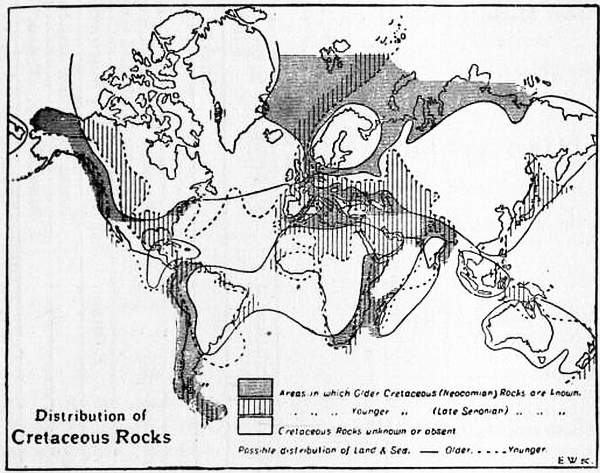
The Cretaceous seas were probably comparatively shallow; this was certainly the case where the deposits are sandy, and in the regions occupied by the hippuritic fauna. Much discussion has taken place as to the depth of the chalk sea. Stress has been laid upon the resemblance of this deposit to the modern deep-sea globigerina-ooze; but on the whole the evidence is in favour of moderate depth, perhaps not more than 1000 fathoms; the freedom of the deposit from detrital matter being regarded as due to the low elevation of the surrounding land, and the main lines of drainage being in other directions. Sandy and shore deposits are common throughout the system in every region. Besides the Weald, there were great lacustrine and terrestrial deposits in N. America (the Potomac, Kootenay, Morrison, Dakota and Laramie formations) as well as in N. Spain, and in parts of Germany, &c. The general distribution of land and sea is indicated in the map.
Earth Movements and Vulcanicity.—During the greater part of the Cretaceous period crustal movements had been small and local in effect, but towards the close a series of great deformative movements was inaugurated and continued into the next period. These movements make it possible to discriminate between the Cretaceous and Tertiary rocks, because the conditions of sedimentation were profoundly modified by them, and in most parts of the world there resulted a distinct break in the sequence of fossil remains. Great tracts of our modern continental land areas gradually emerged, and several mountainous tracts began to be elevated, such as the Appalachians, parts of the Cordilleras, and the Rocky Mountains, and their northern continuation, and indeed the greater part of the western N. American continent was intensely affected; the uplifting was associated with extensive faulting. Volcanic activity was in abeyance in Europe and in much of Asia, but in America there were many eruptions and intrusions of igneous rock towards the close of the period. Diabases and peridotites had been formed during the Lower Cretaceous in the San Luis Obispo region. Great masses of ash and conglomerate occur in the Crow’s Nest Pass in Canada; porphyries and porphyritic tuffs of later Cretaceous age are important in the Andes; while similar rocks are found in the Lower Cretaceous of New Zealand. It is, however, in the Deccan lava flows of India that we find eruptions on a scale more vast than any that have been recorded either before or since. These outpourings of lava cover 200,000 sq. m. and are from 4000 to 6000 ft. thick. They lie upon an eroded Cenomanian surface and are to some extent interbedded with Upper Cretaceous sediments.
Atlantic Coast. Eastern Gulf Region. Western Gulf Region. Western Interior. Pacific Coast. European.
CRETACEOUS Upper Cretaceous. Manasquan. Rancocas. ...... ...... Denver, Livingstone, (possibly Eocene). &c. Laramie. Not differentiated or wanting. Danian.
Monmouth. Matawan. Ripley. Selma. Eutaw. Montana Series Navarro. Colorado Series 2. Austin 1. Eagle Ford Montana Series 2. Fox Hills. 1. Fort Pierre and Belly River. Colorado Series. 2. Niobrara. 1. Benton. Chico. Senonian. Turonian.
...... ...... Dakota. Woodbine. Dakota. Cenomanian. Albian. Unconformity in places.
U n c o n f o r m i t y.
COMANCHEAN Lower Cretaceous. Potomac Series. 4. Raritan. 3. Patapsco. Jurassic? 2. Arundel 1. Patuxent Tuskaloosa Series. Washita. Fredericksburg. Trinity. Kootenay and Morrison (or Como). Horsetown. Knoxville. Shastan. Aptian. Urgonian. Neocomian. Wealden.
Economic Products of Cretaceous Rocks.—Coal is one of the most important products of the rocks of this system. The principal Cretaceous coal-bearing area is in the western interior of N. America, where an enormous amount of coal—mostly lignitic, but in places converted into anthracite—lies in the rocks at the foot of the Rocky Mountains; most of this is of Laramie age. Similar beds occur locally in Montana. Coal seams of Lower Cretaceous age are found in the Black Hills (S. Dakota), Alaska, Greenland, and in New Zealand; and the “Upper Quader” of Löwenberg in Silesia also contains coal seams. Coals also occur in the brackish and fresh-water deposits of Carinthia, Dalmatia and Istria, while unimportant lignitic beds are known in many other regions. The Fort Pierre beds are oil-bearing at Boulder, Colorado; and the Trinity formation bears asphalt and bitumen. Important clay deposits are worked in the Raritan formation of New Jersey, &c., and pottery clays are found in the Löwenberg district in Germany. The Washita beds yield the well-known hone stone. Great beds of gypsum exist in the Cretaceous rocks of S. America. Near Salzburg a variety of the hippuritic limestone is quarried for marble. Lithographic stone occurs in the Pyrenees. The economic products peculiar to the chalk are mentioned in the article Chalk. Beds of iron ore are found in the Lower Cretaceous of Germany and England.
The Life of the Cretaceous Period.—The fossils from the Cretaceous series comprise marine, fresh-water and terrestrial animals and plants. Foremost in interest and importance is the appearance in the Lower Potomac (Lower Cretaceous) of eastern and central N. America of the earliest representatives of angiospermous dicotyledons, and undoubted monocotyledons, the progenitors of our modern flowering plants. The angiosperms spread outward from the Atlantic coast region of N. America, and first appeared in Europe in the Aptian of Portugal; towards the close of the Lower Cretaceous period they occupied parts of Greenland, the remaining land areas of N. America, and were steadily advancing in every quarter of the globe. At first the Jurassic plants, the Cycads, ferns and conifers, lived on and were the dominant plant forms. Gradually, however, they took a subordinate place, and by the close of the Cretaceous period the angiosperms had gained the upper hand. The earliest of these fossil angiosperms is not in a true sense a primitive form, and no records of such types have yet been discovered. Some of the early forms of the Lower Cretaceous are distinctly similar to modern genera, such as Ficus, Sassafras and Aralia; others bore leaves closely resembling our elm, maple, willow, oak, eucalyptus, &c. Before the close of the period many other representatives of living genera had appeared, beech, walnut, tamarisk, plane, laurel (Laurus), cinnamon, ivy, ilex, viburnum, buckthorn, breadfruit, oleander and others; there were also junipers, thujas, pines and sequoias and monocotyledons such as Potamogeton and Arundo. This flora was widely spread and uniform; there was great similarity between that of Europe and N. America, and in parts of the United States (Virginia and Maryland) the plants were very like those in Greenland. The general aspect of the flora was sub-tropical; the eucalyptus and other plants then common in Europe and N. America are now confined to the southern hemisphere.
The marine fauna comprised foraminifera which must have swarmed in the Chalk and some of the limestone seas; their shells have formed great thickness of rock. Common forms are the genera Alveolina, Cristellaria, Rotalia, Textularia, Orbitolina, Globigerina. Radiolarians were doubtless abundant, but their remains are rare. Sponges with calcareous (Peronidilla, Barroisia) and siliceous skeletons (Siphonia, Coeloptychium, Ventriculites) were very numerous in certain of the Cretaceous waters. Corals were comparatively rare, Trochosmilia, Parasmilia, Holocystis being typical genera; reefs were formed in the Maestricht beds of Denmark and Faxoe, in the Neocomian and Turonian of France, in the Turonian of the Alps and Pyrenees, and also in the Gosau beds and in the Utatur group of India. Sea-urchins were a conspicuous feature, and many nearly allied forms are still living; Cidaris, Micraster, Discoidea are examples. Crinoids were represented by Marsupites, Uintacrinus and Bourgueticrinus; starfish (Calliderma and Pentagonaster) were not uncommon. Polyzoa were abundant; brachiopods were fairly common, though subordinate to the pelecypods; they were mostly rhynchonellids and terebratulids, which lived side by side with the ancient forms, like Crania and Discina. The bivalve mollusca were very important during this period, Inoceramus, Ostrea, Spondylus, Gervillia, Exogyra, Pecten, Trigonia being particularly abundant in the northern seas, while in the southern waters the remarkable Hippurites, Radiolites, Caprotina, Caprina, Monopleura and Requienia prevailed. Gasteropods were well represented and included many modern genera. Cephalopods were important as a group, but the ammonites, so vigorous in the foregoing period, were declining and were assuming curious degenerate forms, often with a tendency to uncoil the shell; Baculites, Hoplites, Turrilites, Ptychoceras, Hamites are some of the typical genera, while Belemnites and Belemnitella were abundant in the northern seas.
The vertebrate fauna of the Cretaceous period differed in many features from that of the present day; mammals appear to have been only poorly represented by puny forms, related to Triassic and Jurassic types; they were mainly marsupials (Batodon, Cimolestes) with a few monotreme-like forms; carnivores, rodents and ungulates were still unknown. As in Jurassic times, reptiles were the dominant forms, and not a few genera lived on from the former period into the Cretaceous; but, on the whole, the reptilian assemblage was no longer so varied, and most of the distinctive mesozoic types had passed away before the close of this period. Dinosaurs were represented by herbivorous and carnivorous genera as in the Jurassic period, but the latter were less abundant than before. The Iguanodon of the Sussex-Weald and Bernissart in Belgium is perhaps the best-known genus; but there were many others, their remains being particularly abundant and well-preserved in the Cretaceous deposits of N. America. Titanosaurus, Acanthopholis, Megalosaurus and Hypsilophodon may be mentioned, some of these being of great size, while Diclonius was a curious duck-billed creature; but most remarkable in appearance must have been the horned Dinosaurs, Ceratops and Triceratops, gross, unwieldy creatures, 25 to 30 ft. long, whose huge heads were grotesquely armed with horns and bony frills.
Coincident, perhaps, with the widespread extension of the sea was the development of aquatic habits and structures suitable thereto amongst all the reptilian groups including also the birds. The foremost place was undoubtedly taken by the pythonomorphs or sea-serpents, including Mosasaurus and many others; these were enormously elongated creatures, reaching up to 75 ft., with swimming flappers and powerful swimming tails, and they lived a predatory life in the open sea. Ichthyosaurians soon disappeared from Cretaceous waters; but the plesiosaurians (Cimoliosaurus and others) reached their maximum development in this period. The remarkable flying lizards, pterosaurs, likewise attained their great development and then passed away; they ranged in size from that of a pigeon to creatures with a wing-spread of 25 ft.; notable genera are Pteranodon, Ornithocheirus, Nyctiosaurus. Ordinary lizard-like forms were represented by Coniosaurus, Dolichosaurus, &c.; and true crocodiles, Goniopholis, Suchosaurus, appeared in this period, and continued to approximate to modern genera. The earliest known river turtles are found in the Belly River deposits of Canada; marine turtles also made their first appearance and were widely represented, some of them, Archelon and Protostega, being of great size. True snakes appeared later in the period.
The birds, as far as existing evidence goes, were aquatic; some, like Ichthyornis, were built for powerful flight; others, like Hesperornis, were flightless. Enaliornis is a form well known from the Cambridge Greensand. They were toothed birds having structural affinities with the Dinosaurs and Pterodactyles.
Fish remains of this period show that a marked change was taking place; teleosteans (with bony internal skeleton) were taking a more prominent place, and although ganoids were still represented (Macropoma, Lepidotus, Amiopris, &c.) they had quite ceased to be the dominant types before the close of Cretaceous times. Sharks and rays were of the modern types, though distinct in species. Amongst the early forms of Cretaceous teleosteans may be mentioned Elopopsis, Ichthyodectes, Diplomystus (herring), Haplopteryx and Urenchelys (eel).
For further information see the articles Chalk; Greensand; Wealden. Sir A. Geikie’s Text-book of Geology, vol. ii. (4th ed., 1903), contains in addition to a full general account of the system very full references to the literature.
CRETE (Gr. Κρήτη; Turk. Kirid, Ital. Candia), after Sicily, Sardinia and Cyprus the largest island in the Mediterranean, situated between 34° 50′ and 35° 40′ N. lat. and between 23° 30′ and 26° 20′ E. long. Its north-eastern extremity, Cape Sidero, is distant about 110 m. from Cape Krio in Asia Minor, the interval being partly filled by the islands of Carpathos and Rhodes; its north-western, Cape Grabusa, is within 60 m. of Cape Malea in the Morea. Crete thus forms the natural limit between the Mediterranean and the Archipelago. The island is of elongated form; its length from E. to W. is 160 m., its breadth from N. to S. varies from 35 to 7½ m., its area is 3330 sq. m. The northern coast-line is much indented. On the W. two narrow mountainous promontories, the western terminating in Cape Grabusa or Busa (ancient Corycus), the eastern in Cape Spada, shut in the Bay of Kisamos; beyond the Bay of Canea, to the E., the rocky peninsula of Akrotiri shelters the magnificent natural harbour of Suda (8½ sq. m.), the only completely protected anchorage for large vessels which the island affords. Farther E. are the bays of Candia and Malea, the deep Mirabello Bay and the Bay of Sitia. The south coast is less broken, and possesses no natural harbours, the mountains in many parts rising almost like a wall from the sea; in the centre is Cape Lithinos, the southernmost point of the island, partly sheltering the Bay of Messará on the W. Immediately to the E. of Cape Lithinos is the small bay of Kali Liménes or Fair Havens, where the ship conveying St Paul took refuge (Acts xxvii. 8). Of the islands in the neighbourhood of the Cretan coast the largest is Gavdo (ancient Clauda, Acts xxvii. 16), about 25 m. from the south coast at Sphakia, in the middle ages the see of a bishop. On the N. side the small island of Dia, or Standia, about 8 m. from Candia, offers a convenient shelter against northerly gales. Three small islands on the northern coast—Grabusa at the N.W. extremity, Suda, at the entrance to Suda harbour, and Spinalonga, in Mirabello Bay—remained for some time in the possession of Venice after the conquest of Crete by the Turks. Grabusa, long regarded as an impregnable fortress, was surrendered in 1692, Suda (where the flags of Turkey and the four protecting powers are now hoisted) and Spinalonga in 1715.
Natural Features.—The greater part of the island is occupied by ranges of mountains which form four principal groups. In the western portion rises the massive range of the White Mountains (Aspra Vouna), directly overhanging the southern coast with spurs projecting towards the W. and N.W. (highest summit, Hagios Theodoros, 7882 ft.). In the centre is the smaller, almost detached mass of Psiloriti (Ὑψιλορειτίον, ancient Ida), culminating in Stavros (8193 ft.), the highest summit in the island. To the E. are the Lassithi mountains with Aphenti Christos (7165 ft.), and farther E. the mountains of Sitia with Aphenti Kavousi (4850 ft.). The Kophino mountains (3888 ft.) separate the central plain of Messará from the southern coast. The isolated peak of Iuktas (about 2700 ft.), nearly due S. of Candia, was regarded with veneration in antiquity as the burial-place of Zeus. The principal groups are for the greater part of the year covered with snow, which remains in the deeper clefts throughout the summer; the intervals between them are filled by connecting chains which sometimes reach the height of 3000 ft. The largest plain is that of Monofatsi and Messará, a fertile tract extending between Mt. Psiloriti and the Kophino range, about 37 m. in length and 10 m. in breadth. The smaller plain, or rather slope, adjoining Canea and the valley of Alikianú, through which the Platanos (ancient Iardanos) flows, are of great beauty and fertility. A peculiar feature is presented by the level upland basins which furnish abundant pasturage during the summer months; the more remarkable are the Omalo in the White Mountains (about 4000 ft.) drained by subterranean outlets (κατάβοθρα), Nida (εἰς τὴν Ἴδαν) in Psiloriti (between 5000 and 6000 ft.), and the Lassithi plain (about 3000 ft.), a more extensive area, on which are several villages. Another remarkable characteristic is found in the deep narrow ravines (φαράγγια), bordered by precipitous cliffs, which traverse the mountainous districts; into some of these the daylight scarcely penetrates. Numerous large caves exist in the mountains; among the most remarkable are the famous Idaean cave in Psiloriti, the caves of Melidoni, in Mylopotamo, and Sarchu, in Malevisi, which sheltered hundreds of refugees after the insurrection of 1866, and the Dictaean cave in Lassithi, the birth-place of Zeus. The so-called Labyrinth, near the ruins of Gortyna, was a subterranean quarry from which the city was built. The principal rivers are the Metropoli Potamos and the Anapothiari, which drain the plain of Monofatsi and enter the southern sea E. and W. respectively of the Kophino range; the Platanos, which flows northwards from the White Mountains into the Bay of Canea; and the Mylopotamo (ancient Oaxes) flowing northwards from Psiloriti to the sea E. of Retimo.
Geology.1—The metamorphic rocks of western Crete form a series some 9000 to 10,000 ft. in thickness, of very varied composition. They include gypsum, dolomite, conglomerates, phyllites, and a basic series of eruptive rocks (gabbros, peridotites, serpentines). Glaucophane rocks are widely spread. In the centre of the folds fossiliferous beds with crinoids have been found, and the black slates at the top of the series contain Myophoria and other fossils, indicating that the rocks are of Triassic age. It is, however, not impossible that the metamorphic series includes also some of the Lias. The later beds of the island belong to the Jurassic, Cretaceous and Tertiary systems. At the western foot of the Ida massif calcareous beds with corals, brachiopods (Rhynchonella inconstans, &c.) have been found, the fossils indicating the horizon of the Kimmeridge clay. Lower Cretaceous limestones and schists, with radiolarian cherts, arc extensively developed; and in many parts of the island Upper Cretaceous limestones with Rudistes and Eocene beds with nummulites have been found. All these are involved in the earth movements to which the mountains of the island owe their formation, but the Miocene beds (with Clypeaster) and later deposits lie almost undisturbed upon the coasts and the low-lying ground. With the Jurassic beds is associated an extensive series of eruptive rocks (gabbro, peridotite, serpentine, diorite, granite, &c.); they are chiefly of Jurassic age, but the eruptions may have continued into the Lower Cretaceous.
The structure of the island is complex. In the west the folds run from north to south, curving gradually westward towards the southern and western coasts; but in the east the folds appear to run from west to east, and to be the continuation of the Dinaric folds of the Balkan peninsula. The structure is further complicated by a great thrust-plane which has brought the Jurassic and Lower Cretaceous beds upon the Upper Cretaceous and Eocene beds.
Vegetation.—The forests which once covered the mountains have for the most part disappeared and the slopes are now desolate wastes. The cypress still grows wild in the higher regions; the lower hills and the valleys, which are extremely fertile, are covered with olive woods. Oranges and lemons also abound, and are of excellent quality, furnishing almost the whole supply of continental Greece and Constantinople. Chestnut woods are found in the Selino district, and forests of the valonia oak in that of Retimo; in some parts the carob tree is abundant and supplies an important article of consumption. Pears, apples, quinces, mulberries and other fruit-trees flourish, as well as vines; the Cretan wines, however, no longer enjoy the reputation which they possessed in the time of the Venetians. Tobacco and cotton succeed well in the plains and low grounds, though not at present cultivated to any great extent.
Animals.—Of the wild animals of Crete, the wild goat or agrimi (Capra aegagrus) alone need be mentioned; it is still found in considerable numbers on the higher summits of Psiloriti and the White Mountains. The same species is found in the Caucasus and Mount Taurus, and is distinct from the ibex or bouquetin of the Alps. Crete, like several other large islands, enjoys immunity from dangerous serpents—a privilege ascribed by popular belief to the intercession of Titus, the companion of St Paul, who according to tradition was the first bishop of the island, and became in consequence its patron saint. Wolves also are not found in the island, though common in Greece and Asia Minor. The native breed of mules is remarkably fine.
Population.—The population of Crete under the Venetians was estimated at about 250,000. After the Turkish conquest it greatly diminished, but afterwards gradually rose, till it was supposed to have attained to about 260,000, of whom about half were Mahommedans, at the time of the outbreak of the Greek revolution in 1821. The ravages of the war from 1821 to 1830, and the emigration that followed, caused a great diminution, and the population was estimated by Pashley in 1836 at only about 130,000. In the next generation it again materially increased; it was calculated by Spratt in 1865 as amounting to 210,000. According to the census taken in 1881, the complete publication of which was interdicted by the Turkish authorities, the population of the island was 279,165, or 35.78 to the square kilometre. Of this total, 141,602 were males, 137,563 females; 33,173 were literate, 242,114 illiterate; 205,010 were orthodox Christians, 73,234 Moslems, and 921 of other religious persuasions. The Moslem element predominated in the principal towns, of which the population was—Candia, 21,368; Canea, 13,812; Retimo, 9274. According to the census taken in June 1900, the population of the island was 301,273, the Christians having increased to 267,266, while the Moslems had diminished to 33,281. The Moslems, as well as the Christians, are of Greek origin and speak Greek.
Towns.—The three principal towns are on the northern coast and possess small harbours suitable for vessels of light draught. Candia, the former capital and the see of the archbishop of Crete (pop. in 1900, 22,501), is officially styled Herákleion; it is surrounded by remarkable Venetian fortifications and possesses a museum with a valuable collection of objects found at Cnossus, Phaestus, the Idaean cave and elsewhere. It has been occupied since 1897 by British troops. Canea (Xaviá), the seat of government since 1840 (pop. 20,972), is built in the Italian style; its walls and interesting galley-slips recall the Venetian period. The residence of the high commissioner and the consulates of the powers are in the suburb of Halepa. Retimo Ρέθυμνος is, like Canea, the see of a bishop (pop. 9311). The other towns, Hierapetra, Sitia, Kisamos, Selino and Sphakia, are unimportant.
Production and Industries.—Owing to the volcanic nature of its soil, Crete is probably rich in minerals. Recent experiments lead to the conclusion that iron, lead, manganese, lignite and sulphur exist in considerable abundance. Copper and zinc have also been found. A large number of applications for mining concessions have been received since the establishment of the autonomous government. The principal wealth of the island is derived from its olive groves; notwithstanding the destruction of many thousands of trees during each successive insurrection, the production is apparently undiminished, and will probably increase very considerably owing to the planting of young trees and the improved methods of cultivation which the Government is endeavouring to promote. The orange and lemon groves have also suffered considerably, but new varieties of the orange tree are now being introduced, and an impulse will be given to the export trade in this fruit by the removal of the restriction on its importation into Greece. Agriculture is still in a primitive condition; notwithstanding the fertility of the arable land the supply of cereals is far below the requirements of the population. A great portion of the central plain of Monofatsi, the principal grain-producing district, is lying fallow owing to the exodus of the Moslem peasantry. The cultivation of silk cocoons, formerly a flourishing industry, has greatly declined in recent years, but efforts are now being made to revive it. There are few manufactures. Soap is produced at fifteen factories in the principal towns, and there are two distilleries of cognac at Candia.
Commerce.—The expansion of Cretan commerce has been retarded by many drawbacks, such as the unsatisfactory condition of the harbours, the want of direct steamship lines to England and other countries, and the deficiency of internal communications. The total value of imports in the four years 1901-1904 was £1,756,888, of exports £1,386,777; excess of imports over exports, £370,111. Exports in 1904 were valued at £419,642, the principal items being agricultural products (oranges, lemons, carobs, almonds, grapes, valonia, &c.), value £153,858, olives and products of olives (oil, soap, &c.), £134,788, and wines and liquors, £48,544. The countries which accept the largest share of Cretan produce are Turkey, England, Egypt, Austria and Russia. Imports in 1904 were valued at £549,665, including agricultural products (mainly flour and corn), value £162,535, and textiles, £129,349. Cereals are imported from the Black Sea and Danube ports, ready-made clothing from Austria and Germany, articles of luxury from Austria and France, and cotton textiles from England. Imports are charged 8%, exports 1% ad valorem duty. According to a law published in 1899, Turkish merchandise became subjected to the same rates as that of foreign nations.
Constitution and Government.—During the past half-century the affairs of Crete have repeatedly occupied the attention of Europe. Owing to the existence of a strong Mussulman minority among its inhabitants, the warlike character of the natives, and the mountainous configuration of the country, which enabled a portion of the Christian population to maintain itself in a state of partial independence, the island has constantly been the scene of prolonged and sanguinary struggles in which the numerical superiority of the Christians was counterbalanced by the aid rendered to the Moslems by the Ottoman troops. This unhappy state of affairs was aggravated and perpetuated by the intrigues set on foot at Constantinople against successive governors of the island, the conflicts between the Palace and the Porte, the duplicity of the Turkish authorities, the dissensions of the representatives of the great powers, the machinations of Greek agitators, the rivalry of Cretan politicians, and prolonged financial mismanagement. A long series of insurrections—those of 1821, 1833, 1841, 1858, 1866-1868, 1878, 1889 and 1896 may be especially mentioned—culminated in the general rebellion of 1897, which led to the interference of Greece, the intervention of the great powers, the expulsion of the Turkish authorities, and the establishment of an autonomous Cretan government under the suzerainty of the sultan. According to the autonomous constitution of 1899 the supreme power was vested in Prince George of Greece, acting as high commissioner of the protecting powers. The authority thus conferred was confided exclusively to the prince, and was declared liable to modification by law in the case of his successor. The modified constitution of February 1907 curtailed the large exceptional legislative and administrative powers then accorded. The high commissioner is irresponsible, but his decrees, except in certain specified cases, must be countersigned by a member of his council. He convokes, prorogues and dissolves the chamber, sanctions laws, exercises the right of pardon in case of political offences, represents the island in its foreign relations and is chief of its military forces. The chamber (βουλή), which is elected in the proportion of one deputy to every 5000 inhabitants, meets annually for a session of two months. New elections are held every two years. The chamber exercises a complete financial control, and no taxes can be imposed without its consent. The high commissioner is aided in the administration by a cabinet of three members, styled “councillors” (σύμβουλοι), who superintend the departments of justice, finance, education, public security and the interior. The councillors, who are nominated and dismissed by the high commissioner, are responsible to the chamber, which may impeach them before a special tribunal for any illegal act or neglect of duty.
In general the Cretan constitution is characterized by a conservative spirit, and contrasts with the ultra-democratic systems established in Greece and the Balkan States. A further point of difference is the more liberal payment of public functionaries in Crete. For administrative purposes the departmental divisions existing under the Turkish government have been retained. There are 5 nomoi or prefectures (formerly sanjaks) each under a prefect (νομάρχος), and 23 eparchies (formerly kazas) each under a sub-prefect (ἔπαρχος). All these functionaries are nominated by the high commissioner. The prefects are assisted by departmental councils. The system of municipal and communal government remains practically unchanged. The island is divided into 86 communes, each with a mayor, an assistant-mayor, and a communal council elected by the people. The councils assess within certain limits the communal taxes, maintain roads, bridges, &c., and generally superintend local affairs. Public order is maintained by a force of gendarmerie (χωροφυλακή) organized and at first commanded by Italian officers, who were replaced by Greek officers in December 1906. The constitution authorizes the formation of a militia (πολιτοφυλακή) to be enrolled by conscription, but in existing circumstances the embodiment of this force seems unnecessary.
Justice.—The administration of justice is on the French model. A supreme court of appeal, which also discharges the functions of a court of cassation, sits at Canea. There are two assize courts at Canea and Candia respectively with jurisdiction in regard to serious offences (κακουργήματα). Minor offences (πλημμελήματα) and civil causes are tried by courts of first instance in each of the five departments. There are 26 justices of peace, to whose decision are referred slight contraventions of the law (πταίσματα) and civil causes in which the amount claimed is below 600 francs. These functionaries also hold monthly sessions in the various communes. The judges are chosen without regard to religious belief, and precautions have been taken to render them independent of political parties. They are appointed, promoted, transferred or removed by order of the council of justice, a body composed of the five highest judicial dignitaries, sitting at Canea. An order for the removal of a judge must be based upon a conviction for some specified offence before a court of law. The jury system has not been introduced. The Greek penal code has been adopted with some modifications. The Ottoman civil code is maintained for the present, but it is proposed to establish a code recently drawn up by Greek jurists which is mainly based on Italian and Saxon law. The Mussulman cadis retain their jurisdiction in regard to religious affairs, marriage, divorce, the wardship of minors and inheritance.
Religion and Education.—The vast majority of the Christian population belongs to the Orthodox (Greek) Church, which is governed by a synod of seven bishops under the presidency of the metropolitan of Candia. The Cretan Church is not, strictly speaking, autocephalous, being dependent on the patriarchate of Constantinople. There were in 1907 3500 Greek churches in the island with 53 monasteries and 3 nunneries; 55 mosques, 4 Roman Catholic churches and 4 synagogues. Education is nominally compulsory. In 1907 there were 547 primary schools (527 Christian and 20 Mahommedan), and 31 secondary schools (all Christian). About £20,000 is granted annually by the state for the purposes of education.
Finance.—Owing to the havoc wrought during repeated insurrections, the impoverishment of the peasants, the desolation of the districts formerly inhabited by the Moslem agricultural population, and the drain of gold resulting from the sale of Moslem lands and emigration of the former proprietors, together with other causes, the financial situation has been unsatisfactory. Notwithstanding the advance of £160,000 made by the four protecting powers after the institution of autonomous government and the profits (£61,937) derived from the issue of a new currency in 1900, there was at the beginning of 1906 an accumulated deficit of £23,470, which represents the floating debt. In addition to the above-mentioned debt to the powers, the state contracted a loan of £60,000 in 1901 to acquire the rights and privileges of the Ottoman Debt, to which the salt monopoly has been conceded for 20 years. In the budgets for 1905 and 1906 considerable economies were effected by the curtailment of salaries, the abolition of various posts, and the reduction of the estimates for education and public works. The estimated revenue and expenditure for 1906 were as follows:—