VOLUME IV SLICE III Borgia, Lucrezia to Bradford, John
Reading edition
Articles in This Slice
BORGIA, LUCREZIA BOULOGNE-SUR-SEINE
BORGLUM, SOLON HANNIBAL BOULTON, MATTHEW
BORGOGNONE, AMBROGIO BOUND
BORGO SAN DONNINO BOUNDS, BEATING THE
BORGU BOUNTY
BORIC ACID BOURBAKI, CHARLES DENIS SAUTER
BORING BOURBON
BORIS FEDOROVICH GODUNOV BOURBON, CHARLES
BORISOGLYEBSK BOURBON-LANCY
BORKU BOURBON L’ARCHAMBAULT
BORKUM BOURBONNE-LES-BAINS
BORLASE, WILLIAM BOURCHIER, ARTHUR
BORMIO BOURCHIER, THOMAS
BORN, IGNAZ BOURDALOUE, LOUIS
BORNA BOURDON, FRANÇOIS LOUIS
BÖRNE, KARL LUDWIG BOURG-EN-BRESSE
BORNEO BOURGEOIS, LÉON VICTOR AUGUSTE
BORNHOLM BOURGEOIS
BORNIER, HENRI BOURGES
BORNU BOURGET, PAUL CHARLES JOSEPH
BORODIN, ALEXANDER PORFYRIEVICH BOURIGNON, ANTOINETTE
BORODINO BOURKE
BOROLANITE BOURMONT, LOUIS AUGUSTE VICTOR
BORON BOURNE, VINCENT
BOROUGH, STEVEN BOURNE (town)
BOROUGH BOURNE (stream)
BOROUGHBRIDGE BOURNEMOUTH
BOROUGH ENGLISH BOURNONITE
BORROMEAN ISLANDS BOURRÉE
BORROMEO, CARLO BOURRIENNE, LOUIS ANTOINE FAUVELET DE
BORROMINI, FRANCESCO BOURRIT, MARC THÉODORE
BORROW, GEORGE HENRY BOURSAULT, EDME
BORSIPPA BOURSE
BORT BOURSSE, ESAIAS
BORY DE SAINT-VINCENT, JEAN BOUSSINGAULT, JEAN BAPTISTE JOSEPH DIEUDONNÉ
BORZHOM BOUTERWEK, FRIEDRICH
BOS, LAMBERT BOUTHILLIER, CLAUDE
BOSA BOUTS-RIMÉS
BOSBOOM-TOUSSAINT, ANNA LOUISA GEERTRUIDA BOUTWELL, GEORGE SEWALL
BOSC, LOUIS AUGUSTIN GUILLAUME BOUVARDIA
BOSCÁN ALMOGAVER, JUAN BOUVET, FRANÇOIS JOSEPH
BOSCASTLE BOUVIER, JOHN
BOSCAWEN, EDWARD BOUVINES
BOSCH, JEROM BOVEY BEDS
BOSCOVICH, ROGER JOSEPH BOVIANUM
BOSNIA AND HERZEGOVINA BOVIDAE
BOSPORUS BOVILL, SIR WILLIAM
BOSPORUS CIMMERIUS BOVILLAE
BOSQUET, PIERRE FRANÇOIS JOSEPH BOW
BOSS BOWDICH, THOMAS EDWARD
BOSSI, GIUSEPPE BOWDITCH, NATHANIEL
BOSSU, RENÉ LE BOWDLER, THOMAS
BOSSUET, JAQUES BÉNIGNE BOWDOIN, JAMES
BOSTANAI BOWELL, SIR MACKENZIE
BOSTON, THOMAS BOWEN, CHARLES SYNGE CHRISTOPHER BOWEN
BOSTON (Lincolnshire, England) BOWEN, FRANCIS
BOSTON (Massachusetts, U.S.A.) BOWEN, SIR GEORGE FERGUSON
BOSTON (game of cards) BOWER, WALTER
BOSTONITE BOWERBANK, JAMES SCOTT
BOSTRÖM, CHRISTOFFER JACOB BOWIE, JAMES
BOSWELL, JAMES BOW-LEG
BOSWORTH, JOSEPH BOWLES, SAMUEL
BOTANY BOWLES, WILLIAM LISLE
BOTANY BAY BOWLINE
BOTHA, LOUIS BOWLING
BOTHNIA, GULF OF BOWLING GREEN (Kentucky, U.S.A.)
BOTHWELL, JAMES HEPBURN BOWLING GREEN (Ohio, U.S.A.)
BOTHWELL (town) BOWLS
BOTOCUDOS BOWNESS-ON-WINDERMERE
BOTORI BOWRING, SIR JOHN
BOTOSHANI BOWTELL
BO-TREE BOWYER, WILLIAM
BOTRYTIS BOX
BOTTA, CARLO GIUSEPPE GUGLIELMO BOXING
BOTTESINI, GIOVANNI BOXWOOD
BOTTICELLI, SANDRO BOYACÁ
BÖTTIGER, KARL AUGUST BOYAR
BOTTLE BOY-BISHOP
BOTTLE-BRUSH PLANTS BOYCE, WILLIAM
BOTTLENOSE WHALE BOYCOTT
BOTTOMRY BOYD, ANDREW KENNEDY HUTCHISON
BOTZARIS, MARCO BOYD, ROBERT BOYD
BOTZEN BOYD, ZACHARY
BOUCHARDON, EDME BOYDELL, JOHN
BOUCHER, FRANÇOIS BOYER, ALEXIS
BOUCHER, JONATHAN BOYER, JEAN PIERRE
BOUCHER DE CRÈVCOEUR DE PERTHES, JACQUES BOYLE, JOHN J.
BOUCHES-DU-RHÔNE BOYLE, ROBERT
BOUCHOR, MAURICE BOYLE (town)
BOUCHOTTE, JEAN BAPTISTE NOËL BOYNE
BOUCICAULT, DION BOYS’ BRIGADE
BOUCICAUT, JEAN BOZDAR
BOUDIN, EUGÈNE BOZRAH
BOUDINOT, ELIAS BRABANT (duchy)
BOUÉ, AMI BRABANT (Belgium)
BOUFFLERS, LOUIS FRANÇOIS BRABANT, NORTH
BOUFFLERS, STANISLAS JEAN BRACCIANO
BOUGAINVILLE, LOUIS ANTOINE DE BRACCIOLINI, FRANCESCO
BOUGHTON, GEORGE HENRY BRACE, CHARLES LORING
BOUGIE BRACE, JULIA
BOUGUER, PIERRE BRACE
BOUGUEREAU, ADOLPHE WILLIAM BRACEGIRDLE, ANNE
BOUHOURS, DOMINIQUE BRACELET
BOUILHET, LOUIS HYACINTHE BRACHIOPODA
BOUILLÉ, FRANÇOIS CLAUDE AMOUR BRACHISTOCHRONE
BOUILLON BRACHYCEPHALIC
BOUILLOTTE BRACKYLOGUS
BOUILLY, JEAN NICOLAS BRACKET
BOULAINVILLIERS, HENRI BRACKET-FUNGI
BOULANGER BRACKLESHAM BEDS
BOULANGER, GEORGE ERNEST JEAN MARIE BRACKLEY, THOMAS EGERTON
BOULAY DE LA MEURTHE, JOSEPH BRACKLEY
BOULDER (Colorado, U.S.A.) BRACQUEMOND, FÉLIX
BOULDER (large stone) BRACTON, HENRY DE
BOULDER CLAY BRADAWL
BOULĒ BRADDOCK, EDWARD
BOULEVARD BRADDOCK
BOULLE, ANDRÉ CHARLES BRADDON, MARY ELIZABETH
BOULOGNE BRADFORD, JOHN
BOULOGNE-SUR-MER
BORGIA, LUCREZIA (1480-1519), duchess of Ferrara, daughter of Cardinal Rodrigo Borgia, afterwards Pope Alexander VI. (q.v.), by his mistress Vanozza dei Cattanei, was born at Rome in 1480. Her early years were spent at her mother’s house near her father’s splendid palace; but later she was given over to the care of Adriana de Mila, a relation of Cardinal Borgia and mother-in-law of Giulia Farnese, another of his mistresses. Lucrezia was educated according to the usual curriculum of Renaissance ladies of rank, and was taught languages, music, embroidery, painting, &c.; she was famed for her beauty and charm, but the corrupt court of Rome in which she was brought up was not conducive to a good moral education. Her father at first contemplated a Spanish marriage for her, and at the age of eleven she was betrothed to Don Cherubin de Centelles, a Spanish nobleman. But the engagement was broken off almost immediately, and Lucrezia was married by proxy to another Spaniard, Don Gasparo de Procida, son of the count of Aversa. On the death of Innocent VIII. (1492), Cardinal Borgia was elected pope as Alexander VI., and, contemplating a yet more ambitious marriage for his daughter, he annulled the union with Procida; in February 1493 Lucrezia was betrothed to Giovanni Sforza, lord of Pesaro, with whose family Alexander was now in close alliance. The wedding was celebrated in June; but when the pope’s policy changed and he became friendly to the king of Naples, the enemy of the house of Sforza, he planned the subjugation of the vassal lords of Romagna, and Giovanni, feeling his position insecure, left Rome for Pesaro with his wife. By Christmas 1495 they were back in Rome; the pope had all his children around him, and celebrated the carnival with a series of magnificent festivities. But he decided that he had done with Sforza, and annulled the marriage on the ground of the husband’s impotence (March 1497). In order to cement his alliance with Naples, he married Lucrezia to Alphonso of Aragon, duke of Bisceglie, a handsome youth of eighteen, related to the Neapolitan king. But he too realized the fickleness of the Borgias’ favour when Alexander backed up Louis XII. of France in the latter’s schemes for the conquest of Naples. Bisceglie fled from Rome, fearing for his life, and the pope sent Lucrezia to receive the homage of the city of Spoleto as governor. On her return to Rome in 1499, her husband, who really loved her, was induced to join her once more. A year later he was murdered by the order of her brother Cesare. After the death of Bisceglie, Lucrezia retired to Nepi, and then returned to Rome, where she acted for a time as regent during Alexander’s absence. The latter now was anxious for a union between his daughter and Alphonso, son and heir to Ercole d’Este, duke of Ferrara. The negotiations were somewhat difficult, as neither Alphonso nor his father was anxious for a connexion with the house of Borgia, and Lucrezia’s own reputation was not unblemished. However, by bribes and threats the opposition was overcome, and in September 1501 the marriage was celebrated by proxy with great magnificence in Rome. On Lucrezia’s arrival at Ferrara she won over her reluctant husband by her youthful charm (she was only twenty-two), and from that time forth she led a peaceful life, about which there was hardly a breath of scandal. On the death of Ercole in 1505, her husband became duke, and she gathered many learned men, poets and artists at her court, among whom were Ariosto, Cardinal Bembo, Aldus Manutius the printer, and the painters Titian and Dosso Dossi. She devoted herself to the education of her children and to charitable works; the only tragedy connected with this period of her life is the murder of Ercole Strozzi, who is said to have admired her and fallen a victim to Alphonso’s jealousy. She died on the 24th of June 1519, leaving three sons and a daughter by the duke of Ferrara, besides one son Rodrigo by the duke of Bisceglie, and possibly another of doubtful paternity. She seems to have been a woman of very mediocre talents, and only played a part in history because she was the daughter of Alexander VI. and the sister of Cesare Borgia. While she was in Rome she was probably no better and no worse than the women around her, but there is no serious evidence for the charges of incest with her father and brothers which were brought against her by the scandal-mongers of the time.
See the bibliographies for Alexander VI. and Borgia, Cesare; and especially F. Gregorovius’s Lucrezia Borgia (Stuttgart, 1874), the standard work on the subject; also W. Gilbert’s Lucrezia Borgia, Duchess of Ferrara (London, 1869), which, while containing much information, is quite without historic value; and G. Campori’s “Una Vittima della Storia, Lucrezia Borgia,” in the Nuova Antologia (August 31, 1866), which aims at the rehabilitation of Lucrezia.
(L. V.*)
BORGLUM, SOLON HANNIBAL (1868- ), American sculptor, was born in Ogden, Utah, on the 22nd of December 1868, the son of a Danish wood-carver. He studied under Louis F. Rebisso in the Cincinnati art school in 1895-1897, and under Frémiet in Paris. He took as his chief subjects incidents of western life, cowboys and Indians, with which he was familiar from his years on the ranch; notably “Lassoing Wild Horses,” “Stampeding Wild Horses,” “Last Round-up,” “On the Border of White Man’s Land,” and “Burial on the Plains.” His elder brother, Gutzon Borglum (b. 1867), also showed himself an artist of some originality.
BORGOGNONE, AMBROGIO (fl. 1473-1524), Italian painter of the Milanese school, whose real name was Ambrogio Stefani da Fossano, was approximately contemporary with Leonardo da Vinci, but represented, at least during a great part of his career, the tendencies of Lombard art anterior to the arrival of that master—the tendencies which he had adopted and perfected from the hands of his predecessors Foppa and Zenale. We are not precisely informed of the dates either of the death or the birth of Borgognone, who was born at Fossano in Piedmont, and whose appellation was due to his artistic affiliation to the Burgundian school. His fame is principally associated with that of one great building, the Certosa, or church and convent of the Carthusians at Pavia, for which he worked much and in many different ways. It is certain, indeed, that there is no truth in the tradition which represents him as having designed, in 1473, the celebrated façade of the Certosa itself. His residence there appears to have been of eight years’ duration, from 1486, when he furnished the designs of the figures of the virgin, saints and apostles for the choir-stalls, executed in tarsia or inlaid wood work by Bartolommeo Pola, till 1494, when he returned to Milan. Only one known picture, an altar-piece at the church San Eustorgio, can with probability be assigned to a period of his career earlier than 1486. For two years after his return to Milan he worked at the church of San Satiro in that city. From 1497 he was engaged for some time in decorating with paintings the church of the Incoronata in the neighbouring town at Lodi. Our notices of him thenceforth are few and far between. In 1508 he painted for a church in Bergamo; in 1512 his signature appears in a public document of Milan; in 1524—and this is our last authentic record—he painted a series of frescoes illustrating the life of St Sisinius in the portico of San Simpliciano at Milan. Without having produced any works of signal power or beauty, Borgognone is a painter of marked individuality. He holds an interesting place in the most interesting period of Italian art. The National Gallery, London, has two fair examples of his work —the separate fragments of a silk banner painted for the Certosa, and containing the heads of two kneeling groups severally of men and women; and a large altar-piece of the marriage of St Catherine, painted for the chapel of Rebecchino near Pavia. But to judge of his real powers and peculiar ideals—his system of faint and clear colouring, whether in fresco, tempera or oil; his somewhat slender and pallid types, not without something that reminds us of northern art in their Teutonic sentimentality as well as their Teutonic fidelity of portraiture; the conflict of his instinctive love of placidity and calm with a somewhat forced and borrowed energy in figures where energy is demanded, his conservatism in the matter of storied and minutely diversified backgrounds—to judge of these qualities of the master as they are, it is necessary to study first the great series of his frescoes and altar-pieces at the Certosa, and next those remains of later frescoes and altar-pieces at Milan and Lodi, in which we find the influence of Leonardo and of the new time mingling with, but not expelling, his first predilections.
BORGO SAN DONNINO, a town and episcopal see of Emilia, Italy, in the province of Parma, 14 m. N.W. by rail from the town of Parma. Pop. (1901) town, 6251; commune, 12,109. It occupies the site of the ancient Fidentia, on the Via Aemilia; no doubt, as its name shows, of Roman origin. Here M. Lucullus defeated the democrats under Carbo in 82 B.C. It was independent under Vespasian, but seems soon to have become a village dependent on Parma. Its present name comes from the martyrdom of S. Domninus under Maximian in A.D. 304. The cathedral, erected in honour of this saint, is one of the finest and best-preserved Lombardo-Romanesque churches of the 11th-13th centuries in north Italy. The upper part of the façade is incomplete, but the lower, with its three portals and sculptures, is very fine; the interior is simple and well-proportioned, and has not been spoilt by restorations. For the bénitier, a work of the early 11th century, see Rassegna d’Arte, 1905, 180. Not far from the town is the small church of S. Antonio del Viennese, a 13th-century structure in brick (ib., 1906, 22). The Palazzo Comunale, in the Gothic-Lombard style, is a work of the 14th century. Borgo S. Donnino is an important centre for the produce and cattle of Emilia.
(T. As.)
BORGU, or Barba, an inland country of West Africa. The western part is included in the French colony of Dahomey (q.v.); the eastern division forms the Borgu province of the British protectorate of Nigeria. Borgu is bounded N.E. and E. by the Niger, S. by the Yoruba country, N.W. by Gurma. The country consists of an elevated plain traversed by rivers draining north or east to the Niger. The water-parting between the Niger basin and the coast streams of Dahomey and Lagos runs north-east and south-west near the western frontier. In about 10° N., below the town of Bussa, rapids block the course of the Niger, navigable up to that point from the sea. The soil is mostly fertile, and is fairly cultivated, producing in abundance millet, yams, plantains and limes. The acacia tree is common, and from it gum-arabic of good quality is obtained. From the nut of the horse-radish tree ben oil is expressed. Cattle are numerous and of excellent breed, and game is abundant. Borgu is inhabited by a number of pagan negro tribes, several of whom were dependent on the chief of Nikki, a town in the centre of the country, the chief being spoken of as sultan of Borgu. The king of Bussa was another more or less powerful potentate. In the early years of the 19th century Borgu was invaded by the Fula (q.v.), but the Bariba (as the people are called collectively) maintained their independence. In 1894 Borgu became the object of rivalry between France and England. The Royal Niger Company, which had already concluded a treaty of protection with the king of Bussa, sent out Captain (afterwards Sir) F.D. Lugard to negotiate treaties with the king of Nikki and other chiefs, and Lugard succeeded in doing so a few days before the arrival of French expeditions from the west. Disregarding the British treaties, French officers concluded others with various chiefs, invaded Bussa and established themselves at various points on the Niger. To defend British interests, the West African Frontier Force was raised locally under Lugard’s command, and a period of great tension ensued, British and French troops facing one another at several places. A conflict was, however, averted, and by the convention of June 1898 the western part of Borgu was declared French and the eastern British, the French withdrawing from all places on the lower Niger.
The British portion of Borgu has an area of about 12,000 sq. m. Up to the period of inclusion within the protectorate of Nigeria little or nothing was known of the country, though there were interesting legends of the antiquity of its history. The population was entirely independent, and resisted with success not only the Fula from the north but also the armies of Dahomey and Mossi from the south and west. Travellers who attempted to penetrate this country had never returned. Since 1898 the country has been opened, and from being the most lawless and truculent of people the Bariba have become singularly amenable and law-abiding. Provincial courts are established, but there is little crime in the province. The British garrisons have been replaced by civil police. The assessment of taxes under British administration was successfully carried out in 1904, and taxes are collected without trouble. In south Borgu the people are agricultural but not industrious or inclined for trade. In the north there are some pastoral settlements of Fula. The Bariba themselves remain agricultural. Cart-roads have been constructed between the town of Kiama and the Niger. The agricultural resources of Borgu are great, and as the population increases with the cessation of war and by immigration the country should show marked development. Shea trees are abundant. Elephants are still to be found in the fifty-mile strip of forest land which stretches between the Niger and the interior of the province. The forest contains valuable sylvan products, and there are great possibilities for the cultivation of rubber. There are also extensive areas of fine land suitable for cotton, with the waterway of the Niger close at hand. Labour might be brought from Yorubaland close by, and a Yoruba colony has been experimentally started. (See Nigeria and Bussa.)
BORIC ACID, or Boracic Acid, H3BO3, an acid obtained by dissolving boron trioxide in water. It was first prepared by Wilhelm Homberg (1652-1715) from borax, by the action of mineral acids, and was given the name sal sedativum Hombergi. The presence of boric acid or its salts has been noted in sea-water, whilst it is also said to exist in plants and especially in almost all fruits (A.H. Allen, Analyst, 1904, 301). The free acid is found native in certain volcanic districts such as Tuscany, the Lipari Islands and Nevada, issuing mixed with steam from fissures in the ground; it is also found as a constituent of many minerals (borax, boracite, boronatrocalcite and colemanite).
The chief source of boric acid for commercial purposes is the Maremma of Tuscany, an extensive and desolate tract of country over which jets of vapour and heated gases (soffioni) and springs of boiling water spurt out from chasms and fissures. In some places the fissures open directly into the air, but in other parts of the district they are covered by small muddy lakes (lagoni). The soffioni contain a small quantity of boric acid (usually less than 0.1%), together with a certain amount of ammoniacal vapours. In order to obtain the acid, a series of basins is constructed over the vents, and so arranged as to permit of the passage of water through them by gravitation. Water is led into the highest basin and by the action of the heated gases is soon brought into a state of ebullition; after remaining in this basin for about a day, it is run off into the second one and is treated there in a similar manner. The operation is carried on through the entire series, until the liquor in the last basin contains about 2% of boric acid. It is then run into settling tanks, from which it next passes into the evaporating pans, which are shallow lead-lined pans heated by the gases of the soffioni. These pans are worked on a continuous system, the liquor in the first being concentrated and run off into a second, and so on, until it is sufficiently concentrated to crystallize. The crystals are purified by recrystallization from water. Artificial soffioni are sometimes prepared by boring through the rock until the fissures are reached, and the water so obtained is occasionally sufficiently impregnated with boric acid to be evaporated directly. Boric acid is also obtained from boronatrocalcite by treatment with sulphuric acid, followed by the evaporation of the solution so obtained. The residue is then heated in a current of superheated steam, in which the boric acid volatilizes and distils over. It may also be obtained by the decomposition of boracite with hot hydrochloric acid. In small quantities, it may be prepared by the addition of concentrated sulphuric acid to a cold saturated solution of borax.
Na2B4O7 + H2SO4 + 5H2O = Na2SO4 + 4H3BO3.
Boric acid crystallizes from water in white nacreous laminae belonging to the triclinic system; it is difficultly soluble in cold water, but dissolves readily in hot water. It is one of the “weak” acids, its dissociation constant being only 0.08169 (J. Walker, Jour. of Chem. Soc., 1900, lxxvii. 5), and consequently its salts are appreciably hydrolysed in aqueous solution. The free acid turns blue litmus to a claret colour. Its action upon turmeric is characteristic; a turmeric paper moistened with a solution of boric acid turns brown, the colour becoming much darker as the paper dries; while the addition of sodium or potassium hydroxide turns it almost black. Boric acid is easily soluble in alcohol, and if the vapour of the solution be inflamed it burns with a characteristic vivid green colour. The acid on being heated to 100° C. loses water and is converted into metaboric acid, HBO3; at 140° C., pyroboric acid, H2B4O7, is produced; at still higher temperatures, boron trioxide is formed. The salts of the normal or orthoboric acid in all probability do not exist; metaboric acid, however, forms several well-defined salts which are readily converted, even by carbon dioxide, into salts of pyroboric acid. That orthoboric acid is a tribasic acid is shown by the formation of ethyl orthoborate on esterification, the vapour density of which corresponds to the molecular formula B(OC2H5)3; the molecular formula of the acid must consequently be B(OH)3 or H3BO3. The metallic borates are generally obtained in the hydrated condition, and with the exception of those of the alkali metals, are insoluble in water. The most important of the borates is sodium pyroborate or borax (q.v.).
Borax and boracic acid are feeble but useful antiseptics. Hence they may be used to preserve food-substances, such as milk and butter (see Adulteration). In medicine boracic acid is used in solution to relieve itching, but its chief use is as a mild antiseptic to impregnate lint or cotton-wool. Recent work has shown it is too feeble to be relied upon alone, but where really efficient antiseptics, such as mercuric chloride and iodide, and carbolic acid, have been already employed, boracic acid (which, unlike these, is non-poisonous and non-irritant) may legitimately be used to maintain the aseptic or non-bacterial condition which they have obtained. Borax taken internally is of some value in irritability of the bladder, but as a urinary antiseptic it is now surpassed by several recently introduced drugs, such as urotropine.
BORING. The operations of deep boring are resorted to for ascertaining the nature, thickness and extent of the various geological formations underlying the surface of the earth. Among the purposes for which boring is specifically employed are: (1) prospecting or searching for mineral deposits; (2) sinking petroleum, natural gas, artesian or salt wells; (3) determining the depth below the surface of bed-rock or other firm substratum, together with the character of the overlying materials, preparatory to mining or civil engineering operations; (4) carrying on geological or other scientific explorations.
Prospecting by boring is practised most successfully in the case of mineral deposits of large area, which are nearly horizontal, or at least not highly inclined; e.g. deposits of coal, iron, lead and salt. Wide, flat beds of such minerals may be pierced at any desired number of points. The depth at which each hole enters the deposit and the thickness of the mineral itself are readily ascertained, so that a map may be constructed with some degree of accuracy. Samples of the mineral are also secured, furnishing data as to the value of the deposit. While boring is sometimes adopted for prospecting irregular and steeply inclined mineral deposits of small area, the results are obviously less trustworthy than under the conditions named above, and may be actually misleading unless a large number of holes are bored. Incidentally, bore-holes supply information as to the character and depth of the valueless depositions of earth or rock overlying the mineral deposit. Such data assist in deciding upon the appropriate method for, and in estimating the cost of, sinking shafts or driving tunnels for the development and exploitation of the deposit. In sinking petroleum wells, boring serves not only for discovering the oil-bearing strata but also for extracting the oil. This industry has become of great importance in many parts of the United States, in southern Russia and elsewhere. Rock salt deposits are sometimes worked through bore-holes, by introducing water and pumping out the solution of brine for further treatment. The sinking of artesian wells is another application of boring. They are often hundreds, and sometimes thousands, of feet in depth. A well in St Louis, Missouri, has a depth of 3843 ft.
Boring is useful in mines themselves for a variety of purposes, such as exploring the deposit ahead of the workings, searching for neighbouring veins, and sounding the ground on approaching dangerous inundated workings. In the coal regions of Pennsylvania, bore-holes are often sunk for carrying steam pipes and hoisting ropes underground at points remote from a shaft.
Several of the methods of boring in soft ground are employed in connexion with civil engineering operations; as for ascertaining the depth below the surface to solid rock, preparatory to excavating for and designing deep foundations for heavy structures, and for estimating the cost of large scale excavations in earth and rock.
Lastly, a number of deep holes have been bored for geological exploration or for observing the increase of temperature in depth in the earth’s crust; for example, at Paruschowitz, Silesia, about 6700 ft. deep; at Leipzig, Germany, 6265 ft.; near Pittsburg, Pennsylvania, 5532 ft.; and at Wheeling, West Virginia, nearly 5000 ft. The two last mentioned were intended to obtain as complete a knowledge as possible of the bituminous coal and oil-bearing formations.
There are five methods of boring, viz.: by (1) earth augers, (2) drive pipes, (3) long, jointed rods and drop drill, (4) the rope system, in which the rods are replaced by rope, (5) rotary drills. The first two methods are adapted to soft or earthy soils only; the others are for rock.
1. Earth augers comprise spiral and pod augers. The ordinary spiral auger resembles the wood auger commonly used by carpenters. It is attached to the rod or stem by a socket joint, successive sections of rod being added as the hole is deepened. The auger is rotated by means of horizontal levers, clamped to the rod—by hand for holes of small diameter (2 to 6 in.), the larger sizes (8 to 16 in.) by horse power. Clayey, cohesive soils, containing few stones, are readily bored; stony ground with difficulty. The operation of the auger is intermittent. After a few revolutions it is raised and emptied, the soil clinging between the spirals. Depths to 50 or 60 ft. are usually bored by hand; deeper holes by horse power. For sandy, non-cohesive soils, the auger may be encircled by a close-fitting sheet-iron cylinder to prevent the soil from falling out.
Pod augers generally vary in diameter from 8 to 20 in. A common form (fig. l) consists of two curved iron plates, one attached to the rod rigidly, the other by hinge and key. By being turned through a few revolutions the pod is filled, and is then raised and emptied. For boring in sandy soils, the open sides are closed by hinged plates. Fig. 2 shows another type of pod auger. For holes of large diameter earth augers are handled with the aid of a light derrick.
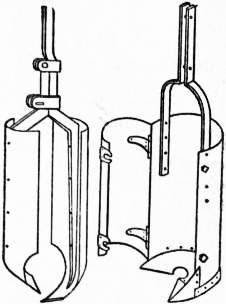
Fig. 1. Fig. 2. Pod Auger.
2. Drive pipes are widely used, both for testing the depth and character of soft material overlying solid rock and as a necessary preliminary to rock boring, when some thickness of surface soil must first be passed through. In its simplest form the drive pipe consists of one or more lengths of wrought iron pipe, open at both ends and from ½ in. to 6 in. diameter. When of small size the pipe is driven by a heavy hammer; for deep and large holes, a light pile-driver becomes necessary. The lower end of the pipe is provided with an annular steel shoe; the upper end has a drivehead for receiving the blows of the hammer. Successive lengths are screwed on as required. For shallow holes the pipe is cleaned out by a “bailer” or “sand-pump”—a cylinder 4 to 6 ft. long, with a valve in the lower end. It is lowered at intervals, filled by being dashed up and down, and then raised and emptied. If, after reaching some depth, the external frictional resistance prevents the pipe from sinking farther, another pipe of small diameter may be inserted and the driving continued. Drive pipes are often sunk by applying weights at the surface and slowly rotating by a lever. Two pipes are then used, one inside the other. Water is pumped down the inner pipe, thus loosening the soil, raising the debris and increasing the speed of driving. The “driven well” for water supply is an adaptation of the drive pipe and put down in the same way.
3. Drill and Rods.—This method has long been used in Europe and elsewhere for deep boring. In the United States it is rarely employed for depths greater than 200 or 300 ft. The usual form of cutting tool or drill is shown in fig. 3. The iron rods are from 1 to 2 in. square, in long lengths with screw joints (fig. 4). Wooden rods are occasionally used. For shallow holes (50 to 75 ft.) the work is done by hand, one or two cross-bars being clamped to the rod. The men alternately raise and drop the drill, meanwhile slowly walking around and around to rotate the bit and so keep the hole true. The cuttings are cleaned out by a bailer, as for drive pipes.
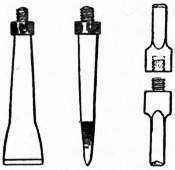
Fig. 3 Drill Bit. Fig. 4. Rod Joint.
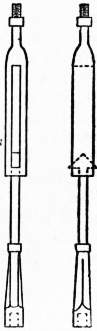
Fig. 5. Sliding Link.
In boring by hand, the practical limit of depth is soon reached, on account of the increasing weight of the rods. For going deeper a “spring-pole” may be used. This is a tapering pole, say 30 ft. long and 5 or 6 in. diameter at the small end. It rests in an inclined position on a fulcrum set about 10 ft. from the butt, the latter being firmly fixed. The rods are suspended from the end of the pole, which extends at a height of several feet over the mouth of the hole. With the aid of the spring of the pole the strokes are produced by a slight effort on the part of the driller. Average speeds of 6 to 10 ft. per 10 hours are easily made, to depths of 200 to 250 ft.
For deep boring the rod system requires a more elaborate plant. The rods are suspended from a heavy “walking beam” or lever, usually oscillated by a steam engine. By means of a screw-feed device, the rods, which are rotated slightly after every stroke, are gradually fed down as the hole is deepened, length after length being added. A tall derrick carries the sheaves and ropes by which the rods and tools are manipulated. The drill bit cannot be attached rigidly to the rods as in shallow boring, because the momentum of the heavy moving parts, transmitted directly to the bit as the blow is struck, would cause excessive vibration and breakage. It becomes necessary, therefore, to introduce a sliding-link joint between the rods and bit. One form of link is shown in fig. 5. On striking its blow, the bit comes to rest, while the rods continue to descend to the end of the stroke, the upper member of the link sliding down upon the lower. Then, on the up stroke the lower link, with the bit, is raised for delivering another blow. For large holes the striking weight is, say, 800 to 1000 ℔, length of stroke 2½ to 5 ft., and speed from 20 to 30 strokes per minute.

Fig. 6. Kind Free-Falling Tool.
By using the sliding link the cross-section and weight of the rods may be greatly reduced, the only strain being that of tension. To deliver a sharp, effective blow, however, the rods must drop with a quick stroke, which brings a heavy strain upon the operating machinery. For overcoming this difficulty, various “free-falling tools” have been devised. By these the bit is allowed to fall by gravity; the rod follows on its measured down stroke, and picks up the bit. Free-falling tools are of two classes: (1) those by which the bit is released automatically; (2) those operated by a sudden twist imparted to the rod by the drillman. One of the best known of the first class is the Kind free-fall (fig. 6). The shank of the bit is gripped and released by the jaws J, J, worked through a toggle joint by movements of the disk D. When the rod begins its downward stroke, the resistance of the water in the hole slightly raises D, thus opening the jaws and releasing the bit, which falls by gravity. On reaching the end of the stroke the jaws again catch the shank of the bit and raise it for delivering another blow. The Fabian free-fall may be noted as an example of the second class (see Köhler, Lehrbuch der Bergbaukunde, p. 57). Tools are sometimes used for cutting an annular groove in the bottom of the hole, and raising to the surface the core so formed, for observing the character of the rock.
4. Rope and Drop Tools.—This method was long ago used in China. Because of its extensive application in the oil-fields it is generally designated in the United States as the “oil-well system.” In its various modifications it is often employed also in general prospecting of mineral deposits and in sinking artesian, natural gas and salt wells. One of its forms is known in England as the Mather & Platt system.
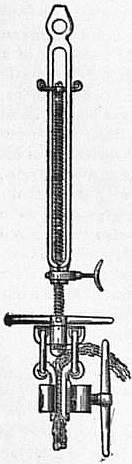
Fig. 7. Temper Screw.
The chief point of difference from rod-boring is the substitution of rope for the jointed rods. For deep boring it possesses the advantage of saving the large amount of time consumed in raising and lowering the rods, as required whenever the hole is to be cleaned out, or a dull bit replaced, since the tools are rapidly run up or down by means of the rope with which they are operated while drilling. The speed of rope-boring is therefore but little affected by increase of depth, while with rod-boring it falls off rapidly. In its simplest form the so-called “string of tools,” suspended from the rope, is composed of the bit or drill, jars and rope-socket. The jars are a pair of sliding links, similar to those used for rod-boring, but serving a different purpose, viz. to produce a sharp shock on the upward stroke, as the jars come together, for loosening the bit should it tend to stick fast in the hole. A heavy bar (auger stem) is generally inserted between the jars and bit, for increasing the force of the blow. The weight of another bar above the jars (sinker-bar) keeps the rope taut. The length of stroke and feed are regulated by the “temper-screw” (fig. 7), a feed device resembling that used for rod-boring. Clamped to it is the drill rope, which is let out at intervals, as the hole is deepened. The bits usually range from 3 to 8 in. diameter, the speed of boring being generally between 20 and 40 ft. per 24 hours, according to the kind of rock. A great variety of special “fishing tools” are made, for use in case of breakage of parts in the hole or other accident.
5. Diamond Drill.—The methods described above are capable of boring holes vertically downward only. By the diamond drill, holes can be bored in any direction, from vertically downward to vertically upward. It has the further advantage of making an annular hole from which is obtained a core, furnishing a practically complete cross-section of the strata penetrated; the thickness and character of each stratum are shown, together with its depth below the surface. Thus, the diamond drill is peculiarly well adapted for prospecting mineral deposits from which samples are desired. The first practical application of diamonds for drilling in rock was made in 1863 by Professor Rudolph Leschot, a civil engineer of Paris.
The apparatus consists essentially of a line of hollow rods, coupled by screw joints, an annular steel bit or crown, set with diamonds, being attached to the lower end. By means of a small engine on the surface the rods are rapidly rotated and fed down automatically as the hole deepened. The speed of rotation is from 300 to 800 revolutions per minute, depending on the character of the rock and diameter of the bit. While boring a stream of water is forced down the hollow rods by a pump, passing back to the surface through the annular space between the rods and the walls of the drill hole. The cuttings are thus carried to the surface, leaving the bottom of the hole clean and unobstructed. For recovering the core and inspecting the bit and diamonds, the rods are raised at every 3 to 8 ft. of depth. This is done by a small drum and rope, operated by the driving engine.
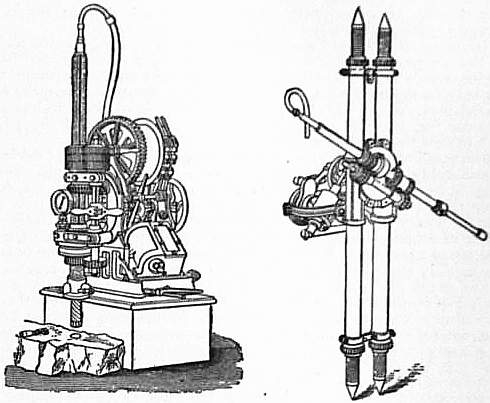
Fig. 8.—Little Champion Rock Drill. Fig. 9.
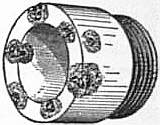
Fig. 10. Diamond Drill Bit.
Diamond drills of standard designs (fig. 8) bore holes from 19⁄16 to 2¾ in. diameter, yielding cores of 1 to 115⁄16 in. diameter, and are capable of reaching depths of a few hundred to 4000 ft. or more. They require from 8 to 30 boiler horse-power. Large machines will bore shallower holes up to 6, 9 or even 12 in. diameter. For operating in underground workings of mines, small and compact machines are sometimes mounted on columns (fig. 9). They bore 1¼ to 19⁄16 in. holes to depths of 300 to 400 ft., cores being 7⁄8 to 1 in. diameter. Hand-power drills are also built. In the South African goldfields several diamond drill holes from 4500 to 5200 ft. deep have been successfully bored. Rates of advance for core-drilling to moderate depths range usually from 2 to 3 ft. per hour, including ordinary delays, though in favourable rock much higher speeds are often attained. In deep holes the speeds diminish, because of time consumed in raising and lowering the rods. If no core is desired a “solid bit” is used. The drilling then proceeds faster, as it is only necessary to raise the rods occasionally, for examining the condition of the bit.
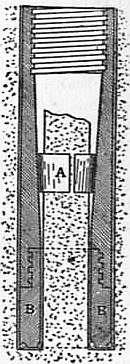
Fig. 11. Core Lifter and Barrel
The driving engine has two inclined cylinders, coupled to a crank-shaft, by which, through gearing, the drill-rod is rotated. The rods are wrought iron or steel tubes, in 5 to 10 ft. lengths. For producing the feed two devices are employed, the differential screw and hydraulic cylinder. For the differential feed (fig. 9) the engine has a hollow left-hand threaded screw-shaft, to which the rods are coupled. This shaft is driven by a spline and bevel gearing and is supported by a threaded feed-nut, carried in the lower bearing. Geared to the screw-shaft is a light counter-shaft. By properly proportioning the number of teeth in the system of gear-wheels, the feed-nut is caused to revolve a little faster than the screw-shaft, so that the drill-rod is fed downward a small fraction of an inch for each revolution. To vary the rate of feed, as suitable for different rocks, three pairs of gears with different ratios of teeth are provided. The screw-shaft and gearing are carried by a swivel-head, which can be rotated in a vertical plane, for boring holes at an angle.
The hydraulic feed is an improvement on the above, in that the rate of feed is independent of the rotative speed of the rods and can be adjusted with the utmost nicety. There are either one or two feed cylinders, supplied with water from the pump. The rod, while rotating freely, is supported by the feed cylinder piston and caused to move slowly downward by allowing the water to pass from the lower to the upper part of the cylinder. A valve regulates the passage of the water and hence the rate of feed.
The bit (fig. 10 and fig. 11, B) is of soft steel, set with six to eight or more diamonds according to its diameter. The diamonds, usually from 1½ to 2½ carats in size, are carefully set in the bit, projecting but slightly from its surface. Two kinds of diamonds are used, “carbons” and “borts.” The carbons are opaque, dark in colour, tougher than the brilliant, and have no cleavage planes. They are therefore suitable for drilling in hard rock. Borts are rough, imperfect brilliants, and are best used for the softer rocks. As the bit wears, the stones must be reset from time to time. The wear of carbons in a well-set bit is small, though extremely variable. Above the bit are the core-lifter and core-barrel. The core-lifter (fig. 11, A) is a device for gripping and breaking off the core and raising it to the surface. The barrel, 3 to 10 ft. long, fits closely in the hole and is often spirally grooved for the passage of the water and debris. It serves partly as a guide, tending to keep the hole straight, partly for holding and protecting the core.
Diamond drills do not work satisfactorily in broken, fissured rock, as the carbons are liable to be injured, loosened or torn from their settings. In these circumstances, and for soft rocks, the diamond bit may be replaced by a steel toothed bit. Another apparatus for core-drilling is the Davis Calyx drill. For hard rock it has an annular bit, accompanied by a quantity of chilled steel shot; for soft rock, a toothed bit is used.
Diamond drill holes are rarely straight, and usually deviate considerably from the direction in which they are started. Very deep holes have been found to vary as much as 45° and even 60° from their true direction. This is due to the fact that the rods do not fit closely in the hole and therefore bend. It is also likely to occur in drilling through inclined strata, specially when of different degrees of hardness. By using a long and closely fitting core-barrel the liability to deviation is reduced, but cannot be wholly prevented. Holes which are nearly horizontal always deflect upward, because the sag of the rods tilts up the bit. Diamond drill holes should therefore always be surveyed. This is done by lowering into the hole instruments for observing at a number of successive points the direction and degree of deviation.1 If accurately surveyed a crooked hole may be quite as useful as a straight one.
Authorities.—For further information on boring see Trans. Amer. Inst. Mining Engs. vol. ii. p. 241, vol. xxvii. p. 123; C. le Neve Foster, Text-book of Ore and Stone Mining, chap. iii.; Glückauf, 9th December 1899, 20th and 27th May 1905; Scientific American, 21st August 1886; Engineering and Mining Jour. vol. lviii. p. 268, vol. lxx. p. 699, vol. lxxx. p. 920; Trans. Inst. Mining Engs., England, vol. xxiii. p. 685; School of Mines Quarterly, N. Y., vol. xvi. p. 1; Zeitschr. für Berg- Hütten- und Salinenwesen, vol. xxv. p. 29; Denny, “Diamond Drilling,” Mines and Minerals, vol. xx., August 1899, p. 7, to January 1900, p. 241; Mining Jour., 26th January 1901; Mining and Scientific Press, 28th November 1903, p. 353; Öst. Zeitschr. für Berg- und Hüttenwesen, 21st May, 4th June 1904; Trans. Inst. Mining and Metallurgy, vol. xii. p. 301; Engineering Magazine, March 1896, p. 1075.
(R. P.*)
1 Brough, Mine Surveying, pp. 276-278; Marriott, Trans. Inst. Mining and Metallurgy, vol. xiv. p. 255.
BORIS FEDOROVICH GODUNOV, tsar of Muscovy (c. 1551-1605), the most famous member of an ancient, now extinct, Russian family of Tatar origin, which migrated from the Horde to Muscovy in the 14th century. Boris’ career of service began at the court of Ivan the Terrible. He is mentioned in 1570 as taking part in the Serpeisk campaign as one of the archers of the guard. In 1571 he strengthened his position at court by his marriage with Maria, the daughter of Ivan’s abominable favourite Malyuta Skuratov. In 1580 the tsar chose Irene, the sister of Boris, to be the bride of the tsarevich Theodore, on which occasion Boris was promoted to the rank of boyar. On his deathbed Ivan appointed Boris one of the guardians of his son and successor; for Theodore, despite his seven-and-twenty years, was of somewhat weak intellect. The reign of Theodore began with a rebellion in favour of the infant tsarevich Demetrius, the son of Ivan’s fifth wife Marie Nagaya, a rebellion resulting in the banishment of Demetrius, with his mother and her relations, to their appanage at Uglich. On the occasion of the tsar’s coronation (May 31, 1584), Boris was loaded with honours and riches, yet he held but the second place in the regency during the lifetime of his co-guardian Nikita Romanovich, on whose death, in August, he was left without any serious rival. A conspiracy against him of all the other great boyars and the metropolitan Dionysy, which sought to break Boris’ power by divorcing the tsar from Godunov’s childless sister, only ended in the banishment or tonsuring of the malcontents. Henceforth Godunov was omnipotent. The direction of affairs passed entirely into his hands, and he corresponded with foreign princes as their equal. His policy was generally pacific, but always most prudent. In 1595 he recovered from Sweden the towns lost during the former reign. Five years previously he had defeated a Tatar raid upon Moscow, for which service he received the title of sluga, an obsolete dignity even higher than that of boyar. Towards Turkey he maintained an independent attitude, supporting an anti-Turkish faction in the Crimea, and furnishing the emperor with subsidies in his war against the sultan. Godunov encouraged English merchants to trade with Russia by exempting them from tolls. He civilized the north-eastern and south-eastern borders of Muscovy by building numerous towns and fortresses to keep the Tatar and Finnic tribes in order. Samara, Saratov, and Tsaritsyn and a whole series of lesser towns derive from him. He also re-colonized Siberia, which had been slipping from the grasp of Muscovy, and formed scores of new settlements, including Tobolsk and other large centres. It was during his government that the Muscovite church received its patriarchate, which placed it on an equality with the other Eastern churches and emancipated it from the influence of the metropolitan of Kiev. Boris’ most important domestic reform was the ukaz (1587) forbidding the peasantry to transfer themselves from one landowner to another, thus binding them to the soil. The object of this ordinance was to secure revenue, but it led to the institution of serfdom in its most grinding form. The sudden death of the tsarevich Demetrius at Uglich (May 15, 1591) has commonly been attributed to Boris, because it cleared his way to the throne; but this is no clear proof that he was personally concerned in that tragedy. The same may be said of the many, often absurd, accusations subsequently brought against him by jealous rivals or ignorant contemporaries who hated Godunov’s reforms as novelties.
On the death of the childless tsar Theodore (January 7, 1598), self-preservation quite as much as ambition constrained Boris to seize the throne. Had he not done so, lifelong seclusion in a monastery would have been his lightest fate. His election was proposed by the patriarch Job, who acted on the conviction that Boris was the one man capable of coping with the extraordinary difficulties of an unexampled situation. Boris, however, would only accept the throne from a Zemsky Sobor, or national assembly, which met on the 17th of February, and unanimously elected him on the 21st. On the 1st of September he was solemnly crowned tsar. During the first years of his reign he was both popular and prosperous, and ruled the people excellently well. Enlightened as he was, he fully recognized the intellectual inferiority of Russia as compared with the West, and did his utmost to bring about a better state of things. He was the first tsar to import foreign teachers on a great scale, the first to send young Russians abroad to be educated, the first to allow Lutheran churches to be built in Russia. He also felt the necessity of a Baltic seaboard, and attempted to obtain Livonia by diplomatic means. He cultivated friendly relations with the Scandinavians, in order to intermarry if possible with foreign royal houses, so as to increase the dignity of his own dynasty. That Boris was one of the greatest of the Muscovite tsars there can be no doubt. But his great qualities were overbalanced by an incurable suspiciousness, which made it impossible for him to act cordially with those about him. His fear of possible pretenders induced him to go so far as to forbid the greatest of the boyars to marry. He also encouraged informers and persecuted suspects on their unsupported statements. The Romanov family in especial suffered severely from these delations. Boris died suddenly (April 13, 1605), leaving one son, Theodore II., who succeeded him for a few months and then was foully murdered by the enemies of the Godunovs.
See Platon Vasilievich Pavlov, On the Historical Significance of the Reign of Boris Godunov (Rus.) (Moscow, 1850); Sergyei Mikhailivich Solovev, History of Russia (Rus.) (2nd ed., vols. vii.-viii., St Petersburg, 1897).
(R. N. B.)
BORISOGLYEBSK, a town of Russia, in the government of Tambov, 100 m. S.S.E. of the city of that name, in 51° 22′ N. lat. and 43° 4′ E. long. It was founded in 1646 to defend the southern frontiers of Muscovy against the Crimean Tatars, and in 1696 was surrounded by wooden fortifications. The principal industries are the preparation of wool, iron-casting, soap-boiling, tallow-melting, and brick-making; and there is an active trade in grain, wool, cattle, and leather, and two important annual fairs. Pop. (1867) 12,254; (1897) 22,370.
BORKU, or Borgu, a region of Central Africa between 17° and 19° N. and 18° and 21° E., forming part of the transitional zone between the arid wastes of the Sahara and the fertile lands of the central Sudan. It is bounded N. by the Tibesti Mountains, and is in great measure occupied by lesser elevations belonging to the same system. These hills to the south and east merge into the plains of Wadai and Darfur. South-west, in the direction of Lake Chad, is the Bodele basin. The drainage of the country is to the lake, but the numerous khors with which its surface is scored are mostly dry or contain water for brief periods only. A considerable part of the soil is light sand drifted about by the wind. The irrigated and fertile portions consist mainly of a number of valleys separated from each other by low and irregular limestone rocks. They furnish excellent dates. Barley is also cultivated. The northern valleys are inhabited by a settled population of Tibbu stock, known as the Daza, and by colonies of negroes; the others are mainly visited by nomadic Berber and Arab tribes. The inhabitants own large numbers of goats and asses.
A caravan route from Barca and the Kufra oasis passes through Borku to Lake Chad. The country long remained unknown to Europeans. Gustav Nachtigal spent some time in it in the year 1871, and gave a valuable account of the region and its inhabitants in his book, Sahara und Sudan (Berlin, 1879-1889). In 1899 Borku, by agreement with Great Britain, was assigned to the French sphere of influence. The country, which had formerly been periodically raided by the Walad Sliman Arabs, was then governed by the Senussi (q.v.), who had placed garrisons in the chief centres of population. From it raids were made on French territory. In 1907 a French column from Kanem entered Borku, but after capturing Ain Galakka, the principal Senussi station, retired. Borku is also called Borgu, but must not be confounded with the Borgu (q.v.) west of the Niger.
A summary of Nachtigal’s writing on Borku will be found in section 28 of Gustav Nachtigal’s Reisen in der Sahara und im Sudan (1 vol.), arranged by Albert Fränkel (Leipzig, 1887). See also an article (with map) by Commdt. Bordeaux in La Géographie, Oct. 1908.
BORKUM, an island of Germany, in the North Sea, belonging to the Prussian province of Hanover, the westernmost of the East Frisian chain, lying between the east and west arms of the estuary of the Ems, and opposite to the Dollart. Pop. about 2500. The island is 5 m. long and 2½ m. broad, is a favourite summer resort, and is visited annually by about 20,000 persons. There is a daily steamboat service with Emden, Leer and Hamburg during the summer months. The island affords pasture for cattle, and a breeding-place for sea-birds.
BORLASE, WILLIAM (1695-1772), English antiquary and naturalist, was born at Pendeen in Cornwall, of an ancient family, on the 2nd of February 1695. He was educated at Exeter College, Oxford, and in 1719 was ordained. In 1722 he was presented to the rectory of Ludgvan, and in 1732 he obtained in addition the vicarage of St Just, his native parish. In the parish of Ludgvan were rich copper works, abounding with mineral and metallic fossils, of which he made a collection, and thus was led to study somewhat minutely the natural history of the county. In 1750 he was admitted a fellow of the Royal Society; and in 1754 he published, at Oxford, his Antiquities of Cornwall (2nd ed., London, 1769). His next publication was Observations on the Ancient and Present State of the Islands of Scilly, and their Importance to the Trade of Great Britain (Oxford, 1756). In 1758 appeared his Natural History of Cornwall. He presented to the Ashmolean museum, Oxford, a variety of fossils and antiquities, which he had described in his works, and received the thanks of the university and the degree of LL.D. He died on the 31st of August 1772. Borlase was well acquainted with most of the leading literary men of the time, particularly with Alexander Pope, with whom he kept up a long correspondence, and for whose grotto at Twickenham he furnished the greater part of the fossils and minerals.
Borlase’s letters to Pope, St Aubyn and others, with answers, fill several volumes of MS. There are also MS. notes on Cornwall, and a complete unpublished treatise Concerning the Creation and Deluge. Some account of these MSS., with extracts from them, was given in the Quarterly Review, October 1875. Borlase’s memoirs of his own life were published in Nichol’s Literary Anecdotes, vol. v.
BORMIO (Ger. Worms), a town of Lombardy, Italy, in the province of Sondrio, 41½ m. N.E. of the town of Sondrio. Pop. (1901) 1814. It is situated in the Valtellina (the valley of the Adda), 4020 ft. above sea-level, at the foot of the Stelvio pass, and, owing to its position, was of some military importance in the middle ages. It contains interesting churches and picturesque towers. A cemetery of pre-Roman date was discovered at Bormio in 1820.
The baths of Bormio, 2 m. farther up the valley, are mentioned by Pliny and Cassiodorus, the secretary of Theodoric, and are much frequented.
BORN, IGNAZ, Edler von (1742-1791), Austrian mineralogist and metallurgist, was born of a noble family at Karlsburg, in Transylvania, on the 26th of December 1742. Educated in a Jesuit college in Vienna, he was for sixteen months a member of the order, but left it and studied law at Prague. Then he travelled extensively in Germany, Holland and France, studying mineralogy, and on his return to Prague in 1770 entered the department of mines and the mint. In 1776 he was appointed by Maria Theresa to arrange the imperial museum at Vienna, where he was nominated to the council of mines and the mint, and continued to reside until his death on the 24th of July 1791. He introduced a method of extracting metals by amalgamation (Über das Anquicken der Erze, 1786), and other improvements in mining and other technical processes. His publications also include Lithophylacium Bornianum (1772-1775) and Bergbaukunde (1789), besides several museum catalogues. Von Born attempted satire with no great success. Die Staatsperücke, a tale published without his knowledge in 1772, and an attack on Father Hell, the Jesuit, and king’s astronomer at Vienna, are two of his satirical works. Part of a satire, entitled Monachologia, in which the monks are described in the technical language of natural history, is also ascribed to him. Von Born was well acquainted with Latin and the principal modern languages of Europe, and with many branches of science not immediately connected with metallurgy and mineralogy. He took an active part in the political changes in Hungary. After the death of the emperor Joseph II., the diet of the states of Hungary rescinded many innovations of that ruler, and conferred the rights of denizen on several persons who had been favourable to the cause of the Hungarians, and, amongst others, on von Born. At the time of his death in 1791, he was employed in writing a work entitled Fasti Leopoldini, probably relating to the prudent conduct of Leopold II., the successor of Joseph, towards the Hungarians.
BORNA, a town of Germany in the kingdom of Saxony, on the Wyhra at its junction with the Pleisse, 17 m. S. by E. of Leipzig by rail. Pop. (1905) 9176. The industries include peat-cutting, iron foundries, organ, pianoforte, felt and shoe factories.
BÖRNE, KARL LUDWIG (1786-1837), German political writer and satirist, was born on the 6th of May 1786 at Frankfort-On-Main, where his father, Jakob Baruch, carried on the business of a banker. He received his early education at Giessen, but as Jews were ineligible at that time for public appointments in Frankfort, young Baruch was sent to study medicine at Berlin under a physician, Markus Herz, in whose house he resided. Young Baruch became deeply enamoured of his patron’s wife, the talented and beautiful Henriette Herz (1764-1847), and gave vent to his adoration in a series of remarkable letters. Tiring of medical science, which he had subsequently pursued at Halle, he studied constitutional law and political science at Heidelberg and Giessen, and in 1811 took his doctor’s degree at the latter university. On his return to Frankfort, now constituted as a grand duchy under the sovereignty of the prince bishop Karl von Dalberg, he received (1811) the appointment of police actuary in that city. The old conditions, however, returned in 1814 and he was obliged to resign his office. Embittered by the oppression under which the Jews suffered in Germany, he engaged in journalism, and edited the Frankfort liberal newspapers, Staatsristretto and Die Zeitschwingen. In 1818 he became a convert to Lutheran protestantism, changing his name from Löb Baruch to Ludwig Börne. This step was taken less out of religious conviction than, as in the case of so many of his descent, in order to improve his social standing. From 1818 to 1821 he edited Die Wage, a paper distinguished by its lively political articles and its powerful but sarcastic theatrical criticisms. This paper was suppressed by the police authorities, and in 1821 Börne quitted for a while the field of publicist writing and led a retired life in Paris, Hamburg and Frankfort. After the July Revolution (1830), he hurried to Paris, expecting to find the newly-constituted state of society somewhat in accordance with his own ideas of freedom. Although to some extent disappointed in his hopes, he was not disposed to look any more kindly on the political condition of Germany; this lent additional zest to the brilliant satirical letters (Briefe aus Paris, 1830-1833, published Paris, 1834), which he began to publish in his last literary venture, La Balance, a revival under its French name of Die Wage. The Briefe aus Paris was Börne’s most important publication, and a landmark in the history of German journalism. Its appearance led him to be regarded as one of the leaders of the new literary party of “Young Germany.” He died at Paris on the 12th of February 1837.
Börne’s works are remarkable for brilliancy of style and for a thorough French vein of satire. His best criticism is to be found in his Denkrede auf Jean Paul (1826), a writer for whom he had warm sympathy and admiration, in his Dramaturgische Blätter (1829-1834), and the witty satire, Menzel der Franzosenfresser (1837). He also wrote a number of short stories and sketches, of which the best known are the Monographie der deutschen Postschnecke (1829) and Der Esskünstler (1822).
The first edition of his Gesammelte Schriften appeared at Hamburg (1829-1834) in 14 volumes, followed by 6 volumes of Nachgelassene Schriften (Mannheim, 1844-1850); more complete is the edition in 12 volumes (Hamburg, 1862-1863), reprinted in 1868 and subsequently. The latest complete edition is that edited by A. Klaar (8 vols., Leipzig, 1900). For further biographical matter see K. Gutzkow, Börnes Leben (Hamburg, 1840), and M. Holzmann, L. Börne, sein Leben und sein Wirken (Berlin, 1888). Börnes Briefe an Henriette Herz (1802-1807), first published in 1861, have been re-edited by L. Geiger (Oldenburg, 1905), who has also published Börne’s Berliner Briefe (1828) (Berlin, 1905). See also Heine’s witty attack on Börne (Werke, ed. Elster, vii.), G. Gervinus’ essay in his Historiche Schriften (Darmstadt, 1838), and the chapters in G. Brandes, Hovedströmninger i det 19 de Aarhundredes Litteratur vol. vi. (Copenhagen, 1890, German trans. 1891; English trans. 1905), and in J. Proelss, Das junge Deutschland (Stuttgart, 1892).
BORNEO, a great island of the Malay Archipelago, extending from 7° N. to 4° 20′ S., and from 108° 53′ to 119° 22′ E. It is 830 m. long from N.E. to S.W., by 600 m. in maximum breadth. Its area according to the calculations of the Topographical Bureau of Batavia (1894) comprises 293,496 sq. m. These figures are admittedly approximate, and Meyer, who is generally accurate, gives the area of Borneo at 289,860 sq. m. It is roughly, however, five times as large as England and Wales. Politically Borneo is divided into four portions: (1) British North Borneo, the territory exploited and administered by the Chartered British North Borneo Company, to which a separate section of this article is devoted; (2) Brunei (q.v.), a Malayan sultanate under British protection; (3) Sarawak (q.v.), the large territory ruled by raja Brooke, and under British protection in so far as its foreign relations are concerned; and (4) Dutch Borneo, which comprises the remainder and by far the largest and most valuable portion of the island.
Physical Features.—The general character of the country is mountainous, though none of the ranges attains to any great elevation, and Kinabalu, the highest peak in the island, which is situated near its north-western extremity, is only 13,698 ft. above sea-level. There is no proper nucleus of mountains whence chains ramify in different directions. The central and west central parts of the island, however, are occupied by three mountain chains and a plateau. These chains are: (1) the folded chain of the upper Kapuas, which divides the western division of Dutch Borneo from Sarawak, extends west to east, and attains near the sources of the Kapuas river a height of 5000 to 6000 ft.; (2) the Schwaner chain, south of the Kapuas, whose summits range from 3000 to 7500 ft., the latter being the height of Bukit Raja, a plateau which divides the waters of the Kapuas from the rivers of southern Borneo; and (3) the Müller chain, between the eastern parts of the Madi plateau (presently to be mentioned) and the Kapuas chain, a volcanic region presenting heights, such as Bukit Terata (4700 ft.), which were once active but are now long extinct volcanos. The Madi plateau lies between the Kapuas and the Schwaner chains. Its height is from 3000 to 4000 ft., and it is clothed with tropical high fens. These mountain systems are homologous in structure with those, not of Celebes or of Halmahera, but of Malacca, Banka and Billiton. From the eastern end of the Kapuas mountains there are further to be observed: (1) A chain running north-north-east, which forms the boundary between Sarawak and Dutch Borneo, the highest peak of which, Gunong Tebang, approaches 10,000 ft. This chain can hardly be said to extend continuously to the extreme north of the island, but it carries on the line of elevation towards the mountains of Sarawak to the west, and those of British North Borneo to the north, of which latter Kinabalu is the most remarkable. The mountains of North Borneo are more particularly referred to in the portion of this article which deals with that territory. (2) A chain which runs eastward from the central mountains and terminates in the great promontory of the east coast, known variously as Cape Kanior or Kaniungan. (3) A well-marked chain running in a south-easterly direction among the congeries of hills that extend south-eastward from the central mountains, and attaining, near the southern part of the east coast, heights up to and exceeding 6000 ft.
Coasts.—Resting on a submarine plateau of no great depth, the coasts of Borneo are for the most part rimmed round by low alluvial lands, of a marshy, sandy and sometimes swampy character. In places the sands are fringed by long lines of Casuarina, trees; in others, and more especially in the neighbourhood of some of the river mouths, there are deep banks of black mud covered with mangroves; in others the coast presents to the sea bold headlands, cliffs, mostly of a reddish hue, sparsely clad with greenery, or rolling hills covered by a growth of rank grass. The depth of the sea around the shore rarely exceeds a maximum depth of 1 to 3 fathoms, and the coast as a whole offers few accessible ports. The towns and seaports are to be found as a rule at or near the mouths of those rivers which are not barricaded too efficiently by bars formed of mud or sand. All round the long coast-line of Dutch Borneo there are only seven ports of call, which are habitually made use of by the ships of the Dutch Packet Company. They are Pontianak, Banjermasin, Kota Bharu, Pasir, Samarinda, Beru and Bulungan. The islands off the coast are not numerous. Excluding some of alluvial formation at the mouths of many of the rivers, and others along the shore which owe their existence to volcanic upheaval, the principal islands are Banguey and Balambangan at the northern extremity, Labuan (q.v.), a British colony off the west coast of the territory of North Borneo, and the Karimata Islands off the south-west coast. On Great Karimata is situated the village of Palembang with a population of about 500 souls employed in fishing, mining for iron, and trading in forest produce.
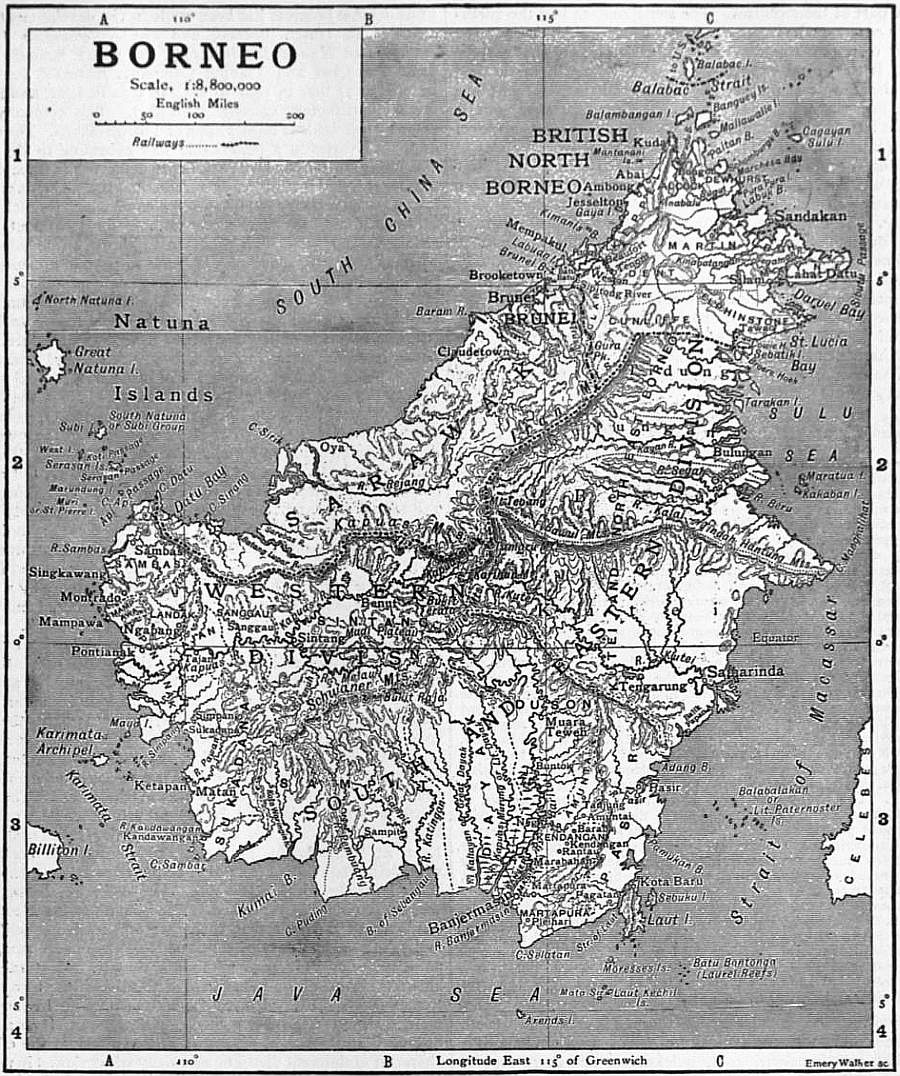
Rivers.—The rivers play a very important part in the economy of Borneo, both as highways and as lines along which run the main arteries of population. Hydrographically the island may be divided into five principal versants. Of these the shortest embraces the north-western slope, north of the Kapuas range, and discharges its waters into the China Sea. The most important of its rivers are the Sarawak, the Batang-Lupar, the Sarebas, the Rejang (navigable for more than 100 m.), the Baram, the Limbang or Brunei river, and the Padas. The rivers of British North Borneo to the north of the Padas are of no importance and of scant practical utility, owing to the fact that the mountain range here approaches very closely to the coast with which it runs parallel. In the south-western versant the largest river is the Kapuas, which, rising near the centre of the island, falls into the sea between Mampawa and Sukadana after a long and winding course. This river, of volume varying with the tide and the amount of rainfall, is normally navigable by small steamers and native prahus, of a draught of 4 to 5 ft., for 300 to 400 m., that is to say, from Pontianak up to Sintang, and thence as far as Benut. The middle part of this river, wider and more shallow than the lower reaches, gives rise to a region of inundation and lakes which extend as far as the northern mountain chain. Among its considerable tributaries may be mentioned the southern Melawi with its affluent the Penuh. It reaches the sea through several channels in a wide marshy delta. The Sambas, north of the Kapuas, is navigable in its lower course for vessels drawing 25 ft. Rivers lying to the south of the Kapuas, but of less importance in the way of size, commerce and navigation, are the Simpang, Pawanand Kandawangan, in the neighbourhood of whose mouths, or upon the adjacent coast, the principal native villages are situated in each case. The Barito, which is the principal river of the southern versant, takes its rise in the Kuti Lama Lake, and falls into the Java Sea in 114° 30′ E. Its upper reaches are greatly impeded by rocks, rapids and waterfalls, but the lower part of its course is wide, and traverses a rich, alluvial district, much of which is marshy. Cross branches unite it with two rivers of considerable size towards the west, the Kapuas Murung or Little Dyak, and the Kahayan or Great Dyak. The Katingan or Mendawei, the Sampit, Pembuang or Surian and the Kota Waringin are rivers that fall into the sea farther to the west. The rivers of the southern versant are waters of capacious drainage, the basin of the Kahayan having, for instance, an area of 16,000 sq. m., and the Barito one of 38,000 sq. m. These rivers are navigable for two-thirds of their course by steamers of a fair size, but in many cases the bars at their mouths present considerable difficulties to ships drawing anything over 8 or 9 ft. Most of the larger affluents of the Barito are also navigable throughout the greater part of their courses. The south-eastern like the north-western corner of the island is watered by a considerable number of short mountain streams. The one great river of the eastern versant is the Kutei or Mahakan, which, rising in the central mountains, flows east with a sinuous course and falls by numerous mounts into the Straits of Madassar. At a great distance from its mouth it has still a depth of three fathoms, and in all its physical features it is comparable to the Kapuas and Barito. The Kayan or Bulungan river is the only other in the eastern versant that calls for mention. Most of the rivers of the northern versant are comparatively small, as the island narrows into a kind of promontory. Of these the Kinabatangan in the territory of British North Borneo is the most important. Lakes are neither numerous nor very large. In most cases they are more fittingly described as swamps. In the flood area of the upper Kapuas, of which mention has already been made, there occurs Lake Luar, and there are several lake expanses of a similar character in the basins of the Barito and Kutei rivers. The only really fine natural harbour in the island of which any use has been made is that of Sandakan, the principal settlement of the North Borneo Company on the north coast.
Geology.—The geology of Borneo is very imperfectly known. The mountain range which lies between Sarawak and the Dutch possessions, and may be looked upon as the backbone of the island, consists chiefly of crystalline schists, together with slates, sandstones and limestones. All these beds are much disturbed and folded. The sedimentary deposits were formerly believed to be Palaeozoic, but Jurassic fossils have since been found in them, and it is probable that several different formations are represented. Somewhat similar rocks appear to form the axis of the range in south-east Borneo, and possibly of the Tampatung Mountains. But the Müller range, the Madi plateau, and the Schwaner Mountains of west Borneo, consist chiefly of almost undisturbed sedimentary and volcanic rocks of Tertiary age. The low-lying country between the mountain ranges is covered for the most part by Tertiary and Quaternary deposits, but Cretaceous beds occur at several localities. Some of the older rocks of the mountain regions have been referred to the Devonian, but the evidence cannot be considered conclusive. Vertebraria and Phyllotheca, plants characteristic of the Indian Gondwana series, have been recorded in Sarawak; and marine forms, similar to those of the lower part of the Australian Carboniferous system, are stated to occur in the limestone of north Borneo. Pseudomonotis salinaria, a Triassic form, has been noted from the schists of the west of Borneo. In the Kapoewas district radiolarian cherts supposed to be of Jurassic age are met with. Undoubted Jurassic fossils, belonging to several horizons, have been described from west Borneo and Sarawak. The Cretaceous beds, which have long been known in west Borneo, are comparatively little disturbed. They consist for the most part of marls with Orbitolina concava, and are referred to the Cenomanian. Cretaceous beds of somewhat later date are found in the Marpapura district in south-east Borneo. The Tertiary system includes conglomerates, sandstones, limestones and marls, which appear to be of Eocene, Oligocene and Miocene age. They contain numerous seams of coal. The Tertiary beds generally lie nearly horizontal and form the lower hills, but in the Madi plateau and the Schwaner range they rise to a height of several thousand feet. Volcanic rocks of Tertiary and late Cretaceous age are extensively developed, especially in the Müller Mountains. The whole of this consists of tuffs and lavas, andesites prevailing in the west and rhyolites and dacites in the east.
Minerals.—The mineral wealth of Borneo is great and varied. It includes diamonds, the majority of which, however, are of a somewhat yellow colour, gold, quicksilver, cinnabar, copper, iron, tin, antimony, mineral oils, sulphur, rock-salt, marble and coal. The exploitation of the mines suffers in many cases from the difficulties and expense of transport, the high duties payable in Dutch Borneo to the native princes, the competition among the rival companies, and often the limited quantities of the minerals found in the mines. The districts of Sambas and Landak in the west, the Kahayan river, the mountain valleys of the extreme south-east and parts of Sarawak furnish the largest quantities of gold, which is obtained for the most part from alluvial washings. The Borneo Company is engaged in working gold-mines in the upper part of the Sarawak valley, and the prospects of the enterprise, which is conducted on a fairly extensive scale, are known to be encouraging. Diamonds are also found widely distributed and mainly in the same regions as the gold. The Kapuas valley has so far yielded the largest quantity, and Pontianak is, for diamonds, the principal port of export. Considerable progress has been made in the development of the oil-fields in Dutch Borneo, and the Nederlandsch Indische Industrie en Handel Maatschappij, the Dutch business of the Shell Transport and Trading Company, increased its output from 123,592 tons in 1901 to 285,720 tons in 1904, and showed further satisfactory increase thereafter. This company owns extensive oil-fields at Balik Papan and Sanga-Sanga. The quality of the oil varies in a remarkable way according to the depth. The upper stratum is struck at a depth of 600 to 700 ft., and yields a natural liquid fuel of heavy specific gravity. The next source is met with at about 1200 ft., yielding an oil which is much lighter in weight and, as such, more suitable for treatment in the refinery. The former oil is almost invariably of an asphalte basis, whereas the latter sometimes is found to contain a considerable percentage of paraffin wax. The average daily production is very high, owing to a large number of the wells flowing under the natural pressure of the gas. There is every reason to believe that the oil-fields of Dutch Borneo have a great future. Coal mines have, in many instances, been opened and abandoned, failure being due to the difficulty of production. Coal of good quality has been found in Pengaron and elsewhere in the Banjermasin district, but most Borneo coal is considerably below this average of excellence. It has also been found in fair quantities at various places in the Kutei valley and in Sarawak. The coalmines of Labuan have been worked spasmodically, but success has never attended the venture. Sadong yields something under 130 tons a day, and the Brooketown mine, the property of the raja of Sarawak, yields some 50 tons a day of rather indifferent coal. The discovery that Borneo produced antimony was made in 1825 by John Crawfurd, the orientalist, who learned in that year that a quantity had been brought to Singapore by a native trader as ballast. The supply is practically unlimited and widely distributed. The principal mine is at Bidi in Sarawak.
Climate and Health.—As is to be anticipated, having regard to its insular position and to the fact that the equator passes through the very middle of the island, the climate is at once hot and very damp. In the hills and in the interior regions are found which may almost be described as temperate, but on the coasts the atmosphere is dense, humid and oppressive. Throughout the average temperature is from 78° to 80° F., but the thermometer rarely falls below 70°, except in the hills, and occasionally on exceptional days mounts as high as 96° in the shade. The rainy westerly winds (S.W. and N.W.) prevail at all the meteorological stations, not the comparatively dry south-east wind. Even at Banjermasin, near the south coast, the north-west wind brings annually a rainfall of 60 in., as against 33 in. of rain carried by the south-east wind. The difference between the seasons is not rigidly marked. The climate is practically unchanging all the year round, the atmosphere being uniformly moist, and though days of continuous downpour are rare, comparatively few days pass without a shower. Most rain falls between November and May, and at this season the torrents are tremendous while they last, and squalls of wind are frequent and violent, almost invariably preceding a downpour. Over such an extensive area there is, of course, great variety in the climatic character of different districts, especially when viewed in relation to health. Some places, such as Bidi in Sarawak, for instance, are notoriously unhealthy; but from the statistics of the Dutch government, and the records of Sarawak and British North Borneo, it would appear that the European in Borneo has in general not appreciably more to fear than his fellow in Java, or in the Federated Malay States of the Malayan Peninsula. Among the native races the prevailing diseases, apart from those of a malarial origin, are chiefly such as arise from bad and insufficient food, from intemperance, and from want of cleanliness. The habit of allowing their meat to putrefy before regarding it as fit for food, and of encouraging children of tender age to drink to intoxication, accounts for absence of old folk and the heavy mortality which are to be observed among the Muruts of British North Borneo and some of the other more debased tribes of the interior of the island. Scrofula and various forms of lupus are common among the natives throughout the country and especially in the interior; elephantiasis is frequently met with on the coast. Smallpox, dysentery and fevers, frequently of a bilious character, are endemic and occasionally epidemic. Cholera breaks out from time to time and works great havoc, as was the case in 1903 when one of the raja of Sarawak’s punitive expeditions was stricken while ascending the Limbang river by boat, and lost many hundreds of its numbers before the coast could be regained. Ophthalmia is common and sometimes will attack whole tribes. About one sixth of the native population of the interior, and a smaller proportion of those living on the coast, suffer from a kind of ringworm called kurap, which also prevails almost universally among the Sakai and Semang, the aboriginal hill tribes of the Malayan Peninsula. The disease is believed to be aggravated by chronic anaemia. Consumption is not uncommon.
Fauna.—The fauna of Borneo comprises a large variety of species, many of which are numerically of great importance. Among the quadrupeds the most remarkable is the orang-utan (Malay, ôrang ûtan, i.e. jungle man), as the huge ape, called mias or mâyas by the natives, is named by Europeans. Numerous species of monkey are found in Borneo, including the wahwah, a kind of gibbon, a creature far more human in appearance and habits than the orang-utan, and several Semnopitheci, such as the long-nosed ape and the golden-black or chrysomelas. The large-eyed Stenops tardigradus also deserves mention. The larger beasts of prey are not met with, and little check is therefore put on the natural fecundity of the graminivorous species. A small panther and the clouded tiger (so called)—Felis macroscelis—are the largest animals of the cat kind that occur in Borneo. The Bengal tiger is not found. The Malay or honey-bear is very common. The rhinoceros and the elephant both occur in the northern part of the island, though both are somewhat rare, and in this connexion it should be noted that the distribution of quadrupeds as between Borneo, Sumatra and the Malayan Peninsula is somewhat peculiar and seemingly somewhat capricious. Many quadrupeds, such as the honey-bear and the rhinoceros, are common to all, but while the tiger is common both in the Malayan Peninsula and in Sumatra, it does not occur in Borneo; the elephant, so common in the peninsula, and found in Borneo, is unknown in Sumatra; and the orang-utan, so plentiful in parts of Borneo and parts of Sumatra, has never been discovered in the Malay Peninsula. It has been suggested, but with very scant measure of probability, that the existence of elephants in Borneo, whose confinement to a single district is remarkable and unexplained, is due to importation; and the fact is on record that when Magellan’s ships visited Brunei in 1522 tame elephants were in use at the court of the sultan of Brunei. Wild oxen of the Sunda race, not to be in any way confounded with the Malayan seladang or gaur, are rare, but the whole country swarms with wild swine, and the babirusa, a pig with curious horn-like tusks, is not uncommon. Alligators are found in most of the rivers, and the gavial is less frequently met with. Three or four species of deer are common, including the mouse-deer, or plandok, an animal of remarkable grace and beauty, about the size of a hare but considerably less heavy. Squirrels, flying-squirrels, porcupines, civet-cats, rats, bats, flying-foxes and lizards are found in great variety; snakes of various kinds, from the boa-constrictor downward, are abundant, while the forests swarm with tree-leeches, and the marshes with horse-leeches and frogs. A remarkable flying-frog was discovered by Professor A.R. Wallace. Birds are somewhat rare in some quarters. The most important are eagles, kites, vultures, falcons, owls, horn-bills, cranes, pheasants (notably the argus, fire-back and peacock-pheasants), partridges, ravens, crows, parrots, pigeons, woodpeckers, doves, snipe, quail and swallows. Of most of these birds several varieties are met with. The Cypselus esculentus, or edible-nest swift, is very common, and the nests, which are built mostly in limestone caves, are esteemed the best in the archipelago. Mosquitoes and sand-flies are the chief insect pests, and in some districts are very troublesome. Several kinds of parasitic jungle ticks cause much annoyance to men and to beasts. There are also two kinds of ants, the sěmut âpi (“fire ant”) and the sěmut lâda (“pepper ant”), whose bites are peculiarly painful. Hornets, bees and wasps of many varieties abound. The honey and the wax of the wild bee are collected by the natives. Butterflies and moths are remarkable for their number, size, variety and beauty. Beetles are no less numerously represented, as is to be expected in a country so richly wooded as Borneo. The swamps and rivers, as well as the surrounding seas, swarm with fish. The siawan is a species of fish found in the rivers and valued for its spawn, which is salted. The natives are expert and ingenious fishermen. Turtles, trepang and pearl-shell are of some commercial importance.
The dog, the cat, the pig, the domestic fowl (which is not very obviously related to the bantam of the woods), the buffalo, a smaller breed than that met with in the Malayan Peninsula, and in some districts bullocks of the Brahmin breed and small horses, are the principal domestic animals. The character of the country and the nomadic habits of many of the natives of the interior, who rarely occupy their villages for more than a few years in succession, have not proved favourable to pastoral modes of life. The buffaloes are used not only in agriculture, but also as beasts of burden, as draught-animals and for the saddle. Horses, introduced by Europeans and owned only by the wealthier classes, are found in Banjermasin and in Sarawak. In British North Borneo, and especially in the district of Tempasuk on the north-west coast, Borneo ponies, bred originally, it is supposed, from the stock which is indigenous to the Sulu archipelago, are common.
Flora.—The flora of Borneo is very rich, the greater portion of the surface of the island being clothed in luxuriant vegetation. The king of the forest is the tapan, which, rising to a great height without fork or branch, culminates in a splendid dome of foliage. The official seats of some of the chiefs are constructed from the wood of this tree. Iron-wood, remarkable for the durability of its timber, is abundant; it is used by the natives for the pillars of their homes and forms an article of export, chiefly to Hong-Kong. It is rivalled in hardness by the kâyu těmběsu. In all, about sixty kinds of timber of marketable quality are furnished in more or less profusion, but the difficulty of extraction, even in the regions situated in close proximity to the large waterways, renders it improbable that the timber trade of Borneo will attain to any very great dimensions until other and easier sources of supply have become exhausted. Palm-trees are abundant in great variety, including the nîpah, which is much used for thatching, the cabbage, fan, sugar, coco and sago palms. The last two furnish large supplies of food to the natives, some copra is exported, and sago factories, mostly in the hands of Chinese, prepare sago for the Dutch and British markets. Gutta-percha (gětah pěrcha in the vernacular), camphor, cinnamon, cloves, nutmegs, gambir and betel, or areca-nuts, are all produced in the island; most of the tropical fruits flourish, including the much-admired but, to the uninitiated, most evil-smelling durian, a large fruit with an exceedingly strong outer covering composed of stout pyramidal spikes, which grows upon the branches of a tall tree and occasionally in falling inflicts considerable injuries upon passers-by. Yams, several kinds of sweet potatoes, melons, pumpkins, cucumbers, pineapples, bananas and mangosteens are cultivated, as also are a large number of other fruits. Rice is grown in irrigated lands near the rivers and in the swamps, and also in rude clearings in the interior; sugar-cane of superior quality in Sambas and Montrado; cotton, sometimes exported in small quantities, on the banks of the Negara, a tributary of the Barito; tobacco, used very largely now in the production of cigars, in various parts of northern Borneo; and tobacco for native consumption, which is of small commercial importance, is cultivated in most parts of the island. Indigo, coffee and pepper have been cultivated since 1855 in the western division of Dutch Borneo. Among the more beautiful of the flowering plants are rhododendrons, orchids and pitcher-plants—the latter reaching extraordinary development, especially in the northern districts about Kinabalu. Epiphytous plants are very common, many that are usually independent assuming here the parasitic character; the Vanda lowii, for example, grows on the lower branches of trees, and its strange pendent flower-stalks often hang down so as almost to reach the ground. Ferns are abundant, but not so varied as in Java.
Population.—The population of Borneo is not known with any approach to accuracy, but according to the political divisions of the island it is estimated as follows:—
Dutch Borneo 1,130,000
British North Borneo 200,000
Sarawak 500,000
Brunei 20,000
No effective census of the population has ever been taken, and vast areas in Dutch Borneo and in British North Borneo remain unexplored, and free from any practical authority or control. In Sarawak, owing to the high administrative genius of the first raja and his successor, the natives have been brought far more completely under control, but the raja has never found occasion to utilize the machinery of his government for the accurate enumeration of his subjects.
Dutch Borneo is divided for administrative purposes into two divisions, the western and the south and eastern respectively. Of the two, the former is under the more complete and effective control. The estimated population in the western division is 413,000 and in the south and eastern 717,000. Europeans number barely 1000; Arabs about 3000, and Chinese, mainly in the western division, over 40,000. In both divisions there is an average density of little more than 1 to every 2 sq. m. The sparseness of the population throughout the Dutch territory is due to a variety of causes—to the physical character of the country, which for the most part restricts the area of population to the near neighbourhood of the rivers; to the low standard of civilization to which the majority of the natives have attained and the consequent disregard of sanitation and hygiene; to wars, piracy and head-hunting, the last of which has not even yet been effectually checked among some of the tribes of the interior; and to the aggression and oppressions in earlier times of Malayan, Arab and Bugis settlers. Among the natives, more especially of the interior, an innate restlessness which leads to a life of spasmodic nomadism, poverty, insufficient nourishment, an incredible improvidence which induces them to convert into intoxicating liquor a large portion of their annual crops, feasts of a semi-religious character which are invariably accompanied by prolonged drunken orgies, and certain superstitions which necessitate the frequent procuration of abortion, have contributed to check the growth of population. In Sambas, Montrado and some parts of Pontianak, the greater density of the population is due to the greater fertility of the soil, the opening of mines, the navigation and trade plied on the larger rivers, and the concentration of the population at the junctions of rivers, the mouths of rivers and the seats of government. Of the chief place in the western division, Pontianak has about 9000 inhabitants; Sambas about 8000; Montrado, Mampawa and Landak between 2000 and 4000 each; and in the south and eastern division there are Banjermasin with nearly 50,000 inhabitants; Marabahan, Amuntai, Negara, Samarinda and Tengarung with populations of from 5000 to 10,000 inhabitants each. In Amuntai and Martapura early Hindu colonization, of which the traces and the influence still are manifest, the fertile soil, trade and industry aided by navigable rivers, have co-operated towards the growth of population to a degree which presents a marked contrast to the conditions in the interior parts of the Upper Barito and of the more westerly rivers. Only a very small proportion of the Europeans in Dutch Borneo live by agriculture and industry, the great majority of them being officials. The Arabs and Chinese are engaged in trading, mining, fishing and agriculture. Of the natives fully 90% live by agriculture, which, however, is for the most part of a somewhat primitive description. The industries of the natives are confined to such crafts as spinning and weaving and dyeing, the manufacture of iron weapons and implements, boat- and shipbuilding, &c. More particularly in the south-eastern division, and especially in the districts of Negara, Banjermasin, Amuntai and Martapura, shipbuilding, iron forging, gold- and silversmith’s work, and the polishing of diamonds, are industries of high development in the larger centres of population.
Races.—The peoples of Borneo belong to a considerable variety of races, of different origin and degrees of civilization. The most important numerically are the Dyaks, the Dusuns and Muruts of the interior, the Malays, among whom must be counted such Malayan tribes as the Bajaus, Ilanuns, &c., the Bugis, who were originally immigrants from Celebes, and the Chinese. The Dutch, and to a minor extent the Arabs, are of importance on account of their political influence in Dutch Borneo, while the British communities have a similar importance in Sarawak and in British North Borneo. Accounts of the Malays, Dyaks and Bugis are given under their several headings, and some information concerning the Dusuns and Muruts will be found in the section below, which deals with British North Borneo. The connexion of the Chinese with Borneo calls for notice here. They seem to have been the first civilized people who had dealings with Borneo, if the colonization of a portion of the south-eastern corner of the island by Hindus be excepted. The Chinese annals speak of tribute paid to the empire by Pha-la on the north-east coast of the island as early as the 7th century, and later documents mention a Chinese colonization in the 15th century. The traditions of the Malays and Dyaks seem to confirm the statements, and many of the leading families of Brunei in north-west Borneo claim to have Chinese blood in their veins, while the annals of Sulu record an extensive Chinese immigration about 1575. However this may be, it is certain that the flourishing condition of Borneo in the 16th and 17th centuries was largely due to the energy of Chinese settlers and to trade with China. In the 18th century there was a considerable Chinese population settled in Brunei, engaged for the most part in planting and exporting pepper, but the consistent oppression of the native rajas destroyed their industry and led eventually to the practical extirpation of the Chinese. The Malay chiefs of other districts encouraged immigration from China with a view to developing the mineral resources of their territories, and before long Chinese settlers were to be found in considerable numbers in Sambas, Montrado, Pontianak and elsewhere. They were at first forbidden to engage in commerce or agriculture, to carry firearms, to possess or manufacture gunpowder. About 1779 the Dutch acquired immediate authority over all strangers, and thus assumed responsibility for the control of the Chinese, who presently proved themselves somewhat troublesome. Their numbers constantly increased and were reinforced by new immigrants, and pushing inland in search of fresh mineral-bearing areas, they contracted frequent intermarriages with the Dyaks and other non-Mahommedan natives. They brought with them from China their aptitude for the organization of secret societies which, almost from the first, assumed the guise of political associations. These secret societies furnished them with a machinery whereby collective action was rendered easy, and under astute leaders they offered a formidable opposition to the Dutch government. Later, when driven into the interior and eventually out of Dutch territory, they cost the first raja of Sarawak some severe contests before they were at last reduced to obedience. Serious disturbances among the Chinese are now in Borneo matters of ancient history, and to-day the Chinaman forms perhaps the most valuable element in the civilization and development of the island, just as does his fellow in the mining states of the Malayan Peninsula. They are industrious, frugal and intelligent; the richer among them are excellent men of business and are peculiarly equitable in their dealings; the majority of all classes can read and write their own script, and the second generation acquires an education of an European type with great facility. The bulk of the shopkeeping, trading and mining industries, so long as the mining is of an alluvial character, is in Chinese hands. The greater part of the Chinese on the west coast are originally drawn from the boundaries of Kwang-tung and Kwang-si. They are called Kehs by the Malays, and are of the same tribes as those which furnish the bulk of the workers to the tin mines of the Malay Peninsula. They are a rough and hardy people, and are apt at times to be turbulent. The shopkeeping class comes mostly from Fuh-kien and the coast districts of Amoy. They are known to the Borneans as Ollohs.