VOLUME IV SLICE III Borgia, Lucrezia to Bradford, John (continued 7)
Reading edition
Bougainville’s name is given to the largest member of the Solomon Islands, which belongs to Germany; and to the strait which divides it from the British island of Choiseul. It is also applied to the strait between Mallicollo and Espiritu Santo Islands of the New Hebrides group, and the South American climbing plant Bougainvillea, often cultivated in greenhouses, is named after him.
BOUGHTON, GEORGE HENRY (1834-1905), Anglo-American painter, was born in England, but his parents went to the United States in 1839, and he was brought up at Albany, N.Y. He studied art in Paris in 1861-62, and subsequently lived mainly in London; he was much influenced by Frederick Walker, and the delicacy and grace of his pictures soon made his reputation. He was elected an A.R.A. in 1879, and R.A. in 1896, and a member of the National Academy of Design in New York in 1871. His pictures of Dutch life and scenery were especially characteristic; and his subject-pictures, such as the “Return of the Mayflower” and “The Scarlet Letter,” were very popular in America.
BOUGIE, a seaport of Algeria, chief town of an arrondissement in the department of Constantine, 120 m. E. of Algiers. The town, which is defended by a wall built since the French occupation, and by detached forts, is beautifully situated on the slope of Mount Guraya. Behind it are the heights of Mounts Babor and Tababort, rising some 6400 ft. and crowned with forests of pinsapo fir and cedar. The most interesting buildings in the town are the ancient forts, Borj-el-Ahmer and Abd-el-Kader, and the kasbah or citadel, rectangular in form, flanked by bastions and towers, and bearing inscriptions stating that it was built by the Spaniards in 1545. Parts of the Roman wall exist, and considerable portions of that built by the Hammadites in the 11th century. The streets are very steep, and many are ascended by stairs. The harbour, sheltered from the east by a breakwater, was enlarged in 1897-1902. It covers 63 acres and has a depth of water of 23 to 30 ft. Bougie is the natural port of Kabylia, and under the French rule its commerce—chiefly in oils, wools, hides and minerals—has greatly developed; a branch railway runs to Beni Mansur on the main line from Constantine to Oran. Pop. (1906) of the town, 10,419; of the commune, 17,540; of the arrondissement, which includes eight communes, 37,711.
Bougie, if it be correctly identified with the Saldae of the Romans, is a town of great antiquity, and probably owes its origin to the Carthaginians. Early in the 5th century Genseric the Vandal surrounded it with walls and for some time made it his capital. En-Nasr (1062-1088), the most powerful of the Berber dynasty of Hammad, made Bougie the seat of his government, and it became the greatest commercial centre of the North African coast, attaining a high degree of civilization. From an old MS. it appears that as early as 1068 the heliograph was in common use, special towers, with mirrors properly arranged, being built for the purpose of signalling. The Italian merchants of the 12th and 13th centuries owned numerous buildings in the city, such as warehouses, baths and churches. At the end of the 13th century Bougie passed under the dominion of the Hafsides, and in the 15th century it became one of the strongholds of the Barbary pirates. It enjoyed partial independence under amirs of Hafside origin, but in January 1510 was captured by the Spaniards under Pedro Navarro. The Spaniards strongly fortified the place and held it against two attacks by the corsairs Barbarossa. In 1555, however, Bougie was taken by Salah Rais, the pasha of Algiers. Leo Africanus, in his Africae descriptio, speaks of the “magnificence” of the temples, palaces and other buildings of the city in his day (c. 1525), but it appears to have fallen into decay not long afterwards. When the French took the town from the Algerians in 1833 it consisted of little more than a few fortifications and ruins. It is said that the French word for a candle is derived from the name of the town, candles being first made of wax imported from Bougie.
BOUGUER, PIERRE (1698-1758), French mathematician, was born on the 16th of February 1698. His father, John Bouguer, one of the best hydrographers of his time, was regius professor of hydrography at Croisic in lower Brittany, and author of a treatise on navigation. In 1713 he was appointed to succeed his father as professor of hydrography. In 1727 he gained the prize given by the Académie des Sciences for his paper “On the best manner of forming and distributing the masts of ships”; and two other prizes, one for his dissertation “On the best method of observing the altitude of stars at sea,” the other for his paper “On the best method of observing the variation of the compass at sea.” These were published in the Prix de l’Académie des Sciences. In 1729 he published Essai d’optique sur la gradation de la lumière, the object of which is to define the quantity of light lost by passing through a given extent of the atmosphere. He found the light of the sun to be 300 times more intense than that of the moon, and thus made some of the earliest measurements in photometry. In 1730 he was made professor of hydrography at Havre, and succeeded P.L.M. de Maupertuis as associate geometer of the Académie des Sciences. He also invented a heliometer, afterwards perfected by Fraunhofer. He was afterwards promoted in the Academy to the place of Maupertuis, and went to reside in Paris. In 1735 Bouguer sailed with C.M. de la Condamine for Peru, in order to measure a degree of the meridian near the equator. Ten years were spent in this operation, a full account of which was published by Bouguer in 1749, Figure de la terre déterminée. His later writings were nearly all upon the theory of navigation. He died on the 15th of August 1758.
The following is a list of his principal works:—Traité d’optique sur la gradation de la lumière (1729 and 1760); Entretiens sur la cause d’inclinaison des orbites des planètes (1734); Traité de navire, &c. (1746, 4to); La Figure de la terre déterminée, &c. (1749), 4to; Nouveau traité de navigation, contenant la théorie et la pratique du pilotage (1753); Solution des principaux problèmes sur la manoeuvre des vaisseaux (1757); Opérations faites pour la vérification du degré du méridien entre Paris et Amiens, par Mess. Bouguer, Camus, Cassini et Pingré(1757).
See J.E. Montucla, Histoire des mathématiques (1802).
BOUGUEREAU, ADOLPHE WILLIAM (1825-1905), French painter, was born at La Rochelle on the 30th of November 1825. From 1843 till 1850 he went through the course of training at the École des Beaux-Arts, and in 1850 divided the Grand Prix de Rome scholarship with Baudry, the subject set being “Zenobia on the banks of the Araxes.” On his return from Rome in 1855 he was employed in decorating several aristocratic residences, deriving inspiration from the frescoes which he had seen at Pompeii and Herculaneum, and which had already suggested his “Idyll” (1853). He also began in 1847 to exhibit regularly at the Salon. “The Martyr’s Triumph,” the body of St Cecilia borne to the catacombs, was placed in the Luxembourg after being exhibited at the Paris Exhibition of 1855; and in the same year he exhibited “Fraternal Love,” a “Portrait” and a “Study.” The state subsequently commissioned him to paint the emperor’s visit to the sufferers by the inundations at Tarascon. In 1857 Bouguereau received a first prize medal. Nine of his panels executed in wax-painting for the mansion of M. Bartholomy were much discussed—“Love,” “Friendship,” “Fortune,” “Spring,” “Summer,” “Dancing,” “Arion on a Sea-horse,” a “Bacchante” and the “Four Divisions of the Day.” He also exhibited at the Salon “The Return of Tobit” (now in the Dijon gallery). While in antique subjects he showed much grace of design, in his “Napoleon,” a work of evident labour, he betrayed a lack of ease in the treatment of modern costume. Bouguereau subsequently exhibited “Love Wounded” (1859), “The Day of the Dead” (at Bordeaux), “The First Discord” (1861, in the Club at Limoges), “The Return from the Fields” (a picture in which Théophile Gautier recognized “a pure feeling for the antique”), “A Fawn and Bacchante” and “Peace”; in 1863 a “Holy Family,” “Remorse,” “A Bacchante teasing a Goat” (in the Bordeaux gallery); in 1864 “A Bather” (at Ghent), and “Sleep”; in 1865 “An Indigent Family,” and a portrait of Mme Bartholomy; in 1866 “A First Cause,” and “Covetousness,” with “Philomela and Procne”; and some decorative work for M. Montlun at La Rochelle, for M. Emile Péreire in Paris, and for the churches of St Clotilde and St Augustin; and in 1866 the large painting of “Apollo and the Muses on Olympus,” in the Great Theatre at Bordeaux. Among other works by this artist may be mentioned “Between Love and Riches” (1869), “A Girl Bathing” (1870), “In Harvest Time” (1872), “Nymphs and Satyrs” (1873), “Charity” and “Homer and his Guide” (1874), “Virgin and Child,” “Jesus and John the Baptist,” “Return of Spring” (which was purchased by an American collector, and was destroyed by a fanatic who objected to the nudity), a “Pietà” (1876), “A Girl defending herself from Love” (1880), “Night” (1883), “The Youth of Bacchus” (1884), “Biblis” (1885), “Love Disarmed” (1886), “Love Victorious” (1887), “The Holy Women at the Sepulchre” and “The Little Beggar Girls” (1890), “Love in a Shower” and “First Jewels” (1891). To the Exhibition of 1900 were contributed some of Bouguereau’s best-known pictures. Most of his works, especially “The Triumph of Venus” (1856) and “Charity,” are popularly known through engravings. “Prayer,” “The Invocation” and “Sappho” have been engraved by M. Thirion, “The Golden Age” by M. Annetombe. Bouguereau’s pictures, highly appreciated by the general public, have been severely criticized by the partisans of a freer and fresher style of art, who have reproached him with being too content to revive the formulas and subjects of the antique. At the Paris Exhibition of 1867 Bouguereau took a third-class medal, in 1878 a medal of honour, and the same again in the Salon of 1885. He was chosen by the Society of French Artists to be their vice-president, a post he filled with much energy. He was made a member of the Legion of Honour in 1856, an officer of the Order 26th of July 1876, and commander 12th of July 1885. He succeeded Isidore Pils as member of the Institute, 8th of January 1876. He died on the 20th of August 1905.
See Ch. Vendryes, Catalogue illustré des œuvres de Bouguereau (Paris, 1885); Jules Claretie, Peintres et sculpteurs contemporains (Paris, 1874); P.G. Hamerton, French Painters; Artistes modernes: dictionnaire illustré des beaux-arts (1885); “W. Bouguereau,” Portfolio (1875); Émile Bayard, “William Bouguereau,” Monde moderne (1897).
BOUHOURS, DOMINIQUE (1628-1702), French critic, was born in Paris in 1628. He entered the Society of Jesus at the age of sixteen, and was appointed to read lectures on literature in the college of Clermont at Paris, and on rhetoric at Tours. He afterwards became private tutor to the two sons of the duke of Longueville. He was sent to Dunkirk to the Romanist refugees from England, and in the midst of his missionary occupations published several books. In 1665 or 1666 he returned to Paris, and published in 1671 Les Entretiens d’Ariste et d’Eugène, a critical work on the French language, printed five times at Paris, twice at Grenoble, and afterwards at Lyons, Brussels, Amsterdam, Leiden, &c. The chief of his other works are La Manière de bien penser sur les ouvrages d’esprit (1687), Doutes sur la langue française (1674), Vie de Saint Ignace de Loyola (1679), Vie de Saint François Xavier (1682), and a translation of the New Testament into French (1697). His practice of publishing secular books and works of devotion alternately led to the mot, ”qu’il servait le monde et le ciel par semestre.” Bouhours died at Paris on the 27th of May 1702.
See Georges Doucieux, Un Jésuite homme de lettres au dix-septième siècle: Le père Bouhours (1886). For a list of Bouhours’ works see Backer and Sommervogel, Bibliothèque de la Compagnie de Jésus, i. pp. 1886 et seq.
BOUILHET, LOUIS HYACINTHE (1822-1869), French poet and dramatist, was born at Cany, Seine Inférieure, on the 27th of May 1822. He was a schoolfellow of Gustave Flaubert, to whom he dedicated his first work, Méloenis (1851), a narrative poem in five cantos, dealing with Roman manners under the emperor Commodus. His volume of poems entitled Fossiles attracted considerable attention, on account of the attempt therein to use science as a subject for poetry. These poems were included also in Festons et astragales (1859). As a dramatist he secured a success with his first play, Madame de Montarcy (1856), which ran for seventy-eight nights at the Odéon; and Hélène Peyron (1858) and L’Oncle Million (1860) were also favourably received. But of his other plays, some of them of real merit, only the Conjuration d’Amboise (1866) met with any great success. Bouilhet died on the 18th of July 1869, at Rouen. Flaubert published his posthumous poems with a notice of the author, in 1872.
See also Maxime du Camp, Souvenirs littéraires (1882); and H. de la Ville de Mirmont, Le Poète Louis Bouilhet (1888).
BOUILLÉ, FRANÇOIS CLAUDE AMOUR, Marquis de (1739-1800), French general. He served in the Seven Years’ War, and as governor in the Antilles conducted operations against the English in the War of American Independence. On his return to France he was named governor of the Three Bishoprics, of Alsace and of Franche-Comté. Hostile to the Revolution, he had continual quarrels with the municipality of Metz, and brutally suppressed the military insurrections at Metz and Nancy, which had been provoked by the harsh conduct of certain noble officers. Then he proposed to Louis XVI. to take refuge in a frontier town where an appeal could be made to other nations against the revolutionists. When this project failed as a result of Louis XVI.’s arrest at Varennes, Bouillé went to Russia to induce Catherine II. to intervene in favour of the king, and then to England, where he died in 1800, after serving in various royalist attempts on France. He left Mémoires sur la Révolution française depuis son origine jusqu’à la retraite du duc de Brunswick (Paris, 1801).
BOUILLON, formerly the seat of a dukedom in the Ardennes, now a small town in the Belgian province of Luxemburg. Pop. (1904) 2721. It is most picturesquely situated in the valley under the rocky ridge on which are still the very well preserved remains of the castle of Godfrey of Bouillon (q.v.), the leader of the first crusade. The town, 690 ft. above the sea, but lying in a basin, skirts both banks of the river Semois which is crossed by two bridges. The stream forms a loop round and almost encircles the castle, from which there are beautiful views of the sinuous valley and the opposite well-wooded heights. The whole effect of the grim castle, the silvery stream and the verdant woods makes one of the most striking scenes in Belgium. In the 8th and 9th centuries Bouillon was one of the castles of the counts of Ardenne and Bouillon. In the 10th and 11th centuries the family took the higher titles of dukes of Lower Lorraine and Bouillon. These dukes all bore the name of Godfrey (Godefroy) and the fifth of them was the great crusader. He was the son of Eustace, count of Boulogne, which has led many commentators into the error of saying that Godfrey of Bouillon was born at the French port, whereas he was really born in the castle of Baisy near Genappe and Waterloo. His mother was Ida d’Ardenne, sister of the fourth Godfrey (“the Hunchback”), and the successful defence of the castle when a mere youth of seventeen on her behalf was the first feat of arms of the future conqueror of Jerusalem. This medieval fortress, strong by art as well as position before the invention of modern artillery, has since undergone numerous sieges. In order to undertake the crusade Godfrey sold the castle of Bouillon to the prince bishop of Liége, and the title of duke of Bouillon remained the appendage of the bishopric till 1678, or for 580 years. The bishops appointed “châtelains,” one of whom was the celebrated “Wild Boar of the Ardennes,” William de la Marck. His descendants made themselves quasi-independent and called themselves princes of Sedan and dukes of Bouillon, and they were even recognized by the king of France. The possession of Bouillon thenceforward became a constant cause of strife until in 1678 Louis XIV. garrisoned it under the treaty of Nijmwegen. From 1594 to 1641 the duchy remained vested in the French family of La Tour d’Auvergne, one of whom (Henry, viscount of Turenne and marshal of France) had married in 1591 Charlotte de la Marck, the last of her race. In 1676 the duke of Créquy seized it in the name of Louis XIV., who in 1678 gave it to Godefroy Marie de La Tour d’Auvergne, whose descendants continued in possession till 1795. Bouillon remained French till 1814, and Vauban called it “the key of the Ardennes.” In 1760 the elder Rousseau established here the famous press of the Encyclopaedists. In 1814-1815, before the decrees of the Vienna Congress were known, an extraordinary attempt was made by Philippe d’Auvergne of the British navy, the cousin and adopted son of the last duke, to revive the ancient duchy of Bouillon. The people of Bouillon freely recognized him, and Louis XVIII. was well pleased with the arrangement, but the congress assigned Bouillon to the Netherlands. Napoleon III. on his way to Germany after Sedan slept one night in the little town, which is a convenient centre for visiting that battlefield.
BOUILLOTTE, a French game of cards, very popular during the Revolution, and again for some years from 1830. Five, four or three persons may play; a piquet pack is used, from which, in case five play, the sevens, when four the knaves, and when three the queens also, are omitted. Counters or chips, as in poker, are used. Before the deal each player “antes” one counter, after which each, the “age” passing, may “raise” the pot; those not “seeing the raise” being obliged to drop out. Three cards are dealt to each player, and a thirteenth, called the retourne, when four play, turned up. Each player must then bet, call, raise or drop out. When a call is made the hands are shown and the best hand wins. The hands rank as follows: brélan carré, four of a kind, one being the retourne; simple brélan, three of a kind, ace being high; brélan favori, three of a kind, one being the retourne. When no player holds a brélan the hand holding the greatest number of pips wins, ace counting 11, and court cards 10.
BOUILLY, JEAN NICOLAS (1763-1842), French author, was born near Tours on the 24th of January 1763. At the outbreak of the Revolution he held office under the new government, and had a considerable share in the organization of primary education. In 1799 he retired from public life to devote himself to literature. His numerous works include the musical comedy, Pierre le Grand (1790), for Grétry’s music, and the opera, Les Deux Journées (1800), music by Cherubini; also L’Abbé de l’épée (1800), and some other plays; and Causeries d’un vieillard (1807), Contes à ma fille (1809), and Les Adieux du vieux conteur (1835). His Léonore (1798) formed the basis of the libretto of the Fidelio of Beethoven. Bouilly died in Paris on the 14th of April 1842.
See Bouilly, Mes récapitulations (3 vols., 1836-1837); E. Legouvé, Soixante ans de souvenir (lère partie, 1886).
BOULAINVILLIERS, HENRI, Comte de (1658-1722), French political writer, was born at St Saire in Normandy in 1658. He was educated at the college of Juilly, and served in the army until 1697. He wrote a number of historical works (published after his death), of which the most important were the following: Histoire de l’ancien gouvernement de la France (La Haye, 1727); État de la France, avec des mémoires sur l’ancien gouvernement (London, 1727); Histoire de la pairie de France (London, 1753); Histoire des Arabes (1731). His writings are characterized by an extravagant admiration of the feudal system. He was an aristocrat of the most pronounced type, attacking absolute monarchy on the one hand and popular government on the other. He was at great pains to prove the pretensions of his own family to ancient nobility, and maintained that the government should be entrusted solely to men of his class. He died in Paris on the 23rd of January 1722.
BOULANGER, the name of several French artists:—Jean (1606-1660), a pupil of Guido Reni at Bologna, who had an academy at Modena; his cousin Jean (1607-1680), a celebrated line-engraver; the latter’s son Matthieu, another engraver; Louis (1806-1867), a subject-painter, the friend of Victor Hugo, and director of the imperial school of art at Dijon; the best-known, Gustave Rodolphe Clarence (1824-1888), a pupil of Paul Delaroche, a notable painter of Oriental and Greek and Roman subjects, and a member of the Institute (1882); and Clément (1805-1842), a pupil of Ingres.
BOULANGER, GEORGE ERNEST JEAN MARIE (1837-1891), French general, was born at Rennes on the 29th of April 1837. He entered the army in 1856, and served in Algeria, Italy, Cochin-China and the Franco-German War, earning the reputation of being a smart soldier. He was made a brigadier-general in 1880, on the recommendation of the duc d’Aumale, then commanding the VII. army corps, and Boulanger’s expressions of gratitude and devotion on this occasion were remembered against him afterwards when, as war minister in M. Freycinet’s cabinet, he erased the name of the due d’Aumale from the army list, as part of the republican campaign against the Orleanist and Bonapartist princes. In 1882 his appointment as director of infantry at the war office enabled him to make himself conspicuous as a military reformer; and in 1884 he was appointed to command the army occupying Tunis, but was recalled owing to his differences of opinion with M. Cambon, the political resident. He returned to Paris, and began to take part in politics under the aegis of M. Clémenceau and the Radical party; and in January 1886, when M. Freycinet was brought into power by the support of the Radical leader, Boulanger was given the post of war minister.
By introducing genuine reforms for the benefit of officers and common soldiers alike, and by laying himself out for popularity in the most pronounced fashion—notably by his fire-eating attitude towards Germany in April 1887 in connexion with the Schnaebele frontier incident—Boulanger came to be accepted by the mob as the man destined to give France her revenge for the disasters of 1870, and to be used simultaneously as a tool by all the anti-Republican intriguers. His action with regard to the royal princes has already been referred to, but it should be added that Boulanger was taunted in the Senate with his ingratitude to the duc d’Aumale, and denied that he had ever used the words alleged. His letters containing them were, however, published, and the charge was proved. Boulanger fought a bloodless duel with the baron de Lareinty over this affair, but it had no effect at the moment in dimming his popularity, and on M. Freycinet’s defeat in December 1886 he was retained by M. Goblet at the war office. M. Clémenceau, however, had by this time abandoned his patronage of Boulanger, who was becoming so inconveniently prominent that, in May 1887, M. Goblet was not sorry to get rid of him by resigning. The mob clamoured for their “brav’ général,” but M. Rouvier, who next formed a cabinet, declined to take him as a colleague, and Boulanger was sent to Clermont-Ferrand to command an army corps. A Boulangist “movement” was now in full swing. The Bonapartists had attached themselves to the general, and even the comte de Paris encouraged his followers to support him, to the dismay of those old-fashioned Royalists who resented Boulanger’s treatment of the duc d’Aumale. His name was the theme of the popular song of the moment—“C’est Boulanger qu’il nous faut”; the general and his black horse became the idol of the Parisian populace; and he was urged to play the part of a plebiscitary candidate for the presidency.
The general’s vanity lent itself to what was asked of it; after various symptoms of insubordination had shown themselves, he was deprived of his command in 1888 for twice coming to Paris without leave, and finally on the recommendation of a council of inquiry composed of five generals, his name was removed from the army list. He was, however, almost at once elected to the chamber for the Nord, his political programme being a demand for a revision of the constitution. In the chamber he was in a minority, since genuine Republicans of all varieties began to see what his success would mean, and his actions were accordingly directed to keeping the public gaze upon himself. A popular hero survives many deficiencies, and neither his failure as an orator nor the humiliation of a discomfiture in a duel with M. Floquet, then an elderly civilian, sufficed to check the enthusiasm of his following. During 1888 his personality was the dominating feature of French politics, and, when he resigned his seat as a protest against the reception given by the chamber to his revisionist proposals, constituencies vied with one another in selecting him as their representative. At last, in January 1889, he was returned for Paris by an overwhelming majority. He had now become an open menace to the parliamentary Republic. Had Boulanger immediately placed himself at the head of a revolt he might at this moment have effected the coup d’état which the intriguers had worked for, and might not improbably have made himself master of France; but the favourable opportunity passed. The government, with M. Constans as minister of the interior, had been quietly taking its measures for bringing a prosecution against him, and within two months a warrant was signed for his arrest. To the astonishment of his friends, on the 1st of April he fled from Paris before it could be executed, going first to Brussels and then to London. It was the end of the political danger, though Boulangist echoes continued for a little while to reverberate at the polls during 1889 and 1890. Boulanger himself, having been tried and condemned in absentia for treason, in October 1889 went to live in Jersey, but nobody now paid much attention to his doings. The world was startled, however, on the 30th of September 1891 by hearing that he had committed suicide in a cemetery at Brussels by blowing out his brains on the grave of his mistress, Madame de Bonnemains (née Marguerite Crouzet), who had died in the preceding July.
See also the article France: History; and Verly, Le Général Boulanger et la conspiration monarchique (Paris, 1893).
(H. Ch.)
BOULAY DE LA MEURTHE, ANTOINE JACQUES CLAUDE JOSEPH, Comte (1761-1840), French politician and magistrate, son of an agricultural labourer, was born at Chamousey (Vosges) on the 19th of February 1761. Called to the bar at Nancy in 1783, he presently went to Paris, where he rapidly acquired a reputation as a lawyer and a speaker. He supported the revolutionary cause in Lorraine, and fought at Valmy (1792) and Wissembourg (1793) in the republican army. But his moderate principles brought suspicion on him, and during the Terror he had to go into hiding. He represented La Meurthe in the Council of Five Hundred, of which he was twice president, but his views developed steadily in the conservative direction. Fearing a possible renewal of the Terror, he became an active member of the plot for the overthrow of the Directory in November 1799. He was rewarded by the presidency of the legislative commission formed by Napoleon to draw up the new constitution; and as president of the legislative section of the council of state he examined and revised the draft of the civil code. In eight years of hard work as director of a special land commission he settled the titles of land acquired by the French nation at the Revolution, and placed on an unassailable basis the rights of the proprietors who had bought this land from the government. He received the grand cross of the Legion of Honour and the title of count, was a member of Napoleon’s privy council, but was never in high favour at court. After Waterloo he tried to obtain the recognition of Napoleon II. He was placed under surveillance at Nancy, and later at Halberstadt and Frankfort-on-Main. He was allowed to return to France in 1819, but took no further active part in politics, although he presented himself unsuccessfully for parliamentary election in 1824 and 1827. He died in Paris on the 4th of February 1840. He published two books on English history—Essai sur les causes qui, en 1649, amenèrent en Angleterre l’établissement de la république (Paris, 1799), and Tableau politique des regnes de Charles II et Jacques II, derniers rois de la maison de Stuart (The Hague, 1818)—which contained much indirect criticism of the Directory and the Restoration governments. He devoted the last years of his life to writing his memoirs, which, with the exception of a fragment on the Théorie constitutionnelle de Sieyès (1836), remained unpublished.
His elder son, Comte Henri Georges Boulay de la Meurthe (1797-1858), was a constant Bonapartist, and after the election of Louis Napoleon to the presidency, was named (January 1849) vice-president of the republic. He zealously promoted popular education, and became in 1842 president of the society for elementary instruction.
BOULDER, a city and the county-seat of Boulder county, Colorado, U.S.A., about 30 m. N.W. of Denver. Pop. (1890) 3330; (1900) 6150 (693 foreign-born); (1910) 9539. It is served by the Union Pacific, the Colorado & Southern, and the Denver, Boulder & Western railways; the last connects with the neighbouring mining camps, and affords fine views of mountain scenery. Boulder lies about 5300 ft. above the sea on Middle Boulder Creek, a branch of the St Vrain river about 30 m. from its confluence with the Platte, and has a beautiful situation in the valley at the foot of the mountains. The state university of Colorado, established at Boulder by an act of 1861, was opened in 1877; it includes a college of liberal arts, school of medicine (1883), school of law (1892), college of engineering (1893), graduate school, college of commerce (1906), college of education (1908), and a summer school (1904), and has a library of about 42,000 volumes. There are a fine park of 2840 acres, the property of the city, and three beautiful cañons near Boulder. At the southern limits, in a beautiful situation 400 ft. above the city, are the grounds of an annual summer school, the Colorado Chautauqua. The climate is beneficial for those afflicted with bronchial and pulmonary troubles; the average mean annual temperature for eleven years ending with 1907 was 51° F. There are medicinal springs in the vicinity. The water-works are owned and operated by the city, the water being obtained from lakes at the foot of the Arapahoe Peak glacier in the Snowy Range, 20 m. from the city. The surrounding country is irrigated, and successfully combines agriculture and mining. There are ore sampling works and brick-making establishments. Oil and natural gas abound in the vicinity; there are oil refineries in the city; and in Boulder county, especially at Nederland, 18 m. south-west, and at Eldora, about 22 m. south-west of the city, has been obtained since 1900 most of the tungsten mined in the United States; the output in 1907 was valued at about $520,000. The first settlement near the site of Boulder was made in the autumn of 1858. Placer gold was discovered on an affluent of Boulder Creek in January 1859. The town was laid out and organized in February 1859, and a city charter was secured in 1871 and another in 1882.
BOULDER (short for “boulder-stone,” of uncertain origin; cf. Swed. bullersten, a large stone which causes a noise of rippling water in a stream, from bullra, to make a loud noise), a large stone, weathered or water-worn; especially a geological term for a large mass of rock transported to a distance from the formation to which it belongs. Similarly, in mining, a mass of ore found at a distance from the lode.
BOULDER CLAY, in geology, a deposit of clay, often full of boulders, which is formed in and beneath glaciers and ice-sheets wherever they are found, but is in a special sense the typical deposit of the Glacial Period in northern Europe and America. Boulder clay is variously known as “till” or “ground moraine” (Ger. Blocklehme, Geschiebsmergel or Grundmoräne; Fr. argile à blocaux, moraine profonde; Swed. Krosstenslera). It is usually a stiff, tough clay devoid of stratification; though some varieties are distinctly laminated. Occasionally, within the boulder clay, there are irregular lenticular masses of more or less stratified sand, gravel or loam. As the boulder clay is the result of the abrasion (direct or indirect) of the older rocks over which the ice has travelled, it takes its colour from them; thus, in Britain, over Triassic and Old Red Sandstone areas the clay is red, over Carboniferous rocks it is often black, over Silurian rock it may be buff or grey, and where the ice has passed over chalk the clay may be quite white and chalky (chalky boulder clay). Much boulder clay is of a bluish-grey colour where unexposed, but it becomes brown upon being weathered.
The boulders are held within the clay in an irregular manner, and they vary in size from mere pellets up to masses many tons in weight. Usually they are somewhat oblong, and often they possess a flat side or “sole”; they may be angular, sub-angular, or well rounded, and, if they are hard rocks, they frequently bear grooves and scratches caused by contact with other rocks while held firmly in the moving ice. Like the clay in which they are borne, the boulders belong to districts over which the ice has travelled; in some regions they are mainly limestones or sandstones; in others they are granite, basalts, gneisses, &c.; indeed, they may consist of any hard rock. By the nature of the contained boulders it is often possible to trace the path along which a vanished ice-sheet moved; thus in the Glacial drift of the east coast of England many Scandinavian rocks can be recognized.
With the exception of foraminifera which have been found in the boulder clay of widely separated regions, fossils are practically unknown; but in some maritime districts marine shells have been incorporated with the clay. See Glacial Period; and Glacier.
BOULĒ (Gr. βουλή, literally “will,” “advice”; hence a “council”), the general term in ancient Greece for an advisory council. In the loose Homeric state, as in all primitive societies, there was a council of this kind, probably composed of the heads of families, i.e. of the leading princes or nobles, who met usually on the summons of the king for the purpose of consultation. Sometimes, however, it met on its own initiative, and laid suggestions before the king. It formed a means of communication between the king and the freemen assembled in the Agora. In Dorian states this aristocratic form of government was retained (for the Spartan Council of Elders see Gerousia). In Athens the ancient council was called the Boule until the institution of a democratic council, or committee of the Ecclesia, when, for purposes of distinction, it was described as “the Boulē on the Areopagus,” or, more shortly, “the Areopagus” (q.v.). It must be clearly understood that the second, or Solonian Boule, was entirely different from the Areopagus which represented the Homeric Council of the King throughout Athenian history, even after the “mutilation” carried out by Ephialtes. Further, it is, as will appear below, a profound mistake to call the second Boule a “senate.” There is no real analogy between the Roman senate and the Athenian council of Five Hundred.
Before describing the Athenian Boule, the only one of its kind of which we have even fairly detailed information, it is necessary to mention that councils existed in other Greek states also, both oligarchic and democratic. A Boulē was in the first place a necessary part of a Greek oligarchy; the transition from monarchy to oligarchy was nominally begun by the gradual transference of the powers of the monarch to the Boule of nobles. Further, in the Greek democracy, the larger democratic Boule was equally essential. The general assembly of the people was utterly unsuited to the proper management of state affairs in all their minutiae. We therefore find councils of both kinds in almost all the states of Greece. (1) At Corinth we learn that there was an oligarchic council of unknown numbers presided over by eight leaders (Nicol. Damasc. Frag. 60). It was probably like the old Homeric council, except that its constitution did not depend on a birth qualification, but on a high census. This was natural in Corinth where, according to Herodotus (ii. 167), mercantile pursuits bore no stigma. (2) From an inscription we learn that the Athenians, in imposing a constitution on Erythrae (about 450 B.C.), included a council analogous to their own. (3) In Elis (Thuc. v. 47) there was an aristocratic council of ninety, which was superseded by a popular council of six hundred (471). (4) Similarly in Argos there were an aristocratic council of eighty and later a popular council of much larger size (Thuc. v. 47). Councils are also found at (5) Rhodes, (6) Megalopolis (democratic), (7) Corcyra (democratic), (Thuc. iii. 70). Of these seven the most instructive is that of Erythrae, which proves that in the 5th century the Council of Five Hundred was so efficient in Athens that a similar body was imposed at Erythrae (and probably in the other tributary cities).
The Boulē at Athens. History.—The origin of the second Boulē, or Council of Four Hundred, at Athens is involved in obscurity. In the Aristotelian Constitution of Athens (c. 4), it is stated that Draco established a council of 401, and that he transferred to it some of the functions of the Council of Areopagus (q.v.). It is, however, generally held (see Draco) that this statement is untrue, and that it was Solon who first established the council as a part of the constitution. Thirdly, it has been held that the council was not invented either by Draco or by Solon, but was of older and unknown origin. Fourthly, it has also been maintained by some recent writers that no Boulē existed before Cleisthenes. The principal evidence for this view is the omission of any reference to the Boulē in one of the earliest Athenian inscriptions, that relating to Salamis (Hicks and Hill, No. 4), where in place of the customary formula of a later age, ἔδοξε τῇ βουλῇ καὶ τῷ δήμῳ, we have the formula ἔδοχσεν τῷ δήμῳ. This argument is far from conclusive, and it is clear from the Constitution (c. 20) that the resistance of the Boulē to Cleomenes and Isagoras was anterior to the legislation of Cleisthenes (i.e. that the Boulē in question was the Solonian and not the Cleisthenian). On the whole it is reasonable to conclude that it was Solon who invented the Boulē to act as a semi-democratic check upon the democracy, whose power he was increasing at the expense of the oligarchs by giving new powers to the people in the Ecclesia and the Dicasteries. Practically nothing is known of the operations of this council until the struggle between Isagoras and Cleisthenes (Herod, v. 72). Solon’s council had been based on the four Ionic tribes. When Cleisthenes created the new ten tribes in order to destroy the local influence of dominant families and to give the country demes a share in government, he changed the Solonian council into a body of 500 members, 50 from each tribe. This new body (see below) was the keystone of the Cleisthenean democracy, and may be said in a sense to have embodied the principle of local representation. After Cleisthenes, the council remained unaltered till 306 B.C., when, on the addition of two new tribes named after Antigonus and his son, Demetrius Poliorcetes, its numbers were increased to 600. In A.D. 126-127 the old number of 500 was restored. A council of 750 members is mentioned in an inscription of the early 3rd century A.D., and about A.D. 400 the number of councillors had fallen to 300.
Constitution and Functions.—(a) Under Solon the council consisted of 400 members, 100 from each of the four Ionic tribes. It is certain that all classes were eligible except the Thētes, but the method of appointment is not known. Solon’s council. Three suggestions have been made, (1) that each tribe chose its representatives, (2) that they were chosen by lot from qualified citizens in rotation, (3) that the combined method of selection by lot from a larger number of elected candidates was employed. According to the passage in Plutarch’s Solon the functions of this body were from the first probouleutic (i.e. it prepared the business for the Ecclesia). Others hold that this function was not assigned to it until the Cleisthenean reforms. When we consider, however, the double danger of leaving the Ecclesia in full power, and yet under the presidency of the aristocratic archons, it seems probable that the probouleutic functions were devised by Solon as a method of maintaining the balance. On this hypothesis the Solonian Boulē was from the first what it certainly was later, a committee of the Ecclesia, i.e. not a “senate.” It may be regarded as certain Cleisthenes’ council. that the system of Prytaneis was the invention of Cleisthenes, not of Solon. (b) Under Cleisthenes the council reached its full development as a democratic representative body. Its actual organization is still uncertain, but it may be inferred that it became gradually a more strictly self-existent body than the Solonian council. Every full citizen of thirty years of age was eligible, and, unlike other civil offices, it was permissible to serve twice, but not more than twice (Ath. Pol. c. 62). It may be regarded as certain, although our evidence is derived from inscriptions which date from the 3rd century B.C., that from the first the Bouleutae were appointed by the demes, in numbers proportionate to the size of the deme, and that from the first also the method of sortition was employed. For each councillor chosen by lot, a substitute was chosen in case of death or disgrace. After nomination each had to pass before the old council an examination in which the whole of his private life was scrutinized. After this, the councillors had to take an oath that they (1) would act according to the laws, (2) would give the best advice in their power, and (3) would carry out the examination of their successors in an impartial spirit. As symbols of office they wore wreaths; they received payment originally at the rate of one drachma a day,1 at the end of the 4th century of five obols a day. At the end of the year of office each councillor had to render an account of his work, and if the council had done well the people voted crowns of honour. Within its own sphere the council exercised disciplinary control over its members by the device known as Ecphyllophoria; it could provisionally suspend a member, pending a formal trial before the whole council assembled ad hoc. The council had further a complete system of scribes or secretaries (grammateis), private treasury officials, and a paid herald who summoned the Boule and the Ecclesia. The meetings took place generally in the council hall (Bouleuterion), but on special occasions in the theatre, the stadium, the dockyards, the Acropolis or the Theseum. They were normally public, the audience being separated by a barrier, but on occasions of peculiar importance the public was excluded.
The Ecclesia, owing to its size and constitution, was unable to meet more than three or four times a month; the council, on the other hand, was in continuous session, except on feast days. It was impossible that the Five Hundred Prytaneis. should all sit every day, and, therefore, to facilitate the despatch of business, the system of Prytaneis was introduced, probably by Cleisthenes. By this system the year was divided into ten equal periods. During each of these periods the council was represented by the fifty councillors of one of the ten tribes, who acted as a committee for carrying on business for a tenth of the year. Each of these committees was led by a president (Epistates), who acted as chairman of the Boule and the Ecclesia also, and a third of its numbers lived permanently during their period of office in the Tholos (Dome) or Skias, a round building where they (with certain other officials and honoured citizens) dined at the public expense. In 378-377 B.C. (or perhaps in the archonship of Eucleides, 403) the presidency of the Ecclesia was transferred to the Epistates of the Proedri, the Proedri being a body of nine chosen by lot by the Epistates of the Prytaneis from the remaining nine tribes. It was the duty of the Boule (i.e. the Prytany which was for the time in session) to prepare all business for the consideration of the Ecclesia. Their recommendation (προβούλευμα) was presented to the popular assembly (for procedure, see Ecclesia), which either passed it as it stood or made amendments subject to certain conditions. It must be clearly understood that the recommendation of the council had no intrinsic force until by the votes of the Ecclesia it passed into law as a psephism. But in addition to this function, the Council of the Five Hundred had large administrative and judicial control. (1) It was before the council that the Poletae arranged the farming of public revenues, the receipt of tenders for public works and the sale of confiscated property; further, it dealt with defaulting collectors (ἑκλόγεις), exacted the debts of private persons to the state, and probably drew up annual estimates. (2) It supervised the treasury payments of the Apodectae (“Receivers”) and the “Treasurers of the God.” (3) From Demosthenes (In Androt.) it is clear that it had to arrange for the provision of so many triremes per annum and the award of the trierarchic crown. (4) It arranged for the maintenance of the cavalry and the special levies from the demes. (5) It heard certain cases of eisangelia (impeachment) and had the right to fine up to 500 drachmas, or hand the case over to the Heliaea. The cases which it tried were mainly prosecutions for crimes against the state (e.g. treason, conspiracy, bribery). In later times it acted mainly as a court of first instance. Subsequently (Ath. Pol. c. 45) its powers were limited and an appeal was allowed to the popular courts. (6) The council presided over the dokimasia (consideration of fitness) of the magistrates; this examination, which was originally concerned with a candidate’s moral and physical fitness, degenerated into a mere inquiry into his politics. (7) In foreign affairs the council as the only body in permanent session naturally received foreign envoys and introduced them to the Ecclesia. Further, the Boulē;, with the Strategi (“Generals”), took treaty oaths, after the Ecclesia had decided on the terms. The Xenophontic Politeia states that the council of the 5th century was “concerned with war,” but in the 4th century it chiefly supervised the docks and the fleet. On two occasions at least the council was specially endowed with full powers; Demosthenes (De Fals. Leg. p. 389) states that the people gave it full powers to send ambassadors to Philip, and Andocides (De Myst. 14 foil.) states that it had full power to investigate the affair of the mutilation of the Hermae on the night before the sailing of the Sicilian Expedition.
It will be seen that this democratic council was absolutely essential to the working of the Athenian state. Without having any final legislative authority, it was a necessary part of the legislative machinery, and it may be regarded as certain that a large proportion of its recommendations were passed without alteration or even discussion by the Ecclesia. The Boulē was, therefore, in the strict sense a committee of the Ecclesia, and was immediately connected with a system of sub-committees which exercised executive functions.
Bibliography.—With this article compare Ecclesia, Strategus, Archon, Draco, Solon, Cleisthenes, where collateral information is given. Besides the chief histories of Greece (Grote, ed. 1907, Meyer &c.), see Gilbert, Constitutional Antiquities (Eng. trans. by E.J. Brooks and T. Nicklin, 1895); J.B. Bury, History of Greece (1900); A.H.J. Greenidge Handbook of Greek Constitutional History (1896); J.E. Sandys’ edition of the Constitution of Athens; Boeckh, Die Staatshaushaltung der Athener (1886); Schumann, Griechische Altertümer (1897-1902); Busolt, Die griechischen Staats- und Rechtsaltertümer (1902). See also H. Swoboda, Die griechischen Volksbeschlüsse (1890); Szanto, Das griechische Bürgerrecht (1892); Perrot, Essai sur le droit public d’Athènes (1869). It should be observed that all works published before 1891 are so far useless that they are without the information contained in the Constitution of Athens (q.v.). See also Greek Law.
(J. M. M.)
1 The institution of pay for the councillors may safely be ascribed to Pericles although we have no direct evidence of it before 411 B.C. (Thuc. viii. 69; see Pericles).
BOULEVARD (a Fr. word, earlier boulevart, from Dutch or Ger. Bollwerk, cf. Eng. “bulwark”), originally, in fortification, an earthwork with a broad platform for artillery. It came into use owing to the width of the gangways in medieval walls being insufficient for the mounting of artillery thereon. The boulevard or bulwark was usually an earthen outwork mounting artillery, and so placed in advance as to prevent the guns of a besieger from battering the foot of the main walls. It was as a rule circular. Semicircular demi-boulevards were often constructed round the bases of the old masonry towers with the same object. In modern times the word is most frequently used to denote a promenade laid out on the site of a former fortification, and, by analogy, a broad avenue in a town planted with rows of trees.
BOULLE, ANDRÉ CHARLES (1642-1732), French cabinet-maker, who gave his name to a fashion of inlaying known as Boulle or Buhl work. The son of Jean Boulle, a member of a family of ébénistes who had already achieved distinction—Pierre Boulle, who died c. 1636, was for many years tourneur et menuisier du roy des cabinets d’ébène,—he became the most famous of his name and was, indeed, the second cabinet-maker—the first was Jean Macé—who has acquired individual renown. That must have begun at a comparatively early age, for at thirty he had already been granted one of those lodgings in the galleries of the Louvre which had been set apart by Henry IV. for the use of the most talented of the artists employed by the crown. To be admitted to these galleries was not only to receive a signal mark of royal favour, but to enjoy the important privilege of freedom from the trammels of the trade gilds. Boulle was given the deceased Jean Macé’s own lodging in 1672 by Louis XIV. upon the recommendation, of Colbert, who described him as “le plus habile ébéniste de Paris,” but in the patent conferring this privilege he is described also as “chaser, gilder and maker of marqueterie.” Boulle appears to have been originally a painter, since the first payment to him by the crown of which there is any record (1669) specifies “ouvrages de peinture.” He was employed for many years at Versailles, where the mirrored walls, the floors of “wood mosaic,” the inlaid panelling and the pieces in marqueterie in the Cabinet du Dauphin were regarded as his most remarkable work. These rooms were long since dismantled and their contents dispersed, but Boulle’s drawings for the work are in the Musée des Arts Décoratifs. His royal commissions were, indeed, innumerable, as we learn both from the Comptes des bâtiments and from the correspondence of Louvois. Not only the most magnificent of French monarchs, but foreign princes and the great nobles and financiers of his own country crowded him with commissions, and the mot of the abbé de Marolles, “Boulle y tourne en ovale,” has become a stock quotation in the literature of French cabinet-making. Yet despite his distinction, the facility with which he worked, the high prices he obtained, and his workshops full of clever craftsmen, Boulle appears to have been constantly short of money. He did not always pay his workmen, clients who had made considerable advances failed to obtain the fine things they had ordered, more than one application was made for permission to arrest him for debt under orders of the courts within the asylum of the Louvre, and in 1704 we find the king giving him six months’ protection from his creditors on condition that he used the time to regulate his affairs or “ce scra la derniére grâce que sa majesté lui fera là-dessus.” Twenty years later one of his sons was arrested at Fontainebleau and kept in prison for debt until the king had him released. In 1720 his finances were still further embarrassed by a fire which, beginning in another atelier, extended to his twenty workshops and destroyed most of the seasoned materials, appliances, models and finished work of which they were full. The salvage was sold and a petition for pecuniary help was sent to the regent, the result of which does not appear. It would seem that Boulle was never a good man of business, but, according to his friend Mariette, many of his pecuniary difficulties were caused by his passion for collecting pictures, engravings and other objects of art—the inventory of his losses in the fire, which exceeded £40,000 in amount, enumerates many old masters, including forty-eight drawings by Raphael and the manuscript journal kept by Rubens in Italy. He attended every sale of drawings and engravings, borrowed at high interest to pay for his purchases, and when the next sale took place, fresh expedients were devised for obtaining more money. Collecting was to Boulle a mania of which, says his friend, it was impossible to cure him. Thus he died in 1732, full of fame, years and debts. He left four sons who followed in his footsteps in more senses than one—Jean Philippe (born before 1690, dead before 1745), Pierre Benoit (d. 1741), Charles André (1685-1749) and Charles Joseph (1688-1754). Their affairs were embarrassed throughout their lives, and the three last are known to have died in debt.
All greatness is the product of its opportunities, and the elder Boulle was made by the happy circumstances of his time. He was born into a France which was just entering upon the most brilliant period of sumptuary magnificence which any nation has known in modern times. Louis XIV., so avid of the delights of the eye, by the reckless extravagance of his example turned the thoughts of his courtiers to domestic splendours which had hitherto been rare. The spacious palaces which arose in his time needed rich embellishment, and Boulle, who had not only inherited the rather flamboyant Italian traditions of the late Renaissance, but had ébénisterie in his blood, arose, as some such man invariably does arise, to gratify tastes in which personal pride and love of art were not unequally intermingled. He was by no means the first Frenchman to practise the delightful art of marqueterie, nor was he quite the inventor of the peculiar type of inlay which is chiefly associated with his name; but no artist, before or since, has used these motives with such astonishing skill, courage and surety. He produced pieces of monumental solidity blazing with harmonious colour, or gleaming with the sober and dignified reticence of ebony, ivory and white metal. The Renaissance artists chiefly employed wood in making furniture, ornamenting it with gilding and painting, and inlaying it with agate, cornelian, lapis-lazuli, marble of various tints, ivory, tortoise-shell, mother-of-pearl and various woods. Boulle improved upon this by inlaying brass devices into wood or tortoise-shell, which last he greatly used according to the design he had immediately in view, whether flowers, scenes, scrolls, &c.; to these he sometimes added enamelled metal. Indeed the use of tortoise-shell became so characteristic that any furniture, however cheap and common, which has a reddish fond that might by the ignorant be mistaken for inlay, is now described as “Buhl”—the name is the invention of the British auctioneer and furniture-maker. In this process the brass is thin, and, like the ornamental wood or tortoise-shell, forms a veneer. In the first instance the production of his work was costly, owing to the quantity of valuable material that was cut away and wasted, and, in addition, the labour lost in separately cutting for each article or copy of a pattern. By a subsequent improvement Boulle effected an economy by gluing together various sheets of material and sawing through the whole, so that an equal number of figures and matrices were produced at one operation. Boulle adopted from time to time various plans for the improvement of his designs. He placed gold-leaf or other suitable material under the tortoise-shell to produce such effect as he required; he chased the brass-work with a graver for a like purpose, and, when the metal required to be fastened down with brass pins or nails, these were hammered flat and disguised by ornamental chasing. He also adopted, in relief or in the round, brass feet, brackets, edgings, and other ornaments of appropriate design, partly to protect the corners and edges of his work, and partly for decoration. He subsequently used other brass mountings, such as claw-feet to pedestals, or figures in high or low relief, according to the effect he desired to produce. These mounts in the pieces that undoubtedly come from Boulle’s atelier are nearly always of the greatest excellence. They were cast in the rough—the tools of the chaser gave them their sharpness, their minute finish, their jewel-like smoothness.
Unhappily it is by no means easy, even for the expert, to declare the authenticity of a commode, a bureau, or a table in the manner of Boulle and to all appearance from his workshops. His sons unquestionably carried on the traditions for some years after his death, and his imitators were many and capable. A few of the more magnificent pedigree-pieces are among the world’s mobiliary treasures. There are, for instance, the two famous armoires, which fetched £12,075 at the Hamilton Palace sale; the marqueterie commodes, enriched with bronze mounts, in the Bibliotheque Mazarine; various cabinets and commodes and tables in the Louvre, the Musée Cluny and the Mobilier National; the marriage coffers of the dauphin which were in the San Donato collection. There are several fine authenticated pieces in the Wallace collection at Hertford House, together with others consummately imitated, probably in the Louis Seize period. On the rare occasions when a pedigree example comes into the auction-room, it invariably commands a high price; but there can be little doubt that the most splendid and sumptuous specimens of Boulle are diminishing in number, while the second and third classes of his work are perhaps becoming more numerous. The truth is that this wonderful work, with its engraved or inlaid designs of Bérain, its myriads of tiny pieces of ivory and copper, ebony and tortoise-shell, all kept together with glue and tiny chased nails, and applied very often to a rather soft, white wood, is not meet to withstand the ravages of time and the variations of the atmosphere. Alternate heat and humidity are even greater enemies of inlaid furniture than time and wear—such delicate things are rarely much used, and are protected from ordinary chances of deterioration. There is consequently reason to rejoice when a piece of real artistry in furniture finds its final home in a museum, where a degree of warmth is maintained which, however distressing it may be to the visitor, at least preserves the contents from one of the worst enemies of the collector.
(J. P.-B.)
BOULOGNE, or Boullongne, the name of a family of French painters. Louis (1609-1674), who was one of the original members of the Academy of Painting and Sculpture (1648), became celebrated under Louis XIV. His traditions were continued by his children: Genevieve (1645-1708), who married the sculptor Jacques Clerion; Madeleine (1646-1710), whose work survives in the Trophies d’armes at Versailles; Bon (1649-1717), a successful teacher and decorative artist; and Louis the younger (1654-1733), who copied Raphael’s cartoons for the Gobelins tapestry, and besides taking a high place as a painter was also a designer of medals.
BOULOGNE-SUR-MER, a fortified seaport of northern France and chief town of an arrondissement in Pas-de-Calais, situated on the shore of the English Channel at the mouth of the river Liane, 157 m. N.N.W. of Paris on the Northern railway, and 28 m. by sea S.E. of Folkestone, Kent. Pop. (1906) 49,636. Boulogne occupies the summit and slopes of a ridge of hills skirting the right bank of the Liane; the industrial quarter of Capécure extends along the opposite bank, and is reached by two bridges, while the river is also crossed by a double railway viaduct. The town consists of two parts, the Haute Ville and the Basse Ville. The former, situated on the top of the hill, is of comparatively small extent, and forms almost a parallelogram, surrounded by ramparts of the 13th century, and, outside them, by boulevards, and entered by ancient gateways. In this part are the law court, the château and the hotel de ville (built in the 18th century), and a belfry tower of the 13th and 17th centuries is in the immediate neighbourhood. In the château (13th century) now used as barracks, the emperor Napoleon III was confined after the abortive insurrection of 1840. At some distance north-west stands the church of Notre-Dame, a well-known place of pilgrimage, erected (1827-1866) on the site of an old building destroyed in the Revolution, of which the extensive crypt still remains. The modern town stretches from the foot of the hill to the harbour, along which it extends, terminating in an expanse of sandy beach frequented by bathers, and provided with a bathing establishment and casino. It contains several good streets, some of which are, however, very steep. A main street, named successively rue de la Lampe, St Nicolas and Grande rue, extends from the bridge across the Liane to the promenade by the side of the ramparts. This is intersected first by the Quai Gambetta, and farther back by the rue Victor Hugo and the rue Nationale, which contain the principal shops. The public buildings include several modern churches, two hospitals and a museum with collections of antiquities, natural history, porcelain, &c. Connected with the museum is a public library with 75,000 volumes and a number of valuable manuscripts, many of them richly illuminated. There are English churches in the town, and numerous boarding-schools intended for English pupils. Boulogne is the seat of a sub-prefect, and has tribunals of first instance and of commerce, a board of trade-arbitrators, a chamber of commerce and a branch of the Bank of France. There are also communal colleges, a national school of music, and schools of hydrography, commerce and industry. Boulogne has for a long time been one of the most anglicized of French cities; and in the tourist season a continuous stream of English travellers reach the continent at this point.
The harbour is formed by the mouth of the Liane. Two jetties enclose a channel leading into the river, which forms a tidal basin with a depth at neap-tides of 24 ft. Alongside this is an extensive dock, and behind it an inner port. There is also a tidal basin opening off the entrance channel. The depth of water in the river-harbour is 33 ft. at spring-tide and 24 ft. at neap-tide; in the sluice of the dock the numbers are 29½ and 23½ respectively. The commerce of Boulogne consists chiefly in the importation of jute, wool, woven goods of silk and wool skins, threads, coal, timber, and iron and steel, and the exportation of wine, woven goods, table fruit, potatoes and other vegetables, skins, motor-cars, forage and cement. The average annual value of the exports in the five years 1901-1905 was £10,953,000 (£11,704,000 in the years 1896-1900), and of the imports £6,064,000 (£7,003,000 in the years 1896-1900). From 1901 to 1905 the annual average of vessels entered, exclusive of fishing-smacks, was 2735, tonnage 1,747,699; and cleared 2750, tonnage 1,748,297. The total number of passengers between Folkestone and Boulogne in 1906 was 295,000 or 49% above the average for the years 1901-1905. These travelled by the steamers of the South-Eastern & Chatham railway company. The liners of the Dutch-American, Hamburg-American and other companies also call at the port. In the extent and value of its fisheries Boulogne is exceeded by no seaport in France. The most important branch is the herring-fishery; next in value is the mackerel. Large quantities of fresh fish are transmitted to Paris by railway, but an abundant supply is reserved to the town itself. The fishermen live for the most part in a separate quarter called La Beurrière, situated in the upper part of the town. In 1905 the fisheries of Boulogne and the neighbouring village of Étaples employed over 400 boats and 4500 men, the value of the fish taken being estimated at £1,025,000. Among the numerous industrial establishments in Boulogne and its environs may be mentioned foundries, cement-factories, important steel-pen manufactories, oil-works, dye-works, fish-curing works, flax-mills, saw-mills, and manufactories of cloth, fireproof ware, chocolate, boots and shoes, and soap. Shipbuilding is also carried on.
Among the objects of interest in the neighbourhood the most remarkable is the Colonne de la Grande Armée, erected on the high ground above the town, in honour of Napoleon I., on occasion of the projected invasion of England, for which he here made great preparations. The pillar, which is of the Doric order, 166 ft. high, is surmounted by a statue of the emperor by A.S. Bosio. Though begun in 1804, the monument was not completed till 1841. On the edge of the cliff to the east of the port are some rude brick remains of an old building called Tour d’Ordre, said to be the ruins of a tower built by Caligula at the time of his intended invasion of Britain.
Boulogne is identified with the Gessoriacum of the Romans, under whom it was an important harbour. It is suggested that it was the Portus Itius where Julius Caesar assembled his fleet (see Itius Portus). At an early period it began to be known as Bononia, a name which has been gradually modified into the present form. The town was destroyed by the Normans in 882, but restored about 912. During the Carolingian period Boulogne was the chief town of a countship that was for long the subject of dispute between Flanders and Ponthieu. From the year 965 it belonged to the house of Ponthieu, of which Godfrey of Bouillon, the first king of Jerusalem, was a scion. Stephen of Blois, who became king of England in 1135, had married Mahaut, daughter and heiress of Eustace, count of Boulogne. Their daughter Mary married Matthew of Alsace (d. 1173), and her daughter Ida (d. 1216) married Renaud of Dammartin. Of this last marriage was issue Mahaut, countess of Boulogne, wife of Philip Hurepel (d. 1234), a son of King Philip Augustus. To her succeeded the house of Brabant, issue of Mahaut of Boulogne, sister of Ida, and wife of Henry I. of Brabant; and then the house of Auvergne, issue of Alice, daughter of Henry I. of Brabant, inherited the Boulonnais. It remained in the possession of descendants of these families until Philip the Good, duke of Burgundy, seized upon it in 1419. In 147 7 Louis XI. of France reconquered it, and reunited it to the French crown, giving Lauraguais as compensation to Bertrand IV. de la Tour, count of Auvergne, heir of the house of Auvergne. To avoid doing homage to Mary of Burgundy, suzerain of the Boulonnais and countess of Artois, Louis XI declared the countship of Boulogne to be held in fee of Our Lady of Boulogne. In 1544 Henry VIII.— more successful in this than Henry III. had been in 1347—took the town by siege; but it was restored to France in 1550. From 1566 to the end of the 18th century it was the seat of a bishopric.
BOULOGNE-SUR-SEINE, a town of northern France, in the department of Seine, on the right bank of the Seine, S.W. of Paris and immediately outside the fortifications. Pop. (1906) 49,412. The town has a Gothic church of the 14th and 15th centuries (restored in 1863) founded in honour of Notre-Dame of Boulogne-sur-Mer. To this fact is due the name of the place, which was previously called Menus-lès-St Cloud. Laundrying is extensively carried on as well as the manufacture of metal boxes, soap, oil and furniture, and there are numerous handsome residences. For the neighbouring Bois de Boulogne see Paris.
BOULTON, MATTHEW (1728-1809), English manufacturer and engineer, was born on the 3rd of September 1728, at Birmingham, where his father, Matthew Boulton the elder, was a manufacturer of metal articles of various kinds. To this business he succeeded on his father’s death in 1759, and in consequence of its growth removed his works in 1762 from Snowhill to what was then a tract of barren heath at Soho, 2 mi. north of Birmingham. Here he undertook the manufacture of artistic objects in metal, as well as the reproduction of oil paintings by a mechanical process in which he was associated with Francis Eginton (1737-1805), who subsequently achieved a reputation as a worker in stained or enamelled glass. About 1767, Boulton, who was finding the need of improving the motive power for his machinery, made the acquaintance of James Watt, who on his side appreciated the advantages offered by the Soho works for the development of his steam-engine. In 1772 Watt’s partner, Dr John Roebuck, got into financial difficulties, and Boulton, to whom he owed £1200, accepted the two-thirds share in Watt’s patent held by him in satisfaction of the debt. Three years later Boulton and Watt formally entered into partnership, and it was mainly through the energy and self-sacrifice of the former, who devoted all the capital he possessed or could borrow to the enterprise, that the steam-engine was at length made a commercial success. It was also owing to Boulton that in 1775 an act of parliament was obtained extending the term of Watt’s 1769 patent to 1799. In 1800 the two partners retired from the business, which they handed over to their sons, Matthew Robinson Boulton and James Watt junior. In 1788 Boulton turned his attention to coining machinery, and erected at Soho a complete plant with which he struck coins for the Sierra Leone and East India companies and for Russia, and in 1797 produced a new copper coinage for Great Britain. In 1797 he took out a patent in connexion with raising water on the principle of the hydraulic ram. He died at Birmingham on the 18th of August 1809.
BOUND, or Boundary (from O. Fr. bonde, Med. Lat. bodena or butina, a frontier line), that which serves to indicate the limit or extent of land. It is usually defined by a certain mark, such as a post, ditch, hedge, dyke, wall of stones, &c., though on the other hand it may have to be ascertained by reference to a plan or by measurement. In law, the exact boundary of land is always a matter of evidence; where no evidence is available, the court acts on presumption. For example, the boundary of land on opposite sides of a road, whether public or private, is presumed to be the middle line of the road. Where two fields are separated by a hedge and ditch the boundary line will run between the hedge and the ditch. Boundaries of parishes, at common law, depended upon ancient and immemorial custom, and in many parishes great care was taken to perpetuate the boundaries of the parish by perambulations from time to time. The confusion of local boundaries in England was the subject of several commissions and committees in the 19th century, and much information will be found in their reports (1868, 1870, 1873, 1888). The Local Government Act 1888, ss. 50-63, contains provisions for the alteration of local areas.
BOUNDS, BEATING THE, an ancient custom still observed in many English parishes. In former times when maps were rare it was usual to make a formal perambulation of the parish boundaries on Ascension day or during Rogation week. The latter is in the north of England still called “Gang Week” or “Ganging Days” from this “ganging” or procession. The priest of the parish with the churchwardens and the parochial officials headed a crowd of boys who, armed with green boughs, beat with them the parish border-stones. Sometimes the boys were themselves whipped or even violently bumped on the boundary-stones to make them remember. The object of taking boys was obviously to ensure that witnesses to the boundaries should survive as long as possible. In England the custom is as old as Anglo-Saxon days, as it is mentioned in laws of Alfred and Aethelstan. It is thought that it may have been derived from the Roman Terminalia, a festival celebrated on the 22nd of February in honour of Terminus, the god of landmarks, to whom cakes and wine were offered, sports and dancing taking place at the boundaries. In England a parish-ale or feast was always held after the perambulation, which assured its popularity, and in Henry VIII.’s reign the occasion had become an excuse for so much revelry that it attracted the condemnation of a preacher who declared “these solemne and accustomable processions and supplications be nowe growen into a right foule and detestable abuse.” Beating the bounds had a religious side in the practice which originated the term Rogation, the accompanying clergy being supposed to beseech (rogare) the divine blessing upon the parish lands for the ensuing harvest. This feature originated in the 5th century, when Mamercus, bishop of Vienne, instituted special prayers and fasting and processions on these days. This clerical side of the parish bounds-beating was one of the religious functions prohibited by the Injunctions of Queen Elizabeth; but it was then ordered that the perambulation should continue to be performed as a quasi-secular function, so that evidence of the boundaries of parishes, &c. might be preserved (Gibson, Codex juris Ecclesiastici Anglicani (1761) pp. 213-214). Bequests were sometimes made in connexion with bounds-beating. Thus at Leighton Buzzard on Rogation Monday, in accordance with the will of one Edward Wilkes, a London merchant who died in 1646, the trustees of his almshouses accompanied the boys. The will was read and beer and plum rolls distributed. A remarkable feature of the bequest was that while the will is read one of the boys has to stand on his head.
BOUNTY (through O. Fr. bontet, from Lat. bonitas, goodness), a gift or gratuity; more usually, a premium paid by a government to encourage some branch of production or industry, as in England in the case of the bounty on corn, first granted in 1688 and abolished in 1814, the herring-fishery bounties, the bounties on sail-cloth, linen and other goods. It is admitted that the giving of bounties is generally impolitic, though they may sometimes be justified as a measure of state. The most striking modern example of a bounty was that on sugar (q.v.). Somewhat akin to bounties are the subsidies granted to shipping (q.v.) by many countries. Bounties or, as they may equally well be termed, grants are often given, more especially in new countries, for the destruction of beasts of prey; in the United States and some other countries, bounties have been given for tree-planting; France has given bounties to encourage the Newfoundland fisheries.
Bounty was also the name given to the money paid to induce men to enlist in the army or navy, and, in the United Kingdom, to the sum given on entering the militia reserve. During the American Civil War, many recruits joined solely for the sake of the bounty offered, and afterwards deserted; they were called “bounty-jumpers.” The term bounty was also applied in the English navy to signify money payable to the officers and crew of a ship in respect of services on particular occasions.
Queen Anne’s Bounty (q.v.) is a fund applied for the augmentation of poor livings in the established church.
King’s Bounty is a grant made by the sovereign of his royal bounty to those of his subjects whose wives are delivered of three or more children at a birth.
BOURBAKI, CHARLES DENIS SAUTER (1816-1897), French general, was born at Pau on the 22nd of April 1816, the son of a Greek colonel who died in the War of Independence in 1827. He entered St Cyr, and in 1836 joined the Zouaves, becoming lieutenant of the Foreign Legion in 1838, and aide-de-camp to King Louis Philippe. It was in the African expedition that he first came to the front. In 1842 he was captain in the Zouaves; 1847, colonel of the Turcos; in 1850, lieutenant-colonel of the 1st Zouaves; 1851, colonel; 1854, brigadier-general. In the Crimean War he commanded a portion of the Algerian troops; and at the Alma, Inkerman and Sevastopol Bourbaki’s name became famous. In 1857 he was made general of division, commanding in 1859 at Lyons. His success in the war with Italy was only second to that of MacMahon, and in 1862 he was proposed as a candidate for the vacant Greek throne, but declined the proffered honour. In 1870 the emperor entrusted him with the command of the Imperial Guard, and he played an important part in the fighting round Metz.
A curious incident of the siege of Metz is connected with Bourbaki’s name. A man who called himself Regnier,1 about the 21st of September, appeared at Hastings, to seek an interview with the refugee empress Eugénie, and failing to obtain this he managed to get from the young prince imperial a signed photograph with a message to the emperor Napoleon. This he used, by means of a safe-conduct from Bismarck, as credentials to Marshal Bazaine, to whom he presented himself at Metz, telling him on the empress’s alleged authority that peace was about to be signed and that either Marshal Canrobert or General Bourbaki was to go to Hastings for the purpose. Bourbaki at once went to England, with Prussian connivance, as though he had a recognized mission, only to discover from the empress at Hastings that a trick had been played on him; and as soon as he could manage he returned to France. He offered his services to Gambetta and received the command of the Northern Army, but was recalled on the 19th of November and transferred to the Army of the Loire. In command of the hastily-trained and ill-equipped Army of the East, Bourbaki made the attempt to raise the siege of Belfort, which, after the victory of Villersexel, ended in the repulse of the French in the three days’ battle of the Lisaine. Other German forces under Manteuffel now closed upon Bourbaki, and he was eventually driven over the Swiss frontier with the remnant of his forces (see Franco-German War). His troops were in the most desperate condition, owing to lack of food; and out of 150,000 men under him when he started, only 84,000 escaped from the Germans into Swiss territory. Bourbaki himself, rather than submit to the humiliation of a probable surrender, on the 26th of January 1871 delegated his functions to General Clinchant, and in the night fired a pistol at his own head, but the bullet, owing to a deviation of the weapon, was flattened against his skull and his life was saved. General Clinchant carried Bourbaki into Switzerland, and he recovered sufficiently to return to France. In July 1871 he again took the command at Lyons, and subsequently became military governor. In 1881, owing to his political opinions, he was placed on the retired list. In 1885 he was an unsuccessful candidate for the senate. He died on the 27th of September 1897. A patriotic Frenchman and a brilliant soldier and leader, Bourbaki, like some other French generals of the Second Empire whose training had been obtained in Africa, was found wanting in the higher elements of command when the European conditions of 1870 were concerned.
1 The whole Regnier affair remained a mystery; the man himself— who on following Bourbaki to England made the impression on Lord Granville (see the Life of Lord Granville, by Lord Fitzmaurice, ii. 61) of being a “swindler” but honestly wishing to serve the empress—was afterwards mixed up in the Humbert frauds of 1902-1903; he published his own version of the affair in 1870 in a pamphlet, Quel est votre nom? It has been suspected that on the part either of Bazaine or of the German authorities some undisclosed intrigue was on foot.
BOURBON. The noble family of Bourbon, from which so many European kings have sprung, took its name from Bourbon l’Archambault, chief town of a lordship which in the 10th century was one of the largest baronies of the kingdom of France. The limits of the lordship, which was called the Bourbonnais, were approximately those of the modern department of Allier, being on the N. the Nivernais and Berry, on the E. Burgundy and Lyonnais, on the S. Auvergne and Marche and on the W. Berry. The first of the long line of Bourbons known in history was Adhémar or Aimar, who was invested with the barony towards the close of the 9th century. Matilda, heiress of the first house of Bourbon, brought this lordship to the family of Dampierre by her marriage, in 1196, with Guy of Dampierre, marshal of Champagne (d. 1215). In 1272 Beatrix, daughter of Agnes of Bourbon-Dampierre, and her husband John of Burgundy, married Robert, count of Clermont, sixth son of Louis IX. (St Louis) of France. The elder branches of the family had become extinct, and their son Louis became duke of Bourbon in 1327. In 1488 the line of his descendants ended with Jean II., who died in that year. The whole estates passed to Jean’s brother Pierre, lord of Beaujeu, who was married to Anne, daughter of Louis XI. Pierre died in 1503, leaving only a daughter, Suzanne, who, in 1505, married Charles de Montpensier, heir of the Montpensier branch of the Bourbon family. Charles, afterwards constable of France, who took the title of duke of Bourbon on his marriage, was born in 1489, and at an early age was looked upon as one of the finest soldiers and gentlemen in France. With the constable ended the direct line from Pierre I., duke of Bourbon (d. 1356). But the fourth in descent from Pierre’s brother, Jacques, count of La Marche, Louis, count of Vendôme and Chartres (d. 1446), became the ancestor of the royal house of Bourbon and of the noble families of Condé, Conti and Montpensier. The fourth in direct descent from Louis of Vendôme was Antoine de Bourbon, who in 1548 married Jeanne d’Albret, heiress of Navarre, and became king of Navarre in 1554. Their son became king of France as Henry IV. Henry was succeeded by his son, Louis XIII., who left two sons, Louis XIV., and Philip, duke of Orleans, head of the Orleans branch. Louis XIV.’s son, the dauphin, died before his father, and left three sons, one of whom died without issue. Of the others the elder, Louis of Burgundy, died in 1712, and his only surviving son became Louis XV. The younger, Philip, duke of Anjou, became king of Spain, and founded the Spanish branch of the Bourbon family. Louis XV. was succeeded by his grandson, Louis XVI., who perished on the scaffold. At the restoration the throne of France was occupied by Louis XVIII., brother of Louis XVI., who in turn was succeeded by his brother Charles X. The second son of Charles X., the duc de Berry, left a son, Henri Charles Ferdinand Marie Dieudonné d’Artois, duc de Bordeaux, and comte de Chambord (q.v.). From Louis XIV.’s brother, Philip, descended another claimant of the throne. Philip’s son was the regent Orleans, whose great-grandson, “Philippe Égalité,” perished on the scaffold in 1793. Égalité’s son, Louis Philippe, was king of the French from 1830 to 1848; his grandson, Louis Philippe, comte de Paris (1838-1894), inherited on the death of the comte de Chambord the rights of that prince to the throne of France, and was called by the royalists Philip VII. He had a son, Louis Philippe Robert, duc d’Orléans, called by his adherents Philip VIII.
Spanish Branch.—Philip, duke of Anjou, grandson of Louis XIV., became king of Spain as Philip V., in 1700. He was succeeded in 1746 by his son Ferdinand VI., who died in 1759 without family, and was followed by his brother Charles III. Charles III.’s eldest son became Charles IV. of Spain in 1788, while his second son, Ferdinand, was made king of Naples in 1759. Charles IV. was deposed by Napoleon, but in 1814 his son, Ferdinand VII., again obtained his throne. Ferdinand was succeeded by his daughter Isabella, who in 1870 abdicated in favour of her son, Alphonso XII. (d. 1885). Alphonso’s posthumous son became king of Spain as Alphonso XIII. Ferdinand’s brother, Don Carlos (d. 1855), claimed the throne in 1833 on the ground of the Salic law, and a fierce war raged for some years in the north of Spain. His son Don Carlos, count de Montemolin (1818-1861), revived the claim, but was defeated and compelled to sign a renunciation. The nephew of the latter, Don Carlos Maria Juan Isidor, duke of Madrid, for some years carried on war in Spain with the object of attaining the rights contended for by the Carlist party.
GENEALOGICAL TABLE OF THE HOUSE OF BOURBON
I. The French Bourbons.
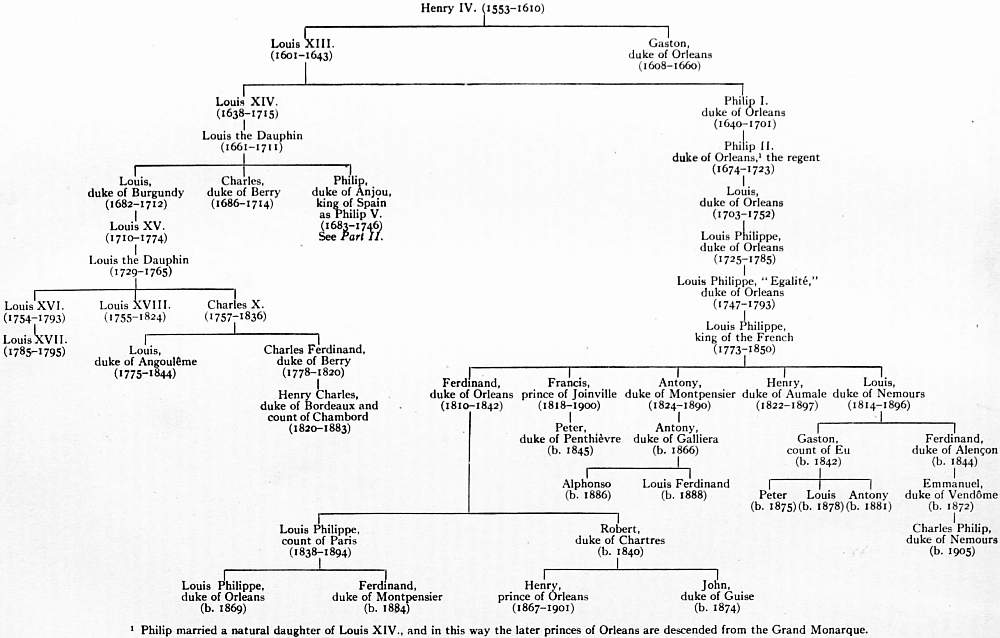
II. The Spanish and Italian Bourbons.
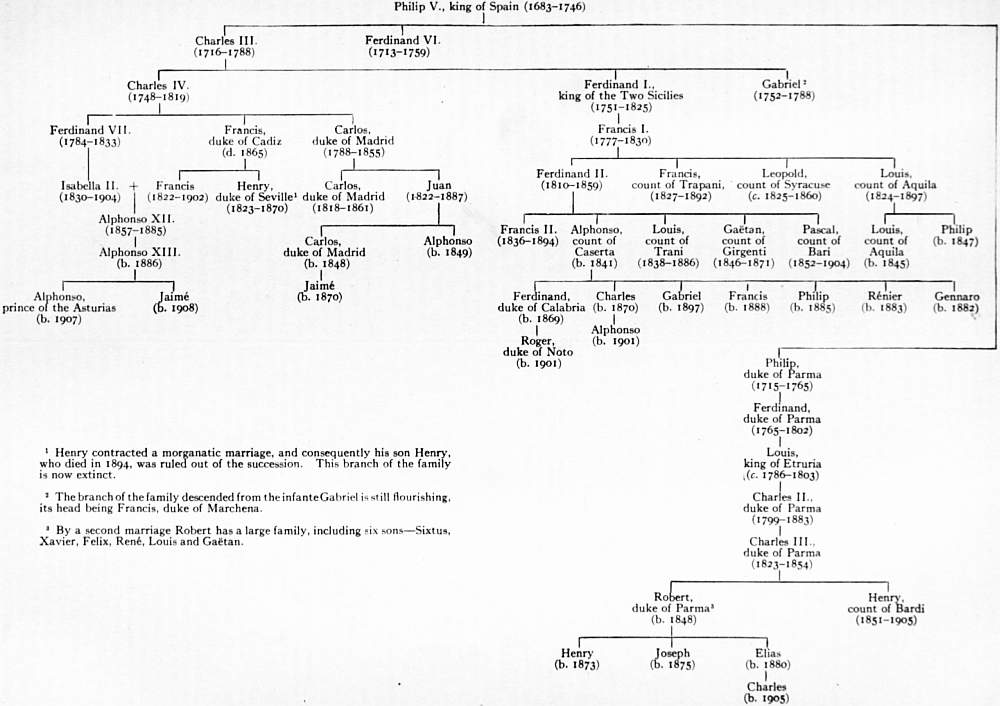
Neapolitan Branch.—The first Bourbon who wore the crown of Naples was Charles III. of Spain, who on his succession to the Spanish throne in 1759, resigned his kingdom of Naples to his son Ferdinand. Ferdinand was deposed by Napoleon, but afterwards regained his throne, and took the title of Ferdinand I., king of the Two Sicilies. In 1825 he was succeeded by his son Francis, who in turn was succeeded in 1830 by his son Ferdinand II. Ferdinand II. died in 1859, and in the following year his successor Francis II. was deprived of his kingdom, which was incorporated into the gradually-uniting Italy.
Duchies of Lucca and Parma.—In 1748 the duchy of Parma was conferred on Philip, youngest son of Philip V. of Spain. He was succeeded by his son Ferdinand in 1765. Parma was ceded to France in 1801, Ferdinand’s son Louis being made king of Etruria, but the French only took possession of the duchy after Ferdinand’s death in 1802. Louis’s son Charles Louis was forced to surrender Etruria to France in 1807, and he was given the duchy of Lucca by the congress of Vienna in 1815. In 1847, on the death of Marie Louise, widow of Napoleon, who had received Parma and Piacenza in accordance with the terms of the treaty of Paris of 1814, Charles Louis succeeded to the duchies as Charles II., at the same time surrendering Lucca to Tuscany. In 1849 he abdicated in favour of his son, Charles III., who married a daughter of the duke of Berry, and was assassinated in 1854, being succeeded by his son Robert. In 1860 the duchies were annexed by Victor Emmanuel to the new kingdom of Italy.
Bastard Branches.—There are numerous bastard branches of the family of Bourbon, the most famous being the Vendôme branch, descended from Caesar, natural son of Henry IV., and the Maine and Toulouse branches, descended from the two natural sons of Louis XIV. and Madame de Montespan.
See Coiffier de Moret, Histoire du Bourbonnais et des Bourbons (2 vols., 1824); Berand, Histoire des sires et ducs de Bourbon (1835); Désormeaux, Histoire de la maison de Bourbon (5 vols., 1782-1788); Achaintre, Histoire généalogique et chronologique de la maison royale de Bourbon (2 vols., 1825-1826); and Dussieux, Généalogie de la maison de Bourbon (1872).
BOURBON, CHARLES, Duke of (1490-1527), constable of France, second son of Gilbert, count of Montpensier and dauphin of Auvergne, was born on the 17th of February 1490, his mother being a Gonzaga. In 1505 he married Suzanne, heiress of Peter II., duke of Bourbon, by Anne of France, daughter of King Louis XI., and assumed the title of duke of Bourbon. The addition of this duchy to the numerous duchies, countships and other fiefs which he had inherited on the death of his elder brother Louis in 1501, made him at the age of fifteen the wealthiest noble in Europe. He gained his first military experience in the Italian campaigns of Louis XII., taking part in the suppression of the Genoese revolt (1507) and contributing to the victory over the Venetians at Agnadello (May 14, 1509). Shortly after the accession of Francis I. Bourbon received the office of constable of France, and for his brilliant services at the battle of Marignano (September 1515) he was made governor of the Milanese, which he succeeded in defending against an attack of the emperor Maximilian. But dissensions arose between Francis and the constable. Grave, haughty and taciturn, Bourbon was but ill suited to the levities of the court, and his vast wealth and influence kindled in the king a feeling of resentment, if not of fear. The duke was recalled from the government of the Milanese; his official salary and the sums he had borrowed for war expenses remained unpaid; and in the campaign in the Netherlands against the emperor Charles V. the command of the vanguard, one of the most cherished prerogatives of the constables, was taken from him. The death of his wife without surviving issue, on the 28th of April 1521, afforded the mother of the king, Louise of Savoy, a means to gratify her greed, and at the same time to revenge herself on Bourbon, who had slighted her love. A suit was instituted at her instance against the duke in the parlement of Paris, in which Louise, as grand-daughter of Charles, duke of Bourbon (d. 1456), claimed the female and some of the male fiefs of the duchy of Bourbon, while the king claimed those fiefs which were originally appanages, as escheating to the crown, and other claims were put forward. Before the parlement was able to arrive at a decision, Francis handed over to his mother a part of the Bourbon estates, and ordered the remainder to be sequestrated.
Smarting under these injuries, Bourbon, who for some time had been coquetting with the enemies of France, renewed his negotiations with the emperor and Henry VIII. of England. It was agreed that the constable should raise in his own dominions an armed force to assist the emperor in an invasion of France, and should receive in return the hand of Eleonora, queen dowager of Portugal, or of another of the emperor’s sisters, and an independent kingdom comprising his own lands together with Dauphiné and Provence. He was required, too, to swear fidelity to Henry VIII. as king of France. But Bourbon’s plans were hampered by the presence of the French troops assembling for the invasion of Italy, and for this reason he was unable to effect a junction with the emperor’s German troops from the east. News of the conspiracy soon reached the ears of Francis, who was on his way to take command of the Italian expedition. In an interview with Bourbon at Moulins the king endeavoured to persuade him to accompany the French army into Italy, but without success. Bourbon remained at Moulins for a few days, and after many vicissitudes escaped into Italy. The joint invasion of France by the emperor and his ally of England had failed signally, mainly through lack of money and defects of combination. In the spring of 1524, however, Bourbon at the head of the imperialists in Lombardy forced the French across the Sesia (where the chevalier Bayard was mortally wounded) and drove them out of Italy. In August 1524 he invested Marseilles, but being unable to prevent the introduction of supplies by Andrea Doria, the Genoese admiral in the service of Francis, he was forced to raise the siege and retreat to the Milanese. He took part in the battle of Pavia (1525), where Francis was defeated and taken prisoner. But Bourbon’s troops were clamouring for pay, and the duke was driven to extreme measures to satisfy their demands. Cheated of his kingdom and his bride after the treaty of Madrid (1526), Bourbon had been offered the duchy of Milan by way of compensation. He now levied contributions from the townsmen, and demanded 20,000 ducats for the liberation of the chancellor Girolamo Morone (d. 1529), who had been imprisoned for an attempt to realize his dream of an Italy purged of the foreigner. But the sums thus raised were wholly inadequate. In February 1527 Bourbon’s army was joined by a body of German mercenaries, mostly Protestants, and the combined forces advanced towards the papal states. Refusing to recognize the truce which the viceroy of Naples had concluded with Pope Clement VII., Bourbon hastened to put into execution the emperor’s plan of attaching Clement to his side by a display of force. But the troops, starving and without pay, were in open mutiny, and Spaniards and Lutherans alike were eager for plunder. On the 5th of May 1527 the imperial army appeared before the walls of Rome. On the following morning Bourbon attacked the Leonine City, and while mounting a scaling ladder fell mortally wounded by a shot, which Benvenuto Cellini in his Life claims to have fired. After Bourbon’s death his troops took and sacked Rome.
See E. Armstrong, Charles V. (London, 1902); Cambridge Mod. Hist. vol. ii., bibliography to chaps. i. ii. and iii.
BOURBON-LANCY, a watering-place of east-central France in the department of Saône-et-Loire, on a hill about 2 m. from the right bank of the Loire and on the Borne, 52 m. S.S.E. of Nevers by rail. Pop. (1906) town, 1896; commune, 4266. The town possesses thermal springs, resorted to in the Roman period, and ancient baths and other remains have been found. The waters, which are saline and ferruginous, are used for drinking and bathing, in cases of rheumatism, &c. Their temperature varies from 117° to 132° F. Cardinal Richelieu, Madame de Sévigné, James II. of England, and other celebrated persons visited the springs in the 17th and 18th centuries. The town has a well-equipped bathing establishment, a large hospital, and a church of the 11th and 12th centuries (used as an archaeological museum), and there are ruins of an old stronghold on a hill overlooking the town. A belfry pierced by a gateway of the 15th century and houses of the 15th and 16th centuries also remain. The industries of the town include the manufacture of farm implements.
In the middle ages Bourbon-Lancy was an important stronghold and a fief of the Bourbon family, from the name of a member of which the suffix to its name is derived.