VOLUME IV SLICE III Borgia, Lucrezia to Bradford, John (continued 10)
Reading edition
Boxing is the art of hitting without getting hit. The boxers face each other just out of reach and balanced equally on both feet, the left from 10 to 20 in. in advance of the right. The left foot is planted flat on the floor, while the right heel is raised slightly from it. The left side of the body is turned a little towards the opponent and the right shoulder slightly depressed. When the hands are clenched inside the gloves the thumb is doubled over the second and third fingers to avoid a sprain when hitting. The general position of the guard is a matter of individual taste. In the “crouch,” affected by many American professionals, the right hip is thrust forward and the body bent over towards the right, while the left arm is kept well stretched out to keep the opponent at a distance. No good master, however, teaches a beginner any other than the upright position. Some boxers stand with the right foot forward, a practice common in the 18th century, which gives freer play with the right hand but is rather unstable. A boxer should stand lightly on his feet, ready to advance or retreat on the instant, using short steps, advancing with the left foot first and retreating with the right. Attacks are either simple or secondary. Simple attacks consist in straight leads, i.e. blows aimed with or without preliminary feints, at some part of the opponent’s body or head. All other attacks are either “counters” or returns after a guard or “block.” A counter is a lead carried out just as one is attacked, the object being to block (parry) the blow and land on the opponent at the same time. Counters are often carried out in connexion with a side-step, a slip or a crouch. In hitting, a boxer seeks to exert the greatest force at the instant of impact. Blows may be either straight, with or without the weight of the body behind them (“straight from the shouder” hits); jabs, short blows (usually with the left hand when at close quarters); hooks, or side-blows with bent arm; upper cuts (short swinging blows from beneath to the adversary’s chin); chops (short blows from above); punches (usually at close quarters, with the right hand); or swings (round-arm blows, usually delivered with a partial twist of the body to augment the force of the blow). Of the dangerous blows, which often result in a knockout, or in seriously weakening an adversary, the following may be mentioned:—on the pit of the stomach, called the solar plexus, from the sensitive network of nerves situated there; a blow on the point of the chin, having a tendency slightly to paralyse the brain; a blow under the ear, painful and often resulting in partial helplessness; and one directly over the heart, kidney or liver. As a boxer is allowed ten seconds after being knocked down in which to rise, an experienced ring-fighter will drop on one knee when partially stunned, remaining in that position in order to recover until the referee has counted nine.
Guarding is done with the arm or hand, either open or shut. If a blow is caught or stopped short it is called blocking, but a blow may also be shoved aside, or avoided altogether by slipping, i.e. moving the head quickly to one side, or by ducking and allowing the adversary’s swing to pass harmlessly over the head. Still another method of avoiding a blow without guarding is to bend back the head or body so as narrowly to escape the opponent’s glove.
The rules of the Amateur Boxing Association (founded 1884) contain the following provisions. “An amateur is one who has never competed for a money prize or staked bet with or against a professional for any prize, except with the express sanction of the A.B.A., and who has never taught, pursued or assisted in the practice of athletic exercises as a means of obtaining a livelihood.” The ring shall be roped and between 12 and 24 ft. square. No spikes shall be worn on shoes. Boxers are divided into the following classes by weight:—Bantam, not exceeding 8 st. 4 lb (116 lb); Feather, not exceeding 9 st. (126 lb); Light, not exceeding 10 st. (140 lb); Middle, not exceeding 11 st. 4 ℔ (158 lb); and Heavy, any weight above. There shall be two judges, a referee and a timekeeper. The votes of the judges decide the winner of a bout, unless they disagree, in which case the referee has the deciding vote. In case of doubt he may order an extra round of two minutes’ duration. Each match is for three rounds, the first two lasting three minutes and the third four, with one minute rest between the rounds. A competitor failing to come up at the call of time loses the match. When a competitor draws a bye he must box for a specified time with an opponent chosen by the judges. A competitor is allowed one assistant (second) only, and no advice or coaching during the progress of a round is permitted. Unless one competitor is unable to respond to the call of time, or is obliged to stop before the match is over, the judges decide the winner by points, which are for attack, comprising successful hits cleanly delivered, and defence, comprising guarding, slipping, ducking, counter-hitting and getting away in time to avoid a return. When the points are equal the decision is given in favour of the boxer who has done the most leading, i.e. has been the more aggressive. Fouls are hitting below the belt, kicking, hitting with the open hand, the side of the hand, the wrist, elbow or shoulder, wrestling or “roughing” on the ropes, i.e. unnecessary shouldering and jostling.
The boxing rules of the American Amateur Athletic Association differ slightly from the British. The ring is roped but must be from 16 to 24 ft. square. Gloves must not be worn more than 8 oz. in weight. The recognized classes by weight are: Bantam, 105 ℔ and under; Feather, 115 ℔ and under; Light, 135 lb and under; Welter, 145 ℔ and under; Middle, 158 ℔ and under; and Heavy, over 158 ℔ The rules for officials and rounds are identical with the British, except that only in final bouts does the last round last four minutes. Two “seconds” are allowed. The rules for points and fouls coincide with the British. The amateur rules are very strict, and any one who competes in a boxing contest of more than four rounds is suspended from membership in the Athletic Association.
Glossary of terms not mentioned above:—Break away, to get away from the adversary, usually a command from the referee when the men clinch. Break ground, retire diagonally to right or left. Catch-weight, any weight. Corners, the opposite angles of the square “ring,” in which the boxers rest between the rounds. Cross-counter, a blow in which the right or left arm crosses that of the adversary as he leads off; the arm is slightly curved to get round that of the opponent but is straightened at the moment of impact. Clinching, grappling after an exchange of blows; when breaking from a clinch one tries to pin the adversary’s hands in order to prevent his hitting at close quarters. Drawing an opponent, enticing him by leaving an apparent opening into making an attack for which a counter is prepared. Fiddling, forward and back movements of the arms at the beginning of a round, a part of sparring for an opening. Footwork, the manner in which a boxer uses his feet. In-fighting, boxing at very close quarters. Mark, the pit of the stomach. Side-step, springing quickly to one side to avoid a blow, the movement being usually followed up by a counter attack. Timing, a blow delivered on the enemy’s preparation of an attack of his own, but more quickly.
See Boxing, by R. Allanson Winn (Isthmian Library, London, 1897); Boxing, by Wm. Elder (Spalding’s Athletic Library, New York, 1902) (these two books are excellent for the technicalities of boxing). The article “Boxing,” by B. Jno. Angle and G.W. Barroll, in the Encyclopaedia of Sport; Boxing, by J.C. Trotter (Oval Series, London, 1896); Fencing, Boxing and Wrestling, in the Badminton Library (London, 1892).
French Boxing (la boxe française) dates from about 1830. It is more like the ancient Greek pankration (see Pugilism) than is British boxing, as not only striking with the fists, but also kicking with the feet, butting with the head and wrestling are allowed. It is a development of the old sport of savate, in which the feet, and not the hands, were used in attack. Lessons in savate, which was practised especially by roughs, were usually given in some low resort, and there were no respectable teachers. While Paris was restricted to savate, another sport, called chausson or jeu marseillais, was practised in the south of France, especially among the soldiers, in which blows of the fist as well as kicks were exchanged, and the kicks were given higher than in savate, in the stomach or even the face. It was an excellent exercise, but could hardly be reckoned a serious means of defence, for the high kicks usually fell short, and the upward blows of the fist could not be compared with the terrible sledge-hammer blows of the English boxers. Alexandre Dumas père says that Charles Lecour first conceived the idea of combining English boxing with savate. For this purpose he went to England, and took lessons of Adams and Smith, the London boxers. He then returned to Paris, about 1852, and opened a school to teach the sport since called la boxe française. Around him, and two provincial instructors who came to Paris about this time with similar ideas, there grew up a large number of sportsmen, who between 1845 and 1855 brought French boxing to its highest development. Among others who gave public exhibitions was Lecour’s brother Hubert, who although rather undersized, was quick as lightning, and had an English blow and a French kick that were truly terrible. Charles Ducros was another whose style of boxing, more in the English fashion, but with low kicks about his opponent’s shins, made a name for himself. Later came Vigneron, a “strong man,” whose style, though slow, was severe in its punishment. About 1856 the police interfered in these fights, and Lecour and Vigneron had to cease giving public exhibitions and devote themselves to teaching. Towards 1862 a new boxer, J. Charlemont, was not only very clever with his fists and feet, but an excellent teacher, and the author of a treatise on the art. Lecour, Vigneron and Charlemont may be said to have created la boxe française, which, for defence at equal weights, the French claim to be better than the English.
See L’Art de la boxe française et de la canne, by J. Charlemont (Paris, 1899); The French Method of the Noble Art of Self Defence, by Georges d’Amoric (London, 1898).
BOXWOOD, the wood obtained from the genus Buxus, the principal species being the well-known tree or shrub, B. sempervirens, the common box, in general use for borders of garden walks, ornamental parterres, &c. The other source of the ordinary boxwood of commerce is B. balearica, which yields the variety known as Turkey boxwood. The common box is grown throughout Great Britain (perhaps native in the chalk-hills of the south of England), in the southern part of the European continent generally, and extends through Persia into India, where it is found growing on the slopes of the western Himalayas. There has been much discussion as to whether it is a true native of Britain. Writing more than 200 years ago, John Ray, the author of the important Historia Plantarum, says, “The Box grows wild on Boxhill, hence the name; also at Boxwell, on the Cotteswold Hills in Gloucestershire, and at Boxley in Kent.... It grows plentifully on the chalk hills near Dunstable.” On the other hand the box is not wild in the Channel Islands, and in the north of France, Holland and Belgium is found mainly in hedgerows and near cultivation, and it may have been one of the many introductions owed to the Romans. Only a very small proportion of the wood suitable for industrial uses is now obtained in Great Britain. The box is a very slow-growing plant, adding not more than 1½ or 2 in. to its diameter in twenty years, and on an average attaining only a height of 16 ft., with a mean diameter of 10½ in. The leaves of this species are small, oval, leathery in texture and of a deep glossy green colour. B. balearica is a tree of considerable size, attaining to a height of 80 ft., with leaves three times larger than those of the common box. It is a native of the islands of the Mediterranean, and grows in Turkey, Asia Minor, and around the shores of the Black Sea, and is supposed to be the chief source of the boxwood which comes into European commerce by way of Constantinople. The wood of both species possesses a delicate yellow colour; it is very dense in structure and has a fine uniform grain, which has given it unique value for the purposes of the wood-engraver. A large amount is used in the manufacture of measuring rules, various mathematical instruments, flutes and other musical instruments, as well as for turning into many minor articles, and for inlaying, and it is a favourite wood for small carvings. The use of boxwood for turnery and musical instruments is mentioned by Pliny, Virgil and Ovid.
BOYACÁ, or Bojacá, an inland department of Colombia, bounded by the departments of Santander and Cundinamarca on the N., W. and S., and the republic of Venezuela on the E., and having an area of 33,321 sq. m., including the Casanare territory. Pop. (1899, estimate) 508,940. The department is very mountainous, heavily forested and rich in minerals. The famous Muso emerald mines are located in the western part of Boyacá. The capital, Tunja (pop. 1902, 10,000), is situated in the Eastern Cordilleras, 9054 ft. above sea-level, and has a cool, temperate climate, though only 5½° N. of the equator. It was an important place in colonial times, and occupies the site of one of the Indian towns of this region (Hunsa), which had acquired a considerable degree of civilization before the discovery of America. Other towns of note in the department are Chiquinquira (20,000), Moniquira (18,000), Sogamoso (10,787), and Boyacá (7000), where on the 7th of August 1819 Bolivar defeated the Spanish army and secured the independence of New Granada.
BOYAR (Russ. boyarin, plur. boyare), a dignity of Old Russia conterminous with the history of the country. Originally the boyars were the intimate friends and confidential advisers of the Russian prince, the superior members of his druzhina or bodyguard, his comrades and champions. They were divided into classes according to rank, most generally determined by personal merit and service. Thus we hear of the “oldest,” “elder” and the “younger” boyars. At first the dignity seems to have been occasionally, but by no means invariably, hereditary. At a later day the boyars were the chief members of the prince’s duma, or council, like the senatores of Poland and Lithuania. Their further designation of luchshie lyudi or “the best people” proves that they were generally richer than their fellow subjects. So long as the princes, in their interminable struggles with the barbarians of the Steppe, needed the assistance of the towns, “the best people” of the cities and of the druzhina proper mingled freely together both in war and commerce; but after Yaroslav’s crushing victory over the Petchenegs in 1036 beneath the walls of Kiev, the two classes began to draw apart, and a political and economical difference between the members of the princely druzhina and the aristocracy of the towns becomes discernible. The townsmen devote themselves henceforth more exclusively to commerce, while the druzhina asserts the privileges of an exclusively military caste with a primary claim upon the land. Still later, when the courts of the northern grand dukes were established, the boyars appear as the first grade of a fullblown court aristocracy with the exclusive privilege of possessing land and serfs. Hence their title of dvoryane (courtiers), first used in the 12th century. On the other hand there was no distinction, as in Germany, between the Dienst Adel (nobility of service) and the simple Adel. The Russian boyardom had no corporate or class privileges, (1) because their importance was purely local (the dignity of the principality determining the degree of dignity of the boyars), (2) because of their inalienable right of transmigration from one prince to another at will, which prevented the formation of a settled aristocracy, and (3) because birth did not determine but only facilitated the attainment of high rank, e.g. the son of a boyar was not a boyar born, but could more easily attain to boyardom, if of superior personal merit. It was reserved for Peter the Great to transform the boyarstvo or boyardom into something more nearly resembling the aristocracy of the West.
See Alexander Markevich, The History of Rank-priority in the Realm of Muscovy in the 15th-18th Centuries (Russ.) (Odessa, 1888); V. Klyuchevsky, The Boyar Duma of Ancient Russia (Russ.) (Moscow, 1888).
(R. N. B.)
BOY-BISHOP, the name given to the “bishop of the boys” (episcopus puerorum or innocentium, sometimes episcopus scholariorum or chorestarum), who, according to a custom very wide-spread in the middle ages, was chosen in connexion with the festival of Holy Innocents. For the origin of the curious authority of the boy-bishop and of the rites over which he presided, see Fools, Feast of. In England the boy-bishop was elected on December 6, the feast of St Nicholas, the patron of children, and his authority lasted till Holy Innocents’ day (December 28). The election made, the lad was dressed in full bishop’s robes with mitre and crozier and, attended by comrades dressed as priests, made a circuit of the town blessing the people. At Salisbury the boy-bishop seems to have actually had ecclesiastical patronage during his episcopate, and could make valid appointments. The boy and his colleagues took possession of the cathedral and performed all the ceremonies and offices except mass. Originally, it seems, confined to the cathedrals, the custom spread to nearly all the parishes. Several ecclesiastical councils had attempted to abolish or to restrain the abuses of the custom, before it was prohibited by the council of Basel in 1431. It was, however, too popular to be easily suppressed. In England it was abolished by Henry VIII. in 1542, revived by Mary in 1552 and finally abolished by Elizabeth. On the continent it survived longest in Germany, in the so-called Gregoriusfest, said to have been founded by Gregory IV. in 828 in honour of St Gregory, the patron of schools. A school-boy was elected bishop, duly vested, and, attended by two boy-deacons and the town clergy, proceeded to the parish church, where, after a hymn in honour of St Gregory had been sung, he preached. At Meiningen this custom survived till 1799.
See Brand, Pop. Antiquities of Great Britain (1905); Gasquet, Parish Life in Medieval England (1906); Du Cange, Glossarium (London, 1884), s.v. “Episcopus puerorum.”
BOYCE, WILLIAM (1710-1779), English musical composer, the son of a cabinet-maker, was born in London on the 7th of February 1710. As a chorister in St Paul’s he received his early musical education from Charles King and Dr Maurice Greene, and he afterwards studied the theory of music under Dr Pepusch. In 1734, having become organist of Oxford chapel, Vere Street, Cavendish Square, he set Lord Lansdowne’s masque of Peleus and Thetis to music. In 1736 he left Oxford chapel and was appointed organist of St Michael’s church, Cornhill, and in the same year he became composer to the chapel royal, and wrote the music for John Lockman’s oratorio David’s Lamentation over Saul and Jonathan. In 1737 he was appointed to conduct the meetings of the three choirs of Gloucester, Worcester and Hereford. In 1743 was written the serenata Solomon, in which occurs the favourite song “Softly rise, O southern breeze.” In 1749 he received the degree of doctor of music from the university of Cambridge, as an acknowledgment of the merit of his setting of the ode performed at the installation of Henry Pelham, duke of Newcastle, as chancellor; and in this year he became organist of All-hallows the Great and Less, Thames Street. A musical setting to The Chaplet, an entertainment by Moses Mendez, was Boyce’s most successful achievement in this year. In 1750 he wrote songs for Dryden’s Secular Masque and in 1751 set another piece (The Shepherd’s Lottery) by Mendez. He became master of the king’s band in succession to Greene in 1757, and in 1758 he was appointed principal organist to the chapel royal. As an ecclesiastical composer Boyce ranks among the best representatives of the English school. His two church services and his anthems, of which the best specimens are By the Waters of Babylon and O, Where shall Wisdom be found, are frequently performed. It should also be remembered that he wrote additional accompaniments and choruses for Purcell’s Te Deum and Jubilate, which the earlier musician had composed for the St Cecilia’s day of 1694. Boyce did this in his capacity of conductor at the annual festivals of the Sons of the Clergy at St Paul’s cathedral, an office which he had taken in succession to Greene. His twelve trios for two violins and a bass were long popular. One of his most valuable services to musical art was his publication in three volumes quarto of a work on Cathedral Music. The collection had been begun by Greene, but it was mainly the work of Boyce. The first volume appeared in 1760 and the last in 1778. On the 7th of February 1779 Boyce died from an attack of gout. He was buried under the dome of St Paul’s cathedral.
BOYCOTT, the refusal and incitement to refusal to have commercial or social dealings with any one on whom it is wished to bring pressure. As merely a form of “sending to Coventry” or (in W.E. Gladstone’s phrase) “exclusive dealing,” boycotting may be, from a legal point of view, unassailable, and as such has frequently been justified by its original political inventors. But in practice it has usually taken the form of what is undoubtedly an illegal conspiracy to injure the person, property or business of another by unwarrantably putting pressure on all and sundry to withdraw from him their social or business intercourse. The word was first used in Ireland, and was derived from the name of Captain Charles Cunningham Boycott (1832-1897), agent for the estates of the earl of Erne in Co. Mayo. For refusing in 1880 to receive rents at figures fixed by the tenants, Captain Boycott had his life threatened, his servants compelled to leave him, his fences torn down, his letters intercepted and his food supplies interfered with. It took a force of 900 soldiers to protect the Ulster Orangemen (“Emergency Men”) who succeeded finally in getting in his crops. He was hooted and mobbed in the streets, and hanged and burnt in effigy. The system of boycotting was an essential part of the Irish Nationalist “Plan of Campaign,” and was dealt with under the Crimes Act of 1887. The term soon came into common English use, and was speedily adopted by the French, Germans, Dutch and Russians. In the United States this method of “persuasion” was taken up by the trade unions about 1886, an employer who refused their demands being brought to terms by a combination to refuse to buy his product or do his work, or to deal with any who did. Various cases have occurred in America in which labour organizations have pronounced such a boycott against a firm; and its illegal nature has been established in the law-courts, notably in the case of the Bucks Stove Company v. The American Federation of Labor (1907) in the Supreme Court of the district of Columbia, and in a suit against the Hatters’ Union (February 1908) in the U.S. Supreme Court. A boycott has also been held by the U.S. Supreme Court to be a violation of the Sherman Anti-Trust law.
BOYD, ANDREW KENNEDY HUTCHISON (1825-1899), Scottish author and divine, was born at Auchinleck manse in Ayrshire on the 3rd of November 1825. He studied at King’s College, London, and at the Middle Temple, with the idea of practising at the English bar. Returning to Scotland, however, he entered Glasgow University and there qualified for the Scottish ministry, being licensed as a preacher by the presbytery of Ayr. He served in succession the parishes of Newton-on-Ayr, Kirkpatrick-Irongray near Dumfries, St Bernard’s, Edinburgh, and finally, in 1865, became minister of the first charge at St Andrews. Here he advocated an improved ritual in the Scottish church, his action resulting in the appointment by the general assembly of a committee, with Boyd as convener, to prepare a new hymnal. In 1890 he was appointed moderator of the general assembly, and fulfilled the duties of the position with admirable dignity and tact. He died at Bournemouth on the 1st of March 1899. Dr Boyd was a very famous preacher and talker, and his desultory essays have very much of the charm of his conversation. Among his numerous publications may be specially mentioned the two works (each in three series), Recreations of a Country Parson (1859, 1861 and 1878), and Graver Thoughts of a Country Parson (1862-1865 and 1875); he also wrote Twenty-five Years at St Andrews (1892), and St Andrews and Elsewhere (1894). He was familiarly known to the public as a writer by his initials “A.K.H.B.”
BOYD, ROBERT BOYD, Lord (d.c. 1470), Scottish statesman, was a son of Sir Thomas Boyd (d. 1439), and belonged to an old and distinguished family, one member of which, Sir Robert Boyd, had fought with Wallace and Robert Bruce. Boyd, who was created a peer about 1454, was one of the regents of Scotland during the minority of James III., but, in 1466, with some associates he secured the person of the young king and was appointed his sole governor. As ruler of Scotland he was instrumental in reforming some religious foundations; he arranged the marriage between James III. and Margaret, daughter of Christian I., king of Denmark and Norway, and secured the cession of the Orkney Islands by Norway. However, when in 1467 he obtained the offices of chamberlain and justiciary for himself, and the hand of the king’s sister Mary, with the title of earl of Arran for his eldest son Thomas, his enemies became too strong for him, and he was found guilty of treason and sentenced to death. He escaped to England, and the date of his death is unknown. His brother and assistant, Sir Alexander Boyd, was beheaded on the 22nd of November 1469.
Boyd’s son Thomas, earl of Arran, was in Denmark when his father was overthrown. However, he fulfilled his mission, that of bringing the king’s bride, Margaret, to Scotland, and then, warned by his wife, escaped to the continent of Europe. He is mentioned very eulogistically in one of the Paston Letters, but practically nothing is known of his subsequent history.
Lord Boyd’s grandson Robert (d. c. 1550), a son of Alexander Boyd, was confirmed in the possession of the estates and honours of his grandfather in 1549, and is generally regarded as the 3rd Lord Boyd. His son Robert, 4th Lord Boyd (d. 1590), took a prominent part in Scottish politics during the troubled time which followed the death of James V. in 1542. At first he favoured the reformed religion, but afterwards his views changed and he became one of the most trusted advisers of Mary, queen of Scots, whom he accompanied to the battle of Langside in 1568. During the queen’s captivity he was often employed on diplomatic errands; he tried to stir up insurrections in her favour, and he was suspected of participation in the murder of the regent Murray. He enjoyed a high and influential position under the regent James Douglas, earl of Morton, but was banished in 1583 for his share in the seizure of King James VI., a plot known as the Raid of Ruthven. He retired to France, but was soon allowed to return to Scotland. He died on the 3rd of January 1590.
William, 8th or 9th Lord Boyd (d. 1692), was created earl of Kilmarnock in 1661, and this nobleman’s grandson William, the 3rd earl (d. 1717), was a partisan of the Hanoverian kings and fought for George I. during the rising of 1715. His son William, the 4th earl (1704-1746), was educated in the same principles, but in 1745, owing either to a personal affront or to the influence of his wife or to his straitened circumstances he deserted George II. and joined Charles Edward, the Young Pretender. The 4th earl fought at Falkirk and Culloden, where he was made prisoner, and was beheaded on the 18th of August 1746. The title of earl of Kilmarnock is now merged in that of earl of Erroll.
BOYD, ZACHARY (1585?-1653), Scottish divine, was educated at the universities of Glasgow and St Andrews. He was for many years a teacher in the Protestant college of Saumur in France, but returned to Scotland in 1621, to escape the Huguenot persecution. In 1623 he was appointed minister of the Barony church in Glasgow, and he was rector of the university in 1634, 1635 and 1645. He bequeathed to the university the half of his fortune, a sum amounting to £20,000 Scots, besides his library and twelve volumes of MSS. His poetical compositions, though often eccentric, have some merit. The common statement that he made the printing of his metrical version of the Gospels and other Biblical narratives a condition of the reception of his grant to the university is a mistake. In later years he was a staunch Covenanter, and though for a time opposed to Oliver Cromwell, afterwards became friendly with him. His best-known works are The Battel of the Soul in Death (1629), of which a new edition, with a biography by G. Neil, was published in Glasgow in 1831; Zion’s Flowers—often called “Boyd’s Bible” (1644); Four Letters of Comfort (1640, reprinted, Edinburgh, 1878).
BOYDELL, JOHN (1719-1804), English alderman and publisher, was born at Dorrington, and at the age of twenty-one came to London and was apprenticed for seven years to an engraver. In 1746 he published a volume of views in England and Wales, and started in business as a print-seller. By his good taste and liberality he managed to secure the services of the best artists, and his engravings were executed with such skill that his business became extensive and lucrative. He succeeded in his plan of a Shakespeare gallery, and obtained the assistance of the most eminent painters of the day, whose contributions were exhibited publicly for many years. The engravings from these paintings form a splendid companion volume to his large illustrated edition of Shakespeare’s works. Towards the close of his life Boydell sustained severe losses through the French Revolution, and was compelled to dispose of his Shakespeare gallery by lottery. Boydell had previously become an alderman, and rose to be lord mayor of London.
BOYER, ALEXIS (1757-1833), French surgeon, was born on the 1st of March 1757 at Uzerches (Corrèze). The son of a tailor, he obtained his first medical knowledge in the shop of a barber-surgeon. Removing to Paris he had the good fortune to attract the notice of Antoine Louis (1723-1792) and P.J. Desault (1744-1795); and his perseverance, anatomical skill and dexterity as an operator, became so conspicuous, that at the age of thirty-seven he obtained the appointment of second surgeon to the Hôtel Dieu of Paris. On the establishment of the École de Santé he gained the chair of operative surgery, but soon exchanged it for the chair of clinical surgery. In 1805 Napoleon nominated him imperial family surgeon, and, after the brilliant campaigns of 1806-7, conferred on him the legion of honour, with the title of baron of the empire and a salary of 25,000 francs. On the fall of Napoleon the merits of Boyer secured him the favour of the succeeding sovereigns of France, and he was consulting surgeon to Louis XVIII., Charles X., and Louis Philippe. In 1825 he succeeded J.F.L. Deschamps (1740-1824) as surgeon-in-chief to the Hôpital de la Charité, and was chosen a member of the Institute. He died in Paris on the 23rd of November 1833. Perhaps no French surgeon of his time thought or wrote with greater clearness and good sense than Boyer; and while his natural modesty made him distrustful of innovation, and somewhat tenacious of established modes of treatment, he was as judicious in his diagnosis and as cool and skilful in manipulating, as he was cautious in forming his judgment on individual cases. His two great works are:—Traité complet de l’anatomie (in 4 vols., 1797-1799), of which a fourth edition appeared in 1815, and Traité des maladies chirurgicales et des opérations qui leur conviennent (in 11 vols., 1814-1826), of which a new edition in 7 vols. was published in 1844-1853, with additions by his son, Philippe Boyer (1801-1858).
BOYER, JEAN PIERRE (1776-1850), president of the republic of Haiti, a mulatto, was born at Port-au-Prince on the 28th of February 1776. He received a good education in France, and, returning to St Domingo, joined the army in 1792. In 1794 he was already in command of a battalion, and fought with distinction under General Rigaud against the English. The negro insurrection under Toussaint l’Ouverture, which was directed against the mulattoes as well as the whites, ultimately forced him to take refuge in France. He was well received by Napoleon, and in 1802 obtained a commission in Leclerc’s expedition. Being opposed to the reinstitution of slavery, he turned against the French and succeeded in producing an alliance between the negroes and mulattoes by which they were driven from the island. Dessalines, a negro, was proclaimed king, but his cruelty and despotism were such that Boyer combined with A.A.S. Pétion and General Christophe to overthrow him (1806). Christophe now seized the supreme power, but Pétion set up an independent republic in the southern part of the island, with Boyer as commander-in-chief. Christophe’s efforts to crush this state were defeated by Boyer’s gallant defence of Port-au-Prince, and a series of brilliant victories, which, on Pétion’s death in 1818, led to Boyer’s election as president. Two years later the death of Christophe removed his only rival, and he gained almost undisputed possession of the whole island. During his presidency Boyer did much to set the finances and the administration in order, and to encourage the arts and sciences, and in 1825 obtained French recognition of the independence of Haiti, in return for a payment of 150,000 francs. The weight of this debt excited the greatest discontent in Haiti. Boyer was able to carry on his government for some years longer, but in March 1843 a violent insurrection overthrew his power and compelled him to take refuge in Jamaica. He resided there till 1848, when he removed to Paris, where he died in 1850.
See Wallez, Précis historique des négociations entre la France et Saint-Domingue, avec une notice biographique sur le général Boyer (Paris, 1826).
BOYLE, JOHN J. (1851- ), American sculptor, was born in New York City. He studied in the Pennsylvania Academy of Fine Arts, Philadelphia, and in the École des Beaux Arts, Paris. He is particularly successful in the portrayal of Indians. Among his principal works are: “Stone Age,” Fairmount Park, Philadelphia; “The Alarm,” Lincoln Park, Chicago; and, a third study in primitive culture, the two groups, “The Savage Age” at the Pan-American Exposition of 1901. His work also includes the seated “Franklin,” in Philadelphia; and “Bacon” and “Plato” in the Congressional library, Washington, D.C.
BOYLE, ROBERT (1627-1691), English natural philosopher, seventh son and fourteenth child of Richard Boyle, the great earl of Cork, was born at Lismore Castle, in the province of Munster, Ireland, on the 25th of January 1627. While still a child he learned to speak Latin and French, and he was only eight years old when he was sent to Eton, of which his father’s friend, Sir Henry Wotton, was then provost. After spending over three years at the college, he went to travel abroad with a French tutor. Nearly two years were passed in Geneva; visiting Italy in 1641, he remained during the winter of that year in Florence, studying the “paradoxes of the great star-gazer” Galileo, who died within a league of the city early in 1642. Returning to England in 1644 he found that his father was dead and had left him the manor of Stalbridge in Dorsetshire, together with estates in Ireland. From that time he gave up his life to study and scientific research, and soon took a prominent place in the band of inquirers, known as the “Invisible College,” who devoted themselves to the cultivation of the “new philosophy.” They met frequently in London, often at Gresham College; some of the members also had meetings at Oxford, and in that city Boyle went to reside in 1654. Reading in 1657 of Otto von Guericke’s air-pump, he set himself with the assistance of Robert Hooke to devise improvements in its construction, and with the result, the “machina Boyleana” or “Pneumatical Engine,” finished in 1659, he began a series of experiments on the properties of air. An account of the work he did with this instrument was published in 1660 under the title New Experiments Physico-Mechanical touching the spring of air and its effects. Among the critics of the views put forward in this book was a Jesuit, Franciscus Linus (1595-1675), and it was while answering his objections that Boyle enunciated the law that the volume of a gas varies inversely as the pressure, which among English-speaking peoples is usually called after his name, though on the continent of Europe it is attributed to E. Mariotte, who did not publish it till 1676. In 1663 the “Invisible College” became the “Royal Society of London for improving natural knowledge,” and the charter of incorporation granted by Charles II. named Boyle a member of the council. In 1680 he was elected president of the society, but declined the honour from a scruple about oaths. In 1668 he left Oxford for London where he resided at the house of his sister, Lady Ranelagh, in Pall Mall. About 1689 his health, never very strong, began to fail seriously and he gradually withdrew from his public engagements, ceasing his communications to the Royal Society, and advertising his desire to be excused from receiving guests, “unless upon occasions very extraordinary,” on Tuesday and Friday forenoon, and Wednesday and Saturday afternoon. In the leisure thus gained he wished to “recruit his spirits, range his papers,” and prepare some important chemical investigations which he proposed to leave “as a kind of Hermetic legacy to the studious disciples of that art,” but of which he did not make known the nature. His health became still worse in 1691, and his death occurred on the 30th of December of that year, just a week after that of the sister with whom he had lived for more than twenty years. He was buried in the churchyard of St Martin’s in the Fields, his funeral sermon being preached by his friend Bishop Burnet.
Boyle’s great merit as a scientific investigator is that he carried out the principles which Bacon preached in the Novum Organum. Yet he would not avow himself a follower of Bacon or indeed of any other teacher: on several occasions he mentions that in order to keep his judgment as unprepossessed as might be with any of the modern theories of philosophy, till he was “provided of experiments” to help him judge of them, he refrained from any study of the Atomical and the Cartesian systems, and even of the Novum Organum itself, though he admits to “transiently consulting” them about a few particulars. Nothing was more alien to his mental temperament than the spinning of hypotheses. He regarded the acquisition of knowledge as an end in itself, and in consequence he gained a wider outlook on the aims of scientific inquiry than had been enjoyed by his predecessors for many centuries. This, however, did not mean that he paid no attention to the practical application of science nor that he despised knowledge which tended to use. He himself was an alchemist; and believing the transmutation of metals to be a possibility, he carried out experiments in the hope of effecting it; and he was instrumental in obtaining the repeal, in 1689, of the statute of Henry IV. against multiplying gold and silver. With all the important work he accomplished in physics—the enunciation of Boyle’s law, the discovery of the part taken by air in the propagation of sound, and investigations on the expansive force of freezing water, on specific gravities and refractive powers, on crystals, on electricity, on colour, on hydrostatics, &c.—chemistry was his peculiar and favourite study. His first book on the subject was The Sceptical Chemist, published in 1661, in which he criticized the “experiments whereby vulgar Spagyrists are wont to endeavour to evince their Salt, Sulphur and Mercury to be the true Principles of Things.” For him chemistry was the science of the composition of substances, not merely an adjunct to the arts of the alchemist or the physician. He advanced towards the modern view of elements as the undecomposable constituents of material bodies; and understanding the distinction between mixtures and compounds, he made considerable progress in the technique of detecting their ingredients, a process which he designated by the term “analysis.” He further supposed that the elements were ultimately composed of particles of various sorts and sizes, into which, however, they were not to be resolved in any known way. Applied chemistry had to thank him for improved methods and for an extended knowledge of individual substances. He also studied the chemistry of combustion and of respiration, and made experiments in physiology, where, however, he was hampered by the “tenderness of his nature” which kept him from anatomical dissections, especially of living animals, though he knew them to be “most instructing.”
Besides being a busy natural philosopher, Boyle devoted much time to theology, showing a very decided leaning to the practical side and an indifference to controversial polemics. At the Restoration he was favourably received at court, and in 1665 would have received the provostship of Eton, if he would have taken orders; but this he refused to do, on the ground that his writings on religious subjects would have greater weight coming from a layman than a paid minister of the Church. He spent large sums in promoting the spread of Christianity, contributing liberally to missionary societies, and to the expenses of translating the Bible or portions of it into various languages. By his will he founded the Boyle lectures, for proving the Christian religion against “notorious infidels, viz. atheists, theists, pagans, Jews and Mahommedans,” with the proviso that controversies between Christians were not to be mentioned.
In person Boyle was tall, slender and of a pale countenance. His constitution was far from robust, and throughout his life he suffered from feeble health and low spirits. While his scientific work procured him an extraordinary reputation among his contemporaries, his private character and virtues, the charm of his social manners, his wit and powers of conversation, endeared him to a large circle of personal friends. He was never married. His writings are exceedingly voluminous, and his style is clear and straightforward, though undeniably prolix.
The following are the more important of his works in addition to the two already mentioned:—Considerations touching the Usefulness of Experimental Natural Philosophy (1663), followed by a second part in 1671; Experiments and Considerations upon Colours, with Observations on a Diamond that Shines in the Dark (1663); New Experiments and Observations upon Cold (1665); Hydrostatical Paradoxes (1666); Origin of Forms and Qualities according to the Corpuscular Philosophy (1666); a continuation of his work on the spring of air (1669); tracts about the Cosmical Qualities of Things, the Temperature of the Subterraneal and Submarine Regions, the Bottom of the Sea, &c. with an Introduction to the History of Particular Qualities (1670); Origin and Virtues of Gems (1672); Essays of the strange Subtilty, great Efficacy, determinate Nature of Effluviums (1673); two volumes of tracts on the Saltness of the Sea, the Hidden Qualities of the Air, Cold, Celestial Magnets, Animadversions on Hobbes’s Problemata de Vacuo (1674); Experiments and Notes about the Mechanical Origin or Production of Particular Qualities, including some notes on electricity and magnetism (1676); Observations upon an artificial Substance that Shines without any Preceding Illustration (1678); the Aerial Noctiluca (1680); New Experiments and Observations upon the Icy Noctiluca (1682); a further continuation of his work on the air; Memoirs for the Natural History of the Human Blood (1684); Short Memoirs for the Natural Experimental History of Mineral Waters (1685); Medicina Hydrostatica (1690); and Experimenta et Observiationes Physicae (1691). Among his religious and philosophical writings were:—Seraphic Love, written in 1648, but not published till 1660; an Essay upon the Style of the Holy Scriptures (1663); Occasional Reflections upon Several Subjects (1665), which was ridiculed by Swift in A Pious Meditation upon a Broomstick, and by Butler in An Occasional Reflection on Dr Charlton’s Feeling a Dog’s Pulse at Cresham College; Excellence of Theology compared with Natural Philosophy (1664); Some Considerations about the Reconcileableness of Reason and Religion, with a Discourse about the Possibility of the Resurrection (1675); Discourse of Things above Reason (1681); High Veneration Man owes to God (1685); A Free Inquiry into the vulgarly received Notion of Nature (1686); and the Christian Virtuoso (1690). Several other works appeared after his death, among them The General History of the Air designed and begun (1692); a “collection of choice remedies,” Medicinal Experiments (1692-1698); and A Free Discourse against Customary Swearing (1695). An incomplete and unauthorized edition of Boyle’s works was published at Geneva in 1677, but the first complete edition was that of Thomas Birch, with a life, published in 1744, in five folio volumes, a second edition appearing in 1772 in six volumes, 4to. Boyle bequeathed his natural history collections to the Royal Society, which also possesses a portrait of him by the German painter, Friedrich Kerseboom (1632-1690).
BOYLE, a market town of Co. Roscommon, Ireland, in the north parliamentary division, on the Sligo line of the Midland Great Western railway, 106¼ m. N.W. by W. from Dublin and 28 m. S. by E. from Sligo. Pop. (1901) 2477. It is beautifully situated on both banks of the river Boyle, an affluent of the Shannon, between Loughs Gara and Key. Three bridges connect the two parts of the town. There is considerable trade in agricultural produce. To the north of the town stand the extensive ruins of a Cistercian abbey founded in 1161, including remains of a cruciform church, with a fine west front, and Norman and Transitional arcades with carving of very beautiful detail. The offices of the monastery are well preserved, and an interesting feature is seen in the names carved on the door of the lodge, attributed in Cromwell’s soldier, who occupied the buildings. Neighbouring antiquities are Asselyn church near Lough Key, and a large cromlech by the road towards Lough Gara. Boyle was incorporated by James I., and returned two members to the Irish parliament.
BOYNE, a river of Ireland, which, rising in the Bog of Allen, near Carbery in Co. Kildare, and flowing in a north-easterly direction, passes Trim, Navan and Drogheda, and enters the Irish Sea, 4 m. below the town last named. It is navigable for barges to Navan, 19 m. from its mouth. Much of the scenery on its banks is beautiful, though never grand. About 2 m. west of Drogheda, an obelisk, 150 ft. in height, marks the spot where the forces of William III. gained a celebrated victory over those of James II., on the 1st of July1 1690, known as the battle of the Boyne.
1 This was the “old style” date, which in the new style (see Calendar) would be July 11th (not 12th, as Lecky says, Hist, of Ireland, iii. p. 427). The 12th of July is annually celebrated by the Orangemen in the north of Ireland as the anniversary, but this is a confusion between the supposed new style for July 1st and the old style date of the battle of Aughrim, July 12th; the intention being to commemorate both.
BOYS’ BRIGADE, an organization founded in Glasgow by Mr (afterwards Sir) W.A. Smith in 1883 to develop Christian manliness by the use of a semi-military discipline and order, gymnastics, summer camps and religious services and classes. There are about 2200 companies connected with different churches throughout the United Kingdom, the British empire and the United States, with 10,000 officers and 100,000 boys. A similar organization, confined to the Anglican communion, is the Church Lads’ Brigade. Boys’ and girls’ life brigades are a more recent movement; they teach young people how to save life from fire and from water, and hold classes in hygiene, ambulance and elementary nursing.
BOZDAR, a Baluch tribe of Rind (Arab) extraction, usually associated with the mountain districts of the frontier near Dera Ghazi Khan. They are also to be found in Zhob, Thal-Chotiali and Las Bela, whilst the majority of the population are said to live in the Punjab. They are usually graziers, and the name Bozdar is probably derived from Buz, the Persian name for goat. Within the limits of their mountain home on the outer spurs of the Suliman hills they have always been a turbulent race, mustering about 2700 fighting men, and they were formerly constantly at feud with the neighbouring Ustarana and Sherani tribes. In 1857 their raids into the Punjab drew upon them an expedition under Brigadier-General Sir N.B. Chamberlain. The Sangarh pass was captured and the Bozdars submitted. Since Baluchistan has been taken over they have given but little trouble.
BOZRAH. (1) A capital of Edom (Gen. xxxvi. 33; Amos i. 12; Is. xxxiv. 6, lxiii. 1), doubtfully identified with el-Buseireh, S.E. of the Dead Sea, in the broken country N. of Petra; the ruins here are comparatively unimportant. It is the centre of a pastoral district, and its inhabitants, who number between 100 and 200, are all shepherds. (2) A city in the Mishor or plain country of Moab, denounced by Jeremiah (xlviii. 24). It has been identified (also questionably) with a very extensive collection of ruins of various ages, now called Bosrā (the Roman Bostra), situated in the Hauran, about 80 m. south of Damascus. The area within the walls is about 1¼ m. in length, and nearly 1 m. in breadth, while extensive suburbs lie to the east, north and west. The principal buildings which can still be distinguished are a temple, an aqueduct, a large theatre (enclosed by a castle of much more recent workmanship), several baths, a triumphal and other arches, three mosques, and what are known as the church and convent of the monk Boheira. In A.D. 106 the city was beautified and perhaps restored from ruin by Trajan, who made it the capital of the new province of Arabia. In the reign of Alexander Severus it was made a colony, and in 244, a native of the place, Philippus, ascended the imperial throne. By the time of Constantine the Great it seems to have been Christianized, and not long after it was the seat of an extensive bishopric. It was one of the first cities of Syria to be subjected to the Mahommedans, and it successfully resisted all the attempts of the Crusaders to wrest it from their hands. As late as the 14th century it was a populous city, after which it gradually fell into decay. It is now inhabited by thirty or forty families only. Another suggested identification is with Kusūr el-Besheir, equidistant (2 m.) from Dibon and Aroer. This is perhaps the same as the Bezer mentioned in Deuteronomy and Joshua as a levitical city and a city of refuge.
In 1 Macc. v. 26 there is mention of Bosor and of Bosora. The latter is probably to be identified with Bosra, the former perhaps with the present Busr el-Hariri in the south-east corner of the Lejā.
(R. A. S. M.)
BRABANT, a duchy which existed from 1190 to 1430, when it was united with the duchy of Burgundy, the name being derived from Brabo, a semi-mythical Frankish chief.
The history of Brabant is connected with that of the duchy of Lower Lorraine (q.v.), which became in the course of the 11th century split up into a number of small feudal states. The counts of Hainaut, Namur, Luxemburg and Limburg asserted their independence, and the territory of Liége passed to the bishops of that city. The remnant of the duchy, united since 1100 with the margraviate of Antwerp, was conferred in 1106 by the emperor Henry V., with the title of duke of Lower Lorraine, upon Godfrey (Godefroid) I., “the Bearded,” count of Louvain and Brussels. His title was disputed by Count Henry of Limburg, and for three generations the representatives of the rival houses contested the possession of the ducal dignity in Lower Lorraine. The issue was decided in favour of the house of Louvain by Duke Godfrey III. in 1159. His son, Henry I., “the Warrior” (1183-1235), abandoned the title of duke of Lower Lorraine and assumed in 1190 that of duke of Brabant. His successors were Henry II., “the Magnanimous” (1235-1248), Henry III., “le Debonnair” (1248-1261), and John I., “the Victorious” (1261-1294). These were all able rulers. Their usual place of residence was Louvain. John I., in 1283 bought the duchy of Limburg from Adolf of Berg, and secured his acquisition by defeating and slaying his competitor, Henry of Luxemburg, at the battle of Woeringen (June 5, 1288). His own son, John II., “the Pacific” (1294-1312), bestowed liberties upon his subjects by the charter of Cortenberg. This charter laid the foundation of Brabantine freedom. By it the imposition of grants (beden) and taxes was strictly limited and regulated, and its execution was entrusted to a council appointed by the duke for life (four nobles, ten burghers) whose duty it was to consider all complaints and to see that the conditions laid down by the charter concerning the administration of justice and finance were not infringed. He was succeeded by his son, John III., “the Triumphant” (1312-1355), who succeeded in maintaining his position in spite of formidable risings in Louvain and Brussels, and a league formed against him by his princely neighbours, but he had a hard struggle to face, and many ups and downs of fortune. He it was to whom Brabant owed the great charter of its liberties, called La joyeuse entrée, because it was granted on the occasion of the marriage of his daughter Johanna (Jeanne) with Wenzel (Wenceslaus) of Luxemburg, and was proclaimed on their state entry into Brussels (1356).
Henry, the only legitimate son of John III., having died in 1349, the ducal dignity passed to his daughter and heiress, the above-named Johanna (d. 1406). She had married in first wedlock William IV., count of Holland (d. 1345). Wenzel of Luxemburg, her second husband, assumed in right of his wife, and by the sanction of the charter La joyeuse entrée, the style of duke of Brabant. Johanna’s title was, however, disputed by Louis II., count of Flanders (d. 1384), who had married her sister Margaret. The question had been compromised by the cession to Margaret in 1347 of the margraviate of Antwerp by John III., but a war broke out in 1356 between Wenzel supported by the gilds, and Louis, who upheld the burgher-patrician party in the Brabant cities. The democratic leaders were Everhard Tserclaes at Brussels and Peter Coutercel at Louvain. In the course of a stormy reign Wenzel was taken prisoner in 1371 by the duke of Gelderland, and had to be ransomed by his subjects. After his death (1383) his widow continued to rule over the two duchies for eighteen years, but was obliged to rely on the support of the house of Burgundy in her contests with the turbulent city gilds and with her neighbours, the dukes of Jülich and Gelderland. In 1390 she revoked the deed which secured the succession to Brabant to the house of Luxemburg, and appointed her niece, Margaret of Flanders (d. 1405), daughter of Louis II. and Margaret of Brabant (see Flanders), and her husband, Philip the Bold of Burgundy, her heirs. Margaret of Flanders had married (1) Philip I. de Rouvre of Burgundy (d. 1361) and (2) Philip II., the Bold, (d. 1404), son of John II., king of France (see Burgundy). Of her three sons by her second marriage John succeeded to Burgundy, and Anthony to Brabant on the death of Johanna in 1406. Anthony was killed at the battle of Agincourt in 1415 and was succeeded by his eldest son by Jeanne of Luxemburg St Pol, John IV. (d. 1427). He is chiefly memorable for the excitement caused by his divorce from his wife Jacoba (q.v.), countess of Holland. John IV. left no issue, and the succession passed to his brother Philip I., who also died without issue in 1430.
On the extinction of the line of Anthony the duchy of Brabant became the inheritance of the elder branch of the house of Burgundy, in the person of Philip III., “the Good,” of Burgundy, II. of Brabant, son of John. His grand-daughter Mary (d. 1482), daughter and heiress of Charles I., “the Bold,” (d. 1477) married the archduke Maximilian of Austria (afterwards emperor) and so brought Brabant with the other Burgundian possessions to the house of Habsburg. The chief city of Brabant, Brussels, became under the Habsburg régime the residence of the court and the capital of the Netherlands. In the person of the emperor Charles V. the destinies of Brabant and the other Netherland states were linked with those of the Spanish monarchy. The attempt of Philip II. of Spain to impose despotic rule upon the Netherlands led to the outbreak of the Netherland revolt, 1568 (see Netherlands).
In the course of the eighty years’ war of independence the province of Brabant became separated into two portions. In the southern and larger part Spanish rule was maintained, and Brussels continued to be the seat of government. The northern (smaller) part was conquered by the Dutch under Maurice and Frederick Henry of Orange. The latter captured ’s Hertogenbosch (1629), Maastricht (1632) and Breda (1637). At the peace of Münster this portion, which now forms the Dutch province of North Brabant, was ceded by Philip IV. to the United Provinces and was known as Generality Land, and placed under the direct government of the states-general. The southern portion, now divided into the provinces of Antwerp and South Brabant, remained under the rule of the Spanish Habsburgs until the death of Charles II., the last of his race in 1700. After the War of the Spanish Succession the southern Netherlands passed by the treaty of Utrecht (1713) to the Austrian branch of the Habsburgs. During the whole period of Austrian rule the province of Brabant succeeded in maintaining, to a very large extent unimpaired, the immunities and privileges to which it was entitled under the provisions of its ancient charter of liberty, the Joyous Entry. An ill-judged attempt by the emperor Joseph II., in his zeal for reform, to infringe these inherited rights stirred up the people under the leadership of Henry van der Noot to armed resistance in the Brabançon revolt of 1789-1790.
Since the French conquest of 1794 the history of Brabant is merged in that of Belgium (q.v.). The revolt against Dutch rule in 1830 broke out at Brussels and was in its initial stages largely a Brabançon movement. The important part played by Brabant at this crisis of the history of the southern Netherlands was marked in 1831 by the adoption of the ancient Brabançon colours to form the national flag, and of the lion of Brabant as the armorial bearings of Belgium. The title of duke of Brabant has been revived as the style of the eldest son of the king of the Belgians.
(G. E.)
BRABANT, the central and metropolitan province of Belgium, is formed out of part of the ancient duchy. From 1815 to 1830, that is to say, during the existence of the kingdom of the Netherlands, Belgian Brabant was distinguished from Dutch by the employment of the geographical terms South and North. The surface of Brabant is undulating, and the highest points, some 400 ft. in altitude, are to be found at and near Mont St Jean. The province is well cultivated, and the people are well known for their industry. There are valuable stone quarries, and many manufactures flourish in the smaller towns, such as Ottignies, as well as in the larger cities of Brussels and Louvain. Brabant contains 820,740 acres or 1268 sq. m. Its principal towns are Brussels, Louvain, Nivelles, Hal, Ottignies, and its three administrative divisions are named after the first three of those towns. They are subdivided into 50 cantons and 344 communes. In 1904 the population of the province was 1,366,389 or a proportion of 1077 per sq. m.
BRABANT, NORTH, the largest province in Holland, bounded S. by Belgium, W. and N.W. by the Scheldt, the Eendracht, the Volkerak and the Hollandsch Diep, which separate it from Zealand and South Holland, N. and N. E. by the Merwede and Maas, which separate it from South Holland and Gelderland, and E. by the province of Limburg. It has an area of 231 sq. m. and a pop. (1900) of 553,842. The surface of the province is a gentle slope from the south-east (where it ranges between 80 and 160 ft. in height) towards the north and north-west, and the soil is composed of diluvial sand, here and there mixed with gravel, but giving place to sea-clay along the western boundary and river-clay along the banks of the Maas and smaller rivers. The watershed is formed by the north-eastern edge of the Belgian plateau of Campine, and follows a curved line drawn through Bergen-op-Zoom, Turnhout and Maastricht. The landscape consists for the most part of waste stretches of heath, occasionally slightly overlaid with high fen. Between the valleys of the Aa and the Maas lies the long stretch of heavy high-fen called the Peel (“marshy land”). Deurne, a few miles east of Helmond, the site of a prehistoric burial-ground, was an early fen colony. The work of reclamation was removed farther eastwards to Helenaveen in the second half of the 19th century. Agriculture (potatoes, buckwheat, rye) is the main industry, generally combined with cattle-raising. On the clay lands wheat and barley are the principal products, and in the western corner of the province beetroot is largely cultivated for the beet sugar industry, factories being found at Bergen-op-Zoom, Steenbergen and Oudenbosch. There is a special cultivation of hops in the district north-west of ’s Hertogenbosch. The large majority of the population is Roman Catholic. The earliest development of towns and villages took place along the river Maas and its tributaries, and the fortified Roman camps which were the origin of many such afterwards developed in the hands of feudal lords. The chief town of the province, ’s Hertogenbosch, may be cited as an interesting historical example. Geertruidenberg, Heusden, Ravestein and Grave are all similarly situated. Breda is the next town in importance to the capital. Bergen-op-Zoom had originally a more maritime importance. Rozendaal, Eindhoven and Bokstel (or Boxtel) are important railway junctions. Bokstel was formerly the seat of an independent barony which came into the possession of Philip the Good in 1439. The castle was restored in modern times. The precarious position of the province on the borders of the country doubtless militated against an earlier industrial development, but since the separation from Belgium and the construction of roads, railways and canals there has been a general improvement, Tilburg, Eindhoven and Helmond all having risen into prominence in modern times as industrial centres. Leather-tanning and shoe-making are especially associated with the district called Langstraat, which is situated between Geertruidenberg and ’s Hertogenbosch, and consists of a series of industrial villages along the course of the Old Maas.
BRACCIANO, a town in the province of Rome, Italy, 25 m. N.W. of Rome by rail, situated on the S.W. shore of the Lake of Bracciano, 915 ft. above sea-level. Pop. (1901) 3987. It is chiefly remarkable for its fine castle (built by the Orsini in 1460, and since 1696 the property of the Odescalchi) which has preserved its medieval character. The beautiful lake is the ancient Lacus Sabatinus, supposed to derive its name from an Etruscan city of the name of Sabate, which is wrongly thought to be mentioned in the Itineraries; the reference is really to the lake itself, which bore this name and gave it to one of the Roman tribes, the tribus Sabatina, founded in 387 B.C. (O. Cuntz in Jahreshefte des Österr. Arch. Instituts, ii., 1899, 85). It is 22 sq. m. in area, 538 ft. above sea-level, and 530 ft. deep; it is almost circular, but is held to be, not an extinct crater, but the result of a volcanic subsidence. The tufa deposits which radiate from it extend as far as Rome; various small craters surround it, while the existence of warm springs in the district (especially those of Vicarello, probably the ancient Aquae Apollinares) may also be noted. Many remains of ancient villas may be seen round the lake: above its west bank is the station of Forum Clodii, and on its north shore the village of Trevignano, which retains traces of the fortifications of an ancient town of unknown name. About half-a-mile east of it was a post station called Ad Novas. The site of Anguillara, on the south shore, was occupied by a Roman villa. The water of the lake partly supplies the Acqua Paola, a restoration by Paul V. of the Aqua Traiana.
(T. As.)
BRACCIOLINI, FRANCESCO (1566-1645), Italian poet, was born at Pistoia, of a noble family, in 1566. On his removing to Florence he was admitted into the academy there, and devoted himself to literature. At Rome he entered the service of Cardinal Maffeo Barberini, with whom he afterwards went to France. After the death of Clement VIII. he returned to his own country; and when his patron Barberini was elected pope, under the name of Urban VIII., Bracciolini repaired to Rome, and was made secretary to the pope’s brother, Cardinal Antonio. He had also the honour conferred on him of taking a surname from the arms of the Barberini family, which were bees; whence he was afterwards known by the name of Bracciolini dell’ Api. During Urban’s pontificate the poet lived at Rome in considerable reputation, though at the same time he was censured for his sordid avarice. On the death of the pontiff he returned to Pistoia, where he died in 1645. There is scarcely any species of poetry, epic, dramatic, pastoral, lyric or burlesque, which Bracciolini did not attempt; but he is principally noted for his mock-heroic poem Lo Scherno degli Dei, published in 1618, similar but confessedly inferior to the contemporary work of Tassoni, Secchia Rapita. Of his serious heroic poems the most celebrated is La Croce Racquistata.
For the Italian humanist Poggio Bracciolini see Poggio.
BRACE, CHARLES LORING (1826-1890), American philanthropist, was born on the 19th of June 1826 in Litchfield, Connecticut. He graduated at Yale in 1846, studied theology there in 1847-1848, and graduated from Union Theological Seminary in 1849. From this time he practically devoted his life to social work among the poor of New York, and to Christian propaganda among the criminal classes; and he became well known as a social reformer, at home and abroad. He started in 1852 to hold “boys’ meetings,” and in 1853 helped to found the Children’s Aid Society, establishing workshops, industrial schools and lodging-houses for newsboys. In 1872 he was a delegate to the international prison congress which met in London. He died at Campfer, in Tirol, on the 11th of August 1890. He published from time to time several volumes embodying his views on practical Christianity and its application to the improvement of social conditions.
See The Life and Letters of Charles Loring Brace (New York, 1894), edited by his daughter, Emma Brace.
BRACE, JULIA (1806-1884), American blind deaf-mute, was born at Newington, Connecticut, on the 13th of June 1806. In her fifth year she became blind and deaf, and lost the power of speech. At the age of eighteen she entered the asylum for the deaf and dumb at Hartford. The study of blind deaf-mutes and their scientific training was then in its infancy; but she learnt to sew well, was neat in her dress, and had a good memory. Dr S.G. Howe’s experiments with her were interesting as leading to his success with Laura Bridgman. She died at Bloomington, Conn., on the 12th of August 1884.
BRACE (through the Fr. from the plural of the Lat. bracchium, the arm), a measure of length, being the distance between the extended arms. From the original meaning of “the two arms” comes that of something which secures, connects, tightens or strengthens, found in numerous uses of the word, as a carpenter’s tool with a crank handle and socket to hold a bit for boring; a beam of wood or metal used to strengthen any building or machine; the straps passing over the shoulders to support the trousers; the leathern thong which slides up and down the cord of a drum, and regulates the tension and the tone; a writing and printing sign ({) for uniting two or more lines of letterpress or music; a nautical term for a rope fastened to the yard for trimming the sails (cf. the corresponding French term bras de vergue). As meaning “a couple” or “pair” the term was first applied to dogs, probably from the leash by which they were coupled in coursing. In architecture “brace mould” is the term for two ressaunts or ogees united together like a brace in printing, sometimes with a small bead between them.
BRACEGIRDLE, ANNE (c. 1674-1748), English actress, is said to have been placed under the care of Thomas Betterton and his wife, and to have first appeared on the stage as the page in The Orphan at its first performance at Dorset Garden in 1680. She was Lucia in Shadwell’s Squire of Alsatia at the Theatre Royal in 1688, and played similar parts until, in 1693, as Araminta in The Old Bachelor, she made her first appearance in a comedy by Congreve, with whose works and life her name is most closely connected. In 1695 she went with Betterton and the other seceders to Lincoln’s Inn Fields, where, on its opening with Congreve’s Love for Love, she played Angelica. This part, and those of Belinda in Vanbrugh’s Provoked Wife, and Almira in Congreve’s Mourning Bride, were among her best impersonations, but she also played the heroines of some of Nicholas Rowe’s tragedies, and acted in the contemporary versions of Shakespeare’s plays. In 1705 she followed Betterton to the Haymarket, where she found a serious competitor in Mrs Oldfield, then first coming into public favour. The story runs that it was left for the audience to determine which was the better comedy actress, the test being the part of Mrs Brittle in Betterton’s Amorous Widow, which was played alternately by the two rivals on successive nights. When the popular vote was given in favour of Mrs Oldfield, Mrs Bracegirdle quitted the stage, making only one reappearance at Betterton’s benefit in 1709. Her private life was the subject of much discussion. Colley Cibber remarks that she had the merit of “not being unguarded in her private character,” while Macaulay does not hesitate to call her “a cold, vain and interested coquette, who perfectly understood how much the influence of her charms was increased by the fame of a severity which cost her nothing.” She was certainly the object of the adoration of many men, and she was the innocent cause of the killing of the actor William Mountfort (q.v.), whom Captain Hill and Lord Mohun regarded as a rival for her affections. During her lifetime she was suspected of being secretly married to Congreve, whose mistress she is also said to have been. He was at least always her intimate friend, and left her a legacy. Rightly or wrongly, her reputation for virtue was remarkably high, and Lord Halifax headed a subscription list of 800 guineas, presented to her as a tribute to her virtue. Her charity to the poor in Clare Market and around Drury Lane was conspicuous, “insomuch that she would not pass that neighbourhood without the thankful acclamations of people of all degrees.” She died in 1748, and was buried in the cloisters of Westminster Abbey.
See Genest, History of the Stage; Colley Gibber, Apology (edited by Bellchambers); Egerton, Life of Anne Oldfield; Downes, Roscius Anglicanus.
BRACELET, or Armlet, a personal ornament for the arm or wrist, made of different materials, according to the fashion of the age and the rank of the wearer. The word is the French bracelet, a diminutive of bracel, from brac(c)hiale, formed from the Latin bracchium, the arm, on which it was usually worn. By the Romans it was called armilla, brachiale, occabus; and in the middle ages bauga, armispatha.
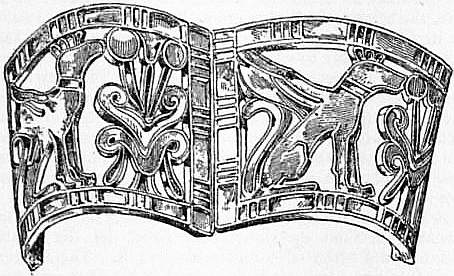
From La Grande Encyclopédie. Fig. 1.—Egyptian Bracelet, Louvre.
In the Bible there are three different words which the authorized version renders by “bracelet.” These are—(1) הרעצא ’eş‘adah, which occurs in Num. xxxi. 50, 2 Sam. i. 10, and which being used with reference to men only, may be taken to be the armlet; (2) דימצ şamīd, which is found in Gen. xxiv. 22, Num. xxxi. 50, Ezek. xvi. 11;—where these two words occur together (as in Num. xxxi. 50) the first is rendered by “chain,” and the second by “bracelet”; (3) תורש sheroth, which occurs only in Isa. iii. 19. The first probably meant armlets worn by men; the second, bracelets worn by women and sometimes by men; and the third a peculiar bracelet of chain-work worn only by women. In 2 Sam. i. 10 the first word denotes the royal ornament which the Amalekite took from the arm of the dead Saul, and brought with the other regalia to David. There is little question that this was such a distinguishing band of jewelled metal as we still find worn as a mark of royalty from the Tigris to the Ganges. The Egyptian kings are represented with armlets, which were also worn by the Egyptian women. These, however, are not jewelled, but of plain or enamelled metal, as was in all likelihood the case among the Hebrews.
In modern times the most celebrated armlets are those which form part of the regalia of the Persian kings and formerly belonged to the Mogul emperors of India, being part of the spoil carried to Persia from Delhi by Nadir Shah in 1739. These ornaments are of dazzling splendour, and the jewels in them are of such large size and immense value that the pair have been reckoned to be worth a million sterling. The principal stone of the right armlet is famous in the East under the name of the Darya-i-nur, “sea (or river) of light.” It weighs 186 carats, and is considered the diamond of finest lustre in the world. The principal jewel of the left armlet, although of somewhat inferior size (146 carats) and value, is renowned as the Tāj-e-mah, “crown of the moon.” The imperial armlets, generally set with jewels, may also be observed in most of the portraits of the Indian emperors.
Bracelets have at all times been much in use among barbaric nations, and the women frequently wear several on the same arm. The finer kinds are of mother-of-pearl, fine gold or silver; others of less value are made of plated steel, horn, brass, copper, beads, &c. Chinese bracelets are sometimes cut out of single pieces of jade.
From La Grande Encyclopédie.
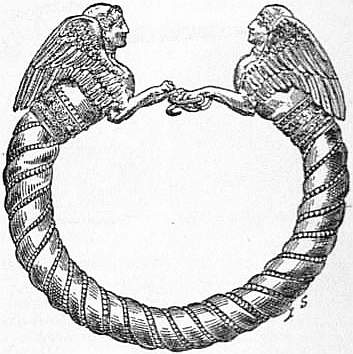
Fig. 2.—Greek Bracelet, Hermitage.
This species of personal ornament has been exceedingly common in Europe from prehistoric times onward. The bracelets of the Bronze Age were of either gold or bronze, silver being then unknown. In shape they were oval and penannular with expanding or trumpet-shaped ends, having an opening between them of about half an inch to enable them to be easily slipped over the wrist. Those of gold were generally plain, hammered rods, bent to the requisite shape, but those of bronze were often chased with decorative designs. Some forms of spiral armlets of bronze, peculiar to Germany and Scandinavia, covered the whole fore-arm, and were doubtless intended as much for defence against a sword-stroke as for ornament. Among the nations of classical antiquity, bracelets were worn by both sexes of the Etruscans; by women only among the Greeks, except in orientalized communities. Among the Romans they were worn by women only as a rule, but they are also recorded to have been used during the empire by nouveaux riches, and by some of the emperors. It should also be mentioned that bracelets were conferred as a military decoration in the field.
The bracelets of the Greeks are of two leading types, both of which were also familiar to the Assyrians. The one class were in the form of coiled spirals, usually in the form of snakes, a term which Pollux gives as a synonym for bracelet. The other class were stiff penannular hoops, capable of being slightly opened. In such examples the terminals are finely finished as rams’ heads, lions’ heads, or (as in the accompanying figure from a bracelet found at Kuloba) as enamelled sphinxes. In late Etruscan art the bracelet may be formed of consecutive panels, as often in modern jewelry.

From La Grande Encydopédie. Fig. 3.—Etruscan Bracelet, Louvre.
The spiral forms were common in the Iron Age of northern Europe, while silver bracelets of great elegance, formed of plaited and intertwisted strands of silver wire, and plain penannular hoops, round or lozenge-shaped in section and tapering to the extremities, became common towards the close of the pagan period. The late Celtic period in Britain was characterized by serpent-shaped bracelets and massive armlets, with projecting ornaments of solid bronze and perforations filled with enamel. In the middle ages bracelets were much less commonly used in Europe, but the custom has continued, to prevail among Eastern nations to the present time, and many of the types that were common in Europe in prehistoric times are still worn in central Asia.
A treatise, De Armillis Veterum, by Thomas Bartholinus, was published at Amsterdam in 1676.
BRACHIOPODA, an important and well-defined but extremely isolated class of invertebrates. The group may be defined as follows: Sessile solitary Coelomata with bivalved shells usually of unequal size and arranged dorso-ventrally. The head is produced into ciliated arms bearing tentacles. They reproduce sexually, and with doubtful exceptions are of separate sexes.
The name Brachiopod (βραχίων, an arm, and πούς, ποδός, a foot) was proposed for the class by F. Cuvier in 1805, and by A.M.C. Dumeril in 1809, and has since been very extensively adopted. The division of the group into Ecardines (Inarticulata), with no hinge to the shell and with an alimentary canal open at both ends, and Testicardines (Articulata), with a hinge between the dorsal and ventral valves and with no anus, was proposed by Owen and has been adopted by nearly all authors. In a later scheme based on our increased knowledge of fossil forms, the Brachiopoda are divided into four primary groups (orders). This is given at the end of the article, but it must not be forgotten that the existing forms with an anus (Ecardines) differ markedly from the aproctous members of the group (Testicardines).
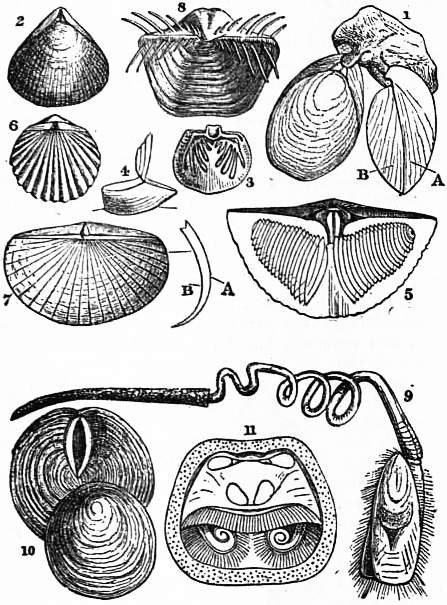
Figs. 1-11.—Various forms of Brachiopoda.
1. Magellania [Waldheimia] cranium. A, ventral, B, dorsal valve. 2. Rhynchonella (Hemithyris) psittacea. 3. and 4. Thecidea. 5. Spirifer. Dorsal valve, showing calcareous spiral coils. 6. Orthis calligramma. 7. Leptaena transversalis. A, ventral, B, dorsal valve. 8. Productus horridus. 9. Lingula pyramidata (after Morse). 10. Discinisca lamellosa. 11. Crania anomala Interior of dorsal valve, showing muscular impressions and labial appendages.
The soft body of the Brachiopod is in all cases protected by a shell composed of two distinct valves; these valves are always, except in cases of malformation, equal-sided, but not equivalved. The valves are, consequently, essentially symmetrical, which is not the case with the Lamellibranchiata,—so much so, that certain Brachiopod shells were named Lampades, or lamp shells, by some early naturalists; but while such may bear a kind of resemblance to an antique Etruscan lamp, by far the larger number in no way resemble one. The shell is likewise most beautiful in its endless shapes and variations. In some species it is thin, semi-transparent and glassy, in others massive. Generally the shell is from a quarter of an inch to about 4 in. in size, but in certain species it attains nearly a foot in breadth by something less in length, as is the case with Productus giganteus. The valves are also in some species very unequal in their respective thickness, as may be seen in Productus (Daviesiella)1 llangollensis, Davidsonia verneuilii, &c., and while the space allotted to the animal is very great in many species, as in Terebratula sphaeroidalis, it is very small in others belonging to Strophomena, Leptaena, Chonetes, &c. The ventral valve is usually the thickest, and in some forms is six or seven times as great as the opposite one. The outer surface of many of the species presents likewise the most exquisite sculpture, heightened by brilliant shades, or spots of green, red, yellow and bluish black. Traces of the original colour have also been preserved in some of the fossil forms; radiating bands of a reddish tint have been often seen in well-preserved examples of Terebratula (Dielasma) hastata, T. (Dielasma) sacculus, T. communis, T. biplicata, and of several others. Some specimens of T. carnea are of a beautiful pale pink colour when first removed from their matrix, and E. Deslongchamps has described the tint of several Jurassic species.
The valves are distinguished as dorsal and ventral. The ventral valve is usually the larger, and in many genera, such as Terebratula and Rhynchonella, has a prominent beak or umbo, with a circular or otherwise shaped foramen at or near its extremity, partly bounded by one or two plates, termed a deltidium. Through the foramen passes a peduncle, by which the animal is in many species attached to submarine objects during at least a portion of its existence. Other forms show no indication of ever having been attached, while some that had been moored by means of a peduncle during the early portion of their existence have become detached at a more advanced stage of life, the opening becoming gradually cicatrized, as is so often seen in Leptaena rhomboidalis, Orthisina anomala, &c. Lastly, some species adhere to submarine objects by a larger or smaller portion of their ventral valve, as is the case with many forms of Crania, Thecidium, Davidsonia, &c. Some Cranias are always attached by the whole surface of their lower or ventral valve, which models itself and fills up all the projections or depressions existing on either the rock, shell or coral to which it adhered. These irregularities are likewise, at times, reproduced on the upper or dorsal valve. Some species of Strophalosia and Productus seem also to have been moored during life to the sandy or muddy bottoms on which they lived, by the means of tubular spines often of considerable length. The interior of the shell varies very much according to families and genera. On the inner surface of both valves several well-defined muscular, vascular and ovarian impressions are observable; they form either indentations of greater or less size and depth, or occur as variously shaped projections. In the Trimerellidae, for example, some of the muscles are attached to a massive or vaulted platform situated in the medio-longitudinal region of the posterior half or umbonal portion of both valves. In addition to these, there exists in the interior of the dorsal valve of some genera a variously modified, thin, calcified, ribbon-shaped skeleton for the support of the ciliated arms, and the form of this ribbon serves as one of the chief generic characters of both recent and extinct forms. This brachial skeleton is more developed in some genera than in others. In certain forms, as in Terebratula and Terebratulina, it is short and simple, and attached to a small divided hinge-plate, the two riband-shaped lamina being bent upwards in the middle (fig. 15). The cardinal process is prominent, and on each side of the hinge-plate are situated the dental sockets; the loop in Terebratulina becomes annular in the adult by the union of its crural processes (fig. 16). In Magellania [Waldheimia] it is elongated and reflected; the hinge-plate large, with four depressions, under which originates a median septum, which extends more or less into the interior of the shell (figs. 13 and 14). In Terebratella the loop is attached to the hinge-plate and to the septum (fig. 17). In Megerlia it is three times attached, first to the hinge-plate, and then to the septum by processes from the diverging and reflected positions of the loop. In Magas the brachial skeleton is composed of an elevated longitudinal septum reaching from one valve to the other, to which are affixed two pairs of calcareous lamellae, the lower ones riband-shaped; attached first to the hinge-plate, they afterwards proceed by a gentle curve near to the anterior portion of the septum, to the sides of which they are affixed; the second pair originate on both sides of the upper edge of the septum, extending in the form of two triangular anchor-shaped lamellae (fig. 18). In Bouchardia the septum only is furnished with two short anchor-shaped lamellae. Many more modifications are observable in different groups of which the great family Terebratulidae is composed. In Thecidium (figs. 3,4) the interior of the dorsal valve is variously furrowed to receive the lophophore folded in two or more lobes. In the family Spiriferidae there are two conical spires directed outwards, and nearly filling the cavity of the shell (fig. 5); while in Atrypa the broad spirally coiled lamellae are vertical, and directed toward the centre of the dorsal valve. In the Rhynchonellidae there are two short slender curved laminae, while in many genera and even families, such as the Productidae, Strophomenidae, Lingulidae, Discinidae, &c., there exists no calcified support for the labial appendages. The ventral valve in many of the genera is provided with two curved hinge-teeth, which fit into corresponding sockets in the opposite valve, so that the valves cannot be separated without breaking one of the teeth.
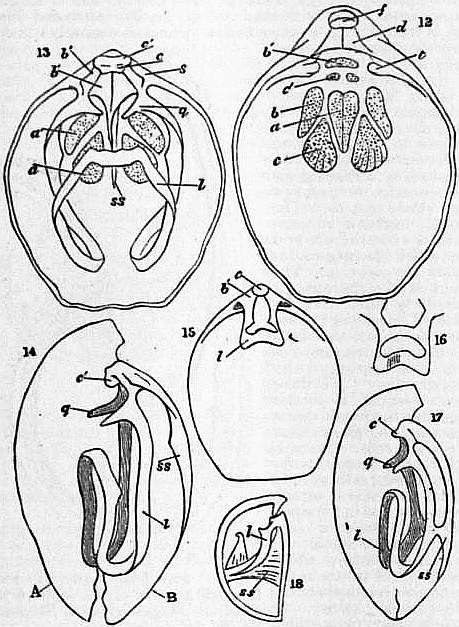
Figs. 12-18.
12. Magellania [Waldheimia] flavescens. Interior of ventral valve. f, foramen; d, deltidium; t, teeth; a, adductor impressions (=occlusors, Hancock); c, divaricator (=cardinal muscles, King, = muscles diducteurs principaux, Gratiolet); c’, accessory divaricators (muscles diducteurs accessoires, Gratiolet); b, ventral adjuster (= ventral peduncular muscles, or muscles du pedoncule paire supérieure, Gratiolet); b’, peduncular muscle. 13. Magellania [Waldheimia] flavescens. Interior of dorsal valve. c, c’, cardinal process; b’, b’, hinge-plate; s, dental sockets; l, loop; q, crura; a, a’, adductor impressions; c, accessory divaricator; b, peduncle muscles; ss, septum. 14. Magellania [Waldheimia] flavescens. Longitudinal section of valves. A, ventral, B, dorsal valves; l, loop; q, crura; ss, septum; c, cardinal process. 15. Terebratula (Liothyris) vitrea. Interior of dorsal valve. l, loop; b, hinge-plate; c, cardinal process. 16. Loop of Terebratulina caput serpentis. 17. Longitudinal section of Terebratella dorsata. (References as in fig. 14.) 18. Longitudinal section of Magas pumilus.
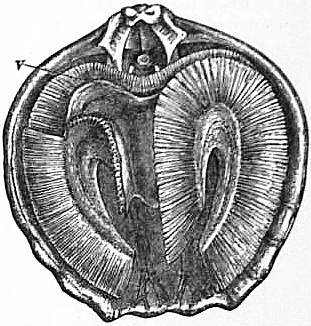
Fig. 19.—Magellania [Waldheimia] flavescens. Interior of dorsal valve, to show the position of the labial appendages. v, Mouth. (A portion of the fringe of cirri is removed to show the brachial membrane and a portion of the spiral extremities of the arms.)
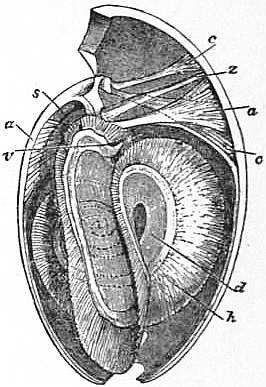
Fig. 20.—Magellania [Waldheimia] flavescens. Logitudinal section with a portion of the animal.
d, h, Brachial appendages. a, Adductor. c, c’, Divaricator muscles. s, Septum. v, Mouth. z, Exremity of alimentary tube.
The penduncular muscules have been purposely omitted.
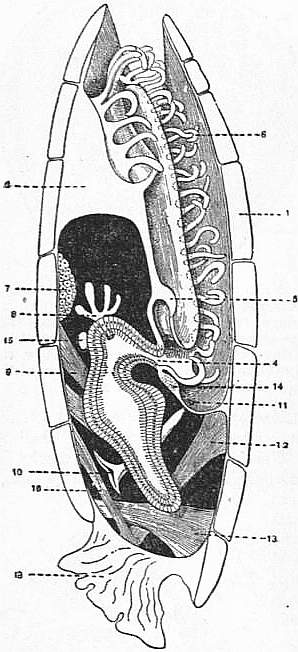
Fig. 21.—A diagram of the left half of an Argiope (Megathyris), which has been bisected in the median plane.
1. The ventral valve. 2. The dorsal valve. 3. The pedicle. 4. The mouth. 5. Lip which overhangs the mouth and runs all round the lophophore. 6. Tentacles. 7. Ovary in dorsal valve. 8. Liver diverticula. 9. Occlusor muscle—its double origin is shown. 10. Internal opening of left nephridium. 11. External opening of the same. 12. Ventral adjustor. 13. Divaricator muscle. 14. Sub-oesophageal nerve ganglion. 15. The heart. 16. Dorsal adjustor muscle.
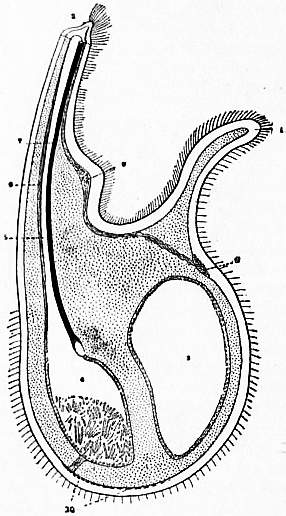
Fig. 22.—Diagrammatic section through an arm of the lophophore of Crania. Magnified; after Blochmann.
1. The lip. 2. The base of a tentacle bisected in the middle line. 3. Great arm-sinus. 4. Small arm-sinus, containing muscle-fibres. 5. Tentacular canal. 6. External tentacular muscle. 7. Tentacular blood-vessel arising from the cut arm-vessel in the small arm-sinus. 8. Chief arm-nerve. 9. Secondary arm-nerve. 10. Under arm-nerve.
Each valve of the shell is lined by a mantle which contains prolongations of the body cavity. The outer surfaces of the mantle secrete the shell, which is of the nature of a cuticle impregnated by calcareous salts. These often have the form of prisms of calcite surrounded by a cuticular mesh work; the whole is nourished and kept alive by processes, which in Crania are branched; these perforate the shell and permit the access of the coelomic fluid throughout its substance. These canals are closed externally and are absent in Rhynchonella, where the amount of calcareous deposit is small. In Lingula the shell is composed of alternate layers of chitin and of phosphate of lime. The free edges of the mantle often bear chitinous bristles or setae which project beyond the shell. As in the case of the Lamellibranchiata, the shell of the adult is not a direct derivative of the youngest shell of the larva. The young Brachiopod in all its species is protected by an embryonic shell called the “protegulum,” which sometimes persists in the umbones of the adult shells but is more usually worn off. In all species it has the same shape, a shape which has been retained in the adult by the Lower Cambrian genus Iphidea.
The body of the Brachiopod usually occupies about the posterior half of the space within the shell. The anterior half of this space is lined by the inner wall of the mantle and is called the mantle cavity. This cavity lodges the arms, which are curved and coiled in different ways in different genera. The water which bears the oxygen for respiration and the minute organisms upon which the Brachiopod feeds is swept into the mantle cavity by the action of the cilia which cover the arms, and the eggs and excreta pass out into the same cavity. The mouth lies in the centre of the anterior wall of the body. Its two lips fusing together at the corners of the mouth are prolonged into the so-called arms. These arms, which together form the lophophore, may be, as in Cistella, applied flat to the inner surface of the dorsal mantle fold, but more usually they are raised free from the body like a pair of moustaches, and as they are usually far too long to lie straight in the mantle cavity, they are folded or coiled up. The brachial skeleton which in many cases supports the arms has been mentioned above.
A transverse section through the arm (fig. 22) shows that it consists of a stout base, composed of a very hyaline connective tissue not uncommon in the tissues of the Brachiopoda, which is traversed by certain canals whose nature is considered below under the section (The Body Cavity) devoted to the coelom. Anteriorly this base supports a gurrie or gutter, the pre-oral rim of which is formed by a simple lip, but the post-oral rim is composed of a closely set row of tentacles. These may number some thousands, and they are usually bent over and tend to form a closed cylinder of the gutter. Each of these tentacles (fig. 22) is hollow, and it contains a diverticulum from the coelom, a branch of the vascular system, a nerve and some muscle-fibres. Externally on two sides and on the inner surface the tentacles are ciliated, and the cilia are continued across the gutter to the lip and even on the outer surface of the latter. These cilia pass on any diatoms and other minute organism which come within their range of action to the capacious oval mouth, which appears as a mere deepening of the gutter in the middle line. In Terebratulina, Rhynchonella, Lingula, and possibly other genera, the arms can be unrolled and protruded from the opened shell; in this case the tentacles also straighten themselves and wave about in the water.
The Body Cavity.—The various internal organs of the brachiopod body, the alimentary canal and liver, the excretory organs, the heart, numerous muscles and the reproductive organs, are enclosed in a cavity called the body cavity, and since this cavity (i.) is derived from the archicoel and is from the first surrounded by meroblast, (ii.) communicates with the exterior through the nephridia or excretory organs, and (iii.) gives rise by the proliferation of the cells which line it to the ova and spermatoza, it is of the nature of a true coelom. The coelom then is a spacious chamber surrounding the alimentary canal, and is continued dorsally and ventrally into the sinuses of the mantle (fig. 21). Some of the endothelial cells lining the coelom are ciliated, the cilia keeping the corpusculated fluid contents in movement. Others of the endothelial cells show a great tendency to form muscle fibres. Besides this main coelomic cavity there are certain other spaces which F. Blochmann regards as coelomic, but it must be remembered that his interpretation rests largely on histological grounds, and at present embryological confirmation is wanting. These spaces are as follows:—(i.) the great arm-sinus; (ii.) the small arm-sinus together with the central sinus and the peri-oesophageal sinus, and in Discinisca and Lingula, and, to a less extent, in Crania, the lip-sinus; (iii.) certain portions of the general body cavity which in Crania are separated off and contain muscles, &c.; (iv.) the cavity of the stalk when such exists. The great arm-sinus of each side of the lophophore lies beneath the fold or lip which together with the tentacles forms the ciliated groove in which the mouth opens. These sinuses are completely shut off from all other cavities, they do not open into the main coelomic space nor into the small arm-sinus, nor does the right sinus communicate with the left. The small arm-sinus runs along the arms of the lophophore at the base of the tentacles, and gives off a blind diverticulum into each of these. This diverticulum contains the blood-vessel and muscle-fibres (fig. 22). In the region of the mouth where the two halves of the small arm-sinus approach one another they open into a central sinus lying beneath the oesophagus and partly walled in by the two halves of the ventral mesentery. This sinus is continued round the oesophagus as the peri-oesophageal sinus, and thus the whole complex of the small arm-sinus has the relations of the so-called vascular system of a Sipunculid. In Crania it is completely shut off from the main coelom, but in Lingula it communicates freely with this cavity. In Discinisca and Lingula there is further a lip-sinus or hollow system of channels which traverses the supporting tissue of the edge of the mantle and contains muscle-fibres. It opens into the peri-oesophageal sinus. It is better developed and more spacious in Lingula than in Discinisca. In Crania, where only indications of the lip-sinus occur, there are two other closed spaces. The posterior occlusor muscles lie in a special closed space which Blochmann also regards as coelomic. The posterior end of the intestine is similarly surrounded by a closed coelomic space known as the peri-anal sinus in which the rectum lies freely, unsupported by mesenteries. All these spaces contain a similar coagulable fluid with sparse corpuscles, and all are lined by ciliated cells. There is further a great tendency for the endothelial cells to form muscles, and this is especially pronounced in the small arm-sinus, where a conspicuous muscle is built up. The mantle-sinuses which form the chief spaces in the mantle are diverticula of the main coelomic cavity. In Discinisca they are provided with a muscular valve placed at their point of origin. They contain the same fluid as the general coelom. The stalk is an extension of the ventral body-wall, and contains a portion of the coelom which, in Discinisca and Lingula, remains in communication with the general body cavity.