VOLUME IV SLICE III Borgia, Lucrezia to Bradford, John (continued 9)
Reading edition
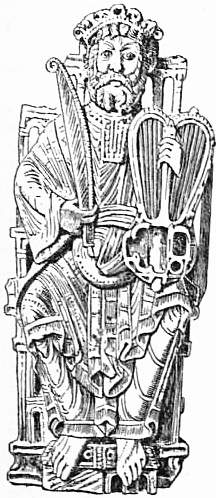
Drawn from the ivory cover of the Lothair Psalter, by permission of Sir Thomas Brooke. Fig. 1.—Earliest Bow of the Crémaillère Type (c. 11th century).
The first improvement on the primitive arched bow was to provide some sort of handle in a straight line with the hair or string of the bow, such as is shown in the MS. translation of the Psalms by Labeo Notker, late 10th century, in the University library, Leipzig.14 The length of the handle was often greatly exaggerated, perhaps by the fancy of the artist. Another handle (see Bodleian Library MS., N.E.D. 2, 12th century) was in the form of a hilt with a knob, possibly a screw-nut, in which the arched stick and the hair were both fixed. The first development of importance influencing the technique of stringed instruments was the attempt to find some device for controlling the tension of the hair. The contrivance known as crémaillère, which was the first step in this direction, seems to have been foreshadowed in the bows drawn in a quaint MS. of the 14th century in the British Museum (Sloane 3983, fol. 43 and 13) on astronomy. Forming an obtuse angle with the handle of the bow is a contrivance shaped like a spear-head which presumably served some useful purpose; if it had notches (which would be too small to show in the drawing), and the hair of the bow was finished with a loop, then we have here an early example of a device for controlling the tension. Another bow in the same MS. has two round knobs on the stick which may be assumed to have served the same purpose.
A very early example of the crémaillère bow (fig. 1) occurs on a carved ivory plate ornamenting the binding of the fine Carolingian MS. Psalter of Lothair (A.D. 825), for some time known as the Ellis and White Psalter, but now in the library of Sir Thomas Brooke at Armitage Bridge House. The carved figure of King David, assigned from its characteristic pose and the treatment of the drapery to the 11th century, holds a stringed instrument, a rotta of peculiar shape, which occurs twice in other Carolingian MSS.15 of the 9th century, but copied here without understanding, as though it were a lyre with many strings. The artist has added a bow with crémaillère attachment, which is startling if the carving be accurately placed in the 11th century. The earliest representation of a crémaillère bow, with this exception, dates from the 15th century, according to Viollet-le-Duc, who merely states that it was copied from a painting.16 Fétis (op. cit. p. 117) figures a crémaillère bow which he styles “Bassani, 1680.” Sebastian Virdung draws a bow for a tromba marina, with the hair and stick bound together with waxed cord. The hair appears to be kept more or less tense by means of a wedge of wood or other material forced in between stick and hair, the latter bulging slightly at this point like the string of an archery bow when the arrow is in position; this contrivance may be due to the fancy of the artist.

Drawn from bows the property of William E. Hill & Sons. Fig. 2.—A, B, Tartini Bows; C, Tourte Bow.
The invention of a movable nut propelled by a screw is ascribed to the elder Tourte (fig. 2); had we not this information on the best authority (Vuillaume and Fétis), it might be imagined that some of the bows figured by Mersenne,17 e.g. the bass viol bow KL (p. 184), and another KLM (p. 192), had a movable nut and screw; the nut is clearly drawn astride the stick as in the modern bow. Mersenne explains (p. 178) the construction of the bow, which consists of three parts: the bois, bâton or brin, the soye, and the demi-roüe or hausse. The term “half-wheel” clearly indicates that the base of the nut was cut round so as to fit round the stick. In the absence of any allusion to such ingenious mechanism as that of screw and nut, we must infer that the drawing is misleading and that the very decided button was only meant for an ornamental finish to the stick. We are informed further that la soye was in reality hairs from the horse or some other animal, of which from 80 to 100 were used for each bow. The up-stroke of the bow was used on the weak beats, 2, 4, 6, 8, and the down-stroke on the strong beats, 1, 3, 5, 7 (p. 185). The same practice prevailed in England in 1667, when Christopher Simpson wrote the Division Viol. He gives information concerning the construction of the bow in these words: “the viol-bow for division should be stiff but not heavy. The length (betwixt the two places where the hairs are fastened at each end) about seven-and-twenty inches. The nut should be short, the height of it about a finger’s breadth or a little more” (p. 2).
As soon as Corelli (1653-1713) formulated the principles of the technique of the violin, marked modifications in the construction of the bow became noticeable. Tartini, who began during the second decade of the 18th century to gauge the capabilities of the bow, introduced further improvements, such as a lighter wood for the stick, a straight contour, and a shorter head, in order to give better equilibrium. The Tourtes, father and son, accomplished the rest.
After Francois Tourte, the following makers are the most esteemed: J.B. Vuillaume, who was directly inspired by Tourte and rendered an inestimable service to violinists by working out on a scientific basis the empirical taper of the Tourte stick, which was found in all his bows to conform to strict ratio;18 Dominique Peccate, apprenticed to J.B. Vuillaume; Henry, 1812-1870, who signs his name and “Paris” on the stick near the nut; Jacques Lefleur, 1760-1832; François Lupot, 1774-1837, the first to line the angular cutting of the nut, where it slides along the stick, with a plate of metal; Simon, born 1808, who also signs his bows on the stick near the nut; John Dodd of Richmond, the greatest English bow-maker, who was especially renowned for his violoncello bows, though his violin bows had the defect of being rather short.
The violoncello bow is a little shorter than those used for violin and viola, and the head and nut are deeper.
The principal models of double-bass bows in vogue at the beginning of the 19th century were the Dragonetti, maintaining the arch of the medieval bows, and the Bottesini, shaped and held like the violin bow; the former was held over-hand with the hair inclining towards the bridge, and was adopted by the Paris Conservatoire under Habeneck about 1830; the great artist himself sent over the model from London. Illustrations of both bows are given by Vidal (op. cit. pl. xviii.).
Messrs W.E. Hill & Sons probably possess the finest and most representative collection of bows in the world.
(K. S.)
1 “Bow,” the forepart or head of a ship, must be distinguished from this word. It is the same word, and pronounced in the same way, as “bough,” an arm or limb of a tree, and represents a common Teutonic word, seen in O. Eng. bog, Ger. Bug, shoulder, and is cognate with Gr. πῆχυς, forearm. The sense of “shoulder” of a ship is not found in O. Eng. bog. but was probably borrowed from Dutch or Danish. “Bow,” an inclination of the head or body, though pronounced as “bough,” is of the same origin as “bow,” to bend.
2 See F.J. Fétis, Antoine Stradivari, pp. 120-121 (Paris, 1856).
3 Fétis, op. cit. p. 123.
4 J. Rühlmann, Die Geschichte der Bogeninstrumente (Brunswick, 1882), p. 143.
5 Fétis, op. cit. p. 119.
6 Antoine Vidal, Les Instruments à archet (Paris, 1876-1878), tome i. p. 269
7 De Cantu et Musica Sacra (1774), tome ii. pl. xxxii. No. 18; the MS. has since perished by fire.
8 See, for an illustration of the bowed instrument on one of the sides of a Byzantine ivory casket, 9th century, in the Carrand Collection, Florence, A. Venturi, Gallerie Nazionali Italiane, iii. (Rome, 1897), plate, p. 263; and Add. MS. 19,352, British Museum, Greek Psalter, dated 1066.
9 See Jean Clédat, “Le Monastère et la nécropole de Baouît,” in Mém. de l’Inst. franç. d’archéol. orient. du Caire, vol. xii. (1904), chap. xviii. pl. lxiv. (2); also Fernand Cabrol, Dict. d’archéol. chrétienne, s.v. “Baouît.”
10 For an illustration, see Sonnerat, Voyage aux Indes orientales (Paris, 1806), vol. i. p. 182.
11 Op. cit. pp. 4-10.
12 Op. cit. vol. i. p. 3 and pl. ii.
13 Edward Heron-Allen, Violin-making as it was and is (London, 1884), pp. 37-42, figs. 5-10.
14 MS. 774, fol. 30. For an illustration of it see Hyacinth Abele, Die Violine, ihre Geschichte und ihr Bau (Neuburg-a-D., 1874), pl. 5, No. 7.
15 See Crowd for fig. from the Bible of Charles le Chauve; and also King David in the Bible of St Paul extra muros, Rome (photographic facsimile by J.O. Westwood, Oxford, 1876).
16 See Dictionnaire raisonné du mobilier français (Paris, 1871), vol. ii. part iv. pp. 265 D. and 266 note.
17 Marin Mersenne, L’Harmonie universelle (Paris, 1636-1637), pp. 184 and 192.
18 Vuillaume’s diagram and explanation are reproduced by Fétis, op. cit. pp. 125-128.
BOWDICH, THOMAS EDWARD (1790-1824), English traveller and author, was born at Bristol in 1790. In 1814, through his uncle, J. Hope-Smith, governor of the British Gold Coast Settlements, he obtained a writership in the service of the African Company of Merchants and was sent to Cape Coast. In 1817 he was sent, with two companions, to Kumasi on a mission to the king of Ashanti, and chiefly through his skilful diplomacy the mission succeeded in its object of securing British control over the coast natives (see Ashanti: History). In 1818 Bowdich returned to England, and in 1819 published an account of his mission and of the study he had made of the barbaric court of Kumasi, entitled Mission from Cape Coast Castle to Ashantee, &c. (London, 1819). His African collections he presented to the British Museum. Bowdich publicly attacked the management of the African committee, and his strictures were instrumental in leading the British government to assume direct control over the Gold Coast. From 1820 to 1822 Bowdich lived in Paris, studying mathematics and the natural sciences, and was on intimate terms with Cuvier, Humboldt and other savants. During his stay in France he edited several works on Africa, and also wrote scientific works. In 1822, accompanied by his wife, he went to Lisbon, where, from a study of historic MSS., he published An Account of the Discoveries of the Portuguese in ... Angola and Mozambique (London, 1824). In 1823 Bowdich and his wife, after some months spent in Madeira and Cape Verde Islands, arrived at Bathurst at the mouth of the Gambia, intending to go to Sierra Leone and thence explore the interior. But at Bathurst Bowdich died on the 10th of January 1824. His widow published an account of his last journey, entitled Excursions in Madeira and Porto Santo ... to which is added.... A Narrative of the Continuance of the Voyage to its Completion, &c. (London, 1825). Bowdich’s daughter, Mrs Hutchinson Hale, republished in 1873, with an introductory preface, her father’s Mission from Cape Coast Castle to Ashantee.
BOWDITCH, NATHANIEL (1773-1838), American mathematician, was born at Salem, Massachusetts. He was bred to his father’s business as a cooper, and afterwards apprenticed to a ship-chandler. His taste for mathematics early developed itself; and he acquired Latin that he might study Newton’s Principia. As clerk (1795) and then as supercargo (1796, 1798, 1799) he made four long voyages; and, being an excellent navigator, he afterwards (1802) commanded a vessel, instructing his crews in lunar and other observations. He edited two editions of Hamilton Moore’s Navigation, and in 1802 published a valuable work, New American Practical Navigator, founded on the earlier treatise by Moore. In 1804 he became president of a Salem insurance company. In the midst of his active career he undertook a translation of the Mécanique céleste of P.S. Laplace, with valuable annotations (vol. i., 1829). He was offered, but declined, the professorship of mathematics and astronomy at Harvard. Subsequently he became president of the Mechanics’ Institute in Boston, and also of the American Academy of Arts and Sciences. He died at Boston on the 16th of March 1838.
A life of Bowditch was written by his son Nathaniel Ingersoll Bowditch (1805-1861), and was prefixed to the fourth volume (1839) of the translation of Laplace. In 1865 this was elaborated into a separate biography by another son, Henry Ingersoll Bowditch (1808-1892), a famous Boston physician.
BOWDLER, THOMAS (1754-1825), editor of the “family” Shakespeare, younger son of Thomas Bowdler, a gentleman of independent fortune, was born at Ashley, near Bath, on the 11th of July 1754. He studied medicine at the universities of St Andrews and Edinburgh, graduating M.D. in 1776. After four years spent in foreign travel, he settled in London, where he became intimate with Mrs Montague and other learned ladies. In 1800 he left London to live in the Isle of Wight, and later on he removed to South Wales. He was an energetic philanthropist, and carried on John Howard’s work in the prisons and penitentiaries. In 1818 he published The Family Shakespeare “in ten volumes, in which nothing is added to the original text; but those words and expressions are omitted which cannot with propriety be read aloud in a family.” Criticisms of this edition appeared in the British Critic of April 1822. Bowdler also expurgated Edward Gibbon’s History of the Decline and Fall of the Roman Empire (published posthumously, 1826); and he issued a selection from the Old Testament for the use of children. He died at Rhyddings, near Swansea, on the 24th of February 1825.
From Bowdler’s name we have the word to “bowdlerize,” first known to occur in General Perronet Thompson’s Letters of a Representative to his Constituents during the Session of 1836, printed in Thompson’s Exercises, iv. 126. The official interpretation is “to expurgate (a book or writing) by omitting or modifying words or passages considered indelicate or offensive.” Both the word and its derivatives, however, are associated with false squeamishness. In the ridicule poured on the name of Bowdler it is worth noting that Swinburne in “Social Verse” (Studies in Prose and Poetry, 1894, p. 98) said of him that “no man ever did better service to Shakespeare than the man who made it possible to put him into the hands of intelligent and imaginative children,” and stigmatized the talk about his expurgations as “nauseous and foolish cant.”
BOWDOIN, JAMES (1726-1790), American political leader, was born of French Huguenot descent, in Boston, Massachusetts, on the 7th of August 1726. He graduated at Harvard in 1745, and was a member of the lower house of the general court of Massachusetts in 1753-1756, and from 1757 to 1774 of the Massachusetts council, in which, according to Governor Thomas Hutchinson, he “was without a rival,” and, on the approach of the War of Independence, was “the principal supporter of the opposition to the government.” From August 1775 until the summer of 1777 he was the president of the council, which had then become to a greater extent than formerly an executive as well as a legislative body. In 1779-1780 he was president of the constitutional convention of Massachusetts, also serving as chairman of the committee by which the draft of the constitution was prepared. Immediately afterward he was a member of a commission appointed “to revise the laws in force in the state; to select, abridge, alter and digest them, so as to be accommodated to the present government.” From 1785 to 1787 he was governor of Massachusetts, suppressing with much vigour Shays’ Rebellion, and failing to be re-elected largely because it was believed that he would punish the insurrectionists with more severity than would his competitor, John Hancock. Bowdoin was a member of the state convention which in February 1788 ratified for Massachusetts the Federal Constitution, his son being also a member. He died in Boston on the 6th of November 1790. He took much interest in natural philosophy, and presented various papers before the American Academy of Arts and Sciences, of which he was one of the founders and, from 1780 to 1790, the first president. Bowdoin College was named in his honour.
His son, James Bowdoin (1752-1811), was born in Boston on the 22nd of September 1752, graduated at Harvard in 1771, and served, at various times, as a representative, senator and councillor of the state. From 1805 until 1808 he was the minister plenipotentiary of the United States in Spain. He died on Naushon Island, Dukes county, Massachusetts, on the 11th of October 1811. To Bowdoin College he gave land, money and apparatus; and he made the college his residuary legatee, bequeathing to it his collection of paintings and drawings, then considered the finest in the country.
BOWELL, SIR MACKENZIE (1823- ), Canadian politician, son of John Bowell, carpenter and builder, was born at Ricking-hall, England, on the 27th of December 1823. In 1833 he moved with his family to Belleville, Canada, where he finally became editor and proprietor of the Intelligencer. He was elected grand master of the Orange Association of British America, and was long the exponent in the Canadian parliament of the claims of that order. From 1867 till 1892 he represented North Hastings in the House, after which he retired to the senate. From 1878 till 1891 he was minister of customs in the cabinet of Sir John Macdonald; then minister of militia; and under the premiership of Sir John Thompson, minister of trade and commerce. From December 1894 till April 1896 he was premier of Canada, and endeavoured to enforce remedial legislation in the question of the Manitoba schools. But his policy was unsuccessful, and he retired from the government. From 1896 till 1906 he led the Conservative party in the senate. In 1894 he presided over the colonial conference held in Ottawa, and in 1895 was created K.C.M.G.
BOWEN, CHARLES SYNGE CHRISTOPHER BOWEN, Baron (1835-1894), English judge, was born on the 1st of January 1835, at Woolaston in Gloucestershire, his father, the Rev. Christopher Bowen of Hollymount, Co. Mayo, being then curate of the parish. He was educated at Lille, Blackheath and Rugby schools, leaving the latter with a Balliol scholarship in 1853. At Oxford he made good the promise of his earlier youth, winning the principal classical scholarships and prizes of his time. He was made a fellow of Balliol in 1858. From Oxford Bowen went to London, where he was called to the bar at Lincoln’s Inn in 1861, and while studying law he wrote regularly for the Saturday Renew, and also later for the Spectator. For a time he had little success at the bar, and came near to exchanging it for the career of a college tutor, but he was induced by his friends, who recognized his talents, to persevere. Soon after he had begun to make his mark he was briefed against the claimant in the famous “Tichborne Case.” Bowen’s services to his leader, Sir John Coleridge, helped to procure for him the appointment of junior counsel to the treasury when Sir John had passed, as he did while the trial proceeded, from the office of solicitor-general to that of attorney-general; and from this time his practice became a very large one. The strain, however, of the Tichborne trials had been great, so that his physical health became unequal to the tasks which his zeal for work imposed upon it, and in 1879 his acceptance of a judgeship in the queen’s bench division, on the retirement of Mr Justice Mellor, gave him the opportunity of comparative rest. The character of Charles Bowen’s intellect hardly qualified him for some of the duties of a puisne judge; but it was otherwise when, in 1882, in succession to Lord Justice Holker, he was raised to the court of appeal. As a lord justice of appeal he was conspicuous for his learning, his industry and his courtesy to all who appeared before him; and in spite of failing health he was able to sit more or less regularly until August 1893, when, on the retirement of Lord Hannen, he was made a lord of appeal in ordinary, and a baron for life, with the title of Baron Bowen of Colwood. By this time, however, his health had finally broken down; he never sat as a law lord to hear appeals, and he gave but one vote as a peer, while his last public service consisted in presiding over the commission which sat in October 1893 to inquire into the Featherstone riots. He died on the 10th of April 1894.
Lord Bowen was regarded with great affection by all who knew him either professionally or privately. He had a polished and graceful wit, of which many instances might be given, although such anecdotes lose force in print. For example, when it was suggested on the occasion of an address to Queen Victoria, to be presented by her judges, that a passage in it, “conscious as we are of our shortcomings,” suggested too great humility, he proposed the emendation “conscious as we are of one another’s shortcomings”; and on another occasion he defined a jurist as “a person who knows a little about the laws of every country except his own.” Lord Bowen’s judicial reputation will rest upon the series of judgments delivered by him in the court of appeal, which are remarkable for their lucid interpretation of legal principles as applied to the facts and business of life. Among good examples of his judgment may be cited that given in advising the House of Lords in Angus v. Dalton (6 App. Cas. 740), and those delivered in Abrath v. North Eastern Railway (11 Q.B.D. 440); Thomas v. Quartermaine (18 Q.B.D. 685); Vagliano v. Bank of England (23 Q.B.D. 243) (in which he prepared the majority judgment of the court, which was held to be wrong in its conclusion by the majority of the House of Lords); and the Mogul Steamship Company v. M’Gregor (23 Q.B.D. 598). Of Lord Bowen’s literary works besides those already indicated may be mentioned his translation of Virgil’s Eclogues, and Aeneid, books i.-vi., and his pamphlet, The Alabama Claim and Arbitration considered from a Legal Point of View. Lord Bowen married in 1862 Emily Frances, eldest daughter of James Meadows Rendel, F.R.S., by whom he had two sons and a daughter.
See Lord Bowen, by Sir Henry Stewart Cunningham.
BOWEN, FRANCIS (1811-1890), American philosophical writer and educationalist, was born in Charlestown, Massachusetts, on the 8th of September 1811. He graduated at Harvard in 1833, taught for two years at Phillips Exeter Academy, and then from 1835 to 1839 was a tutor and instructor at Harvard. After several years of study in Europe, he settled in Cambridge, Massachusetts, and was editor and proprietor of the North American Review from 1843 to 1854. In 1850 he was appointed professor of history at Harvard; but his appointment was disapproved by the board of overseers on account of reactionary political opinions he had expressed in a controversy with Robert Carter (1819-1879) concerning the Hungarian revolution. In 1853 his appointment as Alford professor of natural religion, moral philosophy and civil polity was approved, and he occupied the chair until 1889. In 1876 he was a member of the Federal commission appointed to consider currency reform, and wrote (1877) the minority report, in which he opposed the restoration of the double standard and the remonetization of silver. He died in Boston, Massachusetts, on the 22nd of January 1890. His writings include lives of Sir William Phipps, Baron von Steuben, James Otis and Benjamin Lincoln in Jared Sparks’ “Library of American Biography”; Critical Essays on the History and Present Condition of Speculative Philosophy (1842); Lowell Lectures on the Application of Metaphysical and Ethical Science to the Evidences of Religion (1849); The Principles of Political Economy applied to the Condition, Resources and Institutions of the American People (1856); A Treatise on Logic (1864); American Political Economy (1870); Modern Philosophy from Descartes to Schopenhauer and Hartmann (1877); and Gleanings from a Literary Life, 1838-1880 (1880).
BOWEN, SIR GEORGE FERGUSON (1821-1899), British colonial governor, eldest son of the Rev. Edward Bowen, afterwards rector of Taughboyne, Co. Donegal, was born on the 2nd of November 1821. Educated at Charterhouse school and Trinity College, Oxford, he took a first class in classics in 1844, and was elected a fellow of Brasenose. In 1847 he was chosen president of the university of Corfu. Having served as secretary of government in the Ionian Islands, he was appointed in 1859 the first governor of Queensland, which colony had just been separated from New South Wales. He was interested in the exploration of Queensland and in the establishment of a volunteer force, but incurred some unpopularity by refusing to sanction the issue of inconvertible paper money during the financial crisis of 1866. In 1867 he was made governor of New Zealand, in which position he was successful in reconciling the Maoris to the English rule, and saw the end of the struggle between the colonists and the natives. Transferred to Victoria in 1872, Bowen endeavoured to reduce the expenses of the colony, and in 1879 became governor of Mauritius. His last official position was that of governor of Hong-Kong, which he held from 1882 to 1887. He was made a K.C.M.G. in 1856, a privy councillor in 1886, and received honorary degrees from both Oxford and Cambridge. In December 1887 he was appointed chief of the royal commission which was sent to Malta with regard to the new constitution for the island, and all the recommendations made by him were adopted. He died at Brighton on the 21st of February 1899, having been married twice, and having had a family of one son and four daughters. Bowen wrote Ithaca in 1850 (London, 1854), translated into Greek in 1859; and Mount Athos, Thessaly and Epirus (London, 1852); and he was the author of Murray’s Handbook for Greece (London, 1854).
A selection of his letters and despatches, Thirty Years of Colonial Government (London, 1889), was edited by S. Lane-Poole.
BOWER, WALTER (1385-1449), Scottish chronicler, was born about 1385 at Haddington. He was abbot of Inchcolm (in the Firth of Forth) from 1418, was one of the commissioners for the collection of the ransom of James I., king of Scots, in 1423 and 1424, and in 1433 one of the embassy to Paris on the business of the marriage of the king’s daughter to the dauphin. He played an important part at the council of Perth (1432) in the defence of Scottish rights. During his closing years he was engaged on his work the Scotichronicon, on which his reputation now chiefly rests. This work, undertaken in 1440 by desire of a neighbour, Sir David Stewart of Rosyth, was a continuation of the Chronica Gentis Scotorum of Fordun. The completed work, in its original form, consisted of sixteen books, of which the first five and a portion of the sixth (to 1163) are Fordun’s—or mainly his, for Bower added to them at places. In the later books, down to the reign of Robert I. (1371), he was aided by Fordun’s Gesta Annalia, but from that point to the close the work is original and of contemporary importance, especially for James I., with whose death it ends. The task was finished in 1447. In the two remaining years of his life he was engaged on a reduction or “abridgment” of this work, which is known as the Book of Cupar, and is preserved in the Advocates’ library, Edinburgh (MS. 35. 1. 7). Other abridgments, not by Bower, were made about the same time, one about 1450 (perhaps by Patrick Russell, a Carthusian of Perth) preserved in the Advocates’ library (MS. 35. 6. 7) and another in 1461 by an unknown writer, also preserved in the same collection (MS. 35. 5. 2). Copies of the full text of the Scotichronicon, by different scribes, are extant. There are two in the British Museum, in The Black Book of Paisley, and in Harl. MS. 712; one in the Advocates’ library, from which Walter Goodall printed his edition (Edin., 1759), and one in the library of Corpus Christi, Cambridge.
Goodall’s is the only complete modern edition of Bower’s text. See also W.F. Skene’s edition of Fordun in the series of Historians of Scotland (1871). Personal references are to be found in the Exchequer Rolls of Scotland, iii. and iv. The best recent account is that by T.A. Archer in the Dict, of Nat. Biog.
BOWERBANK, JAMES SCOTT (1797-1877), English naturalist and palaeontologist, was born in Bishopsgate, London, on the 14th of July 1797, and succeeded in conjunction with his brother to his father’s distillery, in which he was actively engaged until 1847. In early years astronomy and natural history, especially botany, engaged much of his attention; he became an enthusiastic worker at the microscope, studying the structure of shells, corals, moss-agates, flints, &c., and he also formed an extensive collection of fossils. The organic remains of the London Clay attracted particular attention, and about the year 1836 he and six other workers founded “The London Clay Club”—the members comprising Dr Bowerbank, Frederick E. Edwards (1799-1875), author of The Eocene Mollusca (Palaeontograph. Soc.), Searles V. Wood, John Morris, Alfred White (zoologist), N.T. Wetherell, surgeon of Highgate (1800-1875), and James de Carle Sowerby. In 1840 Bowerbank published A History of the Fossil Fruits and Seeds of the London Clay, and two years later he was elected F.R.S. In 1847 he suggested the establishment of a society for the publication of undescribed British Fossils, and thus originated the Palaeontographical Society. From 1844 until 1864 he did much to encourage a love of natural science by being “at home” every Monday evening at his residence in Park Street, Islington, and afterwards in Highbury Grove, where the treasures of his museum, his microscopes, and his personal assistance were at the service of every earnest student. In the study of sponges he became specially interested, and he was author of A Monograph of the British Spongiadae in 4 vols., published by the Ray Society, 1864-1882. He retired in 1864 to St Leonards, where he died on the 8th of March 1877.
BOWIE, JAMES (1796-1836), American pioneer, was born in Logan county, Kentucky. He was taken to Louisiana about 1802, and in 1818-1820 was engaged with his brothers, John J. and Rezin P., in smuggling negro slaves into the United States from the headquarters of the pirates led by Jean Lafitte on Galveston Island. Bowie removed to Texas in 1828 and took a prominent part in the revolt against Mexico, being present at the battles of Nacogdoches (1832), Concepcion (1835) and the Grass Fight (1835). He was one of the defenders of the Alamo (see San Antonio), but was ill of pneumonia at the time of the final assault on the 6th of March 1836, and was among the last to be butchered. Bowie’s name is now perpetuated by a county in north-eastern Texas, and by its association with that of the famous hunting-knife, which he used, but probably did not invent.
BOW-LEG (Genu Varum), a deformity characterized by separation of the knees when the ankles are in contact. Usually there is an outward curvature of both femur and tibia, with at times an interior bend of the latter bone. At birth all children are more or less bandy-legged. The child lies on its nurse’s knee with the soles of the feet facing one another; the tibiae and femora are curved outwards; and, if the limbs are extended, although the ankles are in contact, there is a distinct space between the knee-joints. During the first year of life a gradual change takes place. The knee-joints approach one another; the femora slope downwards and inwards towards the knee-joints; the tibiae become straight; and the sole of the foot faces almost directly downwards. While these changes are occurring, the bones, which at first consist principally of cartilage, are gradually becoming ossified, and in a normal child by the time it begins to walk the lower limbs are prepared, both by their general direction and by the rigidity of the bones which form them, to support the weight of the body. If, however, the child attempts either as the result of imitation or from encouragement to walk before the normal bandy condition had passed off, the result will necessarily be either an arrest in the development of the limbs or an increase of the bandy condition. If the child is weakly, either rachitic or suffering from any ailment which prevents the due ossification of the bones, or is improperly fed, the bandy condition may remain persistent. Thus the chief cause of this deformity is rickets (q.v.). The remaining causes are occupation, especially that of a jockey, and traumatism, the condition being very likely to supervene after accidents involving the condyles of the femur. In the rickety form the most important thing is to treat the constitutional disease, at the same time instructing the mother never to place the child on its feet. In many cases this is quite sufficient in itself to effect a cure, but matters can be hastened somewhat by applying splints. When in older patients the deformity arises either from traumatism or occupation, the only treatment is that of operation.
A far commoner deformity than the preceding is that known as knock-knee (or Genu Valgum). In this condition there is close approximation of the knees with more or less separation of the feet, the patient being unable to bring the feet together when standing. Occasionally only one limb may be affected, but the double form is the more common. There are two varieties of this deformity: (i.) that due to rickets and occurring in young children (the rachitic form), and (ii.) that met with in adolescents and known as the static form. In young children it is practically always due to rickets, and the constitutional disease must be most rigorously dealt with. It is, however, especially in these cases that cod-liver oil is to be avoided, since it increases the body weight and so may do harm rather than good. The child if quite young must be kept in bed, and the limbs manipulated several times a day. Where the child is a little older and it is more difficult to keep him off his feet, long splints should be applied from the axilla or waist to a point several inches below the level of the foot. It is only by making the splints sufficiently long that a naturally active child can be kept at rest. The little patient should live in the open air as much as possible.
The static form of Genu Valgum usually occurs in young adolescents, especially in anaemic nurse-girls, young bricklayers, and young people who have outgrown their strength, yet have to carry heavy weights. Normally in the erect posture the weight of the body is passed through the outer condyle of the femur rather than the inner, and this latter is lengthened to keep the plane of the knee-joint horizontal. This throws considerable strain on the internal lateral ligament of the knee-joint, and after standing of long duration or with undue weight the muscles of the inner side of the limb also become over-fatigued. Thus the ligament gradually becomes stretched, giving the knee undue mobility from side to side. If the condition be not attended to, the outer condyle becomes gradually atrophied, owing to the increased weight transmitted through it, and the inner condyle becomes lengthened. These changes are the direct outcome of a general law, namely, that diminished pressure results in increased growth, increased pressure in diminished growth. The best example of the former principle is the rapid growth that takes place in the child that is confined to bed during a prolonged illness. The distorted, stunted, shortened and fashionable foot of the Chinese lady is an example of the latter. Flat-foot (see Club-Foot) and lateral curvature of the spine, scoliosis, are often associated with this form of Genu Valgum, the former being due to relaxation of ligaments, the latter being compensatory where the deformity only affects one leg, though often found merely in association with the more common bilateral variety. In the early stages of the static form attention to general health, massage and change of air, will often effect a cure. But in the more aggravated forms an apparatus is needed. This usually consists of an outside iron rod, jointed at the knee, attached above to a pelvic band and below to the heel of the boot. By the gradual tightening of padded straps passing round the limbs the bones can be drawn by degrees into a more natural position. But if the patient has reached such an age that the deformity is fixed, then the only remedy is that of operation.
BOWLES, SAMUEL (1826-1878), American journalist, was born in Springfield, Massachusetts, on the 9th of February 1826. He was the son of Samuel Bowles (1779-1851) of the same city, who had established the weekly Springfield Republican in 1824. The daily issue was begun in 1844, as an evening newspaper, afterwards becoming a morning journal. To its service Samuel Bowles, junior, devoted his life (with the exception of a brief period during which he was in charge of a daily in Boston), and he gave the paper a national reputation by the vigour, incisiveness and independence of its editorial utterances, and the concise and convenient arrangement of its local and general news-matter. During the controversies affecting slavery and resulting in the Civil War, Bowles supported, in general, the Whig and Republican parties, but in the period of Reconstruction under President Grant his paper represented anti-administration or “Liberal Republican” opinions, while in the disputed election of 1876 it favoured the claims of Tilden, and subsequently became independent in politics. Bowles died at Springfield on the 16th of January 1878. During his lifetime, and subsequently, the Republican office was a sort of school for young journalists, especially in the matter of pungency and conciseness of style, one of his maxims being “put it all in the first paragraph.” Bowles published two books of travel, Across the Continent (1865) and The Switzerland of America (1869), which were combined into one volume under the title Our New West (1869). He was succeeded as publisher and editor-in-chief of the Republican by his son Samuel Bowles (b. 1851).
A eulogistic Life and Times of Samuel Bowles (2 vols., New York, 1885), by George S. Merriam, is virtually a history of American political movements after the compromise of 1850.
BOWLES, WILLIAM LISLE (1762-1850), English poet and critic, was born at King’s Sutton, Northamptonshire, of which his father was vicar, on the 24th of September 1762. At the age of fourteen he entered Winchester school, the head-master at the time being Dr Joseph Warton. In 1781 he left as captain of the school, and proceeded to Trinity College, Oxford, where he had gained a scholarship. Two years later he won the chancellor’s prize for Latin verse. In 1789 he published, in a small quarto volume, Fourteen Sonnets, which met with considerable favour at the time, and were hailed with delight by Coleridge and his young contemporaries. The Sonnets even in form were a revival, a return to the older and purer poetic style, and by their grace of expression, melodious versification, tender tone of feeling and vivid appreciation of the life and beauty of nature, stood out in strong contrast to the elaborated commonplaces which at that time formed the bulk of English poetry. After taking his degree at Oxford he entered the Church, and was appointed in 1792 to the vicarage of Chicklade in Wiltshire. In 1797 he received the vicarage of Dumbleton in Gloucestershire, and in 1804 was presented to the vicarage of Bremhill in Wiltshire. In the same year he was collated by Bishop Douglas to a prebendal stall in the cathedral of Salisbury. In 1818 he was made chaplain to the prince regent, and in 1828 he was elected residentiary canon of Salisbury. He died at Salisbury on the 7th of April 1850, aged 88.
The longer poems published by Bowles are not of a very high standard, though all are distinguished by purity of imagination, cultured and graceful diction, and great tenderness of feeling. The most extensive were The Spirit of Discovery (1804), which was mercilessly ridiculed by Byron; The Missionary of the Andes (1815); The Grave of the Last Saxon (1822); and St John in Patmos (1833). Bowles is perhaps more celebrated as a critic of poetry than as a poet. In 1806 he published an edition of Pope’s works with notes and an essay on the poetical character of Pope. In this essay he laid down certain canons as to poetic imagery which, subject to some modification, have been since recognized as true and valuable, but which were received at the time with strong opposition by all admirers of Pope and his style. The “Pope and Bowles” controversy brought into sharp contrast the opposing views of poetry, which may be roughly described as the natural and the artificial. Bowles maintained that images drawn from nature are poetically finer than those drawn from art; and that in the highest kinds of poetry the themes or passions handled should be of the general or elemental kind, and not the transient manners of any society. These positions were vigorously assailed by Byron, Campbell, Roscoe and others of less note, while for a time Bowles was almost solitary. Hazlitt and the Blackwood critics, however, came to his assistance, and on the whole Bowles had reason to congratulate himself on having established certain principles which might serve as the basis of a true method of poetical criticism, and of having inaugurated, both by precept and by example, a new era in English poetry. Among other prose works from his prolific pen was a Life of Bishop Ken (2 vols., 1830-1831).
His Poetical Works were collected in 1855, with a memoir by G. Gilfillan.
BOWLINE (a word found in most Teutonic languages, probably connected with the “bow” of a ship), a nautical term for a rope leading from the edge of a sail to the bows, for the purpose of steadying the sail when sailing close to the wind—“on a bowline.”
BOWLING (Lat. bulla, a globe, through O. Fr. boule, ball), an indoor game played upon an alley with wooden balls and nine or ten wooden pins. It has been played for centuries in Germany and the Low Countries, where it is still in high favour, but attains its greatest popularity in the United States, whence it was introduced in colonial times from Holland. The Dutch inhabitants of New Amsterdam, now New York, were much addicted to it, and up to the year 1840 it was played on the green, the principal resort of the bowlers being the square just north of the Battery still called Bowling Green. The first covered alleys were made of hardened clay or of slate, but those in vogue at present are built up of alternate strips of pine and maple wood, about 1 × 3 in. in size, set on edge, and fastened together and to the bed of the alley with the nicest art of the cabinet-maker. The width of the alley is 4l½ in., and its whole length about 80 ft. From the head, or apex, pin to the foul-line, over which the player may not step in delivering the ball, the distance is 60 ft. On each side of the alley is a 9-in. “gutter” to catch any balls that are bowled wide. Originally nine pins, set up in the diamond form, were used, but during the first part of the 19th century the game of “nine-pins” was prohibited by law, on account of the excessive betting connected with it. This ordinance, however, was soon evaded by the addition of a tenth pin, resulting in the game of “ten-pins,” the pastime in vogue to-day. The ten pins are set up at the end of the alley in the form of a right-angled triangle in four rows, four pins at the back, then three, then two and one as head pin. The back row is placed 3 in. from the alley’s edge, back of which is the pin-pit, 10 in. deep and about 3 ft. wide. The back wall is heavily padded (often with a heavy, swinging cushion), and there are safety corners for the pin-boys, who set up the pins, call the scores and place the balls in the sloping “railway” which returns them to the players’ end of the alley. The pins are made of hard maple and are 15 in. high, 2¼ in. in diameter at their base and 15 in. in circumference at the thickest point. The balls, which are made of some very hard wood, usually lignum vitae, may be of any size not exceeding 27 in. in circumference and 16½ ℔ in weight. They are provided with holes for the thumb and middle finger. As many may play on a side as please, five being the number for championship teams, though this sometimes varies. Each player rolls three balls, called a frame, and ten frames constitute a game, unless otherwise agreed upon. In first-class matches two balls only are rolled. If all ten pins are knocked down by the first ball the player makes a strike, which counts him 10 plus whatever he may make with the first two balls of his next frame. If, however, he should then make another strike, 10 more are added to his score, making 20, to which are added the pins he may knock down with his first ball of the third frame. This may also score a strike, making 30 as the score of the first frame, and, should the player keep up this high average, he will score the maximum, 300, in his ten frames. If all the pins are knocked down with two balls it is called a spare, and the player may add the pins made by the first ball of his second frame. This seemingly complicated mode of scoring is comparatively simple when properly lined score-boards are used. Of course, if all three balls are used no strike or spare is scored, but the number of pins overturned is recorded. The tens of thousands of bowling clubs in the United States and Canada are under the jurisdiction of the American Bowling Congress, which meets once a year to revise the rules and hold contests for the national championships.
Several minor varieties of bowling are popular in America, the most in vogue being “Cocked Hat,” which is played with three pins, one in the head-pin position and the others on either corner of the back row. The pins are usually a little larger than those used in the regular game, and smaller balls are used. The maximum score is 90, and all balls, even those going into the gutter, are in play. “Cocked hat and Feather” is similar, except that a fourth pin is added, placed in the centre. Other variations of bowling are “Quintet,” in which five pins, set up like an arrow pointed towards the bowler, are used; the “Battle Game,” in which 12 can be scored by knocking down all but the centre, or king, pin; “Head Pin and Four Back,” in which five pins are used, one in the head-pin position and the rest on the back line; “Four Back”; “Five Back”; “Duck Pin”; “Head Pin,” with nine pins set up in the old-fashioned way, and “Candle Pin,” in which thin pins tapering towards the top and bottom are used, the other rules being similar to those of the regular game.
The American bowling game is played to a slight extent in Great Britain and Germany. In the latter country, however, the old-fashioned game of nine-pins (Kegelspiel) with solid balls and the pins set up diamond-fashion, obtains universally. The alleys are made with less care than the American, being of cement, asphalt, slate or marble.
BOWLING GREEN, a city and the county-seat of Warren county, Kentucky, U.S.A., on the Barren river, 113 m. S. by W. of Louisville. Pop. (1890) 7803; (1900) 8226, of whom 2593 were negroes; (1910) 9173. The city is served by the Louisville & Nashville railway (which maintains car shops here), and by steamboats navigating the river. Macadamized or gravel roads also radiate from it to all parts of the surrounding country, a rich agricultural and live-stock raising region, in which there are deposits of coal, iron ore, oil, natural gas, asphalt and building stone. The city is the seat of Potter College (for girls; non-sectarian, opened 1889); of Ogden College (non-sectarian, 1877), a secondary school, endowed by the bequest of Major Robert W. Ogden (1796-1873); of the West Kentucky State Normal School, opened (as the Southern Normal School and Business College) at Glasgow in 1875 and removed to Bowling Green in 1884; and of the Bowling Green Business University, formerly a part of the Southern Normal School and Business College. Bowling Green has two parks, a large horse and mule market, and a trade in other live-stock, tobacco and lumber; among its manufactures are flour, lumber, tobacco and furniture. The municipality owns and operates the water-works and the electric lighting plant. Bowling Green was incorporated in 1812. During the early part of the Civil War Bowling Green was on the right flank of the first line of Confederate defence in the West, and was for some time the headquarters of General Albert Sidney Johnston. It was abandoned, however, after the capture by the Federals of Forts Henry and Donelson.
BOWLING GREEN, a city and the county-seat of Wood county, Ohio, U.S.A., 20 m. S. by W. of Toledo, of which it is a residential suburb. Pop. (1890) 3467; (1900) 5067 (264 foreign-born); (1910) 5222. Bowling Green is served by the Cincinnati, Hamilton & Dayton and the Toledo & Ohio Central railways, and by the Toledo Urban & Interurban and the Lake Erie, Bowling Green & Napoleon electric lines, the former extending from Toledo to Dayton. It is situated in a rich agricultural region which abounds in oil and natural gas. Many of the residences and business places of Bowling Green are heated by a privately owned central hot-water heating plant. Among the manufactures are cut glass, stoves and ranges, kitchen furniture, guns, thread-cutting machines, brooms and agricultural implements. Bowling Green was first settled in 1832, was incorporated as a town in 1855, and became a city in 1904.
BOWLS, the oldest British outdoor pastime, next to archery, still in vogue. It has been traced certainly to the 13th, and conjecturally to the 12th century. William Fitzstephen (d. about 1190), in his biography of Thomas Becket, History. gives a graphic sketch of the London of his day and, writing of the summer amusements of the young men, says that on holidays they were “exercised in Leaping, Shooting. Wrestling, Casting of Stones [in jactu lapidum], and Throwing of Javelins fitted with Loops for the Purpose, which they strive to fling before the Mark; they also use Bucklers, like fighting Men.” It is commonly supposed that by jactus lapidum Fitzstephen meant the game of bowls, but though it is possible that round stones may sometimes have been employed in an early variety of the game-and there is a record of iron bowls being used, though at a much later date, on festive occasions at Nairn,—nevertheless the inference seems unwarranted. The jactus lapidum of which he speaks was probably more akin to the modern “putting the weight,” once even called “putting the stone.” It is beyond dispute, however, that the game, at any rate in a rudimentary form, was played in the 13th century. A MS. of that period in the royal library, Windsor (No. 20, E iv.), contains a drawing representing two players aiming at a small cone instead of an earthenware ball or jack. Another MS. of the same century has a picture—crude, but spirited—which brings us into close touch with the existing game. Three figures are introduced and a jack. The first player’s bowl has come to rest just in front of the jack; the second has delivered his bowl and is following after it with one of those eccentric contortions still not unusual on modern greens, the first player meanwhile making a repressive gesture with his hand, as if to urge the bowl to stop short of his own; the third player is depicted as in the act of delivering his bowl. A 14th-century MS. Book of Prayers in the Francis Douce collection in the Bodleian library at Oxford contains a drawing in which two persons are shown, but they bowl to no mark. Strutt (Sports and Pastimes) suggests that the first player’s bowl may have been regarded by the second player as a species of jack; but in that case it is not clear what was the first player’s target. In these three earliest illustrations of the pastime it is worth noting that each player has one bowl only, and that the attitude in delivering it was as various five or six hundred years ago as it is to-day. In the third he stands almost upright; in the first he kneels; in the second he stoops, halfway between the upright and the kneeling position.
As the game grew in popularity it came under the ban of king and parliament, both fearing it might jeopardize the practice of archery, then so important in battle; and statutes forbidding it and other sports were enacted in the reigns of Edward III., Richard II. and other monarchs. Even when, on the invention of gunpowder and firearms, the bow had fallen into disuse as a weapon of war, the prohibition was continued. The discredit attaching to bowling alleys, first established in London in 1455, probably encouraged subsequent repressive legislation, for many of the alleys were connected with taverns frequented by the dissolute and gamesters. The word “bowls” occurs for the first time in the statute of 1511 in which Henry VIII. confirmed previous enactments against unlawful games. By a further act of 1541—which was not repealed until 1845—artificers, labourers, apprentices, servants and the like were forbidden to play bowls at any time save Christmas, and then only in their master’s house and presence. It was further enjoined that any one playing bowls outside of his own garden or orchard was liable to a penalty of 6s. 8d., while those possessed of lands of the yearly value of £100 might obtain licences to play on their own private greens. But though the same statute absolutely prohibited bowling alleys, Henry VIII. had them constructed for his own pleasure at Whitehall Palace, and was wont to back himself when he played. In Mary’s reign (1555) the licences were withdrawn, the queen or her advisers deeming the game an excuse for “unlawful assemblies, conventicles, seditions and conspiracies.” The scandals of the bowling alleys grew rampant in Elizabethan London, and Stephen Gosson in his School of Abuse (1579) says, “Common bowling alleys are privy moths that eat up the credit of many idle citizens; whose gains at home are not able to weigh down their losses abroad; whose shops are so far from maintaining their play, that their wives and children cry out for bread, and go to bed supperless often in the year.”
Biased bowls were introduced in the 16th century. “A little altering of the one side,” says Robert Recorde, the mathematician, in his Castle of Knowledge (1556), “maketh the bowl to run biasse waies.” And Shakespeare (Richard II., Act. III. Sc. 4) causes the queen to remonstrate, in reply to her lady’s suggestion of a game at bowls to relieve her ennui, “’Twill make me think the world is full of rubs, and that my fortune runs against the bias.” This passage is interesting also as showing that women were accustomed to play the game in those days. It is pleasant to think that there is foundation for the familiar story of Sir Francis Drake playing bowls on Plymouth Hoe as the Armada was beating up Channel, and finishing his game before tackling the Spaniards. Bowls, at that date, was looked upon as a legitimate amusement for Sundays,—as, indeed, were many other sports. When John Knox visited Calvin at Geneva one Sunday, it is said that he discovered him engaged in a game; and John Aylmer (1521-1594), though bishop of London, enjoyed a game of a Sunday afternoon, but used such language “as justly exposed his character to reproach.” The pastime found favour with the Stuarts. In the Book of Sports (1618), James I. recommended a moderate indulgence to his son, Prince Henry, and Charles I. was an enthusiastic bowler, unfortunately encouraging by example wagering and playing for high stakes, habits that ultimately brought the green into as general disrepute as the alley. It is recorded that the king occasionally visited Richard Shute, a Turkey merchant who owned a beautiful green at Barking Hall, and that after one bout his losses were £1000. He was permitted to play his favourite game to beguile the tedium of his captivity. The signboard of a wayside inn near Goring Heath in Oxfordshire long bore a portrait of the king with couplets reciting how his majesty “drank from the bowl, and bowl’d for what he drank.” During his stay at the Northamptonshire village of Holdenby or Holmby—where Sir Thomas Herbert complains the green was not well kept—Charles frequently rode over to Lord Vaux’s place at Harrowden, or to Lord Spencer’s at Althorp, for a game, and, according to one account, was actually playing on the latter green when Cornet Joyce came to Holmby to remove him to other quarters. During this period gambling had become a mania. John Aubrey, the antiquary, chronicles that the sisters of Sir John Suckling, the courtier-poet, once went to the bowling-green in Piccadilly, crying, “for fear he should lose all their portions.” If the Puritans regarded bowls with no friendly eye, as Lord Macaulay asserts, one can hardly wonder at it. But even the Puritans could not suppress betting. So eminently respectable a person as John Evelyn thought no harm in bowling for stakes, and once played at the Durdans, near Epsom, for £10, winning match and money, as he triumphantly notes in his Diary for the 14th of August 1657. Samuel Pepys repeatedly mentions finding great people “at bowles.” But in time the excesses attending the game rendered it unfashionable, and after the Revolution it became practically a pothouse recreation, nearly all the greens, like the alleys, having been constructed in the grounds and gardens attached to taverns.
After a long interval salvation came from Scotland, somewhat unexpectedly, because although, along with its winter analogue of curling, bowls may now be considered, much more than golf, the Scottish national game, it was not until well into the 19th century that the pastime acquired popularity in that country. It had been known in Scotland since the close of the 16th century (the Glasgow kirk session fulminated an edict against Sunday bowls in 1595), but greens were few and far between. There is record of a club in Haddington in 1709, of Tom Bicket’s green in Kilmarnock in 1740, of greens in Candleriggs and Gallowgate, Glasgow, and of one in Lanark in 1750, of greens in the grounds of Heriot’s hospital, Edinburgh, prior to 1768, and of one in Peebles in 1775. These are, of course, mere infants compared with the Southampton Town Bowling Club, founded in 1299, which still uses the green on which it has played for centuries and possesses the quaint custom of describing its master, or president, as “sir,” and are younger even than the Newcastle-on-Tyne club established in 1657. But the earlier clubs did nothing towards organizing the game. In 1848 and 1849, however, when many clubs had come into existence in the west and south of Scotland (the Willowbank, dating from 1816, is the oldest club in Glasgow), meetings were held in Glasgow for the purpose of promoting a national association. This was regarded, by many, as impracticable, but a decision of final importance was reached when a consultative committee was appointed to draft a uniform code of laws to govern the game. This body delegated its functions to its secretary, W.W. Mitchell (1803-1884), who prepared a code that was immediately adopted in Scotland as the standard laws. It was in this sense that Scottish bowlers saved the game. They were, besides, pioneers in laying down level greens of superlative excellence. Not satisfied with seed-sown grass or meadow turf, they experimented with seaside turf and found it answer admirably. The 13th earl of Eglinton also set an example of active interest which many magnates emulated. Himself a keen bowler, he offered for competition, in 1854, a silver bowl and, in 1857, a gold bowl and the Eglinton Cup, all to be played for annually. These trophies excited healthy rivalry in Ayrshire and Lanarkshire, and the enthusiasm as well as the skill with which the game was conducted in Scotland at length proved contagious. Clubs in England began to consider the question of legislation, and to improve their greens. Moreover, Scottish emigrants introduced the game wherever they went, and colonists in Australia and New Zealand established many clubs which, in the main, adopted Mitchell’s laws; while clubs were also started in Canada and in the United States, in South Africa, India (Calcutta, Karachi), Japan (Kobe, Yokohama, Kumamoto) and Hong-Kong. In Ireland the game took root very gradually, but in Ulster, owing doubtless to constant intercourse with Scotland, such clubs as have been founded are strong in numbers and play.
On the European continent the game can scarcely be said to be played on scientific principles. It has existed in France since the 17th century. When John Evelyn was in Paris in 1644 he saw it played in the gardens of the Luxembourg Palace. In the south of France it is rather popular with artisans, who, however, are content to pursue it on any flat surface and use round instead of biased bowls, the bowler, moreover, indulging in a preliminary run before delivering the bowl, after the fashion of a bowler in cricket. A rude variety of the game occurs in Italy, and, as we have seen, John Calvin played it in Geneva, where John Evelyn also noticed it in 1646. There is evidence of its vogue in Holland in the 17th century, for the painting by David Teniers (1610-1690), in the Scottish National Gallery at Edinburgh, is wrongly described as “Peasants playing at Skittles.” In this picture three men are represented as having played a bowl, while the fourth is in the act of delivering his bowl. The game is obviously bowls, the sole difference being that an upright peg, about 4 in. high, is employed instead of a jack,—recalling, in this respect, the old English form of the game already mentioned.
Serious efforts to organize the game were made in the last quarter of the 19th century, but this time the lead came from Australia. The Bowling Associations of Victoria and New South Wales were established in 1880, and it was not until 1892 that the Scottish Bowling Association was founded. Then in rapid succession came several independent bodies—the Midland Counties (1895), the London and Southern Counties (1896), the Imperial (1899), the English (1903) and the Irish and Welsh (1904). These institutions were concerned with the task of regularizing the game within the territories indicated by their titles, but it soon appeared that the multiplicity of associations was likely to prove a hindrance rather than a help, and with a view, therefore, to reducing the number of clashing jurisdictions and bringing about the establishment of a single legislative authority, the Imperial amalgamated with the English B.A. in 1905. The visits to the United Kingdom of properly organized teams of bowlers from Australia and New Zealand in 1901 and from Canada in 1904 demonstrated that the game had gained enormously in popularity. The former visit was commemorated by the institution of the Australia Cup, presented to the Imperial Bowling Association (and now the property of the English B.A.) by Mr Charles Wood, president of the Victorian Bowling Association. An accredited team of bowlers from the mother country visited Canada in 1906, and was accorded a royal welcome. Perhaps the most interesting proof that bowls is a true Volksspiel is to be found in the fact that it has become municipalized. In Edinburgh, Glasgow, and elsewhere in Scotland, and in London (through the county council), Newcastle and other English towns, the corporations have laid down greens in public parks and open spaces. In Scotland the public greens are self-supporting, from a charge, which includes the use of bowls, of one penny an hour for each player; in London the upkeep of the greens falls on the rates, but players must provide their own bowls.
There are two kinds of bowling green, the level and the crown. The crown has a fall which may amount to as much as 18 in. all round from the centre to the sides. This type of green is confined almost wholly to certain of the northern The game. and midland counties of England, where it is popular for single-handed, gate-money contests. But although the crown-green game is of a sporting character, it necessitates the use of bowls of narrow bias and affords but limited scope for the display of skill and science. It is the game on the perfectly level green that constitutes the historical game of bowls. Subject to the rule as to the shortest distance to which the jack must be thrown (25 yds.), there is no prescribed size for the lawn; but 42 yds. square forms an ideal green. The Queen’s Park and Titwood clubs in Glasgow have each three greens, and as they can quite comfortably play six rinks on each, it is not uncommon to see 144 players making their game simultaneously. An undersized lawn is really a poor pitch, because it involves playing from corner to corner instead of up and down—the orthodox direction. For the scientific construction of a green, the whole ground must be excavated to a depth of 18 in. or so, and thoroughly drained, and layers of different materials (gravel, cinders, moulds, silver-sand) laid down before the final covering of turf, 2½ or 3 in. thick. Seaside turf is the best. It wears longest and keeps its “spring” to the last. Surrounding the green is a space called a ditch, which is nearly but not quite on a level with the green and slopes gently away from it, the side next the turf being lined with boarding, the ditch itself bottomed with wooden spars resting on the foundation. Beyond the ditch are banks generally laid with turf. A green is divided into spaces usually from 18 to 21 ft. in width, commonly styled “rinks”—a word which also designates each set of players—and these are numbered in sequence on a plate fixed in the bank at each end opposite the centre of the space. The end ditch within the limits of the space is, according to Scottish laws, regarded as part of the green, a regulation which prejudices the general acceptance of those laws. In match play each space is further marked off from its neighbour by thin string securely fastened flush with the turf.
Every player uses four lignum vitae bowls in single-handed games and (as a rule) in friendly games, but only two in matches. Every bowl must have a certain amount of bias, which was formerly obtained by loading one side with lead, but is now imparted by the turner making one side more convex than the other, the bulge showing the side of the bias. No bowl must have less than No. 3 bias—that is, it should draw about 6 ft. to a 30 yd. jack on a first-rate green: it follows that on an inferior green the bowler, though using the same bowl, would have to allow for a narrower draw. It is also a rule that the diameter of the bowl shall not be less than 4½ in. nor more than 5¼ in., and that its weight must not exceed 3½ ℔ The jack or kitty, as the white earthenware ball to which the bowler bowls is called, is round and 2½ to 2¾ in. in diameter. On crown-greens it is customary to use a small biased wooden jack to give the bowler some clue to the run of the green. The bowler delivers his bowl with one foot on a mat or footer, made of india-rubber or cocoa-nut fibre, the size of which is also prescribed by rule as 24 by 16 in., though, with a view to protecting the green, Australasian clubs employ a much larger size, and require the bowler to keep both feet on the mat in the act of delivery.
In theory the game of bowls is very simple, the aim of the player being to roll his bowl so as to cause it to rest nearer to the jack than his opponent’s, or to protect a well-placed bowl, or to dislodge a better bowl than his own. But in practice there is every opportunity for skill. On all good greens the game is played in rinks of four a side, there being, however, on the part of many English clubs still an adherence to the old-fashioned method of two and three a side rinks. Ordinarily a match team consists of four rinks of four players each, or sixteen men in all. The four players in a rink are known as the leader, second player, third player and skip (or driver, captain or director), and their positions, at least in matches, are unchangeable. Great responsibility is thus thrown on the skip in the choice of his players, who are selected for well-defined reasons. The leader has to place the mat, to throw the jack, to count the game, and to call the result of each end or head to the skip who is at the other end of the green. He is picked for his skill in playing to the jack. It is, therefore, his business to “be up.” There is no excuse for short play on his part, and his bowls would be better off the green than obstructing the path of subsequent bowls. So he will endeavour to be “on the jack,” the ideal position being a bowl at rest immediately in front of or behind it. The skip plays last, and directs his men from the end that is being played to. The weakest player in the four is invariably played in the second place (the “soft second”). Most frequently he will be required either to protect a good bowl or to rectify a possible error of the leader. His official duty is to mark the game on the scoring card when the leader announces the result. He keeps a record of the play of both sides. The third player, who does any measuring that may be necessary to determine which bowl or bowls may be nearest the jack, holds almost as responsible a position as the captain, whose place, in fact, he takes whenever the skip is temporarily absent. The duties of the skip will already be understood by inference. Before he leaves the jack to play, he must observe the situation of the bowls of both sides. It may be that he has to draw a shot with the utmost nicety to save the end, or even the match, or to lay a cunningly contrived block, or to “fire”—that is, to deliver his bowl almost dead straight at the object, with enough force to kill the bias for the moment. The score having been counted, the leader then places the mat, usually within a yard of the spot where the jack lay at the conclusion of the head, and throws the jack in the opposite direction for a fresh end. On small greens play, for obvious reasons, generally takes place from each ditch. The players play in couples—the first on both sides, then the second and so on. The leader having played his first bowl, the opposing leader will play his first and so on. As a rule, a match consists of 21 points, or 21 ends (or a few more, by agreement).
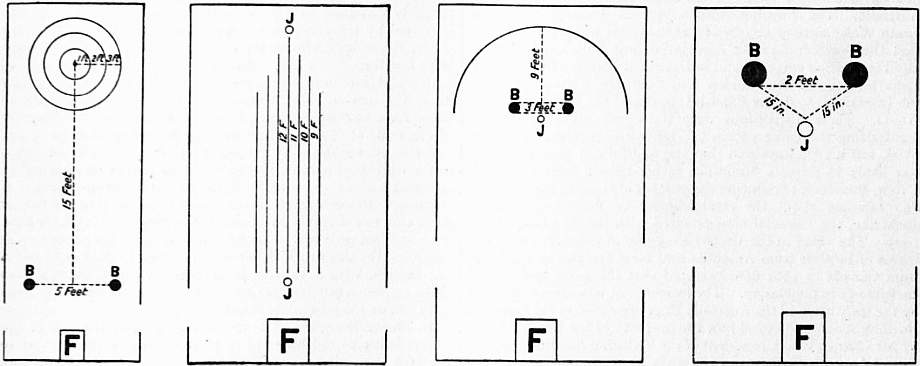
Fig. 1.—Drawing. Fig. 2.—Guarding. Figs. 3.—Trailing. Figs. 4.—Driving.
(In every case F is the Footer, B the Bowl, J the Jack.)
Certain points in the play call for notice. In throwing the jack, the leader is bound to throw (i.e. roll) a legal jack. A legal jack must travel at least 25 yds. from the footer and not come to rest within 2 yds. of either side boundary; but it may be thrown as far beyond this as the leader chooses, provided that it does not run within 2 yds. of the end ditch or either side boundary. In English practice the leader is entitled to a second throw if he fail to roll a legal jack at his first attempt; should he fail again, the right to throw passes to his opponent, but not the right of playing first. On Scottish greens the leader has only a single throw. A legal jack should not be interfered with except by the course of play. Should the jack be driven towards the side boundary, it is legitimate for a player to cause his bowl to draw outside of the dividing string, provided that when it has ceased running it shall have come to rest entirely within his own space. If it stop on the string, or outside of it, the bowl is “dead” and must be removed to the bank. A “toucher” bowl is a characteristic of the Scottish game to which great exception is taken by many English clubs. Should a bowl running jackwards touch the jack, however slightly, it is called a toucher and must be marked by the skip with a chalk cross as soon as it is at rest. Such a bowl is alive until the end is finished wherever it may lie, within the limits of the space. Even if it run into the ditch or be driven in by another bowl, it will yet count as alive. A bowl, however, that is forced on to the jack by another is not a toucher. The feat of hitting the jack is so common that it really calls for no special reward. Difference of opinion prevails as to the condition of the jack after it has been driven into the ditch. According to Scottish rules, unless it has been forced clean out of bounds, such a jack is still alive. On most English greens it is a “dead” jack and the end void. Every bowler should learn both forehand and backhand play. In forehand play the bowl as it courses to the jack describes its segment of a circle on the right, in backhand play on the left. In both styles the biased side must always be the inner.
In the United Kingdom the regular bowling season extends from May day till the end of September or the middle of October. At its close the green must be carefully examined, weeds uprooted, worn patches re-turfed, and the whole laid under a winter blanket of silver-sand.
On Scottish greens the game of points is frequently played, but it is rarely seen on English greens. Its main object is to perfect the proficiency of players in certain departments of bowls proper. There are four sections in the game, namely, drawing, guarding, trailing and driving. In drawing (fig. 1), the object is to draw as near as possible to the jack, the player’s bowl passing outside of two other bowls placed 5 ft. apart in a horizontal line 15 ft. from the jack, without touching either of them. Three points are scored if the bowl come to rest within 1 ft. of the jack, two points if within 2 ft., and one point if within 3 ft. Circles of these radii are usually marked around the jack for convenience sake. In guarding (fig. 2), two jacks are laid at the far end of the green 12 ft. apart in a vertical line. A thread is then pinned down between them, and on each side of this thread three others are pinned down parallel with it and 6 in. apart from each other. A bowl that comes to rest on the central line, or within 6 in. of it, counts three points, a bowl 12 in. away two points, and a bowl 18 in. off one point. In trailing (fig. 3), two bowls are laid on the turf 3 ft. apart, and straight lines are chalked from bowl to bowl across their back and front faces, and a jack is then deposited equidistant from each bowl and immediately before the front line. A semicircle is then drawn behind the bowls with a radius of 9 ft. from the jack. Three points are given to the bowl that trails the jack over both lines into the semicircle and goes over them itself. If a bowl trail the jack over both lines, but only itself cross the first; or if it pass both lines, but the jack cross only the first, two points are awarded. A bowl passing between the jack and either of the stationary bowls, and passing over the back line; or touching the jack, yet not trailing it past the first line, but itself crossing the back line; or trailing the jack over the front line without crossing it itself, receives one point. In no case must the stationary bowls be touched, or the semicircle crossed by the trailed jack or played bowls. In driving (fig. 4), two bowls are laid down 2 ft. apart, and then a jack is placed in front of them, 15 in. apart from each, and occupying the position of the apex of an inverted pyramid. The player who drives the jack into the ditch between the two bowls scores three. If he moves the jack, but does not carry it through to the ditch, he scores two. If he pass between the jack and either bowl he scores one, although it is not easy to see what driving he has done. The played bowl must itself run into the ditch without touching either of the stationary bowls. It is obvious that the points game demands an ideally perfect green.
See W.W. Mitchell, Manual of Bowl-playing (Glasgow, 1880); Laws of the Game issued by the Scottish B.A. (1893, et sqq.); H.J. Dingley, Touchers and Rubs (Glasgow, 1893); Sam Aylwin, The Gentle Art of Bowling, with 26 diagrams (London, 1904); James A. Manson, The Bowler’s Handbook (London, 1906).
(J. A. M.)
BOWNESS-ON-WINDERMERE, an urban district in the Appleby parliamentary division of Westmorland, England, on the east shore of Windermere, 1¼ m. S.W. of Windermere station on the London & North-Western railway. Together with the town of Windermere it forms an urban district (pop. 5061 in 1901), but the two towns were separate until 1905. Its situation is fine, the lake-shore here rising sharply, while at this point the lake narrows and is studded with islands. The low surrounding hills are richly wooded, and a number of country seats stand upon them. Bowness lies at the head of a small bay, is served by the lake-steamers of the Furness Railway Company, and is a favourite yachting, boating, fishing and tourist centre. The church of St Martin is ancient, and contains stained glass from Cartmel priory in Furness. (See Windermere.)
BOWRING, SIR JOHN (1792-1872), English linguist, political economist and miscellaneous writer, was born at Exeter, on the 17th of October 1792, of an old Puritan family. In early life he came under the influence of Jeremy Bentham. He did not, however, share his master’s contempt for belles-lettres, but was a diligent student of literature and foreign languages, especially those of eastern Europe. As a linguist he ranked with Mezzofanti and von Gabelentz among the greatest of the world. The first-fruits of his study of foreign literature appeared in Specimens of the Russian Poets (1821-1823). These were speedily followed by Batavian Anthology (1824), Ancient Poetry and Romances of Spain (1824), Specimens of the Polish Poets, and Servian Popular Poetry, both in 1827. During this period he began to contribute to the newly founded Westminster Review, of which he was appointed editor in 1825. By his contributions to the Review he obtained considerable reputation as political economist and parliamentary reformer. He advocated in its pages the cause of free trade long before it was popularized by Richard Cobden and John Bright. He pleaded earnestly in behalf of parliamentary reform, Catholic emancipation and popular education. In 1828 he visited Holland, where the university of Groningen conferred on him the degree of doctor of laws. In the following year he was in Denmark, preparing for the publication of a collection of Scandinavian poetry. Bowring, who had been the trusted friend of Bentham during his life, was appointed his literary executor, and was charged with the task of preparing a collected edition of his works. This appeared in eleven volumes in 1843. Meanwhile Bowring had entered parliament in 1835 as member for Kilmarnock; and in the following year he was appointed head of a government commission to be sent to France to inquire into the actual state of commerce between the two countries. He was engaged in similar investigations in Switzerland, Italy, Syria and some of the German states. The results of these missions appeared in a series of reports laid before the House of Commons. After a retirement of four years he sat in parliament from 1841 till 1849 as member for Bolton. During this busy period he found leisure for literature, and published in 1843 a translation of the Manuscript of the Queen’s Court, a collection of old Bohemian lyrics, &c. In 1849 he was appointed British consul at Canton, and superintendent of trade in China, a post which he held for four years. After his return he distinguished himself as an advocate of the decimal system, and published a work entitled The Decimal System in Numbers, Coins and Accounts (1854). The introduction of the florin as a preparatory step was chiefly due to his efforts. Knighted in 1854, he was again sent the same year to Hong-Kong as governor, invested with the supreme military and naval power. It was during his governorship that a dispute broke out with the Chinese; and the irritation caused by his “spirited” or high-handed policy led to the second war with China. In 1855 he visited Siam, and negotiated with the king a treaty of commerce. After the usual five years of service he retired and received a pension. His last employment by the English government was as a commissioner to Italy in 1861, to report on British commercial relations with the new kingdom. Sir John Bowring subsequently accepted the appointment of minister plenipotentiary and envoy extraordinary from the Hawaiian government to the courts of Europe, and in this capacity negotiated treaties with Belgium, Holland, Italy, Spain and Switzerland. In addition to the works already named he published—Poetry of the Magyars (1830); Cheskian Anthology (1832); The Kingdom and People of Siam (1857); a translation of Peter Schlemihl (1824); translations from the Hungarian poet, Alexander Petöfi (1866); and various pamphlets. He was elected F.R.S. and F.R.G.S., and received the decorations of several foreign orders of knighthood. He died at Claremont, near Exeter, on the 23rd of November 1872. His valuable collection of coleoptera was presented to the British Museum by his second son, Lewin Bowring, a well-known Anglo-Indian administrator; and his third son, E.A. Bowring, member of parliament for Exeter from 1868 to 1874, became known in the literary world as an able translator.
Sir John Bowring’s Recollections were edited by Lewin Bowring (d. 1910) in 1877.
BOWTELL, a medieval term in architecture for a round or corniced moulding; the word is a variant of “boltel,” which is probably the diminutive of “bolt,” the shaft of an arrow or javelin. A “roving” bowtell is one which passes up the side of a bench end and round a finial, the term “roving” being applied to that which follows the line of a curve.
BOWYER, WILLIAM (1663-1737), English printer, was born in 1663, apprenticed to a printer in 1679, made a liveryman of the Stationers’ Company in 1700, and nominated as one of the twenty printers allowed by the Star Chamber. He was burned out in the great fire of 1712, but his loss was partly made good by the subscription of friends and fellow craftsmen, as recorded on a tablet in Stationers’ Hall, and in 1713 he returned to his Whitefriars shop and became the leading printer of his day. He died on the 27th of December 1737.
His son, William Bowyer (1699-1777), was born in London on the 19th of December 1699. He was educated at St John’s College, Cambridge, and in 1722 became a partner in his father’s business. In 1729 he was appointed printer of the votes of the House of Commons, and in 1736 printer to the Society of Antiquaries, of which he was elected a fellow in 1737. In 1737 he took as apprentice John Nichols, who was to be his successor and biographer. In 1761 Bowyer became printer to the Royal Society, and in 1767 printer of the rolls of the House of Lords and the journals of the House of Commons. He died on the 13th of November 1777, leaving unfinished a number of large works and among them the reprint of Domesday Book. He wrote a great many tracts and pamphlets, edited, arranged and published a host of books, but perhaps his principal work was an edition of the New Testament in Greek, with notes. His generous bequests in favour of his own profession are administered by the Stationers’ Company, of which he became a liveryman in 1738, and in whose hall is his portrait bust and a painting of his father. He was known as “the learned printer.”
BOX (Gr. πύξος, Lat. buxus, box-wood; cf. πύξις, a pyx), the most varied of all receptacles. A box may be square, oblong, round or oval, or of an even less normal shape; it usually opens by raising, sliding or removing the lid, which may be fastened by a catch, hasp or lock. Whatever its shape or purpose or the material of which it is fashioned, it is the direct descendant of the chest, one of the most ancient articles of domestic furniture. Its uses are infinite, and the name, preceded by a qualifying adjective, has been given to many objects of artistic or antiquarian interest.
Of the boxes which possess some attraction beyond their immediate purpose the feminine work-box is the commonest. It is usually fitted with a tray divided into many small compartments, for needles, reels of silk and cotton and other necessaries of stitchery. The date of its introduction is in considerable doubt, but 17th-century examples have come down to us, with covers of silk, stitched with beads and adorned with embroidery. In the 18th century no lady was without her work-box, and, especially in the second half of that period, much taste and elaborate pains were expended upon the case, which was often exceedingly dainty and elegant. These boxes are ordinarily portable, but sometimes form the top of a table.
But it is as a receptacle for snuff that the box has taken its most distinguished and artistic form. The snuff-box, which is now little more than a charming relic of a disagreeable practice, was throughout the larger part of the 18th century the indispensable companion of every man of birth and breeding. It long survived his sword, and was in frequent use until nearly the middle of the 19th century. The jeweller, the enameller and the artist bestowed infinite pains upon what was quite as often a delicate bijou as a piece of utility; fops and great personages possessed numbers of snuff-boxes, rich and more ordinary, their selection being regulated by their dress and by the relative splendour of the occasion. From the cheapest wood that was suitable—at one time potato-pulp was extensively used—to a frame of gold encased with diamonds, a great variety of materials was employed. Tortoise-shell was a favourite, and owing to its limpid lustre it was exceedingly effective. Mother-of-pearl was also used, together with silver, in its natural state or gilded. Costly gold boxes were often enriched with enamels or set with diamonds or other precious stones, and sometimes the lid was adorned with a portrait, a classical vignette, or a tiny miniature, often some choice work by an old master. After snuff-taking had ceased to be general it lingered for some time among diplomatists, either because—as Talleyrand explained—they found a ceremonious pinch to be a useful aid to reflection in a business interview, or because monarchs retained the habit of bestowing snuff-boxes upon ambassadors and other intermediaries, who could not well be honoured in any other way. It is, indeed, to the cessation of the habit of snuff-taking that we may trace much of modern lavishness in the distribution of decorations. To be invited to take a pinch from a monarch’s snuff-box was a distinction almost equivalent to having one’s ear pulled by Napoleon. At the coronation of George IV. of England, Messrs Rundell & Bridge, the court jewellers, were paid £8205 for snuff-boxes for foreign ministers. Now that the snuff-box is no longer used it is collected by wealthy amateurs or deposited in museums, and especially artistic examples command large sums. George, duke of Cambridge (1819-1904), possessed an important collection; a Louis XV. gold box was sold by auction after his death for £2000.
A jewel-box is a receptacle for trinkets. It may take a very modest form, covered in leather and lined with satin, or it may reach the monumental proportions of the jewel cabinets which were made for Marie Antoinette, one of which is at Windsor, and another at Versailles, the work of Schwerdfeger as cabinet-maker, Degault as miniature-painter, and Thomire as chaser.
A strong-box is a receptacle for money, deeds and securities. Its place has been taken in modern life by the safe. Some of those which have survived, such as that of Sir Thomas Bodley in the Bodleian library, possess locks with an extremely elaborate mechanism contrived in the under-side of the lid.
The knife-box is one of the most charming of the minor pieces of furniture which we owe to the artistic taste and mechanical ingenuity of the English cabinet-makers of the last quarter of the 18th century. Some of the most elegant were the work of Adam, Hepplewhite and Sheraton. Occasionally flat-topped boxes, they were most frequently either vase-shaped, or tall and narrow with a sloping lid necessitated by a series of raised stages for exhibiting the handles of knives and the bowls of spoons. Mahogany and satinwood were the woods most frequently employed, and they were occasionally inlaid with marqueterie or edged with boxwood. These graceful receptacles still exist in large numbers; they are often converted into stationery cabinets.
The Bible-box, usually of the 17th century, but now and again more ancient, probably obtained its name from the fact that it was of a size to hold a large Bible. It often has a carved or incised lid.
The powder-box and the patch-box were respectively receptacles for the powder and the patches of the 18th century; the former was the direct ancestor of the puff-box of the modern dressing-table.
The étui is a cylindrical box or case of very various materials, often of pleasing shape or adornment, for holding sewing materials or small articles of feminine use. It was worn on the châtelaine.
BOXING (M.E. box, a blow, probably from Dan. bask, a buffet), the art of attack and defence with the fists protected by padded gloves, as distinguished from pugilism, in which the bare fists, or some kind of light gloves affording little moderation of the blow, are employed. The ancient Greeks used a sort of glove in practice, but, although far less formidable than the terrible caestus worn in serious encounters, it was by no means so mild an implement as the modern boxing-glove, the invention of which is traditionally ascribed to Jack Broughton (1705-1789), “the father of British pugilism.” In any case gloves were first used in his time, though only in practice, all prize-fights being decided with bare fists. Broughton, who was for years champion of England, also drew up the rules by which prize-fights were for many years regulated, and no doubt, with the help of the newly invented gloves, imparted instruction in boxing to the young aristocrats of his day. The most popular teacher of the art was, however, John Jackson (1769-1845), called “Gentleman Jackson,” who was champion from 1795 to 1800, and who is credited with imparting to boxing its scientific principles, such as countering, accurate judging of distance in hitting, and agility on the feet. Tom Moore, the poet, in his Memoirs, asserted that Jackson “made more than a thousand a year by teaching sparring.” Among his pupils was Lord Byron, who, when chided for keeping company with a pugilist, insisted that Jackson’s manners were “infinitely superior to those of the fellows of the college whom I meet at the high table,” and referred to him in the following lines in Hints from Horace:—
“And men unpractised in exchanging knocks Must go to Jackson ere they dare to box.”
His rooms in Bond Street were crowded with men of birth and distinction, and when the allied monarchs visited London he was entrusted with the management of a boxing carnival with which they were vastly pleased. In 1814 the Pugilistic Club, the meeting-place of the aristocratic sporting element, was formed, but the high-water mark of the popularity of boxing had been reached, and it declined rapidly, although throughout the country considerable interest continued to be manifested in prize-fighting.
The sport of modern boxing, as distinguished from pugilism, may be said to date from the year 1866, when the public had become disgusted with the brutality and unfair practices of the professional “bruisers,” and the laws against prize-fighting began to be more rigidly enforced. In that year the “Amateur Athletic Club” was founded, principally through the efforts of John G. Chambers (1843-1883), who, in conjunction with the 8th marquess of Queensberry, drew up a code of laws (known as the Queensberry Rules) which govern all glove contests in Great Britain, and were also authoritative in America until the adoption of the boxing rules of the Amateur Athletic Union of America. In 1867 Lord Queensberry presented cups for the British amateur championships at the recognized weights.
For the history of pugilism in classic antiquity and an account of modern prize-fighting see Pugilism. At present two kinds of boxing contests are in vogue, that for a limited number of rounds (as in the amateur championships) and that for endurance, in which the one who cannot continue the fight loses. Endurance contests, which contain the essential element of the old prize-fights, are now indulged in only by professionals. Among amateurs boxing is far less popular than it once was, owing to the importance placed upon brute strength, and the prevailing ambition of the modern boxer to “knock out” his opponent, i.e. reduce him to a state of insensibility. Even in 3-round matches between gentlemen, in which points win, and there is therefore no need to knock an opponent senseless, it is nevertheless a common practice to strike a dazed and reeling adversary a heavy blow with a view to ending the battle at once. During the annual boxing competitions between Oxford and Cambridge more than half the bouts have been known to end in this manner. Undoubtedly the prettiest boxing is seen when two men proficient in the art indulge in a practice bout—or “sparring.”