VOLUME IV SLICE III Borgia, Lucrezia to Bradford, John (continued 8)
Reading edition
BOURBON L’ARCHAMBAULT, a town of central France in the department of Allier, on the Burge, 16 m. W. of Moulins by rail. Pop. (1906) 2306. The town has thermal springs known in Roman times, which are used in cases of scrofula and rheumatism. The bathing-establishment is owned by the state. A church dating from the 12th century, and ruins of a castle of the dukes of Bourbon (13th and 15th centuries), including a cylindrical keep, are of interest. There are a military and a civil hospital in the town. Stone is quarried in the vicinity. Bourbon (Aquae Borvonis or Bormonis) was anciently the capital of the Bourbonnais and gave its name to the great Bourbon family. The affix Archambault is the name of one of its early lords.
BOURBONNE-LES-BAINS, a town of eastern France, in the department of Haute-Marne, 35½ m. by rail E.N.E. of Langres. Pop. (1906) 3738. It is much frequented on account of its hot saline springs, which were known to the Romans under the name Aquae Borvonis. The heat of these springs varies from 110° to 156° F. The waters are used in cases of lymphatic affections, scrofula, rheumatism, wounds, &c. The principal buildings are a church of the 12th century, the state bathing-establishment and the military hospital; there are also the remains of a castle. Timber-sawing and plaster manufacture are carried on in the town. In the neighbourhood are the buildings of the celebrated Cistercian abbey of Morimond.
BOURCHIER, ARTHUR (1864- ), English actor, was born in Berkshire in 1864, and educated at Eton and Christ Church, Oxford. At the university he became prominent as an amateur actor in connexion with the O.U.A.D.C., which he founded, and in 1889 he joined Mrs Langtry as a professional. He also acted with Charles Wyndham at the Criterion, and was for a while in Daly’s company in America. In 1894 he married the actress Violet Vanbrugh, elder sister of the no less well-known actress Irene Vanbrugh, and he and his wife subsequently took the leading parts under his management of the Garrick theatre. Both as tragedian and comedian Mr Bourchier took high rank on the London stage, and his career as actor-manager was remarkable for the production of a number of successful modern plays, by Mr Sutro and others.
BOURCHIER, THOMAS (c. 1404-1486), English archbishop, lord chancellor and cardinal, was a younger son of William Bourchier, count of Eu (d. 1420), and through his mother, Anne, a daughter of Thomas of Woodstock, duke of Gloucester, was a descendant of Edward III. One of his brothers was Henry, earl of Essex (d. 1483), and his grand-nephew was John, Lord Berners, the translator of Froissart. Educated at Oxford and then entering the church, he obtained rapid promotion, and after holding some minor appointments he became bishop of Worcester in 1434. In the same year he was chancellor of the university of Oxford, and in 1443 he was appointed bishop of Ely; then in April 1454 he was made archbishop of Canterbury, becoming lord chancellor of England in the following March. Bourchier’s short term of office as chancellor coincided with the opening of the Wars of the Roses, and at first he was not a strong partisan, although he lost his position as chancellor when Richard, duke of York, was deprived of power in October 1456. Afterwards, in 1458, he helped to reconcile the contending parties, but when the war was renewed in 1459 he appears as a decided Yorkist; he crowned Edward IV. in June 1461, and four years later he performed a similar service for the queen, Elizabeth Woodville. In 1457 Bourchier took the chief part in the trial of Reginald Pecock, bishop of Chichester, for heresy; in 1467 he was created a cardinal; and in 1475 he was one of the four arbitrators appointed to arrange the details of the treaty of Picquigny between England and France. After the death of Edward IV. in 1483 Bourchier persuaded the queen to allow her younger son, Richard, duke of York, to share his brother’s residence in the Tower of London; and although he had sworn to be faithful to Edward V. before his father’s death, he crowned Richard III. in July 1483. He was, however, in no way implicated in the murder of the young princes, and he was probably a participant in the conspiracies against Richard. The third English king crowned by Bourchier was Henry VII., whom he also married to Elizabeth of York in January 1486. The archbishop died on the 30th of March 1486 at his residence, Knole, near Sevenoaks, and was buried in Canterbury cathedral.
See W.F. Hook, Lives of the Archbishops of Canterbury (1860-1884).
BOURDALOUE, LOUIS (1632-1704), French Jesuit and preacher, was born at Bourges on the 20th of August 1632. At the age of sixteen he entered the Society of Jesus, and was appointed successively professor of rhetoric, philosophy and moral theology, in various colleges of the Order. His success as a preacher in the provinces determined his superiors to call him to Paris in 1669 to occupy for a year the pulpit of the church of St Louis. Owing to his eloquence he was speedily ranked in popular estimation with Corneille, Racine, and the other leading figures of the most brilliant period of Louis XIV.’s reign. He preached at the court of Versailles during the Advent of 1670 and the Lent of 1672, and was subsequently called again to deliver the Lenten course of sermons in 1674, 1675, 1680 and 1682, and the Advent sermons of 1684, 1689 and 1693. This was all the more noteworthy as it was the custom never to call the same preacher more than three times to court. On the revocation of the Edict of Nantes he was sent to Languedoc to confirm the new converts in the Catholic faith, and he had extraordinary success in this delicate mission. Catholics and Protestants were unanimous in praising his fiery eloquence in the Lent sermons which he preached at Montpellier in 1686. Towards the close of his life he confined his ministry to charitable institutions, hospitals and prisons, where his sympathetic discourses and conciliatory manners were always effective. He died in Paris on the 13th of May 1704. His peculiar strength lay in his power of adapting himself to audiences of every kind, and throughout his public career he was highly appreciated by all classes of society. His influence was due as much to his saintly character and to the gentleness of his manners as to the force of his reasoning. Voltaire said that his sermons surpassed those of Bossuet (whose retirement in 1669, however, practically coincided with Bourdaloue’s early pulpit utterances); and there is little doubt that their simplicity and coherence, and the direct appeal which they made to hearers of all classes, gave them a superiority over the more profound sermons of Bossuet. Bourdaloue may be with justice regarded as one of the greatest French orators, and many of his sermons have been adopted as text-books in schools.
Bibliography.—The only authoritative source for the Sermons is the edition of Père Bretonneau (14 vols., Paris, 1707-1721, followed by the Pensées, 2 vols., 1734). There has been much controversy both as to the authenticity of some of the sermons in this edition and as to the text in general. It is, however, generally agreed that the changes confessedly made by Bretonneau were merely formal. Other editions not based on Bretonneau are inferior; some, indeed, are altogether spurious (e.g. that of Abbé Sicard, 1810). Among critical works are: Anatole Feugère, Bourdaloue, sa prédication et son temps (Paris, 1874); Adrien Lézat, Bourdaloue, théologien et orateur (Paris, 1874); P.M. Lauras, Bourdaloue, sa vie et ses œuvres (2 vols., Paris, 1881); Abbé Blampignon, Étude sur Bourdaloue (Paris, 1886); Henri Chérot, Bourdaloue inconnu (Paris, 1898), and Bourdaloue, sa correspondance et ses correspondans (Paris, 1898-1904); L. Pauthe, Bourdaloue (les maîtres de la chaire au XVIIe siècle) (Paris, 1900); E. Griselle, Bourdaloue, histoire critique de sa prédication (2 vols., Paris, 1901), Sermons inédits; bibliographie, &c. (Paris, 1901), Deux sermons inédits sur le royaume de Dieu (Lille and Paris, 1904); Ferdinand Castets, Bourdaloue, la vie et la prédication d’un religieux au XVIIe siècle, and La Revue Bourdaloue (Paris, 1902-1904); C.H. Brooke, Great French Preachers (sermons of Bourdaloue and Bossuet, London, 1904); F. Brunetière, “L’Éloquence de Bourdaloue,” in Revue des deux mondes (August 1904), a general inquiry into the authenticity of the sermons and their general characteristics.
BOURDON, FRANÇOIS LOUIS (d. 1797), known as Bourdon de l’Oise, French revolutionist, was procureur at the parlement of Paris. He ardently embraced the revolutionary doctrines and took an active part in the insurrection of the 10th of August 1792. Representing the department of the Oise in the Convention, he voted for the immediate death of the king. He accused the Girondists of relations with the court, then turned against Robespierre, who had him expelled from the Jacobin club for his conduct as commissioner of the Convention with the army of La Rochelle. On the 9th Thermidor he was one of the deputies delegated to aid Barras to repress the insurrection made by the commune of Paris in favour of Robespierre. Bourbon then became a violent reactionary, attacking the former members of the Mountain and supporting rigorous measures against the rioters of the 12th Germinal and the 1st Prairial of the year III. In the council of Five Hundred, Bourdon belonged to the party of “Clichyens,” composed of disguised royalists, against whom the directors made the coup d’état of the 18th Fructidor. Bourdon was arrested and deported to French Guiana, where he died soon after his arrival.
BOURG-EN-BRESSE, a town of eastern France, capital of the department of Ain, and formerly capital of the province of Bresse, 36 m. N.N.E. of Lyons by the Paris-Lyon railway. Pop. (1906) town, 13,916; commune, 20,045. Bourg is situated at the western base of the Jura, on the left bank of the Reyssouze, a tributary of the Saône. The chief of the older buildings is the church of Notre-Dame (16th century), of which the façade belongs to the Renaissance; other parts of the church are Gothic. In the interior there are stalls of the 16th century. The other public buildings, including a handsome prefecture, are modern. The hôtel de ville contains a library and the Lorin museum with a collection of pictures, while another museum has a collection of the old costumes and ornaments characteristic of Bresse. Among the statues in the town there is one of Edgar Quinet (1803-1875), a native of Bourg. Bourg is the seat of a prefect and of a court of assizes, and has a tribunal of first instance, a tribunal and a chamber of commerce, and a branch of the Bank of France. Its educational establishments include lycées for boys and girls, and training colleges. The manufactures consist of iron goods, mineral waters, tallow, soap and earthenware, and there are flour mills and breweries; and there is considerable trade in grain, cattle and poultry. The church of Brou, a suburb of Bourg, is of great artistic interest. Marguerite of Bourbon, wife of Philibert II. of Savoy, had intended to found a monastery on the spot, but died before her intention could be carried into effect. The church was actually built early in the 16th century by her daughter-in-law Marguerite of Austria, wife of Philibert le Beau of Savoy, in memory of her husband. The exterior, especially the façade, is richly ornamented, but the chief interest lies in the works of art in the interior, which date from 1532. The most important are the three mausoleums with the marble effigies of Marguerite of Bourbon, Philibert le Beau, and Marguerite of Austria. All three are remarkable for perfection of sculpture and richness of ornamentation. The rood loft, the oak stalls, and the reredos in the chapel of the Virgin are masterpieces in a similar style.
Roman remains have been discovered at Bourg, but little is known of its early history. Raised to the rank of a free town in 1250, it was at the beginning of the 15th century chosen by the dukes of Savoy as the chief city of the province of Bresse. In 1535 it passed to France, but was restored to Duke Philibert Emmanuel, who later built a strong citadel, which afterwards withstood a six months’ siege by the soldiers of Henry IV. The town was finally ceded to France in 1601. In 1814 the inhabitants, in spite of the defenceless condition of their town, offered resistance to the Austrians, who put the place to pillage.
BOURGEOIS, LÉON VICTOR AUGUSTE (1851- ), French statesman, was born at Paris on the 21st of May 1851, and was educated for the law. After holding a subordinate office (1876) in the department of public works, he became successively prefect of the Tarn (1882) and the Haute-Garonne (1885), and then returned to Paris to enter the ministry of the interior. He became prefect of police in November 1887, at the critical moment of President Grévy’s resignation. In the following year he entered the chamber, being elected deputy for the Marne, in opposition to General Boulanger, and joined the radical left. He was under-secretary for home affairs in the Floquet ministry of 1888, and resigned with it in 1889, being then returned to the chamber for Reims. In the Tirard ministry, which succeeded, he was minister of the interior, and subsequently, on the 18th of March 1890, minister of public instruction in the cabinet of M. de Freycinet, a post for which he had qualified himself by the attention he had given to educational matters. In this capacity he was responsible in 1890 for some important reforms in secondary education. He retained his office in M. Loubet’s cabinet in 1892, and was minister of justice under M. Ribot at the end of that year, when the Panama scandals were making the office one of peculiar difficulty. He energetically pressed the Panama prosecution, so much so that he was accused of having put wrongful pressure on the wife of one of the defendants in order to procure evidence. To meet the charge he resigned in March 1893, but again took office, and only retired with the rest of the Freycinet ministry. In November 1895 he himself formed a cabinet of a pronouncedly radical type, the main interest of which was attached to its fall, as the result of a constitutional crisis arising from the persistent refusal of the senate to vote supply. The Bourgeois ministry appeared to consider that popular opinion would enable them to override what they claimed to be an unconstitutional action on the part of the upper house; but the public was indifferent and the senate triumphed. The blow was undoubtedly damaging to M. Bourgeois’s career as an homme de gouvernement. As minister of public instruction in the Brisson cabinet of 1898 he organized courses for adults in primary education. After this short ministry he represented his country with dignity and effect at the Hague peace congress, and in 1903 was nominated a member of the permanent court of arbitration. He held somewhat aloof from the political struggles of the Waldeck-Rousseau and Combes ministries, travelling considerably in foreign countries. In 1902 and 1903 he was elected president of the chamber. In 1905 he replaced the due d’Audiffret-Pasquier as senator for the department of Marne, and in May 1906 became minister of foreign affairs in the Sarrien cabinet. He was responsible for the direction of French diplomacy in the conference at Algeciras.
BOURGEOIS, a French word, properly meaning a freeman of a bourg or borough in France; later the term came to have the wider significance of the whole class lying between the ouvriers or workmen and the nobility, and is now used generally of the trading middle-class of any country. In printing, the word (pronounced burjoice′) is used of a type coming in size between longprimer and brevier; the derivation is supposed to be from the name of a French printer, otherwise unknown.
BOURGES, a city of central France, chief town of the department of Cher, 144 m. S. of Paris on the Orléans railway between Vierzon and Nevers. Pop. (1906) town, 34,581; commune, 44,133. Bourges is built amidst flat and marshy country on an eminence limited on three sides by the waters of the Canal Of Berry, the Yèvre, the Auron, and other smaller streams with which they unite at this point. The older part of the town with its narrow streets and old houses forms a centre, to the south and east of which lie important engineering suburbs. Flourishing nurseries and market-gardens are situated in the marshy ground to the north and north-east. Bourges preserves portions of the Roman ramparts of the 4th century, which are for the most part built into the houses of the old quarter. They measure considerably less in circumference than the fortifications of the 13th century, remains of which in the shape of ruined walls and towers are still to be seen. The summit of the rise on which the city is built is crowned by the cathedral of St Étienne, one of the most important in France. Begun at the end of the 12th century, it was not completed till the 16th century, to which period belong the northernmost of the two unfinished towers flanking the façade and two of its five elaborately sculptured portals. The interior, which has double aisles, the inner aisles of remarkable height, and no transepts, contains, among many other works of art, magnificent stained glass of the 13th century. Beneath the choir there is a crypt of Romanesque construction, where traces of the Roman fosses are to be found; the two lateral portals are also survivals of a Romanesque church. The Jardin de l’Archevêché, a pleasant terrace-garden, adjoins the choir of the cathedral. Bourges has many fine old houses. The hôtel Lallemant and the hôtel Cujas (now occupied by the museum) are of the Renaissance period. The hôtel de Jacques Cœur, named after the treasurer of Charles VII. and now used as the law-court, is of still greater interest, though it has been doubted whether Jacques Cœur himself inhabited it. The mansion is in the Renaissance style, but two towers of the Roman fortifications were utilized in the construction of the south-western façade (see House, Plate II. figs. 7 and 8). Its wings surround a courtyard into which three staircase turrets project; one of these leads to a chapel, the ceiling of which is decorated by fine frescoes.
Bourges is the seat of an archbishopric, a court of appeal, a court of assizes and a prefect; and is the headquarters of the VIII. army corps. It has tribunals of first instance and of commerce, a board of trade-arbitrators, and a chamber of commerce, and a branch of the Bank of France. Its educational institutions include an ecclesiastical seminary, a lycée for boys, and a college for girls, training colleges, and a school of industrial art. The industrial activity of Bourges depends primarily on its gunpowder and ammunition factories, its cannon-foundry and gun-carriage works. These all belong to the government, and, together with huge magazines, a school of pyrotechnics, and an artillery school, lie in the east of the town. The suburb of Mazières has large iron and engineering works, and there are manufactories of anvils, edge-tools, biscuits, woollen goods, oil-cloth, boots and shoes, fertilizers, brick and tile works, breweries, distilleries, tanneries, saw-mills and dye-works. The town has a port on the canal of Berry, and does a considerable trade in grain, wine, vegetables, hemp and fruit.
Bourges occupies the site of the Gallic town of Avaricum, capital of the Bituriges, mentioned by Caesar as one of the most important of all Gaul. In 52 B.C., during the war with Vercingetorix, it was completely destroyed by the Roman conqueror, but under Augustus it rose again into importance, and was made the capital of Aquitania Prima. About A.D. 250 it became the seat of a bishop, the first occupant of the see being Ursinus. Captured by the Visigoths about 475, it continued in their possession till about 507. In the middle ages it was the capital of Berry. During the English occupation of France in the 15th century it became the residence of Charles VII., who thus acquired the popular title of “king of Bourges.” In 1463 a university was founded in the city by Louis XI., which continued for centuries to be one of the most famous in France, especially in the department of jurisprudence. On many occasions Bourges was the seat of ecclesiastical councils—the most important being the council of 1438, in which the Pragmatic Sanction of the Gallican church was established, and that of 1528, in which the Lutheran doctrines were condemned.
BOURGET, PAUL CHARLES JOSEPH (1852- ), French novelist and critic, was born at Amiens on the 2nd of September 1852. His father, a professor of mathematics, was afterwards appointed to a post in the college at Clermont-Ferrand. Here Bourget received his early education. He afterwards studied at the Lycée Louis-le-Grand and at the École des Hautes Études. In 1872-1873 he produced a volume of verse, Au bord de la mer, which was followed by others, the last, Les Aveux, appearing in 1882. Meanwhile he was making a name in literary journalism, and in 1883 he published Essais de psychologic contemporaine, studies of eminent writers first printed in the Nouvelle Revue, and now brought together. In 1884 Bourget paid a long visit to England, and there wrote his first published story (L’Irréparable). Cruelle Énigme followed in 1885; and André Cornelis (1886) and Mensonges (1887) were received with much favour. Le Disciple (1889) showed the novelist in a graver attitude; while in 1891 Sensations d’Italie, notes of a tour in that country, revealed a fresh phase of his powers. In the same year appeared the novel Cœur de femme, and Nouveaux Pastels, types of the characters of men, the sequel to a similar gallery of female types (Pastels, 1890). His later novels include La Terre promise (1892); Cosmopolis (1892), a psychological novel, with Rome as a background; Une Idylle tragique (1896); La Duchesse bleue (1897); Le Fantôme (1901); Les Deux Sœurs (1905); and some volumes of shorter stories—Complications sentimentales (1896), the powerful Drames de famille (1898), Un Homme fort (1900), L’Étape (1902), a study of the inability of a family raised too rapidly from the peasant class to adapt itself to new conditions. This powerful study of contemporary manners was followed by Un Divorce (1904), a defence of the Roman Catholic position that divorce is a violation of natural laws, any breach of which inevitably entails disaster. Études et portraits, first published in 1888, contains impressions of Bourget’s stay in England and Ireland, especially reminiscences of the months which he spent at Oxford; and Outre-Mer (1895), a book in two volumes, is his critical journal of a visit to the United States in 1893. He was admitted to the Academy in 1894, and in 1895 was promoted to be an officer of the Legion of Honour, having received the decoration of the order ten years before.
As a writer of verse Bourget was merely trying his wings, and his poems, which were collected in two volumes(1885-1887), are chiefly interesting for the light which they throw upon his mature method and the later products of his art. It was in criticism that his genius first found its true bent. The habit of close scientific analysis which he derived from his father, the sense of style produced by a fine ear and moulded by a classical education, the innate appreciation of art in all its forms, the taste for seeing men and cities, the keen interest in the oldest not less than the newest civilizations, and the large tolerance not to be learned on the boulevard—all these combined to provide him with a most uncommon equipment for the critic’s task. It is not surprising that the Sensations d’ltalie (1891), and the various psychological studies, are in their different ways scarcely surpassed throughout the whole range of literature. Bourget’s reputation as a novelist has long been assured. Deeply impressed by the singular art of Henry Beyle (Stendhal), he struck out on a new course at a moment when the realist school reigned without challenge in French fiction. His idealism, moreover, had a character of its own. It was constructed on a scientific basis, and aimed at an exactness, different from, yet comparable to, that of the writers who were depicting with an astonishing faithfulness the environment and the actions of a person or a society. With Bourget observation was mainly directed to the secret springs of human character. At first his purpose seemed to be purely artistic, but when Le Disciple appeared, in 1889, the preface to that remarkable story revealed in him an unsuspected fund of moral enthusiasm. Since then he has varied between his earlier and his later manner, but his work in general has been more seriously conceived. From first to last he has painted with a most delicate brush the intricate emotions of women, whether wronged, erring or actually vicious; and he has described not less happily the ideas, the passions and the failures of those young men of France to whom he makes special appeal.
Bourget has been charged with pessimism, and with undue delineation of one social class. The first charge can hardly be sustained. The lights in his books are usually low; there is a certain lack of gaiety, and the characters move in a world of disenchantment. But there is no despair in his own outlook upon human destiny as a whole. As regards the other indictment, the early stories sometimes dwell to excess on the mere framework of opulence; but the pathology of moral irresolution, of complicated affairs of the heart, of the ironies of friendship, in which the writer revels, can be more appropriately studied in a cultured and leisured society than amid the simpler surroundings of humbler men and women. The style of all Bourget’s writings is singularly graceful. His knowledge of the literature of other lands gives it a greater flexibility and a finer allusiveness than most of his contemporaries can achieve. The precision by which it is not less distinguished, though responsible for a certain over-refinement, and for some dull pages of the novels, is an almost unmixed merit in the critical essays. As a critic, indeed, either of art or letters, Bourget leaves little to be desired. If he is not in the very first rank of novelists, if his books display more ease of finished craftsmanship than joy in spontaneous creation, it must be remembered that the supreme writers of fiction have rarely succeeded as he has in a different field.
See also C. Lecigne, L’Évolution morale et religieuse de M. Paul Bourget (1903); Sargeret, Les Grands Convertis (1906). His Oeuvres complètes began to appear in a uniform edition in 1899.
BOURIGNON, ANTOINETTE (1616-1680), Flemish mystic, was born at Lille on the 13th of January 1616. From an early age she was under the influence of religion, which took in course of time a mystical turn. Undertaking the work of a reformer, she visited France, Holland, England and Scotland. Her religious enthusiasm, peculiarity of views and disregard of all sects raised both zealous persecutors and warm adherents. On her death at Franeker, Friesland, on the 30th of October 1680, she left a large number of followers, who, however, dwindled rapidly away; but in the early 18th century her influence revived in Scotland sufficiently to call forth several denunciations of her doctrines in the various Presbyterian general assemblies of 1701, 1709 and 1710. So far as appears from her writings and contemporary records, she was a visionary of the ordinary type, distinguished only by the audacity and persistency of her pretensions.
Her writings, containing an account of her life and of her visions and opinions, were collected by her disciple, Pierre Poiret (19 vols., Amsterdam, 1679-1686), who also published her life (2 vols., 1679). For a critical account see Hauck, Realencyklopädie (Leipzig, 1897), and Étude sur Antoinette Bourignon, by M. E. S. (Paris, 1876). Three of her works at least have been translated into English:— An Abridgment of the Light of the World (London, 1786); A Treatise of Solid Virtue (1699); The Restoration of the Gospel Spirit (1707)
BOURKE, a town of Cowper county, New South Wales, Australia, 503 m. by rail N.W. from Sydney. Pop. (1901) 2614. It is situated on the south bank, and at the head of the ordinary winter navigation, of the Darling river. Very rich copper ore exists in the district in great abundance. Bourke is the centre of a large sheep-farming area, and the annual agricultural show is one of the best in the colony. On the west side of the Darling, 3 m. distant, is the small town of North Bourke, and at Pera, 10 m. distant, is an important irrigation settlement.
BOURMONT, LOUIS AUGUSTE VICTOR, Comte de Ghaisne de (1773-1846), marshal of France, entered the Gardes Françaises of the royal army shortly before the Revolution, emigrated in 1789, and served with Condé and the army of the émigrés in the campaigns of 1792 and 1793, subsequently serving as chief of staff to Scépeaux, the royalist leader, in the civil war in lower Anjou (1794-1796). Bourmont, excepted from the amnesty of April 1796, fled into Switzerland, but soon afterwards, having been made by Louis XVIII. a maréchal de camp and a knight of St Louis, he headed a fresh insurrection, which after some preliminary successes collapsed (1799-1800). He then made his submission to the First Consul, married, and lived in Paris; but his thinly veiled royalism caused his arrest a few months later, and he remained a prisoner for more than three years, finally escaping to Portugal in 1804. Three years later the French army under General Junot invaded Portugal, and Bourmont offered his services to Junot, who made him chief of staff of a division. He returned to France with Junot after the convention of Cintra, and was promptly re-arrested. He was soon released, however, on Junot’s demand, and was commissioned as an officer in the imperial army. He served in Italy for a time, then went on the staff of the viceroy Eugène (Beauharnais), whom he accompanied in the Moscow campaign. He was taken prisoner in the retreat, but escaped after a time and rejoined the French army. His conspicuous courage at the battle of Lützen in 1813 led Napoleon to promote him general of brigade, and in 1814 his splendid defence of Nogent (February 13) earned him the rank of general of division. At the first Restoration Bourmont was naturally employed by the Bourbons, to whose service he had devoted his life, but he rejoined Napoleon on his return from Elba. On the eve of the campaign of 1815, and at the urgent request of Count Gérard, he was given a divisional command in the army of the north. On the first day of the Waterloo campaign Bourmont went over to the enemy. It is not probable that he gave information of French movements to the allies, but the best that can be said in exculpation of his treachery is that his old friends and comrades, the royalists of Anjou, were again in insurrection, and that he felt that he must lead them. He made no attempt to defend his conduct, and acted as the accuser of Marshal Ney. A year later he was given command of a division of the royal guard; and in 1823 he held an important position in the army which, under the command of the duc d’Angoulême, invaded Spain. He commanded the whole army in Spain for a time in 1824, became minister of war in 1829, and in 1830 was placed in command of the Algiers expedition. The landing of the French and the capture of Algiers were directed by him with complete success, and he was rewarded with the bâton of marshal. But the revolution of 1830 put an end to his command, and, refusing to take the oath to Louis Philippe, he was forced to resign. In 1832 Marshal Bourmont took part in the rising of the duchesse de Berri, and on its failure retired to Portugal. Here, as always, on the side of absolutism, he commanded the army of Dom Miguel during the civil war of 1833-1834, and after the victory of the constitutional party he retired to Rome. At the amnesty of 1840 he returned to France. He died at the château of Bourmont on the 27th of October 1846.
Charles de Bourmont, a son of the marshal, wrote several pamphlets in vindication of his father’s career.
BOURNE, VINCENT (1695-1747), English classical scholar, familiarly known as “Vinny” Bourne, was born at Westminster in 1695. In 1710 he became a scholar at Westminster school, and in 1714 entered Trinity College, Cambridge. He graduated in 1717, and obtained a fellowship three years later. Of his afterlife exceedingly little is known. It is certain that he passed the greater portion of it as usher in Westminster school. He died on; the 2nd of December 1747. During his lifetime he published three editions of his Latin poems, and in 1772 there appeared a very handsome quarto volume containing all Bourne’s pieces, but also some that did not belong to him. The Latin poems are remarkable not only for perfect mastery of all linguistic niceties, but for graceful expression and genuine poetic feeling. A number of them are translations of English poems, and it is not too much to say that the Latin versions almost invariably surpass the originals. Cowper, an old pupil of Bourne’s, Beattie and Lamb have combined in praise of his wonderful power of Latin versification.
See an edition (1840) of his Poemata, with a memoir by John Mitford.
BOURNE, or Bourn, a market town in the S. Kesteven or Stamford parliamentary division of Lincolnshire, England; lying in a fenny district 95 m. N. by W. from London. Pop. of urban district (1901) 4361. The Stamford-Sleaford branch of the Great Northern railway here crosses the Saxby-Lynn joint line of the Great Northern and Midland companies. The church of St Peter and St Paul is Norman and Early English with later insertions; it is part of a monastic church belonging to a foundation of Augustinian canons of 1138, of which the other buildings have almost wholly disappeared. Trade is principally agricultural. Bourne is famous through its connexion with the ardent opponent of William the Conqueror, Hereward the Wake. Of his castle very slight traces remain. Bourne was also the birthplace of the Elizabethan statesman Cecil, Lord Burghley. The Red Hall, which now forms part of the railway station buildings, belonged to the family of Digby, of whom Sir Everard Digby was executed in 1606 for his connexion with the Gunpowder Plot.
BOURNE (southern form of burn, Teutonic born, brun, burna), an intermittent stream frequent in chalk and limestone country where the rock becomes saturated with winter rain, that slowly drains away until the rock becomes dry, when the stream ceases. A heavy rainfall will cause streams to run in winter from the saturated soil. These are the winter bournes that have given name to several settlements upon Salisbury Plain, such as Winterbourne Gunning. The “bourne” may also be a permanent “burn,” but the word is usually applied to an intermittent stream. (2) (From the Fr. borne), a boundary; the first use of the word in English is in Lord Ferrers’ translation of Forrest, 1523; the figurative meaning of limit, end or final destination comes from Shakespeare’s Hamlet, “the undiscovered country, from whose bourne no traveller returns.”
BOURNEMOUTH, a municipal and county borough and watering-place of Hampshire, England, in the parliamentary borough of Christchurch, 107½ m. S.W. by W. from London by the London & South-Western railway. Pop. (1901) 59,762. It is beautifully situated on Poole Bay. Considerable sandstone cliffs rise from the sandy beach, and are scored with deep picturesque dells or chines. The town itself lies in and about the valley of the Bourne stream. Its sheltered situation and desirable winter climate began to attract notice about 1840; in 1855 a national sanatorium for consumptive patients was erected by subscription; a pier was opened in 1861, and in 1870 railway communication was afforded. The climate is remarkably equable, being relatively warm in winter and cool in summer; the average temperature in July is 61.7° F., and in January 40.3°. The town contains numerous handsome buildings, including municipal buildings, churches, various places of entertainment, sanatoria and hospitals, a public library and a science and art school. Its suburbs have greatly extended along the sea front, and the beautiful chines of Boscombe, Alum and Branksome have attracted a large number of wealthy residents. There are piers at the town itself and at Boscombe, and the bathing is excellent. The parks, gardens and drives are extensive and pleasant. A service of electric tramways is maintained, notable as being the first system installed in England with a combination of the trolley and conduit principles of supplying current. There are golf links in Meyrick and Queen’s parks, both laid out by the corporation, which has in other ways studied the entertainment of visitors. The two railway stations are the Central and West, and through communications with the north are maintained by the Somerset & Dorset and Midland, and the Great Western and Great Central railways. The town, which is of wholly modern and remarkably rapid growth (for in the middle of the 19th century the population was less than 1000), was incorporated in 1890, and became a county borough in 1900. The corporation consists of a mayor, 11 aldermen and 33 councillors. Area, 5769 acres.
BOURNONITE, a mineral species, a sulphantimonite of lead and copper with the formula PbCuSbS3. It is of some interest on account of the twinning and the beautiful development of its crystals. It was first mentioned by Philip Rashleigh in 1797 as “an ore of antimony,” and was more completely described by the comte de Bournon in 1804, after whom it was named: the name given by Bournon himself (in 1813) was endellione, since used in the form endellionite, after the locality in Cornwall where the mineral was first found. The crystals are orthorhombic, and are generally tabular in habit owing to the predominance of the basal pinacoid (c); numerous smooth bright faces are often developed on the edges and corners of the crystals. An un-twinned crystal is represented in fig. 1. Usually, however, the crystals are twinned, the twin-plane being a face of the prism (m); the angle between the faces of this prism being nearly a right angle (86° 20′), the twinning gives rise to cruciform groups (fig. 2), and when it is often repeated the group has the appearance of a cog-wheel, hence the name Rädelerz (wheel-ore) of the Kapnik miners. The repeated twinning gives rise to twin-lamellae, which may be detected on the fractured surfaces, even of the massive material. The mineral is opaque, and has a brilliant metallic lustre with a lead-grey colour. The hardness is 2½, and the specific gravity 5.8.
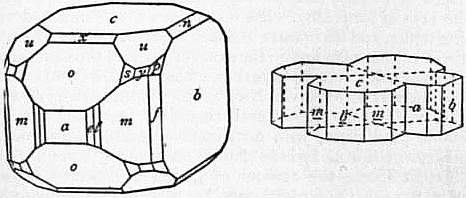
Fig. 1.—Crystal of Bournonite. Fig. 2.—Twinned Crystal of Bournonite.
At the original locality, Wheal Boys in the parish of Endellion in Cornwall, it was found associated with jamesonite, blende and chalybite. Later, still better crystals were found in another Cornish mine, namely, Herodsfoot mine near Liskeard, which was worked for argentiferous galena. Fine crystals of large size have been found with quartz and chalybite in the mines at Neudorf in the Harz, and with blende and tetrahedrite at Kapnik-Bánya near Nagy-Bánya in Hungary. A few other localities are known for this mineral.
(L. J. S.)
BOURRÉE, a French name for a dance common in Auvergne and in Biscay in Spain; also a term for a musical composition or a dance-movement in a suite, somewhat akin to the gavotte, in quick time with two beats to the bar.
BOURRIENNE, LOUIS ANTOINE FAUVELET DE (1769-1834), French diplomatist, was born at Sens on the 9th of July 1769. He was educated at the military school of Brienne in Champagne along with Napoleon Bonaparte; and although the solitary habits of the latter made intimacy difficult, the two youths seem to have been on friendly terms. It must, however, be added that the stories of their very close friendship, as told in Bourrienne’s memoirs, are open to suspicion. Leaving Brienne in 1787, and conceiving a distaste for the army, Bourrienne proceeded to Vienna. He was pursuing legal and diplomatic studies there and afterwards at Leipzig, when the French Revolution broke out and went through its first phases. Not until the spring of 1792 did Bourrienne return to France; at Paris he renewed his acquaintance with Bonaparte. They led a Bohemian life together, and among other incidents of that exciting time, they witnessed the mobbing of the royal family in the Tuileries (June 20) and the overthrow of the Swiss Guards at the same spot (August 10). Bourrienne next obtained a diplomatic appointment at Stuttgart, and soon his name was placed on the list of political émigrés, from which it was not removed until November 1797. Nevertheless, after the affair of 13th Vendémiaire (October 5, 1795) he returned to Paris and renewed his acquaintance with Bonaparte, who was then second in command of the Army of the Interior and soon received the command of the Army of Italy. Bourrienne did not proceed with him into Italy, but was called thither by the victorious general at the time of the long negotiations with Austria (May-October 1797), when his knowledge of law and diplomacy was of some service in the drafting of the terms of the treaty of Campo Formio (October 17). In the following year he accompanied Bonaparte to Egypt as his private secretary, and left a vivid, if not very trustworthy, account of the expedition in his memoirs. He also accompanied him on the adventurous return voyage to Fréjus (September-October 1799), and was of some help in the affairs which led up to the coup d’état of Brumaire (November) 1799. He remained by the side of the First Consul in his former capacity, but in the autumn of 1802 incurred his displeasure owing to his very questionable financial dealings. In the spring of 1805 he was sent as French envoy to the free city of Hamburg. There it was his duty to carry out the measures of commercial war against England, known as the Continental System; but it is known that he not only viewed those tyrannical measures with disgust, but secretly relaxed them in favour of those merchants who plied him with douceurs. In the early spring of 1807, when directed by Napoleon to order a large number of military cloaks for the army, then in East Prussia, he found that the only means of procuring them expeditiously was to order them from England. After gaining a large fortune while at Hamburg, he was recalled to France in disgrace at the close of 1810. In 1814 he embraced the royal cause, and during the Hundred Days (1815) accompanied Louis XVIII. to Ghent. The rest of his life was uneventful; he died at Caen on the 7th of February 1834, after suffering from a mental malady for two years.
The fame of Bourrienne rests, not upon his achievements or his original works, which are insignificant, but upon his Mémoires, edited by C.M. de Villemarest (10 vols., Paris, 1829-1831), which have been frequently republished and translated. The best English edition is that edited by Colonel R.W. Phipps (4 vols., London, 1893); a new French edition has been edited by D. Lacroix (5 vols., Paris, 1899-1900). See Bourrienne et ses erreurs, volontaires et involontaires (Paris, 1830), by Generals Belliard, Gourgaud, &c., for a discussion of the genuineness of his Memoirs; also Napoléon et ses détracteurs, by Prince Napoleon (Paris, 1887; Eng. trans., London, 1888).
(J. Hl. R.)
BOURRIT, MARC THÉODORE (1739-1819), Swiss traveller and writer, came of a family which was of French origin but had taken refuge at Geneva for reasons connected with religion. His father was a watchmaker there, and he himself was educated in his native city. He was a good artist and etcher, and also a pastor, so that by reason of his fine voice and love of music he was made (1768) precentor of the church of St Peter (the former cathedral) at Geneva. This post enabled him to devote himself to the exploration of the Alps, for which he had conceived a great passion ever since an ascent (1761) of the Voirons, near Geneva. In 1775 he made the first ascent of the Buet (10,201 ft.) by the now usual route from the Pierre à Bérard, on which the great flat rock known as the Table au Chantre still preserves his memory. In 1784-1785 he was the first traveller to attempt the ascent of Mont Blanc (not conquered till 1786), but neither then nor later (1788) did he succeed in reaching its summit. On the other hand he reopened (1787) the route over the Col du Géant (11,060 ft.), which had fallen into oblivion, and travelled also among the mountains of the Valais, of the Bernese Oberland, &c. He received a pension from Louis XVI., and was named the historiographe des Alpes by the emperor Joseph II., who visited him at Geneva. His last visit to Chamonix was in 1812. His writings are composed in a naïve, sentimental and rather pompous style, but breathe throughout a most passionate love for the Alps, as wonders of nature, and not as objects of scientific study. His chief works are the Description des glacières de Savoye, 1773 (English translation, Norwich, 1775-1776), the Description des Alpes pennines et rhétiennes (2 vols., 1781) (reprinted in 1783 under the title of Nouvelle Description des vallées de glace, and in 1785, with additions, in 3 vols., under the name of Nouvelle Description des glacières), and the Descriptions des cols ou passages des Alpes, (2 vols., 1803), while his Itinéraire de Genève, Lausanne et Chamouni, first published in 1791, went through several editions in his lifetime.
(W. A. B. C.)
BOURSAULT, EDME (1638-1701), French dramatist and miscellaneous writer, was born at Mussy l’Évêque, now Mussy-sur-Seine (Aube), in October 1638. On his first arrival in Paris in 1651 his language was limited to a Burgundian patois, but within a year he produced his first comedy, Le Mort vivant. This and some other pieces of small merit secured for him distinguished patronage in the society ridiculed by Molière in the École des femmes. Boursault was persuaded that the “Lysidas” of that play was a caricature of himself, and attacked Molière in Le Portrait du peintre ou la contre-critique de l’École des femmes (1663). Molière retaliated in L’Impromptu de Versailles, and Boileau attacked Boursault in Satires 7 and 9. Boursault replied to Boileau in his Satire des satires (1669), but was afterwards reconciled with him, when Boileau on his side erased his name from his satires. Boursault obtained a considerable pension as editor of a rhyming gazette, which was, however, suppressed for ridiculing a Capuchin friar, and the editor was only saved from the Bastille by the interposition of Condé. In 1671 he produced a work of edification in Ad usum Delphini: la véritable étude des souverains, which so pleased the court that its author was about to be made assistant tutor to the dauphin when it was found that he was ignorant of Greek and Latin, and the post was given to Pierre Huet. Perhaps in compensation Boursault was made collector of taxes at Mont-luçon about 1672, an appointment that he retained until 1688. Among his best-known plays are Le Mercure galant, the title of which was changed to La Comédie sans titre (1683); La Princesse de Clèves (1676), an unsuccessful play which, when refurbished with fresh names by its author, succeeded as Germanicus; Ésope à la ville (1690); and Ésope à la cour (1701). His lack of dramatic instinct could hardly be better indicated than by the scheme of his Ésope, which allows the fabulist to come on the stage in each scene and recite a fable. Boursault died in Paris on the 15th of September 1701.
The Oeuvres choisies of Boursault were published in 1811, and a sketch of him is to be found in M. Saint-René Taillandier’s Études littéraires (1881).
BOURSE (from the Med. Lat. bursa, a purse), the French equivalent of the Stock Exchange, and so used of the Paris Exchange, or of any foreign money-market. The English form “burse,” as in Sir Thomas Gresham’s building, which was known as “Britain’s Burse,” went out of use in the 18th century. The origin of the name is doubtful; it is not derived from any connexion between purse and money, but rather from the use of a purse as a sign. At Bruges a house belonging to the family de Bursa is said to have been first used as an Exchange, and to have had three purses as a sign on the front.
BOURSSE, ESAIAS (1630-1673), Dutch painter, was born in Amsterdam. He was a follower of Pieter de Hooch, in whose manner he worked for many years in his native town; then he took service with the Dutch East India Company, and died on a sea voyage. His paintings are exceedingly rare, perhaps because, in spite of their greater freedom and breadth, many of them pass under the names of Vermeer of Delft and Pieter de Hooch. Two of the paintings ascribed to the latter (one bears the false signature) at the Ryks museum in Amsterdam, are now recognized as being the work of Boursse. His subjects are interiors with figures, painted with great precision and with exquisite quality of colour. The Wallace collection has his masterpiece, an interior with a woman and a child in a cradle, almost as brilliant as on the day it was painted, and reflecting something of the feeling of Rembrandt, by whom he was influenced. Other important examples are at the Ryks museum and at Aix-la-Chapelle. Boursse’s “Boy blowing Soap Bubbles,” in the Berlin museum, was until lately attributed to Vermeer of Delft. More than one picture bearing the false signature of Boursse have been publicly shown of late years.
BOUSSINGAULT, JEAN BAPTISTE JOSEPH DIEUDONNÉ (1802-1887), French chemist, was born in Paris on the 2nd of February 1802. After studying at the school of mines at Saint-Étienne he went, when little more than twenty years old, to South America as a mining engineer on behalf of an English company. During the insurrection of the Spanish colonies he was attached to the staff of General Bolivar, and travelled widely in the northern parts of the continent. Returning to France he became professor of chemistry at Lyons, and in 1839 was appointed to the chair of agricultural and analytical chemistry at the Conservatoire des Arts et Métiers in Paris. In 1848 he was elected to the National Assembly, where he sat as a Moderate republican. Three years later he was dismissed from his professorship on account of his political opinions, but so much resentment at this action was shown by scientific men in general, and especially by his colleagues, who threatened to resign in a body, that he was reinstated. He died in Paris on the 11th of May 1887. His first papers were concerned with mining topics, and his sojourn in South America yielded a number of miscellaneous memoirs, on the cause of goitre in the Cordilleras, the gasses of volcanoes, earthquakes, tropical rain, &c., which won the commendation of A. von Humboldt. From 1836 he devoted himself mainly to agricultural chemistry and animal and vegetable physiology, with occasional excursions into mineral chemistry. His work included papers on the quantity of nitrogen in different foods, the amount of gluten in different wheats, investigations on the question whether plants can assimilate free nitrogen from the atmosphere (which he answered in the negative), the respiration of plants, the function of their leaves, the action and value of manures, and other similar subjects. Through his wife he had a share in an estate at Bechebronn in Alsace, where he carried out many agricultural experiments. He collaborated with J.B.A. Dumas in writing an Essai de statique chimique des ètres organisés (1841), and was the author of Traité d’économic rurale (1844), which was remodelled as Agronomie, chimie agricole, et physiologie (5 vols., 1860-1874; 2nd ed., 1884), and of Études sur la transformation du fer en acier (1875).
BOUTERWEK, FRIEDRICH (1766-1828), German philosopher and critic, was born at Oker, near Goslar in Lower Saxony, and studied law at Göttingen. From 1790, however, he became a disciple of Kant, published Aphorismen nach Kants Lehre vorgelegt (1793), and became professor of philosophy at Göttingen (1802), where he died on the 9th of August 1828. As a philosopher, he is interesting for his criticism of the theory of the “thing-in-itself” (Ding-an-sich). For the pure reason, as described in the Kritik, the “thing-in-itself” can be only an inconceivable “something-in-general”; any statement about it involves the predication of Reality, Unity and Plurality, which belong not to the absolute thing but to phenomena. On the other hand, the subject is known by the fact of will, and the object by that of resistance; the cognizance of willing is the assertion of absolute reality in the domain of relative knowledge. This doctrine has since been described as absolute Virtualism. Following this train of thought, Bouterwek left the Kantian position through his opposition to its formalism. In later life he inclined to the views of F.H. Jacobi, whose letters to him (published at Göttingen, 1868) shed much light on the development of his thought. His chief philosophical works are Ideen zu einer allgemeinen Apodiktik (Göttingen and Halle, 1799); Aesthetik (Leipzig, 1806; Göttingen, 1815 and 1824); Lehrbuch der philos. Vorkenntnisse (Göttingen, 1810 and 1820); Lehrbuch der philos. Wissenschaften (Göttingen, 1813 and 1820). In these works he dissociated himself from the Kantian school. His chief critical work was the Geschichte der neuern Poesie und Beredsamkeit (Göttingen, 12 vols., 1801-1819), of which the history of Spanish literature has been published separately in French, Spanish and English. The Geschichte is a work of wide learning and generally sound criticism, but it is not of equal merit throughout. He also wrote three novels, Paulus Septimus (Halle, 1795), Graf Donamar (Göttingen, 1791) and Ramiro (Leipzig, 1804), and published a collection of poems (Göttingen, 1802).
BOUTHILLIER, CLAUDE, Sieur de Fouilletourte (1581-1652), French statesman, began life as an advocate. In 1613 he was councillor in the parlement of Paris, and in 1619 became councillor of state and a secretary to the queen-mother, Marie de’ Medici. The connexion of his father, Denis Bouthillier (d. 1622), with Cardinal Richelieu secured for him the title of secretary of state in 1628, and he was able to remain on good terms with both Marie de’ Medici and Richelieu, in spite of their rivalry. In 1632 he became superintendent of finances. But his great role was in diplomacy. Richelieu employed him on many diplomatic missions, and the success of his foreign policy was due in no small degree to Bouthillier’s ability and devotion. In 1630 he had taken part at Regensburg in arranging the abortive treaty between the emperor and France. From 1633 to 1640 he was continually busied with secret missions in Germany, sometimes alone, sometimes with Father Joseph. Following Richelieu’s instructions, he negotiated the alliances which brought France into the Thirty Years’ War. Meanwhile, at home, his tact and amiable disposition, as well as his reputation for straightforwardness, had secured for him a unique position of influence in a court torn by jealousies and intrigues. Trusted by the king, the confidant of Richelieu, the friend of Marie de’ Medici, and through his son, Léon Bouthillier, who was appointed in 1635 chancellor to Gaston d’Orléans, able to bring his influence to bear on that prince, he was an invaluable mediator; and the personal influence thus exercised, combined with the fact that he was at the head of both the finances and the foreign policy of France, made him, next to the cardinal, the most powerful man in the kingdom. Richelieu made him executor of his will, and Louis XIII. named him a member of the council of regency which he intended should govern the kingdom after his death. But the king’s last plans were not carried out, and Bouthillier was obliged to retire into private life, giving up his office of superintendent of finances in June 1643. He died in Paris on the 13th of March 1652.
His son, Léon Bouthillier (1608-1652), comte de Chavigny, was early associated with his father, who took him with him from 1629 to 1632 to all the great courts of Europe, instructing him in diplomacy. In 1632 he was named secretary of state and seconded his father’s work, so that it is not easy always to distinguish their respective parts. After the death of Louis XIII. he had to give up his office; but was sent as plenipotentiary to the negotiations at Munster. He showed himself incapable, however, giving himself up to pleasure and fêtes, and returned to France to intrigue against Mazarin. Arrested twice during the Fronde, and then for a short time in power during Mazarin’s exile (April 1651), he busied himself with small intrigues which came to nothing.
BOUTS-RIMÉS, literally (from the French) “rhymed ends,” the name given in all literatures to a kind of verses of which no better definition can be found than was made by Addison, in the Spectator, when he described them as “lists of words that rhyme to one another, drawn up by another hand, and given to a poet, who was to make a poem to the rhymes in the same order that they were placed upon the list.” The more odd and perplexing the rhymes are, the more ingenuity is required to give a semblance of common-sense to the production. For instance, the rhymes breeze, elephant, squeeze, pant, scant, please, hope, pope are submitted, and the following stanza is the result:—
Escaping from the Indian breeze, The vast, sententious elephant Through groves of sandal loves to squeeze And in their fragrant shade to pant; Although the shelter there be scant, The vivid odours soothe and please, And while he yields to dreams of hope, Adoring beasts surround their Pope.
The invention of bouts-rimés is attributed to a minor French poet of the 17th century, Dulot, of whom little else is remembered. According to the Menagiana, about the year 1648, Dulot was complaining one day that he had been robbed of a number of valuable papers, and, in particular, of three hundred sonnets. Surprise being expressed at his having written so many, Dulot explained that they were all “blank sonnets,” that is to say, that he had put down the rhymes and nothing else. The idea struck every one as amusing, and what Dulot had done seriously was taken up as a jest. Bouts-rimés became the fashion, and in 1654 no less a person than Sarrasin composed a satire against them, entitled La Défaite des bouts-rimés, which enjoyed a great success. Nevertheless, they continued to be abundantly composed in France throughout the 17th century and a great part of the 18th century. In 1701 Etienne Mallemans (d. 1716) published a collection of serious sonnets, all written to rhymes selected for him by the duchess of Maine. Neither Piron, nor Marmontel, nor La Motte disdained this ingenious exercise, and early in the 19th century the fashion was revived. The most curious incident, however, in the history of bouts-rimés is the fact that the elder Alexandre Dumas, in 1864, took them under his protection. He issued an invitation to all the poets of France to display their skill by composing to sets of rhymes selected for the purpose by the poet, Joseph Méry (1798-1866). No fewer than 350 writers responded to the appeal, and Dumas published the result, as a volume, in 1865.
W.M. Rossetti, in the memoir of his brother prefixed to D.G. Rossetti’s Collected Works (1886), mentions that, especially in 1848 and 1849, he and Dante Gabriel Rossetti constantly practised their pens in writing sonnets to bouts-rimés, each giving the other the rhymes for a sonnet, and Dante Gabriel writing off these exercises in verse-making at the rate of a sonnet in five or eight minutes. Most of W.M. Rossetti’s poems in The Germ were bouts-rimés experiments. Many of Dante Gabriel’s, a little touched up, remained in his brother’s possession, but were not included in the Collected Works.
(E. G.)
BOUTWELL, GEORGE SEWALL (1818-1905), American statesman, was born in Brookline, Massachusetts, on the 28th of January 1818. He was reared on a farm, and at an early age began a mercantile career at Groton, Mass. There he studied law and in 1836 was admitted to the bar, but did not begin practice for many years. In 1842-1844 and again in 1847-1850 he served in the state house of representatives, and became the recognized leader on the Democratic side; he was thrice defeated for Congress, and was twice an unsuccessful candidate for governor. In 1851, however, by means of “Free-Soil” votes, he was chosen governor, and was re-elected by the same coalition in 1852. In the following year he took an active part in the state constitutional convention. He became a member of the Massachusetts Board of Education in 1853, and as its secretary in 1855-1861 prepared valuable reports and rendered much service to the state’s school system. The passage of the Kansas-Nebraska Bill in 1854 had finally alienated him from the Democratic party, and he became one of the founders of the new Republican party in the state. He played an influential part in the Republican national convention in 1860, and in 1862 after the passage of the war tax measures he was appointed by President Lincoln the first commissioner of internal revenue, which department he organized. From 1863 to 1869 he was a representative in Congress, taking an influential part in debate, and acting as one of the managers of President Johnson’s impeachment. From 1869 to 1873 he was secretary of the treasury in President Grant’s cabinet, and from 1873 until 1877 was a United States senator from Massachusetts. Under an appointment by President Hayes, he prepared the second edition of the United States Revised Statutes (1878). In 1880 he represented the United States before the commission appointed in accordance with the treaty of that year, between France and the United States, to decide the claims brought by French citizens against the United States for acts of the American authorities during the Civil War, and the claims of American citizens against France for acts of French authorities during the war between France and Mexico, the Franco-German War and the Commune. He opposed the acquisition by the United States of the Philippine Islands, became president of the Anti-Imperialistic League, and was a presidential elector on the Bryan (Democratic) ticket in 1900. He died at Groton, Massachusetts, on the 28th of February 1905. He published various volumes, including The Constitution of the United States at the End of the First Century (1895), and Reminiscences of Sixty Years in Public Affairs (2 vols., New York, 1902).
BOUVARDIA, a genus of handsome evergreen greenhouse shrubs, belonging to the natural order Rubiaceae, and a native of tropical America. The flowers are in terminal generally many-flowered clusters; the corolla has a large tube and a spreading four-rayed limb. The cultivated forms include a number of hybrids. The plants are best increased by cuttings taken off in April, and placed in a brisk heat in a propagating frame with a close atmosphere. When rooted they should be potted singly into 3-in. pots in fibrous peat and loam, mixed with one-fourth leaf-mould and a good sprinkling of sand, and kept in a temperature of 70° by night and 80° during the day; shade when required; syringe overhead in the afternoon and close the house with sun-heat. The plants should be topped to ensure a bushy habit, and as they grow must be shifted into 6-in. or 7-in. pots. After midsummer move to a cool pit, where they may remain till the middle of September, receiving plenty of air and space. They should then be removed to a house, and some of the plants put at once in a temperature of about 70° at night, with a few degrees higher in the daytime, to bring them into flower. Others are moved into heat to supply flowers in succession through the winter and spring.
BOUVET, FRANÇOIS JOSEPH (1753-1832), French admiral, son of a captain in the service of the French East India Company, was born on the 23rd of April 1753. He went to sea at the age of twelve with his father. Bouvet served in the East Indies in the famous campaign of 1781-83 under the command of Suffren, but only in a subordinate rank. On the outbreak of the French Revolution he very naturally took the anti-royalist side. Murder and exile had removed the great majority of the officers of the monarchy, and the services of a man of Bouvet’s experience were valuable. He was promoted captain and received the command of the “Audacieux” (80) in the first great fleet collected by the republic. In the same year (1793) he was advanced to rear-admiral, and he commanded a division in the fleet which fought the battle of the 1st of June 1794 against Lord Howe. Until the close of 1796 he continued in command of a squadron in the French Channel fleet. In the December of that year he was entrusted with the van division of the fleet which was sent from Brest to attempt to land General Hoche with an expeditionary force in the south of Ireland. The stormy weather which scattered the French as soon as they left Brest gave Bouvet a prominence which he had not been designed to enjoy. Bouvet, who found himself at daybreak on the 17th of December separated with nine sail of the line from the rest of the fleet, opened his secret orders, and found that he was to make his way to Mizen Head. He took a wide course to avoid meeting British cruisers, and on the 19th had the good luck to fall in with a considerable part of the rest of the fleet and some of the transports. On the 21st of December he arrived off Dursey Island at the entry to Bantry Bay. On the 24th he anchored near Bear Island with part of his fleet. The continued storms which blew down Bantry Bay, and the awkwardness of the French crews, made it impossible to land the troops he had with him. On the evening of the 25th the storm increased to such a pitch of violence that the frigate in which Bouvet had hoisted his flag was blown out to sea. The wind moderated by the 29th, but Bouvet, being convinced that none of the ships of his squadron could have remained at the anchorage, steered for Brest, where he arrived on the 1st of January 1797. His fortune had been very much that of his colleagues in this storm-tossed expedition, and on the whole he had shown more energy than most of them. He was wrong, however, in thinking that all his squadron had failed to keep their anchorage in Bantry Bay. The government, displeased by his precipitate return to Brest, dismissed him from command soon afterwards. He was compelled to open a school to support himself. Napoleon restored him to the service, and he commanded the squadron sent to occupy Guadaloupe during the peace of Amiens, but he had no further service, and lived in obscurity till his death on the 21st of July 1832.
Tronde, Batailles navales de la France, vols. ii. and iii., and James, Naval History, vols. i. and ii., give accounts of the 1st of June and the expedition to Ireland. There is a vigorous account of the expedition in Tronde’s English in Ireland, and it is dealt with in Admiral Colomb’s Naval Warfare.
(D. H.)
BOUVIER, JOHN (1787-1851), American jurist, was born in Codogno, France, in 1787. In 1802 his family, who were Quakers (his mother was a member of the well-known Benezet family), emigrated to America and settled in Philadelphia, and after varied experiences as proprietor of a book shop and as a country editor he was admitted to the bar in 1818, having become a citizen of the United States in 1812. He attained high standing in his profession, was recorder of Philadelphia in 1836, and from 1838 until his death was an associate justice of the court of criminal sessions in that city. He is best known for his able legal writings. His Law Dictionary Adapted to the Constitution and Laws of the United States of America and of the Several States of the American Union (1839, revised and brought up to date by Francis Rawle, under the title of Bouvier’s Law Dictionary, 2 vols., 1897) has always been a standard. He published also an edition of Bacon’s Abridgement of the Law (10 vols., 1842-1846), and a compendium of American law entitled The Institutes of American Law (4 vols., 1851; new ed. 2 vols., 1876).
BOUVINES, a village on the French-Belgian frontier between Lille and Tournay, the scene of one of the greatest battles of the middle ages, fought on the 27th of July 1214, between the forces of Philip Augustus, king of France, and those of the coalition formed against him, of which the principal members were the emperor and King John of England. The plan of campaign seems to have been designed by King John, who was the soul of the alliance; his general idea was to draw the French king to the southward against himself, while the emperor Otto IV., the princes of the Netherlands and the main army of the allies should at the right moment march upon Paris from the north. John’s part in the general strategy was perfectly executed; the allies in the north moved slowly. While John, after two inroads, turned back to his Guienne possessions on the 3rd of July, it was not until three weeks later that the emperor concentrated his forces at Valenciennes, and in the interval Philip Augustus had countermarched northward and concentrated an army at Péronne. Philip now took the offensive himself, and in manoeuvring to get a good cavalry ground upon which to fight he offered battle (July 27), on the plain east of Bouvines and the river Marque— the same plain on which in 1794 the brilliant cavalry action of Willems was fought. The imperial army accepted the challenge and drew up facing south-westward towards Bouvines, the heavy cavalry on the wings, the infantry in one great mass in the centre, supported by the cavalry corps under the emperor himself. The total force is estimated at 6500 heavy cavalry and 40,000 foot. The French army (about 7000 cavalry and 30,000 infantry) took ground exactly opposite to the enemy and in a similar formation, cavalry on the wings, infantry, including the milice des communes, in the centre, Philip with the cavalry reserve and the Oriflamme in rear of the foot. The battle opened with a confused cavalry fight on the French right, in which individual feats of knightly gallantry were more noticeable than any attempt at combined action. The fighting was more serious between the two centres; the infantry of the Low Countries, who were at this time almost the best in existence, drove in the French; Philip led the cavalry reserve of nobles and knights to retrieve the day, and after a long and doubtful fight, in which he himself was unhorsed and narrowly escaped death, began to drive back the Flemings. In the meanwhile the French feudatories on the left wing had thoroughly defeated the imperialists opposed to them, and William Longsword, earl of Salisbury, the leader of this corps, was unhorsed and taken prisoner by the warlike bishop of Beauvais. Victory declared itself also on the other wing, where the French at last routed the Flemish cavalry and captured Count Ferdinand of Flanders, one of the leaders of the coalition. In the centre the battle was now between the two mounted reserves led respectively by the king and the emperor in person. Here too the imperial forces suffered defeat, Otto himself being saved only by the devotion of a handful of Saxon knights. The day was already decided in favour of the French when their wings began to close inwards to cut off the retreat of the imperial centre. The battle closed with the celebrated stand of Reginald of Boulogne, a revolted vassal of King Philip, who formed a ring of seven hundred Brabançon pikemen, and not only defied every attack of the French cavalry, but himself made repeated charges or sorties with his small force of knights. Eventually, and long after the imperial army had begun its retreat, the gallant schiltron was ridden down and annihilated by a charge of three thousand men-at-arms. Reginald was taken prisoner in the mêlée; and the prisoners also included two other counts, Ferdinand and William Longsword, twenty-five barons and over a hundred knights. The killed amounted to about 170 knights of the defeated party, and many thousands of foot on either side, of whom no accurate account can be given.
See Oman, History of the Art of War, vii. pp. 457-480; also Köhler, Kriegsgeschichte, &c., i. 140, and Delpech, Tactique au XIII siècle, 127.
BOVEY BEDS, in geology, a deposit of sands, clays and lignite, 200-300 ft. thick, which lies in a basin extending from Bovey Tracey to Newton Abbot in Devonshire, England. The deposit is evidently the result of the degradation of the neighbouring Dartmoor granite; and it was no doubt laid down in a lake. O. Heer, who examined the numerous plant remains from these beds, concluded that they belonged to the same geological horizon as the Molasse or Oligocene of Switzerland. Starkie Gardiner, however, who subsequently examined the flora, showed that it bore a close resemblance to that of the Bournemouth Beds or Lower Bagshot; in this view he is supported by C. Reid. Large excavations have been made for the extraction of the clays, which are very valuable for pottery and similar purposes. The lignite or “Bovey Coal” has at times been burned in the local kilns, and in the engines and workmen’s cottages, but it is not economical.
See S. Gardiner, Q. J. G. S. London, xxxv., 1879; W. Pengelly and O. Heer, Phil. Trans., 1862; C. Reid, Q. J. G. S. lii., 1896, p. 490, and loc. cit. liv., 1898, p. 234. An interesting general account is given by A.W. Clayden, The History of Devonshire Scenery (London, 1906), pp. 159-168.
BOVIANUM, the name of two ancient Italian towns, (1) Undecimanorum [Boiano], the chief city of the Pentri Samnites, 9 m. N.W. of Saepinum and 18 m. S.E. of Aesernia, on the important road from Beneventum to Corfinium, which connected the Via Appia and the Via Valeria. The original city occupied the height (Civita) above the modern town, where remains of Cyclopean walls still exist, while the Roman town (probably founded after the Social War, in which Bovianum was the seat of the Samnite assembly) lay in the plain. It acquired the name Undecimanorum when Vespasian settled the veterans of the Legio XI. Claudia there. Its remains have been covered by over 30 ft. of earth washed down from the mountains. Comparatively few inscriptions have been discovered. (2) Vetus (near Pietrabbondante, 5 m. S. of Agnone and 19 m. N.W. of Campobasso), according to Th. Mommsen (Corpus Inscrip. Lat. ix. Berlin, 1883, p. 257) the chief town of the Caraceni. It lay in a remote situation among the mountains, and where Bovianum is mentioned the reference is generally to Bovianum Undecimanorum. Remains of fortifications and lower down of a temple and a theatre (cf. Römische Mitteilungen, 1903, 154)— the latter remarkable for the fine preservation of the stone seats of the three lowest rows of the auditorium—are to be seen. No less than eight Oscan inscriptions have been found.
(T. As.)
BOVIDAE, the name of the family of hollow-horned ruminant mammals typified by the common ox (Bos taurus), and specially characterized by the presence on the skulls of the males or of both sexes of a pair of bony projections, or cores, covered in life with hollow sheaths of horn, which are never branched, and at all events after a very early stage of existence are permanently retained. From this, which is alone sufficient for diagnostic purposes, the group is often called the Cavicornia. For other characteristics see Pecora. The Bovidae comprise a great number of genera and species, and include the oxen, sheep, goats, antelopes and certain other kinds which come under neither of these designations. In stature they range from the size of a hare to that of a rhinoceros; and their horns vary in size and shape from the small and simple spikes of the oribi and duiker antlers to the enormous and variously shaped structures borne respectively by buffaloes, wild sheep and kudu and other large antelopes. In geographical distribution the Bovidae present a remarkable contrast to the deer tribe, or Cervidae. Both of these families are distributed over the whole of the northern hemisphere, but whereas the Cervidae are absent from Africa south of the Sahara and well represented in South America, the Bovidae are unknown in the latter area, but are extraordinarily abundant in Africa. Neither group is represented in Australasia; Celebes being the eastern limit of the Bovidae. The present family doubtless originated in the northern half of the Old World, whence it effected an entrance by way of the Bering Strait route into North America, where it has always been but poorly represented in the matter of genera and species.
The Bovidae are divided into a number of sections, or subfamilies, each of which is briefly noticed in the present article, while fuller mention of some of the more important representatives of these is made in other articles.
The first section is that of the Bovinae, which includes buffaloes, bison and oxen. The majority of these are large and heavily-built ruminants, with horns present in both sexes, the muzzle broad, moist and naked, the nostrils lateral, no face-glands, and a large dewlap often developed in the males; while the tail is long and generally tufted, although in one instance longhaired throughout. The horns are of nearly equal size in both sexes, are placed on or near the vertex of the skull, and may be either rounded or angulated, while their direction is more or less outwards, with an upward direction near the tips, and conspicuous knobs or ridges are never developed on their surface. The tall upper molars have inner columns. The group is represented throughout the Old World as far east as Celebes, and has one living North American representative. All the species may be included in the genus Bos, with several subgeneric divisions (see Anoa, Aurochs, Bantin, Bison, Buffalo, Gaur, Gayal, Ox and Yak).
The second group, or Caprinae, includes the sheep and goats, which are smaller animals than most of the Bovidae, generally with horns in both sexes, but those of the females small. In the males the horns are usually compressed and triangular, with transverse ridges or knobs, and either curving backwards or spiral. The muzzle is narrow and hairy; and when face-glands are present these are small and insignificant; while the tail is short and flattened. Unlike the Bovinae, there are frequently glands in the feet; and the upper molar teeth differ from those of that group in their narrower crowns, which lack a distinct inner column. When a face-pit is present in the skull it is small. The genera are Ovis (sheep), Capra (goats) and Hemitragus (tahr). Sheep and goats are very nearly related, but the former never have a beard on the chin of the males, which are devoid of a strong odour; and their horns are typically of a different type. There are, however, several more or less transitional forms. Tahr are short-horned goats. The group is unknown in America, and in Africa is only represented in the mountains of the north, extending, however, some distance south into the Sudan and Abyssinia. All the species are mountain-dwellers. (See Udad, Argali, Goat, Ibex, Mouflon, Sheep and Tahr.)
The musk-ox (Ovibos moschatus) alone represents the family Ovibovinae, which is probably most nearly related to the next group (see Musk-ox).
Next come the Rupicaprinae, which include several genera of mountain-dwelling ruminants, typified by the European chamois (Rupicapra); the other genera being the Asiatic serow, goral and takin, and the North American Rocky Mountain goat. These ruminants are best described as goat-like antelopes. (See Antelope, Chamois, Goral, Rocky Mountain Goat, Serow and Takin.)
Under the indefinable term “antelope” (q.v.) may be included the seven remaining sections, namely Tragelaphinae (kudu and eland), Hippotraginae (sable antelope and oryx), Antilopinae (black-buck, gazelles, &c.), Cervicaprinae (reedbuck and waterbuck), Neotraginae (klipspringer and steinbok), Cephalophinae (duikers and four-horned antelopes) and Bubalinae (hartebeests and gnus).
(R. L.*)
BOVILL, SIR WILLIAM (1814-1873), English judge, a younger son of Benjamin Bovill, of Wimbledon, was born at All-hallows, Barking, on the 26th of May 1814. On leaving school he was articled to a firm of solicitors, but entering the Middle Temple he practised for a short time as a special pleader below the bar. He was called in 1841 and joined the home circuit. His special training in a solicitor’s office, and its resulting connexion, combined with a thorough knowledge of the details of engineering, acquired through his interest in a manufacturing firm in the east end of London, soon brought him a very extensive patent and commercial practice. He became Q.C. in 1855, and in 1857 was elected M.P. for Guildford. In the House of Commons he was very zealous for legal reform, and the Partnership Law Amendment Act 1865, which he helped to pass, is always referred to as Bovill’s Act. In 1866 he was appointed solicitor-general, an office which he vacated on becoming chief justice of the common pleas in succession to Sir W. Erie in November of the same year. He died at Kingston, Surrey, on the 1st of November 1873. As a barrister he was unsurpassed for his remarkable knowledge of commercial law; and when promoted to the bench his painstaking labour and unswerving uprightness, as well as his great patience and courtesy, gained for him the respect and affection of the profession.
BOVILLAE, an ancient town of Latium, a station on the Via Appia (which in 293 B.C. was already paved up to this point), 11 m. S.E. of Rome. It was a colony of Alba Longa, and appears as one of the thirty cities of the Latin league; after the destruction of Alba Longa the sacra were, it was held, transferred to Bovillae, including the cult of Vesta (in inscriptions virgines Vestales Albanae are mentioned, and the inhabitants of Bovillae are always spoken of as Albani Longani Bovillenses) and that of the gens Iulia. The existence of this hereditary worship led to an increase in its importance when the Julian house rose to the highest power in the state. The knights met Augustus’s dead body at Bovillae on its way to Rome, and in A.D. 16 the shrine of the family worship was dedicated anew,1 and yearly games in the circus instituted, probably under the charge of the sodales Augustales, whose official calendar has been found here. In history Bovillae appears as the scene of the quarrel between Milo and Clodius, in which the latter, whose villa lay above the town on the left of the Via Appia, was killed. The site is not naturally strong, and remains of early fortifications cannot be traced. It may be that Bovillae took the place of Alba Longa as a local centre after the destruction of the latter by Rome, which would explain the deliberate choice of a strategically weak position. Remains of buildings of the imperial period—the circus, a small theatre, and edifices probably connected with the post-station—may still be seen on the south-west edge of the Via Appia.
See L. Canina, Via Appia (Rome, 1853), i. 202 seq.; T. Ashby in Mélanges de l’école française de Rome (1903), p. 395.
(T. As.)
1 It is not likely that any remains of it now exist.
BOW (pronounced “bō”), a common Teutonic word for anything bent1 (O. Eng. boƺa; cf. O. Sax. and O.H.G. bogo, M.H.G. boge, Mod. Ger. bogen; from O. Teut. stem bug- of beugan, Mod. Ger. biegen, to bend). Thus it is found in English compound words, e.g. “elbow,” “rainbow,” “bow-net,” “bow-window,” “bow-knot,” “saddle-bow,” and by itself as the designation of a great variety of objects. The Old English use of “bow,” or stone-bow, for “arch,” now obsolete, survives in certain names of churches and places, e.g. Bow church (St Mary-in-Arcubus) in Cheapside, and Stratford-le-Bow (the “Stratford-atte-Bowe” of Chaucer). “Bow,” however, is still the designation of objects so various as an appliance for shooting arrows (see Archery), a necktie in the form of a bow-knot (i.e. a double-looped knot), a ring or hoop forming a handle (e.g. the bow of a watch), certain instruments or tools consisting of a bent piece of wood with the ends drawn together by a string, used for drilling, turning, &c., in various crafts, and the stick strung with horsehair by means of which the strings of instruments of the violin family are set in vibration. It is with this last that the present article is solely concerned.
Bow in Music.—The modern bow (Fr. archet; Ger. Bogen; Ital. arco) consists of five parts, i.e. the “stick,” the screw or “ferrule,” the “nut,” the “hair” and the “head.” The stick, in high-grade bows, is made of Pernambuco wood (Caesalpinia brasiliensis), which alone combines the requisite lightness, elasticity and power of resistance; for the cheaper bows American oak is used, and for the double-bass bow beech. A billet rich in colouring matter and straight in the grain is selected, and the stick is usually cut from a templet so as to obtain the accurate taper, which begins about 4¼ in. from the nut, decreasing according to regular proportions from 3⁄8 in. at the screw to 3⁄16 at the back of the head. The stick is cut absolutely straight and parallel along its whole length with the fibre of the wood; it is then bent by heat until it is slightly convex to the hair and has assumed the elegant cambrure first given to it by François Tourte (1747-1835). This process requires the greatest care, for if the fibres be not heated right through, they offer a continual resistance to the curve, and return after a time to the rigid straight line, a defect often observed in cheap bows. The sticks are now of either cylindrical or octagonal section, and are lapped or covered with gold thread or leather for some inches beyond the nut in order to afford a firm grip. The length of the stick was definitely and finally fixed by François Tourte at 29.34 to 29.528 in.
The centre of gravity in a well-balanced violin bow should be at 19 cm. (7½ to 7¾ in.) from the nut;2 in the violoncello bow the hair measures from 60 to 62 cm. (24 to 25 in.), and the centre of gravity is at from 175 to 180 mm. (7 to 7¼ in.) from the nut. In consequence of the flexure given to the stick, Tourte found it necessary to readjust the proportions and relative height of head and nut, in order to keep the hair at a satisfactory distance from the stick, and at the necessary angle in attacking the strings so as to avoid contact between stick and strings in bowing. In order to counterbalance the consequent increased weight of the head and to keep the centre of gravity nearer the hand, Tourte loaded the nut with metal inlays or ornamental designs.
The screw or ferrule, at the cylindrical end of the stick held by the hand, provides the means of tightening or loosening the tension of the hair. This screw, about 3¼ in. long, hidden within the stick, runs through the eye of another little screw at right angles to it, which is firmly embedded in the nut.
The nut is a wooden block at the screw end of the stick, the original purpose of which was to keep the hair at a proper distance from the stick and to provide a secure attachment for the hair. The whole nut slides up and down the stick in a groove in answer to the screw, thus tightening or relaxing the tension of the hair. In the nut is a little cavity or chamber, into which the knotted end of the hair is firmly fixed by means of a little wedge, the hair being then brought out and flattened over the front of the nut like a ribbon by the pressure of a flat ferrule. The mother-of-pearl slide which runs along a mortised groove further protects the hair on the outside of the nut. Bows having these attachments of ferrule and slide, added by Tourte at the instigation of the violinist Giovanni Battista Viotti, were known as archets à recouvrements.
The hair is chosen from the best white horsehair, and each of the 150 to 200 hairs which compose the half-inch wide ribbon of the bow must be perfectly cylindrical and smooth. It is bought by the pound, and must be very carefully sorted, for not more than one hair in ten is perfectly cylindrical and fit for use on a high-grade bow. Experience determines the right number of hairs, for if the ribbon be too thick it hinders the vibration of the strings; if too thin the friction is not strong enough to produce a good tone. Fétis gives 175 to 250 as the number used in the modern bow,3 and Julius Rühlmann 110 to 120.4 Tourte attached the greatest importance to the hairing of the bow, and bestowed quite as much attention upon it as upon the stick. He subjected the hair to the following process of cleansing: first it was thoroughly scoured with soap and water to remove all grease, then steeped in bran-water, freed from all heterogeneous matter still adhering to it, and finally rinsed in pure water slightly blued. When passed between the fingers in the direction from root to tip, the hair glides smoothly and offers no resistance, but passed in the opposite direction it feels rough, suggesting a regular succession of minute projections. The outer epithelium or sheath of the hair is composed of minute scales which produce a succession of infinitesimal shocks when the hair is drawn across the strings; the force and uniformity of these shocks, which produce series of vibrations of equal persistency, is considerably heightened by the application of rosin to the hair. The particles of rosin cling to the scales of the epithelium, thus accentuating the projections and the energy of the attack or “bite” upon the strings. With use, the scales of the epithelium wear off, and then no matter how much rosin is applied, the bow fails to elicit musical sounds— it is then “played out” and must be re-haired. The organic construction of horsehair makes it necessary, in hairing the bow, to lay the hairs in opposite directions, so that the up and down strokes may be equal and a pure and even tone obtained. Waxed silk is wound round both ends of the hair to form a strong knot, which is afterwards covered with melted rosin and hardens with the hair into a solid mass.
The head, 1 in. long and 7⁄16 in. wide at the plate, is cut in one piece with the stick, an operation which requires delicate workmanship; otherwise the head is liable to snap at this point during a sforzando passage. The head has a chamber and wedge contrivance similar to that of the nut, in which the other end of the hair is immovably fixed. The hair on the face of the head is protected by a metal or ivory plate.
The model bow here described, elaborated by François Tourte as long ago as between 1775 and 1780 according to Fétis,5 or between 1785 and 1790 according to Vidal,6 has not since been surpassed.
That the violin and the bow form one inseparable whole becomes evident when we consider the history of the forerunners of the viol family: without the bow the ancestor of the violin would have remained a guitar; the bow would not have reached its present state of perfection had it been required only for instruments of the rebec and vielle type. As soon as the possibilities of the violin were realized, as a solo instrument capable, through the agency of the bow, of expressing the emotions of the performer, the perfecting of the bow was prosecuted in earnest until it was capable of responding to every shade of delicate thought and feeling. This accounts in a measure for the protracted development of the bow, which, although used long before the violin had been evolved, did not reach a state of perfection at the hands of Tourte until more than a century and a half after the Cremona master had given us the violin.
The question of the origin of the bow still remains a matter of conjecture. Its appearance in western Europe seems to have coincided with the conquest of Spain by the Moors in the 8th century, and the consequent impetus their superior culture gave to arts and sciences in the south-west of Europe. We have, however, no well-authenticated representation of the bow before the 9th century in Europe; the earliest is the bow illustrated along with the Lyra Teutonica by Martin Gerbert7, the representation being taken from a MS. at the monastery of St Blaise, dating in his opinion from the 9th century. On the other hand, Byzantine art of the 9th and 11th centuries8 reveals acquaintance with a bow far in advance of most of the crude contemporary specimens of western Europe. The bow undoubtedly came from the East, and was obviously borrowed by the Greeks of Asia Minor and the Arabs from a common source—probably India, by way of Persia. The earliest representation of a bow yet discovered is to be found among the fine frescoes in one of the chapels of the monastery of Bawit9 in Egypt. The mural paintings in question were the work of many artists, covering a considerable period of time. The only non-religious subject depicted is a picture of a youthful Orpheus, assigned by Jean Clédat to some date not later than the 8th century A.D., but more probably the work of a 6th-century artist. Orpheus is holding an instrument, which appears to be a rebab, against his chin, in the act of bowing and stopping the strings. The bow is similar in shape to one shown in the Psalter of Labeo Notker, Leipzig, 10th century, mentioned farther on. On Indian sculptures of the first centuries of our era, such as the Buddhist stupas of Amaravati, the risers of the topes of Jamal-Garhi, in the Yusafzai district of Afghanistan (both in the British Museum), on which stringed instruments abound, there is no bow. The bow has remained a primitive instrument in India to this day; a Hindu tradition assigns its invention to Ravanon, a king of Ceylon, and the instrument for which it was invented was called ravanastron; a primitive instrument of that name is still in use in Hindustan10. F.J. Fétis11, Antoine Vidal12, Edward Heron-Allen13, and others have given the question some consideration, and readers who wish to pursue the matter farther are referred to their works.
There is thus no absolute proof of the existence of the bow in primitive times. The earliest bow known in Europe was associated with the rebab (q.v.), the most widely used bowed instrument until the 12th century. The development of this instrument can be traced with some degree of certainty, but it is quite impossible to decide at what date or in what place the use of the bow was introduced. The bow developed very slowly in Europe and remained a crude instrument as long as it was applied to the rebab and its hybrids. Its progress became marked only from the time when it was applied to the almost perfect guitar (q.v.), which then became the guitar fiddle (q.v.), the immediate forerunner of the viols.