VOLUME IV SLICE III Borgia, Lucrezia to Bradford, John (continued 6)
Reading edition
The Botocudos are nomads, wandering naked in the woods and living on forest products. They are below the medium height, but broad-shouldered and remarkable for the muscular development and depth of their chests. Their arms and legs are, however, soft and fleshy, and their feet and hands small. Their features, which vary individually almost as much as those of Europeans, are broad and flat, with prominent brow, high cheek-bones, small bridgeless nose, wide nostrils and slight projection of the jaws. They are longheaded, and their hair is coarse, black and lank. Their colour is a light yellowish brown, sometimes almost approaching white. The general yellow tint emphasizes their Mongolic appearance, which all travellers have noticed. The Botocudos were themselves greatly struck by the Chinese coolies, whom they met in Brazilian seaports, and whom they at once accepted as kinsmen (Henri Hollard, De l’homme et des races humaines, Paris, 1853).1 Some few Botocudos have settled and become civilized, but the great bulk of them, numbering between twelve and fourteen thousand, are still the wildest of savages. During the earlier frontier wars (1790-1820) every effort was made to extirpate them. They were regarded by the Portuguese as no better than wild beasts. Smallpox was deliberately spread among them; poisoned food was scattered in the forests; by such infamous means the coast districts about Rios Doce and Belmonte were cleared, and one Portuguese commander boasted that he had either slain with his own hands or ordered to be butchered many hundreds of them. Their implements and domestic utensils are all of wood; their only weapons are reed spears and bows and arrows. Their dwellings are rough shelters of leaf and bast, seldom 4 ft. high. So far as the language of the Botocudos is known, it would appear that they have no means of expressing the numerals higher than one. Their only musical instrument is a small bamboo nose-flute. They attribute all the blessings of life to the “day-fire” (sun) and all evil to “night-fire” (moon). At the graves of the dead they keep fires burning for some days to scare away evil spirits, and during storms and eclipses arrows are shot into the sky to drive away demons.
The most conspicuous feature of the Botocudos is the tembeitera, or wooden plug or disk which is worn in the lower lip and the lobe of the ear. This disk, made of the specially light and carefully dried wood of the barriguda tree (Chorisia ventricosa), is called by the natives themselves emburé, whence Augustin Saint Hilaire suggests the probable derivation of their name Aimbore (Voyages dans l’intérieur du Brésil 1816-1821, Paris, 1830). It is worn only in the under-lip, now chiefly by women, but formerly by men also. The operation for preparing the lip begins often as early as the eighth year, when an initial boring is made by a hard pointed stick, and gradually extended by the insertion of larger and larger disks or plugs, sometimes at last as much as 3 in. in diameter. Notwithstanding the lightness of the wood the tembeitera weighs down the lip, which at first sticks out horizontally and at last becomes a mere ring of skin around the wood. Ear-plugs are also worn, of such size as to distend the lobe down to the shoulders. Ear-ornaments of like nature are common in south and even central America, at least as far north as Honduras. When Columbus discovered this latter country during his fourth voyage (1502) he named part of the seaboard Costa de la Oreja, from the conspicuously distended ears of the natives. Early Spanish explorers also gave the name Orejones or “big-eared” to several Amazon tribes.
See A.R. Wallace, Travels on the Amazon (1853-1900); H.H. Bancroft, Hist. of Pacific States (San Francisco, 1882), vol. i. p. 211; A.H. Keane, “On the Botocudos” in Journ. Anthrop. Instit. vol. xiii. (1884); J.R. Peixoto, Novos Estudios Craniologicos sobre os Botocuds (Rio Janeiro, 1882); Prof. C.F. Hartt, Geology and Physical Geography of Brazil (Boston, 1870), pp. 577-606.
1 A parallel case is that of the Bashkir soldiers of Orenburg, who formed part of the Russian army sent to put down the Hungarian revolt of 1848, and who recognized their Ugrian kinsmen in the Zeklars and other Magyars settled in the Danube basin.
BOTORI, a Japanese game played at the naval, military and other schools, by two sides of equal number, usually about one hundred, each of which defends a pole about 8 ft. high firmly set in the ground, the poles being about 200 yds. distant from each other. The object of each party is to overthrow the adversaries’ pole while keeping their own upright. Pulling, hauling and wrestling are allowed, but no striking or kicking. The players resort to all kinds of massed formations to arrive at the enemies’ pole, and frequently succeed in passing over their heads and shoulders one or more comrades, who are thus enabled to reach the pole and bear it down unless pulled off in time by its defenders. A game similar in character is played by the Sophomore and Freshman classes of Amherst College (Massachusetts), called the “Flag-rush.” It was instituted at the instance of the faculty to take the place of the traditional “Cane-rush,” a general mêlée between the two classes for the ultimate possession of a stout walking-stick, which became so rough that students were frequently seriously injured. In the “Flag-rush” a small flag is set upon a padded post about 6 ft. high, and is defended by one class while the other endeavours, as at Botori, to overthrow it. If the flag is not captured or torn down within a certain time the defending side wins.
BOTOSHANI (Botoşani), the capital of the department of Botoshani, Rumania; on a small tributary of the river Jijia, and in one of the richest agricultural and pastoral regions of the north Moldavian hills. Pop. (1900) 32,193. Botoshani is commercially important as the town through which goods from Poland and Galicia pass in transit for the south; being situated on a branch railway between Dorohoi and on the main line from Czernowitz to Galatz. It has extensive starch and flour mills; and Botoshani flour is highly prized in Rumania, besides being largely exported to Turkey and the United Kingdom. Botoshani owes its name to a Tatar chief, Batus or Batu Khan, grandson of Jenghiz Khan, who occupied the country in the 13th century. There are large colonies of Armenians and Jews.
BO-TREE, or Bodhi-tree, the name given by the Buddhists of India and Ceylon to the Pipul or sacred wild fig (Ficus religiosa). It is regarded as sacred, and one at least is planted near each temple. These are traditionally supposed to be derived from the original one, the Bodhi-tree of Buddhist annals, beneath which the Buddha is traditionally supposed to have attained perfect knowledge. The Bo-tree at the ruined city of Anuradhapura, 80 m. north of Kandy, grown from a branch of the parent-tree sent to Ceylon from India by King Asoka in the 3rd century B.C., is said to have been planted in 288 B.C., and is to this day worshipped by throngs of pilgrims who come long distances to pray before it. Usually a bo-tree is planted on the graves of the Kandy priests.
BOTRYTIS, a minute fungus which appears as a brownish-grey mould on decaying vegetation or on damaged fruits. Under a hand-lens it is seen to consist of tiny, upright, brown stalks which are branched at the tips, each branchlet being crowned with a naked head of pale-coloured spores. It is a very common fungus, growing everywhere in the open or in greenhouses, and can be found at almost any season. It has also a bad record as a plant disease. If it once gains entrance into one of the higher plants, it spreads rapidly, killing the tissues and reducing them to a rotten condition. Seedling pines, lilies and many other cultivated plants are subject to attack by Botrytis, Some of the species exist in two other growth-forms, so different in appearance from the Botrytis that they have been regarded as distinct plants:—a sclerotium, which is a hard compact mass of fungal filaments, or mycelium, that can retain its vitality for a considerable time in a resting condition; and a stalked Peziza, or cup-fungus, which grows out of the sclerotium. The latter is the perfect form of fruit. The Botrytis mould is known as the conidial form.
BOTTA, CARLO GIUSEPPE GUGLIELMO (1766-1837), Italian historian, was born at San Giorgio Canavese in Piedmont. He studied medicine at the university of Turin, and obtained his doctor’s degree when about twenty years of age. Having rendered himself obnoxious to the government during the political commotions that followed the French Revolution, he was imprisoned for over a year; and on his release in 1795 he withdrew to France, only to return to his native country as a surgeon in the French army, whose progress he followed as far as Venice. Here he joined the expedition to Corfu, from which he did not return to Italy till 1798. At first he favoured French policy in Italy, contributed to the annexation of Piedmont by France in 1799, and was an admirer of Napoleon; but he afterwards changed his views, realizing the necessity for the union of all Italians and for their freedom from foreign control. After the separation of Piedmont from France in 1814 he retired into private life, but, fearing persecution at home, became a French citizen. In 1817 he was appointed rector of the university of Rouen, but in 1822 was removed owing to clerical influence. Amid all the vicissitudes of his early manhood Botta had never allowed his pen to be long idle, and in the political quiet that followed 1816 he naturally devoted himself more exclusively to literature. In 1824 he published a history of Italy from 1789 to 1814 (4 vols.), on which his fame principally rests; he himself had been an eyewitness of many of the events described. His continuation of Guicciardini, which he was afterwards encouraged to undertake, is a careful and laborious work, but is not based on original authorities and is of small value. Though living in Paris he was in both these works the ardent exponent of that recoil against everything French which took place throughout Europe. A careful exclusion of all Gallicisms, as a reaction against the French influences of the day, is one of the marked features of his style, which is not infrequently impassioned and eloquent, though at the same time cumbrous, involved and ornate. Botta died at Paris in August 1837, in comparative poverty, but in the enjoyment of an extensive and well-earned reputation.
His son, Paul Émile Botta (1802-1870), was a distinguished traveller and Assyrian archaeologist, whose excavations at Khorsabad (1843) were among the first efforts in the line of investigation afterwards pursued by Layard.
The works of Carlo Botta are Storia naturale e medica dell’ Isola di Corfu (1798); an Italian translation of Born’s Joannis Physiophili specimen monachologiae (1801); Souvenirs d’un voyage en Dalmatie (1802); Storia della guerra dell’ Independenza d’America (1809); Camillo, a poem (1815); Storia d’Italia dal 1789 al 1814 (1824, new ed., Prato, 1862); Storia d’ltalia in continuazione al Guicciardini (1832, new ed., Milan, 1878). See C. Dionisiotti, Vita di Carlo Botta (Turin, 1867); C. Pavesio, Carlo Botta e le sue opere storiche (Florence, 1874); Scipione Botta, Vita privata di Carlo Botta (Florence, 1877); A. d’Ancona c O. Bacci, Manuela della Letteratura Italiana (Florence, 1894), vol. v. pp. 245 seq.
BOTTESINI, GIOVANNI (1823-1889), Italian contrabassist and musical composer, was born at Crema in Lombardy on the 24th of December 1823. He studied music at the Milan Conservatoire, devoting himself especially to the double-bass, an instrument with which his name is principally associated. On leaving Milan he spent some time in America and also occupied the position of principal double-bass in the theatre at Havana. Here his first opera, Cristoforo Colombo, was produced in 1847. In 1849 he made his first appearance in England, playing double-bass solos at one of the Musical Union concerts. After this he made frequent visits to England, and his extraordinary command of his unwieldy instrument gained him great popularity in London and the provinces. Apart from his triumphs as an executant, Bottesini was a conductor of European reputation, and earned some success as a composer, though his work had not sufficient individuality to survive the changes of taste and fashion. He was conductor at the Théâtre des Italiens in Paris from 1855 to 1857, where his second opera, L’Assedio di Firenze, was produced in 1856. In 1861 and 1862 he conducted at Palermo, supervising the production of his opera Marion Delorme in 1862, and in 1863 at Barcelona. During these years he diversified the toils of conducting by repeated concert tours through the principal countries of Europe. In 1871 he conducted a season of Italian opera at the Lyceum theatre in London, during which his opera Ali Baba was produced, and at the close of the year he was chosen by Verdi to conduct the first performance of Aïda, which took place at Cairo on 27th December 1871. Bottesini wrote three operas besides those already mentioned: Il Diavolo della Notte (Milan, 1859); Vinciguerra (Paris, 1870); and Ero e Leandro (Turin, 1880), the last named to a libretto by Arrigo Boito, which was subsequently set by Mancinelli. He also wrote The Garden of Olivet, a devotional oratorio (libretto by Joseph Bennett), which was produced at the Norwich festival in 1887, a concerto for the double-bass, and numerous songs, and minor instrumental pieces. Bottesini died at Parma on the 7th of July 1889.
BOTTICELLI, SANDRO, properly Alessandro di Mariano dei Filipepi (1444-1510). Florentine painter, was born at Florence in 1444, in a house in the Via Nuova, Borg’ Ognissanti. This was the home of his father, Mariano di Vanni dei Filipepi, a struggling tanner. Sandro, the youngest child but one of his parents, derived the name Botticelli, by which he was commonly known, not, as related by Vasari, from a goldsmith to whom he was apprenticed, but from his eldest brother Giovanni, a prosperous broker, who seems to have taken charge of the boy, and who for some reason bore the nickname Botticello or Little Barrel. A return made in 1457 by his father describes Sandro as aged thirteen, weak in health, and still at school (if the words sta al legare are to be taken as a misspelling of sta al leggere, otherwise they might perhaps mean that he was apprenticed either to a jeweller or a bookbinder). One of his elder brothers, Antonio, who afterwards became a bookseller, was at this time in business as a goldsmith and gold-leaf-beater, and with him Sandro was very probably first put to work. Having shown an irrepressible bent towards painting, he was apprenticed in 1458-1459 to Fra Filippo Lippi, in whose workshop he remained as an assistant apparently until 1467, when the master went to carry out a commission for the decoration with frescoes of the cathedral church of Spoleto. During his apprentice years Sandro was no doubt employed with other pupils upon the great series of frescoes in the choir of the Pieve at Prato upon which his master was for long intermittently engaged. The later among these frescoes in many respects anticipate, by charm of sentiment, animation of movement and rhythmic flutter of draperies, some of the prevailing characteristics of Sandro’s own style. One of Sandro’s earliest extant pictures, the oblong “Adoration of the Magi” at the National Gallery, London (No. 592, long ascribed in error to Filippino), shows him almost entirely under the influence of his first master. Left in Florence on Fra Filippo’s departure to Spoleto, he can be traced gradually developing his individuality under various influences, among which that of the realistic school of the Pollaiuoli is for some time the strongest. From that school he acquired a knowledge of bodily structure and movement, and a searching and expressive precision of linear draughtsmanship, which he could never have learnt from his first master. The Pollaiuolo influence dominates, with some slight admixture of that of Verrocchio, in the fine figure of Fortitude, now in the Uffizi, which was painted by Botticelli for the Mercanzia about 1470; this is one of a series of the seven Virtues, of which the other six, it seems, were executed by Piero Pollaiuolo from the designs of his brother Antonio. The same influence is again very manifest in the two brilliant little pictures at the Uffizi in which the youthful Botticelli has illustrated the story of Judith and Holofernes; in his injured portrait of a man holding a medal of Cosimo de’ Medici, No. 1286 at the Uffizi; and in his life-sized “St Sebastian” at Berlin, which we know to have been painted for the church of Sta Maria Maggiore in 1473. Tradition and internal evidence seem also to point to Botticelli’s having occasionally helped, in his earliest or Pollaiuolo period, to furnish designs to the school of engravings in Florence which had been founded by the goldsmith Maso Finiguerra.
Some authorities hold that he must have attended for a while the much-frequented workshop of Verrocchio. But the “Fortitude” is the only authenticated early picture in which the Verrocchio influence is really much apparent; the various other pictures on which this opinion is founded, chiefly Madonnas dispersed among the museums of Naples, Florence, Paris and elsewhere, have been shown to be in all probability the work not of Sandro himself, but of an anonymous artist, influenced partly by him and partly by Verrocchio, whose individuality it has been endeavoured to reconstruct under the provisional name of Amico di Sandro. At the same time we know that the young Botticelli stood in friendly relations with some of the pupils in Verrocchio’s workshop, particularly with Leonardo da Vinci. Among the many “Madonnas” which bear Botticelli’s name in galleries public and private, the earliest which carries the unmistakable stamp of his own hand and invention is that which passed from the Chigi collection at Rome to that of Mrs Gardner at Boston. At the beginning of 1474 he entered into an agreement to work at Pisa, both in the Campo Santo and in the chapel of the Incoronata in the Duomo, but after spending some months in that city abandoned the task, we know not why. Next in the order of his preserved works comes probably the much-injured round of the “Adoration of the Magi” in the National Gallery (No. 1033), long ascribed in error, like the earlier oblong panel of the same subject, to Filippino Lippi. (To about this date is assigned by some the well-known “Assumption of the Virgin surrounded with the heavenly hierarchies,” formerly at Hamilton Palace and now in the National Gallery [No. 1126]; but recent criticism has proved that the tradition is mistaken which since Vasari’s time has ascribed this picture to Botticelli, and that it is in reality the work of a subordinate painter somewhat similarly named, Francesco Botticini.)
A more mature and more celebrated “Adoration of the Magi” than either of those in the National Gallery is that now in the Uffizi, which Botticelli painted for Giovanni Lami, probably in 1477, and which was originally placed over an altar against the front wall of the church of Sta Maria Novella to the right inside the main entrance. The scene is here less crowded than in some other of the master’s representations of the subject, the conception entirely sane and masculine, with none of those elements of bizarre fantasy and over-strained sentiment to which he was sometimes addicted and which his imitators so much exaggerated; the execution vigorous and masterly. The picture has, moreover, special interest as containing lifelike portraits of some of the chief members of the Medici family. Like other leading artists of his time in Florence, Botticelli had already begun to profit by the patronage of this family. For the house of Lorenzo Il Magnifico in the Via Larga he painted a decorative piece of Pallas with lance and shield (not to be confounded with the banner painted with a similar allegoric device of Pallas by Verrocchio, to be carried by Giuliano de’ Medici in the famous tournament in 1475 in which he wore the favour of La Bella Simonetta, the wife of his friend Marco Vespucci). This Pallas by Botticelli is now lost, as are several other decorative works in fresco and panel recorded to have been done by him for Lorenzo Il Magnifico between 1475 and Lorenzo’s death in 1492. But Sandro’s more especial patron, for whom were executed several of his most important still extant works, was another Lorenzo, the son of Pierfrancesco de’ Medici, grandson of a natural brother of Cosimo Pater Patriae, and inheritor of a vast share of the family estates and interests. For the villa of this younger Lorenzo at Castello Botticelli painted about 1477-1478 the famous picture of “Primavera” or Spring now in the Academy at Florence. The design, inspired by Poliziano’s poem the “Giostra,” with reminiscences of Lucretius and of Horace (perhaps also, as has lately been suggested, of the late Latin “Mythologikon” of Fulgentius) thrown in, is of an enchanting fantasy, and breathes the finest and most essential spirit of the early Renaissance at Florence. Venus fancifully draped, with Cupid hovering above her, stands in a grove of orange and myrtle and welcomes the approach of Spring, who enters heralded by Mercury, with Flora and Zephyrus gently urging her on. In pictures like this and in the later “Birth of Venus,” the Florentine genius, brooding with passion on the little that it really yet knew of the antique, and using frankly and freshly the much that it was daily learning of the truths of bodily structure and action, creates a style wholly new, in which something of the strained and pining mysticism of the middle ages is intimately and exquisitely blended with the newly awakened spirit of naturalism and the revived pagan delight in bodily form and movement and richness of linear rhythm. In connexion with this and other classic and allegoric pictures by the master, much romantic speculation has been idly spent on the supposition that the chief personages were figured in the likeness of Giuliano de’ Medici and Simonetta Vespucci. Simonetta in point of fact died in 1476, Giuliano was murdered in 1478; the web of romance which has been spun about their names in modern days is quite unsubstantial; and there is no reason whatever why Botticelli should have introduced the likenesses of these two supposed lovers (for it is not even certain that they were lovers at all) in pictures all of which were demonstrably painted after the death of one and most of them after the death of both.
The tragedy of Giuliano’s assassination by the Pazzi conspirators in 1478 was a public event which certainly brought employment to Botticelli. After the capture and execution of the criminals he was commissioned to paint their effigies hanging by the neck on the walls of the Palazzo del Podestà, above the entrance of what was formerly the Dogana. In the course of Florentine history public buildings had on several previous occasions received a similar grim decoration: the last had been when Andrea del Castagno painted in 1434 the effigies, hanging by the heels, of the chief citizens outlawed and expelled on the return of Cosimo de’ Medici. Perhaps from the time of this Pazzi commission may be dated the evidences which are found in some of Botticelli’s work of a closer study than heretofore of the virile methods and energetic types of Castagno. His frescoes of the hanged conspirators held their place for sixteen years only, and were destroyed in 1494 in consequence of another revolution in the city’s politics. Two years later (1480) he painted in rivalry with Ghirlandaio a grand figure of St Augustine on the choir screen of the Ognissanti; now removed to another part of the church. About the same time we find clear evidence of his contributing designs to the workshops of the “fine-manner” engravers in the shape of a beautiful print of the triumph of Bacchus and Ariadne adapted from an antique sarcophagus (the only example known is in the British Museum), as well as in nineteen small cuts executed for the edition of Dante with the commentary of Landino printed at Florence in 1481 by Lorenzo della Magna. This series of prints was discontinued after canto xix., perhaps because of the material difficulties involved by the use of line engravings for the decoration of a printed page, perhaps because the artist was at this time called away to Rome to undertake the most important commission of his life. Due possibly to the same call is the unfinished condition of a much-damaged, crowded “Adoration of the Magi” by Botticelli preserved in the Uffizi, the design of which seems to have influenced Leonardo da Vinci in his own Adoration (which in like manner remains unfinished) of nearly the same date, also at the Uffizi.
The task with which Botticelli was charged at Rome was to take part with other leading artists of the time (Ghirlandaio, Cosimo Rosselli, Perugino and Pinturicchio) in the decoration of Sixtus IV.’s chapel at the Vatican, the ceiling of which was afterwards destined to be the field of Michelangelo’s noblest labours. Internal evidence shows that Sandro and his assistants bore a chief share in the series of papal portraits which decorate the niches between the windows. His share in the decoration of the walls with subjects from the Old and the New Testament consists of three frescoes, one illustrating the history of Moses (several episodes of his early life arranged in a single composition); another the destruction of Korah, Dathan and Abiram; a third the temptation of Christ by Satan (in this case the main theme is relegated to the background, while the foreground is filled with an animated scene representing the ritual for the purification of a leper). On these three frescoes Botticelli laboured for about a year and a half at the height of his powers, and they may be taken as the central and most important productions of his career, though they are far from being the best-known, and from their situation on the dimmed and stained walls of the chapel are by no means easy of inspection. Skill in the interlinking of complicated groups; in the principal actors energy of dramatic action and expression not yet overstrained, as it came to be in the artist’s later work; an incisive vigour of portraiture in the personages of the male bystanders; in the faces and figures of the women an equally vital grasp of the model, combined with that peculiar strain of haunting and melancholy grace which is this artist’s own; the most expressive care and skill in linear draughtsmanship, the richest and most inventive charm in fanciful costume and decorative colouring, all combine to distinguish them. During this time of his stay in Rome (1481-1482) Botticelli is recorded also to have painted another “Adoration of the Magi,” his fifth or sixth embodiment of the same subject; this has been identified, no doubt rightly, with a picture now in the Hermitage gallery at St Petersburg.
Returning to Florence towards the end of 1482, Botticelli worked there for the next ten years, until the death of Lorenzo Il Magnifico in 1492, with but slight variations in manner and sentiment, in the now formed manner of his middle life. Some of the recorded works of this time have perished; but a good many have been preserved, and except in the few cases where the dates of commission and payment can be established by existing records, their sequence can only be conjectured from internal evidence. A scheme of work which he was to have undertaken with other artists in the Sala dei Gigli in the Palazzo Pubblico came to nothing (1483); a set of important mythologic frescoes carried out by him in the vestibule of a villa of Lorenzo Il Magnifico at Spedaletto near Volterra in 1484 has been destroyed by the effects first of damp and then of fire. To 1482-1483 belongs the fine altar-piece of San Barnabo (a Madonna and Child with six saints and four angels), now in the academy at Florence. Very nearly of the same time must be the most popular and most often copied, though very far from the best-preserved, of his works, the round picture of the Madonna with singing angels in the Uffizi, known, from the text written in the open choir-book, as the “Magnificat.” Somewhere near this must be placed the beautiful and highly finished drawing of “Abundance,” which has passed through the Rogers, Morris Moore and Malcolm collections into the British Museum, as well as a small Madonna in the Poldi-Pezzoli collection at Milan, and the fine full-faced portrait of a young man, probably some pupil or apprentice in the studio, at the National Gallery (No. 626). For the marriage of Antonio Pucci to Lucrezia Dini in 1483 Botticelli designed, and his pupils or assistants carried out, the interesting and dramatic set of four panels illustrating Boccaccio’s tale of Nastagio degl’Onesti, which were formerly in the collection of Mr Barker and are now dispersed. His magnificent and perfectly preserved altar-piece of the Madonna between the two saints John, now in the Berlin gallery, was painted for the Bardi chapel in the church of San Spirito in 1486. In the same year he helped to celebrate the marriage of Lorenzo Tornabuoni with Giovanna degli Albizzi by an exquisite pair of symbolical frescoes, the remains of which, after they had been brought to light from under a coat of whitewash on the walls of the Villa Lemmi, were removed in 1882 to the Louvre. Within a few years of the same date (1485-1488) should apparently be placed that second masterpiece of fanciful classicism done for Lorenzo di Pierfrancesco’s villa at Castello, the “Birth of Venus,” now in the Uffizi, the design of which seems to have been chiefly inspired by the “Stanze” of Poliziano, perhaps also by the Pervigilium Veneris; together with the scarcely less admirable “Mars and Venus” of the National Gallery, conceived in the master’s peculiar vein of virile sanity mingled with exquisite caprice; and the most beautiful and characteristic of all his Madonnas, the round of the “Virgin with the Pomegranate” (Uffizi). The fine picture of “Pallas and the Centaur,” rediscovered after an occultation of many years in the private apartments of the Pitti Palace, would seem to belong to about 1488, and to celebrate the security of Florentine affairs and the quelling of the spirit of tumult in the last years of the power of the great Lorenzo (1488-1490). “The Annunciation” from the convent of Cestello, now in the Uffizi, shows a design adapted from Donatello, and expressive, in its bending movements and vehement gestures, of that agitation of spirit the signs of which become increasingly perceptible in Botticelli’s work from about this time until the end. The great altar-piece at San Marco with its predelle, commissioned by the Arte della Seta in 1488 and finished in 1490, with the incomparable ring of dancing and quiring angels encircling the crowned Virgin in the upper sky, is the last of Botticelli’s altar-pieces on a great scale. To nearly the same date probably belongs his deeply felt and beautifully preserved small painting of the “Last Communion of St Jerome” belonging to the Marchese Farinola.
In 1490 Botticelli was called to take part with other artists in a consultation as to the completion of the façade of the Duomo, and to bear a share with Alessio Baldovinetti and others in the mosaic decorations of the chapel of San Zenobio in the same church. The death of Lorenzo Il Magnifico in 1492, and the accession to chief power of his worthless son Piero, soon plunged Florence into political troubles, to which were by and by added the profound spiritual agitation consequent upon the preaching and influence of Savonarola. Lorenzo di Pierfrancesco de’ Medici, who with his brother Giovanni was in a position of political rivalry against their cousin Piero, continued his patronage of Botticelli; and it was for him, apparently chiefly between the years 1492 and 1495, that the master undertook to execute a set of drawings in illustration of Dante on a far more elaborate and ambitious plan than the little designs for the engraver which had been interrupted in 1481. Eighty-five of these drawings are in the famous manuscript acquired for the Berlin museum at the sale of the Hamilton Palace collection in 1882, and eleven more in the Vatican library at Rome. The series is one of the most interesting that has been preserved by any ancient master; revealing an intimate knowledge of and profound sympathy with the text; full of Botticelli’s characteristic poetic yearning and vehemence of expression, his half-childish intensity of vision; exquisite in lightness of touch and in swaying, rhythmical grace of linear composition and design. These gifts were less suited on the whole to the illustration of the Hell than of the later parts of the poem, and in the fiercer episodes there is often some puerility and inadequacy of invention. Throughout the Hell and Purgatory Botticelli maintains a careful adherence to the text, illustrating the several progressive incidents of each canto on a single page in the old-fashioned way. In the Paradise he gives a freer rein to his invention, and his designs become less a literal illustration of the text than an imaginative commentary on it. Almost all interest is centred on the persons of Dante and Beatrice, who are shown us again and again in various phases of ascending progress and rapt contemplation, often with little more than a bare symbolical suggestion of the beatific visions presented to them. Most of the drawings remain in pen outline only over a light preliminary sketch with the lead stylus; all were probably intended to be finished in colour, as a few actually are. To the period of these drawings (1492-1497) would seem to belong the fine and finely preserved small round of the “Virgin and Child with Angels” at the Ambrosiana, Milan, and the famous “Calumny of Apelles” at the Uffizi, inspired no doubt by some contemporary translation of the text by Lucian, and equally remarkable by a certain feverish energy in its sentiment and composition, and by its exquisite finish and richness of execution and detail. Probably the small “St Augustine” in the Uffizi, the injured “Judith with the head of Holofernes” in the Kaufmann collection at Berlin, and the “Virgin and Child with St John,” belonging to Mr Heseltine in London, are works of the same period.
Simone di Mariano, a brother of Botticelli long resident at Naples, returned to Florence in 1493 and shared Sandro’s home in the Via Nuova. He soon became a devoted follower of Savonarola, and has left a manuscript chronicle which is one of the best sources for the history of the friar and of his movement. Sandro himself seems to have remained aloof from the movement almost until the date of the execution of Savonarola and his two followers in 1498. At least there is clear evidence of his being in the confidence and employ of Lorenzo di Pierfrancesco so late as 1496 and 1497, which he could not possibly have been had he then been an avowed member of the party of the Piagnoni. It was probably the enforced departure of Lorenzo from Florence in 1497 that brought to a premature end the master’s great undertaking on the illustration of Dante. After Lorenzo’s return, following on the overthrow and death of Savonarola in 1498, we find no trace of any further relations between him and Botticelli, who by that time would seem to have become a declared devotee of the friar’s memory and an adherent, like his brother, of the defeated side. During these years of swift political and spiritual revolution in Florence, documents give some glimpses of him: in 1497 as painting in the monastery of Monticelli a fresco of St Francis which has perished; in the winter of the same year as bound over to keep the peace with, a neighbour living next to the small suburban villa which Sandro held jointly with his brother Simone in the parish of San Sepolcro; in 1499 as paying belated matriculation fees to the gild of doctors and druggists (of which the painters were a branch); and again in 1499 as carrying out some decorative paintings for a member of the Vespucci family. It has been suggested, probably with reason, that portions of these decorations are to be recognized in two panels of dramatic scenes from Roman history, one illustrating the story of Virginia, which has passed with the collection of Senatore Morelli into the gallery at Bergamo, the other a history of Lucretia formerly belonging to Lord Ashburnham, which passed into Mrs Gardner’s collection at Boston. These and the few works still remaining to be mentioned are all strongly marked by the strained vehemence of design and feeling characteristic of the master’s later years, when he dramatizes his own high-strung emotions in figures flung forward and swaying out of all balance in the vehemence of action, with looks cast agonizingly earthward or heavenward, and gestures of wild yearning or appeal. These characters prevail still more in a small Pietà at the Poldi-Pezzoli gallery, probably a contemporary copy of one which the master is recorded to have painted for the Panciatichi chapel in the church of Sta Maria Maggiore; they are present to a degree even of caricature in the larger and coarser painting of the same subject which bears the master’s name in the Munich gallery, but is probably only a work of his school. The mystic vein of religious and political speculation into which Botticelli had by this time fallen has its finest illustration in the beautiful symbolic “Nativity” which passed in succession from the Aldobrandini, the Ottley, and the Fuller Maitland collections into the National Gallery in 1882, with the apocalyptic inscription in Greek which the master has added to make his meaning clear (No. 1034). In a kindred vein is a much-injured symbolic “Magdalene at the foot of the Cross” in private possession at Lyons. Among extant pictures those which from internal evidence we must put latest in the master’s career are three panels illustrating the story of St Zenobius, of which one is at Dresden and the other two in the collection of Dr Mond in London. The documentary notices of him after 1500 are few. In 1502 he is mentioned in the correspondence of Isabella d’Este, marchioness of Gonzaga, and in a poem by Ugolino Verino. In 1503-1504 he served on the committee of artists appointed to decide where the colossal David of Michelangelo should be placed. In these and the following years we find him paying fees to the company of St Luke, and the next thing recorded of him is his death, followed by his burial in the Ortaccio or garden burial-ground of the Ognissanti, in May 1510.
The strong vein of poetical fantasy and mystical imagination in Botticelli, to which many of his paintings testify, and the capacity for religious conviction and emotional conversion which made of him an ardent, if belated, disciple of Savonarola, coexisted in him, according to all records, with a strong vein of the laughing humour and love of rough practical and verbal jesting which belonged to the Florentine character in his age. His studio in the Via Nuova is said to have been the resort, not only of pupils and assistants, of whom a number seem to have been at all times working for him, but of a company of more or less idle gossips with brains full of rumour and tongues always wagging. Vasari’s account of the straits into which he was led by his absorption in the study of Dante and his adhesion to the sect of Savonarola are evidently much exaggerated, since there is proof that he lived and died, not rich indeed, but possessed of property enough to keep him from any real pinch of distress. The story of his work and life, after having been the subject in recent years of much half-informed study and speculation, has at length been fully elucidated in the work of Mr H.P. Horne cited below,—a masterpiece of documentary research and critical exposition.
Bibliography.—Vasari, Le Opere (ed. Milanesi), vol. iii.; Crowe-Cavalcaselle, Hist. of Painting in Italy, vol. ii.; Fr. Lippmann, Botticellis Zeichnungen zu Dantes Göttlicher Komödie; Dr Karl Woermann, “Sandro Botticelli” (in Dohme, Kunst u. Künstler); Dr Hermann Ulmann, Sandro Botticelli; Dr E. Steinmann, Sandro Botticelli (in Knackfuss series, valuable for the author’s elucidation of the Sixtine frescoes); I.B. Supino, Sandro Botticelli; Bernhard Berenson, The Drawings of Florentine Painters; The Florentine Painters of the Renaissance (2nd ed.); The Study and Criticism of Italian Art; papers in the Burlington Magazine, the Gazette des Beaux-Arts (to this critic is due the first systematic attempt to discriminate between the original work of Botticelli and that of his various pupils); J. Mesnil, Miscellanea d’Arte and papers in the Rivista d’Arte, &c.; W. Warburg, Sandro Botticelli’s “Geburt der Venus” and “Frühling”; Julia Cartwright (Mrs Ady), The Life and Art of Sandro Botticelli (1904); F. Wickhoff in the Jahrbuch der k. Preussischen Kunstsammlungen (1906); Herbert P. Horne, Alessandro Filipepi commonly called Sandro Botticelli (1908); this last authority practically supersedes all others.
(S. C.)
BÖTTIGER, KARL AUGUST (1760-1835), German archaeologist, was born at Reichenbach on the 8th of June 1760. He was educated at the school of Pforta, and the university of Leipzig. After holding minor educational posts, he obtained in 1791, through the influence of Herder, the appointment of rector of the gymnasium at Weimar, where he entered into a circle of literary men, including Wieland, Schiller, and Goethe. He published in 1803 a learned work, Sabina, oder Morgenszenen im Putzzimmer einer reichen Römerin, a description of a wealthy Roman lady’s toilette, and a work on ancient art, Griechische Vasengemälde. At the same time he assisted in editing the Journal des Luxus und der Moden, the Deutsche Merkur, and the London and Paris. In 1804 he was called to Dresden as superintendent of the studies of the court pages, and received the rank of privy councillor. In 1814 he was made director of studies at the court academy, and inspector of the Museum of Antiquities. He died at Dresden on the 17th of November 1835. His chief works are:—Ideen zur Archäologie der Malerei, i. (1811) (no more published); Kunstmythologie (1811); Vorlesungen und Aufsätze zur Alterthumskunde (1817); Amalthea (1821-1825); Ideen zur Kunstmythologie (1826-1836). The Opuscula et Carmina Latina were published separately in 1837; with a collection of his smaller pieces, Kleine Schriften (1837-1838), including a complete list of his works (56 pages). His biography was written by his son Karl Wilhelm Böttiger (1790-1862), for some time professor of history at Erlangen, and author of several valuable histories (History of Germany, History of Saxony, History of Bavaria, Universal History of Biographies).
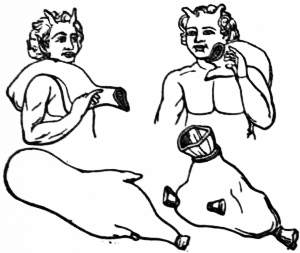
Roman Skin Bottles, from specimens at Pompeii and Herculaneum.
BOTTLE (Fr. bouteille, from a diminutive of the Lat. butta, a flask; cf. Eng. “butt”), a vessel for containing liquids, generally as opposed to one for drinking from (though this probably is not excluded), and with a narrow neck to facilitate closing and pouring. The first bottles were probably made of the skins of animals. In the Iliad (iii. 247) the attendants are represented as bearing wine for use in a bottle made of goat’s skin. The ancient Egyptians used skins for this purpose, and from the language employed by Herodotus (ii. 121), it appears that a bottle was formed by sewing up the skin and leaving the projection of the leg and foot to serve as a vent, which was hence termed ποδεών. The aperture was closed with a plug or a string. Skin bottles of various forms occur on Egyptian monuments. The Greeks and Romans also were accustomed to use bottles made of skins; and in the southern parts Europe they are still used for the transport of wine. The first of explicit reference to bottles of skin in Scripture occurs in Joshua (ix. 4), where it is said that the Gibeonites took “old sacks upon their asses, and wine-bottles old and rent and bound up.” The objection to putting “new wine into old bottles” (Matt. ix. 17) is that the skin, already stretched and weakened by use, is liable to burst under the pressure of the gas from new wine. Skins are still most extensively used throughout western Asia for the conveyance and storage of water. It is an error to represent the bottles of the ancient Hebrews as being made exclusively of skins. In Jer. xix. 1 the prophet speaks of “a potter’s earthen vessel.” The Egyptians (see Egypt: Art and Archaeology) possessed vases and bottles of hard stone, alabaster, glass, ivory, bone, porcelain, bronze, silver and gold, and also of glazed pottery or common earthenware. In modern times bottles are usually made of glass (q.v.), or occasionally of earthenware. The glass bottle industry has attained enormous dimensions, whether for wine, beer, &c., or mineral waters; and labour-saving machinery for filling the bottles has been introduced, as well as for corking or stoppering, for labelling and for washing them.
BOTTLE-BRUSH PLANTS, a genus of Australian plants, known botanically as Callistemon, and belongiug to the myrtle family (Myrtaceae). They take their name from the resemblance of the head of flowers to a bottle-brush. They are well known in cultivation as greenhouse shrubs; the flower owes its beauty to the numerous long thread-like stamens which far exceed the small petals. Callistemon salignus is a valuable hard wood.
BOTTLENOSE WHALE (Hyperoödon rostratus), a member of the sperm-whale family, which is an inhabitant of the North Atlantic, passing the summer in the Spitzbergen seas and going farther south in winter. It resembles the sperm-whale in possessing a large store of oil in the upper part of the head, which yields spermaceti when refined; on this account, and also for the sake of the blubber, which supplies an oil almost indistinguishable from sperm-oil, this whale became the object of a regular chase in the latter half of the 19th century. In length these whales vary between 20 ft. and 30 ft.; and in colour from black on the upper surface in the young to light brown in old animals, the under-parts being greyish white. There is no notch between the flukes, as in other whales, but the hinder part of the tail is rounded. Bottlenoses feed on cuttle-fishes and squills, and are practically toothless; the only teeth which exist in the adult being a small pair at the front of the lower jaw, concealed beneath the gum during life. Examples have frequently been recorded on the British coasts. In November 1904 a female, 24 ft. long, and a calf 15 ft. long were driven ashore at Whitstable. (See Cetacea.)
BOTTOMRY, a maritime contract by which a ship (or bottom) is hypothecated in security for money borrowed for expenses incurred in the course of her voyage, under the condition that if she arrive at her destination the ship shall be liable for repayment of the loan, together with such premium thereon as may have been agreed for; but that if the ship be lost, the lender shall have no claim against the borrower either for the sum advanced or for the premium. The freight may be pledged as well as the ship, and, if necessary, the cargo also. In some cases the personal obligation of the shipmaster is also included. When money is borrowed on the security of the cargo alone, it is said to be taken up at respondentia; but it is now only in rare and exceptional cases that it could be competent to the shipmaster to pledge the cargo, except under a general bottomry obligation, along with the ship and freight. In consideration of the risks assumed by the lender, the bottomry premium (sometimes termed maritime interest) is usually high, varying of course with the nature of the risk and the difficulty of procuring funds.
A bottomry contract may be written out in any form which sufficiently shows the conditions agreed on between the parties; but it is usually drawn up in the form of a bond which confers a maritime lien (q.v.). The document must show, either by express terms or from its general tenor, that the risk of loss is assumed by the lender,—this being the consideration for which the high premium is conceded. The lender may transfer the bond by indorsation, in the same manner as a bill of exchange or bill of lading, and the right to recover its value becomes vested in the indorsees. (See Bond.)
According to the law of England, a bottomry contract remains in force so long as the ship exists in the form of a ship, whatever amount of damage she may have sustained. Consequently, the “constructive total loss” which is recognized in marine insurance, when the ship is damaged to such an extent that she is not worth repairing, is not recognized in reference to bottomry, and will not absolve the borrower from his obligation. But if the ship go to pieces, the borrower is freed from all liability under the bottomry contract; and the lender is not entitled to receive any share of the proceeds of such of the ship’s stores or materials as may have been saved from the wreck. Money advanced on bottomry is not liable in England for general average losses. If the ship should deviate from the voyage for which the funds were advanced, her subsequent loss will not discharge the obligation of the borrower under the bottomry contract. If she should not proceed at all on her intended voyage, the lender is not entitled to recover the bottomry premium in addition to his advance, but only the ordinary rate of interest for the temporary loan. As the bottomry premium is presumed, in every case, to cover the risks incurred by the lender, he is not entitled to charge the borrower with the premium which he may pay for insurance of the sum advanced, in addition to that stipulated in the bond.
The contract of bottomry seems to have arisen from the custom of permitting the master of a ship, when in a foreign country, to pledge the ship in order to raise money for repairs, or other extraordinary expenditures rendered necessary in the course of the voyage. Circumstances often arise, in which, without the exercise of this power on the part of the master, it would be impossible to provide means for accomplishing the voyage; and it is better that the master should have authority to burden the ship, and, if necessary, the freight and cargo also, in security for the money which has become requisite, than that the adventure should be defeated by inability to proceed. But the right of the master to pledge the ship or goods must always be created by necessity; if exercised without necessity the contract will be void. Accordingly, the master of a British ship has no power to grant a bottomry bond at a British port, or at any foreign port where he might raise funds on the personal credit of the shipowners. Neither has he any power to pledge the ship or goods for private debts of his own, but only for such supplies as are indispensable for the purposes of the voyage. And in all cases he ought, if possible, to communicate with the owners of the ship, and with the proprietor of the cargo before pledging their property (“The Bonaparte,” 1853, 8 Moo. P.C. 473; “The Staffordshire,” 1872, L.R. 4 P.C. 194). Increased facility of communication, by telegraph and otherwise, has given additional stringency to this rule, and caused a decline in the practice of giving bottomry bonds.
The bottomry lender must use reasonable diligence to ascertain that a real necessity exists for the loan; but he is not bound to see to the application of the money advanced. If the lender has originally advanced the funds on the personal credit of the owner he is not entitled to require a bottomry obligation. A bond procured from the shipmaster by improper compulsion would be void.
The power of the master to pledge the cargo depends upon there being some reasonable prospect of benefit to it by his so doing. He has no such power except in virtue of circumstances which may oblige him to assume the character of agent for the cargo, in the absence of any other party authorized to act on its behalf. Under ordinary circumstances he is not at liberty to pledge the cargo for repairs to the ship. If indeed the goods be of a perishable nature, and if it be impossible to get the ship repaired in sufficient time to obviate serious loss on them by delay, without including them under the bottomry contract, he has power to do so, because it may fairly be assumed, in the case supposed, that the cargo will be benefited by this procedure. The general principle is, that the master must act for the cargo, with a reasonable view to the interests of its proprietors, under the whole circumstances of the case. When he does this his proceedings will be sustained; but should he manifestly prejudice the interests of the cargo by including it under bottomry for the mere purpose of relieving the ship, or of earning the freight, the owners of the cargo will not be bound by the bottomry contract. Any bottomry or respondentia bond may be good in part or bad in part, according as the master may have acted within or beyond the scope of his legitimate authority in granting it. If two or more bottomry bonds have been granted at different stages of the voyage, and the value of the property be insufficient to discharge them all, the last-dated bond has the priority of payment, as having furnished the means of preserving the ship, and thereby preventing the total loss of the security for the previous bonds.
When the sum due under a bottomry bond over ship, freight and cargo is not paid at the stipulated time, proceedings may be taken by the bondholder for recovery of the freight and for the sale of the ship; and should the proceeds of these be insufficient to discharge the claim, a judicial sale of the cargo may be resorted to. As a general rule the value of the ship and freight must be exhausted before recourse can be taken against the cargo. A bottomry bond gives no remedy to the lenders against the owners of the ship or cargo personally. The whole liability under it may be met by the surrender of the property pledged, whether the value so surrendered covers the amount of the bond or not. But the owners of the ship, though not liable to the bondholder for more than the value of the ship and freight, may be further liable to the proprietors of the cargo for any sum in excess of the cargo’s proper share of the expenses, taken by the bondholder out of the proceeds of the cargo to satisfy the bond after the ship and freight have been exhausted.
The bottomry premium must be ultimately paid by the parties for whose benefit the advances were obtained, as ascertained on the final adjustment of the average expenditures at the port of destination.
The practice of pledging property subject to maritime risks was common among the ancient Greeks, being known as ἔκδοσις or δάνειον (see Demosthenes’ speeches Pro Phormione, Contra Lacritum and In Dionysodorum); it passed into Roman law as foenus nauticum or usura maritima.
See also Lien: Maritime; and generally Abbott on Shipping (14th ed., 1901).
BOTZARIS [Bozzaris], MARCO (c. 1788-1823), leader in the War of Greek Independence, born at Suli in Albania, was the second son of Kitzo Botzaris, murdered at Arta in 1809 by order of Ali of Iannina. In 1803, after the capture of Suli by Ali Pasha, Marco, with the remnant of the Suliots, crossed over to the Ionian Islands, where he ultimately took service in an Albanian regiment in French pay. In 1814 he joined the Greek patriotic society known as the Hetairia Philike, and in 1820, with other Suliots, made common cause with Ali of Iannina against the Ottomans. On the outbreak of the Greek revolt, he distinguished himself by his courage, tenacity and skill as a partisan leader in the fighting in western Hellas, and was conspicuous in the defence of Missolonghi during the first siege (1822-1823). On the night of the 21st of August 1823 he led the celebrated attack at Karpenisi of 350 Suliots on 4000 Albanians who formed the vanguard of the army with which Mustai Pasha was advancing to reinforce the besiegers. The rout of the Turks was complete; but Botzaris himself fell. His memory is still celebrated in popular ballads in Greece. Marco Botzaris’s brother Kosta (Constantine), who fought at Karpenisi and completed the victory, lived to become a general and senator in the Greek kingdom. He died at Athens on the 13th of November 1853. Marco’s son, Dimitri Botzaris, born in 1813, was three times minister of war under the kings Otho and George. He died at Athens on the 17th of August 1870.
BOTZEN, or Bozen (Ital. Bolzano), a town in the Austrian province of Tirol, situated at the confluence of the Talfer with the Eisak, and a short way above the junction of the latter with the Adige or Etsch. It is built at a height of 869 ft., and is a station on the Brenner railway, being 58 m. S. of that pass and 35 m. N. of Trent. In 1900 it had a population of 13,632, Romanist and mainly German-speaking, though the Italian element is said to be increasing. Botzen is a Teutonic town amid Italian surroundings. It is well built, and boasts of a fine old Gothic parish church, dating from the 14th and 15th centuries, opposite which a statue was erected in 1889 to the memory of the famous Minnesänger, Walther von der Vogelweide, who, according to some accounts, was born (c. 1170) at a farm above Waidbruck, to the north of Botzen. Botzen is the busiest commercial town in the German-speaking portion of Tirol, being admirably situated at the junction of the Brenner route from Germany to Italy with that from Switzerland down the Upper Adige valley or the Vintschgau. Hence the transit trade has always been very considerable (it has four large fairs annually), while the local wine is mentioned as early as the 7th century. Lately its prosperity has been increased by the rise into favour as a winter resort of the village of Gries, on the other bank of the Talfer, and now practically a suburb of Botzen.
The pons Drusi (probably over the Adige, just below Botzen) is mentioned in the 4th century by the Peutinger Table. In the 7th to 8th centuries Botzen was held by a dynasty of Bavarian counts. But in 1027, with the rest of the diocese of Trent, it was given by the emperor Conrad II. to the bishop of Trent. From 1028 onwards it was ruled by local counts, the vassals of the bishops, but after Tirol fell into the hands of the Habsburgers (1363) their power grew at the expense of that of the bishops. In 1381 Leopold granted to the citizens the privilege of having a town council, while in 1462 the bishops resigned all rights of jurisdiction over the town to the Habsburgers, so that its later history is merged in that of Tirol.
(W. A. B. C.)
BOUCHARDON, EDME (1698-1762), French sculptor, was esteemed in his day the greatest sculptor of his time. Born at Chaumont, he became the pupil of Guillaume Coustou and gained the prix de Rome in 1722. Resisting the tendency of the day he was classic in his taste, pure and chaste, always correct, charming and distinguished, a great stickler for all the finish that sand-paper could give. During the ten years he remained at Rome, Bouchardon made a striking bust of Pope Benedict XIII. (1730). In 1746 he produced his first acclaimed masterpiece, “Cupid fashioning a Bow out of the Club of Hercules,” perfect in its grace, but cold in the purity of its classic design. His two other leading chefs-d’œuvre are the fountain in the rue de Grenelle, Paris, the first portions of which had been finished and exhibited in 1740, and the equestrian statue of Louis XV., a commission from the city of Paris. This superb work, which, when the model was produced, was declared the finest work of its kind ever produced in France, Bouchardon did not live to finish, but left its completion to Pigalle. It was destroyed during the Revolution.
Among the chief books on the sculptor and his art are Vie d’Edme Bouchardon, by le comte de Caylus (Paris, 1762); Notice sur Edme Bouchardon, sculpteur, by E. Jolibois (Versailles, 1837); Notice historique sur Edme Bouchardon, by J. Carnandet (Paris, 1855); and French Architects and Sculptors of the 18th Century, by Lady Dilke (London, 1900).
BOUCHER, FRANÇOIS (1703-1770), French painter, was born in Paris, and at first was employed by Jean François Cars (1670-1739), the engraver, father of the engraver Laurent Cars (1699-1771), to make designs and illustrations for books. In 1727, however, he went to Italy, and at Rome became well known as a painter. He returned to Paris in 1731 and soon became a favourite in society. His picture “Rinaldo and Armida” (1734) is now in the Louvre. He was made inspector of the Gobelins factory in 1755 and court painter in 1765, and was employed by Madame de Pompadour both to paint her portrait and to execute various decorative works. He died in 1770. His Watteau-like style and graceful voluptuousness gave him the title of the Anacreon of painting, but his repute declined until recent years. The Wallace collection, at Hertford House, has some of his finest pictures, outside the Louvre. His etchings were also numerous and masterly.
See Antoine Bret’s notice in the Nécrologe des hommes célèbres for 1771, and the monographs by the brothers de Goncourt and Paul Mantz.
BOUCHER, JONATHAN (1738-1804), English divine and philologist, was born in the hamlet of Blencogo, near Wigton, Cumberland, on the 12th of March 1738. He was educated at the Wigton grammar school, and about 1754 went to Virginia, where he became a private tutor in the families of Virginia planters. Among his charges was John Parke Custis, the step-son of George Washington, with whom he began a long and intimate friendship. Returning to England, he was ordained by the bishop of London in March 1762, and at once sailed again for America, where he remained until 1775 as rector of various Virginia and Maryland parishes, including Hanover, King George’s county, Virginia, and St Anne’s at Annapolis, Maryland. He was widely known as an eloquent preacher, and his scholarly attainments won for him the friendship and esteem of some of the ablest scholars in the colonies. During his residence in Maryland he vigorously opposed the “vestry act,” by which the powers and emoluments of the Maryland pastors were greatly diminished. When the struggle between the colonies and the mother country began, although he felt much sympathy for the former, his opposition to any form of obstruction to the Stamp Act and other measures, and his denunciation of a resort to force created a breach between him and his parish, and in a fiery farewell discourse preached after the opening of hostilities he declared that no power on earth should prevent him from praying and shouting “God save the King.” In the succeeding autumn he returned to England, where his loyalism was rewarded by a government pension. In 1784 he became vicar of Epsom in Surrey, where he continued until his death on the 27th of April 1804, becoming known as one of the most eloquent preachers of his day. He was an accomplished writer and scholar, contributed largely to William Hutchinson’s History of the County of Cumberland (2 vols., 1704 seq.), and published A View of the Causes and Consequences of the American Revolution (1797), dedicated to George Washington, and consisting of thirteen discourses delivered in America between 1763 and 1775. His philological studies, to which the last fourteen years of his life were devoted, resulted in the compilation of “A Glossary of Provincial and Archaic Words,” intended as a supplement to Dr Johnson’s Dictionary, but never published except in part, which finally in 1831 passed into the hands of the English compilers of Webster’s Dictionary, by whom it was utilized.
His son, Barton Boucher (1794-1865), rector of Fonthill Bishops, Wiltshire, in 1856, was well known as the author of religious tracts, hymns and novels.
BOUCHER DE CRÈVCOEUR DE PERTHES, JACQUES (1788-1868), French geologist and antiquary, was born on the 10th of September 1788 at Rethel, Ardennes, France. He was the eldest son of Jules Armand Guillaume Boucher de Crèvecœur, botanist and customs officer, and of Étienne-Jeanne-Marie de Perthes (whose surname he was authorized by royal decree in 1818 to assume in addition to his father’s). In 1802 he entered government employ as an officer of customs. His duties kept him for six years in Italy, whence returning (in 1811) he found rapid promotion at home, and finally was appointed (March 1825) to succeed his father as director of the douane at Abbeville, where he remained for the rest of his life, being superannuated in January 1853, and dying on the 5th of August 1868. His leisure was chiefly devoted to the study of what was afterwards called the Stone Age, “antediluvian man,” as he expressed it. About the year 1830 he had found, in the gravels of the Somme valley, flints which in his opinion bore evidence of human handiwork; but not until many years afterwards did he make public the important discovery of a worked flint implement with remains of elephant, rhinoceros, &c., in the gravels of Menchecourt. This was in 1846. A few years later he commenced the issue of his monumental work, Antiquités celtiques et an édiluviennes (1847, 1857, 1864; 3 vols.), a work in which he was the first to establish the existence of man in the Pleistocene or early Quaternary period. His views met with little approval, partly because he had previously propounded theories regarding the antiquity of man without facts to support them, partly because the figures in his book were badly executed and they included drawings of flints which showed no clear sign of workmanship. In 1855 Dr Jean Paul Rigollot (1810-1873), of Amiens, strongly advocated the authenticity of the flint implements; but it was not until 1858 that Hugh Falconer (q.v.) saw the collection at Abbeville and induced Prestwich (q.v.) in the following year to visit the locality. Prestwich then definitely agreed that the flint implements were the work of man, and that they occurred in undisturbed ground in association with remains of extinct mammalia. In 1863 his discovery of a human jaw, together with worked flints, in a gravel-pit at Moulin-Quignon near Abbeville seemed to vindicate Boucher de Perthes entirely; but doubt was thrown on the antiquity of the human remains (owing to the possibility of interment), though not on the good faith of the discoverer, who was the same year made an officer of the Legion of Honour together with Quatrefages his champion. Boucher de Perthes displayed activity in many other directions. For more than thirty years he filled the presidential chair of the Société d’Émulation at Abbeville, to the publications of which he contributed articles on a wide range of subjects. He was the author of several tragedies, two books of fiction, several works of travel, and a number of books on economic and philanthropic questions. To his scientific books may be added De l’homme antédilumen et de ses œuvres (Paris, 1860).
See Alcius Ledien, Boucher de Perthes; sa vie, ses œuvres, sa correspondence (Abbeville, 1885); Lady Prestwich, “Recollections of M. Boucher de Perthes” (with portrait) in Essays Descriptive and Biographical (1901).
BOUCHES-DU-RHÔNE, a maritime department of south-eastern France situated at the mouth of the Rhone. Area, 2026 sq. m. Pop. (1906) 765,918. Formed in 1790 from western Provence, it is bounded N. by Vaucluse, from which it is separated by the Durance, E. by Var, W. by Card, and S. by the Mediterranean, along which its seaboard stretches for about 120 m. The western portion consists of the Camargue (q.v.), a low and marshy plain enclosed between the Rhone and the Petit-Rhône, and comprising the Rhone delta. A large portion of its surface is covered by lagoons and pools (étangs), the largest of which is the Étang de Vaccarès; to the east of the Camargue is situated the remarkable stretch of country called the Crau, which is strewn with pebbles like the sea-beach; and farther east and north there are various ranges of mountains of moderate elevation belonging to the Alpine system. The Étang de Berre, a lagoon covering an area of nearly 60 sq. m., is situated near the sea to the south-east of the Crau. A few small tributaries of the Rhone and the Durance, a number of streams, such as the Arc and the Touloubre, which flow into the Étang de Berre, and the Huveaune, which finds its way directly to the sea, are the only rivers that properly belong to the department.
Bouches-du-Rhône enjoys the beautiful climate of the Mediterranean coast, the chief drawback being the mistral, the icy north-west wind blowing from the central plateau of France. The proportion of arable land is small, though the quantity has been considerably increased by artificial irrigation and by the draining of marshland. Cereals, of which wheat and oats are the commonest, are grown in the Camargue and the plain of Aries, but they are of less importance than the olive-tree, which is grown largely in the east of the department and supplies the oil-works of Marseilles. The vine is also cultivated, the method of submersion being used as a safeguard against phylloxera. In the cantons of the north-west large quantities of early vegetables are produced. Of live-stock, sheep alone are raised to any extent. Almonds, figs, capers, mulberry trees and silkworms are sources of considerable profit. Iron is worked, but the most important mines are those of lignite, in which between 2000 and 3000 workmen are employed; the department also produces bauxite, building-stone, lime, cement, gypsum, clay, sand and gravel and marble. The salt marshes employ many workmen, and the amount of sea-salt obtained exceeds in quantity the produce of any other department in France. Marseilles, the capital, is by far the most important industrial town. In its oil-works, soap-works, metallurgical works, shipbuilding works, distilleries, flour-mills, chemical works, tanneries, engineering and machinery works, brick and tile works, manufactories of preserved foods and biscuits, and other industrial establishments, is concentrated most of the manufacturing activity of the department. To these must be added the potteries of the industrial town of Aubagne, the silk-works in the north-west cantons, and various paper and cardboard manufactories, while several of the industries of Marseilles, such as the distilling of oil, metal-founding, shipbuilding and soap-making, are common to the whole of Bouches-du-Rhône. Fishing is also an important industry. Cereals, flour, silk, woollen and cotton goods, wine, brandy, oils, soap, sugar and coffee are chief exports; cereals, oil-seeds, wine and brandy, raw sugar, cattle, timber, silk, wool, cotton, coal, &c., are imported. The foreign commerce of the department, which is principally carried on in the Mediterranean basin, is for the most part concentrated in the capital; the minor ports are Martigues, Cassis and La Ciotat. Internal trade is facilitated by the canal from Aries to Port-de-Bouc and two smaller canals, in all about 35 m. in length. The Rhone and the Petit-Rhône are both navigable within the department.
Bouches-du-Rhône is divided into the three arrondissements of Marseilles, Aix and Arles (33 cantons, 111 communes). It belongs to the archiepiscopal province of Aix, to the region of the XV. army corps, the headquarters of which are at Marseilles, and to the académie (educational division) of Aix. Its court of appeal is at Aix. Marseilles, Aix, Arles, La Ciotat, Martigues, Salon, Les Saintes-Maries, St Rémy, Les Baux and Tarascon, the principal places, are separately noticed. Objects of interest elsewhere may be mentioned. Near Saint-Chamas there is a remarkable Roman bridge over the Touloubre, which probably dates from the 1st century B.C. and is thus the oldest in France. It is supported on one semicircular span and has triumphal arches at either end. At Vernègues there are remains of a Roman temple known as the “Maison-Basse.” The famous abbey of Montmajour, of which the oldest parts are the Romanesque church and cloister, is 2½ m. from Arles. At Orgon there are the ruins of a château of the 15th century, and near La Roque d’Anthéron the church and other buildings of the Cistercian abbey of Silvacane, founded in the 12th century.
BOUCHOR, MAURICE (1855- ), French poet, was born on the 15th of December 1855 in Paris. He published in succession Chansons joyeuses (1874), Poèmes de l’amour et de la mer (1875), Le Faust moderne (1878) in prose and verse, and Les Contes parisiens (1880) in verse. His Aurore (1883) showed a tendency to religious mysticism, which reached its fullest expression in Les Symboles (1888; new series, 1895), the most interesting of his works. Bouchor (whose brother, Joseph Félix Bouchor, b. 1853, became well known as an artist) was a sculptor as well as a poet, and he designed and worked the figures used in his charming pieces as marionettes, the words being recited or chanted by himself or his friends behind the scenes. These miniature dramas on religious subjects, Tobie (1889), Noël (1890) and Sainte Cécile (1892), were produced in Paris at the Théâtre des Marionnettes. A one-act verse drama by Bouchor, Conte de Noël, was played at the Théâtre Français in 1895, but Dieu le veut (1888) was not produced. In conjunction with the musician Julien Tiersot (b. 1857), he made efforts for the preservation of the French folk-songs, and published Chants populaires pour les écoles (1897).
BOUCHOTTE, JEAN BAPTISTE NOËL (1754-1840), French minister, was born at Metz on the 25th of December 1754. At the outbreak of the Revolution he was a captain of cavalry, and his zeal led to his being made colonel and given the command at Cambrai. When Dumouriez delivered up to the Austrians the minister of war, the marquis de Beurnonville, in April 1793, Bouchotte, who had bravely defended Cambrai, was called by the Convention to be minister of war, where he remained until the 31st of March 1794. The predominant rôle of the Committee of Public Safety during that period did not leave much scope for the new minister, yet he rendered some services in the organization of the republican armies, and chose his officers with insight, among them Kléber, Masséna, Moreau and Bonaparte. During the Thermidorian reaction, in spite of his incontestable honesty, he was accused by the anti-revolutionists. He was tried by the tribunal of the Eure-et-Loire and acquitted. Then he withdrew from politics, and lived in retirement until his death on the 8th of June 1840.
BOUCICAULT, DION (1822-1890), Irish actor and playwright, was born in Dublin on the 26th of December 1822, the son of a French refugee and an Irish mother. Before he was twenty he was fortunate enough to make an immediate success as a dramatist with London Assurance, produced at Covent Garden on the 4th of March 1841, with a cast that included Charles Matthews, William Farren, Mrs Nesbitt and Madame Vestris. He rapidly followed this with a number of other plays, among the most successful of the early ones being Old Heads and Young Hearts, Louis XI., and The Corsican Brothers. In June 1852 he made his first appearance as an actor in a melodrama of his own entitled The Vampire at the Princess’s theatre. From 1853 to 1869 he was in the United States, where he was always a popular favourite. On his return to England he produced at the Adelphi a dramatic adaptation of Gerald Griffin’s novel, The Collegians, entitled The Colleen Bawn. This play, one of the most successful of modern times, was performed in almost every city of the United Kingdom and the United States, and made its author a handsome fortune, which he lost in the management of various London theatres. It was followed by The Octoroon (1861), the popularity of which was almost as great. Boucicault’s next marked success was at the Princess’s theatre in 1865 with Arrah-na-Pogue, in which he played the part of a Wicklow carman. This, and his admirable creation of Con in his play The Shaughraun (first produced at Drury Lane in 1875), won him the reputation of being the best stage Irishman of his time. In 1875 he returned to New York City and finally made his home there, but he paid occasional visits to London, where his last appearance was made in his play, The Jilt, in 1886. The Streets of London and After Dark were two of his late successes as a dramatist. He died in New York on the 18th of September 1890. Boucicault was twice married, his first wife being Agnes Robertson, the adopted daughter of Charles Kean, and herself an actress of unusual ability. Three children, Dion (b. 1859), Aubrey (b. 1868) and Nina, also became distinguished in the profession.
BOUCICAUT, JEAN [Jean le Meingre, called Boucicaut] (c. 1366-1421), marshal of France, was the son of another Jean le Meingre, also known as Boucicaut, marshal of France, who died on the 15th of March 1368 (N.S.). At a very early age he became a soldier; he fought in Normandy, in Flanders and in Prussia, distinguishing himself at the battle of Roosebeke in 1382; and then after a campaign in Spain he journeyed to the Holy Land. Boucicaut’s great desire appears to have been to fight the Turk, and in 1396 he was one of the French soldiers who marched to the defence of Hungary and shared in the Christian defeat at Nicopolis, where he narrowly escaped death. After remaining for some months a captive in the hands of the sultan, he obtained his ransom and returned to France; then in 1399 he was sent at the head of an army to aid the Eastern emperor, Manuel II., who was harassed by the Turks. Boucicaut drove the enemy from his position before Constantinople and returned to France for fresh troops, but instead of proceeding again to eastern Europe, he was despatched in 1401 to Genoa, who in 1396 had placed herself under the dominion of France. Here he was successful in restoring order and in making the French occupation effective, and he was soon able to turn his attention to the defence of the Genoese possessions in the Mediterranean. The energy which he showed in this direction involved him not only in a quarrel with Janus, king of Cyprus, but led also to a short war with Venice, whose fleet he encountered off Modon in the Archipelago in October 1403. This battle has been claimed by both sides as a victory. Peace was soon made with the republic, and then in 1409, while the marshal was absent on a campaign in northern Italy, Genoa threw off the French yoke, and Boucicaut, unable to reduce her again to submission, retired to Languedoc. He fought at Agincourt, where he was taken prisoner, and died in England. Boucicaut, who was very skilful in the tournament, founded the order of the Dame blanche à l’écu vert, a society the object of which was to defend the wives and daughters of absent knights.
There is in existence an anonymous account of Boucicaut’s life and adventures, entitled Livre des faits du bon messire Jean le Meingre dit Boucicaut, which was published in Paris by T. Godefroy in 1620. See J. Delaville le Roulx, La France en Orient: expéditions du maréchal Boucicaut (Paris, 1886).
BOUDIN, EUGÈNE (1824-1898), French painter of the paysage de mer, was the son of a pilot. Born at Honfleur he was cabin-boy for a while on board the rickety steamer that plied between Havre and Honfleur across the estuary of the Seine. But before old age came on him, Boudin’s father abandoned seafaring, and the son gave it up too, having of course no real vocation for it, though he preserved to his last days much of a sailor’s character,—frankness, accessibility, open-heartedness. Boudin the elder now established himself as stationer and frame-maker; this time in the greater seaport town of Havre; and Eugène helped in the little business, and, in stolen hours, produced certain drawings. That was a time at which the romantic outlines of the Norman coast engaged Isabey, and the green wide valleys of the inland country engaged Troyon; and Troyon and Isabey, and Millet too, came to the shop at Havre. Young Boudin found his desire to be a painter stimulated by their influence; his work made a certain progress, and the interest taken in the young man resulted in his being granted for a short term of years by the town of his adoption a pension, that he might study painting. He studied partly in Paris; but whatever individuality he possessed in those years was hidden and covered, rather than disclosed. An instance of tiresome, elaborate labour—good enough, no doubt, as groundwork, and not out of keeping with what at least was the popular taste of that day—is his “Pardon of Sainte Anne de la Palud,” a Breton scene, of 1858, in which he introduced the young Breton woman who was immediately to become his wife. This conscientious and unmoving picture hangs in the museum of Havre, along with a hundred later, fresher, thoroughly individual studies and sketches, the gift of Boudin’s brother, Louis Boudin, after the painter’s death. Re-established at Honfleur, Boudin was married and poor. But his work gained character and added, to merely academic correctness, character and charm. He was beginning to be himself by 1864 or 1865—that was the first of such periods of his as may be accounted good—and, though not at that time so fully a master of transient effects of weather as he became later, he began then to paint with a success genuinely artistic the scenes of the harbour and the estuary, which no longer lost vivacity by deliberate and too obvious completeness. The war of 1870-71 found Boudin impecunious but great, for then there had well begun the series of freshly and vigorously conceived canvases and panels, which record the impressions of a precursor of the Impressionists in presence of the Channel waters, and of those autumn skies, or skies of summer, now radiant, now uncertain, which hung over the small ports and the rocky or chalk-cliff coasts, over the watering-places, Trouville, Dieppe, and over those larger harbours, with port and avant-port and bassin, of Dunkirk, of Havre. In the war time, Boudin was in Brittany and then in the Low Countries. About 1875-1876 he was at Rotterdam and Bordeaux. That great bird’s-eye vision of Bordeaux which is in the Luxembourg dates from these years, and in these years he was at Rotterdam, the companion of Jongkind, with whom he had so much in common, but whose work, like his, free and fearless and unconventional, can never be said with accuracy to have seriously influenced his own. Doing excellent things continually through all the ’seventies, when he was in late middle age—gaining scope in colour, having now so many notes—faithful no longer wholly to his amazing range of subtle greys, now blithe and silvery, now nobly deep—sending to the Salon great canvases, and to the few enlightened people who would buy them of him the toile or panel of most moderate size on which he best of all expressed himself—Boudin was yet not acceptable to the public or to the fashionable dealer. The late ’eighties had to come and Boudin to be elderly before there was a sale for his work at any prices that were in the least substantial. Broadly speaking his work in those very ’eighties was not so good as the labour, essentially delicate and fresh and just, of some years earlier, nor had it always the attractiveness of the impulsive deliverances of some years later, when the inspired sketch was the thing that he generally stopped at. Old age found him strong and receptive. Only in the very last year of his life was there perceptible a positive deterioration. Not very long before it, Boudin, in a visit to Venice, had produced impressions of Venice for which much more was to be said than that they were not Ziem’s. And the deep colouring of the South, on days when the sunshine blazes least, had been caught by him and presented nobly at Antibes and Villefranche. At last, resorting to the south again as a refuge from ill-health, and recognizing soon that the relief it could give him was almost spent, he resolved that it should not be for him, in the words of Maurice Barrès, a “tombe fleurie,” and he returned, hastily, weak and sinking, to his home at Deauville, that he might at least die within sight of Channel waters and under Channel skies. As a “marine painter”—more properly as a painter of subjects in which water must have some part, and as curiously expert in the rendering of all that goes upon the sea, and as the painter too of the green banks of tidal rivers and of the long-stretched beach, with crinolined Parisienne noted as ably as the sailor-folk—Boudin stands alone. Beside him others are apt to seem rather theatrical—or if they do not romance they appear, perhaps, to chronicle dully. The pastels of Boudin—summary and economic even in the ’sixties, at a time when his painted work was less free—obtained the splendid eulogy of Baudelaire, and it was no other than Corot who, before his pictures, said to him: “You are the master of the sky.”
See also Gustave Cahen, Eugène Boudin (Paris, 1899); Arsène Alexandre, Essais; Frederick Wedmore, Whistler and Others (1906).
(F. We.)
BOUDINOT, ELIAS (1740-1821), American revolutionary leader, was born at Philadelphia, Pennsylvania, of Huguenot descent, on the 2nd of May 1740. He studied law at Princeton, New Jersey, in the office of Richard Stockton, whose sister Hannah he married in 1762, and in November 1760 he was licensed as a counsellor and attorney-at-law, afterwards practising at Elizabethtown, New Jersey. On the approach of the War of Independence he allied himself with the conservative Whigs. He was a deputy to the provincial congress of New Jersey from May to August 1775, and from May 1777 until July 1778 was the commissary-general of prisoners, with the rank of colonel, in the continental army. He was one of the New Jersey members of the continental congress in 1778 and again from 1781 until 1783, and from November 1782 until October 1783 was president of that body, acting also for a short time, after the resignation of Robert R. Livingston, as secretary for foreign affairs. From 1789 to 1795 he sat as a member of the national House of Representatives, and from 1795 until 1805 he was the director of the United States mint at Philadelphia. He took an active part in the founding of the American Bible Society in 1816, of which he became the first president. He was a trustee and a benefactor of the college of New Jersey (afterwards Princeton University). In reply to Thomas Paine’s Age of Reason, he published the Age of Revelation (1790); he also published a volume entitled A Star in the West, or a Humble Attempt to Discover the Long Lost Ten Tribes of Israel (1816), in which he endeavours to prove that the American Indians may be the ten lost tribes. Boudinot died at Burlington, New Jersey, on the 24th of October 1821.
See The Life, Public Services, Addresses and Letters of Elias Boudinot, edited by J.J. Boudinot (Boston and New York, 1896).
BOUÉ, AMI (1794-1881), Austrian geologist, was born at Hamburg on the 16th of March 1794, and received his early education there and in Geneva and Paris. Proceeding to Edinburgh to study medicine at the university, he came under the influence of Robert Jameson, whose teachings in geology and mineralogy inspired his future career. Boué was thus led to make geological expeditions to various parts of Scotland and the Hebrides, and after taking his degree of M.D. in 1817 he settled for some years in Paris. In 1820 he issued his Essai géologique sur l’Écosse, in which the eruptive rocks in particular were carefully described. He travelled much in Germany, Austria and southern Europe, studying various geological formations, and becoming one of the pioneers in geological research; he was one of the founders of the Société Géologique de France in 1830, and was its president in 1835. In 1841 he settled in Vienna, and became naturalized as an Austrian. He died on the 21st of November 1881. To the Imperial Academy of Sciences at Vienna he communicated important papers on the geology of the Balkan States (1859-1870), and he also published Mémoires géologiques et paléontologiques (Paris, 1832) and La Turquie d’Europe; observations sur la géographie, la géologie, l’histoire naturelle, &c. (Paris, 1840).
BOUFFLERS, LOUIS FRANÇOIS, Duc de, comte de Cagny (1644-1711), marshal of France, was born on the 10th of January 1644. He entered the army and saw service in 1663 at the siege of Marsal, becoming in 1669 colonel of dragoons. In the conquest of Lorraine (1670) he served under Marshal de Créqui. In Holland he served under Turenne, frequently distinguishing himself by his skill and bravery; and when Turenne was killed by a cannon-shot in 1675 he commanded the rear-guard during the retreat of the French army. He was already a brigadier, and in 1677 he became maréchal de camp. He served throughout the campaigns of the time with increasing distinction, and in 1681 became lieutenant-general. He commanded the French army on the Moselle, which opened the War of the League of Augsburg with a series of victories; then he led a corps to the Sambre, and reinforced Luxemburg on the eve of the battle of Fleurus. In 1691 he acted as lieutenant-general under the king in person; and during the investment of Mons he was wounded in an attack on the town. He was present with the king at the siege of Namur in 1692, and took part in the victory of Steinkirk. For his services he was raised in 1692 to the rank of marshal of France, and in 1694 was made a duke. In 1694 he was appointed governor of French Flanders and of the town of Lille. By a skilful manoeuvre he threw himself into Namur in 1695, and only surrendered to his besiegers after he had lost 8000 of his 13,000 men. In the conferences which terminated in the peace of Ryswick he had a principal share. During the following war, when Lille was threatened with a siege by Marlborough and Eugene, Boufflers was appointed to the command, and made a most gallant resistance of three months. He was rewarded and honoured by the king for his defence of Lille, as if he had been victorious. It was indeed a species of triumph; his enemy, appreciating his merits, allowed him to dictate his own terms of capitulation. In 1708 he was made a peer of France. In 1709, when the affairs of France were threatened with the most urgent danger, Boufflers offered to serve under his junior, Villars, and was with him at the battle of Malplaquet. Here he displayed the highest skill, and after Villars was wounded he conducted the retreat of the French army without losing either cannon or prisoners. He died at Fontainebleau on the 22nd of August 1711.
See F...., Vie du Mal. de Boufflers (Lille, 1852), and Père Delarue’s and Père Poisson’s Oraisons funèbres du Mal. B. (1712).
BOUFFLERS, STANISLAS JEAN, Chevalier de (1737-1815), French statesman and man of letters, was born near Nancy on the 31st of May 1738. He was the son of Louis François, marquis de Boufflers. His mother, Marie Catherine de Beauveau Craon, was the mistress of Stanislas Leszczynski, and the boy was brought up at the court of Lunéville. He spent six months in study for the priesthood at Saint Sulpice, Paris, and during his residence there he put in circulation a story which became extremely popular, Aline, reine de Golconde. Boufflers did not, however, take the vows, as his ambitions were military. He entered the order of the Knights of Malta, so that he might be able to follow the career of arms without sacrificing the revenues of a benefice he had received in Lorraine from King Stanislas. After serving in various campaigns he reached the grade of maréchal de camp in 1784, and in the next year was sent to West Africa as governor of Senegal. He proved an excellent administrator, and did what he could to mitigate the horrors of the slave trade; and he interested himself in opening up the material resources of the colony, so that his departure in 1787 was regarded as a real calamity by both colonists and negroes. The Mémoires secrets of Bachaumont give the current opinion that Boufflers was sent to Senegal because he was in disgrace at court; but the real reason appears to have been a desire to pay his debts before his marriage with Mme de Sabran, which took place soon after his return to France. Boufflers was admitted to the Academy in 1788, and subsequently became a member of the states-general. During the Revolution he found an asylum with Prince Henry of Prussia at Rheinsberg. At the Restoration he was made joint-librarian of the Bibliothèque Mazarine. His wit and his skill in light verse had won him a great reputation, and he was one of the idols of the Parisian salons. His paradoxical character was described in an epigram attributed to Antoine de Rivarol, “abbé libertin, militaire philosophe, diplomate chansonnier, émigré patriote, républicain courtisan.” He died in Paris on the 18th of January 1815.
His Œuvres complètes were published under his own supervision in 1803. A selection of his stories in prose and verse was edited by Eugène Asse in 1878; his Poésies by O. Uzanne in 1886; and the Correspondance inédite de la comtesse de Sabran et du chevalier de Boufflers (1778-1788), by E. de Magnieu and Henri Prat in 1875.
BOUGAINVILLE, LOUIS ANTOINE DE (1729-1811), French navigator, was born at Paris on the 11th of November 1729. He was the son of a notary, and in early life studied law, but soon abandoned the profession, and in 1753 entered the army in the corps of musketeers. At the age of twenty-five he published a treatise on the integral calculus, as a supplement to De l’Hôpital’s treatise, Des infiniment petits. In 1755 he was sent to London as secretary to the French embassy, and was made a member of the Royal Society. In 1756 he went to Canada as captain of dragoons and aide-de-camp to the marquis de Montcalm; and having distinguished himself in the war against England, was rewarded with the rank of colonel and the cross of St Louis. He afterwards served in the Seven Years’ War from 1761 to 1763. After the peace, when the French government conceived the project of colonizing the Falkland Islands, Bougainville undertook the task at his own expense. But the settlement having excited the jealousy of the Spaniards, the French government gave it up to them, on condition of their indemnifying Bougainville. He was then appointed to the command of the frigate “La Boudeuse” and the transport “L’Etoile,” and set sail in December 1766 on a voyage of discovery round the world. Having executed his commission of delivering up the Falkland Islands to the Spanish, Bougainville proceeded on his expedition, and touched at Buenos Aires. Passing through the Straits of Magellan, he visited the Tuamotu archipelago, and Tahiti, where the English navigator Wallis had touched eight months before. He proceeded across the Pacific Ocean by way of the Samoan group, which he named the Navigators Islands, the New Hebrides and the Solomon Islands. His men now suffering from scurvy, and his vessels requiring refitting, he anchored at Buru, one of the Moluccas, where the governor of the Dutch settlement supplied his wants. It was the beginning of September, and the expedition took advantage of the easterly monsoon, which carried them to Batavia. In March 1769 the expedition arrived at St Malo, with the loss of only seven out of upwards of 200 men. Bougainville’s account of the voyage (Paris, 1771) is written with simplicity and some humour. After an interval of several years, he again accepted a naval command and saw much active service between 1779 and 1782. In the memorable engagement of the 12th of April 1782, in which Rodney defeated the comte de Grasse, near Martinique, Bougainville, who commanded the “Auguste,” succeeded in rallying eight ships of his own division, and bringing them safely into St Eustace. He was created chef d’escadre, and on re-entering the army, was given the rank of maréchal de camp. After the peace he returned to Paris, and obtained the place of associate of the Academy. He projected a voyage of discovery towards the north pole, but this did not meet with support from the French government. Bougainville obtained the rank of vice-admiral in 1791; and in 1792, having escaped almost miraculously from the massacres of Paris, he retired to his estate in Normandy. He was chosen a member of the Institute at its formation, and returning to Paris became a member of the Board of Longitude. In his old age Napoleon I. made him a senator, count of the empire, and member of the Legion of Honour. He died at Paris on the 31st of August 1811. He was married and had three sons, who served in the French army.