VOLUME IV SLICE III Borgia, Lucrezia to Bradford, John (continued 11)
Reading edition
The Alimentary Canal.— The mouth, which is quite devoid of armature, leads imperceptibly into a short and dorsally directed oesophagus. The latter enlarges into a spherical stomach into which open the broad ducts of the so-called liver. The stomach then passes into an intestine, which in the Testicardines (Articulata) is short, finger-shaped and closed, and in the Ecardines (Inarticulata) is longer, turned back upon its first course, and ends in an anus. In Lingula and Discina the anus lies to the right in the mantle-cavity, but in Crania it opens medianly into a posterior extension of the same. Apart from the asymmetry of the intestine caused by the lateral position of the anus in the two genera just named, Brachiopods are bilaterally symmetrical animals.
The liver consists of a right and left half, each opening by a broad duct into the stomach. Each half consists of many lobes which may branch, and the whole takes up a considerable proportion of the space in the body cavity. The food passes into these lobes, which may be found crowded with diatoms, and without doubt a large part of the digestion is carried on inside the liver. The stomach, oesophagus and intestine are ciliated on their inner surface. The intestine is slung by a median dorsal and ventral mesentery which divides the body cavity into two symmetrically shaped halves; it is “stayed” by two transverse septa, the anterior or gastroparietal band running from the stomach to the body wall and the posterior or ileoparietal band running from the intestine to the body wall. None of these septa is complete, and the various parts of the central body cavity freely communicate with one another. In Rhynchonella, where there are two pairs of kidneys, the internal opening of the anterior pair is supported by the gastroparietal band and that of the posterior pair by the ileoparietal band. The latter pair alone persists in all other genera.
The kidneys or nephridia open internally by wide funnel-shaped nephridiostomes and externally by small pores on each side of the mouth near the base of the arms. Each is short, gently curved and devoid of convolutions. They are lined by cells charged with a yellow or brown pigment, and besides their excretory functions they act as ducts through which the reproductive cells leave the body.
Circulatory System.—The structures formerly regarded as pseudohearts have been shown by Huxley to be nephridia; the true heart was described and figured by A. Hancock, but has in many cases escaped the observation of later zoologists. F. Blochmann in 1884, however, observed this organ in the living animal in species of the following genera:—Terebratulina, Magellania [Waldheimia], Rhynchonella, Megathyris (Argiope), Lingula, and Crania (fig. 21). It consists of a definite contractile sac or sacs lying on the dorsal side of the alimentary canal near the oesophagus, and in preparations of Terebratulina made by quickly removing the viscera and examining them in sea-water under a microscope, he was able to count the pulsations, which followed one another at intervals of 30-40 seconds.
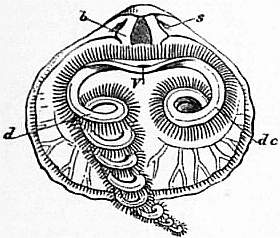
Fig. 23.—Rhynchonella (Hemithyris) psittacea. Interior of dorsal valve, s, Sockets; b, dental plates; V, mouth; de, labial appendage in its natural position; d, appendage extended or unrolled.
A vessel—the dorsal vessel—runs forward from the heart along the dorsal surface of the oesophagus. This vessel is nothing but a split between the right and left folds of the mesentery, and its cavity is thus a remnant of the blastocoel. A similar primitive arrangement is thought by F. Blochmann to obtain in the genital arteries. Anteriorly the dorsal vessel splits into a right and a left half, which enter the small arm-sinus and, running along it, give off a blind branch to each tentacle (fig. 21). The right and left halves are connected ventrally to the oesophagus by a short vessel which supplies these tentacles in the immediate neighbourhood of the mouth. There is thus a vascular ring around the oesophagus. The heart gives off posteriorly a second median vessel which divides almost at once into a right and a left half, each of which again divides into two vessels which run to the dorsal and ventral mantles respectively. The dorsal branch sends a blind twig into each of the diverticula of the dorsal mantle-sinus, the ventral branch supplies the nephridia and neighbouring parts before reaching the ventral lobe of the mantle. Both dorsal and ventral branches supply the generative organs.
The blood is a coagulable fluid. Whether it contains corpuscles is not yet determined, but if so they must be few in number. It is a remarkable fact that in Discinisca, although the vessels to the lophophore are arranged as in other Brachiopods, no trace of a heart or of the posterior vessels has as yet been discovered.
Muscles.—The number and position of the muscles differ materially in the two great divisions into which the Brachiopoda have been grouped, and to some extent also in the different genera of which each division is composed. Unfortunately almost every anatomist who has written on the muscles of the Brachiopoda has proposed different names for each muscle, and the confusion thence arising is much to be regretted. In the Testicardines, of which the genus Terebratula may be taken as an example, five or six pairs of muscles are stated by A. Hancock, Gratiolet and others to be connected with the opening and closing of the valves, or with their attachment to or movements upon the peduncle. First of all, the adductors or occlusors consist of two muscles, which, bifurcating near the centre of the shell cavity, produce a large quadruple impression on the internal surface of the small valve (fig. 13, a, a’), and a single divided one towards the centre of the large or ventral valve (fig. 12, a). The function of this pair of muscles is the closing of the valves. Two other pairs have been termed divaricators by Hancock, or cardinal muscles (“muscles diducteurs” of Gratiolet), and have for function the opening of the valves. The divaricators proper are stated by Hancock to arise from the ventral valve, one on each side, a little in advance of and close to the adductors, and after rapidly diminishing in size become attached to the cardinal process, a space or prominence between the sockets in the dorsal valve. The accessory divaricators are, according to the same authority, a pair of small muscles which have their ends attached to the ventral valve, one on each side of the median line, a little behind the united basis of the adductors, and again to the extreme point of the cardinal process. Two pairs of muscles, apparently connected with the peduncle and its limited movements, have been minutely described by Hancock as having one of their extremities attached to this organ. The dorsal adjusters are fixed to the ventral surface of the peduncle, and are again inserted into the hinge-plate in the smaller valve. The ventral adjusters are considered to pass from the inner extremity of the peduncle, and to become attached by one pair of their extremities to the ventral valve, one on each side and a little behind the expanded base of the divaricators. The function of these muscles, according to the same authority, is not only that of erecting the shell; they serve also to attach the peduncle to the shell, and thus effect the steadying of it upon the peduncle. By alternate contracting they can cause a slight rotation of the animal in its stalk.
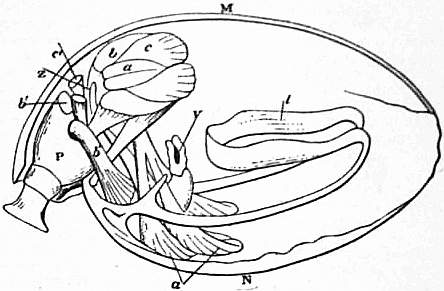
Fig. 24.—Magellania [Waldheimia] flavescens. Diagram showing the muscular system. (After Hancock.)
M, Ventral, N, Dorsal valve, l, Loop. V, Mouth. Z, Extremity of intestine, c, Divaricators. c′, Accessory divaricators. a, Adductor. b, Ventral adjusters. b′, Peduncular muscles. b″, Dorsal adjusters. P, Peduncle.
Such is the general arrangement of the shell muscles in the division composing the articulated Brachiopoda, making allowance for certain unimportant modifications observable in the animals composing the different families and genera thereof. Owing to the strong and tight interlocking of the valves by the means of curved teeth and sockets, many species of Brachiopoda could open their valves but slightly. In some species, such as Thecidea, the animal could raise its dorsal valve at right angles to the plane of the ventral one (fig. 4).
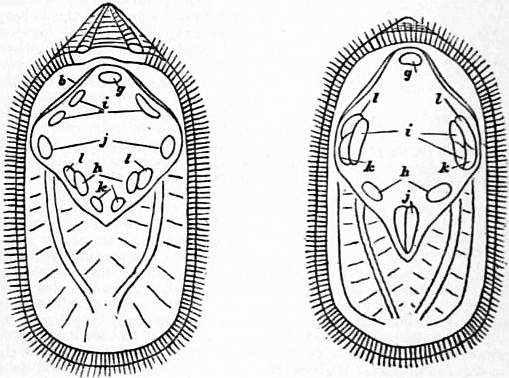
Figs. 25, 26. Lingula anatina.
25, Interior of ventral valve. 26, Interior of dorsal valve. g, Umbonal muscular impressions (open valves). h, Central muscles (close valves). i, Transmedial or sliding muscles. b, Parietal band. j, k, l, Lateral muscles (j, anteriors; k, middles; l, outsiders), enabling the valves to move forward and backward on each other. (After King.)
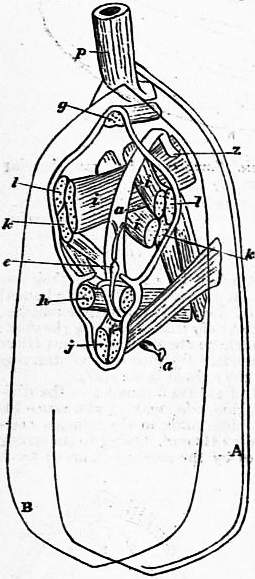
Fig. 27.—Lingula anatina. Diagram showing the muscular system. (After Hancock.) The letters indicate the muscles as in figs. 25 and 26.
A, Dorsal, B, Ventral valve. p, Peduncle. e, Heart. a, Alimentary tube. z, Anal aperture.
In the Ecardines, of which Lingula and Discina may be quoted as examples, the myology is much more complicated. Of the shell or valvular muscles W. King makes out five pairs and an odd one, and individualizes their respective functions as follows:—Three pairs are lateral, having their members limited to the sides of the shell; one pair are transmedians, each member passing across the middle of the reverse side of the shell, while the odd muscle occupies the umbonal cavity. The central and umbonal muscles effect the direct opening and closing of the shell, the laterals enable the valves to move forward and backward on each other, and the transmedians allow the similar extremities (the rostral) of the valves to turn from each other to the right or the left on an axis subcentrically situated, that is, the medio-transverse region of the dorsal valve. It was long a matter in discussion whether the animal could displace its valves sideways when about to open its shell, but this has been actually observed by Professors K. Semper and E.S. Morse, who saw the animal perform the operation. They mention that it is never done suddenly or by jerks, as the valves are at first always pushed to one side several times and back again on each other, at the same time opening gradually in the transverse direction till they rest opposite to one another and widely apart. Those who have not seen the animal in life, or who did not believe in the possibility of the valves crossing each other with a slight obliquity, would not consent to appropriating any of its muscles to that purpose, and consequently attributed to all the lateral muscles the simple function of keeping the valves in an opposite position, or holding them adjusted. We have not only the observations of Semper and Morse, but the anatomical investigations of King, to confirm the sliding action or lateral divarication of the valves of Lingula.
In the Testicardines, where no such sliding action of the valves was necessary or possible, no muscles for such an object were required, consequently none took rise from the lateral portions of the valves as in Lingula; but in an extinct group, the Trimerellidae, which seems to be somewhat intermediate in character between the Ecardines and Testicardines, have been found certain scars, which appear to have been produced by rudimentary lateral muscles, but it is doubtful (considering the shells are furnished with teeth, though but rudely developed) whether such muscles enabled the valves, as in Lingula, to move forward and backward upon each other. Crania in life opens its valves by moving upon the straight hinge, without sliding the valve.
The nervous system of Brachiopods has, as a rule, maintained its primitive connexion with the external epithelium. In a few places it has sunk into the connective-tissue supporting layer beneath the ectoderm, but the chief centres still remain in the ectoderm, and the fibrils forming the nerves are for the most part at the base of the ectodermal cells. Above the oesophagus is a thin commissure which passes laterally into the chief arm-nerve. This latter includes in its course numerous ganglion cells, and forms, according to F. Blochmann, the immensely long drawn out supra-oesophageal ganglion. The chief arm-nerve traverses the lophophore, being situated between the great arm-sinus and the base of the lip (figs. 22 and 28); it gives off a branch to each tentacle, and these all anastomose at the base of the tentacles with the second nerve of the arm, the so-called secondary arm-nerve. Like the chief arm-nerve, this strand runs through the lophophore, parallel indeed with the former except near the middle line, where it passes ventrally to the oesophagus. The lophophore is supplied by yet a third nerve, the under arm-nerve, which is less clearly defined than the others, and resembles a moderate aggregation of the nerve fibrils, which seem everywhere to underlie the ectoderm, and which in a few cases are gathered up into nerves. The under arm-nerve, which lies between the small arm-sinus and the surface, supplies nerves to the muscles of both arm-sinuses (figs. 22 and 28). Medianly, it has its origin in the sub-oesophageal ganglion, which, like the supra-oesophageal, is drawn out laterally, though not to the same extent. In the middle line the sub-oespphageal nerve mass is small; the ganglion is in fact drawn out into two halves placed on either side of the body. From each of these sub-oesophageal ganglia numerous nerves arise. Passing from the middle line outwards they are—(i.) the median pallial nerve to the middle of the dorsal mantle; (ii.) numerous small nerves—the circum-oesophageal commissures—which pass round the oesophagus to the chief arm-nerve or supra-oesophageal ganglion; (iii.) the under arm-nerve to the lophophore and its muscles; (iv.) the lateral pallial nerve to the sides of the dorsal mantle. Laterally, the sub-oesophageal ganglia give off (v.) nerves to the ventral mantle, and finally they supply (vi.) branches to the various muscles. There is a special marginal nerve running round the edge of the mantle, but the connexion of this with the rest of the nervous system is not clear; probably it is merely another concentration of the diffused sub-ectodermal nervous fibrils.
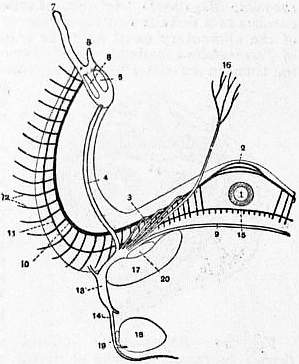
Fig. 28.—Diagram of nervous system of Crania; from the dorsal side. The nerves running to the dorsal parts are white, with black edges; those running to the ventral parts are solid black. Magnified. (After Blochmann.)
1. Oesophagus. 2. Supra-oesophageal commisure. 3. Circum-oesophageal commisure. 4. Under arm-nerve. 5. Great arm-sinus. 6. Small arm-sinus. 7. Tentacle. 8. Lip of lophophore. 9. Infra-oesophageal commisure. 10. Chief arm-nerve. 11. Secondary arm-nerve. 12. Nerves to tentacles. 13. Sub-oesophageal ganglion. 14. Dorsal lateral nerve. 15. Sub-oesophageal portion of the secondary arm-nerve. 16. Median pallial nerve of dorsal lobe of mantle. 17. Anterior occlusor muscle. 18. Posterior occlusor muscle. 19. Obliquus superior muscle. 20. Levator brachii muscle.
The above account applies more particularly to Crania, but in the main it is applicable to the other Inarticulata which have been investigated. In Discinisca and Lingula, however, the sub-oesophageal ganglion is not drawn out, but lies medianly; it gives off two posteriorly directed nerves to the stalk, which in Lingula unite and form a substantial nerve. Sense organs are unknown in the adult. The larval forms are provided with eye-spots, but no very specialized sense organs are found in the adult.
The histology of Brachiopods presents some peculiar and many primitive features. As a rule the cells are minute, and this has especially stood in the way of embryological research. The plexus of nerve-fibrils which underlie the ectoderm and are in places gathered up into nerves, and the great development of connective tissue, are worthy of notice. Much of the latter takes the form of hyaline supporting tissue, embedded in which are scattered cells and fibres. The lophophore and stalk are largely composed of this tissue. The ectodermal cells are large, ciliated, and amongst the ciliated cells glandular cells are scattered. The chitinous chaetae have their origin in special ectodermal pits, at the base of which is one large cell which is thought to secrete the chaeta, as in Chaetopods. These pits are not isolated, but are connected by an ectodermal ridge, which grows in at the margin of the mantle and forms a continuous band somewhat resembling the ectodermal primordium of vertebrate teeth.
The ovary and testes are heaped-up masses of red or yellow cells due to a proliferation of the cells lining the coelom. There are four of such masses, two dorsal and two ventral, and as a rule they extend between the outer and inner layer of the mantle lining the shells. The ova and the spermatozoa dehisce into the body cavity and pass to the exterior through the nephridia. Fertilization takes place outside the body, and in some species the early stages of development take place in a brood-pouch which is essentially a more or less deep depression of the body-wall median in Thecidea, while in Cistella (? Argiope) there is one such pouch on each side, just below the base of the arms, and into these the nephridia open. The developing ova are attached by little stalks to the walls of these pouches. In spite of some assertions to the contrary, all the Brachiopods which have been carefully investigated have been found to be male or female. Hermaphrodite forms are unknown.
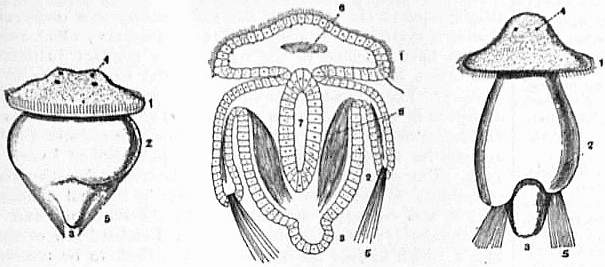
Fig. 29.—Three larvae stages of Megathyris (Argiope). A, Larva which has just left brood-pouch; B, longitudinal section through a somewhat later stage; C, the fully formed embryo just before fixing—the neo-embryo of Beecher. Highly magnified.
1. Anterior segment. 2. Second or mantle-forming segment. 3. Third or stalk-forming segment. 4. Eye-spots. 5. Setae. 6. Nerve mass (?). 7. Alimentary canal. 8. Muscles.
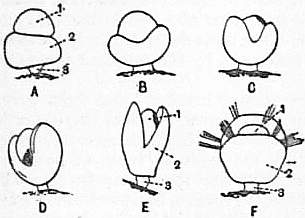
Fig. 30.—Stages in the fixing and metamorphosis of Terebratulina. Highly magnified. (From Morse.)
A, Larva (neo-embryo) just come to rest. B, C, D, Stages showing the turning forward of the second or mantle segment. E, Completion of this. F, Young Brachiopod. 1, 2, 3, The first, second and third segments.
Embryology.—With the exception of Yatsu’s article on the development of Lingula (J. Coll. Sci., Japan, xvii., 1901-1903) and E.G. Conklin’s on “Terebratulina septentrionalis” (P. Amer. Phil. Soc. xli., 1902), little real advance has been made in our knowledge of the embryology of the Brachiopoda within recent years. Kovalevsky’s researches (Izv. Obshch. Moskov, xiv., 1874) on Megathyris (Argiope) and Yatsu’s just mentioned are the most complete as regards the earlier stages. Segmentation is complete, a gastrula is formed, the blastopore closes, the archenteron gives off two coelomic sacs which, as far as is known, are unaffected by the superficial segmentation of the body that divides the larva into three segments. The walls of these sacs give rise at an early stage to muscles which enable the parts of the larva to move actively on one another (fig. 29, B). About this stage the larvae leave the brood-pouch, which is a lateral or median cavity in the body of the female, and lead a free swimming life in the ocean. The anterior segment broadens and becomes umbrella-shaped; it has a powerful row of cilia round the rim and smaller cilia on the general surface. By the aid of these cilia the larva swims actively, but owing to its minute size it covers very little distance, and this probably accounts for the fact that where brachiopods occur there are, as a rule, a good many in one spot. The head bears four eye-spots, and it is continually testing the ground (fig. 29, A, C). The second segment grows downwards like a skirt surrounding the third segment, which is destined to form the stalk. It bears at its rim four bundles of very pronounced chaetae. After a certain time the larva fixes itself by its stalk to some stone or rock, and the skirt-like second segment turns forward over the head and forms the mantle. What goes on within the mantle is unknown, but presumably the head is absorbed. The chaetae drop off, and the lophophore is believed to arise from thickenings which appear in the dorsal mantle lobe. The Plankton Expedition brought back, and H. Simroth (Ergeb. Plankton Expedition, ii., 1897) has described, a few larval brachiopods of undetermined genera, two of which at least were pelagic, or at any rate taken far from the coast. These larvae, which resemble those described by Fritz Müller (Arch. Naturg., 1861-1862), have their mantle turned over their head and the larval shell well developed. No stalk has been seen by Simroth or Fritz Müller, but in other respects the larva resembles the stages in the development of Megathyris and Terebratulina which immediately precede fixation. The cirri or tentacles, of which three or four pairs are present, are capable of being protruded, and the minute larva swims by means of the ciliary action they produce. It can retract the tentacles, shut its shell, and sink to the bottom.
C.E.E. Beecher (Amer. Jour. Sci. ser. 3, xli. and xliv.) has classified with appropriate names the various stages through which Brachiopod larvae pass. The last stage, that in which the folds of the second segment are already reflected over the first, he calls the Typembryo. Either before or just after turning, the mantle develops a larval shell termed the protegulum, and when this is completed the larva is termed the Phylembryo. By this time the eyes have disappeared, the four bundles of chaetae have dropped off, and the lophophore has begun to appear as an outgrowth of the dorsal mantle lobe. The protegulum has been found in members of almost all the families of Brachiopod, and it is thought to occur throughout the group. It resembles the shell of the Cambrian genus Iphidea [Paterina], and the Phylembryo is frequently referred to as the Paterina stage. In some orders the Phylembryo is succeeded by an Obolella stage with a nearly circular outline, but this is not universal. The larva now assumes specific characters and is practically adult.
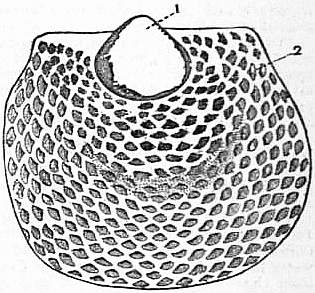
Fig. 31.—Shell of larval Brachiopod. Phylembryo stage. (From Simroth.) 1, Protegulum; 2, permanent shell.
Classification.—Beecher’s division of the Brachiopoda into four orders is based largely on the character of the aperture through which the stalk or pedicle leaves the shell. To appreciate his diagnoses it is necessary to understand certain terms, which unfortunately are not used in the same sense by all authors. The triangular pedicle-opening seen in Orthis, &c., has been named by James Hall and J.M. Clarke the delthyrium. In some less primitive genera, e.g. Terebratula, that type of opening is found in the young stages only; later it becomes partly closed by two plates which grow out from the sides of the delthyrium. These plates are secreted by the ventral lobe of the mantle, and were named by von Buch in 1834 the “deltidium.” The form of the deltidium varies in different genera. The two plates may meet in the middle line, and leave only a small oval opening near the centre for the pedicle, as in Rhynchonella; or they may meet only near the base of the delthyrium forming the lower boundary of the circular pedicle-opening, as in Terebratula; or the right plate may remain quite distinct from the left plate, as in Terebratella. The pro-deltidium, a term introduced by Hall and Clarke, signifies a small embryonic plate originating on the dorsal side of the body. It subsequently becomes attached to the ventral valve, and develops into the pseudo-deltidium, in the Neotremata and the Protremata. The pseudo-deltidium (so named by Bronn in 1862) is a single plate which grows from the apex of the delthyrium downwards, and may completely close the aperture. The pseudo-deltidium is sometimes reabsorbed in the adult. In the Telotremata neither pro-deltidium nor pseudo-deltidium is known. In the Atremata the pro-deltidium does not become fixed to the ventral valve, and does not develop into a pseudo-deltidium. The American use of the term deltidium for the structure which Europeans call the pseudo-deltidium makes for confusion. The development of the brachial supports has been studied by Friele, Fischer and Oehlert. A summary of the results is given by Beecher (Trans. Connect. Acad. ix., 1893; reprinted in Studies in Evolution, 1901).
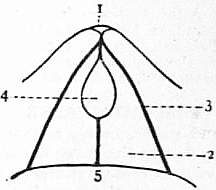
Fig. 32.—Diagram of the pedicle-opening of Rhynchonella. Magnified.
1. Umbo of ventral valve. 2. Deltidium. 3. Margin of delthyrium. 4. Pedicle-opening. 5. Dorsal valve.
The orders Atremata and Neotremata are frequently grouped together, as the sub-class Inarticulata or Ecardines—the Tretenterata of Davidson—and the orders Protremata and Telotremata, as the Articulata or Testicardines— the Clistenterata of Davidson. The following scheme of classification is based on Beecher’s and Schubert’s. Recent families are printed in italic type.
Class I. Ecardines (Inarticulata)
ORDER I. Atremata (Beecher).—Inarticulate Brachiopoda, with the pedicle passing out between the umbones, the opening being shared by both valves. Pro-deltidium attached to dorsal valves. FAMILIES.—Paterinidae, Obolidae, Trimerellidae, Lingulellidae, Lingulidae, Ligulasmatidae.
ORDER II. Neotremata (Beecher).—More or less circular, cone-shaped, inarticulate Brachiopoda. The pedicle passes out at right angles to the plane of junction of the valves of the shell; the opening is confined to the ventral valve, and may take the form of a slit, or may be closed by the development of a special plate called the listrium, or by a pseudo-deltidium. Pro-deltidium attached to ventral valve. FAMILIES.—Acrotretidae, Siphonotretidae, Trematidae, Discinidae, Craniidae.
Class II. Testicardines (Articulata)
ORDER III. Protremata (Beecher).—Articulate Brachiopoda, with pedicle-opening restricted to ventral valve, and either open at the hinge line or more or less completely closed by a pseudo-deltidium, which may disappear in adult. The pro-deltidium originating on the dorsal surface later becomes anchylosed with the ventral valve. FAMILIES.—Kutorginidae, Eichwaldiidae, Billingsellidae, Strophomenidae, Thecidiidae, Productidae, Richthofenidae, Orthidae, Clitambonitidae, Syntrophiidae, Porambonitidae, Pentameridae.
ORDER IV. Telotremata (Beecher).—Articulate Brachiopoda, with the pedicle-opening, confined in later life to the ventral valve, and placed at the umbo or beneath it. Deltidium present, but no pro-deltidium. Lophophore supported by calcareous loops, &c. FAMILIES.—Protorhynchidae, Rhynchonellidae, Centronellidae, Terebratulidae, Stringocephalidae, Megalanteridae, Terebratellidae, Atrypidae, Spiriferidae, Athyridae.
Affinities.—Little light has been thrown on the affinities of the Brachiopoda by recent research, though speculation has not been wanting. Brachiopods have been at various times placed with the Mollusca, the Chaetopoda, the Chaetognatha, the Phoronidea, the Polyzoa, the Hemichordata, and the Urochordata. None of these alliances has borne close scrutiny. The suggestion to place Brachiopods with the Polyzoa, Phoronis, Rhabdopleura and Cephalodiscus, in the Phylum Podaxonia made in Ency. Brit. (vol. xix, ninth edition, pp. 440-441) has not met with acceptance, and until we have a fuller account of the embryology of some one form, preferably an Inarticulate, it is wiser to regard the group as a very isolated one. It may, however, be pointed out that Brachiopods seem to belong to that class of animal which commences life as a larva with three segments, and that tri-segmented larvae have been found now in several of the larger groups.
Distribution.—Brachiopods first appear in the Lower Cambrian, and reached their highest development in the Silurian, from which upwards of 2000 species are known, and were nearly as numerous in the Devonian period; at present they are represented by some 140 recent species. The following have been found in the British area, as defined by A.M. Norman, Terebratulina caput-serpentis L., Terebratula (Gwynia) capsula Jeff., Magellania (Macandrevia) cranium Müll., M. septigera Lovén, Terebratella spitzbergenensis Dav., Megathyris decollata Chemn., Cistella cistellula S. Wood, Cryptopora gnomon Jeff., Rhynchonella (Hemithyris) psittacea Gmel., Crania anomala Müll., and Discinisca atlantica King. About one-half the 120 existing species are found above the 100-fathoms line. Below 150 fathoms they are rare, but a few such as Terebratulina wyvillei are found down to 2000 fathoms. Lingula is essentially a very shallow water form. As a rule the genera of the northern hemisphere differ from those of the southern. A large number of specimens of a species are usually found together, since their only mode of spreading is during the ciliated larval stage, which although it swims vigorously can only cover a few millimetres an hour; still it may be carried some little distance by currents.
Undue stress is often laid on the fact that Lingula has come down to us apparently unchanged since Cambrian times, whilst Crania, and forms very closely resembling Discina and Rhynchonella, are found from the Ordovician strata onwards. The former statement is, however, true of animals from other classes at least as highly organized as Brachiopods, e.g. the Gasteropod Capulus, whilst most of the invertebrate classes were represented in the Ordovician by forms which do not differ from their existing representatives in any important respect.
A full bibliography of Brachiopoda (recent and fossil) is to be found in Davidson’s Monograph of British Fossil Brachiopods, Pal. Soc. Mon. vi., 1886. The Monograph on Recent Brachiopoda, by the same author, Tr. Linn. Soc. London, Zool. ser. ii. vol. iv., 1886-1888, must on no account be omitted.
(A. E. S.)
1 Subgenera are indicated by round, synonyms by square brackets.
BRACHISTOCHRONE (from the Gr. βράχιστος, shortest, and χρόνος, time), a term invented by John Bernoulli in 1694 to denote the curve along which a body passes from one fixed point to another in the shortest time. When the directive force is constant, the curve is a cycloid (q.v.); under other conditions, spirals and other curves are described (see Mechanics).
BRACHYCEPHALIC (Gr. for short-headed), a term invented by Andreas Retzius to denote those skulls of which the width from side to side was little less than the length from front to back, their ratio being as 80 to 100, as in those of the Mongolian type. Thus taking the length as 100, if the width exceeds 80, the skull is to be classed as brachycephalic. The prevailing form of the head of civilized races is brachycephalic. It is supposed that a brachycephalic race inhabited Europe before the Celts. Among those peoples whose heads show marked brachycephaly are the Indo-Chinese, the Savoyards, Croatians, Bavarians, Lapps, Burmese, Armenians and Peruvians. (See Craniometry.)
BRACKYLOGUS (from Gr. βραχύς, short, and λόγος, word), title applied in the middle of the 16th century to a work containing a systematic exposition of the Roman law, which some writers have assigned to the reign of the emperor Justinian, and others have treated as an apocryphal work of the 16th century. The earliest extant edition of this work was published at Lyons in 1549, under the title of Corpus Legum per modum Institutionum; and the title Brachylogus totius Juris Civilis appears for the first time in an edition published at Lyons in 1553. The origin of the work may be referred with great probability to the 12th century. There is internal evidence that it was composed subsequently to the reign of Louis le Débonnaire (778-840), as it contains a Lombard law of that king’s, which forbids the testimony of a clerk to be received against a layman. On the other hand its style and reasoning is far superior to that of the law writers of the 10th and 11th centuries; while the circumstance that the method of its author has not been in the slightest degree influenced by the school of the Gloss-writers (Glossatores) leads fairly to the conclusion that he wrote before that school became dominant at Bologna. Savigny, who traced the history of the Brachylogus with great care, is disposed to think that it is the work of Irnerius himself (Geschichte des röm. Rechts im Mittelalter). Its value is chiefly historical, as it furnishes evidence that a knowledge of Justinian’s legislation was always maintained in northern Italy. The author of the work has adopted the Institutes of Justinian as the basis of it, and draws largely on the Digest, the Code and the Novels; while certain passages, evidently taken from the Sententiae Receptae of Julius Paulus, imply that the author was also acquainted with the Visigothic code of Roman law compiled by order of Alaric II.
An edition by E. Bocking was published at Berlin in 1829, under the title of Corpus Legum sive Brachylogus Juris Civilis. See also H. Fitting, Über die Heimath und das Alter des sogenannten Brachylogus (Berlin, 1880).
BRACKET, in architecture and carpentering, a projecting feature either in wood or metal for holding things together or supporting a shelf. The same feature in stone is called a “console” (q.v.). In furniture it is a small ornamental shelf for a wall or a corner, to bear knick-knacks, china or other bric-à-brac. The word has been referred to “brace,” clamp, Lat. bracchium, arm, but the earliest form “bragget” (1580) points to the true derivation from the Fr. braguette, or Span. bragueta (Lat. bracae, breeches), used both of the front part of a pair of breeches and of the architectural feature. The sense development is not clear, but it has no doubt been influenced by the supposed connexion with “brace.”
BRACKET-FUNGI. The term “bracket” has been given to those hard, woody fungi that grow on trees or timber in the form of semicircular brackets. They belong to the order Polyporeae, distinguished by the layer of tubes or pores on the under surface within which the spores are borne. The mycelium, or vegetable part of the fungus, burrows in the tissues of the tree, and often destroys it; the “bracket” represents the fruiting stage, and produces innumerable spores which gain entrance to other trees by some wound or cut surface; hence the need of careful forestry. Many of these woody fungi persist for several years, and a new layer of pores is superposed on the previous season’s growth.
BRACKLESHAM BEDS, in geology, a series of clays and marls, with sandy and lignitic beds, in the Middle Eocene of the Hampshire Basin, England. They are well developed in the Isle of Wight and on the mainland opposite; and receive their name from their occurrence at Bracklesham in Sussex. The thickness of the deposit is from 100 to 400 ft. Fossil mollusca are abundant, and fossil fish are to be found, as well as the Palaeophis, a sea-snake. Nummulites and other foraminifera also occur. The Bracklesham Beds lie between the Barton Clay above and the Bournemouth Beds, Lower Bagshot, below. In the London Basin these beds are represented only by thin sandy clays In the Middle Bagshot group. In the Paris Basin the “Calcaire grossier” lies upon the same geological horizon.
See F. Dixon, Geology of Sussex (new ed., 1878); F.E. Edwards and S.V. Wood, “Monograph of Eocene Mollusca,” Palaeontographical Soc. vol. i. (1847-1877); “Geology of the Isle of Wight,” Mem. Geol. Survey (2nd ed., 1889); C. Reid, “The Geology of the Country around Southampton,” Mem. Geol. Survey (1902).
BRACKLEY, THOMAS EGERTON, Viscount (c. 1540-1617), English lord chancellor, was a natural son of Sir Richard Egerton of Ridley, Cheshire. The exact date of his birth is unrecorded, but, according to Wood,1 when he became a commoner at Brasenose College, Oxford, in 1556, he was about seventeen. He entered Lincoln’s Inn in 1559, and was called to the bar in 1572, being chosen a governor of the society in 1580, Lent reader in 1582, and treasurer in 1588. He early obtained legal renown and a large practice, and tradition relates that his skilful conduct of a case against the crown gained the notice of Elizabeth, who is reported to have declared: “In my troth he shall never plead against me again.” Accordingly, on the 26th of June 1581, he was made solicitor-general. He represented Cheshire in the parliaments of 1585 and 1586, but in his official capacity he often attended in the House of Lords. On the 3rd of March 1589 the Commons desired that he should return to their house, the Lords refusing on the ground that he was called by the queen’s writ to attend in the Lords before his election by the House of Commons.2 He took part in the trial of Mary, queen of Scots, in 1586, and advised that in her indictment she should only be styled “commonly called queen of Scots,” to avoid scruples about judging a sovereign. He conducted several other state prosecutions. On the 2nd of June 1592 he was appointed attorney-general, and was knighted and made chamberlain of Chester in 1593. On the 10th of April 1594 he became master of the rolls, and on the 6th of May 1596 lord keeper of the great seal and a privy councillor, remaining, however, a commoner as Sir Thomas Egerton, and presiding in the Lords as such during the whole reign of Elizabeth. He kept in addition the mastership of the rolls, the whole work of the chancery during this period falling on his shoulders and sometimes causing inconvenience to suitors3. His promotion was welcomed from all quarters. “I think no man,” wrote a contemporary to Essex, “ever came to this dignity with more applause than this worthy gentleman.”4
Egerton became one of the queen’s most trusted advisers and one of the greatest and most striking figures at her court. He was a leading member of the numerous special commissions, including the ecclesiastical commission, and was the queen’s interpreter in her communications to parliament. In 1598 he was employed as a commissioner for negotiating with the Dutch, obtaining great credit by the treaty then effected, and in 1600 in the same capacity with Denmark. In 1597, in consequence of his unlawful marriage with his second wife, in a private house without banns, the lord keeper incurred a sentence of excommunication, and was obliged to obtain absolution from the bishop of London.5 He was a firm friend of the noble but erratic and unfortunate Essex. He sought to moderate his violence and rashness, and after the scene in the council in July 1598, when the queen struck Essex and bade him go and be hanged, he endeavoured to reconcile him to the queen in an admirable letter which has often been printed.6 On the arrival of Essex in London without leave from Ireland, and his consequent disgrace, he supported the queen’s just authority, avoiding at the same time any undue severity to the offender. Essex was committed to his custody in York House from the 1st of October 1599 till the 5th of July 1600, when the lord keeper used his influence to recover for him the queen’s favour and gave him kindly warnings concerning the necessity for caution in his conduct. On the 5th of June 1600 he presided over the court held at his house, which deprived Essex of his offices except that of master of the horse, treating him with leniency, not pressing the charge of treason but only that of disobedience, and interrupting him with kind intentions when he attempted to justify himself. After the trial he tried in vain to bring Essex to a sense of duty. On the 8th of February 1601, the day fixed for the rebellion, the lord keeper with other officers of state visited Essex at Essex House to demand the reason of the tumultuous assemblage. His efforts to persuade Essex to speak with him privately and explain his “griefs,” and to refrain from violence, and his appeal to the company to depart peacefully on their allegiance, were ineffectual, and he was imprisoned by Essex for six hours, the mob calling out to kill him and to throw the great seal out of the window. Subsequently he abandoned all hope of saving Essex, and took an active part in his trial. On the 13th of February he made a speech in the Star Chamber, exposing the wickedness of the rebellion, and of the plot of Thomas Lea to surprise Elizabeth at her chamber door.7 In July 1602, a few months before her death, Elizabeth visited the lord keeper at his house at Harefield in Middlesex, and he was one of those present during her last hours who received her faltering intimation as to her successor.
On the accession of James I., Sir Thomas Egerton was reappointed lord keeper, resigning the mastership of the rolls in May 1603, and the chamberlainship of Chester in August. On the 21st of July he was created Baron Ellesmere, and on the 24th lord chancellor. His support of the king’s prerogative was too faithful and undiscriminating. He approved of the harsh penalty inflicted upon Oliver St John in 1615 for denying the legality of benevolences, and desired that his sentencing of the prisoner “might be his last work to conclude his services.”8 In May 1613 he caused the committal of Whitelocke to the Fleet for questioning the authority of the earl marshal’s court. In 1604 he came into collision with the House of Commons. Sir Francis Goodwin, an outlaw, having been elected for Buckinghamshire contrary to the king’s proclamation, the chancellor cancelled the return when made according to custom into chancery, and issued writs for a new election. The Commons, however, considering their privileges violated, restored Goodwin to his seat, and though the matter was in the present instance compromised by the choice of a third party, they secured for the future the right of judging in their own elections. He was at one with James in desiring to effect the union between England and Scotland, and served on the commission in 1604; and the English merchants who opposed the union and community of trade with the Scots were “roundly shaken by him.” In 1608, in the great case of the Post Nati, he decided, with the assistance of the fourteen judges, that those born after the accession of James I. to the throne of England were English subjects and capable of holding lands in England; and he compared the two dissentient judges to the apostle Thomas, whose doubts only confirmed the faith of the rest. He did not, however, always show obedience to the king’s wishes. He opposed the latter’s Spanish policy, and in July 1615, in spite of James’s most peremptory commands and threats, refused to put the great seal to the pardon of Somerset. In May 1616 he officiated as high steward in the trial of the latter and his countess for the murder of Overbury. He was a rigid churchman, hostile to both the Puritans and the Roman Catholics. He fully approved of the king’s unfriendly attitude towards the former, adopted at the Hampton Court conference in 1604, and declared, in admiration of James’s theological reasoning on this occasion, that he had never understood before the meaning of the legal maxim, Rex est mixta persona cum sacerdote. In 1605 he opposed the petition for the restitution of deprived Puritan ministers, and obtained an opinion from the judges that the petition was illegal. He supported the party of Abbot against Laud at Oxford, and represented to the king the unfitness of the latter to be president of St John’s College. In 1605 he directed the judges to enforce the penal laws against the Roman Catholics.
His vigorous and active public career closed with a great victory gained over the common law and his formidable antagonist, Sir Edward Coke. The chancellor’s court of equity had originated in the necessity for a tribunal to decide cases not served by the common law, and to relax and correct the rigidity and insufficiency of the latter’s procedure. The two jurisdictions had remained bitter rivals, the common-law bar complaining of the arbitrary and unrestricted powers of the chancellor, and the equity lawyers censuring and ridiculing the failures of justice in the courts of common law. The disputes between the courts, concerning which the king had already in 1615 remonstrated with the chancellor and Sir Edward Coke,9 the lord chief justice, came to a crisis in 1616, when the court of chancery granted relief against judgments at common law in the cases of Heath v. Rydley and Courtney v. Granvil. This relief was declared by Coke and other judges sitting with him to be illegal, and a counter-attack was made by a praemunire, brought against the parties concerned in the suit in chancery. The grand jury, however, refused to bring in a true bill against them, in spite of Coke’s threats and assurances that the chancellor was dead, and the dispute was referred to the king himself, who after consulting his counsel and on Bacon’s advice decided in favour of equity. The chancellor’s triumph was a great one, and from this time the equitable jurisdiction of the court of chancery was unquestioned. In June 1616 he supported the king in his dispute with and dismissal of Coke in the case of the commendams, agreeing with Bacon that it was the judge’s duty to communicate with the king, before giving judgments in which his interests were concerned, and in November warned the new lord chief justice against imitating the errors of his predecessor and especially his love of “popularity.”10 Writing in 1609 to Salisbury, the chancellor had described Coke (who had long been a thorn in his flesh) as a “frantic, turbulent and idle broken brayned fellow,” apologizing for so often troubling Salisbury on this subject, “no fit exercise for a chancellor and a treasurer.”11 He now summoned Coke before him and communicated to him the king’s dissatisfaction with his Reports, desiring, however, to be spared further service in his disgracing. After several petitions for leave to retire through failing health, he at last, on the 3rd of March 1617, delivered up to James the great seal, which he had held continuously for the unprecedented term of nearly twenty-one years. On the 7th of November 1616 he had been created Viscount Brackley, and his death took place on the 15th of March 1617. Half an hour before his decease James sent Bacon, then his successor as lord keeper, with the gift of an earldom, and the presidentship of the council with a pension of £3000 a year, which the dying man declined as earthly vanities with which he had no more concern. He was buried at Dodleston in Cheshire.
As Lord Chancellor Ellesmere he is a striking figure in the long line of illustrious English judges. No instance of excessive or improper use of his jurisdiction is recorded, and the famous case which precipitated the contest between the courts was a clear travesty of justice, undoubtedly fit for the chancellor’s intervention. He refused to answer any communications from suitors in his court,12 and it was doubtless to Ellesmere (as weeding out the “enormous sin” of judicial corruption)13 that John Donne, who was his secretary, addressed his fifth satire. He gained Camden’s admiration, who records an anagram on his name, “Gestat Honorem.” Bacon, whose merit he had early recognized, and whose claims to the office of solicitor-general he had unavailingly supported both in 1594 and 1606, calls him “a true sage, a salvia in the garden of the state,” and speaks with gratitude of his “fatherly kindness.” Ben Jonson, among the poets, extolled in an epigram his “wing’d judgements,” “purest hands,” and constancy. Though endowed with considerable oratorical gifts he followed the true judicial tradition and affected to despise eloquence as “not decorum for judges, that ought to respect the Matter and not the Humours of the Hearers.”14 Like others of his day he hoped to see a codification of the laws,15 and appears to have had greater faith in judge-made law than in statutes of the realm, advising the parliament (October 27, 1601) “that laws in force might be revised and explained and no new laws made,” and describing the Statute of Wills passed in Henry VIII.’s reign as the “ruin of ancient families” and “the nurse of forgeries.” In the thirty-eighth year of Elizabeth he drew up rules for procedure in the Star Chamber,16 restricting the fees, and in the eighth of James I. ordinances for remedying abuses in the court of chancery. In 1609 he published his judgment in the case of the Post Nati, which appears to be the only certain work of his authorship. The following have been ascribed to him:—The Privileges and Prerogatives of the High Court of Chancery (1641); Certain Observations concerning the Office of the Lord Chancellor (1651)—denied by Lord Chancellor Hardwicke in A Discourse of the Judicial Authority of the Master of the Rolls (1728) to be Lord Ellesmere’s work; Observations on Lord Coke’s Reports, ed. by G. Paul (about 1710), the only evidence of his authorship being apparently that the MS. was in his handwriting; four MSS., bequeathed to his chaplain, Bishop Williams, viz. The Prerogative Royal, Privileges of Parliament, Proceedings in Chancery and The Power of the Star Chamber; Notes and Observations on Magna Charta, &c., Sept. 1615 (Harl. 4265, f. 35), and An Abridgment of Lord Coke’s Reports (see MS. note by F. Hargrave in his copy of Certain Observations concerning the Office of Lord Chancellor, Brit. Mus. 510 a 5, also Life of Egerton, p. 80, note T, catalogue of Harleian collection, and Walpole’s Royal and Noble Authors, 1806, ii. 170).
He was thrice married. By his first wife, Elizabeth, daughter of Thomas Ravenscroft of Bretton, Flintshire, he had two sons and a daughter. The elder son, Thomas, predeceased him, leaving three daughters. The younger, John, succeeded his father as 2nd Viscount Brackley, was created earl of Bridgewater, and, marrying Lady Frances Stanley (daughter of his father’s third wife, widow of the 5th earl of Derby), was the ancestor of the earls and dukes of Bridgewater (q.v.), whose male line became extinct in 1829. In 1846 the titles of Ellesmere and Brackley were revived in the person of the 1st earl of Ellesmere (q.v.), descended from Lady Louisa Egerton, daughter and co-heir of the 1st duke of Bridgewater.
No adequate life of Lord Chancellor Ellesmere has been written, for which, however, materials exist in the Bridgewater MSS., very scantily calendared in Hist. MSS. Comm. 11th Rep. p. 24, and app. pt. vii. p. 126. A small selection, with the omission, however, of personal and family matters intended for a separate projected Life which was never published, was edited by J.P. Collier for the Camden Society in 1840.
1 Athenae Oxon. (Bliss), ii. 197.
2 D’Ewes’s Parliaments of Elizabeth, 441, 442.
3 Cal. of St. Pap., Dom., 1601-1603, p. 191.
4 Birch’s Mem. of Queen Elizabeth, i. 479.
5 Hist. MSS. Comm. 11th Rep. p. 24.
6 T. Birch’s Mem. of Queen Elizabeth, ii. 384.
7 Cal. of St. Pap., Dom., 1598-1601, pp. 554, 583.
8 State Trials, ii. 909.
9 Cal. St. Pap., Dom., 1611-1618, p. 381.
10 Cal. St. Pap., Dom., 1611-1618, p. 407.
11 Lansdowne MS. 91, f. 41.
12 Hist. MSS. Comm. app. pt. vii. p. 156.
13 Life of Donne, by E. Gosse, i. 43.
14 Judgment on the Post Nati.
15 Speech to the parliament, 24th of October 1597.
16 Harleian MS. 2310, f. i.; Gardiner’s Hist. of England, ix. 56.
BRACKLEY, a market town and municipal borough in the southern parliamentary division of Northamptonshire, England, 59 m. N.W. by W. from London by the Great Central railway; served also by a branch of the London & North-Western railway. Pop. (1901) 2467. The church of St Peter, the body of which is Decorated and Perpendicular, has a beautiful Early English tower. Magdalen College school was founded in 1447 by William of Waynflete, bishop of Winchester, bearing the name of his great college at Oxford. Of a previous foundation of the 12th century, called the Hospital of St John, the transitional Norman and Early English chapel remains. Brewing is carried on. The borough is under a mayor, 4 aldermen and 12 councillors. Area, 3489 acres.
Brackley (Brachelai, Brackele) was held in 1086 by Earl Alberie, from whom it passed to the earl of Leicester and thence to the families of De Quinci and Holand. Brilliant tournaments were held in 1249 and 1267, and others were prohibited in 1222 and 1244. The market, formerly held on Sunday, was changed in 1218 to Wednesday, and in answer to a writ of Quo Warranto Maud de Holand claimed in 1330 that her family had held a fair on St Andrew’s day from time immemorial. In 1553 Mary granted two fairs to the earl of Derby. By charter of 1686 James II. incorporated the town under a mayor, 6 aldermen, and 26 burgesses, granted three new fairs and confirmed the old fair and market. In 1708 Anne granted four fairs to the earl of Bridgewater, and in 1886 the borough had a new charter of incorporation under a mayor, 4 aldermen and 12 councillors under the Municipal Corporations Act of 1882. Camden (Brit. p. 430) says that Brackley was formerly a famous staple for wool. It first sent members to parliament in 1547, and continued to send two representatives till disfranchised by the Reform Act of 1832. The town formerly had a considerable woollen and lace-making trade.
BRACQUEMOND, FÉLIX (1833- ), French painter and etcher, was born in Paris. He was trained in early youth as a trade lithographer, until Guichard, a pupil of Ingres, took him to his studio. His portrait of his grandmother, painted by him at the age of nineteen, attracted Théophile Gautier’s attention at the Salon. He applied himself to engraving and etching about 1853, and played a leading and brilliant part in the revival of the etcher’s art in France. Altogether he has produced over eight hundred plates, comprising portraits, landscapes, scenes of contemporary life, and bird-studies, besides numerous interpretations of other artists’ paintings, especially those of Meissonier, Gustave Moreau and Corot. After having been attached to the Sèvres porcelain factory in 1870, he accepted a post as art manager of the Paris atelier of the firm of Haviland of Limoges. He was connected by a link of firm friendship with Manet, Whistler, and all the other fighters in the impressionist cause, and received all the honours that await the successful artist in France, including the grade of officer of the Legion of Honour in 1889.
BRACTON, HENRY DE (d. 1268), English judge and writer on English law. His real name was Bratton, and in all probability he derived it either from Bratton Fleming or from Bratton Clovelly, both of them villages in Devonshire. It is only after his death that his name appears as “Bracton.” He seems to have entered the king’s service as a clerk under the patronage of William Raleigh, who after long service as a royal justice died bishop of Winchester in 1250. Bracton begins to appear as a justice in 1245, and from 1248 until his death in 1268 he was steadily employed as a justice of assize in the south-western counties, especially Somerset, Devon and Cornwall. During the earlier part of this period he was also sitting as a judge in the king’s central court, and was there hearing those pleas which “followed the king”; in other words, he was a member of that section of the central tribunal which was soon to be distinguished as the king’s bench. From this position he retired or was dismissed in or about the year 1257, shortly before the meeting of the Mad Parliament at Oxford in 1258. Whether his disappearance is to be connected with the political events of this turbulent time is uncertain. He continued to take the assizes in the south-west, and in 1267 he was a member of a commission of prelates, barons and judges appointed to hear the complaints of the disinherited partisans of Simon de Montfort. In 1259 he became rector of Combe-in-Teignhead, in 1261 rector of Barnstaple, in 1264 archdeacon of Barnstaple, and, having resigned the archdeaconry, chancellor of Exeter cathedral; he also held a prebend in the collegiate church at Bosham. Already in 1245 he enjoyed a dispensation enabling him to hold three ecclesiastical benefices. He died in 1268 and was buried in the nave of Exeter cathedral, and a chantry for his soul was endowed out of the revenues of the manor of Thorverton.
His fame is due to a treatise on the laws and customs of England which is sufficiently described elsewhere (see English Law). The main part of it seems to have been compiled between 1250 and 1256; but apparently it is an unfinished work. This may be due to the fact that when he ceased to be a member of the king’s central court Bracton was ordered to surrender certain judicial records which he had been using as raw material. Even though it be unfinished his book is incomparably the best work produced by any English lawyer in the middle ages.
The treatise was published in 1569 by Richard Tottel. This text was reprinted in 1640. An edition (1878-1883) with English translation was included in the Rolls Series. Manuscript copies are numerous, and a critical edition is a desideratum. See Bracton’s Note-Book (ed. Maitland, 1887); Bracton and Azo (Selden Society, 1895).
(F. W. M.)
BRADAWL (from “brad,” a flat nail, and “awl,” a piercing tool), a small tool used for boring holes (see Tool).
BRADDOCK, EDWARD (1695?-1755), British general, was born in Perthshire, Scotland, about 1695. He was the son of Major-General Edward Braddock (d. 1725), and joined the Coldstream Guards in 1710. In 1747 as a lieutenant-colonel he served under the prince of Orange in Holland during the siege of Bergen-op-Zoom. In 1753 he was given the colonelcy of the 14th foot, and in 1754 he became a major-general. Being appointed shortly afterwards to command against the French in America, he landed in Virginia in February 1755. After some months of preparation, in which he was hampered by administrative confusion and want of resources, he took the field with a picked column, in which George Washington served as a volunteer officer, intended to attack Fort Duquesne (Pittsburg, Pa.). The column crossed the Monongahela river on the 9th of July and almost immediately afterwards fell into an ambuscade of French and Indians. The troops were completely surprised and routed, and Braddock, rallying his men time after time, fell at last mortally wounded. He was carried off the field with difficulty, and died on the 13th. He was buried at Great Meadows, where the remnant of the column halted on its retreat to reorganize. (See Seven Years’ War.)
BRADDOCK, a borough of Allegheny county, Pennsylvania, U.S.A., on the Monongahela river, 10 m. S.E. of Pittsburg. Pop. (1890) 8561; (1900) 15,654, of whom 5111 were foreign-born; (1910 census) 19,357. Braddock is served by the Pennsylvania, the Baltimore & Ohio, and the Pittsburg & Lake Erie railways. Its chief industry is the manufacture of steel—especially steel rails; among its other manufactures are pig-iron, wire rods, wire nails, wire bale ties, lead pipe, brass and electric signs, cement and plaster. In 1905 the value of the borough’s factory products was $4,199,079. Braddock has a Carnegie library. Kennywood Park, near by, is a popular resort. The municipality owns and operates the water-works. Braddock was named in honour of the English general Edward Braddock, who in 1755 met defeat and death near the site of the present borough at the hands of a force of French and Indians. The borough was first settled at the close of the 18th century, and was incorporated in 1867.
BRADDON, MARY ELIZABETH (1837- ), English novelist, daughter of Henry Braddon, solicitor, of Skirdon Lodge, Cornwall, and sister of Sir Edward Braddon, prime minister of Tasmania, was born in London in 1837. She began at an early age to contribute to periodicals, and in 1861 produced her first novel, The Trail of the Serpent. In the same year appeared Garibaldi, accompanied by Olivia, and other poems, chiefly narrative, a volume of extremely spirited verse, deserving more notice than it has received. In 1862 her reputation as a novelist was made by a favourable review in The Times of Lady Audley’s Secret. Aurora Floyd, a novel with a strong affinity to Madame Bovary, followed, and achieved equal success. Its immediate successors, Eleanor’s Victory, John Marchmont’s Legacy, Henry Dunbar, remain with her former works the best-known of her novels, but all her numerous books have found a large and appreciative public. They give, indeed, the great body of readers of fiction exactly what they require; melodramatic in plot and character, conventional in their views of life, they are yet distinguished by constructive skill and opulence of invention. For a considerable time Miss Braddon conducted Belgravia, in which several of her novels appeared. In 1874 she married Mr John Maxwell, publisher, her son, W.B. Maxwell, afterwards becoming known as a clever novelist and newspaper correspondent.
BRADFORD, JOHN (1510?-1555), English Protestant martyr, was born at Manchester in the early part of the reign of Henry VIII., and educated at the local grammar school. Being a good penman and accountant, he became secretary to Sir John Harrington, paymaster of the English forces in France. Bradford at this time was gay and thoughtless, and to support his extravagance he seems to have appropriated some of the money entrusted to him; but he afterwards made full restitution. In April 1547 he took chambers in the Inner Temple, and began to study law; but finding divinity more congenial, he removed, in the following year, to St Catharine’s Hall, Cambridge, where he studied with such assiduity that in little more than a year he was admitted by special grace to the degree of master of arts, and was soon after made fellow of Pembroke Hall, the fellowship being “worth seven pound a year.” One of his pupils was John Whitgift. Bishop Ridley, who in 1550 was translated to the see of London, sent for him and appointed him his chaplain. In 1553 he was also made chaplain to Edward VI., and became one of the most popular preachers in the kingdom, earning high praise from John Knox. Soon after the accession of Mary he was arrested on a charge of sedition, and confined in the Tower and the king’s bench prison for a year and a half. During this time he wrote several epistles which were dispersed in various parts of the kingdom. He was at last brought to trial (January 1554/5) before the court in which Bishop Gardiner sat as chief, and, refusing to retract his principles, was condemned as a heretic and burnt, with John Leaf, in Smithfield on the 1st of July 1555.
His writings, which consist chiefly of sermons, meditations, tracts, letters and prayers, were edited by A. Townsend for the Parker Society (2 vols. 8vo, Cambridge, 1848-1853).