VOLUME II SLICE V Arculf to Armour, Philip (continued 9)
Reading edition
64. Complex Fractions.—A fraction (or fractional number), the numerator or denominator of which is a fractional number, is called a complex fraction (or fractional number), to distinguish it from a simple fraction, which is a fraction having integers for numerator and denominator. Thus 52⁄3 / 111⁄3 of A means that we take a unit X such that 111⁄3 times X is equal to A, and then take 52⁄3 times X. To simplify this, we take a new unit Y, which is 1⁄3 of X. Then A is 34 times Y, and 52⁄3 / 111⁄3 of A is 17 times Y, i.e. it is ½ of A.
65. Multiplication of Fractional Numbers.—To multiply 8⁄3 by 5⁄7 is to take 5⁄7 times 8⁄3. It has already been explained (§ 62) that 5⁄7 times is an operation such that 5⁄7 times 7 times is equal to 5 times. Hence we must express 8⁄3, which itself means 8⁄3 times, as being 7 times something. This is done by multiplying both numerator and denominator by 7; i.e. 8⁄3 is equal to 7·8⁄7·3, which is the same thing as 7 times 8⁄7·3. Hence 5⁄7 times 8⁄3 = 5⁄7 times 7 times 8⁄7·3 = 5 times 8⁄7·3 = 5·8⁄7·3. The rule for multiplying a fractional number by a fractional number is therefore the same as the rule for finding a fraction of a fraction.
66. Division of Fractional Numbers.—To divide 8⁄3 by 5⁄7 is to find a number (i.e. a fractional number) x such that 5⁄7 times x is equal to 8⁄3. But 7⁄5 times 5⁄7 times x is, by the last section, equal to x. Hence x is equal to 7⁄5 times 8⁄3. Thus to divide by a fractional number we must multiply by the number obtained by interchanging the numerator and the denominator, i.e. by the reciprocal of the original number.
If we divide 1 by 5⁄7 we obtain, by this rule, 7⁄5. Thus the reciprocal of a number may be defined as the number obtained by dividing 1 by it. This definition applies whether the original number is integral or fractional.
By means of the present and the preceding sections the rule given in § 63 can be extended to the statement that a fractional number is equal to the number obtained by multiplying its numerator and its denominator by any fractional number.
67. Negative Fractional Numbers.—We can obtain negative fractional numbers in the same way that we obtain negative integral numbers; thus − 5⁄7 or − 5⁄7A means that 5⁄7 or 5⁄7A is taken negatively.
68. Genesis of Fractional Numbers.—A fractional number may be regarded as the result of a measuring division (§ 39) which cannot be performed exactly. Thus we cannot divide 3 in. by 11 in. exactly, i.e. we cannot express 3 in. as an integral multiple of 11 in.; but, by extending the meaning of “times” as in § 62, we can say that 3 in. is 3⁄11 times 11 in., and therefore call 3⁄11 the quotient when 3 in. is divided by 11 in. Hence, if p and n are numbers, p/n is sometimes regarded as denoting the result of dividing p by n, whether p and n are integral or fractional (mixed numbers being included in fractional).
The idea and properties of a fractional number having been explained, we may now call it, for brevity, a fraction. Thus “2⁄3 of A” no longer means two of the units, three of which make up A; it means that A is multiplied by the fraction 2⁄3, i.e. it means the same thing as “2⁄3 times A.”
69. Percentage.—In order to deal, by way of comparison or addition or subtraction, with fractions which have different denominators, it is necessary to reduce them to a common denominator. To avoid this difficulty, in practical life, it is usual to confine our operations to fractions which have a certain standard denominator. Thus (§ 79) the Romans reckoned in twelfths, and the Babylonians in sixtieths; the former method supplied a basis for division by 2, 3, 4, 6 or 12, and the latter for division by 2, 3, 4, 5, 6, 10, 12, 15, 20, 30, or 60. The modern method is to deal with fractions which have 100 as denominator; such fractions are called percentages. They only apply accurately to divisions by 2, 4, 5, 10, 20, 25 or 50; but they have the convenience of fitting in with the denary scale of notation, and they can be extended to other divisions by using a mixed number as numerator. One-fortieth, for instance, can be expressed as 2½/100, which is called 2½ per cent., and usually written 2½%. Similarly 31⁄3% is equal to one-thirtieth.
If the numerator is a multiple of 5, the fraction represents twentieths. This is convenient, e.g. for expressing rates in the pound; thus 15% denotes the process of taking 3s. for every £1, i.e. a rate of 3s. in the £.
In applications to money “per cent.” sometimes means “per £100.” Thus “£3, 17s. 6d. per cent.” is really the complex fraction
3176⁄12
20
100
70. Decimal Notation of Percentage.—An integral percentage, i.e. a simple fraction with 100 for denominator, can be expressed by writing the two figures of the numerator (or, if there is only one figure, this figure preceded by 0) with a dot or “point” before them; thus .76 means 76%, or 76⁄100. If there is an integral number to be taken as well as a percentage, this number is written in front of the point; thus 23.76 × A means 23 times A, with 76% of A. We might therefore denote 76% by 0.76.
If as our unit we take X = 1⁄100 of A = 1% of A, the above quantity might equally be written 2376 X = 2376⁄100 of A; i.e. 23.76 × A is equal to 2376% of A.
71. Approximate Expression by Percentage.—When a fraction cannot be expressed by an integral percentage, it can be so expressed approximately, by taking the nearest integer to the numerator of an equal fraction having 100 for its denominator. Thus 1⁄7 = 142⁄7 / 100, so that 1⁄7 is approximately equal to 14%; and 2⁄7 = (284⁄7)/100, which is approximately equal to 29%. The difference between this approximate percentage and the true value is less than ½%, i.e. is less than 1⁄200.
If the numerator of the fraction consists of an integer and ½—e.g. in the case of 3⁄8 = (37½)/100—it is uncertain whether we should take the next lowest or the next highest integer. It is best in such cases to retain the ½; thus we can write 3⁄8 = 37½% = .37½.
72. Addition and Subtraction of Percentages.—The sum or difference of two percentages is expressed by the sum or difference of the numbers expressing the two percentages.
73. Percentage of a Percentage.—Since 37% of 1 is expressed by 0.37, 37% of 1% (i.e. of 0.01) might similarly be expressed by 0.00.37. The second point, however, is omitted, so that we write it 0.0037 or .0037, this expression meaning 37⁄100 of 1⁄100 = 37⁄10000.
On the same principle, since 37% of 45% is equal to 37⁄100 of 45⁄100 = 1665⁄10000 = 16⁄100 + (65⁄100 of 1⁄100), we can express it by .1665; and 3% of 2% can be expressed by .0006. Hence, to find a percentage of a percentage, we multiply the two numbers, put 0’s in front if necessary to make up four figures (not counting fractions), and prefix the point.
74. Decimal Fractions.—The percentage-notation can be extended to any fraction which has any power of 10 for its denominator. Thus 153⁄1000 can be written .153 and 15300⁄100000 can be written .15300. These two fractions are equal to each other, and also to .1530. A fraction written in this way is called a decimal fraction; or we might define a decimal fraction as a fraction having a power of 10 for its denominator, there being a special notation for writing such fractions.
A mixed number, the fractional part of which is a decimal fraction, is expressed by writing the integral part in front of the point, which is called the decimal point. Thus 271530⁄10000} can be written 27.1530. This number, expressed in terms of the fraction 1⁄10000 or .0001, would be 271530. Hence the successive figures after the decimal point have the same relation to each other and to the figures before the point as if the point did not exist. The point merely indicates the denomination in which the number is expressed: the above number, expressed in terms of 1⁄10, would be 271.530, but expressed in terms of 100 it would be .271530.
Fractions other than decimal fractions are usually called vulgar fractions.
75. Decimal Numbers.—Instead of regarding the .153 in 27.153 as meaning 153⁄1000, we may regard the different figures in the expression as denoting numbers in the successive orders of submultiples of 1 on a denary scale. Thus, on the grouping system, 27.153 will mean 2·10 + 7 + 1/10 + 5/102 + 3/103, while on the counting system it will mean the result of counting through the tens to 2, then through the ones to 7, then through tenths to 1, and so on. A number made up in this way may be called a decimal number, or, more briefly, a decimal. It will be seen that the definition includes integral numbers.
76. Sums and Differences of Decimals.—To add or subtract decimals, we must reduce them to the same denomination, i.e. if one has more figures after the decimal point than the other, we must add sufficient 0’s to the latter to make the numbers of figures equal. Thus, to add 5.413 to 3.8, we must write the latter as 3.800. Or we may treat the former as the sum of 5.4 and .013, and recombine the .013 with the sum of 3.8 and 5.4.
77. Product of Decimals.—To multiply two decimals exactly, we multiply them as if the point were absent, and then insert it so that the number of figures after the point in the product shall be equal to the sum of the numbers of figures after the points in the original decimals.
In actual practice, however, decimals only represent approximations, and the process has to be modified (§ 111).
78. Division by Decimal.—To divide one decimal by another, we must reduce them to the same denomination, as explained in § 76, and then omit the decimal points. Thus 5.413 ÷ 3.8 = 5413⁄1000 ÷ 3800⁄1000 = 5413 ÷ 3800.
79. Historical Development of Fractions and Decimals.—The fractions used in ancient times were mainly of two kinds: unit-fractions, i.e. fractions representing aliquot parts (§ 103), and fractions with a definite denominator.
The Egyptians as a rule used only unit-fractions, other fractions being expressed as the sum of unit-fractions. The only known exception was the use of 2⁄3 as a single fraction. Except in the case of 2⁄3 and ½, the fraction was expressed by the denominator, with a special symbol above it.
The Babylonians expressed numbers less than 1 by the numerator of a fraction with denominator 60; the numerator only being written. The choice of 60 appears to have been connected with the reckoning of the year as 360 days; it is perpetuated in the present subdivision of angles.
The Greeks originally used unit-fractions, like the Egyptians; later they introduced the sexagesimal fractions of the Babylonians, extending the system to four or more successive subdivisions of the unit representing a degree. They also, but apparently still later and only occasionally, used fractions of the modern kind. In the sexagesimal system the numerators of the successive fractions (the denominators of which were the successive powers of 60) were followed by ′, ″, ″′, ″″, the denominator not being written. This notation survives in reference to the minute (′) and second (″) of angular measurement, and has been extended, by analogy, to the foot (′) and inch (″). Since ξ represented 60, and ο was the next letter, the latter appears to have been used to denote absence of one of the fractions; but it is not clear that our present sign for zero was actually derived from this. In the case of fractions of the more general kind, the numerator was written first with ′, and then the denominator, followed by ″, was written twice. A different method was used by Diophantus, accents being omitted, and the denominator being written above and to the right of the numerator.
The Romans commonly used fractions with denominator 12; these were described as unciae (ounces), being twelfths of the as (pound).
The modern system of placing the numerator above the denominator is due to the Hindus; but the dividing line is a later invention. Various systems were tried before the present notation came to be generally accepted. Under one system, for instance, the continued sum 4/5 + 1/(7 × 5) + 3/(8 × 7 × 5) would be denoted by (3 1 4)/(8 7 5); this is somewhat similar in principle to a decimal notation, but with digits taken in the reverse order.
Hindu treatises on arithmetic show the use of fractions, containing a power of 10 as denominator, as early as the beginning of the 6th century A.D. There was, however, no development in the direction of decimals in the modern sense, and the Arabs, by whom the Hindu notation of integers was brought to Europe, mainly used the sexagesimal division in the ′ ″ ″′ notation. Even where the decimal notation would seem to arise naturally, as in the case of approximate extraction of a square root, the portion which might have been expressed as a decimal was converted into sexagesimal fractions. It was not until A.D. 1585 that a decimal notation was published by Simon Stevinus of Bruges. It is worthy of notice that the invention of this notation appears to have been due to practical needs, being required for the purpose of computation of compound interest. The present decimal notation, which is a development of that of Stevinus, was first used in 1617 by H. Briggs, the computer of logarithms.
80. Fractions of Concrete Quantities.—The British systems of coinage, weights, lengths, &c., afford many examples of the use of fractions. These may be divided into three classes, as follows:—
(i) The fraction of a concrete quantity may itself not exist as a concrete quantity, but be represented by a token. Thus, if we take a shilling as a unit, we may divide it into 12 or 48 smaller units; but corresponding coins are not really portions of a shilling, but objects which help us in counting. Similarly we may take the farthing as a unit, and invent smaller units, represented either by tokens or by no material objects at all. Ten marks, for instance, might be taken as equivalent to a farthing; but 13 marks are not equivalent to anything except one farthing and three out of the ten acts of counting required to arrive at another farthing.
(ii) In the second class of cases the fraction of the unit quantity is a quantity of the same kind, but cannot be determined with absolute exactness. Weights come in this class. The ounce, for instance, is one-sixteenth of the pound, but it is impossible to find 16 objects such that their weights shall be exactly equal and that the sum of their weights shall be exactly equal to the weight of the standard pound.
(iii) Finally, there are the cases of linear measurement, where it is theoretically possible to find, by geometrical methods, an exact submultiple of a given unit, but both the unit and the submultiple are not really concrete objects, but are spatial relations embodied in objects.
Of these three classes, the first is the least abstract and the last the most abstract. The first only involves number and counting. The second involves the idea of equality as a necessary characteristic of the units or subunits that are used. The third involves also the idea of continuity and therefore of unlimited subdivision. In weighing an object with ounce-weights the fact that it weighs more than 1 ℔ 3 oz. but less than 1 ℔ 4 oz. does not of itself suggest the necessity or possibility of subdivision of the ounce for purposes of greater accuracy. But in measuring a distance we may find that it is “between” two distances differing by a unit of the lowest denomination used, and a subdivision of this unit follows naturally.
VII. Approximation
81. Approximate Character of Numbers.—The numbers (integral or decimal) by which we represent the results of arithmetical operations are often only approximately correct. All numbers, for instance, which represent physical measurements, are limited in their accuracy not only by our powers of measurement but also by the accuracy of the measure we use as our unit. Also most fractions cannot be expressed exactly as decimals; and this is also the case for surds and logarithms, as well as for the numbers expressing certain ratios which arise out of geometrical relations. Even where numbers are supposed to be exact, calculations based on them can often only be approximate. We might, for instance, calculate the exact cost of 3 ℔ 5 oz. of meat at 9½ d. a ℔, but there are no coins in which we could pay this exact amount.
When the result of any arithmetical operation or operations is represented approximately but not exactly by a number, the excess (positive or negative) of this number over the number which would express the result exactly is called the error.
82. Degree of Accuracy.—There are three principal ways of expressing the degree of accuracy of any number, i.e. the extent to which it is equal to the number it is intended to represent.
(i) A number can be correct to so many places of decimals. This means (cf. § 71) that the number differs from the true value by less than one-half of the unit represented by 1 in the last place of decimals. For instance, .143 represents 1⁄7 correct to 3 places of decimals, since it differs from it by less than .0005. The final figure, in a case like this, is said to be corrected.
This method is not good for comparative purposes. Thus .143 and 14.286 represent respectively 1⁄7 and 100⁄7 to the same number of places of decimals, but the latter is obviously more exact than the former.
(ii) A number can be correct to so many significant figures. The significant figures of a number are those which commence with the first figure other than zero in the number; thus the significant figures of 13.027 and of .00013027 are the same.
This is the usual method; but the relative accuracy of two numbers expressed to the same number of significant figures depends to a certain extent on the magnitude of the first figure. Thus .14286 and .85714 represent 1⁄7 and 6⁄7 correct to 5 significant figures; but the latter is relatively more accurate than the former. For the former shows only that 1⁄7 lies between .142855 and .142865, or, as it is better expressed, between .14285½ and .14286½; but the latter shows that 6⁄7 lies between .85713½ and .85714½, and therefore that 1⁄7 lies between .142857⁄12 and .142859⁄12.
In either of the above cases, and generally in any case where a number is known to be within a certain limit on each side of the stated value, the limit of error is expressed by the sign ±. Thus the former of the above two statements would give 1⁄7 = .14286 ± .000005. It should be observed that the numerical value of the error is to be subtracted from or added to the stated value according as the error is positive or negative.
(iii) The limit of error can be expressed as a fraction of the number as stated. Thus 1⁄7 = .143 ± .0005 can be written 1⁄7 = 143(1 ± 1⁄286).
83. Accuracy after Arithmetical Operations.—If the numbers which are the subject of operations are not all exact, the accuracy of the result requires special investigation in each case.
Additions and subtractions are simple. If, for instance, the values of a and b, correct to two places of decimals, are 3.58 and 1.34, then 2.24, as the value of a − b, is not necessarily correct to two places. The limit of error of each being ±.005, the limit of error of their sum or difference is ±.01.
For multiplication we make use of the formula (§ 60 (i)) (a′ ± α)(b′ ± β) = a′b′ + aβ ± (a′β + b′α). If a′ and b′ are the stated values, and ±α and ±β the respective limits of error, we ought strictly to take a′b′ + αβ as the product, with a limit of error ±(a′β + b′α). In practice, however, both αβ and a certain portion of a′b′ are small in comparison with a′β and b′α, and we therefore replace a′b′ + αβ by an approximate value, and increase the limit of error so as to cover the further error thus introduced. In the case of the two numbers given in the last paragraph, the product lies between 3.575 × 1.335 = 4.772625 and 3.585 × 1.345 = 4.821825. We might take the product as (3.58 × 1.34) + (.005)2 = 4.797225, the limits of error being ±.005(3.58 + 1.34) = ±.0246; but it is more convenient to write it in such a form as 4.797 ± .025 or 4.80 ± .03.
If the number of decimal places to which a result is to be accurate is determined beforehand, it is usually not necessary in the actual working to go to more than two or three places beyond this. At the close of the work the extra figures are dropped, the last figure which remains being corrected (§ 82 (i)) if necessary.
VIII. Surds and Logarithms
84. Roots and Surds.—The pth root of a number (§ 43) may, if the number is an integer, be found by expressing it in terms of its prime factors; or, if it is not an integer, by expressing it as a fraction in its lowest terms, and finding the pth roots of the numerator and of the denominator separately. Thus to find the cube root of 1728, we write it in the form 26}·33, and find that its cube root is 22·3 = 12; or, to find the cube root of 1.728, we write it as 1728⁄1000 = 216⁄125 = 23·33/53, and find that the cube root is 2·3/5 = 1.2. Similarly the cube root of 2197 is 13. But we cannot find any number whose cube is 2000.
It is, however, possible to find a number whose cube shall approximate as closely as we please to 2000. Thus the cubes of 12.5 and of 12.6 are respectively 1953.125 and 2000.376, so that the number whose cube differs as little as possible from 2000 is somewhere between 12.5 and 12.6. Again the cube of 12.59 is 1995.616979, so that the number lies between 12.59 and 12.60. We may therefore consider that there is some number x whose cube is 2000, and we can find this number to any degree of accuracy that we please.
A number of this kind is called a surd; the surd which is the pth root of N is written p√N, but if the index is 2 it is usually omitted, so that the square root of N is written √N.
85. Surd as a Power.—We have seen (§§ 43, 44) that, if we take the successive powers of a number N, commencing with 1, they may be written N0, N1, N2, N3, ..., the series of indices being the standard series; and we have also seen (§ 44) that multiplication of any two of these numbers corresponds to addition of their indices. Hence we may insert in the power-series numbers with fractional indices, provided that the multiplication of these numbers follows the same law. The number denoted by N1/3 will therefore be such that N1/3 × N1/3 × N1/3 = N1/3 + 1/3 + 1/3 = N; i.e. it will be the cube root of N. By analogy with the notation of fractional numbers, N2/3 will be N1/3 + 1/3 = N1/3 × N1/3; and, generally, Np/q will mean the product of p numbers, the product of q of which is equal to N. Thus N2/6 will not mean the same as N1/3, but will mean the square of N1/6; but this will be equal to N1/3, i.e. (6√N)2 = 3√N.
86. Multiplication and Division of Surds.—To add or subtract fractional numbers, we must reduce them to a common denominator; and similarly, to multiply or divide surds, we must express them as power-numbers with the same index. Thus 3√2 × √5 = 21/3 × 51/2 = 22/6 × 53/6 = 41/6 × 1251/6 = 5001/6 = 6√500.
87. Antilogarithms.—If we take a fixed number, e.g. 2, as base, and take as indices the successive decimal numbers to any particular number of places of decimals, we get a series of antilogarithms of the indices to this base. Thus, if we go to two places of decimals, we have as the integral series the numbers 1, 2, 4, 8, ... which are the values of 20, 21, 22, ... and we insert within this series the successive powers of x, where x is such that x100 = 2. We thus get the numbers 2.01, 2.02, 2.03, ..., which are the antilogarithms of .01, .02, .03, ... to base 2; the first antilogarithm being 2.00 = 1, which is thus the antilogarithm of 0 to this (or any other) base. The series is formed by successive multiplication, and any antilogarithm to a larger number of decimal places is formed from it in the same way by multiplication. If, for instance, we have found 2.31, then the value of 2.316 is found from it by multiplying by the 6th power of the 1000th root of 2.
For practical purposes the number taken as base is 10; the convenience of this being that the increase of the index by an integer means multiplication by the corresponding power of 10, i.e. it means a shifting of the decimal point. In the same way, by dividing by powers of 10 we may get negative indices.
88. Logarithms.—If N is the antilogarithm of p to the base a, i.e. if N = ap, then p is called the logarithm of N to the base a, and is written loga N. As the table of antilogarithms is formed by successive multiplications, so the logarithm of any given number is in theory found by successive divisions. Thus, to find the logarithm of a number to base 2, the number being greater than 1, we first divide repeatedly by 2 until we get a number between 1 and 2; then divide repeatedly by 10√2 until we get a number between 1 and 10√2; then divide repeatedly by 100√2; and so on. If, for instance, we find that the number is approximately equal to 23 × (10√2)5 × (100√2)7 × (1000√2)4, it may be written 23.574, and its logarithm to base 2 is 3.574.
For a further explanation of logarithms, and for an explanation of the treatment of cases in which an antilogarithm is less than 1, see Logarithm.
For practical purposes logarithms are usually calculated to base 10, so that log10 10 = 1, log10 100 = 2, &c.
IX. Units
89. Change of Denomination of a numerical quantity is usually called reduction, so that this term covers, e.g., the expression of £153, 7s. 4d. as shillings and pence and also the expression of 3067s. 4d. as £, s. and d.
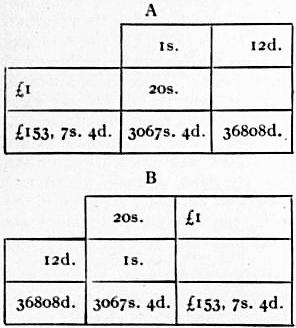
The usual statement is that to express £153, 7s. as shillings we multiply 153 by 20 and add 7. This, as already explained (§ 37), is incorrect. £153 denotes 153 units, each of which is £1 or 20s.; and therefore we must multiply 20s. by 153 and add 7s., i.e. multiply 20 by 153 (the unit being now 1s.) and add 7. This is the expression of the process on the grouping method. On the counting method we have a scale with every 20th shilling marked as a £; there are 153 of these 20’s, and 7 over.
The simplest case, in which the quantity can be expressed as an integral number of the largest units involved, has already been considered (§§ 37, 42). The same method can be applied in other cases by regarding a quantity expressed in several denominations as a fractional number of units of the largest denomination mentioned; thus 7s. 4d. is to be taken as meaning 74⁄12s., but £0, 7s. 4d. as £0[(74⁄12) / 20] (§ 17). The reduction of £153, 7s. 4d. to pence, and of 36808d. to £, s. d., on this principle, is shown in diagrams A and B above.
For reduction of pounds to shillings, or shillings to pounds, we must consider that we have a multiple-table (§ 36) in which the multiples of £1 and of 20s. are arranged in parallel columns; and similarly for shillings and pence.
90. Change of Unit.—The statement “£153 = 3060s.” is not a statement of equality of the same kind as the statement “153 × 20 = 3060,” but only a statement of equivalence for certain purposes; in other words, it does not convey an absolute truth. It is therefore of interest to see whether we cannot replace it by an absolute truth.
To do this, consider what the ordinary processes of multiplication and division mean in reference to concrete objects. If we want to give, to 5 boys, 4 apples each, we are said to multiply 4 apples by 5. We cannot multiply 4 apples by 5 boys, for then we should get 20 “boy-apples,” an expression which has no meaning. Or, again, to distribute 20 apples amongst 5 boys, we are not regarded as dividing 20 apples by 5 boys, but as dividing 20 apples by the number 5. The multiplication or division here involves the omission of the unit “boy,” and the operation is incomplete. The complete operation, in each case, is as follows.
(i) In the case of multiplication we commence with the conception of the number “5” and the unit “boy”; and we then convert this unit into 4 apples, and thus obtain the result, 20 apples. The conversion of the unit may be represented as multiplication by a factor (4 apples)/(1 boy), so that the operation is (4 apples)/(1 boy) × (5 boys) = 5 × (4 apples)/(1 boy) × (1 boy) = 5 × 4 apples = 20 apples. Similarly, to convert £153 into shillings we must multiply it by a factor 20s./£1, so that we get
20s. × £153 = 153 × 20s. × £1 = 153 × 20s. = 3060s.
£1 £1
Hence we can only regard £153 as being equal to 3060s. if we regard this converting factor as unity.
(ii) In the case of partition we can express the complete operation if we extend the meaning of division so as to enable us to divide 20 apples by 5 boys. We thus get (20 apples)/(5 boys) = (4 apples)/(1 boy), which means that the distribution can be effected by distributing at the rate of 4 apples per boy. The converting factor mentioned under (i) therefore represents a rate; and partition, applied to concrete cases, leads to a rate.
In reference to the use of the sign × with the converting factor, it should be observed that “(7 ℔)/(4 ℔) ×” symbolizes the replacing of so many times 4 ℔ by the same number of times 7 ℔, while “7⁄4 ×” symbolizes the replacing of 4 times something by 7 times that something.
X. Arithmetical Reasoning
91. Correspondence of Series of Numbers.—In §§ 33-42 we have dealt with the parallelism of the original number-series with a series consisting of the corresponding multiples of some unit, whether a number or a numerical quantity; and the relations arising out of multiplication, division, &c., have been exhibited by diagrams comprising pairs of corresponding terms of the two series. This, however, is only a particular case of the correspondence of two series. In considering addition, for instance, we have introduced two parallel series, each being the original number-series, but the two being placed in different positions. If we add 1, 2, 3, ... to 6, we obtain a series 7, 8, 9, ..., the terms of which correspond with those of the original series 1, 2, 3,...
Again, in §§ 61-75 and 84-88 we have considered various kinds of numbers other than those in the original number-series. In general, these have involved two of the original numbers, e.g. 53 involves 5 and 3, and log2 8 involves 2 and 8. In some cases, however, e.g. in the case of negative numbers and reciprocals, only one is involved; and there might be three or more, as in the case of a number expressed by (a + b)n. If all but one of these constituent elements are settled beforehand, e.g. if we take the numbers 5, 52, 53, ..., or the numbers 3√1, 3√2, 3√3, ... or log10 1.001, log10 1.002, log10 1.003 ... we obtain a series in which each term corresponds with a term of the original number-series.
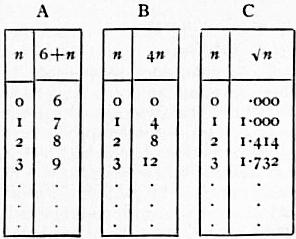
This correspondence is usually shown by tabulation, i.e. by the formation of a table in which the original series is shown in one column, and each term of the second series is placed in a second column opposite the corresponding term of the first series, each column being headed by a description of its contents. It is sometimes convenient to begin the first series with 0, and even to give the series of negative numbers; in most cases, however, these latter are regarded as belonging to a different series, and they need not be considered here. The diagrams, A, B, C are simple forms of tables; A giving a sum-series, B a multiple-series, and C a series of square roots, calculated approximately.
92. Correspondence of Numerical Quantities.—Again, in § 89, we have considered cases of multiple-tables of numerical quantities, where each quantity in one series is equivalent to the corresponding quantity in the other series. We might extend this principle to cases in which the terms of two series, whether of numbers or of numerical quantities, merely correspond with each other, the correspondence being the result of some relation. The volume of a cube, for instance, bears a certain relation to the length of an edge of the cube. This relation is not one of proportion; but it may nevertheless be expressed by tabulation, as shown at D.
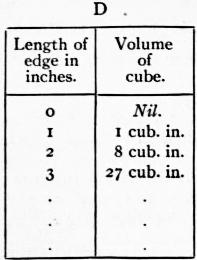
93. Interpolation.—In most cases the quantity in the second column may be regarded as increasing or decreasing continuously as the number in the first column increases, and it has intermediate values corresponding to intermediate (i.e. fractional or decimal) numbers not shown in the table. The table in such cases is not, and cannot be, complete, even up to the number to which it goes. For instance, a cube whose edge is 1½ in. has a definite volume, viz. 33⁄8 cub. in. The determination of any such intermediate value is performed by Interpolation (q.v.).
In treating a fractional number, or the corresponding value of the quantity in the second column, as intermediate, we are in effect regarding the numbers 1, 2, 3, ..., and the corresponding numbers in the second column, as denoting points between which other numbers lie, i.e. we are regarding the numbers as ordinal, not cardinal. The transition is similar to that which arises in the case of geometrical measurement (§ 26), and it is an essential feature of all reasoning with regard to continuous quantity, such as we have to deal with in real life.
94. Nature of Arithmetical Reasoning.—The simplest form of arithmetical reasoning consists in the determination of the term in one series corresponding to a given term in another series, when the relation between the two series is given; and it implies, though it does not necessarily involve, the establishment of each series as a whole by determination of its unit. A method involving the determination of the unit is called a unitary method. When the unit is not determined, the reasoning is algebraical rather than arithmetical. If, for instance, three terms of a proportion are given, the fourth can be obtained by the relation given at the end of § 57, this relation being then called the Rule of Three; but this is equivalent to the use of an algebraical formula.
More complicated forms of arithmetical reasoning involve the use of series, each term in which corresponds to particular terms in two or more series jointly; and cases of this kind are usually dealt with by special methods, or by means of algebraical formulae. The old-fashioned problems about the amount of work done by particular numbers of men, women and boys, are of this kind, and really involve the solution of simultaneous equations. They are not suitable for elementary purposes, as the arithmetical relations involved are complicated and difficult to grasp.
XI. Methods of Calculation
(i.) Exact Calculation.
95. Working from Left.—It is desirable, wherever possible, to perform operations on numbers or numerical quantities from the left, rather than from the right. There are several reasons for this. In the first place, an operation then corresponds more closely, at an elementary stage, with the concrete process which it represents. If, for instance, we had one sum of £3, 15s. 9d. and another of £2, 6s. 5d., we should add them by putting the coins of each denomination together and commencing the addition with the £. In the second place, this method fixes the attention at once on the larger, and therefore more important, parts of the quantities concerned, and thus prevents arithmetical processes from becoming too abstract in character. In the third place, it is a better preparation for dealing with approximate calculations. Finally, experience shows that certain operations in which the result is written down at once—e.g. addition or subtraction of two numbers or quantities, and multiplication by some small numbers—are with a little practice performed more quickly and more accurately from left to right.
96. Addition.—There is no difference in principle between addition (or subtraction) of numbers and addition (or subtraction) of numerical quantities. In each case the grouping system involves rearrangement, which implies the commutative law, while the counting system requires the expression of a quantity in different denominations to be regarded as a notation in a varying scale (§§ 17, 32). We need therefore consider numerical quantities only, our results being applicable to numbers by regarding the digits as representing multiples of units in different denominations.
When the result of addition in one denomination can be partly expressed in another denomination, the process is technically called carrying. The name is a bad one, since it does not correspond with any ordinary meaning of the verb. It would be better described as exchanging, by analogy with the “changing” of subtraction. When, e.g., we find that the sum of 17s. and 18s. is 35s., we take out 20 of the 35 shillings, and exchange them for £1.
To add from the left, we have to look ahead to see whether the next addition will require an exchange. Thus, in adding £3, 17s. 0d. to £2, 18s. 0d., we write down the sum of £3 and £2 as £6, not as £5, and the sum of 17s. and 18s. as 15s., not as 35s.
When three or more numbers or quantities are added together, the result should always be checked by adding both upwards and downwards. It is also useful to look out for pairs of numbers or quantities which make 1 of the next denomination, e.g. 7 and 3, or 8d. and 4d.
97. Subtraction.—To subtract £3, 5s. 4d. from £9, 7s. 8d., on the grouping system, we split up each quantity into its denominations, perform the subtractions independently, and then regroup the results as the “remainder” £6, 2s. 4d. On the counting system we can count either forwards or backwards, and we can work either from the left or from the right. If we count forwards we find that to convert £3, 5s. 4d. into £9, 7s. 8d. we must successively add £6, 2s. and 4d. if we work from the left, or 4d., 2s. and £6 if we work from the right. The intermediate values obtained by the successive additions are different according as we work from the left or from the right, being £9, 5s. 4d. and £9, 7s. 4d. in the one case, and £3, 5s. 8d. and £3, 7s. 8d. in the other. If we count backwards, the intermediate values are £3, 7s. 8d. and £3, 5s. 8d. in the one case, and £9, 7s. 4d. and £9, 5s. 4d. in the other.
The determination of each element in the remainder involves reference to an addition-table. Thus to subtract 5s. from 7s. we refer to an addition-table giving the sum of any two quantities, each of which is one of the series 0s., 1s., ... 19s.
Subtraction by counting forward is called complementary addition.
To subtract £3, 5s. 8d. from £9, 10s. 4d., on the grouping system, we must change 1s. out of the 10s. into 12d., so that we subtract £3, 5s. 8d. from £9, 9s. 16d. On the counting system it will be found that, in determining the number of shillings in the remainder, we subtract 5s. from 9s. if we count forwards, working from the left, or backwards, working from the right; while, if we count backwards, working from the left, or forwards, working from the right, the subtraction is of 6s. from 10s. In the first two cases the successive values (in direct or reverse order) are £3, 5s. 8d., £9, 5s. 8d., £9, 9s. 8d. and £9, 10s. 4d.; while in the last two cases they are £9, 10s. 4d., £3, 10s. 4d., £3, 6s. 4d. and £3, 5s. 8d.
In subtracting from the left, we look ahead to see whether a 1 in any denomination must be reserved for changing; thus in subtracting 274 from 637 we should put down 2 from 6 as 3, not as 4, and 7 from 3 as 6.
98. Multiplication-Table.—For multiplication and division we use a multiplication-table, which is a multiple-table, arranged as explained in § 36, and giving the successive multiples, up to 9 times or further, of the numbers from 1 (or better, from 0) to 10, 12 or 20. The column (vertical) headed 3 will give the multiples of 3, while the row (horizontal) commencing with 3 will give the values of 3 × 1, 3 × 2, ... To multiply by 3 we use the row. To divide by 3, in the sense of partition, we also use the row; but to divide by 3 as a unit we use the column.
99. Multiplication by a Small Number.—The idea of a large multiple of a small number is simpler than that of a small multiple of a large number, but the calculation of the latter is easier. It is therefore convenient, in finding the product of two numbers, to take the smaller as the multiplier.
To find 3 times 427, we apply the distributive law (§ 58 (vi)) that 3·427 = 3(400 + 20 + 7) = 3·400 + 3·20 + 3·7. This, if we regard 3·427 as 427 + 427 + 427, is a direct consequence of the commutative law for addition (§ 58 (iii)), which enables us to add separately the hundreds, the tens and the ones. To find 3·400, we treat 100 as the unit (as in addition), so that 3·400 = 3·4·100 = 12·100 = 1200; and similarly for 3·20. These are examples of the associative law for multiplication (§ 58 (iv)).
100. Special Cases.—The following are some special rules:—
(i) To multiply by 5, multiply by 10 and divide by 2. (And conversely, to divide by 5, we multiply by 2 and divide by 10.)
(ii) In multiplying by 2, from the left, add 1 if the next figure of the multiplicand is 5, 6, 7, 8 or 9.
(iii) In multiplying by 3, from the left, add 1 when the next figures are not less than 33 ... 334 and not greater than 66 ... 666, and 2 when they are 66 ... 667 and upwards.
(iv) To multiply by 7, 8, 9, 11 or 12, treat the multiplier as 10 − 3, 10 − 2, 10 − 1, 10 + 1 or 10 + 2; and similarly for 13, 17, 18, 19, &c.
(v) To multiply by 4 or 6, we can either multiply from the left by 2 and then by 2 or 3, or multiply from the right by 4 or 6; or we can treat the multiplier as 5 − 1 or 5 + 1.
101. Multiplication by a Large Number.—When both the numbers are large, we split up one of them, preferably the multiplier, into separate portions. Thus 231·4273 = (200 + 30 + 1)·4273 = 200·4273 + 30·4273 + 1·4273. This gives the partial products, the sum of which is the complete products. The process is shown fully in A below,—
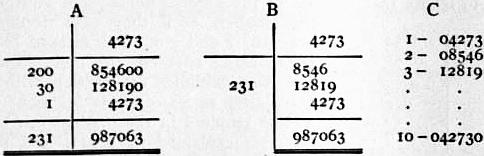
and more concisely in B. To multiply 4273 by 200, we use the commutative law, which gives 200·4273 = 2 × 100 × 4273 = 2 × 4273 × 100 = 8546 × 100 = 854600; and similarly for 30·4273. In B the terminal 0’s of the partial products are omitted. It is usually convenient to make out a preliminary table of multiples up to 10 times; the table being checked at 5 times (§ 100) and at 10 times.
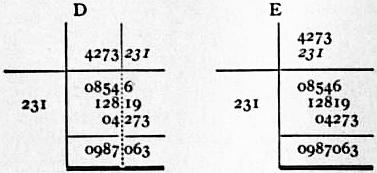
The main difficulty is in the correct placing of the curtailed partial products. The first step is to regard the product of two numbers as containing as many digits as the two numbers put together. The table of multiples will them be as in C. The next step is to arrange the multiplier and the multiplicand above the partial products. For elementary work the multiplicand may come immediately after the multiplier, as in D; the last figure of each partial product then comes immediately under the corresponding figure of the multiplier. A better method, which leads up to the multiplication of decimals and of approximate values of numbers, is to place the first figure of the multipler under the first figure of the multiplicand, as in E; the first figure of each partial product will then come under the corresponding figure of the multiplier.
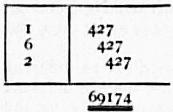
102. Contracted Multiplication.—The partial products are sometimes omitted; the process saves time in writing, but is not easy. The principle is that, e.g. (a·102 + b·10 + c)(p·102 + q10 + r) = ap·104 + (aq + bp)·103 + (ar + bq + cp)·102 + (br + cq)·10 + cr. Hence the digits are multiplied in pairs, and grouped according to the power of 10 which each product contains. A method of performing the process is shown here for the case of 162·427. The principle is that 162·427 = 100·427 + 60·427 + 2·427 = 1·42700 + 6·4270 + 2·427; but, instead of writing down the separate products, we (in effect) write 42700, 4270, and 427 in separate rows, with the multipliers 1, 6, 2 in the margin, and then multiply each number in each column by the corresponding multiplier in the margin, making allowance for any figures to be “carried.” Thus the second figure (from the right) is given by 1 + 2·2 + 6·7 = 47, the 1 being carried.
103. Aliquot Parts.—For multiplication by a proper fraction or a decimal, it is sometimes convenient, especially when we are dealing with mixed quantities, to convert the multiplier into the sum or difference of a number of fractions, each of which has 1 as its numerator. Such fractions are called aliquot parts (from Lat. aliquot, some, several). This can usually be done in a good many ways. Thus 5⁄6 = 1 − 1⁄6, and also = ½ + 1⁄3; and 15% = .15 = 1⁄10 + 1⁄20 = 1⁄6 − 1⁄60 = 1⁄8 + 1⁄40. The fractions should generally be chosen so that each part of the product may be obtained from an earlier part by a comparatively simple division. Thus ½ + 1⁄20 − 1⁄60 is a simpler expression for 8⁄15 than ½ + 1⁄30.
The process may sometimes by applied two or three times in succession; thus 8⁄15 = 4⁄5·2⁄3 = (1 − 1⁄5)(1 − 1⁄3), and 33⁄40 = ¾·11⁄10 = (1 − ¼)(1 + 1⁄10).
104. Practice.—The above is a particular case of the method called practice, but the nomenclature of the method is confusing. There are two kinds of practice, simple practice and compound practice, but the latter is the simpler of the two. To find the cost of 2 ℔ 8 oz. of butter at 1s. 2d. a ℔, we multiply 1s. 2d. by 28⁄16 = 2½. This straightforward process is called “compound” practice. “Simple” practice involves an application of the commutative law. To find the cost of n articles at £a, bs, cd. each, we express £a, bs, cd. in the form £(a + f), where f is a fraction (or the sum of several fractions); we then say that the cost, being n × £(a + f), is equal to (a + f) × £n, and apply the method of compound practice, i.e. the method of aliquot parts.
105. Multiplication of a Mixed Number.—When a mixed quantity or a mixed number has to be multiplied by a large number, it is sometimes convenient to express the former in terms of one only of its denominations. Thus, to multiply £7, 13s. 6d. by 469, we may express the former in any of the ways £7.675, 307⁄40 of £1, 153½s., 153.5s., 307 sixpences, or 1842 pence. Expression in £ and decimals of £1 is usually recommended, but it depends on circumstances whether some other method may not be simpler.
A sum of money cannot be expressed exactly as a decimal of £1 unless it is a multiple of ¾d. A rule for approximate conversion is that 1s. = .05 of £1, and that 2½d.= .01 of £1. For accurate conversion we write .1£ for each 2s., and .001£ for each farthing beyond 2s., their number being first increased by one twenty-fourth.
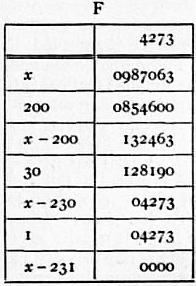
106. Division. Of the two kinds of division, although the idea of partition is perhaps the more elementary, the process of measuring is the easier to perform, since it is equivalent to a series of subtractions. Starting from the dividend, we in theory keep on subtracting the unit, and count the number of subtractions that have to be performed until nothing is left. In actual practice, of course, we subtract large multiples at a time. Thus, to divide 987063 by 427, we reverse the procedure of § 101, but with intermediate stages. We first construct the multiple-table C, and then subtract successively 200 times, 30 times and 1 times; these numbers being the partial quotients. The theory of the process is shown fully in F. Treating x as the unknown quotient corresponding to the original dividend, we obtain successive dividends corresponding to quotients x − 200, x − 230 and x − 231. The original dividend is written as 0987063, since its initial figures are greater than those of the divisor; if the dividend had commenced with (e.g.) 3 ... it would not have been necessary to insert the initial 0. At each stage of the division the number of digits in the reduced dividend is decreased by one. The final dividend being 0000, we have x − 231 = 0, and therefore x = 231.
107. Methods of Division.—What are described as different methods of division (by a single divisor) are mainly different methods of writing the successive figures occurring in the process. In long division the divisor is put on the left of the dividend, and the quotient on the right; and each partial product, with the remainder after its subtraction, is shown in full. In short division the divisor and the quotient are placed respectively on the left of and below the dividend, and the partial products and remainders are not shown at all. The Austrian method (sometimes called in Great Britain the Italian method) differs from these in two respects. The first, and most important, is that the quotient is placed above the dividend. The second, which is not essential to the method, is that the remainders are shown, but not the partial products; the remainders being obtained by working from the right, and using complementary addition. It is doubtful whether the brevity of this latter process really compensates for its greater difficulty.
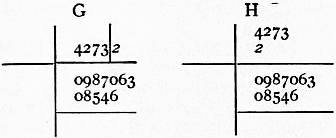
The advantage of the Austrian arrangement of the quotient lies in the indication it gives of the true value of each partial quotient. A modification of the method, corresponding with D of § 101, is shown in G; the fact that the partial product 08546 is followed by two blank spaces shows that the figure 2 represents a partial quotient 200. An alternative arrangement, corresponding to E of § 101, and suited for more advanced work, is shown in H.
108. Division with Remainder.—It has so far been assumed that the division can be performed exactly, i.e. without leaving an ultimate remainder. Where this is not the case, difficulties are apt to arise, which are mainly due to failure to distinguish between the two kinds of division. If we say that the division of 41d. by 12 gives quotient 3d. with remainder 5d., we are speaking loosely; for in fact we only distribute 36d. out of the 41d., the other 5d. remaining undistributed. It can only be distributed by a subdivision of the unit; i.e. the true result of the division is 35⁄12d. On the other hand, we can quite well express the result of dividing 41d. by 1s (= 12d.) as 3 with 5d. (not “5”) over, for this is only stating that 41d. = 3s. 5d.; though the result might be more exactly expressed as 35⁄12s.
Division with a remainder has thus a certain air of unreality, which is accentuated when the division is performed by means of factors (§ 42). If we have to divide 935 by 240, taking 12 and 20 as factors, the result will depend on the fact that, in the notation of § 17, In incomplete partition the quotient is 3, and the remainders 11 and 17 are in effect disregarded; if, after finding the quotient 3, we want to know what remainder would be produced by a direct division, the simplest method is to multiply 3 by 240 and subtract the result from 935. In complete partition the successive quotients are 7711⁄12 and 3[(1711⁄12)/20] = 3215⁄240. Division in the sense of measuring leads to such a result as 935d. = £3, 17s. 11d.; we may, if we please, express the 17s. 11d. as 215d., but there is no particular reason why we should do so.
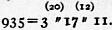
109. Division by a Mixed Number.—To divide by a mixed number, when the quotient is seen to be large, it usually saves time to express the divisor as either a simple fraction or a decimal of a unit of one of the denominations. Exact division by a mixed number is not often required in real life; where approximate division is required (e.g. in determining the rate of a “dividend”), approximate expression of the divisor in terms of the largest unit is sufficient.
110. Calculation of Square Root.—The calculation of the square root of a number depends on the formula (iii) of § 60. To find the square root of N, we first find some number a whose square is less than N, and subtract a2 from N. If the complete square root is a + b, the remainder after subtracting a2 is (2a + b)b. We therefore guess b by dividing the remainder by 2a, and form the product (2a + b)b. If this is equal to the remainder, we have found the square root. If it exceeds the square root, we must alter the value of b, so as to get a product which does not exceed the remainder. If the product is less than the remainder, we get a new remainder, which is N − (a + b)2; we then assume the full square root to be c, so that the new remainder is equal to (2a + 2b + c)c, and try to find c in the same way as we tried to find b.
An analogous method of finding cube root, based on the formula for (a + b)3, used to be given in text-books, but it is of no practical use. To find a root other than a square root we can use logarithms, as explained in § 113.
(ii.) Approximate Calculation.
111. Multiplication.—When we have to multiply two numbers, and the product is only required, or can only be approximately correct, to a certain number of significant figures, we need only work to two or three more figures (§ 83), and then correct the final figure in the result by means of the superfluous figures.
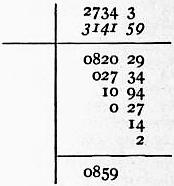
A common method is to reverse the digits in one of the numbers; but this is only appropriate to the old-fashioned method of writing down products from the right. A better method is to ignore the positions of the decimal points, and multiply the numbers as if they were decimals between .1 and 1.0. The method E of § 101 being adopted, the multiplicand and the multiplier are written with a space after as many digits (of each) as will be required in the product (on the principle explained in § 101); and the multiplication is performed from the left, two extra figures being kept in. Thus, to multiply 27.343 by 3.1415927 to one decimal place, we require 2 + 1 + 1 = 4 figures in the product. The result is 085.9 = 85.9, the position of the decimal point being determined by counting the figures before the decimal points in the original numbers.
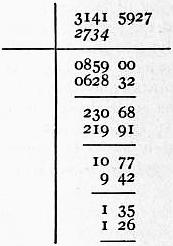
112. Division.—In the same way, in performing approximate division, we can at a certain stage begin to abbreviate the divisor, taking off one figure (but with correction of the final figure of the partial product) at each stage. Thus, to divide 85.9 by 3.1415927 to two places of decimals, we in effect divide .0859 by .31415927 to four places of decimals. In the work, as here shown, a 0 is inserted in front of the 859, on the principle explained in § 106. The result of the division is 27.34.
113. Logarithms.—Multiplication, division, involution and evolution, when the results cannot be exact, are usually most simply performed, at any rate to a first approximation, by means of a table of logarithms. Thus, to find the square root of 2, we have log √2 = log (21/2) = ½ log 2. We take out log 2 from the table, halve it, and then find from the table the number of which this is the logarithm. (See Logarithm.) The slide-rule (see Calculating Machines) is a simple apparatus for the mechanical application of the methods of logarithms.
When a first approximation has been obtained in this way, further approximations can be obtained in various ways. Thus, having found √2 = 1.414 approximately, we write √2 = 1.414 + θ, whence 2 = (1.414)2 + (2.818)θ + θ2. Since θ2 is less than ¼ of (.001)2, we can obtain three more figures approximately by dividing 2 − (1.414)2 by 2.818.
114. Binomial Theorem.—More generally, if we have obtained a as an approximate value for the pth root of N, the binomial theorem gives as an approximate formula p√N = a + θ, where N = ap + pap − 1θ.
115. Series.—A number can often be expressed by a series of terms, such that by taking successive terms we obtain successively closer approximations. A decimal is of course a series of this kind, e.g. 3.14159 ... means 3 + 1/10 + 4/102 + 1/103 + 5/104 + 9/105 + ... A series of aliquot parts is another kind, e.g. 3.1416 is a little less than 3 + 1⁄7 − 1⁄800.
Recurring Decimals are a particular kind of series, which arise from the expression of a fraction as a decimal. If the denominator of the fraction, when it is in its lowest terms, contains any other prime factors than 2 and 5, it cannot be expressed exactly as a decimal; but after a certain point a definite series of figures will constantly recur. The interest of these series is, however, mainly theoretical.
116. Continued Products.—Instead of being expressed as the sum of a series of terms, a number may be expressed as the product of a series of factors, which become successively more and more nearly equal to 1. For example,
3.1416 = 3 × 10472⁄10000 = 3 × 1309⁄1250 = 3 × 22⁄21 × 2499⁄2500 = 3(1 + 1⁄21)(1 − 1⁄2500).
Hence, to multiply by 3.1416, we can multiply by 31⁄7, and subtract 1⁄2500 (= .0004) of the result; or, to divide by 3.1416, we can divide by 3, then subtract 1⁄22 of the result, and then add 1⁄2499 of the new result.
117. Continued Fractions.—The theory of continued fractions (q.v.) gives a method of expressing a number, in certain cases, as a continued product. A continued fraction, of the kind we are considering, is an expression of the form where b, c, d, ... are integers, and a is an integer or zero. The expression is usually written, for compactness, a + 1/b+ 1/c+ 1/d+ &c. The numbers a, b, c, d, ... are called the quotients.
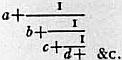
Any exact fraction can be expressed as a continued fraction, and there are methods for expressing as continued fractions certain other numbers, e.g. square roots, whose values cannot be expressed exactly as fractions.
The successive values, a/1, (ab + 1)/b, ..., obtained by taking account of the successive quotients, are called convergents, i.e. convergents to the true value. The following are the main properties of the convergents.
(i) If we precede the series of convergents by 0⁄1 and 1⁄0, then the numerator (or denominator) of each term of the series 0⁄1, 1⁄0, a/1, (ab + 1)/b ..., after the first two, is found by multiplying the numerator (or denominator) of the last preceding term by the corresponding quotient and adding the numerator (or denominator) of the term before that. If a is zero, we may regard 1/b as the first convergent, and precede the series by 1⁄0 and 0⁄1.
(ii) Each convergent is a fraction in its lowest terms.
(iii) The convergents are alternately less and greater than the true value.
(iv) Each convergent is nearer to the true value than any other fraction whose denominator is less than that of the convergent.
(v) The difference of two successive convergents is the reciprocal of the product of their denominators; e.g. (ab + 1)/b − a/1 = 1/(1·b), and (abc + c + a)/(bc + 1) − (ab + 1)/b = −1/b(bc + 1).
It follows from these last three properties that if the successive convergents are p1/1, p2/q2, p3/q3, ... the number can be expressed in the form p1(1 + 1/p1q2) (1 − 1/p2q3) (1 + 1/p3q4) ..., and that if we go up to the factor 1 ± 1/(pnqn + 1) the product of these factors differs from the true value of the number by less than ±{1/(qnqn + 1).
In certain cases two or more factors can be combined so as to produce an expression of the form 1 ± 1/k, where k is an integer. For instance, 3.1415927 = 3(1 + 1⁄3.7) (1 − 1⁄22.106) (1 + 1⁄333.113) ...; but the last two of these factors may be combined as (1 − 1⁄22.113). Hence 3.1415927 = 3⁄1 · 22⁄21 · 2485⁄2486 ...
XII. Applications
(i.) Systems of Measures.1
118. Metric System.—The metric system was adopted in France at the end of the 18th century. The system is decimal throughout. The principal units of length, weight and volume are the metre, gramme (or gram) and litre. Other units are derived from these by multiplication or division by powers of 10, the names being denoted by prefixes. The prefixes for multiplication by 10, 102, 103 and 104 are deca-, hecto-, kilo- and myria-, and those for division by 10, 102 and 103 are deci-, centi- and milli-; the former being derived from Greek, and the latter from Latin. Thus kilogramme means 1000 grammes, and centimetre means 1⁄100 of a metre. There are also certain special units, such as the hectare, which is equal to a square hectometre, and the micron, which is 1⁄1000 of a millimetre.
The metre and the gramme are defined by standard measures preserved at Paris. The litre is equal to a cubic decimetre. The gramme was intended to be equal to the weight of a cubic centimetre of pure water at a certain temperature, but the equality is only approximate.
The metric system is now in use in the greater part of the civilized world, but some of the measures retain the names of old disused measures. In Germany, for instance, the Pfund is ½ kilogramme, and is approximately equal to 11⁄10 ℔ English.
119. British Systems.—The British systems have various origins, and are still subject to variations caused by local usage or by the usage of particular businesses. The following tables are given as illustrations of the arrangement adopted elsewhere in this article; the entries in any column denote multiples or submultiples of the unit stated at the head of the column, and the entries in any row give the expression of one unit in term of the other units.
Length
Inch. Foot. Yard. Chain. Furlong. Mile.
1 1⁄12 1⁄36 1⁄792 1⁄7920 1⁄63360
12 1 1⁄3 1⁄66 1⁄660 1⁄5280
36 3 1 1⁄22 1⁄220 1⁄1760
792 66 22 1 1⁄10 1⁄80
7920 660 220 10 1 1⁄8
63360 5280 1760 80 8 1
Weight (Avoirdupois)
Ounce. Pound. Stone. Quarter. Hundred- weight. Ton.
1 1⁄16 1⁄224 1⁄448 1⁄1792 1⁄33840
16 1 1⁄14 1⁄28 1⁄112 1⁄2240
224 14 1 ½ 1⁄8 1⁄160
448 28 2 1 ¼ 1⁄80
1792 112 8 4 1 1⁄20
33840 2240 160 80 20 1
(Also 7000 grains = 1 ℔ avoirdupois.)
120. Change of System.—It is sometimes necessary, when a quantity is expressed in one system, to express it in another, The following are the ratios of some of the units; each unit is expressed approximately as a decimal of the other, and their ratio is shown as a continued product (§ 116), a few of the corresponding convergents to the continued fraction (§ 117) being added in brackets. It must be remembered that the number expressing any quantity in terms of a unit is inversely proportional to the magnitude of the unit, i.e. the number of new units is to be found by multiplying the number of old units by the ratio of the old unit to the new unit.
Yard = 9144⁄10000 = 10000⁄10935 = 22⁄12· 884⁄385· 8225⁄8224 ... (11⁄32, 32⁄35 = 8⁄7· 4⁄5, 235⁄257).
Metre
Inch = 25400⁄10000 = 10000⁄3937 = 2⁄5· 66⁄65· 1651⁄1650 ... (5⁄2, 33⁄13, 127⁄50).
Centimetre
Mile = 16093⁄10000 = 10000⁄6214 = 8⁄5· 185⁄184· 2369⁄2368 ... (8⁄5, 37⁄23, 103⁄64).
Kilometre
Square Yard = 8361⁄10000 = 10000⁄11960 = 5⁄6· 306⁄305· 15250⁄15249 ... (5⁄6, 51⁄61, 250⁄299).
Square Metre
Acre = 4047⁄10000 = 10000⁄24711 = 2⁄5· 85⁄84· 5320⁄5321 ... (2⁄5, 17⁄42, 380⁄939).
Hectare
Quart = 11365⁄10000 = 10000⁄8799 = 8⁄7· 175⁄176· 8976⁄8975 ... (8⁄7, 25⁄22, 408⁄359).
Litre
Pound = 4536⁄10000 = 10000⁄22046 = 1⁄2· 10⁄11· 484⁄485· 29391⁄29392 ... (1⁄2, 5⁄11, 44⁄97, 303⁄668).
Kilogramme
(ii.) Special Applications.
121. Commercial Arithmetic.—This term covers practically all dealings with money which involve the application of the principle of proportion. A simple class of cases is that which deals with equivalence of sums of money in different currencies; these cases really come under § 120. In other cases we are concerned with a proportion stated as a numerical percentage, or as a money percentage (i.e. a sum of money per £100), or as a rate in the £ or the shilling. The following are some examples. Percentage: Brokerage, commission, discount, dividend, interest, investment, profit and loss. Rate in the £: Discount, dividend, rates, taxes. Rate in the shilling: Discount.
Text-books on arithmetic usually contain explanations of the chief commercial transactions in which arithmetical calculations arise; it will be sufficient in the present article to deal with interest and discount, and to give some notes on percentages and rates in the £. Insurance and Annuities are matters of general importance, which are dealt with elsewhere under their own headings.
122. Percentages and Rates in the £.—In dealing with percentages and rates it is important to notice whether the sum which is expressed as a percentage of a rate on another sum is a part of or an addition to that sum, or whether they are independent of one another. Income tax, for instance, is calculated on income, and is in the nature of a deduction from the income; but local rates are calculated in proportion to certain other payments, actual or potential, and could without absurdity exceed 20s. in the £.
It is also important to note that if the increase or decrease of an amount A by a certain percentage produces B, it will require a different percentage to decrease or increase B to A. Thus, if B is 20% less than A, A is 25% greater than B.
123. Interest is usually calculated yearly or half-yearly, at a certain rate per cent. on the principal. In legal documents the rate is sometimes expressed as a certain sum of money “per centum per annum”; here “centum” must be taken to mean “£100.”
Simple interest arises where unpaid interest accumulates as a debt not itself bearing interest; but, if this debt bears interest, the total, i.e. interest and interest on interest, is called compound interest. If 100r is the rate per cent. per annum, the simple interest on £A for n years is £nrA, and the compound interest (supposing interest payable yearly) is £[(1 + r)n − 1]A. If n is large, the compound interest is most easily calculated by means of logarithms.
124. Discount is of various kinds. Tradesmen allow discount for ready money, this being usually at so much in the shilling or £. Discount may be allowed twice in succession off quoted prices; in such cases the second discount is off the reduced price, and therefore it is not correct to add the two rates of discount together. Thus a discount of 20%, followed by a further discount of 25%, gives a total discount of 40%, not 45%, off the original amount. When an amount will fall due at some future date, the present value of the debt is found by deducting discount at some rate per cent. for the intervening period, in the same way as interest to be added is calculated. This discount, of course, is not equal to the interest which the present value would produce at that rate of interest, but is rather greater, so that the present value as calculated in this way is less than the theoretical present value.
125. Applications to Physics are numerous, but are usually only of special interest. A case of general interest is the measurement of temperature. The graduation of a thermometer is determined by the freezing-point and the boiling-point of water, the interval between these being divided into a certain number of degrees, representing equal increases of temperature. On the Fahrenheit scale the points are respectively 32° and 212°; on the Centigrade scale they are 0° and 100°; and on the Réaumur they are 0° and 80°. From these data a temperature as measured on one scale can be expressed on either of the other two scales.
126. Averages occur in statistics, economics, &c. An average is found by adding together several measurements of the same kind and dividing by the number of measurements. In calculating an average it should be observed that the addition of any numerical quantity (positive or negative) to each of the measurements produces the addition of the same quantity to the average, so that the calculation may often be simplified by taking some particular measurement as a new zero from which to measure.
Authorities.—For the history of the subject, see W.W.R. Ball, Short History of Mathematics (1901), and F. Cajori, History of Elementary Mathematics (1896); or more detailed information in M. Cantor, Vorlesungen über Geschichte der Mathematik (1894-1901). L.C. Conant, The Number-Concept (1896), gives a very full account of systems of numeration. For the latter, and for systems of notation, reference may also be made to Peacock’s article “Arithmetic” in the Encyclopaedia Metropolitana, which contains a detailed account of the Greek system. F. Galton, Inquiries into Human Faculty (1883), contains the first account of number-forms; for further examples and references see D.E. Phillips, “Genesis of Number-Forms,” American Journal of Psychology, vol. viii. (1897). There are very few works dealing adequately but simply with the principles of arithmetic. Homersham Cox, Principles of Arithmetic (1885), is brief and lucid, but is out of print. The Psychology of Number, by J.A. McLellan and J. Dewey (1895), contains valuable suggestions (some of which have been utilized in the present article), but it deals only with number as the measure of quantity, and requires to be read critically. This work contains references to Grube’s system, which has been much discussed in America: for a brief explanation, see L. Seeley, The Grube Method of Teaching Arithmetic (1890). On the teaching of arithmetic, and of elementary mathematics generally, see J.W.A. Young, The Teaching of Mathematics in the Elementary and the Secondary School (1907); D.E. Smith, The Teaching of Elementary Mathematics (1900), also contains an interesting general sketch; W.P. Turnbull, The Teaching of Arithmetic (1903), is more elaborate. E.M. Langley, A Treatise on Computation (1895), has notes on approximate and abbreviated calculation. Text-books on arithmetic in general and on particular applications are numerous, and any list would soon be out of date. Recent English works have been influenced by the brief Report on the Teaching of Elementary Mathematics, issued by the Mathematical Association (1905); but this is critical rather than constructive. The Association has also issued a Report on the Teaching of Mathematics in Preparatory Schools (1907). In the United States of America the Report of the Committee of Ten on secondary school studies (1893) and the Report of the Committee of Fifteen on elementary education (1893-1894), both issued by the United States Bureau of Education, have attracted a good deal of attention. Sir O. Lodge, Easy Mathematics, chiefly Arithmetic (1905), treats the subject broadly in its practical aspects. The student who is interested in elementary teaching should consult the annual bibliographies in the Pedagogical Seminary; an article by D.E. Phillips in vol. v. (October 1897) contains references to works dealing with the psychological aspect of number. For an account of German methods, see W. King, Report on Teaching of Arithmetic and Mathematics in the Higher Schools of Germany (1903).
(W. F. Sh.)
1 See also Weights And Measures.
ARIUS (Ἄρειος), a name celebrated in ecclesiastical history, not so much on account of the personality of its bearer as of the “Arian” controversy which he provoked. Our knowledge of Arius is scanty, and nothing certain is known of his birth or of his early training. Epiphanius of Salamis, in his well-known treatise against eighty heresies (Haer. lxix. 3), calls him a Libyan by birth, and if the statement of Sozomen, a church historian of the 5th century, is to be trusted, he was, as a member of the Alexandrian church, connected with the Meletian schism (see Meletius of Lycopolis), and on this account excommunicated by Peter of Alexandria, who had ordained him deacon. After the death of Peter (November 25, 311), he was received into communion by Peter’s successor, Achillas, elevated to the presbytery, and put in charge of one of the great city churches, Baucalis, where he continued to discharge his duties with apparent faithfulness and industry after the accession of Alexander. This bishop also held him in high repute. Theodoret (Hist. Eccl. i. 2) indeed does not hesitate to say that Arius was chagrined because Alexander, instead of himself, had been appointed to the see of Alexandria, and that the beginning of his heretical attitude is, in consequence, to be attributed to discontent and envy. But this must be rejected, for it is a common explanation of heretical movements with the early church historians, and there is no evidence for it in the original sources. However, Arius was ambitious. Epiphanius, using older documents, describes him as a man inflamed with his own opinionativeness, of a soft and smooth address, calculated to persuade and attract, especially women: “in no time he had drawn away seven hundred virgins from the church to his party.” When the controversy broke out, Arius was an old man.
The real causes of the controversy lay in differences as to dogma. Arius had received his theological education in the school of the presbyter Lucian of Antioch, a learned man, and distinguished especially as a biblical scholar. The latter was a follower of Paul of Samosata, bishop of Antioch, who had been excommunicated in 269, but his theology differed from that of his master in a fundamental point. Paul, starting with the conviction that the One God cannot appear substantially (οὐσιωδῶς) on earth, and, consequently, that he cannot have become a person in Jesus Christ, had taught that God had filled the man Jesus with his Logos (σοφία) or Power (δύναμις). Lucian, on the other hand, persisted in holding that the Logos became a person in Christ. But since he shared the above-mentioned belief of his master, nothing remained for him but to see in the Logos a second essence, created by God before the world, which came down to earth and took upon itself a human body. In this body the Logos filled the place of the intellectual or spiritual principle. Lucian’s Christ, then, was not “perfect man,” for that which constituted in him the personal element was a divine essence; nor was he “perfect God,” for the divine essence having become a person was other than the One God, and of a nature foreign to him. It is this idea which Arius took up and interpreted unintelligently. His doctrinal position is explained in his letters to his patron Eusebius, bishop of the imperial city of Nicomedia, and to Alexander of Alexandria, and in the fragments of the poem in which he set forth his dogmas, which bears the enigmatic title of “Thalia” (θάλεια), used in Homer, in the sense of “a goodly banquet,” most unjustly ridiculed by Athanasius as an imitation of the licentious style of the drinking-songs of the Egyptian Sotades (270 B.C.). From these writings it can even nowadays be seen clearly that the principal object which he had in view was firmly to establish the unity and simplicity of the eternal God. However far the Son may surpass other created beings, he remains himself a created being, to whom the Father before all time gave an existence formed out of not being (ἐξ οὐκ ὄντων); hence the name of Exoukontians sometimes given to Arius’s followers. On the other hand, Arius affirmed of the Son that he was “perfect God, only-begotten” (πλήρης θεὸς μονογενής); that through him God made the worlds (αἰῶνες, ages); that he was the product or offspring of the Father, and yet not as one among things made (γέννημα ἀλλ᾽ οὐχ ὡς ἓν τὤν γεγενημένων). In his eyes it was blasphemy when he heard that Alexander proclaimed in public that “as God is eternal, so is his Son,—when the Father, then the Son,—the Son is present in God without birth (ἀγεννήτως), ever-begotten (ἀειγενής), an unbegotten-begotten (ἀγεννητογενής).” He detected in his bishop Gnosticism, Manichaeism and Sabellianism, and was convinced that he himself was the champion of pure doctrine against heresy. He was quite unconscious that his own monotheism was hardly to be distinguished from that of the pagan philosophers, and that his Christ was a demi-god.
For years the controversy may have been fermenting in the college of presbyters at Alexandria. Sozomen relates that Alexander only interfered after being charged with remissness in leaving Arius so long to disturb the faith of the church. According to the general supposition, the negotiations which led to the excommunication of Arius and his followers among the presbyters and deacons took place in 318 or 319, but there are good reasons for assigning the outbreak of the controversy to the time following the overthrow of Licinius by Constantine, i.e. to the year 323. In any case, from this time events followed one another to a speedy conclusion. Arius was not without adherents, even outside Alexandria. Those bishops who, like him, had passed through the school of Lucian were not inclined to let him fall without a struggle, as they recognized in the views of their fellow-student their own doctrine, only set forth in a somewhat radical fashion. In addressing to Eusebius of Nicomedia a request for his help, Arius ended with the words: “Be mindful of our adversity, thou faithful comrade of Lucian’s school (συλλουκιανιστής)”; and Eusebius entered the lists energetically on his behalf. But Alexander too was active; by means of a circular letter he published abroad the excommunication of his presbyter, and the controversy excited more and more general interest.
It reached even the ears of Constantine. Now sole emperor, he saw in the one Catholic church the best means of counteracting the movement in his vast empire towards disintegration; and he at once realized how dangerous dogmatic squabbles might prove to its unity. His letter, preserved by the imperial biographer, Eusebius of Caesarea, is a state document inspired by a wisely conciliatory policy; it made out both parties to be equally in the right and in the wrong, at the same time giving them both to understand that such questions, the meaning of which would be grasped only by the few, had better not be brought into public discussion; it was advisable to come to an agreement where the difference of opinion was not fundamental. This well-meaning attempt at reconciliation, betraying as it did no very deep understanding of the question, came to nothing. No course was left for the emperor except to obtain a general decision. This took, place at the fist oecumenical council, which was convened in Nicaea (q.v.) in 325. After various turns in the controversy, it was finally decided, against Arius, that the Son was “of the same substance” (ὁμοούσιος) with the Father, and all thought of his being created or even subordinate had to be excluded. Constantine accepted the decision of the council and resolved to uphold it. Arius and the two bishops of Marmarica Ptolemais, who refused to subscribe the creed, were excommunicated and banished to Illyria, and even Eusebius of Nicomedia, who accepted the creed, but not its anathemas, was exiled to Gaul. Alexander returned to his see triumphant, but died soon after, and was succeeded by Athanasius (q.v.), his deacon, with whose indomitable fortitude and strange vicissitudes the further course of the controversy is bound up.
It only remains for us here to sketch what is known of the future career of Arius and the Arians. Although defeated at the council of Nicaea, the Arians were by no means subdued. Constantine, while strongly disposed at first to enforce the Nicene decrees, was gradually won to a more conciliatory policy by the influence especially of Eusebius of Caesarea and Eusebius of Nicomedia, the latter of whom returned from exile in 328 and won the ear of the emperor, whom he baptized on his death-bed. In 330 even Arius was recalled from banishment. Athanasius, on the other hand, was banished to Trèves in 335. During his absence Arius returned to Alexandria, but even now the people are said to have raised a fierce riot against the heretic. In 336 the emperor was forced to summon him to Constantinople. Bishop Alexander reluctantly assented to receive him once more into the bosom of the church, but before the act of admission was completed, Arius was suddenly taken ill while walking in the streets, and died in a few moments. His death seems to have exercised no influence worth speaking of on the course of events. His theological radicalism had in any case never found many convinced adherents. It was mainly the opposition to the Homoousios, as a formula open to heretical misinterpretation, and not borne out by Holy Writ, which kept together the large party known as Semiarians, who under the leadership of the two Eusebiuses carried on the strife against the Nicenes and especially Athanasius. Under the sons of Constantine Christian bishops in numberless synods cursed one another turn by turn. In the western half of the empire Arianism found no foothold, and even the despotic will of Constantius, sole emperor after 351, succeeded only for the moment in subduing the bishops exiled for the sake of their belief. In the east, on the other hand, the Semiarians had for long the upper hand. They soon split up into different groups, according as they came to stand nearer to or farther from the original position of Arius. The actual centre was formed by the Homoii, who only spoke generally of a likeness ὁμοιότης of the Son to the Father; to the left of them were the Anomoii, who, with Arius, held the Son to be unlike ἀνόμοιος the Father; to the right, the Homoiousians who, taking as their catchword “likeness of nature” ὁμοιότης κατ᾽ οὐσίαν, thought that they could preserve the religious content of the Nicene formula without having to adopt the formula itself. Since this party in the course of years came more and more into sympathy with the representatives of the Nicene party, the Homoousians, and notably with Athanasius, the much-disputed formula became more and more popular, till the council summoned in 381 at Constantinople, under the auspices of Theodosius the Great, recognized the Nicene doctrine as the only orthodox one. Arianism, which had lifted up its head again under the emperor Valens, was thereby thrust out of the state church. It lived to flourish anew among the Germanic tribes at the time of the great migrations. Goths, Vandals, Suebi, Burgundians and Langobardi embraced it; here too as a distinctive national type of Christianity it perished before the growth of medieval Catholicism, and the name of Arian ceased to represent a definite form of Christian doctrine within the church, or a definite party outside it.
The best account of the proceedings, both political and theological, may be found in the following books:—H.M. Gwatkin, Studies of Arianism (2nd edit., Cambridge, 1900); A. Harnack, History of Dogma (Eng. trans., 1894-1899); J.F. Bethune-Baker, An Introduction to the Early History of Christian Doctrine (London, 1903); W. Bright, The Age of the Fathers (London, 1903). Cardinal Newman’s celebrated Arians of the Fourth Century is interesting more from the controversial than from the historical point of view. See also Paavo Snellman, Der Anfang des arianischen Streites (Helsingfors, 1904); Sigismund Rogala, Die Anfange des arianischen Streites (Paderborn, 1907).
(G. K.)
ARIZONA (from the Spanish-Indian Arizonac, of unknown meaning,—possibly “few springs,”—the name of an 18th-century mining camp in the Santa Cruz valley, just S. of the present border of Arizona), a state on the S.W. border of the United States of America, lying between 31° 20′ and 37° N. lat. and 109° 2′ and 114° 45′ W. long. It is bounded N. by Utah, E. by New Mexico, S. by Mexico and W. by California and Nevada, the Colorado river separating it from California and in part from Nevada. On the W. is the Great Basin. Arizona itself is mostly included in the great arid mountainous uplift of the Rocky Mountain region, and partly within the desert plain region of the Gulf of California, or Open Basin region. The whole state lies on the south-western exposure of a great roof whose crest, along the continental divide in western New Mexico, pitches southward. Its altitudes vary from 12,800 ft. to less than 100 ft. above the sea. Of its total area of 113,956 sq. m. (water surface, 116 sq. m.), approximately 39,000 lie below 3000 ft., 27,000 from 3000 to 5000 ft., and 47,000 above 5000 ft.
Physical Features.—Three characteristic physiographic regions are distinctly marked: first the great Colorado Plateau, some 45,000 sq. m. in area, embracing all the region N. and E. of a line drawn from the Grand Wash Cliffs in the N.W. corner of the state to its E. border near Clifton; next a broad zone of compacted mountain ranges with a southern limit of similar trend; and lastly a region of desert plains, occupying somewhat more than the S.W. quarter of the state. The plateau region has an average elevation of 6000-8000 ft. eastward, but it is much broken down in the west. The plateau is not a plain. It is dominated by high mountains, gashed by superb canyons of rivers, scarred with dry gullies and washes, the beds of intermittent streams, varied with great shallow basins, sunken deserts, dreary levels, bold buttes, picturesque mesas, forests and rare verdant bits of valley. In the N.W. there is a giddy drop into the tremendous cut of the Grand Canyon (q.v.) of the Colorado river. The surface in general is rolling, with a gentle slope northward, and drains through the Little Colorado (or Colorado Chiquito), Rio Puerco and other streams into the Grand Canyon. Along the Colorado is the Painted Desert, remarkable for the bright colours—red, brown, blue, purple, yellow and white—of its sandstones, shales and clays. Within the desert is a petrified forest, the most remarkable in the United States. The trees are of mesozoic time, though mostly washed down to the foot of the mesas in which they were once embedded, and lying now amid deposits of a later age. Blocks and logs of agate, chalcedony, jasper, opal and other silicate deposits lie in hundreds over an area of 60 sq. m. The forest is now protected as a national reserve against vandalism and commercialism. Everywhere are evidences of water and wind erosion, of desiccation and differential weathering. This is the history of the mesas, which are the most characteristic scenic feature of the highlands. The marks of volcanic action, particularly lava-flows, are also abundant and widely scattered.
Separating the plateau from the mountain region is an abrupt transition slope, often deeply eroded, crossing the entire state as has been indicated. In localities the slope is a true escarpment falling 150 and even 250 ft. per mile. In the Aubrey Cliffs and along the Mogollon mesa, which for about 200 m. parts the waters of the Gila and the Little Colorado, it often has an elevation of 1000 to 2000 ft., and the ascent is impracticable through long distances to the most daring climber. It is not of course everywhere so remarkable, or even distinct, and especially after its trend turns southward W. of Clifton, it is much broken down and obscured by erosion and lava deposits. The mountain region has a width of 70 to 150 m., and is filled with short parallel ranges trending parallel to the plateau escarpment. Many of the mountains are extinct volcanoes. In the San Francisco mountains, in the north central part of the state, three peaks rise to from 10,000 to 12,794 ft.; three others are above 9000 ft.; all are eruptive cones, and among the lesser summits are old cinder cones. The S.E. corner of Arizona is a region of greatly eroded ranges and gentle aggraded valleys. This mountain zone has an average elevation of not less than 4000 ft., while in places its crests are 5000 ft. above the plains below. The line dividing the two regions runs roughly from Nogales on the Mexican border, past Tucson, Florence and Phoenix to Needles (California), on the W. boundary. These plains, the third or desert region of the state, have their mountains also, but they are lower, and they are not compacted; the plains near the mountain region slope toward the Gulf of California across wide valleys separated by isolated ranges, then across broad desert stretches traversed by rocky ridges, and finally there is no obstruction to the slope at all. Small parts of the desert along the Mexican boundary are shifting sand.
(Click to enlarge.)
Climate.—As may be inferred from the physical description, Arizona has a wide variety of local climates. In general it is characterized by wonderfully clear air and extraordinarily low humidity. The scanty rainfall is distributed from July to April, with marked excess from July to September and a lesser maximum in December. May and June are very dry. Often during a month, sometimes for several months, no rain falls over the greatest part of Arizona. Very little rain comes from the Pacific or the Gulf of California, the mountains and desert, as well as the adverse winds, making it impossible. Rain and snow fall usually from clouds blown from the Gulf of Mexico and not wholly dried in Texas. The mountainous areas are the only ones of adequate precipitation; the northern slope of the Colorado Plateau is almost destitute of water; the region of least precipitation is the “desert” region. The mean annual rainfall varies from amounts of 2 to 5.5 in. at various points in the lower gulf valley, and on the western border to amounts of 25 to 30 in. in the mountains. The highest recorded maximum in Arizona is 35 in. The proportion of perfectly clear days in the year varies at different points from a half to two-thirds; of the rest not more than half are without brilliant sunshine part of the day. Local thunderstorms and cloud-bursts are a characteristic phenomenon, inundating limited areas and transforming dried-up streams into muddy torrents carrying boulders and débris. Often in the plateau country the dry under-air absorbs the rain as it falls; and rarely in the Hopi Country do flooded gullies “run through” to the Little Colorado. The country of the cliff-dwellers in the N.E. is desert-like. Only points high in altitude catch much rain. Mountain snows feed the Gila, the Little Colorado, and the Colorado rivers. The Colorado, apart from the Gila, draws little water from Arizona. The mountain zone W. of Prescott drains into the Colorado, and to the S. and E. into the Gila; and the latter is by far the heavier drainage in volume. The floods come in May and June, and during the wet season the rivers, all with steep beds in their upper courses, wash along detritus that lower down narrows, and on smaller streams almost chokes, their courses. These gradients enable the inconstant streams tributary to the Colorado to carve their canyons, some of which are in themselves very remarkable, though insignificant beside the Grand Canyon. Many streams that are turned in spring or by summer cloud-bursts into torrents are normally mere water films or dry gulches. Even the Gila is dry in its bed part of the year at its mouth near Yuma. From the Gila to the southern boundary the parched land gives no water to the sea, and the international boundary runs in part through a true desert. In the hot season there is almost no surface water. Artesian wells are used in places, as in the stock country of the Baboquivari valley.
The temperature of Arizona is somewhat higher than that of points of equal latitude on the Atlantic and Gulf of Mexico coasts. In the mountains on the plateau it ranges from that of the temperate zone to that of regions of perpetual snow; S. of the mountains it ranges from temperate heats in the foothills to semi-tropic heat in the lower valleys of the Gila and Colorado. The average annual temperature over the region N. of 34′ N. is about 55°; that of the region S. is about 68°. The warmest region is the lower Gila valley. Here the hottest temperature of the year hovers around 130°, the mean for the hottest month (July) is about 98°, and the mean for the year is from 68.9°-74.4° F. at different points. Some parts of the Santa Cruz valley are equally hot. In the hottest (western) portions of the true desert on the Mexican border the daily maximum temperature is about 110° F.; but owing to the rapid radiation in the dry, clear, cloudless air the temperature frequently falls 40-50° in the night. The coldest points on the high plateau have annual means as low as 45-48°, and a mean for the coldest month at times below 20° F. The range from high to low extreme on the plateau may be as great as 125°, but in the S.W. it is only about 70-80° F. The daily variation (not uncommonly 60° F.) is of course greatest in the most arid regions, where radiation is most rapid. And of all Arizona it should be said that owing to the extreme dryness of the air, evaporation from moist surfaces is very rapid,1 so that the high temperatures here are decidedly less oppressive than much lower temperatures in a humid atmosphere. The great difference between absolute and sensible temperature is a very important climatic characteristic of Arizona. Generally speaking, during two-thirds of the year the temperature is really delightful; the nights are cool, the mornings bracing, the days mild though splendid. Intense heat prevails in July, August and September. In lowness of humidity (mean annual relative humidity at Yuma about 39, at Phoenix 36.7, at Tucson 37.8) and clarity of atmosphere, southern Arizona rivals Upper Egypt and other famous arid health resorts.