VOLUME II SLICE V Arculf to Armour, Philip (continued 4)
Reading edition
At the outset of the 4th century, Argos, with a population and resources equalling those of Athens, took a prominent part in the Corinthian League against Sparta. In 394 the Argives helped to garrison Corinth, and the latter state seems for a while to have been annexed by them. But the peace of Antalcidas (q.v.) dissolved this connexion, and barred Argive pretensions to control all Argolis. After the battle of Leuctra Argos experienced a political crisis; the oligarchs attempted a revolution, but were put down by their opponents with such vindictiveness that 1200 of them are said to have been executed (370). The democracy consistently supported the victorious Thebans against Sparta, figuring with a large contingent on the decisive field of Mantineia (362). When pressed in turn by their old foes the Argives were among the first to call in Philip of Macedon, who reinstated them in Cynuria after becoming master of Greece. In the Lamian War Argos was induced to side with the patriots against Macedonia; after its capture by Cassander from Polyperchon (317) it fell in 303 into the hands of Demetrius Poliorcetes. In 272 the Argives joined Sparta in resisting the ambition of King Pyrrhus of Epirus, whose death ensued in an unsuccessful night attack upon the city. They passed instead into the power of Antigonus Gonatas of Macedonia, who maintained his control by means of tyrants. After several unavailing attempts Aratus (q.v.) contrived to win Argos for the Achaean League (229), in which it remained save during a brief occupation by the Spartans Cleomenes III. (q.v.) and Nabis (224 and 196).
The Roman conquest of Achaea enhanced the prosperity of Argos by removing the trade competition of Corinth. Under the Empire, Argos was the headquarters of the Achaean synod, and continued to be a resort of Roman merchants. Though plundered by the Goths in A.D. 267 and 395 it retained some of its commerce and culture in Byzantine days. The town was captured by the Franks in 1210; after 1246 it was held in fief by the rulers of Athens. In later centuries it became the scene of frequent conflicts between the Venetians and the Turks, and on two occasions (1397 and 1500) its population was massacred by the latter. Repeopled with Albanian settlers, Argos was chosen as seat of the Greek national assembly in the wars of independence. Its citadel was courageously defended by the patriots (1822); in 1825 the city was burnt to the ground by Ibrahim Pasha. The present town of 10,000 inhabitants is a purely agricultural settlement. The Argive plain, though not yet sufficiently reclaimed, yields good crops of corn, rice and tobacco.
In the early days of Greece the Argives enjoyed high repute for their musical talent. Their school of bronze sculpture, whose first famous exponent was Ageladas (Hagelaidas), the reputed master of Pheidias, reached its climax towards the end of the 5th century in the atelier of Polyclitus (q.v.) and his pupils. To this period also belongs the new Heraeum (see below), one of the most splendid temples of Greece.
Remains of the early city are still visible on the Larissa acropolis, which towers 900 ft. high to the north-west of the town. A few courses of the ancient ramparts appear under the double enceinte of the surviving medieval fortress. An aqueduct of Greek times is represented by some fragments on the south-western edge. In the slope above the town was hewn a theatre equalling that of Athens in size. The Aspis or smaller citadel to the north-east has revealed traces of an early Mycenaean settlement; the Deiras or ridge connecting the two heights contains a prehistoric cemetery.
Authorities.—Herodotus, Thucydides, Xenophon; Plutarch, Pyrrhus, 30-34; Strabo pp. 373-374; Pausanias ii. 15-24; W.M. Leake, Travels in the Morea (London, 1835), ii. chs. 19-22; E. Curtius, Peloponnesos (Gotha, 1851), ii. 350-364; H.F. Tozer, Geography of Greece (London, 1873), pp. 292-294; J.K. Kophiniotis, Ίστορία τοῦ ῎Αργους (Athens, 1892-1893); W. Vollgraff in Bulletin de Correspondance Hellénique (1904, pp. 364-399; 1906, pp. 1-45; 1907, pp. 139-184).
(M. O. B. C.)
The Argive Heraeum.—Since 1892 investigation has added considerably to our knowledge concerning the Argive Heraeum or Heraion, the temple of Hera, which stood, according to Pausanias, “on one of the lower slopes of Euboea.” The term Euboea did not designate the eminence upon which the Heraeum is placed, or the mountain-top behind the Heraeum only, but, as Pausanias distinctly indicates, the group of foothills of the hilly district adjoining the mountain. When once we admit that this designated not only the mountain, which is 1730 ft. high, but also the hilly district adjoining it, the general scale of distance for this site grows larger. The territory of the Heraeum was divided into three parts, namely Euboea, Acraea and Prosymna. Pausanias tells us that the Heraeum is 15 stadia from Mycenae. Strabo, on the other hand, says that the Heraeum was 40 stadia from Argos and 10 from Mycenae. Both authors underestimate the distance from Mycenae, which is about 25 stadia, or a little more than 3 m., while the distance from Argos is 45 stadia, or a little more than 5 m. The distance from the Heraeum to the ancient Midea is slightly greater than to Mycenae, while that from the Heraeum to Tiryns is about 6 m. The Argive Heraeum was the most important centre of Hera and Juno worship in the ancient world; it always remained the chief sanctuary of the Argive district, and was in all probability the earliest site of civilized life in the country inhabited by the Argive people. In fact, whereas the site of Hissarlik, the ancient Troy, is not in Greece proper, but in Asia Minor, and can thus not furnish the most direct evidence for the earliest Hellenic civilization as such; and whereas Tiryns, Mycenae, and the city of Argos, each represent only one definite period in the successive stages of civilization, the Argive Heraeum, holding the central site of early civilization in Greece proper, not only retained its importance during the three periods marked by the supremacy of Tiryns, Mycenae and the city of Argos, but in all probability antedated them as a centre of civilized Argive life. These conditions alone account for the extreme archaeological importance of this ancient sanctuary.
According to tradition the Heraeum was founded by Phoroneus at least thirteen generations before Agamemnon and the Achaeans ruled. It is highly probable that before it became important merely as a temple, it was the fortified centre uniting the Argive people dwelling in the plain, the citadel which was superseded in this function by Tiryns. There is ample evidence to show that it was the chief sanctuary during the Tirynthian period. When Mycenae was built under the Perseïds it was still the chief sanctuary for that centre, which superseded Tiryns in its dominance over the district, and which this temple clearly antedated in construction. According to the Dictys Cretensis, it was at this Heraeum that Agamemnon assembled the leaders before setting out for Troy. In the period of Dorian supremacy, in spite of the new cults which were introduced by these people, the Heraeum maintained its supreme importance: it was here that the tablets recording the succession of priestesses were kept which served as a chronological standard for the Argive people, and even far beyond their borders; and it was here that Pheidon deposited the ὀβελίσκοι when he introduced coinage into Greece.
We learn from Strabo that the Heraeum was the joint sanctuary for Mycenae and Argos. But in the 5th century the city of Argos vanquished the Mycenaeans, and from that time onwards the city of Argos becomes the political centre of the district, while the Heraeum remains the religious centre. And when in the year 423 B.C., through the negligence of the priestess Chryseis, the old temple was burnt down, the Argives erected a splendid new temple, built by Eupolemos, in which was placed the great gold and ivory statue of Hera, by the sculptor Polyclitus, the contemporary and rival of Pheidias, which was one of the most perfect works of sculpture in antiquity. Pausanias describes the temple and its contents (ii. 17), and in his time he still saw the ruins of the older burnt temple above the temple of Eupolemos.
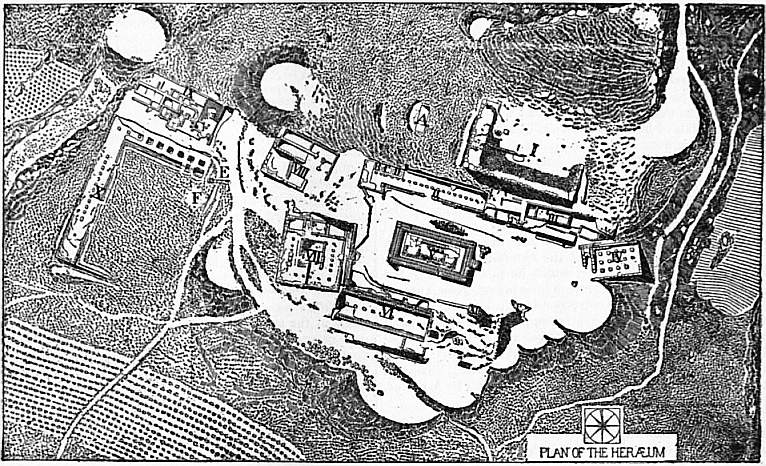
Plan of the Heraeum (surveyed and drawn by Edward L. Tilton).
I. Old Temple. II. Stoa. III. Stoa. IV. East Building. V. 5th-Century Temple. VI. South Stoa. VII. West Building. VIII. North-West Building. IX. Roman Building. X. Lower Stoa. XI. Phylakeion. A, B, C, D, E, F, Cisterns.
All these facts have been verified and illustrated by the excavations of the American Archaeological Institute and School of Athens, which were carried on from 1892 to 1895. In 1854 A.R. Rhangabé made tentative excavations on this site, digging a trench along the north and east sides of the second temple. Of these excavations no trace was to be seen when those of 1892 were begun. The excavations have shown that the sanctuary, instead of consisting of but one temple with the ruins of the older one above it, contained at least eleven separate buildings, occupying an area of about 975 ft. by 325.
On the uppermost terrace, defined by the great Cyclopean supporting wall, exactly as described by Pausanias, the excavations revealed a layer of ashes and charred wood, below which were found numerous objects of earliest date, together with some remains of the walls resting on a polygonal platform—all forming part of the earliest temple. Immediately adjoining the Cyclopean wall and below it were found traces of small houses of the rudest, earliest masonry which are pre-Mycenaean, if not pre-Cyclopean.
We then descend to the second terrace, in the centre of which the substructure of the great second temple was revealed, together with so much of the walls, as well as the several architectural members forming the superstructure, that it has been possible for E.L. Tilton to design a complete restoration of the temple. On the northern side of this terrace, between the second temple and the Cyclopean supporting wall, a long stoa or colonnade runs from east to west abutting at the west end in structures which evidently contained a well-house and waterworks; while at the eastern end of this stoa a number of chambers were erected against the hill, in front of which were placed statues and inscriptions, the bases for which are still extant. At the eastern-most end of this second terrace a large hall with three rows of columns in the interior, with a porch and entrance at the west end facing the temple, is built upon elaborate supporting walls of good masonry.
Below the second terrace at the south-west end a large and complicated building, with an open courtyard surrounded on three sides by a colonnade and with chambers opening out towards the north, may have served as a gymnasium or a sanatorium. It is of good early Greek architecture, earlier than the second temple. A curious, ruder building to the north of this and to the west of the second terrace is probably of much earlier date, perhaps of the Mycenaean period, and may have served as propylaea.
Immediately below the second temple at the foot of the elevation on which this temple stands, towards the south, and thus facing the city of Argos, a splendid stoa or colonnade, to which large flights of steps lead, was erected about the time of the building of the second temple. It is a part of the great plan to give worthy access to the temple from the city of Argos. To the east of this large flights of steps lead up to the temple proper.
At the western extremity of the whole site, immediately beside the river-bed, we again have a huge stoa running round two sides of a square, which was no doubt connected with the functions of this sanctuary as a health resort, especially for women, the goddess Hera presiding over and protecting married life and child-birth. Finally, immediately to the north of this western stoa there is an extensive house of Roman times also connected with baths.
While the buildings give archaeological evidence for every period of Greek life and history from the pre-Mycenaean period down to Roman times, the topography itself shows that the Heraeum must have been constructed before Mycenae and without any regard to it. The foothills which it occupies form the western boundary to the Argive plain as it stretches down towards the sea in the Gulf of Nauplia. While it was thus probably chosen as the earliest site for a citadel facing the sea, its second period points towards Tiryns and Midea. It could not have been built as the sanctuary of Mycenae, which was placed farther up towards the north-west in the hills, and could not be seen from the Heraeum, its inhabitants again not being able to see their sanctuary. The west building, the traces of bridges and roads, show that at one time it did hold some relation to Mycenae; but this was long after its foundation or the building of the huge Cyclopean supporting wall which is coeval with the walls of Tiryns, these again being earlier than those of Mycenae. There are, moreover, traces of still more primitive walls, built of rude small stones placed one upon the other without mortar, which are in character earlier than those of Tiryns, and have their parallel in the lowest layers of Hissarlik.
Bearing out the evidence of tradition as well as architecture, the numerous finds of individual objects in terra-cotta figurines, vases, bronzes, engraved stones, &c., point to organized civilized life on this site many generations before Mycenae was built, a fortiori before the life as depicted by Homer flourished—nay, before, as tradition has it, under Proetus the walls of Tiryns were erected. We are aided in forming some estimate of the chronological sequence preceding the Mycenaean age, as suggested by the finds of the Heraeum, in the new distribution which Dörpfeld has been led to make of the chronological stratification of Hissarlik. For the layer, which he now assigns to the Mycenaean period, is the sixth stratum from below. Now, as some of the remains at the Heraeum correspond to the two lowest layers of Hissarlik, the evidence of the Argive temple leads us far beyond the date assigned to the Mycenaean age, and at least into the second millennium B.C. (see also Aegean Civilization). As to its chronological relation to the Cretan sites—Cnossus, Phaestus, &c., and the “Minoan” civilization as determined by Dr A. Evans, see the discussion under Crete.
This sanctuary still holds a position of central importance as illustrating the art of the highest period in Greek history, namely, the art of the 5th century B.C. under the great sculptor Polyclitus. Though the excavations in the second temple have clearly revealed the outlines of the base upon which the great gold and ivory statue of Hera stood, it is needless to say that no trace of the statue itself has been found. From Pausanias we learn that “the image of Hera is seated and is of colossal size: it is made of gold and ivory, and is the work of Polyclitus.” Based on the computations made by the architect of the American excavations, E.L. Tilton, on the ground of the height of the nave, the total height of the image, including the base and the top of the throne, would be about 26 ft., the seated figure of the goddess herself about 18 ft. It is probable that the face, neck, arms and feet were of ivory, while the rest of the figure was draped in gold. Like the Olympian Zeus of Pheidias, Hera was seated on an elaborately decorated throne, holding in her left hand the sceptre, surmounted in her case by the cuckoo (as that of Zeus had an eagle), and in her right, instead of an elaborate figure of Victory (such as the Athena Parthenos and the Olympian Zeus held), simply a pomegranate. The crown was adorned with figures of Graces and the Seasons. A Roman imperial coin of Antoninus Pius shows us on a reduced scale the general composition of the figure; while contemporary Argive coins of the 5th century give a fairly adequate rendering of the head. A further attempt has been made to identify the head in a beautiful marble bust in the British Museum hitherto known as Bacchus (Waldstein, Journal of Hellenic Studies, vol. xxi., 1901, pp. 30 seq.)
We also learn from Pausanias that the temple was decorated with “sculptures over the columns, representing some the birth of Zeus and the battle of the gods and giants, others the Trojan War and the taking of Ilium.” It was formerly supposed that the phrase “over the columns” pointed to the existence of sculptured metopes, but no pedimental groups. Finds made in the excavations, however, have shown that the temple also had pedimental groups. Besides numerous fragments of nude and draped figures belonging to pedimental statues, a well-preserved and very beautiful head of a female divinity, probably Hera, as well as a draped female torso of excellent workmanship, both belonging to the pediments, have been discovered. Of the metopes also a great number of fragments have been found, together with two almost complete metopes, the one containing the torso of a nude warrior in perfect preservation, as well as ten well-preserved heads. These statues bear the same relation to the sculptor Polyclitus which the Parthenon marbles hold to Pheidias; and the excavations have thus yielded most important material for the illustration of the Argive art of Polyclitus in the 5th century B.C.
See Waldstein, The Argive Heraeum (vol. i., Boston and New York, 1902; vol. ii., the Vases by J.C. Hoppin, the Bronzes by H.F. de Cosa, 1905); Excavations of the American School of Athens at the Heraion of Argos (1892); and numerous reports and articles in the American Archaeological Journal since 1892.
(C. W.*)
ARGOSTOLI (anc. Cephallenia), the capital of Cephalonia (one of the Ionian islands), and the seat of a bishop of the Greek church. Pop. about 10,000. It possesses an excellent harbour, a quay a mile in length, and a fine bridge. Shipbuilding and silk-spinning are carried on. Near at hand are the ruins of Cranii, which afford fine examples of Greek military architecture; and at the west side of the harbour there is a curious stream, flowing from the sea, and employed to drive mills before losing itself in caverns inland.
See Sir C. Fellows’s Journal of an Excursion in Asia Minor in 1838, and Wiebel’s Die Insel Kephalonia und die Meermühlen von Argostoli (Hamburg, 1873).
ARGOSY (a corruption, by transposition of letters, of the name of the seaport Ragusa), the term originally for a carrack or merchant ship from Ragusa and other Adriatic ports, now used poetically of any vessel carrying rich merchandise. In English writings of the 16th century the seaport named is variously spelt Ragusa, Aragouse or Aragosa, and ships coming thence were named Ragusyes, Arguzes and Argosies; the last form surviving and passing into literature. The incorrect derivation from Jason’s ship, the “Argo,” is of modern origin.
ARGUIN, an island (identified by some writers with Hanno’s Cerne), off the west coast of Africa, a little south of Cape Blanco, in 20° 25′ N., 16° 37′ W. It is some 4 m. long by 2½ broad, produces gum-arabic, and is the seat of a lucrative turtle-fishery. Off the island, which was discovered by the Portuguese in the 15th century, are extensive and very dangerous reefs. Arguin was occupied in turn by Portuguese, Dutch, English and French; and to France it now belongs. The aridity of the soil and the bad anchorage prevent a permanent settlement. The fishery is mostly carried on by inhabitants of the Canary Isles. In July 1816 the French frigate “Medusa,” which carried officers on their way to Senegal to take possession of that country for France, was wrecked off Arguin, 350 lives being lost.
ARGUMENT, a word meaning “proof,” “evidence,” corresponding in English to the Latin word argumentum, from which it is derived; the originating Latin verb arguere, to make clear, from which comes the English “argue,” is from a root meaning bright, appearing in Greek ἀργής, white. From its primary sense are derived such applications of the word as a chain of reasoning, a fact or reason given to support a proposition, a discussion of the evidence or reasons for or against some theory or proposition and the like. More particularly “argument” means a synopsis of the contents of a book, the outline of a novel, play, &c. In logic it is used for the middle term in a syllogism, and for many species of fallacies, such as the argumentum ad hominem, ad baculum, &c. (see Fallacy). In mathematics the term has received special meanings; in mathematical tables the “argument” is the quantity upon which the other quantities in the table are made to depend; in the theory of complex variables, e.g. such as a + ib where i = √−1, the “argument” (or “amplitude”) is the angle θ given by tan θ = b/a. In astronomy, the term is used in connexion with the Ptolemaic theory to denote the angular distance on the epicycle of a planet from the true apogee of the epicycle; and the “equation to the argument” is the angle subtended at the earth by the distance of a planet from the centre of the epicycle.
ARGUS, in ancient Greek mythology, the son of Inachus, Agenor or Arestor, or, according to others, an earth-born hero (autochthon). He was called Panoptes (all-seeing), from having eyes all over his body. After performing several feats of valour, he was appointed by Hera to watch the cow into which Io had been transformed. While doing this he was slain by Hermes, who stoned him to death, or put him to sleep by playing on the flute and then cut off his head. His eyes were transferred by Hera to the tail of the peacock. Argus with his countless eyes originally denoted the starry heavens (Apollodorus ii. 1; Aeschylus, P. V. 569; Ovid, Metam. i. 264).
Another Argus, the old dog of Odysseus, who recognized his master on his return to Ithaca, figures in one of the best-known incidents in Homer’s Odyssey (xvii. 291-326).
ARGYLL, EARLS AND DUKES OF. The rise of this family of Scottish peers, originally the Campbells of Lochow, and first ennobled as Barons Campbell, is referred to in the article Argyllshire.
Archibald Campbell, 5th earl of Argyll (1530-1573), was the elder son of Archibald, 4th earl of Argyll (d. 1558), and a grandson of Colin, the 3rd earl (d. 1530). His great-grandfather was the 2nd earl, Archibald, who was killed at Flodden in 1513, and this nobleman’s father was Colin, Lord Campbell (d. 1493), the founder of the greatness of the Campbell family, who was created earl of Argyll in 1457. With Lord James Stuart, afterwards the regent Murray, the 5th earl of Argyll became an adherent of John Knox about 1556, and like his father was one of the most influential members of the party of religious reform, signing what was probably the first “godly band” in December 1557. As one of the “lords of the congregation” he was one of James Stuart’s principal lieutenants during the warfare between the reformers and the regent, Mary of Lorraine; and later with Murray he advised and supported Mary queen of Scots, who regarded him with great favour. It was about this time that William Cecil, afterwards Lord Burghley, referred to Argyll as “a goodly gentleman universally honoured of all Scotland.” Owing to his friendship with Mary, Argyll was separated from the party of Knox, but he forsook the queen when she determined to marry Lord Darnley; he was, however, again on Mary’s side after Queen Elizabeth’s refusal to aid Murray in 1565. Argyll was probably an accomplice in the murder of Rizzio; he was certainly a consenting party to that of Darnley, and then separating himself from Murray he commanded Mary’s soldiers after her escape from Lochleven, and by his want of courage and resolution was partly responsible for her defeat at Langside in May 1568. Soon afterwards he made his peace with Murray, but it is possible that he was accessory to the regent’s murder in 1570. After this event Argyll became lord high chancellor of Scotland, and he died on the 12th of September 1573. His first wife was an illegitimate daughter of James V., and he was thus half-brother-in-law to Mary and to Murray. His relations with her were not harmonious; he was accused of adultery, and in 1568 he performed a public penance at Stirling.
He left no children, and on his death his half-brother Colin (d. 1584) became 6th earl of Argyll. This nobleman, whose life was partly spent in feuds with the regent Morton, died in October 1584. He was succeeded as 7th earl by his young son Archibald (1576-1638), who became a Roman Catholic, fought for Philip III. of Spain in Flanders, whither he had gone to avoid his creditors, and, having entrusted the care of his estates to his son, died in London.
Archibald Campbell, 1st marquess and 8th earl of Argyll (1607-1661), eldest son of Archibald, 7th earl, by his first wife, Lady Anne Douglas, daughter of William, 1st earl of Morton, was born in 16071 and educated at St Andrews University, where he matriculated on the 15th of January 1622. He had early in life, as Lord Lorne, been entrusted with the possession of the Argyll estates when his father renounced Protestantism and took service with Philip of Spain; and he exercised over his clan an authority almost absolute, disposing of a force of 20,000 retainers, and being, according to Baillie, “by far the most powerful subject in the kingdom.” On the outbreak of the religious dispute between the king and Scotland in 1637 his support was eagerly desired by Charles I. He had been made a privy councillor in 1628, and in 1638 the king summoned him, together with Traquair and Roxburgh, to London; but he refused to be won over, openly and courageously warned Charles against his despotic ecclesiastical policy, and showed great hostility towards Laud. In consequence a secret commission was given to the earl of Antrim to invade Argyllshire and stir up the Macdonalds against the Campbells, a wild and foolish project which completely miscarried. Argyll, who inherited the title by the death of his father in 1638, had originally no preference for Presbyterianism, but now definitely took the side of the Covenanters in defence of the national religion and liberties. He continued to attend the meetings of the Assembly after its dissolution by the marquess of Hamilton, when Episcopacy was abolished. In 1639 he sent a statement to Laud, and subsequently to the king, defending the Assembly’s action; and raising a body of troops he seized Hamilton’s castle of Brodick in Arran. After the pacification of Berwick he carried a motion, in opposition to Montrose, by which the estates secured to themselves the election of the lords of the articles, who had formerly been nominated by the king, a fundamental change in the Scottish constitution, whereby the management of public affairs was entrusted to a representative body and withdrawn from the control of the crown. An attempt by the king to deprive him of his office as justiciary of Argyll and Tarbet failed, and on the prorogation of the parliament by Charles, in May 1640, Argyll moved that it should continue its sittings and that the government and safety of the kingdom should be secured by a committee of the estates, of which, though not a member, he was himself the guiding spirit. In June he was entrusted with a “commission of fire and sword” against the royalists in Atholl and Angus, which, after succeeding in entrapping the earl of Atholl, he carried out with completeness and some cruelty. It was on this occasion that took place the burning of “the bonnie house of Airlie.” By this time the personal rivalry and difference in opinion between Montrose and Argyll had led to an open breach. The former arranged that on the occasion of Charles’s approaching visit to Scotland, Argyll should be accused of high treason in the parliament. The plot, however, was disclosed, and Montrose with others was imprisoned. Accordingly when the king arrived he found himself deprived of every remnant of influence and authority. It only remained for Charles to make a series of concessions. He transferred the control over judicial and political appointments to the parliament, created Argyll a marquess (1641) with a pension of £1000 a year, and returned home, having in Clarendon’s words “made a perfect deed of gift of that kingdom.” Meanwhile the king’s policy of peace and concession had, as usual, been rudely and treacherously interrupted by a resort to force, an unsuccessful attempt, known as the “incident,” being made to kidnap Argyll, Hamilton and Lanark. Argyll was mainly instrumental at this crisis in keeping the national party faithful to what was to him evidently the common cause, and in accomplishing the alliance with the Long Parliament in 1643. In January 1644 he accompanied the Scottish army into England as a member of the committee of both kingdoms and in command of a troop of horse, but was soon in March compelled to return to suppress royalist movements in the north and to defend his own territories. He compelled Huntly to retreat in April, and in July advanced to meet the Irish troops now landed in Argyllshire, which were acting in conjunction with Montrose, who had put himself at the head of the royalist forces in Scotland. A campaign followed in the north in which neither general succeeded in obtaining any advantage over the other, or even in engaging battle. Argyll then returned to Edinburgh, threw up his commission, and retired to Inveraray Castle. Thither Montrose unexpectedly followed him in December, compelled him to flee to Roseneath, and devastated his territories. On the 2nd of February 1645, when following Montrose northwards, Argyll was surprised by him at Inverlochy and witnessed from his barge on the lake, to which he had retired owing to a dislocated arm, a fearful slaughter of his troops, which included 1500 of the Campbells. He arrived at Edinburgh on the 12th of February and was again present at Montrose’s further great victory on the 15th of August at Kilsyth, whence he escaped to Newcastle. Argyll was at last delivered from his formidable antagonist by Montrose’s final defeat at Philiphaugh on the 12th of September. In 1646 he was sent to negotiate with the king at Newcastle after his surrender to the Scottish army, when he endeavoured to moderate the demands of the parliament and at the same time to persuaade the king to accept them. On the 7th of July 1646 he was appointed a member of the Assembly of Divines.
Up to this point the statesmanship of Argyll had been highly successful. The national liberties and religion of Scotland had been defended and guaranteed, and the power of the king in Scotland reduced to a mere shadow. In addition, these privileges had been still further secured by the alliance with the English opposition, and by the subsequent triumph of the parliament and Presbyterianism in the neighbouring kingdom. The sovereign himself, after vainly contending in arms, was a prisoner in their midst. But Argyll’s influence could not survive the rupture of the alliance between the two nations on which his whole policy was constructed. He opposed in vain the secret treaty now concluded between the king and the Scots against the parliament, and while Hamilton marched into England and was defeated by Cromwell at Preston, Argyll, after a narrow escape from a surprise at Stirling, joined the Whiggamores, a body of Covenanters at Edinburgh; and, supported by London, Leven and Leslie, he established a new government, which welcomed Cromwell on his arrival there on the 4th of October. This alliance, however, was at once destroyed by the execution of Charles I., which excited universal horror in Scotland. In the series of tangled incidents which followed, Argyll lost control of the national policy. He describes himself at this period as “a distracted man ... in a distracted time” whose “remedies ... had the quite contrary operation.” He supported the invitation from the Covenanters to Charles II. to land in Scotland, gazed upon the captured Montrose, bound on a cart on his way to execution at Edinburgh, and subsequently, when Charles II. came to Scotland, having signed the Covenant and repudiated Montrose, Argyll remained at the head of the administration. After the defeat of Dunbar, Charles retained his support by the promise of a dukedom and the Garter, and an attempt was made by Argyll to marry the king to his daughter. On the 1st of January 1651 he placed the crown on Charles’s head at Scone. But his power had now passed to the Hamilton party. He strongly opposed, but was unable to prevent, the expedition into England, and in the subsequent reduction of Scotland, after having held out in Inveraray Castle for nearly a year, was at last surprised in August 1652 and submitted to the Commonwealth. His ruin was then complete. His policy had failed, his power had vanished. In his estate he was hopelessly in debt, and on terms of such violent hostility with his eldest son as to be obliged to demand a garrison in his house for his protection. During his visit to Monk at Dalkeith in 1654 to complain of this, he was subjected to much personal insult from his creditors, and on visiting London in September 1655 to obtain money due to him from the Scottish parliament, he was arrested for debt, though soon liberated. In Richard Cromwell’s parliament of 1659 Argyll sat as member for Aberdeenshire. At the Restoration he presented himself at Whitehall, but was at once arrested by order of Charles and placed in the Tower (1660), being sent to Edinburgh to stand his trial for high treason. He was acquitted of complicity in the death of Charles I., and his escape from the whole charge seemed imminent, but the arrival of a packet of letters written by Argyll to Monk showed conclusively his collaboration with Cromwell’s government, particularly in the suppression of Glencairn’s royalist rising in 1652. He was immediately sentenced to death, his execution by beheading taking place on the 27th of May 1661, before even the death warrant had been signed by the king. His head was placed on the same spike upon the west end of the Tolbooth on which that of Montrose had previously been exposed, and his body was buried at the Holy Loch, where the head was also deposited in 1664. A monument was erected to his memory in St Giles’s church in Edinburgh in 1895.
While imprisoned in the Tower he wrote Instructions to a Son (1661; reprinted in 1689 and 1743). Some of his speeches, including the one delivered on the scaffold, were published and are printed in the Harleian Miscellany. He married Lady Margaret Douglas, daughter of William, 2nd earl of Morton, and had two sons and four daughters.
See also the Life and Times of Archibald Marquis of Argyll (1903), by John Willcock, who prints for the first time the six incriminating letters to Monk; Eng. Hist. Review, xviii. 369 and 624; Scottish History Society, vol. xvii. (1894); Charles II. and Scotland in 1650, ed. by S.R. Gardiner, and vol. xviii. (1895); History of Scotland, by A. Lang, vol. iii. (1904).
Archibald Campbell, 9th earl of Argyll (1629-1685), eldest son of the 8th earl, studied abroad, and at the age of thirteen was appointed captain in the Scottish regiment serving in France under his uncle the earl of Irvine. He returned home at the close of 1649, and was made captain of Charles II.’s life guards on the king’s arrival in Scotland in 1650. He declared himself a royalist in opposition to his father, with the view, as some said, of securing the family estates in any event. He fought at Dunbar on the 3rd of September 1650, and after the battle of Worcester joined Glencairn in the Highlands. Bitter disputes arose, and on the 2nd of January 1654 Lorne, quitting his troops, fled to avoid arrest. In 1653 he submitted to Monk. He appears, however, to have maintained communications with Charles, and on his refusal to take the oath renouncing allegiance to the Stuarts in 1657 he was imprisoned, remaining in confinement probably till a short time before the Restoration. He was then well received at court by Charles II. After the execution of his father, he endeavoured to obtain the restitution of his forfeited estates and title, but having incautiously attacked certain members of the government in letters which were made public, he was indicted at Edinburgh on the capital charge of “leasing-making” and was sentenced to death on the 26th of August. He remained a prisoner in Edinburgh Castle till the 4th of June 1663, when the sentence was cancelled and he was re-created earl and restored to his estates. He disapproved of the severities practised upon the Covenanters in the west, and in 1671 pleaded for milder methods. His staunch Protestantism rendered him exceedingly obnoxious to James, duke of York, who in 1680 arrived as high commissioner in Scotland and at once expressed his jealousy of Argyll’s immense territorial influence. Argyll moved the re-enactment of “all the acts against popery” omitted on James’s account, and opposed the exemption of the royal family from the test, though allowing it in the case of James. In signing the test himself, in its final form both ambiguous and self-contradictory, he made the reservation “so far as consistent with itself and the Protestant faith,” and declined to engage himself not to promote any alteration of advantage in church or state. On his refusal to record his oath in writing and to sign it, he was dismissed from the Scottish privy council, and on the 9th of November 1681 was accused of treason, a charge which Halifax declared openly in England “they would not hang a dog upon.” A trial followed, a scandalous exhibition of illegality and injustice, at the close of which Argyll was sentenced to death and to the forfeiture of his estates. Shortly afterwards, through the instrumentality of his step-daughter, Sophia Lindsay, he succeeded in making his escape, and after some adventures retired to Holland. His subsequent movements are uncertain, but he appears to have again visited London, and was in correspondence with the Rye House plotters and proposing to head a rebellion in Scotland in 1683. In 1685 he joined the conspiracy in Holland to set Monmouth on the throne instead of James II., arriving in Orkney on the 6th of May and making his way to his own country. But his clansmen refused to join him, and whatever small chances of success remained were destroyed by constant and paralysing disputes. His ships and ammunition were captured, and after some aimless wanderings he found himself deserted, with but one companion, Major Fullerton. On the 18th of June he was taken prisoner at Inchinnan and arrived at Edinburgh on the 20th, where he was paraded through the streets and put in irons in the castle. James ordered his summary execution on the 29th, and it was carried out by beheading on the following day, on the old charge of 1681. His head was exposed on the west side of the Tollbooth, where his father’s and Montrose’s had also been exhibited, his body finding its final place of burial at Inveraray.
By his first wife, Lady Mary Stewart, daughter of the 4th earl of Moray (Murray), he had four sons and three daughters.
See Argyll Papers (1834); Letters from Archibald, 9th Earl of Argyle, to the Duke of Lauderdale (1829); Hist. MSS. Comm. vi. Rep. 606; Life of Mr Donald Cargile, by P. Walker, pp. 45 et seq.; The 3rd Part of the Protestant Plot ... and a Brief Account of the Case of the Earl of Argyle (1682); Sir George MacKenzie’s Hist. of Scotland, p. 70; and J. Willcock, A Scots Earl in Covenanting Times (1908).
Archibald Campbell, 1st duke of Argyll (? 1651-1703), was the eldest son of the 9th earl. He tried to get his father’s attainder reversed by seeking the king’s favour, but being unsuccessful he went over to the Hague and joined William of Orange as an active promoter of the revolution of 1688. In spite of the attainder, he was admitted in 1689 to the convention of the Scottish estates as earl of Argyll, and he was deputed, with Sir James Montgomery and Sir John Dalrymple, to present the crown to William III. in its name, and to tender him the coronation oath. In 1690 an act was passed restoring his title and estates, and it was in connexion with the refusal of the Macdonalds of Glencoe to join in the submission to him that he organized the terrible massacre which has made his name notorious. In 1696 he was made a lord of the treasury, and his political services were rewarded in 1701 by his being created duke of Argyll. He had two sons by his wife Elizabeth, daughter of Sir Lionel Talmash, John (the 2nd duke) and Archibald (the 3rd duke.)
John Campbell, 2nd duke of Argyll and duke of Greenwich (1678-1743), was born on the 10th of October 1678. He entered the army in 1694, and in 1701 was promoted to the command of a regiment. On the death of his father in 1703, he was appointed a member of the privy council, and at the same time colonel of the Scotch horse guards, and one of the extraordinary lords of session. In return for his services in promoting the Union, he was created (1705) a peer of England, by the titles of baron of Chatham and earl of Greenwich, and in 1710 was made a knight of the Garter. He first distinguished himself in a military capacity at the battle of Oudenarde (1708), where he served as a brigadier-general; and was afterwards present under the duke of Marlborough at the sieges of Lille, Ghent, Bruges and Tournay, and did remarkable service at the battle of Malplaquet in 1709. He was very popular with the troops, and his rivalry with Marlborough on this account is thought to have been the cause of the enmity shown by Argyll afterwards to his old commander. In 1711 he was sent to take command in Spain; but being seized with a violent fever at Barcelona, and disappointed of supplies from home, he returned to England. Having a seat in the House of Lords, and being gifted with an extraordinary power of oratory, he censured the measures of the ministry with such freedom that all his places were disposed of to other noblemen; but at the accession of George I. he recovered his influence. On the breaking out of the rebellion in 1715 he was appointed commander-in-chief of the forces in North Britain, and was principally instrumental in effecting the total extinction of the rebellion in Scotland without much bloodshed. He arrived in London early in March 1716, and at first stood high in the favour of the king, but in a few months was strippee of his offices. This disgrace, however, did not deter him from the discharge of his parliamentary duties; he supported the bill for the impeachment of Bishop Atterbury, and lent his aid to his countrymen by opposing the bill for punishing the city of Edinburgh for the Porteous riot. In the beginning of the year 1719 he was again admitted into favour, appointed lord steward of the household, and, in April following, created duke of Greenwich; he held various offices in succession, and in 1735 was made a field marshall. He continued in the administration till after the accession of George II., when, in April 1740, a violent speech against the government led again to his dismissal from office. He was soon restored on a change of the ministry, but disapproving the measures of the new administration, and apparently disappointed at not being given the command of the army, he shortly resigned all his posts, and spent the rest of his life in privacy and retirement. He died on the 4th of October 1743. A monument by Roubillac was erected to his memory in Westminster Abbey. He was twice married, and by his second wife, Jane Warburton, had five daughters; his Scottish titles passed to his brother, but his English titles became extinct, and though his eldest daughter was created baroness of Greenwich in 1767 this title also became extinct on her death in 1794.
Archibald Campbell, 3rd duke of Argyll (1682-1761), was born at Ham House in Surrey, in June 1682. On his father being created a duke, he joined the army, and served for a short time under the duke of Marlborough. In 1705 he was appointed treasurer of Scotland, and in the following year was one of the commissioners for treating of the Union; on the consummation of which, having been raised to the peerage of Scotland as earl of Islay, he was chosen one of the sixteen peers for Scotland in the first parliament of Great Britain. In 1711 he was called to the privy council, and commanded the royal army at the battle of Sheriffmuir in 1715. he was appointed keeper of the privy seal in 1721, and was afterwards entrusted with the principal management of Scottish affairs to an extent which caused him to be called “king of Scotland.” In 1733 he was made keeper of the great seal, an office which he held till his death. He succeeded to the dukedom in 1743. Both as earl of Islay and as duke of Argyll he was prominently connected (with Duncan Forbes of Culloden) with the movement for consolidating Scottish loyalty by the formation of locally recruited highland regiments. The duke was eminent not only for his political abilities, but also for his literary accomplishments, and he collected one of the most valuable private libraries in Great Britain. He died suddenly on the 15th of April 1761. He was married but had no legitimate issue, and his English property was left to a Mrs Williams, by whom he had a son, William Campbell.
The succession now passed to the descendants of the younger son of the 9th earl, the Campbells of Mamore; the 4th duke died in 1770, and was succeeded by his son John, the 5th duke (1723-1806) He was a soldier who had fought at Dettingen and Culloden, and became colonel of the 42nd regiment (Black Watch), and eventually a field marshall. He sat in the House of Commons for Glasgow from 1744 to 1761, when on his father’s succession to the dukedom he became legally disqualified, as courtesy marquess of Lorne, for a Scottish constituency; he could sit, however, for an English one, and was returned for Dover, which he represented till 1766, when he was created an English peer as Baron Sundridge, the title by which till 1892 the dukes of Argyll sat in the House of Lords. The 5th duke was an active landlord, and was the first president of the Highland and Agricultural Society. In 1759 he had married the widowed duchess of Hamilton (the beautiful Elizabeth Gunning), by whom he had two sons and two daughters. The eldest of his sons, George (d. 1841), became 6th duke, and on his death was succeeded as 7th duke by his brother John (1777-1847), who from 1799-1822 sat in parliament as member for Argyllshire. He was thrice married, and by his second wife, Joan Glassell (d. 1828), had two sons, the eldest of whom (b. 1821) died in 1837, and two daughters, the second of whom died in infancy.
George John Douglas Campbell, 8th duke (1823-1900), the second son of the 7th duke, was born on the 30th of April 1823, and succeeded his father in April 1847. He had already obtained notice as a writer of pamphlets on the disruption of the Church of Scotland, which he strove to avert, and he rapidly became prominent on the Liberal side in parliamentary politics. He was a frequent and eloquent speaker in the House of Lords, and sat as lord privy seal (1852) and postmaster-general (1855) in the cabinets of Lord Aberdeen and Lord Palmerston. In Mr Gladstone’s cabinet of 1868 he was secretary of state for India, and somewhat infelicitously signalized his term of office by his refusal, against the advice of the Indian government, to promise the amir of Afghanistan support against Russian aggression, a course which threw that ruler into the arms of Russia and was followed by the second Afghan War. His eminence alike as a great Scottish noble, and as a British statesman, was accentuated in 1871 when his son, the marquess of Lorne, married Princess Louise, the fourth daughter of Queen Victoria; but in the political world few memorable acts on his part call for record except his resignation of the office of lord privy seal, which he held in Mr Gladstone’s administration of 1880, from his inability to assent to the Irish land legislation of 1881. He opposed the Home Rule Bill with equal vigour, though Mr Gladstone subsequently stated that, among all the old colleagues who dissented from his course, the duke was the only one whose personal relations with him remained entirely unchanged. Detached from party, the duke took an independent position, and for many years spoke his mind with great freedom in letters to The Times on public questions, especially such as concerned the rights or interests of landowners. He was no less active on scientific questions in their relation to religion, which he earnestly strove to reconcile with the progress of discovery. With this aim he published The Reign of Law (1866), Primeval Man (1869), The Unity of Nature (1884), The Unseen Foundations of Society (1893), and other essays. He also wrote on the Eastern question, with especial reference to India, the history and antiquities of Iona, patronage in the Church of Scotland, and many other subjects. The duke (to whose Scottish title was added a dukedom of the United Kingdom in 1892) died on the 24th of April 1900. He was thrice married: first (1844) to a daughter of the second duke of Sutherland (d. 1878); secondly (1881) to a daughter of Bishop Claughton of St Albans (d. 1894); and thirdly (1895) to Ina Erskine M‘Neill. Few men of the duke’s era displayed more versatility of intellect, and he was remarkable among the men of his time for his lofty eloquence.
He was succeeded as 9th duke by his eldest son John Douglas Sutherland Campbell (1845- emsp;), whose marriage in 1871 to H.R.H. Princess Louise gave him a special prominence in English public life. He was governor-general of Canada from 1878 to 1883; member of parliament for South Manchester, in the Unionist interest, 1895 to 1900; and he also became known as a writer both in prose and verse. In 1907 he published his reminiscences, Pages from the Past.
See the Autobiography and Memoirs of the 8th duke, edited by his widow (1906), which is full of interesting historical and personal detail.
(P. C. Y.; H. Ch.)
1 The date of 1598, previously accepted, is shown by Willcock to be incorrect.
ARGYLLSHIRE, a county on the west coast of Scotland, the second largest in the country, embracing a large tract of country on the mainland and a number of the Hebrides or Western Isles. The mainland portion is bounded N. by Inverness-shire; E. by Perth and Dumbarton, Loch Long and the Firth of Clyde; S. by the North Channel (Irish Sea); and W. by the Atlantic. Its area is 1,990,471 acres or 3110 sq. m. The principal districts are Ardnamurchan on the Atlantic, Ardnamurchan Point being the most westerly headland of Scotland; Morven or Morvern, bounded by Loch Sunart, the Sound of Mull and Loch Linnhe; Appin, on Loch Linnhe, with piers at Ballachulish and Port Appin; Benderloch, lying between Loch Creran and Loch Etive; Lorne, surrounding Loch Etive and giving the title of marquess to the Campbells; Argyll, in the middle of the shire, containing Inveraray Castle and furnishing the titles of earl and duke to the Campbells; Cowall, between Loch Fyne and the Firth of Clyde, in which lie Dunoon and other favourite holiday resorts; Knapdale between the Sound of Jura and Loch Fyne; and Kintyre or Cantyre, a long narrow peninsula (which, at the isthmus of Tarbert, is little more than 1 m. wide), the southernmost point of which is known as the Mull, the nearest part of Scotland to the coast of Ireland, only 13 m. distant.
There are no navigable rivers. The two principal mountain streams are the Orchy and Awe. The Orchy flows from Loch Tulla through Glen Orchy, and falls into the north-eastern end of Loch Awe; and the Awe drains the loch at its north-western extremity, discharging into Loch Etive. Among other streams are the Add, Aray, Coe or Cona, Creran, Douglas, Eachaig, Etive, Euchar, Feochan, Finart, Fyne, Kinglass, Nell, Ruel, Shiel, Shira, Strae and Uisge-Dhu. The county is remarkable for the numerous sea-lochs which deeply indent the coast, the principal being Loch Long (with its branches Loch Goil and the Holy Loch), Loch Striven (Rothesay’s “weather glass”), Loch Riddon, Loch Fyne (with Loch Gilp and Loch Gair), Lochs Tarbert, Killisport, Swin, Crinan, Craignish, Melfort, Feochan, Etive, Linnhe (with its branches Loch Creran, Loch Leven and Loch Eil) and Sunart. There are also a large number of inland lakes, the total area of which is about 25,000 acres. Of these the principal are Lochs Awe, Avich, Eck, Lydoch and Shiel. The principal islands are Mull, Islay, Jura, Colonsay, Lismore, Tyree, Coll, Gigha, Luing and Kerrera. Besides these there are the two small but interesting islands of Staffa and Iona. The mountains are so many as to give the shire a markedly rugged character. Some of them are among the loftiest in the kingdom, as Ben Cruachan with its summit of twin pyramids (3689 ft.), Ben More, in Mull (3172), Ben Ima (3318), Buachaille Etive (3345), Ben Bui (3106), Ben Lui (or Loy), on the confines of the shires of Perth and Argyll (3708), Ben Starav near the head of Loch Etive (3541), and Ben Arthur, called from its shape “The Cobbler” (2891), on the borders of Dumbartonshire. There are many picturesque glens, of which the best-known are Glen Aray, Glen Croe, Glen Etive, Glendaruel, Glen Lochy (“the wearisome glen”—some 10 m. of bare hills and boulders—between Tyndrum and Dalmally), Glen Strae, Hell’s Glen (off Lech Goil) and Glencoe, the scene of the massacre in 1692. The waterfalls of Cruachan are beautiful; and those of Connel, which are more in the nature of rapids, caused by the rush of the ebbing tide over the rocky bar at the narrowing mouth of Loch Etive, have been made celebrated by Ossian, who called them “the Falls of Lora.” In several of the glens, as Glen Aray, small falls may be seen, enhanced in beauty when the rivers are in flood. Pre-eminently Argyll is the shire of the sportsman. The lovely Western Isles provide endless enjoyment for the yachtsman; the lochs and rivers abound with salmon and trout; the deer forests and grouse moors are second to none in Scotland.
Geology.—The mainland portion of the county consists chiefly of the metamorphic rocks of the Eastern Highlands, nearly all the subdivisions of that series (see Scotland: Geology) being represented. They form parallel belts of varying width trending north-east and south-west. The slates and phyllites referred to the lowest group occur along the shore at Dunoon, and are followed by the Beinn Bheula grits and albite schists, forming nearly all the highest ground in Cowall between Loch Fyne and the Firth of Clyde and the greater part of Kintyre. The green beds, Glensluan mica-schists and Loch Tay limestones are developed in Glendaruel, and have been traced north-east to Glen Fyne and at intervals south-west to Campbeltown. The next prominent zone is that of the Ardrishaig phyllites, with quartzites in the lower portion and soft phyllites in the upper part, which cover a belt from 3 to 6 m. across, stretching from Glen Shira by Inveraray and Ardrishaig to south Knapdale.
Next in order come the Easdale slates, phyllites with thin dark limestone, the main limestone of Loch Awe and the pebbly quartzite (Schiehallion), which are repeated by innumerable folds and spread northwards to Loch Linnhe and westwards to Jura and Islay. The slates of this horizon have been largely quarried at Easdale and Ballachulish, and this main limestone is typically developed near Loch Awe, near Kilmartin, on the islands of Lismore and Shuna, and in Islay between Bridgend and Portaskaig. The quartzites of this series form the highest hills in the south of Islay, occupy nearly the whole of Jura, and are continued in the mainland, where, by means of the rapid isoclinal folding, they form lenticular masses. In Islay and at various localities on the mainland a conglomerate occurs at or near the base of the quartzites, which contains fragments of the underlying rocks and boulders of granite not now found in place in that region.
On the mainland, on the north side of the compound synclinal folding of Loch Awe, the Ardrishaig phyllites reappear at Craignish near Kilmartin, and the quartzites of this group are supposed to come to the surface again in Glencoe, not far from the outcrop of the Schiehallion quartzite.
The metamorphic rocks are associated with bands of epidiorite which have shared in the folding and metamorphism of the region. These are largely developed near Loch Awe, in Knapdale, and on the south-east coast of Islay. They have been usually regarded as intrusive, but south of Tayvallich on the mainland, lavas and tuffs, which have escaped deformation, occur in the Easdale slates and the pebbly limestone.
The Lower Old Red Sandstone, chiefly composed of volcanic rocks—lavas and tuffs—rests unconformably on the metamorphic series. These rocks cover a wide area in Lorne between Loch Melfort, Oban and the Pass of Brander, and they reappear in the lofty mountains on both sides of Glencoe. Representatives of this formation are found in Kintyre, south of Campbeltown, where the sediments prevail. The intrusive igneous rocks belonging to this period are widely distributed and form conspicuous features. The plutonic masses are represented by the granite of Ben Cruachan, by the diorite of Gleann Domhainn, and by the kentallenite (a basic rock related to the monxonites), near Ballachulish. Throughout the Lorne volcanic plateau there are numerous dykes of porphyrite which likewise traverse the schists and part of the Ben Cruachan granite. Sheets of quartz-porphyry, lamprophyre and diorite are also represented, the first of these types being quarried at Crarae on the north shore of Loch Fyne.
The Upper Old Red Sandstone forms isolated patches resting unconformably on all older rocks, on the west coast of Kintyre, and between Campbeltown and Southend. In the district of Campbeltown these red sandstones and cornstones are followed by the volcanic rocks of the Calciferous Sandstone series, which lie to the south of the depression at Machrihanish, and are succeeded by the lower limestones and coals of the Carboniferous Limestone series.
On the north and south shores of the promontory of Ardnamurchan there are small patches of Jurassic strata ranging from the Lower Lias to the Oxford Clay, and in Morvern on the shores of Loch Aline representatives of the Upper Greensand are covered by the basaltic lavas of Tertiary age. The acid and basic plutonic rocks (gabbros and granophyres) of Tertiary time occur in Ardnamurchan. A striking geological feature of the county is the number of dolerite and basalt dykes trending in a north-west direction, which are referred to the same period of intrusion. There is, however, another group of dolerite dykes running east and west near Dunoon and elsewhere, which are cut by the former and are probably of older date.
Lead veins occur at Strontian which have yielded a number of minerals, including sphalerite, fluorite, strontianite, harmotone, brewsterite and pilolite. Near Inveraray, nickeliferous ore has been obtained at two localities.
Climate.—The rainfall is very abundant. At Oban, the average annual amount is 64.18 in.; in Glen Fyne, 104.11 in.; at the bridge of Orchy, 113.62 in., and at Upper Glencoe 127.65. The prevailing winds, as observed near Crinan, are south-west and south-east, and next in frequency are the north-west and north-east. The average yearly temperature is 48° F.
Agriculture.—Argyllshire was formerly partly covered with natural forests, remains of which, consisting chiefly of oak, ash, pine and birch, are still visible in the mosses; but, owing to the clearance of the ground for the introduction of sheep, and to past neglect of planting, the county is now remarkable for its lack of wood, except in the neighbourhood of Inveraray, where there are extensive and flourishing plantations, and a few other places. Replanting, however, has been carried on. Most of the county is unfitted for agriculture; but many districts afford fine pasturage for mountain sheep; and some of the valleys, such as Glendaruel, are very fertile. The chief crop is oats; there is a little barley, but no wheat. The shire is one of those where the crofting system exists, but it is by no means universal. It is predominant in Tyree and the western district of the mainland, but elsewhere farms of moderate size are the rule. The cattle, though small, are equal to any other breed in the kingdom, and are marketed in large numbers in the south. Dairy farming is carried on to some extent in the southern parts of Kintyre, where there is a large proportion of arable land. In the higher tracts sheep have taken the place of cattle with excellent results. The black-faced is the species most generally reared.
Industries.—Whisky is manufactured at Campbeltown, in Islay, at Oban, Ardrishaig and elsewhere. Gunpowder is made at Kames (Kyles of Bute), Melfort and Furnace. Coarse woollens are made for home use; but fishing is the most important industry, Loch Fyne being famous for its herrings. The season lasts from June to January, but white fishing is carried on at one or other of the ports all the year round. Slate and granite quarrying and some coal-mining are the only other industries of any consequence.
Communications.—Owing partly to the paucity of trading industries and partly to the fact that, owing to its greatly indented coast-line, no place in the shire is more than 12 m. from the sea, the railway mileage in the county is very small. The Tyndrum to Oban section of the Caledonian railway company’s system is within the county limits; a small portion of the track of the North British railway company’s line to Mallaig skirts the extreme west of the shire, and the Caledonian line from Oban to Ballachulish serves the northern coast districts of the Argyllshire mainland. In connexion with this last route mention should be made of the cantilever bridge crossing the Falls of Lora with a span of 500 ft. at a height of 125 ft. above the water-way. The chief means of communication is by steamers, which maintain regular intercourse between Glasgow and various parts of the coast. In order to avoid the circuitous passage round the Mull of Kintyre the Crinan Canal, across the isthmus from Ardrishaig to Loch Crinan, a distance of 9 m., was constructed in 1793-1801, at a cost of £142,000. It has 15 locks, an average depth of 10 ft., a surface width of 66 ft., and bottom width of 30 ft., is navigable by vessels of 200 tons, and runs through a district of remarkable beauty. Another canal unites Campbeltown with Dalavaddy. In summer the mails for the islands and the great bulk of the tourist traffic by the MacBrayne fleet is conveyed through the Crinan Canal, transhipment being effected at Ardrishaig and Crinan. Throughout the year goods traffic between the Clyde and elsewhere and the West Highland ports is conveyed by deep-sea steamers round the Mull. Before the advent of railways the shire contained many famous coaching routes, but now coaches only run during the tourist season, either in connexion with train and steamer, or in districts still not served by either.
Population and Government.—Owing to emigration, chiefly to Canada, the population has declined, almost without a break, since 1831, when it was 100,973, to 74,085 in 1891 and 73,642 in 1901, in which year there were 24 persons to the sq. m. In 1901 the number of Gaelic-speaking persons was 34,224, of whom 3313 spoke Gaelic only. The chief towns are Campbeltown (population in 1901, 8286), Dunoon (6779) and Oban (5427), with Ardrishaig (1285), Ballachulish (1143), Lochgilphead (1313) and Tarbert (1697). The county returns a member to parliament. Inveraray, Campbeltown and Oban belong to the Ayr district group of parliamentary burghs. Argyllshire is a sheriffdom, and there are resident sheriffs-substitute at Inveraray, Campbeltown and Oban; courts are held also at Tobermory, Lochgilphead, Bowmore in Islay, and Dunoon. Both Presbyterian bodies are strongly represented; there are Roman Catholic and (Anglican) Episcopal bishops of Argyll and the Isles, and there is a Roman Catholic pro-cathedral at Oban. Campbeltown, Dunoon and Oban have secondary schools, Tarbert public school has a secondary department, and several other schools earn grants for giving higher education. Part of the “residue” grant is spent by the county council on classes of navigation and other subjects in various schools, short courses in agriculture for farmers, and in providing bursaries.
History.—The early history of Argyll (Airergaidheal) is very obscure. At the close of the 5th century Fergus, son of Erc, a descendant of Conor II., airdrigh or high king of Ireland, came over with a band of Irish Scots and established himself in Argyll and Kintyre. Nothing more is known till, in the days of Conall I., the descendant of Fergus in the fourth generation, St Columba appears. Conall died in 574, and Columba was mainly instrumental in establishing his first cousin, Aidan, founder of the Dalriad kingdom and ancestor of the royal house of Scotland, in power. In the 8th century Argyll, with the Western Islands and Man, fell under the power of the Norsemen until, in the 12th century, Somerled (or Somhairle), a descendant of Colla-Uais, airdrigh of Ireland (327-331), succeeded in ousting them and established his authority, not only as thane of Argyll, but also in Kintyre and the Western Islands. Somerled died in 1164 and his descendants maintained themselves in Argyll and the islands, between the conflicting claims of the kings of Scotland, Norway and Man, until the end of the 15th century.
Up to 1222 Argyll had formed an independent Celtic princedom; but in that year it was reduced by Alexander II., the Scottish king, to a sheriffdom, and was henceforth regarded as an integral part of Scotland. Among the various clans in Argyll, the Campbells of Loch Awe, a branch of the clan McArthur, now began to come to the fore, though the mainland was still chiefly in the possession of the MacDougals. The position of the lords of the house of Somerled was now curious, since they were feudatories of the king of Norway for the isles and of the king of Scotland for Argyll. Their policy in the wars between the two powers was a masterly neutrality. Thus, during the expedition of Alexander II. to the Western Isles in 1249, Ewan (Eoghan), lord of Argyll, refused to fight against the Norwegians; in 1263 the same Ewan refused to join Haakon of Norway in attacking Alexander III. Forty years later the clansmen of Argyll, mainly MacDougals, were warring on the side of Edward of England against Robert Bruce, by whom they were badly beaten on Loch Awe in 1309. The clansmen of the house of Somerled in the isles, on the other hand, the MacDonalds, remained loyal to Scotland in spite of the persuasions of John of Argyll, appointed admiral of Edward II.’s western fleet; and, under their chief Angus Og, they contributed much to the victory of Bannockburn. The alliance of John, earl of Ross and lord of the Isles, with Edward IV. of England in 1461 led to the breaking of the power of the house of Somerled, and in 1478 John was forced to resign Ross to the crown and, two years later, his lordships of Knapdale and Kintyre as well. In Argyll itself the Campbells had already made the first step to supremacy through the marriage of Colin, grandson of Sir Duncan Campbell of Lochow, first Lord Campbell, with Isabel Stewart, eldest of the three co-heiresses of John, third lord of Lorne. He acquired the greater part of the lands of the other sisters by purchase, and the lordship of Lorne from Walter their uncle, the heir in tail male, by an exchange for lands in Perthshire. In 1457 he was created, by James II., earl of Argyll. He died on the 10th of May 1493. From him dates the greatness of the house of the earls and dukes of Argyll (q.v.), whose history belongs to that of Scotland. The house of Somerled survives in two main branches—that of Macdonald of the Isles, Alexander Macdonald (d. 1795) having been raised to the peerage in 1776, and that of the Macdonnells, earls of Antrim in Ireland. The principal clans in Argyll, besides those already mentioned, were the Macleans, the Stewarts of Appin, the Macquarries and the Macdonalds of Glencoe, and the Macfarlanes of Glencroe. The Campbells are still very numerous in the county.
Argyllshire men have made few contributions to English literature. For long the natives spoke Gaelic only and their bards sang in Gaelic (see Celt: Literature: Scottish). Near Inistrynich on the north-eastern shore of Loch Awe stands the monumental cairn erected in honour of Duncan Ban McIntyre (1724-1812), the most popular of modern Gaelic bards. But the romantic beauty of the country has made it a favourite setting for the themes of many poets and story-tellers, from “Ossian” and Sir Walter Scott to Robert Louis Stevenson, while not a few men distinguished in affairs or in learning have been natives of the county.
The antiquities comprise monoliths, circles of standing stones, crannogs and cairns. In almost all the burying-grounds—as at Campbeltown, Keil, Soroby, Kilchousland, Kilmun—there are specimens of sculptured crosses and slabs. Besides the famous ecclesiastical remains at Iona (q.v.), there are ruins of a Cistercian priory in Oronsay, and of a church founded in the 12th century by Somerled, thane of Argyll, at Saddell. Among castles may be mentioned Dunstaffnage, Ardtornish, Skipness, Kilchurn (beloved of painters), Ardchonnel, Dunolly, Stalker, Dunderaw and Carrick.
Authorities.—The (Eighth) Duke of Argyll, Commercial Principles Applied to the Hire of Land (London, 1877); Crofts and Farms in the Hebrides (Edinburgh, 1883); Iona (Edinburgh, 1889); Scotland as it Was and Is (Edinburgh, 1887), House of Argyll (Glasgow, 1871); A. Brown, Memorials of Argyllshire (Greenock, 1889); Harvie-Brown and Buckley, Vertebrate Fauna of Argyll and the Inner Hebrides (Edinburgh, 1892); D. Clerk, “On the Agriculture of the County of Argyll” (Trans. of H. and A. Soc., 1878); T. Gray, Week at Oban (Edinburgh, 1881); Stewart, Collection of Views of Campbeltown. For antiquities see The Sculptured Stones of Scotland, vol. ii., published by the Spalding Club, and Capt. T.P. White’s Archaeological Sketches in Kintyre and Proc. Antiq. Soc. of Scotland, vols. iv., v., viii.
ARGYRODITE, a mineral which is of interest as being that in which the element germanium was discovered by C. Winkler in 1886. It is a silver sulpho-germanate, Ag8GeS6, and crystallizes in the cubic system. The crystals have the form of the octahedron or rhombic dodecahedron, and are frequently twinned. The botryoidal crusts of small indistinct crystals first found in a silver mine at Freiberg in Saxony were originally thought to be monoclinic, but were afterwards proved to be identical with the more distinctly developed crystals recently found in Bolivia. The colour is iron-black with a purplish tinge, and the lustre metallic. There is no cleavage; hardness 2½, specific gravity 6.2. It is of interest to note that the Freiberg mineral was long ago imperfectly described by A. Breithaupt under the name Plusinglanz, and that the Bolivian crystals were incorrectly described in 1849 as crystallized brongniardite. The name argyrodite is from the Greek ἀργυρώδης, rich in silver.
Isomorphous with argyrodite is the corresponding tin compound Ag8SnS6, also found in Bolivia as cubic crystals, and known by the name canfieldite. Other Bolivian crystals are intermediate in composition between argyrodite and canfieldite.
(L. J. S.)
ARGYROKASTRO, or Argyrocastron (Turkish, Ergeri; Albanian Ergir Castri), a town of southern Albania, Turkey, in the vilayet of Iannina. Pop. (1900) about 11,000. Argyrokastro is finely situated 1060 ft. above sea-level, on the eastern slopes of the Acroceraunian mountains, and near the left bank of the river Dhrynos, a left-hand tributary of the Viossa. It is the capital of a sanjak bearing the same name, and was formerly important as the headquarters of the local Moslem aristocracy, partly owing to the mountainous and easily defensible nature of the district. It contains the ruins of an imposing castellated fort. A fine kind of snuff, known as fuli, is manufactured here. Argyrokastro has been variously identified with the ancient Hadrianopolis and Antigonea. In the 18th century it is said to have contained 20,000 inhabitants, but it was almost depopulated by plague in 1814. Albanian Moslems constitute the greater part of the population.
ARGYROPULUS, or Argyropulo, JOHN (c. 1416-1486), Greek humanist, one of the earliest promoters of the revival of learning in the West, was born in Constantinople, and became a teacher there, Constantine Lascaris being his pupil. He then appears to have crossed over to Italy, and taught in Padua in 1434, being subsequently made rector of the university. About 1441 he returned to Constantinople, but after its capture by the Turks, again took refuge in Italy. About 1456 he was invited to Florence by Cosimo de’ Medici, and was there appointed professor of Greek in the university. In 1471, on the outbreak of the plague, he removed to Rome, where he continued to act as a teacher of Greek till his death. Among his scholars were Angelus Politianus and Johann Reuchlin. His principal works were translations of the following portions of Aristotle,— Categoriae, De Interpretatione, Analytica Posteriora, Physica, De Caelo, De Anima, Metaphysica, Ethica Nicomachea, Politica; and an Expositio Ethicorum Aristotelis. Several of his writings exist still in manuscript.
See Humphrey Hody, De Graecis Illustribus, 1742, and Smith’s Dictionary of Greek and Roman Biography, s.v. Joannes.
ARIA (Ital. for “air”), a musical term, equivalent to the English “air,” signifying a melody apart from the harmony, but especially a musical composition for a single voice or instrument, with an accompaniment of other voices or instruments.
The aria originally developed from the expansion of a single vocal melody, generally on the lines of what is known as binary form (see Sonata and Sonata Forms). Accordingly, while the germs of aria form may be traceable in the highest developments of folk-song, the aria as a definite art-form could not exist before the middle of the 17th century; because up to that time the whole organization of music was based upon polyphonic principles which left no room for the development of melody for melody’s sake. When at the beginning of the 17th century the Monodists (see Harmony and Monteverde) inaugurated a new era and showed in their first experiments the enormous possibilities latent in their new art of accompanying single voices by instruments, it was natural that for many years the mere suggestiveness and variety of their experiments should suffice to retain the attention of contemporary listeners, without any real artistic coherence in the works as wholes. But, even at the outset, mere novelty of harmony, however poignant its emotional expression, was felt by the profounder spirits of the new art to be an untrustworthy guide to progress. And Monteverde’s famous lament of the deserted Ariadne is one of many early examples that appeal to an elementary sense of form by making the last phrase identical with the first. As instrumental music grew, and the modern sense of key became strong and consistent, composers felt themselves more and more able to appeal to that sense of harmonically consistent melody which has asserted itself in folk-music before the history of harmonic music may be said to have begun. The technique of solo singers grew as rapidly as that of solo players, and composers soon found their chief musical interest in doing justice to both. In Sir Hubert Parry’s work, The Music of the 17th Century (Oxford History of Music, vol. iii.), will be found numerous illustrations of the early development of aria forms, from their first indications in Monteverde’s instinctive struggles after coherence, to their complete maturity in the works of Alessandro Scarlatti.
By Scarlatti’s time it was thoroughly established that the binary form of melody was that which could best be expanded into a form which should do justice both to singers and to the players who accompanied them. Thus the aria became on a small scale the prototype of the Concerto; and under that heading will accordingly be found all that need be said as to the relation between the instrumental ritornello and the material of the voice part in an aria.
So far we have spoken only of the main body of the aria; but the addition of a middle section with a da Capo, which constitutes the universal 18th-century da Capo form of aria, adds a very simple new principle to the essential scheme without really modifying it. A typical aria of the Scarlatti or Handelian type is a very large melody in binary form, delivered by the voice, which expands it with florid perorations before each cadence (and sometimes also with florid preludes); while relief is given to the voice, further spaciousness to the form, and justice done to the accompaniment, by the addition of an instrumental ritornello containing the gist of the melody not only at the beginning and end, but also in suitable shorter forms at the principal intermediate cadences in foreign keys. A smaller scheme of the same kind in a new group of related keys, but generally without much new material, is then appended as a middle section after which follows the main section da Capo. The result is generally a piece of music of considerable length, in a form which cannot fail to be effective and coherent; and there is little cause for wonder in the extent to which it dominated 18th-century music. It was not, however, invariable. In the Cavatina we find a form too small for the da Capo; and in the oratorios of Handel and the choral works of Bach we find a majority of arias in a larger form which evades the possibility of exact repetition.
The aria forms are profoundly influenced by the difference between the Sonata style and the style of Bach and Handel. But the scale of the form is inevitably small, and in any opera an aria is hardly possible except in a situation which is a tableau rather than an action. Consequently there is no such difference between the form of the classical operatic aria of Mozart and that of the Handelian type as there is between sonata music and suite music. The scale, however, has become too large for the da Capo, which was in any case too rigid to survive in music designed to intensify a dramatic situation instead of to distract attention from it. The necessary change of style was so successfully achieved that, until Wagner succeeded in devising music that moved absolutely pari passu with his drama, the aria remained as the central formal principle in dramatic music; and few things in artistic evolution are more interesting than the extent to which Mozart’s predecessor, the great dramatic reformer Gluck, profited by the essential resources of his pet aversion, the aria style, when he had not only purged it of what had become the stereotyped ideas of ritornellos and vocal flourishes, but animated it by the new sense of dramatic climax to which the sonata style appealed.
In modern opera the aria is almost always out of place, and the forms in which definite melodies nowadays appear are rather those of the song in its limited sense as that of a poem in formal stanzas all set to the same music. In other words, a song in a modern opera tends to be something which would be sung even if the drama had to be performed as a play without music; whereas a classical aria would in non-musical drama be a soliloquy. This can be shown by works at such opposite poles of musical and dramatic technique as Bizet’s Carmen and the later works of Wagner. In Carmen the librettist has so managed that, if his work were performed as a play, almost the whole of it would have to be sung; and the one exception of musical importance is the developed soliloquy of Micaëla in the third act, which, although treated in no old-fashioned or commonplace spirit by the composer, is the one thing in the opera which sounds “operatic.”
In the later works of Wagner those passages in which we can successfully detach complete melodies from their context have, one and all, dramatically the aspect of songs and not of soliloquies. Siegmund sings the song of Spring to his sister-bride; Mime teaches Siegfried lessons of gratitude in nursery rhymes; and the whole story of the Meistersinger is a series of opportunities for song-singing.
The distinctions and gradations between aria and song are of great aesthetic importance, but their history would carry us too far. The distinction is obviously of the same importance as that between dramatic and lyric poetry. Beethoven’s Adelaïde is a famous example of what is called a song when it is really entirely in aria style; while the operas of Mozart and Weber naturally contain in appropriate situations many numbers which really are songs. The composers themselves generally give appropriate names. Thus Mozart, in Figaro, calls “Non so piu cosa son” an aria, because of its free style, though Cherubino actually sings it as a song he has just invented; while “Voi che sapete,” being more purely lyric, is called Canzona.
The term aria form is applied, generally most inaccurately, to all kinds of slow cantabile instrumental music of which the general design can be traced to the operatic aria. Mozart, for example, is very fond of slow movements in large binary form without development, and this is constantly called aria-form, though the term ought certainly to be restricted to such examples as have some traits of the aria style, such as the first slow movement in the great serenade in B flat. At all events, until writers on music have agreed to give the term some more accurate use, it is as well to avoid it and its cognate version, Lied-form, altogether in speaking of instrumental music.
The air or aria in a suite is a short binary movement in a flowing rhythm in common or duple time and by no means of the broadly tunelike quality which its name would seem to imply.
(D. F. T.)
ARIADNE (in Greek mythology), was the daughter of Minos, king of Crete, and Pasiphae, the daughter of Helios the Sun-god. When Theseus landed on the island to slay the Minotaur (q.v.), Ariadne fell in love with him, and gave him a clue of thread to guide him through the mazes of the labyrinth. After he had slain the monster, Theseus carried her off, but, according to Homer (Odyssey, xi. 322) she was slain by Artemis at the request of Dionysus in the island of Dia near Cnossus, before she could reach Athens with Theseus. In the later legend, she was abandoned, while asleep on the island of Naxos, by Theseus, who had fallen a victim to the charms of Aegle (Plutarch, Theseus, 20; Diodorus, iv. 60, 61). Her abandonment and awakening are celebrated in the beautiful Epithalamium of Catullus. On Naxos she is discovered by Dionysus on his return from India, who is enchanted with her beauty, and marries her when she awakes. She receives a crown as a bridal gift, which is placed amongst the stars, while she herself is honoured as a goddess (Ovid, Metam. viii. 152, Fasti, iii. 459).
The name probably means “very holy” = ἀρι-αγνη; another (Cretan) form Άριδήλα (= φανερά)indicates the return to a “bright” season of nature. Ariadne is the personification of spring. In keeping with this, her festivals at Naxos present a double character; the one, full of mourning and sadness, represents her death or abandonment by Theseus, the other, full of joy and revelry, celebrates her awakening from sleep and marriage with Dionysus. Thus nature sleeps and dies during winter, to awake in springtime to a life of renewed luxuriance. With this may be compared the festivals of Adonis and Osiris and the myth of Persephone. Theseus himself was said to have founded a festival at Athens in honour of Ariadne and Dionysus after his return from Crete. The story of Dionysus and Ariadne was a favourite subject for reliefs and wall-paintings. Most commonly Ariadne is represented asleep on the shore at Naxos, while Dionysus, attended by satyrs and bacchanals, gazes admiringly upon her; sometimes they are seated side by side under a spreading vine. The scene where she is holding the clue to Theseus occurs on a very early vase in the British Museum. There is a statue of the sleeping Ariadne in the Vatican Museum.
Kanter, De Ariadne (1879); Pallat, De Fabula Ariadnea (1891).
ARIANO DI PUGLIA, a town and episcopal see, which, despite its name, now belongs to Campania, Italy, in the province of Avellino, 1509 ft. above sea-level, on the railway between Benevento and Foggia, 24 m. E. of the former by rail. Pop. (1901) town, 8384; commune, 17,653. It lies in the centre of a fertile district, but has no buildings of importance, as it has often been devastated by earthquakes. A considerable part of the population still dwells in caves. It has been supposed to occupy the site of Aequum Tuticum, an ancient Samnite town, which became a post-station on the Via Traiana1 in Roman times; but this should probably be sought at S. Eleuterio 5½ m. north. It was a military position of some importance in the middle ages. Thirteen miles south-south-east is the Sorgente Mefita, identical with the pools of Ampsanctus (q.v.).
(T. As.)
1 This has generally been supposed to be the place referred to by Horace (Sat. i. 5. 87), as one which the metre would not allow him to mention by name; but H.-Nissen (Halische Landeskunde, Berlin, 1902, ii. 845) proposes Ausculum instead.
ARIAS MONTANO, BENITO (1527-1598), Spanish Orientalist and editor of the Antwerp Polyglot, was born at Fregenal de la Sierra, in Estremadura, in 1527. After studying at the universities of Seville and Alcala, he took orders about the year 1559 and in 1562 he was appointed consulting theologian to the council of Trent. He retired to Peña de Aracena in 1564, wrote his commentary on the minor prophets (1571), and was sent to Antwerp by Philip II. to edit the polyglot Bible projected by Christopher Plantin. The work appeared in 8 volumes folio, between 1568 and 1573. León de Castro, a professor at Salamanca, thereon brought charges of heresy against Arias Montano, who was finally acquitted after a visit to Rome in 1575-1576. He was appointed royal chaplain, but withdrew to Peña de Aracena from 1579 to 1583; he resigned the chaplaincy in 1584, and went into complete seclusion at Santiago de la Espada in Seville, where he died in 1598.
He is the subject of an Elogio histórico by Tomás Gonzalez Carvajal in the Memorias de la Real Academia de la Historia (Madrid, 1832), vol. vii.
ARICA (San Marcos de Arica), a town and port of the Chilean-governed province of Tacna, situated in 18° 28′ 08″ S. lat. and 70° 20′ 46″ W. long. It is the port for Tacna, the capital of the province, 38 m. distant, with which it is connected by rail, and is the outlet for a large and productive mining district. Arica at one time had a population of 30,000 and enjoyed much prosperity, but through civil war, earthquakes and conquest, its population had dwindled to 2853 in 1895 and 2824 in 1902. The great earthquake of 1868, followed by a tidal wave, nearly destroyed the town and shipping. Arica was captured, looted and burned by the Chileans in 1880, and in accordance with the terms of the treaty of Ancon (1883) should have been returned to Peru in 1894, but this was not done. Late in 1906 the town again suffered severely from an earthquake.
ARICIA (mod. Ariccia), an ancient city of Latium, on the Via Appia, 16 m. S.E. of Rome. The old town, or at any rate its acropolis, now occupied by the modern town, lay high (1350 ft. above sea-level) above the circular Valle Aricciana, which is probably an extinct volcanic crater; some remains of its fortifications, consisting of a mound of earth supported on each side by a wall of rectangular blocks of peperino stone, have been discovered (D. Marchetti, in Notizie degli scavi, 1892, 52). The lower town was situated on the north edge of the valley, close to the Via Appia, which descended into the valley from the modern Albano, and re-ascended partly upon very fine substructions of opus quadratum, some 200 yds. in length, to the modern Genzano. Remains of the walls of the lower town, of the cella of a temple built of blocks of peperino, and also of later buildings in brickwork and opus reticulatum, connected with the post-station (Aricia being the first important station out of Rome, cf. Horace, Sat. i. 5. 1, Egressum magna me excepit Aricia Roma hospitio modico) on the highroad, may still be seen (cf. T. Ashby in Mélanges de l’école française de Rome, 1903, 399). Aricia was one of the oldest cities of Latium, and appears as a serious opponent of Rome at the end of the period of the kings and beginning of the republic. In 338 B.C. it was conquered by C. Maenius and became a civitas sine suffragio, but was soon given full rights. Even in the imperial period its chief magistrate was styled dictator, and its council senatus, and it preserved its own calendar of festivals. Its vegetables and wine were famous, and the district is still fertile.
(T. As.)
ARICINI, the ancient inhabitants of Aricia (q.v.), the form of the name ranking them with the Sidicini, Marrucini (q.v.), &c., as one of the communities belonging probably to the earlier or Volscian stratum of population on the west side of Italy, who were absorbed by the Sabine or Latin immigrants. Special interest attaches to this trace of their earlier origin, because of the famous cult of Diana Nemorensis, whose temple in the forest close by Aricia, beside the lacus Nemorensis, was served by “the priest who slew the slayer, and shall himself be slain”; that is to say, the priest, who was called rex Nemorensis, held office only so long as he could defend himself from any stronger rival. This cult, which is unique in Italy, is picturesquely described in the opening chapter of J.G. Frazer’s Golden Bough (2nd ed., 1900) where full references will be found. Of these references the most important are, perhaps, Strabo v. 3. 12; Ovid, Fasti, iii. 263-272; and Suetonius, Calig. 35, whose wording indicates that the old-world custom was dying out in the 1st century A.D. It is a reasonable conjecture that this extraordinary relic of barbarism was characteristic of the earlier stratum of the population who presumably called themselves Arici.
On the anthropological aspect of the cult, see also A.B. Cook, Class. Rev. xvi., 1902, p. 365, where the whole evidence is very fully collected; and Frazer’s Studies in the Early History of Kingship (1907), where he accepts Cook’s criticism of his own earlier theory.
(R. S. C.)
ARIÈGE, an inland department of southern France, bounded S. by Spain, W. and N. by the department of Haute-Garonne, N.E. and E. by Aude, and S.E. by Pyrénées-Orientales. It embraces the old countship of Foix, and a portion of Languedoc and Gascony. Area, 1893 sq. m. Pop. (1906) 205,684. Ariège is for the most part mountainous. Its southern border is occupied by the snow-clad peaks of the eastern Pyrenees, the highest of which within the department is the Pic de Montcalm (10,512 ft.). Communication with Spain is afforded by a large number of ports or cols, which are, however, for the most part difficult paths, and only practicable for a few months in the year. Farther to the north two lesser ranges running parallel to the main chain traverse the centre of the department from south-east to north-west. The more southerly, the Montagne de Tabe, contains, at its south-eastern end, several heights between 7200 and 9200 ft., while the Montagues de Plantaurel to the north of Foix are of lesser altitude. These latter divide the fertile alluvial plains of the north from the mountains of the centre and south. The department is intersected by torrents belonging to the Garonne basin—the Salat, the Arize, which, near Mas d’Azil, flows through a subterranean gallery, the Ariège and the Hers. The climate is mild in the south, but naturally very severe among the mountains. Generally speaking, the arable land, which is chiefly occupied by small holdings, is confined to the lowlands. Wheat, maize and potatoes are the chief crops. Good vineyards and market gardens are found in the neighbourhood of Pamiers in the north. Flax and hemp are also cultivated. The mountains afford excellent pasture, and a considerable number of cattle, sheep and swine are reared. Poultry- and bee-farming flourish. Forests cover more than one-third of the department and harbour wild boars and even bears. Game, birds of prey and fish are plentiful. There is abundance of minerals, including lead, copper, manganese and especially iron. Grindstones, building-stone, talc, gypsum, marble and phosphates are also produced. Warm mineral springs of note are found at Ax, Aulus and Ussat. Pamiers and St Girons are the most important industrial towns. Iron founding and forging, which have their chief centre at Pamiers are principal industries. Flour-milling, paper-making and cloth-weaving may also be mentioned. Ariège is served by the Southern railway. It forms the diocese of Pamiers and belongs to the ecclesiastical province of Toulouse. It is within the circumscriptions of the académie (educational division) and of the court of appeal of Toulouse and of the XVII. army corps. Its capital is Foix; it comprises the arrondissements of Foix, St Girons and Pamiers, with 20 cantons and 338 communes. Foix, Pamiers, St Girons and St Lizier-de-Cousérans are the more noteworthy towns. Mention may also be made of Mirepoix, once the seat of a bishopric, and possessing a cathedral (15th and 16th centuries) with a remarkable Gothic spire.
ARIES (“The Ram”), in astronomy, the first sign of the zodiac (q.v.), denoted by the sign ♈, in imitation of a ram’s head. The name is probably to be associated with the fact that when the sun is in this part of the heavens (in spring) sheep bring forth their young; this finds a parallel in Aquarius, when there is much rain. It is also a constellation, mentioned by Eudoxus (4th century B.C.) and Aratus (3rd century B.C.); Ptolemy catalogued eighteen stars, Tycho Brahe twenty-one, and Hevelius twenty-seven. According to a Greek myth, Nephele, mother of Phrixus and Helle, gave her son a ram with a golden fleece. To avoid the evil designs of Hera, their stepmother, Phrixus and Helle fled on the back of the ram, and reaching the sea, attempted to cross. Helle fell from the ram and was drowned (hence the Hellespont); Phrixus, having arrived in Colchis and been kindly received by the king, Aeetes, sacrificed the ram to Zeus, to whom he also dedicated the fleece, which was afterwards carried away by Jason. Zeus placed the ram in the heavens as the constellation.