VOLUME II SLICE V Arculf to Armour, Philip (continued 11)
Reading edition
ARKWRIGHT, SIR RICHARD (1732-1792), English inventor, was born at Preston in Lancashire, on the 23rd of December 1732, of parents in humble circumstances. He was the youngest of thirteen children, and received but a very indifferent education. After serving his apprenticeship in his native town, he established himself as a barber at Bolton about 1750, and later amassed a little property from dealing in human hair and dyeing it by a process of his own. This business he gave up about 1767 in order to devote himself to the construction of the spinning frame. The spinning jenny, which was patented by James Hargreaves (d. 1778), a carpenter of Blackburn, Lancashire, in 1770, though he had invented it some years earlier, gave the means of spinning twenty or thirty threads at once with no more labour than had previously been required to spin a single thread. The thread spun by the jenny could not, however, be used except as weft, being destitute of the firmness or hardness required in the longitudinal threads or warp. Arkwright supplied this deficiency by the invention of the spinning-frame, which spins a vast number of threads of any degree of fineness and hardness.
The precise date of the invention is not known; but in 1767 he employed John Kay, a watchmaker at Warrington, to assist him in the preparation of the parts of his machine, and he took out a patent for it in 1769. The first model was set up in the parlour of the house belonging to the free grammar school at Preston. This invention having been brought to a fairly advanced stage, he removed to Nottingham in 1768, accompanied by Kay and John Smalley of Preston, and there erected his first spinning mill, which was worked by horses. But his operations were at first greatly fettered by want of capital, until Jedediah Strutt (q.v.), having satisfied himself of the value of the machines, entered with his partner, Samuel Need, into partnership with him, and enabled him in 1771 to build a second factory, on a much larger scale, at Cromford in Derbyshire, the machinery of which was turned by a water-wheel. A fresh patent, taken out in 1775, covered several additional improvements in the processes of carding, roving and spinning. As the value of his processes became known, he began to be troubled with infringements of his patents, and in 1781 he took action in the courts to vindicate his rights. In the first case, against Colonel Mordaunt, who was supported by a combination of manufacturers, the decision was unfavourable to him, on the sole ground that the description of the machinery in the specification was obscure and indistinct. In consequence he prepared a “case,” which he at one time intended to lay before parliament, as the foundation of an application for an act for relief. But this intention was subsequently abandoned; and in a new trial (Arkwright v. Nightingale) in February 1785, the presiding judge having expressed himself favourably with respect to the sufficiency of the specification, a verdict was given for Arkwright. On this, as on the former trial, nothing was stated against the originality of the invention.
In consequence of these conflicting verdicts, the whole matter was brought, by a writ of scire facias, before the court of King’s Bench, to have the validity of the patent finally settled, and it was not till this third trial, which took place in June 1785, that Arkwright’s claim to the inventions which formed the subject of the patent was disputed. To support this new allegation, Arkwright’s opponents brought forward, for the first time, Thomas Highs, or Hayes, a reed-maker at Bolton, who stated that he had invented a machine for spinning by rollers previously to 1768, and that he had employed the watchmaker Kay to make a model of that machine. Kay himself was produced to prove that he had communicated that model to Arkwright, and that this was the real source of all his pretended inventions. Having no idea that any attempt was to be made to overturn the patent on this new ground, Arkwright’s counsel were not prepared with evidence to repel this statement, and the verdict went against him. On a motion for a new trial on the 10th of November of the same year it was stated that he was furnished with affidavits contradicting the evidence that had been given by Kay and others with respect to the originality of the invention; but the court refused to grant a new trial, on the ground that, whatever might be the fact as to the question of originality, the deficiency in the specification was enough to sustain the verdict, and the cancellation of the patents was ordered a few days afterwards. His fortunes, however, were not thereby seriously affected, for by this time his business capacity and organizing skill had enabled him to consolidate his position, in spite of the difficulties he had encountered not only from rival manufacturers but also from the working classes, who in 1779 displayed their antipathy to labour-saving appliances by destroying a large mill he had erected near Chorley.
Though a man of great personal strength, Arkwright never enjoyed good health, and throughout his career of invention and discovery he laboured under a severe asthmatic affection. A complication of disorders at length terminated his life on the 3rd of August 1792, at his works at Cromford. He was knighted in 1786 when he presented a congratulatory address from the wapentake of Wirksworth to George III., on his escape from the attempt on his life by Margaret Nicholson.
ARLES, a town of south-eastern France, capital of an arrondissement in the department of Bouches-du-Rhône, 54 m. N.W. of Marseilles by rail. Pop. (1906) 16,191. A canal unites Arles with the harbour of Bouc on the Mediterranean. Arles stands on the left bank of the Rhone, just below the point at which the river divides to form its delta. A tubular bridge unites it with the suburb of Trinquetaille on the opposite bank. The town is hemmed in on the east by the railway line from Lyons to Marseilles, on the south by the Canal de Craponne. Its streets are narrow and irregular, and, away from the promenades which border it on the south, there is little animation. In the centre of the town stand the Place de la République, a spacious square overlooked by the hôtel de ville, the museum, and the old cathedral of St Trophime, the finest Romanesque church in Provence. Founded in the 7th century, St Trophime has been several times rebuilt, and was restored in 1870. Its chief portal, which dates from the 12th century, is a masterpiece of graceful arrangement and rich carving. The interior, plain in itself, contains interesting sculpture. The choir opens into a beautiful cloister, the massive vaulting of which is supported on heavy piers adorned with statuary, between which intervene slender columns arranged in pairs and surmounted by delicately carved capitals. Two of the galleries are Romanesque, while two are Gothic. Arles has two other churches of the Romanesque period, and others of later date. The hôtel de ville, a building of the 17th century, contains the library. Its clock tower, surmounted by a statue of Mars, dates from the previous century. The museum, occupying an old Gothic church, is particularly rich in Roman remains and in early Christian sarcophagi; there is also a museum of Provençal curiosities. The tribunal of commerce and the communal college are the chief public institutions. Arles is not a busy town and its port is of little importance. There are, however, flour mills, oil and soap works, and the Paris-Lyon-Méditerranée Railway Company have large workshops. Sheep-breeding is a considerable industry in the vicinity. The women of Arles have long enjoyed a reputation for marked beauty, but the distinctive type is fast disappearing owing to their intermarriage with strangers who have immigrated to the town.
Arles still possesses many monuments of Roman architecture and art, the most remarkable being the ruins of an amphitheatre (the Arénes), capable of containing 25,000 spectators, which, in the 11th and 12th centuries, was flanked with massive towers, of which three are still standing. There are also a theatre, in which, besides the famous Venus of Arles, discovered in 1651, many other remains have been found; an ancient obelisk of a single block, 47 ft. high, standing since 1676 in the Place de la République; the ruins of the palace of Constantine, the forum, the thermae and the remains of the Roman ramparts and of aqueducts. There is, besides, a Roman cemetery known as the Aliscamps (Elysii Campi), consisting of a short avenue once bordered by tombs, of which a few still remain.
The ancient town, Arelate, was an important place at the time of the invasion of Julius Caesar, who made it a settlement for his veterans. It was pillaged in A.D. 270, but restored and embellished by Constantine, who made it his principal residence, and founded what is now the suburb of Trinquetaille. Under Honorius, it became the seat of the prefecture of the Gauls and one of the foremost cities in the western empire. Its bishopric founded by St Trophimus in the 1st century, was in the 5th century the primatial see of Gaul; it was suppressed in 1790. After the fall of the Roman empire the city passed into the power of the Visigoths, and rapidly declined. It was plundered in 730 by the Saracens, but in the 10th century became the capital of the kingdom of Arles (see below). In the 12th century it was a free city, governed by a podesta and consuls after the model of the Italian republics, which it also emulated in commerce and navigation. In 1251 it submitted to Charles I. of Anjou, and from that time onwards followed the fortunes of Provence. A number of ecclesiastical synods have been held at Arles, as in 314 (see below), 354, 452 and 475.
See V. Clair, Monuments d’Arles (1837); J.J. Estrangin, Description de la ville d’Arles (1845); F. Beissier, Le Pays d’Arles (1889); Roger Peyre, Nîmes, Arles, Orange (1903).
(R. Tr.)
Synod of Arles (314).—As negotiations held at Rome in October 313 had failed to settle the dispute between the Catholics and the Donatists, the emperor Constantine summoned the first general council of his western half of the empire to meet at Arles by the 1st of August following. The attempt of Seeck to date the synod 316 presupposes that the emperor was present in person, which is highly improbable. Thirty-three bishops are included in the most authentic list of signatures, among them three from Britain,—York, London and “Colonia Londinensium” (probably a corruption of Lindensium, or Lincoln, rather than of Legionensium or Caerleon-On-Usk). The twenty-two canons deal chiefly with the discipline of clergy and people. Husbands of adulterous wives are advised not to remarry during the lifetime of the guilty party. Reiteration of baptism in the name of the Trinity is forbidden. For the consecration of a bishop at least three bishops are required. It is noteworthy that British representatives assented to Canon I., providing that Easter be everywhere celebrated on the same day: the later divergence between Rome and the Celtic church is due to improvements in the supputatio Romana adopted at Rome in 343 and subsequently.
For the canons see Mansi ii. 471 ff.; Bruns ii. 107 ff.; Lauchert 26 ff. See also W. Smith and S. Cheetham, Dictionary of Christian Antiquities (Boston, 1875), i. 141 ff. (contains also notices of later synods at Arles); W. Bright, Chapters of Early English Church History (2nd edition, Oxford, 1888), 9 f.; Herzog-Hauck, Realencyklopadie (3rd edition), ii. 59, x. 238 ff.; W. Moller, Kirchengeschichte (2nd edition by H. von Schubert, Tubingen, 1902), i. 417. For full titles see Council.
(W. W. R.*)
ARLES, Kingdom of, the name given to the kingdom formed about 933 by the union of the old kingdoms of Provence (q.v.) or Cisjurane Burgundy, and Burgundy (q.v.) Transjurane, and bequeathed in 1032 by its last sovereign, Rudolph III., to the emperor Conrad II. It comprised the countship of Burgundy (Franche-Comté), part of which is now Switzerland (the dioceses of Geneva, Lausanne, Sion and part of that of Basel), the Lyonnais, and the whole of the territory bounded by the Alps, the Mediterranean and the Rhone; on the right bank of the Rhone it further included the Vivarais. It is only after the end of the 12th century that the name “kingdom of Arles” is applied to this district; formerly it was known generally as the kingdom of Burgundy, but under the Empire the name of Burgundy came to be limited more and more to the countship of Burgundy, and the districts lying beyond the Jura. The authority of Rudolph III. over the chief lords of the land, the count of Burgundy and the count of Maurienne, founder of the house of Savoy, was already merely nominal, and the Franconian emperors (1039-1125), whose visits to the country were rare and of short duration, did not establish their power any more firmly. During the first fifty years of their domination they could rely on the support of the ecclesiastical feudatories, who generally favoured their cause, but the investiture struggle, in which the prelates of the kingdom of Arles mostly sided with the pope, deprived the Germanic sovereigns even of this support. The emperors, on the other hand, realized early that their absence from the country was a grave source of weakness; in 1043 Henry III. conferred on Rudolph, count of Rheinfelden (afterwards duke of Swabia), the title of dux et rector Burgundiae, giving him authority over the barons of the northern part of the kingdom of Arles. Towards the middle of the 12th century Lothair II. revived this system, conferring the rectorate on Conrad of Zähringen, in whose family it remained hereditary up to the death of the last representative of the house, Berthold V., in 1218; and it was the lords of Zähringen who were foremost in defending the cause of the Empire against its chief adversaries, the counts of Burgundy. In the time of the Swabian emperors, the Germanic sovereignty in the kingdom of Arles was again, during almost the whole period, merely nominal, and it was only in consequence of fortuitous circumstances that certain of the heads of the Empire were able to exercise a real authority in these parts. Frederick I., by his marriage with Beatrix (1156), had become uncontested master of the countship of Burgundy; Frederick II., who was more powerful in Italy than his predecessors had been, and was extending his activities into the countries of the Levant, found Provence more accessible to his influence, thanks to the commercial relations existing between the great cities of this country and Italy and the East. Moreover, the heretics and enemies of the church, who were numerous in the south, upheld the emperor in his struggle against the pope. Henry VII. also, thanks to his good relations with the princes of Savoy, succeeded in exercising a certain influence over a part of the kingdom of Arles. The emperors further tried to make their power more effective by delegating it, first to a viceroy, William of Baux, prince of Orange (1215), then to an imperial vicar, William of Montferrat (1220), who was succeeded by Henry of Revello and William of Manupello. In spite of this, the history of the kingdom of Arles in the 13th century, and still more in the 14th, is distinguished particularly by the decline of the imperial authority and the progress of French influence in the country. In 1246 the marriage of Charles, the brother of Saint Louis, with Beatrice, the heiress to the countship of Provence, caused Provence to pass into the hands of the house of Anjou, and many plans were made to win the whole of the kingdom for a prince of this house. At the beginning of the 14th century the bishops of Lyons and Viviers recognized the suzerainty of the king of France, and in 1343 Humbert II., dauphin of Viennois, made a compact with the French king Philip VI. that on his death his inheritance should pass to a son or a grandson of the French king. Humbert, who was perhaps the most powerful noble in Arles, was induced to take this step as he had just lost his only son, and Philip had already cast covetous eyes on his lands. Then in 1349, being in want of money, he agreed to sell his possessions outright, and thus Viennois, or Dauphiné, passed into the hands of Philip’s grandson, afterwards King Charles V. The emperor Charles IV. took an active part in the affairs of the kingdom, but without any consistent policy, and in 1378 he, in turn, ceded the imperial vicariate of the kingdom to the dauphin, afterwards King Charles VI. This date may be taken as marking the end of the history of the kingdom of Arles, considered as an independent territorial area.
See the monumental work of P. Fournier, Le Royaume d’Arles et de Vienne (Paris, 1890); Leroux, Recherches critiques sur les relations politiques de la France avec l’Allemagne de 1292 à 1378 (Paris, 1882). For the early history of the kingdom, L. Jacob, Le Royaume de Bourgogne sous les empereurs franconiens (1038-1129), (Paris, 1906). The question of the nature and extent of the rights of the Empire over the kingdom of Arles has given rise, ever since the 16th century, to numerous juridical polemics; the chief dissertations published on this subject are indicated in A. Leroux, Bibliographie des conflits entre la France et l’Empire (Paris, 1902).
(R. Po.)
ARLINGTON, HENRY BENNET, Earl of (1618-1685), English statesman, son of Sir John Bennet of Dawley, Middlesex, and of Dorothy Crofts, was baptized at Little Saxham, Suffolk, in 1618, and was educated at Westminster school and Christ Church, Oxford. He gained some distinction as a scholar and a poet, and was originally destined for holy orders. In 1643 he was secretary to Lord Digby at Oxford, and was employed as a messenger between the queen and Ormonde in Ireland. Subsequently he took up arms for the king, and received a wound in the skirmish at Andover in 1644, the scar of which remained on his face through life.1 And after the defeat of the royal cause he travelled in France and Italy, joined the exiled royal family in 1650, and in 1654 became official secretary to James on Charles’s recommendation, who had already been attracted by his “pleasant and agreeable humour.”2 In March 1657 he was knighted, and the same year was sent as Charles’s agent to Madrid, where he remained, endeavouring to obtain assistance for the royal cause, till after the Restoration. On his return to England in 1661 he was made keeper of the privy purse, and became the prime favourite. One of his duties was the procuring and management of the royal mistresses, in which his success gained him great credit. Allying himself with Lady Castlemaine, he encouraged Charles’s increasing dislike to Clarendon; and he was made secretary of state in October 1662 in spite of the opposition of Clarendon, who had to find him a seat in parliament. He represented Callington from 1661 till 1665, but appears never to have taken part in debate. He served subsequently on the committees for explaining the Irish Act of Settlement and for Tangiers. In 1663 he obtained a peerage as Baron Arlington of Arlington, or Harlington, in Middlesex, and in 1667 was appointed one of the postmasters-general. The control of foreign affairs was entrusted to him, and he was chiefly responsible for the attack on the Smyrna fleet and for the first Dutch War. In 1665 he advised Charles to grant liberty of conscience, but this was merely a concession to gain money during the war; and he showed great activity later in oppressing the nonconformists. On the death of Southampton, whose administration he had attacked, his great ambition, the treasurership, was not satisfied; and on the fall of Clarendon, against whom he had intrigued, he did not, though becoming a member of the Cabal ministry, obtain the supreme influence which he had expected; for Buckingham first shared, and soon surpassed him, in the royal favour. With Buckingham a sharp rivalry sprang up, and they only combined forces when endeavouring to bring about some evil measure, such as the ruin of the great Ormonde, who was an opponent of their policy and their schemes. Another object of jealousy to Arlington was Sir William Temple, who achieved a great popular success in 1668 by the conclusion of the Triple Alliance; Arlington endeavoured to procure his removal to Madrid, and entered with alacrity into Charles’s plans for destroying the whole policy embodied in the treaty, and for making terms with France. He refused a bribe from Louis XIV., but allowed his wife to accept a gift of 10,000 crowns;3 in 1670 he was the only minister besides the Roman Catholic Clifford to whom the first secret treaty of Dover (May 1670), one clause of which provided for Charles’s declaration of his conversion to Romanism, was confided (see Charles II.); and he was the chief actor in the deception practised upon the rest of the council.4 He supported several other pernicious measures—the scheme for rendering the king’s power absolute by force of arms; the “stop of the exchequer,” involving a repudiation of the state debt in 1672; and the declaration of indulgence the same year, “that we might keep all quiet at home whilst we are busy abroad.”5 On the 22nd of April 1672 he was created an earl, and on the 13th of June obtained the Garter; the same month he proceeded with Buckingham on a mission, first to William at the Hague, and afterwards to Louis at Utrecht, endeavouring to force upon the Dutch terms of peace which were indignantly refused. But Arlington’s support of the court policy was entirely subordinate to personal interests; and after the appointment of Clifford in November 1672 to the treasurership, his jealousy and mortification, together with his alarm at the violent opposition aroused in parliament, caused him to veer over to the other side. He advised Charles in March 1673 to submit the legality of the declaration of indulgence to the House of Lords, and supported the Test Act of the same year, which compelled Clifford to resign. He joined the Dutch party, and in order to make his peace with his new allies, disclosed the secret treaty of Dover to the staunch Protestants Ormonde and Shaftesbury.6 Arlington had, however, lost the confidence of all parties, and these efforts to procure support met with little success. On the 15th of January 1674 he was impeached by the Commons, the specific charges being “popery,” corruption and the betrayal of his trust—Buckingham in his own defence having accused him the day before of being the chief instigator of the French and anti-Protestant policy, of the scheme of governing by the army, of responsibility for the Dutch War, and of embezzlement. But the motion for his removal, owing chiefly to the influence of his brother-in-law, the popular Lord Ossory, was rejected by 166 votes to 127. His escape could not, however, prevent his fall, and he resigned the secretaryship on the 11th of September 1674, being appointed lord chamberlain instead. In 1675 he made another attempt to gain favour with the parliament by supporting measures against France and against the Roman Catholics, and by joining in the pressure put upon Charles to remove James from the court. In November he went on a mission to the Hague, with the popular objects of effecting a peace and of concluding an alliance with William and James’s daughter Mary. In this he entirely failed, and he returned home completely discredited. He had again been disappointed of the treasurership when Danby succeeded Clifford; Charles having declared “that he had too much kindness for him to let him have it, for he was not fit for the office.”7 His intrigues with discontented persons in parliament to stir up an opposition to his successful rival came to nothing. From this time, though lingering on at court, he possessed no influence, and was treated with scanty respect. It was safe to ridicule his person and behaviour, and it became a common jest for “some courtier to put a black patch upon his nose and strut about with a white staff in his hand in order to make the king merry at his expense.”8 He was appointed a commissioner of the treasury in March 1679, was included in Sir William Temple’s new modelled council the same year, and was a member of the inner cabinet which was almost immediately formed. In 1681 he was made lord lieutenant of Suffolk. He died on the 28th of July 1685, and was buried at Euston, where he had bought a large estate and had carried out extensive building operations. His residence in London was Goring House, on the site of which was built the present Arlington Street.
Arlington was a typical statesman of the Restoration, possessing outwardly an attractive personality, and according to Sir W. Temple “the greatest skill of court and the best turns of art in particular conversation,”9 but thoroughly unscrupulous and self-seeking, without a spark of patriotism, faithless even to a bad cause, and regarding public office solely as a means of procuring pleasure and profit. His knowledge of foreign affairs and of foreign languages, gained during his residence abroad, was considerable, but long absence from England had also taught him a cosmopolitan indifference to constitutions and religions, and a careless disregard for English public opinion and the essential interests of the country. According to Clarendon, he “knew no more of the constitution and laws of England than he did of China, nor had he in truth a care or tenderness for church or state, but believed France was the best pattern in the world.”10 He was one of the chief promoters of the attempt to reintroduce into England arbitrary government after the French model, not because he imagined an absolute monarchy essential to the well-being and security of the state, but because under such an administration the favourites of a king enjoyed far greater privileges and profits than under a constitutional government. Of the same egotistical character was his religion, towards which his attitude was similar to that of Charles II. himself. He was credited with having inclined the king towards Romanism. Before the Restoration he had attended mass with the king abroad, and in opposition to Lord Bristol had urged Charles to declare publicly his conversion in order to obtain the long-expected succour from the foreign powers. But his religion sat lightly upon him as it did upon his master, and it was often convenient to disguise it. Like the king he continued to profess and practise Protestantism, and spent large sums in restoring the church at Euston; and, unlike Clifford, he took the Test in 1673 and remained in office, successfully concealing his faith till on his deathbed, when he declared himself an adherent of Roman Catholicism.11
He married Isabella of Beerwaert, daughter of Louis of Nassau, by whom he had one daughter, Isabella, who married Henry, duke of Grafton, the natural son of Charles II. and Lady Castlemaine.
Authorities.—In addition to those mentioned above, see Biographia Britannica (Kippis), accurate and careful, but too partial, and written without complete knowledge of Arlington’s career; Wood’s Fasti Oxonienses (Bliss), ii. 274; Hist. of Great Britain by J. Macpherson (1776), i. 132-133; Lauderdale Papers (Camden Soc. N.S., vols. 34, 36, 38), and MSS. in Brit. Mus.; Original Letters of Sir R. Fanshaw (1724); Letters from the Secretaries of State to Francis Parry (1817); Add. MSS. Brit. Mus. indexes; Cat. of State Pap. Dom., and Hist. MSS. Comm.—MSS. of Marquis of Ormonde, and Duke of Buccleugh at Montagu House, ii. 49.
(P. C. Y.)
1 See his portrait in the earl of Arlington’s Letters to Sir W. Temple, by Tho. Babington (1701).
2 Clarendon’s Life and Continuation, 397.
3 Memoirs of Great Britain and Ireland, by Sir John Dalrymple (1790), i. 125.
4 Ibid. 114 et seq.
5 Arlington to Sir B. Gascoyn, in J.T. Brown’s Miscellanea Aulica (1702), 66.
6 On the authority of Colbert, 20th November 1673; Dalrymple’s Memoirs, i. 131.
7 James’s statement in Macpherson’s Orig. Pap. i. 67.
8 Eachard’s History of England (1720), 911.
9 Memoirs of W. Temple, ed. by T.P. Courtenay, ii. 27.
10 Life and Con. 404.
11 Cf. North’s Examen, 26; Dalrymple’s Mem. (1790) i. 40; Pepys’s Diary (Feb. 17, 1663); Cat. of Clarendon St. Pap. iii. 295; T. Carte’s Life of the Duke of Ormonde (1851), iv. 109.
ARLINGTON, a township of Middlesex county in E. Massachusetts, U.S.A. Pop. (1890) 5629; (1900) 8603, of whom 2387 were foreign-born; (1910 census) 11,187. Area, 5½ sq. m. It is served by the Boston & Maine railway. It has pleasant residential villages (Arlington, Arlington Heights, &c.) with attractive environs, and there is an excellent public library (the Robbins library). At Arlington Heights there are several well-known sanatoriums. Spy Pond (about 100 acres) is one of the prettiest bodies of water in the vicinity of Boston. Arlington is an important centre for market-gardening (in hot-houses), and along Mill Brook, in the township, are several factories, including chrome works, a large mill and a manufactory of pianoforte cases. In 1762 Arlington was made a “precinct” of Cambridge (of which it was a part from 1635 to 1807) under the name of Menotomy. In 1807 it became a separate township under the name (retained until 1867) of West Cambridge.
See B. and W.R. Cutter, History of the Town of Arlington ... 1637-1879 (Boston, 1880); and C.S. Parker, The Town of Arlington, Past and Present (Arlington, 1907).
ARLON, the chief town of the Belgian province of Luxemburg, situated on a hill about 1240 ft. above the sea. Pop. (1904) 10,894. It is a very ancient town, and in the time of the Romans was called Orolaunum, being a station on the Antoninian way connecting Reims and Trèves. Authorities dispute as to the origin of the name, some tracing it to Ara Lunae, a temple of Diana having been erected here, while others more plausibly derive it from the Celtic words ar (mount) and lun (wooded). Nowadays the woods have disappeared, and Arlon is chiefly notable for the extensive views obtainable from the church of St Donat which crowns the peak. Arlon is no longer fortified. When Vauban by order of Louis XIV. turned it into a fortress in 1671 great damage was done to the old Roman wall, the foundations of which were practically intact. In the local museum are many Roman antiquities collected on the spot, including several large sculptural stones similar to the celebrated monument at Igel near Trèves. In the middle ages Arlon was the seat of a powerful countship (later marquisate), held after 1235 by the dukes of Luxemburg. As an important strategic position it was several times seized by the French, e.g. in 1647 and 1651.
ARM (a common Teutonic word; the Indo-European root is ar, to join or fit; cf. the Lat. armus, shoulder, and the plural word arma, weapons, Gr. ἁρμός, joint, and the reduplicated ἀραρίσκειν, to join), the human upper limb from the shoulder to the wrist, and the fore limb of an animal. (See Anatomy: Superficial and Artistic, and Skeleton: Appendicular.) The word is also used of any projecting limb, as of a crane, or balance, of a branch of a tree, and so, in a transferred sense, of the branch of a river or a nerve. Through the Fr. armes, from the Lat. arma, and so in English usually in the plural “arms,” comes the use of the word for weapons of offence and defence, and in many expressions such as “men-at-arms,” “assault-at-arms,” and the like, and for the various branches, artillery, cavalry, infantry, of which an army is composed, the “arms of the service.” “Arms” or “armorial bearings” are the heraldic devices displayed by knights in battle on the defensive armour or embroidered on the surcoat worn over the armour and hence called “coats of arms.” These became hereditary and thus are borne by families, and similar insignia are used by nations, cities, episcopal sees and corporations generally. (See Heraldry.)
ARMADA, THE. The Spanish or Invincible Armada was the great fleet (in Spanish, armada) sent against England by Philip II. in 1588. The marquis of Santa Cruz, to whom the command had first been given, died on the 9th of February 1588 (according to the Gregorian calendar then used by Spain; on the 31st of January by the Julian calendar used in England; the other dates given in this article will be in Old Style, or Julian calendar). Santa Cruz was succeeded by Don Alonso Perez de Guzman, duke of Medina Sidonia, a noble of large estate, but of no experience or capacity, who took the command unwillingly, and only on the reiterated order of the king. The fleet was collected at Lisbon, after many delays, and sailed on the 20th of May 1588. Its nominal strength was 132 vessels, of 59,190 tons, carrying 21,621 soldiers and 8066 sailors. But from a third to a half of the vessels were transports, galleys or very small boats, and some of them never reached the Channel. The effective force was far below the paper strength. On the 10th of June, when the Armada had rounded Cape Finisterre, it was scattered by squalls. Some of the vessels went on to the appointed rendezvous at the Scilly Isles, but the majority anchored on the north coast of Spain. Medina Sidonia, who found many defects in his fleet, did not finally sail till the 12th of July. On the English side all the royal navy, and such armed merchant ships as could be obtained from the ports, had been collected under the command of the lord high admiral Howard of Effingham, who had with him Hawkins, Drake and Frobisher as subordinate admirals. The number of vessels is put at 197, but the majority were very small. It is impossible to state with confidence what were the relative numbers of guns carried by the two fleets. The Spaniards had more pieces, but their gunnery was inferior. The English fleet carried 16,000 or 17,000 men, of whom the large majority were sailors. About 100 of their ships were at Plymouth with the lord high admiral. The others were in the Downs with Lord Henry Seymour and Sir William Winter, to co-operate with a Dutch squadron under Justinus of Nassau in blockading the Flemish ports, then occupied by the Spanish army of the duke of Parma. The object was to prevent the proposed junction of the forces of Medina Sidonia and Parma. On the 20th of July the Armada was seen off the Lizard. It sailed past Plymouth, and was followed by the English fleet. The Spaniards, who were heavy sailers, and were hampered by the transports, were much harassed by the more active English, and were defeated in all their attempts to board, which it was their wish to do in order to make use of their superior numbers of men. The flagship of the squadron of Andalucia, “Nuestra Señora del Rosario,” commanded by Don Pedro de Valdes, was crippled, fell behind and had to surrender. On the 25th of July, when the fleets were near the Isle of Wight, a shift of the wind offered the Spaniards a chance of bringing on a close action, but it soon changed again. The English fleet, of which part had been in some danger, escaped uninjured, and the Spaniards stood on. They anchored on the 26th of July at Calais. The duke of Medina Sidonia now sent an officer to Parma, calling on him to come to sea and join in a landing on the shore of England. But Parma could not leave port in face of Justinus of Nassau’s squadron. While these messages were going and coming, Lord Howard had been joined by Lord Henry Seymour and Sir William Winter from the Downs. A council of war was held, to decide on the measures to be taken to assail the Spaniards at Calais. The course taken was to send fireships among them. On the night of the 28th of July the fireships were sent in, and produced an utter panic in the Armada. Most of the Spanish vessels slipped their cables and ran to sea. Others weighed anchor, and escaped in a more orderly style. One great vessel ran ashore and was taken possession of by the English, who were however compelled to give her up by the French governor of Calais. On the 29th of July the scattered Spaniards, who were quite unable to restore order, were attacked by the English off Gravelines. The engagement was hot, and, though the English did not succeed in taking any of the Spaniards, they destroyed some of them, and their superiority in sailing force and gunnery was now so obvious that the duke of Medina Sidonia lost heart. His large vessels were indeed so helpless that only a timely shift of the wind saved many of them from drifting on to the banks of Flanders. Officers and men alike were completely discouraged. It was now recognized that an invasion of England could not be carried out in face of the more active English fleet and the proved impossibility of bringing about the proposed union with Parma’s army. Suggestions were made that the Armada should sail to Hamburg, refit there, and renew the attack. But by this time the Spanish force was incapable of energetic action. Medina Sidonia and his council could think of nothing but of a return to Spain. As the wind was westerly, and the English fleet barred the way, it was impossible to sail down the Channel. The only alternative was to take the route between the north of Scotland and Norway. So the Armada sailed to the north. Lord Howard followed, after detaching Lord Henry Seymour to remain in the Downs. He watched the Spaniards to the Firth of Forth. The English had at that time little knowledge of the seas beyond the Firth, and they were beginning to run short of food and ammunition. On the 2nd of August, therefore, they gave up the pursuit. Medina Sidonia continued to the north, till his pilots told him that it was safe to turn to the west. Up to this time the loss of the Spaniards in ships had not been considerable. If the weather had been that of a normal summer, they would probably have reached home with no greater loss of men than was usually inflicted on all fleets of the age by scurvy and fever. But the summer of 1588 was marked by a succession of gales of unprecedented violence. The damaged and weakened Spanish ships, which were from the first greatly undermanned in sailors, were unable to contend with the storms. It is not possible to give the details of the disasters which overtook them. Nineteen of them are known to have been wrecked on the coasts of Scotland and Ireland. The crews who fell into the hands of the English officers in Ireland were put to the sword. Many more of them disappeared at sea. Of the total number of the vessels originally collected for the invasion of England one-half, if not more, perished, and the crews of those which escaped were terribly diminished by scurvy and starvation.
The failure of the Armada was mainly due to its own interior weakness, and as a military operation the English victory was less glorious than some other less renowned achievements of the British fleet. But the repulse of the great Spanish armament was an event of the first historical importance. It marked the final failure of King Philip II. of Spain to establish the supremacy of the Habsburg dynasty and of the Church of Rome, which he considered as being in a peculiar sense his charge, in Europe. From that time forward no serious attempt to invade England was, or could be, made. It became therefore the unconquerable supporter of that part of Europe which had thrown off the authority of the pope. The Armada had much of the character of a crusade. Though Philip II. had political reasons for hostility to Queen Elizabeth, they were so intimately bound up with the struggle between the Reformation and the Counter Reformation that the secular and the religious elements of the conflict cannot be separated from one another. The struggle was therefore not one between armed forces in national rivalry alone. It was a trial of strength between two widely different conceptions of life and of the state—between the medieval and the modern worlds. The volunteers of all ranks who came forward in large numbers on both sides were fighting for a religious cause as well as for the interests of their respective peoples.
Authorities.—The English side of the story of the Armada can best be studied in the State Papers relating to the Defeat of the Spanish Armada, edited by Sir J.K. Laughton, and printed for the Navy Records Society (London, 1894). The Spanish side will be found in La Armada Invencible, by Captain Cesareo Fernandez Duro (Madrid, 1884). Froude summarized the work of Captain Fernandez Duro in his brilliant Spanish Story of the Armada (London, 1892).
(D. H.)
ARMADILLO, the Spanish designation for the small mail-clad Central and South American mammals of the order Edentata, constituting the family Dasypodidae. The armature consists of a bony case, partly composed of solid buckler-like plates, and partly of movable transverse bands, the latter differing in number with the species, and giving to the body a considerable degree of flexibility. The bony plates are overlain by horny scales. Armadillos are omnivorous, feeding on roots, insects, worms, reptiles and carrion, and are mostly, though not universally, nocturnal. They are harmless and inoffensive creatures, offering no resistance when caught; their principal means of escape being the extraordinary rapidity with which they burrow in the ground, and the tenacity with which they retain their hold in their subterranean retreats. Notwithstanding the shortness of their limbs they run with rapidity. Most of the species are esteemed good eating by the natives of the countries in which they live. They are all inhabitants of the open plains or the forests of the tropical and temperate parts of South America, with the exception of a few species which range as far north as Texas. The largest species is the giant armadillo (Priodon gigas), measuring nearly a yard long, from the forests of Surinam and Brazil; while one of the smallest is Dasypus minutus, a near ally of the larger D. sexcinctus. The peba (Tatusia novemcincta) represents a group with a large number of movable bands in the armour; while the apar (Tolypeutes tricinctus) and the other members of the same genus are remarkable for their power of rolling themselves up into balls. For the distinctive characters of these and the other genera see Edentata.
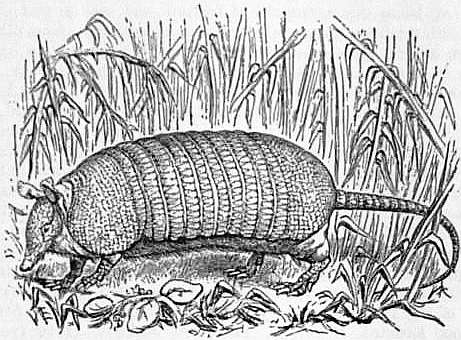
Peba Armadillo (Tatusia novemcincta).
ARMAGEDDON, a name occurring in the Authorized Version of the English Bible in Rev. xvi. 16. The Revised Version has Harmagedon. The form is commonly regarded as the Greek equivalent of the Hebrew har megiddōn, the mountain district of Megiddo. The writer is describing the place where the last decisive battle was to be fought at the Day of Judgment, and Harmagedon may have been chosen as the name because the district about Megiddo had been on several occasions the scene of great battles (cf. Judg. iv. 6 ff., v. 19). It has, however, been suggested in the Zeitschrift für die Alttestamentliche Wissenschaft, vii. 170 (1887), that the name is for har migdo, “his fruitful mountain”—the mountain land of Israel. Prof. Cheyne (Encyc. Bibl. s.v.) again, following suggestions of H. Gunkel, H. Zimmern and P. Jensen, compares the dragon of the Apocalypse with the Babylonian Tiāmat, thinks that some myth is referred to, and finds the μαγεδων of Ἀρμαγεδων in the divine name Ὑεσεμμιγαδων, a Babylonian god of the underworld. The name of the place where Tiāmat was defeated by Marduk perhaps included that of a god of the underworld. (See Antichrist.) From the application of the word Armageddon to the great battle of the End of Time comes the use of the phrase “an Armageddon” to express any great slaughter or final conflict.
ARMAGH, an inland county of Ireland, in the province of Ulster, bounded N. by Lough Neagh, E. by Co. Down, S. by Louth and W. by Monaghan and Tyrone. The area is 327,704 acres, or about 512 sq. m. The general surface of the county is gently undulating and pleasantly diversified; but in the northern extremity, on the borders of Lough Neagh, there is a considerable tract of low, marshy land, and the southern border of the county is occupied by a barren range of hills, the highest of which, Slieve Gullion, attains an elevation of 1893 ft. In the western portion of the county are the Few Mountains, a chain of abrupt hills mostly incapable of cultivation. The county is well watered by numerous streams. The principal are the Callan, the Tynan and the Tallwater, flowing into the Blackwater, which, after forming the boundary between this county and Tyrone, empties itself into the south-western angle of Lough Neagh. The Tara and Newtown-Hamilton, the Creggan and the Fleury, flow into the bay of Dundalk. The Cam or Camlin joins the Bann, which, crossing the north-western corner of the county, falls into Lough Neagh to the east of the Blackwater. The Newry Canal, communicating with Carlingford Lough at Warrenpoint, 6 m. below Newry, proceeds northward through Co. Armagh for about 21 m., joining the Bann at Whitecoat. The Ulster Canal begins at Charlemont on the river Blackwater, near its junction with Lough Neagh, proceeding through the western border of the county, and passing thence to the south-west by Monaghan and Clones into Upper Lough Erne, after a course of 48 m. Part of Lough Neagh is in the county, and there are many small loughs, such as Gullion, Cam and Ross.
Geology.—The flat shore of Lough Neagh in the north is due to the thick deposit of pale-coloured clays with lignites, which are probably of Pliocene age, and indicate a reduction of the area of the lake in still later times. Between this lowland and Armagh city, the early Cainozoic basalts form slightly higher ground, while on the west a strip of Trias appears, overlying Carboniferous Limestone. A rough conglomerate containing blocks of this latter rock forms the hills on which Armagh itself is built; this outlier is probably Permian. The Carboniferous Limestone beneath it and around it is red-brown instead of grey, and is famous for its richness in fish remains. A hummocky irregular country spreads southward, where the Silurian axis is encountered, in continuation of the southern uplands of Scotland. Slates and fine-grained sandstones appear here freely through the glacial drift. In the south the granite core of this upland is revealed, and is quarried extensively about Bessbrook. It is penetrated by far younger intrusive masses at Slieve Gullion and Forkill. These rocks, which include some highly siliceous lavas, form part of the Eocene series that is so conspicuously displayed above Carlingford in Co. Louth. Lead-veins have been worked in various parts of the county from time to time.
Industries.—The soil of the northern portion of the county is a rich brown loam, on a substratum of clay or gravel. Towards Charlemont there is much reclaimable bog resting on a limestone substratum. The eastern portion of the county is generally of a light friable soil; the southern portion rocky and barren, with but little bog except in the neighbourhood of Newtown-Hamilton. The climate of Armagh is considered to be one of the most genial in Ireland, and less rain is supposed to fall in this than in any other county. Only about one-twentieth of the land is naturally barren, and Armagh offers a relatively large area of cultivable soil. Agriculture, however, is not far advanced, yet owing to the linen industry the inhabitants are generally in circumstances of comparative comfort. The principal crops are oats and potatoes, but all grain crops are decreasing, and flax, formerly grown to a considerable extent, is now practically neglected. The acreage under pasture slightly exceeds that of tillage. Cattle, sheep, pigs and poultry show a general increase in numbers. The principal manufacture, and that which has given a peculiar tone to the character of the population, is that of linen, though it has somewhat declined in modern times. It is not necessary to the promotion of this manufacture that the spinners and weavers should be congregated in large towns, or united in crowded and unwholesome factories. On the contrary, most of its branches can be carried on in the cottages of the peasantry. The men devote to the loom those hours which are not required for the cultivation of their little farms; the women spin and reel the yarn during the intervals of their other domestic occupations. Smooth lawns, pure springs and the open sky are necessary for perfecting the bleaching process. Hence the numerous bleachers dwell in the country with their assistants and machinery. Such is the effect of this combination of agricultural occupations with domestic manufactures that the farmers are more than competent to supply the resident population of the county with vegetable, though not with animal food; and some of the less crowded and less productive parts of Ulster receive from Armagh a considerable supply of oats, barley and flour. Apples are grown in such quantities as to entitle the county to the title applied to it, the orchard of Ireland.
Communications are monopolized by the Great Northern railway company, whose main line from Belfast divides at Portadown, sending off lines to Omagh, to Clones and to Dublin. A branch from Omagh joins the Dublin line to Goraghwood, and from this line there is a branch to Newry in Co. Down. An electric tram-way connects Bessbrook, a town with important linen manufactures and granite quarries, with Newry.
Population and Administration.—The population (72,286 in 1891; 65,619 in 1901) shows a heavy decrease, though emigration affects it less seriously than the majority of Irish counties. Of the total about 45% are Roman Catholics, 32% Protestant Episcopalians, and 16% Presbyterians, the Roman Catholic faith prevailing in the mountainous districts and the Protestant in the towns and lowlands. About 74% of the whole constitutes the rural population. The chief towns are Armagh (a city and the county town, pop. 7588), Lurgan (11,782), Portadown (10,092), Tanderagee (1427), Bessbrook (2977) and Keady (1466). Armagh is divided into eight baronies, and contains twenty-five parishes and parts of parishes, the greater number of which are in the Protestant and Roman Catholic dioceses of Armagh, and a few in the Roman Catholic diocese of Dromore. The constabulary has its headquarters at Armagh, the county being divided into five districts. Assizes are held at Armagh, and quarter sessions at Armagh, Ballybot, Lurgan, Markethill and Newtown-Hamilton. The parliamentary divisions are three: mid, north and south, each returning one member.
History and Antiquities.—Armagh, together with Louth, Monaghan and some smaller districts, formed part of a territory called Orgial or Urial, which was long subject to the occasional incursions of the Danes. The county was made shire ground in 1586, and called Armagh after the city by Sir John Perrott. When James I. proceeded to plant with English and Scottish colonists the vast tracts escheated to the crown in Ulster, the whole of the arable and pasture land in Armagh, estimated at 77,800 acres, was to have been allotted in sixty-one portions. Nineteen of these, comprising 22,180 acres, were to have been allotted to the church, and forty-two, amounting to 55,620 acres, to English and Scottish colonists, servitors, native Irish and four corporate towns—the swordsmen to be dispersed throughout Connaught and Munster. This project was not strictly adhered to in Co. Armagh, nor were the Irish swordsmen or soldiers transplanted into Connaught and Munster from this and some other counties. The antiquities consist of cairns and tumuli; the remains of the fortress of Emain near the city of Armagh (q.v.), once the residence of the kings of Ulster; and Danes Cast, an extensive fortification in the south-east of the county, near Poyntzpass, extending into Co. Down. Spears, battle-axes, collars, rings, amulets, medals of gold, ornaments of silver, jet and amber, &c., have also been found in various places. The religious houses were at Armagh, Killevy, Kilmore, Stradhailloyse and Tahenny. Of military antiquities the most remarkable are Tyrone’s ditches, near Poyntzpass; and the pass of Moyry, the entry into the county from the south, which was fiercely contested by the Irish in 1595 and 1600, is defended by a castle. The summit of Slieve Gullion is crowned by a large cairn, which forms the roof of a singular cavern of artificial construction, probably an early burial-place.
ARMAGH, a city and market town, and the county town of Co. Armagh, Ireland, in the mid parliamentary division, 89½ m. N.N.W. of Dublin by the Great Northern railway, at the junction of the Belfast-Clones line. Pop. (1901) 7588. It is said to derive its name of Ard-macha, the Hill of Macha, from Queen Macha of the Golden Hair, who flourished in the middle of the 4th century B.C. but earlier it was named from its situation on the sides of a steep hill called Drumsailech, or the Hill of Sallows, which rises in the midst of a fertile plain near the Callan stream. Of high antiquity, and, like many other Irish towns, claiming (with considerable probability) to have been founded by St Patrick in the 5th century, it long possessed the more important distinction of being the metropolis of Ireland; and, as the seat of a flourishing college, was greatly frequented by students from other lands, among whom the English and Scots were said to have been so numerous as to give the name of Trian-Sassanagh, or Saxon Street, to one of the quarters of the city. St Patrick’s bell, long preserved at Armagh, the oldest Irish relic of its kind, is now, with its shrine of the year 1091, preserved in the museum of the Royal Irish Academy at Dublin. Of a synod that was held at Armagh as early as 448, there is an interesting memorial in the Book of Armagh, an Irish MS. dating about A.D. 800. Exposed to the successive calamities of the Danish incursions, the English conquest and the English wars, and at last deserted by its bishops, who retired to Drogheda, the venerable city sank into an insignificant collection of cabins, with a dilapidated cathedral. From this state of decay, however, it was raised, in the second half of the 18th century, by the unwearied exertions of Archbishop Richard Robinson, 1st Lord Rokeby (1709-1794), which, seconded by similar devotion on the part of succeeding archbishops of the Beresford family, notably Archbishop Lord John George Beresford (1773-1862), made of Armagh one of the best built and most respectable towns in the country. As the ecclesiastical metropolis and seat of an archbishop (Primate of all Ireland) in both the Protestant and Roman organizations, it possesses two cathedrals and two archiepiscopal palaces. As the county town Armagh has a court-house, a prison, a lunatic asylum and a county infirmary. Besides these there is a fever hospital, erected by Lord John George Beresford; a college, which Primate Robinson was anxious to raise to the rank of a university; a public library founded by him, an observatory, which has become famous from the efficiency of its astronomers; a number of churches and schools, and barracks. Almost all the buildings are built of the limestone of the district, but the Anglican cathedral is of red sandstone. It stands boldly on the top of the hill, a cruciform structure dating from the 13th, but practically rebuilt in the 18th century, in accordance with its original plan. The Roman Catholic cathedral is in the Decorated style, and was consecrated in 1873. Armagh was a parliamentary borough until 1885; and, having been incorporated in 1613, so remained until 1835. The administration is in the hands of an urban district council. Two miles W. of Armagh is Emain, Emania, or Navan Fort, with large entrenchments and mounds, the site of a royal palace of Ulster, founded by that Queen Macha who gave her name to the city. In A.D. 335 it was destroyed during the inroad on the defeat of the king of Ulster by the three brothers Colla, cousins of Muredach, king of Ireland. Armagh itself fell before the king Brian Boroime, who was buried here; and before Edward Bruce in 1315, while previous to the English war after the Reformation, it had witnessed the struggles of Shane O’Neill (1564).
ARMAGNAC, formerly a province of France and the most important fief of Gascony, now wholly comprised in the department of Gers (q.v.). In the 15th century, when it attained its greatest extent, it included, besides Armagnac, the neighbouring territories of Fezensac, Fezensaguet, Pardiac, Pays de Gaure, Rivière Basse, Eauzan and Lomagne, and stretched from the Garonne to the Adour. Armagnac is a region of hills ranging to a height of 1000 ft., watered by the river Gers and other rivers which descend fanwise from the plateau of Lannemezan. On the slope of its hills grow the grapes from which the famous Armagnac brandy is made. In Roman Gaul this territory formed part of the diocese of Auch (civitas Ausciorum), which corresponded roughly with the later duchy of Gascony (q.v.). About the end of the 9th century Fezensac (comitatus Fedentiacus), in circumstances of which no trustworthy record remains, was erected into an hereditary countship. This latter was in its turn divided, the south-western portion becoming, about 960, the countship of Armagnac (pagus Armaniacus). The domain of this countship, at first very limited in extent, continued steadily to increase in size, and about 1140 Count Gerald III. added the whole of Fezensac to his possessions. Under the English rule the counts of Armagnac were turbulent and untrustworthy vassals; and the administration of the Black Prince, tending to favour the towns of Aquitaine at the expense of the nobles, drove them to the side of France. The complaint against the English prince which Count John I., in defiance of the treaty of Brétigny, himself carried to Paris, was the principal cause of the resumption of hostilities of 1369, and of the incessant defeats sustained by the English until the accession of their king Henry V.
At that moment Count Bernard VII. was all-powerful at the French court; and Charles of Orleans, in order to be able to avenge his father, Louis of Orleans, who had been assassinated in 1407 by John the Fearless, duke of Burgundy, married Bonne, Bernard’s daughter. This was the origin of the political party known as “the Armagnacs.” With the object of combating the duke of Burgundy’s preponderant influence, a league was formed at Gien, including the duke of Orleans and his father-in-law, the dukes of Berry, Bourbon and Brittany, the count of Alençon and all the other discontented nobles. Bernard VII. ravaged the environs of Paris; and the treaty of Bicêtre (November 2, 1410) only suspended hostilities for a few months, war breaking out afresh in the spring of 1411. Paris sided with the duke of Burgundy, and at his instigation Charles VII. collected an army to besiege the allies in Bourges. The peace of Bourges, confirmed at Auxerre on the 22nd of August, put an end to the war. Paris was dominated at that time by the party of the “butchers,” or Cabochiens, which had been organized and armed by the count of Saint-Pol, brother-in-law of John the Fearless. But their excesses, and in particular the Cabochien ordinance of the 25th of May 1413, aroused public indignation; a reaction took place, and in the month of August the Armagnacs in their turn became masters of the government and of the king. The duke of Burgundy, besieged in Arras, only obtained peace (treaty of Arras, September 4, 1414), on condition of not returning to Paris.
Several months later Henry V. declared war against France; and when, in August 1415, the English landed in Normandy, the Armagnacs and Burgundians united against them, but were defeated in the battle of Agincourt (October 25, 1415). John the Fearless then began negotiations with the English, while Bernard VII., appointed constable in place of the count of Saint-Pol, who had been killed at Agincourt, returned to defend Paris. However, the excesses committed by the Armagnacs incensed the populace, and John the Fearless, who was ravaging the surrounding districts, re-entered the capital on the 29th of May 1418, in consequence of the treason of Perrinet Leclerc. On the 12th of June Bernard VII. and the members of his party were massacred. From this time onward the Armagnac party, with the dauphin, afterwards King Charles VII., at its head, was the national party, while the Burgundians united with the English. This division in France continued until the treaty of Arras, on the 21st of September 1435. The rivalry of the Burgundians and Armagnacs brought terrible disasters upon France, and for many years afterwards the name of “Armagnacs” was bestowed upon the bands of adventurers who were as much to be feared as the Grandes Compagnies of the preceding age.
In 1444-45 the emperor Frederick III. of Germany obtained from Charles VII. a large army of Armagnacs to enforce his claims in Switzerland, and the war which ensued took the name of the Armagnac war (Armagnakenkrieg). In Germany the name of the foreigners, who were completely defeated in the battle of St Jakob on the Birs, not far from Basel, was mockingly corrupted into Arme Jacken, Poor Jackets, or Arme Gecken, Poor Fools.
On the death of Charles of Armagnac, in 1497, the countship was united to the crown by King Charles VII., but was again bestowed on Charles, the nephew of that count, by Francis I., who at the same time gave him his sister Margaret in marriage. After the death of her husband, by whom she had no children, she married Henry of Albret, king of Navarre; and thus the countship of Armagnac came back to the French crown along with the other dominions of Henry IV. In 1645 Louis XIV. erected a countship of Armagnac in favour of Henry of Lorraine, count of Harcourt, in whose family it continued till the Revolution. James of Armagnac, grandson of Bernard VII., was made duke of Nemours in 1462, and was succeeded in the dukedom by his second son, John, who died without issue, and his third son, Louis, in whom the house of Armagnac became extinct in 1503.
In 1789 Armagnac was a province forming part of the Gouvernement-général of Guienne and Gascony; it was divided into two parts, High or White Armagnac, with Auch for capital, and Low or Black Armagnac. At the Revolution the whole of the original Armagnac was included in the department of Gers.
For authorities see U. Chevalier, Répertoire des sources hist, du moyen âge, s. Armagnac (Montbéliard, 1894). For the Armagnacs see Paul Dognon, “Les Armagnacs et les Bourguignons, le comte de Foix et le dauphin en Languedoc” (1416-1420) in Annales du Midi (1889); Rameau, “Guerre des Armagnacs dans le Mâconnais” (1418-1435) in the Rév. soc. lit. de l’Ain (1884); Berthold Zeller, Les Armagnacs et les Bourguignons, la Commune de 1413; E. Wulcker, Urkunden und Schreiben betreffend den Zug der Armagnaken (Frankfort, 1873); Witte, Die Armagnaken im Elsass, 1439-1445 (Strassburg, 1889).
ARMATOLES (Gr. ἀρματωλός, a man-at-arms), the name given to some Greeks who discharged certain military and police functions under the Turkish government. When the Turks under Sultan Mahommed II. conquered Greece in the 15th century, many of the Greeks fled into the mountainous districts of Macedonia and northern Greece, and maintained a harassing warfare with the conquerors of their country. These men were called Klephts (modern Gr. κλέφτης, ancient κλέπτης, a thief, a brigand), and during the 16th century the Turkish pashas came to terms with some of them, and these men were allowed to retain their local customs, and were confirmed in the possession of certain districts, while in return they undertook some duties, such as the custody of the highroads. Those who accepted these terms were called armatoles, and the districts in which they lived armatoliks. Strengthened by a considerable number of Christian Albanians, they rendered good service in defending Greece, and to some extent repressed the ravages of the Klephts; but their power and independence were disliked by the Turks. After the peace of Belgrade in 1739 (between Austria and Turkey), the Turkish government sought to weaken the position of the armatoles. Their privileges were restricted, Mahommedan Albanians were introduced into the armatoliks, and towards the end of the 18th century their numbers were seriously reduced. Irritated by this policy the armatoles rendered considerable service to Ali Pasha of Iannina in his struggle with the Turks in 1820-22, and afforded valuable assistance to their countrymen during the Greek war of independence in 1830.
ARMATURE (from Lat. armatura, armour), a covering for defence. In zoology the word is used of the bony shell of the armadillo. In architecture it is applied to the iron stays by which the lead lights are secured in windows. (See Stanchion and Saddle: Saddle-Bars.) In magnetism Dr William Gilbert applied the term to the piece of soft iron with which he “armed” or capped the lodestone in order to increase its power. It is also used for the “keeper” or piece of iron which is placed across the poles of a horse-shoe magnet, and held in place by magnetic attraction, in order to complete the magnetic circuit and preserve the magnetism of the steel; and hence, in dynamo-electric machinery, for the portion which is attracted by the electromagnet, as the moving part of an electric motor, or, by extension, the moving part of a dynamo (q.v.).
ARMAVIR, (1) The ruins of the old capital of Armenia, on the S.E. slope of the extinct volcano Ala-geuz, according to legend, built by Armais, a grandson of Haik, in 1980 B.C., and the capital of the Armenian kings till the 2nd century A.D. Now a small village, Tapadibi, occupies its seat. (2) A district town of Russia, northern Caucasia, province of Kuban, on Kuban river, and on the main line of the Caucasian railway, 40 m. by rail west of Stavropol, built in 1848 for the settlement of Armenian mountaineers, and now a well-built, growing town with 8000 inhabitants, the merchants of which carry on a lively trade.
ARMENIA (old Persian Armina, Armenian Hayasdan, or Hayq), the popular modern name of a district south of the Caucasus and Black Sea, which formed part of the ancient Armenian kingdom. The name, which first occurs in the cuneiform inscriptions of Darius Hystaspis, supplanted the earlier Urardhu, or Ararat, but its origin is unknown. In its widest extent Armenia stretched from 37° to 49° E. long., and from 37½° to 41½° N. lat.; but this area was never, or only for a brief period, united under one king. Armenia is now divided between Persia, Russia and Turkey, and the three boundaries have a common point on Little Ararat.
Geographically, Armenia is a continuation westward of the great Iranian plateau. On the north it descends abruptly to the Black Sea; on the south it breaks down in rugged terraces to the lowlands of Mesopotamia; and on the east and west it sinks more gradually to the lower plateaus of Persia and Asia Minor. Above the general level of the plateau, 6000 ft., rise bare ranges of mountains, which run from north-east to south-west at an altitude of 8000-12,000 ft., and culminate in Ararat, 17,000 ft. Between the ranges are broad elevated valleys, through which the rivers of the plateau flow before entering the rugged gorges that convey their waters to lower levels. Geologically, Armenia consists of archaic rocks upon which, towards the north, are superimposed Palaeozoic, and towards the south later sedimentary rocks. The last have been pierced by volcanic outbursts that extend southward to Lake Van. Amongst the higher mountains are the two Ararats; Ala-geuz Dagh, north of the Aras; Bingeul Dagh, south of Erzerum; and the peaks near Lake Van. The rivers are the Euphrates, Tigris, Aras, Churuk Su (Chorokh) and Kelkit Irmak, all rising on the plateau. The more important lakes are Van, 5100 ft., about twice the size of the Lake of Geneva, and Urmia, 4000 ft., both salt; Gokcha or Sevan, 5870 ft., discharging into the Aras; and Chaldir, into the Kars Chai. The aspect of the plateau is dreary and monotonous. The valleys are wide expanses of arable land, and the hills are for the most part grass-covered and treeless. But the gorges of the Euphrates and Tigris, and their tributaries, cannot be surpassed in wildness and grandeur. The climate is varied. In the higher districts the winter is long and the cold severe; whilst the summer is short, dry and hot. In Erzerum the temperature ranges from −22° to 84° F., and snow sometimes falls in June. In the valley of the Aras, and in the western and southern districts, the climate is more moderate. Most of the towns lie high, from 4000 to 6000 ft. The villages are usually built on gentle slopes, in which the houses are partially excavated as a protection against the severity of the weather. Many of the early towns were on or near the Araxes, and amongst their ruins are the remains of churches which throw light on the history of Christian architecture in the East. Armenia is rich in mineral wealth, and there are many hot and cold mineral springs. The vegetation varies according to the locality. Cereals and hardy fruits grow on the higher ground, whilst rice is cultivated in the hot, well-watered valley of the Araxes. The summer is so hot that the vine grows at much higher altitudes than it does in western Europe, and the cotton tree and all southern fruit trees are cultivated in the deeper valleys. On the fine pasture lands which now support the flocks of the Kurds, the horses and mules, so celebrated in ancient times, were reared. Trout are found in the rivers, and a small herring in Lake Van. The country abounds in romantic scenery; that of the district of Ararat especially has been celebrated by patriotic historians like Moses of Chorene and Lazarus of Pharb.
Population.—Accurate statistics cannot be obtained; but it is estimated that in the nine vilayets, which include Turkish Armenia, there are 925,000 Gregorian, Roman Catholic and Protestant Armenians, 645,000 other Christians, 100,000 Jews, Gypsies, &c., and 4,460,000 Moslems. The Armenians, taking the most favourable estimate, are in a majority in nine kazas or sub-districts only (seven near Van, and two near Mush) out of 159. In Russian Armenia there are 960,000 Armenians, and in Persian Armenia 130,000. According to an estimate made by General Zelenyi for the Caucasus Geographical Society (Zapiski, vol. xviii., Tiflis, 1896, with map), the population of the nine Turkish vilayets, Erzerum, Van, Bitlis, Kharput (Mamuret-el-Aziz). Diarbekr, Sivas, Aleppo, Adana and Trebizond, was 6,000,000 (Armenians, 913,875, or 15%; other Christians, 632,875, or 11%; and Moslems, 4,453,250, or 74%). In the first five vilayets which contain most of the Armenians, the population was 2,642,000 (Armenians, 633,250, or 24%; other Christians, 179,875, or 7%; and Moslems, 1,828,875, or 69%); and in the seven Armenian kazas the population was 282,375 (Armenians, 184,875, or 65%; other Christians, 1000, or 0.3%; and Moslems, 96,500, or 34.7%). In 1897 there were 970,656 Armenians in Russia, of whom 827,634 were in the provinces of Erivan, Elisavetpol and Tiflis.
The total number of Armenians is estimated at 2,900,000 (in Turkey, 1,500,000; Russia, 1,000,000; Persia, 150,000; Europe, America and East Indies, 250,000).
History.—The history of Armenia has been largely influenced by its physical features. The isolation of the valleys, especially in winter, encouraged a tendency to separation, which invariably showed itself when the central power was weak. The rugged mountains have always been the home of hardy mountaineers impatient of control, and the sanctuary to which the lowlanders fled for safety in times of invasion. The country stands as an open doorway between the East and the West. Through its long valleys run the roads that connect the Iranian plateau with the fertile lands and protected harbours of Asia Minor, and for its possession nations have contended from the remotest past.
The original inhabitants of Armenia are unknown, but, about the middle of the 9th century B.C., the mass of the people belonged to that great family of tribes which seems to have been spread over western Asia and to have had a common Ethnology. non-Aryan language. Mixed with these proto-Armenians, there was an important Semitic element of Assyrian and Hebrew origin. In the 7th century B.C., between 640 and 600, the country was conquered by an Aryan people, who imposed their language, and possibly their name, upon the vanquished, and formed a military aristocracy that was constantly recruited from Persia and Parthia. Politically the two races soon amalgamated, but, except in the towns, there was apparently little intermarriage, for the peasants in certain districts closely resemble the proto-Armenians, as depicted on their monuments. After the Arab and Seljuk invasions, there was a large emigration of Aryan and Semitic Armenians to Constantinople and Cilicia; and all that remained of the aristocracy was swept away by the Mongols and Tatars. This perhaps explains the diversity of type and characteristics amongst the modern Armenians. In the recesses of Mount Taurus the peasants are tall, handsome, though somewhat sharp-featured, agile and brave. In Armenia and Asia Minor they are robust, thick-set and coarse-featured, with straight black hair and large hooked noses. They are good cultivators of the soil, but are poor, superstitious, ignorant and unambitious, and they live in semi-subterranean houses as their ancestors did 800 years B.C. The townsmen, especially in the large towns, have more regular features—often of the Persian type. They are skilled artisans, bankers and merchants, and are remarkable for their industry, their quick intelligence, their aptitude for business, and for that enterprising spirit which led their ancestors, in Roman times, to trade with Scythia, China and India. The upper classes are polished and well educated, and many have occupied high positions in the public service in Turkey, Russia, Persia and Egypt. The Armenians are essentially an Oriental people, possessing, like the Jews, whom they resemble in their exclusiveness and widespread dispersion, a remarkable tenacity of race and faculty of adaptation to circumstances. They are frugal, sober, industrious and intelligent, and their sturdiness of character has enabled them to preserve their nationality and religion under the sorest trials. They are strongly attached to old manners and customs, but have also a real desire for progress which is full of promise. On the other hand they are greedy of gain, quarrelsome in small matters, self-seeking and wanting in stability; and they are gifted with a tendency to exaggeration and a love of intrigue which has had an unfortunate influence on their history. They are deeply separated by religious differences, and their mutual jealousies, their inordinate vanity their versatility and their cosmopolitan character must always be an obstacle to the realization of the dreams of the nationalists. The want of courage and self-reliance, the deficiency in truth and honesty sometimes noticed in connexion with them, are doubtless due to long servitude under an unsympathetic government.
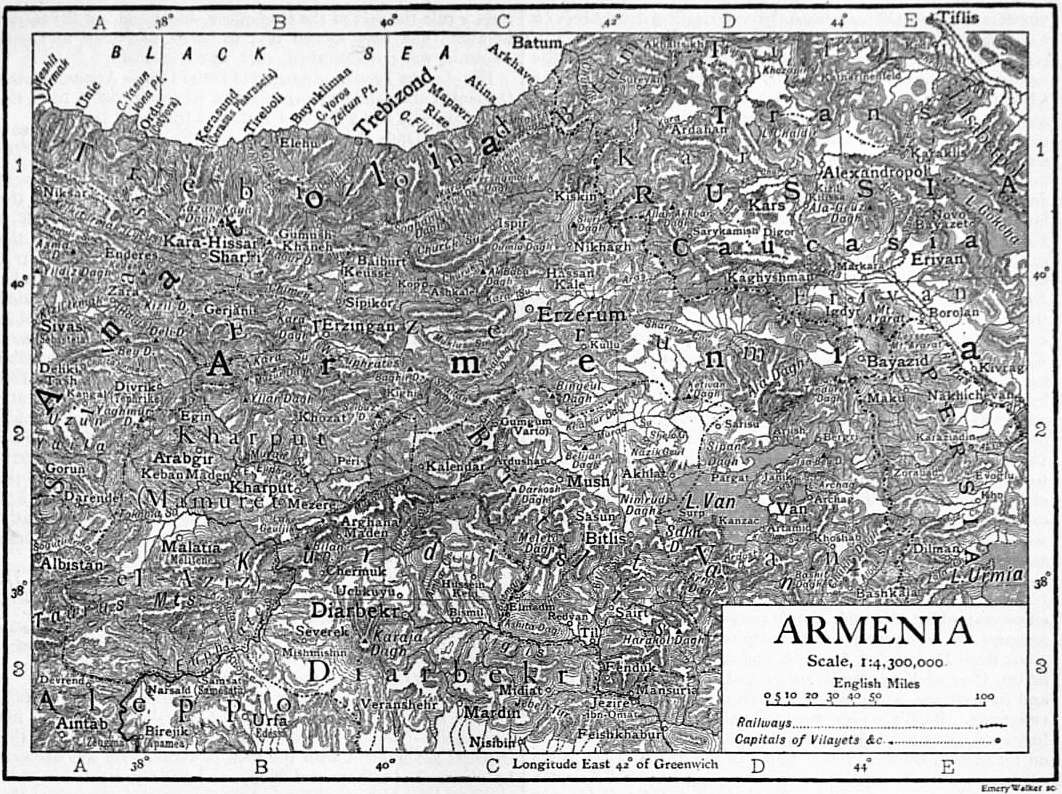
The early history of Armenia, more or less mythical, is partly based on traditions of the Biainian kings (see Ararat), and is interwoven with the Bible narrative, of which a knowledge was possibly obtained from captive Jews settled Ancient kingdom. in the country by Assyrian and Babylonian monarchs. The legendary kings are but faint echoes of the kings of Biainas; the story of Semiramis and Ara is but another form of the myth of Venus and Adonis; and tradition has clothed Tigranes, the reputed friend of Cyrus, with the transient glory of the opponent of Lucullus. The fall of the Biainian kingdom, perhaps overthrown by Cyaxares, was apparently soon followed by an immigration of Aryan (Medo-Persian) races, including the progenitors of the Armenians. But they spread slowly, for the “Ten Thousand,” when crossing the plateau to Trebizond, 401-400 B.C., met no Armenians after leaving the villages four days’ march beyond the Teleboas, now Kara Su. Under the Medes and Persians Armenia was a satrapy governed by a member of the reigning family; and after the battle of Arbela, 331 B.C., it was ruled by Persian governors appointed by Alexander and his successors. Ardvates, 317-284 B.C., freed himself from Seleucid control; and after the defeat of Antiochus the Great by the Romans, 190 B.C., Artaxias (Ardashes), and Zadriades, the governors of Armenia Major and Armenia Minor, became independent kings, with the concurrence of Rome. (See Tigranes.) Artaxias established his capital at Artaxata on the Araxes, and his most celebrated successor was Tigranes (Dikran), 94-56 B.C., the son-in-law of Mithradates VI., the Great. Tigranes founded a new capital, Tigranocerta, in northern Mesopotamia, which he modelled on Nineveh and Babylon, and peopled with Greek and other captives. Here, and at Antioch, he played the part of “great king” in Asia until his refusal to surrender his father-in-law involved him in war with Rome. Defeated, 69 B.C., by Lucullus beneath the walls of his capital, he surrendered his conquests to Pompey, 66 B.C., who had driven Mithradates across the Phasis, and was permitted to hold Armenia as a vassal state of Rome.
The campaigns of Lucullus and Pompey brought Rome into delicate relations with Parthia. Armenia, although politically dependent upon Rome, was connected with Parthia by geographical position, a common language and faith, Under later Empire. intermarriage and similarity of arms and dress. It had never been Hellenized, as the provinces of Asia Minor had been; the Roman provincial system was never applied to it; and the policy of Rome towards it was never consistent. The country became the field upon which the East and West contended for mastery, and the struggle ended for a time in the partition of Armenia, A.D. 387, between Rome and Persia. The Roman portion was soon added to the Diocesis Pontica. The Persian portion, Pers-Armenia, remained a vassal state under an Arsacid prince until 428. It was afterwards governed by Persian and Armenian noblemen selected by the “great king,” and entitled marzbans. Before the partition, Tiridates, converted by St Gregory, “the Illuminator,” had established Christianity as the religion of the state, and set an example followed later by Constantine. After the partition, the invention of the Armenian alphabet, and the translation of the Bible into the vernacular, 410, drew the Armenians together, and the discontinuance of Greek in the Holy Offices relaxed the ecclesiastical dependence on Constantinople, which ceased entirely when the Patriarch, 491, refused to accept the decrees of the council of Chalcedon. The rule of the marzbans was marked by relentless persecution of the Christians, forced conversions to Magism, frequent insurrections and the rise to importance of the great families founded by men of Assyrian, Parthian, Persian, Syrian and Jewish origin, and in some cases of royal blood, who had been governors of districts, or holders of fiefs under the Arsacids. Amongst the marzbans were Jewish Bagratids and Persian Mamegonians; and one of the latter family, Vartan, made himself independent (571-578), with Byzantine aid. In 632 the victories of Heraclius restored Armenia to the Byzantines; but the war that followed the Arab invasion, 636, left the country in the hands of the caliphs, who set over it Arab and Armenian governors (ostikans). One of the governors, the Bagratid Ashod I., was crowned king of Armenia by the caliph Motamid, 885, and founded a dynasty which ended with Kagig II. in 1079. A little later the Ardzrunian Kagig, governor of Vaspuragan or Van, was crowned king of that province by the caliph Moktadir, 908, and his descendants ruled at Van and Sivas until 1080. The Bagratids founded dynasties at Kars, 962-1080, and in Georgia, which they held until its absorption, 1801, by Russia. From 984 to 1085 the country from Diarbekr to Melasgerd was ruled under the suzerainty first of Arabs then of Byzantines and Seljuks, by the Mervanid dynasty of Kurds, called princes of Abahuni (Ἀπαχουνῆς). The Arab invasion drove many Armenian noblemen to Constantinople, where they intermarried with the old Roman families or became soldiers of fortune. Artavasdes, an Arsacid, usurped the Byzantine throne for two years; Leo V., an Ardzrunian, and John Zimisces, became emperors; whilst Manuel, the Mamegonian, and others were amongst the best generals of the empire. In 991, and again in 1021, Basil II. invaded Armenia, and in the latter year Senekherim, king of Vaspuragan, exchanged his kingdom for Sivas and its territory, where he settled down with many Armenian emigrants. Basil’s policy was to make the great Armenian fortresses, garrisoned by imperial troops, the first line of defence on his eastern frontier; but it failed in the hands of his feeble successors, who thought more of converting heretical Armenia than of defending its frontier. The king of Ani, Kagig II., was compelled to exchange his kingdom for estates in Cappadocia. The country was raided by Seljuks and harried by Byzantine soldiers, and the miseries of the people were regarded as gain to the Orthodox church. After the defeat and capture of Romanus IV. by Alp Arslan, 1071, Armenia formed part of the Seljuk empire until it split up, 1157, into petty states, ruled by Arabs, Kurds and Seljuks, who were in turn swept away by the Mongol invasion, 1235. For more than three centuries after the appearance of the Seljuks, Armenia was traversed by a long Medieval Partition. succession of nomad tribes whose one aim was to secure good pasturage for their flocks on their way to the richer lands of Asia Minor. The cultivators were driven from the plains, agriculture was destroyed, and the country was seriously impoverished when its ruin was completed by the ravages and wholesale butcheries of Timur. Many Armenians fled to the mountains, where they embraced Islam, and intermarried with the Kurds, or purchased security by paying blackmail to Kurdish chiefs. Others migrated to Cappadocia or to Cilicia, where the Bagratid Rhupen had founded, 1080, a small principality which, gradually extending its limits, became the kingdom of Lesser Armenia. This Christian kingdom in the midst of Moslem states, hostile to the Byzantines, giving valuable support to the leaders of the crusades, and trading with the great commercial cities of Italy, had a stormy existence of about 300 years. Internal disorders, due to attempts by the later Lusignan kings to make their subjects conform to the Roman Church, facilitated its conquest by Egypt, 1375. The memory of Kiligia (Cilicia) is enshrined in a popular song, and at Zeitun, in the recesses of Mount Taurus, a small Armenian community has hitherto maintained almost complete independence. After the death of Timur, Armenia formed part of the territories of the Turkoman dynasties of Ak- and Kara-Kuyunli, and under their milder rule the seat of the Catholicus, which, during the Seljuk invasion, had been moved first to Sivas, and then to Lesser Armenia, was re-established, 1441, at Echmiadzin.
In 1514, the Persian campaign of Selim I. gave Armenia to the Osmanli Turks, and its reorganization was entrusted to Idris, the historian, who was a Kurd of Bitlis. Idris found the rich arable lands almost deserted, and the mountains Under Turkey. bristling with the castles of independent chieftains, of Kurd, Arab and Armenian descent, between whom there were long-standing feuds. He compelled the Kurds to settle on the vacant lands, and divided the country into small sanjaks which in the plains were governed by Turkish officials, and in the mountains by local chiefs. This policy gave rest to the country, but favoured the growth of Kurd influence and power, which by 1534 had spread westwards to Angora. Armenia was invaded by the Persians in 1575, and again in 1604, when Shah Abbas transplanted many thousand Armenians from Julfa to his new capital Isfahan. In 1639, the province of Erivan, which included Echmiadzin, was assigned by treaty to Persia, and it remained in her hands until it passed to Russia, 1828, under the treaty of Turkman-chai. The Turko-Russian War of 1828-29, which advanced the Russian frontier to the Arpa Chai, was followed by a large emigration of Armenians from Turkish to Russian territory, and a smaller exodus took place after the war of 1877-78, which gave Batum, Ardahan and Kars to Russia. In 1834 the independent power of the Kurds in Armenia was greatly curtailed; and risings under Bedr Khan Bey in 1843, and Sheik Obeidullah in 1880, were firmly suppressed.
After the capture of Constantinople, 1453, Mahommed II. organized his non-Moslem subjects in communities, or millets, under ecclesiastical chiefs to whom he gave absolute authority in civil and religious matters, and in criminal Gregorian Armenians. offences that did not come under the Moslem religious law. Under this system the Armenian bishop of Brusa, who was appointed patriarch of Constantinople by the sultan, became the civil, and practically the ecclesiastical head of his community (Ermeni millet), and a recognized officer of the imperial government with the rank of vizier. He was assisted by a council of bishops and clergy, and was represented in each province by a bishop. This imperium in imperio secured to the Armenians a recognized position before the law, the free enjoyment of their religion, the possession of their churches and monasteries, and the right to educate their children and manage their municipal affairs. It also encouraged the growth of a community life, which eventually gave birth to an intense longing for national life. On the other hand it degraded the priesthood. The priests became political leaders rather than spiritual guides, and sought promotion by bribery and intrigue. Education was neglected and discouraged, servility and treachery were developed, and in less than a century the people had become depraved and degraded to an almost incredible extent. After the issue, 1839, of the hatt-i-skerif of Gül-khaneh, the tradesmen and artisans of the capital freed themselves from clerical control. Under regulations, approved by the sultan in 1862, the patriarch remained the official representative of the community, but all real power passed into the hands of clerical and lay councils elected by a representative assembly of 140 members. The “community,” which excluded Roman Catholics and Protestants, was soon called the “nation,” “domestic” became “national” affairs, and the “representative” the “national” assembly.
The connexion of “Lesser Armenia” with the Western powers led to the formation, 1335, of an Armenian fraternity, “the Unionists,” which adopted the dogmas of the Roman church, and at the council of Florence, 1439, was Roman Catholics. entitled the “United Armenian Church.” Under the millet system the unionists were frequently persecuted by the patriarchs, but this ended in 1830, when, at the intervention of France, they were made a community (Katoluk millet), with their own ecclesiastical head. The Roman Catholics, through the works issued by the Mechitharists at Venice, have greatly promoted the progress of education and the development of Armenian literature. They are most numerous at Constantinople, Angora and Smyrna.
The Protestant movement, initiated at Constantinople by American missionaries in 1831, was opposed by the patriarchs and Russia. In 1846 the patriarch anathematized all Armenians with Protestant sympathies, and this led Protestants. to the formation of the “Evangelical Church of the Armenians,” which was made, after much opposition from France and Russia, a community (Protestant millet), at the instance of the British ambassador. The missionaries afterwards founded colleges on the Bosporus, at Kharput, Marsivan and Aintab, to supply the needs of higher university education, and they opened good schools for both sexes at all their stations. Everywhere they supplied the people with pure, wholesome literature, and represented progress and religious liberty.
When Abd-ul-Hamid came to the throne of Turkey in 1876, the condition of the Armenians was better than it had ever been under the Osmanlis; but with the close of the war of 1877-78 came the “Armenian Question.” By the treaty of San Modern Armenian question. Stefano, Turkey engaged to Russia to carry out reforms “in the provinces inhabited by the Armenians, and to guarantee their security against the Kurds and Circassians.” By the treaty of Berlin, 13th of July 1878, a like engagement to the six signatory powers was substituted for that to Russia. By the Cyprus convention, 4th of June 1878, the sultan promised Great Britain to introduce necessary reforms “for the protection of the Christians and other subjects of the Porte” in the Turkish territories in Asia. The Berlin treaty encouraged the Armenians to look to the powers, and not to Russia for protection; and the convention, which did not mention the Armenians, was regarded as placing them under the special protection of Great Britain. This impression was strengthened by the action of England at Berlin in insisting that Russia should evacuate the occupied territory before reforms were introduced, and so removing the only security for their introduction. The presentation of identic and collective notes to the Porte by the powers, in 1880, produced no result, and in 1882 it was apparent that Turkey would only yield to compulsion. In 1881 a circular note from the British ministry to the five powers was evasively answered, and in 1883 Prince Bismarck intimated to the British government that Germany cared nothing about Armenian reforms and that the matter had better be allowed to drop. Russia had changed her policy towards the Armenians, and the other powers were indifferent. The so-called “Concert of Europe” was at an end, but British ministries continued to call the attention of the sultan to his obligations under the treaty of Berlin.
Russia began to interest herself in the Armenians when she acquired Georgia in 1801; but it was not until 1828-1829 that any appreciable number of them became her subjects. She found them necessary to the development of her Russian policy. new territories, and allowed them much freedom. They were permitted, within certain limits, to develop their national life; many became wealthy, and many rose to high positions in the military and civil service of the state. After the war of 1877-78 the Russian consuls in Turkey encouraged the formation of patriotic committees in Armenia, and a project was formed to create a separate state, under the supremacy of Russia, which was to include Russian, Persian and Turkish Armenia. The project was favoured by Loris-Melikov, then all-powerful in Russia, but in 1881 Alexander II. was assassinated, and shortly afterwards a strongly anti-Armenian policy was adopted. The schools were closed, the use of the Armenian language was discouraged, and attempts were made to Russify the Armenians and bring them within the pale of the Russian Church. All hope of practical self-government under Russian protection now ceased, and the Armenians of Tiflis turned their attention to Turkish Armenia. They had seen the success of the Slav committees in treating disturbances in the Balkans, and became the moving spirit in the attempts to produce similar troubles in Armenia. Russia made no real effort to check the action of her Armenian subjects, and after 1884 she steadily opposed any active interference by Great Britain in favour of the Turkish Armenians. When Echmiadzin passed to Russia, in 1828, the Catholicus began to claim spiritual jurisdiction over the whole Armenian Church, and the submission of the patriarch of Constantinople was obtained by Russia when she helped the sultan against Mehemet Ali. Subsequently Russia secured the submission of the independent catholicus of Sis, and thus acquired a power of interference in Armenian affairs in all parts of the world. During 1900 Russia showed renewed interest in Turkish Armenia by securing the right to construct all railways in it, and in the Armenians by pressing the Porte to restore order and introduce reforms.
The Berlin treaty was a disappointment to the Gregorian Armenians, who had hoped that Armenia and Cilicia would have been formed into an autonomous province administered by Christians. But the formation of such a province was impossible. The Gregorians were scattered over the empire, and, except in a few small districts, were nowhere in a majority. Nor were they bound together by any community of thought or sentiment. The Turkish-speaking Armenians of the south could scarcely converse with the Armenian-speaking people of the north; and the ignorant mountaineers of the east had nothing in common, Revolutionary movement. except religion, with the highly educated townsmen of Constantinople and Smyrna. After the change in Russian policy and the failure of the powers to secure reforms, the advanced party amongst the Armenians, some of whom had been educated in Europe and been deeply affected by the free thought and Nihilistic tendencies of the day, determined to secure their object by the production of disturbances such as those that had given birth to Bulgaria. Societies were formed at Tiflis and in several European capitals for the circulation of pamphlets and newspapers, and secret societies, such as the Huntchagist, were instituted for more revolutionary methods. An active propaganda was carried on in Turkish Armenia by emissaries, who tried to introduce arms and explosives, and represented the ordinary incidents of Turkish misrule to Europe as serious atrocities. The revolutionary movement was joined by some of the younger men, who formed local committees on the Nihilist plan, but it was strongly opposed by the Armenian clergy and the American missionaries, who saw the impossibility of success; and its irreligious tendency and the self-seeking ambition of its leaders made it unacceptable to the mass of the people. Exasperated at their failure, the emissaries organized attacks on individuals, wrote threatening letters, and at last posted revolutionary placards, 5th of January 1893, at Yuzgat, and on the walls of the American College at Marsivan. In the last case the object of the Huntchagists was to compromise the missionaries, and in this they succeeded. The Americans were accused of issuing the placards; two Armenian professors were imprisoned; and the girls’ school was burned down. Outbreaks, easily suppressed, followed at Kaisarieh and other places.
One of the revolutionary dreams was to make the ancient Daron the centre of a new Armenia. But the movement met with no encouragement, either amongst the prosperous peasants on the rich plain of Mush or in the mountain villages of Sasun. In the summer of 1893, an emissary was captured near Mush, and the governor, hoping to secure others, ordered the Kurdish Irregular Horse to raid the mountain district. The Armenians drove off the Kurds,1 and, when attacked in the spring of 1894, again held their own. The vali now called up regular troops from Erzingan; and the sultan issued a firman calling upon all loyal subjects to aid in suppressing the revolt. A massacre of a most brutal character, in which Turkish soldiers took part, followed; and aroused deep indignation in Europe. In November 1894 a Turkish commission of inquiry was sent to Armenia, and was accompanied by the consular delegates of Great Britain, France and Russia, who elicited the fact that there had been no attempt at revolt to justify the action of the authorities. Throughout 1894 the state of the country bordered upon anarchy, and during the winter of 1894-1895 the British government, with lukewarm support from France and Russia, pressed for administrative reforms in the vilayets of Erzerum, Van, Bitlis, Sivas, Memuret-el-Aziz (Kharput) and Diarbekr. The Porte made counter-proposals, and officials concerned in the Sasun massacres were decorated and rewarded. On the 11th of May 1895 the three powers presented to the sultan a complicated scheme of reforms which was more calculated to increase than to lessen the difficulties connected with the government of Armenia; but it was the only one to which Russia would agree. The sultan delayed his answer. Great Britain was in favour of coercion, but Russia, when sounded, replied that she “would certainly not join in any coercive measures” and she was supported by France. At this moment, 21st of June 1895, Lord Rosebery’s cabinet resigned, and when Lord Salisbury’s government resumed the negotiations in August, the sultan appealed to France and Russia against England. During the negotiations the secret societies had not been inactive. Disturbances occurred at Tarsus; Armenians who did not espouse the “national” cause were murdered; the life of the patriarch was threatened; and a report was circulated that the British ambassador wished some Armenians killed to give him an excuse for bringing the fleet to Constantinople. On the 1st of October 1895 a number of Armenians, some armed, went in procession with a petition to the Porte and were ordered by the police to disperse. Shots were fired, and a riot occurred in which many Armenian and some Moslem lives were lost. The British ambassador now pressed the scheme of reforms upon the sultan, who accepted it on the 17th of October. Meanwhile there had been a massacre at Trebizond (October 8), in which armed men from Constantinople took part, and it had become evident that no united action on the part of the powers was to be feared. The sultan refused to publish the scheme of reforms, and massacre followed massacre in Armenia in quick succession until the 1st of January 1896. Nothing was done. Russia refused to agree to any measure of coercion, and declared (December 19) that she would take no action except such as was needed for the protection of foreigners. Great Britain was not prepared to act alone. In the summer of 1896 (June 14-22) there were massacres at Van, Egin, and Niksar; and on the 26th of August the Imperial Ottoman Bank at Constantinople was seized by revolutionists as a demonstration against the Christian powers who had left the Armenians to their fate. The project was known to the Porte, and the rabble, previously armed and instructed, were at once turned loose in the streets. Two days’ massacre followed, during which from 6000 to 7000 Gregorian Armenians perished.