VOLUME II SLICE V Arculf to Armour, Philip (continued 6)
Reading edition
Such is our scanty knowledge of Aristotle’s life, which seems to have been prosperous by inheritance and position, and happy by work and philosophy. His will, which was quoted by Hermippus, and, as afterwards quoted by Diogenes Laertius, has come down to us, though perhaps not complete, supplies some further details, as follows:—Antipater is to be executor with others. Nicanor is to marry Pythias, Aristotle’s daughter, and to take charge of Nicomachus his son. Theophrastus is to be one of the executors if he will and can, and if Nicanor should die to act instead, if he will, in reference to Pythias. The executors and Nicanor are to take charge of Herpyllis, “because,” in the words of the testator, “she has been good to me,” and to allow her to reside either in the lodging by the garden at Chalcis or in the paternal house at Stagira. They are to provide for the slaves, who in some cases are to be freed. They are to see after the dedication of four images by Gryllion of Nicanor, Proxenus, Nicanor’s mother and Arimnestus. They are to dedicate an image of Aristotle’s mother, and to see that the bones of his wife Pythias are, as she ordered, taken up and buried with him. On this will we may remark that Proxenus is said to have been Aristotle’s guardian after the death of his father, and to have been the father of Nicanor; that Herpyllis of Stagira was the mother of Nicomachus by Aristotle; and that Arimnestus was the brother of Aristotle, who also had a sister, Arimneste. Every clause breathes the philosopher’s humanity.
II. Development from Platonism
Turning now from the man to the philosopher as we know him best in his extant writings (see Aristoteles, ed. Bekker, Berlin, 1831, the pages of which we use for our quotations), we find, instead of the general dialogues of Plato, special didactic treatises, and a fundamental difference of philosophy, so great as to have divided philosophers into opposite camps, and made Coleridge say that everybody is born either a Platonist or an Aristotelian. Platonism is the doctrine that the individuals we call things only become, but a thing is always one universal form beyond many individuals, e.g. one good beyond seeming goods; and that without supernatural forms, which are models of individuals, there is nothing, no being, no knowing, no good. Aristotelianism is the contrary doctrine: a thing is always a separate individual, a substance (οὐσία), natural such as earth or supernatural such as God; and without these individual substances, which have attributes and universals belonging to them, there is nothing, to be, to know, to be good. Philosophic differences are best felt by their practical effects: philosophically, Platonism is a philosophy of universal forms, Aristotelianism a philosophy of individual substances: practically, Plato makes us think first of the supernatural and the kingdom of heaven, Aristotle of the natural and the whole world.
So diametrical a difference could not have arisen at once. For, though Aristotle was different from Plato, and brought with him from Stagira a Greek and Ionic but colonial origin, a medical descent and tendency, and a matter-of-fact worldly kind of character, nevertheless on coming to Athens as pupil of Plato he must have begun with his master’s philosophy. What then in more detail was the philosophy which the pupil learnt from the master? When Aristotle at the age of eighteen came to Athens, Plato, at the age of sixty-two, had probably written all his dialogues except the Laws; and in the course of the remaining twenty years of his life and teaching, he expounded “the so-called unwritten dogmas” in his lectures on the Good. There was therefore a written Platonism for Aristotle to read, and an unwritten Platonism which he actually heard.
To begin with the written philosophy of the Dialogues. Individual so-called things neither are nor are not, but become: the real thing is always one universal form beyond the many individuals, e.g. the one beautiful beyond all beautiful individuals; and each form (ἰδέα) is a model which causes individuals by participation to become like, but not the same as, itself. Above all forms stands the form of the good, which is the cause of all other forms being, and through them of all individuals becoming. The creator, or the divine intellect, with a view to the form of the good, and taking all forms as models, creates in a receptacle (ὑποδοχή, Plato, Timaeus, 49 A) individual impressions which are called things but really change and become without attaining the permanence of being. Knowledge resides not in sense but in reason, which, on the suggestion of sensations of changing individuals, apprehends, or (to be precise) is reminded of, real universal forms, and, by first ascending from less to more general until it arrives at the form of good and then descending from this unconditional principle to the less general, becomes science and philosophy, using as its method the dialectic which gives and receives questions and answers between man and man. Happiness in this world consists proximately in virtue as a harmony between the three parts, rational, spirited and appetitive, of our souls, and ultimately in living according to the form of the good; but there is a far higher happiness, when the immortal soul, divesting itself of body and passions and senses, rises from earth to heaven and contemplates pure forms by pure reason. Such in brief is the Platonism of the written dialogues; where the main doctrine of forms is confessedly advanced never as a dogma but always as a hypothesis, in which there are difficulties, but without which Plato can explain neither being, nor truth nor goodness, because throughout he denies the being of individual things. In the unwritten lectures of his old age, he developed this formal into a mathematical metaphysics. In order to explain the unity and variety of the world, the one universal form and the many individuals, and how the one good is the main cause of everything, he placed as it were at the back of his own doctrine of forms a Pythagorean mathematical philosophy. He supposed that the one and the two, which is indeterminate, and is the great and little, are opposite principles or causes. Identifying the form of the good with the one, he supposed that the one, by combining with the indeterminate two, causes a plurality of forms, which like every combination of one and two are numbers but peculiar in being incommensurate with one another, so that each form is not a mathematical number (μαθηματικὸς ἀριθμός), but a formal number (εἰδητικὸς ἀριθμός). Further he supposed that in its turn each form, or formal number, is a limited one which, by combining again with the indeterminate two, causes a plurality of individuals. Hence finally he concluded that the good as the one combining with the indeterminate two is directly the cause of all forms as formal numbers, and indirectly through them all of the multitude of individuals in the world.
Aristotle knew Plato, was present at his lectures on the Good, wrote a report of them (περὶ τἀγαθοῦ), and described this latter philosophy of Plato in his Metaphysics. Modern critics, who were not present and knew neither, often accuse Aristotle of misrepresenting Plato. But Heracleides and Hestiacus, Speusippus and Xenocrates were also present and wrote similar reports. What is more, both Speusippus and Xenocrates founded their own philosophies on this very Pythagoreanism of Plato. Speusippus as president of the Academy from 347 to 339 taught that the one and the many are principles, while abolishing forms and reducing the good from cause to effect. Xenocrates as president from 339 onwards taught that the one and many are principles, only without distinguishing mathematical from formal numbers. Aristotle’s critics hardly realize that for the rest of his life he had to live and to struggle with a formal and a mathematical Platonism, which exaggerated first universals and attributes and afterwards the quantitative attributes, one and many, into substantial things and real causes.
Aristotle had no sympathy with the unwritten dogmas of Plato. But with the written dialogues of Plato he always continued to agree almost as much as he disagreed. Like Plato, he believed in real universals, real essences, real causes; he believed in the unity of the universal, and in the immateriality of essences; he believed in the good, and that there is a good of the universe; he believed that God is a living being, eternal and best, who is a supernatural cause of the motions and changes of the natural world, and that essences and matter are also necessary causes; he believed in the divine intelligence and in the immortality of our intelligent souls; he believed in knowledge going from sense to reason, that science requires ascent to principles and is descent from principles, and that dialectic is useful to science; he believed in happiness involving virtue, and in moral virtue being a control of passions by reason, while the highest happiness is speculative wisdom. All these inspiring metaphysical and moral doctrines the pupil accepted from his master’s dialogues, and throughout his life adhered to the general spirit of realism without materialism pervading the Platonic philosophy. But what he refused to believe with Plato was that reality is not here, but only above; and what he maintained against Plato was that it is both, and that universals and forms, one and many, the good, are real but not separate realities. This deep metaphysical divergence was the prime cause of the transition from Platonism to Aristotelianism.
Fragmenta Aristotelis.—Aristotle’s originality soon asserted itself in early writings, of which fragments have come down to us, and have been collected by Rose (see the Berlin edition of Aristotle’s works, or more readily in the Teubner series, which we shall use for our quotations). Many, no doubt, are spurious; but some are genuine, and a few perhaps cited in Aristotle’s extant works. Some are dialogues, others didactic works. A special interest attaches to the dialogues written after the manner of Plato but with Aristotle as principal interlocutor; and some of these, e.g. the περὶ ποιητῶν and the Eudemus, seem to have been published. It is not always certain which were dialogues, which didactic like Aristotle’s later works; but by comparing those which were certainly dialogues with their companions in the list of Aristotle’s books as given by Diogenes Laertius, we may conclude with Bernays that the books occurring first in that list were dialogues. Hence we may perhaps accept as genuine the following:—
1. Dialogues:—
περὶ δικαιοσύνης: On justice.
περὶ ποιητῶν: On poets (perhaps cited in Poetics, 15, 1454 b 18, ἐν τοῖς ἐκδεδομένοις λόγοις).
περὶ φιλοσοφίας: On philosophy (perhaps cited in Physics, ii. 2, 194 a 35-36).
περὶ πολιτικοῦ: A politician.
περὶ ῥητορικῆς ἢ Γρύλλος: On rhetoric.
προτρεπτικός: An exhortation to philosophy (probably in dialogue, because it is the model of Cicero’s dialogue Hortensius).
Εὔδημος ἢ περὶ Ψυχῆς: On soul (perhaps cited in De Anima, i. 4, 407 b 29, καὶ τοῖς ἐν κοινῷ γενομένοις λόγοις).
2. Didactic writings:—
(1) Metaphysical:—
περὶ τἀγαθοῦ: On the good (probably not a dialogue but a report of Plato’s lectures).
περὶ ἰδεῶν: On forms.
(2) Political:—
περὶ βασιλείας: On monarchy.
Άλέξανδρος ἤ ὑπὲρ ἀποίκων: On colonies.
(3) Rhetorical:—
τέχνης τῆς Θεοδέκτου συναγωγή: The Theodectea (cited in the Preface to the Rhetoric to Alexander (chap. i.)), and as τὰ Θεοδέκτεια in the Rhetoric (iii. 9, 1410 b 2).
τεχνῶν συναγωγή: A historical collection of arts of rhetoric.
Difficult as it is to determine when Aristotle wrote all these various works, some of them indicate their dates. Gryllus, celebrated in the dialogue on rhetoric, was Xenophon’s son who fell at Mantineia in 362; and Eudemus of Cyprus, lamented in the dialogue on soul, died in Sicily in 352. These then were probably written before Plato died in 347; and so probably were most of the dialogues, precisely because they were imitations of the dialogues of Plato. Among the didactic writings, the περὶ τὰγαθοῦ would probably belong to the same time, because it was Aristotle’s report of Plato’s lectures. On the other hand, the two political works, if written for Alexander, would be after 343-342 when Philip made Aristotle his tutor. So probably were the rhetorical works, especially the Theodectea; since both politics and oratory were the subjects which the father wanted the tutor to teach his son, and, when Alexander came to Phaselis, he is said by Plutarch (Alexander, 17) to have decorated the statue of Theodectes in honour of his association with the man through Aristotle and philosophy. On the whole, then, it seems as if Aristotle began with dialogues during his second period under Plato, but gradually came to prefer writing didactic works, especially in the third period after Plato’s death, and in connexion with Alexander.
These early writings show clearly how Aristotle came to depart from Plato. In the first place as regards style, though the Stagirite pupil Aristotle could never rival his Attic master in literary form, yet he did a signal service to philosophy in gradually passing from the vague generalities of the dialogue to the scientific precision of the didactic treatise. The philosophy of Plato is dialogue trying to become science; that of Aristotle science retaining traces of dialectic. Secondly as regards subject-matter, even in his early writings Aristotle tends to widen the scope of philosophic inquiry, so as not only to embrace metaphysics and politics, but also to encourage rhetoric and poetics, which Plato tended to discourage or limit. Thirdly as regards doctrines, the surpassing interest of these early writings is that they show the pupil partly agreeing, partly disagreeing, with his master. The Eudemus and Protrepticus are with Plato; the dialogues on Philosophy and the treatise on Forms are against Plato.
The Eudemus, on the soul (Fragmenta, 37 seq.), must have been in style and thought the most Platonic of all the Aristotelian writings. Plato’s theory of the soul and its immortality was not the ordinary Greek view derived from Homer, who regarded the body as the self, the soul as a shade having a future state but an obscure existence, and stamped that view on the hearts of his countrymen, and affected Aristotle himself. After Homer there had come to Greece the new view that the soul is more real than the body, that it is imprisoned in the carcase as a prison-house, that it is capable of enjoying a happier life freed from the body, and that it can transmigrate from body to body. This strange, exotic, ascetic view was adopted by some philosophers, and especially by the Pythagoreans, and so transmitted to Plato. Aristotle in the Eudemus, written about 352, when he was thirty-two, also believed in it. Accordingly, the soul of Eudemus, when it left his body, is said to be returning home: the soul is made subject to the casting of lots, and in coming from the other world to this it is supposed to forget its former visions: but its disembodied life is regarded as its natural life in a better world. The Eudemus also contained a celebrated passage, preserved by Plutarch (Consolat. ad Apoll..27; Fragm. 44). Here we can read the young Aristotle, writing in the form of the dialogue like Plato, avoiding hiatus like Isocrates, and justifying the praises accorded to his style by Cicero, Quintilian and Dionysius. It shows how nearly the pupil could imitate his master’s dialogues, and still more how exactly he at first embraced his master’s doctrines. It makes Silenus, captured by Midas, say that the best of all things is not to have been born, and the next best, having been born, to die as soon as possible. Nothing could be more like Plato’s Phaedo, or more unlike Aristotle’s later work on the Soul, which entirely rejects transmigration and allows the next life to sink into the background.
Hardly less Platonic is the Protrepticus (Fragm. 50 seq.), an exhortation to philosophy which, according to Zeno the Stoic, was studied by his master Crates. It is an exhortation, whose point is that the chief good is philosophy, the contemplation of the universe by divine and immortal intellect. This is indeed a doctrine of Platonic ethics from which Aristotle in his later days never swerved. But in the Protrepticus he goes on to say that seeming goods, such as strength, size, beauty, honours, opinions, are mere illusion (σκιαγραφία), worthless and ridiculous, as we should know if we had Lyncean eyes to compare them with the vision of the eternal. This indifference to goods of body and estate is quite Platonic, but is very different from Aristotle’s later ethical doctrine that such goods, though not the essence, are nevertheless necessary conditions of happiness. Finally, in the spirit of Plato’s Phaedo and the dialogue Eudemus, the Protrepticus holds that the soul is bound to the sentient members of the body as prisoners in Etruria are bound face to face with corpses; whereas the later view of the De Anima is that the soul is the vital principle of the body and the body the necessary organ of the soul.
Thus we find that at first, under the influence of his master, Aristotle held somewhat ascetic views on soul and body and on goods of body and estate, entirely opposed both in psychology and in ethics to the moderate doctrines of his later writings. This perhaps is one reason why Cicero, who had Aristotle’s early writings, saw no difference between the Academy and the Peripatetics (Acad. Post, i. 4, 17-18).
On the other hand, the dialogue on Philosophy (περὶ φιλοσοφίας, Fragm. 1 seq.) strikingly exhibits the origin of Aristotle’s divergence from Platonism, and that too in Plato’s lifetime. The young son of a doctor from the colonies proved too fond of this world to stomach his Athenian master’s philosophy of the supernatural. Accordingly in this dialogue he attacked Plato’s fundamental position, both in its written and in its unwritten presentment, as a hypothesis both of forms and of formal numbers. First, he attacked the hypothesis of forms (τὴν τῶν ἰδεῶν ὑπόθεσιν, Fragm. 8), exclaiming in his dialogues, according to Proclus, that he could not sympathize with the dogma even if it should be thought that he was opposing it out of contentiousness; while Plutarch says that his attacks on the forms by means of his exoteric dialogues were thought by some persons more contentious than philosophical, as presuming to disdain Plato’s philosophy: so far was he, says Plutarch, from following it. Secondly, in the same dialogue (Fragm. 9), according to Syrianus, he disagreed with the hypothesis of formal numbers (τοῖς εἰδητικοῖς ἀριθμοῖς). If, wrote Aristotle, the forms are another sort of number, not mathematical, there would be no understanding of it. Lastly, in the same dialogue (Fragm. 18 seq.) he revealed his emphasis on nature by contending that the universe is uncreate and indestructible. According to Plato, God caused the natural world to become: according to Aristotle it is eternal. This eternity of the world became one of his characteristic doctrines, and subsequently enabled him to explain how essences can be eternal without being separate from this world which is also eternal (cf. Metaph. Ζ 8). Thus early did Aristotle begin, even in Plato’s lifetime, to oppose Plato’s hypothesis of supernatural forms, and advance his own hypothesis of the eternity of the world.
He made another attack on Platonism in the didactic work περὶ ἰδεῶν, (Fragm. 185 seq.), contending that the Platonic arguments prove not forms (ἰδέαι) but only things common (τὰ κσινά). Here, according to Alexander the commentator, he first brought against Plato the argument of “the third man” (ὸ τρίτος ἄνθρωπος); that, if there is the form, one man beyond many men, there will be a third man predicated of both man and men, and a fourth predicated of all three, and so on to infinity (Fragm. 188). Here, too, he examined the hypothesis of Eudoxus that things are caused by mixture of forms, a hypothesis which formed a kind of transition to his own later views, but failed to satisfy him on account of its difficulties. Lastly, in the didactic work περὶ τἀγαθοῦ (Fragm. 27 seq.), containing his report of Plato’s lectures on the Good, he was dealing with the same mathematical metaphysics which in his dialogue on Philosophy he criticized for converting forms into formal numbers. Aristoxenus, at the beginning of the second book of the Harmonics, gives a graphic account of the astonishment caused by these lectures of Plato, and of their effect on the lectures of Aristotle. In contending, as Aristotle’s pupil, that a teacher should begin by proposing his subject, he tells us how Aristotle used to relate that most of Plato’s hearers came expecting to get something about human goods and happiness, but that when the discourses turned out to be all about mathematics, with the conclusion that good is one, it appeared to them a paradox, which some despised and others condemned. The reason, he adds, was that they were not informed by Plato beforehand; and for this very reason, Aristotle, as he told Aristoxenus himself, used to prepare his hearers by informing them of the nature of the subject. From this rare personal reminiscence we see at a glance that the mind of Plato and the mind of Aristotle were so different, that their philosophies must diverge; the one towards the supernatural, the abstract, the discursive, and the other towards the natural, the substantial, the scientific.
Aristotle then even in the second period of his life, while Plato was still alive, began to differ from him in metaphysics. He rejected the Platonic hypothesis of forms, and affirmed that they are not separate but common, without however as yet having advanced to a constructive metaphysics of his own; while at the same time, after having at first adopted his master’s dialectical treatment of metaphysical problems, he soon passed from dialogues to didactic works, which had the result of separating metaphysics from dialectic. The all-important consequence of this first departure from Platonism was that Aristotle became and remained primarily a metaphysician. After Plato’s death, coming to his third period he made a further departure from Platonism in his didactic works on politics and rhetoric, written in connexion with Alexander and Theodectes. Those on politics (Fragm. 646-648) were designed to instruct Alexander on monarchy and on colonization; and in them Aristotle agreed with Plato in assigning a moral object to the state, but departed from him by saying that a king need not be a philosopher, as Plato had said in the Republic, but does need to listen to philosophers. Still more marked was his departure from Plato as regards rhetoric. Plato in the Gorgias, (501 A) had contended that rhetoric is not an art but an empirical practice (τριβὴ καὶ ἐμπειρία); Aristotle in the Gryllus (Fragm. 68-69), written in his second period, took according to Quintilian a similar view. But in his third period, in the Theodectea (Fragm. 125 seq.), rhetoric is treated as an art, and is laid out somewhat in the manner of his later Art of Rhetoric; while he also showed his interest in the subject by writing a history of other arts of rhetoric called τεχνῶν συναγωγή (Fragm. 136 seq.). Further, in treating rhetoric as an art in the Theodectea he was forced into a conclusion, which carried him far beyond Plato’s rigid notions of proof and of passion: he concluded that it is the work of an orator to use persuasion, and to arouse the passions (τὸ τὰ πάθη διαγεῖραι), e.g. anger and pity (ib. 133-134). Nor could he treat poetry as he is said to have done without the same result.
On the whole then, in his early dialectical and didactic writings, of which mere fragments remain, Aristotle had already diverged from Plato, and first of all in metaphysics. During his master’s life, in the second period of his own life, he protested against the Platonic hypothesis of forms, formal numbers and the one as the good, and tended to separate metaphysics from dialectic by beginning to pass from dialogues to didactic works. After his master’s death, in the third period of his own life, and during his connexion with Alexander, but before the final construction of his philosophy into a system, he was tending to write more and more in the didactic style; to separate from dialectic, not only metaphysics, but also politics, rhetoric and poetry; to admit by the side of philosophy the arts of persuasive language; to think it part of their legitimate work to rouse the passions; and in all these ways to depart from the ascetic rigidity of the philosophy of Plato, so as to prepare for the tolerant spirit of his own, and especially for his ethical doctrine that virtue consists not in suppressing but in moderating almost all human passions. In both periods, too, as we shall find in the sequel, he was already occupied in composing some of the extant writings which were afterwards to form parts of his final philosophical system. But as yet he had given no sign of system, and—what is surprising—no trace of logic. Aristotle was primarily a metaphysician against Plato; a metaphysician before he was a logician; a metaphysician who made what he called primary philosophy (πρώτη φιλοσοφία) the starting-point of his philosophical development, and ultimately of his philosophical system.
III. Composition of his Extant Works
The system which was taught by Aristotle at Athens in the fourth period of his life, and which is now known as the Aristotelian philosophy, is contained not in fragments but in extant books. It will be best then to give at once a list of these extant works, following the traditional order in which they have long been arranged, and marking with a dagger (†) those which are now usually considered not to be genuine, though not always with sufficient reason.
A. Logical
1. Κατηγορίαι: Categoriae: On simple expressions signifying different kinds of things and capable of predication [probably an early work of Aristotle, accepting species and genera as “secondary substances” in deference to Plato’s teaching].
2. περὶ Έρμηνείας: De interpretatione: On language as expression of mind, and especially on the enunciation or assertion (ἀπόφανσις, ἀποφαντικὸς λόγος) [rejected by Andronicus according to Alexander; but probably an early work of Aristotle, based on Plato’s analysis of the sentence into noun and verb].
3. Άναλυτικὰ πρότερα: Analytica Priora, On syllogism, with a view to demonstration.
4. Άναλυτικὰ ὔστερα: Analytica Posteriora: On demonstration, or demonstrative or scientific syllogism (ἀπόδειξις, ἀποδεικτικὸς ἢ ἐπιστημονικὸς συλλογισμός).
5. Τοπικά: Topica: On dialectical syllogism (διαλεκτικὸς συλλογισμός), so called from consisting mainly of commonplaces (τόποι. loci), or general sources of argument.
6. Σοφιστικοὶ ἒλεγχοι: Sophistici Elenchi: On sophistic (σοφιστικὸς) or eristic syllogism (ἐριστικὸς συλλογισμός), so called from the fallacies used by sophists in refutation (ἒλεγχος) of their opponents.
[Numbers 1-6 were afterwards grouped together as the Organon.]
B. Physical
1. Φυσικὴ ἀκρόασις: Physica Auscultatio: On Nature as cause of change, and the general principles of natural science.
2. περὶ οὐρανοῦ: De coelo: On astronomy, &c.
3. περὶ γενέσεως καὶ φθορᾶς: De generatione et corruptione: On generation and destruction in general.
4. Μετεωρολογικά: Meteorologica: On sublunary changes.
5. † περὶ κόσμου: De mundo: On the universe. [Supposed by Zeller to belong to the latter half of the 1st century B.C.]
6. περὶ ψυχῆς: De anima: On soul, conjoined with organic body.
7. περὶ αἰσθήσεως καὶ αἰσθητῶν: De sensu et sensili: On sense and objects of sense.
8. περὶ μνήμης καὶ ἀναμνήσεως: De memoria et reminiscentia: On memory and recollection.
9. περὶ ὒπνου καὶ ἐγρηγόρσεως: De somno et vigilia: On sleep and waking.
10. περὶ ἐνυπνίων: De insomniis: On dreams.
11. περὶ τῆς καθ᾽ ὔπνον μαντικῆς or περὶ μαντικῆς τῆς ἐν τοῖς ὔπνοις: De divinatione per somnum: On prophecy in sleep.
12. περὶ μακροβιότητος καὶ βραχυβιότητος: De longitudine et brevitate vitae: On length and shortness of life.
13. περὶ νεότητος καὶ γήρως καὶ περὶ ζωῆςκαὶ θανάτου: De juventute et senectute et de vita et morte: On youth and age, and on life and death.
14. περὶ ἀναπνοῆς: De respiratione: On respiration. [Numbers 7-14 are grouped together as Parva naturalia.]
15. † περὶ πνεύματος: De spiritu: On innate spirit (spiritus vitalis).
16. περὶ τὰ ζῷα ἱστορίαι: Historia animalium: Description of facts about animals, i.e. their organs. &c.
17. περὶ ζᾠων μορίων. De partibus animalium: Philosophy of the causes of the facts about animals, i.e. their functions.
18. † περὶ ζᾠων κινήσεως: De animalium motione: On the motion of animals. [Ascribed to the school of Theophrastus and Strato by Zeller.]
19. περὶ ζᾠων πορείας: De animalium incessu: On the going of animals.
20. περὶ ζᾠων γενἐσεως: De animalium generatione: On the generation of animals.
21. † περὶ χρωμάτων: De coloribus: On colours. [Ascribed to the school of Theophrastus and Strato by Zeller.]
22. † πεςὶ ἀκουστῶν: De audibilibus. [Ascribed to the school of Theophrastus and Strato by Zeller.]
23. † Φυσιογνωμονικά: Physiognomonica: On physiognomy, and the sympathy of body and soul.
24. † περὶ φυτῷν: De plantis: On plants. [Not Aristotle’s work on this subject.]
25. † περὶ θαυμασίων ἀκουσμάτων: De mirabilibus ausculationibus: On phenomena chiefly connected with natural history.
26. † Μηχανικά: Quaestiones mechanicae: Mechanical questions.
C. Miscellaneous
1. † Προβλήματα: Problemata: Problems on various subjects [gradually collected by the Peripatetics from partly Aristotelian materials, according to Zeller].
2. † περὶ ἀτομῶν γραμμῶν: De insecabilibus lineis: On indivisible lines. [Ascribed to Theophrastus, or his time, by Zeller.]
3. † ἀνέμων θέσεις καὶ προσηγορίαι: Ventorum situs et appellationes: A fragment on the winds.
4. † περὶ Ξενοφάνους, περὶ Ζήνωνος, περὶ Γοργίου: De Xenophane, Zenone et Gorgia: On Xenophanes, Zeno and Gorgias.
D. Primary Philosophy or Theology or Wisdom
τὰ μετὰ τὰ φυσικά: Metaphysica: On being as being and its properties, its causes and principles, and on God as the motive motor of the world.
E. Practical
1. Ήθικὰ Νικομάχεια: Ethica Nicomachea: On the good of the individual.
2. † Ήθικὰ μεγάλα: Magna Moralia: On the same subject. [According to Zeller, an abstract of the Nicomachean and the Eudemian Ethics, tending to follow the latter, but possibly an early draft of the Nicomachean Ethics.]
3. † Ήθικὰ Εὐδήμια or πρὸς Εὔδημον: Ethica ad Eudemum: On the same subject. [Usually supposed to be written by Eudemus, but possibly an early draft of the Nicomachean Ethics.]
4. † περὶ ἀρετῶν καὶ κακιῶν: De virtutibus et vitiis: On virtues and vices. [An eclectic work of the 1st century B.C., half Academic and half Peripatetic, according to Zeller.]
5. Πολιτικά: De re publica: Politics, on the good of the state.
6. † Οἰκονομικά: De cura rei familiaris: Economics, on the good of the family. [The first book a work of the school of Theophrastus or Eudemus, the second later Peripatetic, according to Zeller.]
F. Art
1. τἐχνη ῾Ρητορική: Ars rhetorica: On the art of oratory.
2. † ῾Ρητορικὴ πρὸς: Άλέξανδρον: Rhetorica ad Alexandrum: On the same subject. [Ascribed to Anaximenes of Lampsacus (fl. 365, Diodorus xv. 76) by Petrus Victorius, and Spengel, but possibly an earlier rhetoric by Aristotle.]
3. περὶ Ποιητικῆς: De poetica: On the art of poetry [fragmentary].
G. Historical
Άθηναίων πολιτεία De republica Atheniensium: On the Constitution of Athens. [One of the Πολιτεῖαι, said to have been 158 at least, the genuineness of which is attested by the defence which Polybius (xii.) makes of Aristotle’s history of the Epizephyrian Locrians against Timaeus, Aristotle’s contemporary and critic. Hitherto, only fragments have come down to us (cf. Fragm. 381-603). The present treatise, without however its beginning and end, written on a papyrus discovered in Egypt and now in the British Museum, was first edited by F.G. Kenyon 1890-1891.] (See the article Constitution of Athens.)
The Difficulty.—The genuineness of the Aristotelian works, as Leibnitz truly said (De Stilo Phil. Nizolii, xxx.), is ascertained by the conspicuous harmony of their theories, and by their uniform method of swift subtlety. Nevertheless difficulties lurk beneath their general unity of thought and style. In style they are not quite the same: now they are brief and now diffuse: sometimes they are carelessly written, sometimes so carefully as to avoid hiatus, e.g. the Metaphysics Α, and parts of the De Coelo and Parva Naturalia, which in this respect resemble the fragment quoted by Plutarch from the early dialogue Eudemus (Fragm. 44). They also appear to contain displacements, interpolations, prefaces such as that to the Meteorologica, and appendices such as that to the Sophistical Elenchi, which may have been added. An Aristotelian work often goes on continuously at first, and then becomes disappointing by suddenly introducing discussions which break the connexion or are even inconsistent with the beginning; as in the Posterior Analytics, which, after developing a theory of demonstration from necessary principles, suddenly makes the admission, which is also the main theory of science in the Metaphysics, that demonstration is about either the necessary or the contingent, from principles either necessary or contingent, only not accidental. At times order is followed by disorder, as in the Politics. Again, there are repetitions and double versions, e.g. those of the Physics, vii., and those of the De Anima, ii., discovered by Torstrik; or two discussions of the same subject, e.g. of pleasure in the Nicomachean Ethics, vii. and x.; or several treatises on the same subject very like one another, viz. the Nicomachean Ethics, the Eudemian Ethics and the Magna Moralia; or, strangest of all, a consecutive treatise and other discourses amalgamated, e.g. in the Metaphysics, where a systematic theory of being running through several books (Β, Γ, Ε, Ζ, Η, Θ) is preceded, interrupted and followed by other discussions of the subject. Further, there are frequently several titles of the same work or of different parts of it. Sometimes diagrams (διαγραφαί or ὑπογραφαί) are mentioned, and sometimes given (e.g. in De Interp. 13, 22 a 22; Nicomachean Ethics, ii. 7; Eudemian Ethics, ii. 3), but sometimes only implied (e.g. in Hist. An. i. 17, 497 a 32; iii. 1, 510 a 30; iv. 1, 525 a 9). The different works are more or less connected by a system of references, which give rise to difficulties, especially when they are cross-references: for example, the Analytics and Topics quote one another: so do the Physics and the Metaphysics; the De Vita and De Respiratione and the De Partibus Animalium; this latter treatise and the De Animalium Incessu; the De Interpretatione and the De Anima. A late work may quote an earlier; but how, it may be asked, can the earlier reciprocally quote the later?
Besides these difficulties in and between the works there are others beyond them. On the one hand, there is the curious story given partly by Strabo (608-609) and partly in Plutarch’s Sulla (c. 26), that Aristotle’s successor Theophrastus left the books of both to their joint pupil, Neleus of Scepsis, where they were hidden in a cellar, till in Sulla’s time they were sold to Apellicon, who made new copies, transferred after Apellicon’s death by Sulla to Rome, and there edited and published by Tyrannio and Andronicus. On the other hand, there are the curious and puzzling catalogues of Aristotelian books, one given by Diogenes Laertius, another by an anonymous commentator (perhaps Hesychius of Miletus) quoted in the notes of Gilles Ménage on Diogenes Laertius, and known as “Anonymus Menagii,” and a third copied by two Arabian writers from Ptolemy, perhaps King Ptolemy Philadelphus, son of the founder of the library at Alexandria. (See Rose, Fragm. pp. 1-22.) But the extraordinary thing is that, without exactly agreeing among themselves, the catalogues give titles which do not agree well with the Aristotelian works as we have them. A title in some cases suits a given work or a part of it; but in other cases there are no titles for works which exist, or titles for works which do not exist.
These difficulties are complicated by various hypotheses concerning the composition of the Aristotelian works. Zeller supposes that, though Aristotle may have made preparations for his philosophical system beforehand, still the properly didactic treatises composing it almost all belong to the last period of his life, i.e. from 335-334 to 322; and from the references of one work to another Zeller has further suggested a chronological order of composition during this period of twelve years, beginning with the treatises on Logic and Physics, and ending with that on Metaphysics. There is a further hypothesis that the Aristotelian works were not originally treatises, but notes of lectures either for or by his pupils. This easily passes into the further and still more sceptical hypothesis that the works, as we have them, under Aristotle’s name, are rather the works of the Peripatetic school, from Aristotle, Theophrastus and Eudemus downwards. “We cannot assert with certainty,” says R. Shute in his History of the Aristotelian Writings (p. 176), “that we have even got throughout a treatise in the exact words of Aristotle, though we may be pretty clear that we have a fair representation of his thought. The unity of style observable may belong quite as much to the school and the method as to the individual.” This sceptical conclusion, the contrary of that drawn by Leibnitz from the harmony of thought and style pervading the works, shows us that the Homeric question has been followed by the Aristotelian question.
The Solution.—Such hypotheses attend to Aristotle’s philosophy to the neglect of his life. He was really, as we have seen, a prolific writer from the time when he was a young man under Plato’s guidance at Athens; beginning with dialogues in the manner of his master, but afterwards preferring to write didactic works during the prime of his own life between thirty-eight and fifty (347-335-334), and with the further advantage of leisure at Atarneus and Mitylene, in Macedonia and at home in Stagira. When at fifty he returned to Athens, as head of the Peripatetic school, he no doubt wrote much of his extant philosophy during the twelve remaining years of his life (335-322). But he was then a busy teacher, was growing old, and suffered from a disease in the stomach for a considerable time before it proved fatal at the age of sixty-three. It is therefore improbable that he could between fifty and sixty-three have written almost the whole of the many books on many subjects constituting that grand philosophical system which is one of the most wonderful works of man. It is far more probable that he was previously composing them at his leisure and in the vigour of manhood, precisely as his contemporary Demosthenes composed all his great speeches except the De Corona before he was fifty.
Turning to Aristotle’s own works, we immediately light upon a surprise: Aristotle began his extant scientific works during Plato’s lifetime. By a curious coincidence, in two different works he mentions two different events as contemporary with the time of writing, one in 357 and the other in 356. In the Politics (Ε 10, 1312 b 10), he mentions as now (νῦν) Dion’s expedition to Sicily which occurred in 357. In the Meteorologica (iii. 1, 371 a 30), he mentions as now (νῦν) the burning of the temple at Ephesus, which occurred in 356. To save his hypothesis of late composition, Zeller resorts to the vagueness of the word “now” (νῦν). But Aristotle is graphically describing isolated events, and could hardly speak of events of 357 and 356 as happening “now” in or near 335. Moreover, these two works contain further proofs that they were both begun earlier than this date. The Politics (Β 10) mentions as having happened lately (νεωστί) the expedition of Phalaecus to Crete, which occurred towards the end of the Sacred War in 346. The Meteorologica (Γ 7) mentions the comet of 341. It is true that the Politics also mentions much later events, e.g. the assassination of Philip which took place in 336 (Ε 10, 1311 b 1-3). Indeed, the whole truth about this great work is that it remained unfinished at Aristotle’s death. But what of that? The logical conclusion is that Aristotle began writing it as early as 357, and continued writing it in 346, in 336, and so on till he died. Similarly, he began the Meteorologica as early as 356 and was still writing it in 341. Both books were commenced some years before Plato’s death: both were works of many years: both were destined to form parts of the Aristotelian system of philosophy. It follows that Aristotle, from early manhood, not only wrote dialogues and didactic works, surviving only in fragments, but also began some of the philosophical works which are still parts of his extant writings. He continued these and no doubt began others during the prime of his life. Having thus slowly matured his separate writings, he was the better able to combine them more and more into a system, in his last years. No doubt, however, he went on writing and rewriting well into the last period of his life; for example, the recently discovered Άθηναίων πολιτεία mentions on the one hand (c. 54) the archonship of Cephisophon (329-328), on the other hand (c. 46) triremes and quadriremes but without quinqueremes, which first appeared at Athens in 325-324; and as it mentions nothing later it probably received its final touches between 320 and 324. But it may have been begun long before, and received additions and changes. However early Aristotle began a book, so long as he kept the manuscript, he could always change it. Finally he died without completing some of his works, such as the Politics, and notably that work of his whole philosophic career and foundation of his whole philosophy—the Metaphysics—which, projected in his early criticism of Plato’s philosophy of universal forms, gradually developed into his positive philosophy of individual substances, but remained unfinished after all.
On the whole, then, Aristotle was writing his extant works very gradually for some thirty-five years (357-322), like Herodotus (iv. 30) contemplated additions, continued writing them more or less together, not so much successively as simultaneously, and had not finished writing at his death.
There is a curious characteristic connected with this gradual composition. An Aristotelian treatise frequently has the appearance of being a collection of smaller discourses (λόγοι), as, e.g., K.L. Michelet has remarked.
This is obvious enough in the Metaphysics: it has two openings (Books Α and α); then comes a nearly consecutive theory of being (Β, Γ, Ε, Ζ, Η, Θ), but interrupted by a philosophical lexicon Δ; afterwards follows a theory of unity (Ι); then a summary of previous books and of doctrines from the Physics (Κ); next a new beginning about being, and, what is wanted to complete the system, a theory of God in relation to the world (Λ); finally a criticism of mathematical metaphysics (Μ, Ν), in which the argument against Plato (Α 9) is repeated almost word for word (Μ 4-5). The Metaphysics is clearly a compilation formed from essays or discourses; and it illustrates another characteristic of Aristotle’s gradual method of composition. It refers back to passages “in the first discourses” (ἐν τοῖς πρώτοις λόγοις) —an expression not uncommon in Aristotelian writings. Sometimes the reference is to the beginning of the whole treatise; e.g. Met. Β 2, 997 b 3-5, referring back to Α 6 and 9 about Platonic forms. Sometimes, on the other hand, the reference only goes back to a previous part of a given topic, e.g. Met. Θ 1, 1045 b 27-32, referring back to Ζ 1, or at the earliest to Γ 2. On either alternative, however, “the first discourses” mentioned may have originally been a separate discourse; for Book Γ begins quite fresh with the definition of the science of being, long afterwards called “Metaphysics,” and Book Ζ begins Aristotle’s fundamental doctrine of substance.
Another indication of a treatise having arisen out of separate discourses is its consisting of different parts imperfectly connected. Thus the Nicomachean Ethics begins by identifying the good with happiness (εὐδαιμονία), and happiness with virtuous action. But when it comes to the moral virtues (Book iii. 6), a new motive of the “honourable” (τοῦ καλοῦ ἔνεκα) is suddenly introduced without preparation, where one would expect the original motive of happiness. Then at the end of the moral virtues justice is treated at inordinate length, and in a different manner from the others, which are regarded as means between two vices, whereas justice appears as a mean only because it is of the middle between too much and too little. Later, the discussion on friendship (Books viii.-ix.) is again inordinate in length, and it stands alone. Lastly, pleasure, after having been first defined (Book vii.) as an activity, is treated over again (Book x.) as an end beyond activity, with a warning against confusing activity and pleasure. The probability is that the Nicomachean Ethics is a collection of separate discourses worked up into a tolerably systematic treatise; and the interesting point is that these discourses correspond to separate titles in the list of Diogenes Laertius (περὶ καλοῦ, περὶ δικαίων, περὶ φιλίας, περὶ ἡδονῆς, and περὶ ἡδονῶν). The same list also refers to tentative notes (ὐπομνήματα ἐπιχειρηματικά), and the commentators speak of ethical notes (ἠθικὰ ὑπομνήματα). Indeed, they sometimes divide Aristotle’s works into notes (ὑπομνηματικά) and compilations (συνταγματικά). How can it be doubted that in the gradual composition of his works Aristotle began with notes (ὑπομνήματα) and discourses (λόγοι), and proceeded to treatises (πραγματείαι)? He would even be drawn into this process by his writing materials, which were papyrus rolls of some magnitude; he would tend to write discourses on separate rolls, and then fasten them together in a bundle into a treatise.
If then Aristotle was for some thirty-five years gradually and simultaneously composing manuscript discourses into treatises and treatises into a system, he was pursuing a process which solves beforehand the very difficulties which have since been found in his writings. He could very easily write in different styles at different times, now avoiding hiatus and now not, sometimes writing diffusely and sometimes briefly, partly polishing and partly leaving in the rough, according to the subject, his own state of health or humour, his age, and the degree to which he had developed a given topic; and all this even in the same manuscript as well as in different manuscripts, so that a difference of style between different parts of a work or between different works, explicable by one being earlier than another, does not prove either to be not genuine. As he might write, so might he think differently in his long career. To put one extreme case, about the soul he could think at first in the Eudemus like Plato that it is imprisoned in the body, and long afterwards in the De Anima like himself that it is the immateriate essence of the material bodily organism. Again, he might be inconsistent; now, for example, calling a universal a substance in deference to Plato, and now denying that a universal can be a substance in consequence of his own doctrine that every substance is an individual; and so as to contradict himself in the same treatise, though not in the same breath or at the same moment of thinking. Again, in developing his discourses into larger treatises he might fall into dislocations; although it must be remembered that these are often inventions of critics who do not understand the argument, as when they make out that the treatment of reciprocal justice in the Ethics (v. 5-6) needs rearrangement through their not noticing that, according to Aristotle, reciprocal justice, being the fairness of a commercial bargain, is not part of absolute or political justice, but is part of analogical or economical justice. Or he might make repetitions, as in the same book, where he twice applies the principle, that so far as the agent does the patient suffers, first to the corrective justice of the law court (Eth. v. 4) in order to prove that in a wrong the injurer gains as much as the injured loses, and immediately afterwards to the reciprocal justice of commerce (ib. 5) in order to prove that in a bargain a house must be exchanged for as many shoes as equal it in value. Or he might himself, without double versions, repeat the same argument with a different shade of meaning; as when in the Nic. Ethics (vii. 4) he first argues that incontinence about such natural pleasures as that of gain is only modified incontinence, a sign (as causa cognoscendi) of which is that it is not so bad as incontinence about carnal pleasures, and then argues that, because (as causa essendi) it is only modified incontinence, therefore it is not so bad. Or he might return again and again to the same point with a difference: there is a good instance in his conclusion that the speculative life is the highest happiness; which he first infers because it is the life of man’s highest and divine faculty, intelligence (1176 b-1178 a 8), then after an interval infers a second time because our speculative life is an imitation of that of God (1178 b 7-32), and finally after another interval infers a third time, because it will make man most dear to God (1179 a 22-32). Or, extending himself as it were still more, he might write two drafts, or double versions of his own, on the same subject; e.g. Physics, vii. and De Anima, ii. Or he might, going still further, in his long literary career write two or more treatises on the same subject, different and even more or less inconsistent with each other, as we shall find in the sequel. Finally, having a great number of discourses and treatises, containing all those small blemishes, around him in his library, and determined to collect, consolidate and connect them into a philosophical system, he would naturally be often taking them down from their places to consult and compare one with another, and as naturally enter in them references one to the other, and cross-references between one another. Thus he would enter in the Metaphysics a reference to the Physics, and in the Physics a reference to the Metaphysics, precisely because both were manuscripts in his library. For the same purpose of connexion he would be tempted to add a preface to a book like the Meteorologica. In order to refer back to the Physics, the De Coelo, and the De Generatione, this work begins by stating that the first causes of all nature and all natural motion, the stars ordered according to celestial motion and the bodily elements with their transmutations, and generation and corruption have all been discussed; and by adding that there remains to complete this investigation, what previous investigators called meteorology. To suppose this preface, presupposing many sciences, to have been written in 356, when the Meteorologica had been already commenced, would be absurd; but equally absurd would it be to reject that date on account of the preface, which even a modern author often writes long after his book. Nor is it at all absurd to suppose that, long after he began the Meteorologica, Aristotle himself added the preface in the process of gathering his general treatises on natural science into a system. So he might afterwards add the preface to the De Interpretatione, in order to connect it with the De Anima, though written afterwards, in order to connect his treatises on mind and on its expression. So also he might add the appendix to the Sophistical Elenchi, long after he had written that book, and perhaps, to judge from its being a general claim to have discovered the syllogism, when the founder of logic had more or less realized that he had written a number of connected treatises on reasoning.
The Question of Publication.—There is still another point which would facilitate Aristotle’s gradual composition of discourses into treatises and treatises into a system; there was no occasion for him to publish his manuscripts beyond his school. Printing has accustomed us to publication, and misled us into applying to ancient times the modern method of bringing out one book after another at definite dates by the same author. But Greek authors contemplated works rather than books. Some of the greatest authors were not even writers: Homer, Aesop, Thales, Socrates. Some who were writers were driven to publish by the occasion; and after the orders of government, which were occasionally published to be obeyed, occasional poems, such as the poems of Solon, the odes of Pindar and the plays of the dramatists, which all had a political significance, were probably the first writings to be published or, rather, recited and acted, from written copies. With them came philosophical poems, such as those of Xenophanes and Empedocles; the epical history of Herodotus; the dramatic philosophy of Plato. On a larger scale speeches written by orators to be delivered by litigants were published and encouraged publication; and, as the Attic orators were his contemporaries, publication had become pretty common in the time of Aristotle, who speaks of many bundles (δέσμας) of judicial speeches by Isocrates being hawked about by the booksellers (Fragm. 140).
No doubt then Aristotle’s library contained published copies of the works of other authors, as well as the autographs of his own. It does not follow that his own works went beyond his library and his school. Publication to the world is designed for readers, who at all times have demanded popular literature rather than serious philosophy such as that of Aristotle. Accordingly it becomes a difficult question, how far Aristotle’s works were published in his lifetime. In answering it we must be careful to exclude any evidence which refers to Aristotle as a man, not as a writer, or refers to him as a writer but does not prove publication while he was alive.
Beginning then with his early writings, which are now lost, the dialogues On Poetry and the Eudemus were probably the published discourses to which Aristotle himself refers (Poetics, 15; De Anima, i. 4); and the dialogue Protrepticus was known to the Cynic Crates, pupil of Diogenes and master of Zeno (Fragm. 50), but not necessarily in Aristotle’s lifetime, as Crates was still alive in 307. Again, Aristotle’s early rhetorical instructions and perhaps writings, as well as his opinion that a collection of proverbs is not worth while, must have been known outside Aristotle’s rhetorical school to the orator Cephisodorus, pupil of Isocrates and master of Demosthenes, for him to be able to write in his Replies to Aristotle (ἐν ταῖς πρὸς Άριστοτέλην ἀντιγραφαῖς) an admired defence of Isocrates (Dionys. H. De Isoc. 18). But this early dialectic and rhetoric, being popular, would tend to be published. History comes nearer to philosophy; and Aristotle’s Constitutions were known to his enemy Timaeus, who attacked him for disparaging the descent of the Locrians of Italy, according to Polybius (xii.), who defended Aristotle. But as Timaeus brought his history down to 264 B.C. (Polyb. i. 5), and therefore might have got his information after Aristotle’s death, we cannot be sure that any of the Constitutions were published in the author’s lifetime. We are equally at a loss to prove that Aristotle published his philosophy. He had, like all the great, many enemies, personal and philosophical; but in his lifetime they attacked the man, not his philosophy. In the Megarian school, first Eubulides quarrelled with him and calumniated him (Diog. Laert. ii. 109) in his lifetime; but the attack was on his life, not on his writings: afterwards Stilpo wrote a dialogue (Άριστοτέλης]), which may have been a criticism of the Aristotelian philosophy from the Megarian point of view; but he outlived Aristotle thirty years. In the absence of any confirmation, “the current philosophemata” (τὰ ἐγκύκλια φιλοσοφήματα), mentioned in the De Coela (i. 9, 279 a 30), are sometimes supposed to be Aristotle’s published philosophy, to which he is referring his readers. But the example there given, that the divine is unchangeable, is precisely such a religious commonplace as might easily be a current philosopheme of Aristotle’s day, not of Aristotle; and this interpretation suits the parallel passage in the Nic. Ethics (i. 5, 1096 a 3) where opinions about the happiness of political life are said to have been sufficiently treated “even in current discussions” (καὶ ἐν τοῖς ἐγκυκλίοις).
There is therefore no contemporary proof that Aristotle published any part of his mature philosophical system in his lifetime. It is true that a book of Andronicus, as reported by Aulus Gellius (xx. 5), contained a correspondence between Alexander and Aristotle in which the pupil complained that his master had published his “acroatic discourses” (τοὺς ἀκροατικοὺς τῶν λόγων). But ancient letters are proverbially forgeries, and in the three hundred years which elapsed between the supposed correspondence and the time of Andronicus there was plenty of time for the forgery of these letters. But even if the correspondence is genuine, “acroatic discourses” must be taken to mean what Alexander would mean by them in the time of Aristotle, and not what they had come to mean by the time of Andronicus. Alexander meant those discourses which Aristotle, when he was his tutor, intended for the ears of himself and his fellow-pupils; such as the early political works on Monarchy and on Colonies, and the early rhetorical works, the Theodectea, the Collection of Arts, and possibly the Rhetoric to Alexander, in the preface to which the writer actually says to Alexander: “You wrote to me that nobody else should receive this book.” These few early works may have been published, and contrary to the wishes of Alexander, without affecting Aristotle’s later system. But even so, Alexander’s complaint would not justify writers three centuries later in taking Alexander to have referred to mature scientific writings, which were not addressed, and not much known, to him, the conqueror of Asia; although by the times of Andronicus and Aulus Gellius, Aristotle’s scientific writings were all called acroatic, or acroamatic, or sometimes esoteric, in distinction from exoteric—a distinction altogether unknown to Aristotle, and therefore to Alexander. In the absence of any contemporary evidence, we cannot believe that Aristotle in his lifetime published any, much less all, of his scientific books. The conclusion then is that Aristotle on the one hand to some extent published his early dialectical and rhetorical writings, because they were popular, though now they are lost, but on the other hand did not publish any of the extant historical and philosophical works which belong to his mature system, because they were best adapted to his philosophical pupils in the Peripatetic school. The object of the philosopher was not the applause of the public but the truth of things. Now this conclusion has an important bearing on the composition of Aristotle’s writings and on the difficulties which have been found in them. If he had like a modern author brought out each of his extant philosophical works on a definite day of publication, he would not have been able to change them without a second edition, which in the case of serious writings so little in demand would not be worth while. But as he did not publish them, but kept the unpublished manuscripts together in his library and used them in his school, he was able to do with them as he pleased down to the very end of his life, and so gradually to consolidate his many works into one system.
While Aristotle did not publish his philosophical works to the world, he freely communicated them to the Peripatetic school. They are not mere lectures; but he used them for lectures: he allowed his pupils to read them in his library, and probably to take copies from them. He also used diagrams, which are sometimes incorporated in his works, but sometimes are only mentioned, and were no doubt used for purposes of teaching. He also availed himself of his pupils’ co-operation, as we may judge from his description in the Ethics (x. 7) of the speculative philosopher who, though he is self-sufficing, is better having co-operators (συνεργοὺς ἔχων). From an early time he had a tendency to address his writings to his friends. For example, he addressed the Theodectea to his pupil Theodectes; and even in ancient times a doubt arose whether it was a work of the master or the pupil. It was certainly by Aristotle, because it contained the triple grammatical division of words into noun, verb and conjunction, which the history of grammar recognized as his discovery. But we may explain the share of Theodectes by supposing that he had a hand in the work (cf. Dionys. H. De Comp. Verb. 2; Quintilian i. 4. 18). Similarly in astronomy, Aristotle used the assistance of Eudoxus and Callippus. Indeed, throughout his writings he shows a constant wish to avail himself of what is true in the opinions of others, whether they are philosophers, or poets or ordinary people expressing their thoughts in sayings and proverbs. With one of his pupils in particular, Theophrastus, who was born about 370 and therefore was some fifteen years younger than himself, he had a long and intimate connexion; and the work of the pupil bears so close a resemblance to that of his master, that, even when he questions Aristotle’s opinions (as he often does), he seems to be writing in an Aristotelian atmosphere; while he shows the same acuteness in raising difficulties, and has caught something of the same encyclopaedic genius. Another pupil, Eudemus of Rhodes, wrote and thought so like his master as to induce Simplicius to call him the most genuine of Aristotle’s companions (ὁ γνησιώτατος τῶν Άριστοτέλους ἑταίρων). It is probable that this extraordinary resemblance is due to the pupils having actually assisted their master; and this supposition enables us to surmount a difficulty we feel in reading Aristotle’s works. How otherwise, we wonder, could one man writing alone and with so few predecessors compose the first systematic treatises on the psychology of the mental powers and on the logic of reasoning, the first natural history of animals, and the first civil history of one hundred and fifty-eight constitutions, in addition to authoritative treatises on metaphysics, biology, ethics, politics, rhetoric and poetry; in all penetrating to the very essence of the subject, and, what is most wonderful, describing more facts than any other man has ever done on so many subjects?
The Uncompleted Works.—Such then was the method of composition by which Aristotle began in early manhood to write his philosophical works, continued them gradually and simultaneously, combined shorter discourses into longer treatises, compared and connected them, kept them together in his library without publishing them, communicated them to his school, used the co-operation of his best pupils, and finally succeeded in combining many mature writings into one harmonious system. Nevertheless, being a man, he did not quite succeed. He left some unfinished; such as the Categories, in which the main part on categories is not finished, while the last part, afterwards called postpredicaments, is probably not his, the Politics and the Poetics. He left others imperfectly arranged, and some of the most important, the Metaphysics, the Politics and the logical writings. Of the imperfect arrangement of the Metaphysics we have already spoken; and we shall speak of that of his logical writings when we come to the order of his whole system. At present the Politics will supply us with a conspicuous example of the imperfect arrangement of some, as well as of the gradual composition of all, of Aristotle’s extant writings.
The Politics was begun as early as 357, yet not finished in 322. It betrays its origin from separate discourses. First comes a general theory of constitutions, right and wrong (Books Α, Β, Γ); and this part is afterwards referred to as “the first discourses” (ἐν τοῖς πρώτοις λόγοις). Then follows the treatment of oligarchy, democracy, commonwealth and tyranny, and of the various powers of government (Δ), and independent investigation of revolution, and of the means of preserving states (Ε), and a further treatment of democracy and oligarchy, and of the different offices of the state (Ζ), and finally a return to the discussion of the right form of constitution (Η, Θ). But Δ and Ζ are a group interrupted by Ε, and Η and Θ are another group unconnected with the previous group and with Ε, and are also distinguished in style by avoiding hiatus. Further, the group (Δ, Ζ) and the group (Η, Θ) are both unfinished. Finally the group (Δ, Ζ), the book (Ε) and the group (Η, Θ) though unconnected with one another, are all connected though imperfectly with “the first discourses” (Α, Β, Γ). This complicated arrangement may be represented in the following diagram:—
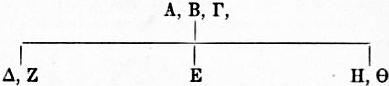
The simplest explanation is that Aristotle began by writing separate discourses, four at least, on political subjects; that he continued to write them and perhaps tried to combine them: but that in the end he failed and left the Politics unfinished and in disorder. But modern commentators, possessed by the fallacy that Aristotle like a modern author must from the first have comtemplated a whole treatise in a regular order for definite publication, lose themselves in vain disputes as to whether to go by the traditional order of books indicated by their letters and known to have existed as early as the abstract (given in Stobaeus, Ecl. ii. 7) ascribed to Didymus (1st century A.D.), or to put the group Η, Θ, as more connected with Α, Β, Γ, before the group Δ, Ζ, and this group before the book Η. It is agreed, says Zeller, that the traditional order contradicts the original plan. But what right have we to say that Aristotle had an original plan?
The incomplete state in which Aristotle left the Metaphysics, the Politics and his logical works, brings us to the hard question how much he did, and how much his Peripatetic followers did to his writings after his death. To answer it we should have to go far beyond Aristotle. But two corollaries follow from our present investigation of his extant writings; the first, that it was the long continuance of the Peripatetic school which gradually caused the publication, and in some cases the forgery, of the separate writings; and the second, that his Peripatetic successors arranged and edited some of Aristotle’s writings, and gradually arrived by the time of Andronicus, the eleventh from Aristotle, at an order of the whole body of writings forming the system. Now, it is probable that the arrangement of the works which we are considering was done by the Peripatetic successors of Aristotle. There is nothing indeed in the Metaphysics to show whether he left it in isolated treatises or in its present disorder; and nothing in the Politics. On the other hand, in the case of logic, it is certain that he did not combine his works on the subject into one whole, but that the Peripatetics afterwards put them together as organic, and made them the parts of logic as an organon, as they are treated by Andronicus. Perhaps something similar occurred to the Metaphysics, as Alexander imputed its redaction to Eudemus, and the majority of ancient commentators attributed its second opening (Book α) to Pasicles, nephew of Eudemus. Again, it is not unlikely that the Politics was arranged in the traditional order of books by Theophrastus, and that this is the meaning of the curious title occurring in the list of Aristotle’s works as given by Diogenes Laertius, πολιτικῆς ἀκροάσεως ὡς ἡ Θεοφράστου α´β´γ´δ´ε´ς´ζ´η´, which agrees with the Politics in having eight books. Although, however, we may concede that such great works as the Metaphysics, the Politics and the logical writings did not receive their present form from Aristotle himself, that concession does not deprive Aristotle of the authorship, but only of the arrangement of those works. On the contrary, Theophrastus and Eudemus, his immediate followers, both wrote works presupposing Aristotle’s Metaphysics and his logical works, and Dicaearchus, their contemporary, used his Politics for his own Tripoliticus. It was Aristotle himself then who wrote these works, whether he arranged them or not; and if he wrote the incomplete works, then a fortiori he wrote the completed works except those which are proved spurious, and practically consummated the Aristotelian system, which, as Leibnitz said, by its unity of thought and style evinces its own genuineness and individuality. We must not exaggerate the school and underrate the individual, especially such an individual. What he mainly wanted was the time, the leisure and the labour, which we have supposed to have been given to the gradual composition of the extant Aristotelian writings. Aristotle, asked where dwell the Muses, answered, “In the souls of those who love work.”
IV. Earlier and Later Writings
Aristotle’s quotations of his other books and of historical facts only inform us at best of the dates of isolated passages, and cannot decide the dates and sequences of whole philosophical books which occupied him for many years. Is there then any way of discriminating between early and late works? There is the evidence of the influences under which the books were written. This evidence applies to the whole Aristotelian literature including the fragments. As to the fragments, we are safe in saying that the early dialogues in the manner of Plato were written under the influence of Plato, and that the subsequent didactic writings connected with Alexander were written more under the influence of Philip and Alexander. Turning to the extant writings, we find that some are more under the influence of Plato, while others are more original and Aristotelian. Also some writings are more rudimentary than others on the same subject; and some have the appearance of being first drafts of others. By these differences we can do something to distinguish between earlier and later philosophical works; and also vindicate as genuine some works, which have been considered spurious because they do not agree in style or in matter with his most mature philosophy. In thirty-five years of literary composition, Aristotle had plenty of time to change, because any man can differ from himself at different times.
On these principles, we regard as early genuine philosophical works of Aristotle, (1) the Categories, (2) the De Interpretatione;(3) the Eudemian Ethics and Magna Moralia; (4) the Rhetoric to Alexander.
1. The Categories (κατηγορίαι).—This short discourse turns on Aristotle’s fundamental doctrine of individual substances, without which there is nothing. He arrives at it from a classification of categories, by which he here means “things stated in no combination” (τὰ κατὰ μηδεμίαν συμπλοκὴν λεγόμενα) or what we should call “names,” capable of becoming predicates (κατηγορούμενα κατηγορίαι). “Every name,” says he (chap. 4), “signifies either substance or something quantitative, or qualitative, or relative, or somewhere, or sometimes, or that it is in a position, or in a condition, or active or passive.” He immediately adds that, by the combination of these names with one another, affirmation or negation arises. The categories then are names signifying things capable of becoming predicates in a proposition. Next he proceeds to substances (οὐσίαι), which he divides into primary (πρῶται) and secondary (δεύτεραι). “Substance”, says he (chap. 5), “which is properly, primarily and especially so called, is that which is neither a predicate of a subject nor inherent in a subject; for example, a particular man, or a particular horse. Secondary substances so called are the species in which are the primarily called substances, and the genera of these species: for example, a particular man is in a species, man, the genus of which is animal: these then are called secondary substances, man and animal.” Having made these subdivisions of substance, he thereupon reduces secondary substances and all the rest of the categories to belongings of individual or primary substances. “All other things”, says he, “are either predicates of primary substances as subjects” (καθ᾽ ὑποκειμένων τῶν πρώτων οὐσιῶν) “or inherent in them as subjects” (ἐν ὑποκειμέναις αὐταῖς). He explains that species and genus are predicates of, and that other categories (e.g. the quality of colour) are inherent in, some individual substance such as a particular man. Then follows his conclusion: “without primary substances it is impossible for anything to be” (μὴ οὐσῶν οῧν τῶν πρώτων οὐσιῶν τῶν ἄλλων τι εἶναι. Cat. 5, 2 b 5-6).
Things are individual substances, without which there is nothing—this is the fundamental point of Aristotelianism, as against Platonism, of which the fundamental point is that things are universal forms without which there becomes nothing. The world, according to Aristotle, consists of substances, each of which is a separate individual, this man, this horse, this animal, this plant, this earth, this water, this air, this fire; in the heavens that moon, that sun, those stars; above all, God. On the other hand, a universal species or genus of substances is a predicate which, as well as everything else in all the other categories, always belongs to some individual substance or other as subject, and has no separate being. In full, then, a substance is a separate individual, having universals, and things in all other categories, inseparably belonging to it. The individual substance Socrates, for example, is a man and an animal (οὐσία), tall, (ποσόν), white (ποιόν), a husband (πρός τι), in the market (ποῦ), yesterday (πότε), sitting (κεῖσθαι), armed (ἔχειν), talking (ποιεῖν), listening (πάσχειν). Aristotelianism is this philosophy of substantial things.
The doctrine that all things are substances which are separate individuals, stated in the Categories, is expanded in the Metaphysics. Both works arrive at it from the classification of categories, which is the same in both; except that in the former the categories are treated rather as a logical classification of names signifying things, in the latter rather as a metaphysical classification of things. In neither, however, are they a grammatical classification of words by their structure; and in neither are they a psychological classification of notions or general conceptions (νοήματα), such as they afterwards became in Kant’s Critique and the post-Kantian idealism. Moreover, even in the Categories as names signifying distinct things they imply distinct things; and hence the Categories, as well as the Metaphysics, draws the metaphysical conclusion that individual substances are the things without which there is nothing else, and thereby lays the positive foundation of the philosophy running through all the extant Aristotelian writings.
Again, according to both works, an individual substance is a subject, a universal its predicate; and they have in common the Aristotelian metaphysics, which differs greatly from the modern logic of subject and predicate. Subject (ὑποκείμενον) originally meant a real thing which is the basis of something, and was used by Aristotle both for a thing to which something belongs and for a name of which another is asserted: accordingly “predicate” (κατηγορούμενον) came with him to mean something really belonging (ὑπάρχον) to a substance as real subject, as well as a name capable of being asserted of a name as a nominal subject. In other words, to him subject meant real as well as nominal subject, and predicate meant real as well as nominal predicate; whereas modern logic has gradually reduced both to the nominal terms of a proposition. Accordingly, when he said that a substance is a subject, he meant a real subject; and when he said that a universal species or genus is a predicate, he meant that it is a real predicate belonging to a real subject, which is always some individual substance of the kind. It follows that Aristotelianism in the Categories and in the Metaphysics is a realism both of individuals and of universals; of individual substances as real subjects, and of universals as real predicates.
Lastly, the two works agree in reducing the Categories to substance and its belongings (ὑπάρχοντα). According to both, it is always some substance, such as Socrates, which is quantitative, qualitative, relative, somewhere, some time, placed, conditioned, active, passive; so that all things in all other categories are attributes which are belongings of substances. There are therefore two kinds of belongings, universals and attributes; and in both cases belonging in the sense of having no being but the being of the substance.
In brief then the common ground of the Categories and the Metaphysics is the fundamental position that all things are substances having belonging to them universals and attributes, which have no separate being as Plato falsely supposed.
This essential agreement suffices to show that the Categories and the Metaphysics are the result of one mind. Nevertheless, there is a deep difference between them in detail, which may be expressed by saying that the Categories is nearer to Platonism. We have seen how anxious Aristotle was to be considered one of the Platonists, how reluctant he was to depart from Plato’s hypothesis of forms, and how, in denying the separability, he retained the Platonic belief in the reality and even in the unity of the universal. We have now to see that, in writing the Categories, on the one hand he carried his differences from his master further than he had done in his early criticisms by insisting that individual substances are not only real, but are the very things which sustain the universal; but on the other hand, he clung to further relics of the Platonic theory, and it is those which differentiate the Categories and the Metaphysics.
In the first place, in the Categories the belonging of things in other categories to individual substances in the first category is not so well developed. A distinction (chap. 2) is drawn between things which are predicates of a subject (καθ᾽ ὑποκείμενον) and things which inhere in a subject (ἐν ὑποκειμένῳ); and, while universals are called predicates of a subject, things in a subordinate category, i.e. attributes such as colour (χρῶμα) in the qualitative, are said to inhere in a subject. It is true that the work gives only a negative definition of the inherent, namely, that it does not inhere as a part and cannot exist apart from that in which it inheres (1 a 24-25), and it admits that what is inherent may sometimes also be a predicate (chap. 5, 2 a 27-34). The commentators explain this to mean that an attribute as individual is inherent, as universal is a predicate. But even so the Categories concludes that everything is either a predicate of, or inherent in, a substance; and the view that this colour belongs to this substance only in the sense of being in it, not of it, leaves the impression that, like a Platonic form, it is an entity rather in than of an individual substance, though even in the Categories Aristotle is careful to deny its separability. The hypothesis of inherence gives an inadequate account of the dependence of an attribute on a substance, and is a kind of half-way house between separation and predication.
On the other hand, in the Metaphysics, the distinction between inherence and predication disappears; and what is more, the relation of an attribute to a substance is regarded as so close that an attribute is merely the substance modified. “The thing itself and the thing affected,” says Aristotle, “are in a way the same; e.g. Socrates and Socrates musical” (Met. Δ 29, 1024 b 30-31). Consequently, all attributes, as well as universals, belong as predicates of individual substances as subjects, according to the Metaphysics, and also according to the most authoritative works of Aristotle, such as the Posterior Analytics, where (cf. i. 4, 22) an attribute (συμβεβηκός) is said to be only by being the substance possessing it, and any separation of an attribute from a substance is held to be entirely a work of human abstraction (ἀφαίρεσις). At this point, Plato and Aristotle have become very far apart: to the master beauty appears to be an independent thing, and really separate, to the pupil at his best only something beautiful, an attribute which is only mentally separable from an individual substance. The first difference then between the Categories and the Metaphysics is in the nature of an attribute; and the theory of inherence in the Categories is nearer to Plato and more rudimentary than the theory of predication in the Metaphysics. The second difference is still nearer to Plato and more rudimentary, and is in the nature of substance. For though both works rest on the reality of individual substances, the Categories (chap. 5) admits that universal species and genera can be called substances, whereas the Metaphysics (Ζ 13) denies that a universal can be a substance at all.
It is evident that in the category of substance, as Aristotle perceived, substance is predicate of substance, e.g. Socrates (οὐσία) is a man (οὐσία), and an animal (οὐσία). The question then arises, what sort of substance can be predicate; and in the Categories Aristotle gave an answer, which would have been impossible, if he had not, under Plato’s influence, accepted both the unity and the substantiality of the universal. What he said in consequence was that the substance in the predicate is not an individual substance, e.g. this man or this animal, because such a primary substance is not a predicate; but that the species man or the genus animal is the substance which is the predicate of Socrates the subject (Cat. 5, 3 a 36 seq.). Finding then that substances are real predicates, and supposing that in that case they must be species or genera, he could not avoid the conclusion that some substances are species or genera, which were therefore called by him “secondary substances,” and by his Latin followers substantiae universales. It is true that this conclusion gave him some misgivings, because he recognized that it is a characteristic of a substance to signify an individual (τόδε τι), which a species or a genus does not signify (ib. 5, 3 b 10-21). Nevertheless, in the Categories, he did not venture to deny that in the category of substance a universal species (e.g. man), or genus (e.g. animal), is itself a substance. On the other hand, in the Metaphysics (Ζ 13), he distinctly denies that any universal can be a substance, on the ground that a substance is a subject, whereas a universal is a predicate and a belonging of a subject, from which it follows as he says that no universal is a substance, and no substance universal. Here again the Categories forms a kind of transition from Platonism to the Metaphysics which is the reverse: to call universals “secondary substances” is half way between Plato’s calling them the only substances and Aristotle’s denial in the Metaphysics that they are substances at all.
What conclusion are we to draw from these differences between the Categories and the Metaphysics? The only logical conclusion is that the Categories, being nearer to Plato on the nature of attributes, and still nearer on the relation of universals to substances, is earlier than the Metaphysics. There are difficulties no doubt in drawing this conclusion; because the Metaphysics, though it denies that universals can be substances, and does not allow species and genera to be called “secondary substances,” nevertheless falls itself into calling a universal essence (τὸ τί ἦν εἶναι) a substance—and that too in the very book where it is proved that no universal can be a substance. But this lapse only shows how powerful a dominion Plato exercised over Aristotle’s soul to the last; for it arises out of the pupil still accepting from his master the unity of the universal though now applying it, not to classes, but to essences. The argument about essences in the Metaphysics is as follows:—Since a separate individual, e.g. Socrates, is a substance, and he is essentially a rational animal, then his essence, being what he is, is a substance; for we cannot affirm that Socrates is a substance and then deny that this rational animal is a substance (Met. Ζ 3). Now, according to the unity of a universal asserted by Plato and accepted by Aristotle, the universal essence of species, being one and the same for all individuals of the kind, is the same as the essence of each individual: e.g. the rational animal in the human species and in Socrates is one and the same; “for the essence is indivisible” (ἄτομον γὰρ τὸ εἶδος, Met. Ζ 8, 1034 a 8). It follows that we must call this selfsame essence, at once individual and universal, substance—a conclusion, however, which Aristotle never drew in so many words, though he continued always to call essence substance, and definition a knowledge of substance.
There is therefore a history of Aristotle’s metaphysical views, corresponding to his gradual method of composition. It is as follows:—
(1) Negative rejection of Plato’s hypothesis of forms and formal numbers, and reduction of forms to the common in the early dialogue περὶ φιλοσοφίας and in the early work περὶ ἰδεῶν.
(2) Positive assertion of the doctrine that things are individual substances in the Categories, but with the admission that attributes sometimes inhere in substance without being predicates of it, and that universal species and genera are “secondary substances.”
(3) Expansion of the doctrine that things are individual substances in the Metaphysics, coupled with the reduction of all attributes to predicates, and the direct denial of universal substances; but nevertheless calling the universal essence of a species of substances substance, because the individual essence of an individual substance really is that substance, and the universal essence of the whole species is supposed to be indivisible and therefore identical with the individual essence of any individual of the species.
2. The De Interpretatione.—Another example of Aristotle’s gradual desertion of Plato is exhibited by the De Interpretatione as compared with the Prior Analytics, and it shows another gradual history in Aristotle’s philosophy, namely, the development of subject, predicate and copula, in his logic.
The short discourse on the expression of thought by language (περὶ Έρμηνείας, De Interpretatione) is based on the Platonic division of the sentence (λόγος) into noun and verb (ὄνομα and ῥῆμα.) Its point is to separate the enunciative sentence, or that in which there is truth or falsity, from other sentences; and then, dismissing the rest to rhetoric or poetry (where we should say grammar), to discuss the enunciative sentence (ἀποφαντικὸς λόγος), or enunciation (ἀποφανσίς), or what we should call the proposition (De Int. chap. 4). Here Aristotle, starting from the previous grammar of sentences in general, proceeded, for the first time in philosophical literature, to disengage the logic of the proposition, or that sentence which can alone be true or false, whereby it alone enters into reasoning. But in spite of this great logical achievement, he continued throughout the discourse to accept Plato’s grammatical analysis of all sentences into noun and verb, which indeed applies to the proposition as a sentence but does not give its particular elements. The first part of the work confines itself strictly to noun and verb, or the form of proposition called secundi adjacentis. Afterwards (chap. 10) proceeding to the opposition of propositions, he adds the form called tertii adjacentis, in a passage which is the first appearance, or rather adumbration, of the verb of being as a copula. In the form secundi adjacentis we only get oppositions, such as the following:—
man is—man is not not-man is—not-man is not
In the form tertii adjacentis the oppositions, becoming more complex, are doubled, as follows:—
man is just—man is not just man is non-just—man is not non-just not-man is just—not-man is not just not-man is non-just—not-man is not non-just.
The words introducing this form (δταν δὲ τὸ ἔστι τρίτον προσκατηγορῆται, chap. 10, 19 b 19), which are the origin of the phrase tertii adjacentis, disengage the verb of being (ἔστι) partially but not entirely, because they still treat it as an extra part of the predicate, and not as a distinct copula. Nor does the work get further than the analysis of some propositions into noun and verb with “is” added to the predicated verb; an analysis, however, which was a great logical discovery and led Aristotle further to the remark that “is” does not mean “exists”; e.g. “Homer is a poet” does not mean “Homer exists” (De Int. chap. 11).
How then did Aristotle get further in the logical analysis of the proposition? Not in the De Interpretatione, but in the Prior Analytics. The first adumbration was forced upon him in the former work by his theory of opposition; the complete appearance in the latter work by his theory of syllogism. In analysing the syllogism, he first says that a premiss is an affirmative or negative sentence, and then that a term is that into which a premiss is dissolved, i.e. predicate and subject, combined or divided by being and not being (Pr. An. i. 1). Here, for the first time in logical literature, subject and predicate suddenly appear as terms, or extremes, with the verb of being (τὸ εἶναι) or not being (τὸ μὴ εἶναι) completely disengaged from both, but connecting them as a copula. Why here? Because the crossing of terms in a syllogism requires it. In the syllogism “Every man is mortal and Socrates is a man,” if in the minor premiss the copula “is” were not disengaged from the predicate “man,” there would not be one middle term “man” in the two premisses. It is not necessary in every proposition, but it is necessary in the arrangement of a syllogism, to extricate the terms of its propositions from the copula; e.g. mortal—man—Socrates.
This important difference between the De Interpretatione and the Prior Analytics can only be explained by supposing that the former is the earlier treatise. It is nearer to Plato’s analysis of the sentence, and no logician would have gone back to it, after the Prior Analytics. It is not spurious, as some have supposed, nor later than the De Anima, as Zeller thought, but Aristotle in an earlier frame of mind.
Moreover we can make a history of Aristotle’s thought and gradual composition thus:
(1) Earlier acceptance in the De Interpretatione of Plato’s grammatical analysis of the sentence into noun and verb (secundi adjacentis) but gradually disengaging the proposition, and afterwards introducing the verb of being as a third thing added (tertium adjacens) to the predicated verb, for the purpose of opposition.
(2) Later logical analysis in the Prior Analytics of the proposition as premiss into subject, predicate and copula, for the purpose of syllogism; but without insisting that the original form is illogical.
3. The Eudemian Ethics and Magna Moralia in relation to the Nicomachean Ethics.—Under the name of Aristotle, three treatises on the good of man have come down to us, Ήθικὰ Νικομάχεια (πρὸς Νικόμαχον, Porphyry), Ήθικὰ Εὐδήμια (πρὸς Εὔδημον, Porphyry), and Ήθικὰ μεγάλα; so like one another that there seems no tenable hypothesis except that they are the manuscript writings of one man. Nevertheless, the most usual hypothesis is that, while the Nicomachean Ethics (E.N.) was written by Aristotle to Nicomachus, the Eudemian (E.E.) was written, not to, but by, Eudemus, and the Magna Moralia (M.M.) was written by some early disciple before the introduction of Stoic and Academic elements into the Peripatetic school. The question is further complicated by the fact that three Nicomachean books (E.N. v.-vii.) and three Eudemian (E.E. Δ-Ζ) are common to the two treatises, and by the consequent question whether, on the hypothesis of different authorship, the common books, as we may style them, were written for the Nicomachean by Aristotle, or for the Eudemian Ethics by Eudemus, or some by one and some by the other author. Against the “Chorizontes,” who have advanced various hypotheses on all these points without convincing one another, it may be objected that they have not considered Aristotle’s method of gradual and simultaneous composition of manuscripts within the Peripatetic school. We have to remember the traces of his separate discourses, and his own double versions; and that, as in ancient times Simplicius, who had two versions of the Physics, Book vii., suggested that both were early versions of Book viii. on the same subject, so in modern times Torstrik, having discovered that there were two versions of the De Anima, Book ii., suggested that both were by Aristotle. Above all, we must consider our present point that Platonic influence is a sign of earliness in an Aristotelian work; and generally, the same man may both think and write differently at different times, especially if, like Aristotle, he has been a prolific author.
These considerations make it probable that the author of all three treatises was Aristotle himself; while the analysis of the treatises favours the hypothesis that he wrote the Eudemian Ethics and the Magna Moralia more or less together as the rudimentary first drafts of the mature Nicomachean Ethics.
As the Platonic philosophy was primarily moral, and its metaphysics a theory of the moral order of the universe, Aristotle from the first must have mastered the Platonic ethics. At first he adopted the somewhat ascetic views of his master about soul and body, and about goods of body and estate; but before Plato’s death he had rejected the hypothesis of forms, formal numbers and the form of the good identified with the one, by which Plato tried to explain moral phenomena; while his studies and teaching on rhetoric and poetry soon began to make him take a more tolerant view than Plato did of men’s passions. Throughout his whole subsequent life, however, he retained the fundamental doctrine, which he had learnt from Plato, and Plato from Socrates, that virtue is essential to happiness. Twice over this tenet, which makes Socrates, Plato and Aristotle one ethical school, inspired Aristotle to attempt poetry: first, in the Elegy to Eudemus of Cyprus, in which, referring to either Socrates or Plato, he praises the man who first showed clearly that a good and happy man are the same (Fragm. 673); and secondly, in the Hymn in memory of Hermias, beginning “Virtue, difficult to the human race, noblest pursuit in life” (ib. 675). Moreover, the successors of Plato in the Academy, Speusippus and Xenocrates, showed the same belief in the essentiality of virtue. The question which divided them was what the good is. Speusippus took the ascetic view that the good is a perfect condition of neutrality between two contrary evils, pain and pleasure. Xenocrates took the tolerant view that it is the possession of appropriate virtue and noble actions, requiring as conditions bodily and external goods. Aristotle was opposed to Speusippus, and nearly agreed with Xenocrates. According to him, the good is activity of soul in accordance with virtue in a mature life, requiring as conditions bodily and external goods of fortune; and virtue is a mean state of the passions. It is probable that when, after Plato’s death and the accession of Speusippus in 347, Aristotle with Xenocrates left Athens to visit his former pupil Hermias, the three discussed this moderate system of Ethics in which the two philosophers nearly agreed. At any rate, it was adopted in each of the three moral treatises which pass under the name of Aristotle.
The three treatises are in very close agreement throughout, and in the following details. The good of Ethics is human good; and human good is happiness, not the universal good or form of the good to which Plato subordinated human happiness. Happiness is activity of soul according to virtue in a mature life: it requires other goods only as conditions. The soul is partly irrational, partly rational; and therefore there are two kinds of virtue. Moral virtue, which is that of the irrational desires so far as they are obedient to reason, is a purposive habit in the mean. The motive of the moral virtues is the honourable (τὸ καλόν, honestum). As the rational is either deliberative or scientific, either practical or speculative intellect, there are two virtues of the intellect—prudence of the deliberative or practical, and wisdom of the scientific or speculative, intellect. The right reason by which moral virtue is determined is prudence, which is determined in its turn by wisdom. Pleasure is a psychical state, and is not a generation in the body supplying a defect and establishing a natural condition, but an activity of a natural condition of the soul. It should be specially noted that this doctrine like the rest is common to the three treatises: in Book vii. of the Nicomachean, which is Ζ of the Eudemian, pleasure is defined as ἐνέργεια τῆς κατὰ φύσιν ἔξεως ἀνεμπόδιστος (chap. 12, 1153 a 14-15); and in the Magna Moralia as ἡ κἰνησις αὐτοῦ καὶ ἡ ἐνέργεια (ii. 7, 1204 b 28; cf. 1205 b 20-28). It is plain from the context that in the former definition “the natural condition” (ἡ κατὰ φύσιν ἔξις) refers to the soul which, while the body is regenerated, remains unimpaired (cf. 1152 b 35 seq., 1154 b 15 seq.); and in the latter definition the thing (αὐτοῦ), whose “motion, that is activity” is spoken of, is the part of the soul with which we feel pleased.