VOLUME II SLICE V Arculf to Armour, Philip (continued 12)
Reading edition
The massacres were apparently organized and carried out in accordance with a well-considered plan. They occurred, except in six places, in the vilayets to which the scheme of reforms was to apply. At Trebizond they took place The massacres. just before the sultan accepted that scheme, and after his acceptance of it they spread rapidly. They were confined to Gregorian and Protestant Armenians. The Roman Catholics were protected by France, the Greek Christians by Russia. The massacre of Syrians, Jacobites and Chaldees at Urfa and elsewhere formed no part of the original plan. Orders were given to protect foreigners, and in some cases guards were placed over their houses. The damage to the American buildings at Kharput was due to direct disobedience of orders. The attacks on the bazars were made without warning, during business hours, when the men were in their shops and the women in their houses. Explicit promises were given, in some instances, that there would be no danger to those who opened their shops, but they were deliberately broken. Nearly all those who, from their wealth, education and influence, would have had a share in the government under the scheme of reforms, were killed and their families ruined by the destruction of their property. Where any attempt at defence was made the slaughter was greatest. The only successful resistance was at Zeitun, where the people received honourable terms after three months’ fighting. In some towns the troops and police took an active part in the massacres. At Kharput artillery was used. In some the slaughter commenced and ended by bugle-call, and in a few instances the Armenians were disarmed beforehand. Wherever a superior official or army officer intervened the massacre at once ceased, and wherever a governor stood firm there was no disturbance. The actual perpetrators of the massacres were the local Moslems, aided by Lazis, Kurds and Circassians. A large majority of the Moslems disapproved of the massacres, and many Armenians were saved by Moslem friends. But the lower orders were excited by reports that the Armenians, supported by the European powers, were plotting the overthrow of the sultan; and their cupidity was aroused by the prospect of wiping out their heavy debts to Armenian pedlars and merchants. No one was punished for the massacres, and many of those implicated in them were rewarded. In some districts, especially in the Kharput vilayet, the cry of “Islam or death” was raised. Gregorian priests and Protestant pastors were tortured, but preferred death to apostasy. Men and women were killed in prison and in churches in cold blood. Churches, monasteries, schools and houses were plundered and destroyed. In some places there was evidence of the previous activity of secret societies, in others none. The number of those who perished, excluding Constantinople, was 20,000 to 25,000.2 Many were forced to embrace Islam, and numbers were reduced to poverty. The destruction of property was enormous, the hardest-working and best tax-paying element in the country was destroyed, or impoverished, and where the breadwinners were killed the women and children were left destitute. Efforts by Great Britain and the United States to alleviate the distress were opposed by the authorities, but met with some success. After the massacres the number of students in the American schools and colleges increased, and many Gregorian Armenians became Roman Catholics in order to obtain the protection of France.
The Armenian revolutionary societies continued their propaganda down to the granting of the Turkish constitution in 1908; and meanwhile further massacres occurred here and there, notably at Mush (1904) and Van (1908).
See Abich, Geologie d. armenischen Hochlandes (Wien, 1882); Bishop, Journeys in Persia and Kurdistan (Lond., 1891); Bliss, Turkey and the Armenian Atrocities (Lond., 1896); Bryce, Transcaucasia and Ararat (4th ed., Lond., 1896); De Coursous, La Rébellion arménienne (Paris, 1895); Lepsius, Armenia and Europe (Lond., 1897); Murray, Handbook for Asia Minor (Lond., 1895); Parly. Papers, Turkey, I. (1895); Turkey, I., II. (1896); Supan, “Die Verbreitung d. Armenier in der asiatischen Turkei, u. in Transkaukasien,” in Pet. Mitt. vol. xlii. (1896); Tozer, Turkish Armenia and Eastern Asia Minor (Lond., 1881); Cholet, Arménie, Kurdistan, et Mésopotamie (1892); Lynch, Armenia (2 vols., 1901).
(C. W. W.)
1 The Armenians and Kurds have lived together from the earliest times. The adoption of Islam by the latter, and by many Armenians, divided the people sharply into Christian and Moslem, and placed the Christian in a position of inferiority. But the relations between the two sects were not unfriendly previously to the Russian campaigns in Persia and Turkey. After 1829 the relations became less friendly; and later, when the Armenians attracted the sympathies of the European powers after the war of 1877-78, they became bitterly hostile.
2 According to some estimates the number killed was 50,000 or more.
ARMENIAN CHURCH. No trustworthy account exists of the evangelization of Armenia, for the legend of King Abgar’s correspondence with Christ, even if it contained any historical truth, only relates to Edessa and Syriac Christianity. That the Armenians appropriated from the Syrians this, as well as the stories of Bartholomew and Thaddeus (the Syriac Addai), was merely an avowal on their part that Edessa was the centre from which the faith radiated over their land. In the 4th century and later the liturgy was still read in Syriac in parts of Armenia, and the New Testament, the history of Eusebius, the homilies of Aphraates, the works of St Ephraem and many other early books were translated from Syriac, from which tongue most of their ecclesiological terms were derived. The earliest notice of an organized church in Armenia is in Eusebius, H. E. vi. 46, to the effect that Dionysius of Alexandria c. 250 sent a letter to Meruzanes, bishop of the brethren in Armenia. There were many Christians in Melitene at the time of the Decian persecution in A.D. 250, and two bishops from Great Armenia were present at the council of Nice in 325. King Tiridates (c. A.D. 238-314) had already been baptized some time after 261 by Gregory the Illuminator. The latter was ordained priest and appointed catholicus or exarch of the church of Great Armenia by Leontius, bishop of Caesarea in Cappadocia. This one fact is certain amidst the fables which soon obscured the history of this great missionary. Thus the church of Great Armenia began as a province of the Cappadocian see. But there was a tradition of a line of bishops earlier than Gregory in Siuniq, a region east of Ararat along the Araxes (Aras), which in early times claimed to be independent of the catholicus. The Adoptianist bishop Archelaus, who opposed the entry of Mani into Armenia under Probus c. 277, was also perhaps a Syriac-speaking bishop of Pers-Armenia. Almost the earliest document revealing anything of the inner organization and condition of the Armenian church in the Nicene age is the epistle of Macarius, bishop of Jerusalem, to the Armenian bishop Verthanes, written between 325 and 335 and preserved in Armenian. Its genuineness has been unreasonably suspected. It insists on the erection of fonts; on distinction of grades among the ordained clergy; on not postponing baptism too long; on bishops and priests alone, and not deacons, being allowed to baptize and lay hands on or confirm the baptized; on avoiding communion with Arians; on the use of unleavened bread in the Sacrament, &c. We learn from it that the bishop of Basen and Bagrevand was an Arian at that time. By the year 450 these two districts already had separate bishops of their own. The letter of Macarius, therefore, if a forgery, must be a very early one.1 The Armenians must, like the Georgians a little later, have set store by the opinion of the bishop of Jerusalem, or they would not have sent to consult him. It was equally from Jerusalem that they subsequently adopted their lectionary and arrangement of the Christian year; and a 9th-century copy of this lectionary in the Paris library preserves to us precious details of the liturgical usages of Jerusalem in the 4th century. We can trace the presence of Armenian convents on the Mount of Olives as early as the 5th century.
Tradition represents the conversion of Great Armenia under Gregory and Tiridates as a sort of triumphant march, in which the temples of the demons and their records were destroyed wholesale, and their undefended sites instantly converted into Christian churches. The questions arise: how was the transition from old to new effected? and what was the type of teaching dominant in the new church? Armenian tradition, confirmed by nearly contemporary Greek sources, answers the first question. The old order went on, but under new names. The priestly families, we learn, hearing that the God preached by Gregory needed not sacrifice, sent to the king a deputation and asked how they were to live, if they became Christians; for until then the priests and their families had lived off the portions of the animal victims and other offerings reserved to them by pagan custom. Gregory replied that, if they would join the new religion, not only should the sacrifices continue, but they should have larger perquisites then ever. The priestly families then went over en masse. How far the older sacrificial rules resembled the levitical law we do not know, but in the canons of Sahak, c. 430, the priests already receive the levitical portions of the victims; and we find that animals are being sacrificed every Sunday, on the feast days which at first were few, in fulfilment of private vows, in expiation of the sins of the living, and still more of those of the dead. No one might kill his own meat and deprive the priest of his due; but this rule did not apply to the chase. The earliest Armenian rituals contain ample services for the conduct of an agapē (q.v.) or love feast held in the church off sacrificial meat. The victim was slaughtered by the priest in the church porch before the crucifix, after it had been ritually wreathed and given the holy salt, by licking which it appropriated a sacramental purity or efficacy previously conveyed into the salt by exorcisms and consecration. In the canons of Sahak the priest is represented as eating the sins of the people in these repasts.
It is easy to underrate the importance in religion of a change of names. The old sacrificial hymns were probably obscene and certainly nonsensical, and the substitution for them of the psalms, and of lections of the prophets and New Testament, was an enormous gain. We do not know precisely how the eucharistic rite was adjusted to these sacrificial meals; but, in the canons of Sahak, 1 Cor. xi. 17-34 is interpreted of these meals, which were known as the Dominical (suppers). The Eucharist was, therefore, long associated with the matal or animal victim, and only in the 8th century do we hear of an interval of time being left between the fleshly and the spiritual sacrifices, as the two rites were then called. The Basilian service of the Eucharist was used in the 5th century, but superseded later on by a Byzantine rite which will be found translated in F.E. Brightman’s Eastern Liturgies. The Eucharist was no doubt the one important sacrifice in the minds of the clergy who had attended the schools of Constantinople and Alexandria; yet the heart of the people remained in their ancient blood-offerings, and as late as the 12th century they were prone to deny that the mass could expiate the sins of the dead unless accompanied by the sacrifice of an animal. Perhaps even to-day the worst fate that can befall a villager after death is to be deprived, not of commemoration in the mass, but of the victim slain for his sins. The keenest spiritual weapon of the Armenian priest was ever a threat not to offer the matal for a man when he died.
Another survival in the Armenian church was the hereditary priesthood. None but a scion of a priestly family could become a deacon, elder or bishop. Accordingly the primacy remained in the family of Gregory until about 374, when the king Pap or Bab murdered Nerses, who had been ordained by Eusebius of Caesarea (362-370) and was over-zealous in implanting in Armenia the canons about celibacy, marriage, fasting, hospices and monastic life which Basil had established in Cappadocia. It may be remarked that Gregory’s own family was a cadet branch of the Arsacid kin which had occupied the thrones of Persia, Bactria, Armenia and Georgia. His primacy therefore was in itself a survival of an earlier age when king and priest were one. He was in fact a rex sacrificulus, and later on, when the Arsacid dynasty fell in Armenia c. A.D. 428, the Armenian catholicus became the symbol of national unity and the rallying-point of patriotism. The line of Gregory was restored in 390 in the person of Isaac or Sahak, son of Nerses, and his patriarchate was the golden age of Armenian literature. But by this time the autonomy of the Armenian church was thoroughly established. On the death of Nerses the right of saying grace at the royal meals, which was the essence of the catholicate, was transferred by the king, in despite of the Greeks, to the priestly family of Albianus, and thenceforth no Armenian catholicus went to Caesarea for ordination. The ties with Greek official Christendom were snapped for ever, and in subsequent ages the doctrinal preferences of the Armenians were usually determined more by antagonism to the Greeks than by reflection. If they accepted the council of Ephesus in 430 and joined in the condemnation of Nestorius, it was rather because the Sassanid kings of Persia, who thirsted for the reconquest of Armenia, favoured Nestorianism, a form of doctrine current in Persia and rejected in Byzantium. But later on, about 480, and throughout the following centuries, the Armenians rejected the decrees of Chalcedon and held that the assertion of two natures in Christ was a relapse into the heresy of Nestor. From the close of the 5th century the Armenians have remained monophysite, like the Copts and Abyssinians, and have only broken the record with occasional short interludes of orthodoxy, as when in 633 the emperor Heraclius forced reunion on them, under a catholicus named Esdras, at a council held in Erzerum. Even then all parties were careful not to mention Chalcedon. The march of Arab conquest kept the Armenians friendly to Byzantium for a few years; but in 718 the catholicus John of Odsun ascended the throne and at the council of Manazkert in 728 repeated and confirmed the anathemas against Chalcedon and the tome of Leo, that had been first pronounced by the catholicus Babken in 491 at a synod held in Valarshapat by the united Armenian, Georgian or Iberian, and Albanian churches. The Armenians marked their complete disruption with the Greeks by starting an era of their own at the synod of Dvin. The era began on the 11th of July 552, and their year is vague, that is to say, it does not intercalate a day in February every fourth year, like the Julian calendar.
The two churches of Iberia and Albania at first depended on the Armenian for ordination of their primates or catholici, and in large part owed their first constitution to Armenian missionaries sent by Gregory the Illuminator. The Iberians still reverence as saints the Armenian doctors of the 5th century, but as early as 552 they began to resent the dictatorial methods of the Armenians, as well might a proud race of mountaineers who never wholly lost their political independence; and they broke off their allegiance to the Armenian see very soon afterwards, accepted Chalcedon and joined the Byzantine church. The Albanians of the Caucasus were also converted in the age of Gregory, early in the 4th century, and were loyal to the Armenians in the great struggle against Mazdaism in the 5th; but broke away for a time towards 600, and chose a patriarch without sending him to Armenia for ordination. Eventually this interesting church was engulfed by the rising tide of Mahommedan conquest, but not before one of their bishops, named Israel, had converted (677-703) the Huns who lay to the north of the Caspian and had translated the Bible and liturgies into their language. If the Albanian and Hunnish versions could be found, they would be of the greatest linguistic importance.
The mother church of Armenia was established by Gregory at Ashtishat in the province of Taron, on the site of the great temple of Wahagn, whose festival on the seventh of the month Sahmi was reconsecrated to John the Baptist and Athenogenes, an Armenian martyr and Greek hymn writer. The first of Navasard, the Armenian new year’s day, was the feast of a god Vanatur or Wanadur (who answered to Ζεὺς ξένιος) in the holy pilgrim city of Bagawan. His day was reconsecrated to the Baptist, whose relics were brought to Bagawan. The feast of Anahite, the Armenian Venus and spouse of the chief god Aramazd, was in the same way rededicated to the Virgin Mary, who for long was not very clearly distinguished by the Armenians from the virgin mother church. The old cult of sacred stones and trees by an easy transition became cross-worship, but a cross was not sacred until the Christ had been, by priestly prayer and invocation, transferred into it.
What was the earliest doctrine of the churches of Armenia? If we could believe the fathers of the 5th and succeeding centuries Nicene orthodoxy prevailed in their country from the first; and in the 5th century they certainly chose for translation the works of orthodox fathers alone, such as Chrysostom, Basil, Gregory of Nyssa and Gregory Nazianzen, Cyril of Jerusalem and Cyril of Alexandria, Athanasius, Julius of Rome, Hippolytus, Irenaeus, avoiding Origen and other fathers who were becoming suspect. However, we do hear of versions of Nestorian writers like Diodore of Tarsus being in circulation, and the Disputation of Archelaus proves that the current orthodoxy of eastern Armenia was Adoptianist, if not Ebionite in tone. The Persian Armenians as late as the 6th century had not heard of the faith of Nicaea, and only then received it from the catholicus Babken. They sent a copy of their old creed to Babken, and it closely resembles the Adoptianist creed of Archelaus, the gist of which was that Jesus, until his thirtieth year, was a man mortal like other men; then, because he was righteous above all others, he was promoted to the honour and name of Son of God. He received the title by grace, but was not equal to God the Father. Because the Spirit worked with him, he was able to vanquish Satan and all desires, and because of his righteousness and good works he was made worthy of grace and became a Temple of God the Word, which came down from heaven in Jordan, dwelt in him and through him wrought miracles. From such a standpoint the baptism of Jesus was the moment of the divine incarnation. The man righteous above all others was then reborn of the Spirit, was illuminated, was spiritually anointed, became the Christ and Son of God. In effect the fathers of the Armenian church often fell back into such language, far removed as it is from orthodoxy; and they emphasized the importance of the baptismal feast of the Epiphany on the 6th of January by refusing to accept the feast of the physical birth of the 25th of December. As late as 1165 their patriarch Nerses defends the Armenian custom of keeping Christmas on the 6th of January on the express ground that as he was born after the flesh from the Virgin, so he was born by way of baptism from the Jordan. The custom from the first, he says, had been to feast on one and the same day the two births, much as they differed in sacramental import and in point of time. We see how deep the early Adoptianism had struck its roots, when a primate of the 12th century could still appeal to the baptismal regeneration of Jesus. The same Nerses held that the second Adam, Jesus Christ, received a new body and nature and the sevenfold grace of the Spirit in the Jordan. The Armenian doctors also taught that John by laying hands on Jesus and ordaining him at his baptism sacramentally transferred to him the three graces or charismata of kingship, prophecy and priesthood which had belonged to ancient Israel. After baptism, if not before, the flesh of Christ was incorruptible. It consisted of ethereal fire, and he was not subject to the ordinary phenomena of digestion, secretions and evacuations.
Monastic institutions were hardly introduced in Armenia before the 5th century, though Christian rest-houses had been erected along the high-roads long before and are mentioned in the Disputation of Archelaus. The Armenians called them wanq, and out of them grew the monasteries. The monks were, strictly speaking, penitents wearing the cowl, and not allowed to take a part in church government. This belonged to the elders. At first there was no separate episcopal ordination, and the one rite of elder or priest (Armen. Qahanay, Heb. cohen) sufficed. There were also deacons, half-deacons and readers. Besides these there was a class of wardapets or teachers, answering to the didascalos of the earliest church, whose province it was to guard the doctrine and for whom no rite of ordination is found in the older rituals.
A few other peculiarities of Armenian church usage or belief deserve notice. In baptism the rubric ordains that the baptized be plunged three times in the font in commemoration of the entombment during three days of the Lord. In the West trine immersion was generally held to be symbolic of the triune name of “Father, Son and Holy Ghost.” This name the Armenians have used, at least since the year 700; before which date their fathers often speak of baptism into the death of Christ as the one essential. As late as about 1300 a traveller hostile to the Armenians reported to the pope that he had witnessed baptisms without any trinitarian invocation in as many as three hundred parish churches.
The paschal lamb is now eaten on Sunday, but until the 11th century, and even later, it was eaten with the Eucharist at a Lord’s Supper celebrated on the evening of Maundy Thursday after the rite of pedilavium or washing of feet. On the morning of the same day the penitents were released from their fast.
The rite of extreme unction was introduced in the crusading epoch, although it was already usual to anoint the bodies of dead priests. The worship of images never seems to have taken root among Armenians; indeed they supplied the Greek world with iconoclast soldiers and emperors. The worship of crosses into which the Spirit or Christ had been inserted by the priest must have satisfied the religious needs of a people who, save in architecture, showed little artistic faculty. In their older rituals we find a rite for blessing a painted church, but no word of statues. Frescoes in their churches are rare, and mostly too high up for veneration to be paid to them.
On certain days the cross was washed, and the water in which it had been washed was a sovereign charm for curing sickness in men and animals and for bringing fertility to the land.
In the older rituals we find a rite of exhomologesis, for restoring those who had sinned after baptism. It was a medicine of sin that could only be used once and not a second time. In form it is a rehearsal of the first baptismal rite, but with omission of the water. It involved like the first rite open confession and repentance, and absolution by the church. In a later and less rigorous age this rite was abridged and adjusted to constant repetition, in such wise that a sinner could be restored to grace not once only, but as often as the clergy chose to accept his repentance and confession. Thus the whole development of the penitentiary system is traceable in the MSS.
The confession of a dying man might be taken by any layman present, and written down in order to be shown to the priest when he arrived. It then was the duty of the latter to supplicate for his forgiveness, and administer to him the Eucharist.
The clergy of all grades were originally married. The parish priests, or white clergy, are so still, except some of the Latinizing ones. But since the 12th century, or even earlier, the higher clergy, i.e. patriarchs and bishops, have taken monkish vows and worn the cowl.
There were abortive attempts to unite the Armenian church with the Byzantine in the 9th century under the patriarch Photius, and again late in the 12th under the emperor Manuel Comnenus, when a joint council met at Romkla, near Tarsus, but ended in nothing (A.D. 1179). Neither could the Armenians keep on good terms even with the Syriac monophysites. From the age of the crusades on, the Armenians of Cilicia, whose patriarch sat at Sis, improved their acquaintance with Rome; and more than one of their patriarchs adopted the Roman faith, at least in words. Dominican missions went to Armenia, and in 1328 under their auspices was formed a regular order called the United Brethren, the forerunners of the Uniats of the present day, who have convents at Venice and Vienna, a college in Rome and a numerous following in Turkey. They retain their Armenian liturgies and rites, pruned to suit the Vatican standards of orthodoxy, and they recognize the pope as head of the church.
The patriarchs of Great Armenia first resided at Ashtishat, on the Araxes. From 478 to 931 they occupied Dvin in the same neighbourhood, then Aghthamar, an island in the Lake of Van, 931-967, the city of Ani, 992-1054, where are still visible the magnificent ruins of their churches and palaces. Since 1441 the chief catholicus has sat at Echmiadzin, the convent of Valarshapat, now part of Russian Armenia. A rival catholicus, with a small following, still has his cathedral and see at Sis. The catholicus of Valarshapat is nominally chosen by all Armenians. A synod of bishops, monks and doctors meets regularly to transact under his eye the business of the convent and the oecumenical affairs of the church; but its decisions are subject to the veto of a Russian procurator. There are Armenian patriarchs, subject to the spiritual jurisdiction of Echmiadzin, in Constantinople and Jerusalem. In the latter place the Armenians occupy a convent on Mount Sion, and keep up in the churches of the Sepulchre and of Bethlehem their own distinct rites and feasts, the only ones there which at all resemble those of the 4th century.
The following list of councils was compiled by John, catholicus about the year 728, and read at the council of Manazkert, when the dogmatic and disciplinary attitude of the Armenian church was defined once and for all:—
1. In twentieth year of catholicate of Gregory and thirty-seventh of Trdat, the king, on return of Aristaces from council of Nice, bringing the Nicene creed and canons.
2. Council held by St Nerses on his return from the council of the 150 fathers at Constantinople against Macedonius.
3. Held by St Sahak and Mesrop on receipt of letters from Proclus and Cyril after the council of Ephesus, when the “Glory in the Highest” was adopted. Held against Nestorianism.
4. Held by Joseph, disciple of Mashdotz (Mesrop) and St Sahak, in Shahapiwan in the sixth year of King Yazkert (i.e. Yazdegerd) of Persia, for the regulation of the church. Forty bishops present. (The Massalians were anathematized.)
5. Held by Babken, catholicus, in the City-plain (i.e. Dvin), in the 18th year of King Kavat (i.e. Kavadh), against the heresy of Acacius and Barsuma (Bar-sauma), the friends of Nestorius. The true (Nicene) faith was sent to the Armenians of the farther East (shortly afterwards a slightly different creed was adopted, identical with a pseudo-Athanasian symbol used by Evagrius of Pontus and given in Greek in Patr. Gr. xxvi. Col. 1232).
6. At the beginning of the Armenian era, held by Nerses in Dvin, in the fourth year of his catholicate, in the fourteenth of Chosroes’ reign and in the fourteenth of Justinian Caesar. Held against Chalcedon, uniting the Baptism and Christmas feasts on the 6th of January (Epiphany), declaring for mono-physitism, and adopting in the Trisagion the words “who wast crucified for us.” This settlement lasted for about seventy-four years.
7. After the retaking of Jerusalem and recovery of the Cross from the Persians in the eighteenth year of his reign, Heraclius called a mixed council at Karin (Theodosiopolis) of Greeks and Armenians under Ezr (Esdras), catholicus, at which the preceding council of Dvin was cursed, its reforms repudiated and the confession of Chalcedon adopted. This remained the official attitude of the Armenian church until the catholicate of Elias (703-717). John, catholicus, denies to Ezr’s meeting the name of council, and so makes his own the seventh.
8. Under John, catholicus, in Manazkert, in the one hundred and seventieth year of the Armenian era (= A.D. 728) under the presidency of Gregory Asharuni Chorepiscopos (Gregory Asheruni). All the Armenian bishops attended, as also the metropolitan of Urhha (Edessa), Jacobite bishops of Gartman, of Nfrkert, Amasia, by command of the archbishop of Antioch. Chalcedon was repudiated afresh, union with the Jacobites instituted, use of water and leaven in the Eucharist condemned, the five days’ preliminary fast before Lent restored, Saturday as well as Sunday made a day of feasting and synaxis, any but the orthodox excluded from the Maundy Thursday Communion, the first communion of the new catechumens; union of the Baptismal and Christmas feasts was restored, and the faithful forbidden to fast on Fridays from Easter until Pentecost. In general these rules have been observed in the Armenian church ever since.
For list of authorities on the Armenian church see the works enumerated at the end of Armenian Language and Literature. For the relations of the Armenian church to the Persian kings see Persia: Ancient History, section viii. §§ 2 and 3.
(F. C. C.)
1 If a forgery, why should this letter have been assigned to Macarius, a comparatively obscure person whose name is not even found in the menaea of the Eastern church? But convincing proof of its authenticity lies in Macarius’ reference to himself as merely archbishop of Jerusalem, and his avowal that he was unwilling to advise the Armenians, “being oppressed by the weakness of the authority conceded him by the weighty usages of the church.” Jerusalem was only allowed to rank as a patriarchate in 451, and the seventh canon of Nice subordinated the see to that of Caesarea in Palestine. To this decree Macarius somewhat bitterly alludes.
ARMENIAN LANGUAGE AND LITERATURE. The Armenian language belongs to the group called Indo-European, of which the Iranic and Indic tongues formed one branch, and Greek, Albanian, Italian, Celtic, Germanic and Baltic-Slavonic dialects the other great branch. Unlike Language. most of these, Armenian lost its genders long before the year A.D. 400, when the existing literature begins. Modern Persian similarly has lost gender; and in both cases the liberation must have been due to attrition of other tongues which had a different system of gender or none at all. So the Armenians were ever in contact on the north with the Iberians of the Caucasus who had none, and with the Semitic races on the south and east which had other ways of forming genders than the Indo-European tongues.
From the original Armenian stock can be readily distinguished a mass of Old and Middle Persian loan-words. These are so numerous that for a time Armenian was classed as an Iranian tongue. For more than a thousand years, say until A.D. 640, Armenia was an appanage of the realm of the Persians and Parthians. Until A.D. 428 the Armenian throne was occupied by a younger branch of the Arsacid dynasty that ruled in Persia until the advent of the Sassanids (c. A.D. 226), and the internal polity and court administration of Armenia were modelled on the Persian or Parthian. Accordingly over 200 proper and personal names in Armenia were Old Persian, as well as 700 names of things. If we count in the derivative forms of these words we get at least 2000 Old Persian words. Often the same Persian word was borrowed twice over in an earlier and later form at an interval of centuries, just as in English we inherit a word direct or have taken it from Latin, and have also assimilated from French a later form of the same. The Persian influence in Armenian was already strong as early as 400 B.C., when Xenophon used a Persian interpreter to converse. In some of the Armenian villages they answered him in Persian. The Persian loan-words already present in Armenian as early as A.D. 400 mirror the earlier political and social life of Armenia. Thus many of their kings and nobles had Persian names; Persian also were most words used in connexion with horses and the chase, with war and army, with dress, trade and coinage, calendar, weights and measures, with court and political institutions, with music, medicine, school, education, literature and the arts. Many everyday words were of the same origin, e.g. the words for village, desert, building and build, need, rich or liberal, arm (of body), rod or goad, face, opposite, wicked, unfriendly, discontented, difficult, daughter, eulogy, a youth, wary, enjoy, unhappy, volition, voluntary, unwilling, blind, cautious, blood-kin, coquet with, slumber, humble, mad, grace or favour, memory or attention, grandfather, old woman, prepared, duty, necessary, end, endless, superior, confident, mistake, warmth, heat, glory. The language of their old religion was mainly Persian, but in the 4th century they derived numerous ecclesiological words from the Syrians, from whom by way of Edessa and Nisibis Christianity penetrated eastern Armenia. The language of the garden and the names of plants were also Persian. They had their own numerals, but the words for one thousand and for ten thousand are Persian.
Yet more indicative of the extent of the Persian influence is the adoption of the adjectival ending -akan and -zan, added to purely Armenian words; also of the preposition ham, answering to con in “conjoin,” “conspire,” added to purely Armenian words, as in hambarnam, I take away, and hamboir, a kiss, a word which, strange to say, the Iberians in turn borrowed from the Armenians. From Persia also the Armenians took their names for surrounding races, e.g. Tatshik or Tajik, first for Arab and then for Turk, Ariq for Persians, Kapkoh for Caucasus, Hrazdan, Vaspuragan, &c. The Armenians call themselves Hay, plural Hayq; their country Hayasdan. The Iberians they called Virq or Wirq (where q marks the plural), the Medes Marq, the Cappadocians Gamirq (Cimmerians), the Greeks Yûnes or Ionians; Ararat they call Masis, the Euphrates the Aradsan, the Tigris Teglath, Erzerum is Karin, Edessa Urhha, Nisibis Mdsbin, Ctesiphon Tizbon, &c.
When the Persian and other loan-words are removed, a stock remains of native words and forms governed by other phonetic laws than those which govern the Aryan, i.e. Indian and Iranic, branch of the Indo-European tongues. Armenian appears to be a half-way dialect between the Aryan branch and Slavo-lettic. Much, however, in Armenian philology remains unexplained. For example the plural of nouns, pronouns and the first and second persons plural of verbs are all formed by adding a q or k, which has no parallel in any Indo-Germanic tongue. The genitive plural again is formed by adding a tz or c, and the same consonant characterizes the composite aorist and the conjunctive. In all three cases it is unexplained. In the verbs the termination m for the first singular at once explains itself, and the n of the third plural is the Indo-Germanic nti. But not so the second person singular ending in s, e.g. berem, I bear, beres, thou bearest. This has a superficial likeness to the I.-G. esi in bheresi, “thou bearest.” Yet we should expect the s between vowels to vanish, and give us in Armenian berê. Perhaps, therefore, an old variant of esi, similar to the ἐσσί, lies behind the Armenian es, thou art, and the es in beres, thou bearest. In any case it is clear that many of the oldest forms which Armenian shared with other Indo-Germanic dialects were lost and replaced by forms of which the origin is obscure. Perhaps a closer study of Mingrelian and Georgian will explain some of these peculiarities, for these and their cognate tongues must have had a wider range in the 7th and 8th centuries B.C. than they had later when clear history begins. The attempts made by S. Bugge to assimilate Old Armenian to Etruscan, and by P. Jensen to explain from it the Hittite inscriptions, appear to be fanciful. There is a large Semitic influence traceable in Armenian due to their early contact with the Syriac-speaking peoples to the south and east of them, and later to the Arab conquest. Much remains to be done in the way of collecting Armenian dialects, for which task there are written materials as far back as the 12th century over and above the work to be done by an intelligent traveller armed with a phonograph. Two main dialects of Armenian are distinguishable to-day, that of Ararat and Tiflis, and that of Stambul and the coast cities of Asia Minor. The latter is much overlaid with Tatar or Turkish words, and the Tatar order of words distinguishes the modern Armenian sentence from the ancient.
It remains to say that classical Armenian resembles rather the modern idiom of Van than of western Armenia. It was a plastic and noble language, capable of rendering faithfully, yet not servilely, the Greek Bible and Greek fathers. Often the Armenian translators, and especially after the 5th century, rendered word for word, preserving the order of the Greek. This literalness, though unpleasing from a literary standpoint, gives to many of their ancient versions the value almost of a Greek codex of the age in which the version was made. The same literalness also characterizes their translations from Syriac.
The Armenians had a temple literature of their own, which was destroyed in the 4th and 5th centuries by the Christian clergy, so thoroughly that barely twenty lines of it survive in the history of Moses of Khoren (Chorene). Literature. Their Christian literature begins about 400 with the invention of the Armenian alphabet by Mesrop. This was probably an older alphabet to which Mesrop merely added vowels; but, in order to pacify the Greek ecclesiastics and the emperor Theodosius the Less, the Armenians concocted a story that it had been divinely revealed. Once their alphabet perfected, the catholicus Sahak formed a school of translators who were sent to Edessa, Athens, Constantinople, Alexandria, Antioch, Caesarea in Cappadocia, and elsewhere, to procure codices both in Syriac and Greek and translate them. From Syriac were made the first version of the New Testament, the version of Eusebius’ History and his Life of Constantine (unless this be from the original Greek), the homilies of Aphraates, the Acts of Gurias and Samuna, the works of Ephrem Syrus (partly published in four volumes by the Mechitharists of Venice). They include the commentaries on the Diatessaron and the Paulines, Laboubna and History of Addai, the Syriac canons of the Apostles.
From the original Greek were rendered in the 5th century the following authors and works. An asterisk is prefixed to those which have been printed:—*Eusebius’ Chronicon; *Philo’s lost commentaries on Genesis and Exodus, and his lost treatises on Providence and Animals, as well as a great number of his works still preserved in Greek; *the entire Bible (the New Testament is a recension after Antiochene Greek texts of an older version made from the oldest Syriac text); *the Alexander romance of the pseudo-Callisthenes; *Epistles and Acts of Ignatius of Antioch; *many homilies of Gregory Thaumaturgus; *Athanasius (a large number of works, many of them wrongly attributed); Irenaeus, Adversus Haereses and Ad Marcianum (recently found); *Hippolytus’ commentaries on the Song of Songs and Daniel, and many fragments; *Timotheus’ life of Athanasius; Theophilus of Alexandria, various homilies; *Eusebius of Gabala or Severianus, fifteen Homilies; *Cyril of Jerusalem, Catecheses and Letter to Constantine; *Wisdom of Ahikar; *the Apology of Aristides; Gregory of Nazianzus, thirty-four Homilies; *Nonnus’ work on Gregory (perhaps a version of 6th century); Basil of Caesarea, *Hexaëmeron, fifteen Homilies on faith, epistle to Terentius, ascetic writings and canons, on the Holy Spirit, to Cledonius, &c. Helladius of Caesarea’s life of Basil; Gregory of Nyssa’s treatise on the Beatitudes, and many other homilies, Commentaries on Song of Songs, *On Human Nature (Nemesius), panegyrics on sundry Martyrs, and other works (but some of these versions belong to the beginning of the 8th century); Epiphanius of Salamis, Commentary on the Gospels, *On weights and measures, *Physiologus, canons and many homilies; Evagrius of Pontus, Homilies and Ascetic works, Letters to Melania, &c.; John Chrysostom, *Homilies and Prayers, in very beautiful language; *Proclus, patriarch of Constantinople, many homilies; *Nilus the Ascete, On the Eight Spirits of Evil; *Josephus, On the Jewish War; Dionysius of Alexandria, *Against Paul of Samosata and other fragments; Acacius, bishop of Melitene, *Letters to Sahak; Julius of Rome (fragments); Zenobius, Homilies (? from Syriac); the History of Julius Africanus was perhaps also translated in this century, but it is lost. To the 5th century belong the versions of the Nicene canons, of which the Armenian text as preserved is barely intelligible, of the eucharistic rites called of *Basil, *Chrysostom, *Ignatius and others; also the *Hours or Breviary, the *Rites of Ordination, Baptism, of the making and release of Penitents, of Epiphany, and perhaps the many rites of animal sacrifice, for these are partly originals, partly versions of lost Greek texts. A mass of martyrs’ acts were also rendered in this century, including parts of the lost collection made by Eusebius. Among these the *Acts and Apology of Apollonius restore a lost 2nd-century text. The *Canons of Sahak also purport to be translated from a Greek original about the year 330.
The Armenians were so busy in this century translating Greek and Syriac fathers that they have left little that is original. Still a number of historical works survive: *Faustus of Byzantium relates the events of the period A.D. 344-392 in a work instinct with life and racy of the soil. It was perhaps first composed in Greek, but it gives a faithful picture of the court of the petty sovereigns of Armenia, of the political organization, of the blood feuds of the clans, of the planting of Christianity. Procopius preserves some fragments of the Greek.
The *History of Taron, by Zenobius of Glak, is a somewhat legendary account of Gregory the Illuminator, and may have been written in Syriac in the 5th, though it was only Armenized in a later century.
*Elisaeus Wardapet wrote a history of Wardan (Vardan), and of the war waged for their faith by the Armenians against the Sassanids. He was an eye-witness of this struggle, and gives a good account of the contemporary Mazdaism which the Persians tried to force on the Armenians. *Lazar of Pharp wrote a history embracing the events of the 5th century up to the year 485, as a continuation of the work of Faustus.
*A history of St Gregory and of the conversion of Armenia by Agathangelus is preserved in Greek, Armenian and Arabic. The Arabic edited by Professor Marr of St Petersburg seems to be the oldest form of text. The Greek is a rendering of the Armenian. It is a compilation, and the second part which contains the Acts of Gregory and of St Rhipsima seems wholly legendary. The Greek and Armenian texts were edited together by Lagarde.
*The History of Armenia by Moses of Khoren (Chorene) relates events up to about the year 450. It is a compilation, devoid of historical method, value or veracity, from all sorts of previous authors, mostly from those which already existed in an Armenian dress. Some critics put down the date of composition as low as about 700, and it was certainly retouched in the late 6th century.
*A long volume of rhetorical exercises, based on Aphthonius, is also ascribed to Moses of Khoren, and appears to be of the 5th century. The *geography which passes under his name may belong to the 7th century. Various homilies of Moses survive, as also of Elisaeus.
Gorium wrote in this century a *Life of Mesrop, and Eznik a *Refutation of the Sects, based largely on antecedent Greek works. The sects in question are Paganism, Mazdaism, Greek Philosophy and Manicheism. A volume of *homilies under the name of Gregory the Illuminator, but not his, also belongs to this century, and a series of ascetic discourses attributed to John Mandakuni, who was patriarch 478-500.
Of the 6th and 7th centuries few works survive except anonymous versions of the *Acts of Thomas (perhaps from the Syriac), of the *Acts of Peter and Paul, *of John (pseudo-Prochorus), *of Bartholomew, and of other apostles; also of *the Acts of Paul and Thekla, *of Titus, *of the Protevangel, *of the Testaments of the patriarchs, of the *Gospel of Nicodemus, or Acts of Pilate, of the *Book of Adam, of the *Deaths of the Prophets, of the *History of Baruch, of the *Apocalypses of Paul and of the Virgin Mary, of the *Acts of Sylvester, and of an enormous number of other similar apocryphs. Some of these may be of the 5th century. Two volumes of these apocryphs of the Old and New Testaments have recently been published at Venice. To these centuries belong also the versions of the Acts of the council of Ephesus, of Gangra, Laodicea and of other councils. To the late 7th century belong the *calendarial works of Ananiah of Shirak, who also has left a *chronicon compiled from Eusebius, Andreas of Crete, Hippolytus and other sources. In the *Letter-book of the Patriarchs, lately printed at Tiflis, are to be found a number of controversial monophysite tracts of these and the succeeding three centuries, important for church history. It includes a mass of documents relative to the churches of Iberia and Albania. The chief literary monument of the 7th century is the history of the wars of Heraclius and of the early Mahommedan conquests in Asia Minor, by the bishop Sebeos, who was an eye-witness. The *history of the Albanians of the Caucasus, by Moses Kalankatuatzi, also belongs to the end of this century. To the middle of the 7th century also belong the translations of Aristotle’s treatises *On the Categories, and *On Interpretation, and of *Porphyry’s Isagogē, as well as of voluminous Greek commentaries on these books; the version of the *Grammar of Dionysius Thrax and an incomplete Euclid. The translator was one David called the Invincible, who also wrote monophysite tracts. At the end of this 7th century one Philo of Tirak is supposed to have made the version of the *History of Socrates, unless indeed it was made earlier. To this century also seems to belong the Armenian version of a *history of the Iberians, by Djuansher, a work full of valuable information.
The early 8th century was a time of great literary activity. Gregory Asheruni wrote an important *commentary on the Jerusalem Lectionary, and his friend *John the catholicus (717-728) commentaries on the other liturgical works of his church; he also collected all existing canon law, Greek or Armenian, respected in his church, wrote *against the Paulicians and Docetae, and composed many beautiful hymns. *Leoncius the priest has left a history of the first caliphs, and Stephanus, bishop of Siunik, translated the *controversial works of Cyril of Alexandria (whose Glaphyra and commentaries, however, seem to have been translated at an earlier period). He also translated the works of Dionysius the Areopagite, commented on the Armenian breviary and wrote hymns.
In the 9th century Zachariah, catholicus, the correspondent of Photius, wrote many eloquent homilies for the various church feasts. Shapuh Bagratuni wrote a history of his age, now lost. Mashtotz, catholicus, collected in one volume the Armenian rituals.
In the 10th century (c. 925) the catholicus John VI. issued his *history of Armenia, and Thomas Artsruni a *history of his clan carried up to the year 936. Ananias of Mok (943-965) wrote a great work against the Paulicians, unfortunately lost. Chosroes wrote a *commentary on the eucharistic rites and breviary, *Mesrop a history of Nerses the Great; *Stephen of Asolik wrote a history of the world, and a commentary on Jeremiah; *Gregory of Narek his famous meditations and hymns; Samuel Kamrdjtsoretzi a commentary on the Lectionary based on Gregory Asheruni.
In the 11th century the catholicus Gregory translated many Acts of Martyrs, and John Kozerhn wrote a history, now lost, as well as a work on the Armenian calendar; Stephen Asolik a *history of Armenia up to the year 1004; *Aristaces of Lastiverd a valuable history of the conquest of Armenia by the Seljuk caliphs. We may also mention a *monophysite work against the Greek doctor Theopistus by Paul of Taron; *letters and poems of Gregory Magistros, who also was the translator of the *Laws, Timaeus and other dialogues of Plato.
The 12th century saw many remarkable writers, mostly in Cilician Armenia, viz. Nerses the Graceful (d. 1165), author of an *Elegy on the taking of Edessa, of *voluminous hymns, of long *Pastoral Letters and Synodal orations of value for the historian of eastern churches. *Samuel of Ani composed a chronicle up to 1179. Nerses of Lambron, archbishop of Tarsus, left a *Synodal oration, a *Commentary on the liturgy, &c., and his contemporary Gregory of Tlay an *Elegy on the capture of Jerusalem, and various *dogmatic works. In this century the *history of Michael the Syrian was translated; Ignatius and Sargis composed *commentaries on Luke and *the catholic epistles, and *Matthew of Edessa a valuable history of the years 952-1136, continued up to 1176 by Gregory the priest. Mechithar (Mekhitar) Kosh (d. 1207) wrote an elegant *Book of Fables, and compiled a *corpus of civil and canon law (partly from Byzantine codes).
In the 13th century the following works or authors are to be noticed:—*history of Kiriakos of Ganzak, which contains much about the Mongols, Georgians and Albanians; *Malakia the monk’s history of the Tatars up to 1272; *Chronicle of Mechithar of Ani (fragmentary); *Vahram’s rhymed chronicle of the kings of Lesser Armenia; *history of the world, by Vartan, up to 1269. In this century mostly falls the redaction of a large fable literature, recently edited in three volumes by Professor Marr of St Petersburg.
14th century: *history of Siunik, by Stephen Orbelian, archbishop of that province 1287-1304; *Sempat’s chronicle of Lesser Armenia (952-1274), carried on by a continuator to 1331; *Mechithar of Airivanq, a chronography; *Hethoum’s account of the Tatars, and chronography of the years 1076-1307. John of Orotn (d. 1388) compiled commentaries on John’s gospel and the Paulines, and wrote homilies and monophysite works; his disciple Gregory of Dathev (b. 1340) compiled a *Summa theologiae called the Book of Questions, in the style of the Summa of Aquinas, which had been translated into Armenian c. 1330, as were a little later the *Summa of Albertus and works of other schoolmen.
15th century: *History of Tamerlane, by Thomas of Medsoph, carried up to 1447.
17th century, Araqel of Tabriz wrote a *history of the Persian invasions of Armenia in the years 1602-1661.
In the above list are not included a number of medical, astrological, calendarial and philological or lexicographic works, mostly written during or since the Cilician or crusading epoch. The hymns used in Armenian worship rarely go back to the 5th century; and they were still few in number and brief in length when Nerses the Graceful and his contemporaries more than doubled their number and bulk in the 12th century. Most Armenian poems embody acrostics, and their poets began to rhyme in the 8th century or thereabouts. Since the 15th century a certain number of profane poets have arisen, whose work is less jejune on the whole than that of the hymn and canticle writers of an earlier age. Gregory Magistros (d. 1058) abridged the whole of the Old and New Testaments in a *rhyming poem, and set a fashion to later writers. Such works as *Barlaam and Josaphat. the *History of the Seven Sages, the *Wisdom of Ahikar, the *Tale of the City of Bronze, were freely turned into verse in the 13th and following centuries.
It will be realized from the above enumeration of works written in each century that Armenian literature was purely monkish. There was no epic or romance literature; although this was not lacking in the contiguous country of Georgia, where there seem to have always been knights and ladies willing to read and keep alive a literature of poetry and narrative, not altogether suitable for monks, and more akin to Persian literature.
Other forms of faith than the orthodox had a hold in Armenia, particularly the Nestorian and the Manichean. Sundry works of Mani were translated in the year 588, but are lost. Perhaps certain works of Diodore of Tarsus survive, but the orthodox monks were so vigilant that there is little chance of finding any other monuments than those of the stereotyped orthodoxy.
The 16th century saw the first books printed in Armenian. A press was set up at Venice in 1565, and the psalms and breviary were printed. In 1584 the Roman propaganda began its issue of Armenian books with a Gregorian calendar. In the 17th century presses were working at Lembourg, Milan, Paris, Isfahan (where in 1640 a large folio of the Lives of the Fathers of the Desert appeared), in Leghorn, Amsterdam (where in 1664 the first edition of the Hymn-book, in 1666 the first Bible, and in 1667 the first Ritual were printed), Marseilles, Constantinople, Leipzig and Padua.
The press which has done most in printing Armenian authors is that of the Mechitharists of Venice. Here in 1836 was issued a magnificent thesaurus of the Armenian language, with the Latin and Greek equivalents of each word. At that time there was no dictionary of any language and literature to be compared with this for exhaustiveness and accuracy. There are now Armenian presses all over the world, reprinting old books or issuing new works, often translations of modern writers, English, French, Russian and German.
The chief collections of old Armenian MSS. are: at the convent of *Echmiadzin at Valarshapat; at Stambul in the library of the fathers of St Anthony; at Venice in the Mechitharist convent of San Lazaro; at the *Mechitharist convent in Vienna; in the *Royal library at Vienna; in the *Paris Bibliothèque Nationale; in the Vatican library; in the British Museum; in the *Bodleian; in the Rylands library; in the *Berlin and *Munich libraries; *in Tübingen; in St Petersburg, and in the *Lazarev institute at Moscow; at New Joulfa, the Armenian suburb of Isfahan. Private collections have been made by Mr Rendel Harris in Birmingham (presented to the university of Leiden); at Parham and elsewhere. A printed catalogue exists of those marked with an asterisk.
Authorities.—F. Combefis, Historia Monothelitarum (Paris, 1648); Arshak Ter Mikelian, Die armen. Kirche, iv. bis zum xiii. Jahrhundert (Leipzig, 1892); H. Gelzer, “Die Anfänge der armenischen Kirche” in the Berichte der Königlich. Sachsischen Gesellschaft der Wissenschaften: Historisch-philologische Classe (1895), p. 171; Gutschmid, Kleine Schriften (Leipzig, 1892), t. iii.; Langlois, Collection d’historiens arméniens (Paris, 1867) (the translations often careless); E.W. Brooks, The Syriac Chronicle known as Zachariah of Mitylene (London, 1899), p. 24; Dulaurier, Recherches sur la chronologie arménienne (Paris, 1859); Agop Manandian, Beiträge zur albanischen Geschichte (Leipzig, 1897); G. Owsepian, Die Entstehungsgeschichte des Monotheletismus (Leipzig, 1897); Cardinal Angelo Mai, Nova SS. patrum bibliotheca, 6 vols. (Rome, 1844-1871), vol. ii. contains Latin version of Armenian canons; Hergenrother, Photius (Regensburg, 1867); Tchamchian, History of Armenia (in Armenian at Venice and English abridged translation entitled M. Chamich by John Audall, Calcutta, 1827); Domini Joannis Onziensis, Opera Latine (Venice, 1834); Nersetis Clajensis, Opera omnia Latine (Venice, 1833); A. Papadopoulos-Kerameus in the Recueil de la société orthodoxe de Palestine (St Petersburg, 1892) (Armenian correspondence with Photius translated); Enthymius Zigabenus, Panoplia, Patrol. Gr. vol. 130, col. 1173; E. Dulaurier, Histoire de l’église armén. (Paris, 1857); le Quien, Oriens christianus; Mansi, Concilia, vol. 25; Steph. Azarian, Ecclesiae Armenae Traditio (Rome, 1870); A. Balgy, Historia doctrinae catholicae inter Armenos (Vienna, 1878); Clemens Galanus, Conciliatio Ecclesiae Armenae cum Romana (Rome, 1690); L. Alishan, Sissouan, contrée de l’Arménie (Venice, 1893), in Armenian, but also in French translation; Recueil d’actes relatifs aux Arméniens (3 vols., Moscow, 1833); St Martin, Mémoires historiques sur l’Arménie (Paris, 1818); V. Langlois, Voyage dans la Cilicie (Paris, 1861); H.G.O. Dwight, Christianity in Turkey (London, 1854); De Damas, Coup d’œil sur l’Arménie (Lyon, 1887); H.F.B. Lynch, Armenia (2 vols., London, 1902); J. Issaverdens, Armenia, Ecclesiastical History (Venice, 1875); E. Dulaurier, Historiens arméniens des Croisades (Paris); Giovanni de Serpos, Compendio Storico (Venice, 1786); Garabed Chahnazarian, Esquisse de l’histoire de l’Arménie (Paris, 1856); Gelzer, “Armenien” in Herzog-Hauck, Realencyklopadie für protestantische Theologie (ed. 3, Leipzig, 1897); Hefele, Hist. of Councils, vols. 3 and 9; F. Néve, L’Arménie chrétienne (Paris); P. Hunanian, Histoire des canciles d’Orient (Vienna, 1847); Gr. Chalathianz, Apocryphes (Moscow, 1897), and other works; Brosset, Collection d’historiens arméniens (St Petersburg, 1874), and numerous other works by the same author; J. Catergian, De fidei symbolo quo Armenii utuntur (Vienna, 1893); Ricaut, The present state of the Greek and Armenian Churches (London, 1679); H. Denzinger, Ritus orientalium (Würzburg, 1863); Fred. C. Conybeare, Rituale Armenorum (Oxford, 1905); F.E. Brightman, Eastern Liturgies (Oxford, 1896); P. Vetter, Chosroae magni explicatio missae (Freiburg-im-Breisgau, 1880); L. Petit, articles on Armenian religious history, councils, literature, creed and discipline in Diction. de théologie catholique, cols. 1888-1968; F.C. Conybeare, “The Armenian canons of St Sahak” in the American Journal of Theology (Chicago, 1898), p. 828; C.F. Neumann, Geschichte der armenischen Literatur (Leipzig, 1836); Simon Weber, Die katholische Kirche in Armenien (Freiburg-im-Breisgau, 1903); Sukias Somal, Quadro della Storia Letteraria di Armenia (Venice, 1829); M.V. Ermoni, “L’Arménie” in Revue de l’orient chrétien (for year 1896); F. Tournebize, “Histoire de l’Arménie” (ib. 1902-3-4-5); R.P.D. Girard, “Les Madag” (ib. for year 1902); H. Hübschmann, Armenische Studien and Grammatik (Leipzig, 1883 and 1895). Grammars by Petermann (in Porta Orientalium Linguarum series), by Prof. Meillet of Paris, by Prof. N. Marr of St Petersburg (in Russian), by Joseph Karst (of the Cilician dialect). Texts of most of the Armenian fathers and historians have been printed by the Mechitharists of San Lazaro, Venice, and are readily procurable at their convent.
(F. C. C.)
ARMENTIÈRES, a town of northern France, in the department of Nord, on the Lys, 13 m. W.N.W. of Lille on the Northern railway from that city to Dunkirk. Pop. (1906) 25,408. The chief building is the hôtel de ville with a 17th-century belfry. There are communal colleges for girls and boys, a board of trade-arbitrators, a chamber of commerce and a national technical school. The town is an important centre for the spinning and weaving of flax and cotton; bleaching, dyeing and the manufacture of machinery are among the other industries. Its industrial prosperity dates from the middle ages, when, however, woollen, not cotton, goods were the staple product.
ARMET (diminutive of Fr. arme), a form of helmet, which was developed out of existing forms in the latter part of the 15th century. It was round in shape, and often had a narrow ridge or comb along the top. It had a pivoted or hinged vizor and nosepiece, and complete chin, neck and cheek protection, closely connected with the gorget. It is distinguished from the basinet by its roundness, and by the fact that it protects the neck and chin by strong plates, instead of a “camail” or loose collar of mail; from the salade and heaume by its close fit and skull-cap shape; and from the various forms of vizored burgonets by the absence of the projecting brim. It remained in use until the final abandonment of the complete closed head-piece.
ARMFELT, GUSTAF MAURITZ, Count (1757-1814), son of Charles II.’s general, Carl Gustaf Armfelt, was born in Finland on the 31st of March 1757. In 1774 he became an ensign in the guards, but his frivolity provoked the displeasure of Gustavus III. and he thought it prudent to go abroad. Subsequently, however, (1780) he met the king again at Spa and completely won the monarch’s favour by his natural amiability, intelligence and brilliant social gifts. Henceforth his fortune was made. At first he was the maître des plaisirs of the Swedish court, but it was not long before more serious affairs were entrusted to him. He took part in the negotiations with Catherine II. (1783) and with the Danish government (1787), and during the Russian war of 1788-90 he was one of the king’s most trusted and active counsellors. He also displayed great valour in the field. In 1788 when the Danes unexpectedly invaded Sweden and threatened Gothenburg, it was Armfelt who under the king’s directions organized the Dalecarlian levies and led them to victory. He remained absolutely faithful to Gustavus when nearly the whole of the nobility fell away from him; brilliantly distinguished himself in the later phases of the Russian war; and was the Swedish plenipotentiary at the conclusion of the peace of Verelä. During the last years of Gustavus III. his influence was paramount, though he protested against his master’s headstrong championship of the Bourbons. On his deathbed Gustavus III. (1792) committed the care of his infant son to Armfelt and appointed him a member of the council of regency; but the anti-Gustavian duke-regent Charles sent Armfelt as Swedish ambassador to Naples to get rid of him. From Naples Armfelt communicated with Catherine II., urging her to bring about by means of a military demonstration a change in the Swedish government in favour of the Gustavians. The plot was discovered by the regent’s spies, and Armfelt only escaped from the man-of-war sent to Naples to seize him, with the assistance of Queen Caroline. He now fled to Russia, where he was interned at Kaluga, while at home he was condemned to confiscation and death as a traitor, and his unjustly accused mistress Magdalena Rudenschöld was publicly whipped to gratify an old grudge of the regent’s. When Gustavus IV. attained his majority, Armfelt was completely rehabilitated and sent as Swedish ambassador to Vienna (1802), but was obliged to quit that post two years later for sharply attacking the Austrian government’s attitude towards Bonaparte. From 1805 to 1807 he was commander-in-chief of the Swedish forces in Pomerania, where he displayed great ability and retarded the conquest of the duchy as long as it was humanly possible. On his return home, he was appointed commander-in-chief on the Norwegian frontier, but could do nothing owing to the ordres, contre-ordres et désordres of his lunatic master. He would have nothing to say to the revolutionaries who in 1809 deposed Gustavus IV. and his whole family. Armfelt was the most courageous of the supporters of the crown prince Gustavus, and when Bernadotte was elected resolved to retire to Finland. His departure was accelerated by a decree of expulsion as a conspirator (1811). Over the impressionable Alexander I. of Russia, Armfelt exercised almost as great an influence as Czartoryski, especially as regards Finnish affairs. He contributed more than any one else to the erection of the grand-duchy into an autonomous state, and was its first and best governor-general. The plan of the Russian defensive campaigns is, with great probability, also attributed to him, and he gained Alexander over to the plan of uniting Norway with Sweden. He died at Tsarskoe Selo on the 19th of August 1814.
See Robert Nisbet Bain, Gustavus III. vol. ii. (London, 1895); Elof Tegner, Gustaf Mauritz Armfelt (Stockholm, 1883-1887).
(R. N. B.)
ARMIDALE, a town in Sandon county, New South Wales, Australia, 313 m. by rail N. of Sydney. Pop. (1901) 4249. It lies at an elevation of 3313 ft., in a picturesque mountainous district, for the most part pastoral and agricultural, though it contains some alluvial gold diggings. Antimony is found in large quantities near the town. Armidale is a cathedral town, being the seat of a Roman Catholic bishop and belonging to the joint Anglican diocese of Grafton; Armidale St Peter’s, the Anglican cathedral, and St Mary’s, the Roman Catholic, are both fine buildings. The town is the centre of great educational activity, its schools including the New England girls’ school, St Patrick’s college, the high school, the Ursuline convent and state schools. Armidale became a municipality in 1863.
ARMILLA, Armil or Armillary Sphere (from the Lat. armilla, a bracelet), an instrument used in astronomy. In its simplest form, consisting of a ring fixed in the plane of the equator, the armilla is one of the most ancient of astronomical instruments. Slightly developed, it was crossed by another ring fixed in the plane of the meridian. The first was an equinoctial, the second a solstitial armilla. Shadows were used as indices of the sun’s position, in combination with angular divisions. When several rings or circles were combined representing the great circles of the heavens, the instrument became an armillary sphere. Armillae are said to have been in early use in China. Eratosthenes (276-196 B.C.) used most probably a solstitial armilla for measuring the obliquity of the ecliptic. Hipparchus (160-125 B.C.) probably used an armillary sphere of four rings. Ptolemy (c. A.D. 107-161) describes his instrument in the Syntaxis (book v. chap, i.), and it is of great interest as an example of the armillary sphere passing into the spherical astrolabe. It consisted of a graduated circle inside which another could slide, carrying two small tubes diametrically opposite, the instrument being kept vertical by a plumb-line.
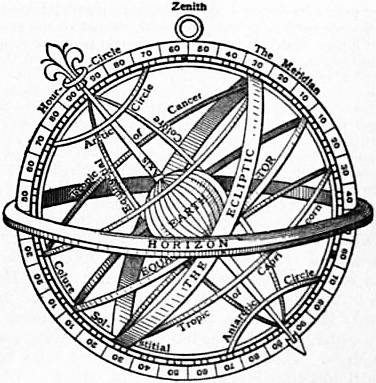
From M. Blundeville’s Treatise of the first principles of Cosmography and specially of the Spheare.
Armillary Sphere. A.D. 1636.
No material advance was made on Ptolemy’s instrument until Tycho Brahe, whose elaborate armillary spheres passing into astrolabes are figured in his Astronomiae Instauratae Mechanica. The armillary sphere survives as useful for teaching, and may be described as a skeleton celestial globe, the series of rings representing the great circles of the heavens, and revolving on an axis within a horizon. With the earth as centre such a sphere is known as Ptolemaic; with the sun as centre, as Copernican.
The designer of the instrument shown no doubt thought that the north pole might suitably have the same ornament as was used to mark N. on the compass card, and so surmounted it with the fleur-de-lys, traditionally chosen for that purpose on the compass by Flavio Gioja in honour of Charles of Anjou, king of Sicily and Naples.
Armillary spheres occur in many old sculptures, paintings and engravings; and from these sources we know that they were made for suspension, for resting on the ground or on a table, for holding by a short handle, or either for holding or for resting on a stand.
Authorities.—Tycho Brahe, Astronomiae Instauratae Mechanica; M. Blundeville, his Exercises; N. Bion, Traité des instrumens de mathématique; also L’Usage des globes célestes; Sédillot, Mémoire sur les instrumens; J.B. Delambre, Histoire de l’astronomie ancienne; R. Grant, History of Physical Astronomy.
(M. L. H.)
ARMINIUS, the Latinized form of the name of Hermann, or more probably Armin (17 B.C.-A.D. 21), the German national hero. He was a son of a certain Segimer, a prince of the tribe of the Cherusci, and in early life served with distinction as an officer in the Roman armies. Returning to his own people he found them chafing under the yoke of the Roman governor, Quintilius Varus; he entertained for them hopes of freedom, and cautiously inducing neighbouring tribes to join his standard he led the rebellion which broke out in the autumn of A.D. 9. Heavily laden with baggage the troops of Varus were decoyed into the fastnesses of the Teutoburger Wald, and there attacked, the completeness of the barbarian victory being attested by the virtual annihilation of three legions, by the voluntary death of Varus, and by the terror which reigned in Rome when the news of the defeat became known, a terror which found utterance in the emperor’s despairing cry: “Varus, give me back my legions!” Then in A.D. 15 Germanicus Caesar led the Romans against Arminius, and captured his wife, Thusnelda. An indecisive battle was fought in the Teutoburger Wald, where Germanicus narrowly escaped the fate of Varus, and in the following year Arminius was defeated. The hero’s later years were spent in fighting against Marbod, prince of the Marcomanni, and in disputes with his own people occasioned probably by his desire to found a powerful kingdom. He was murdered in A.D. 21.
In 1875 a great monument to Arminius was completed. This stands on the Grotenburg mountain near Detmold. Klopstock and other poets have used his exploits as material for dramas.
Much discussion has taken place with regard to the exact spot in the Teutoburger Wald where the great battle between Arminius and Varus was fought. There is an immense literature on this subject, and the following may be consulted:—T. Mommsen, Die Ortlichkeit der Varusschlacht (1885); E. Meyer, Untersuchungen über die Schlacht im Teutoburger Walde (1893); A. Wilms, Die Schlacht im Teutoburger Walde (1899); F. Knoke, Das Schlachtfeld im Teutoburger Walde (1899); E. Dünzelmann, Der Schauplatz der Varusschlacht (1889); and P. Höfer, Die Varusschlacht (1888). For more general accounts of Arminius see: Tacitus, Annals, edited by H. Furneaux (1884-1891); O. Kemmer, Arminius (1893); F.W. Fischer, Armin und die Römer (1893); W. Uhl, Das Portrait des Arminius (1898); and F. Knoke, Die Kriegszüge des Germanicus in Deutschland (1887).
ARMINIUS, JACOBUS (1560-1609), Dutch theologian, author of the modified reformed theology that receives its name of Arminian from him, was born at Oudewater, South Holland, on the 10th of October 1560. Arminius is a Latinized form of his patronymic Hermanns or Hermansen. His father, Hermann Jakobs, a cutler, died while he was an infant, leaving a widow and three children. Theodorus Aemilius, a priest, who had turned Protestant, adopting Jakob, sent him to school at Utrecht, but died when his charge was in his fifteenth year. Rudolf Snellius (Snel van Roijen, 1546-1613), the mathematician, a native of Oudewater, then a professor at Marburg, happening at the time to visit his early home, met the boy, saw promise in him and undertook his maintenance and education. But hardly was he settled at Marburg when the news came that the Spaniards had besieged and taken Oudewater, and murdered its inhabitants almost without exception. Arminius hurried home, but only to find all his relatives slain. In February the same year (1575), the university of Leiden had been founded, and thither, by the kindness of friends, Arminius was sent to study theology. The six years he remained at Leiden (1576-1582) were years of active and innovating thought in Holland. The War of Independence had started conflicting tendencies in men’s minds. To some it seemed to illustrate the necessity of the state tolerating only one religion, but to others the necessity of the state tolerating all. Dirck Coornhert argued, in private conferences and public disputations, that it was wrong to punish heretics, and his great opponents were, as a rule, the ministers, who maintained that there was no room for more than one religion in a state. Caspar Koolhaes, the heroic minister of Leiden—its first lecturer, too, in divinity—pleaded against a too rigid uniformity, for such an agreement on “fundamentals” as had allowed Reformed, Lutherans and Anabaptists to unite. Leiden had been happy, too, in its first professors. There taught in theology Guillaume Feuguières or Feuguereius (d. 1613), a mild divine, who had written a treatise on persuasion in religion, urging that as to it “men could be led, not driven”; Lambert Danaeus, who deserves remembrance as the first to discuss Christian ethics scientifically, apart from dogmatics; Johannes Drusius, the Orientalist, one of the most enlightened and advanced scholars of his day, settled later at Franeker; Johann Kolmann the younger, best known by his saying that high Calvinism made God “both a tyrant and an executioner.” Snellius, Arminius’s old patron, now removed to Leiden, expounded the Ramist philosophy, and did his best to start his students on the search after truth, unimpeded by the authority of Aristotle. Under these men and influences, Arminius studied with signal success; and the promise he gave induced the merchants’ gild of Amsterdam to bear the further expenses of his education. In 1582 he went to Geneva, studied there awhile under Theodore Beza, but had soon, owing to his active advocacy of the Ramist philosophy, to remove to Basel. After a short but brilliant career there he turned to Geneva, studied for three years, travelled, in 1586, in Italy, heard Giacomo Zarabella (1533-1589) lecture on philosophy in Padua, visited Rome, and, open-minded enough to see its good as well as its evil, was suspected by the stern Dutch Calvinists of “popish” leanings. Next year he was called to Amsterdam, and there, in 1588, was ordained. He soon acquired the reputation of being a good preacher and faithful pastor. He was commissioned to organize the educational system of the city, and is said to have done it well. He greatly distinguished himself by fidelity to duty during a plague that devastated Amsterdam in 1602. In 1603 he was called, in succession to Franz Junius, to a theological professorship at Leiden, which he held till his death on the 19th of October 1609.
Arminius is best known as the founder of the anti-Calvinistic school in Reformed theology, which created the Remonstrant Church in Holland (see Remonstrants), and contributed to form the Arminian tendency or party in England. He was a man of mild and liberal spirit, broadened by varied culture, constitutionally averse from narrow views and enforced uniformity. He lived in a period of severe systematizing. The Reformed strengthened itself against the Roman Catholic theology by working itself, on the one hand, into vigorous logical consistency, and supporting itself, on the other, on the supreme authority of the Scriptures. Calvin’s first principle, the absolute sovereignty of God, had been so applied as to make the divine decree determine alike the acts and the destinies of men; and his formal principle had been so construed as to invest his system with the authority of the source whence it professed to have been drawn. Calvinism had become, towards the close of the 16th century, supreme in Holland, but the very rigour of the uniformity it exacted provoked a reaction. Coornhert could not plead for the toleration of heretics without assailing the dominant Calvinism, and so he opposed a conditional to its unconditional predestination. The two ministers of Delft, who had debated the point with him, had, the better to turn his arguments, descended from the supralapsarian to the infralapsarian position, i.e. made the divine decree, instead of precede and determine, succeed the Fall. This seemed to the high Calvinists of Holland a grave heresy. Arminius, fresh from Geneva, familiar with the dialectics of Beza, appeared to many the man able to speak the needed word, and so, in 1589, he was simultaneously invited by the ecclesiastical court of Amsterdam to refute Coornhert, and by Martin Lydius, professor at Franeker, to combat the two infralapsarian ministers of Delft. Thus led to confront the questions of necessity and free will, his own views became unsettled, and the further he pursued his inquiries the more he was inclined to assert the freedom of man and limit the range of the unconditional decrees of God. This change became gradually more apparent in his preaching and in his conferences with his clerical associates, and occasioned much controversy in the ecclesiastical courts where, however, he successfully defended his position. The controversy was embittered and the differences sharpened by his appointment to the professorship at Leiden. He had as colleague Franz Gomarus, a strong supralapsarian, perfervid, irrepressible; and their collisions, personal, official, political, tended to develop and define their respective positions.
Arminius died, worn out by uncongenial controversy and ecclesiastical persecution, before his system had been elaborated into the logical consistency it attained in the hands of his celebrated successor, Simon Episcopius; but though inchoate in detail, it was in its principles clear and coherent enough. These may be thus stated:
1. The decree of God is, when it concerns His own actions, absolute, but when it concerns man’s, conditional, i.e. the decree relative to the Saviour to be appointed and the salvation to be provided is absolute, but the decree relative to the persons saved or condemned is made to depend on the acts—belief and repentance in the one case, unbelief and impenitence in the other—of the persons themselves.
2. The providence or government of God, while sovereign, is exercised in harmony with the nature of the creatures governed, i.e. the sovereignty of God is so exercised as to be compatible with the freedom of man.
3. Man is by original nature, through the assistance of divine grace, free, able to will and perform the right; but is in his fallen state, of and by himself, unable to do so; he needs to be regenerated in all his powers before he can do what is good and pleasing to God.
4. Divine grace originates, maintains and perfects all the good in man, so much so that he cannot, though regenerate, conceive, will or do any good thing without it.
5. The saints possess, by the grace of the Holy Spirit, sufficient strength to persevere to the end in spite of sin and the flesh, but may so decline from sound doctrine as to cause divine grace to be ineffectual.
6. Every believer may be assured of his own salvation.
7. It is possible for a regenerate man to live without sin.
Arminius’s works are mostly occasional treatises drawn from him by controversial emergencies, but they everywhere exhibit a calm, well-furnished, undogmatic and progressive mind. He was essentially an amiable man, who hated the zeal for an impossible orthodoxy that constrained “the church to institute a search after crimes which have not betrayed an existence, yea, and to drag into open contentions those who are meditating no evil.” His friend Peter Bertius, who pronounced his funeral oration, closed it with these words: “There lived a man whom it was not possible for those who knew him sufficiently to esteem; those who entertained no esteem for him are such as never knew him well enough to appreciate his merits.”
The works of Arminius (in Latin) were published in a single quarto volume at Leiden in 1629, at Frankfort in 1631 and 1635. Two volumes of an English translation, with copious notes, by James Nichols, were published at London, 1825-1828; three volumes (complete) at Buffalo, 1853. A life was written by Caspar Brandt, son of Gerard Brandt, the historian of the Dutch reformation, and published in 1724; republished and annotated by J.L. Mosheim in 1725; and translated into English by the Rev. John Guthrie, 1854. James Nichols also wrote a life (London, 1843).
ARMISTICE (from Lat. arma, arms, and sistere, to stop), a suspension of hostilities by mutual agreement between two nations at war, or their respective forces. An armistice may be either general or particular; in the first case there is a complete cessation of hostile operations in every part of the dominions of the belligerent powers; in the second there is merely a temporary truce between two contending armies, or between a besieged fortress and the force besieging it. Such a temporary truce, when for a very limited period and for a special purpose, e.g. the collection of the wounded and the burial of the dead, is termed a suspension of arms. A general armistice cannot be concluded by the commanders-in-chief unless special authority has been previously delegated to them by their respective governments; otherwise any arrangement entered into by them requires subsequent ratification by the supreme powers of the states. A partial truce may be concluded by the officers of the respective powers, without any special authority from their governments, wherever, from the nature and extent of the commands they exercise, their duties could not be efficiently discharged without their possession of such a power. The conduct of belligerent parties during an armistice is usually regulated in modern warfare by express agreement between the parties, but where this is not the case the following general conditions may be laid down. (1) Each party may do, within the limits prescribed by the truce, whatever he could have done in time of peace. For example, he can raise troops, collect stores, receive reinforcements and fortify places that are not actually in a state of siege. (2) Neither party can take advantage of the armistice to do what he could not have done had military operations continued. Thus he cannot throw provisions or reinforcements into a besieged town, and neither besiegers nor besieged are at liberty to repair their fortifications or erect new works. (3) All things contained in places the possession of which was contested, must remain in the state in which they were before the armistice began. Any infringement by either party of the conditions of the truce entitles the other to recommence hostile operations without previous intimation.
ARMOIRE, the French name (cf. Almery) given to a tall movable cupboard, or “wardrobe,” with one or more doors. It has varied considerably in shape and size, and the decoration of its doors and sides has faithfully represented mutations of fashion and modifications of use. It was originally exceedingly massive and found its chief decoration in elaborate hinges and locks of beaten iron. The finer ecclesiastical armoires or aumbries which have come down to us—used in churches for the safe custody of vestments, eucharistic vessels, reliquaries and other precious objects—are usually painted, sometimes even upon the interior, with sacred subjects or with incidents from the lives of the saints. The cathedrals of Bayeux and Noyon contain famous examples; the most typical English one is in York minster. By the end of the 14th century, when the carpenter and the wood-carver had acquired a better mastery of their material, the taste for painted surfaces appears to have given place to the vogue of carving, and the simple rectangular panels gradually became sculptured with a simple motive, such as the linen-fold or parchment patterns. In the treasury of St Germain l’Auxerrois the ends of the 15th-century armoires are treated in this way. In that and the two following centuries the keys and the escutcheons of the locks became highly ornamental; usually in forged iron, they were occasionally made of more precious metals. By slow degrees the shape of this receptacle changed—from breadth was evolved height, and the tall form of armoire became characteristic. The Renaissance exercised a notable effect upon this, as upon so many other varieties of furniture. It became less obviously and aggressively a thing of utility; its proportions shrank from the massive to the elegant; its artistic effectiveness was vastly enhanced by its division into an upper and a lower part. Enriched with columns and pilasters, its panels carved with mythology, its canopied niches filled with sculptured statuettes, and terminating with a rich cornice and perhaps a broken pediment, it was widely removed in appearance, if not in purpose, from the uncompromising iron-mounted receptacle of earlier generations. During the 16th century, when the surging impulses of the Renaissance had died away, the armoire relapsed into plainness, its proportions increased, and it was again constructed in one piece. Ere long, however, it grew more sumptuous than ever. Boulle encrusted it with marqueterie from designs by Bérain; it glowed with amorini, with the torches and arrows of Cupid, with the garlands which he weaves for his captives, and when allusiveness left a corner vacant, it was filled with arabesques in ebony or ivory, in brass or white metal. While the royal palaces and the hôtels of the great nobility were filled with those costly splendours, the ordinary cabinetmaker continued to construct his modest pieces, and by the middle of the 18th century the armoire was found in every French house, ample in width and high in proportion to the lofty rooms of the period. It is not to be supposed that so useful a piece of furniture was confined to France. It was used, more or less, throughout a considerable part of Europe, but it was distinctively Gallic nevertheless, and never became thoroughly acclimatized elsewhere until about the beginning of the 19th century, when it developed into the glass-fronted wardrobe which is now an essential detail in the plenishing of the bed-chamber, not merely in France and England, but in many other countries. The armoire à glace was known and occasionally made in France as far back as the middle of the 18th century, and almost the earliest mention of it connects it with the scandalous relations of the Maréchal de Richelieu and the beautiful fermière générale, Mme de la Popelinière, who had one made to mask a secret door. In the conventional and not very attractive wardrobe of commerce it is difficult to descry the gracious characteristics of the armoire of the Renaissance or the 17th century, and it is not altogether surprising that Théodore de Banville should have condemned one of the most solidly useful of household necessaries as a “hideous monster.”
ARMORICA (Aremorica), the Roman name, derived from two Celtic words meaning the “seaside” (ar, on, and mor, sea), for the land of the Armorici, roughly the peninsula of Brittany. At the time of the Roman advance on Gaul there were five principal tribes in Armorica, the Namneti, the Veneti, the Osismii, the Curiosolitae and the Redones. It was subdued by Caesar, who entirely destroyed the seafaring tribe of its south coast, the Veneti. Under the Empire it formed part of the province of Gallia Lugudunensis (Lugdunensis). It contained hardly any towns, though many large country houses, and was perhaps less Romanized than the rest of Gaul. In and after the later part of the 5th century it received many Celtic immigrants from the British Isles, fleeing (it is said) from the Saxons; and the Celtic dialect which the Bretons still speak is thought to owe its origin to these immigrants. (See further Brittany.)
ARMOUR, PHILIP DANFORTH (1832-1901), American merchant and philanthropist, was born in Stockbridge, New York, on the 16th of May 1832. He was educated at Cazenovia Academy, Cazenovia, N.Y., worked for several years on his father’s farm, and in 1852 with a small party went overland to California, a large part of the journey being made on foot. Here during the next four years he laid the foundations of his fortune. In 1856 he became associated with his friend, Frederick S. Miles, in a wholesale grocery and commission business at Milwaukee. In 1863 he became the head of the firm of Armour, Plankington & Co., pork packers, whose headquarters were at Milwaukee. He also obtained a large interest in the firm H.O. Armour & Co., which was founded by his brother, Herman Ossian Armour (1837-1901), and which, starting as a grain commission business, in 1868 established also a large pork-packing plant. Of this firm, the name of which was changed to Armour & Co. in 1870, he became the head in 1875, and thereafter the business made such rapid progress that in 1901 as many as 11,000 hands were employed. Besides contributing to many charitable enterprises, Armour founded the Armour Institute of Technology at Chicago in 1892 and the Armour Flats in Chicago, built for the purpose of supplying at a low rental good homes for working men and their families. He also contributed liberally to the Armour Mission in Chicago, which was founded in 1881 by his brother, Joseph Armour. At the time of his death, on the 6th of January 1901, Philip D. Armour’s private fortune was supposed to exceed $50,000,000.