VOLUME II SLICE V Arculf to Armour, Philip (continued 3)
Reading edition
Forty years were now to elapse before any further efforts were made by the Spaniards to colonize any part of the territory of the river Plate and lower Paraná. In 1573 Juan de Garay, at the head of an expedition despatched Juan de Garay. from Asunción, founded the city of Santa Fé near the abandoned settlements of San Espiritù and Corpus Christi. Seven years later (1580), when the new colony had been firmly established, Juan de Garay proceeded southwards, and made the third attempt to build a city on the site of Buenos Aires; and despite the determined hostility of the Querendi Indians he succeeded in finally gaining a complete mastery over them. In a desperate battle, the natives were defeated with great slaughter, and the territory surrounding the town was divided into ranches, in which the conquered natives had to labour. The new town received from Garay the name of Ciudad de la Santissima Trinidad, while its port retained the old appellation of Santa Maria de Buenos Aires. It was endowed by its founder with a cabildo (corporation) and full Spanish municipal privileges. Garay, when on his way to Santa Fé, was unfortunately murdered by a party of Indians, Minuas (Mimas), three years later, while incautiously sleeping on the river bank near the ruins of San Espiritù. The new settlement, however, continued to prosper, and the cattle and horses brought from Europe multiplied and spread over the plains of the Pampas.
In the meantime the Spaniards had penetrated into the interior of what is now the Argentine Republic, and established themselves on the eastern slopes of the Andes. In 1553 an expedition from Peru made their way through the mountain region and founded the city of Santiago del Estero, that of Tucumán in 1565, and that of Córdoba in 1573. Another expedition from Chile, under Garcia Hurtado de Mendoza, crossed the Cordillera in 1559, and having defeated the Araucanian Indians, made a settlement which from the name of the leader was called Mendoza. In 1620 Buenos Aires was separated from the authority of the government established at Asunción, and was made the seat of a government extending over Mendoza, Santa Fé, Entre Rios and Corrientes, but at the same time remained like the government of Paraguay at Asunción, and that of the province of Tucumán, which had Córdoba as its capital, subject to the authority of the viceroyalty of Peru.
Thus at the opening of the 17th century, after many adventurous efforts, and the expenditure of many lives and much treasure, the Spaniards found themselves securely established on the river Plate, and had planted a Evils of Spanish colonial system. number of centres of trade and colonization in the interior. Unfortunately, in no part of the Spanish oversea possessions did the restrictive legislation of the home government operate more harshly or disadvantageously to the interests of the colony; it was a more effective hindrance to the development of its resources and the spread of civilization over the country, than the hostility of the Indians. Cabot had urged the feasibility of opening an easier channel for trade with the interior of Peru through the river Plate and its tributaries, than that by way of the West Indies and Panama; and now that his views were able to be realized, the interests of the merchants of Seville and of Lima, who had secured a monopoly of the trade by the route of the isthmus, were allowed to destroy the threatened rivalry of that by the river Plate. Never in the history of colonization has a mother country pursued so relentlessly a policy more selfish and short-sighted. Spanish legislation was not satisfied with endeavouring to exclude all European nations except Spain from trading with the West Indies, but it sought to limit all commerce to one particular route, and it forbade any trade being transacted by way of the river Plate, thus enacting the most flagrant injustice towards the people it had encouraged to settle in the latter country. The strongest protests were raised, but the utmost they could effect was that, in 1618, permission was granted to export from Buenos Aires two shiploads of produce a year. But the Spanish government was not content with the prohibition of sea-borne commerce. To prevent internal trade with Peru a custom-house was set up at Córdoba to levy a duty of 50% on everything in transit to and from the river Plate. In 1665 the relaxation of this system was brought about by the continual remonstrances of the people, Asiento question. but for more than a century afterwards (until 1776) the policy of exclusion was enforced. This naturally led to a contraband trade of considerable dimensions. The English, after the treaty of Utrecht (1715) held the contract (asiento) for supplying the Spanish-American colonies with negro slaves. Among other places the slave ships regularly visited Buenos Aires, and despite the efforts of the Spanish authorities, contrived both to smuggle in and carry away a quantity of goods. This illicit commerce went on steadily till 1739, when it led to an outbreak of war between England and Spain, which put an end to the asiento. The Portuguese were even worse offenders, for in 1680 they made a settlement on the north of the river Plate, right opposite to Buenos Aires, named Colonia, which with one or two short intervals, remained in their hands till 1777. From this port foreign merchandise found its way duty free into the Spanish provinces of Buenos Aires, Tucumán and Paraguay, and even into the interior of Peru. The continual encroachments of the Portuguese at length led the Spanish government to take the important step of making Buenos Aires the seat of a viceroyalty with jurisdiction over the territories of the present republics of Bolivia, Paraguay, Uruguay and the Argentine Confederation (1776). At the same time all this country was opened to Spanish trade even with Peru, and the development of its resources, so long thwarted, was allowed comparatively free play. Pedro de Zeballos, the first viceroy, took with him from Spain a large military force with which he finally expelled the Portuguese from the banks of the river Plate.
The wars of the French Revolution, in which Spain was allied with France against Great Britain, interrupted the growing prosperity of Buenos Aires. On the 17th of June 1806 General William Beresford landed with a body of Effects of French war. troops from a British fleet under the command of Sir Home Popham, and obtained possession of Buenos Aires. But a French officer, Jacques de Liniers, gathered together a large force with which he enclosed the British within the walls, and finally, on the 12th of August, by a successful assault, forced Beresford and his troops to surrender. In July 1807 another British force of eight thousand men under General Whitelock endeavoured to regain possession of Buenos Aires, but strenuous preparations had been made for resistance, and after fierce street fighting the invading army, after suffering severe losses, was compelled to capitulate. The colonists, who had achieved their two great successes without any aid from the home government, were naturally elated, and began to feel a new sense of self-reliance and confidence in their own resources. The successful defence of Buenos Aires accentuated the growing feeling of dissatisfaction with the Spanish connexion, which was soon to lead to open insurrection. The establishment of the Napoleonic dynasty at Madrid was the actual cause which brought about the disturbances which were to end in separation. Liniers was viceroy on the arrival of the news of the crowning of Joseph Bonaparte as king of Spain, but as a Frenchman he was distrusted and was deposed by the adherents of Ferdinand VII. The central junta at Seville, acting in the name of Ferdinand, appointed Balthasar de Cisneros to be viceroy in his place. He entered upon the duties of his office on the 19th of July 1809, and at first he gained popularity by acceding to the urgent appeals of the people and throwing open the trade of the country to all nations. But his measures speedily gave dissatisfaction to the Argentine or Creole party, who had long chafed under the disabilities of Spanish rule, and who now felt themselves no longer bound by ties of loyalty to a country which was in the possession of the French armies.
On the 25th of May 1810 a great armed assembly met at Buenos Aires and a provisional junta was formed to supersede the authority of the viceroy and carry on the government. The acts of the new government ran in the name of Ferdinand VII., Struggle for independence. but the step taken was a revolutionary one, and the 25th of May has ever since been regarded as the birthday of Argentine independence. The most prominent leader of the junta was its secretary Mariano Moreno (1778-1811), who with a number of other active supporters of the patriot cause succeeded in raising a considerable force of Buenos Aireans to maintain, arms in hand, their nationalist and anti-Spanish doctrines. An attempt of the Spanish party to make Balthasar de Cisneros president of the junta failed, and the ex-viceroy retired to Montevideo. A sanguinary struggle between the party of independence and the adherents of Spain spread over the whole country, and was carried on with varying fortune. Foremost among the leaders of the revolutionary armies were Manuel Belgrano, and after March 1812 General José de San Martin, an officer who had gained experience against the French in the Peninsular War. A state of disorder, almost of anarchy, reigned in the provinces, but on the 25th of March 1816 a congress of deputies was assembled at Tucumán, who named Don Martin Pueyrredón supreme director, and on the 9th of July the separation of the united provinces of the Rio de la Plata was formally proclaimed, and comparative order was re-established in the country; Buenos Aires was declared the seat of the government. The jealousy of the provinces, however, against the capital led to a series of disturbances, and for many years continual civil war devastated every part of the country. Bolivia, Paraguay and Uruguay rose in armed revolt, and finally established themselves as separate republics, whilst the city of Buenos Aires itself was torn with faction and the scene of many a sanguinary fight.
From 1816, however, the independence of the Argentine Republic was assured, and success attended the South Americans in their contest with the royal armies. The combined forces of Buenos Aires and Chile defeated the Spaniards Republic established. at Chacabuco in 1817, and at Maipú in 1818; and from Chile the victorious general José de San Martin led his troops into Peru, where on the 9th of July 1821, he made a triumphal entry into Lima, which had been the chief stronghold of the Spanish power, having from the time of its foundation by Pizarro been the seat of government of a viceroyalty which at one time extended to the river Plate. A general congress was assembled at Buenos Aires on the 1st of March 1822, of representatives from all the liberated provinces, and a general amnesty was decreed, though the war was not over until the 9th of December 1824, when the republican forces gained the final, victory of Ayacucho, in the Peruvian border-land. The Spanish government did not, however, formally acknowledge the independence of the country until the year 1842. On the 23rd of January 1825, a national constitution for the federal states, which formed the Argentine Republic, was decreed; and on the 2nd of February of the same year Sir Woodbine Parish, acting under the instructions of George Canning, signed a commercial treaty in Buenos Aires, by which the British government acknowledged the independence of the country. It had already been recognized by the United States of America two years previously.
In 1826 Bernardo Rivadavia was elected president of the confederation. His policy was to establish a strong central government, and he became the head of a party known as Unitarians in contradistinction to their opponents, Unitarians and Federalists. who were styled Federalists, their aim being to maintain to the utmost the local autonomy of the various provinces. Under the government of Rivadavia the people of Buenos Aires became involved, practically single-handed, in a war with Brazil in defence of the Banda Oriental, which had been seized by the imperial forces (see Uruguay). The Brazilians were defeated, notably at Ituzaingo, and in 1827 the war issued in the independence of Uruguay. Rivadavia’s term of office was likewise memorable for the constitution of the 24th of December 1826, passed by the constituent congress of all the provinces, by which the bonds which united the confederated states of the Argentine Republic were strengthened. This project of closer union met, however, with much opposition both at Buenos Aires and the provinces. Rivadavia resigned, and Vicente Lopez, a Federalist, was elected to succeed him, but was speedily displaced by Manuel Dorrego (1827), another representative of the same party. The carrying out of Federalist principles led, however, to the formation in the republic of a number of quasi-independent military states, and Dorrego only ruled in Buenos Aires. After the conclusion of the peace with Brazil, the Unitarians placed themselves under the leadership of General Juan de Lavalle, the victor of Ituzaingo. Lavalle, at the head of a division of troops, drove Dorrego from Buenos Aires, pursued him into the interior, and captured him. He was shot (December 9, 1828), by the order of Lavalle, and during the year 1828 the country was given up to the horrors of civil war.
On the death of Dorrego, a remarkable man, Juan Manuel de Rosas, became the Federalist chief. In 1829 he defeated Lavalle, made himself master of Buenos Aires, and in the course of the next three years made his authority recognized Rosas dictator. after much fighting throughout the provinces. The Unitarians were relentlessly hunted down and a veritable reign of terror ensued. Rosas gradually concentrated all power in his own hands, and was hailed by the populace as a saviour of the state. In 1835, with the title of governor and captain-general, he acquired dictatorial powers, and all public authority passed into his hands. This dictatorship of Rosas continued until 1852. In every department of administration and of government he was supreme. He was exceedingly jealous of foreign interference, and quarrelled with France on questions connected with the rights of foreign residents. Buenos Aires was in 1838 blockaded by a French fleet; but Rosas stood firm. A formidable revolt took place in 1839 under General Lavalle, who had returned to the country accompanied by a number of banished Unitarians. In 1840 he invaded Buenos Aires at the head of troops raised chiefly in the province of Entre Rios; but he was defeated at Santa Fé, then at Luján, and finally was captured in Jujuy and shot, 1841. The rule of Rosas was now one of tyranny and almost incessant bloodshed in Buenos Aires, while his partisans, foremost amongst whom was General Ignacio Oribe, endeavoured to exterminate the Unitarians throughout the provinces. The scene of slaughter was extended to the Banda Oriental by the attempt of Oribe, with the support of Rosas, and of Justo José de Urquiza, governor of Entre Rios, to establish himself as president of that republic (see Uruguay), where the existing government was hostile to Rosas and sheltered all political refugees from the country under his despotic rule. The siege of Montevideo led to a joint intervention of England and France. Buenos Aires was blockaded by the combined English and French fleets, September 1845, which landed a force to open the passage up the Paraná to Paraguay, which had been declared closed to foreigners by Rosas. A convention was signed in 1849, which secured the free navigation of the Paraná and the independence of the Banda Oriental. The downfall of Rosas was at last brought about by the instrumentality of Justo José de Urquiza, who as governor of Entre Rios, had for many years been one of his strongest supporters. The breach between the two men which led to open collision took place in 1846. The first efforts of Urquiza to rouse the country against the oppressor were unsuccessful, but in 1851 he concluded an alliance with Brazil, to which Uruguay afterwards adhered. A large army of twenty-four thousand men was collected at Montevideo, and on the 8th of January 1852 the allied forces crossed the Paraná and the road to Buenos Aires lay open before them. Rosas met the allies at the head of a body of troops fully equal in numbers to their own, but was crushingly routed, February 3rd, at Monte Caseros, about 10 m. from the capital. The dictator fled for refuge to the British legation, from whence he was conveyed on board H.B.M.S. “Locust,” which carried him into exile.
A provisional government was formed under Urquiza, and the Brazilian and Uruguayan troops withdrew. He summoned all the provincial governors at San Nicolás in the province of Buenos Aires, and on the 31st of May they proclaimed Urquiza president. a new constitution, with Urquiza as provisional director of the Argentine nation. A constituent congress, in which each province had equal representation, was duly elected, and in order to provide against the predominance of Buenos Aires, it was determined that Sante Fé should be the place of session. But this did not suit the porteños, as the people of Buenos Aires were called, and the province refused to take any part in the congressional proceedings. But Urquiza Buenos Aires and the provinces. was a man of different temperament from Rosas, and when he found that Buenos Aires refused to submit to his authority, he declined to use force. The congress had (May 1, 1853) appointed Urquiza president of the confederation, and he established the seat of government at Paraná. The province of Buenos Aires was recognized as an independent state, and under the enlightened administration of Doctor Obligado made rapid strides in commercial prosperity. The two sections of the Argentine nation contrived to exist as separate governments without an open breach of the peace until 1859, when the long-continued tension led to the outbreak of hostilities. The army of the porteños, commanded by Colonel Bartolomé Mitre, was defeated at Cepeda by the confederate forces under Urquiza, and Buenos Aires agreed to re-enter the confederation (November 11, 1859). Urquiza at this juncture resigned the presidency, and Doctor Santiago Derqui was elected president of the fourteen provinces with the seat of government at Paraná; while Urquiza became once more governor of Entre Rios, and Mitre was appointed governor of Buenos Aires.
The struggle for supremacy between Buenos Aires and the provinces had, however, to be fought out, and hostilities once more broke out in 1861. The armies of the opposing parties, under Generals Mitre and Urquiza respectively, Mitre president. met at Pavón in the province of Santa Fé (September 17). The battle ended in the disastrous defeat of the provincial forces; General Mitre used his victory in a spirit of moderation and sincere patriotism. He was elected president of the Argentine confederation and did his utmost to settle the questions which had led to so many civil wars, on a permanent and sound basis. The constitution of 1853 was maintained, but Buenos Aires became the seat of federal government without ceasing to be a provincial capital. Causes of friction still remained, but they did not develop into open quarrels, for Mitre was content to leave Urquiza in his province of Entre Rios, and the other administrators (caudillos) in their several governments, a large measure of autonomy, trusting that the position and growing commercial importance of Buenos Aires would inevitably tend to make the federal capital the real centre of power of the republic. In 1865 the Argentines were forced into war with Paraguay through the overbearing attitude of the president Francisco Solano Lopez. The dictator of Paraguay had quarrelled with Brazil for its intervention in the internal affairs of Uruguay, Paraguay war. and he demanded free passage for his troops across the Argentine province of Corrientes. This Mitre refused, and alliance was formed between Argentina, Brazil and Uruguay, for joint action against Lopez. General Mitre became commander-in-chief of the combined armies for the invasion of Paraguay and was absent for several years in the field. The struggle was severe and attended by heavy losses, and it was not until 1870 that the Paraguayans were conquered, Lopez killed, and peace concluded (see Paraguay). Meanwhile, disturbances had broken out in the interior of Argentina (1867), which compelled Mitre to relinquish his command in Paraguay, and to call back a large part of the Argentine forces to suppress the insurrection. The rebels had hoped for assistance from Urquiza, but the powerful governor of Entre Rios maintained the peace in his province, which under his firm and beneficent rule had greatly prospered, and the revolutionary movement was quickly subdued.
In 1868 the term of General Mitre came to an end, and Doctor Domingo Faustino Sarmiento, a native of San Juan, was quietly elected to succeed him. His conduct of affairs was broad-minded and upright, and was characterized Sarmiento president. by earnest efforts to promote education and to develop the resources of the country. His period of office was marked by the rapid advance of Buenos Aires in population and prosperity, and by an expansion of trade that was unfortunately accompanied by financial extravagance. The war with Paraguay left a legacy of disputes concerning boundaries which almost led to war between the two victorious allies, Argentina and Brazil, but by the exertions of Mitre, who was sent at the close of 1872 as special envoy to Rio, a settlement was arrived at and friendly relations restored. The month of April 1870 saw an insurrection in Entre Rios headed by the caudillo, Lopez Jordan. Urquiza was assassinated, and the provincial legislature, through fear, at once proclaimed Lopez Jordan governor. The federal government refused to acknowledge the new governor, and troops were despatched by Sarmiento against Entre Rios. The contest lasted with varying success for more than a year, but finally Lopez Jordan was completely defeated and driven into exile.
The presidential election of 1874 resolved itself, as so often before, into a struggle between the provincials and the porteños (Buenos Aires). The candidate of the former, Dr Nicolas Avellaneda, triumphed over General Mitre, Avellaneda president. not without suspicions of tampering with the returns; and the unsuccessful party appealed to arms. The new president, however, who was installed in office on the 12th of October, took active steps to suppress the revolution, which never assumed a really serious character. The government troops gained two decisive victories over the insurgents under Generals Mitre and Arredondo, and they were compelled to surrender at discretion. But though peace was for a time restored, the old causes of soreness and dissension remained unappeased, and as the time for the next presidential election began to draw near, it became more and more evident that a critical struggle was at hand, and that the people of Buenos Aires, supported by the province of Corrientes, were determined to bring to an issue the question as to what position Buenos Aires was to hold for the future with regard to the remaining provinces of the confederation. It was evident that the president intended to use all the influence which the party in power could exercise, to secure the return of General Julio Roca, who had distinguished himself in 1878 by a successful campaign against the warlike Indian tribes bordering on the Andes. The porteños on their part were determined to resist this policy to the utmost. Mass meetings were held, and a committee was appointed for the purpose of considering what action should be taken to defeat the ambitious designs of the provincials. The Tiro Nacional. Under the direction of this committee, the association known as the “Tiro Nacional” was formed, with the avowed object of training the able-bodied citizens of Buenos Aires in military exercises and creating a volunteer army, ready for service if called upon, to withstand by force the pretensions of their opponents. The establishment of the Tiro Nacional was enthusiastically received by all classes in Buenos Aires, the men turning out regularly to drill, and the women aiding the movement by collecting subscriptions for the purpose of armament and other necessaries. On the 13th of February 1880, the minister of war, Dr Carlos Pellegrini, summoned the principal officers connected with the Tiro Nacional, General Bartolomé Mitre, his brother Emilio, Colonel Julio Campos, Colonel Hilario Lagos and others, and warned them that as officers of the national army they owed obedience to the national government, and would be severely punished if concerned in any revolutionary outbreak against the constituted authorities. The reply to this threat was the immediate resignation of their commissions by all the officers connected with the Tiro Nacional. Two days later, the national government occupied, with a strong force of infantry and artillery, the parade ground at Palermo used by the Buenos Aires volunteers for drill purposes. A great meeting of citizens was then called and marched through the streets. President Avellaneda was frightened at the results of his action, and to avoid a collision ordered the troops to be withdrawn. Negotiations were now opened by the government with the provincial authorities for the disarmament of the city and province of Buenos Aires, but they led to nothing. Matters became still further strained on account of the outrages committed by the national troops, and such was the bitterness of feeling developed between the two factions, that an appeal to arms became inevitable.
In the month of June 1880, President Avellaneda and his ministers left Buenos Aires, and this act was considered by the porteño leaders equivalent to a declaration of war. The national government and the twelve provinces Appeal to Arms. forming the Córdoba League, were ranged on one side; the city and province of Buenos Aires and the province of Corrientes on the other. The national troops were well armed with Remington rifles, provided with abundant ammunition, equipped with artillery and supported by the fleet. In the city and province of Buenos Aires, plenty of volunteers offered their services, and an army of some twenty-five thousand men was quickly raised, but they were armed with old-fashioned weapons and there was only a limited supply of ammunition. Feverish attempts were made to remedy the lack of warlike stores, but difficulty was experienced on account of the fleet blockading the entrance to the river. After several skirmishes, the national army commanded by General Roca, containing many troops seasoned in Indian campaigns, assaulted the porteños posted Fall of Buenos Aires. before Buenos Aires, and after two days’ hard fighting (20th and 21st July) forced its way into the town. On 23rd July the surrender of the city was demanded and obtained. The terms of the surrender were that all the leaders of the revolution should be removed from positions of authority, all government employees implicated in the movement dismissed, and the force in the province and city of Buenos Aires at once disarmed and disbanded. The power of Buenos Aires was thus completely broken and at the mercy of the Córdoba League. The porteños were no longer in a position to nominate a candidate in opposition to General Julio Roca, who was duly elected. He assumed office in October 1880.
Hitherto General Roca had been regarded only in his capacity as a soldier, and not from the point of view of an administrator. In the campaigns against the Indians in the south-west of the province of Buenos Aires and the valley of Roca president. the Rio Negro he had gained much prestige; the victory over Buenos Aires added to his fame, and secured his authority in the outlying provincial centres. One of the first notable acts of the Roca administration was to declare the city of Buenos Aires the property of the national government. This separation of the city from the province, and its federalization had been one of the chief aims of the Córdoba League, and was the natural consequence of the crushing defeat inflicted on the porteños. As a sequel to this step, in 1884 the town of La Plata was declared to be the capital of the province of Buenos Aires, and the provincial administration was moved to that place. This federalization of the capital has proved to be a most important factor in binding together the different parts of the confederation, and in promoting the evolution of an Argentine nation out of a loosely cemented union of a number of semi-independent states.
Considering the circumstances in which General Roca assumed office, it must be admitted that he showed great moderation and used the practically absolute power that he possessed to establish a strong central government, and to initiate a national policy, which aimed at furthering the prosperity and development of the whole country. He was able by the influence he exerted to keep down the internal dissensions and insurrectionary outbreaks which had so greatly impeded for many years the development of the vast natural resources of the republic. With this object he had promoted the extension of railways so as to link the provinces with the great port of Buenos Aires, and to provide at the same time facilities for the rapid despatch of military forces to disturbed districts. Unfortunately the last two years of Roca’s term of office were marked by two grave errors, which subsequently caused widespread suffering and distress throughout the country. The first of these mistakes was a measure making (January 1885) the currency inconvertible for a period of two years. This act, which was only decided upon after much hesitation, had a most deleterious effect upon the national credit. The second was the nomination of Dr Miguel Juarez Celman for the presidential term commencing in October 1886. The nomination was brought about by the Córdoba clique, and Roca lacked the moral courage to oppose the decision of this group, though he was well aware that Celman, who was his brother-in-law, was neither intellectually nor morally fitted for the post.
No sooner had President Juarez Celman come into power towards the close of 1886, than the respectable portion of the community began to feel alarmed at the methods practised by the new president in his conduct of Celman president. public affairs. At first it was hoped that the influence of General Roca would serve to check any serious extravagance on the part of Celman. This hope, however, was doomed to disappointment, and before many months had elapsed it was clear that the president would listen to no prudent counsels from Roca or from any one else. The men of the old Córdoba League became dominant in all branches of the government, and carpet-bagging politicians occupied every official post. In their hurry to obtain wealth, this crowd of office-mongers from the provinces lent themselves to all kinds of bribery and corruption. The public credit was pledged at home and abroad to fill the pockets of the adventurers, and the wildest excesses were committed under the guise of administrative acts. What followed in the second and third years of the Celman administration can only adequately be described as a debauchery of the national honour, of the national resources, of the rights of Argentines as citizens of the republic. Buenos Aires was still prostrate under the crushing blow of the misfortunes of 1880, and lacked strength and power of organization necessary to raise any effective protest against the proceedings of Celman and his friends when the true character of these proceedings was first understood. The conduct of public affairs, however, at length became so scandalous, that action on the part of the more sober-minded and conservative sections was seen to be absolutely imperative if the country was to be saved from speedy and certain ruin. In 1889 the association of the “Union Civica” The Union Civica. was founded, and the organization undertaken by Dr Leandro Alem, Dr Aristobulo del Valle, Dr Bernardo Irigoyen, Dr Vicente Lopez, Dr Lucio Lopez, Dr Oscar Lilliedale and other leading citizens. The untiring energy and zeal of Leandro Alem fitted him for being the chief organizer of a movement into which he threw himself heart and soul. Mass meetings were held in Buenos Aires, and it fell specially to the lot of Dr del Valle, who was an able orator as well as a sincere patriot, to expose the irresponsible and corrupt character of the administration, and the terrible dangers that threatened the republic through its reckless extravagance and financial improvidence. Subsidiary clubs affiliated to the central administration were formed throughout the length and breadth of the country, and millions of leaflets and pamphlets were distributed broadcast to explain the importance of the movement. President Celman underrated the strength of the new opposition, and relied upon his armed forces promptly to suppress any signs of open hostility. No change was made in official methods, and the condition of affairs drifted from bad to worse, until the temper of the people, so long and so sorely tried, showed plainly that the situation had become insufferable. The Union Civica then decided to make a bold bid for freedom by attempting forcibly to eject Celman and his clique from office.
On the night of the 26th of July 1890 the Union Civica called its members to arms. It was joined by some regiments of the regular army and received the support of the fleet. Barricades were thrown up in the principal streets, and the surrounding houses were occupied by the insurgents. Two days of desultory street fighting ensued, during which the fleet began to bombard the city, but was compelled to desist by the interference of foreign men-of-war, on the ground that the bombardment was causing unnecessary damage to the life and property of non-combatants. A suspension of hostilities then took place, and negotiations were opened between the contending parties. Celman, acting upon the advice of General Roca, who recognized the strength of public opinion in the outbreak, placed his resignation in the hands of congress on the 31st of July. A scene of intense enthusiasm followed, and Buenos Aires was en fête for the following three days. The vice-president of the confederation, Carlos Pellegrini, who had been minister of war under presidents Avellaneda and Roca and had had much administrative experience, succeeded without opposition to the vacant post.
Much satisfaction was shown in Europe at the fall of President Celman, for investors had suffered heavily by the way in which the resources of Argentina had been dissipated by a corrupt government, and hopes were entertained Pellegrini president. that the uprising of public opinion against his financial methods signified a more honest conduct of the national affairs in the future. Great expectations were entertained of the ability of President Pellegrini to establish a sound administration, and he succeeded in forming a ministry which gave general satisfaction throughout the country. General Roca was induced to undertake the duties of minister of the interior, and his influence in the provinces was sufficient to check any attempts to stir up disturbances at Córdoba or elsewhere. The most onerous post of all, that of minister of finance, was confided to Dr Vicente Lopez, who, though he was not of marked financial ability, was at least a man of untiring industry and of a personal integrity that was above suspicion. But the economic and financial situation was one of almost hopeless embarrassment and confusion, and Pellegrini proved himself incapable of grappling with it. Instead of facing the difficulties, the president preferred to put off the day of reckoning by flooding the country with inconvertible notes, with the result that the financial crisis became more and more aggravated. Through the rapid depreciation of Argentine credit, the great firm of Baring Brothers, the financial agents of the government in London, became so heavily involved that they were forced into liquidation, November 1890. The consequences of this catastrophe were felt far and wide, and in the spring of 1891 both the Banco Nacional and the Banco de la provincia de Buenos Aires were unable to meet their obligations. Amidst this sea of financial troubles the government drifted helplessly on, without showing any inclination or capacity to initiate a strong policy of reform in the methods of administration which had done so much to ruin the country.
It is little wonder that, in these circumstances, the choice of a successor to Pellegrini, whose term of office expired in 1892, should have been felt to possess peculiar importance. General Bartolomé Mitre was proposed by the porteños as their candidate. He had been absent from Argentina on a journey to Europe, and on his return in April 1891, a popular reception was given to him at which 50,000 persons attended. A petition was presented to him begging him to be a candidate for the presidency, and with some reluctance the veteran leader gave his consent. His partisans, however, found themselves confronted by a compact provincial party, who proposed to put forward the other strong man of the republic, General Roca, to oppose him. But the two generals were equally averse to a contest à outrance, which could only end in civil war. They met accordingly at a conference known as El Acuerdo, and it was arranged that both should withdraw, and that a non-party candidate should be selected who should receive the support of them both. The choice fell upon Dr Saenz Peña, a judge of the supreme court, and a man universally respected, who had never taken any part in political life. This compact aroused the bitter enmity of Dr Leandro Alem, who did his utmost to stir up the Union Civica to a campaign against the neutral candidate. Finding that the more conservative section of the union would not follow him, Alem formed a new association to which he gave the name of Union Civica Radical. Such was his energy, that soon a network of branches of the Union Civica Radical was organized throughout the republic, and Dr Bernardo Irigoyen was put forward as a rival candidate to Dr Saenz Peña. But Alem was not content with constitutional opposition to the Acuerdo, and his movement soon assumed the character of a revolutionary propaganda against the national government. His violence gave Pellegrini the opportunity of taking active steps to preserve the peace. In April 1892 Alem and his chief colleagues were arrested and sent into exile.
In the following month (May), the presidential elections were held; Dr Saenz Peña was declared duly elected, and Dr José Uriburu, the minister in Chile, was chosen as vice-president.
The idea of Dr Saenz Peña was to conduct the government on common sense and non-partisan lines, in fact to translate into practical politics the principles which underlay the compromise of the Acuerdo. He was a straightforward Saenz Peña president. and honourable man, who tried his best to do his duty in a position that had been forced upon him, and was in no sense of the word his own seeking. No sooner, however, was he installed in office than difficulties began to crop up on all sides, and he quickly discovered that to attempt to govern without the aid of a majority in congress was practically impossible. He had had no experience of political life, and he refused to create the support he needed by using his presidential prerogative to build up a political majority. Obstruction met his well-meant efforts to promote the general good, and before twelve months of the presidential term had run public affairs were at a deadlock. Dr Alem, who had been permitted to return from exile, was not slow to profit by the occasion. Embittered by his treatment in 1892, he openly preached the advisability of an armed rising to overthrow the existing administration. Public opinion had been outraged by the immunity with which the governors of certain provinces, and more particularly Dr Julio Costa, the governor of the province of Buenos Aires, had been allowed to maintain local forces, by the aid of which they exacted the payment of illegal taxes and exercised other acts of injustice and oppression. A number of officers of the army and navy agreed to lend assistance to a revolutionary outbreak, and towards the end of July 1893 matters came to a head. The population of Buenos Aires assembled in armed bodies with the avowed intention of ejecting the governor from office, and electing in his stead a man who would give them a just administration. The president was for some time in doubt whether he had any right to intervene in provincial affairs, but eventually troops were despatched to La Plata. There was no serious fighting. Negotiations were soon opened which quickly led to the resignation of Costa, and the return of the insurgents to their homes. While these disturbances were taking place in the province of Buenos Aires, another revolutionary rising was in progress in Santa Fé. Here the efforts of Dr Alem succeeded in supplying a large body of rebels with arms and ammunition, and he was able, by a bold attack, to seize the town of Rosario and there establish the revolutionary headquarters. This capture so alarmed the national government that a force was sent under the command of Roca to put down the insurrection. The revolt speedily collapsed before this redoubtable commander, and Alem and the other leaders surrendered. They were sentenced to banishment in Staten Island at the pleasure of the federal government.
But the suppression of disorder did not relieve the tension between the congress and the executive. During the whole of the 1894 session, the attitude of senators and deputies alike was one of pronounced hostility to the president. All his acts were opposed, legislation was at a standstill and every effort was made to force Dr Saenz Peña to resign. But although he experienced the utmost difficulty in forming a cabinet, the president was obstinate in his determination to retain office without identifying himself with any party. A definite issue was therefore sought by the congress on which to join battle, and it arose out of the death sentences which had been pronounced on certain naval and military officers who had been implicated in the Santa Fé outbreak. The president had made up his mind that the sentence must be carried out; the congress by a great majority were resolved not to permit the death penalty to be inflicted. It was a one-sided struggle, for without the consent of the congress the president could not raise any money for supplies, and congress refused to vote the budget. But heavy expenses had been incurred in putting down revolutionary movements in various parts of the provinces, and war with Chile was threatened upon the question of a dispute concerning the boundaries between the two republics. In January 1895 a special session of congress was summoned to take into consideration the financial proposals of the government, which included an increase in the naval and military estimates. Congress, however, had now got their opportunity, and they used the time of national stress to bring increased pressure to bear upon the president. On the 21st of January Dr Saenz Peña at last perceived that his position was untenable, and he handed in his resignation. It was accepted at once by the chambers, and the vice-president, Dr José Uriburu, became president of the republic for the three years and nine months of Peña’s term which remained unexpired.
Uriburu was neither a politician nor a statesman, but had spent the greater portion of his life abroad in the diplomatic service. His knowledge of foreign affairs was, however, peculiarly useful at a juncture when boundary questions Uriburu President. were the subjects that chiefly attracted public attention. After disputes with Brazil, extending over fifteen years, about the territory of “Misiones,” the matter had been submitted to the arbitration of the president of the United States. In March 1895 President Cleveland gave his decision, which was wholly favourable to the contention of Brazil. The Argentine government, though disappointed at the result, accepted the award loyally. The boundary dispute with Chile, to which reference has already been made, was of a more serious character. The dispute was of old standing. Already in 1884 a protocol had been signed between the contending parties, by which it was agreed that the frontier should follow the line where “the highest peaks of the Andine ranges divide the watershed.” This definition unfortunately ignored the fact that the Andes do not run from north to south in one continuous line, but are separated into cordilleras with valleys between them, and covering in their total breadth a considerable extent of country. Difference of opinion, therefore, arose as to the interpretation of the protocol, the Argentines insisting that the boundary should run from highest peak to highest peak, the Chileans that it should follow the highest points of the watershed. The quarrel at length became acute, and on both sides the populace clamoured from time to time for an appeal to arms, and the resources of both countries were squandered in military and naval preparations for a struggle. Nevertheless despite these obstacles, President Uriburu did something during his term of office to relieve the nation’s financial difficulties. In 1896 a bill was passed by congress, which authorized the state by the issue of national bonds to assume the provincial external indebtedness. This proof of the desire of the Argentine government to meet honestly all its obligations did much to restore its credit abroad. Uriburu found in 1897 the financial position so far improved that he was able to resume cash payments on the entire foreign debt.
In 1898 there was another presidential election. Public opinion, excited by the prospect of a war with Chile, naturally supported the candidature of General Roca, and he was elected without opposition (12th October 1898). Roca President. The first question which he had to handle was the Chilean boundary dispute. During the last months of President Uriburu’s administration, matters had reached a climax, especially in connexion with the delimitation in a district known as the Puña de Atacama. In August an ultimatum was received from Chile demanding arbitration. After some hesitation, on the advice of Roca the Argentines agreed to the demand, and peace was maintained. The principle of arbitration being accepted, the conditions were quickly arranged. The question of the Puña de Atacama was referred to a tribunal composed of the United States minister to Argentina and of one Argentine and one Chilean delegate; that of the southern frontier in Patagonia to the British crown. One of the first steps of President Roca, after his accession to office, was to arrange a meeting with the president of Chile at the Straits of Magellan. At their conference all difficulties were discussed and settled, and an undertaking was given on both sides to put a stop to warlike preparations. The decision of the representative of the United States was given in April 1899. Although the Chileans professed dissatisfaction, no active opposition was raised, and the terms were duly ratified. In his message to congress, on the 1st of May 1899, General Roca spoke strongly of the immediate necessity of a reform in the methods of administering justice, the expediency of a revision of the electoral law, and the imperative need of a reconstruction of the department of public instruction. The administration of justice, he declared, had fallen to so low an ebb as to be practically non-existent. By the powerful influence of the president, government measures were sanctioned by the legislature dealing with the abuses which had been condemned. On the 31st of August of the same year a series of proposals upon the currency question was submitted to congress by the president, whose real object was to counteract the too rapid appreciation of the inconvertible paper money. The official value of the dollar was fixed at 44 cents gold for all government purposes. The violent fluctuations in the value of the paper dollar, which caused so much damage to trade and industry, were thus checked. In October 1900 Dr Manuel Campos Salles, president of Brazil, paid a visit to Buenos Aires, and was received with great demonstrations of friendliness. The aggressive attitude of Chile towards Bolivia was causing considerable anxiety, and Argentina and Brazil wished to show that they were united in opposing a policy which aimed at acquiring an extension of territory by force of arms. The feeling of enmity between Chile and Argentina was indeed anything but extinct. The delay of the arbitration tribunal in London in giving its decision in the matter of the disputed boundary in Patagonia led to a crop of wild rumours being disseminated, and to a revival of animosity between the two peoples. In December 1901 warlike preparations were being carried on in both states, and the outbreak of active hostilities appeared to be imminent. At the critical moment the British government, urged to move in the matter by the British residents in both countries, who feared that war would mean the financial ruin of both Chile and Argentina, used its utmost influence both at Santiago and Buenos Aires to allay the misunderstandings; and negotiations were set on foot which ended in a treaty for the cessation of further armaments being signed, June 1902. The award of King Edward VII. upon the delimitation of the boundary was given a few months later, and was received without controversy and ratified by both governments.
To the calm resourcefulness and level-headedness of President Roca at a very difficult and critical juncture must be largely ascribed the preservation of peace, and the permanent removal of a dispute that had aroused so much irritation. His term Quintana and Alcorta Presidents. of office came to an end in 1904, when Dr Manuel Quintana was elected president and Dr José Figueroa Alcorta vice-president, both having Roca’s support. Dr Quintana at the time of his election was sixty-four years of age. He proved a hard-working progressive president, who did much for the development of communications and the opening up of the interior of the country. He died amidst general regret in March 1906, and was succeeded by Dr Alcorta for the remaining years of his term.
(G. E.)
Authorities.—C.E. Akers, Argentine, Patagonian and Chilian Sketches (London, 1893), and A History of South America 1854-1904 (New York, 1905); Theodore Child, The Spanish-American Republics (London, 1891); Sir T.H. Holdich, The Countries of the King’s Award (London, 1904); W.H. Hudson, The Naturalist in La Plata (London, 1892), and Idle Days in Patagonia (London, 1893); A.H. Keane and C.R. Markham, Central and South America, in Stanford’s “Compendium of Geography and Travel” (London, 1901); G. E. Church, “Argentine Geography and the Ancient Pampean Sea” (Geogr. Journal, xii. p. 386); “South America: an Outline of its Physical Geography” (Geogr. Journal, xvii. p. 333); Dr Karl Kärger, Landwirtschaft und Kolonisation im spanischen Amerika (2 vols., Leipzig, 1901); F.P. Moreno, “Explorations in Patagonia” (Geogr. Journal, xiv. pp. 241, 354); Carlos Lix Klett, Estudios sobre producción, comercio, finanzas e interesses generales de la Republica Argentina (2 vols., Buenos Aires, 1900); G. Carrasco, El crecimiento de la población de la Republica Argentina comparado con el de las principales naciones 1890-1903 (Buenos Aires, 1904); C.M. Urien and C. Colombo, Geografia Argentina (Buenos Aires, 1905); E. von Rosen, Archaeological Researches on the Frontier of Argentina and Bolivia 1901-1902 (Stockholm, 1904); Arturo B. Carranza, Constitución Nacional y Constituciones Provinciales Vigentes (Buenos Aires, 1898); Angelo de Gubernatis, L’Argentina (Firenze, 1898); Meliton Gonzales, El Gran Chaco Argentino (Buenos Aires, 1890); John Grant & Sons, The Argentine Year Book (Buenos Aires, 1902 et seq.); Francis Latzina, Diccionario Geografico Argentino (Buenos Aires, 1891); Géographie de la République Argentine (Buenos Aires, 1890); L’Agriculture et l’Elevage dans la République Argentine (Paris, 1889); Bartolomé Mitre, Historia de San Martin y de la Emancipatión Sud-Americana, según nuevos documentos (3 vols., Buenos Aires, 1887); Historia de Belgrano y de la Independencia Argentina (3 vols., Buenos Aires, 1883); Felipe Soldan, Diccionario Geografico Estadistico Nacional Argentino (Buenos Aires, 1885); Thomas A. Turner, Argentina and the Argentines (New York and London, 1892); Estanislao S. Zeballos, Descripción Amena de la Republica Argentina (3 vols., Buenos Aires, 1881); Anuario de la Direción General de Estadistica 1898 (Buenos Aires, 1899); Charles Wiener, La République Argentine (Paris, 1899); Segundo Censo República Argentina (3 vols., Buenos Aires, 1898); Handbook of the Argentine Republic (Bureau of the American Republics, Washington, 1892-1903).
(A. J. L.)
1 For the geology of Argentina, see Stelzner, Beiträge zur geologie der argentinischen Republik (Cassel and Berlin, 1885); Brackebusch, Mapa geológico del Interiore de la República Argentina (Gotha, 1892); Valentin, Bosquejo geólogico de la Argentina (Buenos Aires, 1897); Hauthal, “Beiträge zur Geologie der argentinischen Provinz Buenos Aires,” Peterm. Mitt. vol. 1., 1904, pp. 83-92, 112-117, pi. vi.
2 Interesting details of the Argentine fauna may be found in Darwin’s Voyage of the Beagle; W.H. Hudson’s Idle Days in Patagonia, and Naturalist in the La Plata; G. Pelleschi’s Eight Months on the Gran Chaco; R. Napp’s Argentine Republic; and de Moussy’s Confédération argentine.
3 There are two distinct statistical offices compiling immigration returns and their totals do not agree, owing in part to the traffic between Buenos Aires and Montevideo. Another report gives the arrivals in 1904 as 125,567 and the departures 38,923. Of the arrivals 67,598 were Italians and 39,851 Spaniards. The total for the years 1859-1904 was 3,166,073 and the departures 1,239,064, showing a net gain of 1,927,009.
ARGENTINE, a former city of Wyandotte county, Kansas, U.S.A., since 1910 a part of Kansas City, on the S. bank of the Kansas river, just above its mouth. Pop. (1890) 4732; (1900) 5878, of whom 623 were foreign-born and 603 of negro descent; (1905, state census) 6053. It is served by the Atchison, Topeka & Santa Fé railway, which maintains here yards and machine shops. The streets of the city run irregularly up the steep face of the river bluffs. Its chief industrial establishment is that of the United Zinc and Chemical Company, which has here one of the largest plants of its kind in the country. There are large grain interests. The site was platted in 1880, and the city was first incorporated in 1882 and again, as a city of the second class, in 1889.
ARGENTITE, a mineral which belongs to the galena group, and is cubic silver sulphide (Ag2S). It is occasionally found as uneven cubes and octahedra, but more often as dendritic or earthy masses, with a blackish lead-grey colour and metallic lustre. The cubic cleavage, which is so prominent a feature in galena, is here present only in traces. The mineral is perfectly sectile and has a shining streak; hardness 2.5, specific gravity 7.3. It occurs in mineral veins, and when found in large masses, as in Mexico and in the Comstock lode in Nevada, it forms an important ore of silver. The mineral was mentioned so long ago as 1529 by G. Agricola, but the name argentite (from the Lat. argentum, “silver”) was not used till 1845 and is due to W. von Haidinger. Old names for the species are Glaserz, silver-glance and vitreous silver. A cupriferous variety, from Jalpa in Tabasco, Mexico, is known as jalpaite. Acanthite is a supposed dimorphous form, crystallizing in the orthorhombic system, but it is probable that the crystals are really distorted crystals of argentite.
(L. J. S.)
ARGENTON, a town of western France, in the department of Indre, on the Creuse, 19 m. S.S.W. of Châteauroux on the Orléans railway. Pop. (1906) 5638. The river is crossed by two bridges, and its banks are bordered by picturesque old houses. There are numerous tanneries, and the manufacture of boots and shoes and linen goods is carried on. The site of the ancient Argentomagus lies a little to the north.
ARGHANDAB, a river of Afghanistan, about 250 m. in length. It rises in the Hazara country north-west of Ghazni, and flowing south-west falls into the Helmund 20 m. below Girishk. Very little is known about its upper course. It is said to be shallow, and to run nearly dry in height of summer; but when its depth exceeds 3 ft. its great rapidity makes it a serious obstacle to travellers. In its lower course it is much used for irrigation, and the valley is cultivated and populous; yet the water is said to be somewhat brackish. It is doubtful whether the ancient Arachotus is to be identified with the Arghandab or with its chief confluent the Tarnak, which joins it on the left about 30 m. S.W. of Kandahar. The two rivers run nearly parallel, inclosing the backbone of the Ghilzai plateau. The Tarnak is much the shorter (length about 200 m.) and less copious. The ruins at Ulân Robât, supposed to represent the city Arachosia, are in its basin; and the lake known as Ab-i-Istâda, the most probable representative of Lake Arachotus, is near the head of the Tarnak, though not communicating with it. The Tarnak is dammed for irrigation at intervals, and in the hot season almost exhausted. There is a good deal of cultivation along the river, but few villages. The high road from Kabul to Kandahar passes this way (another reason for supposing the Tarnak to be Arachotus), and the people live off the road to avoid the onerous duties of hospitality.
ARGHOUL, Arghool, or Arghul (in the Egyptian hieroglyphs, As or As-it),1 an ancient and modern Egyptian and Arab wood-wind instrument, with cylindrical bore and single reed mouthpiece of the clarinet type. The arghoul consists of two reed pipes of unequal lengths bound together by means of waxed thread, so that the two mouthpieces lie side by side, and can be taken by the performer into his mouth at the same time. The mouthpiece consists of a reed having a small tongue detached by means of a longitudinal slit which forms the beating reed, as in the clarinet mouthpiece. The shorter pipe has six holes on which the melody is played; the three upper holes being covered by the fingers of the right hand, and the lower by those of the left hand. The longer pipe has no lateral holes; it is a drone pipe with one note only, which, however, can be varied by the addition of extra lengths of reed. In the illustration all three lengths are shown in use. An arghoul belonging to the collection of the Conservatoire Royal at Brussels, described by Victor Mahillon in his catalogue2 (No. 113), gives the following scale:—
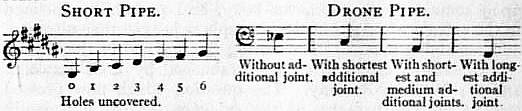

(From Edward William Lane’s An Account of the Manners and Customs of the Modern Egyptians.)
Modern Arghoul, 3 ft. 2½ in. long.
The total length of the shorter pipe, including the mouthpiece, is 0.435 m.; of the longer pipe, without additional joints, 0.555 m. An Egyptian arghoul,3 presented by the khedive to the Victoria and Albert Museum, measures 4 ft. 8½ in.
For further information see Victor Loret, L’Egypte au temps des Pharaons (Paris, 1889), 8vo, pp. 139, 143, 144; G.A. Villoteau, Description historique technique et littéraire des instruments de musique des orientaux (Description de l’Egypte, Paris, 1823, tome xiii, pp. 456-473).
(K. S.)
1 See Victor Loret. “Les Flûtes égyptiennes antiques,” Journal Asiatique, 8ème série, tome xiv., Paris, 1889, pp. 129, 130 and 132.
2 Catalogue descriptif et analytique du musée du Conservatoire Royal de Bruxelles (Ghent, 1880), p. 141.
3 A Descriptive Catalogue of the Musical Instruments in the South Kensington Museum, by Carl Engel (London, 1874), p. 143.
ARGOL, the commercial name of crude tartar (q.v.). It is a semi-crystalline deposit which forms on wine vats, and is generally grey or red in colour.
ARGON (from the Gr. ἀ-, privative, and ἒργον, work; hence meaning “inert”), a gaseous constituent of atmospheric air. For more than a hundred years before 1894 it had been supposed that the composition of the atmosphere was thoroughly known. Beyond variable quantities of moisture and traces of carbonic acid, hydrogen, ammonia, &c., the only constituents recognized were nitrogen and oxygen. The analysis of air was conducted by determining the amount of oxygen present and assuming the remainder to be nitrogen. Since the time of Henry Cavendish no one seemed even to have asked the question whether the residue was, in truth, all capable of conversion into nitric acid.
The manner in which this condition of complacent ignorance came to be disturbed is instructive. Observations undertaken mainly in the interest of Prout’s law, and extending over many years, had been conducted to determine afresh the densities of the principal gases—hydrogen, oxygen and nitrogen. In the latter case, the first preparations were according to the convenient method devised by Vernon Harcourt, in which air charged with ammonia is passed over red-hot copper. Under the influence of the heat the atmospheric oxygen, unites with the hydrogen of the ammonia, and when the excess of the latter is removed with sulphuric acid, the gas properly desiccated should be pure nitrogen, derived in part from the ammonia, but principally from the air. A few concordant determinations of density having been effected, the question was at first regarded as disposed of, until the thought occurred that it might be desirable to try also the more usual method of preparation in which the oxygen is removed by actual oxidation of copper without the aid of ammonia. Determinations made thus were equally concordant among themselves, but the resulting density was about 1⁄1000 part greater than that found by Harcourt’s method (Rayleigh, Nature, vol. xlvi. p. 512, 1892). Subsequently when oxygen was substituted for air in the first method, so that all (instead of about one-seventh part) of the nitrogen was derived from ammonia, the difference rose to ½%. Further experiment only brought out more clearly the diversity of the gases hitherto assumed to be identical. Whatever were the means employed to rid air of accompanying oxygen, a uniform value of the density was arrived at, and this value was ½% greater than that appertaining to nitrogen extracted from compounds such as nitrous oxide, ammonia and ammonium nitrite. No impurity, consisting of any known substance, could be discovered capable of explaining an excessive weight in the one case, or a deficiency in the other. Storage for eight months did not disturb the density of the chemically extracted gas, nor had the silent electric discharge any influence upon either quality. (“On an Anomaly encountered in determining the Density of Nitrogen Gas,” Proc. Roy. Soc., April 1894.)
At this stage it became clear that the complication depended upon some hitherto unknown body, and probability inclined to the existence of a gas in the atmosphere heavier than nitrogen, and remaining unacted upon during the removal of the oxygen—a conclusion afterwards fully established by Lord Rayleigh and Sir William Ramsay. The question which now pressed was as to the character of the evidence for the universally accepted view that the so-called nitrogen of the atmosphere was all of one kind, that the nitrogen of the air was the same as the nitrogen of nitre. Reference to Cavendish showed that he had already raised this question in the most distinct manner, and indeed, to a certain extent, resolved it. In his memoir of 1785 he writes:—
“As far as the experiments hitherto published extend, we scarcely know more of the phlogisticated part of our atmosphere than that it is not diminished by lime-water, caustic alkalies, or nitrous air; that it is unfit to support fire or maintain life in animals; and that its specific gravity is not much less than that of common air; so that, though the nitrous acid, by being united to phlogiston, is converted into air possessed of these properties, and consequently, though it was reasonable to suppose, that part at least of the phlogisticated air of the atmosphere consists of this acid united to phlogiston, yet it may fairly be doubted whether the whole is of this kind, or whether there are not in reality many different substances confounded together by us under the name of phlogisticated air. I therefore made an experiment to determine whether the whole of a given portion of the phlogisticated air of the atmosphere could be reduced to nitrous acid, or whether there was not a part of a different nature to the rest which would refuse to undergo that change. The foregoing experiments indeed, in some measure, decided this point, as much the greatest part of air let up into the tube lost its elasticity; yet, as some remained unabsorbed, it did not appear for certain whether that was of the same nature as the rest or not. For this purpose I diminished a similar mixture of dephlogisticated [oxygen] and common air, in the same manner as before [by sparks over alkali], till it was reduced to a small part of its original bulk. I then, in order to decompound as much as I could of the phlogisticated air [nitrogen] which remained in the tube, added some dephlogisticated air to it and continued the spark until no further diminution took place. Having by these means condensed as much as I could of the phlogisticated air, I let up some solution of liver of sulphur to absorb the dephlogisticated air; after which only a small bubble of air remained unabsorbed, which certainly was not more than 1⁄120 of the bulk of the dephlogisticated air let up into the tube; so that, if there be any part of the dephlogisticated air of our atmosphere which differs from the rest, and cannot be reduced to nitrous acid, we may safely conclude that it is not more than 1⁄120 part of the whole.”
Although, as was natural, Cavendish was satisfied with his result, and does not decide whether the small residue was genuine, it is probable that his residue was really of a different kind from the main bulk of the “phlogisticated air,” and contained the gas afterwards named argon.
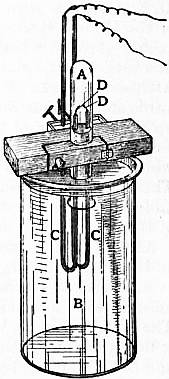
Fig. 1.
The announcement to the British Association in 1894 by Rayleigh and Ramsay of a new gas in the atmosphere was received with a good deal of scepticism. Some doubted the discovery of a new gas altogether, while others denied that it was present in the atmosphere. Yet there was nothing inconsistent with any previously ascertained fact in the asserted presence of 1% of a non-oxidizable gas about half as heavy again as nitrogen. The nearest approach to a difficulty lay in the behaviour of liquid air, from which it was supposed, as the event proved erroneously, that such a constituent would separate itself in the solid form. The evidence of the existence of a new gas (named Argon on account of its chemical inertness), and a statement of many of its properties, were communicated to the Royal Society (see Phil. Trans. clxxxvi. p. 187) by the discoverers in January 1895. The isolation of the new substance by removal of nitrogen from air was effected by two distinct methods. Of these the first is merely a development of that of Cavendish. The gases were contained in a test-tube A (fig. 1) standing over a large quantity of weak alkali B, and the current was conveyed in wires insulated by U-shaped glass tubes CC passing through the liquid and round the mouth of the test-tube. The inner platinum ends DD of the wire may be sealed into the glass insulating tubes, but reliance should not be placed upon these sealings. In order to secure tightness in spite of cracks, mercury was placed in the bends. With a battery of five Grove cells and a Ruhmkorff coil of medium size, a somewhat short spark, or arc, of about 5 mm. was found to be more favourable than a longer one. When the mixed gases were in the right proportion, the rate of absorption was about 30 c.c. per hour, about thirty times as fast as Cavendish could work with the electrical machine of his day. Where it is available, an alternating electric current is much superior to a battery and break. This combination, introduced by W. Spottiswoode, allows the absorption in the apparatus of fig. 1 to be raised to about 80 c.c. per hour, and the method is very convenient for the purification of small quantities of argon and for determinations of the amount present in various samples of gas, e.g. in the gases expelled from solution in water. A convenient adjunct to this apparatus is a small voltameter, with the aid of which oxygen or hydrogen can be introduced at pleasure. The gradual elimination of the nitrogen is tested at a moment’s notice with a miniature spectroscope. For this purpose a small Leyden jar is connected as usual to the secondary terminals, and if necessary the force of the discharge is moderated by the insertion of resistance in the primary circuit. When with a fairly wide slit the yellow line is no longer visible, the residual nitrogen may be considered to have fallen below 2 or 3%. During this stage the oxygen should be in considerable excess. When the yellow line of nitrogen has disappeared, and no further contraction seems to be in progress, the oxygen maybe removed by cautious introduction of hydrogen. The spectrum may now be further examined with a more powerful instrument. The most conspicuous group in the argon spectrum at atmospheric pressure is that first recorded by A. Schuster (fig. 2). Water vapour and excess of oxygen in moderation do not interfere seriously with its visibility. It is of interest to note that the argon spectrum may be fully developed by operating upon a miniature scale, starting with only 5 c.c. of air (Phil. Mag. vol. i. p. 103, 1901).
The development of Cavendish’s method upon a large scale involves arrangements different from what would at first be expected. The transformer working from a public supply should give about 6000 volts on open circuit, although when the electric flame is established the voltage on the platinums is only from 1600 to 2000. No sufficient advantage is attained by raising the pressure of the gases above atmosphere, but a capacious vessel is necessary. This may consist of a glass sphere of 50 litres’ capacity, into the neck of which, presented downwards, the necessary tubes are fitted. The whole of the interior surface is washed with a fountain of alkali, kept in circulation by means of a small centrifugal pump. In this apparatus, and with about one horse-power utilized at the transformer, the absorption of gas is 21 litres per hour (“The Oxidation of Nitrogen Gas,” Trans. Chem. Soc., 1897).
In one experiment, specially undertaken for the sake of measurement, the total air employed was 9250 c.c., and the oxygen consumed, manipulated with the aid of partially de-aërated water, amounted to 10,820 c.c. The oxygen contained in the air would be 1942 c.c.; so that the quantities of atmospheric nitrogen and of total oxygen which enter into combination would be 7308 c.c. and 12,762 c.c. respectively. This corresponds to N + 1.75 O, the oxygen being decidedly in excess of the proportion required to form nitrous acid. The argon ultimately found was 75.0 c.c., or a little more than 1% of the atmospheric nitrogen used. A subsequent determination over mercury by A.M. Kellas (Proc. Roy. Soc. lix. p. 66, 1895) gave 1.186 c.c. as the amount of argon present in 100 c.c. of mixed atmospheric nitrogen and argon. In the earlier stages of the inquiry, when it was important to meet the doubts which had been expressed as to the presence of the new gas in the atmosphere, blank experiments were executed in which air was replaced by nitrogen from ammonium nitrite. The residual argon, derived doubtless from the water used to manipulate the gases, was but a small fraction of what would have been obtained from a corresponding quantity of air.
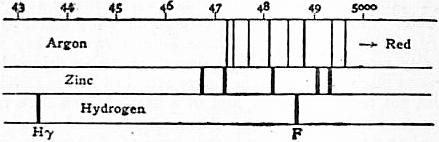
Fig. 2.
The other method by which nitrogen may be absorbed on a considerable scale is by the aid of magnesium. The metal in the form of thin turnings is charged into hard glass or iron tubes heated to a full red in a combustion furnace. Into this air, previously deprived of oxygen by red-hot copper and thoroughly dried, is led in a continuous stream. At this temperature the nitrogen combines with the magnesium, and thus the argon is concentrated. A still more potent absorption is afforded by calcium prepared in situ by heating a mixture of magnesium dust with thoroughly dehydrated quick-lime. The density of argon, prepared and purified by magnesium, was found by Sir William Ramsay to be 19.941 on the O = 16 scale. The volume actually weighed was 163 c.c. Subsequently large-scale operations with the same apparatus as had been used for the principal gases gave an almost identical result (19.940) for argon prepared with oxygen.
Argon is soluble in water at 12° C. to about 4.0%, that is, it is about 2½ times more soluble than nitrogen. We should thus expect to find it in increased proportion in the dissolved gases of rain-water. Experiment has confirmed this anticipation. The weight of a mixture of argon and nitrogen prepared from the dissolved gases showed an excess of 24 mg. over the weight of true nitrogen, the corresponding excess for the atmospheric mixture being only 11 mg. Argon is contained in the gases liberated by many thermal springs, but not in special quantity. The gas collected from the King’s Spring at Bath gave only ½%, i.e. half the atmospheric proportion.
The most remarkable physical property of argon relates to the constant known as the ratio of specific heats. When a gas is warmed one degree, the heat which must be supplied depends upon whether the operation is conducted at a constant volume or at a constant pressure, being greater in the latter case. The ratio of specific heats of the principal gases is 1.4, which, according to the kinetic theory, is an indication that an important fraction of the energy absorbed is devoted to rotation or vibration. If, as for Boscovitch points, the whole energy is translatory, the ratio of specific heats must be 1.67. This is precisely the number found from the velocity of sound in argon as determined by Kundt’s method, and it leaves no room for any sensible energy of rotatory or vibrational motion. The same value had previously been found for mercury vapour by Kundt and Warburg, and had been regarded as confirmatory of the monatomic character attributed on chemical grounds to the mercury molecule. It may be added that helium has the same character as argon in respect of specific heats (Ramsay, Proc. Roy. Soc. l. p. 86, 1895).
The refractivity of argon is .961 of that of air. This low refractivity is noteworthy as strongly antagonistic to the view at one time favoured by eminent chemists that argon was a condensed form of nitrogen represented by N3. The viscosity of argon is 1.21, referred to air, somewhat higher than for oxygen, which stands at the head of the list of the principal gases (“On some Physical Properties of Argon and Helium,” Proc. Roy. Soc. vol. lix. p. 198, 1896).
The spectrum shows remarkable peculiarities. According to circumstances, the colour of the light obtained from a Plücker vacuum tube changes “from red to a rich steel blue,” to use the words of Crookes, who first described the phenomenon. A third spectrum is distinguished by J.M. Eder and Edward Valenta. The red spectrum is obtained at moderately low pressures (5 mm.) by the use of a Ruhmkorff coil without a jar or air-gap. The red lines at 7056 and 6965 (Crookes) are characteristic. The blue spectrum is best seen at a somewhat lower pressure (1 mm. to 2.5 mm.), and usually requires a Leyden jar to be connected to the secondary terminals. In some conditions very small causes effect a transition from the one spectrum to the other. The course of electrical events attending the operation of a Ruhmkorff coil being extremely complicated, special interest attaches to some experiments conducted by John Trowbridge and T.W. Richards, in which the source of power was a secondary battery of 5000 cells. At a pressure of 1 mm. the red glow of argon was readily obtained with a voltage of 2000, but not with much less. After the discharge was once started, the difference of potentials at the terminals of the tube varied from 630 volts upwards.
The introduction of a capacity between the terminals of the Geissler tube, for example two plates of metal 1600 sq. cm. in area separated by a glass plate 1 cm. thick, made no difference in the red glow so long as the connexions were good and the condenser was quiet. As soon as a spark-gap was introduced, or the condenser began to emit the humming sound peculiar to it, the beautiful blue glow so characteristic of argon immediately appeared. (Phil. Mag. xliii. p. 77, 1897.)
The behaviour of argon at low temperatures was investigated by K.S. Olszewski (Phil. Trans., 1895, p. 253). The following results are extracted from the table given by him:—
Name. Critical Temperature, Cent. Critical Pressure, Atmos. Boiling Point Cent. Freezing Point, Cent.
Nitrogen −146.0 35.0 −194.4 −214.0
Argon −121.0 50.6 −187.0 −189.6
Oxygen −118.8 50.8 −182.7 ?
The smallness of the interval between the boiling and freezing points is noteworthy.
From the manner of its preparation it was clear at an early stage that argon would not combine with magnesium or calcium at a red heat, nor under the influence of the electric discharge with oxygen, hydrogen or nitrogen. Numerous other, attempts to induce combination also failed. Nor does it appear that any well-defined compound of argon has yet been prepared. It was found, however, by M.P.E. Berthelot that under the influence of the silent electric discharge, a mixture of benzene vapour and argon underwent contraction, with formation of a gummy product from which the argon could be recovered.
The facts detailed in the original memoir led to the conclusion that argon was an element or a mixture of elements, but the question between these alternatives was left open. The behaviour on liquefaction, however, seemed to prove that in the latter case either the proportion of the subordinate constituents was small, or else that the various constituents were but little contrasted. An attempt, somewhat later, by Ramsay and J. Norman Collie to separate argon by diffusion into two parts, which should have different densities or refractivities, led to no distinct effect. More recently Ramsay and M.W. Travers have obtained evidence of the existence in the atmosphere of three new gases, besides helium, to which have been assigned the names of neon, krypton and xenon. These gases agree with argon in respect of the ratio of the specific heats and in being non-oxidizable under the electric spark. As originally defined, argon included small proportions of these gases, but it is now preferable to limit the name to the principal constituent and to regard the newer gases as “companions of argon.” The physical constants associated with the name will scarcely be changed, since the proportion of the “companions” is so small. Sir William Ramsay considers that probably the volume of all of them taken together does not exceed 1⁄400th part of that of the argon. The physical properties of these gases are given in the following table (Proc. Roy. Soc. lxvii. p. 331, 1900):—
Helium. Neon. Argon. Krypton. Xenon.
Refractivities (air = 1) .1238 .2345 .968 1.449 2.364
Densities (O = 16) 1.98 9.97 19.96 40.88 64
Boiling points at 760 mm. c. 6°1 abs. ? 86.9° abs. 121.33° abs. 163.9° abs.
Critical temperatures ? below 68° abs. 155.6° abs. 210.5° abs. 287.7° abs.
Critical pressures ? ? 40.2 metres. 41.24 metres. 43.5 metres.
Weight of 1 c.c. of liquid ? ? 1.212 gm. 2.155 gm. 3.52 gm.
The glow obtained in vacuum tubes is highly characteristic, whether as seen directly or as analysed by the spectroscope.
Now that liquid air is available in many laboratories, it forms an advantageous starting-point in the preparation of argon. Being less volatile than nitrogen, argon accumulates relatively as liquid air evaporates. That the proportion of oxygen increases at the same time is little or no drawback. The following analyses (Rayleigh, Phil. Mag., June 1903) of the vapour arising from liquid air at various stages of the evaporation will give an idea of the course of events:—
Percentage of Oxygen. Percentage of Argon. Argon as a Percentage of the Nitrogen and Argon.
30 1.3 1.9
43 2.0 3.5
64 2.0 5.6
75 2.1 8.4
90 2.0 20.0
(R.)
1 Sir James Dewar, Compt. Rend. (1904), 139, 261 and 241.
ARGONAUTS (Άργοναῦται, the sailors of the “Argo”), in Greek legend a band of heroes who took part in the Argonautic expedition under the command of Jason, to fetch the golden fleece. This task had been imposed on Jason by his uncle Pelias (q.v.), who had usurped the throne of Iolcus in Thessaly, which rightfully belonged to Jason’s father Aeson. The story of the fleece was as follows. Jason’s uncle Athamas had two children, Phrixus and Helle, by his wife Nephele, the cloud goddess. But after a time he became enamoured of Ino, the daughter of Cadmus, and neglected Nephele, who disappeared in anger. Ino, who hated the children of Nephele, persuaded Athamas, by means of a false oracle, to offer Phrixus as a sacrifice, as the only means of alleviating a famine which she herself had caused by ordering the grain to be secretly roasted before it was sown. But before the sacrifice the shade of Nephele appeared to Phrixus, bringing a ram with a golden fleece on which he and his sister Helle endeavoured to escape over the sea. Helle fell off and was drowned in the strait, which after her was called the Hellespont. Phrixus, however, reached the other side in safety, and proceeding by land to Aea in Colchis on the farther shore of the Euxine Sea, sacrificed the ram, and hung up its fleece in the grove of Ares, where it was guarded by a sleepless dragon.
Jason, having undertaken the quest of the fleece, called upon the noblest heroes of Greece to take part in the expedition. According to the original story, the crew consisted of the chief members of Jason’s own race, the Minyae. But when the legend became common property, other and better-known heroes were added to their number—Orpheus, Castor and Polydeuces (Pollux), Zetes and Calais, the winged sons of Boreas, Meleager, Theseus, Heracles. The crew was supposed to consist of fifty, agreeing in number with the fifty oars of the “Argo,” so called from its builder Argos, the son of Phrixus, or from ἀργός (swift). It was a larger vessel than had ever been seen before, built of pine-wood that never rotted from Mount Pelion. The goddess Athena herself superintended its construction, and inserted in the prow a piece of oak from Dodona, which was endowed with the power of speaking and delivering oracles. The outward course of the “Argo” was the same as that of the Greek traders, whose settlements as early as the 6th century B.C. dotted the southern shores of the Euxine. The first landing-place was the island of Lemnos, which was occupied only by women, who had put to death their fathers, husbands and brothers. Here the Argonauts remained some months, until they were persuaded by Heracles to leave. It is known from Herodotus (iv. 145) that the Minyae had formed settlements at Lemnos at a very early date. Proceeding up the Hellespont, they sailed to the country of the Doliones, by whose king, Cyzicus, they were hospitably received. After their departure, being driven back to the same place by a storm, they were attacked by the Doliones, who did not recognize them, and in a battle which took place Cyzicus was killed by Jason. After Cyzicus had been duly mourned and buried, the Argonauts proceeded along the coast of Mysia, where occurred the incident of Heracles and Hylas (q.v.). On reaching the country of the Bebryces, they again landed to get water, and were challenged by the king, Amycus, to match him with a boxer. Polydeuces came forward, and in the end overpowered his adversary, and bound him to a tree, or according to others, slew him. At the entrance to the Euxine, at Salmydessus on the coast of Thrace, they met Phineus, the blind and aged king whose food was being constantly polluted by the Harpies. He knew the course to Colchis, and offered to tell it, if the Argonauts would free him from the Harpies. This was done by the winged sons of Boreas, and Phineus now told them their course, and that the way to pass through the Symplegades or Cyanean rocks—two cliffs which moved on their bases and crushed whatever sought to pass—was first to fly a pigeon through, and when the cliffs, having closed on the pigeon, began to retire to each side, to row the “Argo” swiftly through. His advice was successfully followed, and the “Argo” made the passage unscathed, except for trifling damage to the stern. From that time the rocks became fixed and never closed again. The next halting-places were the country of the Maryandini, where the helmsman Tiphys died, and the land of the Amazons on the banks of the Thermodon. At the island of Aretias they drove away the Stymphalian birds, who used their feathers of brass as arrows. Here they found and took on board the four sons of Phrixus who, after their father’s death, had been sent by Aeetes, king of Colchis, to fetch the treasures of Orchomenus, but had been driven by a storm upon the island. Passing near Mount Caucasus, they heard the groans of Prometheus and the flapping of the wings of the eagle which gnawed his liver. They now reached their goal, the river Phasis, and the following morning Jason repaired to the palace of Aeetes, and demanded the golden fleece. Aeetes required of Jason that he should first yoke to a plough his bulls, given him by Hephaestus, which snorted fire and had hoofs of brass, and with them plough the field of Ares. That done, the field was to be sown with the dragons’ teeth brought by Phrixus, from which armed men were to spring. Successful so far by means of the mixture which Medea, daughter of Aeetes, had given him as proof against fire and sword, Jason was next allowed to approach the dragon which watched the fleece; Medea soothed the monster with another mixture, and Jason became master of the fleece. Then the voyage homeward began, Medea accompanying Jason, and Aeetes pursuing them. To delay him and obtain escape, Medea dismembered her young brother Absyrtus, whom she had taken with her, and cast his limbs about in the sea for his father to pick up. Her plan succeeded, and while Aeetes was burying the remains of his son at Tomi, Jason and Medea escaped. In another account Absyrtus had grown to manhood then, and met his death in an encounter with Jason, in pursuit of whom he had been sent. Of the homeward course various accounts are given. In the oldest (Pindar) the “Argo” sailed along the river Phasis into the eastern Oceanus, round Asia to the south coast of Libya, thence to the mythical lake Tritonis, after being carried twelve days over land through Libya, and thence again to Iolcus. Hecataeus of Miletus (Schol. Apollon. Rhod. iv. 259) suggested that from the Oceanus it may have sailed into the Nile, and so to the Mediterranean. Others, like Sophocles, described the return voyage as differing from the outward course only in taking the northern instead of the southern shore of the Euxine. Some (pseudo-Orpheus) supposed that the Argonauts had sailed up the river Tanaïs, passed into another river, and by it reached the North Sea, returning to the Mediterranean by the Pillars of Hercules. Again, others (Apollonius Rhodius) laid down the course as up the Danube (Ister), from it into the Adriatic by a supposed mouth of that river, and on to Corcyra, where a storm overtook them. Next they sailed up the Eridanus into the Rhodanus, passing through the country of the Celts and Ligurians to the Stoechades, then to the island of Aethalia (Elba), finally reaching the Tyrrhenian Sea and the island of Circe, who absolved them from the murder of Absyrtus. Then they passed safely through Scylla and Charybdis, past the Sirens, through the Planctae, over the island of the Sun, Trinacria and on to Corcyra again, the land of the Phaeacians, where Jason and Medea held their nuptials. They had sighted the coast of Peloponnesus when a storm overtook them and drove them to the coast of Libya, where they were saved from a quicksand by the local nymphs. The “Argo” was now carried twelve days and twelve nights to the Hesperides, and thence to lake Tritonis (where the seer Mopsus died), whence Triton conducted them to the Mediterranean. At Crete the brazen Talos, who would not permit them to land, was killed by the Dioscuri. At Anaphe, one of the Sporades, they were saved from a storm by Apollo. Finally, they reached Iolcus, and the “Argo” was placed in a groove sacred to Poseidon on the isthmus of Corinth. Jason’s death, it is said, was afterwards caused by part of the stern giving way and falling upon him.
The story of the expedition of the Argonauts is very old. Homer was acquainted with it and speaks of the “Argo” as well known to all men; the wanderings of Odysseus may have been partly founded on its voyage. Pindar, in the fourth Pythian ode. gives the oldest detailed account of it. In Greek, there are also extant the Argonautica of Apollonius Rhodius and the pseudo-Orpheus (4th century A.D.), and the account in Apollodorus (i. 9), based on the best extant authorities; in Latin, the imitation of Apollonius (a free translation or adaptation of whose Argonautica was made by Terentius Varro Atacinus in the time of Cicero) by Valerius Flaccus. In ancient times the expedition was regarded as a historical fact, an incident in the opening up of the Euxine to Greek commerce and colonization. Its object was the acquisition of gold, which was caught by the inhabitants of Colchis in fleeces as it was washed down the rivers. Suidas says that the fleece was a book written on parchment, which taught how to make gold by chemical processes. The rationalists explained the ram on which Phrixus crossed the sea as the name or ornament of the ship on which he escaped. Several interpretations of the legend have been put forward by modern scholars. According to C.O. Müller, it had its origin in the worship of Zeus Laphystius; the fleece is the pledge of reconciliation; Jason is a propitiating god of health, Medea a goddess akin to Hera; Aeetes is connected with the Colchian sun-worship. Forchhammer saw in it an old nature symbolism; Jason, the god of healing and fruitfulness, brought the fleece—the fertilizing rain-cloud—to the western land that was parched by the heat of the sun. Others treat it as a solar myth; the ram is the light of the sun, the flight of Phrixus and the death of Helle signify its setting, the recovery of the fleece its rising again.
There are numerous treatises on the subject: F. Vater, Der Argonautenzug (1845); J. Stender, De Argonautarum Expeditione (1874); D. Kennerknecht, De Argonautarum Fabula (1886); M. Groeger, De Argonautarum Fabularum Historia (1889); see also Grote, History of Greece, part i. ch. 13; Preller, Griechische Mythologie; articles in Pauly-Wissowa’s Realencyclopädie, Roscher’s Lexikon der Mythologie, and Daremberg and Saglio’s Dictionnaire des Antiquités.
ARGONNE, a rocky forest-clad plateau in the north-east of France, extending along the borders of Lorraine and Champagne, and forming part of the departments of Ardennes, Meuse and Marne. The Argonne stretches from S.S.E. to N.N.W., a distance of 63 m. with an average breadth of 19 m., and an average height of 1150 ft. It forms the connecting-link between the plateaus of Haute Marne and the Ardennes, and is bounded E. by the Meuse and W. by the Ante and the Aisne, which rises in its southern plateau. The valleys of the Aire and other rivers traverse it longitudinally, a fact to which its importance as a bulwark of north-eastern France is largely due. Of the numerous forests which clothe both slopes of the plateau, the chief is that of Argonne, which extends for 25 m. between the Aire and the Aisne.
For Dumouriez’s Argonne campaign in 1792, see French Revolutionary Wars.
ARGOS, the name of several ancient Greek cities or districts, but specially appropriated in historic times to the chief town in eastern Peloponnese, whence the peninsula of Argolis derives its name. The Argeia, or territory of Argos proper, consisted of a shelving plain at the head of the Gulf of Argolis, enclosed between the eastern wall of the Arcadian plateau and the central highlands of Argolis. The waters of this valley (Inachus, Charadrus, Erasinus), when properly regulated, favoured the growth of excellent crops, and the capital standing only 3 m. from the sea was well placed for Levantine trade. Hence Argos was perhaps the earliest town of importance in Greece; the legends indicate its high antiquity and its early intercourse with foreign countries (Egypt, Lycia, &c.). Though eclipsed in the Homeric age, when it appears as the seat of Diomedes, by the later foundation of Mycenae, it regained its predominance after the invasion of the Dorians (q.v.), who seem to have occupied this site in considerable force. In accordance with the tradition which assigned the portion to the eldest-born of the Heracleid conquerors, Argos was for some centuries the leading power in Peloponnesus. There is good evidence that its sway extended originally over the entire Argolis peninsula, the land east of Parnon, Cythera, Aegina and Sicyon. Under King Pheidon the Argive empire embraced all eastern Peloponnesus, and its influence spread even to the western districts.
This supremacy was first challenged about the 8th century by Sparta. Though organized on similar lines, with a citizen population divided into three Dorian tribes (and one containing other elements), with a class of Perioeci (neighbouring dependents) and of serfs, the Argives had no more constant foe than their Lacedaemonian kinsmen. In a protracted struggle for the possession of the eastern seaboard of Laconia in spite of the victory at Hysiae (apparently in 669), they were gradually driven back, until by 550 they had lost the whole coast strip of Cynuria. A later attempt to retrieve this loss resulted in a crushing defeat near Tiryns at the hands of King Cleomenes I. (probably in 495), which so weakened the Argives that they had to open the franchise to their Perioeci. By this time they had also lost control over the other cities of Argolis, which they never succeeded in recovering. Partly in consequence of its defeat, partly out of jealousy against Sparta, Argos took no part in the war against Xerxes. Indeed on this, as on later occasions, its relations with Persia seem to have been friendly. About 470 the conflict with Sparta was renewed in concert with the Arcadians, but all that the Argives could achieve was to destroy their revolted dependencies of Mycenae and Tiryns (468 or 464). In 461 they contracted an alliance with Athens, thus renewing a connexion established by Peisistratus (q.v.). In spite of this league Argos made no headway against Sparta, and in 451 consented to a truce. A more important result of Athenian intervention was the substitution of the democratic government for the oligarchy which had succeeded the early monarchy; at any rate forty years later we find that Argos possessed complete democratic institutions.
During the early Peloponnesian War Argos remained neutral; after the break-up of the Spartan confederacy consequent upon the peace of Nicias the alliance of this state, with its unimpaired resources and flourishing commerce, was courted on all sides. By throwing in her lot with the Peloponnesian democracies and Athens, Argos seriously endangered Sparta’s supremacy, but the defeat of Mantineia (418) and a successful rising of the Argive oligarchs spoilt this chance. The speedily restored democracy put little heart into the conflict, and beyond sending mercenary detachments, lent Athens no further help in the war (see Peloponnesian War).