THERMOELECTRICITY
Reading edition
After 140 Years: Seebeck Makes Good
The oldest direct conversion heat engine is the thermocouple. Take two different materials (typically, two dissimilar metal wires), join them, and heat the junction. A voltage, or electromotive force, can be measured across the unheated terminals. T. J. Seebeck first noticed this effect in 1821 in his laboratory in Berlin, but, because of a mistaken interpretation of what was involved, he did not seek any practical application for it. Only recently has any real progress been made in using his discovery for power production. To use the analogy of A. F. Joffe, the Russian pioneer in this field, thermoelectricity lay undisturbed for over a hundred years like Sleeping Beauty. The Prince that awoke her was the semiconductor.
As long as inefficient metal wires were used, textbook writers were correct in asserting that thermoelectricity could never be used for power production. The secret of 13 practical thermoelectricity is therefore the creation of better thermoelectric materials. (Creation is the right word since the best materials for the purpose do not exist in nature.) To perform this alchemy, we first have to understand the Seebeck effect.
Electrons and Holes
Let’s examine the latticework of atoms that make up any solid material. In electrical insulators all the atoms’ outer electrons[5] are held tightly by valence bonds to the neighboring atoms. In contrast, any metal has many relatively loose electrons which can wander freely through its latticework. This is what makes metals good conductors.
THERMOELECTRICITY
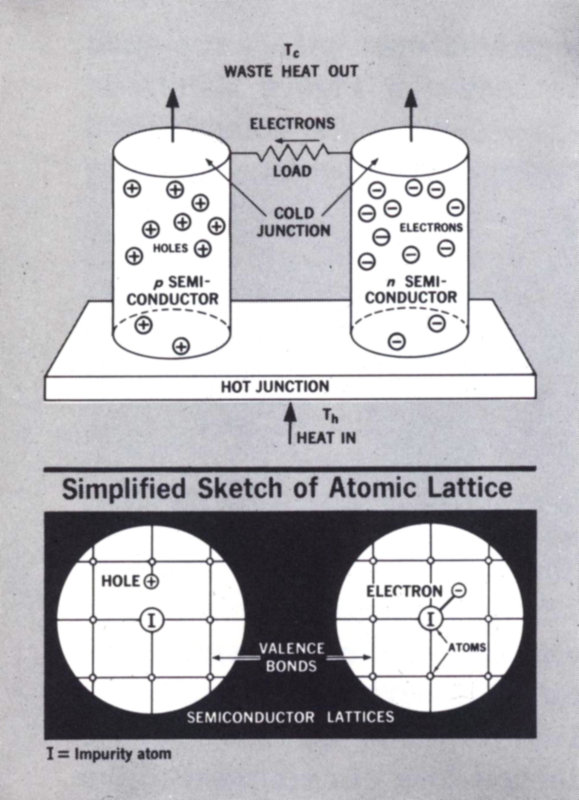
Figure 5 Thermoelectric couple made from p- and n-type semiconductors. The impurity atoms (I) are different in each leg and contribute an excess or deficiency of valence electrons. Heat drives both holes and electrons toward the cold junction.
Tc WASTE HEAT OUT
ELECTRONS
LOAD
COLD JUNCTION
HOLES
ELECTRONS
p SEMICONDUCTOR
n SEMICONDUCTOR
HOT JUNCTION
Th HEAT IN
Simplified Sketch of Atomic Lattice
HOLE
ELECTRON
VALENCE BONDS
SEMICONDUCTOR LATTICES
I = Impurity atom
Figure 5 suggests the latticework of a semiconductor. It is called a semiconductor because its conductivity falls far short of that of the metals. The few electrons available for carrying electricity are supplied by the deliberately introduced 14 impurity atoms, which have more than enough electrons to satisfy the valence-bond requirements of the neighboring atoms. Without the impurities, we would have an insulator. With them, we have an n-type semiconductor. The n is for the extra negative electrons.
A p- or positive-type semiconductor is also included in Figure 5. Here the impurity atom does not have enough valence electrons to satisfy the valence-bond needs of the surrounding lattice atoms. The lattice has been short-changed and is, in effect, full of positive holes. Strangely enough, these holes can wander through the material just like positive charges.
The electron-hole model does not have the precision the physicist likes, but it helps us to visualize semiconductor behavior.
The Seebeck effect is demonstrated when pieces of p- and n-type material are joined as shown in Figure 5. Heat at the hot junction drives the loose electrons and holes toward the cold junction. Think of the holes and electrons as gases being driven through the latticework by the temperature difference. A positive and a negative terminal are thus produced, giving us a source of power. The larger the temperature difference, the bigger the voltage difference. Note that just one thermocouple leg can produce a voltage across its length, but couples made from p and n legs are superior.
Practical Thermoelectric Power Generators
The first nuclear-heated thermoelectric generator was built in 1954 by the Atomic Energy Commission’s Mound Laboratory in Miamisburg, Ohio. It used metal-wire thermocouples. In contrast, the SNAP 3 series thermocouples shown in Figure 1 are thick lead telluride (PbTe) semiconductor cylinders about two inches long. In contrast to the thermocouple wires’ efficiency of less than 1%, SNAP 3 series generators have overall efficiencies exceeding 5%. This value is still low compared to the 35-40% obtained in a modern steam power plant, but SNAP 3 generators can operate unattended in remote localities where steam plants would be totally unacceptable.
Look again at the thermoelements in Figure 1 and the schematic, Figure 5. Underlying the apparent simplicity of 15 the thermoelectric generator are extensive development efforts. The Figure 1 thermoelectric couple, for example, shows the fruits of thousands of experimental brazing tests. It turns out to be uncommonly difficult to fasten thermoelectric elements to the so-called hot shoe (metal plate) at the bottom. The joint has to be strong, must withstand high temperatures, and must have low electrical resistance. We see also that the elements are encased in mica sleeves to prevent chemical disturbance of the delicate balance of impurities in the semiconductor by the surrounding gases. A further complication is the extreme fragility of the elements, and this has yet to be overcome.
Nuclear thermoelectric generators that provide small amounts of electrical power have already been launched into space aboard Department of Defense satellites (Figure 12), installed on land stations in both polar regions, and placed under the ocean.[6] Propane-fueled thermoelectric generators, such as shown in Figure 6, are now on the market for use in camping equipment, in ocean buoys, and in remote spots where only a few watts of electricity are needed. The Russians have long manufactured a kerosene lamp with thermoelements placed in its stack for generating power in wilderness areas.
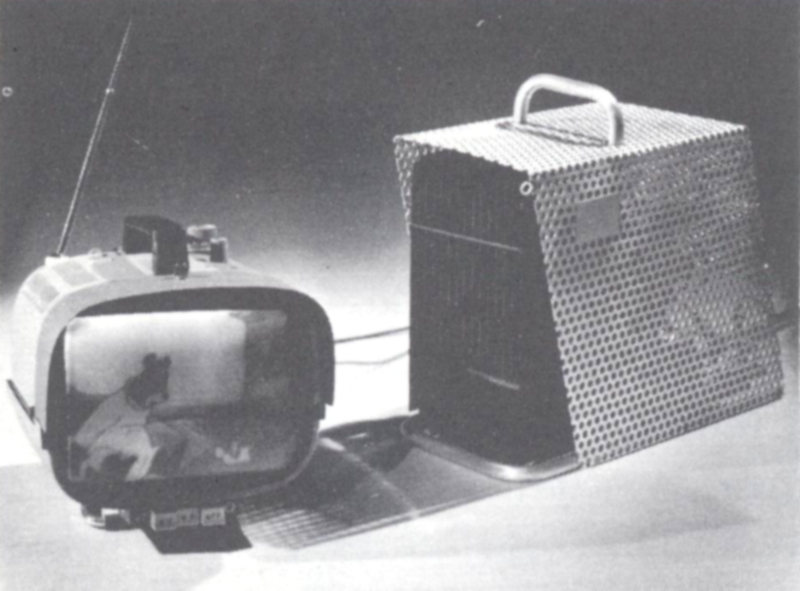
Figure 6 GENERAL PURPOSE GENERATOR Commercially available thermoelectric generators using propane fuel can provide more than enough electrical power to operate a portable TV set. Courtesy Minnesota Mining & Manufacturing Company.
For the present the role of thermoelectric power appears to be one of special uses such as those just mentioned. When higher efficiencies are attained, thermoelectric power may, one day, supplant dynamic conversion equipment in certain low-power applications regardless of location.
16