THE FUEL CELL: A CONTINUOUSLY FUELED BATTERY
Reading edition
Potential Fuels
The battery has a very close relative, the fuel cell. Unlike the battery the fuel cell has a continuous supply of fuel.
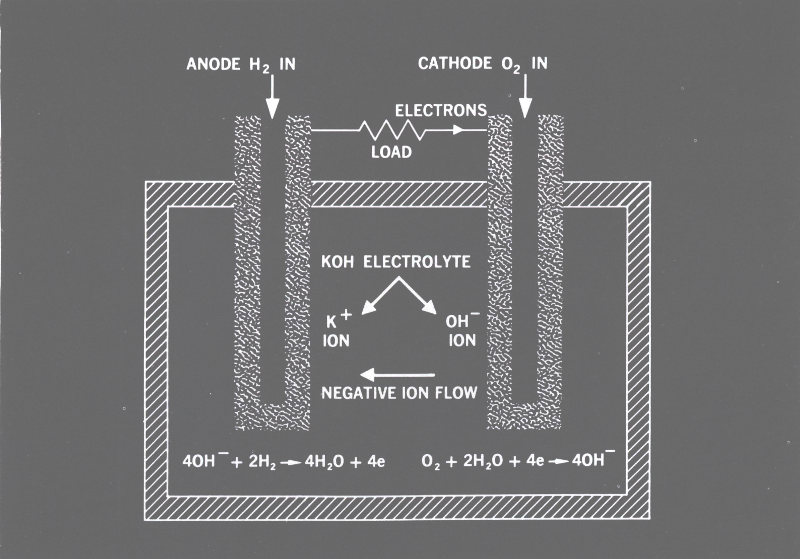
Figure 11 This diagram shows how a hydrogen-oxygen fuel cell works. The chemical battery works in the same way, except that the chemicals are different and are not continuously supplied from outside the cell. The water produced by the H-O cell shown can be used for drinking on spaceships.
ANODE H₂ IN
CATHODE O₂ IN
ELECTRONS
LOAD
KOH ELECTROLYTE
K⁺ ION
OH⁻ ION
NEGATIVE ION FLOW
40H⁻ + 2H₂ ⇒ 4H₂O + 4e
O₂ + 2H₂O + 4e ⇒ 40H⁻
The hydrogen-oxygen cell of Figure 11 is typical of all fuel cells. It essentially burns hydrogen and oxygen to form water. If the hydrogen and oxygen can be supplied continuously and the excess water drained off, we can greatly extend the life of the battery. The fuel cell accomplishes this. Fueled electrical cell would be more descriptive since the physical principles are identical with those of the battery.
Perhaps the most challenging task contemplated for the fuel cell is to bring about the consumption of raw or slightly processed coal, gas, and oil fuels with atmospheric oxygen. If fuel cells can be made to use these abundant fuels, then the high natural conversion efficiency of the fuel cells will make them economically superior to the lower efficiency steam-electric plants now in commercial service.
25
So far we have dwelt on the fuel cell as a cold energy conversion device that is not limited by the Carnot efficiency. A variation on this theme is possible. Take a hydrogen iodide (HI) cell, and heat the HI to 2000°K. Some of the HI molecules will collide at high velocities and dissociate into hydrogen and iodine: 2HI = H₂ + I₂; the higher the temperature, the more the dissociation. By separating the hydrogen and iodine gases and returning them for recycling to the fuel cell where they are recombined, we have eliminated the fuel supply problem and created a regenerative fuel cell. We have, however, also reintroduced the heat engine and the Carnot cycle efficiency. The thermally regenerative fuel cell is a true heat engine using a dissociating gas as the working fluid.
Scheme for Project Apollo
Most of the impetus for developing the fuel cell as a practical device comes from the space program. The cell has admirable properties for space missions that are less than a few months in duration. It is a clean, quiet, vibrationless source of energy. Like the battery it has a high electrical overload capacity for supplying power peaks and is easily controlled. It can even provide potable water for a crew if the Bacon H - O cell is used. For short missions where large fuel supplies are not needed, it is also among the lightest power plants available.
These compelling advantages have led the National Aeronautics and Space Administration to choose the fuel cell for some of the first manned space ventures. Project Apollo, the manned lunar landing mission, is the most notable example. Here the fuel cell will be not only an energy source, but also part of the ecological cycle which keeps the crew alive.
Problem 4
A manned space vehicle requires an average of 2 electrical kilowatts. A nuclear reactor thermoelectric plant having a mass of 1000 kilograms, including shielding, can supply this power for 10,000 hours. The basic fuel cell has a mass of 50 kilograms and consumes ½ kilogram of chemicals per hour. The chemical containers weigh 25 kilograms. What is the longest mission where the total weight of the fuel cell will be less than the weight of the nuclear power plant?
26