SOLAR CELLS
Reading edition
Photons as Energy Carriers
All our fossil fuels, such as coal and oil, owe their existence to the solar energy stream that has engulfed the earth for billions of years. The power in this stream amounts to about 1400 watts per square meter at the earth, nearly enough to supply an average home if all the energy were converted to electricity. The problem is to get the sun’s rays to yield up their energy with high efficiency.
The sun’s visible surface has a temperature around 6000°K. Any object heated to this temperature will radiate visible light mostly in the yellow-green portion of the spectrum (5500 A[11]). Our energy conversion device should be tuned to this wavelength.
The energy packets arriving from the sun are called photons. They travel, of course, at the speed of light, and each carries an amount of energy given by
E = hf = hc/λ
where E = energy (in joules) h = Planck’s constant (6.62 × 10⁻³⁴ joule-second) f = the light’s frequency (in cycles per second = c/λ) c = the velocity of light (300,000,000 meters per second) λ = the wavelength (in meters)
Using the fact that an angstrom unit is 10⁻¹⁰ meter, the energy of a 5500 A photon could be calculated as
E = hf = hc/λ = (6.62 × 10⁻³⁴ × 3.00 × 10⁸)/(5.50 × 10⁻⁷) = 3.61 × 10⁻¹⁹ joule = 2.2 electron volts
Comparing this result, 2.2 electron volts, with the energies required to cause atomic ionization or molecular dissociation 27 (an electron volt or so), we see that it is in the right range to actuate direct conversion devices based on such phenomena.
Harnessing the Sun’s Energy
Historically, the sun’s energy has most often been used by concentrating it with a lens or mirror and then converting it to heat. We could do this and run a heat engine, but a more direct avenue is open.
About a decade ago it was found that the junction between p and n semiconductors would generate electricity if illuminated. This discovery led to the development of the solar cell, a thin, lopsided sandwich of silicon semiconductors. As shown in Figure 12, the top semiconductor layer exposed to the sun is extremely thin, only 2.5 microns. Solar photons can readily penetrate this layer and reach the junction separating it from the thick main body of the solar cell.
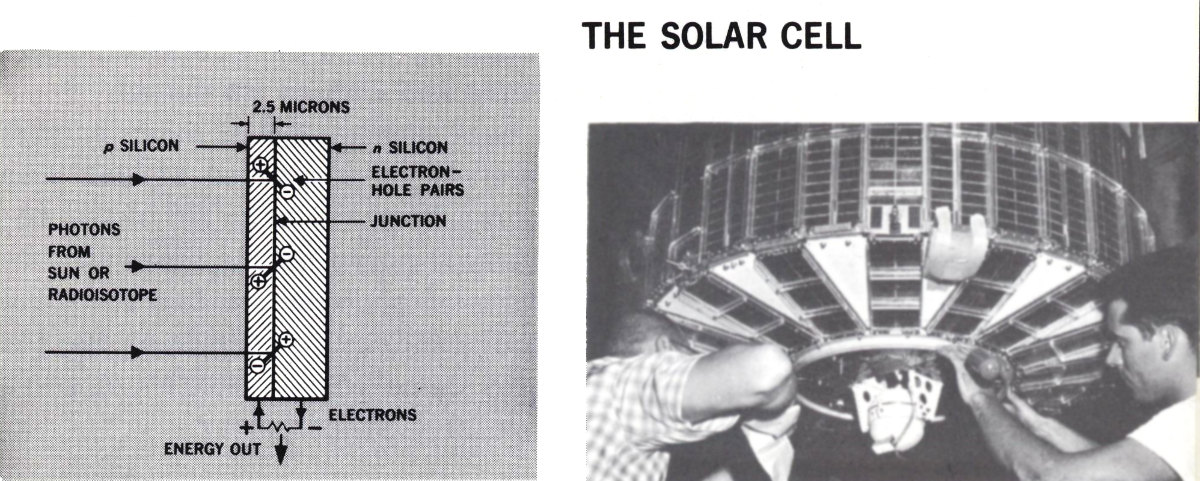
Figure 12 THE SOLAR CELL The photograph shows the solar cell in use on a satellite. The spherical, radioisotope, thermoelectric generator at the bottom of the satellite is used to supplement the solar cells. In the solar cell, hole-electron pairs are created by solar photons in the vicinity of a p-n junction. Courtesy U. S. Air Force and National Aeronautics and Space Administration.
p SILICON
n SILICON
ELECTRON-MOLE PAIRS
JUNCTION
PHOTONS FROM SUN OR RADIOISOTOPE
ELECTRONS
ENERGY OUT
Whenever p- and n-type semiconductors are sandwiched together a voltage difference is created across the junction. The separated holes and electrons in the two semiconductor regions establish this electric field across the junction. Unfortunately, there are usually no current carriers in the immediate vicinity of the junction so that no power is produced.
28
The absorption of solar photons in the vicinity of the junction will create current carriers, as the photons’ energy is transformed into the potential energy of the hole-electron pairs. These pairs would quickly recombine and give up their newly acquired potential energy if the electric field existing across the junction did not whisk them away to an external load.
The solar cell produces electricity when hole-electron pairs are formed. Any other phenomenon that creates such pairs will also generate electricity. The source of energy is irrelevant so long as the current carriers are formed near the junction. Thus, particles emitted by radioactive atoms can also produce electricity from solar cells, although too much bombardment by such particles can damage the cell’s atomic structure and reduce its output.
The solar cell is not a heat engine. Yet it loses enough energy so that the sun’s energy is converted at less than 15% efficiency. Losses commonly occur because of the recombination of the hole-electron pairs before they can produce current, the absorption of photons too far from the junction, and the reflection of incident photons from the top surface of the cell. Despite these losses solar cells are now the mainstay of nonpropulsive space power.