DIRECT VERSUS DYNAMIC ENERGY CONVERSION
Reading edition
Dominance of Dynamic Conversion
We live in a world of motion. A main task of the engineer is to find better and more efficient ways of transforming the energy locked in the sun’s rays or in fuels, such as coal and the uranium nucleus, into energy of motion. Almost all the world’s energy is now transformed by rotating or reciprocating machines. We couple the energy of exploding gasoline and air to our automobile’s wheels by a reciprocating engine. The turbogenerator at a hydroelectric plant extracts energy from falling water and turns it into electricity. Such rotating or reciprocating machines are called dynamic converters.
A New Level of Sophistication: Direct Conversion
A revolution is in the making. We know now that we can force the heat-and-electricity-carrying electrons residing in matter to do our bidding without the use of shafts and pistons. This is a leading accomplishment of modern technology: energy transformation without moving parts. It is called direct conversion.
The thermoelements shown above the turbogenerator in Figure 1 illustrate the contrast between direct and dynamic 4 conversion. The thermoelements convert heat into electricity directly, without any of the intervening machinery seen in the turbogenerator.
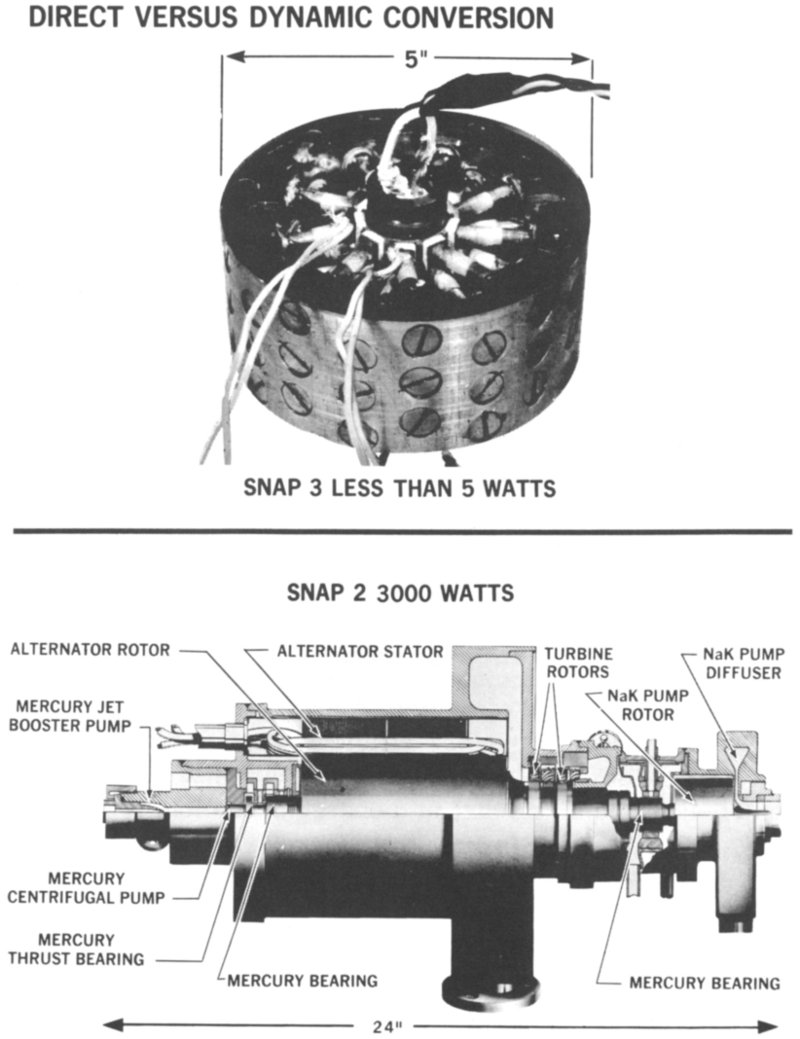
Figure 1 Direct conversion devices, such as the spokelike lead telluride thermoelectric elements inside the SNAP 3 radioisotope generator shown above (courtesy Martin Company), convert heat into electricity without moving parts. In contrast, the SNAP 2 dynamic converter shown below SNAP 3 (courtesy Thompson Ramo Wooldridge, Inc.) includes a high-speed turbine, an electric generator, and pumps to produce electricity from heat. (NaK is a liquid mixture of sodium and potassium.)
DIRECT VERSUS DYNAMIC CONVERSION
SNAP 3 LESS THAN 5 WATTS
5″
SNAP 2 3000 WATTS
24″
ALTERNATOR ROTOR
ALTERNATOR STATOR
TURBINE ROTORS
NaK PUMP DIFFUSER
NaK PUMP ROTOR
MERCURY JET BOOSTER PUMP
MERCURY CENTRIFUGAL PUMP
MERCURY THRUST BEARING
MERCURY BEARING
MERCURY BEARING
5
Why is Direct Conversion Desirable?
There are places where energy conversion equipment must run for years without maintenance or breakdown. Also, there are situations where the ultimate in reliability is required, such as on scientific satellites and particularly on manned space flights. Direct conversion equipment seems to offer greater reliability than dynamic conversion equipment for these purposes.
We should recognize that our belief in the superiority of direct conversion is based more on intuition than proof. It is true that direct converters will never throw piston rods or run out of lubricant. Yet, some satellite power failures have been caused by the degradation of solar cells under the bombardment of solar protons. The other types of direct conversion devices described in the following pages may also break down in ways as yet unknown. Still, today’s knowledge gives us hope that direct conversion will be more reliable and trustworthy than dynamic conversion. Direct conversion equipment is beginning to be adopted for small power plants, producing less than 500 watts, designed to operate for long periods of time in outer space and under the ocean. Some day, large central-station power plants may use direct conversion to improve their efficiencies and reliabilities.
How is Energy Transformed?
What is energy and how do we change it? Energy is a fundamental concept of science involving the capacity for doing work. Kinetic or mechanical energy is the most obvious form of energy. It is defined as
E = ½ mv² where E = energy (expressed in joules) m = mass of the moving object (in kilograms) v = velocity (in meters per second)
Energy can also be stored in chemical and nuclear substances or in the water behind a dam. In these quiescent states it is called potential energy. If the potential energy in a substance is abundant and easily released, the energy-rich substance is called a fuel.
6
ENERGY CONVERSION MATRIX
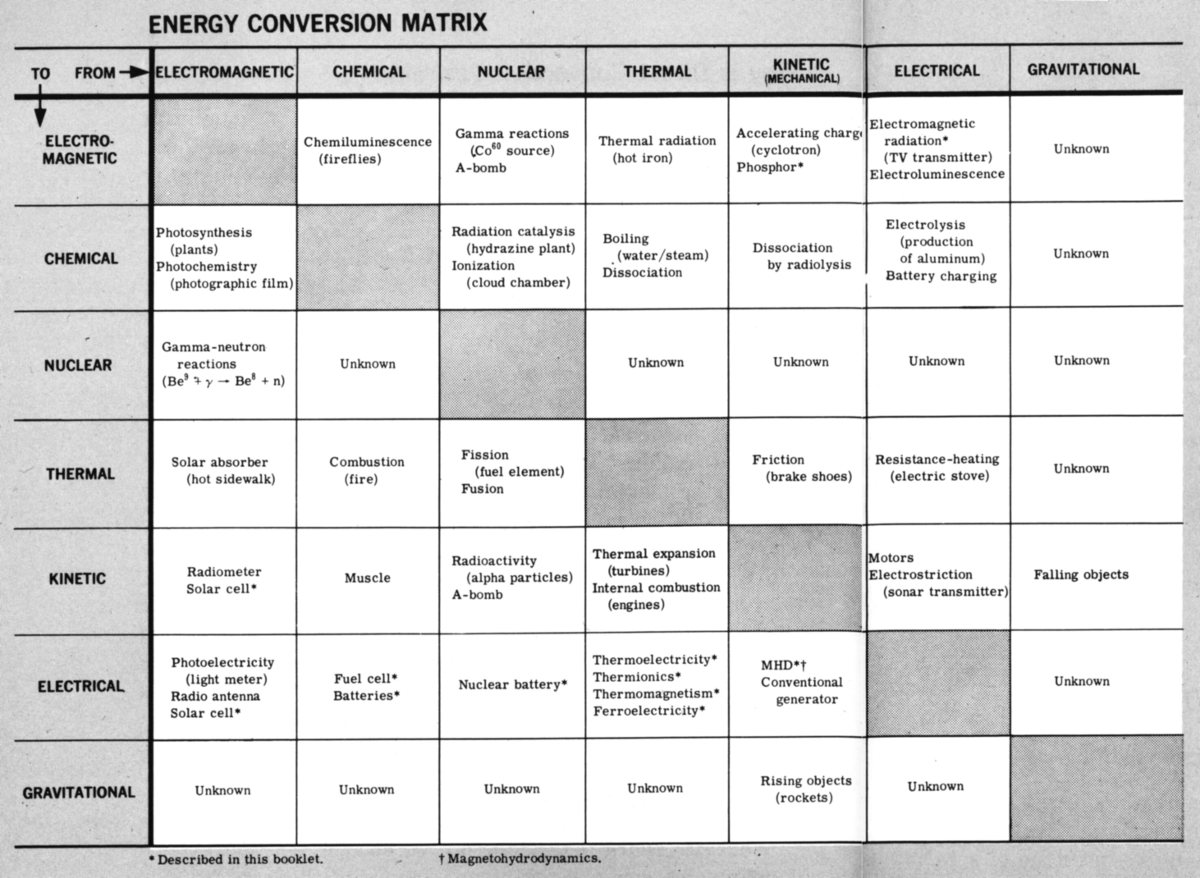
Figure 2 To find how one form of energy is converted into another, start at the proper column and move down until the column intersects with the desired row. The box at the intersection will give typical conversion processes and examples.
FROM⇒ ELECTROMAGNETIC CHEMICAL NUCLEAR THERMAL KINETIC (MECHANICAL) ELECTRICAL GRAVITATIONAL
TO⇓
ELECTROMAGNETIC Chemiluminescence (fireflies) Gamma reactions (Co⁵⁸ source) A-bomb Thermal radiation (hot iron) Accelerating charge (cyclotron) Phosphor[2] Electromagnetic radiation[2] (TV transmitter) Electroluminescence Unknown
CHEMICAL Photosynthesis (plants) Photochemistry (photographic film) Radiation catalysis (hydrazine plant) Ionization (cloud chamber) Boiling (water/steam) Dissociation Dissociation by radiolysis Electrolysis (production of aluminum) Battery charging Unknown
NUCLEAR Gamma-neutron reactions (Be⁹+γ → Be⁸+n) Unknown Unknown Unknown Unknown Unknown
THERMAL Solar absorber (hot sidewalk) Combustion (fire) Fission (fuel element) Fusion Friction (brake shoes) Resistance-heating (electric stove) Unknown
KINETIC Radiometer Solar cell[2] Muscle Radioactivity (alpha particles) A-bomb Thermal expansion (turbines) Internal combustion (engines) Motors Electrostriction (sonar transmitter) Falling objects
ELECTRICAL Photoelectricity (light meter) Radio antenna Solar cell[2] Fuel cell[2] Batteries[2] Nuclear battery[2] Thermoelectricity[2] Thermionics[2] Thermomagnetism[2] Ferroelectricity[2] MHD[2][3] Conventional generator Unknown
GRAVITATIONAL Unknown Unknown Unknown Unknown Rising objects (rockets) Unknown
The Energy Conversion Matrix
Forms of energy are interchangeable. When gasoline is burned in an automobile engine, potential energy is first turned into heat. A portion of this heat, say 25%, is then converted into mechanical motion. The remainder of the heat is wasted and must be removed from the engine.
A multitude of processes and devices have been found which make these transformations from one form of energy to another. Many of these are listed in the blocks in Figure 2. Asterisks refer to direct conversion processes, the subject matter of this booklet.
7
To demonstrate how this diagram is to be read, let us use it to trace the energy transformations involved in an automobile engine. We begin with sunlight because all coal and oil deposits (the fossil fuels) received their initial charge of energy in the form of sunlight.
The first conversion, therefore, is from electromagnetic energy to chemical energy via photosynthesis in living things. We trace the transformation by moving down the column marked Electromagnetic Energy until it intersects the horizontal row labeled Chemical Energy. There we see photosynthesis listed in the block. The next conversion is from chemical energy to thermal energy via combustion. 8 We trace this by moving down the Chemical Energy column to the Thermal Energy row; combustion is listed in the appropriate block. The third and final conversion takes place when thermal energy is transformed into mechanical energy via the internal combustion engine.
By the repeated use of the Energy Conversion Matrix in this way, we can chart any energy transformation.
Problem 1
Continue the automobile example by going through the matrix twice more showing how mechanical energy is converted into stored chemical energy in the car’s battery.
Problem 2
If 1 gram of gasoline (about a tablespoonful) yields 48,000 joules of thermal energy when burned with air, how fast can it make a 1000 kilogram car go? Assume the car starts from rest and its engine is 25% efficient.
Answers to problems are on page 34.