MAGNETOHYDRODYNAMIC CONVERSION
Reading edition
Big Word, Simple Concept
Magnetohydrodynamic (MHD) conversion is very unlike thermoelectric or thermionic conversion. The MHD generators use high-velocity electrically conducting gases to produce power and are generically closer to dynamic conversion concepts. The only concept they carry forward from the preceding conversion ideas is that of the plasma, the electrically conducting gas. Yet they are commonly classified as direct because they replace the rotating turbogenerator of the dynamic systems with a stationary pipe or duct.
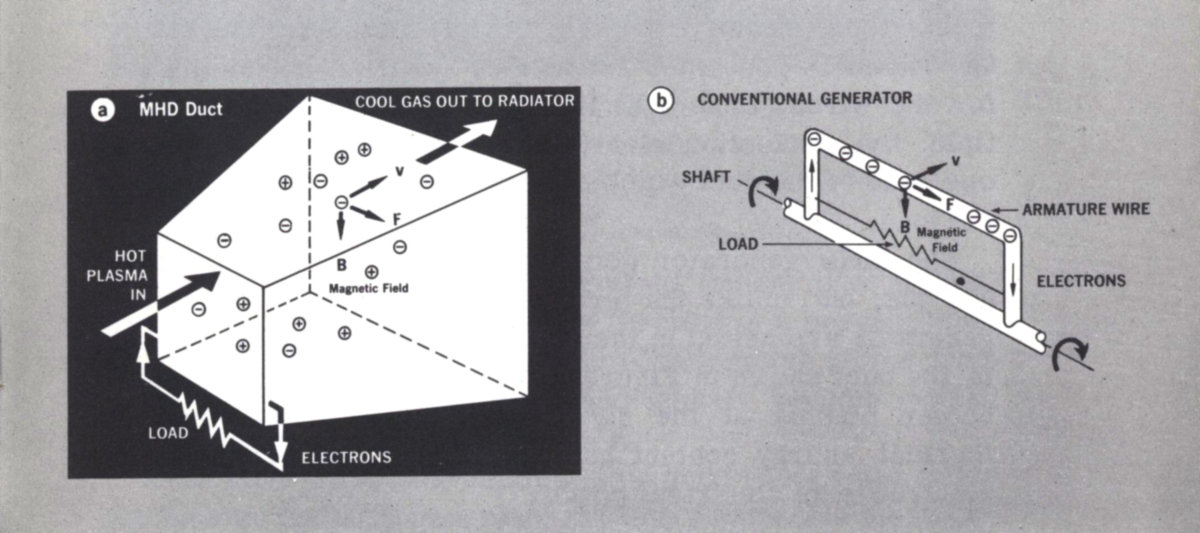
Figure 9 In the MHD duct (a), the electrons in the hot plasma move to the right under influence of force F in the magnetic field B. The electrons collected by the right-hand side of the duct are carried to the load. In a wire in the armature of a conventional generator (b) the electrons are forced to the right by the magnetic field.
a
MHD Duct
HOT PLASMA IN
COOL GAS OUT TO RADIATOR
Magnetic Field
LOAD
ELECTRONS
b
CONVENTIONAL GENERATOR
SHAFT
LOAD
Magnetic Field
ARMATURE WIRE
ELECTRONS
20
In the conventional dynamic generator, an electromotive force is created in a wire that cuts through magnetic lines of force, as shown in Figure 9b. It may be helpful to visualize the conduction electrons as leaving one end of the wire and moving to the other under the influence of the magnetic field.
The force on the electrons in the wire is given by
F = qvB
where F = the force (in newtons[10]) q = the charge on the electron (1.6 × 10⁻¹⁹ coulomb) v = the wire’s velocity (in meters per second) B = the magnetic field strength (in webers per square meter[10])
The surge of electrons along the length of the wire sets up a voltage difference across the ends of the wire. A generator uses this difference to convert the kinetic energy of the moving wire or armature into electrical energy. The wire is kept spinning by the shaft which is connected to a turbine driven by steam or water.
Let us try to eliminate the moving part, the generator armature. What we need is a moving conductor that has no shaft, no bearings, no wearing parts. The substance that meets these requirements is the plasma. Examine Figure 9a. The MHD generator substitutes a moving, conducting gas for the wires. Under the influence of an external magnetic field, the conduction electrons move through the plasma to one side of the duct which carries electrical power away to the load.
The MHD generator gets its energy from an expanding, hot gas; but, unlike the turbogenerator, the heat engine and generator are united in the static duct. The gradual widening of the duct shown in Figure 9a reflects the lower pressure, cooler plasma at the duct’s end. Some of the plasma’s thermal energy content has been tapped off by the duct’s electrodes as electrical power.
21
The Fourth State of Matter
Plasma can be created by temperatures over 2000°K. At this temperature many high-velocity gas atoms collide with enough energy to knock electrons off each other and thus become ionized. The material thus created, shown as a glowing gas in Figure 10, does not behave consistently as any of the three familiar states of matter: solid, liquid, or gas. Plasma has been called a fourth state of matter. Since we have difficulty in containing such high temperatures on earth, we adopt the strategy of seeding. In this technique gases that are ordinarily difficult to ionize, like helium, are made conducting by adding a fraction of a percent of an alkali metal such as potassium. Alkali metal atoms have loosely bound outer electrons and quickly become ionized at temperatures well below 2000°K.
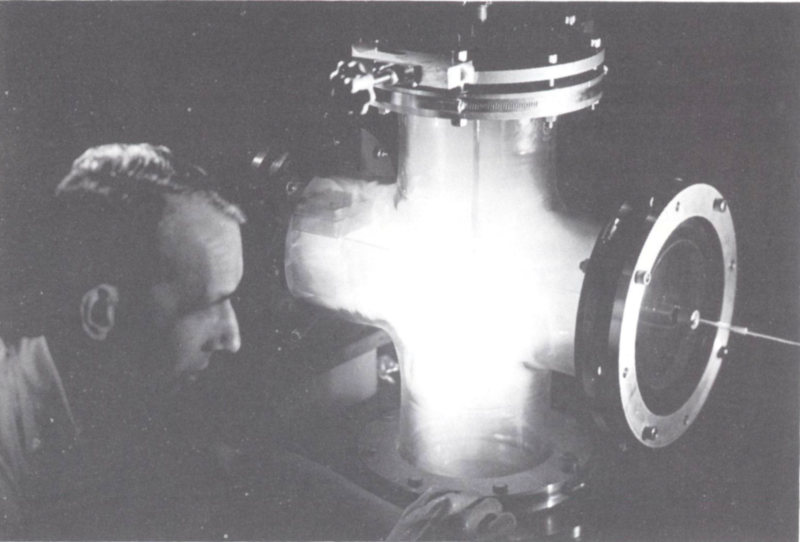
Figure 10 Glowing plasma in experimental device at General Atomic’s John Jay Hopkins Laboratory, San Diego. T-shaped plasma gun provides data for research in thermonuclear fusion. Courtesy Texas Atomic Energy Research Foundation.
A helium-potassium mixture is a good enough conductor for use in an MHD generator. In this plasma the electrons move rapidly under the influence of the applied fields, though not as well as in metals. The positive ions move in the opposite direction from the electrons, but the electrons are much lighter and move thousands of times faster thus carrying the bulk of the electrical current.
22
MHD Power Prospects
The MHD duct is not a complete power plant in itself because, after leaving the duct, the stream of gas must be compressed, heated, and returned to the duct. Very high temperature materials and components must be developed for this kind of service. Moreover, while the duct is simple in concept, it must operate at very high temperatures in the presence of the corrosive alkali metals. This presents us with difficult materials problems. When the problems are solved, probably within the next decade, MHD power plants should be able to provide reliable power with high efficiency. They may then serve in large space power plants, and, most important, they may provide cheaper electricity for general use through their higher temperatures and greater efficiencies.