ADVANCED CONCEPTS
Reading edition
Ferroelectric and thermomagnetic conversion are subtle concepts which depend upon the gross alteration of a material’s physical properties by the application of heat. Devices employing such concepts are true heat engines. Instead of the gaseous and electronic working fluids used in the other direct conversion concepts, the ferroelectric and thermomagnetic concepts employ patterns of atoms and molecules that are actually rearranged periodically by heat.
Ferroelectric Conversion
Ferroelectric conversion makes use of the peculiar properties of dielectric[12] materials. Barium titanate, for example, has good dielectric properties at low temperatures, but, when its temperature is raised to more than 120°C, the properties get worse rapidly. We cannot discuss dielectric behavior thoroughly in this booklet; suffice it to say that in this process heat is absorbed in a realignment of molecules within the barium titanate latticework.
If we now place a slab of barium titanate between the two plates of an electrical condenser and charge the condenser, as shown in Figure 14, we have a unique way of converting heat into electricity directly. When the barium titanate is heated above its Curie point[13] of 120°C, the condenser’s capacitance is radically reduced as the dielectric constant falls. The condenser is forced to discharge and move electrons through an external circuit consisting of the load and the original source of charge. Useful electrical energy is delivered during this step. Figure 14 shows the process schematically and mathematically. When the dielectric is cooled, waste heat is given up by the barium titanate, and the cycle is complete.
31
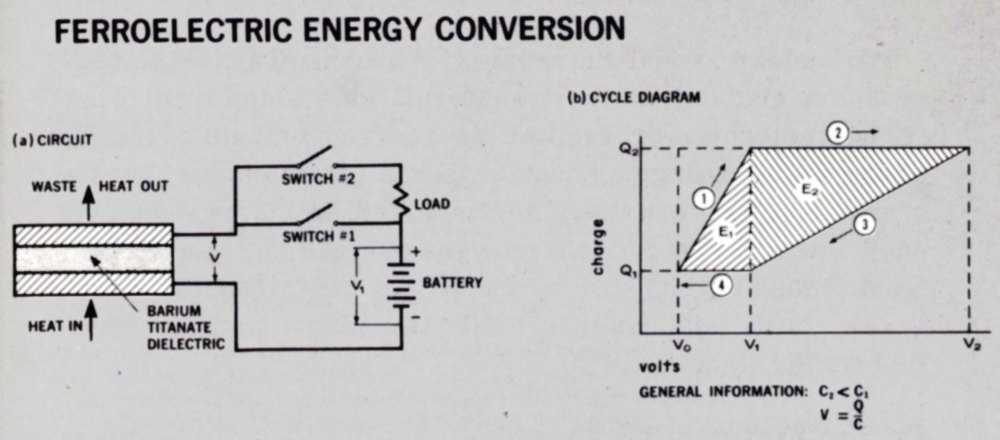
Figure 14 FERROELECTRIC ENERGY CONVERSION The ferroelectric converter is really an electrical capacitor whose capacitance is changed by temperature. When heat is added, capacitance drops, voltage rises, and the capacitor is made to discharge through the load. CYCLE: ① Switch #1 closed, #2 open. Condenser charges from battery to charge Q₂ at voltage V₁ with capacity C₁. ② All switches open. Heat added, capacity changes from C₁ to C₂, charge remains constant, so voltage changes from V₁ to V₂. ③ Switch #2 closed, #1 open. Condenser discharges through load and battery to charge Q₁ at voltage V₁ with capacity C₂. ④ All switches open. Heat rejected, capacity changes from C₂ to C₁, charge remains constant, so voltage changes from V₁ to V₀. CYCLE THEN REPEATS. Energy supplied from battery each cycle is E₁. Energy delivered to load and battery each cycle is E₂. Net energy converted is then E₂ - E₁, the difference in the shaded areas.
(a) CIRCUIT
HEAT IN
BARIUM TITANATE DIELECTRIC
WASTE HEAT OUT
SWITCH #2
LOAD
SWITCH #1
BATTERY
(b) CYCLE DIAGRAM
charge
volts
Q₂, Q₁, E₁, E₂, V₀ V₁ V₂
GENERAL INFORMATION:
C₂ < C₁
V = Q/C
Thermomagnetic Conversion
The analog[14] of ferroelectricity is ferromagnetism. A converter employing similar principles to those in ferroelectricity can be made using an electrical inductance with a ferromagnetic core. When the temperature of the ferromagnetic material is raised above its Curie point, its magnetic permeability drops quickly, causing the magnetic field to collapse partially. Energy may be delivered to an external load during this change. Instead of energy being stored in an electrostatic field, it is stored in a magnetic field.
32
Ferroelectric and thermomagnetic conversion both represent a class of energy transformations which involve internal molecular or crystalline rearrangements of solids. There is no change of phase as in a steam engine, but the energy changes are there nevertheless. In thermodynamics such internal geometrical changes are called second-order transitions, as opposed to the first-order transitions observed with heat engines using two-phase working fluids like water/steam.
On the Frontier
Other potential energy conversion schemes are being investigated by scientists and engineers. Those listed in the Energy Conversion Matrix (Figure 2) only scratch the surface.
In particular, we are just learning how to manipulate photons. There are photochemical, photoelectric, and even photomechanical transformations. These have hardly been tapped.
Consider the reaction when an electron and its antimatter equivalent, the positron, meet. They mutually annihilate each other in a burst of energy! This energy will be harnessed someday.
What energy conversion device are we going to use to completely convert mass into energy? The energy requirements for interstellar exploration are so great that these voyages will be impossible unless a new device is found that can completely transform mass into energy.
Then again, we haven’t the faintest idea of how to control gravitational energy, but we may learn.
The panorama is endless.
Problem 5
A 1,000,000-kilogram spaceship takes off for Alpha Centauri, our nearest star, 4.3 light years away. If it accelerates to nine-tenths the velocity of light, what is its kinetic energy? How much fuel mass will have to be completely converted to energy to acquire this velocity?
33