THERMIONIC CONVERSION
Reading edition
“Boiling” Electrons Out of Metals
Like the thermoelectric element, the thermionic converter is a heat engine. In its simplest form it consists of two closely spaced metallic plates and resembles the diode radio tube. Whereas thermoelectric elements depend on heat to drive electrons and holes through semiconductors to an external electricity-using device or load, the salient feature of the thermionic diode is thermionic emission,[7] or, simply, the boiling-off of electrons from a hot metal surface. The thermionic converter shown in Figure 7 powers a small motor when heated by a torch.
Metals, as we have already seen, have an abundance of loosely bound conduction electrons roaming the atomic latticework. These electrons are easily moved by electric fields while within the metal; but it takes considerably more energy to boil them out of the metal into free space. Work has to be done against the electric fields set up by the surface layer of atoms, which have unattached valence bonds on the side facing empty space.
The energy required to completely detach an electron from the surface is called the metal’s work function. In the case of tungsten, for example, the work function is about 4.5 electron volts[8] of energy.
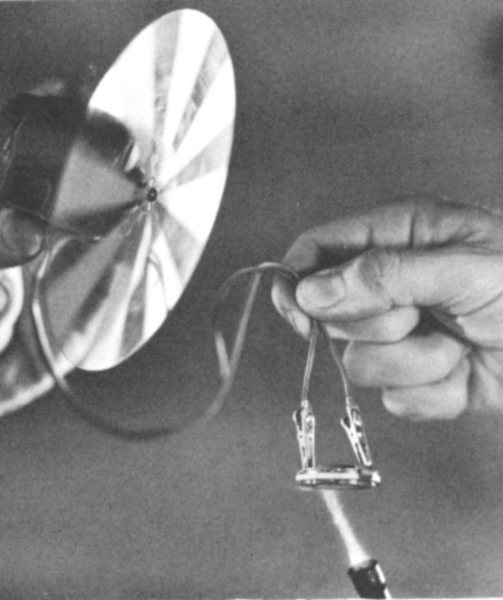
Figure 7 Vacuum type thermionic converter in operation. Courtesy General Electric Company.
As we raise the temperature of a metal, the conduction electrons in the metal also get hotter and move with greater velocity. We may think of some of the electrons in a metal as forming a kind of electron gas. Some electrons will gain such high speeds that they can escape the metal surface. 17 This happens when their kinetic energy exceeds the metal’s work function.
Now that we have found a way to force electrons out of the metal, we would like to make them do useful electrical work. To do this we have to push the electrons across the gap between the plates as well as create a voltage difference to go with the hoped-for current flow.
Reducing the Space Charge
The emitted or boiled-off electrons between the converter plates (Figure 8) form a cloud of negative charges that will repel subsequently emitted electrons back to the emitter plate unless counteraction is taken. To circumvent these space charge effects, we fill the space between the plates with a gas containing positively charged particles. These mix with the electrons and neutralize their charge. The mixture of positively and negatively charged particles is called a plasma.
The presence of the plasma makes the gas a good conductor. The emitted electrons can now move easily across it to the collector where, to continue the gas analogy, they condense on the cooler surface.
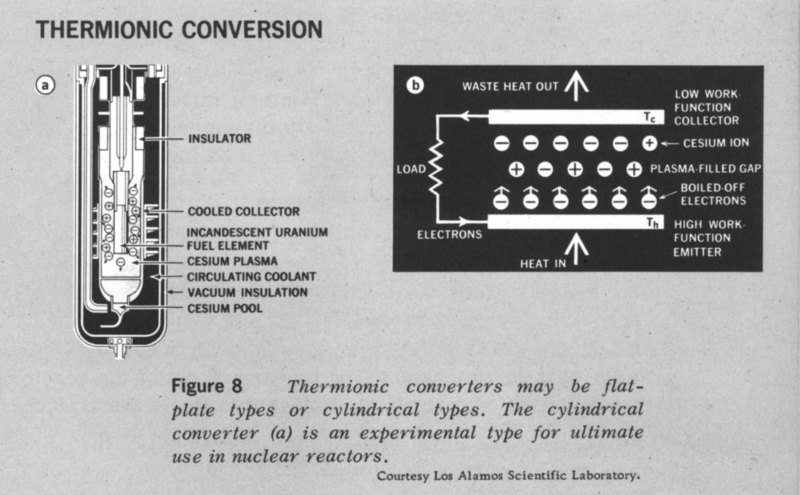
Figure 8 THERMIONIC CONVERSION Thermionic converters may be flat-plate types or cylindrical types. The cylindrical converter (a) is an experimental type for ultimate use in nuclear reactors. Courtesy Los Alamos Scientific Laboratory.
a
INSULATOR
COOLED COLLECTOR
INCANDESCENT URANIUM
FUEL ELEMENT
CESIUM PLASMA
CIRCULATING COOLANT
VACUUM INSULATOR
CESIUM POOL
b
WASTE HEAT OUT
LOAD
ELECTRONS
LOW WORK FUNCTION COLLECTOR
Tc
CESIUM ION
PLASMA FILLED GAP
BOILED OFF ELECTRONS
HIGH WORK FUNCTION EMITTER
Tc
HEAT IN
18
Result: A Plasma Thermocouple
Unless a voltage difference exists across the plates, no external work can be done. In the thermocouple the voltage difference was caused by the different electrical properties of the p and n semiconductors. Both the emitter and collector in the thermionic converter are good metallic conductors rather than semiconductors, so a different tack must be taken.
The key is the use of an emitter and a collector with different work functions. If it takes 4.5 electron volts to force an electron from a tungsten surface and if it regains only 3.5 electron volts when it condenses on a collector with a lower work function, then a voltage drop of 1 volt exists between the emitter and collector.
To summarize, then, the thermionic emission of electrons creates the potentiality of current flow. The difference in work functions makes the thermionic converter a power producer.
There is an interesting comparison that helps describe this phenomenon. Consider the emitter to be the ocean surface and the collector a mountain lake. The atmospheric heat engine vaporizes ocean water and carries it to the cooler mountain elevations, where it condenses as rain which collects in lakes. The lake water as it runs back toward sea level then can be made to drive a hydroelectric plant with the gravitational energy it has gained in the transit. The thermionic converter is similar in behavior: hot emitter (corresponding to the sun-heated ocean); cooler collector (lake); electron gas (water); different electrical voltages (gravity). Without gravity the river would not flow, and the production of electricity would be impossible.
Thermionic Power in Outer Space
Thermionic converters for use in outer space may be heated by the sun, by decaying radioisotopes, or by a fission reactor. Thermionic converters can also be made into concentric cylindrical shells (Figure 8a) and wrapped around the uranium fuel elements in nuclear reactors. The waste heat in this case would be carried out of the reactor to a separate radiator[9] by a stream of liquid metal. Since 19 thermionic converters can operate at much higher temperatures than thermoelectric couples or dynamic power plants, the radiator temperature, Tc, will also be higher. Consequently, space power plants using thermionic converters will have small radiators. Once thermionic converters are developed which have high reliability and long life, they will provide the basis for a new series of lighter, more efficient space power plants.