LAWS GOVERNING ENERGY CONVERSION
Reading edition
The Big Picture: Thermodynamics
To the best of our knowledge, energy and mass are always conserved together in any transformation. This summary of experience has been made into a keystone of science: the Law of Conservation of Energy and Mass. It states that the total amount of mass and energy cannot be altered. This law applies to everything we do, from driving a nail to launching a space probe. While the conscience of the scientist insists that he continually recheck the truth of this law, it remains a bulwark of science.
The Law of Conservation of Energy and Mass is also called the First Law of Thermodynamics. It is related to the Second Law of Thermodynamics, which also governs energy transformations. The Second Law says, in effect, that some energy will unavoidably be lost in all heat engines. The first two laws of thermodynamics have been paraphrased as (1) You can’t win; (2) You can’t even break even. Let us look at them further.
9
You Can’t Win
We used to think that energy and mass were conserved independently, and for many practical purposes we still consider them so conserved. But Einstein united the two with the famous equation
E = mc²
where E = energy (in joules) m = mass (in kilograms) c = speed of light (300,000,000 meters per second)
Notice the resemblance to the kinetic energy equation shown earlier. Energy cannot appear without the disappearance of mass. When energy is locked up in a fuel, it is stored as mass. In the gasoline combustion problem, 1 gram of gasoline was burned with air to give 48,000 joules of energy. Einstein’s equation says that in this case mass disappeared in the amount
m = E/c² = (4.8 × 10⁴)/(9 × 10¹⁶) = 5.3 × 10⁻¹³ kilogram (half a billionth of a gram)
But, when an H-bomb is exploded, grams and even kilograms of mass are converted to energy.
In direct conversion processes we do not need to worry about these mass changes, but at each point we must make sure that all energy is accounted for. For example, in outer space all energy released from fuels (even food) must ultimately be radiated away to empty Space. Otherwise the vehicle temperature will keep rising until the Spaceship melts.
You Can’t Even Break Even
Any engineer is annoyed by having to throw energy away. Why is energy ever wasted? The Second Law of Thermodynamics guides us here. Experience has shown that heat cannot be transformed into another form of energy with 100% efficiency. We can’t explain Nature’s idiosyncracies, but we have to live with them. So, we accept the fact that every engine that starts out with heat must ultimately waste some of that energy (Figure 3).
10
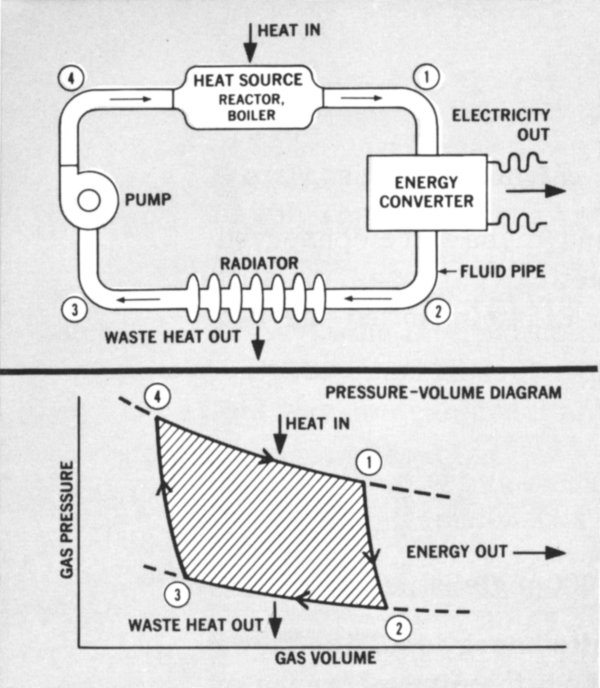
Figure 3 A typical heat engine showing heat input, useful power output, and the unavoidable waste heat that must be rejected to the environment. A pressure-volume diagram is shown underneath for a closed gas-turbine cycle. Circled numbers correspond. The energy produced is represented by the shaded area. Similar diagrams can be made for all heat engines as an aid in studying their performance.
A TYPICAL HEAT ENGINE
HEAT IN
HEAT SOURCE
REACTOR, BOILER
ELECTRICITY OUT
ENERGY CONVERTER
PUMP
FLUID PIPE
RADIATOR
WASTE HEAT OUT
PRESSURE-VOLUME DIAGRAM
HEAT IN
ENERGY OUT
GAS PRESSURE
WASTE HEAT OUT
GAS VOLUME
Direct conversion devices are no exception. Consequently, every thermoelectric element or thermionic converter will have to provide for the disposition of waste heat. The designer will try, however, to make the engine efficiency high so that the waste heat will be small. Figure 4 shows the extensive waste heat radiator on a SNAP 50 power plant planned for deep space missions.
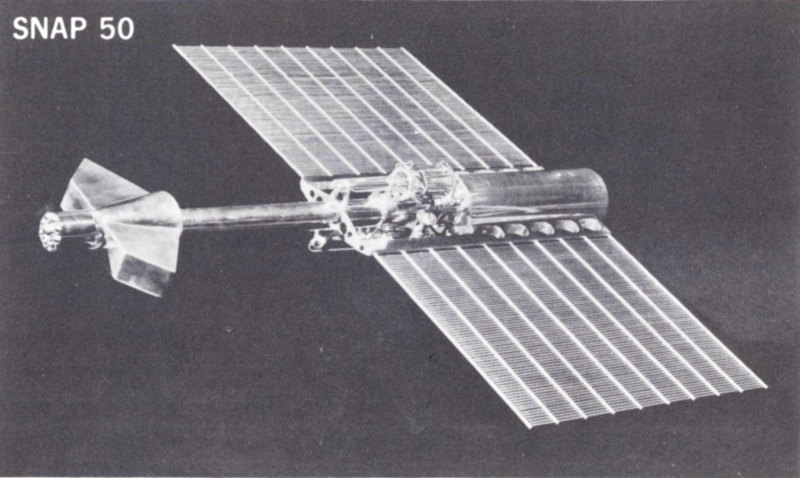
Figure 4 Model of SNAP 50 power plant planned for deep space missions showing extensive waste heat radiator. The system will provide 300 to 1000 kilowatts of electrical power.
11
Carnot Efficiency
In 1824 Sadi Carnot, a young French engineer, conceived of an idealized heat engine. This ideal engine had an efficiency given by
e = 1 - Tc/Th = (Th - Tc)/Th
where e = the so-called Carnot efficiency (no units) Tc = the temperature of the waste heat reservoir (in degrees Kelvin, °K[4]) Th = the temperature of the heat source (in °K)
Unhappily, Tc cannot be made zero (and e therefore made equal to 1, which is 100% efficiency). Physicists have shown absolute zero to be unattainable, although they have approached to within a hundredth of a degree in the laboratory.
Waste heat, since it must be rejected to the surrounding atmosphere, outer space, or water (rivers, the ocean, etc.), must be rejected at Tc greater than 300°K. The reason for this is that these physical reservoirs have average temperatures around 300°K (about 80°F) themselves. The fact that Tc must be 300°K or more is a basic limitation on the Carnot efficiency. The loss in efficiency with increased Tc explains why a jet plane has a harder job taking off on a hot day.
One way to improve the Carnot efficiency, which is the maximum efficiency for any heat engine, is to raise Th as high as possible without melting the engine. For a coal-fired electrical power plant, Th = 600°K and Tc = 300°K, so that
e = 1 - 300/600 = 0.5 = 50%
The actual efficiency is somewhat less than this ideal value because some power is diverted to pumps and other 12 equipment and to unavoidable heat losses. Later on, we shall see that magnetohydrodynamic (MHD) generators hold prospects for increasing Th by hundreds of degrees.
Everything that has been said about the Second Law of Thermodynamics (You can’t even break even) applies to heat engines, where we begin with thermal energy. Suppose instead that we start with kinetic or chemical energy and convert it into electricity without turning it into heat first. We can then escape the Carnot efficiency strait jacket. Chemical batteries perform this trick. So do fuel cells, solar cells, and many other direct conversion devices we shall discuss. Thus, we circumvent the Carnot efficiency limitation by using processes to which it does not apply.
Problem 3
Some space power plants contemplate using the space cabin heat (Th = 300°K) to drive a heat engine which rejects its waste heat to the liquid-hydrogen rocket fuel stored at Tc = 20°K. What would be the Carnot efficiency of this engine?