COURT LADIES OF OLD JAPAN (continued 3)
Annie Shepley Omori translation
The helpers[77] of courtier Narito's daughter were dressed in brocaded karaginu, which was distinctive and pleasing even at night. She was overwhelmed by her dress and her movements were ungraceful, yet the nobles paid her special attention. The King came to see the dance. The Lord Prime Minister, too, crept in from the side entrance, so we felt constraint.
The helpers of Nakakyo's daughter were all of the same height. They were graceful and charming, and people agreed that they were not inferior to any ladies.
The State Councillor and Lieutenant-General had all his maids as helpers of his daughter. One of them was ungraceful, being fat and countrified, so all were laughing at her. The daughter of Tō [State Councillor] gave a fresh and distinct impression because of her family.[78] She had ten helpers.
The ladies who were proud of their good looks seemed more beautiful in this artificial light.
On the morning of the day of the Tiger[79] the courtiers assembled. Although it is a common custom to have the dance, the younger ones were especially curious to see the dancers. Was it because they had acquired rude country manners during these months of absence from the Court? There the dress dyed by rubbing the leaves of the indigo plant was not to be seen. When night came the second official of the Crown Prince was summoned and perfumes were bestowed upon him. Quantities of it were heaped up in a large box.
That night the dance was performed in the Seiry-oden.[80] The King was present to see it. The Prime Minister's wife sent a messenger to the Governor of Owari.
As the August young Prince was to be present, rice was thrown to keep off evil spirits, and people reviled them [the spirits] and called them names. It gave us a queer feeling. I was weary and wanted to rest a little, so I remained in our chamber thinking to present myself when it should be necessary. Lady Kohyoé and Lady Kohyobu sat beside the brazier. We were saying that the hall was crowded and nothing could be seen distinctly, when the Lord Prime Minister came in. "Why do you stay here? Come with us!" so we went reluctantly. I watched the dancers thinking how tired they must be, and what a heavy task they had before them. The daughter of the Governor of Owari became ill and retired. Human fate is like a dream, it seems! After the dance His Majesty retired.
Young noblemen talk of nothing these days but the rooms of those dancers.[81] Even the borders of the curtains hanging over the sudaré were varied according to the taste of the dancer. Their hair-dressing and their style also varied extremely, so the young men talked about that, and more improper things too. Even in ordinary years [when there was no unusual festivity] the dancing girls' hearts are always filled with anxiety, how much more so this year. While I was thinking about it they came out in single file. My heart swelled with sympathy. It may be they have no great patrons to depend on who could protect them. As they are all chosen for their beauty all are attractive, and it would be difficult to say which is superior to the other, although the man of fashion may perhaps perceive differences. In this brilliant light they may not even shade their faces with their fans. They are placed in rivalry with each other in rank, in prudence, and in wit, and must struggle each to excel the other, although at the same time they feel shyness in the presence of the young men. Surrounded by the young nobles, they are forced to hold their own among them worthily. I feel sorry for them.
Governor Tamba's daughter wore a darkish blue gown. The State Councillor Tō's daughter wore red. The maids of the latter wore the blue karaginu of a girl and were so beautiful that they made us women jealous. One girl did not seem at all dignified. The daughter of the State Councillor and Lieutenant-General was tall and had beautiful hair. Her attendants wore deep-coloured clothes trimmed with five folds and their outer garments were varied according to taste. The last girl wore a plain grape-coloured one, and that simple dress was more beautiful, as it showed taste in colour combination.
The secretaries of the sixth rank went towards them to take away their fans. They threw them down themselves. Though they were graceful they did not seem like girls. If we were in their places it would seem like a dream to us. I had never supposed I should mingle with these court ladies! Yet the human heart is an invisible and dreadful being. If I became accustomed to [court life] my bashfulness would be overcome and I could easily stand face to face with men. As if in a vision my future appeared to me, and such a state of things appeared to me undesirable. My mind was greatly troubled and I could observe nothing.
The apartment temporarily given to the dancer who was the daughter of the King's Adviser and State Councillor was just across the way [in the building of another queen, see map of palace] on the corridor opposite to that of our Queen. A part of the sudaré of that room was in sight above the outer shutter, although we could hear voices but faintly. The State Councillor and Lieutenant-General, who knew about it all, said, "There are ladies called Sakyō and Uma who once served that Queen over there." "It was Sakyō who sat in the eastern part of the hall last night as a helper of a certain young lady who danced," said Genshosho, who knew her. Some of our Queen's ladies chanced to overhear these remarks. "How extraordinary! Yet she must remember old times," said they; "how is it possible that a former lady-in-waiting should return to the court as a maid? She may be thinking it will never be known, but we will one day bring it to light!"
Our ladies may have been scheming for this when they chose among the multitude of fans kept by the Queen those representing the Island of Horai[82]—did she feel it, I wonder?
Ground-pine [Lycopodium] was made into a wreath and put into a box-cover [probably of a writing-box, in those days large and elegantly lacquered]. A comb and face-powder were put in also, for the young courtiers had said, "that lady, who is rather advanced in years, wears a curved comb suitable for a young lady." So the comb which was put into the box was curved too much in the vulgar new fashion with perfume balls clumsily covered with paper. A poem was added to it written by Lady Saifu:
Among the many ladies that night of the dance The belle was the one who wore the lycopodium.
The Queen said: "If you are going to send at all, send something clever, here are many fans for it." But some ladies replied: "That will attract too much attention. It is too unusual. If you send this publicly you will not succeed in puzzling her; perhaps we would better send it anonymously." Therefore a lady who was an entire stranger to her was chosen. She went, and, speaking loudly, said: "Here is a letter from Lady Chunagon. It is sent by her Queen to Lady Sakyō." I thought it would be awkward if the messenger were caught by them, but she ran away as soon as she had put down the things. She reported that she heard some one saying, "Whence do you come?" There is no doubt she really thought it a gift from our Queen.
Days passed without any interesting events. After that evening of dancing the Court became absolutely dull. The preparatory music on the eve of the Omi ceremony[83] was very fine. The young courtiers were still filled with thoughts of the dancers. After the Queen's return to the palace, the little sons of another wife of the Prime Minister were permitted to come in to play with the ladies-in-waiting. They came to us without end, which was a great bother. I did not show myself to them, taking advantage of my advanced age. They were not thinking of the dancers, but were playing by the side of Ladies Yasurahi and Kohyoé, joking and chattering like little birds.
At the occasional festival of the Kamo shrine the Vice-Lieutenant-General [first son of the Prime Minister] was made the King's substitute. It was a day of fasting also, so the Lord Prime Minister had passed the night at the palace. The nobles and dancers passed the night of the festival in making a great noise with much merriment in the corridors. Next morning an attendant of the Chamberlain brought something to an attendant of the Lord Prime Minister. It was the box-cover of the previous night.[84] There was in it a silver case for romances, besides a mirror, a comb of aloe wood, and a silver kogai. The comb seemed to be given to adorn the hair of the messenger at the festival. Something was written on the box-cover in reed style in raised characters. It was the answer to the poem of the lycopodium. Two characters were omitted and it was difficult to read. She seemed to have misunderstood. The Chamberlain thought it really was a gift to her from our Queen, so the return was made thus openly. It was but a foolish joke and I felt sorry for her.
The Prime Minister's wife came to court to see the festival. His son, adorning his head with artificial wisteria, appeared quite a man, noble and dignified. The Lady Kura [his nurse], not taking any notice of the dancers, wept for joy watching her young lord. As it was still the day of fasting, they came back from the shrine at two in the morning, and the sacred dance was performed listlessly, as the important persons were absent. Kanetoki [a dancer] who had been very handsome last year, was much fallen off. Though a stranger to him I felt regret, being reminded of the fleeting life of us all.
[Here an interval occurs.]
On the twentieth of the Finishing month I went again to Court. It was the anniversary of the day on which I had first come. I remembered my former career as a wanderer on dream paths, and I loathed myself for having become so familiar with court life. The night was far advanced and as the Queen was fasting, we did not present ourselves before her. I felt lonely and was lying down. The maids-of-honour around me said: "The hours here are very different from those at home. There all would be sleeping by this time, but here our dreams are broken by the sound of shoes along the corridor." Hearing them girlishly talking I murmured to myself:
My life and the year are closing together. At the sound of the wind dreary is my heart.
On that moon-hidden night [last night of the year] the driving off of evil spirits was soon finished. We dyed our teeth [black], and after finishing decorating our faces we sat at ease. Ben-no-Naishi came, and after talking she went to sleep. The Queen's seamstress sat in the doorway watching the maid Ateki sewing. Just then we heard an unusual noise from the direction of Her Majesty's apartment. I tried to wake up Ben-no-Naishi, but she was heavy with sleep. Some one was heard crying wildly. I was frightened and could not think what to do. Was it a fire? But no, it was not that. I pushed the seamstress forward, saying, "Go there! over there! Oh, dear!!" Then, "Her Majesty is in her own room, we must by all means get to her!" I shook Ben-no-Naishi roughly to awaken her and we three ran trembling—flying rather than walking. We saw two naked persons. They were Lady Yugei and Lady Kohyobé. It seemed that they had been robbed of their clothes, and I felt more distressed than before. The kitchen servants had all gone out; even the Queen's guards had retired after devil-driving. We clapped our hands, but no one came. Some went to call the women attendants, while I, forgetting my shyness, said, "Call Hyobu-no-Jo, the secretary." He was sought for, but had left the palace. I felt irritated indeed, but at last an assistant to the Master of Ceremonies came who poured oil into several lamps. We found many who had fainted. At the news a messenger arrived from the King, but we were too frightened to receive him properly. He took out dresses from the royal wardrobe to give them. The new dresses for New Year's Day were not stolen, so these ladies took their misfortune lightly—but unforgettably dreadful is a nude form. I can never call it laughable. It was too dreadful to speak of, but we could not help talking.
The New Year's Day [1008] was inauspicious. The rice-cake [mochi] [85] ceremony was deferred. However, on the third day, the August Crown Prince went up to the King and the rice-cake festival was given for him. His attendant was Lady Dainagon. The dress of the ladies on the first day was karaginu of purple and old rose colour, red kimono and shaded train; on the second day, red and purple brocade, deep violet glossy silk, green karaginu, train dyed by rubbing flowers. On the third day we wore white and rose-coloured brocaded garments, trimmed with many folds. The karaginu was of dull red and old rose brocade. When we wear deep violet-coloured shining silk the inner robe is of crimson; when we wear crimson outside the inner dress is usually of deep violet. The pale and deep colour of spring leaf buds, dull red, golden yellow, and light and dark crimsons—dresses of these ordinary colours were worn trimmed with six folds in very beautiful combinations.[86]
Lady Saisho held the August Prince's honourable sword. The Lord Prime Minister took the August Prince in his arms and they presented themselves before the King. Lady Saisho's dress was a garment trimmed with three and five folds, and figured of the same colour trimmed with seven folds. The uchigi was adorned with a pattern of oak-leaves beautifully embroidered. She wore a karaginu and train trimmed with three folds. Her unlined inner kimono was woven in a pattern. Her costume was in the Chinese style. Her hair was ornamented more elaborately than usual. Her style of dress and manner showed great knowledge of the world. She is rather tall and has a well-rounded figure. Her face is very small and exquisitely tinted.
[The following eleven paragraphs are portraits of prominent ladies of the court.]
LADY DAINAGON is very small and refined, white, beautiful, and round, though in demeanour very lofty. Her hair is three inches longer than her height. She uses exquisitely carved hairpins. Her face is lovely, her manners delicate and charming.
LADY SENJI is also a little person, and haughty. Her hair is fine and glossy and one foot longer than the ordinary. She puts us to shame, her carriage is so noble. When she walks before us we feel so much in the shade that we are uncomfortable. Her mind and speech make us feel that a really noble person ought to be like her.
—If I go on describing ladies' manners I shall be called an old gossip, so I must refrain from talking about those around me. I will be silent about the questionable and imperfect.
LADY KOSHOSHO, all noble and charming. She is like a weeping-willow tree at budding-time. Her style is very elegant and we all envy her her manners. She is so shy and retiring that she seems to hide her heart even from herself. She is of childlike purity even to a painful degree—should there be a low-minded person who would treat her ill or slander her, her spirit would be overwhelmed and she would die. Such delicacy and helplessness make us anxious about her.
LADY MIYA-NO-NAISHI, also a beauty of good height. Her appearance as she sits is very dignified. She is fashionable. Although no single feature is especially beautiful she has altogether an air of youth and beauty. Her face is [literal translation] high in the middle and she excels others in the fairness of her skin. Her hair-ornaments, her forehead, oh, beautiful! produce an effect of refinement and elegance. She is very frank and unaffected in manner, and never the least bit awkward about anything. She is naturalness itself. Her character may be an example for us. She never tries consciously to attract, and she has no vanity.
LADY SHIKIBU is her younger sister. She is too plump, and her complexion is a fragrant white. She has a bright small face and beautiful hair, although it is not long. She presents herself before the Queen with false hair. Her plump appearance, oh, smile-giving! Her eyes and forehead are lovely indeed; her smile is full of sweetness.
Among the younger ladies I think KODAYU and GENSHIKIBU are beautiful. The former is a little person quite modern in type. Her pretty hair is abundant at the roots, but gets too thin at the end, which is one foot longer than she is. Her face is full of wit. People will think her very pretty, and indeed there is no feature one would wish to improve. The latter is tall and rather superior. Her features are fine; she is smile-giving and lovable. She is very refined and seems to be a favourite daughter of some person of dignity.
LADY KOHYOÉ-NO-JO is also refined. These ladies cannot be looked down upon by court nobles. With every one some fault is to be found, but only those who are ever mindful to conceal it even when alone, can completely succeed.
LADY ATTENDANT MYAKI is a very pretty person. Her hair is scarcely longer than her uchigi, the ends are beautifully cut. Her face was agreeable also when I last saw it.
There is also LADY GOSETCHI-NO-BEN.[87] She is the adopted daughter of Middle Adviser Hei. Her face is like a picture. She has a broad forehead and eyelids drooping at the corners. Her features are not remarkable at any point, but her complexion is white, her hands and arms are pretty. When I saw her in the spring for the first time her hair, which was profusely abundant, was one foot longer than herself, but it suddenly became thinner at the ends, and now it is only a little longer than she is.
A LADY KOMA had very long hair, an agreeable lady in those days; now she has become like the bridge of a lute which has been immovably fastened with glue. She has gone home.
So much for their appearance and now for their dispositions. Here few can be selected, though each has some good points and few are entirely bad. It is very difficult to possess such qualities as prudence, wit, charm, right-mindedness, all at once. As to many ladies, the question is whether they excel most in charms of mind or person. It is hard to decide! Wicked, indeed, to write so much of others!
There is LADY CHUJO who waits upon the Princess dedicated to the service of the Kamo shrine. I had heard of her and secretly managed to see her letters addressed to other persons. They were very beautifully written but with such an exalted opinion of herself; in the whole world she is the person of profoundest knowledge! None to compare with her, it seems she is thinking. On reading them my heart beat faster, I was furiously indignant for every one here [the ladies of her own Queen's Court], although it maybe it is wrong to feel so. "Be it in composition or poetry who can judge save our Princess-Abbess, who will have bright futures but the ladies attending our Princess?"!! It may be reasonable, yet I have never seen, compared to ours, any good poems by the lady attendants of that Princess-Abbess. They seem to be living an idle poetic life, but if they were to compete with us, it is not necessarily certain they would be superior, though no one knows them well. On a beautiful moonlight night or morning, at the time of flowers or of cuckoo, courtiers might visit their residence. Other-worldly and sacred it is, and made to the taste of their Princess. There they remain undisturbed, admiring her. On the other hand, with us many things occur. The Queen has to go up to His Majesty's apartment, the Lord Prime Minister comes, and we have to keep watch at night. But there is nothing of all this in that world all their own where they may indulge in elegance and avoid blunders. If I could live there like an old piece of buried wood thrown in among them, I might succeed in freeing myself from the reproach of shallowness—would that I might indulge in elegance there, relaxing myself! Forward young ladies there can devote themselves to dress, making themselves inferior to none and pleasing to courtiers. On the other hand, in our Queen's Court we rather neglect to adorn ourselves, for our Queen has no rivals now. Moreover, she thinks unfavourably of frivolous women, so those who wish to serve her and remain in favour keep from association with men. Of course everywhere there are light-hearted, unashamed, thoughtless women, and men who visit our court to find them say we are awkward and unversed in social usage. Our ladies of the higher ranks are, indeed, much too reserved and haughty; it is not in this way that they can bring honour to our Queen. It is painful to see them. The attendants of the Princess-Abbess seem to have been alluding to these ladies, but both defects and merits are found in every one, so we may not be inferior to them after all. Even our young ladies nowadays have heard of self-respect. It would be embarrassing if they were too frivolous, but one would not wish them to be heartless either.
Our Queen of perfect mind, enviably lovely, is reserved and never obtrusive, for she believes that few who are forward can avoid blunders. In fact, imperfect wit is worse than reserve. Our Queen when she was very young was much annoyed to hear persons of shallow culture saying vulgar, narrow things with conceit, so she favoured ladies who made no mistakes, and childlike persons pleased her very well. This is why our ladies have become so retiring. As Her Majesty grows older, she begins to see the world as it is, the bad and good qualities of the human heart. Reserve or boldness—she knows neither is good. The court nobles rather look down on us—"Nothing interesting here!" they seem to say. The Queen knows this, but she knows we cannot please everybody. If we stumble, hideous things may happen. Yet we must not be faint-hearted and bashful either, so Her Majesty says, but our old habits are not so easily shaken off, and all the young nobles of the present day are, on their side, only indulgent pleasure-seekers.
The ladies around the Abbess, who indulge in æsthetic pursuits, gazing at the moon and admiring flowers, may talk only of these things to the nobles, boastfully and intentionally, and the nobles might say that it is difficult to find ladies with whom they can chatter light-heartedly morning or evening, or discuss interesting topics occasionally; although, as I haven't heard them say it, I don't know really what they think. In general conversation it is awkward to say profound things. It is far better to speak with simplicity, and the nobles seem to think so. The difficulty is to understand the occasion and adapt one's self to it.
When the First Official of Her Majesty comes to report to her, the delicate, shy ladies-in-waiting cannot meet him on common ground, or converse fluently, not because they are deficient in words or thoughts, but because of their extreme timidity. They fear their faults may be noticed so they cannot decide what to say. Others [Abbess ladies] may not be so. Even women of high birth must follow the general custom when they become ladies-in-waiting at the Court, but many behave as if they were still daughters at home.
The Great Adviser[88] is displeased to be received by ladies of low rank, so when he comes to the Queen's court to make some report and suitable ladies to receive him are not available, he goes away without seeing Her Majesty. Other court nobles, who often come to make reports, have each a favourite lady, and when that one is away they are displeased, and go away saying to other people, that the Queen's ladies are quite unsatisfactory. There may be some reason in it, yet it is quite unreasonable for the Abbess's ladies to say that we are unworthy to be seen or heard. It is easy to criticize, and difficult to realize our own ideals. These ladies, however, do not know that, and being full of conceit, they treat others with disdain, thus revealing their own limitations. Oh, how I wanted to show the letters to the Queen, but they had been stolen by the lady who secretly showed them to me, and they were soon taken back. I coveted those letters!
LADY IZUMI SHIKIBU[89] corresponds charmingly, but her behaviour is improper indeed. She writes with grace and ease and with a flashing wit. There is fragrance even in her smallest words. Her poems are attractive, but they are only improvisations which drop from her mouth spontaneously. Every one of them has some interesting point, and she is acquainted with ancient literature also, but she is not like a true artist who is filled with the genuine spirit of poetry. Yet I think even she cannot presume to pass judgment on the poems of others.
The wife of the Governor of Tamba Province is called by the Queen and Prime Minister MASA HIRA EMON.[90] Though she is not of noble birth, her poems are very satisfying. She does not compose and scatter them about on every occasion, but so far as we know them, even her miscellaneous poems shame us. Those who compose poems whose loins are all but broken, yet who are infinitely self-exalted and vain, deserve our contempt and pity.
LADY SEISHONAGON.[91] A very proud person. She values herself highly, and scatters her Chinese writings all about. Yet should we study her closely, we should find that she is still imperfect. She tries to be exceptional, but naturally persons of that sort give offence. She is piling up trouble for her future. One who is too richly gifted, who indulges too much in emotion, even when she ought to be reserved, and cannot turn aside from anything she is interested in, in spite of herself will lose self-control. How can such a vain and reckless person end her days happily!
[Here there is a sudden change from the Court to her own home.]
Having no excellence within myself, I have passed my days without making any special impression on any one. Especially the fact that I have no man who will look out for my future makes me comfortless. I do not wish to bury myself in dreariness. Is it because of my worldly mind that I feel lonely? On moonlight nights in autumn, when I am hopelessly sad, I often go out on the balcony and gaze dreamily at the moon. It makes me think of days gone by. People say that it is dangerous to look at the moon[92] in solitude, but something impels me, and sitting a little withdrawn I muse there. In the wind-cooled evening I play on the koto,[93] though others may not care to hear it. I fear that my playing betrays the sorrow which becomes more intense, and I become disgusted with myself—so foolish and miserable am I.
My room is ugly, blackened by smoke. I play on a thirteen or six-stringed koto, but I neglect to take away the bridges even in rainy weather, and I lean it up against the wall between the cabinet and the door jamb. On either side of the koto stands a lute [Japanese biwa]. A pair of big bookcases have in them all the books they can hold. In one of them are placed old poems and romances. They are the homes of worms which come frightening us when we turn the pages, so none ever wish to read them. [Perhaps her own writings, she speaks so slightingly of them.] As to the other cabinet, since the person[94] who placed his own books [there] no hand has touched it. When I am bored to death I take out one or two of them; then my maids gather around me and say: "Your life will not be favoured with old age if you do such a thing! Why do you read Chinese? Formerly even the reading of sutras was not encouraged for women." They rebuke me in the [shade i.e. behind my back]. I have heard of it and have wished to say, "It is far from certain that he who does no forbidden thing enjoys a long life," but it would be a lack of reserve to say it [to the maids]. Our deeds vary with our age and deeds vary with the individual. Some are proud [to read books], others look over old cast-away writings because they are bored with having nothing to do. It would not be becoming for such a one to chatter away about religious thoughts, noisily shaking a rosary. I feel this, and before my women keep myself from doing what otherwise I could do easily. But after all, when I was among the ladies of the Court I did not say what I wanted to say either, for it is useless to talk with those who do not understand one and troublesome to talk with those who criticize from a feeling of superiority. Especially one-sided persons are troublesome. Few are accomplished in many arts and most cling narrowly to their own opinion.
Pretty and coy, shrinking from sight, unsociable, proud, fond of romance, vain and poetic, looking down upon others with a jealous eye—such is the opinion of those who do not know me, but after seeing me they say, "You are wonderfully gentle to meet with; I cannot identify you with that imagined one."
I see that I have been slighted, hated, and looked down upon as an old gossip, and I must bear it, for it is my destiny to be solitary. The Queen said once, "You were ever mindful not to show your soul, but I have become more intimate with you than others." I hope that I may not be looked at obliquely even by those who are ill-natured, affected, and unsociable. As a rule one is easy at the back [i.e. not afraid of gossip] who is modest, gentle, and of tranquil disposition. Even a coquettish and frivolous person is not rebuked if she is good-natured and of a disposition not embarrassing to others. A person who is self-exalted and eccentric with scornful mouth and demeanor can be unmistakably perceived, and one can be on one's guard; by observing closely one may discover faults of speech and behaviour. Those whose words and deeds are not in harmony, or who are always trying to outdo one another, attract notice. One seldom wishes to criticize those who have defects, but are good-natured. One cannot but sympathize with them. Those who habitually do evil with intention deserve to be freely talked about and laughed at even though sometimes they do it without intention. We ought to love even those who hate us, but it is very difficult to do it. Even the Buddha of Profound Mercy does not say that the sins against Buddha, the laws of religion, and priests, are slight. Moreover, in this muddy world it is best to let alone the persons who hate us. If we compare one who tries to excel in hatred saying extraordinary words and watching [their effect] ill-humouredly face to face, with one who coldly hides her heart with a tranquil manner, we can see which is superior.
There is a lady, Saémon-no-Naishi, who unreasonably cherished hatred of me. I was not at first aware of it, but later heard of much criticism of me in my absence. Once the King was listening to a reading of my Genji-monogatari, and said, "She is gifted, she must have read the Chronicle of Japan." This lady heard of it, and unreflectingly spread abroad among the courtiers the idea that I am very proud of my learning, giving me the name of "The Japanese Chronicle lady"—it is laughable, indeed! I am reserved even before the maids of my own house; how then should I show my learning in Court? When my elder brother Shikibu-no-Jo was a boy he was taught to read "Chinese Historical Records."[95] I listened, sitting beside him, and learned wonderfully fast, though he was sometimes slow and forgot. Father, who was devoted to study, regretted that I had not been a son, but I heard people saying that it is not beautiful even for a man to be proud of his learning, and after that I did not write so much as the figure one in Chinese. I grew clumsy with my [writing] brush. For a long time I did not care for the books I had already read. Thus I was ashamed to think how others would hate me on hearing what Lady Saémon said, and I assumed an air of not being able to read the characters written on the Royal screen. But the Queen made me read [to her] the poetical works of Li T'ai Po, and as she wished to learn them I have been teaching her since the Summer of two years ago the second and third volumes of that collection very secretly when none were present. Her Majesty and I tried to conceal it, but His Majesty the King and the Lord Prime Minister finding it out, the latter presented to the Queen many poetical books which he had had copied. I think that bitter Saémon does not know it yet. If she did, how she would criticize me!
Everything in this world is burdensome. Now I shall not be afraid whatever happens. Whatever others may say of me I will recite sutras kneeling before Amitabha Buddha.[96] When my mind has become completely free from the burden of the world, nothing will weaken my determination to become a saint. Though I set myself devotedly against worldly passions, it seems that there extends before me a limbo of dull wanderings before I can mount the cloud.[97] I must be there now. I am now of a fit age for the religious life. It is common to suppose that men read sutras when they are old, yet really they are not read, for minds grow more and more relax with age. I may be interpreted as one who imitates persons of profound thought, but I will devote myself to the religious life. The person of deep-rooted sin cannot succeed even in such a hope [as that]. There happens many a circumstance which makes me think of the [probable] wickedness of my prenatal life and everything makes me sad.
[There seems to be an abrupt transition here and the following paragraph seems to be part of a letter, perhaps sent with the diary or other writing.]
I wish I could make known everything to you, good and bad, things of the world, and those relating to my life—all that I could not write in my letters. You could not expect such writing as this from your friend? You feel weary of life; please look into my heart, also weary. Please write to me—even a little—whatever comes into your mind. It would be very unfortunate if my writings were scattered about and made known to others. I have written many things of this sort, but recently I have torn up all my old writings, burying some, and making dolls' houses of the rest. Since that time I have received no letters and am determined to write no more on fresh paper, so thrifty have I become! I think I am not in the wrong. After reading, please return quickly. As I could not revise all there may be some defects; read—overlooking them.
My mind has been wholly occupied with the things and persons of our world, and as I close this writing I reflect on how deeply rooted was my interest in them, but it was only accident that closed my descriptions of others.
[Here an interval during which she returns to Court.]
On the eleventh of the First month, 1009, in the early morning they went to the temple. The Lord Prime Minister's wife accompanied the Queen, others went by boat. I was belated and went at night. There was preaching. People made confession according to the custom of the mountain temple.[98] Many pictures of pagodas were painted, and they amused themselves. Most of the nobles had retired, and there were few persons left when the midnight preaching began. The preachers and interpreters of the sutras were twenty in number.... [Here is a sentence whose meaning is lost.] They all preached in different ways about the merit of the Queen's presence; there were many things laughed at. After the preaching the courtiers went boating; they all rowed and enjoyed themselves. At the eastern corner of the temple a bridge had been built opposite the door opening towards the North. There the High Official of the Crown Prince was leaning against the railing. The Lord Prime Minister came for a little while and talked with Lady Saisho, but as we were in the Queen's presence we could not be at our ease. It was pretty both within and without the temple. The pale moon appeared, and young nobles sang songs of the new fashion. A song related that those who had gone into the boat were young and pretty. The old Secretary of the Treasury was among them. He was ashamed with reason to sing with the others, and stood there rather embarrassed. The back view of him was comical and those within the misu [i.e. the ladies] secretly laughed. Some one said, "He in the boat is regretting old age." The High Official on the bridge heard it and sang, "The ancient seekers for eternal life—the tradition is full of lies."[99] It sounded very latest fashion, indeed. Some sang "The Duckweed" accompanied by the flute. Even the morning wind gave us unusual impressions because of the place.
In the Queen's presence was placed Genji-monogatari. Once the Lord Prime Minister saw it and after many playful words wrote to me on a [poem] paper attached to a plum branch.
[The following poem depends for its point on the play upon a word with two meanings.]
{ love Being notorious for { sourness I think none pass by without breaking a branch!
[Her answer]
No one in passing has ever broken the plum tree Who then can know if it be sour?
Oh, regrettable! to be spoken of in such a way! One night I slept in a room near the corridor. Some one came knocking at the door. I was afraid and passed the night without making a sound. The next morning the following poem was sent me [from the Prime Minister]:
All the night through, knocking louder than a water-rail, I stood in vain at the door of hinoki wood weary and lamenting.
I wrote back:
A cause of deep regret, indeed, Had the door opened at the knocking of the water-rail!
[Here a space of nearly one year elapses.]
Third day of First month [1010]. The August Princes have presented themselves before the King for three days[100] to receive gifts of mochi. Ladies of high rank accompanied them. Saémon-no-Kami held the Prince, and the mochi was brought to His Majesty by the Lord Prime Minister. The King, facing towards the east door, gave it to the August Princes.[101] It was a beautiful sight to see the young Princes coming and returning through the corridor. The Queen Dowager did not present herself. On the first day Lady Saisho served at table; her colour combination was cunningly executed. Ladies Takumi and Hyogo officiated as the Queen's secretaries. The ladies who tied their hair were particularly attractive. The lady who was entrusted with the preparation of toso[102] was very vain of her skill and behaved as if she were a doctor of medicine. Ointment was distributed as usual.
The Prime Minister took the younger Prince in his arms and the King embraced him lovingly, saying, "Long life and health" as usual. The Lord Prime Minister replied, "I will uphold the younger Prince in my arms"; but at that His Augustness the Crown Prince became jealous and begged [to be taken up too], saying, "Ah! Ah!" The Prime Minister was much pleased, and the General of the Right Bodyguard and others were amused by it.
The Lord Prime Minister had an audience with the King and they came out together to find amusement. The Minister was much intoxicated. "Troublesome!" I thought, and hid myself away, but I was found. "You are summoned by the father of the Queen, yet you retire so early! Suspicious person!" said he. "Now, instead of the Queen's father it is you who must compose a poem! It is quite an ordinary occasion, so don't hesitate!" He urged, but it seemed to me very awkward to make one only to have it laughed at. As he was very much in liquor, his face was flushed and flamed out in the torchlight. He said, "The Queen had lived for years alone and solitary. I had seen it with anxiety. It is cheering to behold troublesome children on either side of her." And he went to look at the Princes, who had been put to bed, taking off the bedclothes. He was singing:
"If there be no little pines in the field How shall I find the symbol of 1000 ages?"
People thought it more suitable that he should sing this old song than make a new one. The next evening the sky was hazy; as the different parts of the palace are built compactly in close rows I could only catch a slight glimpse of it from the veranda. I admired his recitation of last evening with the nurse Madam Nakadaka. This lady is of deep thought and learning.
I went home for a while. For the fifty days' ceremony of the second Prince, which was the fifteenth day of the Sociable Month, I returned in the early morning to the palace. Lady Koshosho returned in embarrassing broad daylight. We two live together; our rooms adjoin and we throw them together, each occupying the whole when the other is absent. When we are there together we put kichō between them. The Lord Prime Minister says we must be gossiping about other people. Some may be uneasy to hear that, but as there are no unfriendly strangers here we are not anxious about it.
I went to the Queen's audience. My friend wore brocaded uchigi of old rose and white, a red karaginu and figured train. My dress was of red and purple and light green. My karaginu was green and white. The rubbed design on the train was in the very latest fashion, and it would perhaps have been better if a younger lady had worn it. There were seventeen ladies of His Majesty the King's court who presented themselves before the Queen. Lady Tachibana of the third rank served the royal table. Ladies Kodayu and Shikibu on the balcony. The serving of the young August Prince's dinner was entrusted to Lady Koshosho. Their Majesties sat within the dais [one for each]. The morning sun shone in and I felt too much brilliancy in their presence. The King wore a robe with narrow sleeves. The Queen was dressed in red as usual. Her inner kimonos were purple and red with pale and dark green and two shades of yellow. His Majesty's outer dress was grape-coloured[103] brocade, and his inner garment white and green—all rare and modern both in design and colour.
It seemed to be too dazzling in their presence, so I softly slid away into an inner room. The nurse, Madam Nakadaka, holding the young Prince in her arms, came out towards the south between the canopied King and Queen. She is short in stature, but of dignified demeanour. She was perfectly tranquil and grave and a good example for the young Prince [then not two months old!]. She wore grape-coloured uchigi and patternless karaginu of white and old rose. That day all did their utmost to adorn themselves. One had a little fault in the colour combination at the wrist opening. When she went before the Royal presence to fetch something, the nobles and high officials noticed it. Afterwards, Lady Saisho regretted it deeply. It was not so bad; only one colour was a little too pale. Lady Kotaiyu wore a crimson unlined dress and over it an uchigi of deep and pale plum colour bordered with folds. Her karaginu was white and old rose. Lady Gen Shikibu appears to have been wearing a red and purple figured silk. Some said it was unsuitable because it was not brocade. That judgment is too conventional. There may be criticism where want of taste is too apparent, but it were better to criticize manners. Dress is rather unimportant in comparison.
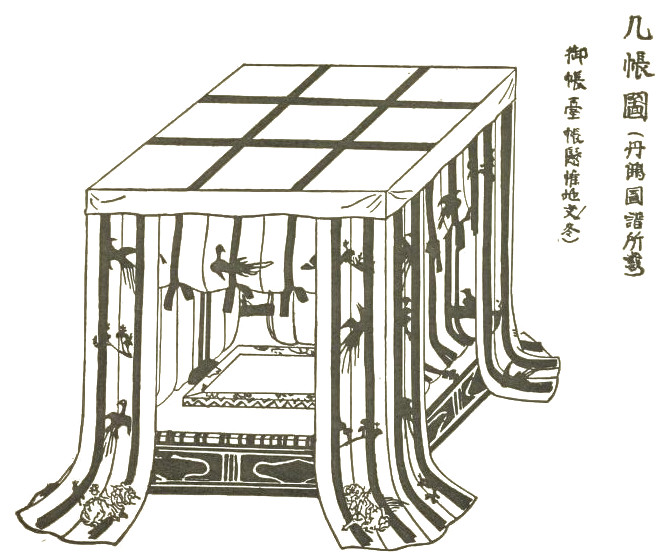
SCREENED DAIS PREPARED FOR ROYALTY From a print in an old book
The ceremony of giving mochi to the Prince is ended and the table is taken away. The misu of the anteroom was rolled up, and we saw ladies sitting crowded at the west side of the dais. There were Lady Tachibana of the third rank, and Naishi Nosuké, the younger attendant of the August Princes sitting in the doorway. In the east anteroom near the shioji[104] there were ladies of high rank. I went to seek Lady Dainagon and Lady Koshosho, who were sitting east of the dais. His August Majesty sat on the dais with his dining-table before him. The ornaments of it were exquisitely beautiful. On the south balcony there sat the Minister of the Right and Left and the Chamberlain, the first officials of the Crown Prince and of the Queen and the Great Adviser Shijo, facing towards the North, the West being the more honourable seat. There were no officials of low rank. Afterwards they begun to amuse themselves. Courtiers sat on the southeast corridor of the side building. The four lower officials took their usual places [on the steps below Royalty] to perform some music. They were Kagemasa, Korekazé, Yukiyoshi, Tonomasa. From the upper seat the Great Adviser Shijo conducted the music. To no Ben played the lute, Tsunetaka played the harp [koto]. The Lieutenant-General of the Left Bodyguard and State Councillor played the flute. Some outsiders joined in the music. One made a mistake in the notes and was hissed. The Minister of the Right praised the six-stringed koto. He became too merry, and made a great mistake, which sent a chill even to the onlookers.
The Prime Minister's gift was flutes put into two boxes.
III
THE DIARY OF IZUMI SHIKIBU
A.D. 1002-1003
Many months had passed in lamenting the World,[1] more shadowy than a dream. Already the tenth day of the Deutzia month was over. A deeper shade lay under the trees and the grass on the embankment was greener.[2] These changes, unnoticed by any, seemed beautiful to her, and while musing upon them a man stepped lightly along behind the hedge. She was idly curious, but when he came towards her she recognized the page of the late prince.[3] He came at a sorrowful moment, so she said, "Is your coming not long delayed? To talk over the past was inclined." "Would it not have been presuming?—Forgive me—In mountain temples have been worshipping. To be without ties is sad, so wishing to take service again I went to Prince Sochino-miya."
"Excellent! that Prince is very elegant and is known to me. He cannot be as of yore?" [i.e. unmarried.] So she said, and he replied, "No, but he is very gracious. He asked me whether I ever visit you nowadays—'Yes, I do,' said I; then, breaking off this branch of tachibana[4] flowers, His Highness replied, 'Give this to her, [see] how she will take it.' The Prince had in mind the old poem:
The scent of tachibana flowers in May Recalls the perfumed sleeves of him who is no longer here.
So I have come—what shall I say to him?"
It was embarrassing to return an oral message through the page, and the Prince had not written; discontented, yet wishing to make some response, she wrote a poem and gave it to the page:
That scent, indeed, brings memories But rather, to be reminded of that other, Would hear the cuckoo's[5] voice.
The Prince was on the veranda of his palace, and as the page approached him with important face, he led him into an inner room saying, "What is it?" The page presented the poem.
The Prince read it and wrote this answer:
The cuckoo sings on the same branch With voice unchanged, That shall you know.
His Highness gave this to the page and walked away, saying, "Tell it to no one, I might be thought amorous." The page brought the poem to the lady. Lovely it was, but it seemed wiser not to write too often [so did not answer].
On the day following his first letter this poem was sent:
To you I betrayed my heart— Alas! Confessing Brings deeper grief, Lamenting days.
Feeling was rootless, but being unlearned in loneliness, and attracted, she wrote an answer:
If you lament to-day At this moment your heart May feel for mine— For in sorrow Months and days have worn away.
He wrote often and she answered—sometimes—and felt her loneliness a little assuaged. Again she received a letter. After expressing feelings of great delicacy:
[I would] solace [you] with consoling words If spoken in vain No longer could be exchanged.
To talk with you about the departed one; how would it be [for you] to come in the evening unobtrusively?
Her answer:
As I hear of comfort I wish to talk with you, but being an uprooted person there is no hope of my standing upright. I am footless [meaning, I cannot go to you].
Thus she wrote, and His Highness decided to come as a private person.
It was still daylight, and he secretly called his servant Ukon-no-zo, who had usually been the medium by which the letters had reached the Prince, and said,
"I am going somewhere," The man understood and made preparations.
His Highness came in an humble palanquin and made his page announce him. It was embarrassing. She did not know what to do; she could not pretend to be absent after having written him an answer that very day. It seemed too heartless to make him go back at once without entering. Thinking, "I will only talk to him," she placed a cushion by the west door on the veranda, and invited the Prince there. Was it because he was so much admired by the world that he seemed to her unusually fascinating? But this only increased her caution. While they were talking the moon shone out and it became uncomfortably bright.
He: "As I have been out of society and living in the shade, I am not used to such a bright place as this "—It was too embarrassing!—"Let me come in where you are sitting; I will not be rude as others are. You are not one to receive me often, are you?" "No indeed! What a strange idea! Only to-night we shall talk together I think; never again!" Thus lightly talking, the night advanced—"Shall we spend the night in this way?" he asked:
The night passes, We dream no faintest dream— What shall remain to me of this summer night?
She:
Thinking of the world Sleeves wet with tears are my bed-fellows. Calmly to dream sweet dreams— There is no night for that.
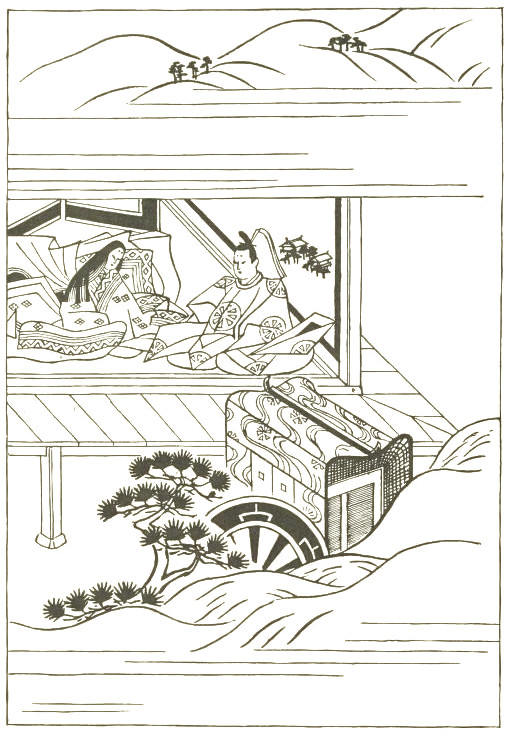
"HIS HIGHNESS CAME IN A HUMBLE PALANQUIN"
He: "I am not a person who can leave my house easily. You may think me rude, but my feeling for you grows ardent." And he crept into the room. Felt horribly embarrassed, but conversed together and at daybreak he returned.
Next day's letter:
In what way are you thinking about me? I feel anxiety—
To you it may be a commonplace to speak of love, But my feeling this morning— To nothing can it be compared!
She answered:
Whether commonplace or not— Thoughts do not dwell upon it For the first time [I] am caught in the toils.
O what a person! What has she done! So tenderly the late Prince spoke to her! She felt regret and her mind was not tranquil. Just then the page came. Awaited a letter, but there was none. It disappointed her; how much in love! When the page returned, a letter was given.
The letter:
Were my heart permitted even to feel the pain of waiting! It may be to wait is lesser pain— To-night—not even to wait for—
The Prince read it, and felt deep pity, yet there must be reserve [in going out at night]. His affection for his Princess is unusually light, but he may be thinking it would seem odd to leave home every night. Perhaps he will reserve himself until the mourning for the late Prince is over;[6] it is a sign that his love is not deep. An answer came after nightfall.
Had she said she was waiting for me with all her heart, Without rest towards the house of my beloved Should I have been impelled!
When I think how lightly you may regard me!
Her answer:
Why should I think lightly of you?
I am a drop of dew Hanging from a leaf Yet I am not unrestful For on this branch I seem to have existed From before the birth of the world.
Please think of me as like the unstable dew which cannot even remain unless the leaf supports it.
His Highness received this letter. He wanted to come, but days passed without realizing his wish. On the moon-hidden day [last day of month] she wrote:
If to-day passes Your muffled voice of April, O cuckoo When can I hear?
She sent this poem, but as the Prince had many callers it could only reach him the next morning.
His answer:
The cuckoo's song in spring is full of pain. Listen and you will hear his song of summer Full-throated from to-day.[7]
And so he came at last, avoiding public attention. The lady was preparing herself for temple-going, and in the act of religious purification. Thinking that the rare visits of the Prince betrayed his indifference, and supposing that he had come only to show that he was not without sympathy, she continued the night absorbed in religious services, talking little with him.
In the morning the Prince said: "I have passed an extraordinary night"—
New is such feeling for me We have been near, Yet the night passed and our souls have not met.
And he added, "I am wretched."
She could feel his distress and was sorry for him; and said:
With endless sorrow my heart is weighted And night after night is passed Even without meeting of the eyelids.
For me this is not new.
May 2. The Prince wrote to her: "Are you going to the temple to-day? When shall you be at home again:
Answer:
In its season the time of gently falling rain will be over. To-night I will drag from its bed the root of ayame.[8]
Went to the temple and came back after two or three days to find a letter [from him]:
My heart yearns for thee, and I wish to see thee, yet I am discouraged by the treatment of the other night. I am sad and ashamed. Do not suppose that I remain at home because my feeling is shallow.
She is cold-hearted, yet I cannot forget her. Time wipes out bitterness, but deepens longings Which to-day have overcome me.
Not slight is my feeling, although—
Her reply:
Are you coming? Scarcely believable are your words, For not even a shadow Passes before my unfrequented dwelling.
The Prince came as usual unannounced. The lady did not believe that he would come at all, and being tired out with the religious observances of several days, fell asleep. No one noticed the gentle knocking at the gate. He, on the other hand, had heard some rumours, and suspecting the presence of another lover, quietly retired. A letter came on the morning of the next day:
I stood before your closed door Never to be opened. Seeing, it became the symbol of your pitiless heart!
I tasted the bitterness of love, and pitied myself.
Then she knew that he had come the night before—carelessly fallen asleep!—and wrote back:
How can you write the thought? The door of precious wood was closely shut, No way to read that heart.
All is thy suspicion—O that I could lay bare my heart [to you]!
The next night he wanted to come again, yet he was advised against it. He feared the criticism of the Chamberlain and Crown Prince, so his visits became more and more infrequent. In the continuous rains the lady gazed at the clouds and thought how the court would be talking about them. She had had many friends; now there was only the Prince. Though people invented various tales about her, she thought the truth could never be known to any. The Prince wrote a letter about the tedious rain:
You are thinking only of the long rains Forever falling everywhere. Into my heart also the rain falls— Long melancholy days.
It was smile-giving to see that he seized upon every occasion to write her a poem, and she also felt as he did that this was a time for sentiment.
The reply:
Unaware of the sadness in your heart, Knowing only of the rain in mine.
And on another paper she wrote another poem:
It passes, the very sorrowful life of the world— By to-day's long { rains { meditation it can be known The { high-water mark { flood will be exceeded.
Is it still long? [before you come].
The Prince read this letter and the messenger came back with his answer:
Helpless man, I am weary even of life. Not to you alone beneath the sky Is rain and dulness.
For us both it is a stupid world.
It was the sixth day of the Fifth month—rain not yet stopped. The Prince had been much more touched by her answer of the day before, which was deeper in feeling, and on that morning of heavy rain he sent with much kindness to inquire after her.
Very terrible was the sound of rain ... Of what was I thinking All the long night through Listening to the rain against the window?
I was sheltered, but the storm was in my heart.
The lady wrote thus to the Prince, and he thought, "Not hopeless."
His poem:
All the night through, it was of you I thought— How is it in a house where is no other To make rain forgotten?
At noon people were talking about the flooding of the Kamo River, and many went to see it, the Prince among them. He wrote:
How are you at present? I have just come back from flood-seeing.
The feeling of my heart, like the overflowing waters of the flood, But deeper my heart's feeling.
Do you know this?
She wrote:
Toward me the waters do not overflow. No depth lies there Though the meadow is flooded.
Words are not enough.
In these words she replied to him; and his Highness made up his mind to come, and ordered perfumery for himself. Just then his old nurse, Jiju-no-Menoto, came up: "Where are you going?" she said,
"People are talking about it. She is no lady of high birth. If you wish her to serve you, you may summon her here as a servant. Your undignified goings-out are very painful for us. Many men go to her, and some awkward thing may happen. All these improper things are suggested by Ukon-no-Zo.[9] He accompanied the late Prince also. If you wander out in the depths of night no good can come of it. I will tell the Prime Minister[10] of the persons who accompany you in these night visits. In the world there may be changes. No one can tell what will happen to-morrow. The late Minister loved you much and asked the present one to show you favour. You must keep yourself from these indiscretions till worldly affairs are quite settled."
The Prince said: "Where shall I go? I am so bored, and am seeking temporary recreation. People are foolish to make much of it."
He said this, although much hurt by the necessity for it. Besides that, he thought her not unworthy of him and even wished to bring her to the palace [as a concubine]. On the other hand, he reflected that in that case things even more painful to hear would be said, and in his trouble of mind days were passed.
At last he visited her. "I could not come in spite of my desires. Please do not think that I neglect you. The fault is in you; I have heard that there are many friends of yours who are jealous of me. That makes me more reserved, and so many days have gone by."
The Prince talked gently, and said: "Now come for this night only. There is a hidden place no one sees; there I can talk with tranquil mind." The palanquin was brought near the veranda. She was forced to enter it and went, without her own volition, with unsteady mind. She kept thinking that people would know about it, but as the night was far advanced no one found them out. The conveyance was quietly brought to a corridor where no one was and he got out.
He whispered, "As the moon is very bright, get down quickly." She was afraid, but hurriedly obeyed him. "Here there is no one to see us; from this time we will meet here. At your honourable dwelling I am always anxious about other men. I can never be at ease there." His words were gentle, and when it was dawn he made her get into the palanquin and said, "I wish to go with you, but as it is broad daylight I fear people may think I have passed the night outside the Court."
He remained in the palace, and she on her way home thought of that strange going out and of the rumours that would fly about—yet the uncommonly beautiful features of the Prince at dawn were lingering in her mind.
Her letter:
Rather would I urge your early return at evening Than ever again make you arise at dawn It is so sorrowful.
His reply:
To see you departing in the morning dew— Comparing, It were better to come back in the evening unsatisfied.
Let us drive away such thoughts. I cannot go out this evening on account of the evil spirit [i.e., he might encounter it]. Only to fetch you I venture.
She felt distress because this [sort of thing] could not go on always. But he came with the same palanquin and said, "Hurry, hurry!" She felt ashamed because of her maids, yet stole out into the carriage. At the same place as last night voices were heard, so they went to another building. At dawn he complained of the cock's crowing, and leading her gently into the palanquin, went out [with her]. On the way he said, "At such times as these, always come with me," and she—"How can it always be so?" Then he returned.
Two or three days went by; the moon was wonderfully bright; she went to the veranda to see it and there received a letter:
What are you doing at this moment? Are you gazing at the moon?
Are you thinking with me Of the moon at the mountain's edge? In memory lamenting the short sweet night— Hearing the cock, awake too soon!
More than usually pleasing was that letter, for her thoughts were then dwelling on the bright moon-night when she was unafraid of men's eyes at the Prince's palace.
The answer:
That night The same moon shone down— Thinking so I gaze, But unsatisfied is my heart, And my eyes are not contented With moon-seeing.
She mused alone until the day dawned. The next night the Prince came again, but she knew not of it. A lady was living in the opposite house. The Prince's attendant saw a palanquin stopping before it and said to His Highness, "Some one has already come—there is a palanquin." "Let us retire," said the Prince, and he went away. Now he could believe the rumours. He was angry with her, yet being unable to make an end of it he wrote: "Have you heard that I went to you last night? It makes me unhappy that you don't know even that.
Against the hill of pines where the maiden pines for me, Waves were high—that I had seen. Yet to-day's sight, O ominous!"[11]
She received the letter on a rainy day, O unlooked-for disaster! She suspected slanderous tongues.
You only are my always-waited-for island— What waves can sweep it away!
So she answered, but the Prince being somewhat troubled by the sight of the previous night, did not write to her for a long time.
Yet at last:
Love and misery in various shapes Pass through my mind and never rest.
She wished to answer, but was ashamed to explain herself, so only wrote:
Let it be as you will, come or not, yet to part without bitter feeling would lighten my sorrow.
From that time he seldom sent letters. One moon-bright night she was lying with grieving thoughts. She envied the moon in its serene course and could not refrain from writing to the Prince:
In her deserted house She gazes at the moon— He is not coming And she cannot reveal her heart— There is none who will listen.
She sent her page to give the poem to Ukon-no-Zo. Just then the Prince was talking with others before the King. When he retired from the presence, Ukon-no-Zo offered the letter. "Prepare the palanquin," he said, and he came to her. The lady was sitting near the veranda looking at the sky, and feeling that some one was coming had had the sudaré rolled down. He was not in his court robe, but in his soft, everyday wear, which was more pleasing to her eye. He silently placed his poem before her on the end of his fan, saying, "As your messenger returned too soon without awaiting my answer—" She drew it towards her with her own.
The Prince seemed to think of coming in, but went out into the garden, singing, "My beloved is like a dew-drop on a leaf." At last he came nearer, and said: "I must go to-night. I came secretly, but on such a bright night as this none can escape being seen. To-morrow I must remain within for religious duties, and people will be suspicious if I am not at home." He seemed about to depart, when she—"Oh, that a shower might come! So another brightness, more sweet than the heavenly one, might linger here for a while!" He felt that she was more amiable than others had admitted. "Ah, dear one," he said, and came up for a while, then went away, saying:
Unwillingly urged by the moon on her cloudy track His body is going out, but not his heart
When he was gone she had the sudaré rolled up and read his poem in the moonlight.
She is looking at the moon, But her thoughts are all of me Hearing this It draws me to her side.
How happy! He seemed to have been thinking her a worthless woman, but he has changed his mind, she thought. The Prince, on his side, thought the lady would have some value for him when he wanted to be amused, but even while he was thinking it, he was told that the Major-General was her favourite and visited her in the daytime. Still others said, "Hyobukyo is another of her lovers." The Prince was deterred by these words and wrote no more.
One day His Highness's little page, who was the lover of one of her maids, came to the house. While they were chattering the page was asked if he had brought a letter, he answered: "No; one day my Lord came here, but he found a palanquin at the gate. From that time he does not write letters. Moreover, he has heard that others visit here." When the boy was gone this was told. She was deeply humiliated. No presumptuous thoughts nor desire for material dependence had been hers. Only while she was loved and respected had she wished for intercourse. Estrangement of any other kind would have been bearable, but her heart was torn asunder to think that he should suspect her of so shameful a thing. In the midst of mourning over her unfortunate situation, a letter was brought her:
I am ill and much troubled these days. Of late I visited your dwelling, but alas! at an unlucky time. I feel that I am unmanly.
Let it be— I will not look toward the beach— The seaman's little boat has rowed away.
Her answer:
You have heard unmentionable things about me. I am humiliated and it is painful for me to write any more. Perhaps this will be the last letter.
Off the shore of { aimlessness { Sodé With burning heart and dripping sleeves, I am he who drifts in the seaman's boat.
It was already the Seventh month. On the seventh day she received many letters from elegant persons in deference to the celestial lovers,[12] but her heart was not touched by them. She was only thinking that she was utterly forgotten by the Prince, who had never lost such an opportunity to write to her; but [at last] there came a poem:
Alas! that I should become like the Herder-God Who can only gaze at the Weaving One Beyond the River of Heaven.
The lady saw that he could not forget her and she was pleased.
Her poem:
I cannot even look towards that shore Where the Herder-God waits: The lover stars also might avoid me.
His Highness would read, and he would feel that he must not desert her. Towards the moon-hidden day [end of the month] he wrote to her:
I am very lonely. Please write to me sometimes as to one of your friends.
Her reply:
Because you do not wake you cannot hear— The wind is sighing in the reeds— Ah, nights and nights of Autumn!
The messenger who took the poem came back with one from him:
O my beloved, how can you think my sleep untroubled? Lately sad thoughts have been mine and never sleep is sound.
The wind blows over the reeds— I will not sleep, but listen Whether its sigh thrills my heart.
After two or three days, towards evening, he came unexpectedly and made his palanquin draw into the courtyard. As she had not yet seen him in the daylight, he was abashed, he said, but there was no help for it. He went away soon and did not write for so long that anxiety began to fill her heart, so at last she sent:
Wearily the Autumn days drag by— From him no message— Boding silence!
Sweet are man's promises, but how different is the heart!
Then he wrote that, though he never forgot her, of late he could not leave the palace.
Though days pass And others may forget I can never lose the thought That meeting in the evening Of an Autumn day.
The lady was pitiable, having no one to depend on, and tried to sustain herself with the uncertain consolations of a life of sentiment. Reflection increased her wretchedness, and when the eighth month came she went to Ishiyama Temple[13] to revive her doleful spirit intending to remain there for seven days.
One day the Prince said to his page: "It is a long time since I wrote; here is a letter for her." The page replied: "I went to her house the other day and heard that she had lately gone to Ishiyama Temple." "Then—it is already late in the day—to-morrow morning you shall go there." He wrote a letter and the page went to Ishiyama with it.
Her mind was not in the presence of Buddha, but at home in the Royal City. She was thinking that were she loved by him as at the beginning there would have been no wandering like that. She was very sad, yet sadness made her pray to the Buddha with all her heart.
Perceiving that some one approached, she looked down, wondering who it might be. It was the Prince's page! As she had just been thinking of the Prince, she hurriedly sent her maid to question him. The letter was brought and opened with more agitation than usual. It was as follows:
You seem to be steeped in Buddha's teaching. It would have given me pleasure to have been informed of it. Surely I am not loved so deeply that I am a hindrance to your devotion to Buddha. Only to think of your calm makes me jealous.
The poem:
Do you feel that my soul wanders after you, Passing across the Barrier? O ceaseless longing!
When shall you return?
When she was in his neighbourhood he wrote but seldom—gratifying that he should send a letter so far!
The answer:
The way of { meeting { Omi [14]
She was thinking that he had quite forgotten— Who can it be that is coming across the barrier?
You ask when I shall go back—it is as yet uncertain.
On the Mount { Nagara { while being My yearning is towards the { Biwa lake { open water { Uchi de no Hama { The beach of going out Does not lie towards { Miyako { the royal city.
The Prince read her poems and said to the page: "I am sorry to trouble you, but please go once more."
His poem:
I sought for you in the { Osaka Yama { mount of meeting But though never forgetting you My way was lost in the trackless valley.
His second poem:
Being overwhelmed with sorrow I wished to remain in retirement But { Omi no umi { the lake of meeting Is beyond { Uchi de no Hama { the beach of going out.
She wrote back only poems:
Tears which could not be restrained at the barrier Flow towards the { Omi no umi— { lake of meeting
And on the margin she wrote:
Let me try you— My own heart also, Come and tempt me towards the royal city.
His Highness had never thought of going so far [to seek her], but he thought he must go to her as he had received such a letter. He came and they went back together.
His poem:
Infelicitous love! Although entered into the Way of Eternal Law.[15] Who was it came And tempted back to the Royal City?
The answer:
Out of the mountain to the darker path I wander, Because I met you once more.
Towards the moon-hidden day a devastating wind blew hard. It rained and she was even sadder than usual, when a letter was brought. She thought the Prince had not lost a fit occasion to inquire for her, and she could harbour no hard thoughts of him.
His poem:
In sorrow I gaze upon the sky of Autumn The clouds are in turmoil And the wind is high.
Her answer:
A gentle wind of Autumn makes me sad O day of storm— No way to speak of it!
The Prince thought in this he could read her true feeling, but days passed before his visit.
It was after the tenth day of the Ninth month. He waked and saw the morning moon.[16] It seemed a long time since he had seen her. He felt that she was gazing at this moon, so followed by his page, he knocked at her gate. The lady was lying awake and meditating, lost in a melancholy which may have been due to the season. She wondered at the knock, but knew not who the visitor might be. She waked the maid lying beside her, who was in a sound sleep; the latter called out for the manservant. When he went out, waking with difficulty, the knocking had ceased and the visitor had gone. The guest must have thought her a dull sleeper and been disheartened. Who was it likely to be? Surely one of like mind with herself! Her man, who had gone out after much rousing, and seen no one, complained that it was only her fancy. "Even at night our mistress is restless—Oh, these unpeaceful persons!" Thus he grumbled away, but went to sleep again at once.
The lady got up and saw the misty sky. When morning came she jotted down her thoughts aimlessly, and while doing it received a letter:
In the Autumn night The pale morning moon was setting When I turned away from the shut door.
He must have thought her a disappointing woman. Yet she was happy to think that he never failed to associate her with every changing season and came to her door when he was attracted by the lovely sight of the sky, so she folded the notes she had just written and sent them to His Highness.
The notes:
Sound of wind; wind blows hard as if it were determined to blow away the last leaves on the branch. It grows cloudy and threatening, rain patters slightly. I am hopelessly desolate.
Before the Autumn ends My sleeves will be all rotted with tears, The slow rains cannot do more to them.
I am sad, but no one remarks it; the leaves of trees and plants change day by day and so affection in him. In anticipation I feel the dreariness of the long winter rains; the leaves are pitifully teased by the winds; the drops on the leaves which may vanish at any moment—how like they are to my own life!
The sight of the leaves ever reminds me strangely of my own sadness. I cannot go within, but lie on the veranda; mayhap my end is not far off. I feel a vague anger that others are in comfortable sleep and cannot sympathize with me. Just now I heard the faint cry of a wild goose.[17] Others will not be touched by it, but I cannot endure the sound.
How many nights, alas!— Sleepless— Only the calls of the wild geese—
Let me not pass the time in this way. I will open the shutter and watch the moon declining towards the western horizon. It seems distant and serenely transparent. There is mist over the earth; together comes the sound of the morning bell and the crowing of cocks. There will be no moment like this in past or future. I feel that the colour of my sleeves is new to me.
Another with same thoughts May be gazing at the pale morning moon Of the Long-night month— No sight is more sorrowful.
Now there comes a knocking at the gate. What does it mean? Who passes the night with thoughts like mine?
There is one of like mind with me Musing upon the morning moon. But no way to find him out!
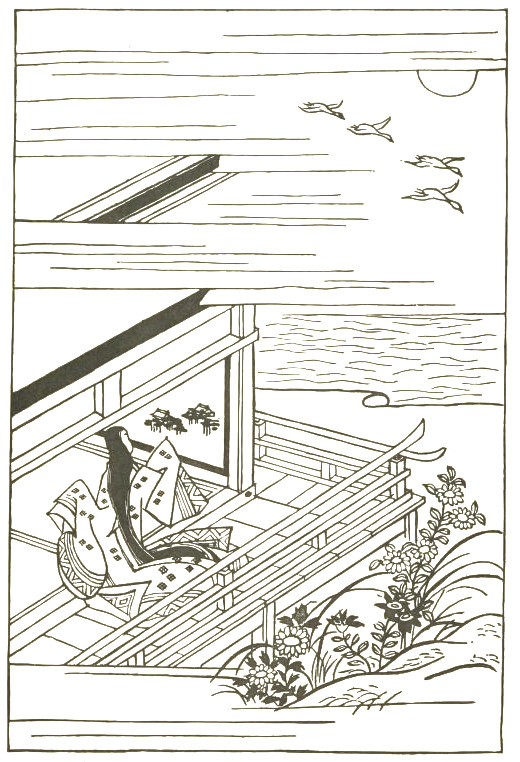
"THE LADY GOT UP AND SAW THE MISTY SKY"
She had meant to send the last poem only to the Prince, but when she learned that it was His Highness himself who had come she sent all.
The Prince read and did not feel that his visit had been in vain, if she also had been awake and sadly dreaming. He wrote promptly and the letter was presented while she was gazing aimlessly. She opened it anxiously and read:
First poem:
She thinks her own sleeves only are wet But another's also are rotting.
Second poem:
Dew-life soon to vanish away, Hangs long suspended in forgetfulness of self On the long-blooming chrysanthemum flower.
Third poem:
Sleepless the call of wild geese on the cloud-track Yet the pain is from your own heart.
Fourth poem:
There may be another with thoughts like mine, Who is gazing toward the sky of the morning moon.
Fifth poem:
Although not together You too were gazing at the moon Believing that I went this morning to your gate, Alas!
O that gate hard to be opened!
So her writing had not been uselessly sent!
Towards the moon-hidden day she had another letter. After excusing himself for his late neglect he wrote:
I have an awkward thing to ask you. There is a lady with whom I have been secretly intimate. She is going away to a distant province and I want to send her a poem which will touch her heart deeply. Everything you write touches me, so please compose a poem for me.
She was unwilling conceitedly to carry out his wishes, but she thought it too prudish to refuse him, so she wrote with the words: "How can I satisfy you?"
Her poem:
In the tears of regret Your image will linger long Even after chilly Autumn has gone by.
It is painful for me to write a heartfelt letter in your place.
And on the margin she wrote:
Leaving you, where can she go? For me no other life.
The Prince wrote back:
Very good poem is all that I can say. I cannot say that you have expressed my heart. Forsaking me she wanders away.
So let it be. Let me think of you, the unexcelled one. There is not another.
Thus I can live on.
It was the Tenth month and more than ten days had passed before the Prince came to her.
"The inner room is too dark and makes me restless. Let me sit here near the veranda." He said many heart-touching and tender words. She could not help being pleased. The moon was hidden and rain came pattering down; the scene was in harmony with their feeling. Her heart was disturbed with mingled emotions. The Prince perceived her feeling and thought: "Why is she so much slandered by others? She is always here alone sorrowing thus." He pitied her and startled the lady a little whose head was bowed in distress on her hand by reciting a poem:
It is not dripping rain nor morning dew Yet here lying, strangely wet are the sleeves of the arm-pillow.
She was overwhelmed by feeling and could not speak, but he saw her tears glistening in the moonlight. He was touched and said: "Why do you not speak? Have my idle words displeased you?" She replied: "I do not know why, but I feel that my heart is anguished, though your words are in my ears. You will see," she went on lightly; "I shall never forget your poem on the sleeves of the arm-pillow."
Thus the pitiful sad night was passed, and the Prince saw that she had no other lover. He was sorry to go away from her in the early dawn, and immediately sent a message: "How are you to-day? Are the tears dry this morning?"
Her answer:
In the morning they were dry, For only in a dream Were the sleeves of the arm-pillow wet.
He read it and smiled at the word "arm-pillow" which she had said she should never forget.
His poem:
You say it was only in a dream That the sleeves were wet with tears: Yet I cannot dry them—the sleeves of the arm-pillow.
I have never experienced so sorrow-sweet an autumnal night. Was it the influence of the time?
After that he could not live without seeing her, and visited her oftener. As he saw her more intimately he saw that she was not a faithless woman. Her helpless situation touched his heart more and more, and he became deeply sympathetic with her. Once he said to her: "Even though you live on thus in solitude, I shall never forget you, but it would be better to come to my palace. All these slanderous rumours are due to your living alone. I for my part never met any men [here]; is it because I come from time to time? Yet others tell me very improper things about you which should not be heard; it made me unspeakably sad to turn away from your shut gate. Remembering that you are living in loneliness I sometimes have made a decision; yet being old-fashioned in my ways I hesitated to tell you of it because I anticipated the profound sadness with which you would hear these rumours; nevertheless, I cannot continue our relations in this way. I fear that the rumour might become true; then I should not be allowed to come, and you would become for me like the moon in the Heavenly way. If you really feel the loneliness you speak of, please come to me. There are many persons living there [in his palace], yet you will have no feeling of constraint. As I have been unhappy in my domestic relations, I do not linger in that desolate region [the house of his Princess]; but am always alone, performing religious services; I hope that my loneliness may be lessened by talking with you whose mind is in sympathy with mine."
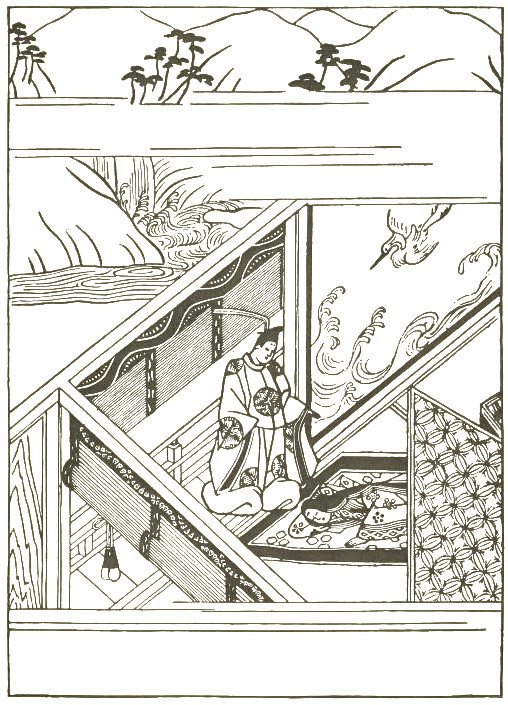
"STRANGELY WET ARE THE SLEEVES OF THE ARM-PILLOW"
Her feeling was opposed to such a thing; she had never told him about the late Prince. Yet there was no mountain retreat to which she could fly from World-troubles and her present condition seemed like a never-ending night. There had been many men who had wanted her; hence many strange reports were flying about. She could have confidence in no one but the Prince, so she was much tempted.
She thought: "He has his wife, yet she lives in a detached house, the nurse does all for him. If I show my affection and take pride in it, I shall be much blamed; my wish is that he should hide me from the world."
"Though to be visited by you is a rare occurrence, such a time soothes my heart; there is nothing else. So let anything happen, I will yield to your every wish. Elsewhere they are saying ugly things about us; if they see the fact accomplished, how much harder their words will be!"
"Those harsh words will be said about me, not you, at any rate. I will find you a completely retired house where we can talk tranquilly." He gave her much hope, and went away in the depths of night—the barred door [outer strong gate of lattice work] had been left open [for that purpose].
She thought within herself, being much troubled: "If I continue to live alone, I can keep myself respected. If I were forsaken by him in his palace, I should be laughed at."
After she retired this poem came:
I went along the path when night was opening. Sodden were they, The sleeves of the arm-pillow.
"That idle fancy of the sleeves he has not forgotten." This pleased her.
Her poem:
Your sleeves are wet with the dews on the grass of the morning path. The sleeves of my arm-pillow are wet, but not with dew.
The next night the moon was very bright. Here and there people were gazing at it. The next morning the Prince wanted to send her a poem and was waiting for the page [to take it]. The lady, too, had noticed the whiteness of the hoar-frost [and sent this poem]:
There was frost on the sleeves of the arm-pillow, And in the morning, Lo! A frost-white world!
The Prince was sorry the lady had got ahead of him. He said to himself: "The night was passed yearning after the beloved and frost—"
Just then the page presented himself and His Highness said, with some temper, handing his letter to the page: "Her messenger has already come; I am beaten. I wish you had come earlier." The page ran to her, and said: "I had been summoned before your messenger got there. I was late and he is angry." The lady read the letter:
The moon last night was very bright,
In a frosty morning I await With hope unwarranted One who cannot be expected.
His letter seemed not to have been suggested by hers, and she was pleased that His Highness had been in the same mood with herself.
Her poem:
I did not sleep, gazing at the moon all night But the dawning of the day Was in whiteness of hoar-frost.
You are angry with the page. He is very sorry, and it awakes my pity.
The morning sun shines on the frost So, like the sun, your face.
Two or three days passed without a word from him. Her heart was in his promise which gave her hope, but she could not sleep for anxiety. While lying awake in bed, she heard a knocking at the gate. It was just dawn. "What can it be?" she wondered, and sent a servant to inquire. It was the Prince's letter. It was an unusual hour for it and she wondered sorrowfully whether the Prince had been conscious of her emotion. She opened her shutter and read this letter in the moonlight:
Do you see that the little night opens[18] And on the ridge of the mountain, serenely bright, Shines the moon of a night of Autumn?
The bridge across the garden pond was clearly seen in the moonlight. The door was shut, and she thought of the messenger outside the gate and hastened her answer:.
The night opens and I cannot sleep, Yet I am dreaming dreams, And, loving them, the moon I do not see.
The Prince thought the answer not invented, and that it would be amusing to have her near him, to respond to his every fancy. After two days he came quietly in a palanquin for women. It was the first time she had shown herself to him in full[19] daylight, but it would be unfriendly to creep away and hide, so she went to welcome him, creeping a little nearer to the entrance. He excused himself for the absence of those days and said: "Make up your mind quickly as to the thing I spoke of the other day. I am always uneasy in these wanderings, yet more uneasy when I cannot see you. O troublesome are the ways of this absurd world!"
She replied: "I wish to yield to your mind, whatever it may be, yet my thoughts are troubled when I anticipate my fate and see myself neglected by you afterwards."
He said: "Try it, I can come very seldom." And he went away. On the hedge there was a beautiful mayumi[20] and the Prince, leaning against the balustrade:
Our words are like these leaves, Ever coloured deeper and deeper—
And she took it up [completing the 31-syllable poem he had begun]:
Although it is only the pearl dew that deepens them.
The Prince was pleased and thought her not without taste.
He seemed very elegant. He was attired as usual, his underdress exquisite. Her eye was much charmed, and she thought that she was too frivolous [to be thinking about it].
Next day he wrote:
Yesterday I was sorry that you were embarrassed, yet the more attracted by it.
She answered:
The Goddess of Mount Katuragi[21] would have felt so too— There is no bridge across the way of Kumé.
I did not know what to do.
The messenger came back with his poem:
Were my devotion to be rewarded How could I stop, Though bridge were none at Katuragi San.
After that he came oftener, and her tiresome days were lightened.
But her old friends also sent letters and visited her, too, so she wanted to go to the Prince's palace at once, lest some unlucky thing should occur; yet her heart was anxious and hesitating.
One day he sent word: "Maple trees of the mountain are very beautiful. Come! let us go together to see them." She answered, "I shall be glad to do it." But the appointed day came and his Highness wrote: "To-day I must confine myself for a religious service." But that night it stormed, and the leaves were all gone from the trees. She waked and wrote to the Prince how sorry she was that they could not have gone the previous day.
His answer:
In the Godless month[22] it stormed— To-day I dream and dream And wonder if the storm was within my heart.
She returned:
Was it a rainstorm? How my sleeves are wet! I cannot tell—but muse profoundly.
After the night storm there are no more maple leaves. O that we could have gone to the mountain yesterday!
His Highness returned:
O that we might have gone to see the maple leaves, for this morning it is useless to think of it.
And on the margin there was a poem:
Though I believe No maple leaves are hanging on the boughs, Yet we may go to see If scattering ones remain.
And she answered:
Were the mountains of evergreens to change into red leaves, Then we would go to see them With tranquil, tranquil hearts. My poem will make you laugh!
The night came and the Prince visited her. As her dwelling was in an unlucky direction,[23] he came to take her out of it.
"For these forty-five days I shall stop at my cousin's, the Lieutenant-General of the Third Rank, on account of the unlucky direction [of my own house]. It is rather embarrassing to take you to that unfamiliar place." Yet he dared to take her there. The palanquin was drawn into its shelter [small house built for it]; the Prince got out and walked away alone, and she felt very lonesome. When all were asleep he came to take her in and talked about various things. The guards, who were curious about it, were walking to and fro. Ukon-no-Zo and the page waited near the Prince. His feeling for her was so intense at this moment that all the past seemed dull. When day dawned he took her back to her own home, and hurriedly returned himself to get back before people woke up.
She could no longer disregard the earnest and condescending wish of His Highness, and she could no more treat him with indifference. She made up her mind to go to live with him. She received kind advice against it, but did not listen. As she had been unhappy, she wanted to yield herself to good fortune; yet when she thought of the court servitude she hesitated and said to herself: "It is not my inmost wish. I yearn for a retired religious life far away from worldly troubles. What shall I do when I am forsaken by the Prince? People will laugh at my credulity. Or shall I live on as I am? Then I can associate with my parents and brothers; moreover, I can look after my child,[24] who seems now like an encumbrance." Nevertheless, at last she wanted to go, and she did not write her heart to the Prince, for she thought he would know everything about her if they should live together. Her old friends sent letters, yet she did not answer them saying [to herself]: "There is nothing to write."