COURT LADIES OF OLD JAPAN (continued 4)
Annie Shepley Omori translation
A letter from the Prince—in it was written: "I was a fool to believe in you." His words were few. There was an old poem:
You are faithless, yet I will not complain. As the silent sea Deep is the hate in my heart.
Her heart was broken. There were many extraordinary rumours about her, yet there were days when she believed that no harm could come of a false rumour. Some one must have slandered her, suspecting that she was yielding to the earnest desires of the Prince and going to live at the palace.
She was sad, but could not write to him. She was ashamed to think of what the Prince might have heard. The Prince, seeing that she did not explain herself, wrote to her again:
Why do you not answer? Now I believe in the rumour. How swiftly your heart changes! I heard something I did not believe, and wrote to you that you might wipe away such unpleasant thoughts from my mind.
These words opened [i.e. lightened] her bosom a little. She wanted to know what he had heard and suddenly the wish to see him came to her.
O could you come to me this instant! I hunger to see thee, but cannot go because I am buried in slander.
The Prince wrote back:
You are too afraid of slanders and I read your mind in this caution. I am angry about it.
She thought he was teasing her, yet it saddened her, and she replied:
I cannot help it, please come in any case!
He returned:
I say to myself, "I will not suspect, I will not resent," but my heart does not follow my will.
Her answer:
Your enmity will never cease. I rely upon you, yet I suspect your faithfulness.
In the evening the Prince came. He said: "I wrote to you not believing the story. If you wish not to have such things said of you, come!"
She replied: "Then take me there!" But when it was dawn His Highness returned alone. He wrote to her continually, yet he seldom visited her. Once there was a great storm—the Prince did not inquire for her. She thought His Highness did not sympathize with her solitude, so wrote to him in the evening:
The season of the withering frost is sad, The autumnal wind rages And the sighing of the reed never stops.
The Prince's answer was:
The solitary reed which none but me remembers How it is sighing in the raging wind!
I am even ashamed to confess how much my mind is completely occupied with you.
She was pleased, indeed. The Prince sent his palanquin, saying that he was going to the hidden rendezvous to avoid the unlucky direction of his house. The lady went thither, thinking she would follow every wish of his. They talked tranquilly for many days and nights, and her unrest was chased away. She was now not unwilling to live with him, but when the time for avoiding the unlucky direction was over, she was sent back to her home. There she thought of him more longingly than ever, and sent a poem:
In this hour of longing Reflection brings to mind each day gone by And in each one Was less of sorrow.
He replied:
Sorrows of love were less each yesterday, But how can those vanished days be caught again?
There is no other way but to resolve to come to me.
She was still cautious and could not take things so easily. She passed many days in musing. By this time the coloured leaves [of Autumn] had all fallen. The sky was clear and bright. One evening as the sun was setting she felt very lonely and wrote to him:
You art always my consolation, Yet with the end of day sadness comes.
He replied:
All are sad when the day ends, Yet are you sadder than any— You who wait?
I can sympathize with you and I am coming.
The next morning the frost was very white; he sent to inquire for her, asking, "How are you feeling now?" She sent a poem:
Not in repose was the night passed; But the frosty morning Brought its own charm, Incomparable.
His answer contained many touching words, and a poem:
To think alone is [not life]. If you were thinking the same thoughts—
She answered:
You are you and I am I, Yet between your heart and mine is no separation. Make no such distinctions.
The lady caught cold. Though not serious she suffered. The Prince often inquired for her and at last she answered, saying:
A little better. The thread of life thinned down and it seemed to be going to break, but now it is dear to me because of you. Is it because I am deep in sin?
He wrote back:
Gladly do I hear it: The thread of your life Cannot easily be broken, For it is tied together, With pledges of long-enduring affection.
The end of the year was at hand. The first day of the Frost month seemed like a day of early spring, but the next morning it snowed. The Prince sent a poem:
Since the god-age it has snowed, It is a known thing, Yet that snow seems very fresh this morning!
She returned an answer:
First snow! I see it young every winter, Yet my face grows old As Winter comes.
Days were passed in exchanging these nothings. Again his letter:
I become impatient to see you, and just now wanted to go to you, but my friends have met here to compose poems together.
She wrote:
Had you no time to come? Then I would go to you. O that I knew { an even way of love. { the art of composing poems.
He was pleased.
Come to my house. Here is the even way and here's the way to see each other.
That night he visited her, and talked touchingly of many things. "Would you be sad," he said, "if I should desert my house and become a monk?" He spoke sadly, and she wondered why such a thought had entered his mind, and whether it could be true or not. Overcome with melancholy she wept. Outside was tranquil rain and snow: they slept not at all, but talked together with feeling throughout the night as if the world were all forgotten. She felt that his affection was deeper than she had suspected. He seemed to feel everything in her, and could sympathize with her every emotion. In that case she could accomplish her determination from the beginning [to go to become a nun]. So she made up her mind, but said nothing and sat lamenting. He saw her feeling and said:
Lovers' fancy of a moment held us both through the night,
And she continued:
Tears came to their eyes, And without was the rain.
In the morning he talked of merrier things than usual, and went back. Though she had no faith in it [i.e. the convent], yet she had been thinking of it to comfort her solitude. Now her mind was confused, trying to think how to realize it, and she told her perplexed feeling to the Prince:
On waking I cannot think. I wish that those were only dreams [of which we talked last night].
And on the margin she wrote:
We made our vows so earnestly, Yet must these vows yield To the common fate of the changing world.
I am sorry to think of it.
The Prince read it and made answer:
I wanted to write to you first—
I will not think it real, Those sad things were only dreams Dreamed in a night of dreams.
I wish that you would think so too. You dwell too much upon nothing.
Only life is fickle: We know not how it will end. But promises shall endure As long as the pine-tree at Suminoye.[25]
O my beloved, I spoke to you of what I did not heartily wish. You are too literal. I am sorry for that.
Yet the lady's thought lingered over that sad intention and she lamented much. Once she was making haste to set out when she received the Prince's letter:
Oh, I longed for it, though I had just seen it A yamato-nadeshiko[26] growing in the hedge of a mountain-dwelling.
It was painful to her present mind, yet she replied:
If you love, come and see, Even the thousand swift gods will not forbid Those who follow in the Way.
He smiled over the poem. As he was reading sutras those days he sent the following poem:
The way of meeting is not god-forbidden. But I am on the seat of the Law And cannot leave it.
Her answer:
Then will I go thither to seek you, Only do you enlarge the seat!
Once it snowed heavily and he sent her a poem affixed to a branch covered with snow:
Snow falls, and on all the branches Plum flowers are in bloom, Though it is not yet spring.
This was unexpected and she wrote back:
Thinking that plum flowers were in bloom I broke the branch, And snow scattered like the flowers.
The next morning early he sent a poem:
These winter nights lovers keep vigil. Lying on one's lonely bed Day dawns And the eyelids have not met.
Her answer:
Can it be true? On Winter nights eyes are shut in ice [frozen tears] And midnight hours are desolate. I wait for dawn, although no joy is in it.
What the Prince had been thinking of he wrote in heart-dwindling words, saying, "I think I cannot live out my life in this world," so she wrote back:
For me, it is fitting to speak of these things, For they recall The romance of past days.
His poem:
I would not exist even for a moment In a world where sorrows Follow one another like the joints In the bamboo stalk.
He had been troubling himself to find out a fit place to conceal her, but he reflected, "She is not used to such a life and would be embarrassed by it. For my part, I should be much rebuked. It is simpler to go myself and bring her as my maid."
So on the eighteenth of the Finishing month on a moon-bright night he visited her. He said in the ordinary way, "Now, please come," and she thought it for a night only. When she got into the palanquin alone, "Take an attendant with you. If you are willing we will talk together tranquilly to-morrow and the day after to-morrow."
He had not spoken in this way before, and she, guessing his intention, took her maid with her. She was not carried to the same house as before. The room was beautifully adorned, and he said, "Live here privately; you may have several attendants." Now she was sure she had understood him and she thought it fortunate to come thus secretly. People would be astonished to find she had come here to live before they were aware. When day dawned she sent her servant to fetch her case of combs and other things. The Prince left the room, but the shutters were still closed. It was not frightful, but uncomfortable.
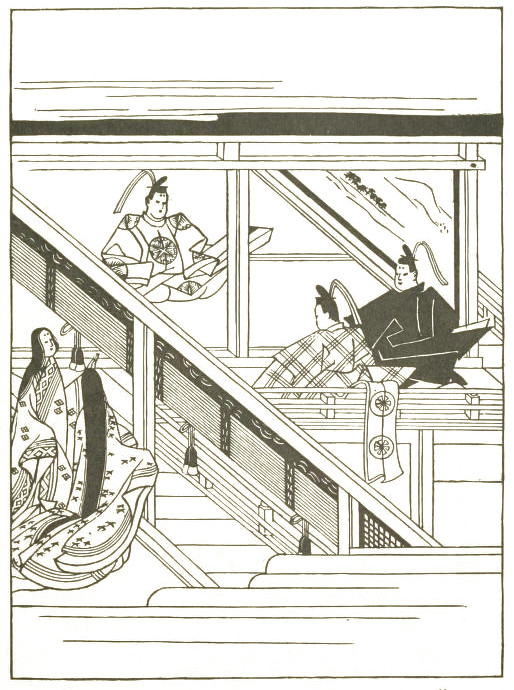
"IN THE DAYTIME COURTIERS CAME TO SEE HIM"
"I wish," said the Prince, "to arrange that you shall live in the North building. This room is near the Audience Room and has no charm in it" [i.e. some one might discover her]. So she shut herself up and listened in secret. In the daytime courtiers of the ex-Emperor [his father] came to see him. He said: "How is it with you here? Can you stay? I feared that you would find it disagreeable by my side"; and she answered, "I feared just the same thing." He laughed and said: "To tell the truth, take care of yourself while I am away; some impertinent fellows may come to catch a glimpse of you. In a few days I will have you live openly in the room where now is my housekeeper [nurse]. The room where I pass the day has no visitors."
After two or three days she was removed to the North side building.[27] People were astonished and ran and told the Princess, who said: "Even without this event, I have not been treated as I ought to have been. She is of no high birth; it is too much." She was angry because he had told her nothing. His secrecy displeased her very much, and she was more inconsolable than ever. The Prince felt sorry for her and tried to be with her oftener. She said to him: "I am ill with hearing rumours and have come to hate seeing people. Why have you not told me this before? I would not have interfered: I cannot bear to be treated like a woman of no importance. I am ashamed to think that people are laughing at me." She said it weeping and weeping. He answered: "I brought her for my maid, and I thought that you would allow it; as you are angry with me the Lieutenant-General [her brother] hates me also. I brought her to dress my hair and she shall serve you also." The Princess was not softened by these words, but she was silenced.
Thus days passed and the lady became used to the court life. She dressed his hair and served in everything. As he did not allow her to retire to her private room, the visits of the Princess became more and more rare. The Princess lamented it infinitely. The year turned back and on the first day of the Social month all the courtiers came to perform the ceremony of congratulation before the Emperor. The Prince was among them. He was younger and fairer than any, and even this made her ashamed of herself. From the Princess's house her ladies went out to see the procession, yet they did not care so much to see the courtiers as to look at her. They were in great disorder looking about; it was an ugly sight.
After dark when the ceremony was over, His Highness came back and all the court nobles came with him to amuse themselves. It was very gay and a contrast to the solitary life of her old home. One day the Prince heard that even the lowest servants were speaking evil of her. He thought it was due to the behaviour of his wife, and being displeased seldom went to the Royal dwelling. She was sorry for the Princess, yet she did not know what to do. She remained there, thinking that she would do as she was bid.
The Princess's elder sister was married to the Crown Prince and just then was living with her parents. She wrote to the younger Princess: "How are you? I have heard something of what people are saying these days. Is it true? Even I feel disgraced. Come to us during the night."
The Princess could not console herself when she thought how much people who make talk about nothing were gossiping. She wrote back to her sister: "I have received your letter. I had been unhappy in the world [married life] and now am in a painful situation. For a time I will go back, and beholding the young Princess will comfort me. Please send some one to summon me. I cannot go away when I desire, for he will not permit it." She began to put her affairs in order, taking away those things which must not be seen by others. She said: "I am going there for a while, for if I stay here my husband will feel uncomfortable to come to me. It is painful for both of us." And they said: "People are talking and laughing about it a good deal. He went out himself to get her. She is dazzling to the eye; she lives in the court ladies' room over there. She goes to the Prince's hall three or four times a day. It is quite right that you should punish him—going away with few words!"
All hated the lady, and he was sorry for her. His Highness suspected what his wife was going to do, and he found his conjecture realized when the sons of his brother-in-law came to fetch her. A lady-in-waiting said to the housekeeper: "The princess has taken important things with her; she is going away." The housekeeper was in great anxiety and said to the Prince: "The Princess is going away. What will the Crown Prince think of it! Go to comfort her."
It was painful to her [the lady] to see these things going on. She was very sorry and pained, yet, as it was an unfit time to say anything, she kept silence. She wanted to get away from this disagreeable place, but thought that also not good. She thought she could never get rid of her trouble if she stayed. His Highness went towards the Princess, who met him as if nothing had happened. "Is it true," he said, "that you are going to your elder sister? Why have you not asked me for the palanquin?" She answered: "Something has happened. There is something which demands me and they have sent messengers for me." She said nothing more. The Princess's words, her letters, and those of her sister were written roughly, from supposition.
THE END
APPENDIX
A
OLD JAPANESE CALENDAR
The year was divided according to a Lunar Calendar, which was one month or so in advance of the present Solar Calendar.
NAMES OF THE MONTHS
First month; Social month; Spring-birth month. Second month; Clothes-again-doubled month; Little-grass-growing month. Third month; Ever-growing month; Flowery month; Dreaming month. Fourth month; Deutzia month; First Summer month. Fifth month; Rice-sprout month; Tachibana month. Sixth month; Watery month (rice-fields filled with water). Seventh month; Rice-ear month; Literary month (people composed poems on the star festival). Eighth month; Rice-ear-swelling month; Mid-autumn. Ninth month; Chrysanthemum month; Long-night month. Tenth month; Gods-absent month; Thunderless month; Little Spring. Eleventh month; Frost month. Twelfth month; Last month; Spring-waiting month.
B
CHRONOLOGICAL TABLE OF EVENTS CONNECTED WITH THE DIARIES
974. Izumi Shikibu, the daughter of Masamune, Governor of the Province of Echizen, born. 977. Prince Tametaka (future lover of Izumi Shikibu) born. 978. Prince Atsumichi (future lover of Izumi Shikibu) born. Murasaki Shikibu, daughter of Fujiwara Tametoki, born. 980. Prince Yasuhito (afterwards the Mikado Ichijo) born. 988. Akiko, Michinaga's first daughter, born. 990. Sadako, daughter of Michinaga's eldest brother Michitaka, comes to the Court, and later becomes Queen to Mikado Ichijo. 991. Sei-Shōnagon comes to Court as one of Queen Sadako's ladies. 994. Prince Atsumichi comes of age and marries the third daughter of Michitaka. 995. Izumi Shikibu marries Tachibana Michisada. Prince Atsumichi divorces his first wife. 996. Prince Atsumichi marries again. 997. Murasaki Shikibu goes to Echizen with her father who has been made Governor of the Province. Akiko joins the Court. Izumi Shikibu's first daughter born. 998. Murasaki Shikibu returns to Kiōto. 999. Murasaki Shikibu marries Fujiwara Nobutaka. 1000. Akiko made second queen. Murasaki Shikibu's daughter born. 1001. Pestilence. Murasaki Shikibu's husband dies. Conflagration of the Palace. 1002. Murasaki Shikibu probably began the writing of the "Genji Monogatari." Sei-Shōnagon probably began the "Makura-no-Sōshi." In June, Prince Tametaka (Izumi Shikibu's lover; her husband, from whom she was divorced, had died earlier) dies. Izumi Shikibu begins a liaison with Prince Atsumichi. 1003. Izumi Shikibu goes to live at the South Palace. 1004. Izumi Shikibu leaves Prince Atsumichi's palace, and marries Fujiwara Yasumasa. 1005. Murasaki Shikibu joins the Court. Conflagration of the Palace. Izumi Shikibu goes to the Province of Tango, her husband having been appointed Governor. 1007. Akiko (second queen) gives birth to Prince Atsusada. Murasaki Shikibu begins to keep her diary. 1008. Izumi Shikibu returns to become lady-in-waiting at the Court. 1009. Fujiwara Takasué's daughter (author of Sarashina Diary) born. 1017. Fujiwara Takasué appointed Province Governor, goes to his province with his daughter. 1021. Takasué's daughter returns to Kiōto. Sarashina Diary begun.