COURT LADIES OF OLD JAPAN (continued 2)
Annie Shepley Omori translation
Days were spent in musing with a vacant mind. I felt as if some one were [always] spying upon me, and I was embarrassed.[54] After ten days or so I got leave to go out. Father and mother were waiting for me with a comfortable fire in a brazier.
Seeing me getting out of my palanquin, my nieces said: "When you were with us people came to see us, but now no one's voice is heard, no one's shadow falls before the house. We are very low-spirited; what can you do for us who must pass days like this?" It was pitiful to see them cry when they said it. The next morning they sat before me, saying: "As you are here many persons are coming and going. It seems livelier."
Tears came to my eyes to think what virtue [literally, fragrance] I could have that my little nieces made so much of me.
It would be very difficult even for a saint to dream of his prenatal life. Yet, when I was before the altar of the Kiyomidzu Temple, in a faintly dreamy state of mind which was neither sleeping nor waking, I saw a man who seemed to be the head of the temple. He came out and said to me:
"You were once a priest of this temple and you were born into a better state by virtue of the many Buddhist images which you carved as a Buddhist artist. The Buddha seventeen feet high which is enthroned in the eastern side of the temple was your work. When you were in the act of covering it with gold foil you died."
"Oh, undeservedly blessed!" I said. "I will finish it, then."
The priest replied: "As you died, another man covered it and performed the ceremony of offerings."
I came to myself and thought: "If I serve with all my heart the Buddha of the Kiyomidzu Temple ... by virtue of my prayers in this temple in the previous life...."[55]
In the Finishing month I went again to the Court. A room was assigned for my use.
I went to the Princess's apartment every night and lay down among unknown persons, so I could not sleep at all. I was bashful and timid and wept in secret. In the morning I retired while it was still dark and passed the days in longing for home where my old and weak parents, making much of me, relied upon me as if I were worthy of it. I yearned for them and felt very lonely. Unfortunate, deplorable, and helpless mind!—That was graven into my thought and although I had to perform my duty faithfully I could not always wait upon the Princess. She seemed not to guess what was in my heart, and attributing it only to shyness favored me by summoning me often from among the other ladies. She used to say, "Call the younger ladies!" and I was dragged out in spite of myself.
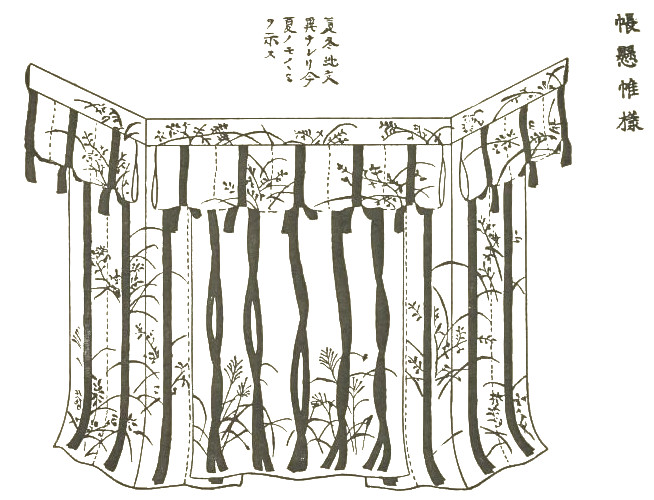
THREE KICHŌ PUT TOGETHER — The curtains of the screen, or kichō, varied with the seasons. This is a summer one with decorations of summer grasses and flowers
Those who were familiar with the court life seemed to be at home there, but I, who was not very young, yet did not wish to be counted among the elderly, was rather neglected, and made to usher guests. However, I did not expect too much of court life, and had no envy for those who were more graceful than I. This, on the contrary, set me at ease, and I from time to time presented myself before the Princess; and talked only with congenial friends about lovely things. Even on smile-presenting, interesting occasions I shrank from intruding and becoming too popular, and did not go far into most things.
Sleeping one night before the Princess, I was awakened by cries and fluttering noises from the waterfowl in the pond.
Like us the water jowl pass all the night in floating sleep, They seem to be weary With shaking away the frost from their feathers.
My companions passed their leisure time in talking over romances with the door open which separated our rooms, and they often called back one who had gone to the Princess's apartment. She sent word once, "I will go if I must" [intending to give herself the pleasure of coming].
The long leaves of the reed are easily bent, So I will not forcibly persuade it, But leave it to the wind.
In this way [composing poems] we passed [the hours] talking idly. Afterwards this lady separated from the Court and left us. She remembered that night and sent me word—
That moonless, flowerless winter night It penetrates my thought and makes me dwell on it— I wonder why?
It touched my heart, for I also was thinking of that night:
In my dreams the tears of that cold night are still frozen. But these I weep away secretly.
The Princess still called my stepmother by the name of Kazusa[56]—Governor's lady. Father was displeased that that name was still used after she had become another man's wife, and he made me write to her about it:
The name of Asakura in a far-off country, The Court now hears it in a divine dance-song:— My name also is still somewhere heard [but not honourably].[57]
One very bright night, after the full moon, I attended the Princess to the Imperial Palace. I remembered that the Heaven Illuminating Goddess was enthroned within, and wanted to take an opportunity to kneel before the altar. One moon-bright night [1042 A.D.] I went in [to the shrine] privately, for I know Lady Hakasé[58] who was taking care of this shrine. The perpetual lights before the altar burned dimly. She [the Lady Hakasé] grew wondrously old and holy; she seems not like a mortal, but like a divine incarnation, yet she spoke very gracefully.
The moon was very bright on the following night and the Princess's ladies passed the time in talking and moon-gazing, opening the doors [outer shutters] of the Fujitsubo.[59] The footsteps of the Royal consort of Umetsubo going up to the King's apartment were so exquisitely graceful as to excite envy. "Had the late Queen[60] been living, she could not walk so grandly," some one said. I composed a poem:
She is like the Moon, who, opening the gate of Heaven, goes up over the clouds. We, being in the same heavenly Palace, pass the night in remembering the footfalls of the past.
The ladies who are charged with the duty of introducing the court nobles seem to have been fixed upon, and nobody notices whether simple-hearted country-women like me exist or not. On a very dark night in the beginning of the Gods-absent month, when sweet-voiced reciters were to read sutras throughout the night, another lady and I went out towards the entrance door of the Audience Room to listen to it, and after talking fell asleep, listening, leaning, ...[61] when I noticed a gentleman had come to be received in audience by the Princess.
"It is awkward to run away to our apartment [to escape him]. We will remain here. Let it be as it will." So said my companion and I sat beside her listening.
He spoke gently and quietly. There was nothing about him to be regretted. "Who is the other lady?" he asked of my friend. He said nothing rude or amorous like other men, but talked delicately of the sad, sweet things of the world, and many a phrase of his with a strange power enticed me into conversation. He wondered that there should have been in the Court one who was a stranger to him, and did not seem inclined to go away soon.
There was no starlight, and a gentle shower fell in the darkness; how lovely was its sound on the leaves! "The more deeply beautiful is the night," he said; "the full moonlight would be too dazzling." Discoursing about the beauties of Spring and Autumn he continued: "Although every hour has its charm, pretty is the spring haze; then the sky being tranquil and overcast, the face of the moon is not too bright; it seems to be floating on a distant river. At such a time the calm spring melody of the lute is exquisite.
"In Autumn, on the other hand, the moon is very bright; though there are mists trailing over the horizon we can see things as clearly as if they were at hand. The sound of wind, the voices of insects, all sweet things seem to melt together. When at such a time we listen to the autumnal music of the koto[62] we forget the Spring—we think that is best—
"But the winter sky frozen all over magnificently cold! The snow covering the earth and its light mingling with the moonshine! Then the notes of the hitchiriki[63] vibrate on the air and we forget Spring and Autumn." And he asked us, "Which captivates your fancy? On which stays your mind?"
My companion answered in favour of Autumn and I, not being willing to imitate her, said:
Pale green night and flowers all melting into one in the soft haze— Everywhere the moon, glimmering in the Spring night.
So I replied. And he, after repeating my poem to himself over and over, said: "Then you give up Autumn? After this, as long as I live, such a spring night shall be for me a memento of your personality." The person who favoured Autumn said, "Others seem to give their hearts to Spring, and I shall be alone gazing at the autumn moon,"
He was deeply interested, and being uncertain in thought said: "Even the poets of the Tang Empire[64] could not decide which to praise most, Spring or Autumn. Your decisions make me think that there must be some personal reasons when our inclination is touched or charmed. Our souls are imbued with the colours of the sky, moon, or flowers of that moment. I desire much to know how you came to know the charms of Spring and Autumn. The moon of a winter night is given as an instance of dreariness, and as it is very cold I had never seen it intentionally. When I went down to Isé to be present as the messenger of the King at the ceremony[65] of installing the virgin in charge of the shrine, I wanted to come back in the early dawn, so went to take leave of the Princess [whose installation had just taken place] in a moon-bright night after many days' snow, half shrinking to think of my journey.
"Her residence was an other-worldly place awful even to the imagination, but she called me into an adequate apartment. There were persons [in that room] who had come down in the reign of the Emperor Enyu.[66] Their aspect was very holy, ancient, and mystical. They told of the things of long ago with tears. They brought out a well-tuned four-stringed lute. The music did not seem to be anything happening in this world; I regretted that day should even dawn, and was touched so deeply that I had almost forgotten about returning to the Capital. Ever since then the snowy nights of winter recall that scene, and I without fail gaze at the moon even though hugging the fire. You will surely understand me, and hereafter every dark night with gentle rain will touch my heart; I feel this has not been inferior to the snowy night at the palace of the Isé virgin."
With these words he departed and I thought he could not have known who I was.
In the Eighth month of the next year [1043] we went again to the Imperial Palace, and there was in the Court an entertainment throughout the night. I did not know that he was present at it, and I passed that night in my own room. When I looked out [in early morning] opening the sliding doors on the corridor I saw the morning moon very faint and beautiful. I heard footsteps and people approached—some reciting sutras. One of them came to the entrance, and addressed me. I replied, and he, suddenly remembering, exclaimed, "That night of softly falling rain I do not forget, even for a moment! I yearn for it." As chance did not permit me many words I said:
What intensity of memory clings to your heart? That gentle shower fell on the leaves— Only for a moment [our hearts touched].
I had scarcely said so when people came up and I stole back without his answer.
That evening, after I had gone to my room, my companion came in to tell me that he had replied to my poem: "If there be such a tranquil night as that of the rain, I should like in some way to make you listen to my lute, playing all the songs I can remember."
I wanted to hear it, and waited for the fit occasion, but there was none, ever.
In the next year one tranquil evening I heard that he had come into the Princess's Palace, so I crept out of my chamber with my companion, but there were many people waiting within and without the Palace, and I turned back. He must have been of the same mind with me. He had come because it was so still a night, and he returned because it was noisy.
I yearn for a tranquil moment To be out upon the sea of harmony, In that enchanted boat. Oh, boatman, do you know my heart?
So I composed that poem—and there is nothing more to tell. His personality was very excellent and he was not an ordinary man, but time passed, and neither called to the other.
In Winter, though the snow had not come yet, the starlit sky was clear and cold. One whole night I talked with those who were in the Palace....[67]
Like a good-for-nothing woman I retired from the Court life.
On the twenty-fifth of the End month [Christmas Day, 1043] I was summoned by the Princess to the religious service of reciting Buddha's names. I went for that night only. About forty ladies were there all dressed in deep-red dresses and also in deep-red outer robe. I sat behind the person who led me in—the most shadow-like person among them—and I retired before dawn. On my way home it snowed in fluttering flakes, and the frozen, ghostly moon was reflected in my dull-red sleeves of glossy silk. Even that reflection seemed to be wet and sad. I thought all the way: "The year comes to a close and the night also—and the moon reflected in my sleeve—all passes. When one is in Court, one may become familiar with those who serve there, and know worldly things better, and if one is thought amiable one is received as a lady and favours may be bestowed"—such had been my thought, but father was now disappointed in me and kept me at home; but how could I expect that my fortunes should become dazzling in a moment? It was father's idle fancy, yet he felt that it had betrayed him.
Though a thousand times, how many! I gathered parsley[68] in the fields Yet my wishes were by no means fulfilled.
I grumbled so far, and no farther.
I regretted deeply the idle fancies of old days, and as my parents would not accompany me to temples [on pilgrimages] I could hardly suppress my impatience. I wish to strengthen my spirit to bring up my child who is still in the germ. Moreover, I wish to do my best to pile up virtuous deeds for the life to come, so encouraging my heart I went to the Ishiyama Temple after the twentieth day of the Frost month [1045]. It snowed and the route was lovely. On coming in sight of the barrier at Osaka Pass, I was reminded that it was also in Winter when I passed it on my way up to Kioto. Then also it was a windy tempestuous day.
The sound of the Autumn wind at the barrier of Osaka! It differs not from that heard long ago.
The temple at Seki, magnificent though it was, made me think of the old roughly hewn Buddha. The beach at Uchidé has not changed in the passing of months and years, but my own heart feels change.
Towards evening I arrived at the temple and after a bath went up to the main shrine. The mountain wind was dreadful. I took it for a good omen that, falling asleep in the temple [I heard a voice], saying: "From the inner shrine perfume has been bestowed. Tell it at once." At the words I awoke, and passed the night in prayer.
The next day the wind raged and it snowed heavily. I comforted my lonely heart with the friend of the Princess who came with me. We left after three days.
On the twenty-fifth of the Tenth month of the next year [1046] the Capital was in great excitement over the purification ceremonies before the Great Ceremony.[69]
For my part I wanted to set out that same day for Hasé [Temple] for my own religious purification. They stopped me, saying it was a sight to be seen only once in one reign; that even the country-people come to see the procession, and it was madness to leave the city that very day. "Your deeds will be spread abroad and people will gossip about you," said my brother angrily. "No, no, let the person have her own will"; and according to my wish he [her husband] let me start. His kindness touched me, but on the other hand I pitied those who accompanied me [her retinue], who with longing hearts wanted to see the ceremony.
But what have we to do with such shows? Buddha will be pleased with those who come at a time like this. I wanted without fail to receive the divine favour, and started before dawn. When I was crossing the great bridge of Nijo, with pine torches flaming before me, and with my attendants in pure white robes, all the men on; horseback, in carriage, or on foot who encountered me on their way to the stands prepared for sight-seers said, in surprise, "What is that?" and some even laughed or scolded me. As I was passing before the gate of Yoshinori the Commander of the Bodyguard and his men were standing there before the wide-open portals. They said, laughing, "Here goes a company to the temple—there are many days and months in the world [to do that in]!" But there was one [standing by] who said: "What is it to fatten the eyes for a moment? They are firmly determined. They will surely receive Buddha's favour; we ought also to make up our minds [for the good] without sight-seeing." Thus one man spoke seriously.
I had wanted to leave the city before broad daylight, and had started in the middle of the night, but had to wait for belated persons till the very thick fog became thinner. People flowed in from the country like a river. Nobody could turn aside to make room for anybody else, and even the ill-behaved and vulgar children, who passed beside my carriage with some difficulty, had words of wonder and contempt for us.
I felt sorry that I had started that day, yet praying to Buddha with all my heart, I arrived at the ferry of Uji. Even there the people were coming up to the city in throngs, and the ferry-man, seeing these numberless people, was filled with his own importance, and grew proud. He, tucking up his sleeves against his face and leaning on his pole, would not bring the boat at once. He looked around whistling and assumed an indifferent air. We could not cross the river for a long time, so I looked around the place, which I had felt a curiosity to see, ever since reading Genji-monogatari which tells that the daughter of the Princess of Uji lived here. I thought it a charming spot. At last we managed to get across the river and went to see the Uji mansion.[70] I was at once reminded that the Lady Ukifuné [of the romance] had been living here.
As we had started before daybreak, my people were tired out, and rested at Hiroichi to take food. The Guard said: "Is that the famous mountain Kurikoma? It is towards evening, be ready with your armour" [to protect from robbers or evil spirits], I listened to these words with a shudder, but we passed that mountain [without adventure] and the sun was on its summit when we arrived at the lake of Nieno. They went in several directions to seek a lodging and returned saying there was no proper place, only an obscure hut; but as there was no other place we took that.
In the house there were only two men, for the rest had all gone to the Capital. Those two men did not sleep that night at all, but kept watch around the house. My maids who were in the recess [perhaps the outer part of the hut used as kitchen] asked, "Why do you walk about so?" and the men answered, "Why? we have rented our house to perfect strangers. What should we do if our kettles were stolen? Of course we cannot sleep!" I felt both dread and laughter to hear them.
In the early morning we left there and knelt before the great East Temple.[71] The temple at Iso-no-Kami was antique and on the verge of ruin. That night we lodged at Yamabé Temple. Although I was tired out, I recited sutras and went to sleep. In my dream I saw a very noble and pure woman. At her coming the wind blew deliciously. She found me out, and said, smiling, "For what purpose have you come?" I answered, "How could I help coming?" [since you are here], and she said, "You would better be in the Imperial Court, and become intimate with the Lady Hakasé." I was very much delighted and encouraged.
We crossed the river and arrived at the Hatsusé Temple at night. After purifying, I went up to the Temple. I remained three days, and slept expecting to start in the morning. At midnight I dreamt that a cedar twig[72] was thrown into the room as a token bestowed by the Inari god. I was startled, but waking found it only a dream.
We began our return journey after midnight, and as we could not find a lodging, we again passed a night in a very small house, which seemed to be a very curious one somehow. "Do not sleep! Something unexpected will happen!" "Don't be frightened!" "Lie down even without breathing!" This was said and I spent the night in loneliness and dread. I felt that I lived a thousand years that night, and when the day dawned I saw that we were in a robbers' den. People said that the mistress of that house lived by a strange occupation.
We crossed the Uji River in a high wind and the ferry-boat passed very near the fishing seine.
Years have passed and only sounds of waters have come to my ears, To-day, indeed, I may even count the ripples around the fishing net.
[This poem may seem a little obscure. It means that her own life had been lived long in a kind of dreamland of her own creating, but was gradually emerging into reality.]
If, as I am doing now, I continue to write down events four or five years after they have happened, my life will seem to be that of a pilgrim, but it is not so. I am jotting down the happenings of several years. In the spring I went to Kurama Temple. It was a soft spring day, with mist trailing over the mountain-side. The mountain people brought tokoro [a kind of root] as the only food and I found it good. When I left there flowers were already gone.
In Gods-absent month I went again, and the mountain views along the way were more beautiful than before, the mountain-side brocaded with the autumn colours. The stream, rushing headlong, boiled up like molten metal and then shattered into crystals.
When I reached the monastery the maple leaves, wet with a shower, were brilliant beyond compare.
The pattern of the maple leaves in Autumn dyed with the rain— Beautiful in the deep mountain!
After two years or so I went again to Ishiyama. It seemed to be raining, and I heard some one saying rain is disagreeable on a journey, but on opening the door I found the waning moon lighting even the depths of the ravine. What I thought rain was the stream rippling below the roots of the trees.
The sound of the mountain brook gives an illusion of rain drops, Yet the calm of the waning moon shines over all.
The next time I went to Hasé Temple, my journey was not so solitary as before. Along the route various persons invited me to ceremonious dinners, and we made but slow progress. The autumn woods were beautiful at the Hahasono forest in Yamashiro. I crossed the Hasé River. We stayed there for three days. This time we were too many to lodge in that small house on the other side of the Nara Pass, so we camped in the field. Our men passed the night lying on mukabaki[73] spread on the grass. They could not sleep for the dew which fell on their heads. The moon clear and more picturesque than elsewhere.
Even in our wandering journey, The lonely moon accompanies us lighting us from the sky, The waning moon I used to gaze at in the Royal City.
As I could do as I liked, I went even to distant temples for worship, and my heart was consoled through both the pleasures and fatigues of the way. Though it was half diversion, yet it [her prayers] gave me hope. I had no pressing sorrow in those days and tried to bring up my boy in the manner I thought best, and was impatient of passing time. The man I depended upon [her husband] wished to attain to happiness like other people, and the future looked promising. A dear friend of mine, who used to exchange poems with me and continued to write, through many changes of situation, although not so often as of old, married the Governor of Echizen and went down to that Province. After that all communication between us ceased, so I wrote her a poem finding the means of sending it with great difficulty:
Undying affection! Can it end at last, overlaid with time Even as snow covers the land in the Northern Province?
She wrote back:
Even a little pebble does not cease to be, Though pressed under the snow of Hakusan; So is my affection even though hidden.
I went down to a hollow of Nishiyama [in the western hills of Kioto]. There were flowers blooming in confusion. It was beautiful, yet lonely. There was no sight of man. A tranquil haze enclosed us.
Far from towns, in the heart of the mountain, The cherry blooms, and wastes its blooms away With none to see.
When the sorrow of the World[74] troubled my heart I made a retreat in the Uzumasa Temple. To me there arrived a letter from one who served the Princess. While I was answering it the temple bell was heard.
The outer world of many sorrows Is not to be forgotten even here. At the sound of the evening bell Lonely grows my heart.
To the beautifully tranquil palace of the Princess I went one day to talk with two congenial friends. The next day, finding life rather tedious, I thought longingly of them and sent a poem:[75]
Knowing the place of our meeting to be the sea of tears, Where memories ripple, and affections flow back, Yet we ventured into it—and my longing for you grew stronger than ever.
One wrote back:
We ventured into that sea, To find the pearls of consolement, No pearls, but drops of sad, sweet tears we found!
And the other:
Who would venture into the sea of tears Seeking for the chance with zealous care, Had not the flowers of lovely vision floated in it!
That friend being of the same mind with me, we used to talk over every joy and sorrow of the world, but she went down to the Province of Chikuzen in Kyushu [extreme southwest of old Japan]. On a moon-bright night I went to bed thinking of her with longing, for in the palace we had been wont not to sleep on such a night, but to sit up gazing into the sky. I dreamed that we were in the palace and saw each other as we had done in reality. I awoke startled; the moon was then near the western ridge of the mountain and I thought "I would I had not wakened"[76] [quoting from a famous poem].
Tell her, oh, western-going moon, That dreaming of her I could sleep no more, But all the night My pillow was bedewed with loving tears.
In the Autumn [1056] I had occasion to go down to the Province of Izumi.[77] From Yodo the journey was very picturesque. We passed a night at Takahama. It was dark, and in the depths of the night I heard the sound of an oar, and was told that a singer had come. My companions called her boat to come alongside ours. She was lighted by a distant fire, her sleeves were long, she shaded her face with a fan and sung. She was charming. The next evening, when the sun was still on the mountain-top, we passed the beach of Sumiyoshi. It was seen all in mist, and pine branches, the surface of the sea, and the beach where waves rolled up, combined to make a scene more beautiful than a picture.
It is an evening of Autumn —The seashore of Sumiyoshi! Can words describe it? What can be compared with it?
Even after the boat was towed along, I looked back again and again, never satiated.
In the Winter I returned to Kioto. We took our boat at Ōé Bay. That night a tempest raged with such fury that the very rocks seemed to be shaken. The god of Thunder[78] came roaring, and the sound of dashing waves, the tumult of the wind, the horrors of the sea, made me feel that life was coming to an end. But they dragged the boat ashore, where we spent the night. The rain stopped, but not the wind, and we could not start. We passed five or six days on these wide-stretching sands. When the wind had gone down a little, I looked out, rolling up the curtain of my cabin. The evening tide was rising swiftly and cranes called to each other in the bay.
People of the Province came in crowds to see us, and said that if the boat had been outside the bay that night it would have been seen no more. Even the thought terrified me.
Off Ishitsu, in the wild sea The boat driven before the storm Fades away and is seen no more. The wild gusts drive the boat— Into the wild sea she disappears— Off Ishitsu!
I devoted myself in various ways for the World [her husband]. Even in serving at Court one had like-wise to devote one's self unceasingly. What favor could one win by returning to the parents' home from time to time?
As I advanced in age I felt it unbecoming to behave as young couples do. While I was lamenting I grew ill, and could not go out to temples for worship. Even this rare going out was stopped, and I had no hope of living long, but I wanted to give my younger children a safer position while I was alive.
I grieved and waited for the delightful thing [an appointment] for my husband. In Autumn he got a position,[79] but not so good a one as we had hoped, and we were much disappointed. It was not so distant as the place from which he had returned, so he made up his mind to go, and we hastily made preparations. He started from the house where his daughter had recently gone to live.[80] It was after the tenth of the Gods-absent month. I could not know what had happened after he started, but all seemed happy on that day. He was accompanied by our boy. My husband wore a red coat and pale purple kimono,[81] and aster-coloured hakama [divided skirt], and carried a long sword. The boy wore blue figured clothes and red hakama, and they mounted their horses beside the veranda.
When they had gone out noisily I felt very, very lonely. As I had heard the Province was not so distant I was less hopeless than I had been before.
The people who accompanied him to see him off returned the next day and told me that they had gone down with great show [of splendour] and, then continuing, said they had seen human fire[82] this morning starting [from the company] and flying towards the Capital. I tried to suppose it to be from some one of his retinue. How could I think the worst? I could think of nothing but how to bring up these younger ones.
He came back in the Deutzia month of the next year and passed the Summer and Autumn at home, and on the twenty-fifth of the Long-night month he became ill.
1058. On the fifth day of the Tenth month all became like a dream.[83] My sorrows could be compared to nothing in this world.
Now I knew that my present state had been reflected in the mirror offered to the Hasé Temple [about twenty-five years before by her mother] where some one was seen weeping in agony. The reflection of the happier one had not been realized. That could never be in the future.
On the twenty-third we burnt his remains with despairing hearts, my boy, who went down with him last Autumn, being dressed exquisitely and much attended, followed the bier weeping in black clothes with hateful things [mourning insignia] on them. My feeling when I saw him going out can never be expressed. I seemed to wander in dreams and thought that human life must soon cease here. If I had not given myself up to idle fictions [she herself had written several] and poetry, but had practised religious austerities night and day, I would not have seen such a dream-world.
At Hasé Temple a cedar branch was cast down to me by the Inari god and this thing [the loss of her husband] would not have happened if I had visited the Inari shrine on my way home. The dreams which I had seen in these past years which bid me pray to the Heaven Illuminating Honoured Goddess meant that I should have been in the Imperial Court as a nurse, sheltered behind the favour of the King and Queen—so the dream interpreter interpreted my dream, but I could not realize this. Only the sorrowful reflection in the mirror was realized unaltered. O pitiful and sorrowful I! Thus nothing could happen as I willed, and I wandered in this world doing no virtuous deed for the future life.
Life seemed to survive sorrows, but I was uneasy at the thought that things would happen against my will, even in the future life. There was only one thing I could rely on.
Ceaseless tears—clouded mind: Bright scene—moon-shadow.
On the thirteenth of the Tenth month [1055] I dreamed one night this dream:
There in the garden of my house at the farthest ledge stood Amitabha Buddha! He was not seen distinctly, but as if through a cloud. I could snatch a glimpse now and then when the cloud lifted. The lotus-flower pedestal was three or four feet above the ground; the Buddha was about six feet high.
Golden light shone forth; one hand was extended, the fingers of the other were bent in form of benediction. None but I could see him, yet I felt such reverence that I dared not approach the blind to see him better. None but I might hear him saying, "Then this time I will go back, and afterwards come again to receive you." I was startled and awoke into the fourteenth day. This dream only was my hope for the life to come.[84]
I had lived with my husband's nephews, but after that sad event we parted not to meet again. One very dark night I was visited by the nephew who was living at Rokuhara; I could not but welcome so rare a guest.
No moon, and darkness deepens Around Obásuté. Why have you come? It cannot be to see the moon![85]
After that time [the death of her husband] an intimate friend stopped all communication.
She may be thinking that I Am no more in this world, yet my days Are wasted in weeping. Weeping, alas!
In the Tenth month I turned, my eyes full of tears, towards the intensely bright moon.
Even into the mind always clouded with grief, There is cast the reflection of the bright moon.
Years and months passed away. Whenever I recollected the dream-like incident [of his death] my mind was troubled and my eyes filled so that I cannot think distinctly of those days.
My people went to live elsewhere and I remained alone in my solitary home. I was tired of meditation and sent a poem to one who had not called on me for a long time.
Weeds grow before my gate And my sleeves are wet with dew, No one calls on me, My tears are solitary—alas!
She was a nun and she sent an answer:
The weeds before a dwelling house May remind you of me! Bushes bury the hut Where lives the world-deserted one,
II
THE DIARY OF MURASAKI SHIKIBU[1]
A.D. 1007-1010
As the autumn season approaches the Tsuchimikado[2] becomes inexpressibly smile-giving. The tree-tops near the pond, the bushes near the stream, are dyed in varying tints whose colours grow deeper in the mellow light of evening. The murmuring sound of waters mingles all the night through with the never-ceasing recitation[3] of sutras which appeal more to one's heart as the breezes grow cooler.
The ladies waiting upon her honoured presence are talking idly. The Queen hears them; she must find them annoying, but she conceals it calmly. Her beauty needs no words of mine to praise it, but I cannot help feeling that to be near so beautiful a queen will be the only relief from my sorrow. So in spite of my better desires [for a religious life] I am here. Nothing else dispels my grief[4]—it is wonderful!
It is still the dead of night, the moon is dim and darkness lies under the trees. We hear an officer call,
"The outer doors of the Queen's apartment must be opened. The maids-of-honour are not yet come—let the Queen's secretaries come forward!" While this order is being given the three-o'clock bell resounds, startling the air. Immediately the prayers at the five altars[5] begin. The voices of the priests in loud recitation, vying with each other far and near, are solemn indeed. The Abbot of the Kanon-in Temple, accompanied by twenty priests, comes from the eastern[6] side building to pray. Even their footsteps along the gallery which sound to'-do-ro to'-do-ro are sacred. The head priest of the Hoju Temple goes to the mansion near the race-track, the prior of the Henji Temple goes to the library. I follow with my eyes when the holy figures in pure white robes cross the stately Chinese bridge and walk along the broad path. Even Azaliah Saisa bends the body in reverence before the deity Daiitoku. The maids-of-honour arrive at dawn.
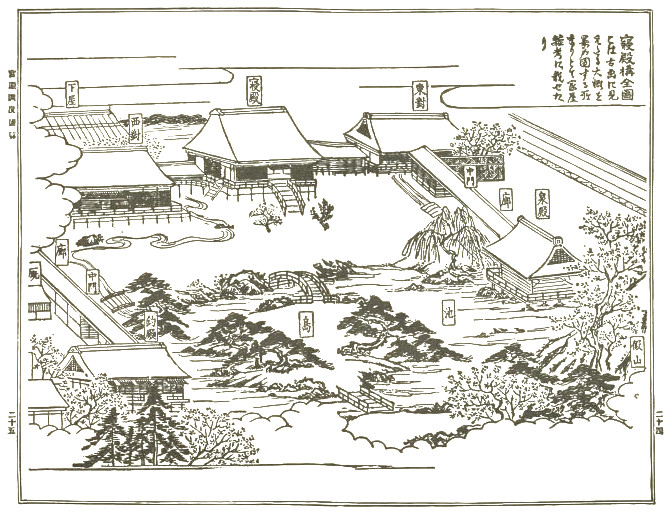
OLD PRINT OF A NOBLEMAN'S DWELLING IN THE AZUMAYA STYLE The Tsuchimikado, or Prime Minister's mansion, must have been like this.
I can see the garden from my room beside the entrance to the gallery. The air is misty, the dew is still on the leaves. The Lord Prime Minister is walking there; he orders his men to cleanse the brook. He breaks off a stalk of omenaishi [flower maiden] which is in full bloom by the south end of the bridge. He peeps in over my screen! His noble appearance embarrasses us, and I am ashamed of my morning [not yet painted and powdered] face. He says, "Your poem on this! If you delay so much the fun is gone!" and I seize the chance to run away to the writing-box, hiding my face—
Flower-maiden in bloom— Even more beautiful for the bright dew, Which is partial, and never favors me.
"So prompt!" said he, smiling, and ordered a writing-box to be brought [for himself].
His answer:
The silver dew is never partial. From her heart The flower-maiden's beauty.
One wet and calm evening I was talking with Lady Saisho. The young Lord[7] of the Third Rank sat with the misu[8] partly rolled up. He seemed maturer than his age and was very graceful. Even in light conversation such expressions as "Fair soul is rarer than fair face" come gently to his lips, covering us with confusion. It is a mistake to treat him like a young boy. He keeps his dignity among ladies, and I saw in him a much-sought-after romantic hero when once he walked off reciting to himself:
Linger in the field where flower-maidens are blooming And your name will be tarnished with tales of gallantry.
Some such trifle as that sometimes lingers in my mind when really interesting things are soon forgotten—why?
Nowadays people are carrying pretty folding fans.
Since the twentieth of the Eighth month, the more favoured court nobles and officers have been on night duty, passing the nights in the corridor, or on the mats of the veranda idly amusing themselves. Young men who are unskilled in koto or fué [harp or flute] amuse themselves with tonearasoi[9] and imayo,[10] and at such a time this is entertaining. Narinobu, the Queen's Grand Chamberlain, Tsunefusa, the Lieutenant-General of the Left Bodyguard and State Councillor, and Narimasa, the Major-General of the Bodyguard and Governor of Mino, passed the night in diversions. The Lord Prime Minister must have been apprehensive, for he has forbidden all public entertainment. Those who have long retired from the court have come in crowds to ask after the Queen's welfare, so we have had no peace.
Twenty-sixth day. We finished the preparation of perfume[11] and distributed it to all. A number of us who had been making it into balls assembled together. On my way from Her Majesty's chamber I peeped into Ben Saisho's room. She was sleeping. She wore garments of hagi[12] and shion[12] over which she had put a strongly perfumed lustrous robe. Her face was hidden behind the cloth;[13] her head rested on a writing-case of gold lacquer. Her forehead was beautiful and fascinating. She seemed like a princess in a picture. I took off the cloth which hid her mouth and said, "You are just like the heroine of a romance!" She blushed, half rising; she was beauty itself. She is always beautiful, but on this occasion her charm was wonderfully heightened.
Dear Lady Hyoé brought me some floss[14] silk for chrysanthemums. "The wife of the Prime Minister favours you with this present to drive away age,[14] carefully use it and then throw it away."
May that lady live one thousand years who guards the flowers! My sleeves are wet with thankful tears As though I had been walking In a garden of dewy chrysanthemums.
I wanted to send it, but as I heard that she had gone away I kept it.
The evening I went to the Queen's chamber. As the moon was beautiful, skirts overflowed from beneath the misu.[15] By and by there came Lady Koshosho and Lady Dainagon. Her Majesty took out some of the perfume made the other day and put it into an incense burner to try it. The garden was admirable—"When the ivy leaves become red!" they were saying—but our Lady seemed less tranquil than usual. The priests came for prayers, and I went into the inside room but was called away and finally went to my own chamber. I wanted only to rest a few minutes, but fell asleep. By midnight everybody was in great excitement.
Tenth day of the Long-moon month.
When day began to dawn the decorations[16] of the Queen's chamber were changed and she removed to a white bed. The Prime Minister, his sons, and other noblemen made haste to change the curtains of the screens, the bed cover, and other things.[16] All day long she lay ill at ease. Men cried at the top of their voices to scare away evil spirits. There assembled not only the priests who had been summoned here for these months, but also itinerant monks who were brought from every mountain and temple. Their prayers would reach to the Buddhas of the three worlds. All the soothsayers in the world were summoned. Eight million gods seemed to be listening with ears erect for their Shinto prayers. Messengers ran off to order sutra-reciting at various temples; thus the night was passed. On the east side of the screen [placed around the Queen's bed] there assembled the ladies of the Court. On the west side there were lying the Queen's substitutes possessed with [or who were enticing] the evil spirits.[17] Each was lying surrounded by a pair of folding screens. The joints of the screens were curtained and priests were appointed to cry sutras there. On the south side there sat in many rows abbots and other dignitaries of the priesthood, who prayed and swore till their voices grew hoarse, as if they were bringing down the living form of Fudo.[18] The space between the north room and the dais [on which was the Queen's bed] was very narrow, yet when I thought of it afterwards I counted more than forty persons who were standing there. They could not move at all, and grew so dizzy that they could remember nothing. The people [i.e. the ladies-in-waiting and maids-of-honour] now coming from home could not enter the main apartment at all. There was no place for their flowing robes and long sleeves. Certain older women wept secretly.
Eleventh day. At dawn the north sliding doors were taken away to throw the two rooms together. The Queen was moved towards the veranda. As there was no time to hang misu, she was surrounded by kichō. The Reverend Gyocho and the other priests performed incantations. The Reverend Ingen recited the prayer written by the Lord Prime Minister on the previous day adding some grave vows of his own. His words were infinitely august and hopeful. The Prime Minister joining in the prayer, we felt more assured of a fortunate delivery. Yet there was still lingering anxiety which made us very sad, and many eyes were filled with tears. We said, "Tears are not suitable to this occasion," but we could not help crying. They said that Her Majesty suffered more because the rooms were too crowded, so the people were ordered to the south and east rooms. After this there remained in the Royal Apartment only the more important personages. The Prime Minister, Lady Sanuki, and Lady Saisho were within the [Royal] screen. The honoured priest of Ninna Temple and the court priest of Mii Temple were summoned within. The Prime Minister gave various commands, and his voice overpowered those of the priests. There were also Ladies Dainagon, Koshosho, Miya-no-Naishi, Nakatsukasa-no-Kimi, Tayu-no-Myobu, Daishikibu-no-Omoto, Tono-no-Senji—these last were venerable ladies of experience, but even they were bewildered with good reason. I am yet a novice, and I felt with all my heart that the occasion was serious. Also, in the place a little behind, outside the curtain, there were the nurses of the Princesses Naishi-no-Kami and Nakatsukasa, of the Queen's sister Shōnagon, and of her younger sister Koshikibu. These nurses forced their way into the narrow passage behind the two screens and there walked back and forth, so that none could pass that way. There were many other persons bustling about, but I could not distinguish them. The Prime Minister's son, Lieutenant-General Saisho, Major-General Masamichi of the Fourth Rank, not to speak of Lieutenant-General Tsunefusa, of the Left Bodyguard, and Miya-no-Tayu, who had not known Her Majesty familiarly, all looked over her screen for some time. They showed eyes swollen up with weeping [over her sufferings], forgetting the shame of it. On their heads rice[19] was scattered white as snow. Their rumpled clothes must have been unseemly, but we could only think of those things afterward. A part of the Queen's head was shaved.[20] I was greatly astonished and very sorry to see it, but she was delivered peacefully. The after-birth was delayed, and all priests crowded to the south balcony, under the eaves of the magnificent main building, while those on the bridge recited sutras more passionately, often kneeling.
Among the ladies-in-waiting on the east side were seen some of the courtiers.[21] Lady Kochujo's eye met that of the Lieutenant-General. People afterwards laughed over her astonished expression. She is a very fascinating and elegant person, and is always very careful to adorn her face. This morning she had done so, but her eyes were red, and her rouge was spoiled by tears. She was disfigured, and hardly seemed the same person. The imperfectly made-up face of Lady Saisho was a rare sight, but what about my own? It is lucky for me that people cannot notice such things at such a time.
As the after-birth came, it was fearful to hear the jealously swearing voices of the evil spirits. Shinzo-Azari took charge of Lady Ben-no-Kurodo; Sōyo took charge of Hyoé-no-Kurodo; a priest Hojuji took charge of Ukon-no-Kurodo;[22] Chiso Azari took charge of Lady Miya-no-Naishi. This last priest was overpowered with the evil spirit, and as he was in a too pitiable state Ninkaku Azari went to help him. It was not because his prayer had little virtue, but the [evil] spirit was too strong. Priest Eiko was in charge of Lady Saisho's supplicator of the spirit [i.e. Queen's substitute]. This priest swore all night till his voice became hoarse. Most ladies who were summoned in order that the spirits might enter into them remained safe, and they were much troubled [thinking that it would be to the Queen's advantage were they attacked]. At noon we felt that the sun came out at last. The Queen was at ease!
She is now at peace. Incomparable joy! Moreover, it is a prince, so the joy cannot be oblique. The court ladies who had passed the previous day in anxiety, not knowing what to do, as if they were lost in the mist of the early morning, went one by one to rest in their own rooms, so that before the Queen there remained only some elderly persons proper for such occasions. The Lord Prime Minister and his Lady went away to give offerings to the priest who had read sutras and performed religious austerities during the past months, and to those doctors who were recently summoned. The doctors and soothsayers, who had invented special forms of efficacy, were given pensions. Within the house they were perhaps preparing for the ceremony of bathing the child.
Large packages [of ceremonial clothes] [23] were carried to the apartments of the ladies-in-waiting. Karaginu[24] and embroidered[24] trains were worn. Some wore dazzlingly brilliant trains embroidered and ornamented with mother-of-pearl. Some lamented that the fans which had been ordered had not come. They all painted and powdered. When I looked from the bridge I saw Her Majesty's first officials, and the highest officers of His Highness the Crown Prince [the newborn child] and other court nobles. The Prime Minister went out to have the brook, which had been choked with mud, cleaned[25] out.
All the people seem happy. Even those who have some cause for melancholy are overtaken by the general joy. The First Official of our Queen has naturally seemed happier than anybody, though he does not show special smiles of self-satisfaction and pride.
The Lieutenant-General of the Light Bodyguard has been joking with the King's Adviser of the Middle Rank, sitting on a mat on the balcony of the side building. The sword of His Highness the young Prince has been brought from the Imperial Court. The Lieutenant-General, and First Secretary Yori-sada, on his way home from the shrine at Isé[26] where he had gone as Imperial Messenger to offer nusa,[27] stopped at the gate [as he could not enter the house] [28] to inquire for Her Majesty. He was given some present, I did not see it.
The navel cord was cut by the Prime Minister's Lady. Lady Tachibana of the Third Rank gave the breast for the first time [ceremonial]. For the wet-nurse Daisaémon-no-Omoto was chosen, for she has been in the Court a long time and is very familiar with it; the daughter of Munetoki, courtier and Governor of Bitchu, and the nurse of Kurodo-no-Ben were also chosen as nurses.
The ceremony of bathing was performed at six o'clock in the evening. The bath was lighted [by torches]. The Queen's maid in white over green prepared the hot water. The stand for the bathtub was covered with white cloth.
Chikamitsu, Governor of Owari [Province], and Nakanobu, the Head Officer attached to the Queen, presented themselves before the misu.
There were two stands for kettles.
Lady Kyoiko and Lady Harima poured the cold water. Two ladies, Omoku and Uma, selected sixteen jars from among those into which the hot water was poured [choosing the purest]. These ladies wore gauze outer garments, fine silk trains, karaginu, and saishi.[29] Their hair was tied by white cords which gave the head a very fair look. In the bath Lady Saisho became the partner of bathing [i.e. entered the bath with the royal infant]. Lady Dainagon in her bathing-dress—she was especially beautiful in this rare costume. The Lord Prime Minister took the August Prince in his arms; Lady Koshosho held the sword, and Lady Miya-no-Naishi held up a tiger's head before the Prince.[30] Lady Miya-no-Naishi wore karaginu with a pattern of pine cones. Her train was woven in a marine design of sea-weeds, waves, etc.; on the belt a vine-pattern was embroidered. Lady Koshosho wore an embroidered belt with a pattern of autumn leaves, butterflies, and birds, which was bright with silver thread. Brocade was forbidden except for persons of high rank and they used it only for the belt. Two sons of the Prime Minister and Major-General Minamoto Masamichi were scattering rice in great excitement.[31] "I will make the most noise," each shouted to the other. The priest of Henchi Temple presented himself to protect the August Child. The rice hit him on his eyes and ears so he held out his fan and the young people laughed at him. The Doctor of Literature, Kurodo Ben-no-Hironari, stood at the foot of the high corridor and read the first book of Sikki [historical records]. Twenty bow-string men twanged the bow-string to scare away evil spirits, they were ten men of the fifth, and ten men of the sixth degree [of rank] arranged in two rows. The same ceremonies of bathing were repeated in the evening. Only the Doctor of Literature was changed. Doctor Munetoki, Governor of Isé, read the Kokyo [book on filial piety], and Takachika read a chapter of Buntei [in the Historical Records of Chinese Kings].
For seven nights every ceremony was performed cloudlessly. Before the Queen in white the styles and colours of other people's dresses appeared in sharp contrast.[32] I felt much dazzled and abashed, and did not present myself in the daytime, so I passed my days in tranquillity and watched persons going up from the eastern side building across the bridge. Those who were permitted to wear the honourable colours[33] put on brocaded karaginu,[34] and also brocaded uchigi. This was the conventionally beautiful dress, not showing individual taste. The elderly ladies who could not wear the honourable colours avoided anything dazzling, but took only exquisite uchigi[35] trimmed with three or five folds,[36] and for karaginu brocade either of one colour or of a simple design. For their inner kimonos they used figured stuffs or gauzes. Their fans, though not at first glance brilliant or attractive, had some written phrases or sentiments in good taste, but almost exactly alike, as if they had compared notes beforehand. In point of fact the resemblance came from their similarity of age, and they were individual efforts. Even in those fans were revealed their minds which are in jealous rivalry. The younger ladies wore much-embroidered clothes; even their sleeve openings were embroidered. The pleats of their trains were ornamented with thick silver thread and they put gold foil on the brocaded figures of the silk. Their fans were like a snow-covered mountain in bright moonlight; they sparkled and could not be looked at steadily. They were like hanging mirrors [in those days made of polished metal].
On the third night Her Majesty's major-domo gave an entertainment. He served the Queen himself. The dining-table of aloe wood, the silver dishes, and other things I saw hurriedly. Minamoto Chunagon and Saisho presented the Queen with some baby clothes and diapers, a stand for a clothes chest, and cloth for wrapping up clothes and furniture. They were white in colour, and all of the same shape, yet they were carefully chosen, showing the artist mind. The Governor of Omi Province was busy with the general management of the banquet. On the western balcony of the East building there sat court nobles in two rows, the north being the more honourable place. On the southern balcony were court officials, the west being the most honourable seat. Outside the doors of the principal building [where the Queen was] white figured-silk screens were put.
On the fifth night the Lord Prime Minister celebrated the birth. The full moon on the fifteenth day was clear and beautiful. Torches were lighted under the trees and tables were put there with rice-balls on them. Even the uncouth humble servants who were walking about chattering seemed to enhance the joyful scene. All minor officials were there burning torches, making it as bright as day. Even the attendants of the nobles, who gathered behind the rocks and under the trees, talked of nothing but the new light which had come into the world, and were smiling and seemed happy as if their own private wishes had been fulfilled. Happier still seemed those in the Audience Chamber, from the highest nobles even to men of the fifth rank, who, scarcely to be counted among the nobility, met the joyful time going about idly, and bending their bodies busily [i.e. obsequiously].
To serve at the Queen's dinner eight ladies tied their hair with white cords, and in that dress brought in Her Majesty's dining-table. The chief lady-in-waiting for that night was Miya-no-Naishi. She was brilliantly dressed with great formality, and her hair was made more charming by the white cords which enhanced her beauty. I got a side glance of her when her face was not screened by her fan. She wore a look of extreme purity.
The following are the maids-of-honour who tied their hair; Minamoto Shikibu, daughter of the Governor of Kaga Province; Kozaémon, daughter of the late Michitoki, Governor of Bitchu; Kohyoé, daughter of Akimasa, Governor of the Left Capital; Osuké, daughter of Sukechika, the head priest of the Isé shrine; O Uma, daughter of Yorinobu, an officer of the Right Bodyguard; Ko Uma, daughter of Michinobu, an officer of the Left Bodyguard; Kohyoé, daughter of Naritaka, Recorder of the Capital; Komoku [or Dakumi], daughter of Nobuyoshi. These were all young and pretty. It was a sight worth seeing. This time, as they chose only the best-looking young ladies, the rest who used to tie their hair on ordinary occasions to serve the Queen's dinner wept bitterly; it was shocking to see them.
More than thirty ladies were sitting in the two rooms east of the Queen's canopy, a magnificent sight. The august dinner trays were carried by unemé.[37] Near the entrance of the great chamber folding screens surrounded a pair of tables on which these dining-trays had been placed. As the night advanced the moon shone brightly. There were unemé, mohitori,[38] migusiagé,[39] tonomori,[40] kanmori-no-nyokwan,[41]—some with whose faces I was not familiar. There were also doorkeepers, carelessly dressed and with hairpins falling out, crowded together towards the eastern corridor of the principal building as if it were a public holiday. There were so many people there was no getting through them. After dinner the maids-of-honour came outside the misu and could be plainly seen by the light of the torches. The train and karaginu of Lady Oshikibu was embroidered to represent the dwarf pine-wood at Mount Oshio. As she is the wife of Michinoku, Governor of the eastern extremity of the island, she serves now in the Prime Minister's household. Dayu-no-Miyobu neglected the ornamentation of her karaginu, but she adorned her train with silver dust representing sea-waves. It was pleasing to the eye, though not dazzling. Ben-no-Naishi showed on her train a beach with cranes on it painted in silver. It was something new. She had also embroidered pine branches; she is clever, for all these things are emblematic of a long life. The device of Lady Shosho was inferior to these—many laughed at her silver foil. She was sister to Sukemitsu, the Governor of Shinano, and has lived at the court a long time. People wanted to see this entertainment. A priest was there who used to attend the court to beguile the night with religious and other stories. I said to him, "You cannot see such a lovely thing every day." "Indeed! indeed!" said he, neglecting his Buddha and clapping his hands for joy. The court nobles rose from their seats and went to the steps [descending from the balcony]. His Lordship the Prime Minister and others cast da.[42] It was shocking to see them quarrelling about paper. Some [others] composed poems. A lady said, "What response shall we make if some one offers to drink saké with us?" We tried to think of something.[43]
Shijo-no-Dainagon is a man of varied accomplishments. No ladies can rival him in repartee, much less compete with him in poetry, so they were all afraid of him, but [this evening] he did not give a cup to any particular lady to make her compose poems. Perhaps that was because he had many things to do and it was getting late. At this ceremony the ladies of high rank are given robes, together with babies' dresses presented by the Queen. The ladies of the fourth rank were each given a lined kimono, and those of the sixth rank were given hakama.[44] So much I saw.
The next night the moon was very beautiful. As it is the delightful season, young people went boating. They were all dressed uniformly in white and their hair showed better than when they wear coloured clothes. Kotaibu, Minamoto Shikibu, Miyaki-no-Jiju, Gosetchi-no-Ben, Ukon, Kohyoé, Koeimon, Uma, Yasurahi, Isebito—these were on the veranda when the Lieutenant-General of the Left Bodyguard, and the Lieutenant-General, the Prime Minister's son, came to take them out in the boat punted by Lieutenant-General Kanetaka of the Right Bodyguard. The rest of the ladies were neglected and followed them with their eyes. They seemed to be jealous in spite of themselves. Into the very white garden[45] the moon shone down and added to the beauty of the maids-of-honour in their white dresses. There were many palanquins waiting at the shelter [for conveyances] near the north entrance. They were those of the ladies-in-waiting of His Majesty's court, Tosaumi, Koshosho, Uma, Ukon, Chikuzen, Omi—so far I have heard, but as I don't know them well there may be some mistakes. The people in the boat came in in confusion [hearing that visitors from the King's Court had arrived]. The Lord Prime Minister came out to welcome them and put them in good humour. He seemed to be perfectly happy. Gifts were made to them according to their rank.
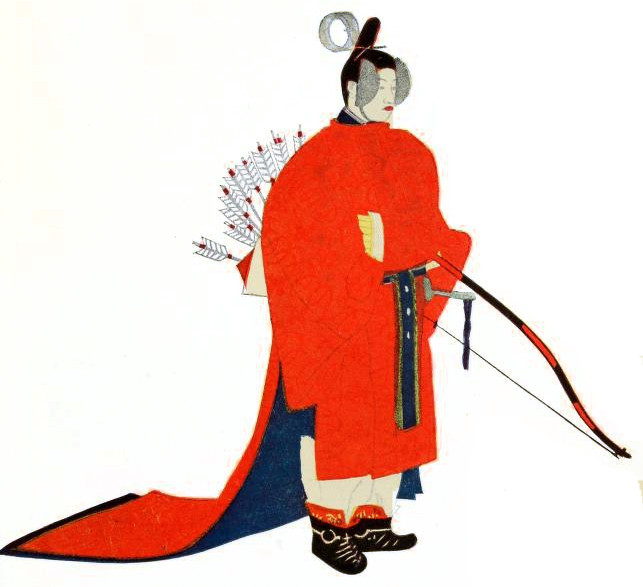
COURT DRESS OF MILITARY OFFICIAL (For explanation see List of Illustrations)
On the seventh day His Majesty celebrated the birth. His secretary and Major-General, Michimasa, came as King's Messenger with a long list [of the presents] put into a wicker box. A letter was immediately sent from the Queen to the King. The students from the Kangakuin[46] came keeping step. The list of visitors' names was presented to Her Majesty. Some may perhaps receive gifts.
The ceremony of the evening was noisier than ever. I peeped under the Queen's canopy. She who is esteemed by the people as the mother of the nation did not seem to be in good spirits. She appeared a little weary. She had grown thinner, and her appearance in bed was slenderer, younger, and gracefuller. A little lantern was hung under the canopy which chased the darkness away even from the corners. Her fair complexion was pale and transparently pure. I thought her abundant hair would be better tied up. There is great impropriety in writing about her at all, so I will stop here.
The general ceremonies were the same as the other day. The gifts to the courtiers were bestowed from within the misu. The women's dresses and the Queen's dress [perhaps from the Queen's wardrobe] were added to them. The chief of the King's secretaries and court nobles received them, approaching the misu.
His Majesty's gifts were uchigi, and kimonos, and rolls of silk in the usual court fashion.[47] The gifts to Tachibana-no-Sanmi [who offered the breast to the young Prince for the first time] were a set of women's clothes and rolls of brocade, a silver clothes chest, and wrappings for clothes [which perhaps were white]. I have heard that something wrapped up was added also, though I could not see it in detail.
On the eighth day all changed their dress [which had been white, the colour of purification]. On the ninth evening the Vice-Governor[48] of the August Crown Prince's retinue celebrated the birth. The present was put on a white cabinet. The ceremony was quite in the new style. On the silver clothes chest a raised ornament was carved, and the island of Horai[49] was also represented as usual, but in finer and newer fashion. I am sorry I cannot describe it all exactly. This evening the winter screens were used, and the ladies wore richly coloured dresses. They seemed all the more charming as it was the first time after the birth [to see them]. The rich and brilliant colours shone through the karaginu. The women's figures also showed more distinctly and that enhanced their beauty. This was the night that Lady Komano-no-Omoto was put to shame.
It was after the tenth day of the Gods-absent month, but the Queen could not leave her bed. So night and day ladies attended her in her apartment towards the West. The Lord Prime Minister visited her both during the night and at dawn. He examined the breasts of the wet-nurses. Those nurses who were in a sound sleep were much startled and got up while still asleep; it was quite a pity to see them. He very naturally devoted himself with the utmost care, while there was anxiety about the August Child. Sometimes the Honourable Infant did a very unreasonable thing and wet the Lord Prime Minister's clothes. He, loosening his sash, dried his dress behind the screen. He said: "Ah! it is a very happy thing to be wet by the Prince. When I am drying my clothes is my most comfortable moment!" So he said rejoicing. He especially favoured Prince Murakami, and as he thinks I am related to that Prince he talked to me very familiarly. I know many things which may be expected to happen![50]
The day of the King's visit was approaching, and the Lord's mansion was improved and adorned. Beautiful chrysanthemums were sought for everywhere, to plant in the garden. Some were already fading, others in yellow were especially lovely. When they were planted and I saw them through the shifting morning mists, they seemed indeed to drive away old age.
I wish I could be more adaptable and live more gaily in the present world—had I not an extraordinary sorrow—but whenever I hear delightful or interesting things my yearning for a religious life grows stronger. I become melancholy and lament. I try to forget, for sorrow is vain. Am I too sinful? So I was musing one morning when I saw waterfowl playing heedlessly in the pond.[51]
Waterfowl floating on the water— They seem so gay, But in truth It is not gay to live anxiously seeking means of existence.
I sympathized with them who outwardly have no other thought but amusement, yet in reality are seeking a livelihood in great anxiety.
Lady Koshosho sent me a letter, and when I was writing the answer a brisk shower came pattering down. The sky looked threatening and the messenger was in a hurry, so I think I wrote but a broken-legged poem. After dark the messenger returned with a strongly perfumed and deeply coloured paper[52] on which was written:
The dark sky dulls my dreamy mind, The down-dripping rain lingers— O my tears down falling, longing after thee!
I have forgotten what I wrote to her except the poem:
There are pauses between the showers of the outer world, But there is no time when my sleeves, wet with tears, are dry.
That day the Queen saw the new boats which were presented for her inspection. The dragon's head and the phoenix at the prow made me think of animated living figures.
The visit[53] of His Majesty was to be made at eight or nine o'clock in the morning. From early dawn ladies adorned themselves with great care. As the seats of the courtiers were placed in the west side building the Queen's apartment was not so much disturbed. I have heard that the ladies serving at the Imperial shrine dressed very elaborately in the rooms of the first maid-of-honour.
In the early morning Lady Koshosho came back from her father's. We dressed our hair together. In spite of the fixed hour His Majesty's coming will be delayed, we thought, and our relaxed minds were still indolent. Some ladies had ordered unornamented silk fans and were on tiptoe with expectancy when the drums were heard [announcing Royalty] and they were in an awkward predicament.[54] We welcomed the Royal equipage. The boatmen's music was very good. When the Royal palanquin drew near, the bearers, though they were rather honourable persons, bent their heads in absolute humility as they ascended the steps. Even in the highest society there are grades of courtesy, but these men were too humble. The Royal dais was prepared at the west side of the Queen's.[55] His honourable chair was placed in the eastern part of the south veranda. A little apart from it on the east side were hung misu, and two of the court ladies in attendance on the King came out from behind that misu. The beautiful shape of their hair, tied with bands, was like that of the beauties in Chinese pictures. Lady Saémon held the King's sword. She wore a blue-green patternless karaginu and shaded train with floating bands and belt of "floating thread" brocade dyed in dull red. Her outer robe was trimmed with five folds and was chrysanthemum-coloured. The glossy[56] silk was of crimson; her figure and movement, when we caught a glimpse of it, was flower-like and dignified. Lady Ben-no-Naishi held the box of the King's seals. Her uchigi was grape-coloured, her brocaded train and karaginu were the same as the former lady. She is a very small and smile-giving person and seemed a little shy and I was sorry for her. Her face and clothes were in better taste than those of the other ladies. Her hairbands were blue-green. Her appearance suggested one of the ancient dream-maidens descended from heaven.
The officers of the King's Bodyguard managed things connected with the state carriage [perhaps drawn by a bullock] in fine style. They were elegantly dressed. The First Lieutenant-General took His Majesty's sword and gave it to Lady Saémon.
Looking over those who were inside the misu I saw that persons who were permitted to wear honourable colours were in karaginu of blue or red, painted trains, and uchigi which were as a rule brocade of old red and old rose. Only the Right Bodyguard wore clothes of shrimp pink. The beaten[57] stuffs were like the mingling of dark and light maple leaves in autumn. The under garments were in deep and pale jasmine yellow or in green and white. Some wore scarlet and green, and others dresses trimmed with three folds. Among those who were not permitted to wear figured silk the elderly persons wore blue, or dull red and old rose five-fold-bordered uchigi. The colour of the sea painted on their trains was tasteful and quiet. On their belts was a repeated design.
The younger ladies wore five-fold-trimmed karaginu of chrysanthemum colours according to their taste. The first garment was white and those who wore a blue dress covered it with a red one. Those who wore old rose on the outside took more richly coloured garments underneath.[58] Among those whose dress was in combination with white, only those who made skilful combinations seemed well dressed. I saw some fans exquisitely strange and original. We can compare their tastes more easily in their everyday dress, but on such an occasion as this, when they give their whole minds to the costumes, vying with each other, they all seem like so many works of art. They look rather alike, and it is difficult to distinguish ages, or to know whether hair is thick or thin. Their faces and heads were hidden by fans, yet some ladies seemed more dignified and others inferior. Ladies who seem distinguished at such a time must be beautiful indeed. Five ladies who had formerly served both the King and our Queen were assembled here. They were, two ladies-in-waiting, two maids-of-honour, and one cook.[59]
To serve the dinner Ladies-in-Waiting Chikuzen and Sakyo, their hair tied with bands, came out near the square pillar where the court ladies sat. They were like beautiful angels [Japanese word, tennin]. Sakyo wore karaginu of white, and blue under white. Lady Chikuzen wore five-fold-trimmed karaginu of chrysanthemum colours. The ornament of their trains was dyed by rubbing.[60] Lady Tachibana of the Third Rank prepared the dinner. She is an old lady and wore blue[61] karaginu, and yellow chrysanthemum uchigi woven in a "floating thread" pattern. A sudaré was rolled up, but a post obscured the view. The Lord Prime Minister, taking the August young Prince in his arms went before the King. His Majesty took the child himself. The Honourable Infant cried a little in a very young voice. Lady Ben-no-Saisho stood holding the Prince's sword. The Prince was taken to the Lord Prime Minister's wife, who sat on the west side of the inner door. After His Majesty had gone, Ben-no-Saisho came out and said to me: "I was exposed to brightness [i.e. the radiance of the King's presence]. I felt discomposed." Her blushing face was beautiful in every feature, and set off her dress delightfully.
When night came we had beautiful dances. The court nobles presented themselves before the King [to dance]. The names of the dances performed were:
The Pleasures of Ten Thousand Ages. The Pleasures of a Peaceful Reign. The Happy Palace.
When they danced the "Long-Pleasing[62] Son," the closing one, they went out singing and danced along the road beyond the garden hills.[63] As they went farther away the sound of flute and drum mingled with the sound of wind in the pine-wood towards which they were going. The garden brook, cleansed very carefully, was refreshing to us and the [sound of the] water rippling on the pond gave us a chilly feeling. Lady Sakyo offered the Queen sympathy, not knowing that she had doubled her undergarments, so people laughed secretly. Lady Chikuzen talked of the late King Enyu,[64] who had visited her often. She talked about the events of those days, and I felt that she was about to utter things unfit for this happy occasion, so I did not answer her saying I was too tired. We were sitting with a curtain between us. If there had been some one to ask, "Alas, what things?" she would have spilled the unfit words.[64] The dancing before the King had begun and it was very delightful, when the voice of the young Prince was heard crying beautifully. The Minister of the Right said flatteringly that the August Child's voice was in accord with the music. The Commander of the King's Left Bodyguard recited with others "The Pleasures of Ten Thousand Years" and "The Pleasures of Ten Thousand Autumns." Our honourable host, the Lord Prime Minister, said, "Ah! I held the previous condescending visit as a great honour, but this is the greatest." He wept in intoxication of joy. There's really no need of my saying it, but he is so grateful to the King and so conscious of his happiness it is lovely to see it.
The Prime Minister withdrew and His Majesty retired from the chamber. He summoned the Minister of the Right to order him to record that the Queen's officials and Prime Minister's stewards were to be advanced in rank. Tō-no-Ben presented to him all who were to be thus honoured. The nobles of the Fujiwara clans[65] arrived together, but there were only those immediately connected with the Prime Minister's family, the other three families were not among them. Then came the chief officers of the Right Bodyguard, the high officials of the Queen Dowager, the officials of our Queen to whom additional duties were assigned, and other members of the court who had been promoted and who came to thank the King. His Majesty went in beside the Queen, but as the night was far advanced it was not long before the Prime Minister called the Royal carriage and the King returned to his own palace.
The next day Royal messengers came here before the morning mist had cleared up. I arose late and did not see them. Last evening was the first time that His Majesty the King had met the Queen during these months. After the visit the duties of the August Prince's attendants and ladies were made public. Some who had not heard about it before were disappointed and jealous. The decorations of the Queen's apartment, which had been neglected, were improved. Things became more attractive in the Queen's presence. For years the Prime Minister had felt anxious [as the Queen had had no child], but his hopes being realized he and his wife devoted themselves to taking care of the Queen. The August Child seems to have shed brightness around him.
In the evening the moonlight was very beautiful. The Second Official of the August young Prince came, perhaps thinking that his thanks might be offered by a court lady. The bridge opposite the door was wet with vapour from the bath. No one answered, so he went to the room of Lady Miya-no-Naishi which is next the bridge of the eastern building. Lady Saisho was in the inner room. The man, holding back the unlocked door, asked again, "Is some one within?" But she did not come out. Just then the Queen's First Officer appeared and called, "Is some one there?" She felt it impossible not to reply, so made a faint answer. The new official was in a gay humour and said reproachfully, "You did not answer me, but you especially favour the Head Officer! It is natural enough, but not kind; is there so much difference between the nobles in this place? It is too much!" He sung "The August Happiness of the Day." As the night advanced the moon became brighter; "It would be better to take away the obstruction from before the door," said he persuasively. I thought it awkward that a noble of the Court should stand there below me like that, but I did not open the door. If I were younger, I thought, my inexperience would be my excuse were I to talk with him or open the door, but one cannot talk thoughtlessly when one is young no longer, so I did not open the door but held it with my hand.
The first day of the Frost month was the fiftieth day after the birth. The persons who were to present themselves came in full dress. The sight before her presence was like a picture of a poet's assembly. Many kichō were arranged along the east side of the Queen's dais from the inner room to the veranda. The Royal dining-table was placed towards the south front of the house. At the west side was prepared the Queen Dowager's dinner. It was placed on a tray of aloe wood. I don't know what kind of a stand it was on because I did not see it. She wore a grape-coloured kimono trimmed with five folds and red uchigi. Those serving the dinner were Lady Saisho and Lady Sanuki. The maids-of-honour dressed their hair with saishi and bands. Lady Dainagon served the August Prince's dinner at the east side—a little dining-table, plate, stand for chopsticks, with a central decoration representing a bit of seashore—all as small as play-things for dolls. At the east end where the sudaré was a little rolled up, there were in waiting such ladies as Ben-no-Naishi, Lady Nakatsukasa, Lady Koshosho; as I was inside I could not see in great detail. That night Lady Sefu, the nurse, was permitted to wear a dress of honourable colour. She seemed still girlish, as she took the August Prince in her arms and gave him to the Lord Prime Minister who was within the dais. He came out quietly and they were plainly seen in the flickering light of the torches. It was very lovely. The August Prince was dressed in red brocade with shaded skirt—exquisitely pretty. The Mochi[66] was given to him by the Lord Prime Minister. The seats of the courtiers had been prepared at the west side of the east building; there were two ministers present. They came out onto the bridge and were very drunk and boisterous.
As the torches burnt low, the Major-General of the Fourth Rank was called to light lanterns. Boxes and baskets of food,[67] the Prime Minister's gifts, were borne in by the attendants and piled up on the balcony near the railing. Some of the boxes were to be taken to the King's kitchen, and as the next day was to be a day of abstinence for religious devotion they were carried away at once.
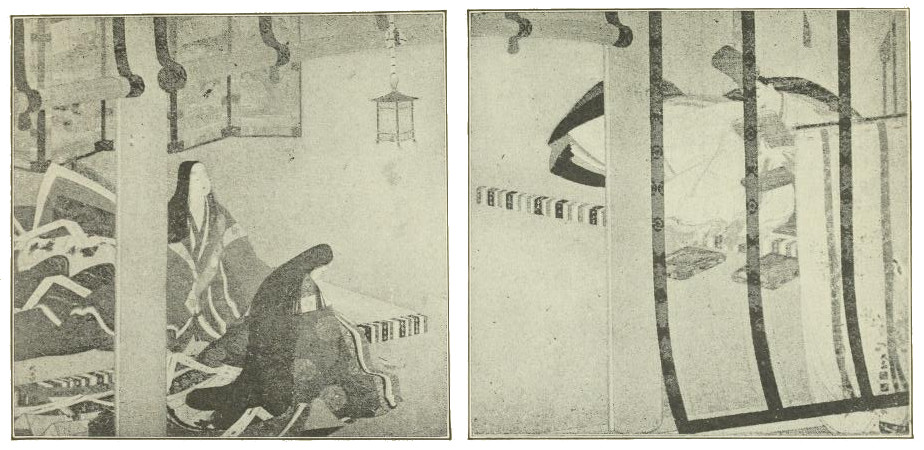
ROYAL DAIS AND KICHŌ, SUDARÉ, ETC.
The Queen's First Officer came to the misu and asked if the court nobles should be invited there. As the answer was "yes," every one came led by the Prime Minister, and approached the east door. Ladies stood in two or three rows; the misu was rolled up by those who were nearest it, Lady Dainagon, Lady Koshosho, and others. The Minister of the Right came dancing wildly and made a hole in the kichō behind which ladies were sitting. They laughed, saying, "He has long passed the age for that." He did not notice, but made a great many unbecoming jokes, taking away ladies' fans. The August Prince's First Officer took a saké cup[68] and stepped out; he sung a song; although it was unaccompanied by dancing it was very delightful. Farther towards the east, leaning against a door-post, the General of the Right was standing, studying the ladies' sleeves and the skirts of their garments showing below the misu. He is different from other men. The ladies, thinking that after all the intoxicated men were only trying to seem young and irresistible, made light of their behavior and said, "It is nothing, nobody else will behave so." Compared with such men the General is far superior. He was afraid of the saké cup, and when it came to him passed it by, singing the song which begins "One Thousand and Ten Thousand Ages." The First Officer of the Light Bodyguard said, "I think Lady Murasaki must be somewhere here!" I listened, thinking, "How can she be here in a place where there is no such graceful person as Prince Genji?"[69] The Minister of the Right said, "Sanmi-no-Suké [officer of the third rank], accept this cup!" When the officer came out from below the Lord Keeper of the seal [an inferior position] the drunken man wept. The King's Adviser, leaning in a corner, was flirting with Lady Hyobu. The Prime Minister did not forbid even unmentionable jokes. It was an awful night of carousal, so after the ceremony I signalled to Lady Saisho and we hid ourselves, but there came noisily the Prime Minister's sons and Lieutenant-General Saisho, so, although we two had remained hidden behind the screen, even this was taken away and we were captives. "Compose a poem each, and you shall be excused," said the Lord Prime Minister. I was frightened and helpless, and made haste to comply:
How can I number the years of the Prince! One thousand, nay, eight thousand, may he live, and more.
"Well done!" said he, reciting it twice, and he answered immediately:
O would I might live the life of a crane— Then might I reckon the years of the Prince Up to one thousand!
He was much intoxicated, but the poem had feeling, for it came from his innermost desire. The child cherished in this way will have a very bright future. Even such as I can imagine the thousand prosperous years of His August Highness! He felt satisfied with his own poem and said, "Has Your Majesty heard the poem? I have made a poem!" and then—"I am worthy to be your father and you are worthy to be my daughter—Mother is smiling, she must think she is happy. She may be thinking she has got a good husband!" said he in extreme intoxication. As is usual with drunken persons all were listening. His wife seemed to be embarrassed by this conversation and retired. "Mother will be angry if I do not follow her," said he, and went through the dais hurriedly, muttering, "Excuse me, Your Majesty, but a child is adored because of its father!" and everybody laughed.
The day for the Queen's return to the palace approaches and her ladies have no tranquil hours because of continual ceremonies. Her Majesty had had blank books made, so from early morning I was summoned to attend her to arrange the paper and to write letters which were sent with the books and the romances to be copied. I also spent days in compiling these into books. "What fancy is this? Why do you do such things these chilly days?" the Lord Prime Minister said, but he himself brought out fine papers, brushes and ink, and even writing-boxes. These were given to the ladies by the Queen's own hand. They were bashful, but excuses were in vain, and they went into corners and composed and came back blushing, saying, "I have done this," only to be given more brushes and ink. I had brought my romances from home and hidden them in my own room, but one day the Prime Minister entered it secretly to hunt about and found them and gave them to the first lady-in-waiting. As the books are not at all clearly written, I am ashamed to think what their opinion must be.[70]
The infant Prince begins to babble and crow. His Majesty is naturally impatient to have him. The waterfowl have begun to come more and more to the pond before the house.
I longed for snow while we were staying there, but just then I had to go home to my parents. Two days after retiring from the Court a great snow came. The old familiar trees of my home reminded me of those melancholy years when I used to gaze upon them musing when the colours of flowers, the voices of birds, the skies of Spring and Autumn, moon shadows, frost and snow, told me nothing but that time was revolving, and that I was menaced with a dreary future. Before I went to Court I tried to avoid sadness by writing to those who were in the same state of mind, even to those with whom I was only slightly acquainted, and associating with them I consoled my heart in various ways. Although an unimportant person I had passed my life without feeling any sort of contempt of myself until I went to Court—since then, alas! I have experienced all the bitterness of it. To-day I took out romances, but they no longer interested me. I was ashamed to think what those melancholy persons to whom I used to write had thought of me since I went to Court, so I had no courage to write to them again. Those with whom I am now intimate would have to publish my letters broadcast, so how can I write to them my inmost heart?—thus my letters have inadvertently grown few. I had a feeling that association with some of the younger ladies who used to visit me before I went to Court could not continue. Some of them I had to refuse when they came, and in my home all these trifles have made me feel more deeply that I have gone into a world not intended for me. I write only to those from whom I can never part, to whom my heart prompts me to speak. O worthless heart, that feels love only for those with whom it daily associates! I long for Lady Dainagon with whom I spent every night before the Queen, when we told each other all our heart's secrets—is it also my worldly heart that longs for a companion other than Buddha?
Like two wild ducks Floating with unrestful slumber, Yet even those nights I would recall— Feathers wet and cold— But colder tears!
Lady Dainagon returned this answer:
Midnight sleep was broken But no friend to brush away the cold tears! I envy the Oshidori[71] which has ever its mate by its side.
Her handwriting is very elegant. She is a very true-hearted person.
A lady wrote me, "The Queen has seen the snow, and she regrets deeply that you are not here at Court." The Prime Minister's Lady wrote to me, "When I tried to stop your going away you said you would go at once that you might come back soon. Was not that true?—for many days have passed." She may not have been in earnest, yet as I received such a letter I went back to the Court.
It was on the seventeenth of the Frost month that the Queen went back to the palace. The time had been fixed for eight o'clock in the evening, but the night was far advanced. I could not see more than thirty ladies who tied up their hair. To the east balcony of the Queen's apartments came more than ten ladies-in-waiting from His Majesty's Court [to escort the Queen]. Her Majesty's senji [woman who repeats the Queen's words to outsiders] went in Her Majesty's coach with her. The Lord Prime Minister's wife and Lady Sen, the nurse, holding the August Infant in her arms, went in a coach adorned with silk fringes. Lady Dainagon and Lady Saisho were in a gold-studded coach. In the next one went Lady Koshosho and Lady Miya-no-Naishi. The Lieutenant-General of His Majesty's stud was in the next one. I was to go in that one. His manner expressed dissatisfaction with so mean a companion and I was much discomposed. Lady Jiyu, Ben-no-Naishi, Lady Saémon, the Prime Minister's first attendant, and Lady Shikibu went in their proper order in their palanquins. As it was bright moonlight I was greatly embarrassed, and in the palace I followed the Lieutenant-General not knowing where I trod. If some one had been looking at me from behind [Japanese expression signifying "gossiping about or criticizing"], I must have been ashamed indeed.
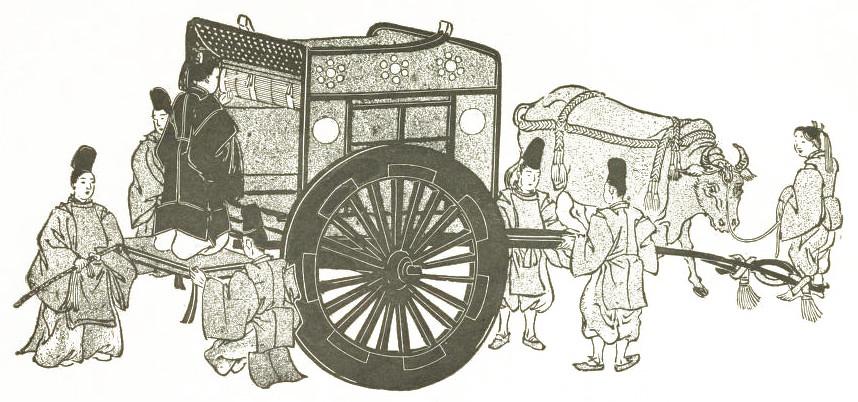
A NOBLEMAN'S CARRIAGE
I passed that night in the third little room on the corridor of the Kokiden.[72] Lady Koshosho came and we talked of the sadness of our lives. We took off our kimonos and put on doubly wadded ones, and making a fire in an incense-burner we were complaining of the cold when the Chamberlain and the State Councillor and Lieutenant-General Kinnobu came to inquire for us. I wished I might have been entirely forgotten this evening. It annoyed more than it pleased us; nevertheless, as they had come to make inquiries, I said: "To-morrow I will return the compliment and go to inquire after you. To-night I am shivering with cold." Saying these words we secretly stole away from that room. Some were now preparing to go back to their homes; we thought them to be some of the lower officials. I do not say this as comparing them with myself. By the way, Lady Koshosho is very noble in character and beautiful, but I notice she is thinking sadly of the World.[73] One reason is her father's rather humble rank which makes good fortune delay to come to her.
This morning Her Majesty saw in detail last evening's presents from the Prime Minister. The hair ornaments in a case were more lovely than words can express. There were a pair of salvers. On one of them were poem papers and bound blank books. On the other were the poetical collections of the Kokinshu, Gosenshu, and Juishu.[74] Each was bound in five volumes. The copyists of these volumes were the King's Adviser and attendant of middle rank and Enkwan.[75] The covers were of thin figured silk; the fastenings of braided silk of the same material. They were fitted into a basket. There were also ancient and modern poetical collections of various families, such as those of Yoshinobu and Motosuké. The copies made by Enkwan[75] and Chikazumi[75] were kept for the Queen's private use. They were made in the new fashion.
On the twentieth day of the Frost month the dance of Gosetchi[76] was performed. A costume was given to the young lady whom the King's attendant and State Councillor offered for the dance. The Lieutenant-General asked for a garland for his dancer, which was given. At the same time a box of perfume ornamented with artificial leaves and plum blossoms was given her. As the arrangements had been made a long time beforehand this year, there was great rivalry among the dancers. Torches were lighted in close rows along the outer doors of the eastern veranda so there was day-brightness, and it was really awkward to walk there. I felt for the girls, but it was not they only who were embarrassed. Young nobles looked at the girls face to face, almost bringing the lights down in front of them. They tried to draw a curtain before themselves, but in vain, and the nobles' eyes were still on them. My heart throbs even at the memory of it.