PART II. CHILDREN'S LEAFLETS.
Reading edition
Designed to Open the Eyes of the Young.
Most of these leaflets were published as companions to the Teachers' Leaflets and Lessons,—the teachers' lessons written in one vein and the children's in another. Even though the subject-matter may be largely duplicated in the two, it seems worth while to keep these separate as showing a simple method of presentation and as suggesting a means of procedure to those who would reach small children.
THE CHILD'S REALM. By L. H. BAILEY.
A little child sat on the sloping strand Gazing at the flow and the free, Thrusting its feet in the golden sand, Playing with the waves and the sea. I snatch'd a weed that toss'd on the flood And parted its tangled skeins; I trac'd the course of the fertile blood That lay in its meshèd veins; I told how the stars are garner'd in space, How the moon on its course is roll'd, How the earth is hung in its ceaseless place As it whirls in its orbit old:— The little child paus'd with its busy hands And gaz'd for a moment at me, Then dropp'd again to its golden sands And play'd with the waves and the sea.
LEAFLET LI. A SNOW STORM.[68] By ALICE G. McCLOSKEY.
(Compare Leaflet VII.)
A chill no coat however stout, Of homespun stuff could quite shut out, The coming of the snow storm told.
—Whittier.
"Surely, it is going to snow," says Grandfather, as he puts an armful of wood into the old box beside the fire; and a happy feeling comes over you, and you like Grandfather a little better because he has promised you a snow storm. "What a wise old Grandfather he is!" you think. He always seems to know what is going to happen out-of-doors and you wonder how he learned it all. Perhaps I can tell you why Grandfather is so wise. When he was a boy he lived on a farm and was in the outdoor world summer and winter. There he learned to know Nature day by day. This is why he can consult her now as to wind and weather, and why he nearly always understands what she tells him. He is a good observer.
If you hope ever to be as weather-wise as Grandfather, you must begin right away to see and to think. The next time you hear him say, "It is going to snow," put on your fur cap and mittens and go out-of-doors. Is the air clear, crisp, and cold—the kind you like to be out in? Or is it a keen cold that makes you long for the fire-place? Can you see the sun? If so, how does it look? In what direction is the wind? How cold does the thermometer tell you it is?
All the time that you are learning these things the storm will be coming nearer. Then on your dark coat sleeve something soft and white and glistening falls—a snowflake. You touch the bright thing and it disappears. Where did it come from and whither did it go? Others follow faster and faster, jostling each other as they whirl through the air. Look at them closely. Are the crystals large and flowery or small and clear? Put your head back and let them come down on your face. Is their touch soft or do they hurt as they fall?
Perhaps by this time you are very cold and think that supper must be nearly ready. You go into the house, and you find the gray kitten snoozing comfortably on the hearthrug. You snuggle down beside her "to warm your frozen bones a bit," and still the storm and outdoor world are near; for is it not splendid music that the wind is making as it roars down the old chimney or sways the tall pine trees?
Suggestions for Study.
Answer as many of the following questions as you can from your own observations:
1. How did the sky look before it began to snow? During the storm? After the storm? It is always a good thing to look up at the sky.
2. In what direction did the old weather-cock tell you the wind was blowing as the storm came on? Did the wind change during the storm? If so, did the snow change in any way?
3. Look at snow crystals through a tripod lens if you have one. How many points do they have?
4. After supper go to the window, raise the shade, and look out on the stormy night. Tell Uncle John all that you see.
5. On your way to school the next day after a snow storm, have the following in mind to write to us about:
(a) The tracks in the snow. How many do you find? Did Rover make them? the gray kitten? a snow bird? an old crow? a rabbit? a squirrel?
(b) The way the trees and small plants receive the snow. Some hold it, others cast it off: why?
(c) Notice the snow drifts. Where are they highest? Why does the snow pile up in some places and not in others? Is the drift deepest close to buildings or a little way from them? Are the drifts deepest close to the trees, or is there a space between the tree and the drift?
LEAFLET LII. A PLANT AT SCHOOL.[69] By L. H. BAILEY.
I dropped a seed into the earth. It grew, and the plant was mine.
It was a wonderful thing, this plant of mine. I did not know its name, and the plant did not bloom. All I know is that I planted something apparently as lifeless as a grain of sand and that there came forth a green and living thing unlike the seed, unlike the soil in which it stood, unlike the air into which it grew. No one could tell me why it grew, nor how. It had secrets all its own, secrets that baffle the wisest men; yet this plant was my friend. It faded when I withheld the light, it wilted when I neglected to give it water, it flourished when I supplied its simple needs. One week I went away on a vacation, and when I returned the plant was dead; and I missed it.
Although my little plant had died so soon, it had taught me a lesson; and the lesson was that it is worth while to have a plant. I wish that every Junior Naturalist would have a plant. It matters little what the plant is. Just drop the seed, keep the earth warm and moist, watch the plant "come up," see it grow. Measure its height at a given time every day. Keep a record of how many times you water it. Make a note of every new leaf that appears. See whether it leans towards the light. If it dies, tell why. Four weeks from the time when you plant the seed, send Uncle John your notes.
A sheet of foolscap paper contains about twenty-eight lines, one line for the notes of each day, and space enough at the top to write your name, date of sowing, kind of seed, and nature of the soil. Open the sheet and on each line at the left side write all the dates for four weeks ahead; then fill in these lines across the two pages day by day as the plant grows. For the first few days there will not be much to write, but you can say whether you watered the earth or not, and where you kept the pot or box. It will be good practice to get into the habit of taking notes. I suppose that the record of the first few days will run something as follows:
Myron Johnson, name of school, age ——. ——, Teacher.
Feb. 2. Monday. Planted six cabbage seeds in loose soil from the chip yard. I put the earth in a small old tin cup, and pressed it down firmly. I made it just nicely moist, not wet. I planted the seeds about equal distances apart and about one-fourth inch deep, and pressed the earth over them.
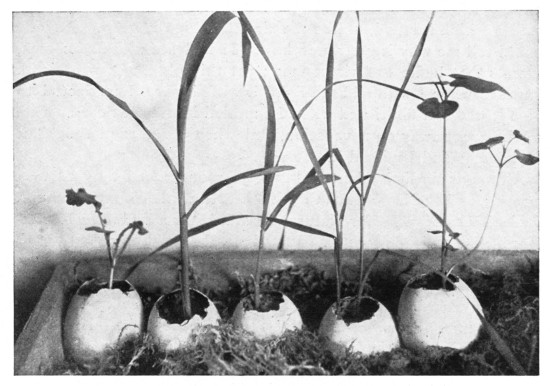
Fig. 297. An egg-shell farm. The plants, from left to right, are: cabbage, field corn, pop-corn, wheat, buckwheat.
Feb. 2. Did not water to-day, for the soil seemed to be moist enough.
Feb. 3. Watered at 10:30 A. M. Teacher told me to be careful not to make the soil too wet.
Feb. 4. Watered at noon.
Feb. 5. Put the cup nearer the stove so that the seeds would come up more quickly.
Feb. 6. The earth is cracking in two or three places. Watered at noon.
Feb. 7. Went to the schoolhouse and found some of the plants coming up.
Feb. 9. Four of the plants are up. (Here tell how they look, or make a few marks to show.)
When your month's record is all complete, send the sheet, or a copy of it, to Uncle John, and this will be your club dues. See how many things you can find out in these four weeks.
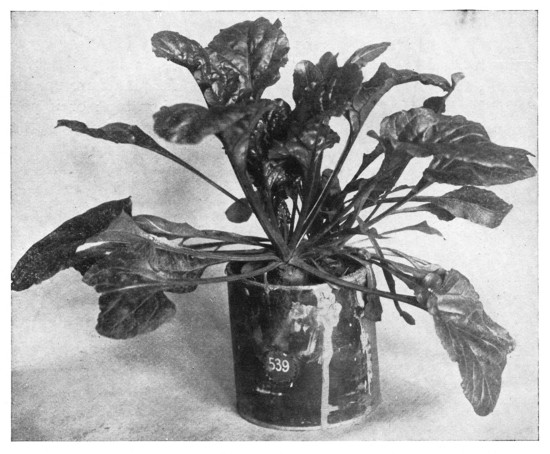
Fig. 298. A window plant that is easy to grow. It is a common garden beet. The end of the beet was cut off so that it could be got into the tin can. A very red beet will produce handsome red-ribbed leaves. In all cases, be sure that the crown or top of the plant has not been cut off too close, or the leaves may not start readily. The beet starts into growth quickly and the growing plant will stand much abuse. It makes a very comely plant for the school-room window. Try carrot, turnip, and parsnip in the same way.
Before the four weeks are past write to Uncle John and he will tell you what next to do. By that time your plants will need transplanting, and he will tell you how to do it. Perhaps you can set some of the plants outdoors later on and see them grow all summer; whether you can or not will depend on the kinds of plants that you grow. If you want to grow asters or cabbages next summer, you can start some of them in February and March.
Quick-germinating seeds, fit for starting in the schoolroom, are wheat, oats, buckwheat, corn, bean, pumpkin and squash, radish, cabbage, turnip. Perhaps some of these require a warmer place than others in which to germinate. If you find out which they are, let Uncle John know.
You can grow the plants in egg-shells, wooden boxes (as cigar boxes), tin cans, flower pots. If you use tin cans it is well to punch two or three holes in the bottom so that the extra water will drain out. Set the can or box in a saucer, plate, or dripping-pan so that the water will not soil the desk or table. It is best not to put it in a sunny window until after the plants are up, for the soil is likely to "bake" or to become hard on top; or if you do put it in such a place, throw a newspaper over it to prevent the earth from drying out.
Suggestions for Plant Study.[70]
Last year hundreds of children sent us records of their plants. This kind of work is most satisfactory to Uncle John. Following is a record which we received in March, from a girl in the fourth grade:
Feb. 16—Monday. I planted seven cabbage seeds in an eggshell. I did not water it.
Feb. 17—Did not see anything.
Feb. 18—Saw a little brown thing.
Feb. 19—Saw a little seed lying on top.
Feb. 20—Saw little sprout.
Feb. 21—Holiday.
Feb. 22—Holiday.
Feb. 23—Holiday.
Feb. 24—Saw two little sprouts.
Feb. 25—The egg-shell was full of sprouts.
Feb. 26—The plant was coming up and the earth was very wet, so I did not water it.
Feb. 27—Saw six sprouts.
Feb. 28—Holiday.
March 1—Holiday.
March 2—Turned the plant around, so it would look toward the light.
March 2—That afternoon I planted the cabbage in a tin can with tissue paper around it, because the cabbage outgrew the eggshell some time ago.
March 3—I put the plant out of the window.
March 4—I did not look at it.
March 5—One of the sprouts began to droop.
March 6—I dug the dirt up around it. Then it was put in the air out of the window.
March 7—Holiday.
March 8—Holiday.
March 9—I put it out of the window.
March 10—It was put out of the window. It was brought in at the close of school.
March 11—Dug the dirt out from the plant and patted it down.
March 12—Watered.
March 13—Put out of the window.
March 14—Holiday.
March 15—Holiday.
March 16—Watered and put out of the window. HELEN.
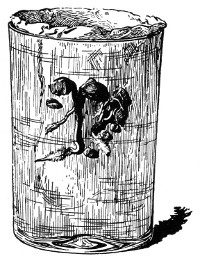
Fig. 299. Radish seeds germinating between blotting-paper and the side of a tumbler.
Was not this a good record for a little girl to make? I wish that she had told something about the soil in which she planted the seeds. This is always important. In winter you may have some difficulty in getting soil, but in the village a florist will let you have some, and in the country you may be able to get it in the cellar of a grocery store or from your own cellar. Perhaps you can find some in the potato bin. When there is a "thaw," get some soil, even if it is very wet; you can dry it near the stove. Perhaps your schoolhouse will be too cold over Sunday in mid-winter to allow you to grow plants. If so, plant the seeds at home.
When you have planted your seeds, unless you take them up every day, you cannot see how the little plants are behaving down under the soil. I want to tell you how you can know some things that the plants are doing without disturbing them.
Choose an ordinary glass (Fig. 299), roll up a piece of blotting paper so that it is a trifle smaller than the glass, and place it inside. Between the blotting paper and the glass, put a few radish seeds or any kind of seed such as you planted in the soil. Keep the blotting paper moist and watch what happens. In four or five days the plants should be "up." Here are some things to think about as you watch them:
1. Note any change in the seeds when they have been moist for a few hours.
2. What happens to the outer coat of the seed?
3. In what direction does the little root grow? The stem?
4. Notice the woolly growth on the root? Does this growth extend to the tip of the root?
5. When the little plant has begun to grow, turn it around so that the root is horizontal. Does it remain in that position?
6. How soon do the leaves appear?
It may interest some of the Junior Naturalists to see the effect of much water on seeds. Suppose you experiment a little along this line. Choose three glasses. In one put seeds into water, in another put them into very wet or muddy soil, and in the third plant the seeds in moist soil, such as seeds are ordinarily planted in. Tell us the results of the three experiments.
A Third-grade Record.
Following is a facsimile reproduction of a spontaneous and unpruned record made by a child in the third grade. The child grew beans in a tumbler against blotting paper, as shown in Fig. 299. I hope that this will illustrate to both teacher and children the value of simple note-taking.
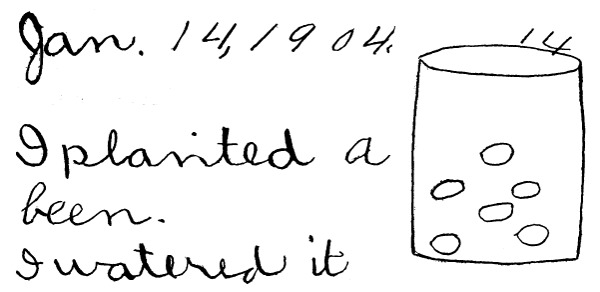
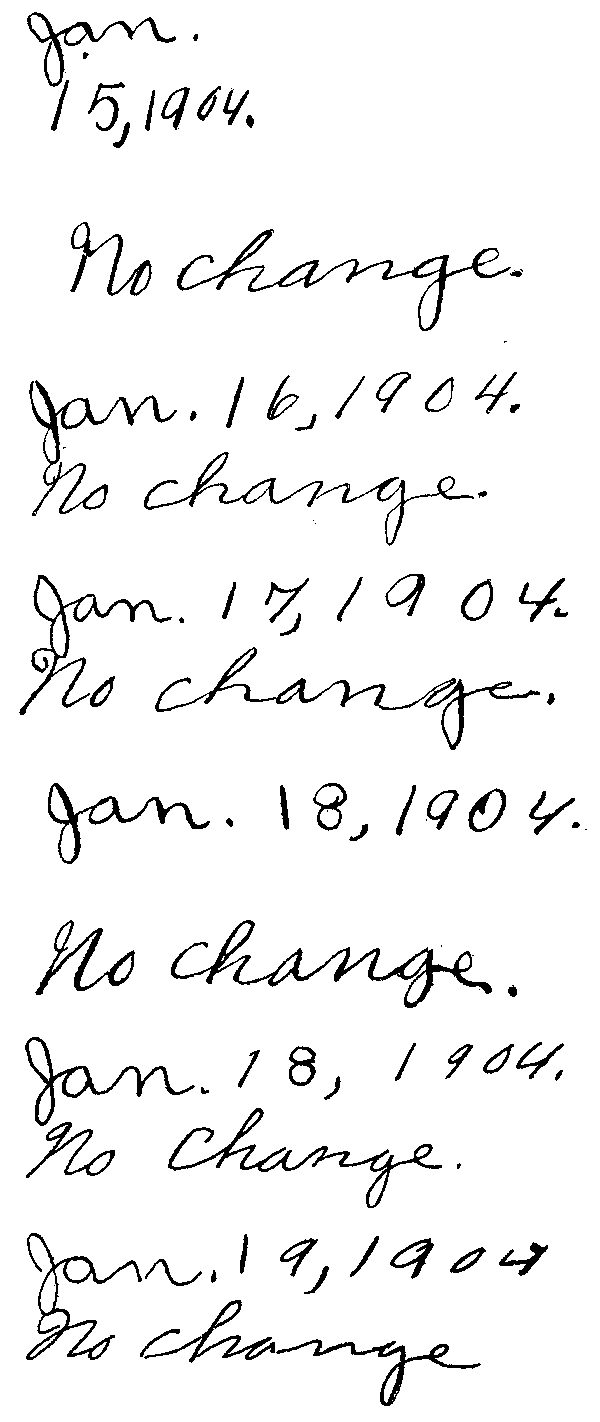
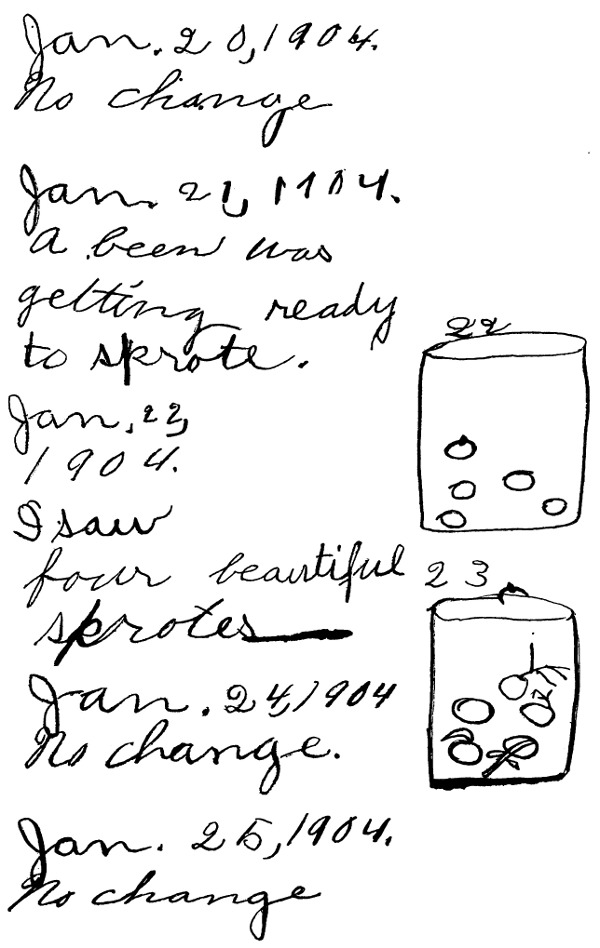
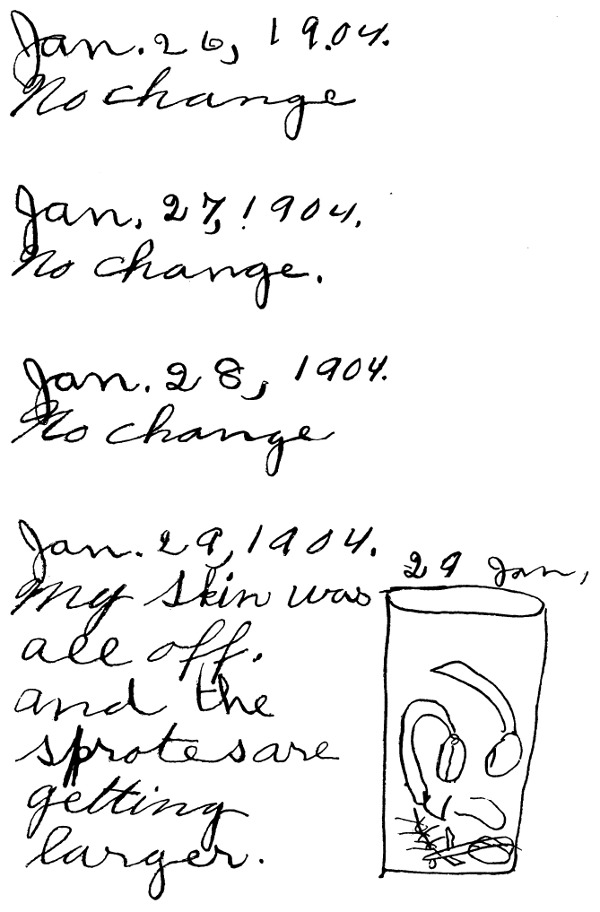
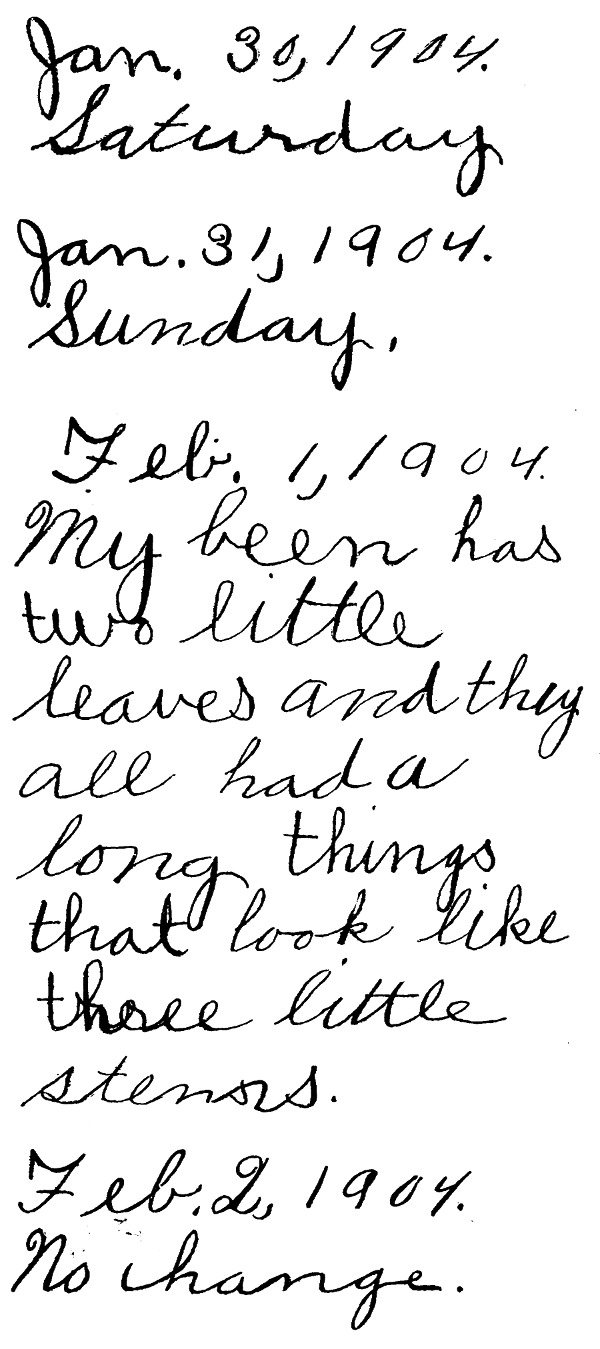
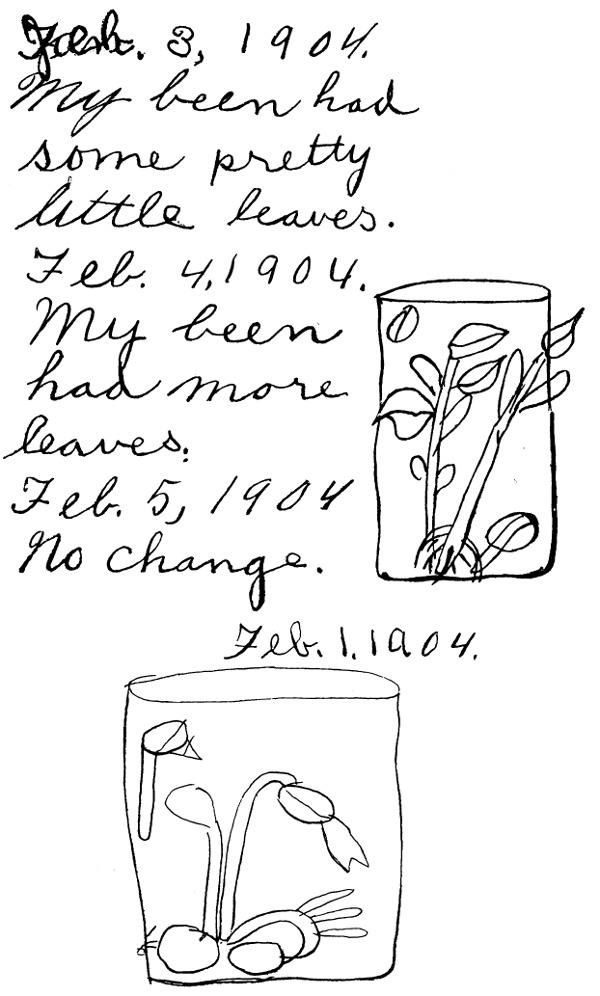
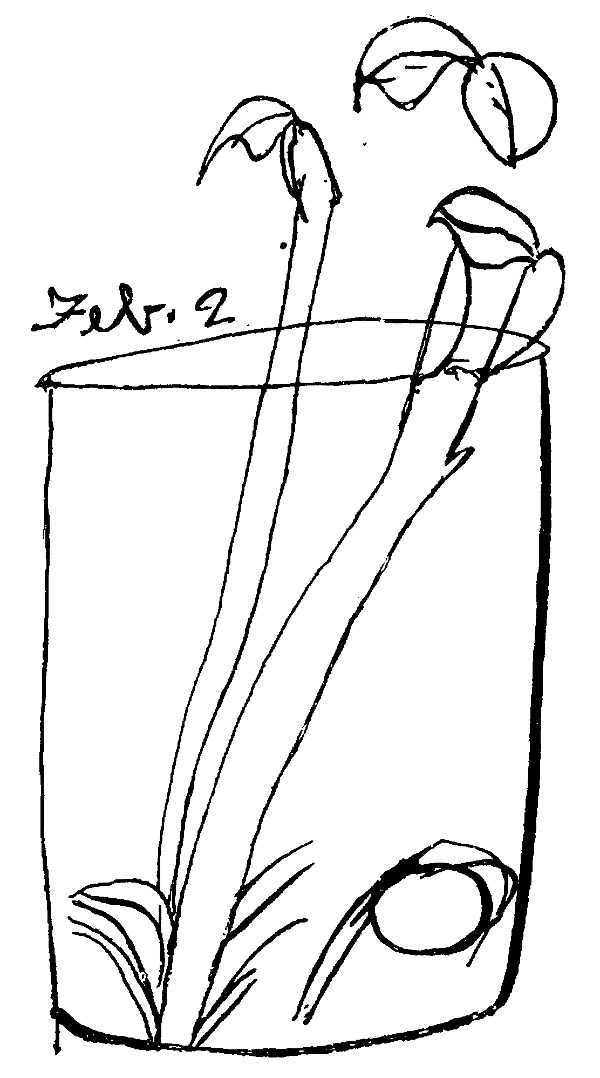
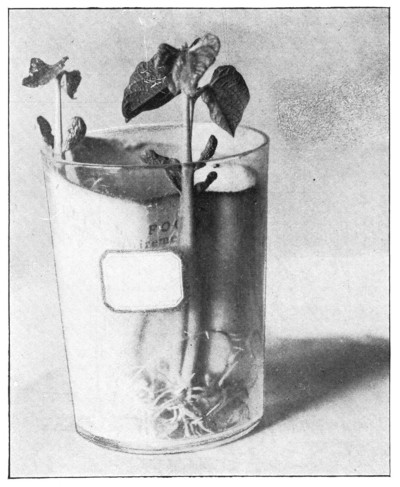
Fig. 300. The bean plants that were grown by the third-grade child.
LEAFLET LIII. AN APPLE TWIG AND AN APPLE.[71] By L. H. BAILEY.
(Compare Leaflet XXXI.)
Yesterday I went over into the old apple orchard. It was a clear November day. The trees were bare. The wind had carried the leaves into heaps in the hollows and along the fences. Here and there a cold-blue wild aster still bloomed. A chipmunk chittered into a stone pile.
I noticed many frost-bitten apples still clinging to the limbs. There were decayed ones on the ground. There were several small piles of fruit that the owner had neglected, lying under the trees, and they were now worthless. I thought that there had been much loss of fruit, and I wondered why. If the fruit-grower had not made a profit from the trees, perhaps the reason was partly his own fault. Not all the apples still clinging to the tree were frost-bitten and decayed. I saw many very small apples, no larger than the end of my finger, standing stiff on their stems. Plainly these were apples that had died when they were young. I wondered why.
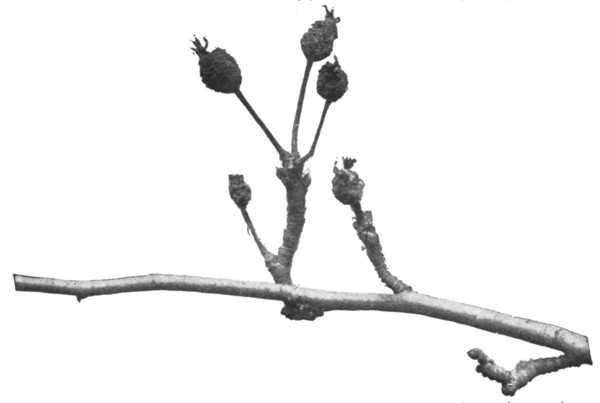
Fig 301. This is the branch that tried and failed.
I took a branch home and photographed it. You have the engraving in Fig. 301. Note that there are three dead young apples at the tip of one branch. Each apple came from a single flower. These flowers grew in a cluster. There were three other flowers in this cluster, for I could see the scars where they fell off.
But why did these three fruits die? The whole branch on which they grew looked to be only half alive. I believe that it did not have vigor enough to cause the fruit to grow and ripen. If this were not the cause, then some insect or disease killed the young apples, for apples, as well as people, may have disease.
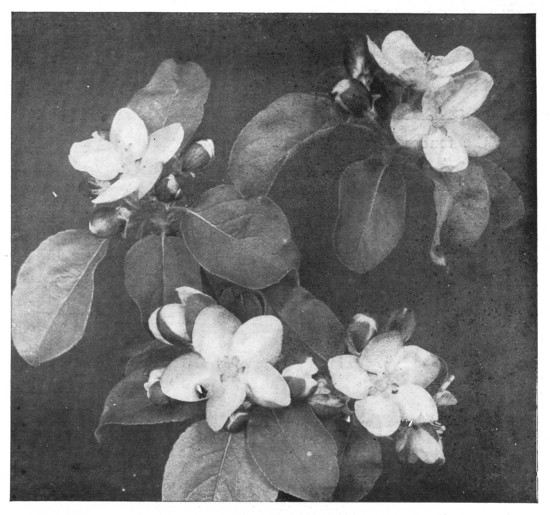
Fig. 302. These are the flowers that make the apples. How many clusters are there?
Beneath the three dead apples, is still another dead one. Notice how shrivelled and dried it is, and how the snows and rains have beaten away the little leaves from its tip. The three uppermost apples grew in 1902; but this apple grew in some previous year. If I could show you the branch itself, I could make you see in just what year this little apple was borne, and just what this branch has tried to do every year since. This branch has tried its best to bear apples, but the fruit-grower has not given it food enough, or has not kept the enemies and diseases away.
The lesson that I got from my walk was this: if the apples were not good and abundant it was not the fault of the trees, for they had done their part.
In the cellar at home we have apples. I like to go into the cellar at night with a lantern and pick apples from this box and that—plump and big and round—and eat them where I stand. They are crisp and cool, and the flesh snaps when I bite it and the juice is as fresh as the water from a spring. There are many kinds of them, each kind known by its own name, and some are red and some are green, some are round and some are long, some are good and some are poor.
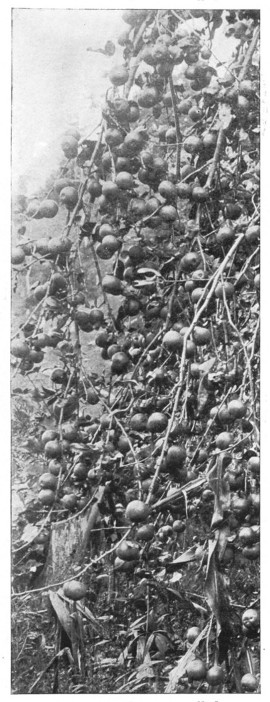
Fig. 303. The apples are usually borne one in a place, although the flowers are in clusters. Why?
Over and over, these apples in the cellar have been sorted, until only the good ones are supposed to remain. Yet now and then I find a decayed heart or a hollow place. The last one I picked up was fair and handsome on the outside, but a black place and a little "sawdust" in the blossom end made me suspicious of it. I cut it open. Here is what I found (Fig. 306). Someone else had found the apple before I had. Last summer a little moth had laid an egg on the growing apple, a worm had come from the egg and had eaten and eaten into the apple, burrowing through the core, until at last it was full grown, as shown in the picture. Now it is preparing to escape. It has eaten a hole through the side of the apple, but has plugged up the hole until it is fully ready to leave. When it leaves it will crawl into a crack or crevice somewhere, and next spring change into a pupa and finally come forth a small, dun-gray moth. This moth will lay the eggs and then die; and thus will be completed the eventful life of the codlin-moth, from egg to worm and pupa and moth. But in doing all this the insect has spoiled the apple. The insect acts as if the apple belonged to him; but I think the apple belongs to me. I wonder which is correct?
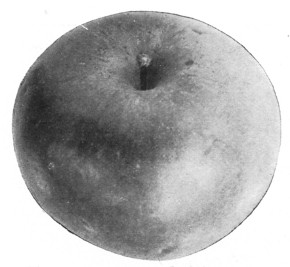
Fig. 304. The Baldwin apple. How many kinds of apples do you know?
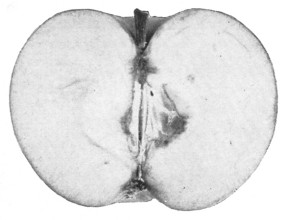
Fig. 305. The same Baldwin apple cut in two.
Some of these apples are sound and solid on the inside, but they have hard blackish spots on the outside (Fig. 307). This is a disease—the apple-scab. This scab is caused by minute plants and these plants also claim the apple as their own. There are ways by means of which the apple-grower is able to destroy the codlin-moth and the apple-scab; and thereby he secures fair and sound apples.
Insects and diseases and men are all fighting to own the apple.
Ten Things to Learn from an Apple.
When you write your dues to Uncle John on the apple, answer as many of the following questions as you can. You can get the answers from an apple itself. He does not want you to ask anyone for the answers:
1. How much of the apple is occupied by the core?
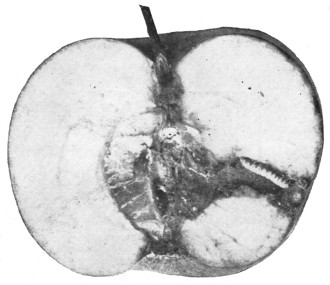
Fig. 306. This is an apple in which a worm made its home.
2. How many parts or compartments are there in the core?
3. How many seeds are there in each part?
4. Which way do the seeds point?
5. Are the seeds attached or joined to any part of the core? Explain.
6. What do you see in the blossom end of the apple?
7. What do you see in the opposite end?
8. Is there any connection between the blossom end and the core?
9. Find a wormy apple and see if you can make out where the worm left the apple. Perhaps you can make a drawing. To do this, cut the apple in two. Press the cut surface on a piece of paper. When the apple is removed you can trace out the marks.
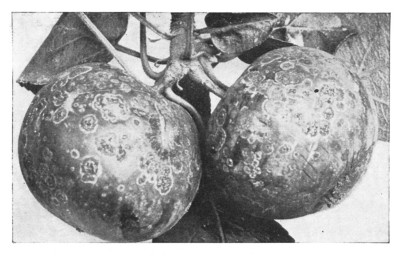
Fig. 307. These are the apples on which other plants are living.—The apple-scab.
10. When you hold an apple in your hand, see which way it looks to be bigger—lengthwise or crosswise. Then cut it in two lengthwise, measure it each way, and see which diameter is the greater.
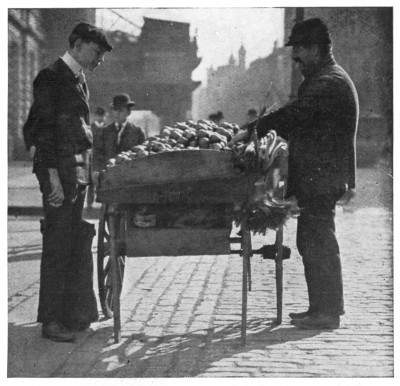
Fig. 308. Here is where city boys and girls buy their apples.
LEAFLET LIV. TWIGS IN LATE WINTER.[72] By ALICE G. McCLOSKEY.
Along a country road, through a drifted field, over a rail fence, and into the woods I went, gathering twigs here and there as I passed. A February thaw had come and these first messengers of spring, reaching out from shrub and tree, were beginning to show signs of life. Many young people do not believe that spring is near until they hear a robin or a bluebird. The bare little twigs tell us first. Look at them as you go on your way to school. Are they the same color in February that they were in the short December days?
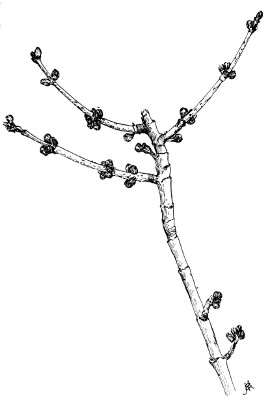
Fig. 309. Red or swamp maple.
When I reached home with my bundle of twigs, it was "fun" to sit by the window and study the strange little things. They were so different one from another, and so interesting in every way, that I decided to ask our boys and girls to gather some winter twigs and tell us about them. Select your twigs from the butternut, willow, hickory, horsechestnut, apple, plum, plane-tree, maple, or any other tree that you come across. Here are some suggestions that will help you in your study:
1. How many colors do you find in one twig? Count the tints and shades. I found eight colors on a small maple branch (Fig. 309).
2. Notice the differences in several twigs as they lie on the table. What makes them look so different: size, shape, color, arrangement of buds, the size or shape of the buds?
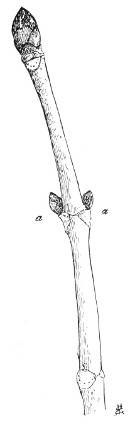
Fig. 310. Horsechestnut.

Fig. 311. Butternut.
3. On how many twigs are the buds opposite each other? Note the opposite buds on the horsechestnut (Fig. 310). On how many are they alternate? Are the buds opposite on the butternut (Fig. 311)?
4. Which twigs bear the buds singly?
5. When you find two or more buds growing together on a stem, is there any difference in the size of the buds?
6. On how many of the twigs can you see a scar left by the leaf when it dropped off (Fig. 310 and Fig. 311 a, a)? Compare the leaf scars on different twigs. Notice the strange scar on the butternut (Fig. 311). It looks like the face of an old sheep.
7. Do you see any cocoons on your twig?
8. You all know the rings on an apple twig that tell how much it grew each year. Do you find rings on other twigs? Do you see them on any of these pictures?
9. What do you suppose makes these rings? Do you think there was once a large terminal bud where these rings are?
LEAFLET LV PRUNING.[73]
By ALICE G. McCLOSKEY.
(Compare Leaflet XLVI.)
First snow, then sleet, and then a down-pour of rain—it stormed all day. At night-fall it grew colder. The wind blew fiercely. The twigs and branches fell on the white crust which covered the earth. Nature was pruning the trees.
Have you ever seen your father go into the orchard and prune his trees? Why did he do it? Compare the work done by nature and that which your father does. Which seems to be the more careful pruner?
Let us experiment a little. It will please Uncle John. He always wants his boys and girls to find out things for themselves. Select a branch of lilac or some other shrub. Mark it so that you will always know it. Count the buds on the branch. Watch them through the spring and the summer. Note the number that become branches. You will then know that nature prunes the trees.
If you think a minute, you will see that pruning is necessary in the plant world. Suppose a branch has thirty buds, and that every bud should produce thirty branches, each of which in turn should produce thirty more,—do you think there would be any room left in the world for boys and girls? Would a tree be able to hold so many branches?
You certainly have noticed decayed holes in trees. Did you ever wonder why they were there? I suppose that most persons never wonder about it at all; or if they do give it any passing thought, they say it is only "natural" for trees to have rotten spots. But these rotten spots mean that once the tree was injured. Perhaps the injury was the work of a careless or thoughtless man who pruned the tree. Very few persons seem really to know how to remove the limbs of a tree so that the wound will heal readily.
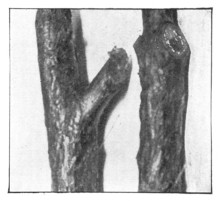
Fig. 312. The wrong way and the right way to remove a limb.
As you go and come, observe how the trees have been pruned. Do you see long "stubs" left, where limbs have been cut? Yes; and that is the wrong way to cut them. They should be cut close to the main branch or trunk, for then the wounds will heal over better (Fig. 312). If we abused our cows and horses, as we sometimes abuse our shade trees, what would become of the animals?
Did you ever see trees that were mutilated to allow of the stringing of telephone and telegraph wires?
Who owns the shade trees along a street or public highway?
LEAFLET LVI THE HEPATICA.[74] By ALICE G. McCLOSKEY.
(Compare Leaflet XL.)
Something new and pleasant happened in my life this year. In February, while the wood was snow-covered and the roadsides piled high with drifts, I saw hepaticas in bloom.
Oh, no! I did not find them out of doors. I had all the fun of watching them from my warm chimney-corner. Then when winds blew fiercely I often went to the window where they grew and buried my head in the sweet blossoms. What do you suppose they told me? If some winter day you feel their soft touch on your face, and smell their woodsy fragrance, you will hear the message.
Perhaps you want to know how the hepaticas found their way into my window-box. Last fall as I walked through a leafy wood I gathered a few plants, roots and all, that I had known and loved in spring and summer days. Among them were hepaticas. These I laid away in the cellar until the first of February. Then I planted them in a corner of the window-box that I had left for them.
Since the little woods plants have come to live with me I have learned to know them well. Perhaps the most important lesson they have taught me is this: The blossoms may be the least interesting part of a plant. Will you find out what hepaticas have to tell as the seasons pass?
Even before you hear the first robin, go into the woods, find one of the hepaticas, and mark it for your own. You will know it by the old brown leaves. Then watch it day by day. The following questions will help you to learn its life story:
1. Where do hepaticas grow, in sunny or shady places? During which seasons do they get the most sunlight?
2. Watch the first sign of life in the plant. Do the new leaves or the flowers come first?
3. Look at the hepatica blossom a long time. How many different parts can you see in it? Whether you know the names of these parts now does not matter. I want you to see them.
4. Notice the three small, green, leaf-like parts that are around the flower bud. As the flower opens see whether they are a part of it, or whether they are a little way from it on the stem.
5. Observe the stem closely. Is it short or long? Hairy or smooth?
6. As the new leaves appear find out whether they are fuzzy on the inside as well as on the outside. Notice how they are rolled up and watch them unroll.
7. In how many different colors do you find hepaticas?
8. Do some smell sweeter than others? If so, does color seem to have anything to do with it?
9. Look at a hepatica plant at night or very late in the afternoon. Also watch it early in the morning and in cloudy weather. Then look at it in bright sunshine. Do you see any change in the flowers? I think you will discover something of much interest.
10. Seed-time among hepaticas is very interesting. Notice what becomes of the three small, leaf-like parts that were underneath the flower. How many seeds are there?
11. How long do you think the leaves of hepatica remain on the plant? Do you suppose they remain green all winter?
12. What becomes of the hepatica plant after it blossoms? Did you ever see one in summer? Describe.
LEAFLET LVII JACK-IN-THE-PULPIT.[75] By ALICE G. McCLOSKEY.
(Compare Leaflet XLI.)
They call him Jack-in-the-Pulpit, he stands up so stiff and so queer
On the edge of the swamp, and waits for the flower-folk to come and hear
The text and the sermon, and all the grave things that he has to say;
But the blossoms they laugh and they dance, they are wilder than ever to-day;
And as nobody stops to listen, so never a word has he said;
But there in his pulpit he stands, and holds his umbrella over his head,
And we have not a doubt in our minds, Jack, you are wisely listening,
To the organ-chant of the winds, Jack, and the tunes that the sweet birds sing!
Lucy Larcom.
"It is Indian turnip," said I.
"No," said Grandmother, "it's memory root. If you taste it once you will never forget it." And what Grandmother said to me so long ago, I say to every boy and girl, "If you taste it once you will never forget it."
But of all the names for this strange little wood plant, I like Jack-in-the-pulpit best. Though never a word has it said in our lifelong acquaintance, it has been a helpful little "country preacher" to me. As we go into the woods this year, let us make up our minds that we will know more than we ever have known before of its interesting life.
Where do you find the Jack-in-the-pulpit? In what kind of soil does it grow? How does it first come up?
What is the shape of the root? One is enough for the whole class to study and it should be planted again. We do not want the Jack-in-the-pulpit to disappear from our woods.
Does the little hood fold over at first?
The hood or "umbrella" is not the flower. You will find the flowers on the little central stalk that you call "Jack." See whether the blossoms are alike. Look at the blossoms on several plants. Place a stick by the side of one of these plants so that you will know it later in the year when the Jack-in-the-pulpit has disappeared.
Notice whether there are insects in the lower part of the flower stalk. If so, can they get out?
When the blossom has gone, look for the seeds. What color are they in June? In August?
Have you any house plant that you think is related to Jack-in-the-pulpit?
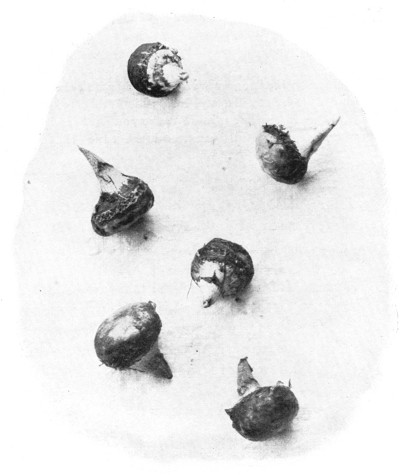
Fig. 313. Tubers of Jack-in-the-pulpit, or Indian turnip.
LEAFLET LVIII. THE DANDELION.[76] By ALICE G. McCLOSKEY and L. H. BAILEY.
The first warmth of spring brought the dandelions out of the banks and knolls. They were the first proofs that winter was really going, and we began to listen for the blackbirds and swallows. We loved the bright flowers, for they were so many reflections of the warming sun. They soon became more familiar, and invaded the yards. Then they overran the lawns, and we began to despise them. We hated them because we had made up our minds not to have them, not because they were unlovable. In spite of every effort, we could not get rid of them. Then if we must have them, we decided to love them. Where once were weeds are now golden coins scattered in the sun, and bees revelling in color; and we are happy! L. H. Bailey.
Suggestions for Study.
I. Ask your teacher to let you go out of doors for ten minutes to look at dandelions. In your note books write answers to the following questions:
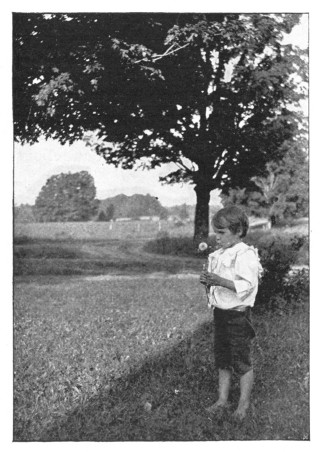
Fig. 314. Blow the dandelion balloon!
1. At what time of day are you looking for the dandelions? Is the sun shining, or is the sky overcast? Make up your mind to notice whether dandelions behave the same at all hours of the day and in all kinds of weather.
2. How many dandelions can you count as you stand on the school-ground? The little yellow heads can be seen a long distance.
3. Where do they prefer to grow,—on the hillsides, along the roadsides, in the marshes, or in your garden?
II. Gather a basket full of blossoming dandelions, roots and all, take them to school, and ask the teacher to let you have a dandelion lesson. Here are some suggestions that will help you:
1. Each pupil should have a plant, root and all. Describe the plant. Is it tall or short? How many leaves are there? How many blossoms?
2. Hold the plant up so that you can see it well. How many distinct colors do you find? How many tints and shades of these colors?
3. Look carefully at the blossom. How many parts has it? How much can you find out about the way in which the yellow head is made up?
III. Mark a dandelion plant in your garden. Watch it every day. Keep a record of all that happens in its life. Later in the year send Uncle John a little history or account of the plant you have watched.
Dandelion.
Dear common flower, that grow'st beside the way, Fringing the dusty road with harmless gold, First pledge of blithesome May, Which children pluck, and, full of pride uphold, High-hearted buccaneers, o'erjoyed that they An Eldorado in the grass have found, Which not the earth's ample round May match in wealth, thou art more dear to me Than all the prouder summer-blooms may be.
—Lowell.
LEAFLET LIX MAPLE TREES IN AUTUMN.[77] By ALICE G. McCLOSKEY.
(Compare Leaflets XLVII and XLVIII.)
The hills are bright with maples yet, But down the level land The beech leaves rustle in the wind, As dry and brown as sand. The clouds in bars of rusty red Along the hill-tops glow, And in the still sharp air the frost Is like a dream of snow.—Alice Cary.
The hills are bright with maples about the time Jack Frost appears, and many people say that he makes the leaves turn red and yellow. Wise folk tell us, however, that Jack Frost is not the artist; that leaves change to autumn tints when their work is completed.
Boys and girls may not know that leaves "work;" yet all through the long summer days when you have been playing in the shade of some old maple, the leaves over your head have been very busy. Uncle John says that each leaf is a "starch factory," and this is true. Starch is necessary for plant food and it is manufactured in the leaves. The green leaves and stems are the machinery, which is run by sunlight. Look at a large branch of maple and see how the leaves are arranged to catch every sunbeam. The more light the green parts of the tree get, the more plant food can be made and the sturdier and handsomer the tree.
But the story of the way in which the plant food is made is a long one and not easy for young people to understand. This can come later when you have become familiar with the many interesting things that you learn by watching the tree and by studying with the microscope.
If I should to go into your school-room and should ask how many boys and girls know a sugar maple, I suppose every hand would be raised. But if I should ask: "When does the sugar maple blossom?" "What do the blossoms look like?" "When do the winged seeds fall?" I wonder how many could give me satisfactory answers to my questions!
Choose some fine old maple for study. The one that stands near the door will be best, since you can see it every day. Write in a note book all that you can find out about it as the weeks go by.
Suggestions for Fall Study.
1. Notice how the leaves turn to the sunlight.
2. Try to find two leaves exactly alike in color, form, size, length of stem, etc. If you succeed send them to Uncle John.
3. How many different tints can you find in a single leaf?
4. As you look at two sugar maple trees, do they seem to be colored alike?
5. Are all sugar maples that you know the same shape?
6. How are the leaves arranged on the branch?
7. Can you find any winged seeds near the tree? If so, plant one in a box of earth and see whether it will grow.
8. If you find any plants growing beneath the maple tree, describe them or tell what they are.
9. Do you know any other kinds of maples? How do you distinguish them?
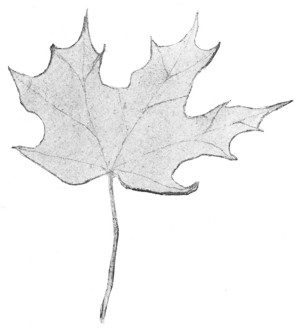
Child's drawing of a maple leaf. Fifth grade. (Reduced.)
LEAFLET LX A CORN STALK.[78] By ALICE G. McCLOSKEY.
(Compare Leaflets XLII and XLIII.)
"Tom," said I to a young friend who stood by the window tossing a ten-cent piece into the air, "what plant is used for part of the design on that coin?"
The boy did not answer right away. I do not believe he had ever looked at it closely; yet this is one of the prettiest of our silver pieces. After a few minutes he said, "It is corn, isn't it?"
Hearing a note of surprise in his voice, I told him something about corn-raising in this country. We then decided that it is a good thing to represent corn on one of the United States coins, since it is a source of much of our wealth.
But aside from its value, Indian corn should interest us because it is a wonderful plant. Boys and girls do not know much more about it than does any old black crow. You have watched the farmer plant corn and you like to eat it. Jim Crow has watched the farmer plant corn and he likes to eat it, too. The time has come, however, when you can get ahead of him if you care to; and to get ahead of crows on the corn question is worth the while. Let me tell you how to do it.
1. Secure a kernel of corn, cut it in halves, and note the food inside it. This food was stored in the seed by the parent plant. Uncle John would say that it is the "lunch" that the mother puts up for her children. What must happen before the food can be used by the little plant?
2. Place some moist soil in a tumbler, and put a kernel of corn in it near the side so that you can watch it grow. How soon does the root appear? The leaves? How many leaves come up at one time?
3. Ask your father to give you a small piece of ground in the garden. Plant a few kernels of corn so that you will have some plants of your own to study this summer. Other people's plants are never so interesting as our own.
4. As your corn plants push their way up into the light and air, watch them every day. Notice how the new leaves are protected by the next older ones.
5. Is the stem hollow or solid? In which way would it be stronger?
6. Notice the joints. Are they the same distance apart throughout the length of the stem? Does the distance between the joints always remain the same? Measure them some day; then in a week measure them again.
7. Where does the stalk break most easily?
8. Where does the leaf clasp the stalk?
9. Notice how strong the leaf is. In what direction do the ribs extend? If these long narrow leaves were not strong what would happen to them as they wave back and forth in the wind?
10. Have you ever noticed the ruffled edges of the leaves? As you bend them you will see that the edges do not tear.
11. There are two kinds of blossoms on a corn plant. The ear bears one kind, the tassel the other. If you were to cut all the tassels from the plants in your garden, the kernels would not grow on the ears. Later on you will learn why.
12. Watch the ear closely as it grows.
13. Follow a thread of silk to the place where it is attached. Notice whether there is one silk for each kernel.
14. When the corn is in the milk stage it is preparing to store up food for the young plants. How does it taste at this time?
15. Look closely at the base of the corn stalk and you will see roots extending obliquely into the soil. These are the brace roots. Of what use do you think they are to the corn stalk?
LEAFLET LXI IN THE CORN FIELDS.[79] By ALICE G. McCLOSKEY.
(Compare Leaflets XLII and XLIII.)
"Caw caw!" said Jim Crow as he flew over our heads. "Was he jeering at us?" we wondered, the children and I. Perhaps he was inquisitive to know what business we had in the open country and in the fields of corn. Perhaps he was not concerned with us at all. Very likely crows are less concerned with us than we think they are.
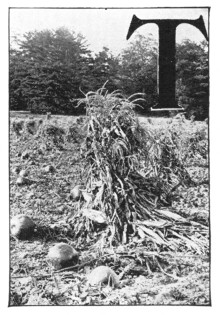
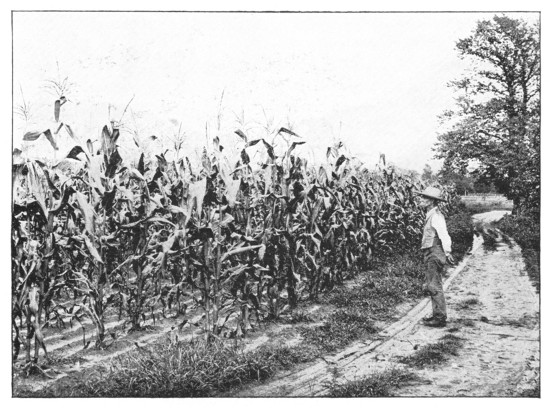
Jim Crow flew on out of sight, but we stayed among the ripening corn. The ears were filling out. The ends of the silk were turning brown. We saw many things that we had planned to look for in vacation: the tall stem, the brace roots, the long strong leaves and the way the ribs extend in them, the ruffled edges of the leaves, the two kinds of blossoms, and where each silken thread is attached. The whole story was before us.
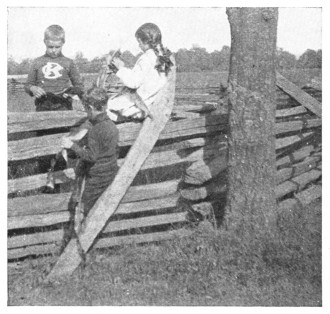
Fig. 315. Over the fields in corn-harvest time.
But this is the harvest time and we are ready to learn a new lesson from the corn fields. As we watch them now let us answer the following questions:
1. How is the corn cut?
2. How many ears do you find on a stalk?
3. Are the ears on the same side of the stalk or on opposite sides?
4. Take into the school room as many kinds of corn as you can find and describe each as follows:
a—The shape and color of the kernel. b—Number of rows of kernels. c—The number of kernels in each row.
5. Perhaps the girls will pop some corn and bring it to the Junior Naturalist Club meeting. Let them try to pop field corn. Cut kernels in two of field corn and pop-corn, and report whether they differ. Why does pop-corn pop?
6. Make a list of the foods for which corn is used.
7. Why are pumpkins planted among corn?
8. Why not make for your school room some decorations from ears of corn?
LEAFLET LXII. THE ALFALFA PLANT.[80] By L. H. BAILEY and JOHN W. SPENCER.
(Compare Leaflet XXXIV.)
All the things that the farmer sells are produced by plants and animals. The animals live on the plants. It is important that we know what some of these plants are.
Some plants are grown for human food. Such are potato, wheat, apple, lettuce. Some are grown only to feed to animals. Such are grasses and clover,—plants that are made into hay.
Hay is the most important crop in New York State. In fact, New York leads all the States in the value of the hay and forage. This value is more than 66 millions of dollars.
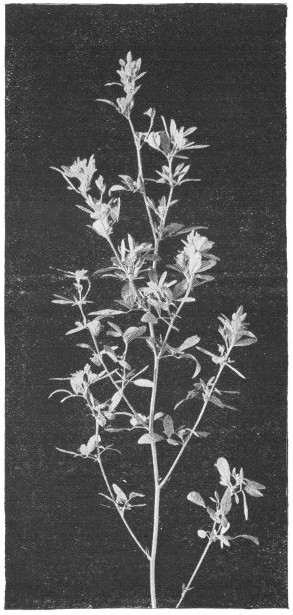
Fig. 316. Sprig of the alfalfa plant.
Hay is important in New York also because there are so many dairy cattle in the State. There are more than one and one-half millions of dairy cattle in New York. In the value of the milk and butter and cheese, New York also leads all other States. There are also great numbers of beef cattle, horses, mules, and sheep. All these millions of animals must be supplied with hay in our long cold winters.
Hay is made in New York State from grasses and clover. Suppose we could find some plant that would yield twice as much hay as clover yields, and yet be as nutritious,—you can readily see how valuable such a plant would be to the State. It would be better than a gift of millions of dollars. Such a plant is alfalfa.
Now that you know something about alfalfa in a general way, I want you to know how the plant looks and how it grows. It is not yet very well known even among farmers, but its cultivation is increasing every year. You will probably know where there are fields of it. Sometimes it grows along roadsides as a weed. Last spring Uncle John offered to send a small packet of alfalfa seeds to any Junior Naturalist who wrote for it. He sent about 5,000 packets. But if you do not know the plant or cannot find it, write at once to Uncle John and he will send you some by mail from the University farm.
Let us see how many school children in New York State will know what alfalfa is between now and Thanksgiving time. When writing to Uncle John about alfalfa, try to answer as many of the following questions as possible from your own observation:
1. Does the plant remind you of any other plant that you ever saw? Of what?
2. How does it grow,—straight up or spreading out on the ground?
3. How many stalks come from one root?
4. What are the leaves like? Mark out the shape with a pencil.
5. What are the flowers like? Do you know any other flowers of similar shape? What is the color?
6. If possible, dig around a plant and describe how the root looks. Does it branch into many fibres, as grass roots or corn roots do?
Uncle John's Letter About the Alfalfa Gardens.
My Dear Boys and Girls:
Do you know much about the alfalfa plant? Do you remember that last spring we promised to send a packet of seed to each of you who asked for it? Did you send your name asking that you be served? We received the names of several thousand children asking for seed and I am wondering whether you are one of them. If so, did you sow the seed? Will you write me a letter telling me what became of it?
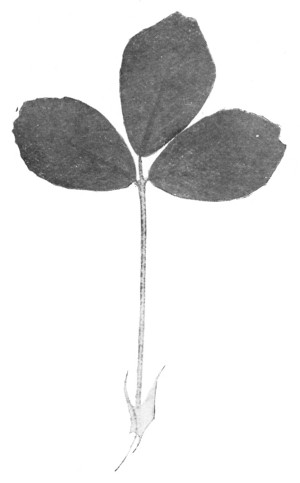
Fig. 317. What leaf is this? Is it enlarged?
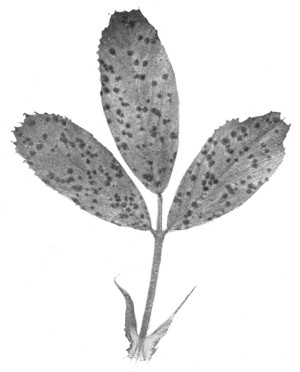
Fig. 318. Leaf of alfalfa. What significance have the spots?
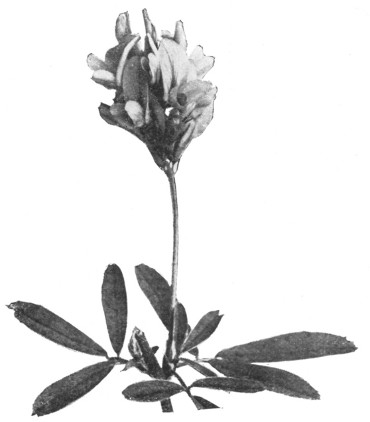
Fig. 319. Flowers of the alfalfa. Are they natural size?
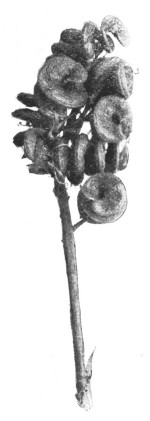
Fig. 320. Alfalfa pods. How much enlarged?
I am very fond of children's letters. Each year I receive more than thirty thousand of them. I sometimes wonder whether there is another man who is honored by so many letters from young people, for I count it an honor to be so remembered.
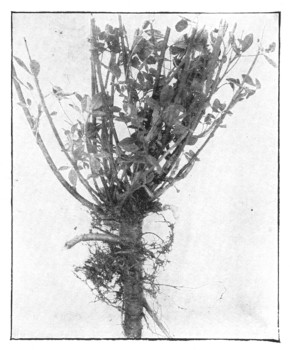
Fig. 321. Crown of the alfalfa plant, showing how root and top start off.
As large as that number is, I cannot spare one letter. I always want a few more. All your letters are read and I take great pains to answer all questions. If, by any oversight, you have been missed I am sorry. I know what it costs a boy or girl to write a letter. I never open one without feeling that the writer is a friend of mine, otherwise he would not have expended so much hard work to write it.
School has now begun and of course you are very busy, and so is your teacher. One of the best opportunities to write letters is in school. Please ask your teacher whether you may not write me during your language period. You may say that she may make authors of all of you if she can, but I will do all I can to help you become good letter writers. Ask her whether a letter to me may not be a substitute for a composition.
In your letter you may tell me your experience with alfalfa. Tell me your failures as well as your successes. Even though you received your seeds and did not sow them, tell me that. I shall never find fault with you for telling me the truth. If you sowed the seed and the plants did not do well, tell me that also. The plants may look very small and uninteresting to you this year, but next year they may surprise you.
In some parts of the United States the alfalfa crop is of great value and the loss of it would bring distress to many farmers. I am wondering whether the crop, as raised in all parts of our country, is not worth more money than all the gold found in the Klondike, taking the two year by year. I do not know how that may be. I am wondering. Men by the thousand have gone to the gold mines and endured many hardships and later returned with less money than those who had remained at home and took care of their alfalfa.
It may be that a mine of wealth lies very near you, and to get it you may have to ask alfalfa to find it and bring it to you. Gold cannot be found in all places in a gold country and alfalfa may not feel comfortable and grow in all parts of a good farming country. What we asked of you last spring was that you become alfalfa prospectors and later tell us what you found.
JOHN W. SPENCER.
LEAFLET LXIII THE RED SQUIRREL.[81] By ALICE G. McCLOSKEY.
(Compare Leaflet XLIX.)
The squirrel came running down a slanting bough, and as he stopped twirling a nut, called out rather impudently, "Look here! just get a snug-fitting fur coat and a pair of fur gloves like mine and you may laugh at a northeast storm."—Thoreau.
For a cheery companion give me the red squirrel! I enter the woods and there the little fellow is, ready to welcome me. "What a fine day it is for gathering nuts!" he seems to say, and straightway, as I listen to his merry chatter, I think it is a fine day for any sport that includes him and the brown November woods.
Young naturalists may think it is a difficult thing to become acquainted with red squirrels, but you will often find them willing to be sociable if you show them a little kindness. I have many times watched two or three squirrels playing about a friend as she sat in her garden. They seemed to find her nearly as interesting as the old pine tree near by. They are inquisitive animals.
"How did you tame them?" I asked.
"I fed them occasionally," she replied. "At first I put some nuts on the grass several feet away from me. Then I gradually placed a tempting meal nearer and nearer until the little fellows seemed to lose all fear of me."
If we care to, you and I, we can learn a great deal about red squirrels before another year has passed. If you live on a farm you should know the habits of all the wild creatures about you. You can then be just to them, and decide whether or not you can afford to let them continue to be tenants on your farm. You will find that all of them have interesting lives.
The Red Squirrel. A. B. C.
Just a tawny glimmer, A dash of red and gray,— Is it a flitting shadow, Or a sunbeam gone astray? It glances up a tree trunk, And from some branch, I know A little spy in ambush Is measuring his foe. I hear his mocking chuckle; In wrath he waxes bold, And stays his pressing business To scold and scold and scold.
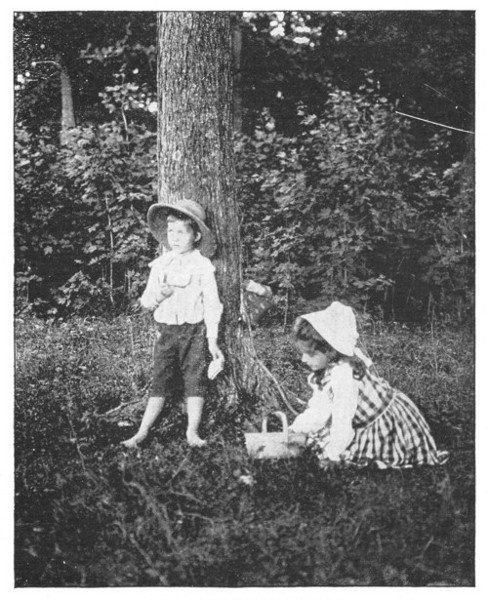
Fig. 322. In the haunts of the red squirrel.
Questions About the Red Squirrel.
1. What is the color of the red squirrel? Is he really red? Is his entire coat of one color? Does he wear different colors in winter and summer?
2. Did you ever see a red squirrel's nest? If so, describe it.
3. Does the red squirrel hibernate; that is, does he sleep all winter as the chipmunk does?
4. What does a red squirrel eat? Did you ever see him getting the winged seeds out of a pitch pine cone?
5. Do you believe a squirrel ever planted an oak? Give a reason.
6. If you live in the country, you have seen red squirrels running on the rail fences. Why do they like rail fences? Do you see them so often on other kinds of fences?
7. Notice the tracks made in the snow in winter woods. Try to find whether the red squirrel's is among them.
8. If you know any other kinds of squirrels, tell how they differ from the red squirrel.
LEAFLET LXIV ROBIN.[82] By L. H. BAILEY.
The drifts along the fences are settling. The brooks are brimming full. The open fields are bare. A warm knoll here and there is tinged with green. A smell of earth is in the air. A shadow darts through the apple tree: it is the robin!
Robin! You and I were lovers when yet my years were few. We roamed the fields and hills together. We explored the brook that ran up into the great dark woods and away over the edge of the world. We knew the old squirrel who lived in the maple tree. We heard the first frog peep. We knew the minnows that lay under the mossy log. We knew how the cowslips bloomed in the lushy swale. We heard the first soft roll of thunder in the liquid April sky.
Robin! The fields are yonder! You are my better self. I care not for the birds of paradise; for whether here or there, I shall listen for your carol in the apple tree.
Our lesson on robin shall be a lesson out of doors. We shall leave the books behind. We shall see the bird. We shall watch him and make up our minds what he is doing and why. We shall know robin better; and robin lives in the fields.
Perhaps you think you know robin. Suppose that one of your friends never saw a robin; do you think you could close your eyes and describe him so that your friend would know how the bird looks?
Then tell me where robin builds its nest, and of what materials; and how many eggs are laid and their color; and how long the mother bird sits; and how long the fledglings remain in the nest. You can readily find a family of robins in some near-by tree, or perhaps even on the porch; and you can learn all these things without ever disturbing the birds.
I want you to watch a bird build its nest. You may think that you know how robin builds, but can you really tell me just how the bird carries the mud, and where it finds the other materials, and how long the building operation continues? Do both birds take part in the building?
Then I want to know whether you can tell the difference between father robin and mother robin. Did you ever notice whether robins that come first in the spring have brighter breasts than those that come later? And can you explain?
Tell me, too, what robin does with his year. You know when he comes in spring and when he builds and when the speckled young ones fly. But where is he in summer and fall and winter? And what is he about all this time? Does he build another nest and rear another family, or does he go vacationing? And does he gather the same kind of food in spring and summer? Does he gather cherries for his family or for himself? Did you ever see robin in winter in New York?
What can you tell me about the song of robin? Does he sing all the year? Or does he have a different note for summer? Not one of you can tell how many different notes and calls robin has. I sometimes think that robin knows several languages.
I have seen many more springs than you have seen: and yet I always wait for robin on the lawn. I often wonder whether the same robins come back to my lawn. They seem to go to business at once. They hop with the most confident air, and day after day pull strings out of the ground. You know what these strings are: but do you know how robin finds them? Is it by smell, or sight, or feeling, or hearing? Do you suppose he is listening when he cocks his head to one side and then to the other? Or is he merely making motions? And I wonder whether birds and animals usually make motions just for the sake of making them?
I have asked you many questions, and not one of you can answer. Perhaps I cannot answer. You ask, "What's the use?" If you can see robin, and learn why, you can also learn other things. But I like robin just because he is robin.
There is one thing more. You will read about robin redbreast. Who is he? Find out for me whether robin redbreast of Europe and of English poetry is the same as our American bird.
LEAFLET LXV CROWS.[83]
By ALICE G. McCLOSKEY.
(Compare Leaflet XXIV.)
At a wigwam in the Adirondack Mountains a tame crow lives with a family of Indians. These Indians make baskets of birch bark and other things that they find out of doors, and sell them to visitors who spend their summer in the mountains. The little crow helps in the business. He makes himself so interesting to the passers-by that they stop to watch him. The Indians then have an opportunity to show their baskets, and very often sell them.
But we need not go to the Adirondacks to find a crow that earns his living. Mr. F. E. L. Beal, who has studied crows a long time, speaks of them as valuable farm hands; and Neltje Blanchan says that they are as much entitled to a share of the corn as the horse that plows it. This may surprise boys and girls who have heard crows spoken of as thieves and rascals. Let us look into their story so that we can find out for ourselves whether to the farmer the crow is a friend or an enemy.
How Jim Crow does harm:—
1. By killing toads, frogs, small snakes, and salamanders ("lizards"). Why are these little creatures first rate farm hands?
2. By pulling up sprouting corn. Some farmers prevent this by tarring the corn.
3. By stealing eggs, small chickens, and tiny birds. It is said that the crow is rarely guilty of these wrongs. What do you know about it?
How Jim Crow does good:—
4. By eating large numbers of insects: grasshoppers, caterpillars (including army worms and cut worms), June bugs, and other insects. So many insects does he devour that he earns more than he destroys. A half bushel of corn scattered on a field is said to be sufficient in many cases to prevent Jim Crow from pulling the growing corn.
To study crows:—
Watch the crows to find out just what they do. Do you ever see them flying in large numbers? If so, at what time of day do they fly? Where are they going? Notice how they use their wings.
Do they come from the same direction each morning? Would it not be a great experience to make up a party and visit the place from which they come? What do you think you would find there?
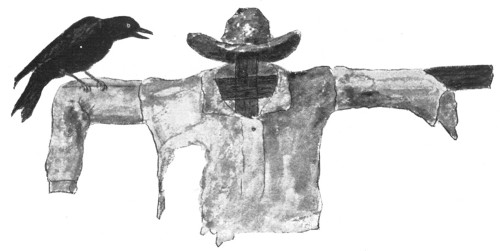
Fig. 323. Who's afraid!
When you see crows feeding in a field try to learn what they are eating.
You can often find crows' tracks in the snow. There the prints of their feet and wings may be seen. What do you think interested the crows in the snow-covered field?
Determine whether the caw is always the same. Is it sometimes short, sometimes long? Can you associate these differences with the actions of the birds?
I wish you would read John Hay's poem, "The Crows at Washington."
LEAFLET LXVI. A FRIENDLY LITTLE CHICKADEE.[84] By ALICE G. McCLOSKEY.
(Compare Leaflet XXIV.)
This scrap of valor just for play Fronts the north wind in waistcoat gray. —Emerson.
One cold December day a chickadee found himself alone in a wood. He looked very much like other chickadees, a small, gray bird, wearing, as someone has said, "a black hood with white side pieces and a black vest." He was like others of his kin, too, in that he was a skillful acrobat. He could stand right side up on a twig or cling to it upside down—one position seemed as easy as the other.
But I am not sure that this little chickadee was like his fellows in one respect. I have wondered whether they are all as friendly as he. I shall tell of something that he did, and leave it to young naturalists to find out whether other chickadees will show as friendly a spirit.
It happened on the cold December day when the chickadee was alone in the "snow-choked wood" that a Senior Naturalist wandered along that way. Whether or no the little bird knew that the tall man was there I cannot say. At any rate, he called out "phœ-be," the plaintive little pipe of two notes, clearer and sweeter than the real phœbe bird can make. The tall man answered the call, whistling two notes as plaintive and sweet as the chickadee's own. Again and again the whistle was repeated and every time it was answered. Nearer and nearer came the fluffy midget, until finally he alighted on a tree directly over the tall man's head.
And then a remarkable thing happened! You will scarcely believe it, yet it is true. Knowing how near the chickadee was, the tall man whistled "phœ-be" very softly, and the little bird flew down and rested on his arm. How pleased the Senior Naturalist must have felt when he had gained the confidence of this wild bird! I wish that our boys and girls would try to do the same thing and tell Uncle John whether the experiment is successful.
Study of a Chickadee in Winter.
1. Keep a sharp lookout for chickadees. Can you tell one when you see it? They are often with nuthatches and downy woodpeckers. If you tie a piece of suet in a tree near your house these winter birds may visit you.
2. Listen to the notes of all the winter birds. Some day you will hear one say "Chick-a-dee-dee-dee-dee." Then he may sing "phœ-be," and you will try to imitate the notes. He may answer you. Tell us how near you can get to one of these friendly little birds.
3. Watch a chickadee searching for his breakfast on a twig. What kind of a bill has he? What do you think he is finding to eat?
4. If I lived on a farm I should have suet hung in my orchard to encourage the chickadees to stay there. Can you tell why?
5. Do you see chickadees in summer? Where are they then?
6. If I were to ask you to find a deserted chickadee's nest, where would you look?
LEAFLET LXVII. THE FAMILY OF WOODPECKERS.[85] By ALICE G. McCLOSKEY.
(Compare Leaflet XXIV.)
I. THE RED-HEADED WOODPECKER.
The story goes that, once upon a time, a naturalist found a great many grasshoppers wedged into an old fencepost. They were alive but could not get away. Bye and bye their jailor appeared. He was neither somber nor ugly, as you might suppose, but a merry red-headed woodpecker. With never a thought of cruelty in his little red head, he had used the fencepost as a cold-storage place, and had filled it with a good supply of food.
Now I am sure our boys and girls will ask, "Is this story true?" I cannot say. The best way to decide whether it may be true is to study the habits of a red-headed woodpecker. Do you think that we shall find him capable of so clever a trick?
The red-head is not uncommon. Keep on the lookout for him. His head, neck, throat, and upper breast are red; the rest of his body is blue-black and white. He is a handsome fellow, a bright bit of color in wood, garden, orchard, or field. Let us see what we can learn about him.
Suggestions.
1. Try to get a nearer view of any bird that you see sitting on a telegraph pole or fencepost. It may be a red-headed woodpecker.
2. Is this little fellow as good a drummer as his relatives?
3. His mate likes his music. If she comes near, the better to hear him drum, notice whether she has a red head.
4. Do you find beech-nuts or other food stored in decayed trees? Under a bit of raised bark? In cracks in bark? In gate posts? If so, a red-head may be about.
5. These woodpeckers eat more grasshoppers than any of the others. Find out whether they eat them on the ground.
6. Have you ever seen one fly into the air after a passing insect?
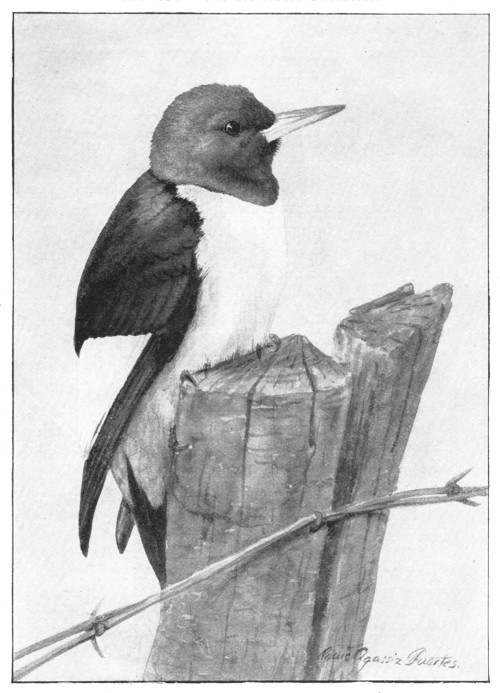
Fig. 324. The red-headed woodpecker.
7. Do red-headed woodpeckers ever visit your chicken yard? Watch them closely and find out why they are there.
8. Do you see them later in the year eating fruit on your farm?
9. It has been found that they eat ants, wasps, beetles, bugs, grasshoppers, crickets, moths, spiders, and caterpillars. If you find them doing harm on your farm will you not compare it with the good they do?
10. What plants do they visit?
11. Where is red-head's nest?
II. DOWNY WOODPECKER.—A LITTLE ORCHARD INSPECTOR.[86]
Rap! rap! rap! the little inspector has come to look at our apple trees. "You are welcome, downy woodpecker," say we every one. "Stay as long as you like. We want to look at you closely so that we shall know you every time we see you."
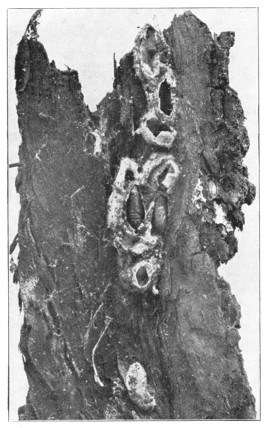
Fig. 325. Cocoons of the codlin-moth as they were found attached to a piece of loose bark, natural size.
A bird about three inches shorter than a robin, black above, white below, white along the middle of the back, and the male red on the nape of the neck: this is the way downy looks. A hardworking, useful, sociable tenant of the farm: this is what downy is.
Let us see how this little woodpecker is useful. If you live on a farm, you have probably heard of borers—grubs that get into trees and injure them. Your father does not like these grubs, but downy does. He seems to like any kind of grub. Watch him on a tree sometimes when he is looking for one. He knows where to find it, although neither you nor I might suspect that an insect is living beneath the smooth bark. Then he bores into the tree, and spears the grub with his long tongue. His tongue is a remarkable weapon. He can stretch it two inches beyond the tip of his bill, and it is barbed on both sides.
Downy does not stop work, you must remember, when borers are not plenty. Beetles nibble no more plants after his eyes light on them. They are trespassers, and as judge, jury, and executioner, he proves his right to be considered a most useful farm hand. Ants, too, provide him with a good meal occasionally.
Among the helpful deeds of the downy woodpecker, we must not forget to mention that he destroys great numbers of the larvæ or worms of the codlin-moth in winter, when these worms have tucked themselves away in the crevices of the bark, all wrapped in their cocoons. (Fig. 325, 326.) Perhaps your father has shown you these little cocoons along the body and in the crotches of the apple tree. If not, you can find them yourself. Open some of them and see whether the worm is still there. If he is not, downy has probably taken him. I suppose you know that the larvæ of the codlin-moth are the worms you find in apples. See Leaflet LIII.
You must not confound the downy woodpecker with that other woodpecker, the sap-sucker, that often drills rings of holes in the trunks of apple trees. The sapsucker has yellow on his under parts. I shall tell you about him some other time.
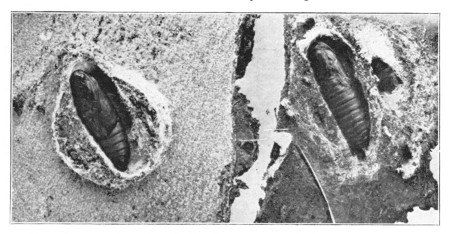
Fig. 326. Pupæ of the codlin-moth in cocoons, enlarged.
You have learned that insects and apple-scab and yourselves all try to see who shall own the apple fruit. Now you know that birds, and insects that feed on leaves and in the wood, are also concerned in this quarrel about the apple.
A Few Things To Observe.
1. Does the downy woodpecker travel down a tree head first or does he hop backward?
2. Try some day to see his feet. You will find that two of his toes are turned forward and two backward. Are there other birds that have this arrangement of toes?
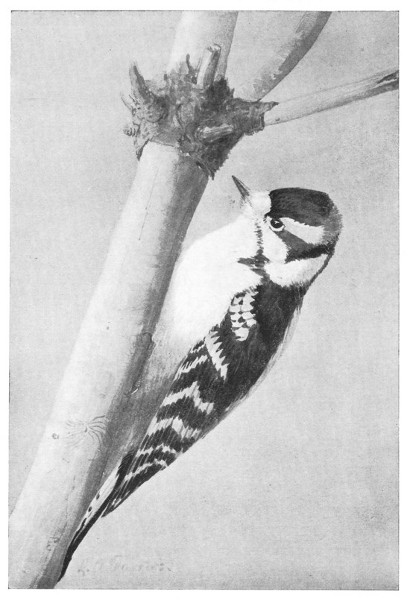
Fig. 327. The downy woodpecker.
3. Notice that he braces himself with his tail as he works.
4. Do you ever see the downy woodpecker eat seeds of plants that the farmers do not like to have on their land?
5. Hang a bone or piece of unsalted suet out of doors for the woodpeckers. They will enjoy an unexpected feast.
6. Where does downy make his nest?
III. THE SAPSUCKER.[87]
If you are walking through an orchard or wood and see a jolly little woodpecker with red on its head, do not say at once that it is a downy woodpecker. Look again. Has it yellow on the underparts, black on the breast, a red throat, and red on the crown instead of on the nape? Then it is a sapsucker, a new arrival. (Fig. 328.) It is larger than the downy. The female has no red on the throat.
And to think that such a merry little fellow has such a bad reputation among farmer-folk! You will be surprised to find how unkindly woodpeckers are treated throughout the country, because of the misdeeds of the sapsucker. Even the downy has suffered much abuse. This is unfortunate, for I am sure downy woodpeckers have done much more good than sapsuckers have done harm.
I wish that all Junior Naturalists would try to find out whether even the sapsucker deserves all that has been said against him. He does harm by boring holes in trees, but how much? Let us learn. As woodpeckers are not shy, it is not difficult to get near them. I have stood within a few feet of a sapsucker, and he did not mind a bit. He kept on boring holes in a tree without a thought that any one might object.
1. How many trees can you find that have holes bored by the sapsucker?
2. How are the holes arranged; here and there on the trunk, or in rings around it? Have you ever found a complete ring of holes?
3. Keep a record of the months in which you find the sapsucker.
4. Notice how the sap runs down into the holes that have been newly made by a sapsucker.
5. It is said that this woodpecker eats the inner bark of the tree as well as the sap. What can you find out about this?
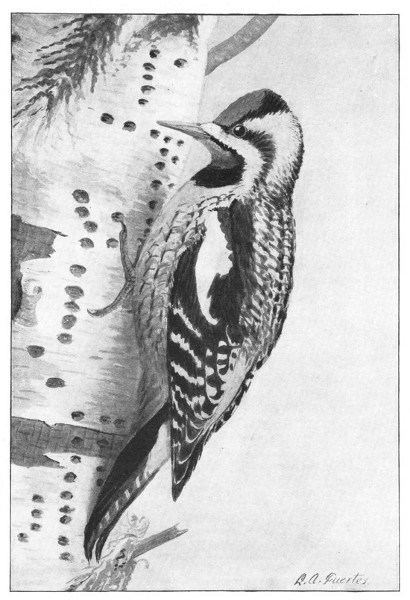
Fig. 328. The sapsucker. Compare this picture with that of the downy woodpecker in Fig. 327.
6. Do you ever find insects near the holes made by the sapsucker? Do you think he eats them?
7. Find out where the sapsucker has his nest.
IV. THE FLICKER.[88]
Three woodpeckers have been introduced to you in these leaflets: the red-head, the hard working downy (Fig. 327), the sapsucker (Fig. 328). There is one more that we ought to add to the list for summer study, since he is very likely to cross our path,—the flicker (Fig. 329).
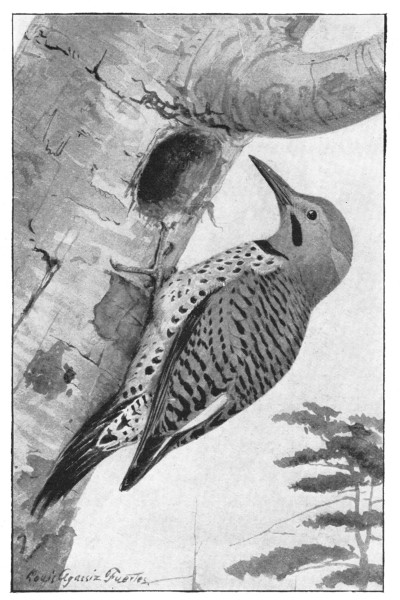
Fig. 329. The flicker.
This woodpecker has a great many names, probably because he lives in a great many States. The most common are: flicker, highhole, yellow-hammer, and golden-winged woodpecker. I like the name flicker best of all.
He is a good-sized bird, about two inches longer than a robin. His colors are: brownish with black spots above, whitish spotted with black underneath, a black crescent on the breast, and a scarlet crescent on the back of the neck. When he flies you will notice two things: the rich golden color of the inside of his wings, and the white patch on the back just above the tail.
Now, since he is a woodpecker, you will probably expect to find the flicker in trees; but you are quite as likely to find him on the ground. About half of his food consists of ants, and these he finds afield. He also eats other insects, as well as a good deal of plant food.
I hope that you will see a flicker this year and hear him call out, "a-wick-a-wick-a-wick-a-wick-a-wick-a." Possibly some of you may find a nest that these birds have dug out in an old apple tree. They do not always make new nests, however, but live in the deserted homes of other woodpeckers.
Questions.
1. Has the flicker a straight bill like the downy woodpecker?
2. Have you seen the flicker's mate? If so, in what way does she differ from him in color or marking?
3. Where does the flicker build its nest? What color are the eggs?
4. Try to watch a flicker feeding its young. Describe.
5. Do you know the call of the flicker? Can you imitate it, or write it so that Uncle John can recognize it?
6. Do flickers remain all winter? If not, when do they come? When do they leave?
LEAFLET LXVIII. DESERTED BIRDS'-NESTS.[89] By ALICE G. McCLOSKEY.
There is a wagon trail which I like to follow; it is always a pleasant walk. There is no foot path; so I do not think many people pass that way. Perhaps this is why many little wild creatures of the field and wood like to live there. I do not know any other place where the birds sing so sweetly, where the wild flowers grow so thick, and where the insects are so numerous.
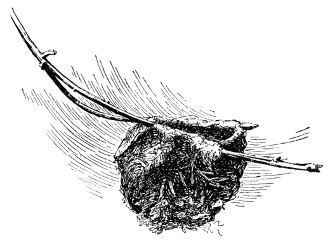
Fig. 330. The vireo's nest.
By the side of this road I found the little vireo's nest which you see in the picture. It was about five feet from the ground, and hung near the end of a long branch. It was interesting to find out what it was made of,—grasses, strips of bark, hair, pine needles, plant fibres, and bits of paper. On the outside were lichens and spiders' webs. The pieces of paper were dropped along the way, I think, by the leader in a cross-country run. Even the little vireos have an interest in the outdoor sports of the college men.
One of the most interesting bird homes is the oriole's nest. Uncle John will like to know whether you find one. The young orioles must have happy times in their cradle, which hangs between the earth and the sky.
Winter is the best time of year to hunt for birds' nests. It is hard to find them in the spring and the summer. The parent birds intend it shall be. If you succeed in getting a nest, take it into the school room so that the other members of your club can study it with you.
Suggestions.
Where did you find the nest? What is its size and shape? Name it, if you can.
Was it built on the horizontal crotch of the branch, or on an upright crotch?
How was it fastened to the branch?
Notice the materials of which it is made.
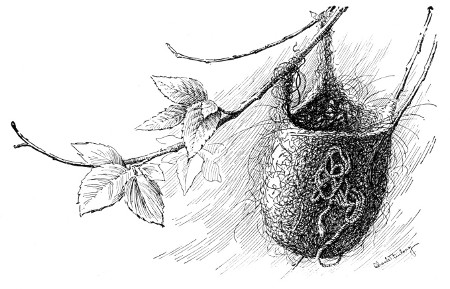
Fig. 331. The hanging nest of the oriole. A cord is woven into the nest.
In the oriole's nest you will see that there is a difference in the way in which the upper and lower parts are made. What is it?
How deep is the oriole's nest which you find? Compare the material on the outside with that on the inside.
How is the nest fastened to the twigs?
Where does a catbird build its nest? Robin? Bluebird? Swallow? Hen? Turkey?
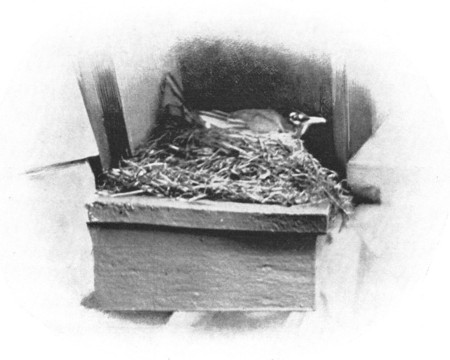
What?
LEAFLET LXIX. THE POULTRY YARD: SOME THANKSGIVING LESSONS.[90] By ALICE G. McCLOSKEY and JAMES E. RICE.
A rosy-cheeked girl, a freckled-faced boy and a little bald-headed baby were the only young persons at the Thanksgiving dinner. The baby was not old enough to be invited, but we were so thankful to have her with us that we could not resist drawing her chair up to the table.
The turkey was a big one and "done to a turn." We old folks thought so, the freckled-faced boy thought so, and the rosy-cheeked girl thought so. The baby, so far as I could judge, thought not at all. She chewed energetically on a spoon and left the discussion of the turkey to her elders.
Having known for a long time that children like to chatter, I decided that I would give the little lad and lassie opposite me an opportunity to talk about turkeys, ducks, chickens, and the like. "These," thought I, "are good Thanksgiving topics, and a boy and girl who have lived on a farm all their lives can tell me some interesting things about them."
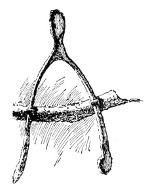
But this world is full of many strange surprises! It was not long before I learned that those little folk could not answer some very simple questions about poultry. They did not even know why a chicken does not fall off the roost when it sleeps. To be sure, they could tell the exact moment when, in the process of carving, the wish-bone would appear: but you will admit that this is very little. I certainly was disappointed. The bald-headed baby cheered things up a bit, however, by crowing lustily. I rejoiced in the fact that apparently she had heard sounds from the barn-yard.
Now there are many reasons why children, Junior Naturalists especially, should know something about poultry. It may be that you live on a farm and will want to raise chickens, ducks, and turkeys some day; and the farmer who knows his poultry best will be most successful in raising it. But whether you live in country or city you will like to study these interesting birds. Let us see what we can find out about them in the next three or four weeks. November, the month of Thanksgiving, is a good time to begin.
Turkeys.
Let us first pay our respects to the king of the poultry yard. We may never know His Royal Highness, the old gobbler, very well, because it is said he will not often permit folks to meet him on his own ground. I am told that a visitor is more sure of a welcome within his domain if he wear sombre garb. Although gaily dressed himself the old fellow objects to bright colors on others.
There is one thing that we can do if the gobbler does not let us near him,—we can peek at him through the fence. Then, too, at Thanksgiving time many a slain monarch will hang in a nearby market. Following are a few suggestions that will help us to learn something about turkeys. I hope that you know all these things now, and, therefore, will not need to be asked. If you do, please write Uncle John. How many letters do you think he will get from such persons?
In the study of any bird, learn to describe it fully: the size, the shape, the bill, the length of legs, the feet, and the color. Is there more than one color of turkey?
Observe the head, face and wattles of the turkey gobbler.
Notice the strong, curved beak; the bright, clear, hazel eyes.
How many colors does he wear?
When the turkey is being prepared for the Thanksgiving dinner, ask mother for the foot. Are there any feathers on it? Has it the same number of toes that you find on a rooster's foot? Is the arrangement of the toes the same?
Perhaps you find scales on the legs of the turkey. Do you find them also on hens' legs? On which side of the leg,—front or back—are the scales the larger?
When I was a little girl I liked to pull a tendon that I found in the turkey's foot after it had been cut off. It was amusing to see the toes curl up. I did not know then that when birds roost at night this tendon is stretched as they bend their legs. Then the toes grasp the perch and hold the bird on. When it stretches its leg to leave the roost the toes spread out, but not until then Because of this birds can go to sleep without the least fear of falling. What kind of perch do they choose, a wide one or a narrow one? Why?
Can you tell which is the hen turkey and which the gobbler? Explain. On which one do you find a hairy tuft on the breast?
Did you ever hear of the caruncle on the head of the turkey? Compare this with the comb in domestic fowls. Does it differ in shape? Do ducks and geese have combs?
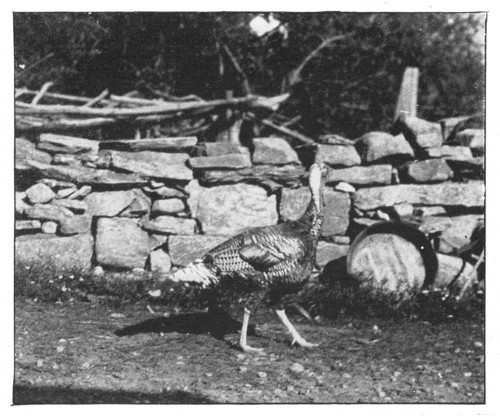
Fig. 332. A turkey likes to roam through the fields.
What is the color of the turkey's face? Does it change color? Do you notice any difference in color when the turkey is angry? What are the turkey's wattles?
Notice the fourth toe. Why is it placed in opposite direction to the others? I wonder whether it enables the fowl to grip the perch; and whether it gives the turkey a wide span for support in running over loose brush.
Turkeys and chickens and other animals have habits, as boys and girls do, only that they are not bad habits. Did you ever watch turkeys hunting grasshoppers? And did they go in flocks or alone? How do chickens hunt,—in flocks or alone? Which roams farther from home, turkeys or chickens? Do turkeys lay their eggs in the barn or poultry house, as chickens do? Did you ever see a turkey's nest, and where was it?
We have Junior Naturalists in many parts of the world: England, Scotland, Australia, Egypt. Will they have an opportunity to study turkeys? See what you can find out in answer to this question.
A Time-honored Race—Geese.
Geese, as you know, come of a very distinguished race. This is no advantage to them in a social way in the poultry yard, however. There is not a duck nor a turkey nor even a wise rooster, that knows or cares whether in times gone by geese saved a Roman city, or whether they were recognized in ancient Egypt.
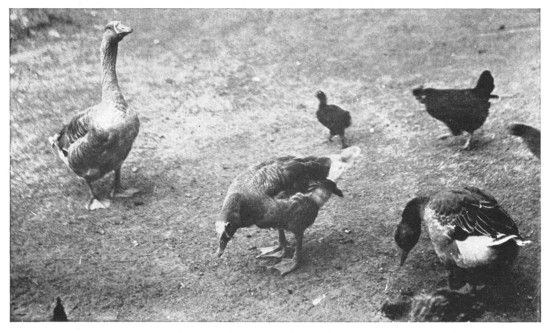
Fig. 333. Geese; "a very distinguished race."
The story of the old gray goose was the one I liked best long ago,—the goose that died before Aunt Nabby had enough feathers to make a bed. How often you and I have listened to mother sing about her! And what an inconsiderate old gray goose we thought she was, to die before the feather bed was finished.
Some things for Junior Naturalists to think about come into my mind in connection with Aunt Nabby's goose and others of its kind:
Why do goose feathers make the best beds?
Do you think an old grandmother goose would give enough feathers in her lifetime to make a good bed? I have heard of one that lived sixty years.
Are feathers ever taken from live geese for beds?
Compare the feathers of land-fowls and water-fowls.
Probably one or more of our Junior Naturalists will have a goose for his Thanksgiving dinner. If so, I wish that the wing feathers might be brought to school. See whether you can find out why the wing feathers of a goose were preferred for making quill pens. Make a pen if you can and write a letter to Uncle John with it. The five outer wing feathers are most useful for writing, and of these the second and third are best. Why? Do you think that the Declaration of Independence was signed with a quill pen? Do goose quills make good holders for artists' brushes?
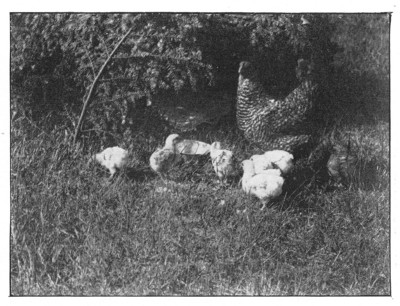
Fig. 334. A happy family.
What kind of food do geese like best?
Is the tongue of a goose similar to that of a turkey or chicken?
Is the old gander as cross as the turkey gobbler?
Have you ever seen a flock of wild geese flying northward or southward? Which way are they going in the fall? Observe that nearly always they keep their V-shaped ranks unbroken. There is, of course, a leader whose call the flock follows. Whether the leader is some chosen member of the number or whether he takes his position by chance I do not know. What time of day do the wild geese fly? Do you like to hear them honking as they go on their way? I wish you would find out whether our farmyard geese are only these common wild geese tamed.
Chickens and Ducks; and the Story of Two Mother Hens.
One mother hen had her own brood of fluffy little chicks (Fig. 334). When they were old enough they scratched for worms and ate gravel as obediently as any one could desire. How happy they were underneath the hemlocks in the long afternoons!
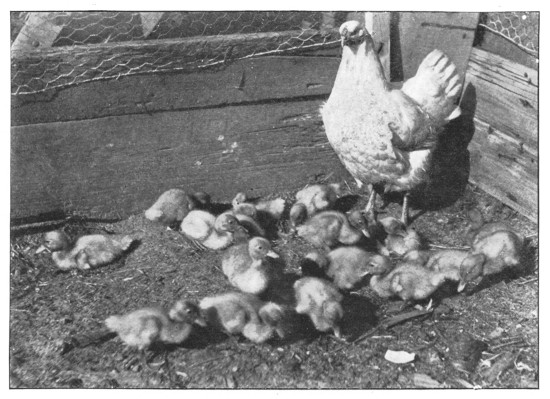
Fig. 335. Mother hen and baby ducks.
The other mother hen had to take care of ducks (Fig. 335). Pretty as any chicks they were, but troublesome as only little ducks can be with a nervous old hen for their adopted mother. The family in the picture looks very contented. Do you suppose that the photographer told them to look pleasant? When we come to know ducks and chickens better, we shall learn why the little ducks are often such a trial to the hen mother.
It may be that when we ask boys and girls to study chickens and ducks they will say that there is nothing new to learn about them. I am not so sure. The freckled-faced boy thought he knew all about them, too. Let us see whether we can suggest some new things to think about, as you look over the fence into the poultry yard, or watch the cook preparing a hen or duck for the Thanksgiving dinner.
As I looked at the chickens in a barn-yard the other day, I was interested in the different kinds that I saw: some brown, some white, some black, some speckled; some had feathers on their feet, others had not; some had combs with many points, in others the comb was close to the head; some had long tails, some short tails, some no tails at all to speak of. If I were to name the differences that I noticed you would not get through reading them in time to write your November dues. How many unlike marks or characters can you find in chickens or ducks?
Have you ever seen two chickens or two ducks exactly alike?
Compare the feet of a hen and a duck. Their bills. Do you think that a duck can scratch for worms?
What do ducks eat? What kind of food do hens like best?
How do a hen's feathers differ from a duck's?
Note the scales on a hen's foot. Snakes have scales on their bodies, too. Some day you may learn a wonderful story that these similar features of hen and snake suggest.
Touch a hen's eye lightly with a pencil. Does she cover it with a thin eyelid? A turtle does this. Has a turtle scales also? If so, may be it will come into the wonderful story connected with hens and snakes.
Look closely at a hen's ear.
Watch chickens as they make their toilet. A farmer told me that among the tail feathers of barn-fowls there is an oil sac that they find useful in cleaning their clothes. I wonder whether this is true?
While I was watching some chickens the other day, I saw one jump up into the air several times. She was a skillful little acrobat. What do you think she was trying to catch?
Watch the cook as she prepares a chicken or turkey for dinner. Find the crop into which the food passes after it has been swallowed. From the crop it passes on to the gizzard. Look closely at the gizzard. See what strong muscles it has. It needs them to grind the grain and gravel stones together. It is a very good mill, you see.
Try to find out whether a duck has a crop and a gizzard. Do not ask any one. Wait until there is to be a duck for dinner some day. Would you suppose from the kind of food ducks eat that they need a crop and a gizzard?