PART II. CHILDREN'S LEAFLETS. (continued 2)
Reading edition
Do little chickens have feathers when they are hatched? What is the cover of their bodies called? Are they always of the same color when they are hatched that they are when they are grown up? What kinds of poultry change their color when their feathers grow? Notice the chickens of Black Minorcas (if you know any one who has that kind), then write Uncle John about their color. Did you ever see fowls without feathers? When you go to the fair be sure to look for some "Silkies." Did you ever see fowls whose feathers were all crinkled up toward their head? Look for "Frizzles" when you go to the fair.
A Lesson on Eggs.
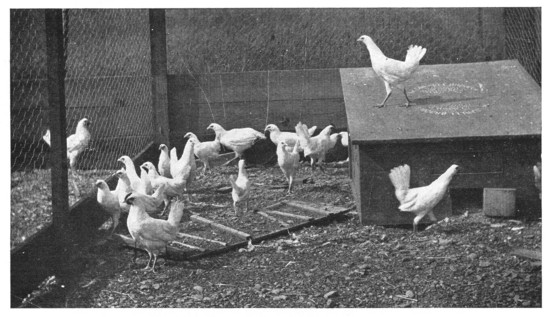
Fig. 336. A coop of chickens.
What is the color of the turkey's egg? Do the first-laid turkey's eggs differ in color from those that are laid later? How do these eggs differ in color from the eggs of ducks, geese, and hens? Do eggs from different breeds of hens differ in color? Do eggs from different kinds of poultry differ in shape? Can you not make some drawings of eggs showing how they differ, and send to Uncle John? Not one of you can tell how much a turkey's egg weighs, nor a hen's egg. Do you think that eggs from all kinds of hens weigh the same? And if they do not, do you think that they are worth the same price the dozen?
Did you ever look through an egg at a strong light? What did you see? Was there an air space? Was it on the big end or the little end? Leave the eggs in a dry room for a few days. Does the air space increase in size? Boil an egg. Remove the shell carefully over the air space. Do you notice a membrane? Are there two membranes? Boil an egg until it is very hard; does the white of the egg separate in layers? Break the yoke carefully; do you notice layers of light and dark color? Is there a little soft light colored spot in the centre? Write to Uncle John and ask him what this is.
Some Questions in General.
How many varieties of fowls can you name? How do they differ in size and color?
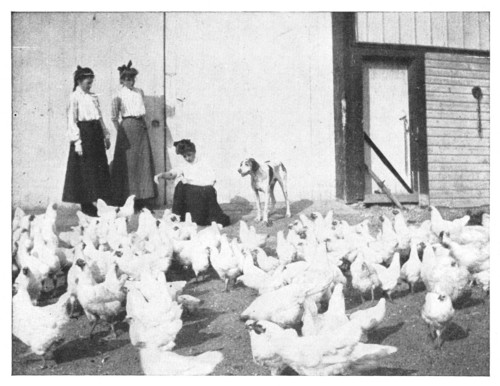
Fig. 337. What kind of hens are these?
Have you ever seen ducks, geese, hens, and turkeys standing on the snow or ice? If so, how did they behave? Which seemed to enjoy it? Why should a duck or goose be able to swim in ice water without apparently suffering from cold? When mother dresses a duck or goose for dinner, ask her to let you see the layers of fat under the skin and inside the body. Write to Uncle John and tell him what the fat in the body is for. Ask him how this fat came in the body; also whether there is such a thing as fat in the food which the ducks eat.
Did you ever see hens and ducks out in the rain? Did they all enjoy it? Did you ever see anything wetter than a wet hen? Why do they look so disconsolate?
Examine the feathers of different kinds of poultry. How do the feathers of ducks, geese, turkeys and fowls differ? Try wetting the various feathers, then let them dry out. Make drawings of these feathers, showing, if you can, the different colors and shapes.
Do turkeys think? Did you ever watch a turkey steal her nest? Where did she go? How long did you watch her before you found the nest? Did she cover up her eggs? With what? Why do they cover the eggs when they leave the nest? Do ducks, geese, turkeys, and hens all cover their eggs? Why do hens differ in this respect from the turkeys? Do all kinds of ducks cover their eggs?
Did you ever watch ducklings and little chickens eat? Did you notice any difference in their appetites? Which grow faster, little chickens or little ducks?
Do you know that some hens do not pay their board? Sometimes hens eat more than they are worth. It may be the fault of the hen or it may be that she is not provided with the proper kind of food or given the proper care. A hen cannot make eggs unless she has the proper kind of food. Some persons so feed and handle their hens that they are able to produce eggs for six cents the dozen; other persons expend more than a dollar to get the dozen.
How does the farmer make his money from fowls (that is, what kind of products does he sell)?
You should learn to classify chickens according to the uses for which they are grown. (1) Some kinds of hens excel in egg-laying. These kinds are known as the "egg breeds." One of the leading egg breeds is the Leghorn. (2) Others produce much meat, and are known as the "meat breeds," as the Brahma. (3) Others are fairly good fowls for both eggs and meat, and are called "general-purpose breeds," of which Plymouth Rock and Wyandotte are good examples. (4) Then there are "fancy breeds," grown as pets or curiosities or as game birds. Now, try to find out whether there are any general differences in form and looks to distinguish one class of breeds from another. And find out whether turkeys, geese, and ducks may be similarly classified.
How Frank and Henry Raised Chickens.
Frank and Henry wanted to keep chickens all by themselves. They thought they might sell the eggs and the fowls and get spending money. They knew little about chickens, but then, it did not matter, for chickens will take care of themselves. All there is to do is to give them corn and water every day,—at least, so the boys thought.
Both boys had a hard time the first year, but they kept at it. Frank finally made a success. Henry lost money; his hens died or did not lay, and he had to give up. One boy turned out to be a good farmer and the other a poor farmer. You have seen such farmers living side by side.
I will tell you why Frank succeeded. 1. He provided warm and pleasant quarters for the chickens, so that the fowls were comfortable and contented. 2. He learned to like the chickens, so that he spent many of his extra hours watching them and caring for them. 3. He learned that something more is required in feeding a hen than merely to satisfy her appetite. Some kinds of food may be best for growing chicks and others for laying hens. 4. He soon found that some hens lay more and larger eggs than others, and he saved eggs from these hens for hatching. Henry said that "eggs are eggs" and that there was "no sense in being so fussy." 5. He learned that eggs and poultry sell best when they really are best and when they are carefully cleaned and neatly packed. Frank had learned the first lessons in good farming.
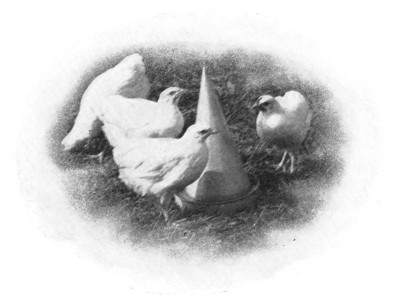
Fig. 338. At the drinking fountain.
LEAFLET LXX. LITTLE HERMIT BROTHER.[91] By ANNA BOTSFORD COMSTOCK.
In far Thibet exists a class of Buddhist monks who are hermits and who dwell in caves. I was told about these strange people by a Senior Naturalist, who has spent his life going around the world and finding the countries upon it as easily as you Junior Naturalists find the same countries on the globe in the schoolroom. A real naturalist is never contented with maps of places and pictures of things, but always desires to see the places and things themselves.
The Senior Naturalist told me that he found Thibet a dreary land inhabited by queer people; and the hermit monks were the queerest of all. Each one dwelt in his solitary cave, ate very little, and worked not at all, but spent his time in thought. Could we read his thoughts we should be none the wiser, since they are only mysterious thoughts about mysterious things.
Now it is a surprising fact that we have hermits of similar habits here in America; only our hermits are little people who dress in a white garb and live in cells underground; they also eat little and work not at all, and probably meditate upon mysteries. However, they are equipped with six legs while the monks of Thibet have only two, a difference of little importance since neither hermit travels far from his cave.
There are in eight or nine counties in New York State places that may surely expect visitors on certain years. The connection between these guests and the hermits of Thibet may not seem very close at first sight; but wait and see.
The reason why these New York counties expect company is that they entertained a large number of similar guests in 1882, 1865, 1848, 1831, 1814, in 1797, and probably at intervals of seventeen years long before that; in 1797, however, was the first record made of the appearance of these visitors. Every time they came they probably outstayed their welcome; yet they had the good quality of allowing their hosts sixteen years of rest between visits.
In order that the Junior Naturalist may recognize these visitors I will describe their methods of arrival. Sometime in the latter part of May or in early June you may hear a great buzzing in some trees, as if there were a thousand lilliputian buzz saws going at once. If you examine the trees you will find on them many queer-looking insects, with black bodies about an inch long, covered with transparent wings folded like a roof. Naturally you will wonder how such great numbers of large insects could appear one day when they were nowhere to be seen the day before. But if you look at the ground beneath the trees you will find in it many small holes. You will also find clinging to the trees many whitish objects, which at first sight seem like pale, wingless insects, but which on closer examination prove to be merely the cast skins of insects (Fig. 339). These are the cowls and robes which our little American hermits cast off after they come out of their underground cells, and which they must shed before they can free their wings. Our little American hermits we call the seventeen-year locusts. However, this name is a most confusing one, since we also call our grasshoppers locusts, and to them the name truly belongs. These seventeen-year locusts are really cicadas, and they belong to a different order from the locusts. The real locusts have mouth-parts formed for biting, while the cicadas have mouth-parts grown together in the form of a tube, through which they suck juices of plants. So we hope the Junior Naturalists will call our little hermits by their right name, cicadas; and will not permit them to be spoken of as locusts.
In order that you may know the mysterious lives of these wonderful insects, I will tell you the story of one of them.
The Story of Little Hermit Brother, Cicada Septendecim.
Once a cicada mother made with her ovipositor a little slit or cavity in an oak twig, and in this slit placed in very neat order two rows of eggs. Six weeks later there hatched from one of these eggs a pale, lively little creature, that to the naked eye looked like a tiny white ant. If, however, we could have examined him through a lens we should have found him very different from an ant; for his two front legs were shaped somewhat like lobsters' big claws, and instead of jaws like an ant, he had simply a long beak that was hollow like a tube. After he came out of his egg he ran about the tree and seemed interested for a time in everything he saw. Then, suddenly, he went to the side of a limb and deliberately fell off. To his little eyes the ground below was invisible; so our small cicada showed great faith when he practically jumped off the edge of his world into space. He was such a speck of a creature that the breeze took him and lifted him gently down, as if he were the petal of a flower; and he alighted on the earth unhurt and probably much delighted with his sail through the air. At once he commenced hunting for some little crevice in the earth; and when he found it he went to the bottom of it and with his shovel-like fore-feet began digging downward. I wonder if he stopped to give a last look at sky, sunshine, and the beautiful green world before he bade them good-bye for seventeen long years! If so, he did it hurriedly, for he was intent upon reaching something to eat. This he finally found a short distance below the surface of the ground, in the shape of a juicy rootlet of the great tree above. Into this he inserted his beak and began to take the sap as we take lemonade through a straw. He made a little cell around himself and then he found existence quite blissful. He ate very little and grew very slowly, and there was no perceptible change in him for about a year; then he shed his skin for the first time, and thus, insect-wise, grew larger. After a time he dug another cell near another rootlet deeper in the ground; but he never exerted himself more than was necessary to obtain the little food that he needed. This idle life he found entirely satisfactory, and the days grew into months and the months into years. Only six times in the seventeen years did our hermit change his clothes, and this was each time a necessity, since they had become too small. Judging from what the Senior Naturalist told me, I think this is six times more than a Thibetan hermit changes his clothes in the same length of time.
What may be the meditations of a little hermit cicada during all these years we cannot even imagine. If any of the Junior Naturalists ever find out the secret they will be very popular indeed with the scientific men called psychologists. However, if we may judge by actions, the sixteenth summer after our hermit buried himself he began to feel stirring in his bosom aspirations toward a higher life. He surely had no memory of the beautiful world he had abandoned in his babyhood; but he became suddenly possessed with a desire to climb upward, and began digging his way toward the light. It might be a long journey through the hard earth; for during the many years he may have reached the depth of nearly two feet. He is now as industrious as he was shiftless before; and it takes him only a few weeks to climb out of the depths into which he had fallen through nearly seventeen years of inertia. If it should chance that he reaches the surface of the ground before he is ready to enjoy life, he hits upon a device for continuing his way upward without danger to himself. Sometimes his fellows have been known to crawl out of their burrows and seek safety under logs and sticks until the time came to gain their wings. But this is a very dangerous proceeding, since in forests there are many watchful eyes which belong to creatures who are very fond of bits of soft, white meat. So our cicada, still a hermit, may build him a tall cell out of mud above ground. How he builds this "hut," "cone," or "turret" as it is variously called, we do not know; but it is often two inches in height, and he keeps himself in the top of it. Under ordinary circumstances our cicada would not build a hut, but remain in his burrow.
Finally there comes a fateful evening when, as soon as the sun has set, he claws his way through the top of his mud turret or out of his burrow and looks about him for further means of gratifying his ambitions to climb. A bush, a tree, the highest thing within his range of vision, attracts his attention and he hurries toward it. It may be he finds himself in company with many of his kind hurrying toward the same goal, but they are of no interest to him as yet. Like the youth in the famous poem, "Excelsior" is his motto and he heeds no invitation to tarry. When he reaches the highest place within his ken he places himself, probably back downward, on some branch or twig, takes a firm hold with all his six pairs of claws, and keeps very still for a time. Then his skeleton nymph-skin breaks open at the back and there pushes out of it a strange creature long and white, except for two black spots upon its back; on he comes until only the tip of his body remains in the old nymph-skin; then he reaches forward and grasps the twig with his soft new legs and pulls himself entirely clear from the old hermit garb. At once his wings begin to grow; at first they are mere pads on his back, but they soon expand until they cover his body and are flat like those of a miller. The many veins in the wings are white and he keeps the wings fluttering in order that they may harden soon. If, in the moonlight of some June evening, a Junior Naturalist should see a tree covered with cicadas at this stage he would think it had suddenly blossomed into beautiful, white, fluttering flowers.
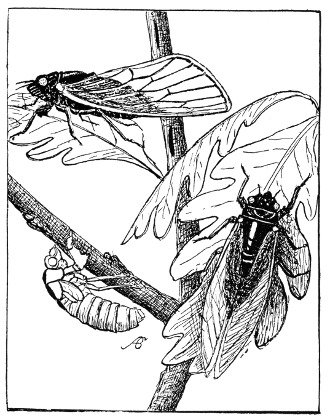
Fig. 339. The cicada is full grown at last, and his empty nymph skin is hanging to a branch.
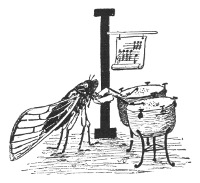
As the night wears on, the color of our hero changes and his wings harden; until when the sun rises we behold him in the glory of a black uniform with facings of orange and with beautiful glassy wings folded roof-like above his body. (Fig. 339.) Great is the change wrought in his appearance during this one marvelous night, and greater still the change wrought in his habits! He is now no longer a hermit; there are thousands of his kind about him, a fact which he realizes with great joy. So happy is he that he feels as if he must burst if he does not find some adequate means for expressing his happiness in this beautiful world of sunshine. Then suddenly he finds in himself the means of expression and bursts into song. Yet, it is not a song exactly, for he is a drummer rather than a singer. On his body just behind each of his hind wings is a kettle drum. The head to this drum is of parchment thrown into folds and may be seen with a lens if you lift his wings and look closely. (Fig. 340.) Instead of drum sticks he uses a pair of strong muscles to throw the membranes into vibration and there is a complex arrangement of cavities and sounding boards around these drum heads so that the noise he gives off is a great one indeed for a fellow of his size. So fond is he of making music that he has no time to eat or to do aught else but to sound fanfares all the sunshiny day. He is not the only musician on the tree; there are many others and they all join in a swelling chorus that has been described as a roar like that made by the "rushing of a strong wind through the trees."
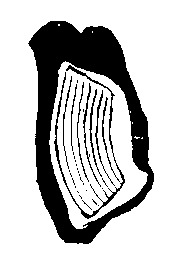
Fig. 340. The cicada's drum.
If our cicada could talk to one of you Junior Naturalists he would tell you that there was a good reason for all this music. He would explain that only the men of the cicada world possess drums and that the object and reason of all their music is the entertainment of the lady cicadas, who are not only very fond of this drumming, but are good critics of cicada music as well. He would perhaps tell you also that he had his eye on a certain graceful maiden perched on the leaf between him and the sun; but she, on the other hand, seemed to give about equal attention to him and three other drummers situated near by. Excited by the competition and by her indifference, he rattled his drum faster and faster until he rose to the heights of cicada melody and harmony that left his rivals far behind. Then the lady of his choice listened spellbound and pronounced him the greatest of all musicians, and thus he won his bride. However, we may safely predict that their wedded life will be too full of happiness to last. After a few weeks the sunshine, the music, the happiness of wooing and winning will prove too much for our hero and one day he will beat his drum in a last mad ecstacy and fall to earth and die from happy exhaustion. His little wife may survive him only long enough to cut slits in some of the twigs of the home tree and place in them rows of eggs from which shall develop a family of hermits which shall come forth and fill the world with their music seventeen years hence.
There are many broods of cicadas in the United States, so that they appear in different localities in different years. New York State has five well-marked broods.
There are several other species of cicada peculiar to America. One is called Cicada tredecim, since it appears every thirteen years. However, this species is limited to the South.
The dog-day harvest fly, or lyreman, is the cicada that is best known to us through the northern and middle States. This appears in small numbers every year and is a distinct addition to the summer chorus of insect singers. He is larger and much more dignified in appearance than is his cousin septendecim. He wears a black suit embroidered with scrolls of dark olive green and the whole lower surface of his body is covered with white powder. His drums are situated above plates which may be seen on the lower side of the body, one behind each hind leg. He hides in trees and his shrill music is so associated with the heat of summer noons that the sound itself makes one drowsy. The hermit life of the lyreman in underground cells is supposed to last only two years.
While the cicadas of which we have spoken are the children of an ancient race which inhabits America, Europe also has her ancient races of cicadas, although they are not the kind which live hermit lives for seventeen years. We have evidence that their music was held in high esteem by the ancient races of men—especially the Greeks. When Homer complimented his orators he compared them with cicadas. Thus it may lend a special interest to the study of the cicada by our Junior Naturalists when they know that his kettle drums have been celebrated instruments of music by poets who wrote three thousand years before America was discovered by Columbus.
Queries for Sharp Eyes.
1. When did you first see one of the cicadas?
2. What was it doing when you found it?
3. Did it do anything to attract your notice to it, or did you find it by accident?
4. Where did you find it?
5. See whether you can determine which are the father and which the mother cicadas.
6. Try to find where a mother cicada has laid eggs.
7. If you find where the cicada emerged from the ground, or from a hut, give a brief description of the location, as to kind of soil, etc.
8. Where did you find the most of the cast-off nymph skins?
9. Did you discover animals or birds feeding upon the cicada?
LEAFLET LXXI. A HOME FOR FRIENDLY LITTLE NEIGHBORS.[92] By ALICE G. McCLOSKEY.
(Compare Leaflet XVII.)
Last year when vacation days were over our young people found it hard to leave the acquaintances that they had made during the summer,—the garden-folk, the road-side-folk, and the wood-folk. Let us take them indoors with us this year. It will not be difficult to provide a home for some of the more friendly ones and they will help to make the schoolroom a cheerful place. How pleasant it will be in the long afternoons to hear the cricket's merry tune or see the flutter of a butterfly's wings! The quiet woods and the green fields will then seem nearer and we shall feel a little touch of their mystery and beauty.
It is not necessary to have a fine home for the outdoor-folk. They will not object if it is not an up-to-date dwelling. Fig. 341 illustrates a very convenient terrarium, as the home is called. The sides and top are covered with fine wire screening and the front is glass. By raising the cover, which is fastened to one side by means of hinges, new visitors can be admitted easily.
Another terrarium is shown in Fig. 126, page 208. This is made from an old berry crate. It does not look quite so well as the other, but, as I said before, the inmates will not mind a bit. The toads will give their high jump as gracefully and the crickets fiddle as merrily as in the finer one.
When the terrarium is ready to furnish, you can have some nature-study trips in search of materials for it. Cover the floor with stones and place about three inches of good soil over them. Then you will be ready to select the carpet. Let this be of soft green moss, the prettiest bits that you can find on the forest floor. Leave one corner free for sods on which tall grasses grow, so that there will be a cozy nook for the orchestra (crickets, grasshoppers, katydids, and the like). What a fine concert there will be! Will the most conceited toad in the terrarium ever dare to raise his voice in song again after hearing it? Perhaps next spring we shall know.
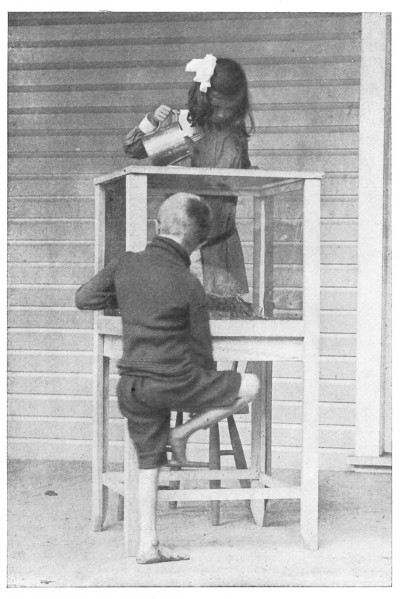
Fig. 341. A shower for the little neighbors.
Even before the home is completed, you can gather your small guests about you. Temporary lodgings can be provided without much trouble. Fig. 342 illustrates a good insect cage, and a box containing damp moss and covered with mosquito netting will make fairly comfortable quarters for salamanders ("lizards") and toads.
The first visitor that you welcome will probably be a little woolly-bear, a brown and black caterpillar that you see so often in your autumn walks (Fig. 343). He is one of my favorite insect friends, and I really like to have him snuggle up in a furry ball in my hand. You will find woolly-bear a very restless little creature. You never know what he is going to do next. He may spin a cocoon this fall or "he may curl up like a woodchuck," as Uncle John says, and sleep until spring. Then, if all goes well, he will spin his cocoon and come out an Isabella tiger-moth (Fig. 344). No matter how fast woolly-bear may be hurrying along the highway when you meet him, put him into the terrarium, for you will find that he is a most entertaining little fellow.
If you have an insect net, sweep it among shrubs and weeds. I am hoping that when you look into it you will find "golden-eyes" or the lace-winged-fly. When you see the pretty little green creature you will wonder that her children can be called aphis-lions, for they are not at all like their mother (Fig. 345); but when you have watched them among the aphids or plant-lice, you will understand how they have earned their name. They have very long jaws and very large appetites.
No one knows better than golden-eyes what her children are capable of doing when on a foraging tour. For this reason she places her eggs high on silken stalks (Fig. 345). If she laid them on the leaf close together, the first aphis-lion hatched would not give the other members of his family a chance to open their eyes, nor to know how pleasant it is to live on a green leaf. As it is he walks down the silken stalk and finds himself among the aphids. Then, when he has proved himself the gardener's friend by devouring a great many of the small green insects, he spins a pearly white cocoon and out of this comes a lace-winged-fly with glistening golden eyes. If one of these dainty creatures comes to live in your terrarium, you may notice some day that it has a disagreeable odor. This is a characteristic that many insects possess, and owing to it the birds do not like to eat them.
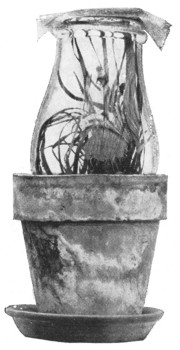
Fig. 342. An insect cage.
There is another insect out in the garden that ought to be an inmate of every terrarium this fall, the green cabbage-worm. Some Junior gardeners will object to calling this a friendly little neighbor, but you will find that he will teach you many new things, in this way proving himself friendly to you as a naturalist. You must remember that these green caterpillars did not know that you had planted the garden in which they worked destruction. They did not know that you wanted to send the very best cabbage to the State fair. They knew only that when they opened their eyes they were on a green leaf and it was good to eat.
Probably you will find the eggs of the cabbage butterfly on the under side of the leaves. Then you can feed the young caterpillars when they hatch. They will, of course, prefer cabbage leaves. If you miss them some day, search in the terrarium for the chrysalids into which they have changed. These chrysalids sometimes imitate the color of the support from which they hang, and you may have difficulty in finding them. For this reason it may be well to keep one of the caterpillars under a lamp chimney, the top of which has been covered with mosquito netting (Fig. 342), so that you may know how the chrysalids look.
The cabbage butterflies are familiar to most boys and girls; yet as they come out of the chrysalid state in your terrarium, you will be able to observe them more closely. Notice that the wings are dull white on the upper sides, while on the under side the apex of the fore wings and the entire surface of the hind wings are pale lemon yellow. In the female you will find that there are two black spots besides the tip on each of the fore wings, and in the male there is but one.
Now that I have put you in the way to find a few members of the insect world for your terrarium, I am going to ask you to think about some other outdoor-folk that naturalists learn to like.
Have you ever turned over stones or broken off pieces of an old stump in the woods or along the bank of a stream? If so, you may have seen salamanders ("lizards") making their escape as quickly as possible. If you can get a few for your terrarium you will learn to like them, for they are harmless and have very interesting ways. Do not catch them by their tails as they try to get away, or you may find that you have captured the tails but lost the salamanders.
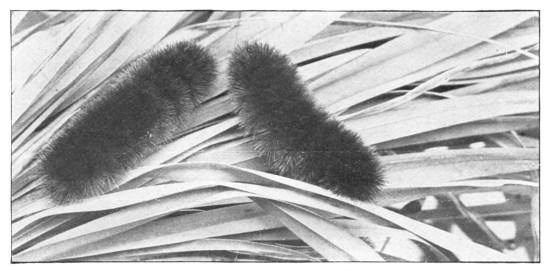
Fig. 343. Woolly-bear, natural size.
Let the excursion in search of these little fellows be one of the jolliest of the year. You will find them in moist places and should therefore, carry a box containing damp moss to put them in. I would suggest that you take two boxes along, one for the smaller salamanders, the other for their larger brothers. Why? I will tell you.
It happened this summer that a party of little folks went out with me on a salamander hunt. We found three kinds: the Spotted Salamander, which is black with yellow spots on each side of the back; the Red-back Salamander, which usually has a reddish brown band along the back; and a black one covered with whitish spots. This black one with whitish spots was named "Freckles" by one of our number, a much more attractive name than his own, which is Pleth'-o-don glu-ti-no'-sus.
We placed the three in a box, and as I closed it the large spotted salamander seemed very well satisfied (no wonder!), while the other two raised their heads in a most appealing way. I was firm, however, and made them prisoners, feeling sure that they would be comfortable in the nice large terrarium.
When morning came we opened the box, for we were ready to put our little neighbors into their new home. What was our surprise to find the spotted salamander alone! As to countenance he was well content; as to sides he was much bulged out. Poor little "Freckles" and poor little Red Back! I wish I had listened to your appeal!
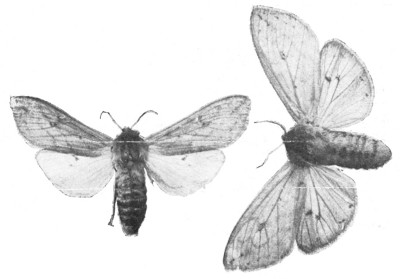
Fig. 344. Isabella tiger moths, male and female. The red and black woolly-bear is the larva or caterpillar of this moth. The smaller moth is the male.
Suggestions for Study.
1. A terrarium is "an inclosed bit of earth on which things may live and grow." Do not think that it is necessary to have one as well made at first as that in the illustration. (Fig. 341.) Uncle John will be well pleased to know that you have made some arrangement for having outdoor-folk live in the schoolroom. Any such home will be a terrarium.
2. Every one can have grasshoppers for study. How many different kinds can you find? Do all have the feelers or antennæ the same length? Observe the growth of the wings in the nymph, as the young grasshopper is called. In the grown-up ones notice that the narrow wing is on the outside and the pretty ones underneath.
3. Every one can also find crickets, and no terrarium will be complete without them. In the warm schoolroom or home they will make music until late in the year. Watch the black cricket make music with his wings.
Notice a tiny light speck near the elbow of the cricket's front leg. This is the ear; so you see the little fellows "listen with their elbows."
The mother cricket has a spear at the end of her body. With this she makes a hole in the ground in which to place her eggs. She cannot chirp, but the father makes enough music for the family. You will see that the mother seems to enjoy it.
Plant fresh grass seed and grain occasionally in the cricket corner of your terrarium.
4. If you do not own an insect net, try to find a lace-winged fly without one. It will not be difficult for young naturalists to see the flies resting on the bushes along the roadside. These insects are valuable to farmers because their children, the aphis-lions, eat so many plant-lice and other insects.
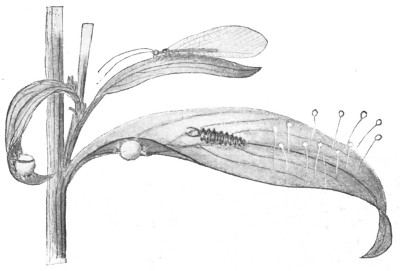
Fig. 345. Golden-eyes or lace-winged fly; eggs, larva or aphis-lion, cocoon, adult.
Look on the under side of the leaves for the cocoon illustrated in Fig. 345. It has the appearance of a small pearl. The first time I found one I did not know what it was. I left it on my desk hoping that something interesting would come out of it. The next morning there was a pretty green insect trying to get out of the window and I wondered how it had come there. While thinking about it my eye fell on the cocoon lying on my desk. I noticed that a lid had been raised on it and suspected at once how golden-eyes had found her way into my room. Who will succeed in getting the eggs, an aphis-lion, a cocoon, or a lace-winged fly? Let us know.
5. The larger the number of butterflies you can bring into the schoolroom, the gayer will be the terrarium world. Gather fresh thistles or other flowers from which they can suck the nectar or give them sweetened water in a dish. Notice their long mouth-parts as they eat.
One of the most common of all butterflies is the large brown and black one. This is called the monarch butterfly. Notice that many of these fly together on autumn days. They are going south with the birds.
6. Be sure to keep the moss damp for the salamanders and add occasionally fresh pieces in which they will get food. Perhaps you can teach them to eat raw meat after they have been with you awhile.
7. The terrarium will not be complete without a toad or two. You can feed them flies, other insects, and earthworms, and they may then leave the salamanders alone. You need not be afraid to handle the toads for they cannot give you warts. When they have been in the terrarium awhile they will show you how they like to spend the winter.
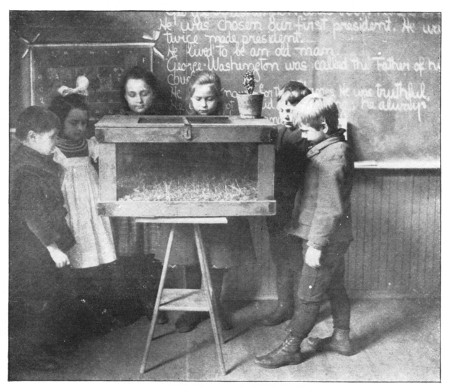
A terrarium in School No. 23, Buffalo.
LEAFLET LXXII. MOTHS AND BUTTERFLIES.[93] By ALICE G. McCLOSKEY.
Of all the insects that interest boys and girls, moths and butterflies seem to hold the first place. I find, however, that young people are not always able to distinguish these insects one from another, and do not know very much of the strange lives they lead. Perhaps you may have found out a few facts about them in books, but this is not knowing. To know, one must see some of the wonderful things that they do. When you have watched the whole life-story of a moth or butterfly, you will have a far greater interest in these animals than their handsome wings and graceful flight have ever given you.
The most important thing to remember in the study of moths and butterflies is that they appear in four different forms during their lives. These forms are:
The egg. The larva. The pupa. The adult.
The Eggs.
The eggs are laid singly or in clusters. They are usually found on the plant which is the favorite food of the young. Look for the shining masses of the eggs of the tent-caterpillar on apple and wild cherry trees; also for the yellow eggs of potato beetles on potato leaves.
The Larva.
The larva or "worm" hatches from the egg. During this period in its history the insect eats and grows. If you doubt that they have good appetites, undertake to feed a few healthy caterpillars this spring. If you doubt that they are particular as to the kind of food they have, find out for yourselves whether the apple tree "worm" will eat milk-weed leaves or whether the milk-weed caterpillar will eat leaves taken from an apple tree.
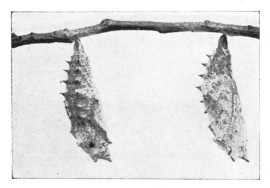
Fig. 346. Chrys'-a-lids of the mourning-cloak butterfly.
One of the most interesting things to notice in the study of larvæ or caterpillars is that they occasionally appear in bright new coats, and we find the old ones have been cast aside. It is necessity, not pride, that leads them to do this. You see, an insect's skeleton is on the outside of its body; and if it could not be shed once in a while how would there be room for the little creature to grow?
The Pupa.
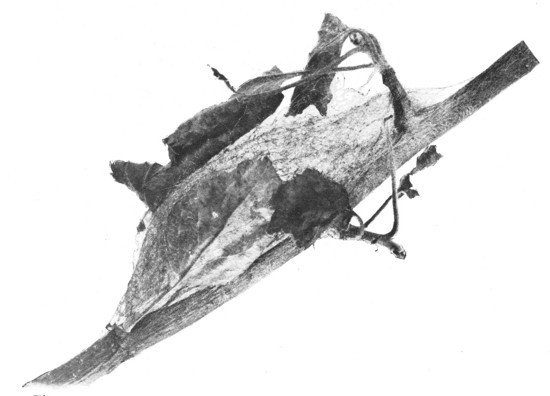
Fig. 347. Cocoon of the cecropia moth. It is often attached to the twig of a fruit tree.
Of all the forms in which moths and butterflies appear, the pupa is the strangest. Although we speak of this period in the life of the insect as one of rest or sleep, it is the time when the most wonderful changes take place in its body.
The queer little objects that you see illustrated in Fig. 346 are the pupæ of the mourning-cloak butterfly. When the caterpillars were about to shed their coats for the last time, they hung themselves head downward from a twig by means of a silk button which they had spun. Then they cast off their skins, leaving the chrysalids or naked pupæ hanging; protected from birds by their spiny form and protected from many enemies, even from young naturalists, by their wood-brown color which so closely resembles the support from which they are suspended.
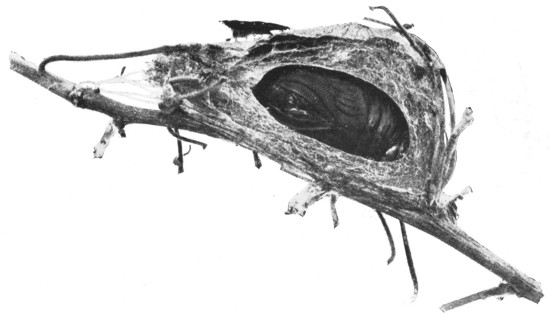
Fig. 348. The cecropia pupa inside the cocoon. Nearly natural size.
Let us next look at the pupa of a moth. This is often inside a covering which is called a cocoon. If you look on the fruit trees or shade trees about your home you may find a cocoon of the ce-cró-pi-a moth. You will see that it is made of silk. This covering was spun by the giant silkworm as a protection against the storms of winter. How snug the pupa is inside, and how firmly the cocoon is fastened to the twig on which you found it! Figs. 347, 348, 349 show this interesting insect.
When you are studying pupæ remember that butterflies do not come out of cocoons. Their chrysalis or pupa is always uncovered. In the case of moths, however, the pupa is either inside a cocoon or protected by being underground or in some well sheltered place. These facts suggest a question. Is there any reason why the one should be better fitted to endure cold and storms than the other?
The Adult.
We now come to the fourth period in the lives of moths and butterflies, a period which has ever had and ever will have an interest for young and old. Since there are many persons, little and big, who cannot distinguish the two groups, butterflies and moths, let us learn the marks by which they may be known.
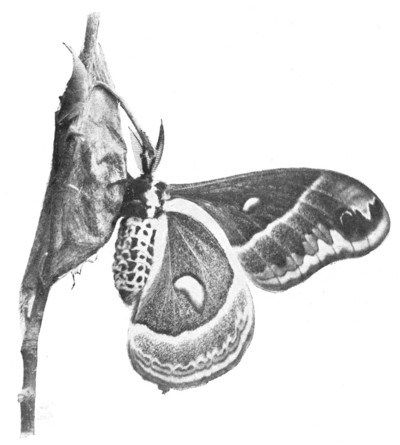
Fig. 349. Cecropia moth just emerged from the cocoon, on which it hangs. The moth comes from the pupa.
Butterflies have uncovered pupæ. They fly by day. The wings are folded over the back when at rest. The antennæ or feelers have knobs on the ends. (Fig. 350 B.) The body is slender.
Moths have pupae either inside cocoons or protected by being underground or in some sheltered place. Many moths fly at night. The antennæ are never knobbed. (Fig. 350 M M.) leave the wings spread when they are at rest. The body is stout.
Occasionally you may come across insects that very closely resemble butterflies, yet have some characters that are similar to those of moths. They are the skippers, so named because of their strong and rapid flight. The antennæ have knobs, but these knobs are drawn out and turned back in the form of a hook. (Fig. 350 S.) The body is rather stout. The pupa is covered by a thin cocoon. In some species the wings are held vertically, in others horizontally.
Suggestions for Study.
Cocoons and butterfly chrysalids are very hard to find because they so closely resemble the withered leaves that cling to shrubs and trees.
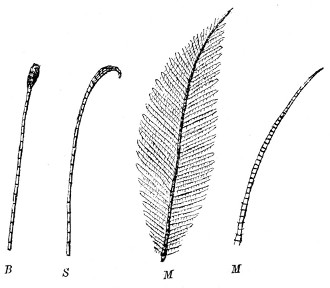
Fig. 350. Antennæ or feelers.
You will probably find cocoons of the ce-cro-pi-a and pro-mé-the-a moths. The former, illustrated by Figs. 347 to 349, is commonly found on fruit trees; the latter swings loosely from a branch of ash, wild cherry, or lilac. The promethea cocoon is enfolded in a leaf which the caterpillar fastened to a twig by means of silk before it spun the cocoon. If you are rewarded for your search by finding some of these winter homes, leave a few of them in a cool place and occasionally dip them in water that they may not become too dry. Look at them carefully from time to time and note any changes that take place. Following are a few suggestions that will help you in the study of cocoons:
1. Observe the covering of the pupa closely. Is it made of other material beside silk? When the woolly-bear, that many of you have cared for all winter, spins his cocoon, he will use some of his own hair as well as silk.
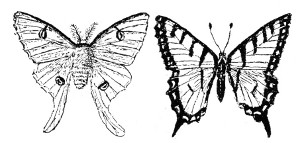
Fig. 351. Luna moth and swallow-tail butterfly.
2. Open the cocoon. Is the pupa free from it? Are the threads of silk woven in the same direction in all parts of the covering?
3. Out of which end do you think the moth will come?
4. Describe the inside of the cocoon. Do you find anything in it beside the pupa?
5. The cocoons of the Chinese silkworm are soaked in hot water or softened by steam before the thread can be unwound. Put one of the cocoons that you find in hot water and see whether you can unwind the silk. I wish you could secure some cocoons of the real silkworm.
Boys and girls often ask us what they shall feed moths and butterflies. Many of the adult insects do not eat at all. Some, however, sip the nectar of flowers or sap of trees. Oftentimes they will drink sweetened water or the juice of fruit. If you have an opportunity, watch one while it eats. Notice the long "tongue" through which it takes its food. This is made of two pieces grooved on the inner side, and when held together they form a tube. When the insect is not eating these mouth-parts are coiled.
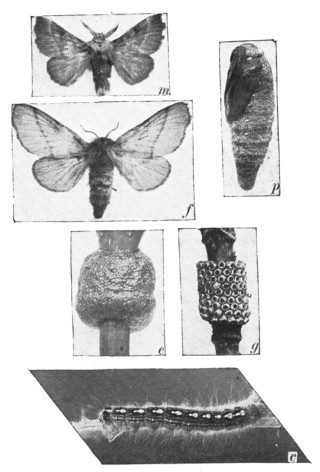
Fig. 352. The life-story of an insect, the forest tent caterpillar. m, male moth; f, female; p, pupa; e, egg-ring recently laid; g, hatched egg-ring; c, caterpillar. Moths and caterpillars are natural size, and eggs and pupa are slightly enlarged.
LEAFLET LXXIII. THE PAPER-MAKERS.[94] BY ALICE G. McCLOSKEY.
A Castle Made of Paper.
Many school rooms in the State have a hornet's nest which some boy or girl has brought to show the teacher. It is usually hung on the wall or used as an ornament on top of the bookcase. Let us take it down some day this month and learn something about it.
Do you think the nest can be called a castle? Why not? Look inside. Is it not several stories high? Are there not spacious galleries in it? Is it not as well guarded when the wasps are at home as if an army of soldiers stood outside?
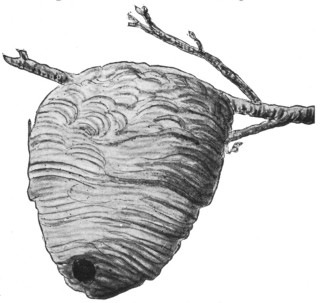
Fig. 353. The paper castle.
Let us see how this castle is built. You have heard that wasps were the first paper makers. In the early summer you will see them around wood that has been worn by the weather. They take off loose fibres and by means of their mouth-parts work them into pulp. Can the rain get through this paper? Find out whether it is waterproof.
Some of the nests made by vespa (Fig. 353), as the hornets or yellow-jackets are called, are very large. Do you think a wasp could make one alone? No, these are social wasps; that is, a great many live together. There are males, females, and workers. Some day we shall tell you how the wasps form their colony, but for this lesson we want you to study the nest.
Notice the envelope which covers the cells. How many layers of paper are there in it? We might call each layer a clapboard.
Can you see any difference in the direction of the outside layers on top of the nest and those which are below?
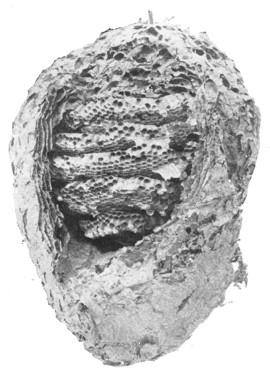
Fig. 354. Interior arrangement of white-faced hornet's nest.
How many stories high is the nest?
Note the difference in the size of the stories. Where do you find the smallest?
Count the rooms or cells in each.
You know, of course, that an egg is placed in each cell. When the larvæ, as the young of the wasps are called, are hatched, they still live in the cells.
How do they manage to keep in their cells? You see the nest is really turned upside down. Their little heads must hang where the worker wasps can feed them easily. I wonder whether you can tell me why the young wasps do not fall out?
The workers chew all the food which they give the little ones. When in summer you see hornets about your flower beds or feeding on other insects, it may be that they are preparing breakfast for the young. Notice the flowers which they visit.
Polistes, the Paper-maker.
In the previous lesson I spoke of vespa wasps that make homes of paper. You learned that they bite off pieces of weather-worn wood with their jaws and chew it until it is made into pulp. Were you interested in these social wasps? If so, you may like to hear about another member of the same family.
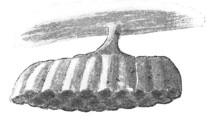
Fig. 355. Home of polistes, the paper-maker.
Hiding in some crevice about your house or the school building there is probably a wasp which naturalists call po-lis´-tes. She has been there ever since the cold weather came. In the spring you may see her tearing off pieces of wood from some unpainted building or weather-worn fence. Let us see what she is going to do.
This wasp is the founder of a colony. The first thing she does is to select a place for her home. Then she makes a few cells—only a few, for she has no help. When you find a nest like the one in the picture (Fig. 355), you will see how the comb is fastened to the roof or to a tree or to the under side of a stone.
As soon as the cells are completed, the mother lays an egg in each. From these eggs little grubs or larvæ are hatched. They are fed by the mother until they become pupæ. The cells are sealed over while the wasps are in the pupa state. They have to break open the seals before they can come out.
All members of the first brood are workers. As soon as they are hatched the mother has nothing to do but to provide eggs. They clean out the cells in which they passed their early days; they make additions to the nests; they take care of the young. Do you remember how the vespa workers prepared food for the larvæ in their colony and what they fed them? The young polistes are cared for in the same way.
You may see the workers flying about in your garden this summer, getting the sweets from the various flowers that you have planted. You will know why they are so busy through the long sunny days. You will think of the hungry little wasps waiting for their dinner. You will wonder whether they put their heads out of the cells when the workers feed them.
Nest of Polistes.
1. Compare the nest of polistes with that of vespa.
2. In what ways do they differ?
3. Where did you find the nest?
4. How was it held in place?
5. How many cells are there in it?
6. Notice the pieces of the seals which still remain on the nest. Tell us whether they are made of the same material as the cells. Of what utility are the seals?
LEAFLET LXXIV. SOME CARPENTER ANTS AND THEIR KIN.[95] By ALICE G. McCLOSKEY.
(Compare Leaflet XXI.)
One bright August morning, as we were walking along the edge of a wood, we found an old tree trunk lying on the ground. I am sure it had been there a long time. Large pieces of bark were loose enough to be lifted up; being naturalists, we took advantage of this fact to see whether anything was living underneath.
What queer little outdoor folk we found: "thousand-legged worms," sow-bugs, a black beetle that looked as if its back were made of patent-leather, and best of all a colony of ants! These ants were large black ones known as carpenter ants. They had made very comfortable quarters in this old log. How alarmed they were when we so rudely exposed them to the light!
One brave ant impressed me more than any other member of the colony. I wish that all of our girls and boys might have seen it. With my knife I commenced to cut down the wall of one of the rooms to see what was inside. The soldier-like ant stood near and, instead of running away, it attacked the large steel blade with its jaws. Was not that a brave thing to do? Are you surprised that I closed the knife and put it into my pocket?
During all this time there was great commotion in the colony. The worker ants were scurrying off with the younger members of the family, trying to find a safe place for them. Some of these little brothers and sisters were tiny white legless creatures; some were covered up in what looked like little bags; others were ghost-like things, very white and apparently lifeless.
Now before you can understand what is going on in an ant's nest, you must know four things:
1. The white oblong eggs are very small. You will not see them readily.
2. The little legless creatures, or larvæ, hatch from the eggs and are fed by the workers. Mrs. Comstock says that an ant larva looks like a crook-neck squash.
3. The larvæ either spin cocoons or rest awhile without any covering before they become fully grown ants. In their resting form they are called pupæ. Children usually think the little sack-like pupæ are the eggs.
4. The fully grown ants come from the pupæ.
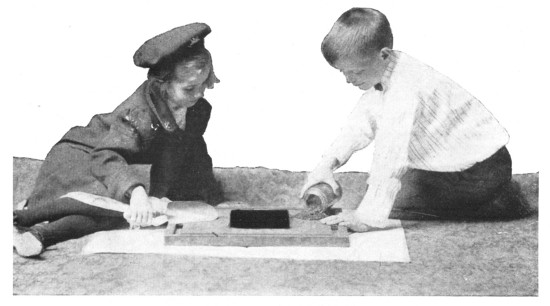
Fig. 356. Making a home for ants.
We want every Junior Naturalist Club to have an ant's nest in the school room and to observe the following:
In time of danger do the ants look to their own safety first?
Watch the workers feed and clean the young.
Try to see an ant help a younger relative out of the pupa skin.
Notice how many uses the ants seem to have for their antennæ or feelers.
Has it ever seemed to you that ants carry on a conversation when they meet?
See how many different kinds of ants you can find out-of-doors, Tell us about their homes.
How To Make an Ant's Nest.
In the illustration (Fig. 356) you will see an ant's nest. For this kind of nest you will need a plank, near the outside edge of which is a deep groove. The plank should be painted; can you tell why? In the center use two pieces of glass laid flat and separated by narrow sticks along each side, so that they are about one-eighth of an inch apart. The sticks should not come close together at one corner. This leaves a little doorway for the ants. Cover the top glass with black paper or cloth so that the space between the two pieces of glass may seem a nice, dark, safe room in which ants may live. It will be a good thing to keep a small piece of damp blotting paper in one corner of this room in case the workers want a moist place for the young ones. Fill the groove in the plank with water and the nest is ready.
The best ant colony to take indoors is the one that you find under stones in a pasture. With a trowel lift up the ants, pupæ, larvæ, and sand and put the contents carefully into a pint can. When you reach the schoolroom put the contents of the can on the plank and watch what happens. If the ants do not find the room you have made for them, place a few larvae and pupæ within it. They will probably find them.
Do not neglect to provide food for the colony. Ants like to eat cracker soaked in sweetened water, bread, cake, berry jams, sugar, bits of raw meat, yolk of hard-boiled egg, and custard.
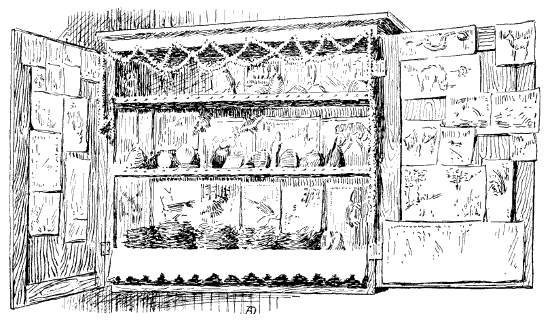
Junior naturalist museum in the school. District No. 2, Sheridan, N. Y.
LEAFLET LXXV. A GARDEN ALL YOUR OWN.[96] By JOHN W. SPENCER.
My Dear Nephews and Nieces:
Would you like to have a garden this summer—a garden all your very own? If so, you can surely have one. A man up in a balloon could have one if he were to try; a man living down in a coal mine could not, because there would be no sunlight. Plants must have light from the sun, which is the vital source of all light. I consider that anyone who cares for a plant, growing either in a window box or in a tomato can, has a garden. Yes; a plant growing in an eggshell constitutes a garden.
A Little Girl's Garden.
Near my desk is a picture of a little girl, holding in her arms a big pumpkin that she raised in a garden all her own. I do not know how many pies could have been made from that pumpkin, but, at any rate, it was a big pumpkin. The seed from which the vine started was planted in an egg-shell in the school-room. When the bright May days came the egg-shell had become too small for the plant or the plant had become too large for the egg-shell, so the little girl planted it in the open ground at her home. She must have been a tiny girl or the soil in her garden must have been very hard, for without help she was unable to spade it and make it fine. She hired her father to do it for her and paid him by carrying his dinner every day for a week to the shop where he worked. When lunch time came, papa and she had a little picnic all by themselves. There is no prettier picture than is made by such strong comradeship between a little girl and her father.
Make a Bargain With Your Teacher.
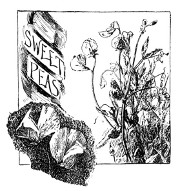
Fig. 357. Sweet peas.
I hope your teacher will permit you to have some boxes of earth (I mean soil) in the windows of your school-room, in which you may plant flower or vegetable seeds. In early June, just before the close of school, you can divide the plants among yourselves and set them out in the open ground or in window boxes at your home. Ask your teacher whether you may have such a privilege. Promise that if she will grant this favor you will be just as good as the "little girl who had a little curl that hung in the middle of her fore-head," and if at any time you become "horrid" the teacher may give your share of the plants to some one better behaved than yourself. If she is a wise teacher she will consent, but not until she has made a bargain with you that you are to do all the work and to ask nothing from her but advice when you need it.
A Plant Nursery.
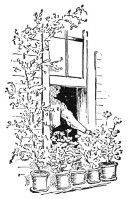
Fig. 358. A nest of window pots.
Your first garden should be in a shallow box, called a "flat," which you may consider a kind of nursery for the plants. Let this nursery, or cradle, be as long and as wide as a soap box, and not more than three or four inches deep. You can make a "flat," as gardeners do, by sawing a soap box in two. In the bottom of the box make some small auger holes for drainage. Some of you may be so fortunate as to be able to gather from the woods and fields the material for fitting up the flat. Some moss,—say about an inch of it,—should first be laid in the bottom. When moss cannot be found, use stones or pieces of broken pottery to cover the drainage holes. This is to prevent the soil from washing through. The remainder of the flat should be filled with good woods earth. Pack the soil firmly. Fill the flat not even full, but to within half an inch of the top. Those who cannot go to the fields must get the best garden soil to be found. A few children may be unable to get even garden soil. They will be obliged to go to the florist's for soil, as they must do when they fill their window boxes. Because of the frequent waterings required by all plants growing in boxes, it is important to get soil that is not sticky and that will not pack hard.
Sowing the Seed.
When the time comes for the sowing of seeds, you had better ask your teacher to look over your shoulder to see that you do it correctly. In sowing, put the seeds in straight rows. These rows may be made by denting the soil with the sharp edge of a stick or ruler. Let the rows extend the entire width of the flat. Into the dent, drop the seeds at regular intervals. If any seeds drop outside of the dent, gently push them into place with a toothpick. Half a dozen rows of one variety of flowers or vegetables having small seeds will give a large number of plants. One flat may accommodate a number of varieties.
At the point where one variety stops and another begins, a neat label of wood should be stuck. This affords a good chance for a boy to bring his new jack-knife into use. On the label should be written the name of each variety. This will give an excellent opportunity for one who writes a good vertical hand to make himself useful. Begin at the very top of the label and write towards the lower end; then if the lower part of the label rots off or becomes discolored, you will still have the first and most important part of the name left. The label should never be disturbed, for a careless boy or girl might not put it back into the exact place where it was found, which would be indeed unfortunate. The Smiths and Joneses of that plant community would become so mixed that the Joneses would be called Smiths and the Smiths would be known as Joneses. It would be as bad as changing door-plates.
When the seeds have been evenly distributed in rows like houses along a street there comes another very important step,—the covering of the seeds. If seeds are covered too deep they will rot because of too much moisture; if the covering is too thin, the soil will dry so rapidly that the seeds will fail because of insufficient moisture. The size of the seed usually determines the amount of covering necessary. As a broad general rule, the soil covering should be about four times the thickness of the seed.
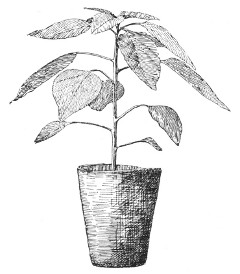
Fig. 359. Transplanted into a pot.
Having been covered, the earth must be thoroughly watered. This must be done gently and carefully. If done with a rush, the water will wash the covering away and many of the seeds will be left bare. Whenever such an accident occurs, the seed may be pushed into the soil with a toothpick. At most times when watering, continue to apply the water until it just begins to drain through the bottom of the flat. This should be practiced even after the seeds have germinated and become growing plants. Keep the flats shaded until the plants begin to push their heads through the soil. After this time strong light should gradually be given them that the plants may not become tall and spindling, or "leggy," as gardeners say.
If the seed boxes are in a sunny or windy place, the soil may dry out too rapidly. This can be prevented by laying a newspaper over the flat when the sun strikes it. As the plantlets grow, care must be taken not to shade them too much.
A Plant Kindergarten.
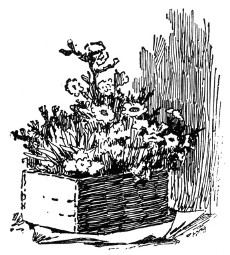
Fig. 360. A soap box put to use.
In some plants the first leaves are called the "seed-leaves," and, like children's milk teeth, soon disappear. The next set are the true leaves. After the true leaves appear, if the plants seem crowded and uncomfortable, like three boys trying to sleep in a narrow bed, transplant them into other flats prepared similarly to the one into which the seeds were sown. You may think of this as the promotion of the young plants from the cradle to the kindergarten. Here the plants should be placed about an inch from each other, in squares. Wet the plants thoroughly before taking them up and also the soil into which they are to make their second home. After this is done, the soil should be pressed firmly about the roots, as you snuggle the bedclothes about your neck on a cold winter's night. It is entertaining practice to transplant the plants into pots, if you happen to have any florist's pots of small size.
This transplanting of plants in the school-room gives a quiet occupation to boys and girls who for a time may not be engaged in study. The disobedient child or the would-be "smart" one might better be denied the privilege. I say "privilege," because the wise teacher will make window gardening a privilege and not required work. After the transplanting has been completed and the plants thoroughly soaked with water, they must be shaded for about twenty-four hours, after which they had better receive the strong light once more, when they will resume their growth.
Plants Need Water.
If plants could feel and talk, they would tell of periods when they had endured great suffering because of thirst: suffering as great as that sometimes experienced by travelers in crossing a desert. Often it has been so great as almost to ruin a plant's constitution. I am often asked, "How frequently shall I water plants?" It is as difficult to give a fixed rule for watering as to determine how often a boy should be allowed a drink. During cool cloudy weather, plants do not require as much water as when the sun shines bright and hot on them. I can give no better general direction than this:—water plants when the surface of the soil seems dry and powder-like, when a pinch of it rolled between the thumb and finger does not form a little ball. Under conditions in which the drainage is good, plants should receive water until the surplus begins to trickle out of the holes at the bottom. If you follow these directions carefully, your schoolroom garden should afford a good lot of plants for cultivation at home in the open ground or in boxes.
What You May Plant.
As to the kind of seeds to sow, you must be governed by what you most desire to have in your home garden for summer cultivation. If you are able to have a garden in the open ground, I would have you make a selection of both flowers and vegetables. Do not choose a large variety of either, for children are but little men and women and must shape their tasks to fit their shoulders. It would be better to have a garden the size of a horse blanket and have it in good condition all summer than to have a larger one and allow it to become a wilderness of weeds.
In the vegetable line, you can have radishes and lettuce that may be harvested by the Fourth of July. After the first crop has been removed the ground should be spaded and wax beans planted in rows about eighteen inches apart and the beans six inches apart in the rows. These give the juiciest of pods, excellent for pickling. Kings and princes could have none better. This plan gives you two crops from the same ground in one summer. Plant radishes in rows twelve inches apart and about two inches apart in the row. Pull them for the table when the roots are three-quarters of an inch or a little more in diameter. Set lettuce about three inches apart in the row, which is twice or more as thick as the plants should be when full grown. When half grown or more every other plant may be pulled out for table use and the remaining ones will soon fill the vacancies.
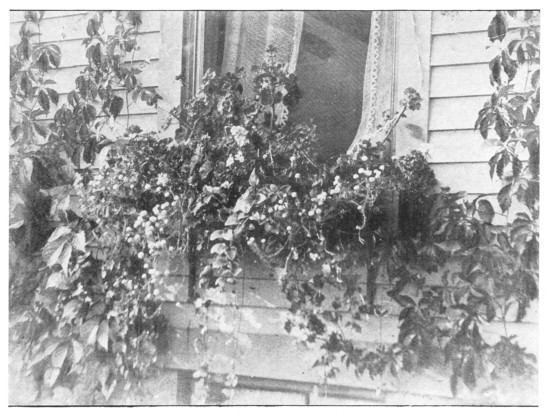
Fig. 361. A window-garden of one's own.
In suggesting your selection of flowers, I shall mention but a few. I have chosen the following kinds because they are not too particular or exacting as to care, while some are equally well adapted for cultivation either in the open ground or in window boxes. I hope you will include sweet peas, dahlias, and gladioli in your selection. I have not named them in this list because they are not suitable for planting in flats, but are planted directly in the open ground where they are to spend their lives. Gladioli and most dahlias you will not raise from seeds.
The following is a list from which you may make a selection for planting in your school-room, to divide later with your mates for home planting:—
Petunia Nasturtium Sweet Alyssum Mignonette } Suitable for planting either in window boxes or in the open ground.
Bachelor's Button Salvia (Flowering Sage) Phlox Aster Marigold Candytuft } To be planted in the open ground.
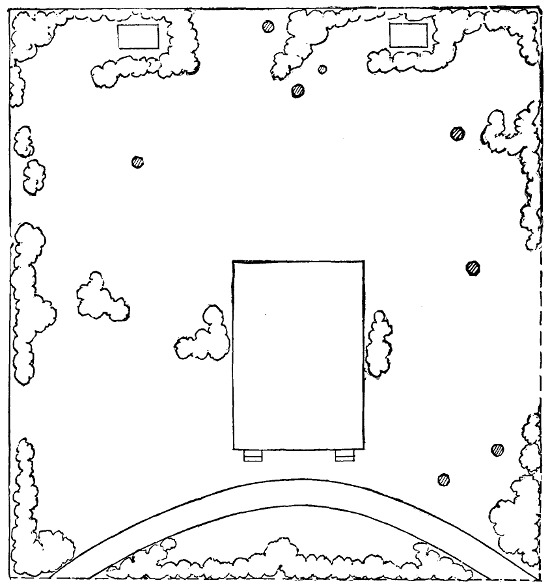
Fig. 362. Plan of the improvement of the school ground, shown in Fig. 365.
Make a Garden in a Box.
There is no reason why you cannot have a window-box as attractive as the one shown in Fig. 361. Plants will grow as well for you as for the richest or the greatest man of whom you ever heard. All they require is to be made comfortable. The two things most necessary for their comfort are water as often as they need it, and fertile soil that will not become hard from frequent watering. Plants in boxes need water much oftener than those in the open ground. I once knew of a window-box on a tin roof on the south side of the house that was watered morning, noon, and night. Those plants must have been comfortable, for they made thrifty growth.
When you have learned how to make plants comfortable in a flat, you will know what is necessary for their comfort in a window-box. They should have the same kind of earth, but more of it. The box should never be less than eight inches wide and eight inches deep and as long as you can afford to fill with earth and plants. There must be holes in the bottom for drainage, and moss or small stones placed over the holes to prevent the soil from washing away.
The plants should be set four to six inches apart in the box. At first, this will seem too great a distance, but after a few weeks of growth, the plants will cover all bare spots. When transplanting either to window-boxes or to the open ground, do it the same way as when changing plants from the cradle flat to the kindergarten flat.
I know of a brother and a sister who found enough soil to fill some egg-shells. The shells had small drainage holes in the bottom. In time the plants grew and became too large for the egg-shells. Then the children went in search of more soil. They found enough to fill a few tomato cans. These cans also had drainage holes in the bottom. In each can they set a plant. They then put the cans into a soap box. Then they packed excelsior into all the vacant places in the soapbox. The excelsior helped to hold the moisture. The box stood on a back veranda where the plants had plenty of sunshine. So long as they were comfortable they did their best, which is as much as they could have done if they had been in expensive vases in the grounds of the White House at Washington.
Consider Your School Grounds.
On the last page of this leaflet are two pictures of a school-house. The first shows how it looked when it had not a friend. The second shows what the friendship of the teacher and the children could do for it. In both cases the building remains the same. Look at one picture and then at the other. See, if you can, what one thing has been done to make the difference—a difference as great as that between a tramp and a gentleman. A few shrubs have been planted by the friends, but the greatest thing they did was to clean up. They took away everything that looked untidy and shabby.
At this time of the year you see many beautiful crocuses, tulips, daffodils, and hyacinths. Nothing children can plant will give so much for the labor as these bulbs. Why not have some on the school grounds? When school begins next September, write me for directions how to grow them.
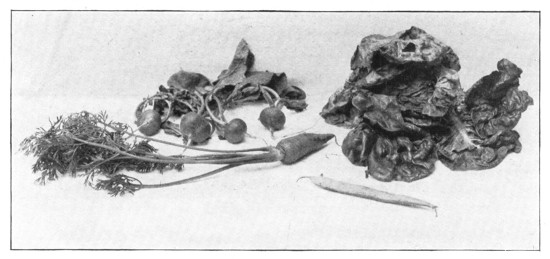
Fig. 363. Product of a child's garden.
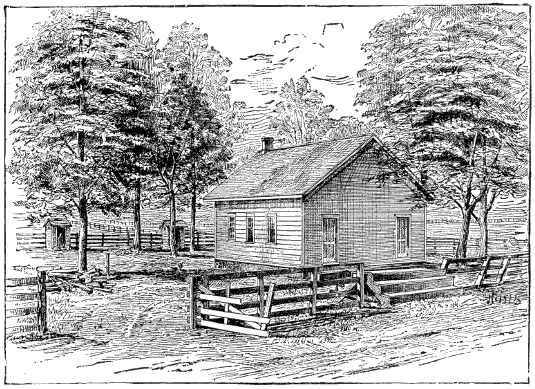
Fig. 364. School premises before improving.
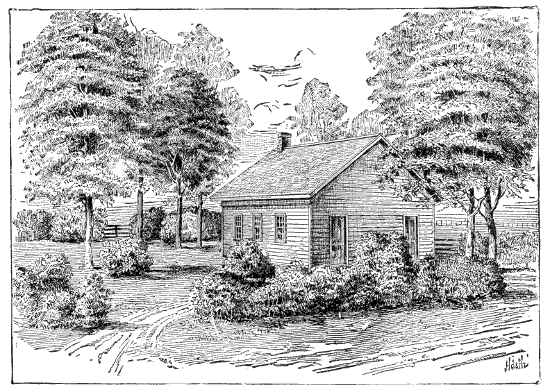
Fig. 365. School premises after improving. Could you not do as much for your school grounds?
LEAFLET LXXVI. THE GARDENS AND THE SCHOOL GROUNDS.[97] By JOHN W. SPENCER.
My Dear Boys And Girls:
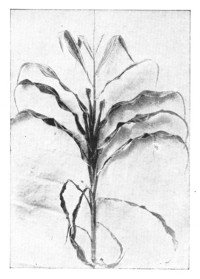
Of course you believe that Columbus discovered America, even though you were not with him. If you had been on the deck of his ship when San Salvador raised its head on the rim of the sea, you would be talking about it every day of your life. As it is, your knowledge comes to you through books, and you think you are fortunate if you are able to answer questions correctly on examination. This leads me to remark that there is much more interest in things that we have helped to "make happen" than in things that we read about and that were "made to happen" by some one else.
There is a chance for each of you boys and girls, in a way, to become a Columbus. It is true that, not counting the north and south poles, all the continents are discovered, but there is much pleasure and "fun" in discovering facts. I am now speaking from experience. I think that James Buchanan was President when I learned, in such a way that I could explain to others, the principles of a suction-pump. Some of the suggestions led me to make a squirt gun from a bit of elder stalk. Sometimes when I made a demonstration the water would fly in the faces of my audience. I started a squirt gun factory, but the teacher stopped the enterprise because it made too much litter in the school-room.
I have a suggestion that will start you on a voyage of discovery. When you have gone as far as you can I wish you would write me, telling what you have learned. Writers of agricultural books sometimes use the expression, "There is fertility in tillage." Is that true?
By fertility is meant the power of the soil to furnish plant-food. Fertile soil is "rich" soil. By tillage is meant frequent stirring of the soil. For example, Billy Boy and his chum each have a flower garden side by side of equal size. Each boy sows seeds from the same bag. The same sunshine and the same rains give vigor to each flower-bed alike. Billy Boy spades the soil deep and makes it fine. His chum stirs the top and leaves clods on the surface. With the end of a sharp stick Billy makes a straight drill for the seed. On the bottom of the drill the soil is fine like meal, and the seed is sown with great care and is covered with the finest soil. If the seed is small he makes the soil covering very thin. The last thing he does is to firm the soil by patting it with either his hand or the flat part of a hoe, and he does it in an affectionate way as if he were patting a dog. His chum makes the drill for the seed in a hasty way, leaving in the bottom little clods of earth as large as hickory nuts. He sows the seed as if he were glad to get rid of it, and he covers it as if he wanted it out of sight as soon as possible.
Which of the two boys gave the better tillage to the soil? During the summer you will see how others care for their plants and you will see instances of good tillage and poor tillage. You must observe and write me which of the two had the better success in having the seed come up. The difference between the two ways does not end in sowing and germination of seed, but continues all summer until the end of the season. Billy Boy will care for the soil by combing it with a rake several times a week, with the same care and affection with which the lover of a horse will groom the animal each morning. The chum will think the plants are all like goats, and ought to live with almost any chance. Billy Boy will have no weeds among his plants and his chum will have them in great numbers. The chum may say that weeds shade the plants and thereby protect them from drought. I have known grown-up farmers to say that. Is it true? Go on a voyage of discovery and find out.
I hope your garden may be of the Billy Boy kind, receiving plenty of tillage. You will have no trouble to find any number of the other kind of gardens growing to weeds and receiving no tillage. It will please me very much if you will write me, giving as many reasons as you can why tillage makes the soil more fertile (or "rich") and able to produce better plants and flowers. Each letter will be carefully read.
An Experiment.
Perhaps you can answer the questions by watching your garden or some one's else garden; but you can answer them better if you will grow a few "hills" of corn. In the fall I shall have many questions to ask you about corn, and I want you to be able to answer by telling me what you have seen with your own eyes. Those of you who are Junior Naturalists have done well with your dues this year, but we must always do better next year than we did last; so I want you to know many things about Indian corn when you come back to school in the fall. Your teacher has also been asked to study corn, and I am going to study it myself. I am a farmer and I have grown corn all my life. Once I thought that I knew all about it; but frequently some one asks me a question about it that I cannot answer.
Now, I hope that you can plant at least ten "hills" of corn, or, if you do not plant it in "hills," you may make two rows, each of them five or ten feet long. I want you to plant part of these hills (or one of the rows) in good rich soil. Perhaps your father will let you plant them in the best part of the garden along with the cabbages or other crops; or, perhaps, your mother will let you plant them at the back part of the flower garden. Then I want you to keep down the weeds and break or cultivate the ground often with a hoe or rake so that the soil is always loose. Then I want you to plant the other part of the corn in a poor or dry piece of ground, where the weeds grow. This part you need not cultivate. I think that before the summer is half over you will learn a very great lesson by looking at these two pieces of corn. Some of you will say that you know beforehand what will happen; but I want you to grow the corn nevertheless.
By fall I hope you will be able to write me whether you can tell a rich soil when you see it, and also why you think it is rich. I want everyone of the Junior Gardeners to tell me that much when school opens.
To the Teacher:
We must depend upon your courtesy to help in reporting what has been done by you and your pupils in improvement of school grounds. In addition to this we hope it may be your pleasure to ask all the children who are able to write to tell us in detail, at some language period, what they have done. We are never able to get reports of all this good work. Many teachers feel that nothing but heroic deeds in the planting of school grounds are worthy of mention. This is a mistake. Some grounds may be more improved by attention to simple tidiness than by expensive planting, and they are equally worthy of mention.
The attendance at some schools is small and the pupils are young. Small efforts from them are relatively great when compared with what is done by schools with ample facilities. We know a teacher who began her first teaching in the fall of 1902. The pupils were eight in number and most of them were small. The school was in the country. The interior of the building was shabby. The teacher was courageous and resolute. With her small handful of not over-competent pupils, she had school "exercises" and the children sold tickets. By this means enough paper was bought to cover the walls, and the teacher and the children put the paper on. Then they made other sales, for which they received as commission three pictures creditably framed. They were hung on the walls of the school-house. By this time, the tide of civic improvement in that community began to turn towards the improving of the school building and grounds. We are eagerly awaiting reports to know what was done on Arbor Day. Under such conditions, it was no small thing that the teacher and children accomplished.
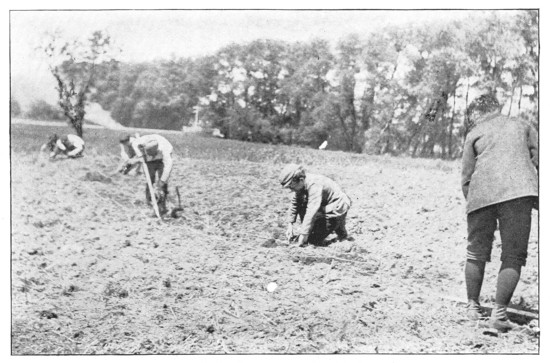
Fig. 366. Making a school-garden in Massachusetts.
LEAFLET LXXVII. SOMETHING FOR YOUNG FARMERS.[98] By JOHN W. SPENCER.
My Dear Nephews and Nieces:
I wish to make farmers of you all. I will try to tell you how to have farms all your own—farms on which you can plant seeds and see the plants grow. Once a little girl in Buffalo, who is one of my Junior Naturalists, asked me whether I would call at her home and see the harvest from seeds she planted on one of her farms the spring before. The principal of the school went with me, for he knew all about the little girl's success, and seemed proud of what she had accomplished. What do you think it was she had raised? It was something that filled her lap and was good to eat. It was a fine pumpkin. It weighed twenty-two pounds. I wish I could have a photograph of her holding the pumpkin, her face glowing with pride and satisfaction.
You are surely able to do as much as this little girl did. Perhaps you would prefer some other crop to pumpkins, in which case you have many kinds of seeds from which to choose.
Last spring, in school, this little girl with other boys and girls began planting and caring for egg-shell farms. It costs no money and but little trouble to own several such farms. The greatest pleasure and profit is to be found in having them in school, for then you have the opportunity of seeing how others manage their farms, and there is a spur in doing what others are doing. When you have read all about my plan I wish you would ask your teacher whether you cannot have some egg-shell farms in your grade. When your plants are large enough to put permanently in the open ground, you can plant them in a garden or window-box at your home. If it is not convenient to have egg-shell farms at school, ask your parents if you cannot have some at home.
Please give me your ears and your attention while I tell you how to get your farms.
In April you have eggs at some one of the three meals of the day, and the empty shells can be easily obtained. The end of the shell to be broken is the sharp or "peaked" end. Break away about a quarter or a third of it and pour out the white and the yolk that is inside. This empty shell is to hold the soil of your farm, and you can have as many farms as may be convenient to care for. On each egg-shell you may write your name, for the same reason that people have door plates on the doors of their houses or signs on their places of business. Some very methodical boys and girls write also the names of the kind of seeds sown, and the dates of planting and sprouting. Do not forget to put a hole through the bottom of each one of your farms for drainage. I wish I could be with you when you get your soil; we would go out to the pastures and the woods for a supply. I should be able to tell you much about different soils, and how they have been made. It is an interesting story that I must tell you when we are past the hurry of spring's work. If we could go afield we should find the best soil for your egg-shell farms about the roots of rotted stumps or in rotted leaves. It is necessary that the soil shall not bake hard because of frequent waterings, shall not dry out quickly, and shall have plenty of plant-food. I fancy the most convenient plan will be for all of you who wish soil to form a syndicate by contributing a cent each and go to a florist and buy your soil. Tell the florist you wish it for your use and the probabilities are that he will be so much interested in your plants that you will get more for the same amount of money than I could if I were to go for you.
The next difficulty will be to keep your farms right side up. That is easily accomplished by putting some sand or sawdust in a shallow box and making a dent where you wish each farm to stand. If you have your farms in the school-room, Tom, Dick, and Harry can have all their farms in the same box. There will be no trouble in separating them if the owner's name is written on each one.
Next comes the planting of seeds and the problem of the amount of earth to put over them. Big seeds require more covering than little seeds. Seeds like peas, beans, and corn may be thrust into the middle of your farm. Small seeds, like those of the petunia, which are almost like dust, require only the gentlest sprinkling of soil. Seeds as large as those of the aster and the balsam should be covered with a layer of earth as thick as a lead pencil. I advise you to plant twice as many seeds as you wish to have grow. Many accidents may happen and if all grow, the surplus plants can be replanted later or thrown away. The earth covering should be sprinkled or sifted over the seeds, and then it must be patted or pressed down firmly. By this means the particles of soil are snuggled close together, and the seed and the soil hold moisture much better than when the particles lie loose and far apart.
The next thing to do after planting is to sprinkle water over your farms. Do this as gently as possible, for with all your care some seeds may be uncovered. Look over the ground carefully, and those you find exposed poke into the earth with the point of a pencil or a stick.
The soil of your farms must be kept moist at all times. This is a point that will require your continued attention. When your Uncle John attended school, many years ago, there was a passage in his reader that taught him that "Eternal vigilance is the price of liberty." The attention required to keep plants suitably watered does not fall much short of eternal vigilance. This need not scare you. If you care for your farms you will find it a pleasure to wait on your plants.
If you have your egg-shell farms in the school-room, there will be no opportunity to water your plants Saturday or Sunday, when school is not in session. I think if you make your farms soaking wet Friday at the close of school, and then set them back from the window out of the direct rays of the sun, no harm will come from dryness before Monday morning.
You must watch to see whether all members of the same family do the same thing precisely alike. After sowing your seeds and watering your farms you will go to them many times to see whether anything has happened. You will not be able to see anything or hear anything, and you will conclude that nothing is going on in the soil.
In this you will be mistaken, for some active changes are taking place. They are of a kind that you can neither see nor hear. In days to come, when you are men and women, you will be able to appreciate the fact that some of the most important events come about silently and some of the least important come with a racket.
The first leaves that appear on most plants are called the seed-leaves. If your plants are comfortable, but a few days will pass before true leaves develop. You will find the latter very different from the seed-leaves. Before the first or seed-leaves appear it is not important that your farms have the strong sunlight. In fact I always put my egg-shell farms in the shade while the seeds are germinating, but at the first peep of a leaf or stem I put them in the full sunshine.
Most of you will no doubt have your farms on the window ledge. Among the first things you will observe is a way all the leaves have of looking out of doors. If you turn your farms around so the leaves are looking in the room, the time will not be long before all of them will be faced out of doors again. Once on a time one of my Junior Naturalists told me that plants take to sunshine as a duck does to water. A duck is never so comfortable as when in water; and I am certain that sunshine is important to the comfort of most plants. Some of my nephews and nieces will understand why light is so necessary to plants, for I have spoken of this before.
I hope you will this moment decide to have some egg-shell farms, and sow some seed immediately after getting your soil. Later, when the plants are large enough to plant in the open ground, we will talk of what is best to do with them. In Leaflet LII you will find a picture of an egg-shell farm.
LEAFLET LXXVIII. BULBS.[99] By JOHN W. SPENCER.
A BULB GARDEN.
"It's rather dark in the earth to-day,"
Said one little bulb to his brother;
"But I thought that I felt a sunbeam ray—
We must strive and grow till we find the way?"
And they nestled close to each other.
Then they struggled and toiled by day and by night
Till two little snowdrops in green and white,
Rose out of the darkness and into the light,
And softly kissed one another. —Boston Journal.
To succeed with the cultivation of flowers, the first thing to have in mind is to make the plant comfortable. This condition should be not only the first thought, but also the last thought. If you can do this successfully, the plant will do the rest of the work and your results will be abundant.
What plant comfort is, is a question more easily suggested than answered, for it is a very large subject—about as large as the surface of the earth. As a venture we will say that there are as many different kinds of plants as there are people. It is at least safe to say that plants have as many different notions as to their conditions of life as have the people of the different nations and tribes of the world.
Fig. 367. The Snow-drop.
If you were to have a birthday party and should invite as your guests the children from the four corners of the earth, and by magic could bring them to you in a jiffy, the boys and girls from Greenland would come enfolded in seal-skin, and those from Hawaii would bring only their bathing suits. You would have a busy time keeping them comfortable, for when you opened the door to cool off the little Greenlanders, the little Kanakas would complain of too much draft; and at the table the former would ask if you happened to have some tallow candles for dessert, and the latter would ask for bread-fruit and bananas.
Many of our flowering plants have been brought together from such remote quarters as that. We have bulbs from Holland, and pansies from England, and phlox from the dry atmosphere of Texas.
There is as much difference in the conditions necessary for comfort in these different plants as there is in the requirements of the little Eskimos and little Polynesians. To some extent, plants can change their manner of living, but in the main they are happiest when they can have their own way, just as you and I are.