PART I. TEACHERS' LEAFLETS.
Reading edition
Publications designed to aid the teacher with subject-matter, to indicate the point of view, and to suggest a method of presentation.
THE SCHOOL HOUSE. By L. H. BAILEY.
In the rural districts, the school must become a social and intellectual centre. It must stand in close relationship with the life and activities of its community. It must not be an institution apart, exotic to the common-day lives; it must teach the common things and put the pupil into sympathetic touch with his own environment. Then every school house will have a voice, and will say:
I teach The earth and soil To them that toil, The hill and fen To common men That live right here; The plants that grow, The winds that blow, The streams that run In rain and sun Throughout the year; And then I lead, Thro' wood and mead, Thro' mold and sod, Out unto God With love and cheer. I teach!
LEAFLET I. WHAT IS NATURE-STUDY?[1] By L. H. BAILEY.
Nature-study, as a process, is seeing the things that one looks at, and the drawing of proper conclusions from what one sees. Its purpose is to educate the child in terms of his environment, to the end that his life may be fuller and richer. Nature-study is not the study of a science, as of botany, entomology, geology, and the like. That is, it takes the things at hand and endeavors to understand them, without reference primarily to the systematic order or relationships of the objects. It is informal, as are the objects which one sees. It is entirely divorced from mere definitions, or from formal explanations in books. It is therefore supremely natural. It trains the eye and the mind to see and to comprehend the common things of life; and the result is not directly the acquiring of science but the establishing of a living sympathy with everything that is.
The proper objects of nature-study are the things that one oftenest meets. Stones, flowers, twigs, birds, insects, are good and common subjects. The child, or even the high school pupil, is first interested in things that do not need to be analyzed or changed into unusual forms or problems. Therefore, problems of chemistry and of physics are for the most part unsuited to early lessons in nature-study. Moving things, as birds, insects and mammals, interest children most and therefore seem to be the proper objects for nature-study; but it is often difficult to secure such specimens when wanted, especially in liberal quantity, and still more difficult to see the objects in perfectly natural conditions. Plants are more easily had, and are therefore usually more practicable for the purpose, although animals and minerals should by no means be excluded.
If the objects to be studied are informal, the methods of teaching should be the same. If nature-study were made a stated part of a rigid curriculum, its purpose might be defeated. One difficulty with our present school methods is the necessary formality of the courses and the hours. Tasks are set, and tasks are always hard. The best way to teach nature-study is, with no hard and fast course laid out, to bring in some object that may be at hand and to set the pupils to looking at it. The pupils do the work,—they see the thing and explain its structure and its meaning. The exercise should not be long, not to exceed fifteen minutes perhaps, and, above all things, the pupil should never look upon it as a "recitation," nor as a means of preparing for "examination." It may come as a rest exercise, whenever the pupils become listless. Ten minutes a day, for one term, of a short, sharp, and spicy observation lesson on plants, for example, is worth more than a whole text-book of botany.
The teacher should studiously avoid definitions, and the setting of patterns. The old idea of the model flower is a pernicious one, because it does not exist in nature. The model flower, the complete leaf, and the like, are inferences, and pupils should always begin with things and phenomena, and not with abstract ideas. In other words, the ideas should be suggested by the things, and not the things by the ideas. "Here is a drawing of a model flower," the old method says; "go and find the nearest approach to it." "Go and find me a flower," is the true method, "and let us see what it is."
Every child, and every grown person too, for that matter, is interested in nature-study, for it is the natural way of acquiring knowledge. The only difficulty lies in the teaching, for very few teachers have had experience in this informal method of drawing out the observing and reasoning powers of the pupil without the use of text-books. The teacher must first of all feel in natural objects the living interest which it is desired the pupils shall acquire. If the enthusiasm is not catching, better let such teaching alone.
Primarily, nature-study, as the writer conceives it, is not knowledge. He would avoid the leaflet that gives nothing but information. Nature-study is not "method." Of necessity each teacher will develop a method; but this method is the need of the teacher, not of the subject.
Nature-study is not to be taught for the purpose of making the youth a specialist or a scientist. Now and then a pupil will desire to pursue a science for the sake of the science, and he should be encouraged. But every pupil may be taught to be interested in plants and birds and insects and running brooks, and thereby his life will be the stronger. The crop of scientists will take care of itself.
It is said that nature-study teaching is not thorough and therefore is undesirable. Much that is good in teaching has been sacrificed for what we call "thoroughness,"—which in many cases means only a perfunctory drill in mere facts. One cannot teach a pupil to be really interested in any natural object or phenomenon until the pupil sees accurately and reasons correctly. Accuracy is a prime requisite in any good nature-study teaching, for accuracy is truth and it develops power. It is better that a pupil see twenty things accurately, and see them himself, than that he be confined to one thing so long that he detests it. Different subjects demand different methods of teaching. The method of mathematics cannot be applied to dandelions and polliwogs.
The first essential in nature-study is actually to see the thing or the phenomenon. It is positive, direct, discriminating, accurate observation. The second essential is to understand why the thing is so, or what it means. The third essential is the desire to know more, and this comes of itself and thereby is unlike much other effort of the schoolroom. The final result should be the development of a keen personal interest in every natural object and phenomenon.
Real nature-study cannot pass away. We are children of nature, and we have never appreciated the fact so much as we do now. But the more closely we come into touch with nature, the less do we proclaim the fact abroad. We may hear less about it, but that will be because we are living nearer to it and have ceased to feel the necessity of advertising it.
Much that is called nature-study is only diluted and sugar-coated science. This will pass. Some of it is mere sentimentalism. This also will pass. With the changes, the term nature-study may fall into disuse; but the name matters little so long as we hold to the essence.
All new things must be unduly emphasized, else they cannot gain a foothold in competition with things that are established. For a day, some new movement is announced in the daily papers, and then, because we do not see the head lines, we think that the movement is dead; but usually when things are heralded they have only just appeared. So long as the sun shines and the fields are green, we shall need to go to nature for our inspiration and our respite; and our need is the greater with every increasing complexity of our lives.
All this means that the teacher will need helps. He will need to inform himself before he attempts to inform the pupil. It is not necessary that he become a scientist in order to do this. He goes as far as he knows, and then says to the pupil that he cannot answer the questions that he cannot. This at once raises him in the estimation of the pupil, for the pupil is convinced of his truthfulness, and is made to feel—but how seldom is the sensation!—that knowledge is not the peculiar property of the teacher but is the right of any one who seeks it. Nature-study sets the pupil to investigating for himself. The teacher never needs to apologize for nature. He is teaching merely because he is an older and more experienced pupil than his pupil is. This is the spirit of the teacher in the universities to-day. The best teacher is the one whose pupils the farthest outrun him.
In order to help the teacher in the rural schools of New York, we have conceived of a series of leaflets explaining how the common objects can be made interesting to children. Whilst these are intended for the teacher, there is no harm in giving them to the pupil; but the leaflets should never be used as texts from which to make recitations. Now and then, take the children for a ramble in the woods or fields, or go to the brook or lake. Call their attention to the interesting things that you meet—whether you yourself understand them or not—in order to teach them to see and to find some point of sympathy; for every one of them will some day need the solace and the rest which this nature-love can give them. It is not the mere information that is valuable; that may be had by asking someone wiser than they, but the inquiring and sympathetic spirit is one's own.
The pupils will find their regular lessons easier to acquire for this respite of ten minutes with a leaf or an insect, and the school-going will come to be less perfunctory. If you must teach drawing, set the picture in a leaflet before the pupils for study, and then substitute the object. If you must teach composition, let the pupils write on what they have seen. After a time, give ten minutes now and then to asking the children what they saw on their way to school.
Now, why is the College of Agriculture at Cornell University interesting itself in this work? It is trying to help the farmer, and it begins with the most teachable point—the child. The district school cannot teach technical professional agriculture any more than it can teach law or engineering or any other profession or trade, but it can interest the child in nature and in rural problems, and thereby join his sympathies to the country at the same time that his mind is trained to efficient thinking. The child will teach the parent. The coming generation will see the result. In the interest of humanity and country, we ask for help.
How to make the rural school more efficient is one of the most difficult problems before our educators, but the problem is larger than mere courses of study. Social and economic questions are at the bottom of the difficulty, and these questions may be beyond the reach of the educator. A correspondent wrote us the other day that an old teacher in a rural school, who was receiving $20 a month, was underbid 50 cents by one of no experience, and the younger teacher was engaged for $19.50, thus saving the district for the three months' term the sum of $1.50. This is an extreme case, but it illustrates one of the rural school problems.
One of the difficulties with the rural district school is the fact that the teachers tend to move to the villages and cities, where there is opportunity to associate with other teachers, where there are libraries, and where the wages are sometimes better. This movement is likely to leave the district school in the hands of younger teachers, and changes are very frequent. To all this there are many exceptions. Many teachers appreciate the advantages of living in the country. There they find compensations for the lack of association. They may reside at home. Some of the best work in our nature-study movement has come from the rural schools. We shall make a special effort to reach the country schools. Yet it is a fact that new movements usually take root in the city schools and gradually spread to the smaller places. This is not the fault of the country teacher; it comes largely from the fact that his time is occupied by so many various duties and that the rural schools do not have the advantage of the personal supervision which the city schools have.
Retrospect and Prospect after five years' work.[2]
To create a larger public sentiment in favor of agriculture, to increase the farmer's respect for his own business,—these are the controlling purposes in the general movement that we are carrying forward under the title of nature-study. It is not by teaching agriculture directly that this movement can be started. The common schools in New York will not teach agriculture to any extent for the present, and the movement, if it is to arouse a public sentiment, must reach beyond the actual farmers themselves. The agricultural status is much more than an affair of mere farming. The first undertaking, as we conceive the problem, is to awaken an interest in the things with which the farmer lives and has to do, for a man is happy only when he is in sympathy with his environment. To teach observation of common things, therefore, has been the fundamental purpose. A name for the movement was necessary. We did not wish to invent a new name or phrase, as it would require too much effort in explanation. Therefore, we chose the current and significant phrase "nature-study," which, while it covers many methods and practices, stands everywhere for the opening of the mind directly to the common phenomena of nature.
We have not tried to develop a system of nature-study nor to make a contribution to the pedagogics of the subject. We have merely endeavored, as best we could, to reach a certain specific result,—the enlarging of the agricultural horizon. We have had no pedagogical theories, or, if we have, they have been modified or upset by the actual conditions that have presented themselves. Neither do we contend that our own methods and means have always been the best. We are learning. Yet we are sure that the general results justify all the effort.
Theoretical pedagogical ideals can be applied by the good teacher who comes into personal relations with the children, and they are almost certain to work out well. These ideals cannot always be applied, however, with persons who are to be reached by means of correspondence and in a great variety of conditions, and particularly when many of the subjects lie outside the customary work of the schools.
Likewise, the subjects selected for our nature-study work must be governed by conditions and not wholly by ideals. We are sometimes asked why we do not take up topics more distinctly agricultural or economic. The answer is that we take subjects that teachers will use. We would like, for example, to give more attention to insect subjects, but it is difficult to induce teachers to work with them. If distinctly agricultural topics alone were used, the movement would have very little following and influence. Moreover, it is not our purpose to teach technical agriculture in the common schools, but to inculcate the habit of observing, to suggest work that has distinct application to the conditions in which the child lives, to inspire enthusiasm for country life, to aid in home-making, and to encourage a general movement towards the soil. These matters cannot be forced. In every effort by every member of the extension staff, the betterment of agricultural conditions has been the guiding impulse, however remote from that purpose it may have seemed to the casual observer.
We have found by long experience that it is unwise to give too much condensed subject-matter. The individual teacher can give subject-matter in detail because personal knowledge and enthusiasm can be applied. But in general correspondence and propagandist work this cannot be done. With the Junior Naturalist, for example, the first impulse is to inspire enthusiasm for some bit of work which we hope to take up. This enthusiasm is inspired largely by the organization of clubs and by the personal correspondence that is conducted between the Bureau and these clubs and their members. It is the desire, however, to follow up this general movement with instruction in definite subject-matter with the teacher. Therefore, a course in Home Nature-study was formally established under the general direction of Mrs. Mary Rogers Miller. It was designed to carry on the experiment for one year, in order to determine whether such a course would be productive of good results and to discover the best means of prosecuting it. These experimental results were very gratifying. Nearly 2,000 New York teachers are now regularly enrolled in the Course, the larger part of whom are outside the metropolitan and distinctly urban conditions. Every effort is made to reach the rural teacher.
In order that the work may reach the children, it must be greatly popularized and the children must be met on their own ground. The complete or ideal leaflet may have little influence. For example, I prepared a leaflet on "A Children's Garden" which several people were kind enough to praise. However, very little direct result was secured from the use of this leaflet until "Uncle John" began to popularize it and to make appeals to teachers and children by means of personal talks, letters and circulars. So far as possible, his appeal to children was made in their own phrase. The movement for the children's garden has now taken definite shape, and the result is that more than 26,000 children in New York State are raising plants during the present year. Another illustration of this kind may be taken from the effort to improve the rural school grounds. I wrote a bulletin on "The Improvement of Rural School Grounds," but the tangible results were very few. Now, however, through the work of "Uncle John" with the teachers and the children, a distinct movement has begun for the cleaning and improving of the school grounds of the State. This movement is yet in its infancy, but several hundred schools are now in process of renovation, largely through the efforts of the children.
The idea of organizing children into clubs for the study of plants and animals, and other outdoor subjects, originated, so far as our work is concerned, with Mr. John W. Spencer himself an actual, practical farmer. His character as "Uncle John" has done much to supply the personality that ordinarily is lacking in correspondence work, and there has been developed amongst the children an amount of interest and enthusiasm which is surprising to those who have not watched its progress.
The problems connected with the rural schools are probably the most difficult questions to solve in the whole field of education. We believe, however, that the solution cannot begin directly with the rural schools themselves. It must begin in educational centres and gradually spread to the country districts. We are making constant efforts to reach the actual rural schools and expect to utilize fully every means within our power, but it is work that is attended with many inherent difficulties. We sometimes feel that the agricultural status can be reached better through the hamlet, village, and some of the city schools than by means of the little red school house on the corner. By appeals to the school commissioners in the rural districts, by work through teachers' institutes, through farmers' clubs, granges and other means we believe that we are reaching farther and farther into the very agricultural regions. It is difficult to get consideration for purely agricultural subjects in the rural schools themselves. Often the school does not have facilities for teaching such subjects, often the teachers are employed only for a few months, and there is frequently a sentiment against innovation. It has been said that one reason why agricultural subjects are taught less in the rural schools of America than in those of some parts of Europe, is because of the few male teachers and the absence of school gardens.
We have met with the greatest encouragement and help from very many of the teachers in the rural schools. Often under disadvantages and discouragements they are carrying forward their part of the educational work with great consecration and efficiency. In all the educational work we have been fortunate to have the sympathy and co-operation of the State Department of Public Instruction. We do not expect that all teachers nor even a majority will take up nature-study work. It is not desirable that they should. We are gratified, however, at the large number who are carrying it forward.
This Cornell nature-study movement is one small part of a general awakening in educational circles, a movement which looks towards bringing the child into actual contact and sympathy with the things with which he has to do. This work is taking on many phases. One aspect of it is its relation to the teaching of agriculture and to the love of country life. This aspect is yet in its early experimental stage. The time will come when institutions in every State will carry on work along this line. It will be several years yet before this type of work will have reached what may be considered an established condition, or before even a satisfactory body of experience shall have been attained. Out of the varied and sometimes conflicting methods and aims that are now before the public, there will develop in time an institution-movement of extension agricultural teaching.
The literature issued by the Bureau of Nature-Study is of two general types: that which is designed to be of more or less permanent value to the teacher and the school; and that which is of temporary use, mostly in the character of supplements and circulars designed to meet present conditions or to rally the teachers or the Junior Naturalists. The literature of the former type is now republished and is to be supplied gratis to teachers in New York State. The first publication of the Bureau of Nature-Study was a series of teachers' leaflets. This series ran to twenty-two numbers. It was discontinued in May, 1901, because it was thought that sufficient material had then been printed to supply teachers with subjects for a year's work. It was never intended to publish these leaflets indefinitely. Unfortunately, however, some persons have supposed that because these teachers' leaflets were discontinued we were lessening our efforts in the nature-study work. The fact is that later years have seen an intensification of the effort and also a strong conviction on the part of all those concerned that the work has permanent educative value. We never believed so fully in the efficiency of this kind of effort as at the present time.
LEAFLET II. THE NATURE-STUDY MOVEMENT.[3] By L. H. BAILEY.
The nature-study movement is the outgrowth of an effort to put the child into contact and sympathy with its own life.
It is strange that such a movement is necessary. It would seem to be natural and almost inevitable that the education of the child should place it in intimate relation with the objects and events with which it lives. It is a fact, however, that our teaching has been largely exotic to the child; that it has begun by taking the child away from its natural environment; that it has concerned itself with the subject-matter rather than with the child. This is the marvel of marvels in education.
Let me illustrate by a reference to the country school. If any man were to find himself in a country wholly devoid of schools, and were to be set the task of originating and organizing a school system, he would almost unconsciously introduce some subjects that would be related to the habits of the people and to the welfare of the community. Being freed from traditions, he would teach something of the plants and animals and fields and people. Yet, as a matter of fact, what do our rural schools teach? They usually teach the things that the academies and the colleges and the universities have taught—that old line of subjects that is supposed, in its higher phases, to lead to "learning." The teaching in the elementary school is a reflection of old academic methods. We really begin our system at the wrong end—with a popularizing and simplifying of methods and subjects that are the product of the so-called higher education. We should begin with the child. "The greatest achievement of modern education," writes Professor Payne, "is the gradation and correlation of schools, whereby the ladder of learning is let down from the university to secondary schools, and from these to the schools of the people." It is historically true that the common schools are the products of the higher or special schools, and this explains why it is that so much of the common-school work is unadapted to the child. The kindergarten and some of the manual-training, are successful revolts against all this. It seems a pity that it were ever necessary that the ladder of learning be "let down;" it should be stood on the ground.
The crux of the whole subject lies in the conception of what education is. We all define it in theory to be a drawing out and a developing of the powers of the mind; but in practice we define it in the terms of the means that we employ. We have come to associate education with certain definite subjects, as if no other sets of subjects could be made the means of educating a mind. One by one, new subjects have forced themselves in as being proper means for educating. All the professions, natural science, mechanic arts, politics, and last of all agriculture, have contended for a place in educational systems and have established themselves under protest. Now, any subject, when put into pedagogic form, is capable of being the means of educating a man. The study of Greek is no more a proper means of education than the study of Indian corn is. The mind may be developed by means of either one. Classics and calculus are no more divine than machines and potatoes are. We are much in the habit of speaking of certain subjects as leading to "culture;" but this is really factitious, for "culture" is the product only of efficient teaching, whatever the subject-matter may be. So insistent have we been on the employing of "culture studies" that we seem to have mistaken the means of education for the object or result of education. What a man is, is more important than what he knows. Anything that appeals to a man's mind is capable of drawing out and training that mind; and is there any subject that does not appeal to some man's mind? The subject may be Sanskrit literature, hydraulics, physics, electricity, or agriculture—all may be made the means whereby men and women are educated, all may lead to what we ought to know as culture. The particular subject with which the person deals is incidental, for
"A man's a man for a' that and a' that."
Is there, then, to be no choice of subjects? There certainly is. It is the end of education to prepare the man or woman better to live. The person must live with his surroundings. He must live with common things. The most important means with which to begin the educational process, therefore, are those subjects that are nearest the man. Educating by means of these subjects puts the child into first-hand relation with his own life. It expands the child's spontaneous interest in his environment into a permanent and abiding sympathy and philosophy of life. I never knew an exclusive student of classics or philosophy who did not deplore his lack of touch with his own world. These common subjects are the natural, primary, fundamental, necessary subjects. Only as the child-mind develops should it be taken on long flights to extrinsic subjects, distant lands, to things far beyond its own realm; and yet, does not our geography teaching still frequently begin with the universe or with the solar system?
In the good time coming, geography will not begin with a book at all, as, in fact, it does not now with many teachers. It may end with one. It will begin with physical features in the very neighborhood in which the child lives—with brooks and lakes and hills and fields. Education should begin always with objects and phenomena. We are living in a text-book and museum age. First of all, we put our children into books, sometimes even into books that tell about the very things at the child's door, as if a book about a thing were better than the thing itself. So accustomed are we to the book-route that we regard any other route as unsystematic, unmethodical, disconnected. Books are only secondary means of education. We have made the mistake of considering them primary. This mistake we are rapidly correcting. As the book is relegated to its proper sphere, we shall find ourselves free to begin with the familiar end of familiar things.
Not only are we to begin with common objects and events, but with the child's natural point of contact with them. Start with the child's sympathies; lead him on and out. We are to develop the child, not the subject. The specialists may be trusted to develop the subject-matter and to give us new truth. The child is first interested in the whole plant, the whole bug, the whole bird, as a living, grooving object. It is a most significant fact that most young children like plants, but that most youths dislike botany. The fault lies neither in the plants nor in the youths. A youth may study cells until he hates the plant that bears the cells. He may acquire a technical training in cells, but he may be divorced from objects with which he must live, and his life becomes poorer rather than richer. I have no objection to minute dissection and analysis, but we must be very careful not to begin it too early nor to push it too far, for we are not training specialists: we are developing the power that will enable the pupil to get the most from his own life. As soon as the pupil begins to lose interest in the plant or the animal itself, stop!
There is still another reason for the study of the common things in variety: it develops the power to grasp the problems of the day and to make the man resourceful. A young man who has spent all his time in the schoolroom is usually hopelessly helpless when he encounters a real circumstance. I see this remarkably illustrated in my own teaching, for I have young men from the city and from farms. The farm boy will turn his hand to twenty things where the city boy will turn his to one. The farm boy has had to meet problems and to solve them for himself: this is sometimes worth more than his entire school training. Why does the farm boy make his way when he goes to the city?
It is no mere incident to one's life that he be able to think in the thought of his own time. Even though one expect to devote himself wholly to a dead language, in school he should study enough natural science and enough technology to enable him to grasp living problems. I fear that some institutions are still turning out men with mediæval types of mind.
Now, therefore, I come again to my thesis,—to the statement that the end and purpose of nature-study is to educate the young mind by means of the subjects within its own sphere, by appealing to its own sympathetic interest in them, in order that the person's life may be sweeter, deeper, and more resourceful. Nature-study would not necessarily drive any subject from the curriculum; least of all would it depreciate the value of the "humanities;" but it would restore to their natural and proper place the subjects that are related to the man. It would begin with things within the person's realm. If we are to interest children—or grown-ups, either, for that matter—we must begin by teaching the things that touch their lives. Where there is one person that is interested in philology, there are hundreds that are interested in engines and in wheat. From the educational point of view, neither the engine nor the wheat is of much consequence, but the men who like the engines and who grow the wheat are immeasurably important and must be reached. There are five millions of farms in the United States on which chickens are raised, and also thousands of city and village lots where they are grown. I would teach chickens. I would reach Men by means of the Old Hen.
How unrelated much of our teaching is to the daily life is well shown by inquiries recently made of the children of New Jersey by Professor Earl Barnes. Inquiries were made of the country school children in two agricultural counties of the State as to what vocation they hoped to follow. As I recall the figures, of the children at seven years of age 26 per cent desired to follow some occupation connected with country life. Of those at fourteen years, only 2 per cent desired such occupation. This remarkable falling off Professor Barnes ascribes in part to the influence of the teacher in the country schools, who is usually a town or city girl. The teacher measures everything in terms of the city. She talks of the city. She returns to the city at the end of the week. In the meantime, all the beauty and attractiveness and opportunity of the country may be unsuggested. Unconsciously both to teacher and pupil, the minds of the children are turned toward the city. There results a constant migration to the city, bringing about serious social and economic problems; but from the educational point of view the serious part of it is the fact that the school training may unfit the child to live in its normal and natural environment. It is often said that the agricultural college trains the youth away from the farm; the fact is that the mischief is done long before the youth enters college.
Let me give another illustration of the fact that dislike of country life is bred very early in the life of the child. In a certain rural school in New York State, of say forty-five pupils, I asked all those children that lived on farms to raise their hands; all hands but one went up. I then asked those who wanted to live on the farm to raise their hands; only that one hand went up. Now, these children were too young to feel the appeal of more bushels of potatoes or more pounds of wool, yet they had thus early formed their dislike of the farm. Some of this dislike is probably only an ill-defined desire for a mere change, such as one finds in all occupations, but I am convinced that the larger part of it was a genuine dissatisfaction with farm life. These children felt that their lot was less attractive than that of other children; I concluded that a flower garden and a pleasant yard would do more to content them with living on the farm than ten more bushels of wheat to the acre. Of course, it is the greater and better yield that will enable the farmer to supply these amenities; but at the same time it must be remembered that the increased yield itself does not arouse a desire for them. I should make farm life interesting before I make it profitable.
Of course, nature-study is not proposed merely as a means of keeping youth in the country; I have given these examples only to illustrate the fact that much of our teaching is unrelated to the circumstances in which the child lives—and this is particularly true of teaching in the rural schools. Nature-study applies to city and country conditions alike, acquiring additional emphasis in the country from the fact that what we call "nature" forms the greater part of the environment there. But the need to connect the child with itself is fundamental to all efficient teaching. To the city child the problems associated with the city are all-important; but even then I should give much attention to the so-called "nature subjects;" for these are clean, inspiring, universal. "Back to nature" is an all-pervading tendency of the time.
We must distinguish sharply between the purposes of nature-study and its methods. Its purposes are best expressed in the one word "sympathy." By this I do not mean sentimentalism or superficiality or desultoriness. The acquiring of sympathy with the things and events amongst which one lives is the result of a real educational process—a process as vital and logical and efficient as that concerned in educating the older pupil in terms of fact and "science." Nature-study is not "natural history," nor "biology," nor even elementary science. It is an attitude, a point of view, a means of contact.
Nature-study is not merely the adding of one more thing to a curriculum. It is not co-ordinate with geography, or reading, or arithmetic. Neither is it a mere accessory, or a sentiment, or an entertainment, or a tickler of the senses. It is not a "study." It is not the addition of more "work." It has to do with the whole point of view of elementary education, and therefore is fundamental. It is the full expression of personality. It is the practical working out of the extension idea that has become so much a part of our time. More than any other recent movement, it will reach the masses and revive them. In time it will transform our ideals and then transform our methods.
The result of all this changing point of view I like to speak of as a new thing. Of course, there is no education that is wholly new in kind; and it is equally true that education is always new, else it is dead and meaningless. But this determination to cast off academic methods, to put ourselves at the child's point of view, to begin with the objects and phenomena that are near and dear to the child, is just now so marked, and is sure to be so far-reaching in its effects, that I cannot resist the temptation to collect these various movements, for emphasis, under the title of the "new education."
"Nature-study" is another name for this new education. It is a revolt from the too exclusive science-teaching and book-teaching point of view, a protest against taking the child first of all out of its own environment. It is a product of the teaching of children in the elementary schools. The means and methods in nature-study are as varied as the persons who teach it. Most of the criticism of the movement—even among nature-study folk themselves—has to do with means and methods rather than with real ideals. We are now in the epoch when we should overlook minor differences and all work together for the good of a common cause. There is no one subject and no one method that is best.
While it is not my purpose to enter into any discussion of the methods of teaching nature-study, I cannot refrain from calling attention to what I believe to be some of the most serious dangers, (1) I would first mention the danger of giving relatively too much attention to mere subject-matter or fact. Nowhere should the acquiring of mere information be the end of an educational process, and least of all in nature-study, for the very essence of nature-study is spirit, sympathy, enthusiasm, attitude toward life. These results the youth gains naturally when he associates in a perfectly free and natural way with objects in the wild. Science-teaching has fallen short of its goal in the elementary schools—and even in the colleges and universities—by insisting so much on the subject-matter that the pupil is overlooked. In standing so rigidly for the letter, we have missed the spirit. President Eliot has recently called attention to this danger: "College professors heretofore have been apt to think that knowledge of the subject to be taught was the sufficient qualification of a teacher; but all colleges have suffered immeasurable losses as a result of this delusion." (2) A second danger is the tendency to make the instruction too long and too laborious. As soon as the child becomes weary of giving attention, the danger-point is reached; for thereafter there is loss in the spirit and enthusiasm, however much may be gained in dry subject-matter. I believe that even in high schools and colleges we make mistakes by demanding too long-continued application to one subject. Short, sharp, enthusiastic exercises, with pith and point, of five to ten minutes' duration, are efficient and sufficient for most purposes, particularly with beginners. (3) A third danger is the practice of merely telling or explaining. Set the child to work, and let the work be within his own realm. Pollen, lichens, capsules, lymphatics, integuments—these are not within the child's range; they smack of the museum and the text-book. Yet it appears to be the commonest thing to put mere children at the subject of cross-fertilization; they should first be put, perhaps, at flowers and insects. I wish that in every schoolroom might be hung the motto, "Teaching, not telling." (4) A fourth point I ought to mention is the danger of clinging too closely to the book habit; this I have already touched on. We are gradually growing out of the book slavery, even in arithmetic and grammar and history. This means a distinct advance in the abilities of the teacher. Of all subjects that should not be taught by the book, nature-study is chief. Its very essence is freedom from tradition and "method." I wish that there were more nature-study books; but they are most useful as sources of fact and inspiration, not as class texts. The good teacher of nature-study must greatly modify the old idea of "recitations." I wish to quote again from President Eliot: "Arithmetic is a very cheap subject to teach; so are spelling and the old-fashioned geography. As to teaching history in the old-fashioned way, anybody could do that who could hear a lesson recited. To teach nature-studies, geometry, literature, physiography, and the modern sort of history requires well-informed and skillful teachers, and these cost more than the lesson-hearers did." (5) Finally, we must come into contact with the actual things, not with museums and collections. Museums are little better than books unless they are regarded as secondary means. The museum has now become a laboratory. The living museum must come more and more into vogue,—living birds, living plants, living insects. The ideal laboratory is the out-of-doors itself; but for practical school purposes this must be supplemented. The most workable living laboratory of any dimensions is the school garden. The true school garden is a laboratory plat; time is coming when such a laboratory will be as much a part of a good school equipment as blackboards and charts and books now are. It will be like an additional room to the school building. Aside from the real school garden, every school premises should be embellished and improved as a matter of neighborhood and civic pride; for one cannot expect the child to rise above the conditions in which he is placed. All these dangers cannot be overcome by any "system" or "method;" they must be solved one by one, place by place, each teacher for himself. Whenever nature-study comes to be rigidly graded and dressed and ordered, the breath of life will be crushed from it. It is significant that everywhere mere "method" is giving way to individualism.
In time, the methods of teaching nature-study will crystallize and consolidate around a few central points. The movement itself is well under way. It will persist because it is vital and fundamental. It will add new value and significance to all the accustomed work of the schools; for it is not revolutionary, but evolutionary. It stands for naturalness, resourcefulness, and for quickened interest in the common and essential things of life. We talk much about the ideals of education; but the true philosophy of life is to idealize everything with which we have to do.
LEAFLET III. AN APPEAL TO THE TEACHERS OF NEW YORK STATE.[4] By L. H. BAILEY.
The kernel of modern educational development is to relate the school-training to the daily life. Much of our education is not connected with the conditions in which the pupils live and is extraneous to the lives that they must lead. The free common schools are more recent in development than universities, colleges and academies and they are even yet essentially academic and in many ways undemocratic. They teach largely out of books and of subjects that have little vital relation with things that are real to the child. The school work is likely to be exotic to the pupil. The child lives in one world, and goes to school in another world.
Every subject has teaching-power when put into pedagogic form. The nearer this subject is to the child, the greater is its teaching power, other conditions being comparable; and the more completely does it put him into touch with his environment and make him efficient and happy therein. In time, all subjects in which men engage will be put in form for teaching and be made the means of training the mind. The old subjects will not be banished, but rather extended; but the range of subjects will be immensely increased because we must reach all people in terms of their daily experience. How all these subjects are to be handled as school agencies, we cannot yet foresee, nor is it my purpose now to discuss the question; but it is certain that the common things must be taught. And the common subjects are as capable of being made the means of developing the imagination and the higher ideals as are many of the traditional subjects.
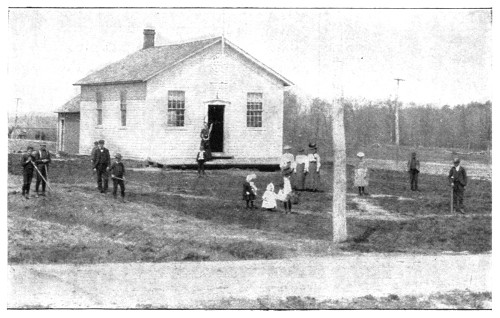
Fig. 1. Junior Gardeners beginning the work of cleaning up a New York school ground.
Great numbers of our people are in industrial and agricultural environments. By means of the industrial and agricultural trades they must live. These trades must be made more efficient; and the youth must be educated to see in them more than a mere livelihood. These industrial and agricultural subjects must be put more and more into schools. My own interest lies at present more with the agricultural subjects, and these are the occasion for this appeal. The so-called "industrial" and commercial subjects have already been put into schools with good effect: the agricultural subjects now must come within the school horizon.
Probably one million and more of the people of New York State live on farms. This is approximately one in seven of our entire population. Moreover, every person is interested in the out-of-doors and in the things that grow therein. The future agricultural efficiency of New York State will depend on the school training more than on any other single factor; and on the agricultural efficiency of the State will depend, to an important extent, its economic supremacy. New York is the fourth State in total agricultural wealth, being exceeded only by Illinois, Iowa and Ohio. All the country children should be reached in terms of the country. Most of our school books are made for the city and town rather than for the country. The problem of the development of the rural school is the most important single educational problem now before us; and it is essentially an agricultural problem.
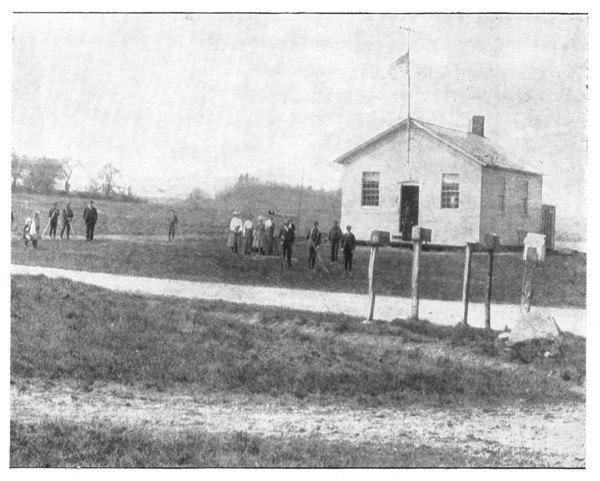
Fig. 2. Junior Gardeners at work in a New York school ground. The grounds are now ready for planting. The mail carrier now calls and the pupils take the mail home.
My appeal, therefore, is to every teacher in New York State, whether in country or city—for the city teacher makes public opinion, helps to set educational standards, and many of the country children go to school in the cities. I do not wish to press agriculture into the schools as a mere professional subject, but I would teach—along with the customary school work—the objects and phenomena and affairs of the country as well as of the city. The schools lead away from the country rather than towards it. All this I do not regard as a fault of the schools, but merely as a limitation due to the fact that the schools are still in process of evolution. It requires time to adapt a means to an end, and the schools are not to be criticised. But we must do our best to hasten the evolution. Schools, colleges and universities have only begun to reach the people effectively: these institutions must eventually touch every vital and homely problem, for they are to be the controlling factors in our civilization. Any subject that is worthy a person's attention out of school is also worthy his attention in school.
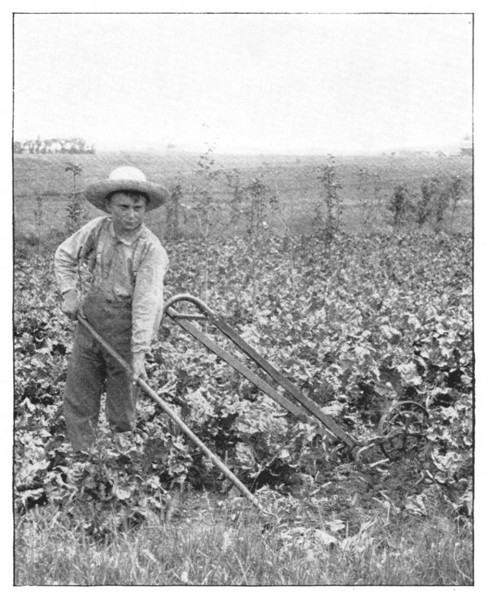
Fig. 3. Sugar beets and a fourteen-year-old experimenter. (Supt. Kern, Illinois.)
I heard a good story the other day of an occurrence of many years ago illustrating the fact that school training may be wholly exotic to the pupil. The story was told in Ogdensburg, and Heuvelton is near by. The class in geography was on exhibition, for there were visitors. The questions were answered quickly: "How far is it from Rome to Corinth?" "From Rome to Constantinople?" "From Paris to Rome?" A visitor was asked whether he had any questions to propound. He had one: "How far is it from Heuvelton to Ogdensburg?" No one answered; yet the visitor said that none of the pupils would be likely to go from Rome to Constantinople, but that every one of them would go from Heuvelton to Ogdensburg.
Not only must the school teach in terms of its own environment, but more and more it must become the intellectual and social center of the neighborhood or district. Every modern rural school building should be attractive enough to induce clubs of many kinds to hold meetings in it. In the old "lyceum" days the school house was an important gathering place. These days are mostly past, but better days should be coming: the school should connect at every point with the life of the community. Any event, however small, that centers the attention of the people at the school house is a beginning and is worth while. A year ago the children and teacher in one of our district schools began the work of "cleaning up" the premises. The picture (Fig. 1) shows them at work. Later, when the grounds were renovated and ready for the planting, boxes were placed for the reception of the mail for those who do not live on the carrier's route: this is the beginning of a centering of attention at the school house. I think that the boxes might have been more attractive and perhaps better placed, but this will come in time: a beginning has been made. When once the people of any community come to think of the school house as a meeting-place for old folks as well as for children, what may we not expect of the rural school? We need adult education as well as juvenile education.
I have now no course of study to propose for agricultural or country-life subjects in the schools, but I would like to know how many teachers in the State desire to take up certain work of this nature as an experiment. The College of Agriculture will be glad to suggest the kind of work, if need be. The western states are undertaking this work: we must not be behind. It is endorsed by Superintendent Skinner, as will be seen from the letter published at the close of this pamphlet.
To be effective and meaningful, this work should deal directly with the things,—handling the things, studying the things, learning from the things. This is nature-study. To commit to memory something about things is of little consequence. We are too closely committed to books. We are often slaves to books. Books are only secondary or incidental means of educating, particularly in nature-study subjects. We have known the book-way of educating for so long a time that many of us have come to accept it as a matter of course and as the only way. A New York school man recently told me an incident that illustrates this fact singularly well. In the Cattaraugus Indian Reservation he opened a school in which at first he employed only manual-training and nature-study work. Soon one of the children left school. The teacher sought the mother and asked why. The mother replied that there was no use in sending the child to school because the teacher had given it no books to study. So slavishly have we followed the book-route that even the Indian accepts it as the only road to schooling!
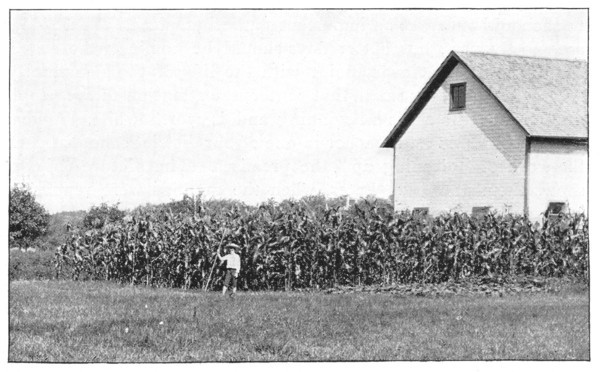
Fig. 4. Prize corn and a ten-year-old experimenter in one of Supt. Kern's districts, Illinois.
School-Gardens.
Many lines of work might be suggested for an occasional period. Perhaps the best one for spring is a school-garden. In time, every good school will have its garden, as it now has charts and blackboards and books. A school-garden is a laboratory-room added to the school house. It may be five feet square or ten times that much. The children prepare the land,—lessons in soils, soil physics; sow the seed,—lessons in planting, germination, and the like; care for the plants,—lessons in transplanting, struggle for existence, natural enemies, conditions that make for the welfare of the plants. The older pupils may be organized into experiment clubs, as they are being organized in parts of Illinois (see article on "Learning by Doing," by Supt. O. J. Kern, Review of Reviews, Oct., 1903, p. 456). We can help you in this school-gardening work.
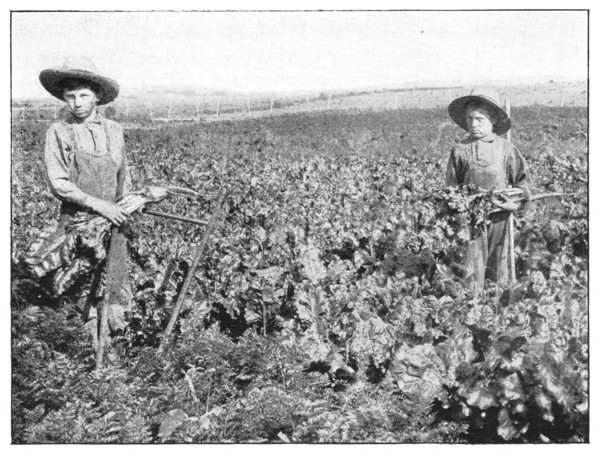
Fig. 5. "Learning by doing." A new kind of school work in Illinois, under the direction of Supt. Kern.
Other Work.
If not school-gardens, take up other lines of work,—study the school premises, the nearby brook or field, an apple tree, or any other common object or phenomenon. If there is any special agricultural industry in the neighborhood, discuss it and set the pupils at work on it. Any of these common-day subjects will interest the children and brighten up the school work; and the pursuit of them will teach the children the all-important fact that so few of us ever learn,—the fact that the commonest and homeliest things are worthy the best attention of the best men and women.
Improving the School Grounds.
Just now, the improving of school grounds is a pressing subject. As a preliminary to the actual improving of the grounds, suppose that the following problems were set before the pupils:
1. Exercises on the Grounds.
1. Area.—Measure the school grounds, to determine the lengths and widths. Draw an outline map showing the shape. The older pupils may compute the square surface area. The distances may be compared, for practice, in feet, yards and rods. (Arithmetic.)
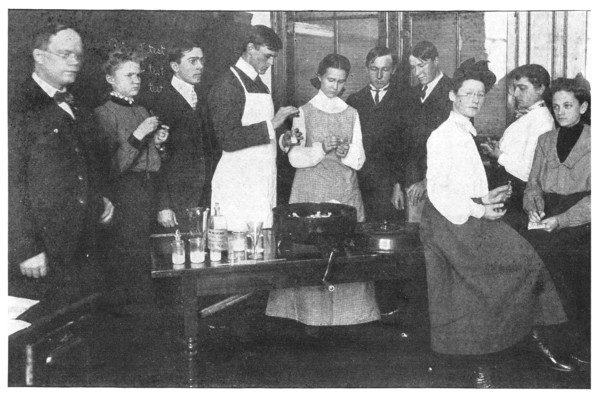
Fig. 6. Using the Babcock milk test at Professor Hollister's School, Corinth, N. Y.
2. Contour.—Is the area level, or rough, or sloping? Determine how great the slope is by sighting across a carpenter's level. In what direction does the ground slope? Is the slope natural, or was it made by grading? The older pupils may draw a cross-section line, to a scale, to show what the slope is. (Geography.)
3. Fences.—What parts of the area are fenced? What kind of fence? Total length of fence? Give opinion whether this fence is needed, with reasons. Is the fence in good repair? If not, what should be done to remedy it? (Arithmetic, language.)
4. Soil.—What is the nature of the soil—clay, sand, gravel, field loam? Was subsoil spread on the surface when the grounds were graded? Is the soil poor or rich, and why do you think so? Is it stony? What can be done to improve the soil? (Geography, language.)
5. Ground cover.—What is on the ground—sod or weeds, or is it bare? What do you think would be the best ground cover, and why? (Geography, language.)
6. Trees and bushes.—How many trees and bushes are there on the ground? Were they planted, or did they come up of themselves? Make a map showing where the principal ones are. Name all the kinds, putting the trees in one list and the bushes in another. Do any of the trees need pruning, and why? State whether any of them have been injured or are unhealthy. (Geography, language.)
7. Tenants.—What animals live or have lived on the school premises? What birds' nests do you find (these may be found in winter)? Hornets' nests? Perhaps you can find cocoons or egg-masses of insects in winter, and the active insects themselves in spring and fall. What birds visit the place? Do rabbits or mice or moles or frogs inhabit the premises? (Geography, language.)
8. Natural features.—Describe any strong natural features, as rocks, ponds, streams, groves. What views do you get from the school grounds? (Geography, language.)
2. Exercises on the School Structures.
9. Buildings.—How many buildings are on the grounds, including sheds, etc.? Give the sizes in lengths and widths. Brick or wood? Color? Make a map or chart showing the position of these structures, being careful to have the buildings properly proportioned with reference to the entire area. (Language, geography.)
10. Repairs needed.—Describe what condition the structures are in. Tell whether repairs are needed on foundations, side walls, roof, belfry, chimney, steps, doors, windows, paint. (Language.)
11. Flag pole.—Where is your flag pole? Could it be in a better place? How tall is it above ground? How much in diameter at the base? What kind of wood? Painted? How deep in the ground? When was it put up? What repairs does it need? (Language.)
3. General Exercises.
12. History.—When was the land set aside for a school? When was the school house built? Who built it? (History, language.)
13. Cost.—Try to find out what the land cost. What the building cost. Are they worth as much now? (History, language.)
14. Government.—Determine what officers have general control of the school. How did they come to be officers? How long do they hold office? What are the duties of each? Determine whether your school receives any aid from the State. (Government.)
15. Improvement.—Tell what you think should be done to improve the school grounds and the school structures. (Language.)
16. Photographs.—The teacher or some pupil should photograph the school premises, and send the picture to us. We want at least one picture of every rural school house and grounds in the State. Even a very poor photograph is better than none.
Experiment Garden.—Every school ground should have at least one small plat on which the children can grow some plant that is useful in that community. Just now alfalfa is demanding much attention from farmers, and it is certain soon to become a very important farm crop in New York State. It is used for pasturage and for hay. When once established, it lives for years. It is allied to clover and is a handsome plant for any school grounds. Will not the teacher suggest to the children that they make an alfalfa bed along one side of the school grounds? It will be attractive and will teach many lessons to pupils and parents even if it is only a few square feet in size. We want to put an alfalfa plat on every rural school ground in the State. We will supply the seed free. Alfalfa is easy to grow if only a few essential principles are kept in mind. We will send full directions to any one who applies. From year to year we will give nature-study lessons on these alfalfa plats.
We are anxious to start work of the above kind. It can be done at any time of the year. We are already in touch with more than 400 school grounds, but we want to reach every rural school ground in the State. Will not the teacher send to us the best piece of work done by any pupil in any of the foregoing sixteen problems? These papers we will file, as showing the conditions of the premises of the particular school. They will enable us to see the progress that is being made from year to year in the improvement of your school premises. They will also enable us better to give advice, when called upon to do so. Sometimes we can send to the particular school a man to give advice on the spot. Sending the best reports to the University will be a reward to the most diligent pupils. Send all reports to John W. Spencer, Nature-Study Bureau, Ithaca, N. Y.
We desire to put in the rural school houses of the State some good pictures of country and farm scenes. These pictures will be artistic reproductions of meritorious photographs, and large enough to hang on the walls of the school room. With each picture will be sent instructions for framing in order to make the picture more attractive. We shall choose eight such pictures for distribution the present school year. We will send one of these pictures free to any rural school in the State that takes up two of the problems given above; and all of them to schools that take up the sixteen problems. We expect to publish lists of all schools, with teachers' names, that take up this work in improving the premises of rural schools.
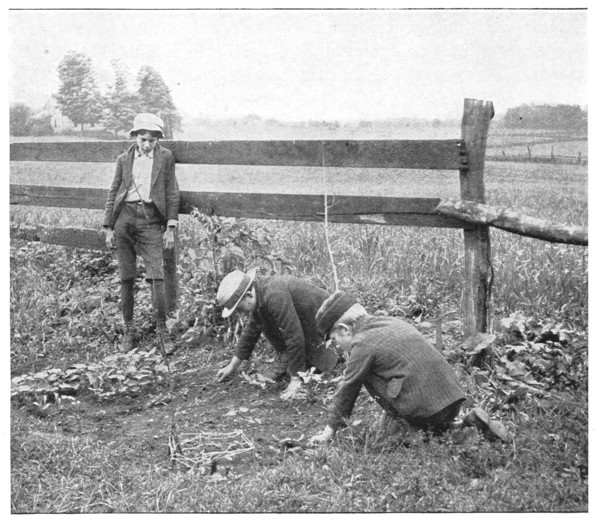
Fig. 7. Junior Naturalists making ready for planting. Tompkins Co., N. Y.
To one who is not teaching in the public schools, all this work seems to be simple enough. Such persons are likely to be impatient that more rapid progress is not made in introducing agricultural and common-life subjects into the schools. But the teacher knows that all this work requires patience and skill. It cannot as yet be forced into the schools and still retain spontaneity and vitality. It must come gradually, and prove itself as it goes. Probably all public school teachers are now agreed that the schools should be put closely in line with the life of their various communities. The questions now to be solved are chiefly those of means and methods, and of arousing the school constituencies to the new points of view. A full and free discussion of the whole subject is now needed. The time is hardly yet ripe for very definite courses of study in these new fields. Many schools are already teaching these new subjects with entire success: these schools can serve the cause by making their experience public.
LETTERS ON THE SUBJECT.
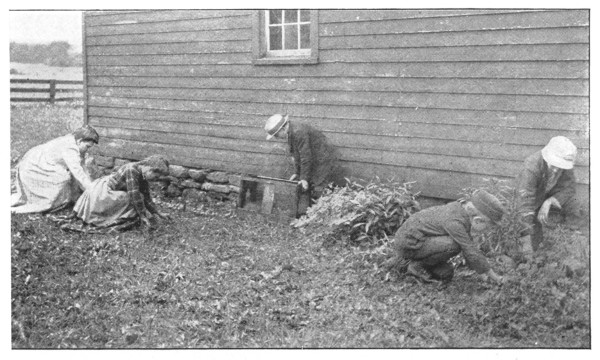
Fig. 8. Junior Gardeners at work in one of the New York Schools.
However, this circular is merely an appeal. It is an inquiry for suggestions and co-operation. I desire to know what can be accomplished in the schools of New York State in the direction of inspiring and useful work for children that live in the country or are interested in the country. I am sure that something needs to be done: just what is most feasible and best the teachers must largely determine. As further suggestions, I append two letters from New York teachers:
From A. M. Hollister, Principal of the Corinth Public Schools, Saratoga Co., N. Y.
"I am sending you under separate cover a picture of my class at work with the Babcock test machine (Fig. 6). We have used the machine both as a means of instruction in physics and chemistry and as a general demonstration before the different classes in the school. It beautifully illustrates some very important principles of physics and chemistry. The most marvellous effect, however, has been shown in the quality of the milk sold in the village. Milk was sold showing a test as low as 2.9 per cent butter fat. Almost as soon as the first testing was reported, the milk showed 3.8 per cent butter fat. Milk has been sent to the school from a number of dairymen with request for a test on particular cows that the parties might base their purchases of cows on the results of the test.
"In regard to the gardening with some of our boys, I would say that both boys and parents are much interested in the subject. We shall doubtless start about forty gardens of one-tenth acre each. The boys are to keep an exact account of all expenses to study methods, and to do all the work. I am anticipating results in a number of directions. The boys will be given something to do and to interest themselves in, which of itself is an important thing for a village boy. It will also develop a power of observation and ingenuity. We wish to get all the information we can on potato, tomato and squash culture. Other things will be suggested during the winter."
Approval of the Superintendent of Public Instruction.
(Published by permission.)
"For many years I have been making earnest efforts to induce teachers, pupils and patrons to improve and beautify the school buildings and school surroundings of our State. Some progress has been made, but much remains to be done.
"I heartily welcome the coöperation of every agency which can contribute to this result. We must interest parents and teachers in this work, but to obtain the best results I have always found that we must first interest the children. Once a spirit of enthusiasm is awakened in the children, it is easy to keep them interested and busy.
"I have long appreciated the earnest assistance of representatives of Cornell University in arousing the interest of pupils, and I heartily commend the plan outlined by the College of Agriculture to make a study of the schoolhouse and school grounds a practical part of the daily education of the child. A child's surroundings have much to do with his education. The result of such systematic study as is suggested must surely be a steadily increasing determination to remedy defects and correct any evil which may exist. When the attention of children is directed to existing conditions which bring discomfort, it will not be difficult to induce them to devise ways and means to improve matters.
"I shall watch the result of your efforts with deep interest, and stand ready to coöperate with you in every way.
"Very sincerely yours, "CHARLES R. SKINNER, "Albany, Dec. 17, 1903. State Superintendent."
LEAFLET IV. WHAT IS AGRICULTURAL EDUCATION?[5] By L. H. BAILEY.
Agricultural education has made great progress within the past few years. Methods are crystallizing and at the same time the field is enlarging. We once thought of agricultural education as wholly special or professional, but we now conceive of it as an integral part of general and fundamental educational policy. As a college or university subject it is necessarily technical and semi-professional; but college work must articulate with the common-school work, as language and science now articulate with the schools. That is, agricultural subjects are now to be considered as a part of primary and secondary school work, leading naturally to special work in the same subjects for those who desire technical training. In the schools the subjects are to be treated non-professionally, as primary means of educating the child. The reason for using these subjects as means of educating lies in the principle that the child should be educated in terms of its own life rather than wholly in subjects that are foreign to its horizon and experience. It is most surprising that, while the theory of education is that the person shall be trained into efficiency, we nevertheless have employed subjects that have little relation to the individual child's effectiveness.
Not long since my father showed me a letter that he received from a school girl in 1851. It read as follows: "I seat myself expressly for the purpose to finish this letter which has been long begun. I go to school room to Mr. Wells and study parsing mental Philosophy grammar and penciling." This sounds as if it came from "The Complete Letter-Writer." This person lived on a farm. She lives on a farm to this day. Her parents and grandparents lived on a farm. The family had no expectation of living elsewhere than on a farm. Yet, in her entire school life, I presume there was not a single hour devoted to any subject directly connected with the farm or with the country. If her studies touched life in any way that she could comprehend, it was probably in habits of thought of the city and of the academician rather than in anything that appealed to her as related to the life she was to lead. It is small wonder that the farm has been devoid of ideals, and that the attraction has been to leave it. The direction of the stream determines the course of the river.
The future course of education will develop many means of training the child mind. Heretofore these means have been few and the result has been narrow. We shall see agricultural, commercial, social subjects put into pedagogic form and be made the agencies whereby minds are drawn out. These will be at least as efficient as the customary methods that we happen thus far to have employed. How much of one or how much of another is a detail that must be left to the future. Nor does it follow that the old-time subjects are to pass away. They will be an important part of the system, but not the whole system. These new subjects are now coming into the schools as rapidly, perhaps, as they can be assimilated. It is a general feeling that our schools already are overcrowded with subjects; and this may be true. The trouble is that while we are introducing new ideas as to subjects, we are still holding to old ideas as to curriculums and courses of study. We will break up our schools into different kinds; we will employ more teachers; we will not endeavor to train all children alike; we will find that we may secure equal results from many kinds of training; we will consider the effect on the pupil to be of much greater importance than the developing of the particular subject that he pursues; there are many men of many minds; some system will be evolved whereby individual capabilities will be developed to the full; the means will be related to the pupil: one of the factors will be subjects making up the environment of the pupil that lives in the country.
My plea, therefore, is that agricultural and country life subjects become the means of educating some of the pupils of at least some of the schools. To be sure, we have already introduced "natural science" into many of the schools, but, for the most, part, this has worked down from the college and, necessarily, it usually stops at the high school. We need something much more vital for the secondary schools than science as commonly taught. The great nature-study movement is an expression, as yet imperfect, of the feeling that there should be some living connection between the school life and the real life.
A college of agriculture, therefore, is as much interested in the common schools as a college of arts and sciences is. It should be a part of a system, however informal that system may be, not an establishment isolated from other educational agencies. But even as a college it will reach more persons than it has ever reached in the past. In any self-sustaining commonwealth it is probable that one-third of the people must be intimately associated with the soil. These people need to be as well-trained as those who follow the mechanic trades or the professions. It is immensely difficult to put these agricultural subjects into teachable form and to reach the agricultural people in a way that will mean much to them, because agriculture is a compound of many wonderfully diverse trades in every conceivable kind of natural conditions. Nor can one institution in each large state or province hope eventually to reach all these people, any more than one institution can reach all those who would best be taught in terms of books. But there must be at least one institution that is well equipped for the very highest kind of effort in these fields; Congress long ago recognized this fact in the establishment of the land-grant colleges, and all persons who are informed on agricultural education also now recognize it. The agricultural colleges have been handicapped from the first for lack of funds. It is now coming to be recognized that the highest kind of effort in these colleges cannot be sustained on a farm that pays for itself nor by means that are copied from the customary college work in "humanities" and "science." If it is to be efficient, agricultural education of a university grade is probably more expensive to equip and maintain than any other kind of education.
Once it was thought that the agricultural college should be wholly separate from any "classical" institution. The oldest of the existing American agricultural colleges, the Michigan institution, is established on this principle. So are the Massachusetts, Iowa and Pennsylvania colleges and a number of others. It is natural that this should have been the feeling in the original movement for the establishment of these colleges, for the movement was itself a protest and revolt from the existing education. Time, however, has put agricultural subjects on an equal pedagogical plane with other subjects, and there is no more reason why the agriculture should be segregated by itself than that the architecture or law or fine arts should be. The agricultural colleges connected with universities are now beginning to grow rapidly. This is illustrated in the great development of the agricultural colleges at the universities in Illinois, Wisconsin, Minnesota, Nebraska, Missouri, Ohio, and elsewhere. It was once thought that the agricultural student would be "looked down upon" in a university or in a college with other departments. This was once true. It was true once, also, of the student in natural science and mechanic arts. Pioneers are always marked men. The only way to place agricultural students on an equality with other students is to place them on an equality.
These remarks are made in no disparagement of the separate agricultural colleges, but only to illustrate the character of the growth of agricultural education. No doubt the separate colleges blazed the way. They stand for an idea that we would not like to dispense with. Every state and territory has one college founded on the land grant, and in the Southern states there are two, one for the whites and one for the blacks; in nearly half of the states these colleges are separate institutions. But the fact remains that the college connected with the university is to have the broader field in the future. Its very connection dignifies it and gives it parity. It draws on many resources that the separate college knows not of, unless, indeed, the separate college develops these resources for itself. The tendency, therefore, is for every ambitious separate college to develop the accessory resources, in the way of equipment in general science, literature, the arts; for agricultural education is constantly coming to be of a higher grade. The separate agricultural and mechanical colleges are rapidly becoming essentially industrial universities, giving general training but with the emphasis on the technical subjects.
It is strange how far this principle of education by isolation has been carried in the development of the agricultural colleges. Not only have the colleges been separated from other educational enterprises, but in many cases they have been planted far in the open country, partly on the theory that the farm boy, of all others, should be removed from temptation and from the allurements of other occupations. It was the early theory, also, that the agricultural student must be compelled to do manual labor in order that he be put in sympathy with it and that his attention be isolated from tendencies that might divert him from farming. These methods seem to have rested on the general theory that if you would make a man a farmer you must deprive him of everything but farming. It would be interesting to try to estimate how much this general attitude on the part of the agricultural colleges was itself responsible for the very inferiority of position that the agricultural student was supposed to occupy. This attitude tended to maintain a traditional class distinction or even to create such a distinction. Agricultural education must be adapted to its ends; but it must also be able to stand alone in competition with all other education without artificial props. It is no longer necessary that the agricultural student wear blinders.
On the other hand, the farm point of view must be kept constantly before the student, as the engineering point of view is kept before the student in a college of civil engineering; but we are coming to a new way of accomplishing this. Mere teaching of the sciences that underlie agricultural practice will not accomplish it; nor, on the other hand, will drill in mere farm practice accomplish it. It is not the purpose of an agricultural college to make men farmers, but to educate farmers. We are not to limit the student's vision to any one occupation, but to make one occupation more meaningful and attractive than it has ever been before. From the farmer's point of view a leading difficulty with the college course is that it sometimes tends to slacken a man's business energy. One cannot at the same time pursue college studies and commercial business; and yet farming is a business. In a four years' course some students are likely to incur certain habits of ease that are difficult to overcome upon their return to the farm. How much this is a fault of the courses of instruction and how much a personal equation of the student is always worth considering. But if this is a fault of college work it is generic and not peculiar to colleges of agriculture. Experience has now shown that a compulsory labor system is no preventive of this tendency, at least not with students of college and university age. Student labor is now a laboratory effort, comparable with laboratory work in medicine or mechanic arts. The mature student must have some other reason for laboring than merely a rule that labor is required. However, it is yet largely an unsolved problem with the agricultural colleges as to just how the stirring business side of farming can be sufficiently correlated with the courses of study to keep the student in touch and sympathy with affairs. With the passing of compulsory student labor there has no doubt been a reaction in the direction of too little utilization of the college farm in schemes of education; but we shall now get back to the farm again, but this time on a true educational basis.
Nothing is more significant of the development of the agricultural colleges than the recent splitting up of the professorships. From agricultural chemistry as a beginning, in one form or another, there have issued a dozen chairs, first one subject and then another being separated as a teachable and administrative entity. Even the word "agriculture" is now being dropped from the professorships, for this is a term for a multitude of enterprises, not for a concrete subject. Horticulture was one of the first protuberances to be lopped off; and even this must very soon be divided into its component parts, for there is little relationship between the effort that grows apples and that grows orchids or between the market garden and landscape gardening. Even the chair of agronomy, the newest department of the colleges, must soon be separated into its units. Forty years ago mechanic arts was undivided. Who then would have prophesied such professorships as experimental engineering, electrical engineering, marine engineering, railroad engineering, naval architecture, machine design? The progress of the dividing up of the mechanic arts and civil engineering marks the rate of our progress, in the terms of the Land Grant Act, "to promote the liberal and practical education of the industrial classes in the several pursuits and professions in life." All trades, classes and professions are to be reached with a kind of education that is related to their work. One by one we are reaching persons in all walks and all places. Socially, there are centuries of prejudice against the farmer. When education is finally allowed to reach him in such a way as to be indispensable to him, it will at last have become truly democratic.
In this spirit agriculture is divided into its teachable units. The lists of divisions of the teaching force or curriculum in the larger agricultural colleges illustrate this admirably. In Illinois, for example, the title of professors and instructors are associated with such divisions as thremmatology, agronomy, pomology, olericulture, floriculture, soil physics, dairy husbandry, dairy manufacture, horses, beef cattle, swine husbandry, farm crops. At Cornell the coördinate departments of instruction in the College of Agriculture are classified as agricultural chemistry, economic entomology, soils, agronomy, horticulture, animal husbandry with its sub-department of poultry husbandry, dairy industry, agricultural engineering and architecture, the farm home, rural economy and sociology, out-door art (including landscape gardening), nature-study for teachers, besides miscellaneous courses—making altogether thirteen divisions. The courses now offered in the Cornell College of Agriculture, not including the winter-courses, are 76, of which 71 are to be given in the next academic year. Nearly all these courses comprise a half-year's work.
While all this subdividing represents progress there are disadvantages attending it, because it tends to give a partial view of the subject. The larger number of farmers must engage in general "mixed husbandry" rather than in specialties. Farming is a philosophy, not a mere process. The tendency of the inevitable subdividing of the subjects is to force the special view rather than the general view, as if, in medicine, students were to become specialists rather than general practitioners. The farm-philosophy idea was represented by the older teachers of agriculture. Of these men Professor Roberts is a typical example, and his work in making students to be successful, all-around farmers is not yet sufficiently appreciated. Much of this farm philosophy is now coming into the courses of instruction under the titles of rural economy, rural economics, rural sociology and the like. I have sometimes thought that the time may come when we will again have professors of "agriculture" who will coördinate and synthesize the work of the agronomist, soil physicist, chemist, dairyman and others. However, the dividing has not yet worked any harm, and perhaps my fears are ungrounded; and it is certain that with increasing knowledge and specialization the courses of instruction must still further divide.
Another most significant development in agricultural education is the change in attitude towards the college farm. Once it was thought that the college estate should be run as a "model farm." However, a farm that sets a pattern to the farmer must be conducted on a commercial basis; yet it is manifest that it is the province of a college to devote itself to education, not primarily to business. A farm cannot be a "model" for all the kinds of farming of the commonwealth; and if it does not represent fairly completely the agriculture of the state, it misses its value as a pattern. At all events the pattern-farm idea is practically given up. It is then a question whether the farm shall be used merely to "illustrate,"—to display kinds of tools, examples of fences and fields, breeds of stock. This conception of the college farm is comparable with the old idea of "experiments" in agricultural chemistry: the teacher performed the experiments for the students to see. The prevailing idea of the college farm is now (or at least, I think, soon must be) that it shall be used as a true laboratory, as the student in chemistry now works first-hand with his materials instead alone of receiving lectures and committing books. Is a student studying cattle? The herds are his for measurements, testing as to efficiency, studying in respect to heredity, their response to feeding, their adaptability to specific purposes, and a hundred other problems. Cattle are as much laboratory material for the agricultural student as rocks are for the geological student or plants for the botanical student. Technical books were once kept only in libraries; now they are kept also in laboratories and are laboratory equipment. College museums were once only for display; now they are also for actual use by the student. Barns are laboratories, to be as much a part of the equipment of a college of agriculture as shops are of mechanic arts. They should be in close connection with the main buildings, not removed to some remote part of the premises. Modern ideas of cleanliness and sanitation are bound to revolutionize the construction and care of barns. There is no reason why these buildings should be offensive. It was once thought that dissecting rooms and hospitals should be removed from proximity to other buildings; but we have now worked these laboratories integrally into the plans of colleges. Time has now come for a closer assembling of the college barns with the college classrooms. Likewise the entire farm is no doubt to be used in the future as a laboratory, at least in the institutions of university grade—except such part as is used for pure investigation and research. Where, then, shall the student go to see his model barn? To these farms themselves; here a stock farm; there a fruit farm; elsewhere a dairy farm. The shops in the colleges of mechanic arts have long since come to be true laboratories; they do not engage in railroading or manufacturing. They do not try to "pay their way;" if they do pay their way this fact is only an incidental or secondary consideration. A college of agriculture is a teaching institution: it must have equipment and laboratories.
It will be seen that the word "agriculture" has taken on a new and enlarged meaning. The farmer is not only a producer of commodities: he is a citizen, a member of the commonwealth, and his efficiency to society and the state depends on his whole outlook. Also his personal happiness depends on his outlook. He must concern himself not alone with technical farming, but also with all the affairs that make up an agricultural community: good roads, organizations, schools, mail routes, labor movements, rural architecture, sanitation, the æsthetic aspect of the country. One will be struck with the new signification of "agriculture" if he scan the titles of publications that issue from governmental agricultural departments, agricultural experiment stations, agricultural nature-study bureaus, agricultural colleges.
I cannot close this sketch without calling attention to the fact that the college of agriculture has obligations to the farmers of its commonwealth. The very fact that every college of agriculture in North America is supported by public funds imposes this obligation. Moreover, the colleges of agriculture and mechanic arts stand for true democratic effort, for they have a definite constituency that they are called upon to aid. It is desirable that as many persons as possible shall assemble at the college itself, but those who cannot go to college still have the right to ask for help. This is particularly true in agriculture, in which the interests are widely separated and incapable of being combined and syndicated. Thereupon has arisen the great "extension" movement that, in one way or another, is now a part of the work of every agricultural college. Education was once exclusive; it is now in spirit inclusive. The agencies that have brought about this change of attitude are those associated with so-called industrial education, growing chiefly out of the forces set in motion by the Land Grant Act of 1862. This Land Grant is the Magna Charta of education: from it in this country we shall date our liberties.
LEAFLET V. SUGGESTIONS FOR NATURE-STUDY WORK.[6] By ANNA BOTSFORD COMSTOCK.
Suggestions for nature-study must necessarily be more or less general. Nature-study should be a matter of observation on the part of the pupils. The teacher's part is to indicate points for observation and not to tell what is to be seen.
After the child has observed all that it is possible for him to see, the remainder of the story may be told him or may be read.
The objects of nature-study should be always in the teacher's mind. These are, primarily, to cultivate the child's power of observation and to put him in sympathy with out-of-door life.
Having these objects clearly in mind, the teacher will see that the spending of a certain amount of time each day giving lessons is not the most important part of the work. A great amount of nature-study may be done without spending a moment in a regular lesson. In the case of all the things kept in the schoolroom—i. e., growing plants, insects in cages and aquaria, tame birds and domestic animals—the children will study the problems for themselves. The privilege of watching these things should be made a reward of merit.
The use of nature-study readers should be restricted. The stories in these should not be read until after the pupils have completed their own observations on the subjects of the stories.
Stories about adventures of animals and adventures with animals may always be read with safety, as these do not, strictly speaking, belong to nature-study. They belong rather to literature and may be used most successfully to interest the child in nature.
Blackboard drawings and charts should be used only to illustrate objects too small for the pupil to see with the naked eye. The pupil must also be made to understand that the object drawn on the board is a real enlargement of the object he has studied with his unaided eye.
The use of a simple lens often contributes much interest to the work of observation. The compound microscope may be used to show some exceptionally interesting point, as the compound eyes of insects, the scales on the butterfly's wing, or the viscid thread of the spider. But this is by no means necessary. Nature-study work does not actually require the use of either microscope or lens, although the latter is a desirable adjunct.
The great danger that besets the teacher just beginning nature-study is too much teaching, and too many subjects. In my own work I would rather a child spent one term finding out how one spider builds its orb web than that he should study a dozen different species of spiders.
If the teacher at the end of the year has opened the child's mind and heart in two or three directions nature-ward, she has done enough.
In teaching about animals, teach no more of the anatomy than is obviously connected with the distinctive habits of each one; i. e., the hind legs of a grasshopper are long so that it can jump, and the ears of a rabbit are long so that it can hear the approach of its foes.
While it is desirable for the teacher to know more than she teaches, in nature-study she may well be a learner with her pupils since they are likely any day to read some page of nature's book never before read by human eyes. This attitude of companionship in studying with her pupils will have a great value in enabling her to maintain happy and pleasant relations with them. It has also great disciplinary value.
Reasons for and against graded courses in nature-study.
The question whether there should be a graded course in nature-study is decidedly a query with two answers.
The reasons why there should not be a graded course, are:
1st. The work should be spontaneous and should be suggested each day by the material at hand. Mother Nature follows no schedule. She refuses to produce a violet one day, an oriole the next, and a blue butterfly on the third.
2d. A graded course means a hard and fast course which each teacher must follow whether or not her tastes and training coincide with it.
3d. There is no natural grading of nature-study work. A subject suited for nature-study may be given just as successfully in the first as in the fifth grade.
There is only one reason why a nature-study course should be graded, and that is so cogent that it outweighs all the reasons on the other side: the training of the grade teacher in nature-study is at present so limited in subject-matter that if the course were ungraded the same work would be given over and over in the successive grades until the pupils became utterly weary of it. To many a pupil in the lower grades to-day, nature-study means the sprouting of beans and peas and nothing more. As a matter of experience, we believe that after a nature-study subject is once studied it should be dropped entirely, the pupil should not again meet it in the schoolroom until he finds it in its respective science in the high school or college. On this account, we have been persuaded that a graded course, or at least a consecutive course, is necessary.
The following suggestions about grading the course are given with a hope of being helpful, and not because we believe that the courses indicated are necessarily the best courses possible. We have graded each subject so that a teacher may follow her own tastes and inclinations, and may not be forced to teach zoology when her interests are entirely with botany, or vice versa.
We have tried to give a distinctive trend to the observations for each year, and have suggested a line along which the work may be done.