PART I. TEACHERS' LEAFLETS. (continued 2)
Reading edition
As a matter of fact, however, the time to study any living thing is when you chance to find it. If you find an interesting caterpillar or cricket or bird, study it, whatever your grade of work. The probabilities are that it may be long before you chance upon these same species again.
It has been the experience of most teachers that the lower grades are much more interested in nature-study than are the higher. Especially are the seventh and eighth grades difficult to interest. Therefore, we have made this part of the course economic in its bearing, hoping that this may appeal to the grown-up feeling of pupils of these grades.
INSECTS.
First Grade.
The first year of work with insects may well be restricted to familiarizing the pupils with the three most striking phases in the life of insects with complete metamorphosis, i. e., the larvæ, the pupæ, and the winged insects. Moths and butterflies are especially adapted for this work with the small children.
Fall work.—In September there are still many caterpillars feeding. Bring them in the schoolroom and feed them in breeding cages. For different forms of cheap breeding cages, see Insect Life, pp. 326-330; Cornell Teachers' Leaflet, No. 5 (No. XIX, this volume); Lessons in Nature-Study, p. 45.
During October many of the hairy caterpillars will be found hurrying along in quest of suitable winter quarters. These should be brought in and put in box cages having sand or dirt in the bottom. They are seeking secluded corners in which to curl up and hide during the cold weather. Some of them pass the winter in their cocoons, and some do not. Insect Life, pp. 239-241; Manual for Study of Insects, pp. 317-324; Moths and Butterflies, (b), pp. 191-198.
Bring in as many cocoons as possible. November or December, after the leaves have fallen from the trees, is the best time in which to hunt for the cocoons of Cecropia, Promethea, and Cynthia. Insect Life, pp. 194-196; Moths and Butterflies, (b), pp. 119-180.
Teach the pupils the difference between the cocoon and the pupa. The pupa is the quiescent form of the insect. The cocoon is the silken bag covering it, and is always made by the caterpillar before it changes to a pupa.
If possible bring in some butterfly larvæ. In September many may be found. The cabbage butterfly especially is always with us. Insect Life, p. 245. Also the larvæ of the black swallow-tail may be easily found. Insect Life, p. 243; Everyday Butterflies, p. 130; Moths and Butterflies, (b), p. 39.
Show the children (do not tell them) that the butterfly caterpillars do not make cocoons, but that the naked pupa is suspended by a silk button, and in some cases also by a silk thread.
Many teachers complain that but few of the moths are able to get out of the cocoons. The usual reason for this is that in the heated atmosphere of the schoolroom the cocoons become too dry. To obviate this, the cocoons should be dipped in water every week or two.
Spring work.—During the spring term use the apple-tree tent-caterpillars. Cornell Teachers' Leaflet, No. 5 (No. XIX, this volume); Moths and Butterflies, (b) p. 201. Show the four stages of the insect: egg, caterpillar, pupa, and moth. Pay especial attention to the way in which the caterpillars grow.
Summary of methods.—This whole year's work may be done with no regular "lessons," and all the time required will be the care of the breeding cages and the time given to hunting for the caterpillars and cocoons. The child's reading may be selected from the many stories of the caterpillars, moths and butterflies. Yet be very careful to make each child understand that he himself is studying out the especial story of each caterpillar and cocoon in the schoolroom.
Second Grade.
The plan for the second year is to continue the study of the life-histories of insects. The pupil, having learned the different stages of the moths and butterflies, should learn that all insects do not experience such marvelous changes of form.
Fall work.—Arrange a breeding cage like figs. 288, 289, Insect Life, p. 329, placing fresh sod in the flower pot and covering the lamp chimney with a square of wire netting. Push the glass chimney down into the earth so as to allow no crevices through which the insects may escape. In such a cage, place grasshoppers and crickets of all sizes, and study their growth. Insect Life, pp. 33-37.
Show the pupils that the young grasshopper looks like the old one except that the wings are shorter; the same is true of crickets. Keep the sod damp so the grass will not become dry; and when it gets too old replace it with other sod. A good way to keep these insects alive and to keep the children interested in them is to plant wheat and grass seed in several flower pots, and then to move the glass chimney from pot to pot, giving the insects fresh pasturage when needed.
As early as possible start some aquaria. Cornell Teachers' Leaflet, No. 11 (No. XII, this volume); Insect Life, pp. 330-332.
The mosquito is one of the most available insects for study in the aquarium. Insect Life, pp. 131-136; Lessons in Nature-Study, p. 12.
The nymphs of dragon flies and damsel flies and many others may be studied during the entire winter. Insect Life, pp. 140-142; Cornell Teachers' Leaflet, No. 11 (No. XII, this volume); Outdoor Studies, p. 54. Those that have cannibalistic habits should be kept apart, each one in a separate jar. They may be fed by dropping into the jar a bit of raw beefsteak tied to the end of a string. The purpose of the string is that the uneaten meat may be withdrawn before it decays. It should not be left in the water more than twenty-four hours. The insects do not need feeding more than twice a week.
Spring work.—In the spring get new material for the aquaria. In pools where there are many dead leaves look for the caddice worms that build the log cabin cases, for these may be kept in aquaria that have no running water. Insect Life, p. 149.
While we advise the introduction of the aquaria during the second year, their use should be continued during the following four grades; there are always new things to study in ponds and streams, and nothing so fascinates a child as watching the movements of these little denizens of the water.
Summary of methods.—There need be no set lessons in the work of the second year, unless the teacher in a few words, now and then, chooses to call attention to certain things as the occasion seems to demand. The object of the year's work is to teach the pupil the life histories of insects which have no quiescent or pupa stage, and this should be accomplished by simple observation of specimens bred in the schoolroom.
Third Grade.
The general subject of this year's work may well be the Homes of Insects. This is a most interesting topic, and if well taught will inspire the pupils to much individual observation and collecting.
The questions to be asked concerning insect homes are:
Of what material are they made? How are they made? What is the purpose of the home? Is it made by the insect for itself to live in, or is it made by the mother for the protection of her young? Is it made as a protection for the insects while they are eating, or do they go out to feed and come back only to rest and spend the night or day?
Fall work.—Leaf rollers: Insect Life, p. 206; Ways of the Six-Footed, p. 119.
Leaf miners: Insect Life, p. 208; Ways of the Six-Footed, p. 29.
Galls: Insect Life, p. 210; Outdoor Studies, pp. 18, 38-39.
Fall web worm: Insect Life, p. 200.
Scallop shell moth: Insect Life, p. 201.
Nests of silver spotted skipper: Insect Life, p. 203; Everyday Butterflies, p. 190.
Bag worms: Insect Life, p. 204. Ant lions: Outdoor Studies, p. 81.
Carpenter bees: Ways of the Six-Footed, p. 108.
Tiger beetle larvæ: Insect Life, pp. 270-272.
All kinds of cocoons are found by the children. Ask concerning the cocoons: Where did you find them? Were they in protected places? Why?
Of these nests there are many more than those mentioned above. In fact, to one who sees what he looks at, every plant, every tree, every fence corner and every foot along the country path contains many most interesting homes. The leaf rollers and leaf miners are the most common and most easily found of all.
Spring work.—The spring work in this subject may be to study the way in which caddice worms make their houses; take a caddice worm out of its house and watch it build another. This is a new phase of the study of caddice worms. Ways of the Six-Footed, p. 133.
Study the homes of beetles under sticks and stones, and find the homes of the engraver beetles under bark. Insect Life, p. 216. This work must necessarily be done by the pupils out of school hours, and their discoveries and specimens of homes should be made topics for lessons for the whole school.
During this term begin a butterfly calendar, made on the same plan as the bird calendar. A collection of butterflies might be started for the schoolroom in connection with the calendar. Study the specimens caught and determine whether they hibernated as adults or chrysalids. If their wings are battered and torn, they spent the winter as adults. If they are bright in colors and their wings perfect, they spent the winter in the chrysalis state.
Hints for collecting insects: Cornell Teachers' Leaflet, No. 7 (No. XVIII, this volume); Insect Life, pp. 283-314 and pp. 48-49. How to Know the Butterflies.
Summary of methods.—The work in the third grade, as outlined, requires a lesson period now and then when single specimens are brought in by individual pupils. Each pupil should examine the specimen, and after that the lesson may be given.
Fourth Grade.
After having studied Insect Homes, the pupils will be ready to take up the broader subject, How Insects Live. The work of this year may be given on this subject.
In order to study the life-histories of insects, the pupils should know some things about insect anatomy. If the work as indicated in the previous grades has been followed, the pupils know the number of legs, wings, and compound eyes most insects have, without ever having killed a specimen or having received a special lesson in insect anatomy. Now teach the children how insects breathe and how they eat. Show the spiracles on the body of any caterpillar which is not hairy; they may be seen on the abdomen of a grasshopper or of a butterfly that has not too many large scales to cover them.
After they have seen these spiracles or breathing pores, give a lesson, illustrated by chart or blackboard, showing that these holes lead to the breathing tubes of the body. Manual for the Study of Insects, pp. 73-75.
To show how insects eat, allow the pupils to watch the following insects in the breeding cages while feeding: a grasshopper; a leaf beetle (potato beetle is a good example); any caterpillar; an ant; and a wasp. Show that all these have mouth parts made for biting. Let the pupils see an aphid sucking the juice of a plant; this may be done by bringing in a twig infested by aphids. Let the pupils see the water bugs in the aquarium eat. Insect Life, pp. 123-131, and pp. 137-140. Let them watch a fly, a honey bee, and, if possible, a butterfly or moth, eat. All these have mouth parts made for sucking. All this work should be original investigation on the part of the pupils.
After the pupils find out how insects breathe and eat, let them see how each insect lives a life adapted to its own peculiar needs. Try to feed some cabbage worms on clover or grass. Then try turnip or mustard leaves, and watch the result. Change the potato beetle larvæ to some other plant, and watch the result.
Let the pupils first find out how the insects breathe in the water. Each insect in the aquarium tells a different story as to its way of getting air. The teacher will find all these stories indicated in the chapters in Insect Life devoted to pond and brook insects.
Call especial attention to protective coloring of insects. Show that when an insect resembles its surroundings in color it is thereby enabled to escape its enemies; or, if need be, is enabled to creep upon its prey unobserved.
Note the color of the grasshopper in the road; color of meadow grasshopper; color of the caterpillars of the cabbage butterfly (green and hard to find). Notice the shape and color of walking sticks; color of the katydids. Note the bright color of the larvæ of potato beetle. Why? (They are distasteful to birds, and their colors advertise the fact.) Study the Monarch butterfly and the Viceroy. Everyday Butterflies, p. 95 and p. 297; Ways of the Six-Footed, p. 39. Bring out strongly in all this work that the insect in order to live must have its special food plant and must escape notice of its enemies. This is the proper place to begin the study of the valuable work done by birds in destroying insects.
In addition to this general work, study especially the wasps.
Solitary Wasps: Mud daubers. Bring in their nests and examine them. Ways of the Six-Footed, p. 96. How are the nests provisioned, and for what purpose were they made? Find, if possible, nests of other solitary wasps. Insect Life, p. 218, p. 262, p. 264.
Social Wasps: Bring in a deserted nest of yellow-jackets. Of what is it made? How? What for? Do the wasps store honey? Do they live as a colony during the winter? All these questions may be answered by a pupil who knows of a yellow-jackets' nest in the fall and watches it during the winter. For the teacher there are discussions of these insects in Manual for Study of Insects, pp. 660-664. Wasps and their Ways.
Continue the butterfly collection and the butterfly calendar.
Spring work.—In the spring, begin a collection of moths for the schoolroom. Insect Life, p. 50. Caterpillars and Moths.
In the spring, notice when the first house-flies appear. What happens to the house-fly in winter? (Send for Circular No. 35, second series, Div. of Entomology of Department of Agriculture, Washington, D. C., for the life-history of the house-fly.) Explain that one female destroyed early in the season means thousands fewer late in the season.
Encourage the children to bring to the schoolroom all sorts of flies and compare them with the house-fly. The object of this is to teach something of the wonderful variety of forms among small and inconspicuous insects. Make a collection of flies for the schoolroom. For description of flies, see Insect Life, pp. 83-84.
A good plan for the spring work is to keep the pupils interested in the first appearance, after the vicissitudes of winter, of each insect which it is possible for them to find. Note that insects do not appear before their food plants appear.
Summary of objects and methods.—The questions to be answered during the whole year's work are: How do the Insects live,—on what do they feed? How do they escape their enemies? What happens to them in winter? How are the new broods started in the spring? The work is chiefly observation, but occasional lessons may be given and stories may be told to keep the interest in the work from flagging.
Fifth Grade.
Fall work.—Study the Bees and Ants.
Fit up ants' nests. Insect Life, p. 278.
Teach the whole life-history by allowing the pupils to colonize the nests. Manual for Study of Insects, pp. 633-639; Insect Life, p. 271. Make observations upon the eggs, pupæ, workers, males, females. What are the winged forms that appear in swarms in June and July.
Let the pupils observe the relation of ants to aphids. This may be done on almost any shrub or roadside plant. Home Nature-Study Lesson 1904, No. 8.
The teacher should read Sir John Lubbock's "Ants, Bees and Wasps."
Many stories on these subjects may be told and read, especially those concerning the habits of exotic ants and ant wars which the children are not likely to see; also of the slave-making ants. These slave-making ants are quite common in New York State; their nests may be found under stones. They resemble the brown mound-builder ant; the slaves are black.
Spring work.—In the spring work in this grade, study the habits of the honey bee. An observation hive is desirable but not necessary. Bring in the honeycomb filled with honey. If there are apiarists in your neighborhood, they will gladly give you specimens of brood in the comb. Read The Bee People and the Manual for Study of Insects, p. 673.
Develop all the facts of the wonderful life in the hive by letting the pupils observe them as far as possible. Then give them the many interesting stories:
Story of the Workers.
Story of the Queen.
Story of the Drone.
Story of the Bee Larva.
Story of Honey Making.
Story of Wax and Comb Making.
Story of the Swarm.
In connection with the study of the honey bee, study the bumble bee. Manual for Study of Insects, pp. 672-673; Insect Life, p. 256. Begin with the study of the big queen that appears in May or June. Show that she is of great benefit to us and must not be harmed or frightened. Let the bumble bee's nest be a problem for summer observation, and finish the study in the next grade in the fall.
Summary of objects and methods.—The work of this year should have for its objects the harmonious life of social insects; their unselfish work for each other; their devotion to their respective colonies; their ways of building and of defending their habitations.
The work should be based upon observations made by the pupils in and out of the schoolroom. Many lessons should be given, mostly in the form of stories. Ways of the Six-Footed, pp. 55-94.
Sixth Grade.
Fall work.—Study the spiders. Lessons in Nature-Study, p. 103; Insect Life, pp. 223-232. Cornell Teachers' Quarterly, final number (No. XV, this volume).
In order to study spiders, they need not be handled with bare hands. While all spiders are venomous to the same extent, perhaps, that a mosquito or a bee is venomous, there is only one species in the eastern United States (and that is very rare) the bite of which need be feared by human beings.
The use of spiders in nature-study does not have to do with handling living specimens, but rather with the habits of the different species and the building of the webs. In catching spiders to bring into the schoolroom, use the method indicated by Professor Kellogg in Nature-Study Lessons. Capture the specimen by the use of a pill box: take the box in one hand and the cover in the other, and catch the spider by suddenly closing the box over it.
The pupils should be made to observe the chief differences between spiders and insects; i. e., spiders have two regions of the body instead of three as in insects; eight legs instead of six, simple eyes instead of compound. Compare spiders with daddy-long-legs.
If the teacher chooses to kill a specimen and show the arrangement of the eyes and the spinnerets under the microscope, she may do so. This is not necessary, although I have seen it done successfully in the sixth grade. Diagrams and blackboard drawings may be used instead of the microscope.
Let the pupils observe the uses of silk by the spider:
1. Snare for prey. 2. To enwrap prey when first entangled. 3. Nests for eggs. 4. Lining for habitations. 5. Means of locomotion.
Introduce the grass spider into the schoolroom in glass jars containing grass sod, and let the pupils observe it at work.
Encourage a study of cobwebs. Capture the owner of an orb web, and bring it in a glass jar to the schoolroom. Try to give it its natural environment; i. e., some sort of frame or branch of tree on which it may fasten its web.
The orb web: 1. How is it made? 2. Of how many kinds of silk? 3. The way the spiral thread is arranged as shown by drawings. 4. The position of the spider on the web. 5. The way the spider passes from one side of the web to the other. 6. The way it treats its prey when the victim is once entangled.
The engineering ability shown in making this web is one of the most marvelous things in all the realm of animal life. These observations may well cover two months of this term.
Study the ballooning spiders, the jumping spiders, the running spiders, and the crab spiders. Study as many egg-sacs of spiders as possible.
Another topic for study during the fall term is the Songs of Insects. Insect Life, p. 235. Bring in the katydids, crickets, and meadow grasshoppers, place them in cages containing green sod, and observe them while they are singing. Note that only the males sing. Show the ears of the crickets, katydids, and meadow grasshoppers in the elbows of their front legs. The ear of the grasshopper is on the side of the segment of the abdomen next to the thorax. Ways of the Six-Footed, pp. 3-27.
Study snowy tree cricket. Manual for Study of Insects, p. 118.
If possible, get a cicada as these insects continue to sing through the warm days of September. Show the cover to the drums on the lower side of the common cicada. Cornell Nature-Study Bulletin, No. 1, p. 24 (No. VI, this volume). This can be made a most interesting subject, and pupils should be encouraged to do observation work outside of school.
Begin a general collection for schoolroom.
Spring work.—Continue making a general collection for the schoolroom, and specialize in this direction. When an insect is brought in and added to the collection, if the teacher knows the insect, a lesson should be given on its life and habits. This connecting of the life and habits of the insects with the collection of dead specimens is of greater value from a nature-study point of view than the collection itself.
Summary of methods.—While this year's work must be based on the observations of the pupils in the schoolroom and out-of-doors, yet many interesting lessons may be given by the teacher.
Seventh Grade.
The study of this entire year may be the relation of insects to flowers. Most of the references are given in the Plant-life work for this grade.
The insect work may be limited to: What insects visit flowers? How do they carry pollen? How does each kind of insect reach the nectar? Which insects are robbers, and which are true pollen carriers? The use of pollen by insects. Outdoor Studies, pp. 7-12.
Take up the study of golden rod and its insect visitors, i. e., let the pupils watch a bunch of golden rod and note all the insect visitors. For directions concerning this work see Outdoor Studies, pp. 29-46.
In the same way take up the study of asters and the late flowers, and their insect visitors. Describe the visitor; what it does; what part of the plant it visits.
Summary of objects and methods.—The object of this whole year's work is to show the beautiful inter-relation between insects and flowers. The studies must necessarily be made in the field. But many delightful lessons may be given on the structure of flowers, that make of greatest use to the flowers the work of insect visitors.
Eighth Grade.
The object of this year's work is the economic side of insect-study. Many pupils do not continue these studies to high school or college. Yet if they have homes with gardens or trees in city or country, they must learn to cope with the many insect enemies that feed upon cultivated plants. They should also learn to discriminate between insect friends and foes. They should learn the best methods of combating the foes and preserving the friends.
Explain first that in fighting an insect enemy we must know how it eats. If it inserts its beak in the stem of the plant there is no use trying to kill it by putting poison on the leaves.
Common Insect Foes.
To be studied in the schoolroom:
Fall work.—Codlin-moth. Insect Life, p. 180. Show work on an apple, and give methods of destroying it.
Plum curculio. Insect Life, p. 182.
The pomace flies. Insect Life, p. 184.
Scale insects. Manual for Study of Insects, pp. 165-174.
Potato beetle. Manual for Study of Insects, p. 176.
Spring work.—Tussock moths and canker worms. Circular No. 9, 2d Series, Dept. Agr., Div. of Ent., Washington, D. C.; Cornell Teachers' Circular, No. 1.
Cabbage worms. How to Know the Butterflies.
Currant worms. Manual for Study of Insects, pp. 613-614.
Plant lice or aphids. Insect Life, pp. 177-178.
Carpet beetle. Circular No. 5, 2d Series, Dept. Agr., Washington, D. C.; Manual for Study of Insects, p. 539.
Clothes moth. Manual for Study of Insects, pp. 257-258; Circular No. 36, 2d Series, Dept. Agr., Washington, D. C.
Tent caterpillar. Cornell Teachers' Leaflet, No. 5 (No. XIX, this volume).
A study of spraying should be made. Insects and Insecticides, pp. 39-56. Spray Calendar, distributed free by the Cornell Agricultural Experiment Station.
Important Insecticides. Farmers' Bulletin No. 127, Dept. Agr., Washington, D. C.
Insect Friends.
Fall work.—Lady bugs. Insect Life, p. 179.
Aphis lions. Insect Life, p. 178; Ways of the Six-Footed, p. 125.
Red clover and the bumble bee.
Parasitic insects. Manual for Study of Insects, pp. 621-630.
Spring work.—Bees and orchard in blossom.
Summary of methods.—The observations may be made in the schoolroom or out-of-doors. There should be observations of experiments in spraying. This may be accomplished in most localities by encouraging the pupils to visit orchards undergoing the operation of spraying. However, by means of syringe or watering pot, the infested plants brought into the schoolroom may be sprayed and the results noted. Lessons should be given on the importance of preserving insect friends while we are destroying insect enemies.
OTHER ANIMALS ADAPTED FOR NATURE-STUDY.
The Toad and Frog. The study of either of these two species is delightful spring work for any grade. Cornell Teachers' Leaflet, No. 9 (No. XVI, this volume); Wilderness Ways, p. 25.
Salamanders or Efts. Familiar Life of the Roadside.
Fishes. Observations upon goldfish or minnows kept in an aquarium should be made the basis of lessons upon the life of fishes. Study: (1) The shape of the body; see how it is especially adapted to rapid movement through the water. (2) The shape and arrangement of the fins, and their uses. (3) How the fish propels itself through the water. (4) How the fish breathes. (5) The shape of the fish's mouth, and how and what it eats. (6) Experiment to ascertain the ability of the fish to see and hear. Cornell Teachers' Leaflet, No. 21 (Nos. XIII and XXXVI, this volume).
Encourage observations of habits of different species of fish common in our ponds and streams. Study their eggs and the places where they are found. Teach the children the reason for the game laws, and impress upon them a true respect for those laws. Food and Game Fishes.
Mice. Some house mice in an improvised cage may be placed in the schoolroom, and the habits of the little creatures observed. Give them paper to see how they make their nests. Note how and what they eat, and how they clean themselves. Note shape of teeth and their use. If possible, study the wild mice. Squirrels and Other Fur Bearers, p. 111; Wild Life, p. 171.
Squirrels and Chipmunks. The work on these animals must be based on out-of-door observations. Try to get the pupils to discover for themselves answers to the following questions: How and where do they travel? What do they eat? Where and how do they carry their food? Do they store it for winter? If so, where? What do they do in winter? Squirrels and Other Fur Bearers, p. 15, p. 134; Wild Neighbors, p. 1.
Rabbits.—A domesticated rabbit should, if possible, be kept in the schoolyard so that the pupils may make their own observations upon its habits. Let them study: How and what it eats. The shape of its teeth. The form and use of the ears. How does it travel? What sort of tracks does it make, and why? From these observations lead the pupils to think of the life of the wild rabbit, how it is adapted to escape from its enemies and to get its food. Ways of Wood Folk, p. 41; Story of Raggylug.
Guinea pigs.—These little animals are easily kept in the schoolroom, and, though not particularly interesting in their habits, they prove attractive to the smaller children and may be studied in the same way as the other animals.
Domestic animals.—These need not be studied in the schoolroom, as the pupils, if they have opportunity, can make the observations at home. Studies of the horse, cow, pig, sheep, and goat, and also the cat and dog may be made most interesting. Such questions as these may be asked concerning each: What is the characteristic form of the animal? What is its clothing? What does it eat? How are its teeth adapted to its food? What is its chief use to man? How does it travel, slow or fast? How are its feet adapted to its way of running or walking? Has it a language? How many emotions can it express by sound? How many can it express by action? How does it fight, and what are its weapons? What sort of life did its wild ancestors live? How did they get their food, and how did they escape from their enemies?
Summary of methods of nature-study of animals.—Study only so much anatomy as is clearly adapted to the animal's ways of living. Observations made by the pupils should be arranged into lessons by either pupil or teacher. Such lessons make excellent English themes, and they may be adapted to any grade.
BIRDS.
Begin the study of birds by the careful study of some domesticated species that may be observed closely and for a long period. The hen is perhaps the best for this purpose. Study carefully all of the adaptations of her anatomy to her life necessities. Study shape of her body; the feathers; the bill; her food; how she eats; drinks; the shape of her feet; their covering; how she sees; hears; smells; sleeps; study the life of a chick; study the language of chick, hen and cock; embryology of a chick. Study a robin or some bird that builds near houses. Note all its habits from the time it appears in spring until autumn. Bird houses and bird protection. Usefulness of birds. Our Native Birds, Lange. Publications of U. S. Dept. Agr.
Summary of methods.—It is much more important that the pupil know the habits of one species than that he should know by name many species. Therefore encourage patient watching and careful observation concerning the things which birds do. Such observations may be made into lessons by pupil or by teacher for the benefit of all the pupils. First Book of Birds, and Second Book of Birds; Bird Lore; The Story of the Birds; Bird Neighbors.
PLANTS.
First Grade.
Fall term.—Let the children study the different forms and the colors of leaves. By no means teach the botanical terms for all the shapes of leaves; simply let the children gather and bring in all the different kinds of leaves they can find. Let them draw the different forms in their blank books. Press leaves and mount them.
The object of this work is to give the child an idea of the great number of leaf forms and colors, and to get him interested in observing them. References: Botany, Bailey, pp. 90-100; Lessons with Plants, pp. 79-90; Gray's How Plants Grow, chapter on Leaves and Forms of Leaves; Elements of Botany, pp. 89-93.
Winter and spring terms.—Let the children study vegetables. The following questions should be answered concerning a vegetable. What part of the plant is it? Does it grow below or above ground? What sort of leaf has it? What sort of flower? What sort of fruit or seed? Lessons with Plants, pp. 353, 356, 364; First Studies, pp. 50, 51, 174; Botany, Bailey, pp. 31-37; Cornell Teachers' Quarterly, No. 7 (No. XXXIX, this volume).
Second Grade.
Teach the use of the flower. Do this by bringing in all flowers possible, and show that as the flower fades the fruit becomes evident. Let the pupils observe for themselves the fact that the flower exists for the sake of the fruit. Interest the pupils in all kinds of fruits and seeds. This is not the place to teach seed dispersion, but simply the forms and colors of fruits and seeds. Let the pupils also observe that insects carry pollen from flower to flower. Do not give the explanation of this to children of this age, but let them see the bees at work.
For this work see Plant World, by Mrs. Bergen, pp. 80-107.
Let the pupils observe the following things in plant physiology:
Flowers sleep: Botany, Bailey, p. 50; Lessons with Plants, p. 402; Plants, Coulter, pp. 9, 10, 48; Elements of Botany, p. 98.
Plants turn toward the light: Elements of Botany, p. 100; Botany, Bailey, p. 50; First Studies, p. 136.
Effect of frost on flowers and leaves.
Winter and spring work.—Seed germination: First Studies, pp. 1-24; Lessons with Plants, pp. 316-331; Botany, Bailey, pp. 164-171; Cornell Teachers' Leaflet, No. 1 (No. XXVIII, this volume); Plants, p. 307; Lessons in Nature-Study, p. 22.
Let the pupils observe in the field: Position of leaves when first open. A Reader in Botany, by Newell, Part I, p. 84.
Position of leaves and flowers in the rain. First Studies, p. 135; Elements of Botany, pp. 175-176; Plants, p. 51.
Third Grade.
Fall work.—The fall work of this grade may be (1) The way flowers make fruit, i. e., the way the fruit is formed from the flower. (2) The dispersion of seeds.
Fruits. First Studies, pp. 168-171; Lessons with Plants, pp. 251-310; Botany, Bailey, pp. 147-157.
Seed dispersion. First Studies, p. 176; Plant World, pp. 133-156; Little Wanderers, by Morley; Seed Dispersal, by Beal; Cornell Teachers' Quarterly, No. 2 (No. VIII, this volume); Seed Travelers, by Weed; Botany, Bailey, p. 158.
Let the pupils observe: "How some plants get up in the world." First Studies, p. 150; Lessons with Plants, p. 396; Botany, Bailey, p. 108.
Spring work.—Opening of the buds. Lessons with Plants, pp. 48-63; First Studies, p. 33.
Arrangement of buds. Lessons with Plants, pp. 63-69.
Expansion of bark. Lessons with Plants, pp. 69-72.
Fourth Grade.
The object of this year's work may be the teaching of the value of earth, air, light, and water upon plants.
Fall work.—Experiments to show these to be carried on in schoolroom. Experiments to show value of earth to plants:
(1) Plant seeds in fertile earth; poor earth; clean sand or sawdust.
(2) Plant seeds in sawdust and on cotton batting placed on water in a jar.
Experiments to show use of light to plants:
(1) Sow seeds in two boxes of earth prepared just alike. Place one in the window, one in a dark closet, and note results.
(2) Place house plants from greenhouse in a window, and note change of position of leaves.
(3) The story of the sunflower.
Experiments showing use of water to plants:
(1) Place a very much wilted cut plant in water, and note result.
(2) Place seeds in earth which is dry, and in earth which is kept moist.
(3) Plant seeds on batting floating on a tumbler of water, and note results.
These experiments should extend over several weeks.
Winter and spring work.—Begin the study of trees. Choose some tree in the schoolyard, if possible, and make this the basis of the work. The following is an outline for the study of a maple tree: Begin observations in January. Make drawings of the tree, showing the relations of branches to trunk and general outline. Note the following details: The color of trunk and branches in January, and the color in February and March; when the buds begin to swell; the arrangement of buds; watch closely to determine whether a bud develops into a blossom or a leaf; the peculiarities of bark on trunk and branches; do the leaves or the blossoms appear first; the shape and color of the blossoms; draw them and study them thoroughly; the color and position of the leaves when they first appear; draw the different stages of the unfolding of the leaves; keep a calendar of all the year's history of the tree; when in full leaf make another drawing of the whole tree; study the tree from below, and if possible from above, to show arrangement of leaves in reference to light; make drawings of the fruit when it is formed; study how it travels; when the first autumn tints appear; make colored drawings of the tree in its autumn foliage, and note when leaves begin to fall and when the branches are finally bare; note different form of maple in the open and maple in the forest.
In connection with the year's history of the tree, study the tree from an economic point of view. Make a special study of sugar-making in connection with the maple tree. Study maple wood. To do this get a quarter section of a piece of maple log and study the grain lengthwise and in cross sections. Study all the industries possible in which maple is used. Devote one notebook to all the work on the maple tree, and at the end summarize the observations. For drawing of trees, see Cornell Teachers' Leaflet, No. 12 (Nos. XXIX and XXX, this volume). Home Nature-Study, Vol. V, Nos. 2, 5.
Fifth Grade.
The work during this grade may be devoted to plant physiology. For this work use First Studies of Plant Life, Atkinson. The experiments described in this book are simple and excellent; they give the pupil definite knowledge of the life processes of plants, and the use to the plant of roots, stems, leaves, flowers, and fruit.
Continue studies of trees. Select some other species than the one studied during the last grade. Study it in the same way. Note the differences between the two. Two or three contrasting species may thus be studied.
Sixth Grade.
Having studied in the previous year the uses of different parts of the plant, the pupil will be fitted now to take up the general subject of weeds.
Take some common forms and let the pupils observe that they grow where other plants do not grow, or that they drive out other plants; then study the special reasons why each kind of weed is able to do these things. Botany, Bailey, pp. 214-222; Elements of Botany, pp. 196-205.
During the autumn another subject for study in this grade is Mushrooms. Lead the pupils to see how these flowerless plants produce seed, and let them bring in as many forms as possible. Do not try to teach which mushrooms are poisonous. Lessons with Plants, p. 347; Mushrooms, by Atkinson.
Winter work.—Evergreen trees. Cornell Teachers' Leaflet, No. 13 (No. XXXIII, this volume).
Spring work.—The spring work may well be the making of a calendar for trees and plants. Keep a record each day of the leafage of plants, the appearance of weeds, and the appearance of blossoms of fruit trees and all common flowers. Record which appear first, leaves or blossoms.
This work will be good preparation for the study of the "struggle for existence," which comes in the next grade.
Seventh Grade.
The work for this year, both fall and spring, may be the study of the cross fertilization of flowers. Choose a few of the common flowers, and let the pupils study the means by which pollen is carried from flower to flower.
In studying any flower fertilized by insects always ask: Where is the nectary? Where in relation to the nectary are the stigma and the anthers? What path must the insect follow in order to get the nectar? Do the flowers attract insects by color? By fragrance? What insects do you find visiting the flowers studied? Lessons with Plants, pp. 224-245; Plants, Coulter, pp. 109-137; Elements of Botany, pp. 182-196; Readers in Botany, Newell, Part II, p. 86; Plant World, Bergen, pp. 57-127; Ten New England Blossoms, Weed.
The cross fertilization of flowers is only one adaptation for succeeding in the struggle for existence.
Study as many other ways of insuring the continuance of a plant as is possible. Botany, Bailey, pp. 197-217; Lessons with Plants, pp. 15-20; Elements of Botany, pp. 199-212.
Study plant communities. Botany, Bailey, pp. 219-227; Plant Relations, pp. 146, 162, 168; Plant Structures, p. 313; Cornell Teachers' Leaflet, No. 19 (No. XXXV, this volume).
Eighth Grade.
It seems to be the experience of most teachers that pupils of the seventh and eighth grades are with difficulty kept interested in nature-study. This is probably due to the fact that the methods suited to earlier grades are not suited to these. Pupils of this age, now feeling "grown up," are attracted only by more mature work. They may be interested in some of the following subjects:
Horticulture and Gardening.—Cornell Teachers' Leaflets. Garden-Making; The Pruning-Book; The Principles of Fruit-Growing; The Principles of Vegetable-Gardening, all by Bailey. Plant Culture, by Goff.
Forestry.—Relations of forests to preservation of rain-fall and streams. Preservation of Forests. Use of Forests. Reforesting waste lands, etc. A Primer of Forestry by Pinchot, United States Department Agriculture. A First Book of Forestry, Roth.
Ferns.—Study and make collections of all the ferns of the locality. Make drawings of each fern and its fruiting organs, and press and mount the specimens with full accounts of habits and locality of the plant. How to Know the Ferns, Mrs. Parsons; Gray's Botany; Our Ferns, Clute.
BIBLIOGRAPHY.[7]
Insects.
Every Day Butterflies. S. H. Scudder. Houghton, Mifflin & Co. $2.00.
Insect Life. J. H. Comstock. D. Appleton & Co. $1.25.
Lessons in Nature-Study. Jenkins & Kellogg. W. B. Harrison, $1.00.
Manual for Study of Insects. J. H. Comstock. Comstock Pub. Co. $3.75.
Moths and Butterflies. (a) Julia P. Ballard. Putnam's Sons. $1.50.
Moths and Butterflies. (b) Mary C. Dickerson. Ginn & Co. $2.50.
Stories of Insect Life. Weed & Murtfeldt. Ginn & Co. 35 cents.
Outdoor Studies. James B. Needham. American Book Co. 40 cents.
Bee People. Margaret W. Morley. A. C. McClurg. $1.25.
The Butterfly Book. W. J. Holland. Doubleday, Page & Co. $3.00.
Caterpillars and Their Moths. Eliot and Soule. The Century Co. $2.00.
Wasps and Their Ways. Margaret W. Morley. Dodd, Mead & Co. $1.50.
The Ways of the Six-Footed. Anna Botsford Comstock. Ginn & Co. 40 cents.
How to Know the Butterflies. J. H. and Anna Botsford Comstock. D. Appleton & Co. $2.25.
Animals Other Than Insects.
Animal Life. Jordan & Kellogg. D. Appleton & Co. $1.25.
Familiar Fish. Eugene McCarthy. D. Appleton & Co. $1.50.
Story of the Fishes. James N. Baskett. D. Appleton & Co. 65 cents.
Familiar Life of the Roadside. Schuyler Mathews. D. Appleton & Co. $1.75.
Squirrels and Other Fur Bearers. John Burroughs. Houghton, Mifflin & Co. $1.00.
Wild Life in Orchard and Field. Harper & Bros. Wild Neighbors. The Macmillan Co. Ernest Ingersoll. $1.50 each.
Kindred of the Wild. Roberts. L. C. Page. $2.00.
Wild Life Near Home. Dallas Lore Sharp. The Century Co. $2.00.
Four Footed Americans. Wright. The Macmillan Co. $1.50.
American Animals. Stone & Cram. Doubleday, Page & Co. $4.00.
Food and Game Fishes. Jordan & Evermann. Doubleday, Page & Co. $4.00.
Various books that deal with animals from the story or narrative point of view will be found to be interesting and helpful. They are often useful in arousing an interest in the subject. There are many good animal books not mentioned in the above list.
Birds.
Bird Homes. A. R. Dugmore. Doubleday, Page & Co. $2.00.
Bird Life (with colored plates). Frank M. Chapman. D. Appleton & Co. $5.00.
Bird Neighbors. Neltje Blanchan. Doubleday, Page & Co. $2.00.
Birds of Village and Field. Florence Merriam. Houghton, Mifflin & Co. $2.00.
First Book of Birds. Olive Thorne Miller. Houghton, Mifflin & Co. $1.00.
Second Book of Birds. Olive Thorne Miller. Houghton, Mifflin & Co. $1.00.
Our Native Birds. D. Lange. The Macmillan Co. $1.00.
Story of the Birds. James N. Baskett. D. Appleton & Co. 65 cents.
How to Attract the Birds. Neltje Blanchan. Doubleday, Page & Co. $1.35.
The Bird Book. Eckstorm. D. C. Heath & Co. 80 cents.
The Relations of Birds to Man. Weed & Dearborn. Lippincott. $2.50.
The Woodpeckers. F. H. Eckstorm. Houghton, Mifflin & Co. $1.00.
Bird Lore. A magazine. The Macmillans. Houghton, Mifflin & Co. $1.00.
Plant Life.
Botany; an Elementary Text for Schools. L. H. Bailey. The Macmillan Co. $1.00.
Corn Plants. F. L. Sargent. Houghton, Mifflin & Co. 60 cents.
Elements of Botany. J. Y. Bergen. Ginn & Co. $1.10.
Familiar Flowers of Field and Garden. S. Mathews. D. Appleton & Co. $1.75.
First Studies in Plant Life. George F. Atkinson. Ginn & Co. 70 cents.
Flowers and Their Friends. Margaret W. Morley. Ginn & Co. 60 cents.
Flowers of Field, Hill and Swamp. C. Creevey. Harper & Bros. $2.50.
Glimpses at the Plant World. Fanny D. Bergen. Ginn & Co. 35 cents.
A Guide to the Wild Flowers. Alice Lounsberry. Frederick A. Stokes Co. $2.50.
How Plants Grow. Asa Gray. American Book Co. 80 cents.
How to Know the Ferns. Mrs. Frances Theodore Parsons. Chas. Scribner's Sons. $1.50.
Our Ferns in Their Haunts. Clute. Stokes Co. $2.00.
How to Know the Wild Flowers. Mrs. Wm. Starr Dana. Chas. Scribner's Sons. $2.00.
Lessons With Plants. L. H. Bailey. The Macmillan Co. $1.10.
Little Wanderers. Margaret W. Morley. Ginn & Co. 35 cents.
Mushrooms. George F. Atkinson. Andrus & Church, Ithaca, N. Y. $3.00.
Plants; a text-book of botany. J. M. Coulter. D. Appleton & Co. $2.00.
Plants and Their Children. Mrs. Wm. Starr Dana. American Book Co. 65 cents.
Reader in Botany. J. H. Newell. 2 vols. Ginn & Co. 70 cents.
Seed Dispersal. W. J. Beal. Ginn & Co. 40 cents.
Ten New England Blossoms. Clarence M. Weed. Houghton, Mifflin & Co. $1.25.
With the Wild Flowers, $1.00; Field, Forest and Wayside Flowers, $1.50. Maud Going. Baker, Taylor & Co.
Flowers and Their Insect Visitors. Gibson. Newson & Co. $1.00.
Trees.
A Guide to the Trees. Alice Lounsberry. Frederick A. Stokes Co. $2.50.
Familiar Trees and Their Leaves. S. Mathews. D. Appleton & Co. $1.75.
Our Native Trees. Our Native Shrubs. Harriet Keeler. Chas. Scribner's Sons. $2.00 each.
A Primer of Forestry. Pinchot. U. S. Dept. Agri.
Getting Acquainted with the Trees. J. H. McFarland. Outlook Co. $1.75.
The First Book of Forestry. Roth. Ginn & Co. $1.00.
Among Green Trees. Julia E. Rogers. Mumford. $3.00.
Trees, Shrubs and Vines. Parkhurst. Chas. Scribner's Sons. $1.50.
Practical Forestry. John Gifford. D. Appleton & Co. $1.20.
The Nature-Study Idea. L. H. Bailey. Doubleday, Page & Co. $1.00.
Science Sketches. David Starr Jordan. McClurg & Co. $1.50.
Poetry of the Seasons. Mary I. Lovejoy. Silver, Burdette & Co. 60 cents.
Nature in Verse. Mary I. Lovejoy. Silver, Burdette & Co. 60 cents.
Nature Pictures by American Poets. The Macmillan Co. $1.25.
Arbor Day Manual. Charles Skinner. Bardeen & Co. $2.50.
Songs of Nature. John Burroughs. McClure, Phillips & Co. $1.50.
Among Flowers and Trees. Wait & Leonard. Lee & Shepherd. $2.00.
LEAFLET VI. A SUMMER SHOWER.[8] By R. S. TARR.
A rainstorm comes, the walks are wet, the roads are muddy. Then the sun breaks through the clouds and soon the walks are no longer damp and the mud of the road is dried. Where did the water come from and where has it gone? Let us answer these questions.
A kettle on the stove is forgotten and soon a cracking is heard; the housewife jumps to her feet for the kettle is dry. The kettle was filled with water, but it has all boiled away; and where has it gone? Surely into the air of the room, for it can be seen issuing as "steam" and then disappearing from view, as if by magic. The heat of the fire has changed the liquid water to a gas as invisible as the air itself. This gas is water vapor.
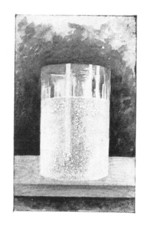
Fig. 9. A glass of cold water on which vapor has condensed in drops.
Do you wish to prove that the water vapor is there, although unseen? Then, if the day is cool, watch the window and notice the drops of water collect upon it. Or, if the day is warm, bring an ice-cold glass or pitcher into the room and see the drops collect upon it (Fig. 9). People sometimes say, when drops of water collect on a glass of cold water, that the glass is "sweating;" but see whether the same thing will not happen with a cold glass that does not contain water.
These two simple observations teach us two very important facts: (1) That heat will change liquid water to an invisible vapor, or gas, which will float about in the air of a room; and (2) that cold will cause some of the vapor to change back to liquid water.
Let us observe a little further. The clothes upon the line on wash day are hung out wet and brought in dry. If the sun is shining they probably dry quickly; but will they not dry even if the sun is not shining? They will, indeed; so here is another fact to add to our other two, namely (3) that the production of vapor from water will proceed even when the water is not heated.
This change of water to vapor is called evaporation. The water evaporates from the clothes; it also evaporates from the walks after a rain, from the mud of the road, from the brooks, creeks and rivers, and from ponds, lakes, and the great ocean itself. Indeed, wherever water is exposed to the air some evaporation is taking place. Yet heat aids evaporation, as you can prove by taking three dishes of the same kind and pouring the same amount of water into each, then placing one on the stove, a second in the sun, and a third in a cool, shady place, as a cellar, and watching to see which is the last to become dry.
About three-fourths of the earth's surface is covered by water, so that the air is receiving vapor all the time. In fact, every minute thousands of barrels of water-vapor are rising into the atmosphere from the surface of the ocean. The air is constantly moving about, forming winds, and this load of vapor is, therefore, drifted about by the winds, so that the air you are breathing may have in it vapor that came from the ocean hundreds or even thousands of miles away. You do not see the vapor, you are perhaps not even aware that it is there; yet in a room 10 feet high and 20 feet square there is often enough vapor, if it could all be changed back to water to fill a two-quart measure.
There is a difference in the amount of vapor from time to time. Some days the air is quite free from it, and then clothes will dry rapidly. On other days the air is damp and humid; then people say it is "muggy," or that the "humidity is high." On these muggy days in summer the air is oppressive because there is so much vapor in it. Near the sea, where there is so much water to evaporate, the air is commonly more humid or moist than in the interior, away from the sea, where there is less water to evaporate.
We have seen that there is some vapor in all air, and that there is more at some times than at others. We have also seen how it has come into the air, and that cold will cause it to condense to liquid water on cold window panes and on water glasses. There are other ways in which the vapor may be changed to liquid.
After a summer day, even when there has been no rain, soon after the sun sinks behind the western horizon the grass becomes so damp that one's feet are wet in walking through it. The dew is "falling." During the daytime the grass is warmed by the sun; but when the sun is gone it grows cooler, much as a stove becomes cool when the fire is out. This cool grass chills the air near it and changes some of the vapor to liquid, which collects in drops on the grass, as the vapor condenses on the outside of a glass of ice water.
In the opposite season of the year, on a cold winter's day, when you step out of a warm house into the chilly air, a thin cloud, or fog, forms as you expel the air from your lungs, and you say that you can "see your breath." What you really see are the little drops of water formed as the vapor-laden breath is chilled on passing from the warm body to the cold air. The vapor is condensed to form a tiny mist.
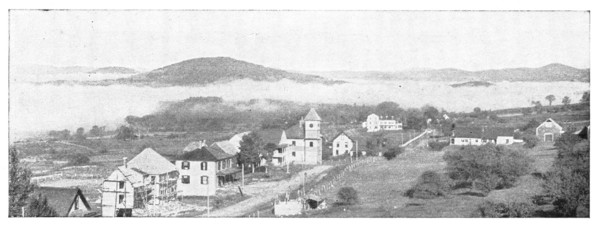
Fig. 10. A wreath of fog settled in a valley with the hilltops rising above it.
Doubtless you have seen a wreath of fog settling in a valley at night; or in the morning you may have looked out upon a fog that has gathered there during the night (Fig. 10). If your home happens to be upon a hillside, perhaps you have been able to look down upon the fog nestled there like a cloud on the land, which it really is. Such a fog is caused in very nearly the same way as the tiny fog made by breathing. The damp air in the valley has been chilled until the vapor has condensed to form tiny mist or fog particles. Without doubt you can tell why this fog disappears when the sun rises and the warm rays fall upon it.
On the ocean there are great fogs, covering the sea for hundreds of miles; they make sailing dangerous, because the sailors cannot see through the mist, so that two vessels may run together, or a ship may be driven upon the coast before the captain knows it. Once more, this is merely condensed vapor caused by chilling air that has become laden with vapor. This chilling is often caused when warm, damp winds blow over the cold parts of the ocean.
This leads the way to an understanding of a rain storm; but first we must learn something about the temperature of the air. The air near the ground where we live is commonly warmer than that above the ground where the clouds are. People who have gone up in balloons tell us so; and now scientific men who are studying this question are in the habit of sending up great kites, carrying thermometers and other instruments, in order to find out about the air far above the ground.
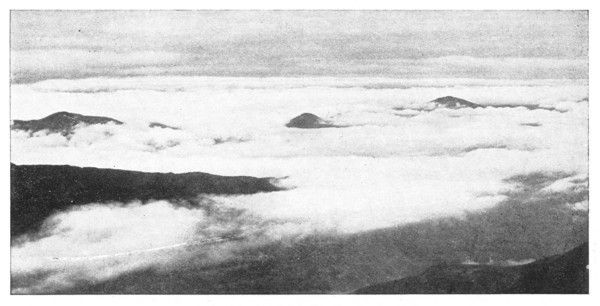
Fig. 11. Fog clouds among the valleys in the mountains, only the mountain peaks projecting above them.
It is not necessary, however, to send up a kite or a balloon to prove this. If your home is among mountains, or even among high hills, you can prove it for yourself; for often, in the late autumn, when it rains on the lower ground, it snows upon the mountain tops, so that when the clouds have cleared away the surface of the uplands is robed in white (Fig. 12). In the springtime, or in the winter during a thaw, people living among these highlands often start out in sleighs on a journey to a town, which is in the valley, and before they reach the valley their horses are obliged to drag the sleigh over bare ground. It is so much warmer on the lower ground that the snow melts away much more quickly than it does among the hills.
The difference in temperature is, on the average, about one degree for every three hundred feet, so that a hill top rising twelve hundred feet above a valley would have an average temperature about four degrees lower than the valley. Now some mountains, even in New York, rise thousands of feet above the surrounding country. They rise high into the regions of cold air, so that they are often covered with snow long before any snow has fallen on the lowlands; and the snow remains upon them long after it has disappeared from the lower country (Fig. 12).
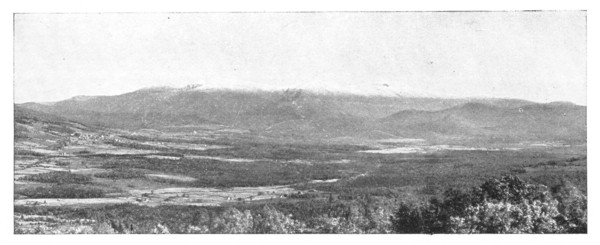
Fig. 12. A mountain whitened by snow on the top, while there is no snow at the base.
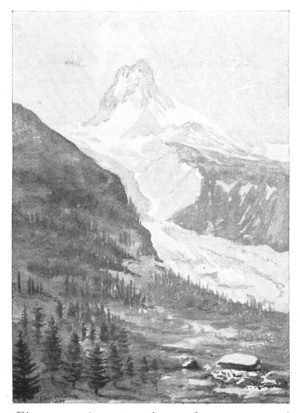
Fig. 13. A mountain peak snow capped, and covered on the very crest by a cloud.
Some mountains are so lofty that it never rains upon them, but snows instead; and they are never free from snow, even in mid-summer. If one climbs to the top of such peaks he finds it always very cold there. While he is shivering from the cold he can look down upon the green fields where the birds are singing, the flowers blossoming and the men, working in the fields, are complaining of the heat.
One who watches such a mountain as this, or in fact any mountain peak, will notice that it is frequently wrapped in clouds (Fig. 13). Damp winds blowing against the cold mountains are chilled and the vapor is condensed. If one climbs through such a cloud, as thousands of people have done when climbing mountains, he often seems to pass through nothing but a fog, for really many clouds are only fogs high in the air. (Fig. 14).
But very often rain falls from these clouds that cling to the mountain sides. The reason for this is easy to understand. As the air comes against the cold mountains so much vapor is condensed that some of the tiny fog particles grow larger and larger until they become mist particles, which are too heavy to float in the air. They then begin to settle; and as one particle strikes against another, the two unite, and this continues until perhaps a dozen have joined together so as to form a good-sized drop, which is so heavy that it is obliged to fall to the ground as rain.
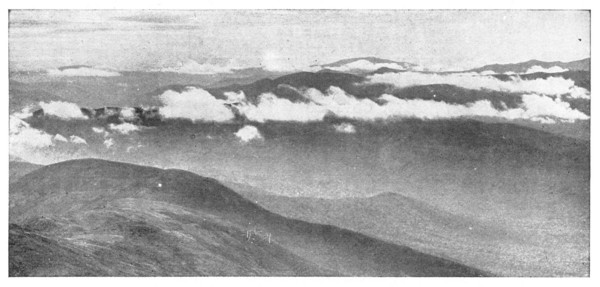
Fig. 14. Clouds clinging to the mountain sides. If one were climbing these mountains he would find himself, in passing through the clouds, either in a fog or a mist.
Let us now look at our summer storms. These do not form about mountain peaks; yet what has been said about the mountains will help us to understand such showers.
It is a hot summer day. The air is muggy and oppressive, so that the least exertion causes a perspiration, and even in the shade one is uncomfortably hot. Soon great banks of clouds appear (Fig. 15),—the "thunder heads,"—and people say "a thunder shower is coming, so that we will soon have relief from this oppressive heat." The clouds draw near, lightning is seen and thunder heard, and from the black base of the cloud, torrents of water fall upon the earth. If we could have watched this cloud from the beginning, and followed it on its course, we would have seen some facts that would help explain it. Similar clouds perhaps began to form over your head in the early afternoon and drifted away toward the east, developing into thunder storms many miles to the east of you.
On such a day as this, the air near the ground is so damp that it gives up vapor easily, as you can prove by allowing a glass of ice water to stand on a table and watching the drops of water gather there, causing the glass to "sweat" (Fig. 9). The sun beats down upon the heated ground and the surface becomes like a furnace, so that the air near the ground is warmed.
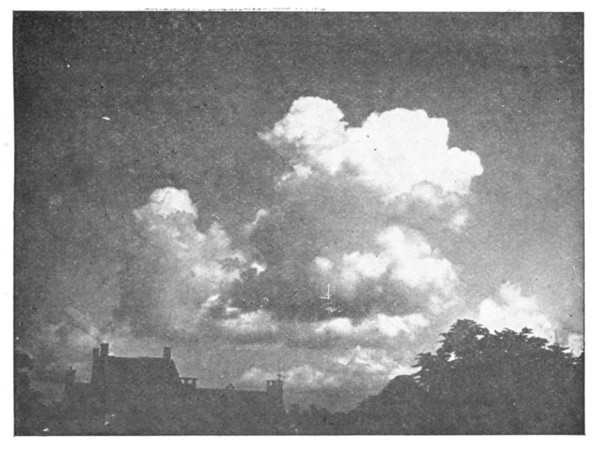
Fig. 15. A "thunder head," or cumulus cloud.
Air that is warm is lighter than cool air, and, being lighter, will rise, for the heavy cool air will settle and push it up, as a chip of wood will rise in a pail of water, because it is lighter than the water which pushes it to the top. This is why the warm air rises from a furnace, or a stove, or a lamp. It is the reason why the hot air rises through a house chimney; undoubtedly you can find other illustrations, as ventilation, and can find abundant opportunity to prove that warm air will rise.
The warm, moist air near the ground becomes so light that the heavy air above settles down and pushes it up, so that an uprising current of air is formed above the heated ground, much as an uprising current of hot air rises through the chimney when the stove is lighted. Rising thousands of feet into the sky the warm air reaches such a height, and finally comes to a place so cool, that some of the vapor must be condensed, forming fog particles, which in turn form a cloud.
On such a day, if you will watch a cloud, you will notice that its base is flat (Fig. 15); and this flat base marks the height above ground where the temperature of the atmosphere is low enough to change the vapor to fog particles. Of course the air still rises somewhat above this base and continues to get cooler, and to have more and more vapor condensed. This makes a pile of clouds resting on a level base, but with rounded tops (Fig. 15). Sometimes the base of these summer clouds, called cumulus clouds, is a mile above the ground and their tops fully a mile higher than this.
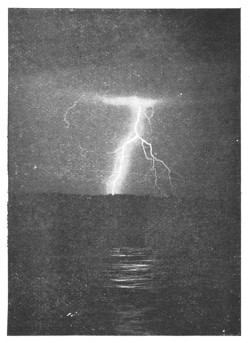
Fig. 16. Photograph of a lightning flash.
Just as on the mountain side, where the drops grow larger until they must fall, so here, fog particles grow to drops of such a size that they are too heavy to float. This growth is often aided by the violent currents of air, which sometimes tumble and toss the clouds about so that you can see the commotion from the ground. These currents blow one particle against another, forming a single drop from the collision of two; then still others are added until the rain drop is so heavy that it must fall.
But sometimes the air currents are so rapid that the drops are carried on up, higher and higher, notwithstanding the fact that they are heavy. Then they may be carried so high, and into air so cold, that they are frozen, forming hail. These "hailstones" cannot sink to the ground until they are thrown out of the violent currents, when they fall to the ground, often near the edge of the storm.
Some hailstones are of great size; you will find it interesting to examine them. If you do this, notice the rings of clear and clouded ice that are often to be seen. These are caused when the hail, after forming, settles to a place where it melts a little, then is lifted again by another current, growing larger by the addition of more vapor. This continues until finally the ice ball sinks to the ground.
There is thunder and lightning in such storms. Few things in nature are grander than these, and those who will watch the lightning flash will see many beautiful and interesting sights (Fig. 16). Sometimes the flash goes from cloud to cloud, again from the cloud to the ground. No one knows exactly why the lightning comes; but we do know that it is an electric spark, something like that which one can often see pass from the trolley to the wire of an electric car line. The main difference is that the spark in a thunder storm is a powerful lightning bolt that passes over a space of thousands of feet and often does great damage where it strikes.
The thunder is a sound which may be compared to the crack heard when a spark passes from the trolley, though of course the noise is very much louder. The crack of the lightning echoes and reverberates among the clouds, often changing to a great rumble; but this rumbling is mainly caused by the echo, the sound from the lightning being a loud crack or crash like that which we sometimes hear when the lightning strikes near by.
Some of the vapor of the air, on condensing, gathers on solid objects like grass, or glass; but some, as fog, floats about in the air. Really this, too, is often gathered around solid objects. Floating about in the air are innumerable bits of "dust" which you can see dancing about in the sunlight when a sunbeam enters a dark room. Some of these "dust" particles are actual dust from the road, but much of it is something else, as the pollen of plants, microbes, and the solid bits produced by the burning of wood or coal.
Each bit serves as a tiny nucleus on which the vapor condenses; and so the very "dust" in the air aids in the formation of rain by giving something solid around which the liquid can gather. The great amount of dust in the air near the great city of London is believed to be one of the causes for the frequent fogs of that city.
That there is dust in the air, and that the rain removes it, is often proved when a dull hazy air is changed to a clear, bright air by a summer shower. Watch to find instances of this. Indeed, after such a hazy day, when the rain drops first begin to fall, if you will let a few drops fall upon a sheet of clean white paper, and then dry it, you will find the paper discolored by the dust that the rain brought with it. So the rain purifies the air by removing from it the solids that are floating in it.
These are only a few of the things of interest that you can see for yourself by studying the air. Watch the sky; it is full of interest. See what you can observe for yourself. Watch especially the clouds, for they are not only interesting but beautiful (Fig. 17). Their forms are often graceful, and they change with such rapidity that you can notice it as you watch them. Even in the daytime the colors and shadows are beautiful; but at sunrise and at sunset the clouds are often changed to gorgeous banks of color.
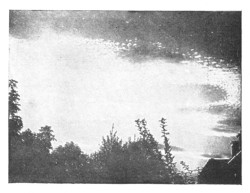
Fig. 17. A sky flecked with clouds high in the air.
Watch the clouds and you will be repaid; look especially for the great piles of clouds in the east during the summer when the sun is setting (Fig. 18). Those lofty banks, tinged with silver and gold, and rising like mountains thousands of feet into the air, are really made of bits of fog and mist. Among them vapor is still changing to water and rain drops are forming, while violent currents are whirling the drops about, and perhaps lifting them to such a height that they are being frozen into hailstones. Far off to the east, beneath that cloud, rain is falling in torrents, lightning is flashing and thunder crashing, though you cannot hear it because it is so far away.
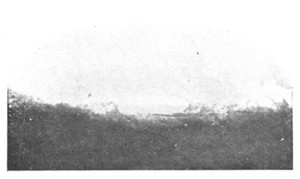
Fig. 18. The cloud banks of a thunder storm on the horizon.
You see the storm merely as a brightly lighted and beautifully colored cloud mass in the sky; but the people over whom it is hanging find it a threatening black cloud, the source of a furious wind, a heavy rain, and the awe-inspiring lightning. To them it may not be beautiful, though grand in the extreme; and so, too, when the summer thunder shower visits you in the early evening, you may know that people to the west of you are probably looking at its side and top and admiring its beauty of form and color.
The storm passes on, still to the eastward, and finally the cloud mass entirely disappears beneath the eastern horizon; but if you watch, you will see signs that it is still there, though out of sight; for in the darkness of the night you can see the eastern horizon lighted by little flashes, the source of which cannot be seen. You call it "heat lightning," but it is really the last signal that we can see of the vanishing thunder storm, so far away that the sound of the crashing thunder cannot be heard.
You watch the mysterious flashes; they grow dimmer and dimmer and finally you see them no more. Our summer shower is gone. It has done what thousands of others have done before, and what thousands of others will do in the future. It has started, moved off, and finally disappeared from sight; and as it has gone it has told us a story. You can read a part of this story if you will; and in reading it will find much that interests.
LEAFLET VII. A SNOW STORM.[9] By ANNA BOTSFORD COMSTOCK.
The snow had begun in the gloaming, And busily all the night Had been heaping field and highway With a silence deep and white. Every pine and fir and hemlock Wore ermine too dear for an earl, And the poorest twig on the elm-tree Was ridged inch deep with pearl. From sheds new-roofed with Carrara Came Chanticleer's muffled crow The stiff rails were softened to swan's-down And still fluttered down the snow. —Lowell.
The storm which Lowell describes so delightfully is the first soft, gentle snow fall that comes in November or early December. "The silence deep and white" settles like a benediction over the brown, uneven landscape, and makes of it a scene of enchantment. Very different from this is the storm that comes when the winter cold is most severe and winter winds most terrific. Then the skies are as white as the fields, with never a sign of blue; if the sun appears at all, it shines cold instead of warm, and seems but a vague white spot behind the veil of upward, downward whirling snowflakes; the wild wind takes the "snow dust" in eddies across the fields and piles it at the fences in great drift billows with overhanging crests. On such a day the snow is so cold and dry, the clouds so low and oppressive, the bare trees so brown and bleak, that we shiver even though we gaze on the dreary scene from the window of a warm and comfortable room.
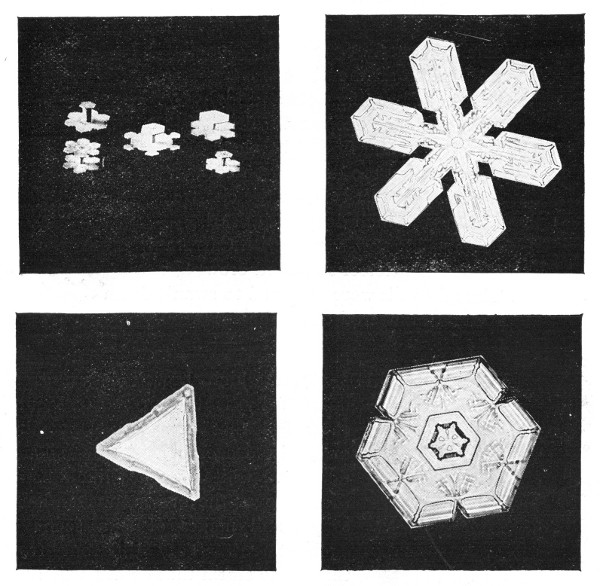
Fig. 19. Snow crystals enlarged.
But another change is sure to come. Some February day the wind will veer suddenly to the south and breathe warm thawing breaths over the white frozen world. Then will the forests appear in robes of vivid blue-purple against the shining hills; and in the mornings the soft blue of the horizon will shade upward into rose-color and still upward into yellow and beryl green; these hues are never seen on the forest or in the sky except when the snow covers the earth to the horizon line. The eye that loves color could ill afford to lose from the world the purples and blues which bring contrast into the winter landscape.
The snow storm to our limited understanding, begins with a miracle—the miracle of crystallization. Why should water freezing freely in the air be a part of geometry, the six rays of the snow crystal growing at an angle one to another, of sixty degrees? Or as if to prove geometry divine beyond cavil, sometimes the rays include angles of twice sixty degrees. Then why should the decorations of the rays assume thousands of intricate, beautiful forms, each ray of a flake ornamented exactly like its five sisters? And why should the snowflake formed in the higher clouds of the upper air be tabular in shape but still, in cross section, show that it is built on the plan of six radii? Look at it as we will, the formation of a crystal is a beautiful mystery and is as unfathomable as is the mystery of life.
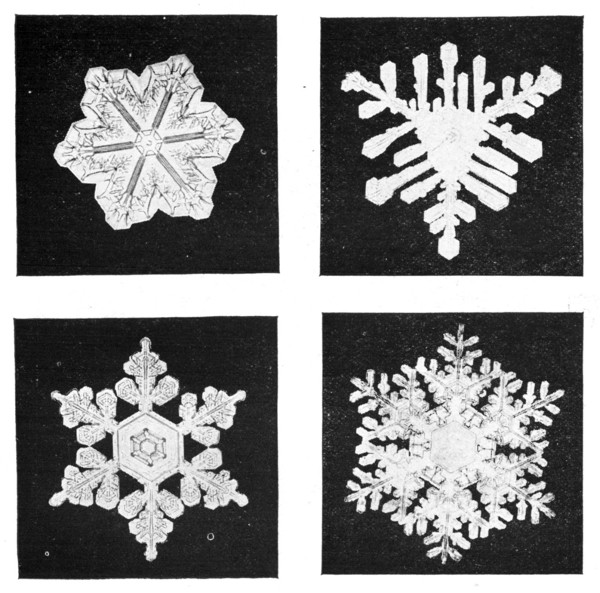
Fig. 20. Snow crystals enlarged.
I am indebted to the courtesy of Mr. R. G. Allen, Section Director for New York of the U. S. Weather Bureau, for suggestions in making out the following questions. The beautiful pictures of snow crystals illustrating this lesson were made from photographs taken by Mr. W. A. Bentley of Jericho, Vt. It is our desire to interest all teachers in the natural history of a snow storm, to the end that "they may love the country better and be content to live therein."
A thermometer hung in a sheltered, open place away from the warmth of the house is a necessary preliminary to the proper observation of the phenomena of a snow storm.
Dark woolen cloth is the best medium on which to catch and observe snow crystals.
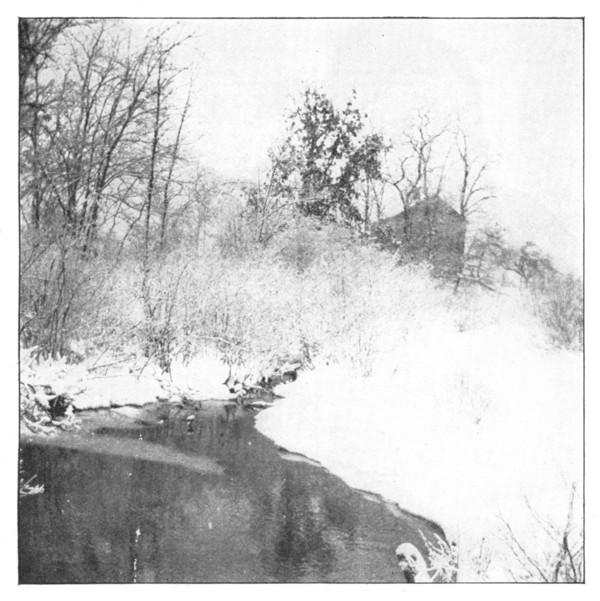
Fig. 21. "With a silence deep and white."
Questions on a Snow Storm.
1. What causes snow?
2. At what temperature do snow crystals form?
3. How do the clouds appear before a snow storm?
4. What is the temperature of the air before the storm?
5. What is the direction of the wind before the storm?
6. Does the storm come from the same direction as the wind?
7. What are the conditions of the wind and temperature when the snow crystals are most perfect in form?
8. What are these conditions when the snow crystals are matted together in great flakes?
9. What are these conditions when the snow crystals appear sharp and needle-like?
10. Are the snow crystals of the same storm similar in structure and decoration?
11. What is the difference in structure between a snowflake and a hail stone?
12. What is sleet?
13. What is the difference between hoar frost and snow?
14. Does the temperature rise or fall during a snow storm?
15. Is it colder or warmer after a snow storm has passed than it was before it began?
16. What are the conditions of weather which cause a blizzard?
17. Why does a covering of snow prevent the ground from freezing so severely as it would if bare?
18. Why is snow a bad conductor of heat?
19. Pack snow in a quart cup until it is full and let it melt; then tell how full the cup is of water. What do you infer from this?
20. Have you ever observed the grass to be green beneath snow drifts? Tell why.
21. Does snow evaporate as well as melt?
22. How does snow benefit the farmer and the fruit grower?
23. Do the snow storms in your locality come from one general direction all winter?
LEAFLET VIII. A HANDFUL OF SOIL: WHAT IT IS.[10] By R. S. TARR.
Wind drifts a seed from the parent plant until it settles to the ground, perhaps in a field or by the roadside, or even in the schoolyard. There it remains through the long winter; but with the return of spring, encouraged by the warm sunlight, the seed awakens from its dormant condition, breaks open the seed-cover and sends leaves into the air and roots into the ground. No one planted the seed; yet the plant has made its way in the world and it thrives until it has given to other seeds the same opportunity to start in life.
Had the seed fallen upon a board or a stone it might have sent out leaves and roots; but it could never have developed into a plant, for something necessary would have been lacking. What is there in the soil that is so necessary to the success of plant life? How has it come to be there? What is this soil that the plants need so much? These are some of the questions which we will try to answer.
One readily sees that the soil furnishes a place in which the plants may fix themselves,—an anchorage, as it were. It is also easy to see that from the soil the plants obtain a supply of water; and, moreover, that this water is very necessary, for the vegetation in a moist country suffers greatly in time of drought, and few plants are able to grow in a desert region because there is so little water. You can make a desert in the schoolroom and contrast it with moist soil by planting seeds in two dishes of soil, watering one, but furnishing no water to the other.
That water is necessary to plants is also proved by the plant itself. The sap and the moisture which may be pressed out of a grass stem or an apple are principally water taken from the soil by the roots. But there is more than water, for the juice of an apple is sweet or sour, while the sap and juice of other plants may be sweet or bitter. There are substances dissolved in the water.
It is these dissolved substances that the plants need for their growth, and they find them ready for use in the soil. There is a plant-food which the roots seek and find, so that every plant which sends roots into the soil takes something from it to build up the plant tissue. The sharp edges of some sedges, which will cut the hand like a dull knife, and the wood ashes left when a wood fire is burned, represent in part this plant-food obtained from the soil.
Let us take a handful of soil from the field, the schoolyard, or the street and examine it. We find it to be dirt that "soils" the hands; and when we try to brush off the dirt, we notice a gritty feeling that is quite disagreeable. This is due to the bits of mineral in the soil; and that these are hard, often harder than a pin, may often be proved by rubbing soil against a piece of glass, which the hard bits will often scratch, while a pin will not.
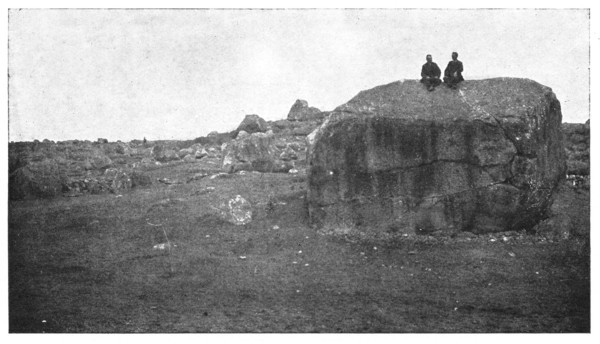
Fig. 21. A boulder-strewn soil of glacial origin with one of the large erratics on the right similar to those which early attracted attention to the drift. See page 105.
Study this soil with the eye and you may not see the tiny bits, though in sandy soils one may easily notice that there are bits of mineral. Even fine loamy and clay soils, when examined with a pocket lens or a microscope, will be found to be composed of tiny fragments of mineral. It is evident that in some way mineral has been powdered up to form the soil; and since the minerals come from rocks, it is the rocks that have been ground up. That powdered rock will make just such a substance as soil may be proved by pounding a pebble to bits, or by collecting some of the rock dust that is made when a hole is drilled in a rock. Much the same substance is ground from a grindstone when a knife is sharpened on it, making the water muddy like that in a mud hole.
It will be an interesting experiment to reduce a pebble to powder and plant seeds in it to see whether they will grow as well as in soil; but in preparing it try to avoid using a sandstone pebble, because sandy soils are never very fertile.
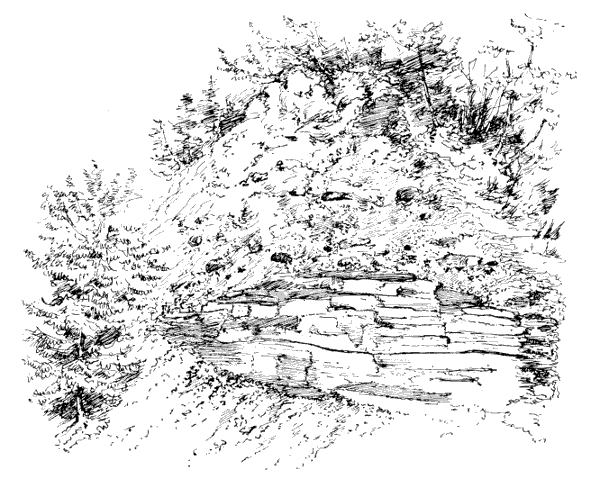
Fig. 22. A glacial soil, containing numerous transported pebbles and boulders, resting on the bed rock.
Not only is soil made up of bits of powdered rock, but it everywhere rests upon rock (Fig. 25). Some consider soil to be only the surface layers in which plants grow; but really this is, in most places, essentially the same as the layers below, down even to the very rock, so that we might call it all soil; though, since a special name, regolith (meaning stone blanket), has been proposed for all the soft, soil-like rock-cover, we may speak of it as regolith and reserve the word soil for the surface layers only.
In some places there is no soil on the bare rocks; elsewhere the soil-cover is a foot or two in depth; but there are places where the regolith is several hundred feet deep. In such places, even the wells do not reach the bed rock; nor do the streams cut down to it; but even there, if one should dig deep enough, he would reach the solid rock beneath.
How has the hard rock been changed to loose soil? One of the ways, of which there are several, may be easily studied whenever a rock has been exposed to the air. Let us go to a stone wall or among the pebbles in a field, for instance, and, chipping off the surface, notice how different the inside is from the outside. The outer crust is rusted and possibly quite soft, while the interior is harder and fresher. Many excellent examples of this may be found in any stony field or stone wall.
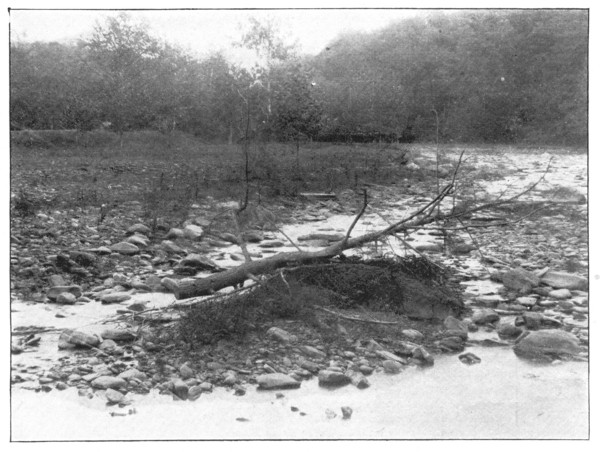
Fig. 23. The bed of a stream at low water, revealing the rounded pebbles that have been worn and smoothed by being rolled about, thus grinding off tiny bits which later are built into the flood-plains.
As hard iron rusts and crumbles to powder when exposed to the weather; so will the minerals and the rocks decay and fall to bits; but rocks require a very much greater time for this than does iron. It happens that the soil of New York has not been produced by the decay of rock; and, therefore, although the soils in many parts of the world have been formed in this way, we will not delay longer in studying this subject now, nor in considering the exact way in which rocks are enabled to crumble.
Another way in which rocks may be powdered may be seen in most parts of New York. The rains wash soil from the hillsides causing the streams to become muddy. In the streams there are also many pebbles, possibly the larger fragments that have fallen into the stream after having been broken from the ledges. The current carries these all along down the stream, and, as they go, one piece striking against another, or being dragged over the rocks in the stream bed, the pebbles are ground down and smoothed (Fig. 23), which means, of course, that more mud is supplied to the stream, as mud is furnished from a grindstone when a knife or scythe is being sharpened on it. On the pebbly beaches of the sea or lakeshore much the same thing may be seen; and here also the constant grinding of the rocks wears off the edges until the pebbles become smooth and round.
Fig. 24. Near view of a cut in glacial soil, gullied by the rains, and with numerous transported pebbles embedded in the rock flour.
Supplied with bits of rock from the soil, or from the grinding up of pebbles and rocks along its course, the stream carries its load onward, perhaps to a lake, which it commences to fill, forming a broad delta of level and fertile land, near where the stream enters the lake. Or, possibly, the stream enters the sea and builds a delta there, as the Mississippi river has done.
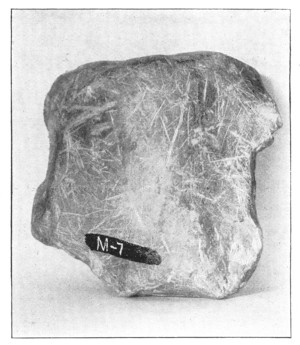
Fig. 25. A scratched limestone pebble taken from a glacial soil.
But much of the mud does not reach the sea. The greatest supply comes when the streams are so flooded by heavy rains or melting snows that the river channel is no longer able to hold the water, which then rises above the banks, overflowing the surrounding country. Then, since its current is checked where it is so shallow, the water drops some of its load of rock bits on the flood-plain, much as the muddy water in a gutter drops sand or mud on the sidewalk when, in time of heavy rains, it overflows the walk.
Many of the most fertile lands of the world are flood-plains of this kind, where sediment, gathered by the streams farther up their courses, is dropped upon the flood-plains, enriching them by new layers of fertile soil. One does not need to go to the Nile, the Yellow, or the Mississippi for illustrations of this; they abound on every hand, and many thousands of illustrations, great and small, may be found in the State of New York. Doubtless you can find one.
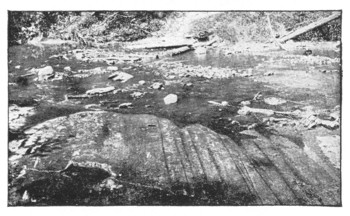
Fig. 26. The grooved bed rock scratched by the movement of the ice sheet over it.
There are other ways in which soils may be formed; but only one more will be considered, and that is the way in which most of the soils of New York have been made. To study this let us go to a cut in the earth, such as a well or a stream bank (Figs. 22 and 24). Scattered through the soil numerous pebbles and boulders will doubtless be found; and if these are compared with the bed rock of the country, which underlies the soil (Fig. 22), some of them will be found to be quite different from it. For instance, where the bed rock is shale or limestone, some of the pebbles will no doubt be granite, sandstone, etc. If you could explore far enough, you would find just such rocks to the north of you, perhaps one or two hundred miles away in Canada; or, if your home is south of the Adirondacks, you might trace the pebbles to those mountains.
On some of these pebbles, especially the softer ones, such as limestone, you will find scratches, as if they had been ground forcibly together (Fig. 25). Looking now at the bed rock in some place from which the soil has been recently removed, you will find it also scratched and grooved (Fig. 26); and if you take the direction of these scratches with the compass, you will find that they extend in a general north and south direction, pointing, in fact, in the same direction from which the pebbles have come.
All over northeastern North America and northwestern Europe the soil is of the same nature as that just described. In our own country this kind of soil reaches down as far as the edge of the shaded area in the map (Fig. 27), and it will be noticed that all of New York is within that area excepting the extreme southwestern part near the southern end of Chautauqua lake.
Not only is the soil peculiar within this district, but there are many small hills of clay or sand, or sometimes of both together (Figs. 33 and 34). They rise in hummocky form and often have deep pits or kettle-shaped basins between, sometimes, when the soil is clayey enough to hold water, containing tiny pools. These hills extend in somewhat irregular ranges stretching across the country from the east toward the west. The position of some of these ranges is indicated on the map (Fig. 27).
For a long time people wondered how this soil with its foreign pebbles and boulders, altogether called "drift," came to be placed where it is; they were especially puzzled to tell how the large boulders, called erratics (Fig. 21), should have been carried from one place to another. It was suggested that they came from the bursting of planets, from comets, from the explosion of mountains, from floods, and in other ways equally unlikely; but Louis Agassiz, studying the glaciers of the Alps and the country round about, was impressed by the resemblance between the "drift" and the materials carried by living glaciers.
Agassiz, therefore, proposed the hypothesis that glaciers had carried the drift and left it where we now find it; but for many years his glacial hypothesis met with a great deal of opposition because it seemed impossible that the climate could have changed so greatly as to cover what is now a temperate land with a great sheet of ice. Indeed, even now, although all who have especially studied the subject are convinced, many people have not accepted Agassiz's explanation, just as years ago, long after it was proved that the earth rotated each day, many people still believed that it was the sun, not the earth, that was moving.
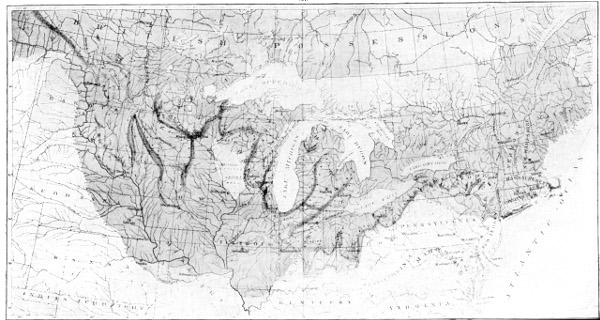
Fig. 27. Map showing the extent of the ice sheet in the United States. Position of some of the moraines indicated by the heavily shaded lines. (After Chamberlain.)
The glacial explanation is as certain as that the earth rotates. For some reason, which we do not know, the climate changed and allowed ice to cover temperate lands, as before that time the climate had changed so as to allow plants like those now growing as far south as Virginia to live in Greenland, now ice covered. When the ice of the glacier melted away it left many signs of its presence; and when the temperate latitude plants grew in Greenland they left seeds, leaves and tree trunks which have been imbedded in the rocks as fossils. One may now pick the leaves of temperate climate trees from the rocks beneath a great icecap.
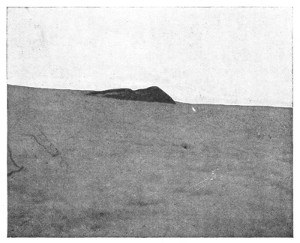
Fig. 28. A view over the great ice plateau of Greenland, with a mountain peak projecting above it.
To one who studies them, the signs left by the glacier are as clear proof as the leaves and seeds. From these signs we know that the climate has changed slowly, but we have not yet learned why it changed.
There are now two places on the earth where vast glaciers, or ice sheets, cover immense areas of land, one in the Antarctic, a region very little known, the other in Greenland, where there is an ice sheet covering land having an area more than ten times that of the State of New York. Let us study this region to see what is being done there, in order to compare it with what has been done in New York.
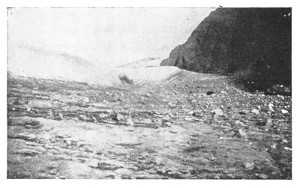
Fig. 29. The edge of a part of the great Greenland ice sheet (on the left) resting on the land, over which are strewn many boulders brought by the ice and left there when it melted.
In the interior is a vast plateau of ice, in places over 10,000 feet high, a great icy desert (Fig. 28), where absolutely no life of any kind, either animal or plant, can exist, and where it never rains, but where the storms bring snow even in the middle of summer. Such must have been the condition in northeastern America during the glacial period.
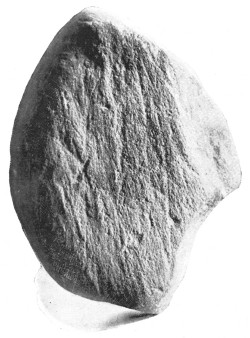
Fig. 30. A scratched pebble taken from the ice of the Greenland glacier.
This vast ice sheet is slowly moving outward in all directions from the elevated center, much as a pile of wax may be made to flow outward by placing a heavy weight upon the middle. Moving toward the north, east, south and west, this glacier must of course come to an end somewhere. In places, usually at the heads of bays, the end is in the sea, as the end of our glacier must have been off the shores of New England. From these sea-ends, icebergs constantly break off; these floating away toward the south, often reach, before they melt, as far as the path followed by the steamers from the United States to Europe. Between bays where the glacier ends in the sea, the ice front rests on the land (Fig. 29), as it did over the greater part of New York and the states further west. There it melts in the summer, supplying streams with water and filling many small ponds and lakes. The front stands there year after year, sometimes moving a little ahead, again melting further back so as to reveal the rocks on which it formerly rested.
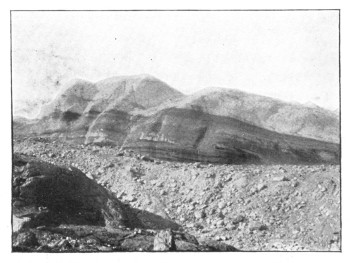
Fig. 31. A part of the edge of the Greenland glacier, with clean white ice above, and dark discolored bands below where laden with rock fragments. In the foreground is a boulder-strewn moraine.
The bed rock here is found to be polished, scratched and grooved just like the bed-rock in New York; and the scratches extend in the direction from which the ice moves. Resting on the rock are boulders and pebbles (Fig. 22), sometimes on the bare rock, sometimes imbedded in a clay as they are in the drift. As we found when studying the soil in our own region, so here the pebbles are often scratched, and many of them are quite different from the rock on which they rest.