PART I. TEACHERS' LEAFLETS. (continued 6)
Reading edition
In April there is likely to appear in any region of New York State a bird which is often mistaken for the downy or hairy, although it is very different in both coloring and habits. This is the sapsucker, the only woodpecker of bad repute (Fig. 184). However, I am sure its deeds are not nearly so black as they are painted. The male sapsucker has a bright red crown and chin and throat, his breast is yellow, and he is also yellowish on the back; while the males of the downy and hairy are red-capped and black and white with no yellow.
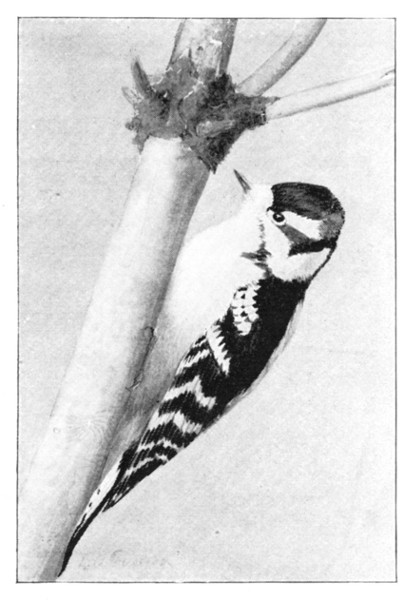
Fig. 183. Downy woodpecker.
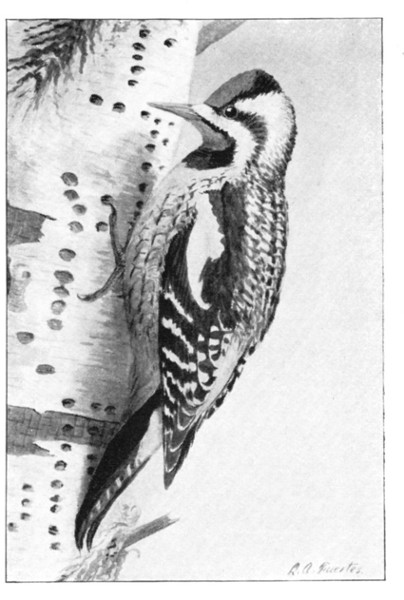
Fig. 184. Sapsucker.
Questions on Woodpeckers to be Answered in March.
1. What is the difference in appearance between the male and female downy?
2. How does the downy travel down a tree; does it go head-first? What food have you seen it eat?
3. How does the downy use its tail in going up and down the tree trunk?
4. Have you approached a woodpecker closely enough to see how its toes are arranged? If so, describe them.
5. How does it manage its head to make its blows forceful?
6. Are you able to discriminate between the hairy and the downy when you see them? How?
7. Do you know the difference in the notes of the hairy and downy? Explain.
Downy, Sapsucker and Red-head.[32]
This morning I was awakened by the beating of a drum over in the woods. My ear was not yet sufficiently trained so that I knew whether my drummer was Mr. Downy or Mr. Hairy, yet I strongly suspected the former. The tattoo of the Sapsucker (which does not nest here) James Whitcomb Riley has aptly characterized as "Weeding out the lonesomeness." This is exactly what the drumming of woodpeckers in the early spring means. The male selects some dried limb of hard wood and there beats out his well-known signal which advertises far and near, "Wanted, a wife." And after he wins her he keeps on drumming to cheer her, while she is busy with her family cares. The woodpecker has no voice for singing, like the robin or thrush, and realizing his deficiency, he does not insist on singing like the peacock, whether he can or no. He chooses rather to devote his voice to terse and business-like conversation, and when he is musically inclined he turns drummer. He is rather particular about his instrument, and, having found one that pleases him in tone, returns to it day after day.
In case the drumming I heard this morning was an advertisement for a wife, I am interested to know what has become of Mrs. Downy, who has been true to her mate all winter. Does, perhaps, the springtime bring divorce as well as marriage? Mr. Burroughs tells of a downy that was absolutely brutal in his treatment of his mate in winter, not allowing her to live in his neighborhood. Be this as it may, the downy and the hairy woodpeckers that have feasted upon my suet this winter have invariably come in pairs, and while only one at a time sits at meat, and the lord and master is somewhat "bossy," yet they seem to get along as well as most married pairs.
The sapsucker is a woodpecker that has strayed from the paths of virtue; he has fallen into temptation by the wayside, and instead of drilling a hole for the sake of the grub at the end of it he drills it for its own sake. He is a tippler and sap is his beverage. He is especially fond of the sap of the mountain ash, apple, thorn apple, canoe birch, red maple, red oak and white ash. He drills his holes in beautiful rows, and sometimes girdles a limb or tree, and for this he is pronounced a rascal by men who have themselves ruthlessly cut from our land millions of trees that should now be standing. However, the sapsucker does not live solely on sap and the soft cambium layer of the tree; he also feeds on insects wherever he finds them. When feeding their young, sapsuckers are true flycatchers, getting the insects while on the wing. If you find a sapsucker girdling a tree in your orchard or a birch on your lawn, just protect the trees with a wire netting, and let the sapsucker catch mosquitoes for you instead, and remember that he belongs to a good family and is entitled to some consideration, even if he has taken to drink.
The red-head (Fig. 185) is well named, for his helmet and visor show a vivid, glowing crimson that stirs the sensibilities of the color lover. He is readily distinguished from all other woodpeckers because his entire head and the bib under his chin are red. For the rest, he is a beautiful dark metallic blue and white. He is a most adept drummer, and his roll is a long one. One that I observed last spring selected a dead limb at the top of an oak tree and there he drummed merrily every morning. He is an adaptable fellow and has been known to drum on tin roofs and lightning rods, thus braving the dangers of civilization for the sake of better music. Though he can rattle so well when he is musically inclined, he is not, after all, much of a woodpecker, for he lives mostly on insects which he catches while they are crawling or on the wing, and he also likes nuts. He is especially fond of beech nuts, and, being a thrifty fellow as well as musical, in time of plenty he stores up food against time of need. He places his nuts in crevices and forks of branches, in holes in trees, and other hiding places. Lets us watch him this spring and see whether we can discover what he eats.
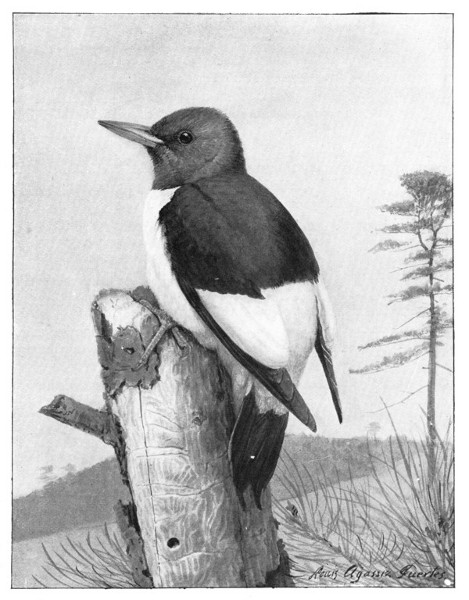
Fig. 185. The Red-headed Woodpecker.
Questions About Woodpeckers to Be Answered in April and May.
1. Have you observed any species of woodpecker drumming?
2. Have you been able to see the drum? If so, describe it.
3. Are you able to distinguish between the tapping of the woodpecker when searching for food, and his drumming when he is making music?
4. If you have made any observations on the sapsucker, please give them.
5. Have you seen the sapsucker at work? If so, did the holes girdle the tree? Were the holes round or square?
6. Have you seen the red-head this spring?
7. Describe the way the woodpecker uses its tail when climbing a tree.
8. Send for Bulletin No. 7, of the United States Department of Agriculture, Division of Ornithology, called "Food of Woodpeckers." Read this Bulletin and answer these questions: Does the sapsucker do more harm than good? What special benefit to us is the red-head? Which is the most useful of our woodpeckers?
The Flicker or Yellow Hammer.[33]
The first time I ever saw a flicker I said, "What a wonderful meadow lark, and what is it doing on that ant hill?" But another glance revealed to me a red spot on the back of the bird's neck, and as soon as I was sure that this was not a bloody gash I knew it belonged to no meadow lark. The golden brown plumage dotted with black, the under wings of luminous yellow, the white spot above the tail, the ashen gray back, and, above all, the oriental ornaments of crescents,—one brilliant red across the back of the neck, one black across the breast,—all conduce to make the flicker one of our most showy and beautiful birds. The flicker has many names, such as golden-winged woodpecker, yellow hammer, highhole, and yarup or wake-up, and many others. It earned the name of highhole because of its way of excavating its nest high up in trees, usually between ten and twenty-five feet from the ground. It especially loves an old apple tree as a site for a nest, and most of our large, old orchards of New York State may boast of a pair of these handsome birds during the nesting season of May and June. However, the flicker is not above renting any house he finds vacant which was made by other birds last year. The flicker earned his name of "yarup" or "wake-up" from his spring song, which is a rollicking jolly "wick-a-wick-a-wick." As a business bird the flicker shines in the rather extraordinary line of eating ants. It has a tongue equipped almost exactly like the tongue of the animal called the ant eater, and it often may be seen using it with great effectiveness in catching the little communal laborers.
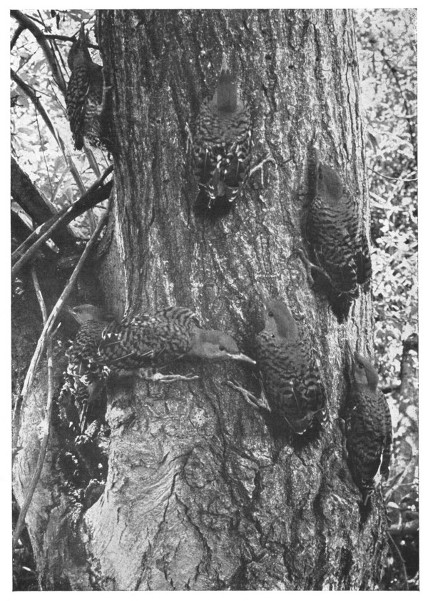
Fig. 186. Young Flickers.
Those who have observed the flicker during the courting season declare him to be the most silly and vain of all the bird wooers. Mr. Baskett says, "When he wishes to charm his sweet-heart he mounts a very small twig near her, and lifts his wings, spreads his tail, and begins to nod right and left as he exhibits his mustache to his charmer, and sets his jet locket first on one side of the twig and then the other. He may even go so far as to turn his head half around to show her the pretty spot on his 'back hair.' In doing all this he performs the most ludicrous antics, and has the silliest of expressions of face and voice as if in losing his heart, as some one phrases it, he had lost his head also."
Summary of the Study of Woodpeckers.
We have now studied our five species of woodpeckers common in New York State, and I trust that you know them all by sight. When you are teaching the children about the woodpecker, there are many interesting stories to tell about the way that his form is adapted to his life. Some of these stories are as follows: First. The woodpecker's bill, which is a drill and chisel, and how he uses it for getting at the grub or the borer in the wood, and for making the hole for the nest, and for drumming when he feels musical. Second. The tongue, which is a barbed spear, and has a wonderful spring attachment of bones which allows it to be thrust far out. This tongue is fitted in each case to get the kind of food which sustains its owner. Third. The feet have a special arrangement of toes which allows the bird to cling tenaciously to a tree trunk. Study the way the fourth toe, which may be compared to our little finger, has been moved around backward so that it acts as another thumb. Fourth. Study how the tail made of stiff feathers is particularly adapted to act as a brace, helping the bird to climb a tree. In studying all these things I would especially recommend you to a little book called, "The Woodpeckers" by Fannie Hardy Eckstrom, published by Houghton, Mifflin & Co., price $1.00.
Questions on the Flicker.
1. Have you ever seen a flicker?
2. Do you know its song?
3. Has the flicker a straight bill like the downy's?
4. What are the differences between the male and female flicker?
5. Have you ever seen a flicker catching ants? Describe.
6. Do you think the flicker is a beneficial bird? If so, why?
7. Have you ever seen a flicker's nest? Describe.
8. Do you know how the flicker feeds its young? Explain.
9. Describe the difference in color between the male and female of the (a) downy, (b) the hairy, (c) the redhead, (d) the sapsucker, (e) and the flicker.
10. How can you tell the difference between a flicker and a meadow lark during flight?
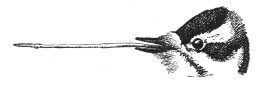
Downy's long tongue.
LEAFLET XXV. THE CHICKADEE.[34] By ANNA BOTSFORD COMSTOCK.
He is the hero of the woods; there are courage and good nature enough in that compact little body, which you may hide in your fist, to supply a whole groveful of May songsters. He has the Spartan virtue of an eagle, the cheerfulness of a thrush, the nimbleness of Cock Sparrow, the endurance of the seabirds condensed into his tiny frame, and there have been added a pertness and ingenuity all his own. His curiosity is immense, and his audacity equal to it; I have even had one alight upon the barrel of the gun over my shoulder as I sat quietly under his tree.—Ernest Ingersoll.
However careless we may be of our friends when we are in the midst of the luxurious life of summer, even the most careless among us give pleased attention to the birds that bravely endure with us the rigors of winter. And when this winged companion of winter proves to be the most fascinating little ball of feathers ever created, constantly overflowing with cheerful song, our pleased attention changes to active delight. Thus it is that in all the lands of snowy winters the chickadee is a loved comrade of the country wayfarer; that happy song, "chick-a-dee-dee-dee," finds its way to the dullest consciousness and the most callous heart.
One day in February we were, with much enjoyment, wading through a drifted highway that skirted a forest, the least twig of which bore a burden of soft snow. Over all hung that silence of winter which is the most "silent silence" that rests upon the earth anywhere outside the desert. No breeze swayed a creaking branch or shook from it the snow in soft thud to the white carpet below. Even the song of the brook was smothered beneath coverlets of ice and pillows of drift. We stood fast, awed by the stillness, when suddenly it was broken by the thrilling notes of the chickadees. We could hardly credit our senses, for it seemed as if the woods was a hopeless place for any living creature that morning. But there before our eyes was a flock of these courageous birds hunting for food on the leeward sides of boles and branches left bare and black in the recent storm. Their tiny weights sent the snow in showers from the terminal twigs, which phenomenon was greeted with triumphant song while the cheerful midgets hunted the relieved branches topside and bottomside for any lurking tidbit. As we watched them, Emerson's poem came to mind:
"Piped a tiny voice near by, Gay and polite, a cheerful cry— Chick-chickadeedee! saucy note Out of sound heart and merry throat, As if it said, 'Good-day, good Sir! Fine afternoon, old passenger! Happy to meet you in these places Where January brings few faces.'"
No wonder that the great American philosopher was attracted by this other American philosopher who sings when he is cold and hungry.
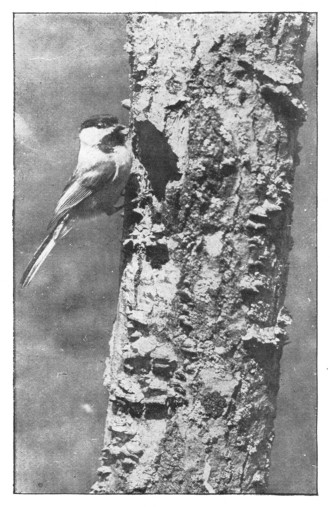
Fig. 187. A chickadee at the entrance to its nest.
Besides its usual song the chickadee has a song that says "phœbe" much more distinctly than does the song of the phœbe itself. Few people recognize this, and often in February or early March it is announced in the local newspaper, "The phœbe-birds were heard to-day" though it may be weeks yet before these birds arrive. The two songs may be easily distinguished by even the ear untrained to music. In the phœbe song of the chickadee, the last syllable is at least one note lower than the first and has a falling inflection; while the last syllable of the phœbe bird's song is at least a half note higher than the first and has a rising inflection.
Not long since I visited the deserted nest of a devoted pair of chickadees. It was cuddled down in the bottom of a hole that opened on the very top of a fence post, and, one would imagine, must have been wet more than once while inhabited. However, a large family was raised there during the past season and much enjoyment was derived from watching the many fubsy birdlings that found home and comfort in that unattractive retreat. I looked upon them with special interest, for I was sure they would visit the suet on my trees this winter and thus become friendly neighbors.
As soon as the trees are bare, nail or tie bits of suet to branches which may be observed from your windows. I know of no investment which pays such enormous dividends both to pleasure and pocket as do suet restaurants in orchards patronized by chickadees. Every child, at home or school, will be attracted by this experiment.
Questions on the Chickadee.
1. Describe the colors of the chickadee above; below; wings; tail; throat and head.
2. Describe the differences in coloring between the chickadee and the nuthatch.
3. What is the shape of the chickadee's beak and for what is it adapted?
4. Does it frequent the trunks of trees, or the twigs?
5. Describe its actions when hunting for food on a twig.
6. What is the chief food of the chickadee?
7. Why is it of special value to the farmer?
8. What are the differences in the winter and summer habits of the chickadee?
9. Do you know the "phœbe" note of the chickadee?
10. Where do these birds build their nests and of what material?
11. What are the colors and markings on the eggs?
12. When is the nesting season?
LEAFLET XXVI. THE WHITE-BREASTED NUTHATCH.[35] By ANNA BOTSFORD COMSTOCK.
The busy nuthatch climbs his tree, Around the great bole spirally, Peeping into wrinkles gray, Under ruffled lichens gay, Lazily piping one sharp note From his silver mailèd throat.
—Maurice Thompson.
"With more artless inquisitiveness than fear, this lively little acrobat stops his hammering or hatching at your approach, and stretching himself out from the tree until it would seem he must fall off, he peers down at you, head downward, straight into your upturned opera-glass. If there is too much snow on the upper side of a branch watch how he runs along underneath it like a fly, busily tapping the bark, or adroitly breaking the decayed bits with his bill, as he stretches for the spider's eggs, larvæ, etc., hidden there; yet somehow, between mouthfuls, managing to call out his cherry quank! quank! hank! hank!"
—Neltje Blanchan.
A voice outside is calling at me; I cannot describe it accurately, but it is making delightful woodsy remarks that make me long to throw aside the pen and go out and wander where the snow is making still softer the carpet of dead leaves on the forest floor. It is not a musical note but it is most enticing and translates into sound the picture of bare-branched trees and the feeling of enchantment that permeates the forest in winter. Neltje Blanchan says the voice reiterates "quank, quank," others say it is "nay, nay"—but no nasal sound of the human voice, and no spelling of the English language adequately represent this call of the white-breasted nuthatch.
On the tree in front of the window I can see the owner of this sylvan voice. He is a little bird blue-gray above with black head and black and white V-trimmings on the back of his suit and with soft, white breast. He is flitting blithely from tree to tree enjoying the snow storm and coming often to the suet feast which I have spread for him and for his little feathered kin.
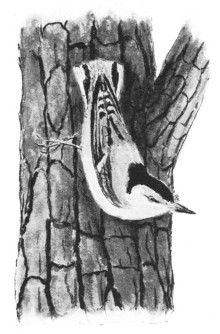
Fig. 188. The nuthatch, one of the winter birds.
We have been having exciting times at the suet banquet this morning. The building in which my office is, stands on a high knoll near the forest-covered brink of a deep gorge. Thus my window is opposite the tops of the trees. One of our nature-study staff, a brave and gallant knight, who loves birds and knows that I love to watch them, climbed two of these trees at imminent risk of breaking his neck in order to place this suet just opposite my window. The whole chickadee family and four nuthatches, and Sir Downy and Madam Hairy had been reveling in the feast all the morning when suddenly one after another three crows appeared upon the scene. My heart sank as I saw them eying the suet with interest. Nearer and nearer they hopped from branch to branch. I pounded on the window and called out, "Go away" in both the crow and the English language, all in vain. One crow braver or hungrier than the others with one defiant eye on me flapped confidently down and sought to carry the suet off in his beak; to his surprise it was tied on. That seemed suspicious and when we raised the window and leaning far out explained matters he lifted slowly with a jeering "caw" that said plainly "I'll call sometime when you are not at home" and with that he and his companions disappeared up the gorge. The invited guests at the suet table were less disturbed than was I, and I suppose it is rather inconsistent to feed the chickadees and let the ravens go hungry. But this suet will last the little birds a month while it would hardly furnish a breakfast for three crows; and in philanthropic enterprises one is obliged to draw the line somewhere even at the cost of consistency.
I will return to my nuthatch, who, by the way, has just hammered off a piece of suet and thrust it into a crevice of the bark on the tree bole. Why does he do that: is it for convenience in eating or is it an attempt to store up some of his dinner for future need? Anyway it is bad manners, like carrying off fruit from table d' hote. But he is polite enough in another respect; every time after eating the suet he wipes his beak on his branch napkin with great assiduity, first one side and then the other, almost as if he were sharpening it. The woodpeckers are similarly fastidious in cleaning suet off their beaks.
The loud note of the nuthatch, seeming to be out of proportion to the size of the bird is, by no means, its only note. Yesterday we observed a pair hunting over the branches of an elm over our heads, and they were talking to each other in sweet confidential syllables "wit, wit, wit," entirely different from the loud note that is meant for the world at large.
The nuthatches and chickadees hunt together all winter. This is no business partnership, but one of congeniality based upon similar tastes. Thus it is that the two birds are often confused. There is, however, a very noticeable character that distinguishes them at the first glance. Strange to say the nuthatch has also been confused with the sapsucker and has gained unjust obloquy thereby. How any one with eyes could confuse these two birds is a mystery, for they resemble each other in no particular nor in general appearance.
While the nuthatch finds much of its food on trees, yet Mr. Torrey tells of seeing one awkwardly turning over the fallen leaves for hidden cocoons and other things quite worth his while; and Mr. Baskett tells of having seem them catch flies in the air and becoming quite out of breath at this unusual exercise.
Audubon made some most interesting observations on the nuthatch. He says they may sleep hanging head downward. He also says of their nesting habits that "both birds work together, all the time congratulating each other in the tenderest manner. The male, ever conspicuous on such occasions, works some, and carries off the slender chips chiseled by the female. He struts around her, peeps into the hole, cherups at intervals, or hovers about her on the wing. While she is sitting on her eggs, he seldom absents himself many moments; now with a full bill he feeds her, now returns to be assured that her time is pleasantly spent."
The red-breasted nuthatch is sometimes associated with its white-breasted cousin; it is a smaller bird and is essentially a northern species. The nuthatches get their name from their habit of wedging nuts and acorns into bark and then hatching them open. From every standpoint the nuthatches are most desirable acquaintances, and we cannot spend our time to better advantage than in getting familiar with their interesting habits.
Questions on the White-breasted Nuthatch.
1. Describe from your own observations the colors of the nuthatch above and below.
2. (a) What is the most noticeable character that distinguishes the nuthatch from the chickadee? (b) Does the nuthatch usually frequent the bole or the twigs of a tree? (c) Is there any difference in this respect between the habits of the nuthatch and the chickadee?
3. Does the nuthatch alight with its head down or up?
4. Does it travel down or up? Does it always go in a spiral?
5. What is its food?
6. Does it open nuts for the meat or the grubs within?
7. Does it use its tail as a brace in climbing trees as does the woodpecker?
8. Where does it build its nest?
9. What is the color of the eggs?
10. Why does it seem less common in summer than in winter?
11. How does it use its feet when resting on a tree trunk?
12. Has it any special development of the feet to help it in traveling on tree trunks?
13. Do you know the note of the nuthatch? Describe.
14. How would you spell its note?
15. How does the nuthatch help the farmer and fruit grower?
LEAFLET XXVII. ABOUT CROWS.[36] By MARY ROGERS MILLER.
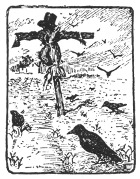
Thousands and thousands of crows fast asleep amongst the branches of a grove of pines! The trees themselves look dark and sombre against the snowy hillside, but when the assemblage of dusky birds has gathered there, the shadows thicken and the darkness settles like a pall. Soon all is hushed and silent.
Would you not go miles to see such a sight?
Yet maybe you have lived for years within easy walking distance of a great crow "dormitory" without even suspecting its existence. You may have watched the crows flying overhead every morning and then again every afternoon, without noticing that they came from the same direction each morning and returned at nightfall. This was just my experience until I began to care about crows and their ways. Now I know that there is a sleeping roost a mile or so up one of our wooded valleys and the oldest inhabitant tells me that he remembers seeing "more'n a million" crows up there in winters when he was a boy. Undoubtedly generation after generation of crows return to these sleeping places; certain localities have probably been so used for centuries.
Although we have crows here all winter they may not be the same individuals that spent the summer here. The center of crow population in the eastern United States from November till February is the neighborhood of Chesapeake Bay. There the food supply is more abundant than where the ground is snow-covered in winter, and thither the crows migrate in innumerable armies. Dormitories from ten to thirty acres in extent and accommodating from ten thousand to three hundred thousand crows each have been found in that region.
Why crows gather thus in companies either small or large is undoubtedly due to their natural sociability. The opportunities for exhibition of conversational powers offered by such a custom seems to be greatly appreciated by every crow. Such a babel as they raise when in early morning their watchman rouses them from sleep! They appear to be reviling him for his untimely interruption. For several minutes the woods fairly ring with their loud, coarse shouts. Then, as if resigned to their fate, they take flight towards the feeding grounds. By sunset they all congregate again and after recounting their adventures, settle down early to sleep.
In open winters crows fare well enough. Seeds and berries are easy to get and considerable grain may be found in harvested fields. But like barnyard fowls, crows are omnivorous. After the grasshoppers disappear, a supply of animal food is hard to get. The silken egg-sacs of spiders are often found torn open and rifled, while suspiciously near by are the tracks of crows. Undoubtedly rabbits and field mice would unite with the spiders in declaring the crow to be their deadly enemy.
That crows eat corn is undeniable. The farmers know it to their sorrow, the bird's champions reluctantly admit it, the crow himself goes openly into the field, both in winter and summer, with no intent to conceal his intentions. And yet this universally acknowledged habit will bear investigation. Upon the real or supposed injury done to sprouting corn and to roasting-ears, the farmer and his sons base their animosity toward crows and rejoice at the wholesale or retail slaughter of these birds. Carefully prepared estimates show conclusively that the crow is the farmer's friend. Only three per cent of the total food of the crow consists of corn in any form, while twenty-six per cent consists of insects such as grasshoppers, May beetles (June bugs, whose young are the white grubs), cutworms and other injurious kinds. On such evidence as this would not an unprejudiced jury acquit the crow?
The best way to establish the crow in this new and true relationship to the farmer, is to interest the boys and girls in studying crows and their ways. To make a fair judgment, one must collect evidence. Mere hearsay is not always to be depended on. Justice and truth are worth working for. The case of the Crow vs. the Farmer, will give opportunity for the practice of both of these virtues.
Winter Birds.[37]
The winter is not so devoid of life as we sometimes think. There are mammals in the woods and coverts, fishes in the lakes and deep brooks, birds in the forest and the open. Let us devote one early midwinter lesson to the birds. Have the children make particular observations on the English sparrow. Other birds may be observed, as, for example, our old friend the crow. All these birds touch the life of the farmer and the nature-lover. Those students who are so situated that a study of crows is impossible may substitute English sparrows, chickadees, woodpeckers or any other winter birds.
A bulletin entitled "The Common Crow" was issued by the U. S. Department of Agriculture in 1895. Students in this course can obtain one copy each by sending ten cents to Superintendent of Documents, Union Building, Washington, D. C. Do not send stamps.
Do crows winter in your vicinity?
Are you able to verify the statements made in the lesson concerning the flight in opposite directions in morning and evening? Give observations made since receiving this lesson.
Is there a crow dormitory in your vicinity? (Inquire of old residents and keep a close watch.)
Watch a crow on the wing. If he is flying low, try to count the big wing feathers. Note here any peculiarities of this bird's way of flying.
How does a crow hold on to a limb when asleep?
What characteristics have crows and chickens in common?
How do they differ?
Compare feathers, bills and feet of chickens and crows.
Look for crow tracks in the snow. Where have you seen them? Can you always tell which way the bird was going? How? Sketch the tracks on separate sheet.
How long is the longest toe, including the claw? Which toe is this?
Is the track ever longer than the toe itself? If so, why?
Have you ever seen the scratches in the snow made by the stiff wing feathers when the crow takes its flight from the ground?
Count the scratches.
What food have you seen crows eating?
Watch during the whole month and mention any new items you can add to their bill of fare.
Have you ever seen crow's nests? Where? When?
Describe the nest, eggs and nestlings, if you have seen them. (These are things to look for during the spring and summer.)
Does the plumage of the yearling crow differ from that of the older birds?
Do males and females differ in color?
Crows are said to possess remarkably well developed brains. What evidence have you of their sagacity, fearlessness, cunning or greed?
What other winter birds have you seen this year?
Give on separate sheet an account of a winter walk.
LEAFLET XXVIII. HOW A SQUASH PLANT GETS OUT OF THE SEED.[38] By L. H. BAILEY.
If one were to plant seeds of a Hubbard or Boston Marrow squash in loose warm earth in a pan or box, and were then to leave the parcel for a week or ten days, he would find, upon his return, a colony of plants like that shown in Fig. 189. If he had not planted the seeds himself or had not seen such plants before, he would not believe that these curious plants would ever grow into squash vines, so different are they from the vines which we know in the garden. This, itself, is a most curious fact,—this wonderful difference between the first and the later stages of nearly all plants, and it is only because we know it so well that we do not wonder at it.
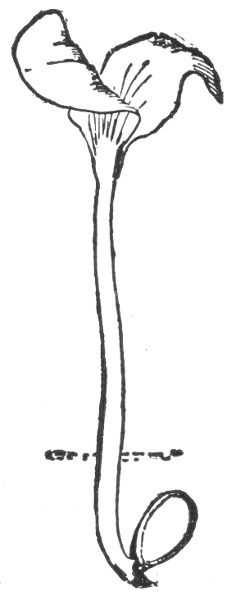
Fig. 189. Squash plant a week old.
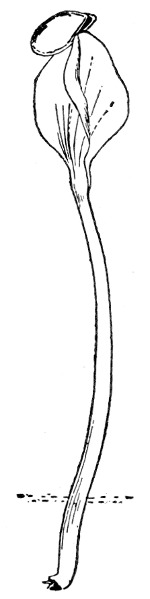
Fig. 190. Squash plant which has brought the seed-coats out of the ground.
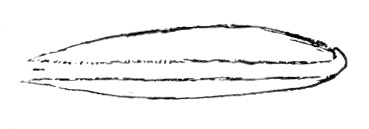
Fig. 191. Germination just beginning.
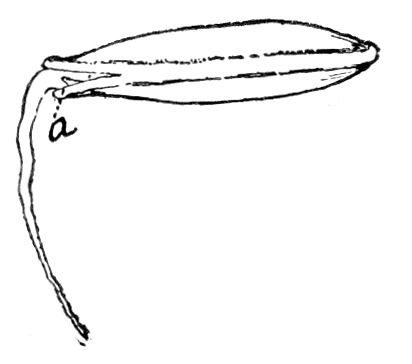
Fig. 192. The root and peg.
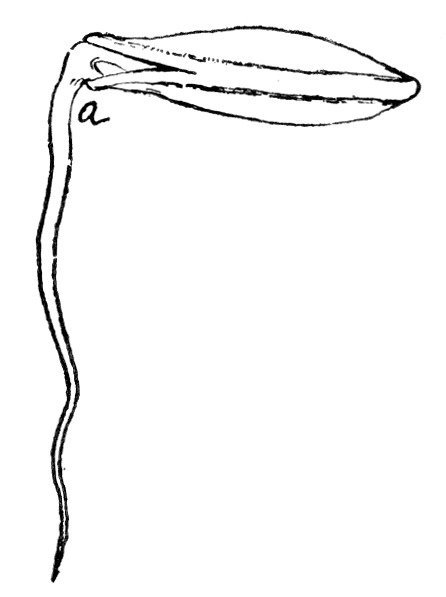
Fig. 193. Third day of root growth.
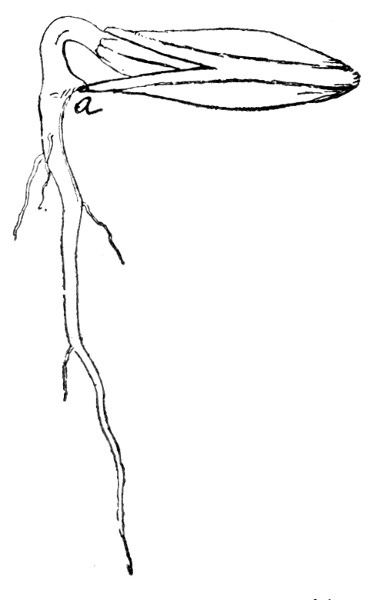
Fig. 194. The plant breaking out of the seed.
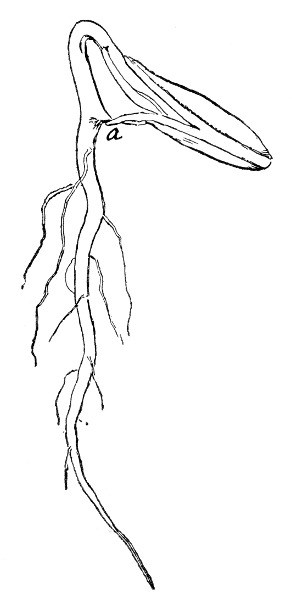
Fig. 195. The operation further progressed.
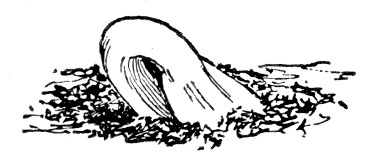
Fig. 196. The plant just coming up.
It may happen, however,—as it did in a pan of seed which I sowed a few days ago—that one or two of the plants may look like that shown in Fig. 190. Here the seed seems to have come up on top of the plant; and one is reminded of the curious way in which beans come up on the stalk of the young plant. If we were to study the matter, however,—as we may do at a future time—we should find a great difference in the ways in which the squashes and the beans raise their seeds out of the ground. It is not our purpose to compare the squash and the bean at this time, but we are curious to know why one of these squash plants brings its seed up out of the ground whilst all the others do not. In order to find out why it is, we must ask the plant, and this asking is what we call an experiment. We may first pull up the two plants. The first one (Fig. 189) will be seen to have the seed-coats still attached to the very lowest part of the stalk below the soil, but the other plant has no seed at that point. We will now plant more seeds, a dozen or more of them, so that we shall have enough to examine two or three times a day for several days. A day or two after the seeds are planted, we shall find a little point or root-like part breaking out of the sharp end of the seed, as shown in Fig. 191. A day later this root part has grown to be as long as the seed itself (Fig. 192), and it has turned directly downwards into the soil. But there is another most interesting thing about this germinating seed. Just where the root is breaking out of the seed (shown at a in Fig. 192), there is a little peg or projection. In Fig. 193, about a day later, the root has grown still longer, and this peg seems to be forcing the seed apart. In Fig, 194, however, it will be seen that the seed is really being forced apart by the stem or stalk above the peg for this stem is now growing longer. The lower lobe of the seed has attached to the peg (seen at a, Fig. 194), and the seed-leaves seem to be backing out of the seed. Fig. 195 shows the seed a day later. The root has now produced many branches and has thoroughly established itself in the soil. The top is also growing rapidly and is still backing out of the seed, and the seed-coats are still firmly held by the obstinate peg.
Whilst we have been seeing all these peculiar things in the seeds which we have dug up, the plantlets which we have not disturbed have been coming through the soil. If we were to see the plant in Fig. 195, as it was "coming up," it would look like Fig. 196. It is tugging away in getting its head out of the bonnet which is pegged down underneath the soil, and it has "got its back up" in the operation. In Fig. 197 it has escaped from its trap and it is laughing and growing in delight. It must now straighten itself up, as it is doing in Fig. 197, and it is soon standing proud and straight, as in Fig. 189. We now see that the reason why the "seed" came up on the plant in Fig. 190, is that in some way the peg did not hold the seed-coats down (see Fig. 195), and the expanding leaves, being pinched together must get themselves loose as best they can.
There is another thing about this interesting squash plant which we must not fail to notice, and this is the fact that these first two leaves of the plantlet came out of the seed and did not grow out of the plant itself. We must notice, too, that these leaves are much smaller when they are first drawn out of the seed-coat than they are when the plantlet has straightened itself up. That is, these leaves increase very much in size after they reach the light and air. The roots of the plantlet are now established in the soil and are taking in food which enables the plant to grow. The next leaves which appear will be very different from these first or seed leaves.
These later ones are called the true leaves. They grow right out of the little plant itself. Fig. 199 shows these true leaves as they appear on a young Crookneck squash plant, and the plant now begins to look much like a squash vine.
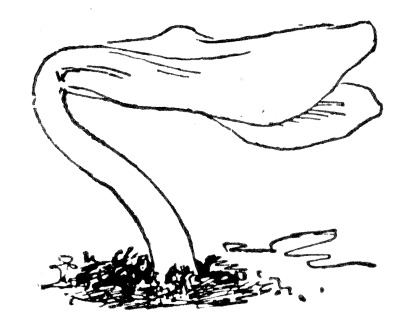
Fig. 197. The plant liberated from the seed-coats.
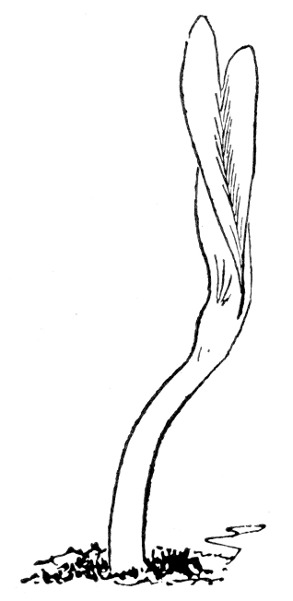
Fig. 198. The plant straightening up.
We are now curious to know how the stem grows when it backs out of the seeds and pulls the little seed-leaves with it, and how the root grows downwards into the soil. Now let us pull up another seed when it has sent a single root about two inches deep into the earth. We will wash it very carefully and lay it upon a piece of paper. Then we will lay a ruler alongside of it, and make an ink mark one-quarter of an inch from the tip, and two or three other marks at equal distances above (Fig. 200).[39] We will now carefully replant the seed. Two days later we will dig it up, when we shall most likely find a condition somewhat like that in Fig. 201. It will be seen that the marks E, C, B, are practically the same distance apart as before and they are also the same distance from the peg AA. The point of the root is no longer at DD, however, but has moved on to F. The root, therefore, has grown almost wholly in the end part.
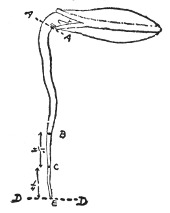
Fig. 199. The true leaves developing.
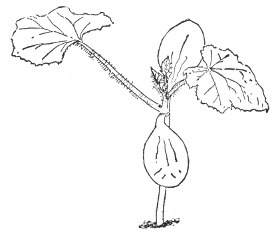
Fig. 200. Marking the root.
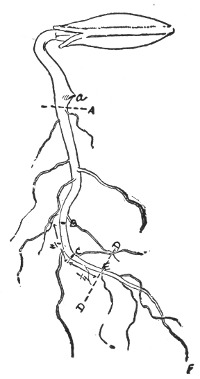
Fig. 201. The root grows in the end parts.
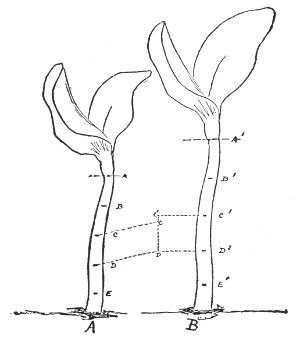
Fig. 202. The marking of the stem, and the spreading apart of the marks.
Now let us make a similar experiment with the stem or stalk. We will mark a young stem, as at A in Fig. 202; but the next day we shall find that these marks are farther apart than when we made them (B, Fig. 202). The marks have all raised themselves above the ground as the plant has grown. The stem, therefore, has grown between the joints rather than from the end. The stem usually grows most rapidly, at any given time, at the upper or younger part of the joint (or internode); and the joint soon reaches the limit of its growth and becomes stationary, while a new one grows out above it.
LEAFLET XXIX. HOW THE TREES LOOK IN WINTER.[40] By L. H. BAILEY.
To the teacher.—We want the country child to have a closer touch with nature in the winter time. Teach him to see, to know, and to care for the trees when they are leafless. This leaflet will suggest how you may interest him.
You can also intensify his interest in the subject, and at the same time increase his knowledge of drawing, by having him make skeleton or outline drawings of the trees about the schoolhouse or the home. Leaflet XXX gives suggestions for drawing.
You can correlate this work with geography by giving the distribution or range of the different kinds of trees. Indicate the limit of distribution northward, southward, eastward, westward; also the regions in which the species is most abundant. The common manuals of botany will help you in this work; or you may consult the many excellent special books on trees.
In teaching nature-study, remember that a great part of its value lies in the enthusiasm and zeal with which you handle it. Try, also, to develop the æsthetic sense of the pupil; but do not teach mere sentiment.
Only the growing and open season is thought to be attractive in the country. The winter is bare and cheerless. The trees are naked. The flowers are under the snow. The birds have flown. The only bright and cheery spot is the winter fireside. But even there the farmer has so much time that he does not know what to do with it. Only those who have little time, appreciate its value.
But the winter is not lifeless and charmless. It is only dormant. The external world fails to interest us because we have not been trained to see and know it; and also because the rigorous weather and the snow prevent us from going afield. In the spring, summer, and fall, the hours are full to overflowing with life and interest. On every hand we are in contact with nature. If the farmer's winter is to be more enjoyable the farmer must have more points of contact with the winter world. One of the best and most direct of these points of sympathy is an interest in the winter aspects of trees.
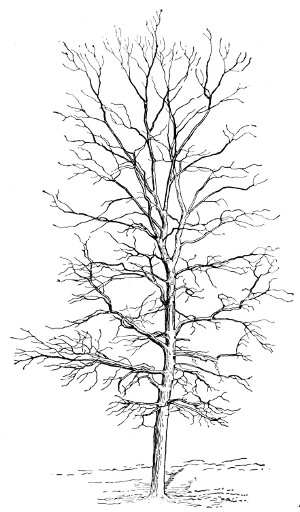
Fig. 203. Small-fruited Shagbark Hickory.
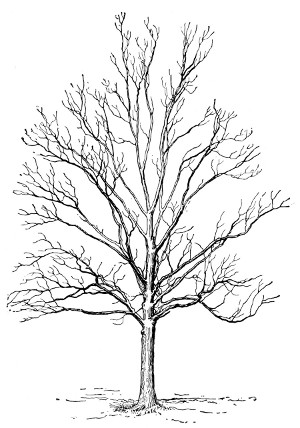
Fig. 204. Pignut Hickory. This and Fig. 203 are from "Lessons with Plants."
a. The Structure of the Tree-top.
In the summer time we distinguish the kinds of trees chiefly by means of the shape and the foliage. In winter the foliage is gone; but the shape remains, and the framework of the tree is also conspicuous. Trees are as distinct in winter as in summer; and in some respects their characters are more apparent and pronounced.
Observe the outline of a tree against the dull winter sky. It does not matter what kind of tree it is. Note its height, shape, and size of top, how many branches there are, how the branches are arranged on the main trunk, the direction of the branches, whether the twigs are few or many, crooked or straight.
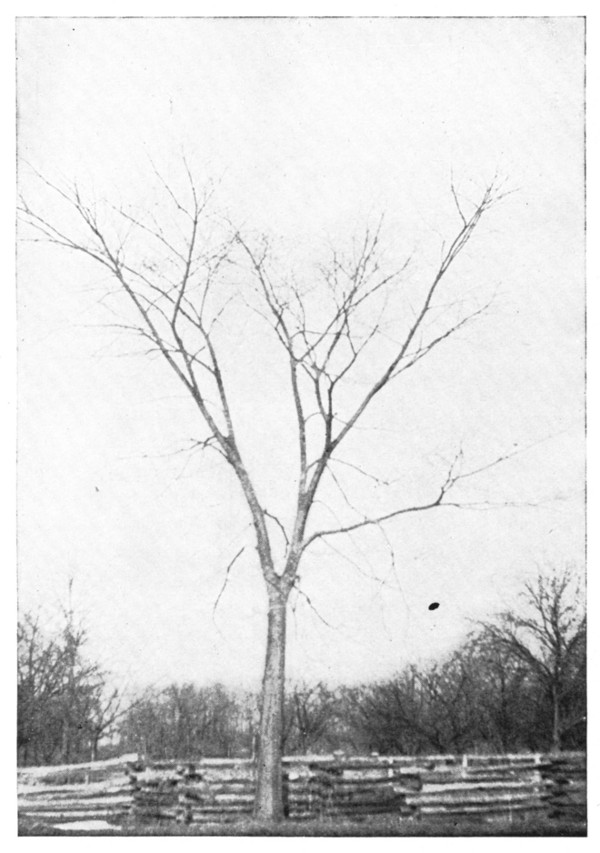
Fig. 205. Slippery Elm. The expression is stiff and hard.
Having observed these points in any tree, compare one kind of tree with another and note how they differ in these features. Compare an apple tree with an elm, an elm with a maple, a basswood with a pine, a poplar with a beech, a pear tree with a peach tree.
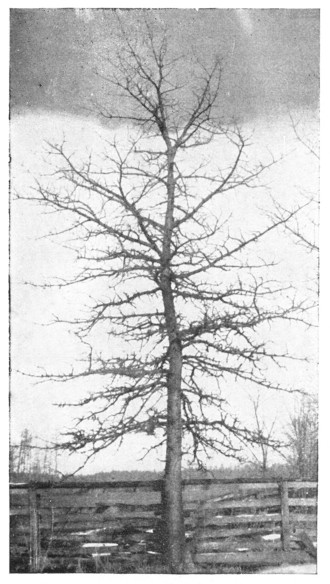
Fig. 206. Swamp White Oak.
Having made comparisons between very dissimilar trees, compare those which are much alike, as the different kinds of maples, of elms, of oaks, of poplars. As your powers of observation become trained, compare the different varieties of the same kind of fruit trees, if there are good orchards in the vicinity. The different varieties of pears afford excellent contrasts. Contrast the Bartlett with the Flemish Beauty, the Kieffer with the Seckel. In apples, compare the Baldwin with the Spy, the King with the Twenty Ounce. The sweet and sour cherries show marked differences in method of branching. Fruit men can tell many varieties apart in winter. How?
Two common hickories are shown in Figs. 203 and 204. How do they differ? Do they differ in length of trunk? General method of branching? Direction of branches? Character of twig growth? Straightness or crookedness of branches?
Contrast the slippery elm (Fig. 205) and the common or American elm (Fig. 211). The former has a crotchy or forked growth, and long, stiff, wide-spreading branches. The latter is more vase-like in shape. The branches are willowy and graceful, with a tendency to weep.
Compare the oaks. The white and scarlet oaks have short trunks when they grow in fields, and the main branches are comparatively few and make bold angles and curves. The swamp white oak (Fig. 206), however, has a more continuous trunk, with many comparatively small, horizontal, and tortuous branches.
With Fig. 206 compare the pepperidge (Fig. 207). This is one of the most unusual and interesting of all our native trees. It grows in swales. It has a very tough-grained wood. The autumn foliage is deep red and handsome. The peculiarities of the tree are the continuation of the trunk to near the summit, and the many lateral, short, deflected, tortuous branches.
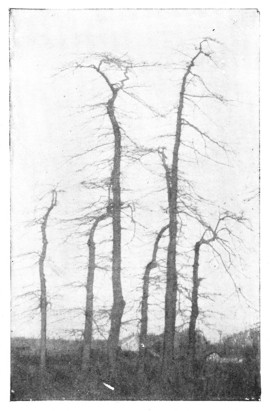
Fig. 207. Pepperidge or Sour Gum. The oddest of New York trees.
Consider the structure of the sassafras in Fig. 208. The great branches stand off nearly at right angles to the trunk, and are bushy and twiggy at the ends. Each large branch if cut off at its base and stood upright would look like an independent tree, so tree-like are its branches. Observe how much more bushy the sassafras is than any of the other trees already figured. Compare it in the method of branching and the twigginess with the slippery elm (Fig. 205).
But there is still greater brushiness in the thorn-apple (Fig. 209). In twigginess Figs. 208 and 209 are very unlike, however. Pick out the differences. Observe the very short and spur-like twigs in the thorn-apple; also notice how soon the trunk is lost in the branches.
With all the foregoing pictures compare the steeple-like form of the Lombardy poplar (Fig. 210). The tree is frequent along roadsides and about yards. What is its structure? Observe it as it stands against the winter sky. There is nothing else in our northern landscape so straight and spire-like. If you know a beech tree standing in a field, contrast it with the Lombardy poplar. These two trees represent extremes of vertical and of horizontal branching.
Aside from the general structure of the tree-top, the pupil will become interested in the winter color of the tree and in the character of the bark. How does the bark differ between elms and maples, oaks and chestnuts, birches and beeches, hickories and walnuts? Why does the bark separate in ridges or peel off in strips? Is it not associated with the increase in diameter of the trunk? The method of breaking of the bark is different and peculiar for each kind of tree.
Look at these things; and think about them.
The Expression of the Tree.
Consciously or unconsciously, we think of trees much as we think of persons. They suggest thoughts and feelings which are also attributes of people. A tree is weeping, gay, restful, spirited, quiet, sombre. That is, trees have expression.
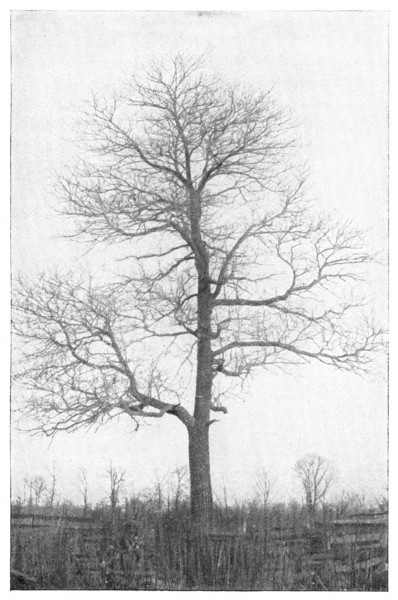
Fig. 208. Sassafras. Type of a bushy-topped tree.
The expression resides in the observer, however, not in the tree. Therefore, the more the person is trained to observe and to reflect, the more sensitive his mind to the things about him, and the more meaning the trees have. No one loves nature who does not love trees. We love them for what they are, wholly aside from their uses in fruit-bearing or shade-giving. A knowledge and love of trees binds one close to the external world.
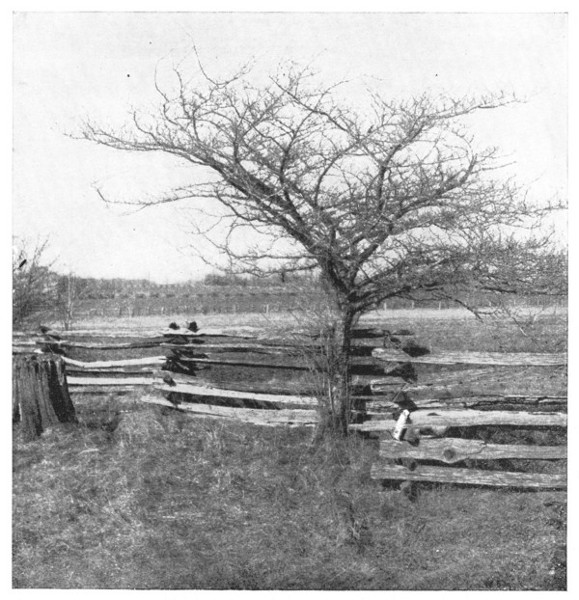
Fig. 209. Thorn-apple. One of the most picturesque objects in the winter landscape.
How shall one increase his love of trees? First, by knowing them. He learns their attributes and names. Knowing them in winter, as already suggested, is one of the ways of becoming acquainted. Second, by endeavoring to determine what thought or feeling they chiefly express. The slippery elm is stiff and hard. The American elm is soft and graceful. The Lombardy poplar is prim and precise. The oak is rugged, stern, and bold. The pepperidge is dejected. The long white branches of a leaning buttonwood standing against a distant forest, suggest some spectre hurrying away from the haunts of men.
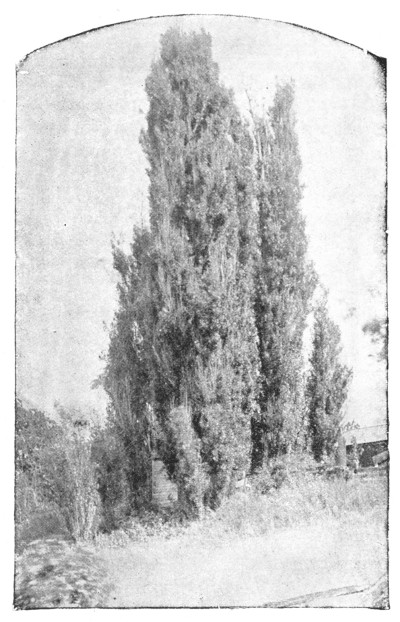
Fig. 210. Group of Lombardy Poplars. From Bulletin 68.
Trees which have very strong expressions, or which are much unlike others, are said to have character. They are peculiar. Of such trees are oaks, pepperidges, Lombardy poplars, button woods, old apple trees.
A tree with very strong characters is said to be picturesque. That is, it is such an object as an artist delights to put into a picture. Trees which are very unsymmetrical, or knotty, gnarled, or crooked, are usually picturesque. Of all common trees, none is more picturesque than an old apple tree. Observe its gnarled and crooked branches, and the irregular spaces in its top.
Encourage the pupil to extend his observation to all the trees about him, especially to such as are common and familiar. Teach him to observe the growths of bushes and trees in the fence-rows which lie on his way to school; and to observe carefully and critically. How do gooseberry bushes differ from currant bushes, and raspberries from blackberries? Observe the lilac bush and the snowballs. How is the snow held on the different kinds of evergreens—as the pines, spruces, arbor-vitæ? See how the fruit-spurs on pears and plums stand out against the sky. (Consult Leaflet No. XXXI, "Four Apple Twigs.") Are there any bright colors of branch and twig to relieve the bareness of the snow? Do you see any warmth of color in the swales where the willows and osiers are? Do you see old plumes of grass and weeds standing above the snow? Do they bring up any visions of summer and brooks and woods?
LEAFLET XXX. ONE WAY OF DRAWING TREES IN THEIR WINTER ASPECT.[41] By C. W. FURLONG.
The few suggestions which are set forth in these pages are based upon two assumptions:—first, that the teacher has some knowledge of the most salient principles of elementary perspective; and second, that she has a love for all things beautiful. It is feasible to deal here not to any extent with art in either its abstract or its concrete form, but only with drawing.
Drawing, in its simplest analysis, is the ability to record objects as they appear to the normal eye.
Art is more complicated. It includes many elements, a few of which are composition, expression of movement, and action. The very thought, feeling, and refinement of the artist must be expressed in his work. He must tell not only what he sees, but also what he feels. He interprets nature through his own moods.
There are no outlines in nature. The boundaries, shapes, and character of various forms are determined by the difference of their color values, and the contrasts of light and shade. Yet an outline drawing is the simplest means of representing form and proportion. Although inadequate in many respects, this somewhat conventional rendering is important to the beginner, for it is necessary that the child be taught to observe forms and proportions correctly; and these impressions may be recorded most simply and definitely by outline drawings. Michael Angelo emphasized its importance in these words: "The science of drawing or of outline is the essence of painting and all the fine arts, and the root of all the sciences."
To a great extent, one may show in an outline drawing the character and texture of surfaces. Our main object should be to train the boys and girls to observe in order to acquire a correctness of perception, for "education amongst us consists too much in telling, not enough in training."
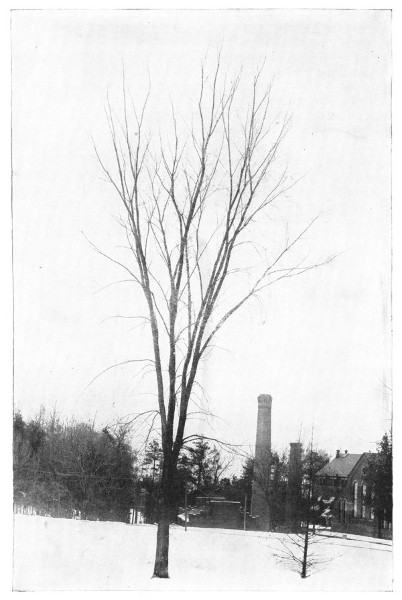
Fig. 211. The American Elm, one of the most typical of vase-form trees.
One of the greatest difficulties is to impress upon the minds of beginners the fact that they must think while they look and draw. Insist upon the pupil's looking repeatedly at the object. It is better to observe for five minutes and draw for one, than to observe for one and draw for five.
Make the drawing lesson more interesting by telling the class something about the object which they are to draw, involving in the story facts that will impress upon their minds some of the most salient characteristics of the object. Encourage the children to discuss the object, drawing out facts for their own observation. Certain kinds of trees, like certain races of people, have a general similarity, yet every single tree has an individuality of its own.
Apply a few essential questions that will help to determine at least the kind of tree it is, the race to which it belongs; for first we must get its general character, seeing its big proportions and shape; and later must search for its individualities.
Is it tall for its greatest width?
How far does the trunk extend before dividing?
At what height do the lowest branches arise?
What is their general direction?
Do they appear to radiate from the trunk?
How do they appear to radiate from the trunk?
How do the main branches compare in size with the trunk?
Are they crooked or straight?
The manner of branch growth must be studied carefully.
We see in our elm (Fig. 211) that the trunk divides at about a fourth of its height into several main branches, while in the case of the pepperidge (Fig. 207) the trunk extends to the very top of the tree, the branches being small in proportion to the trunk, not varying much in size, and taking an oblique downward direction. Notice the weird expression of these trees with their crookedly bent tops, one side of each trunk being almost devoid of branches.
The trunk of the sassafras (Fig. 208) continues nearly to the top of this tree, while the large branches, though unsymmetrical, give it a well-balanced appearance.
Again in our picture of the thorn-apple (Fig. 209), we are at once impressed with its irregular form, the branches on the left taking a more oblique direction than those of the other side, the trunk dividing a little short of half the height of the tree.
For an example, let our subject be an elm tree (Fig. 211); our drawing to be rendered in outline.
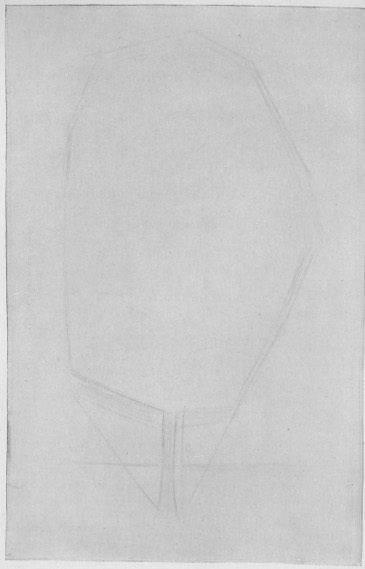
Fig. 212. Blocking-in the elm tree (Fig. 211). The first work which the artist does when he draws the tree.
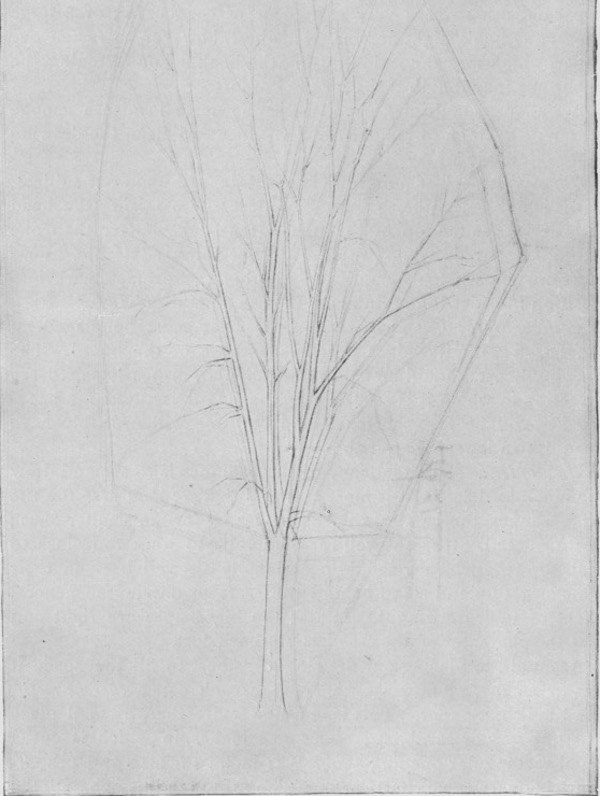
Fig. 213. Working in the details with sharp lines. The original pencil sketch is not followed exactly.
Material.—Almost any good drawing paper, white or buff in color, will answer our purpose; 9x12 is a good size. Our pencil should be of medium grade lead (F. or HB.) of any standard make, Kohinoor preferred.
If procurable, we should have a light drawing board 17x22 inches (here is an opportunity for the carpenters) to place the paper on, otherwise a very stiff piece of cardboard; or a large geography book might answer. It is best, however, to fasten our paper, which we cannot do in using the book. For fastening the paper use four thumb tacks for the corners.
A Faber or multiplex pencil eraser is needed; also a sponge eraser with which to remove the light lines and clean the drawing before lining it in.
Our position.—Our point of view will depend upon our subject, but it is not well to be so near as to necessitate raising the head in order to see the top of the tree. If we take longer than one sitting for our drawing (which I do not think advisable, as we must not choose too complicated a subject), we must mark our position in order to obtain again the same point of view.
Position of the drawing-board.—Our paper must be placed on the board with its edges parallel to those of the board. The drawing-board should be held perpendicular, or nearly so, to the direction in which it is seen, for if the board is tilted far backward, it will be fore-shortened and our tree will probably have been drawn longer than it should be.
How to look.—The tendency of the beginner is to see and draw too much in detail. It is most essential that we look first for the large shapes, the greatest dimensions; next for the smaller ones; last for detail. It is not well for the pupils to work too close to their drawings. They should occasionally sit well back in their seats or get up and stand behind the seats to obtain the general effect of their drawing, to see that the big shapes are right and that the character of the tree has not been lost.
As an aid to placing our drawing so as best to fill the space it has to occupy, we may use what the French call a cherche-motif, the English, a finder. This is nothing more than a small piece of stiff paper or cardboard about 5x8 inches, in which is cut a small rectangular opening about 3/4x1 inch; the size and proportion may vary somewhat. We may look through this opening, the card acting as a frame to our picture. This will help us to decide whether our subject will look better placed the horizontal or the vertical way of the paper and how much of the subject to include and where to place it in that space. We may include more or less in the finder by varying its distance from the eye.
Now, I am sure we should not place ourselves within a dozen yards of our tree if we wished to get its general effect; therefore, we must have plenty of foreground in our drawing. We must give the eye a chance to look, allowing plenty of space between the lowest point of our drawing and the lower edge of our paper.
As the height of tree we are to draw (Fig. 211) is greater than its greatest width, we find that it will fill the space best if placed the vertical way of the paper. After indicating the extreme height and width by four light marks, before carrying the drawing further we must test these proportions by comparing the width with the height, always testing the shorter dimension into the longer, viz.:
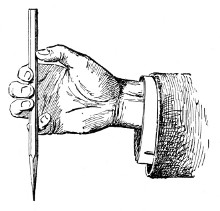
Fig. 214. How to test the drawing.
To test the drawing.—Close one eye. The pencil may be used to test the drawing by holding it in front of you at arm's length (as in Fig. 214) perpendicular to the direction in which the object is seen; also revolving it in a plane perpendicular to the direction in which the object is seen, in order to compare one dimension with another. For example, hold your pencil horizontally at arm's length so that its blunt end covers the outermost left-hand point of the elm. Slide your thumb along the pencil till it covers the extreme right-hand point; retain that measurement (keeping the same position in your chair, pencil always at arm's length); revolve the pencil in the same plane until it coincides with the height of the elm, at the same time lowering it so that the end of the thumb covers the lowest point of the tree; note carefully the point that the blunt end covers; raise the pencil so that the end of the thumb covers that point, noting again where the blunt end occurs and notice how many times, and how much over, the width goes into the height. In our elm (Fig. 211) we find that the width goes about once and six-sevenths into the height, or a little short of twice. If the latter statement is preferred, we must bear in mind the proportion left over.
Do not use the scale side of a ruler or marks on the pencil or object used in order to test the proportions, and never transfer measurements from the object used in testing to your paper. A scale or other mechanical means should not be used in free-hand drawing. The teacher should have a spool of black thread and should give a piece about 2 feet 6 inches long to each pupil. An eraser, a knife, or some small article may be attached to one end of the thread. By holding the weighted thread as a plumb-line in front of us, we have an absolutely vertical line; so by having it intersect a desired point of our tree we may obtain the relative positions to the right and left of other points above and below this intersected point.
Blocking-in.—We may conceive of the general shape of our elm by looking at it with half closed eyes. It appears in silhouette. Now imagine lines joining its outermost points; this will give the general mass or shape of our tree. Now if we represent the outermost points contained in these lines by sketching lightly these "blocking-in" lines, as they are called, we obtain the general shape of the elm (Fig. 212). We must emphasize the fact that these blocking-in lines are to be sketched in lightly by holding the pencil near the blunt end, using a free-arm motion. Now before going farther we again test these new points to see if they occupy their correct positions in relation to the height and width. Do not, however, transfer the measurements from the pencil to the paper. This test is only to obtain the proportion of one dimension to another. Having tested these smaller dimensions we may draw lightly the main branches.
After having indicated their general direction and character of growth, we may indicate some of the smaller branches and twigs (Fig. 213). All this work should be carried out without erasing; all corrections should be made by slightly darker lines.
Let us now sharpen our pencils to a good point and go over the drawing with a fine dark line, carefully studying the character and spirit of the tree. Now erase the lighter and superfluous lines, as the dark lines remain distinct enough to indicate our drawing.
Lining-in.—We may now take our pencil nearer the point and proceed to line-in the drawing, going over it with a definite, consistent line. If desirable, we may accent and bring out certain parts of the tree more strongly than others by darker or shade lines and short, strong markings called accents. These are especially effective at the junction and underside of branches, and where one wishes to give the object a nearer appearance. A soft, broad, grey line may be obtained by using a softer pencil (B) and the drawing given variety by breaking lines here and there. We should be cautious in using them, however; but lack of space does not permit further discussion of the subject of accented outlines.
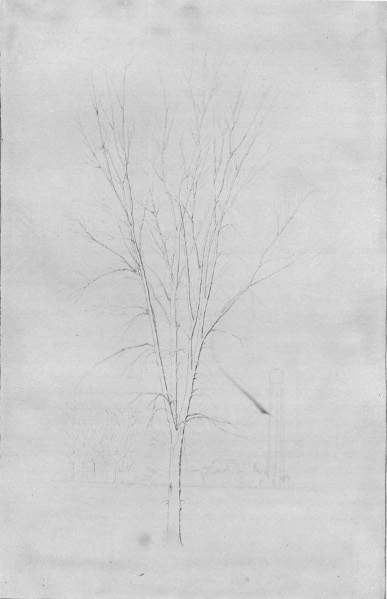
Fig. 215. The outline drawing complete, and the first pencil marks erased.
Allow the pupils to make short ten- or fifteen-minute "time sketches" of trees. In these it is the spirit and general effect of the tree that we must strive for. Above all, we must allow our little draughtsmen to give their own interpretation of the tree. A helpful suggestion as to proportion, etc., would be in place, but we must allow their individuality to have as much play as possible.
The suggestions given on these pages are necessary for the beginner. Some of them are hard facts; but it lies with the teacher to develop the æsthetic and artistic qualities lying dormant in the pupil, ready to be moulded and started in the right direction.
If you have confined the pupils to the flat copy, break away from it; allow them to create. Let them see the beautiful things all about them. They will respond. Let them draw from nature and still life. Train them to observe.
The early summer days, just before school closes, with their bright sunlight and strong shadows, make many subjects interesting as light-and-shade drawings. Fall, with its brilliant coloring, gives us a chance to use the color-box, while the early winter twilights will bring many an interesting silhouette before our boys and girls, and next day during the drawing hour these impressions may be carried out in pen and ink.
The most successful teacher will be the one of sympathetic nature whose love reaches out to the boys and girls, as well as to all things beautiful. The most successful teacher will be the one who endeavors to place the children where they may view nature sympathetically and in the most intimate relationship.
LEAFLET XXXI. FOUR APPLE TWIGS.[42] By L. H. BAILEY.
As I walked through an apple orchard the other day for the first time since the long winter had set in, I was struck by the many different shapes and sizes of the limbs as I saw them against the blue-gray of the February sky. I cut four of them in passing, and as I walked back to the house I wondered why the twigs were all so different; and I found myself guessing whether there would be any apples next summer.
I have had pictures made of these four little apple limbs. Let us look them over and see whether they have any story to tell of how they grew and what they have set out to do.
I.
One of these twigs (Fig. 216) was taken from a strong young tree which, I remember, bore its first good crop of apples last year. This simple twig is plainly of two years' growth, for the "ring" between the old and new wood is seen at B. That is, the main stem from the base up to B grew in 1895, and the part from B to the tip grew in 1896. But the buds upon these two parts look very unlike. Let us see what these differences mean.
We must now picture to ourselves how this shoot from B to 10 looked last summer while it was growing. The shoot bore leaves. Where? There was one just below each bud; or, to be more exact, one bud developed just above each leaf. These buds did not put out leaves. They grew to their present size and then stopped. The leaves fell.
What are these buds of the tip shoot preparing to do in 1897? We can answer this question by going back just one year and seeing what the buds on the lower (or older) part of the shoot did in 1896. On that part (below B) the buds seem to have increased in size. Therefore, they must have grown larger last year. There were no leaves borne below these buds in 1896, but a cluster of leaves came out of each little bud in the spring. As these leaves expanded and grew, the little bud grew on; that is, each bud grew into a tiny branch, and when fall came each of these branches had a bud on its end to continue the growth in the year to come. What we took to be simple buds at 2, 3, 4, 5, 6, are, therefore, little branches.
But the strangest part of this wonderful little twig has not yet been seen,—the branches are of different sizes, and three of them (7, 8, 9) have so far outstripped the others that they seem to be of a different kind. It should be noticed, too, that the very lowermost bud (at 1) never grew at all, but remained perfectly dormant during the entire year 1896. It will be seen, then, that the dormant bud and the smallest branches are on the lower part of the shoot, and the three strong branches are at the very tip of the last year's growth.
If, now, we picture the twig as it looked in the fall of 1895, we shall see that it consisted of a single shoot, terminating at B. It had a large terminal bud (like those at 7, 8, 9, 10), and this bud pushed on into a branch in 1896, while three other buds near the tip did the same thing.
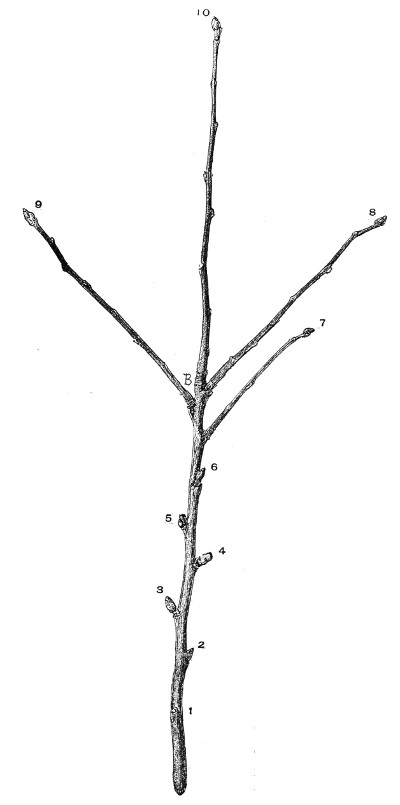
Fig. 216.—A two-year-old shoot from a young apple tree. Half size.
Why did some of these branches grow to be larger than others? "Simply because they were upon the strongest part of the shoot, or that part where the greatest growth naturally takes place," some one will answer. But this really does not answer the question, for we want to know why this part of the shoot is strongest. Probably the real reason is that there is more sunlight and more room on this outward or upward end. In 1897,—if this shoot had been spared—each of these four largest twigs (7, 8, 9, 10) would have done the same thing as the parent twig did in 1896: each would have pushed on from its end, and one or two or three other strong branches would probably have started from the strong side-buds near the tips, the very lowest buds would, no doubt, have remained perfectly inactive or dormant for lack of opportunity, and the intermediate buds would have made short branches like 2, 3, 4, 5, 6. In other words, the tree always tries to grow onward from its tips, and these tip shoots eventually become strong branches, unless some of them die in the struggle for existence. What, now, becomes of the little branches lower down?

Fig. 217. A three-year-old shoot and the fruit-spurs. Half size.
II.
From another apple tree I took the twig shown in Fig. 217. We see at once that it is very unlike the other one. It seems to be two years old, one year's growth extending from the base up to 7, and the last year's growth extending from 7 to 8; but we shall see upon looking closer that this is not so. The short branchlets at 3, 4, 5, 7 are very different from those in Fig. 216. They seem to be broken off. The fact is that the broken ends show were apples were borne in 1896. The branchlets that bore them, therefore, must have grown in 1895, while the main branch, from 1 to 7, grew in 1894. It is plain, from the looks of the buds, that the shoot from 7 to 8 grew last year, 1896.
Starting from the base, then, we have the main twig growing in 1894; the small side branches growing in 1895; these little branches bearing apples in 1896; and the terminal shoot also growing in 1896. Why was there no terminal shoot growing in 1895? Simply because its tip developed a fruit-bud (at 7) and therefore could not send out a branch; for there are two kinds of buds,—the small, pointed leaf-bud and the thick, blunt fruit-bud. If the branchlets 3, 4, 5, 7 are two years old, the dormant buds—1, 2—must be of the same age. That is, for two long years these little buds have been waiting (if I may use the expression) for some bug to eat off the buds and leaves above, or some accident to break the shoot beyond them, so that they might have a chance to grow; but they have waited in vain.
We have now found, therefore, that the little side shoots upon apple twigs often become fruit-branches or fruit-spurs, while the more ambitious branches above them are making a great display of stem and leaves.
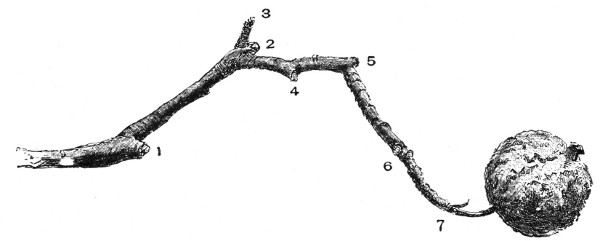
Fig. 218.—A fruit-spur which has borne six apples. Half size.
But will these fruit-spurs bear fruit again in 1897? No. The bearing of an apple is hard work, and these spurs did not have enough vitality left to make fruit-buds for the next year; but as they must perpetuate themselves, they have sent out small side buds which will bear a cluster of leaves and grow into another little spur in 1897, and in that year these new spurs will make fruit-buds for bearing in 1898. The side bud is plainly seen on spur 5, also on spur 4, whilst spur 7 has sown a seed, so to speak, in the bud at 6. It is plain, therefore, why the tree bears every other year.
III.
There was one tree in the orchard from which the farmer had not picked his apples. Perhaps the apples were not worth picking. At any rate, the dried apples, shriveled and brown, are still hanging on the twigs, and even the birds do not seem to care for them. I broke off one of these twigs (Fig. 218). Let us see how many apples this interesting twig has borne. We can tell by the square-cut scars. An apple was once borne at 1, another at 2, another at 4, another at 5, another at 6, and another at 7,—and at 7 there will be a scar when the apple falls. Six apples this modest shoot has borne! And I wonder how many of them got ripe, or how many were taken by the worms, or how many were eaten by the little boys and girls on their way to school!
A peculiar thing happened when the fruit was growing at 2. Two side buds started out, instead of one, and both of them grew the next year. But one of the little branchlets fell sick and died, or a bug nipped off its end, or it starved to death; and its memory is preserved by the little stick standing up at 3. The other branchlet thrived, and eventually bore apples at 4, 5, 6, and 7.
I have said that these fruit-spurs bear only every other year; then, if this branch has borne six apples consecutively, it must be twelve years old. The truth is that it is about twenty years old, for some years it failed to bear; but the age cannot be traced out in the picture, although any little boy or girl with bright eyes could soon learn to trace out yearly rings on the shoot itself.
IV.
The last shoot that I got that day has a whole volume of history in it, and I cannot begin to tell its story unless I should write a small book. But we will trace out its birthdays and see how many apples it has borne. It is shown in Fig. 219, and because it is so long I have had to break it into several pieces to get it on the page. It begins at A, and is continued at B, C, D, E, and F.
Let us count the yearly rings and see how old the whole limb is. These rings are at 28, 26, D, 12, 1,—five of them; and as the shoot grew one year before it made any ring, and another year made no increase in length—as we shall presently see—the whole branch must be seven years old. That is, the limb probably started in 1890.[43] Let us begin, then, at A, and follow it out.
1890. Started as a spur from the main branch, A, and grew to 1.
1891. Apple borne at 1. This apple did not mature, however, as we can readily see by the smallness of the scar. In this year, two side buds developed to continue the spur the next year.
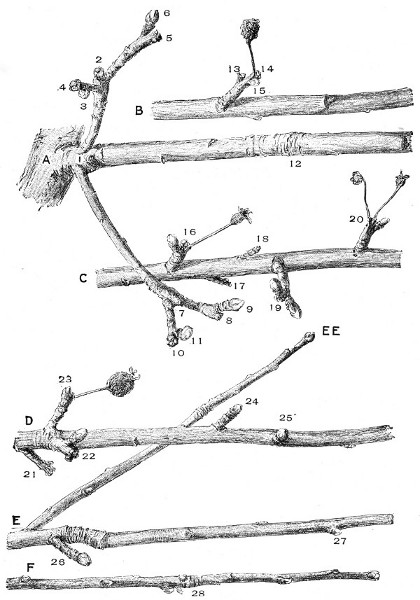
Fig. 219. A seven-year-old apple twig and its curious history. (Half size.)
1892. Ceased to be a fruit-spur, and made a strong growth on to 12. For some reason, it had a good chance to grow. Perhaps the farmer pruned the tree, and thereby gave the shoot an opportunity; or perhaps he plowed and fertilized the land. In the meantime, one of the side buds grew to 3, and the other to 7, and each made a fruit-bud at its end.
1893. Shoot grew lustily,—on to D. The fruit-bud at 3 bore an apple, which probably matured, as shown by the scar 2. Two side buds were formed beneath this apple, to continue the spur next year. The fruit-bud at 7 bloomed, but the apple fell early, as shown by the small scar. Two side buds were formed. The buds upon the main shoot—1 to 12—all remained dormant.
1894. Shoot grew from D to beyond E. Side bud of 2 grew to 4, and made a fruit-bud on its end; the other side bud grew on to 5, and there made a fruit-bud. Side bud of 7 grew on to 10, and the other one to 8, each ending in a fruit-bud. Buds on old shoot—1 to 12—still remained dormant. Some of the buds on the 1893 growth—12 to D,—remained dormant; but some of them made fruit-spurs,—14, 16, 17, 18, 19, 20, 21, 22, 23.
1895. Shoot grew from beyond E to 28. Flowers were borne at 4 and 5; but at 4 the fruit fell early, for the five or six scars of the flowers can be seen, showing that no one of them developed more strongly than the other; that is, none of the flowers "set." A fairly good fruit was probably borne at 5. At the base of each, a bud started to continue the spur next year. Upon the other spur, flowers were borne both at 8 and 10. At 10 none of the flowers set fruit, but a side bud developed. At 8 the fruit partially matured, and a side bud was also developed. The buds upon the old stem from 1 to 12 still remained dormant. Some of the spurs on the 1893 growth—12 to D—developed fruit-buds for bearing in 1896. Some of the buds on the 1894 growth—D to beyond E—remained dormant, but others developed into small fruit-spurs. One of these buds, near the top of the 1894 growth, threw out a long shoot, starting from E; and the bud at 26 also endeavored to make a long branch, but failed.
1896. Main shoot grew from 28 to the end. The side bud below 4 (where the fruit was borne the year before) barely lived, not elongating, as seen above 3. This branch of the spur is becoming weak and will never bear again. The side bud of 5, however, made a fairly good spur and developed a fruit-bud at its end, as seen at 6. The side bud of 10 grew somewhat, making the very short spur 11. This branchlet is also getting weak. The bud of 8, however, developed a strong spur at 9. Both 11 and 9 bear fruit-buds, but that on 11 is probably too weak ever to bear fruit again. In fact, the entire spurs, from 1 to 6 and 1 to 9, are too weak to be of much account for fruit-bearing. This year several of the spurs along the 1893 growth—12 to D—bore flowers. Flowers were borne from two buds on the first one (at 13 and 14), but none of the flowers "set." One of the little apples that died last June still clings to the spur at 14. A side bud (15) formed to continue the spur in 1897. Flowers were borne at 16, 20, 21, and 23, but no apples developed. Upon 16 and 20 the flowers died soon after they opened, as seen by the remains of them. Upon 23, one of the flowers set an apple, but the apple soon died. The spurs 17 and 18 are so weak that they have never made fruit-buds, and they are now nearly dead. The spurs 19 and 22 have behaved differently. Like the others, they grew in 1894 and would have made terminal fruit-buds in 1895, and would have borne fruit in 1896; but the terminal buds were broken off in the fall or winter of 1894, so that two side buds developed in 1895, and each of these developed a fruit-bud at its end in 1896 in the spur 19, but only one of them developed such a bud in 22. Upon these spurs, therefore, the bearing year has been changed. Upon the growth of 1894—D to beyond E—only three spurs have developed, nos. 24, 25, 26. These started out in 1895, and two of them—25 and 26—have made large fat buds which are evidently fruit-buds. The shoot at E grew on to EE, and all the buds on its lower two-year-old portion remained dormant. On the 1895 growth—from beyond E to 28—all the buds remained dormant save one, and this one—27—made only a very feeble attempt to grow into a spur. The buds upon the 1892 growth—1 to 12—are still dormant and waiting for an opportunity to grow. What an eventful history this apple twig has had! And yet in all the seven years of its life, after having made fifteen efforts to bear fruit, it has not produced a single good apple! The fault, therefore, does not lie in the shoot. It has done the best it could. The trouble has been that the farmer either did not give the tree enough food to enable it to support the fruit, or did not prune the tree so as to give the twig light and room, or allowed apple-scab or some other disease to kill the young apples as they were forming. I am wondering, therefore, whether, when trees fail to bear, it is not quite as often the fault of the farmer as it is of the trees?
LEAFLET XXXII. THE BURST OF SPRING.[44] By L. H. BAILEY.
Spring is coming! The buds will burst and the birds will sing!
How do the buds burst? Watch them as the spring opens; or, if you are impatient, cut long twigs and place them in bottles of water in a living-room, and the buds will swell. First, notice what the winter buds are like,—that they are spherical, or oblong, or conical bodies lying close to the limb and tightly covered with scales. Notice that there is a mark or scar beneath the bud, showing where a leaf was borne.
It is excellent practice to collect winter twigs of different kinds of trees and bushes, and to compare the form and color of the shoots, and the size, shape, color, and make-up of the buds. Lay the twigs side by side on the table and notice how one differs from the other. What part of the twig grew last year? Notice the "ring" at the base of the last year's growth. After all the differences are noted, put the twigs in water, as you would a bouquet. Sometimes flowers and leaves will appear. If the twigs are two or three feet long, the buds are more likely to grow, for then there is sufficient supply of food in them. Change the water frequently, and cut off the lower ends of the twigs so that a fresh surface will be exposed to the water. It will be two to five weeks before the buds open, depending mostly on the kind of plant.
Mark one bud on a maple, or apple, or lilac, or other plant, by tying a string about the twig. Look at it carefully from day to day: observe how it opens, and what comes out of it.
The pupil should know that a winter twig has interest.
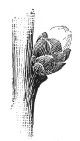
Fig. 220. Opening of an apricot bud.
The bud may be peach or apricot. Soon the bud begins to swell at its top. The scales open. A white lining appears. This lining soon protrudes (Fig. 220). Soon the lining opens. We see that it is a flower. Or perhaps the peach bud sends out a green shoot rather than a flower. There must be two kinds of peach and apricot buds,—a flower-bud and a leaf-bud. Can you tell them apart? The flower-bud is thicker and rounder. Usually one stands on either side of a leaf-bud. But the leaf-bud may stand alone. Find one: any peach tree or apricot tree will have leaf-buds, but all may not have flower-buds. As the bud expands and the flower or leaf appears, notice that the bud-scales fall away. Do these scales leave scars? And do not these scars, standing together, make the "ring" which marks the beginning of the new growth?
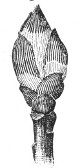
Fig. 221. Opening of a pear bud.
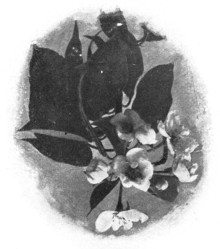
Fig. 222. What came out of a pear bud.
Observe a pear bud. Notice that the scales elongate as the bud swells. You can see the white bases of the scales, marking the new growth (Fig. 221). If it is a leaf-bud the scales may become three-fourths of an inch long before they fall. But sooner or later, they are cast, and their places are marked by scars. If it is a flower-bud, notice that several flowers come out of it. In the apricot and peach, there is only one flower in each bud. Each of these little pear flowers is closed up like a bud and elevates itself on a stalk before it opens: and this stalk becomes the stem of the pear fruit. But this pear flower-bud contains leaves as well as flowers. Fig. 222 shows what comes out of a pear bud. This, then, is a mixed flower-bud,—it contains both leaves and flowers. The apricot and the peach bear true or simple flower-buds.
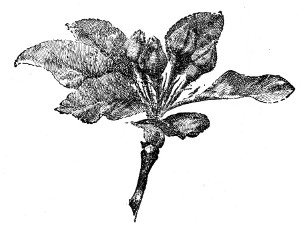
Fig. 223. Opening of an apple bud.
Watch apple buds. The scales do not elongate as in the pear, but the flower-buds are mixed. Fig. 223 shows the expanding cluster from an apple flower-bud. Four flowers will open; and there are six leaves. If the buds are made to open in the house on severed twigs, the leaves do not grow so large before the flowers expand, for the twig does not contain sufficient food. Fig. 224 is a photograph of an apple twig which I had in my window one winter's day.
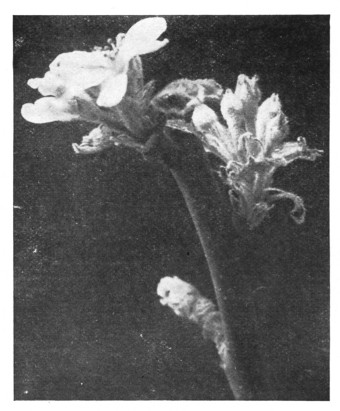
Fig. 224. Apple flowers in midwinter.
Examine a hickory twig. The illustration (Fig. 225) shows the "ring" marking the beginning of the annual growth. See the large leaf-scars. Notice that the terminal bud is much the largest. It is the one which will grow. The other buds will remain dormant unless they are forced into growth by the death of the terminal bud or by other unusual circumstances. Notice that buds differ in size on shoots of all plants; consider that not all the buds are to grow: there is a struggle for existence. When the hickory bud expands, some of the scales fall away; but some of the inner parts enlarge into leaf-like bodies, as shown in Fig. 226. In some hickories these bodies become two or three inches long before they fall. Hickories open very late in the season. The Norway maple, commonly planted on lawns, behaves in a similar way. Observe the sugar maple.

Fig. 225. Shoot of a hickory.
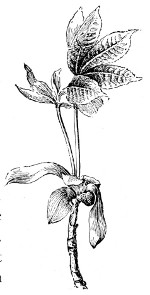
Fig. 226. The opening of a hickory bud.
A twig of the common elm is shown in Fig. 227. Notice the "ring." See the two kinds of buds. We suspect that the three larger ones are flower-buds. With the very first warm days—before the robin has built her nest—these three buds will burst; soon the red-brown tassels will hang on the leafless twigs. Each tassel is a flower. Several flowers come from each bud. We see them in Fig. 228; and the leaf-buds have elongated somewhat. Watch for the fruits or seeds that blow about the walks so early in spring; and note how the leaves come out.

Fig. 227. Twig of elm.
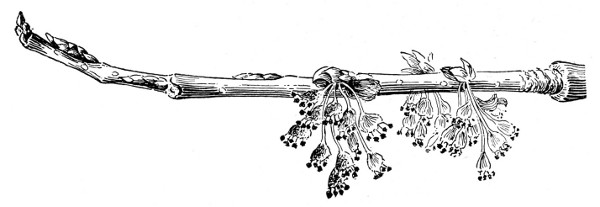
Fig. 228. Blossoms of the elm.
With the first breath of spring, the "pussy willows" come. And what are the "pussies"? They are clusters of flowers. So snugly are the little flowers wrapped in wool, that the "pussies" are silken-soft as they begin to expand. Fig. 229 is a willow shoot. Find one when the buds first begin to burst. Notice the big brown-black scale that covers the bud as a shield and falls when the "pussy" first begins to appear.

Fig. 229. The opening of a pussy willow.
And now what is a winter bud? It is a miniature shoot or flower, resting for the time, and snugly wrapped for the long winter. It was made last season. It is ready to leap into growth the moment the warm rain of spring wakens it. A good hand lens will show the embryo branch, if a section is made of the bud.
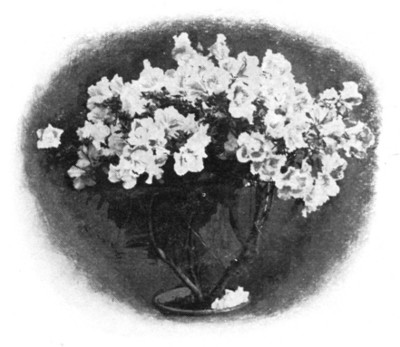
Fig. 230. Bloom of azalea.
This bud is not only ready-formed but is ready-fed. The winter shoots contain starch. On a cut surface of a dormant twig, apply a drop of tincture of iodine; note the bluish color, which is indicative of starch. This starch is insoluble; but with the first awakening of life, it changes into sugar, which is soluble and is transferred to the growing part. The burst of spring is made possible by means of this stored food. Notice the azalea in the florist's window (Fig. 230). The large flower-buds were formed the year before, and it is a short operation to "force" them into bloom. The flowers come in advance of the leaves; therefore these leaves could not have made the food required for the bloom. The blooming of the apple twig (Fig. 224) in the winter shows that the food is in the twig and buds. Once I drew a branch of a tree into a room and fastened it there. It made leaves and began to grow while the tree to which it was attached was perfectly dormant (Fig. 231).
Not only are the buds ready-formed and ready-fed, but they are covered. Snugly is the tender, growing part protected. Pull away the scales of a winter bud one by one. Observe how closely they are placed. Often the chinks are filled with a packing of wool, or are sealed with varnish. Dip the bud in water: then see whether the water permeates the covering. The chief value of the bud covering is not to protect from freezing, as commonly supposed, but to prevent the soft growing parts from drying out.
The plants are waiting for spring. They are ready.
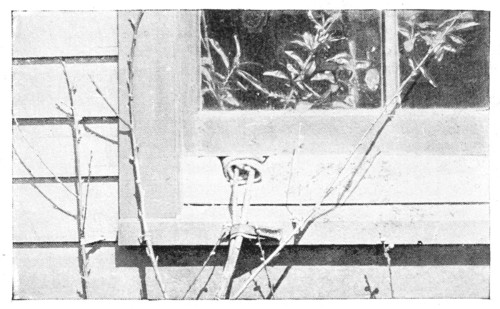
Fig. 231. Branch of a tree bearing leaves inside a window, when the tree itself is dormant.
LEAFLET XXXIII. EVERGREENS AND HOW THEY SHED THEIR LEAVES.[45] By H. P. GOULD.
Note to the teacher.—This leaflet has two particular objects: to teach how evergreens shed their leaves, and to enable you to distinguish a few of the evergreens which are most commonly met. These studies (and those suggested in Leaflet No. XXIX) should be the means of adding much cheer to the winter. Encourage pupils to make collections of cones, to observe when they shed their seeds, and how long (how many seasons) they remain attached to the branch. Remember that mere identification of the kinds of trees is not the highest type of nature-study.
Cones are good subjects for free-hand drawing. Beginners should draw them in outline, omitting the shading. Encourage pupils to draw single leaf-clusters of the different pines, cautioning them to show the right number of leaves in each case.
Cone-bearing evergreens are familiar to everyone; yet this familiarity is usually with the trees as entire objects. We do not often stop to analyze a tree in order to find out what gives it its characteristic appearance or to see what makes it look as it does.
We shall often find, if we stop to look, that much of the character of a tree,—that is, its general appearance or the way in which it impresses us,—is due to the leaves and to their arrangement on the branches. This is true of many of the evergreen trees.
Why are certain kinds of trees called evergreen in distinction from those which are said to be deciduous? The reason is obvious. One kind is always green from the presence of foliage, while the other sheds all of its leaves every season. The evergreen trees, like the pines and the spruces and the firs, always appear to be well covered with foliage; hence it does not often occur to us that these trees shed their leaves. And yet perhaps we can recall happy hours when we used to play beneath some large pine tree where the ground was carpeted with pine "needles."
The falling of the leaves of the maple trees or the oaks is a familiar sight, but who has seen the spruce leaves fall, and who can tell when the pine needles drop?
That the evergreen trees do shed their foliage, as truly as the maples and the elms do, we will not question, for we can see the fallen leaves under any tree. Look up into the top of a spruce or pine. See that the interior is bare of foliage. The leaves are towards the ends of the branches, where they receive sunlight. Yet the branches which are now in the interior once bore leaves, for we can see the leaf-scars.