How to Place Concrete
Reading edition
No time should elapse between the “mixing” and the “placing.” Directions for placing must of necessity be general, and the farmer must use his own judgment as to how to handle this part of the concrete work, in connection with whatever particular job he has on hand. The important thing to remember is, that the materials should not separate in placing.
You may shovel the concrete off the board directly into the work; you may shovel it into wheelbarrows, wheel it to position and dump, or you may carry it to the proper place by buckets and hoisting apparatus.
Directions for Placing
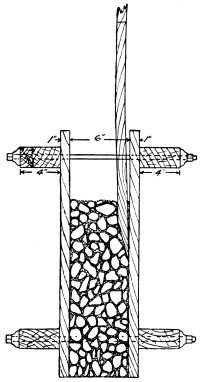
Ordinarily speaking, concrete should be deposited in layers about 6 inches thick.
After placing concrete in the Form, it should be “tamped” lightly with a wooden or iron tamper (or rammer) until the water shows on the top and no stones are left uncovered by mortar.
In order to obtain a smooth face on the concrete, the mixture should be carefully “spaded” immediately after “placing”—on the side next to the Form where the finished concrete will be exposed to view. By “spading” is meant the working of a spade or a beveled board between the concrete and the side of the Form, moving it to and fro, and up and down. This forces the large stones away from the boarding, or Form, and brings a coating of mortar next thereto, thus making the face of the work present an even, smooth appearance.
The Necessary Tools
On certain jobs—as, for instance, in the case of a 6-inch silo wall—a spade cannot very well be used, on account of the narrowness of the concrete section. In this event, use for surfacing, a thin wooden paddle, made from a board 1 inch by 4 inches, and gradually sharpened to a chisel edge at the end. The sharpening should be on one side only, and in using this paddle place the flat side against the Form, as shown in illustration.
When the mixture is a dry one, great care must be used in this “spading” or surfacing, in order to obtain uniform results, but in the case of a wet mixture, spading is only required as an added precaution against the possibility of voids in the face of the work, and in many cases it is not necessary at all.
Protection of Concrete after Placing
Green concrete should not be exposed to the sun until after it has been allowed to set for five or six days. Each day during that period the concrete should be wet down by sprinkling water on it, both in the morning and afternoon. This is done so that the concrete on the outside will not dry out much faster than the concrete in the center of the mass, and should be carried out carefully, especially during the hot summer months. Old canvas, sheeting, burlap, etc., placed so as to hang an inch or so away from the face of the concrete will do very well as a protection. Wet this, as well as the concrete. Often the concrete Forms can be left in place a week or ten days; this protects the concrete during the setting-up period and the above precautions are then unnecessary.
Points to Remember
It may be well, in summing up, to emphasize the following points:—
1st. The materials must be perfectly clean.
2d. The mixing must be in proportions carefully determined.
3d. The mixture must be used while absolutely fresh.
Good results cannot be obtained unless you use a good cement, nor will the work be at its best unless care is taken in the selection of clean sand and clean stone.
Among the uninitiated, there is an all too prevalent idea that anything is good enough for the making of concrete. Some will tell you that sawdust, shavings, mud, clay, etc., will do to complete the mixture, but the absurdity of this notion will very soon become evident to anyone who neglects the precautions which have been above pointed out.
Reinforcement
Principles involved
Concrete and steel render valuable assistance to each other in the support of heavy burdens. On a solid foundation, loaded from above and thus under direct pressure, a concrete column will withstand the strain of an enormous load. A much smaller load so placed as to cause stretching or bending toward one side of the same column may cause it to snap off, for concrete is strong, but brittle. On the other hand, steel is tough and elastic. In the form of rods or wire, steel withstands massive loads that tend to stretch it, and thus displays a kind of strength directly opposite to that of the plain concrete column. In modern construction these two valuable properties of concrete and steel are utilized by combining them in what is called reinforced concrete. With steel properly buried in the concrete, the column withstands not only the load which might otherwise snap it, but one many times larger, and even though it is applied at any place along its length.
Reinforcement, therefore, is steel in the form of rods, bars or wires, buried in concrete to take up and to withstand the strains which tend to stretch or to bend the concrete. A concrete fence post is merely a small concrete column. Reinforced, it easily stands the strain from usage in a fence line.
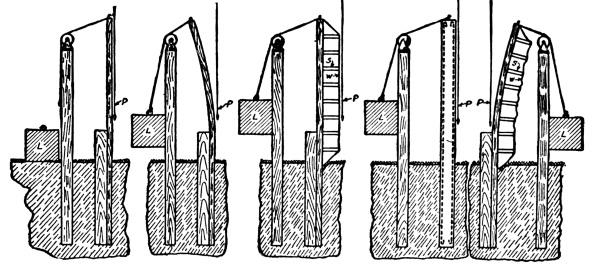
The value of reinforcing concrete posts properly may readily be seen in the figure. If a load (L) is raised so that its weight is supported on one side by a wooden post, the post will bend. The fibre in the wood on the side away from the load may be tough and elastic enough to prevent the post from breaking, and when released the post will spring back into its former position. In the third figure a No. 9 wire (W) is fastened securely to the wooden post at the top and at the ground surface, and is supported along its length by the struts (S). If the same load is applied, the post will not bend, because the wire takes up the bending or stretching strain. This is precisely the case with the reinforcement in a concrete post. Supported along its length by the concrete, the wire (W) or steel in other shapes takes up the bending or stretching strains. Since the load which causes bending or stretching may come from any direction, concrete posts are reinforced on every side; otherwise they might break in a manner somewhat similar to that in which the wooden post bends when the reinforcement is not on the proper side of the post.
In the effort to be safe it is a common fault to insert more reinforcement than is absolutely necessary. This adds needlessly to the cost, for concrete becomes stronger as it grows older.
Kinds of Reinforcement
With regard to the roughness of the outside, metallic reinforcing materials are divided into two classes, smooth and corrugated or deformed. The general result of the many tests carried on in testing laboratories seems to indicate that in strength of bond, if the concrete is sufficiently rich and well mixed, smooth surfaces give satisfactory results. Two kinds of reinforcement are much used—bars and wire.
Bars.—Round bars three-sixteenths or one-fourth of an inch in diameter are the size and kind most used on the farm. The stock on hand at blacksmith shops and hardware stores is generally from steel that stretches too easily and therefore is not the best for reinforcement. Companies which make a specialty of reinforcing materials can furnish both rods and bars which stretch only under very large loads.
Wire.—The development of the wire fence has produced a material well suited for reinforcing purposes. Of equal size, such wire will produce a stronger reinforcement than the material above described. In order to obtain straight wire of the necessary length, the coils ordinarily placed on the market should not be straightened out. Straight wire can be obtained from dealers in the same manner as baling wire; that is, either single or twisted into two or three-ply cables, and of the length desired. The plain, ungalvanized fencing wire is the proper kind, for galvanization adds nothing to the strength, and the metal will not rust when incased in the concrete.