Concrete Sidewalks and Floors
Reading edition
Concrete floors are nothing more than sidewalks of large size, and are formed by casting slabs in place.
The description given is an economical and practical method of laying sidewalks or floors, easily adapted to any use where concrete is found advantageous. This description will therefore apply not only to the building of sidewalks, but to all flat surfaces of concrete resting on the ground.
Lasting Qualities
Concrete floors must remain hard and in position to be permanent. To accomplish this, good materials must be used, and proper methods of mixing and placing must be followed. Only in this way can settlement cracks, upheaval by frost or roots of trees, contraction cracks, crumbling, and general failure be avoided.
Settlement Cracks
To avoid settlement cracks, thoroughly ram the ground after excavating for the foundation. This gives a solid bearing to the concrete slab.
Upheaval by Frost
To prevent upheaval by frost a foundation formed of crushed stone, hard furnace cinders, brick bats broken to about a 2-inch size, broken tile or any other hard porous material, should be laid in such a way as to obtain perfect drainage. Never use ashes.
If freezing occurs, room is in this way provided between the pieces of stone for the expansion of the ice.
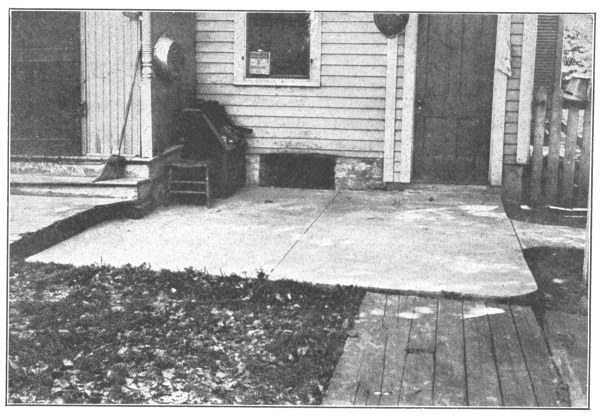
If this foundation is placed in clay soil, side outlets or blind drains of tile should be provided at points along the walk where they are necessary, leading into holes filled with cinders or crushed stone, which will allow the surrounding earth to soak up the accumulated water. Clay soil holds the water collected in the drainage foundation, and if it becomes entirely full of water, the ice formed during freezing weather will upheave the walk.
Upheaval by Tree Roots
Upheaval by tree roots can be easily avoided by cutting out all roots which run under the pavement at a less depth than 18 inches below the surface of the ground.
Contraction Cracks
Cement concrete expands and contracts by changes of temperature in the same way as steel. It is, therefore, necessary to cut joints which will allow for this expansion and contraction. The concrete must be cut entirely through to the bottom of the slab with a trowel, cleaver or other instrument, the joint formed being from ⅛ to ¼ of an inch wide. Blocks formed in this way should not be greater than 6 feet square (36 square feet).
Scaling or Crumbling of the Surface
The principal causes of scaling or crumbling surfaces are improper mixing, drying out before the cement has thoroughly hardened and the use of bad materials.
Cement needs water not only when mixed, but after being placed and tamped, and until it has entirely hardened. If concrete is not kept continually wet until hard, it is weakened, and the surface of such a walk scales or becomes soft and chalky.