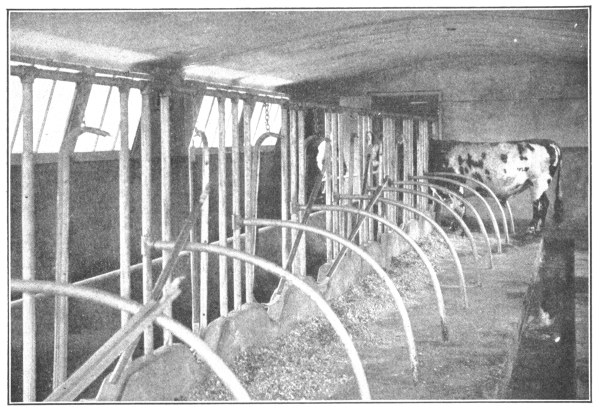
Concrete Barn Floors
Reading edition
Investigations of the Department of Agriculture have disclosed the fact that many cases of typhoid fever and malaria, often considered unaccountable in their origin, are the result of the germs being carried by the house-fly. Screens, flypaper, and poisons are all very well, in a small way, but to free the place of flies means getting rid of the conditions which produce them. Leaving out the manure pile (see Manure Pits, page 45), the favorite breeding-place of flies is the foul floors of the cow and horse barns. The barn can be almost entirely rid of flies by building floors and manure pits of concrete.
The Advantages of Concrete Floors
There are no flies to make the horses stamp.
Rats have no hiding-place about concrete floors.
No other floor is as slick as a manure-soaked wooden floor. Concrete floors may be finished as rough or corrugated, as may be desired.
Concrete floors do not soak up water. The liquids run into the gutters and thence to the manure pits. The floor may be flushed with water and kept as clean and odorless as a kitchen floor.
All kinds of barn floors must be bedded down. Concrete floors are warmer and cleaner than any other kind, for they are always dry. Besides, heat and cold do not easily pass through concrete.
Concrete floors afford good fire protection. No fire can be started on concrete floors by a shiftless farm “hand” dropping cigarette stubs or matches on their surface.
Good farm “hands” prefer to work where there are concrete floors: they lighten the labor. Concrete floors have no uneven edges to catch the scoop and to ruffle the temper.