Volume 2 — C
Reading edition
Chacchadi.—Haddis who do scavenging work, with whom other Haddis do not freely intermarry.
Chadarapu Dhompti (square space marriage offering).—A sub-division of Mādigas, who, at marriages, offer food to the god in a square space.
Chākala.—See Tsākala.
Chakkān.—Recorded in the Madras Census Report, 1901, as “a Malabar caste of oil-pressers (chakku means an oil-mill). Followers of this calling are known also as Vattakkādans in South Malabar, and as Vāniyans in North Malabar, but the former are the higher in social status, the Nāyars being polluted by the touch of the Vāniyans and Chakkāns, but not by that of the Vattakkādans. Chakkāns and Vāniyans may not enter Brāhman temples. Their customs and manners are similar to those of the Nāyars, who will not, however, marry their women.” Chakkingalavan appears as a synonym for Chakkān.
The correlation of the most important measurements of the Mādigas of the Telugu country, and so-called Chakkiliyans of the city of Madras, is clearly brought out by the following figures:—
Thirty Madigas. Fifty Chakkiliyans.
cm. cm.
Stature 163.1 162.2
Cephalic length 18.6 18.6
Cephalic breadth 13.9 13.9
Cephalic index 75. 75.
Nasal height 4.5 4.6
Nasal breadth 3.7 3.6
Nasal index 80.8 78.9
The Chakkiliyan men in Madras are tattooed not only on the forehead, but also with their name, conventional devices, dancing-girls, etc., on the chest and upper extremities.
The Chakkiliyans do not worship Mātangi, who is the special deity of the Mādigas. Their gods include Madurai Vīran, Māriamma, Mūneswara, Draupadi and Gangamma. Of these, the last is the most important, and her festival is celebrated annually, if possible. To cover the expenses thereof, a few Chakkiliyans dress up so as to represent men and women of the Marāthi bird-catching caste, and go about begging in the streets for nine days. On the tenth day the festival terminates. Throughout it, Gangamma, represented by three decorated pots under a small pandal (booth) set up on the bank of a river or tank beneath a margosa (Melia azadirachta), or pīpal (Ficus religiosa) tree, is worshipped. On the last day, goats and fowls are sacrificed, and limes cut.
During the first menstrual period, the Chakkiliyan girl is kept under pollution in a hut made of fresh green boughs, which is erected by her husband or maternal uncle. Meat, curds, and milk are forbidden. On the last day, the hut is burnt down. At marriages a Chakkiliyan usually officiates as priest, or the services of a Valluvan priest may be enlisted. The consent of the girl’s maternal uncle to the marriage is essential. The marriage ceremony closely resembles that of the Paraiyans. And, at the final death ceremonies of a Chakkiliyan, as of a Paraiyan, two bricks are worshipped, and thrown into a tank or stream.
Lean children, especially of the Māla, Mādiga, and Chakkiliyan classes, are made to wear a leather strap, specially made for them by a Chakkiliyan, which is believed to help their growth.
At times of census, some Chakkiliyans have returned themselves as Pagadaiyar, Madāri (conceit or arrogance), and Ranavīran (brave warrior).
The traditional occupation of the Chākkiyans is the recitation of Purānic stories. The accounts of the Avatāras have been considered the highest form of scripture of the non-Brāhmanical classes, and the early Brāhmans utilised the intervals of their Vēdic rites, i.e., the afternoons, for listening to their recitation by castes who could afford the leisure to study and narrate them. Special adaptations for this purpose have been composed by writers like Narayana Bhattapāda, generally known as the Bhattatirippāt, among whose works Dūtavākya, Pānchālisvayamvara, Subhadrāhana and Kauntēyāshtaka are the most popular. In addition to these, standard works like Bhōgachampu and Māhanātaka are often pressed into the Chākkiyar’s service. Numerous upakathās or episodes are brought in by way of illustration, and the marvellous flow of words, and the telling humour of the utterances, keep the audience spell-bound. On the utsavam programme of every important temple, especially in North Travancore, the Chākkiyarkūttu (Chākkiyar’s performance) is an essential item. A special building, known as kūttampalam, is intended for this purpose. Here the Chākkiyar instructs and regales his hearers, antiquely dressed, and seated on a three-legged stool. He wears a peculiar turban with golden rim and silk embossments. A long piece of cloth with coloured edges, wrapped round the loins in innumerable vertical folds with an elaborateness of detail difficult to describe, is the Chākkiyar’s distinctive apparel. Behind him stands the Nambiyar, whose traditional kinship with the Chākkiyar has been referred to, with a big jar-shaped metal drum in front of him called milāvu, whose bass sound resembles the echo of distant thunder. The Nambiyar is indispensable for the Chākkiyarkūttu, and sounds his mighty instrument at the beginning, at the end, and also during the course of his recitation, when the Chākkiyar arrives at the middle and end of a Sanskrit verse. The Nangayar, a female of the Nambiyar caste, is another indispensable element, and sits in front of the Chākkiyar with a cymbal in hand, which she sounds occasionally. It is interesting to note that, amidst all the boisterous merriment into which the audience may be thrown, there is one person who has to sit motionless like a statue. If the Nangayar is moved to a smile, the kūttu must stop, and there are cases where, in certain temples, the kūttu has thus become a thing of the past. The Chākkiyar often makes a feint of representing some of his audience as his characters for the scene under depictment. But he does it in such a genteel way that rarely is offence taken. It is an unwritten canon of Chākkiyarkūttu that the performance should stop at once if any of the audience so treated should speak out in answer to the Chākkiyar, who, it may be added, would stare at an admiring listener, and thrust questions on him with such directness and force as to need an extraordinary effort to resist a reply. And so realistic is his performance that a tragic instance is said to have occurred when, by a cruel irony of fate, his superb skill cost a Chākkiyar his life. While he was explaining a portion of the Mahābhārata with inimitable theatrical effect, a desperate friend of the Pāndavas rose from his seat in a fit of uncontrollable passion, and actually knocked the Chākkiyar dead when, in an attitude of unmistakable though assumed heartlessness, he, as personating Duryōdhana, inhumanely refused to allow even a pin-point of ground to his exiled cousins. This, it is believed, occurred in a private house, and thereafter kūttu was prohibited except at temples.
It is noted, in the Gazetteer of Malabar, that “Chākkiyars or Slāghyar-vakukar are a caste following makkattāyam (inheritance from father to son), and wear the pūnūl (thread). They are recruited from girls born to a Nambūdiri woman found guilty of adultery, after the date at which such adultery is found to have commenced, and boys of similar origin, who have been already invested with the sacred thread. Boys who have not been invested with the pūnūl when their mother is declared an adulteress, join the class known as Chākkiyar Nambiyars, who follow marumakkattāyam (inheritance in the female line), and do not wear the thread. The girls join either caste indifferently. Chākkiyars may marry Nangiyars, but Chākkiyar Nambiyars may not marry Illōtammamar.”
The Chāliyans are so called because, unlike most of the west coast classes, they live in streets, and Teruvan (teru, a street) occurs as a synonym for the caste name. The right-hand section are said to worship the elephant god Ganēsa, and the left Bhagavāti.
The following account of the Chāliyans is given in the Gazetteer of the Malabar district: “Chāliyans are almost certainly a class of immigrants from the east coast. They live in regular streets, a circumstance strongly supporting this view. The traditional account is to the same effect. It is said that they were originally of a high caste, and were imported by one of the Zāmorins, who wished to introduce the worship of Ganapathi, to which they are much addicted. The latter’s minister, the Mangatt Acchan, who was entrusted with the entertainment of the new arrivals, and was nettled by their fastidiousness and constant complaints about his catering, managed to degrade them in a body by the trick of secretly mixing fish with their food. They do not, like their counterparts on the east coast, wear the thread; but it is noticeable that their priests, who belong to their own caste, wear it over the right shoulder instead of over the left like the Brāhman’s pūnūl, when performing certain pūjas (worship). In some parts, the place of the regular pūnūl is taken by a red scarf or sash worn in the same manner. They are remarkable for being the only caste in Malabar amongst whom any trace of the familiar east coast division into right-hand and left-hand factions is to be found. They are so divided; and those belonging to the right-hand faction deem themselves polluted by the touch of those belonging to the left-hand sect, which is numerically very weak. They are much addicted to devil-dancing, which rite is performed by certain of their numbers called Kōmarams in honour of Bhagavathi and the minor deities Vettekkorumagan and Gulikan (a demon). They appear to follow makkatāyam (descent from father to son) in some places, and marumakkatāyam (inheritance in the female line) in others. Their pollution period is ten days, and their purification is performed by the Talikunnavan (sprinkler), who belongs to a somewhat degraded section of the caste.”
The affairs of the caste are managed by headmen called Urālans, and the caste barber, or Pothuvan, acts as the caste messenger. Council meetings are held at the village temple, and the fines inflicted on guilty persons are spent in celebrating pūja (worship) thereat.
When a girl reaches puberty, the elderly females of Urālan families take her to a tank, and pour water over her head from small cups made of the leaves of the jāk (Artocarpus integrifolia) tree. She is made to sit apart on a mat in a room decorated with young cocoanut leaves. Round the mat raw rice and paddy (unhusked rice) are spread, and a vessel containing cocoanut flowers and cocoanuts is placed near her. On the third evening, the washerman (Peruvannān) brings some newly-washed cloths (māttu). He is presented with some rice and paddy, which he ties up in a leaf, and does pūja. He then places the cloths on a plank, which he puts on his head. After repeating some songs or verses, he sets it down on the floor. Some of the girl’s female relations take a lighted lamp, a pot of water, a measure of rice, and go three times round the plank. On the following day, the girl is bathed, and the various articles which have been kept in her room are thrown into a river or tank.
Like many other Malabar castes, the Chāliyans perform the tāli kettu ceremony. Once in several years, the girls of the village who have to go through this ceremony are brought to the house of one of the Urālans, where a pandal (booth) has been set up. Therein a plank, made of the wood of the pāla tree (Alstonia scholaris), a lighted lamp, betel leaves and nuts, a measure of raw rice, etc., are placed. The girl takes her seat on the plank, holding in her right hand a mimic arrow (shanthulkōl). The Pothuvan, who receives a fanam (coin) and three bundles of betel leaves for his services, hands the tāli to a male member of an Urālan family, who ties it on the girl’s neck.
On the day before the wedding-day the bridegroom, accompanied by his male relations, proceeds to the house of the bride, where a feast is held. On the following day the bride is bathed, and made to stand before a lighted lamp placed on the floor. The bridegroom’s father or uncle places two gold fanams (coins) in her hands, and a further feast takes place.
In the seventh month of pregnancy, the ceremony called puli kudi (or drinking tamarind) is performed. The woman’s brother brings a twig of a tamarind tree, and, after the leaves have been removed, plants it in the yard of the house. The juice is extracted from the leaves, and mixed with the juice of seven cocoanuts. The elderly female relations of the woman give her a little of the mixture. The ceremony is repeated during three days. Birth pollution is removed by a barber woman sprinkling water on the ninth day.
The dead are buried. The son carries a pot of water to the grave, round which he takes it three times. The barber makes a hole in the pot, which is then thrown down at the head of the grave. The barber also tears off a piece of the cloth, in which the corpse is wrapped. This is, on the tenth day, taken by the son and barber to the sea or a tank, and thrown into it. Three stones are set up over the grave.
Chāliyan also occurs as an occupational title or sub-division of Nāyars, and Chāliannaya as an exogamous sept of Bant. In the Madras Census Report, 1901, Chāliyan is given as a sub-caste of Vāniyan (oil-pressers). Some Chāliyans are, however, oilmongers by profession.
Challa.—Challa, meaning apparently eaters of refuse, occurs as a sub-division of Yānādis, and meaning buttermilk as an exogamous sept of Dēvānga. Challakūti, meaning those who eat old or cold food, is an exogamous sept of Kāpus.
Chamar.—Nearly three hundred members of this Bengal caste of tanners and workers in leather were returned at the census, 1901. The equivalent Chamura occurs as the name of leather-workers from the Central Provinces.
Chandra (moon).—An exogamous sept of Kuruba. The name Chandravamsapu (moon people) is taken by some Rāzus, who claim to be Kshatriyas, and to be descended from the lunar race of kings of the Mahābhārata.
Chanipoyina (those who are dead).—An exogamous sept of Orugunta Kāpu.
Chāpa (mat).—An exogamous sept of Bōya.
Chappadi (insipid).—An exogamous sept of Jōgi.
Chapparam (a pandal or booth).—An exogamous sept of Dēvānga.
Chapparband.—The Chapparbands are manufacturers of spurious coin, who hail from the Bombay Presidency, and are watched for by the police. It is noted, in the Police Report, 1904, that good work was done in Ganjam in tracing certain gangs of these coiners, and bringing them to conviction.
The following case of swindling, which occurred in the Tanjore district, is recorded in the Police Report, 1903. “A gang of Muhammadans professed to be able to duplicate currency notes. The method was to place a note with some blank sheets of paper between two pieces of glass. The whole was then tied round with string and cloth, and smoked over a fire. On opening the packet, two notes were found, a second genuine one having been surreptitiously introduced. The success of the first operations with small notes soon attracted clients, some of them wealthy; and, when the bait had had time to work, and some very large notes had been submitted for operation, the swindlers declared that these large notes took longer to duplicate, and that the packet must not be opened for several days. Before the time appointed for opening, they disappeared, and the notes were naturally not found in the packets. One gentleman was fleeced in this way to the value of Rs. 4,600.” The administration of an enema to a false coiner will sometimes bring to light hidden treasure.
Charamūrti.—A class of Jangams, who go from village to village preaching.
Chātla (winnow).—An exogamous sept of Mādiga. Chātla Dhompti occurs as a sub-division of Mādigas, who, at marriages, place the offering of food, etc. (dhompti), in a winnow.
Chatri.—Recorded, in the Madras Census Report, 1901, as an equivalent of Kshatriya. It occurs also as the name of an exogamous sept, meaning umbrella, of the Holeyas.
Chaturākshari.—A sub-division of Sātānis, who believe in the efficacy of the four syllables Rā-mā-nu-ja.
Chaudari.—Chaudari, or Chowdari, is recorded as a title of Haddi, Kālingi, and Kōmati.
Chāya (colour) Kurup.—A class of Kollans in Malabar, who work in lacquer.
Chēli (goat).—An exogamous sept of Bottada and Mattiya.
Chēlu (scorpion).—An exogamous sept of Kuruba. The equivalent thēlu occurs among the Padma Sālēs.
Chembadi.—The Chembadis are a Telugu caste, the occupations of which are fresh-water fishing, and rowing boats or coracles. In fishing, unlike the Besthas who use a cast-net, they employ a large drag-net, called baithivala, the two ends of which are fastened to poles. When a new net is made, it is folded up, and placed on the edge of a pond or tank. Mud is spread over it, and on it are placed three masses of mud kneaded into a conical shape. These represent the God, and cakes, called kudumulu, are set before them. A male member of the caste, biting one of the cakes and keeping it between his teeth, goes round the net, and then drags it to the water, in which the conical masses become disintegrated. Like the Besthas, they smear a new net with the blood of the first fish caught in it, but they do not burn a mesh of the net.
Some Chembadis regard Gurappa Gurunathadu as their caste deity, and connect him, for some unknown reason, with the jammi tree (Prosopis spicigera). Jammi occurs as the name of a gōtra, and some children are named Gurappa or Gurunathadu. When such children are five, seven, or nine years old, they are taken on an auspicious day to a jammi tree and shaved, after the tree has been worshipped with offerings of cooked food, etc.
At the betrothal ceremony in this caste, immediately after the girl has taken up areca nuts, placed them in her lap, and folded them in her cloth, the headman takes up the betel leaves and areca nuts (thambūlam) before him with crossed hands. This ceremony corresponds to the thonuku thambūlam of the lower classes, e.g., Mālas and Mangalas. Among the Mangalas and Tsākalas, the thambūlam is said to be taken up by a Balija Setti. For the funeral ceremonies, the Chembadis engage a Dāsari of their own caste. During their performances, flesh and toddy may not be offered to the deceased person.
Chembian.—A name assumed by some Pallis or Vanniyans, who claim that they belong to the Chōla race, on the supposition that Chembinādu is a synonym for Chōla.
Chembillam (chembu, copper).—An exogamous section of Mukkuvan.
Chembōtti.—In the Madras Census Report, 1901, it is stated that the name Chembōtti is derived from “chembu, copper, and kotti, he who beats.” They are coppersmiths in Malabar, who are distinct from the Malabar Kammālans. They are supposed to be descendants of men who made copper idols for temples, and so rank above the Kammālans in social position, and about equally with the lower sections of the Nāyars. The name is also used as an occupational term by the Konkan Native Christian coppersmiths. In the Cochin and Travancore Census Reports, Chembukotti is recorded as an occupational title or sub-caste of Nāyars who work in copper, chiefly in temples and Brāhman houses.
In the Gazetteer of the Malabar district, the Chembōttis are described as copper-workers, whose traditional business is the roofing of the Sri-kōvil, or inner shrine of the temple with that metal. They are said to have originally formed part of the Kammālan community. “When the great temple at Taliparamba was completed, it was purified on a scale of unprecedented grandeur, no less than a thousand Brāhmans being employed. What was their dismay when the ceremony was well forward, to see a Chembōtti coming from the Sri-kōvil, where he had been putting finishing touches to the roof. This appeared to involve a recommencement of the whole tedious and costly ritual, and the Brāhmans gave vent to their feelings of despair, when a vision from heaven reassured them, and thereafter the Chembōttis have been raised in the social scale, and are not regarded as a polluting caste.”
Chembetti, or Chemmatti, meaning hammer, occurs as an exogamous sept of the Telugu Yānādis.
Chempakarāman.—Recorded, in the Travancore Census Report, 1901, as an honorific title of Nāyars.
Bone, had. Cat, billeyi. Ear, kān. Elephant, hate. Tiger, bāg. One, yek. Ten, das. Far, dūr. Drink, pi. Sweet, mithā.
A Chenchu Taliāri (village watchman), who came to see me at Nandyal, was wearing a badge with his name engraved on it in Telugu, which had been presented to him by Government in recognition of his shooting with a double-barrelled gun two Donga Oddes who had robbed a village. Another aged Taliāri had a silver bangle bearing a Telugu inscription, which had been given to him in acknowledgment of his capturing a murderer who was wanted by the police, and came to his hut. The casual visitor explained that he was on his way to Hyderabad, but the Chenchu, noticing blood on his clothes, tied him to a post, and gave information that he had secured him. The same man had also received presents for reporting cases of illicit distillation under the Abkāri Act.
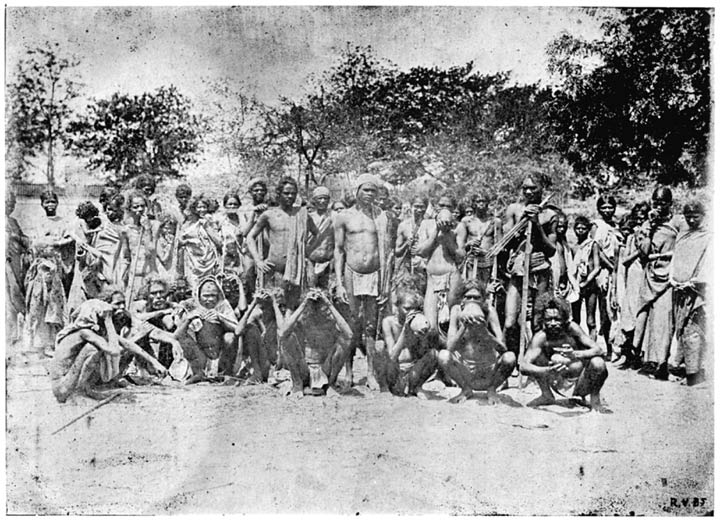
Chenchus.
In recent accounts of the Chenchus of the Nallamalai hills by a forest officer, it is noted that pilgrims, on their way to the Srisailam temple, “are exploited at every turn, the Chentzu being seen in his true colours at this period, and, being among the most active agents in the exactions, but not being by any means the only plunderer. In return for the protection, the Chentzu levies a toll per head, and as much more as he can extort. We had to interfere with the perquisites of one drugged specimen of this race, who drew a knife on a peon (orderly), and had to be sent down under escort.... It is commonly supposed that the Chentzus are a semi-wild, innocent, inoffensive hill tribe, living on roots, honey, wild fruits, and game. If this was so, we should have no difficulty in controlling them. They are actually a semi-wild, lazy, drinking set of brigands. They levy blackmail from every village along the foot of the hills, and, if any ryot (cultivator) refuses to pay up, his crop silently disappears on some moonless night. They levy blackmail from every pilgrim to the shrines in the hills. They levy blackmail from the graziers in the hills. They borrow money from Kōmatis and Buniahs (merchants and money-lenders), and repay it in kind—stolen timber, minor forest produce, etc. They are constantly in debt to the Kōmatis, and are practically their slaves as regards the supply of timber and other forest produce. They think nothing of felling a tree in order to collect its fruits, and they fire miles of forest in order to be able to collect with ease certain minor produce, or to trace game. They poison the streams throughout the hills, and in short do exactly as they please throughout the length and breadth of the Nallamalais.” The Conservator of Forests expressed his belief that this picture was not overdrawn, and added that the Chenchus are “a danger to the forest in many ways, and I have always thought it a pity that they were given some of the rights at settlement, which stand against their names. These rights were—
(1) Rights of way, and to carry torches.
(2) Rights to draw and drink water from, wash or bathe in all streams, springs, wells and pools.
(3) Rights to forest produce for home use.
(4) Rights to fish and shoot.
(5) Rights to graze a limited number of cattle, sheep and goats.
(6) Rights to collect for sale or barter certain minor produce.
In connection with right (3), the District Forest Officer suggested that “the quantity to be taken annually must be limited, especially in the case of wood, bamboos, fibre, firewood and honey. The quality of the wood and of other forest produce should be defined. Chenchus do not require teak or ebony beams or yegi (Pterocarpus Marsupium) spokes and felloes for domestic purposes; but, as the right now stands, they can fell whatever they like, and, though we may know it is for sale to merchants, the Chenchus have only to say it is for domestic use, and they cannot be punished. The wood should be limited to poles and smaller pieces of third-class and unclassified trees.”
In 1898 the Governor in Council made the following rules for regulating the exercise of the rights of the Chenchus living in the reserved forests on the Nallamalais:—
1. The carrying of torches, and the lighting of fires in fire-protected blocks during the fire season are prohibited.
2. There shall be no right to wash or bathe in such springs, wells, pools or portions of streams as are especially set apart for drinking purposes by the District Forest Officer.
3. No more than the quantity which the Collector may consider to be actually required for domestic use shall be removed in the exercise of the right to take wood, bamboos, fibre, thatching grass, firewood, roots, fruits, honey and other forest produce. The term “other forest produce” shall be taken to mean other minor forest produce, not including tusks and horns. No wood other than poles and smaller pieces of third class and unclassified trees shall be removed.
4. No gudem (Chenchu village) shall, without the special permission of the Collector, be allowed to keep a larger number of guns than that for which licenses had been taken out at the time of settlement. Every gun covered by a license shall be stamped with a distinctive mark or number. The use of poison and explosives in water, and the setting of cruives or fixed engines, or snares for the capture or destruction of fish, are strictly prohibited.
5. For purposes of re-generation, a portion of the area set apart for the grazing of cattle, not exceeding one-fifth, may be closed to grazing at any time, and for such length of time as the District Forest Officer deems fit.
6. The right of pre-emption of all minor forest produce collected by the Chenchus for sale or barter shall be reserved to the Forest department. The exercise of the right of collecting wood and other produce for domestic use, and of collecting minor produce for sale or barter, shall be confined to natural growth, and shall not include forest produce which is the result of special plantation or protection on the part of the Forest department.
In connection with a scheme for dealing with the minor forest produce in the Nallamalais, the Conservator of Forests wrote as follows in 1905. “I believe that it is generally recognised that it is imperative to obtain the good-will of the Chenchus even at a considerable loss, both from a political and from a forest point of view; the latter being that, if we do not do so, the whole of the Nallamalai forests will, at a not very remote date, be utterly destroyed by fire. The Chenchus, being a most abnormal type of men, must be treated in an abnormal way; and the proposals are based, therefore, on the fundamental principle of allowing the two District Forest Officers a very free hand in dealing with these people. What is mainly asked for is to make an experiment, of endeavouring to get the Chenchus to collect minor produce for the department, the District Forest Officers being allowed to fix the remuneration as they like, in money or barter, as they may from time to time find on the spot to be best.” In commenting on the scheme, the Board of Revenue stated that “action on the lines proposed is justified by the present state of the Nallamalais. These valuable forests certainly stand in danger of rapid destruction by fire, and, according to the local officers, the Chenchus are almost entirely responsible. The department has at present no means of bringing influence to bear on the Chenchus, or securing their assistance in putting out fires. Repressive measures will be worse than useless, as the Chenchus will merely hide themselves, and do more damage than ever. The only way of getting into touch with them is to enforce the right of pre-emption in the matter of minor produce reserved to Government at the time of forest settlement, and by dealing with them in a just and generous way to secure their confidence. If this is achieved, the department may hope to secure their co-operation and valuable assistance in preventing jungle fires. The department can certainly afford to sell at a profit, and at the same time give the Chenchus better prices than the sowcars (money-lenders), who are said invariably to cheat them. The Board believes that the ultimate loss from advances will not be serious, as advances will ordinarily be small in amount, except in cases where they may be required by Chenchus to pay off sowcars. It will be well, therefore, if the Collector and the District Forest Officers will ascertain as soon as possible how much the Chenchus are indebted to the sowcars, as it will probably be necessary for the success of the scheme to liquidate these debts.”
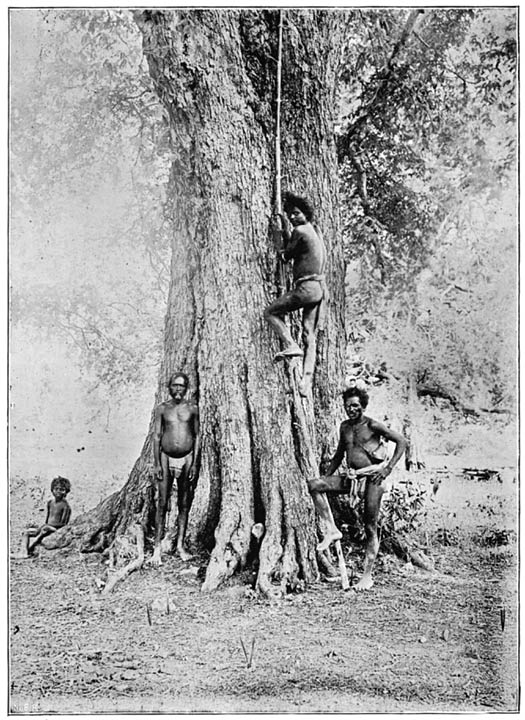
Chenchu tree-climbing.
A Chenchu who was asked by me whether they kill wild beasts replied that they are wild beasts themselves. In devouring a feast of mutton provided for those who were my guests in camp, they certainly behaved as such, gnawing at the bones and tearing off the flesh. To the Chenchus a feast, on however liberal a scale the food may be, is nothing without a copious supply of toddy, of which even infants receive a small share. In the absence of toddy, they sometimes manufacture illicit liquor from the flower-buds of the mahua (or mowhra) tree. The man who gained the prize (a coarse cotton cloth) in a shooting match with bow and arrow, with the head of a straw scarecrow as bull’s-eye, was in an advanced stage of intoxication, and used his success as an argument in favour of drink. In a long distance shooting match, the prize was won with a carry of 144 yards, the arrow being shot high into the air. It was noted by Captain Newbold that the Chenchus are not remarkably expert as archers, to judge from the awkwardness they exhibited in dispatching an unfortunate sheep picketed for them at forty yards, which was held out to them as the prize for the best marksman. Some time ago a Chenchu, who was the bully of his settlement, beat another Chenchu and his wife. The injured man appealed to the District Forest Officer, and, explaining that he knew the law did not allow him to kill his enemy, applied for a written permit to go after him with a bow and arrow.
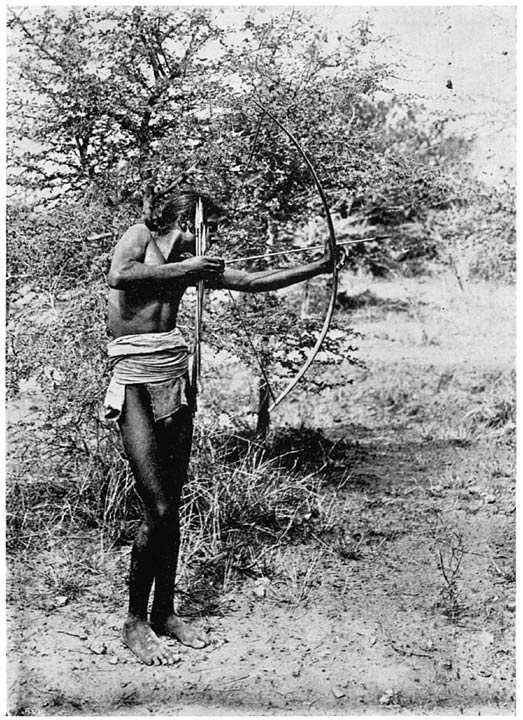
Chenchu.
Some Chenchus bear on the head a cap made of wax-cloth, deer or hare skin. By the more fashionable the tufted ear or bushy tail-end of the large Indian squirrel (Sciurus Indicus) is attached by way of ornament to the string with which the hair of the head is tied into a bunch behind. Leafy garments have been replaced by white loin-cloths, and some of the women have adopted the ravikē (bodice), in imitation of the female costume in the plains. Boys, girls, and women wear bracelets made of Phœnix or palmyra palm leaves. By some pieces of stick strung on a thread, or seeds of Givotia rottleriformis, are worn as a charm to ward off various forms of pain. Some of the women are tattooed on the forehead, corners of the eyes, and arms. And I saw a few men tattooed on the shoulder as a cure for rheumatism.
The huts of which a present day gudem is composed are either in the shape of bee-hives like those of the Yānādis, or oblong with sloping roof, and situated in a grove near a pond or stream. The staple food of the Chenchus consists of cereals, supplemented by yams (Dioscorea) which are uprooted with a digging-stick tipped with iron, forest fruits, and various animals such as peacock, crow, lizard (Varanus), bear, and black monkey. They are very fond of the young flowers and buds of the mahua tree, and tamarind fruits, the acidity of which is removed by mixing with them the ashes of the bark of the same tree.
The forest products collected by the Chenchus include myrabolams, fruits of the tamarind, Semecarpus anacardiúm, Sapindus trifoliatus (soap-nut), Buchanania latifolia, Buchanania angustifolia, and Ficus glomerata; roots of Aristolochia Indica and Hemidesmus Indicus; seeds of Abrus precatorius; flowers of Bassia latifolia; horns, and honey.
The Chenchus recognise two kinds of bees, large and small, and gather honey from nests in trees or rocks. It is stated in the Cuddapah Manual that “the Yenādis or Chenchus alone are able to climb miraculously into difficult and apparently inaccessible places, and over perpendicular cliffs in some places from a hundred to two hundred feet high. This they do by means of a plaited rope made of young bamboos tied together. Accidents sometimes happen by the rope giving way. It is a nervous sight to watch them climbing up and down this frail support. From below the men look like little babies hanging midway. The rope being fastened on the top of the cliff by means of a peg driven into the ground or by a tree, the man swings suspended in the air armed with a basket and a stick. The Chenchu first burns some brushwood or grass under the hive, which is relinquished by most of the bees. This accomplished, he swings the rope, until it brings him close to the hive, which he pokes with his stick, at the same time holding out his basket to catch the pieces broken off from the hive. When the basket is full, he shakes the rope, and is drawn up (generally by his wife’s brother). The bamboo ropes are never taken away; nor are they used a second time, a fresh one being made on each occasion, and at each place. They are to be seen hanging for years, until they decay and fall down of themselves.”
Like other Telugu classes, the Chenchus have exogamous septs or intipēru, of which the following are examples:—gurram (horse), arati (plantain tree), mānla (trees), tōta (garden), mēkala (goats), indla (houses), savaram (sovereign, gold coin), and gundam (pit).
Of the marriage customs the following account is given in the Kurnool Manual. “The Chenchus do not follow a uniform custom in respect to marriage ceremonies. Their marriage is performed in three ways. A man wishing to marry selects his own bride, and both retire for one night by mutual consent from the gudem. On the following morning, when they return, their parents invite their friends and relatives, and by formally investing them with new clothes, declare them duly married. To complete the ceremony, a meal is given to those assembled. The second method is as follows. A small space, circular in form, is cleaned and besmeared with cowdung. In the centre a bow and arrow tied together are fixed in the ground, and the bride and bridegroom are made to move round it, when the men assembled bless them by throwing some rice over them, and the marriage is complete. According to the third mode, a Brāhmin is consulted by the elders of the family. An auspicious day is fixed, and a raised pial (platform) is formed, on which the bride and bridegroom being seated, a tāli (marriage badge) is tied, and rice poured over their heads. The services of the Brāhmin are engaged for three or four days, and are rewarded with a piece of new cloth and some money. This ceremony resembles that of the ryot (cultivating) class among the Hindus. It is evidently a recent Brahminical innovation. On marriage occasions generally tom-toms, if available, are beaten, and a dance takes place.” In the second form of marriage, as described to me, the bride and bridegroom sit opposite each other with four arrows stuck in the ground between them. In Mackenzie’s record it is stated that the Chenchus make the bridal pair sit with a single arrow between them, and, when there is no shadow, some elderly men and women throw rice over their heads. The importance of the arrow with the Chenchus, as with the Yānādis, is that the moment when it casts no shadow is the auspicious time for the completion of the marriage rite. The remarriage of widows is permitted, and the second husband is said to be in most cases a brother of the deceased one.
As an example of the Chenchu songs, the following marriage song, sung by two men and a woman, and recorded by my phonograph, may be cited:—
Oh! the lord of the Chenchus.
Oh! the lord of the Chenchus.
Oh! the lord of the Chenchus.
Wearing a garment made of the leaves of the pāru tree,
Oh! the lord of the Chenchus.
Wearing a bodice made of the leaves of the pannu tree,
Oh! the lord of the Chenchus.
Roaming over inaccessible hills,
Oh! the lord of the Chenchus.
Wandering through dense forests,
Oh! the lord of the Chenchus.
Committing acts that ought not to be done,
Oh! the lord of the Chenchus.
Ōbalēsa’s marriage was celebrated,
Oh! the lord of the Chenchus.
A four-cornered dais was made,
Oh! the lord of the Chenchus.
On the dais arrows were stuck,
Oh! the lord of the Chenchus.
Bamboo rice was used to throw on the heads of the pair,
Oh! the lord of the Chenchus.
Cocoanut cups were stuck on the points of the arrow,
Oh! the lord of the Chenchus.
The marriage was thus celebrated.
At a dance in my honour, men and women executed a series of step dances in time with a drum (thappata) resembling a big tambourine, which, at the conclusion of each dance, was passed to and fro through a blazing fire of cholum straw to bring it up to the proper pitch. An elderly hag went through a variety of gesticulations like those of a Dēva-dāsi (dancing-girl). A man dressed up in straw and fragments of mats picked up near my camp, and another disguised as a woman, with bells round his ankles, supplied the comic business.
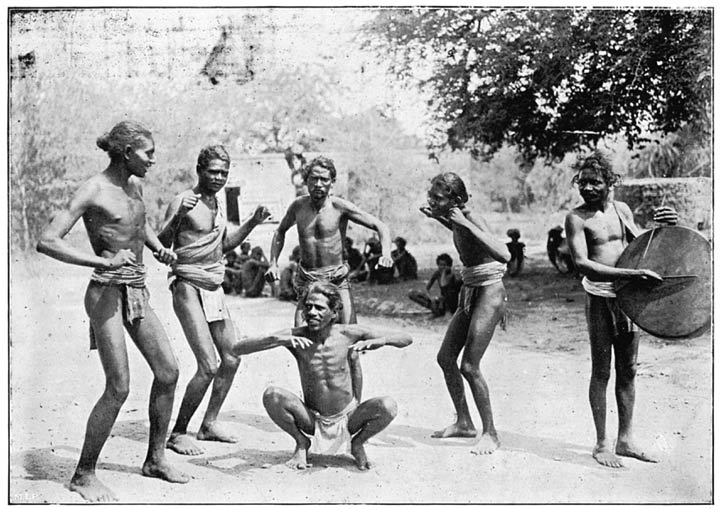
Chencu dance.
In the Kurnool Manual it is stated that “as soon as a child is born, the umbilical cord is cut (with a knife or arrow), and the child is washed in cold or hot water, according as the season is hot or cold. On the third day, all the women of the tribe are invited, and served with betel nut. On the fourth day, an old woman gives a name to the child. The baby is generally laid in a cradle made of deer skins, and suspended from a bamboo by means of strings or dusara creepers.”
The dead are carried to the burial-place in a cloth slung on a pole. The body, after it has been laid in the grave, is covered over with leafy twigs, and the grave is filled in. The spot is marked by a mound of earth and stones piled up. On the second or third day, some cooked food is offered to the soul of the deceased person, near the grave, and, after some of it has been set apart for the crows, the remainder is buried in the mound or within the grave. The same rite is repeated after the eighth day.
In the absence of lucifer matches, the Chenchus make fire with flint and steel, and the slightly charred floss of the white cotton tree, Eriodendron anfractuosum, I am informed that, like the Paniyans of Malabar, they also obtain fire by friction, by means of the horizontal or sawing method, with two pieces of split bamboo.
Some Chenchus still exhibit the primitive short stature and high nasal index, which are characteristic of other jungle tribes such as the Kādirs, Paniyans, and Kurumbas. But there is a very conspicuous want of uniformity in their physical characters, and many individuals are to be met with, above middle height or tall, with long narrow noses. A case is noted in the Kurnool Manual, in which a brick-maker married a Chenchu girl. And I was told of a Bōya man who had married into the tribe, and was living in a gudem. In this way is the pure type of Chenchu metamorphosed.
Stature, cm. Nasal index.
AV. MAX. MIN. AV. MAX. MIN.
162.5 175 149.6 81.9 95.7 68.1
By the dolichocephalic type of head which has persisted, and which the Chenchus possess in common with various other jungle tribes, they are, as shown by the following table, at once differentiated from the mesaticephalic dwellers in the plains near the foot of the Nallamalais:—
Cephalic Index. Number of cases in which index exceeded 80.
40 Chenchus 74.3 1
60 Gollas 77.5 9
50 Boyas 77.9 14
39 Tota Balijas 78. 10
49 Motāti Kapus 78. 16
19 Upparas 78.8 4
16 Mangalas 78.8 7
17 Yerukalas 78.6 6
12 Mēdaras 80.7 8
The visual acuity of the Chenchus was tested with Cohn’s letter E, No. 6. For clinical purposes, the visual acuity would be represented by a fraction, of which 6 is the denominator, and the number of metres at which the position of the letter was recognised by the individual tested is the numerator, e.g.,
V.A. = 13m/6 = 2.16.
The average distances in metres, at which the letter was recognised by the various castes and tribes examined by myself and Dr. W. H. R. Rivers, were as follows:—
16 Shōlagas (Rivers) 12.9
94 Kotas 12.8
180 Badagas 12.6
50 Paraiyans 12.5
58 Telugu ryats 12.4
28 Chenchus 12.3
55 Urālis (Rivers) 12.2
30 Brāhmans, Mysore 12.2
30 Non-Brāhmans, Mysore 12.2
In all classes, it may be noted, the average acuity was between 12 and 13 metres (13 to 14 yards), and ranged between V.A. = 2·15 and V.A. = 2·03. The maxima distances, at which the position of the letter was recognised, were:—Shōlaga, 18m; Paraiyan, 19m; Badaga and Dīkshitar Brāhman, 20m. No cases of extraordinary hyper-acuity were met with. The nine classes, or groups of classes examined, cover a wide range of degrees of civilisation from the wild jungle Chenchus, Shōlagas, and Urālis, to the cultured Brāhman. And, though the jungle man, who has to search for his food and mark the tracks and traces of wild beasts, undoubtedly possesses a specially trained keenness of vision for the exigencies of his primitive life, the figures show that, as regards ordinary visual acuity, he has no advantage over the more highly civilised classes.
There were, in 1904–05, two Board upper primary schools for the Chenchus of the Kurnool district, which were attended by seventy-three pupils, who were fed and clothed, and supplied with books and slates free of charge.
Chēnu (dry field).—An exogamous sept of Kamma.
Chēppāt.—A sub-division of Mārān.
Chērukāra.—Recorded, in the Travancore Census Report, 1901, as a sub-division of Nāyar.
Cheruku.—Cheruku (sugar-cane) or Cherukula has been recorded as an exogamous sept of Bōya, Jōgi and Odde.
Cheruman.—The Cherumans or Cherumukkal have been defined as a Malayālam caste of agricultural serfs, and as members of an inferior caste in Malabar, who are, as a rule, toilers attached to the soil. In the Madras Census Report, 1891, it is stated that “this caste is called Cheruman in South Malabar and Pulayan in North Malabar. Even in South Malabar where they are called Cheruman, a large sub-division numbering over 30,000 is called Pula Cheruman. The most important of the sub-divisions returned are Kanakkan, Pula Cheruman, Erālan, Kūdān and Rōlan. Kanakkan and Pula Cheruman are found in all the southern tāluks, Kūdān almost wholly in Walluvanād, and Erālan in Pālghat and Walluvanād.” In the Census Report, 1901, Ālan (slave), and Paramban are given as sub-castes of Cheruman.
According to one version, the name Cheruma or Cheramakkal signifies sons of the soil; and, according to another, Cheriamakkal means little children, as Parasurāma directed that they should be cared for, and treated as such. The word Pulayan is said to be derived from pula, meaning pollution.
Of the Cherumans, the following account is given in the Gazetteer of Malabar. “They are said to be divided into 39 divisions, the more important of which are the Kanakka Cherumans, the Pula Cherumans or Pulayas, the Era Cherumans or Erālans, the Rōli Cherumans or Rōlans, and the Kūdāns. Whether these sub-divisions should be treated as separate castes or not, it is hardly possible to determine; some of them at least are endogamous groups, and some are still further sub-divided. Thus the Pulayas of Chirakkal are said to be divided into one endogamous and eleven exogamous groups, called Māvadan, Elamanām, Tacchakudiyan, Kundatōn, Cheruvulan, Mulattan, Tālan, Vannatam, Eramālōdiyan, Mullaviriyan, Egudan, and Kundōn. Some at least of these group names obviously denote differences of occupation. The Kundōtti, or woman of the last group, acts as midwife; and in consequence the group is considered to convey pollution by touch to members of the other groups, and they will neither eat nor marry with those belonging to it. Death or birth pollution is removed by a member of the Māvadan class called Maruttan, who sprinkles cowdung mixed with water on the feet, and milk on the head of the person to be purified. At weddings, the Maruttan receives 32 fanams, the prescribed price of a bride, from the bridegroom, and gives it to the bride’s people. The Era Cherumans and Kanakkans, who are found only in the southern tāluks of the district, appear to be divided into exogamous groups called Kūttams, many of which seem to be named after the house-name of the masters whom they serve. The Cherumans are almost solely employed as agricultural labourers and coolies; but they also make mats and baskets.”
Of the history of slavery in Malabar an admirable account is given by Mr. Logan, from which the following extracts are taken. “In 1792, the year in which British rule commenced, a proclamation was issued against dealing in slaves. In 1819, the principal Collector wrote a report on the condition of the Cherumar, and received orders that the practice of selling slaves for arrears of revenue be immediately discontinued. In 1821, the Court of Directors expressed considerable dissatisfaction at the lack of precise information which had been vouchsafed to them, and said ‘We are told that part of the cultivators are held as slaves: that they are attached to the soil, and marketable property.’ In 1836, the Government ordered the remission in the Collector’s accounts of Rs. 927–13–0, which was the annual revenue from slaves on the Government lands in Malabar, and the Government was at the same time ‘pleased to accede to the recommendation in favour of emancipating the slaves on the Government lands in Malabar.’ In 1841, Mr. E. B. Thomas, the Judge at Calicut, wrote in strong terms a letter to the Sadr Adālat, in which he pointed out that women in some tāluks (divisions) fetched higher prices, in order to breed slaves; that the average cost of a young male under ten years was about Rs. 3–8–0, of a female somewhat less; that an infant ten months old was sold in a court auction for Rs. 1–10–6 independent of the price of its mother; and that, in a recent suit, the right to twenty-seven slaves was the ‘sole matter of litigation, and was disposed of on its merits.’ In a further letter, Mr. Thomas pointed out that the slaves had increased in numbers from 144,000 at the Census, 1835, to 159,000 at the Census, 1842. It was apparently these letters which decided the Board of Directors to send out orders to legislate. And the Government of India passed Act V of 1843, of which the provisions were widely published through Malabar. The Collector explained to the Cherumar that it was in their interest, as well as their duty, to remain with their masters, if kindly treated. He proclaimed that ‘the Government will not order a slave who is in the employ of an individual to forsake him and go to the service of another claimant; nor will the Government interfere with the slave’s inclination as to where he wishes to work.’ And again, ‘Any person claiming a slave as janmam, kānam or panayam, the right of such claim or claims will not be investigated into at any one of the public offices or courts.’ In 1852, and again in 1855, the fact that traffic in slaves still continued was brought to the notice of Government, but on full consideration no further measures for the emancipation of the Cherumar were deemed to be necessary. The Cherumar even yet have not realised what public opinion in England would probably have forced down their throats fifty years ago, and there is reason to think that they are still, even now, with their full consent bought and sold and hired out, although, of course, the transaction must be kept secret for fear of the penalties of the Penal Code, which came into force in 1862, and was the real final blow at slavery in India. The slaves, however, as a caste will never understand what real freedom means, until measures are adopted to give them indefeasible rights in the small orchards occupied by them as house-sites.” It is noted by Mr. Anantha Krishna Iyer that “though slavery has been abolished many years ago, the name valliyal (a person receiving valli, i.e., paddy given to a slave) still survives.”
By the Penal Code it is enacted that—
Whoever imports, exports, removes, buys, sells, or disposes of any person as a slave, or accepts, receives, or detains against his will any person as a slave, shall be punished with imprisonment for a term which may extend to seven years, and shall also be liable to a fine.
Whoever habitually imports, exports, removes, buys, sells, traffics or deals in slaves, shall be punished with transportation for life, or with imprisonment for a term not exceeding ten years, and shall be liable to a fine.
Whoever unlawfully compels any person to labour against the will of that person, shall be punished with imprisonment for a term which may extend to one year, or with a fine, or with both.
Lallē lallē lallē ho.
Lallē lallē lallē ho.
“On the European plantations in the Wynād the Cherumans are in great request, and many are to be seen travelling nowadays without fear in railway carriages on their way to the plantations. A few also work in the gold mines of Mysore.”
In connection with the harvest ceremonial in Cochin, Mr. Anantha Krishna Iyer writes as follows. “There are some curious customs connected with the harvest, prevailing among the Pulayas of the southern parts of the State. Before reaping, the Pulaya headman asks his master whether he may begin to reap. With his permission, he faces the east, and puts the sickle to the stalks. The first bundle he reserves for the gods of his master, and the second for those of his castemen. Before thrashing, the same headman takes a few bundles of corn from the sheaf intended for their gods, and sprinkles toddy on them. Another Pulayan does the same for the various reapers, and says, as he does so ‘Come, thrashing corn, increase.’ This is called filling the thrashing floor, and each man thrashes his own sheaves. When the thrashing is over, the headman puts his master’s sheaf in the centre of the floor, and his own at a short distance outside, in order that the two sets of gods may look kindly on them. The headman is privileged to measure the corn sitting with his two assistants, saying ‘Come, paddy, increase,’ as he counts. He also calls out ‘Good paddy, one’, ‘bad paddy, two’, and so on, until he counts ten. The eleventh is the share for the reaper. He takes a handful, and places it in a basket, half of which falls to him, his assistants and the watchman, while the other half is given away in charity to the poor men that come to the thrashing place. In the northern parts of the State, before reaping, offerings of goats, fowls, and cocoanuts, are made to Mallan and Mūni. The Cheruma headman faces east, and applies his sickle to the stalks, reserving the first stalk for the deities above mentioned. The corn is thrashed and measured by one of them, and, as he does so, he says ‘Labham’ (profit) for one, ‘Chetham’ (loss) for two, and counts up to ten. The eleventh goes to the share of the reapers. Thus they get one para for every ten paras of corn. The poor people that attend are also given a handful of the grain. After reaping, the members of the castes named in the table below receive a small portion of the corn for their services rendered to the farmers in the course of the months during which cultivation has been carried on:—
Caste. Purpose for which paddy is given. Remuneration.
Carpenters For making and repairing ploughs, etc. A big bundle of corn.
Blacksmiths For making sickles, knives, and other tools. Do.
Parayan For lifting and placing the loads of stalks on the heads of the Cherumans, who carry them to the farmyard. Do.
Washerman or Mannān. For keeping off birds, insects, etc., from the fields by magic. Do.
Vilkurup For treating Cherumas during their illness, and for shampooing them. Do.
Kaniyan or astrologer. For giving information of the auspicious times for ploughing, sowing, transplanting and reaping, and also of the time for giving rice, vegetables, oil, etc., to the Cherumas during the Onam festival. Do.
“The Pulayans receive, in return for watching, a small portion of the field near the watchman’s rest-hut, which is left unreaped for him. It fetches him a para of paddy.
“The Cherumas who are engaged in reaping get two bundles of corn each for every field. For measuring the corn from the farmyard, a Cheruman gets an edangazhy of paddy, in addition to his daily wage. Three paras of paddy are set apart for the local village deity. During the month of Karkadakam, the masters give every Cheruman a fowl, some oil, garlic, mustard, anise seeds, pepper, and turmeric. They prepare a decoction of seeds, and boil the flesh of the fowl in it, which they take for three days, during which they are allowed to take rest. Three days’ wages are also given in advance.”
The home of the Cheruman is called a chāla or hut, which has a thatched roof of grass and palm-leaves resembling an immense bee-hive. A big underground cell, with a ceiling of planks, forms the granary of the occupants of these huts. The chief house furniture consists of a pestle and mortar, and two or three earthenware pots.
The habitations of the Pulayas of Cochin are thus described by Mr. Anantha Krishna Iyer. “Their huts are generally called madams, which are put up on the banks of fields, in the middle of rice flats, or on trees along their borders, so as to enable them to watch the crops after the toils of the day. They are discouraged from erecting better huts, under the idea that, if settled more comfortably, they would be less inclined to move as cultivation required. The madams are very poor huts, supported on four small posts, and thatched with leaves. The sides are protected with the same kind of leaves. There is only one room, and the floor, though slightly raised, is very damp during the rainy months. These temporary buildings are removed after the harvest, and put up in places where cultivation has to be carried on. All the members of the family sleep together in the same hut. Small temporary huts are sometimes erected, which are little better than inverted baskets. These are placed in the rice field while the crop is on the ground, and near the stacks while it is being thrashed. In the northern parts of the State, the Pulaya huts are made of mud walls, and provided with wooden doors. The roofs are of bamboo framework thatched with palmyra palm leaves. The floor is raised, and the huts are provided with pyals (raised platforms) on three sides. They have also small compounds (grounds) around them. There is only one room inside, which is the sleeping apartment of the newly married youngsters. The others, I am told, sleep on the verandahs. The utensils consist of a few earthen pots for cooking and keeping water, and a few earthen dishes for taking food. In addition to these, I found a wooden mortar, a few pestles, two pans, two winnowing pans, a fish basket for each woman, a few cocoanut shells for keeping salt and other things, a few baskets of their own making, in one of which a few dirty cloths were placed, some mats of their own making, a bamboo vessel for measuring corn, and a vessel for containing toddy.”
The women are profusely decorated with cheap jewelry of which the following are examples:
1. Lobes of both ears widely dilated by rolled leaden ornaments. Brass, and two glass bead necklets, string necklet with flat brass ornaments, the size of a Venetian sequin, with device as in old Travancore gold coins, with two brass cylinders pendent behind, and tassels of red cotton. Three brass rings on right little finger; two on left ring finger, one brass and two steel bangles on left wrist.
2. Several bead necklets, and a single necklet of many rows of beads. Brass necklet like preceding, with steel prong and scoop, for removing wax from the ears and picking teeth, tied to one of the necklets. Attached to, and pendent from one necklet, three palm leaf rolls with symbols and Malayālam inscription to act as a charm in driving away devils. Three ornamental brass bangles on right forearm, two on left. Iron bangle on left wrist. Thin brass ring in helix of each ear. Seventy thin brass rings (alandōti) with heavy brass ornament (adikaya) in dilated lobe of each ear.
3. In addition to glass bead necklets, a necklet with heavy heart-shaped brass pendants. String round neck to ward off fever.
4. String necklet with five brass cylinders pendent; five brass bangles on right wrist; six brass and two iron bangles on left wrist.
Right hand, one copper and five brass rings on middle finger; one iron and three brass rings on little finger.
Left hand, one copper and five brass rings on middle finger; three brass and two copper rings on ring finger; one brass ring on little finger.
5. Trouser button in helix of left ear.
6. Brass bead necklet with pendent brass ornament with legend “Best superior umbrella made in Japan, made for Fazalbhoy Peeroo Mahomed, Bombay.”
A Cheruman, at Calicut, had his hair long and unkempt, as he played the drum at the temple. Another had the hair arranged in four matted plaits, for the cure of disease in performance of a vow. A man who wore a copper cylinder on his loin string, containing a brass strip with mantrams (consecrated formulæ) engraved on it, sold it to me for a rupee with the assurance that it would protect me from devils.
Concerning the marriage ceremony of the Cherumans in Malabar, Mr. Appadorai Iyer writes that “the bridegroom’s sister is the chief performer. It is she who pays the bride’s price, and carries her off. The consent of the parents is required, and is signified by an interchange of visits between the parents of the bride and bridegroom. During these visits, rice-water (conji) is sipped. Before tasting the conji, they drop a fanam (local coin) into the vessel containing it, as a token of assent to the marriage. When the wedding party sets out, a large congregation of Cherumans follow, and at intervals indulge in stick play, the women singing in chorus to encourage them ‘Let us see, let us see the stick play (vadi tallu), Oh! Cheruman.’ The men and women mingle indiscriminately in the dance during the wedding ceremony. On the return to the bridegroom’s hut, the bride is expected to weep loudly, and deplore her fate. On entering the bridegroom’s hut, she must tread on a pestle placed across the threshold.” During the dance, the women have been described as letting down their hair, and dancing with a tolerable amount of rhythmic precision amid vigorous drumming and singing. According to another account, the bridegroom receives from his brother-in-law a kerchief, which the giver ties round his waist, and a bangle which is placed on his arm. The bride receives a pewter vessel from her brother. Next her cousin ties a kerchief round the groom’s forehead, and sticks a betel leaf in it. The bride is then handed over to the bridegroom.
Of the puberty and marriage ceremonies of the Pulayas of Cochin, the following detailed account is given by Mr. Anantha Krishna Iyer. “When a Pulaya girl comes of age, she is located in a separate hut. Five Vallons (headmen), and the castemen of the kara (settlement), are invited to take part in the performance of the ceremony. A song, called malapattu, is sung for an hour by a Parayan to the accompaniment of drum and pipe. The Parayan gets a para of paddy, and his assistants three annas each. As soon as this is over, seven cocoanuts are broken, and the water thereof is poured over the head of the girl, and the broken halves are distributed among the five Vallons and seven girls who are also invited to be present. Some more water is also poured on the girl’s head at the time. She is lodged in a temporary hut for seven days, during which food is served to her at a distance. She is forbidden to go out and play with her friends. On the morning of the seventh day, the Vallons of the kara and the castemen are again invited. The latter bring with them some rice, vegetables, and toddy, to defray the expenses of the feast. At dawn, the mother of the girl gives oil to the seven Pulaya maidens, and to her daughter for an oil-bath. They then go to a neighbouring tank (pond) or stream to bathe, and return home. The girl is then neatly dressed, and adorned in her best. Her face is painted yellow, and marked with spots of various colours. She stands before a few Parayas, who play on their flute and drum, to cast out the demons, if any, from her body. The girl leaps with frantic movements, if she is possessed by them. In that case, they transfer them to a tree close by driving a nail into the trunk after due offerings. If she is not possessed, she remains unmoved, and the Parayas bring the music to a close. The girl is again bathed with her companions, who are all treated to a dinner. The ceremony then comes to an end with a feast to the castemen. The ceremony described is performed by the Valluva Pulayas in the southern parts, near and around the suburbs of Cochin, but is unknown among other sub-tribes elsewhere. The devil-driving by the Parayas is not attended to. Nor is a temporary hut erected for the girl to be lodged in. She is allowed to remain in a corner of the hut, but is not permitted to touch others. She is bathed on the seventh day, and the castemen, friends and relations, are invited to a feast.
“Marriage is prohibited among members of the same koottam (family group). In the Chittūr tāluk, members of the same village do not intermarry, for they believe that their ancestors may have been the slaves of some local landlord, and, as such, the descendants of the same parents. A young man may marry among the relations of his father, but not among those of his mother. In the Palghat tāluk, the Kanakka Cherumas pride themselves on the fact that they avoid girls within seven degrees of relationship. The marriage customs vary according to the sub-division. In the southern parts of the State, Pulaya girls are married before puberty, while in other places, among the Kanakka Cherumas and other sub-tribes, they are married both before and after puberty. In the former case, when a girl has not been married before puberty, she is regarded as having become polluted, and stigmatised as a woman whose age is known. Her parents and uncles lose all claim upon her. They formally drive her out of the hut, and proceed to purify it by sprinkling water mixed with cow-dung both inside and outside, and also with sand. She is thus turned out of caste. She was, in former times, handed over to the Vallon, who either married her to his own son, or sold her to a slave master. If a girl is too poor to be married before puberty, the castemen of the kara raise a subscription, and marry her to one of themselves.
“In the Ooragam proverthy of the Trichūr tāluk, I find that the marriage among the Pulayas of that locality and the neighbouring villages is a rude form of sambandham (alliance), somewhat similar to that which prevails among the Nāyars, whose slaves a large majority of them are. The husband, if he may be so called, goes to the woman’s hut with his wages, to stay therein with her for the night. They may serve under different masters. A somewhat similar custom prevails among the Pula Cherumas of the Trichūr tāluk. The connection is called Merungu Kooduka, which means to tame, or to associate with.
“A young man, who wishes to marry, goes to the parents of the young woman, and asks their consent to associate with their daughter. If they approve, he goes to her at night as often as he likes. The woman seldom comes to the husband’s hut to stay with him, except with the permission of the thamar (landlord) on auspicious occasions. They are at liberty to separate at their will and pleasure, and the children born of the union belong to the mother’s landlord. Among the Kanakka Cherumas in the northern parts of the State, the following marital relations are in force. When a young man chooses a girl, the preliminary arrangements are made in her hut, in the presence of her parents, relations, and the castemen of the village. The auspicious day is fixed, and a sum of five fanams is paid as the bride’s price. The members assembled are treated to a dinner. A similar entertainment is held at the bridegroom’s hut to the bride’s parents, uncles, and others who come to see the bridegroom. On the morning of the day fixed for the wedding, the bridegroom and his party go to the bride’s hut, where they are welcomed, and seated on mats in a small pandal put up in front of the hut. A muri (piece of cloth), and two small mundus (cloths) are the marriage presents to the bride. A vessel full of paddy (unhusked rice), a lighted lamp, and a cocoanut are placed in a conspicuous place therein. The bride is taken to the booth, and seated by the side of the bridegroom. Before she enters it, she goes seven times round it, with seven virgins before her. With prayers to their gods for blessings on the couple, the tāli (marriage badge) is tied round the bride’s neck. The bridegroom’s sister completes the knot. By a strange custom, the bride’s mother does not approach the bridegroom, lest it should cause a ceremonial pollution. The ceremony is brought to a close with a feast to those assembled. Toddy is an indispensable item of the feast. During the night, they amuse themselves by dancing a kind of wild dance, in which both men and women joyfully take part. After this, the bridegroom goes along to his own hut, along with his wife and his party, where also they indulge in a feast. After a week, two persons from the bride’s hut come to invite the married couple. The bride and bridegroom stay at the bride’s hut for a few days, and cannot return to his hut unless an entertainment, called Vathal Choru, is given him.
“The marriage customs of the Valluva Pulayas in the southern parts of the State, especially in the Cochin and Kanayannūr tāluks, are more formal. The average age of a young man for marriage is between fifteen and twenty, while that of a girl is between ten and twelve. Before a young Pulayan thinks of marriage, he has to contract a formal and voluntary friendship with another young Pulayan of the same age and locality. If he is not sociably inclined, his father selects one for him from a Pulaya of the same or higher status, but not of the same illam (family group). If the two parents agree among themselves, they meet in the hut of either of them to solemnise it. They fix a day for the ceremony, and invite their Vallon and the castemen of the village. The guests are treated to a feast in the usual Pulaya fashion. The chief guest and the host eat together from the same dish. After the feast, the father of the boy, who has to obtain a friend for his son, enquires of the Vallon and those assembled whether he may be permitted to buy friendship by the payment of money. They give their permission, and the boy’s father gives the money to the father of the selected friend. The two boys then clasp hands, and they are never to quarrel. The new friend becomes from that time a member of the boy’s family. He comes in, and goes out of their hut as he likes. There is no ceremony performed at it, or anything done without consulting him. He is thus an inseparable factor in all ceremonies, especially in marriages. I suspect that the friend has some claims on a man’s wife. The first observance in marriage consists in seeing the girl. The bridegroom-elect, his friend, father and maternal uncle, go to the bride’s hut, to be satisfied with the girl. If the wedding is not to take place at an early date, the bridegroom’s parents have to keep up the claim on the bride-elect by sending presents to her guardians. The presents, which are generally sweetmeats, are taken to her hut by the bridegroom and his friends, who are well fed by the mother of the girl, and are given a few necessaries when they take leave of her the next morning. The next observance is the marriage negotiation, which consists in giving the bride’s price, and choosing an auspicious day in consultation with the local astrologer (Kaniyan). On the evening previous to the wedding, the friends and relations of the bridegroom are treated to a feast in his hut. Next day at dawn, the bridegroom and his friend, purified by a bath, and neatly dressed in a white cloth with a handkerchief tied over it, and with a knife stuck in their girdles, go to the hut of the bride-elect accompanied by his party, and are all well received, and seated on mats spread on the floor. Over a mat specially made by the bride’s mother are placed three measures of rice, some particles of gold, a brass plate, and a plank with a white and red cover on it. The bridegroom, after going seven times round the pandal, stands on the plank, and the bride soon follows making three rounds, when four women hold a cloth canopy over her head, and seven virgins go in front of her. The bride then stands by the side of the bridegroom, and they face each other. Her guardian puts on the wedding necklace a gold bead on a string. Music is played, and prayers are offered up to the sun to bless the necklace which is tied round the neck of the girl. The bridegroom’s friend, standing behind, tightens the knot already made. The religious part of the ceremony is now over, and the bridegroom and bride are taken inside the hut, and food is served to them on the same leaf. Next the guests are fed, and then they begin the poli or subscription. A piece of silk, or any red cloth, is spread on the floor, or a brass plate is placed before the husband. The guests assembled put in a few annas, and take leave of the chief host as they depart. The bride is soon taken to the bridegroom’s hut, and her parents visit her the next day, and get a consideration in return. On the fourth day, the bridegroom and bride bathe and worship the local deity, and, on the seventh day, they return to the bride’s hut, where the tāli (marriage badge) is formally removed from the neck of the girl, who is bedecked with brass beads round her neck, rings on her ears, and armlets. The next morning, the mother-in-law presents her son-in-law and his friend with a few necessaries of life, and sends them home with her daughter.
“During the seventh month of pregnancy, the ceremony of puli kuti, or tamarind juice drinking, is performed as among other castes. This is also an occasion for casting out devils, if any, from the body. The pregnant woman is brought back to the hut of her own family. The devil-driver erects a tent-like structure, and covers it with plantain bark and leaves of the cocoanut palm. The flower of an areca palm is fixed at the apex. A cocoanut palm flower is cut out and covered with a piece of cloth, the cut portion being exposed. The woman is seated in front of the tent-like structure with the flower, which symbolises the yet unborn child in the womb, in her lap. The water of a tender cocoanut in spoons made of the leaf of the jack tree (Artocarpus integrifolia) is poured over the cut end by the Vallon, guardian, and brothers and sisters present. The devil-driver then breaks open the flower, and, by looking at the fruits, predicts the sex of the child. If there are fruits at the end nearest the stem, the child will live and, if the number of fruits is even, there will be twins. There will be deaths if any fruit is not well formed. The devil-driver repeats an incantation, whereby he invokes the aid of Kali, who is believed to be present in the tent. He fans the woman with the flower, and she throws rice and a flower on it. He repeats another incantation, which is a prayer to Kali to cast out the devil from her body. This magical ceremony is called Garbha Bali (pregnancy offering). The structure, with the offering, is taken up, and placed in a corner of the compound reserved for gods. The devotee then goes through the remaining forms of the ceremony. She pours into twenty-one leaf spoons placed in front of the tent a mixture of cow’s milk, water of the tender cocoanut, flower, and turmeric powder. Then she walks round the tent seven times, and sprinkles the mixture on it with a palm flower. Next she throws a handful of rice and paddy, after revolving each handful round her head, and then covers the offering with a piece of cloth. She now returns, and her husband puts into her mouth seven globules of prepared tamarind. The devil-driver rubs her body with Phlomis (?) petals and paddy, and thereby finds out whether she is possessed or not. If she is, the devil is driven out with the usual offerings. The devil-driver gets for his services twelve measures and a half of paddy, and two pieces of cloth. The husband should not, during this period, get shaved.
“When a young woman is about to give birth to a child, she is lodged in a small hut near her dwelling, and is attended by her mother and a few elderly women of the family. After the child is born, the mother and the baby are bathed. The woman is purified by a bath on the seventh day. The woman who has acted as midwife draws seven lines on the ground at intervals of two feet from one another, and spreads over them aloe leaves torn to shreds. Then, with burning sticks in the hand, the mother with the baby goes seven times over the leaves backwards and forwards, and is purified. For these seven days, the father should not eat anything made of rice. He lives on toddy, fruits, and other things. The mother remains with her baby in the hut for sixteen days, when she is purified by a bath so as to be free from pollution, after which she goes to the main hut. Her enangathi (relation by marriage) sweeps the hut and compound, and sprinkles water mixed with cow-dung on her body as she returns after the bath. In some places, the bark of athi (Ficus glomerata) and ithi (Ficus Tsiela?) is well beaten and bruised, and mixed with water. Some milk is added to this mixture, which is sprinkled both inside and outside the hut. Only after this do they think that the hut and compound are purified. Among the Cherumas of Palghat, the pollution lasts for ten days.
“The ear-boring ceremony is performed during the sixth or seventh year. The Vallon, who is invited, bores the ears with a sharp needle. The wound is healed by applying cocoanut oil, and the hole is gradually widened by inserting cork, a wooden plug, or a roll of palm leaves. The castemen of the village are invited, and fed. The landlord gives the parents of the girl three paras of paddy, and this, together with what the guests bring, goes to defray the expenses of the ceremony. After the meal they go, with drum-beating, to the house of the landlord, and present him with a para of beaten rice, which is distributed among his servants. The ear-borer receives eight edangazhis of paddy, a cocoanut, a vessel of rice, and four annas.
“A woman found to be having intercourse with a Paraya is outcasted. She becomes a convert to Christianity or Mahomedanism. If the irregularity takes place within the caste, she is well thrashed, and prevented from resorting to the bad practice. In certain cases, when the illicit connection becomes public, the castemen meet with their Vallon, and conduct a regular enquiry into the matter, and pronounce a verdict upon the evidence. If a young woman becomes pregnant before marriage, her lover, should he be a Pulaya, is compelled to marry her, as otherwise she would be placed under a ban. If both are married, the lover is well thrashed, and fined. The woman is taken before a Thandan (Izhuva headman), who, after enquiry, gives her the water of a tender cocoanut, which she is asked to drink, when she is believed to be freed from the sin. Her husband may take her back again as his wife, or she is at liberty to marry another. The Thandan gets a few annas, betel leaves and areca nuts, and tobacco. Both the woman’s father and the lover are fined, and the fine is spent in the purchase of toddy, which is indulged in by those present at the time. In the northern parts of the State, there is a custom that a young woman before marriage mates with one or two paramours with the connivance of her parents. Eventually one of them marries her, but this illicit union ceases at once on marriage.”
It is noted by Mr. Logan that “the Cherumans, like other classes, observe death pollution. But, as they cannot at certain seasons afford to be idle for fourteen days consecutively, they resort to an artifice to obtain this end. They mix cow-dung and paddy, and make it into a ball, and place the ball in an earthen pot, the mouth of which they carefully close with clay. The pot is laid in a corner of the hut, and, as long as it remains unopened, they remain free from pollution, and can mix among their fellows. On a convenient day they open the pot, and are instantly seized with pollution, which continues for forty days. Otherwise fourteen days consecutive pollution is all that is required. On the forty-first or fifteenth day, as the case may be, rice is thrown to the ancestors, and a feast follows.”
The following account of the death ceremonies is given by Mr. Anantha Krishna Iyer. “When a Pulayan is dead, the castemen in the neighbourhood are informed. An offering is made to the Kodungallūr Bhagavati, who is believed by the Pulayas to watch over their welfare, and is regarded as their ancestral deity. Dead bodies are generally buried. The relatives, one by one, bring a new piece of cloth, with rice and paddy tied at its four corners, for throwing over the corpse. The cloth is placed thereon, and they cry aloud three times, beating their breasts, after which they retire. A few Parayas are invited to beat drums, and play on their musical instruments—a performance which is continued for an hour or two. After this, a few bits of plantain leaves, with rice flour and paddy, are placed near the corpse, to serve as food for the spirit of the dead. The bier is carried to the graveyard by six bearers, three on each side. The pit is dug, and the body covered with a piece of cloth. After it has been lowered into it, the pit is filled in with earth. Twenty-one small bits of leaves are placed over the grave, above the spot where the mouth of the dead man is, with a double-branched twig fixed to the centre, a cocoanut is cut open, and its water is allowed to flow in the direction of the twig which represents the dead man’s mouth. Such of the members of the family as could not give him kanji (rice gruel) or boiled rice before death, now give it to him. The six coffin-bearers prostrate themselves before the corpse, three on each side of the grave. The priest then puts on it a ripe and tender cocoanut for the spirit of the dead man to eat and drink. Then all go home, and indulge in toddy and aval (beaten rice). The priest gets twelve measures of rice, the grave-diggers twelve annas, the Vallon two annas, and the coffin-bearers each an anna. The son or nephew is the chief mourner, who erects a mound of earth on the south side of the hut, and uses it as a place of worship. For seven days, both morning and evening, he prostrates himself before it, and sprinkles the water of a tender cocoanut on it. On the eighth day, his relatives, friends, the Vallon, and the devil-driver assemble together. The devil-driver turns round and blows his conch, and finds out the position of the ghost, whether it has taken up its abode in the mound, or is kept under restraint by some deity. Should the latter be the case, the ceremony of deliverance has to be performed, after which the spirit is set up as a household deity. The chief mourner bathes early in the morning, and offers a rice-ball (pinda bali) to the departed spirit. This he continues for fifteen days. On the morning of the sixteenth day, the members of the family bathe to free themselves from pollution, and their enangan cleans the hut and the compound by sweeping and sprinkling water mixed with cow-dung. He also sprinkles the members of the family, as they return after the bath. The chief mourner gets shaved, bathes, and returns to the hut. Some boiled rice, paddy, and pieces of cocoanut, are placed on a plantain leaf, and the chief mourner, with the members of his family, calls on the spirit of the dead to take them. Then they all bathe, and return home. The castemen, who have assembled there by invitation, are sumptuously fed. The chief mourner allows his hair to grow as a sign of mourning (diksha), and, after the expiry of the year, a similar feast is given to the castemen.”
Concerning the religion of the Pulayas, Mr. Anantha Krishna Iyer writes as follows. “The Pulayas are animists, but are slowly coming on to the higher forms of worship. Their gods are Parakutty, Karinkutty, Chathan, and the spirits of their ancestors. Offerings to these gods are given on Karkadaka and Makara Sankrantis, Onam, Vishu, and other auspicious days, when one of the Pulayas present turns Velichapad (oracle), and speaks to the assembly as if by inspiration. They are also devout worshippers of Kali or Bhagavati, whose aid is invoked in all times of danger and illness. They take part in the village festivals celebrated in honour of her. Kodungallur Bhagavati is their guardian deity. The deity is represented by an image or stone on a raised piece of ground in the open air. Their priest is one of their own castemen, and, at the beginning of the new year, he offers to the goddess fowls, fruits, and toddy. The Pulayas also believe that spirits exercise an influence over the members of their families, and therefore regular offerings are given to them every year on Sankranti days. The chief festivals in which the Pulayas take part are the following:—
1. Pooram Vela.—This, which may be described as the Saturnalia of Malabar, is an important festival held at the village Bhagavati temple. It is a festival, in which the members of all castes below Brāhmans take part. It takes place either in Kumbham (February–March), or Meenam (March–April). The Cherumas of the northern part, as well as the Pulayas of the southern parts of the State, attend the festival after a sumptuous meal and toddy drinking, and join the procession. Toy horses are made, and attached to long bamboo poles, which are carried to the neighbourhood of the temple. As they go, they leap and dance to the accompaniment of pipe and drum. One among them who acts as a Velichapad (devil-dancer) goes in front of them, and, after a good deal of dancing and loud praying in honour of the deity, they return home.
2. Vittu Iduka.—This festival consists in putting seeds, or bringing paddy seeds to the temple of the village Bhagavati. This also is an important festival, which is celebrated on the day of Bharani, the second lunar day in Kumbham. Standing at a distance assigned to them by the village authorities, where they offer prayers to Kali, they put the paddy grains, which they have brought, on a bamboo mat spread in front of them, after which they return home. In the Chittūr tāluk, there is a festival called Kathiru, celebrated in honour of the village goddess in the month of Vrischikam (November-December), when these people start from the farms of their masters, and go in procession, accompanied with the music of pipe and drum. A special feature of the Kathiru festival is the presence, at the temple of the village goddess, of a large number of dome-like structures made of bamboo and plantain stems, richly ornamented, and hung with flowers, leaves, and ears of corn. These structures are called sarakootams, and are fixed on a pair of parallel bamboo poles. These agrestic serfs bear them in grand processions, starting from their respective farms, with pipe and drum, shouting and dancing, and with fireworks. Small globular packets of palmyra leaves, in which are packed handfuls of paddy rolled up in straw, are also carried by them in huge bunches, along with the sarakootams. These packets are called kathirkootoos (collection of ears of corn), and are thrown among the crowd of spectators all along the route of the procession, and also on arrival at the temple. The spectators, young and old, scramble to obtain as many of the packets as possible, and carry them home. They are then hung in front of the houses, for it is believed that their presence will help in promoting the prosperity of the family until the festival comes round again next year. The greater the number of these trophies obtained for a family by its members, the greater, it is believed, will be the prosperity of the family. The festival is one of the very few occasions on which Pulayas and other agrestic serfs, who are supposed to impart, so to speak, a long distant atmospheric pollution, are freely allowed to enter villages, and worship in the village temples, which generally occupy central positions in the villages. Processions carrying sarakootams and kathirkootoos start from the several farms surrounding the village early enough to reach the temple about dusk in the evening, when the scores of processions that have made their way to the temple merge into one great concourse of people. The sarakootams are arranged in beautiful rows in front of the village goddess. The Cherumas dance, sing, and shout to their hearts content. Bengal lights are lighted, and fireworks exhibited. Kathirkootoos are thrown by dozens and scores from all sides of the temple. The crowd then disperses. All night, the Pulayas and other serfs, who have accompanied the procession to the temple, are, in the majority of cases, fed by their respective masters at their houses, and then all go back to the farms.
3. Mandalam Vilakku.—This is a forty-one days’ festival in Bhagavati temples, extending from the first of Vrischikam (November-December) to the tenth of Dhanu (December-January), during which temples are brightly illuminated both inside and outside at night. There is much music and drum-beating at night, and offerings of cooked peas or Bengal gram, and cakes, are made to the goddess, after which they are distributed among those present. The forty-first day, on which the festival terminates, is one of great celebration, when all castemen attend at the temple. The Cherumas, Malayars, and Eravallars attend the festival in Chittūr. They also attend the Konga Pata festival there. In rural parts of the State, a kind of puppet show performance (olapava koothu) is acted by Kusavans (potters) and Tamil Chettis, in honour of the village deity, to which they contribute their share of subscription. They also attend the cock festival of Cranganore, and offer sacrifices of fowls.”
It is noted by Mr. Anantha Krishna Iyer, that, “in the Palghat tāluk of South Malabar, it is said that the Cherumas in former times used to hold grand meetings for cases of theft, adultery, divorce, etc., at Kannati Kutti Vattal. These assemblies consisted of the members of their caste in localities between Valayar forests and Karimpuzha (in Valluvanād tāluk), and in those between the northern and southern hills. It is also said that their deliberations used to last for several days together. In the event of anybody committing a crime, the punishment inflicted on him was a fine of a few rupees, or sometimes a sound thrashing. To prove his innocence, a man had to swear ‘By Kannati Swarupam (assembly) I have not done it.’ It was held so sacred that no Cheruman who had committed a crime would swear falsely by this assembly. As time went on, they found it difficult to meet, and so left off assembling together.”
In connection with the amusements of the Pulayas, Mr. Anantha Krishna Iyer writes that “their games appear to be connected in some way with their religious observances. Their favourite dance is the kole kali, or club dance. A party of ten or twelve men, provided with sticks, each a yard in length, stand in a circle, and move round, striking at the sticks, keeping time with their feet, and singing at the same time. The circle is alternately widened and narrowed. Vatta kali is another wild dance. This also requires a party of ten or twelve men, and sometimes young women join them. The party move in a circle, clapping their hands while they sing a kind of rude song. In thattinmel kali, four wooden poles are firmly stuck in the ground, two of which are connected by two horizontal pieces of wood, over which planks are arranged. A party of Pulayas dance on the top of this, to the music of their pipe and drum. This is generally erected in front of the Bhagavati temple, and the dancing takes place immediately after the harvest. This is intended to propitiate the goddess. Women perform a circular dance on the occasions of marriage celebrations.”
The Cherumas and Pulayas are, like the Koragas of South Canara, short of stature, and dark-skinned. The most important measurements of the Cherumans whom I investigated at Calicut were as follows:—
Stature, cm. Nasal index. Cephalic index.
Average. Average. Average.
Males 157.5 78.1 73.9
Females 147.8 77. 74.8
Cheruppu-katti (shoemaker).—Said to be a Malayālam synonym for Mādiga.
Chetti.—It is noted in the Census Report, 1891, that “the name Chetti is used both to denote a distinct caste, and also a title, and people bearing this title describe themselves loosely as belonging to the Chetti caste, in the same way as a Vellāla will say that he is a Mudali. This use of Chetti has caused some confusion in the returns, for the sub-divisions show that many other castes have been included as well as Chetti proper.” Again, in the Census Report, 1901, it is recorded that “Chetti means trader, and is one of those titular or occupational terms, which are often loosely employed as caste names. The weavers, oil pressers, and others use it as a title, and many more tack it on to their names, to denote that trade is their occupation. Strictly employed, it is nevertheless, the name of a true caste.” The Chettis are so numerous, and so widely distributed, that their many sub-divisions differ very greatly in their ways. The best known of them are the Bēri Chettis, the Nagarattu Chettis, the Kāsukkar Chettis, and the Nāttukōttai Chettis. Of these, the Bēri and Nāttukōttai Chettis are dealt with in special articles. The following divisions of Chettis, inhabiting the Madura district, are recorded in my notes:—
(a) Men with head clean-shaved:— Ilavagai or Karnakudi. Sundaraththan. Ariyūr. Malampatti. Pālayapattu. Thedakōttai. Periyakōttai-vellān. Puliyangudi. Vallam or Tiruvappūr. Kurungalūr.
(b) Men with kudumi (hair knot):— Puvaththukudi or Mannagudi. Kiramangalam. Vallanāttu. Mārayakkāra. Pandukudi or Manjapaththu.
Of these, the Puvaththukudi Chettis, who receive their name from a village in the Tanjore district, are mostly itinerant petty traders and money-lenders, who travel about the country. They carry on their shoulders a bag containing their personal effects, except when they are cooking and sleeping. I am informed that the Puvaththukudi women engage women, presumably with a flow of appropriate language ready for the occasion, to abuse those with whom they have a quarrel. Among the Puvaththukudi Chettis, marriages are, for reasons of economy, only celebrated at intervals of many years. Concerning this custom, a member of the community writes to me as follows. “In our village, marriages are performed only once in ten or fifteen years. My own marriage was celebrated in the year Nandana (1892–93). Then seventy or eighty marriages took place. Since that time, marriages have only taken place in the present year (1906). The god at Avadaiyar kōvil (temple) is our caste god. For marriages, we must receive from that temple garlands, sandal, and palanquins. We pay to the temple thirty-five rupees for every bridegroom through our Nagaraththar (village headmen). The expenses incurred in connection with the employment of washermen, barbers, nāgasaram (musical instrument) players, talayāris (watchmen), carpenters, potters, blacksmiths, gurukkals (priests), and garland-makers, are borne collectively and shared by the families in which marriages are to take place.” Another Chetti writes that this system of clubbing marriages together is practised at the villages of Puvaththukudi and Mannagudi, and that the marriages of all girls of about seven years of age and upwards are celebrated. The marriages are performed in batches, and the marriage season lasts over several months.