Volume 2 — D
Reading edition
Dāindla.—The name, denoting those who hid or ran away, of a sub-division of Māla.
Daivampati.—Recorded in the Travancore Census Report, 1901, as a caste included among Ambalavāsis, and a sub-division of Nāyar.
Dakkala.—Dakkala or Dakkali is the name of a class of mendicants who beg from Mādigas only. In the Kurnool district they are said to have divided the district with the Mushtis, and not to beg except within their own limits.
The following story is told as regards the origin of the Dakkalas. A smith was asked to make a bottu (marriage badge) for Siva’s wedding, and for this purpose required bellows, fire-pot, hammer, etc. Jāmbuvadu called his eldest son, and prepared the various implements from sundry parts of the body, except the backbone. Being highly pleased at this, the gods endowed the backbone with life, and the son went to his father Jāmbuvadu, who failed to recognise him, and refused to admit him. He was told that he must live as a beggar attached to the Mādigas, and was called Dakkala because he was brought to life from a vertebral column (dakka).
The Dakkalas wander from place to place. They may not enter Mādiga houses, outside which meals are given to them by males only, as females are not allowed to serve them. Mādiga women may not tread on the footsteps of the Dakkalas.
Dakku (fear).—An exogamous sept of Māla.
Dakni.—Dakni or Deccani is defined in the Madras Census Report, 1901, as “a territorial name meaning a Musalman of the Deccan; also a name loosely applied to converts to Islam.” In the Tanjore district, Muhammadans who speak Hindustani, and claim pure Muhammadan descent, are spoken of as Daknis or Dakanis. In other Tamil districts they are called Patānigal, to distinguish them from Labbais and Marakkāyars. The Daknis follow the Muhammadan ritual except in their marriages, which afford an example of a blend between Hindu and Muhammadan ceremonials. Like Hindus, they erect, at times of marriage, a milk-post of bamboo, to which are tied a two-anna piece, and a bit of sugar-candy done up in a Turkey red cloth. The post is handed to the headman, who decorates it with a garland of flowers and a roll of betel, and places it in a hole made in the court-yard of the house, wherein milk has been sprinkled. On the following day, two big pots are placed near the milk-post, and filled with water by four married couples. Around the pots, nine kinds of seed grains are sprinkled. On the third day, the bridegroom’s party proceeds to the house of the bride with thirteen trays of betel, fruits, flowers, sandal paste, and a paste made of turmeric and henna (Lawsonia alba) leaves. The bride is decorated, and sits on a plank. Women smear the face and hands of the bridal couple with the pastes, and one of them, or the bridegroom’s sister, ties a string of black beads round the bride’s neck. While this is being done, no one should sneeze. Wrist threads (kankanam) are tied on the wrists of the bride and bridegroom. On the fourth day, the nikka rite is celebrated, and the newly-married couple sit together while the nalagu ceremony of smearing them with sandal, and waving coloured water (ārati), is performed. The two pots containing water are kept for forty days, and then examined. If the water remains sweet, and does not “teem with vermin,” it is regarded as a good omen. The seed grains, too, should by this time have developed into healthy seedlings.
Dammula.—Recorded, in the Madras Census Report, 1901, as a small class of Telugu beggars, and priests in the temples of village goddesses.
A large number of criminals, undergoing punishment in Ganjam for robbery and thieving, are Dandāsis. The members of the caste, like the Tamil Kallans, believe that thieving is their traditional occupation, and, as such, regard it as justifiable. There is a legend that they adopted this occupation as their profession because their ancestors assisted the Pāndavas to escape from the lac fort which was constructed by the Kurus with a view to killing them, by digging a secret subterranean passage. According to another story, the Dandāsis are descended from the offspring of a clandestine amour of Krishna with Dhūuthika, Rādha’s handmaid. The Dandāsis perform an interesting ceremony of initiation into the profession of thieving, when a child is born. When it is three or five days old, the headman (Bēhara) is invited to attend. A breach is made in the wall, or beneath the door sill. Through this the infant is passed by the Bēhara three times, and received by some members of the family. Each time the Bēhara repeats the words “Enter, baby enter. May you excel your father!” The Dandāsis, when questioned concerning this custom, denied its existence, but some admitted that it was carried out in former days. An old woman stated that her grandchild was passed through a breach beneath the door, but was not inclined to enter into details.
The Dandāsis worship various Tākurānis (village deities), e.g., Sankaithuni, Kulladankuni, Kombēsari and Kālimuki. The gods are either represented temporarily by brass vessels, or permanently by three masses of clay, into each of which a small bit of gold is thrust. When Bassia (mahuā) buds or mangoes are first eaten in their season, a sacrifice is made, and a goat and fowl are killed before the produce of the harvest is first partaken of.
The Dandāsis have a headman, called Bēhara, who exercises authority over several groups of villages, and each group is under a Nāyako, who is assisted by a Dondia. For every village there is a Bholloboya, and, in some places, there is an officer, called Boda Mundi, appointed by the Zamindar, to whom irregularities in the community have to be reported. When a woman is delivered of a still-born child, the whole family is under pollution for eleven days. The headman is then invited to attend, and presents are given to him. He sprinkles water over members of the family, and they are thereby freed from this pollution.
A certain portion of the property stolen by Dandāsis is set apart for the headman, and, like the Tamil Kallans and Maravans, they seem to have a blackmailing system. If a Dandāsi is engaged as a watchman, property is safe, or, if stolen, is recovered and restored to its owner.
Girls are married after puberty. A man may marry his maternal uncle’s, but not his paternal aunt’s daughter. The marriage ceremonies usually last three days, but are sometimes spread over seven days, in imitation of the higher castes. On the day (gondo sono) before the wedding day, seven new pots are brought from a potter’s house, and placed in a room. Seven women throw Zizyphus jujuba leaves over them, and they are filled with water at a tank (pond). One of the pots must be carried by the sister-in-law of the bridegroom. A brass vessel is tied up, and worshipped. Towards evening, a fowl is sacrificed at an ‘ant’ hill. The bridegroom is shaved on this day by his sister’s husband. Like other Oriya castes, the Dandāsis collect water at seven houses, but only from those of members of castes higher than their own. The pot containing this water is hung up over the marriage dais (bedi). On the wedding (bibha) day, the bridegroom sits on the dais, with the bride, seated in her maternal uncle’s lap or at his side, in front of him. The headman, or some respected elder of the community, places a betel nut cutter, on, or with some rice and betel nut between the united hands of the contracting couple, and ties them together with seven turns of a turmeric-dyed thread. He then announces that ... the granddaughter of ... and daughter of ... is united to ... the grandson of ... and son of ... The parents of the bride and bridegroom pour turmeric-water from a chank (Turbinella rapa) shell or leaf over their united hands. The nut-cutter is removed by the bride’s brother, and, after striking the bridegroom, he goes away. The couple then play with cowry (Cypræ arabica) shells, and, while they are so engaged, the ends of their cloths are tied together, and the rice which is in their hands is tied in a knot. When the play is finished, this knot is untied, and the rice is measured in a small earthen pot, first on behalf of the bride, and is pronounced to be all right. It is then again measured, and said to have diminished in quantity. This gives rise to jokes at the expense of the bridegroom, who is called a thief, and other hard names. Those who imitate the ceremonial of the higher castes make the bridegroom go away in feigned anger, after he has broken the pot which is hanging over the dais. He is brought back by his brother-in-law.
On the occasion of the first menstrual period, a girl is under pollution for seven days. If she is engaged to be married, her future father-in-law makes her a present of jewels and money on the seventh day, and thereby confirms the marriage contract.
The dead are cremated. A widow accompanies the corpse of her husband to the boundary of the village, carrying a ladle and pot, which she throws down at the boundary, and returns home. On the day after the funeral, the embers are extinguished, and an effigy of the deceased is made on the spot where he was cremated, and food offered to it. Toddy is distributed among those who have assembled at the house. On the tenth day, food is offered on ten fragments of pots. On the eleventh day, if the dead man was an important personage in the community, a ceremony, corresponding to the jola jola handi of the higher castes, is performed. A cloth is spread on the ground, on the spot where the corpse was cremated, and the ground round it swept by women, whose backs are turned towards the cloth, so that they cannot see it. Two men, with swords or big knives, sit by the side of the cloth and wait till an insect settles on the cloth. They then at once put the swords or knives on the cloth, and, folding it up, place it on a new winnowing-basket. It is taken home, placed on the floor, and connected by means of a long thread with the household god (mass of clay or vessel). It is then shaken near the god, so that the insect falls out.
Dandāsi further occurs as a sub-division of the Kondras, the members of which have taken to the profession of village watchmen.
Dandi (a staff).—A house name of Korava.
Dandu (army).—A sub-division of Īdiga, and an exogamous sept of Bōya and Kāpu. It has been suggested that the name is not Dandu but Dandē, meaning pole, in reference to the apparatus used by the Īdigas in climbing palm trees for the extraction of toddy. Dandu Agasa, indicating army washerman, occurs as a name for some Marātha Dhōbis in Mysore, whose forefathers probably accompanied armies in times of war.
Dāra (stream of water).—An exogamous sept of Māla.
Darabala.—Taken, in the Madras Census Report, 1901, as a sub-caste of Māla. It is a common house-name among many Telugu castes.
Dārāla (thread).—An exogamous sept of Mādiga.
Dās.—The title of Jain immigrants from Northern India, most of whom are established as merchants, and also of the Mahants of the Tirumala (Tirupati) temple, e.g., Balarām Dās, Bhagavān Dās.
“The caste, like that of the Sātānis, is reinforced by idle members of the lower Sūdra classes, who, being branded by the gurus of Tirupati and other shrines, become Dāsaris thereby. They usually wander about, singing hymns to a monotonous accompaniment upon a leather instrument called tappai (tabret). Some Sūdra castes engage them thus to chant in front of the corpse at funerals, and many, accompanying bands of pilgrims travelling to Tirupati, stimulate their religious excitement by singing sacred songs. A few, called Yerudāndis, (q.v.), take possession of young bulls that have been devoted to a swāmi, and teach them to perform tricks very cleverly. The bulls appear to understand what is said to them, and go through various antics at the word of command. Some Dāsaris exhibit what is called the Panda Sērvai performance, which consists in affecting to be possessed by the spirit of the deity, and beating themselves all over the body with a flaming torch, after covering it probably with some protecting substance. In such modes do they wander about and receive alms, each wearing as a distinction a garland of beads made of tulasi (Ocimum sanctum) wood. Every Dāsari is a Tengalai. They have six sub-divisions, called Balija, Janappa, Palli, Valluva, Gangeddula, and Golla Dāsaris, which neither eat together nor intermarry. As these are the names of existing and distinct castes, it is probable that the Dāsaris were formerly members of those classes, who, through their vagabond tastes, have taken to a mendicant life. Beyond prohibiting widow remarriage, they have no social restrictions.”
The Dāsaris in Mysore are described in the Mysore Census Report, 1901, as “mendicants belonging to different classes of Sūdras. They become Dāsas or servants dedicated to the God at Tirupati by virtue of a peculiar vow, made either by themselves or their relatives, at some moment of anxiety or danger, and live by begging in His name. Dāsaris are always Vaishnavites, as the vows are taken only by those castes which are worshippers of that deity. Dāsaris are invited by Sūdras on ceremonial days, and feasted. Properly speaking, Dāsari is not a caste, but simply an occupational division. Among certain castes, the custom of taking a vow to become a Dāsari prevails. In fulfilment of that vow the person becomes a Dāsari, and his eldest son is bound to follow suit, the others taking to other walks of life. The following castes take the vow of becoming Dāsari:—Telugu Banajiga, Holeya, Tigala, and Vakkaliga. The duty of a Dāsari requires that he should daily bathe his head, and take care that, while eating with the profane, their victuals do not get mixed with his. Every Saturday, after bathing and praying for some hours, he must cook his own food in a clean pot. They go about the streets singing some Hari Keerthanams, with a gong and conch to relieve the dull monotony of their mumblings.”
Some Dāsaris are servants under Vaishnava Brāhmans, who act as gurus to various castes. It is their duty to act as messengers to the guru, and carry the news of his arrival to his disciples. At the time of worship, and when the guru approaches a village, the Dāsari has to blow a long brass trumpet (tārai). As the Brāhman may not approach or touch his Paraiyan disciples, it is the Dāsari who gives them the holy water (thirtham). When a Paraiyan is to be branded, the Brāhman heats the instruments bearing the devices of the chank and chakaram, and hands them to the Dāsari, who performs the operation of branding. For councils, settlement of marriage, and the decision of other social matters, the Dāsaris meet, at times of festivals, at well-known places such as Tirutani, Tirupati or Tiruvallūr.
At the annual festival at the temple at Kāramadi in the Coimbatore district, which is visited by very large numbers, belonging for the most part to the lower orders, various vows are fulfilled. These include the giving of kavalam to Dāsaris. Kavalam consists of plantain fruits cut up into small slices, and mixed with sugar, jaggery (crude sugar), fried grain, or beaten rice. The Dāsaris are attached to the temple, and wear short drawers, with strings of small brass bells tied to their wrists and ankles. They appear to be possessed, and move wildly about to the beating of drums. As they go about, the devotee puts some of the kavalam into their mouths. The Dāsaris eat a little, and spit out the remainder into the hands of the devotees, who eat it. This is believed to cure all diseases, and to give children to those who partake of it. In addition to kavalam, some put betel leaves into the mouths of the Dāsaris, who, after chewing them, spit them into the mouths of the devotees. At night the Dāsaris carry large torches made of rags, on which the devotees pour ghī (clarified butter). Some say that, many years ago, barren women used to take a vow to visit the temple at the festival time, and, after offering kavalam, have sexual intercourse with the Dāsaris. The temple authorities, however, profess ignorance of this practice.
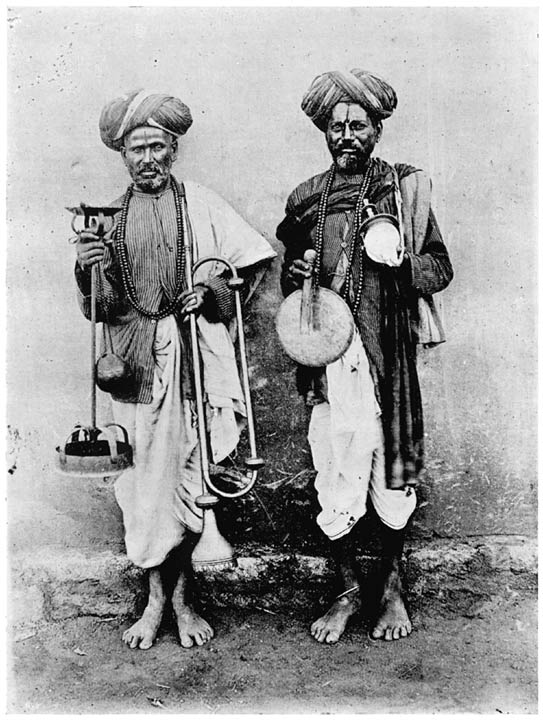
Dāsaris.
When proceeding on a pilgrimage to the temple of Subramanya Swāmi at Palni, some devotees pierce their cheeks with a long silver skewer, which traverses the mouth cavity; pierce the tongue with a silver arrow, which is protruded vertically through the protruded organ; and place a silver shield (mouth-lock) in front of the mouth. Some Dāsaris have permanent holes in their cheeks, into which they insert skewers when they go about the country in pursuit of their profession.
For the following note on Dāsaris in the Vizagapatam district, I am indebted to Mr. C. Hayavadana Rao. The caste is an endogamous unit, the members calling themselves Sankhu (or conch-blowing) Dāsaris, and is divided into numerous exogamous septs. The mēnarikam custom, according to which a man should marry his maternal uncle’s daughter, is followed. The remarriage of widows is permitted, but divorce is forbidden. The dead are cremated, and the chinna (small) and pedda rōzu (big day) death ceremonies are observed. These Dāsaris profess the Tengalai form of Vaishnavism, and get themselves branded. The caste is more secular, and less religious than in the southern districts. A Dāsari of the North Arcot or Anantapur type, with conch-shell, metal gong, iron lamp, copper vessel, and metal image of Hanumān on his neck, is scarcely met with. The Vizagapatam Dāsaris are the most popular among ballad-singers, and sing songs about heroes and heroines, of which the following are the most appreciated:—
1. Bobbilipāta, which describes the siege and conquest of Bobbili by Bussy in 1757.
2. Ammi Nāyudupāta, which describes the tyrannical behaviour of one Ammi Nāyudu, a village headman in the Pālkonda tāluk, who was eventually murdered, to the great relief of those subject to him, by one of his dependents.
3. Lakshmammapāta, which relates the life and death of Lakshmamma, a Velama woman, who went against the mēnarikam custom of the caste, and was put to death by her husband.
4. Yerakammapērantāla-pāta, which recounts the story of one Yerakamma, who committed sati.
Yerakamma is the local goddess at Srungavarapukōta in the Vizagapatam district. The ballads sung about her say that she was the child of Dāsari parents, and that her birth was foretold by a Yerukala woman (whence her name), who prophesied that she would have the gift of second sight. She eventually married, and one day she begged her husband not to go to his field, as she was sure he would be killed by a tiger if he did. Her husband went notwithstanding, and was slain as she had foreseen. She committed sati on the spot where her shrine still stands, and at this there is a festival at Sivarātri.
As ballad-singers, two Dāsaris generally travel about together, begging from house to house, or at the weekly market, one singing, while the other plays, and joins in the chorus.
The titles of these Dāsaris are Anna and Ayya.
Dāsari has been recorded as an exogamous sept of the Koravas, Mālas, and Yerukalas.
Dāsi (servant).—The name for a non-Brāhman female attendant upon a Nambūtiri Brāhman woman, which should not, as sometimes happens, be confused with Dēva-dāsi, (q.v.), which has quite another significance.
Dāyarē (Muhammadan).—The Dāyarē, Daira, or Māhadēv Muhammadans are found in the Bangalore and Mysore districts of the Mysore province. Concerning them, we are informed in the Mysore Gazetteer that “they differ from the general body of Muhammadans in a point of belief concerning the advent of Imām Mahadi. The Dāyarēs maintain that he has visited this earth and departed, while the orthodox Muhammadans believe the Prophet (Imām) has not yet appeared, and that his coming will be a sign of the end of the world. The following account of the origin of this body of dissenters has been related. A child was born of the Sayad sect of Muhammadans at Guzrat about four hundred years ago, who was named Sayad Ahmed, and afterwards became distinguished by the title of Alam (superior to Maulvi) in consequence of his great learning. Sayad Ahmed proclaimed himself the equal of Mahomet, and superior to all other Paigambars or messengers of god. He succeeded in obtaining some followers who believed in him, and repaired to Jivanpur in the Nizam’s territories, where he took the name of Imām Mahadi. From thence he, with some disciples, proceeded to Mecca, but did not visit Medina. After some time he returned to Hyderabad, still retaining the name of Imām Mahadi. Such pretensions could not be tolerated by the great mass of Muhammadans, and Sayad Ahmed, together with his disciples, being worsted in a great religious controversy, was driven out of Hyderabad, and came to Channapatna in the Bangalore district, where they settled. The descendants of these settlers believe that Sayad Ahmed was the Prophet Imām Mahadi predicted in the Korān. They offer prayers in a masjid of their own, separate from other Muhammadans, and do not intermarry with the rest. They are an enterprising body, and carry on a brisk trade in silk with the western coast.” They are mostly domiciled at Channapatna, where a considerable industry in the cocoons of the mulberry silk-moth is carried on.
When an adult Hindu joins the Dāyarēs as a convert, an interesting mock rite of circumcision is performed as a substitute for the real operation. A strip of betel leaf is wrapped round the penis, so that it projects beyond the glans, and is snipped instead of the prepuce.
Like other Muhammadan classes of Southern India, the Dāyarēs are as a whole dolichocephalic. But the frequent occurrence of individuals with a high cephalic index would seem to point to their recruitment from the mesaticephalic or brachycephalic Canarese classes.
Class. Locality. Number examined. Number of times cephalic index exceeded 80.
Māppilla Malabar 40 0
Saiyad Madras 40 2
Pathan Do. 40 2
Sheik Do. 40 2
Dāyarē Mysore 40 8
Dayyālakulam (devil’s family).—Recorded, at times of census, as a sub-caste of Gollas, who are wrestlers and acrobats.
Dedingi.—Recorded as a sub-division of Poroja.
Dēra.—Dēra, Dēndra, and Dēvara occur as synonyms of Dēvānga.
Dēsa.—A sub-division of Balija. Dēsadhipati, denoting ruler of a country, is a name assumed by some Janappans, who say that they are Balijas.
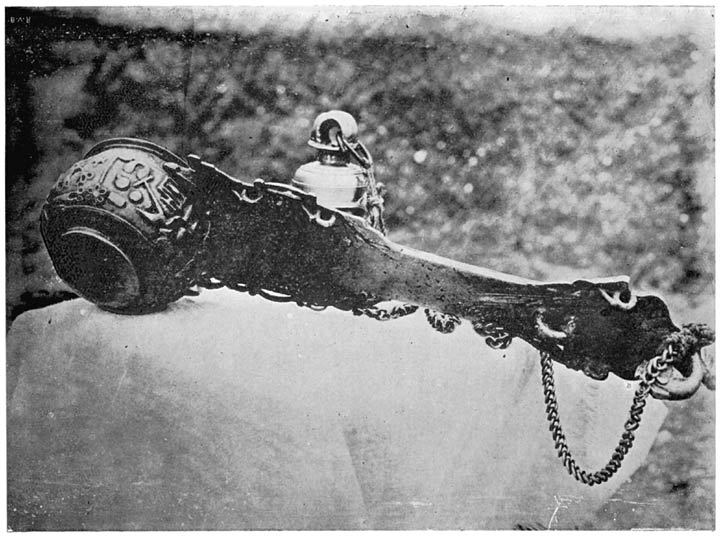
Dēsāyi spoon.
“Every house belonging to the eighteen castes sends to the village representative of the Dēsāyi, who is called Periyatanakāran, a pagoda (Rs. 3–8) in cash, besides rice, dhāl (Cajanus Indicus), and other articles of food for every marriage that takes place, in the village. The representative reserves for himself all the perishable articles, sending only the cash to the Dēsāyi. Thus, for every marriage within his jurisdiction, the Dēsāyi gets one pagoda. Of late, in the case of those Dēsāyis who have purchased their rights as such from the old Dēsāyis, instead of a pagoda, a fee of two annas and a half is levied on each marriage. Every death which occurs in a village is equally a source of income to the Dēsāyi, who receives articles of food, and four annas or more, according to the circumstances of the parties in whose house the death has occurred. As in the case of marriage, the local representative appropriates to himself the articles of food, and transmits the money to the Dēsāyi. The local agent keeps a list of all domestic occurrences that take place in the village, and this list is most carefully scrutinised and checked by the Dēsāyi during his tours, and any amount left unpaid is then collected. Whenever a marriage takes place in his own house, all the houses within his jurisdiction are bound to send him rice, dhāl, and other articles, and any money they can afford to pay. Sometimes rich people send large sums to the Dēsāyi, to enable him to purchase the clothes, jewels, etc., required for the marriage. When a Dēsāyi finds his work too heavy for him to attend to single-handed, he sells a portion of his jurisdiction for some hundreds or thousands of rupees, according to its extent, to some relation. A regular sale deed is executed and registered.” (See also Samaya.)
Dēsikar.—A sub-division and title of Pandāram.
Dēsūr.—The name of a sub-division of Kāpu, which is either territorial, or possibly derived from dēha, body, and sūra, valour.
Dēva-dāsi.—In old Hindu works, seven classes of Dāsis are mentioned, viz., (1) Dattā, or one who gives herself as a gift to a temple; (2) Vikrīta, or one who sells herself for the same purpose; (3) Bhritya, or one who offers herself as a temple servant for the prosperity of her family; (4) Bhakta, or one who joins a temple out of devotion; (5) Hrita, or one who is enticed away, and presented to a temple; (6) Alankāra, or one who, being well trained in her profession, and profusely decked, is presented to a temple by kings and noblemen; (7) Rudraganika or Gopika, who receive regular wages from a temple, and are employed to sing and dance. For the following general account I am indebted to the Madras Census Report, 1901:—
“At the present day they form a regular caste, having its own laws of inheritance, its own customs and rules of etiquette, and its own panchāyats (councils) to see that all these are followed, and thus hold a position, which is perhaps without a parallel in any other country. Dancing-girls, dedicated to the usual profession of the caste, are formally married in a temple to a sword or a god, the tāli (marriage badge) being tied round their necks by some men of their caste. It was a standing puzzle to the census enumerators whether such women should be entered as married in the column referring to civil condition.
“Among the Dāsis, sons and daughters inherit equally, contrary to ordinary Hindu usage. Some of the sons remain in the caste, and live by playing music for the women to dance to, and accompaniments to their songs, or by teaching singing and dancing to the younger girls, and music to the boys. These are called Nattuvans. Others marry some girl of the caste, who is too plain to be likely to be a success in the profession, and drift out of the community. Some of these affix to their names the terms Pillai and Mudali, which are the usual titles of the two castes (Vellāla and Kaikōla) from which most of the Dāsis are recruited, and try to live down the stigma attaching to their birth. Others join the Mēlakkārans or professional musicians. Cases have occurred, in which wealthy sons of dancing-women have been allowed to marry girls of respectable parentage of other castes, but they are very rare. The daughters of the caste, who are brought up to follow the caste profession, are carefully taught dancing, singing, the art of dressing well, and the ars amoris, and their success in keeping up their clientele is largely due to the contrast which they thus present to the ordinary Hindu housewife, whose ideas are bounded by the day’s dinner and the babies. The dancing-girl castes, and their allies the Mēlakkārans, are now practically the sole repository of Indian music, the system of which is probably one of the oldest in the world. Besides them and the Brāhmans, few study the subject. The barbers’ bands of the villages usually display more energy than science. A notable exception, however, exists in Madras city, which has been known to attempt the Dead March in Saul at funerals in the Pariah quarters.
“There are two divisions among the Dāsis, called Valangai (right-hand) and Idangai (left-hand). The chief distinction between them is that the former will have nothing to do with the Kammālans (artisans) or any other of the left-hand castes, or play or sing in their houses. The latter division is not so particular, and its members are consequently sometimes known as the Kammāla Dāsis. Neither division, however, is allowed to have any dealings with men of the lowest castes, and violation of this rule of etiquette is tried by a panchāyat of the caste, and visited with excommunication.
“In the Telugu districts, the dancing-girls are called Bōgams and Sānis. They are supposed to be dedicated to the gods, just as the Dāsis are, but there is only one temple in the northern part of the Presidency which maintains a corps of these women in the manner in vogue further south. This exception is the shrine of Srī Kurmam in Vizagapatam, the dancing-girls attached to which are known as Kurmapus. In Vizagapatam most of the Bōgams and Sānis belong to the Nāgavāsulu and Palli castes, and their male children often call themselves Nāgavāsulus, but in Nellore, Kurnool and Bellary they are often Balijas and Yerukalas. In Nellore the Bōgams are said to decline to sing in the houses of Kōmatis. The men of the Sānis do not act as accompanists to their women at nautch parties, as Bōgam and Dāsi men do.
“In the Oriya country the dancing-girl caste is called Guni, but there they have even less connection with the temples than the Bōgams and Sānis, not being even dedicated to the god.
“In the Canarese (or western) tāluks of Bellary, and in the adjoining parts of Dharwar and Mysore, a curious custom obtains among the Bōyas, Bēdarus, and certain other castes, under which a family which has no male issue must dedicate one of its daughters as a Basavi. The girl is taken to a temple, and married there to the god, a tāli and toe-rings being put on her, and thenceforward she becomes a public woman, except that she does not consort with any one of lower caste than herself. She is not, however, despised on this account, and indeed at weddings she prepares the tāli (perhaps because she can never be a widow). Contrary to all Hindu Law, she shares in the family property as though she was a son, but her right to do so has not yet been confirmed by the Civil Courts. If she has a son, he takes her father’s name, but if only a daughter, that daughter again becomes a Basavi. The children of Basavis marry within their own caste, without restrictions of any kind.
“In Malabar there is no regular community of dancing-girls; nor is there among the Mussalmans of any part of the Presidency.”
In the Travancore Census Report, 1901, the Dāsis of the Coromandel coast are compared, in the words of a Sanskrit poet, to walking flesh-trees bearing golden fruits. The observant Abbé Dubois noticed that, of all the women in India, it is especially the courtesans who are the most decently clothed, as experience has taught them that for a woman to display her charms damps sensual ardour instead of exciting it, and that the imagination is more easily captivated than the eye.
It was noticed by Lord Dufferin, on the occasion of a Viceregal visit to Madura, that the front part of the dress of the dancing-girls hangs in petticoats, but the back is only trousers.
It was unanimously decided, in 1905, by the Executive Committee of the Prince and Princess of Wales’ reception fund, that there should be no performance by nautch girls at the entertainment to be given to Their Royal Highnesses at Madras.
In a note on Basavis, the Collector of the Bellary district writes that “it is usual among Hindus to dedicate a bull for public use on the death of a member of their family. These are the breeding bulls of the village flock. Similarly, cows are dedicated, and are called Basavis. No stigma attaches to Basavis or their children, and they are received on terms of equality by other members of their caste. The origin of the institution, it has been suggested, may probably be traced to the time when the Bōyas, and other castes which dedicate Basavis, were soldiers, and the Basavis acted as camp-followers and nurses of the wounded in battle. According to Hindu custom, the wives of the men could not be taken from their homes, and, other women of the caste being required to attend to their comforts, the institution of Basavis might have been started; or, if they existed before then as religious devotees attached to temples, they might have been pressed into their service, and the number added to as occasion required. In Narayandēvarkeri there are many Bōyas and many Basavis. On the car-festival day, the Bōyas cannot take meals until the car is taken back to its original place after the procession. Sometimes, owing to some accident, this cannot be done the same day, and the car-drawing Bōyas sleep near the car, and do not go to their houses. Then it is their Basavis who bring them food, and not their wives.” At Adoni I have seen a Basavi, who was working at a cotton press for a daily wage of three annas, in full dress on a holiday in honour of a local deity, wearing an elaborately chased silver waist belt and abundant silver jewelry. The following are examples of petitions presented to a European Magistrate and Superintendent of Police by girls who are about to become Basavis:—
Petition of __________ aged about 17 or 18.
I have agreed to become a Basavi, and get myself stamped by my guru (priest) according to the custom of my caste. I request that my proper age, which entitles me to be stamped, may be personally ascertained, and permission granted to be stamped.
The stamping refers to branding with the emblems of the chank and chakram.
Petition of _____ wife of _____.
I have got two daughters, aged 15 and 12 respectively. As I have no male issues, I have got to necessarily celebrate the ceremony in the temple in connection with the tying of the goddess’s tāli to my two daughters under the orders of the guru, in accordance with the customs of my caste. I, therefore, submit this petition for fear that the authorities may raise any objection (under the Age of Consent Act). I, therefore, request that the Honourable Court may be pleased to give permission to the tying of the tāli to my daughters.
Petition of two girls, aged 17 to 19.
Our father and mother are dead. Now we wish to be like prostitutes, as we are not willing to be married, and thus establish our house-name. Our mother also was of this profession. We now request permission to be prostitutes according to our religion, after we are sent before the Medical Officer.
The permission referred to in the above petitions bears reference to a decision of the High Court that, a girl who becomes a Basavi being incapable of contracting a legal marriage, her dedication when a minor is an offence under the Penal Code.
In the Kurnool district, the Basavi system is practised by the Bōyas, but differs from that in vogue in Bellary and Mysore. The object of making a Basavi, in these two localities, is to perpetuate the family when there is no male heir. If the only issue in a family is a female, the family becomes extinct if she marries, as by marriage she changes her sept. To prevent this, she is not married, but dedicated as a Basavi, and continues to belong to her father’s sept, to which also any male issue which is born to her belongs. In the Kurnool district the motive in making Basavis is different. The girl is not wedded to an idol, but, on an auspicious day, is tied by means of a garland of flowers to the garuda kambham (lamp) of a Balija Dāsari. She is released either by the man who is to receive her first favours, or by her maternal uncle. A simple feast is held, and a string of black beads tied round the girl’s neck. She becomes a prostitute, and her children do not marry into respectable Bōya families.
Among the Kaikōlan musicians of Coimbatore, at least one girl in every family should be set apart for the temple service, and she is instructed in music and dancing. At the tāli-tying ceremony she is decorated with jewels, and made to stand on a heap of paddy (unhusked rice). A folded cloth is held before her by two Dāsis, who also stand on heaps of paddy. The girl catches hold of the cloth, and her dancing master, who is seated behind her, grasping her legs, moves them up and down in time with the music which is played. In the evening she is taken, astride a pony, to the temple, where a new cloth for the idol, the tāli, and other articles required for doing pūja (worship) have been got ready. The girl is seated facing the idol, and the officiating Brāhman gives sandal and flowers to her, and ties the tāli, which has been lying at the feet of the idol, round her neck. The tāli consists of a golden disc and black beads. She continues to learn music and dancing, and eventually goes through the form of a nuptial ceremony, The relations are invited on an auspicious day, and the maternal uncle, or his representative, ties a golden band on the girl’s forehead, and, carrying her, places her on a plank before the assembled guests. A Brāhman priest recites mantrams (prayers), and prepares the sacred fire (hōmam). For the actual nuptials a rich Brāhman, if possible, and, if not, a Brāhman of more lowly status is invited. A Brāhman is called in, as he is next in importance to, and the representative of, the idol. As a Dāsi can never become a widow, the beads in her tāli are considered to bring good luck to women who wear them. And some people send the tāli required for a marriage to a Dāsi, who prepares the string for it, and attaches to it black beads from her own tāli. A Dāsi is also deputed to walk at the head of Hindu marriage processions. Married women do not like to do this, as they are not proof against evil omens, which the procession may meet. And it is believed that Dāsis, to whom widowhood is unknown, possess the power of warding off the effects of inauspicious omens. It may be remarked, en passant, that Dāsis are not at the present day so much patronised at Hindu marriages as in olden times. Much is due in this direction to the progress of enlightened ideas, which have of late been strongly put forward by Hindu social reformers. When a Kaikōlan Dāsi dies, her body is covered with a new cloth removed from the idol, and flowers are supplied from the temple, to which she belonged. No pūja is performed in the temple till the corpse is disposed of, as the idol, being her husband, has to observe pollution.
The following account of Dāsis in Travancore, where their total strength is only about four hundred, is taken from a note by Mr. N. Subramani Aiyer. “While the Dāsis of Kartikappalli, Ambalapuzha, and Shertallay belonged originally to the Konkan coast, those of Shenkottah belonged to the Pāndian country. But the South Travancore Dāsis are an indigenous class. The female members of the caste are, besides being known by the ordinary name of Tēvadiyāl and Dāsi, both meaning servant of God, called Kudikkar, meaning those belonging to the house (i.e., given rent free by the Sirkar), and Pendukal, or women, the former of these designations being more popular than the latter. Males are called Tēvadiyan, though many prefer to be known as Nanchināt Vellālas. Males, like these Vellālas, take the title of Pillai. In ancient days Dēva-dāsis, who became experts in singing and dancing, received the title of Rāyar (king) which appears to have been last conferred in 1847 A.D. The South Travancore Dāsis neither interdine nor intermarry with the dancing-girls of the Tamil-speaking districts. They adopt girls only from a particular division of the Nāyars, Tamil Padam, and dance only in temples. Unlike their sisters outside Travancore, they do not accept private engagements in houses on the occasion of marriage. The males, in a few houses, marry the Tamil Padam and Padamangalam Nāyars, while some Padamangalam Nāyars and Nanchināt Vellālas in their turn take their women as wives.
“When a dancing-woman becomes too old or diseased, and thus unable to perform her usual temple duties, she applies to the temple authorities for permission to remove her ear-pendants (todus). The ceremony takes place at the palace of the Mahārāja. At the appointed spot the officers concerned assemble, and the woman, seated on a wooden plank, proceeds to unhook the pendants, and places them, with a nuzzur (gift) of twelve fanams (coins), on the plank. Directly after this she turns about, and walks away without casting a second glance at the ear-ornaments which have been laid down. She becomes immediately a taikkizhavi or old mother, and is supposed to lead a life of retirement and resignation. By way of distinction, a Dāsi in active service is referred to as ātumpātram. Though the ear-ornaments are at once returned to her from the palace, the woman is never again permitted to put them on, but only to wear the pampadam, or antiquated ear-ornament of Tamil Sūdra women. Her temple wages undergo a slight reduction, consequent on her proved incapacity.
“In some temples, as at Kēralapuram, there are two divisions of dancing-girls, one known as the Murakkudi to attend to the daily routine, the other as the Chirappukuti to serve on special occasions. The special duties that may be required of the South Travancore Dāsis are:—(1) to attend the two Utsavas at Sri Padmanābahswāmi’s temple, and the Dusserah at the capital; (2) to meet and escort members of the royal family at their respective village limits; (3) to undertake the prescribed fasts for the Apamargam ceremony in connection with the annual festival of the temple. On these days strict continence is enjoined, and they are fed at the temple, and allowed only one meal a day.
“The principal deities of the dancing-girls are those to whom the temples, in which they are employed, are dedicated. They observe the new and full-moon days, and the last Friday of every month as important. The Onam, Sivarātri, Tye-Pongal, Dīpāvali, and Chitrapurnami are the best recognised religious festivals. Minor deities, such as Bhadrakāli, Yakshi, and Ghandarva are worshipped by the figure of a trident or sword being drawn on the wall of the house, to which food and sweetmeats are offered on Fridays. The priests on these occasions are Ōcchans. There are no recognized headmen in the caste. The services of Brāhmans are resorted to for the purpose of purification, of Nampiyans and Saiva Vellālas for the performance of funeral rites, and of Kurukkals on occasions of marriage, and for the final ceremonies on the sixteenth day after death.
“Girls belonging to this caste may either be dedicated to temple service, or married to a male member of the caste. No woman can be dedicated to the temple after she has reached puberty. On the occasion of marriage, a sum of from fifty to a hundred and fifty rupees is given to the bride’s house, not as a bride-price, but for defraying the marriage expenses. There is a preliminary ceremony of betrothal, and the marriage is celebrated at an auspicious hour. The Kurukkal recites a few hymns, and the ceremonies, which include the tying of the tāli, continue for four days. The couple commence joint life on the sixteenth day after the girl has reached puberty. It is easy enough to get a divorce, as this merely depends upon the will of one of the two parties, and the woman becomes free to receive clothes from another person in token of her having entered into a fresh matrimonial alliance.
“All applications for the presentation of a girl to the temple are made to the temple authorities by the senior dancing-girl of the temple, the girl to be presented being in all cases from six to eight years of age. If she is closely related to the applicant, no enquiries regarding her status and claim need be made. In all other cases, formal investigations are instituted, and the records taken are submitted to the chief revenue officer of the division for orders. Some paddy (rice) and five fanams are given to the family from the temple funds towards the expenses of the ceremony. The practice at the Suchindrum temple is to convene, on an auspicious day, a yōga or meeting, composed of the Valiya Sri-kariyakkar, the Yogattil Potti, the Vattappalli Muttatu, and others, at which the preliminaries are arranged. The girl bathes, and goes to the temple on the morning of the selected day with two new cloths, betel leaves and nuts. The temple priest places the cloths and the tāli at the feet of the image, and sets apart one for the divine use. The tāli consists of a triangular bottu, bearing the image of Ganēsa, with a gold bead on either side. Taking the remaining cloth and the tāli, and sitting close to the girl, the priest, facing to the north, proceeds to officiate. The girl sits, facing the deity, in the inner sanctuary. The priest kindles the fire, and performs all the marriage ceremonies, following the custom of the Tirukkalyānam festival, when Siva is represented as marrying Parvati. He then teaches the girl the Panchakshara hymn if the temple is Saivite, and Ashtakshara if it is Vaishnavite, presents her with the cloth, and ties the tāli round her neck. The Nattuvan, or dancing-master, instructs her for the first time in his art, and a quantity of raw rice is given to her by the temple authorities. The girl, thus married, is taken to her house, where the marriage festivities are celebrated for two or three days. As in Brāhmanical marriages, the rolling of a cocoanut to and fro is gone through, the temple priest or an elderly Dāsi, dressed in male attire, acting the part of the bridegroom. The girl is taken in procession through the streets.
“The birth of male children is not made an occasion for rejoicing, and, as the proverb goes, the lamp on these occasions is only dimly lighted. Inheritance is in the female line, and women are the absolute owners of all property earned. When a dancing-girl dies, some paddy and five fanams are given from the temple to which she was attached, to defray the funeral expenses. The temple priest gives a garland, and a quantity of ashes for decorating the corpse. After this, a Nampiyan, an Ōcchan, some Vellāla headmen, and a Kudikkari, having no pollution, assemble at the house of the deceased. The Nampiyan consecrates a pot of water with prayers, the Ōcchan plays on his musical instrument, and the Vellālas and Kudikkari powder the turmeric to be smeared over the corpse. In the case of temple devotees, their dead bodies must be bathed with this substance by the priest, after which alone the funeral ceremonies may proceed. The Kartā (chief mourner), who is the nearest male relative, has to get his whole head shaved. When a temple priest dies, though he is a Brāhman, the dancing-girl, on whom he has performed the vicarious marriage rite, has to go to his death-bed, and prepare the turmeric powder to be dusted over his corpse. The anniversary of the death of the mother and maternal uncle are invariably observed.
“The adoption of a dancing-girl is a lengthy ceremony. The application to the temple authorities takes the form of a request that the girl to be adopted may be made heir to both kuti and pati, that is, to the house and temple service of the person adopting. The sanction of the authorities having been obtained, all concerned meet at the house of the person who is adopting, a document is executed, and a ceremony, of the nature of the Jātakarma, performed. The girl then goes through the marriage rite, and is handed over to the charge of the music teacher to be regularly trained in her profession.”
Of proverbs relating to dancing-girls, the following may be quoted:—
(2) If the dancing-girl be alive, and her mother dies, there will be beating of drums; but, if the dancing-girl dies, there will be no such display. This is explained by Jensen as meaning that, to secure the favour of a dancing-girl, many men will attend her mother’s funeral; but, if the dancing-girl herself dies, there is nothing to be gained by attending the funeral.
(3) Like a dancing-girl wiping a child. Jensen remarks that a dancing-girl is supposed to have no children, so she does not know how to keep them clean. Said of one who tries to mend a matter, but lacks experience, and makes things worse than they were before.
(4) As when a boy is born in a dancing-girl’s house. Jensen notes that, if dancing-girls have children, they desire to have girls, that they may be brought up to their own profession.
(5) The dancing-girl, who was formerly more than filled with good food in the temple, now turns a somersault to get a poor man’s rice.
(6) If a matron is chaste, she may live in the dancing-girl’s street,
The Dēvādigas or Moilis speak Tulu, and are mainly agriculturists. Their traditional occupation, however, is said to be service in temples (slaves or servants of the dēva or god). A large number of them, both male and female, are engaged as domestic servants. Like the Bants, they follow the aliya santāna law of inheritance (in the female line), and they have the same balis (septs) as the Bants and Billavas. In their marriage ceremonies, they closely imitate the Bants. An interesting feature in connection therewith is that, during the dhāre ceremony, a screen is interposed between the bride and bridegroom at the time when the dhāre water is poured. As a sign of betrothal, a ring is given to the bride-elect, and she wears it on the little finger. The caste is a mixed one, and here and there Dēvādigas are seen to have the typical prominent cheek-bones and square face of the Jains.
In the Census Report, 1901, Dakkera Dēvali, Padarti, and Vālagadava are returned as sub-divisions of Dēvādiga.
Dēvānga.—The Dēvāngas are a caste of weavers, speaking Telugu or Canarese, who are found all over the Madras Presidency. Those whom I studied in the Bellary district connected my operations in a vague way with the pilāg (plague) tax, and collection of subscriptions for the Victoria Memorial. They were employed in weaving women’s sāris in pure cotton, or with a silk border, which were sold to rich merchants in the local bazaar, some of whom belong to the Dēvānga caste. They laughingly said that, though they are professional weavers, they find it cheapest to wear cloths of European manufacture.
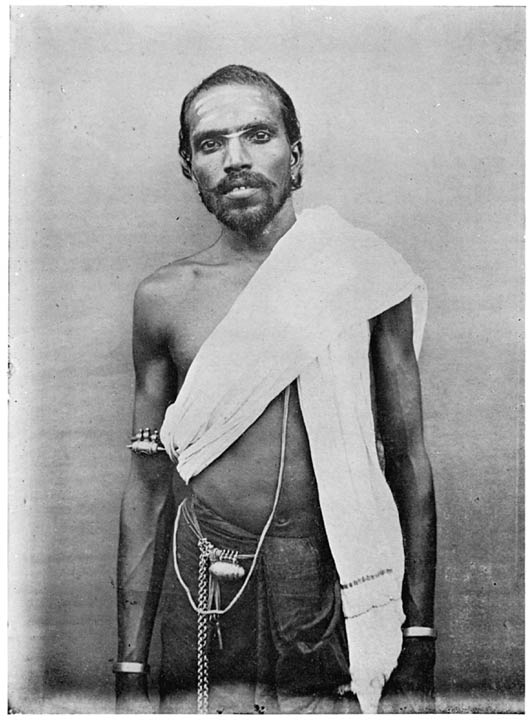
Dēvānga.
The Dēvāngas are also called Jādaru or Jāda (great men), Dēndra, Dēvara, Dēra, Sēniyan, and Sēdan. At Coimbatore, in the Tamil country, they are called Settukkāran (economical people).
The following legend is narrated concerning the origin of the caste. Brahma, having created Manu, told him to weave clothes for Dēvas and men. Accordingly Manu continued to weave for some years, and reached heaven through his piety and virtuous life. There being no one left to weave for them, the Dēvas and men had to wear garments of leaves. Vexed at this, they prayed to Brahma that he would rescue them from their plight. Brahma took them to Siva, who at once created a lustrous spirit, and called him Dēvalan. Struck with the brilliancy thereof, all fled in confusion, excepting Parvati, who remained near Siva. Siva told her that Dēvalan was created to weave clothes, to cover the limbs and bodies of Dēvas and men, whose descendants are in consequence called Dēvāngas (Dēva angam, limb of god). Dēvalan was advised to obtain thread from the lotus stalks springing from the navel of Vishnu, and he secured them after a severe penance. On his way back, he met a Rākshasa, Vajradantan by name, who was doing penance at a hermitage, disguised as a Sanyāsi. Deceived by his appearance, Dēvalan paid homage to him, and determined to spend the night at the hermitage. But, towards the close of the day, the Rishi and his followers threw off their disguise, and appeared in their true colours as Asuras. Dēvalan sought the assistance of Vishnu, and a chakra was given to him, with which he attempted to overthrow the increasing number of Asuras. He then invoked the assistance of Chaudanāyaki or Chaudēswari, who came riding on a lion, and the Asuras were killed off. The mighty Asuras who met their death were Vajradantan (diamond-toothed), Pugainethran (smoke-eyed), Pugaimugan (smoke-faced), Chithrasēnan (leader of armies) and Jeyadrathan (owner of a victory-securing car). The blood of these five was coloured respectively yellow, red, white, green, and black. For dyeing threads of different colours, Dēvalan dipped them in the blood. The Dēvāngas claim to be the descendants of Dēvalan, and say that they are Dēvānga Brāhmans, on the strength of the following stanza, which seems to have been composed by a Dēvānga priest, Sambalinga Murti by name:—
Manu was born in the Brāhman caste.
He was surely a Brāhman in the womb.
There is no Sudraism in this caste.
Dēvanga had the form of Brāhma.
The tribal goddess of the Dēvāngas is Chaudēswari, a form of Kāli or Durga, who is worshipped annually at a festival, in which the entire community takes part either at the temple, or at a house or grove specially prepared for the occasion. During the festival weaving operations cease; and those who take a prominent part in the rites fast, and avoid pollution. The first day is called alagu nilupadam (erecting, or fixing of the sword). The goddess is worshipped, and a sheep or goat sacrificed, unless the settlement is composed of vegetarian Dēvāngas. One man at least from each sept fasts, remains pure, and carries a sword. Inside the temple, or at the spot selected, the pūjari (priest) tries to balance a long sword on its point on the edge of the mouth of a pot, while the alagu men cut their chests with the swords. Failure to balance the sword is believed to be due to pollution brought by somebody to get rid of which the alagu men bathe. Cow’s urine and turmeric water are sprinkled over those assembled, and women are kept at a distance to prevent menstrual or other form of pollution. On the next day, called jothiārambam (jothi, light or splendour) as Chaudēswari is believed to have sprung from jothi, a big mass is made of rice flour, and a wick, fed with ghī (clarified butter) and lighted, is placed in a cavity scooped out therein. This flour lamp must be made by members of a pūjāri’s family assisted sometimes by the alagu boys. In its manufacture, a quantity of rice is steeped in water, and poured on a plantain leaf. Jaggery (crude sugar) is then mixed with it, and, when it is of the proper consistency, it is shaped into a cone, and placed on a silver or brass tray. On the third day, called pānaka pūja or mahānēvedyam, jaggery water is offered, and cocoanuts, and other offerings are laid before the goddess. The rice mass is divided up, and given to the pūjari, setti, alagu men and boys, and to the community, to which small portions are doled out in a particular order, which must be strictly observed. For example, at Tindivānam the order is as follows:—
Setti (headman).
Dhondapu family.
Bapatla family.
Kosanam family.
Modanam family.
Fire-walking does not form part of the festival, as the goddess herself sprang from fire.
In some places in the North Arcot district the festival lasts over ten days, and varies in some points from the above. On the first day, the people go in procession to a jammi (Prosopis spicigera) tree, and worship a decorated pot (kalasam), to which sheep and goats are sacrificed. From the second to the sixth day, the goddess and pot are worshipped daily. On the seventh day, the jammi tree is again visited, and a man carries on his back cooked rice, which may not be placed on the ground, except near the tree, or at the temple. If the rice is not set down en route thereto, it is accepted as a sign that the festival may be proceeded with. Otherwise they would be afraid to light the joti on the ninth day. This is a busy day, and the ceremonies of sandhulu kattadam (binding the corners), alagu erecting, lighting the flour mass, and pot worship are performed. Early in the morning, goats and sheep are killed, outside the village boundary, in the north, east, south, and west corners, and the blood is sprinkled on all sides to keep off all foreign ganams or saktis. The sword business, as already described, is gone through, and certain tests applied to see whether the joti may be lighted. A lime fruit is placed in the region of the navel of the idol, who should throw it down spontaneously. A bundle of betel leaves is cut across with a knife, and the cut ends should unite. If the omens are favourable, the joti is lighted, sheep and goats are killed, and pongal (rice) is offered to the joti. The day closes with worship of the pot. On the last day the rice mass is distributed. All Dēvānga guests from other villages have to be received and treated with respect according to the local rules, which are in force. For this purpose, the community divide their settlements into Sthalams, Pāyakattulu, Galugrāmatulu, Pētalu, and Kurugrāmālu, which have a definite order of precedence.
Among the Dēvāngas the following endogamous sections occur:—(1) Telugu; (2) Canarese; (3) Hathinentu Manayavaru (eighteen house people); (4) Sivachara; (5) Ariya; (6) Kodekal Hatakararu (weavers).
They are practically divided into two linguistic sections, Canarese and Telugu, of which the former have adopted the Brāhmanical ceremonials to a greater extent than the latter, who are more conservative. Those who wear the sacred thread seem to preponderate over the non-thread weavers in the Canarese section. To the thread is sometimes attached metal charm-cylinder to ward off evil spirits.
The following are examples of exogamous septs in the Telugu section:—
Ākāsam, sky. Anumala, seeds of Dolichos lablab. Boggula, charcoal. Bandla, rock or cart. Chintakai, tamarind fruit. Challa, buttermilk. Chapparam, pandal or booth. Dhoddi, cattle-pen, or courtyard. Dhuggāni, money. Yerra, red. Konda, mountain. Kaththi, knife. Bandāri (treasurer). Būsam, grain. Dhondapu (Cephalandra indica). Elugoti, assembly. Gattu, bank or mound. Paidam, money. Gonapala, old plough. Gosu, pride. Jigala, pith. Katta, a dam. Kompala, houses. Kōnangi, buffoon. Kātikala, collyrium. Kaththiri, scissors. Mōksham, heaven. Pasupala, turmeric. Pidakala, dried cow-dung cakes. Pōthula, male. Pachi powaku, green tobacco. Padavala, boat. Pouzala, a bird. Pammi, clay lamp. Thalakōka, female cloth. Thūtla, hole. Utla, ropes for hanging pots. Vasthrāla, cloths. Matam, monastery. Madira, liquor or heap of earth. Mēdam, fight. Māsila, dirt. Olikala, funeral pyre and ashes. Prithvi, earth. Peraka, tile. Punjala, cock or male. Pinjala, cotton-cleaning. Pichchiga, sparrow. Sika (kudumi: tuft of hair). Sandala, lanes. Santha, a fair. Sajje (Setaria italica).
The majority of Dēvāngas are Saivites, and wear the lingam. They do not, however, wash the stone lingam with water, in which the feet of Jangams have been washed. They are not particular as to always keeping the lingam on the body, and give as an explanation that, when they are at work, they have to touch all kinds of people. Some said that merchants, when engaged in their business, should not wear the lingam, especially if made of spatikam (quartz), as they have to tell untruths as regards the value and quality of their goods, and ruin would follow if these were told while the lingam was on the body.
In some parts of Ganjam, the country folk keep a large number of Brāhmini bulls. When one of these animals dies, very elaborate funeral ceremonies take place, and the dead beast is carried in procession by Dēvāngas, and buried by them. As the Dēvāngas are Lingāyats, they have a special reverence for Basavanna, the sacred bull, and the burying of the Brāhmini bull is regarded by them as a sacred and meritorious act. Other castes do not regard it as such, though they often set free sacred cows or calves.
Dēvāngas and Padma Sālēs never live in the same street, and do not draw water from the same well. This is probably due to the fact that they belong to the left and right-hand factions respectively, and no love is lost between them. Like other left-hand castes, Dēvāngas have their own dancing-girls, called Jāthi-biddalu (children of the castes), whose male offspring do achchupani, printing-work on cloth, and occasionally go about begging from Dēvāngas. In the Madras Census Report, 1901, it is stated that “in Madura and Tinnevelly, the Dēvāngas, or Sēdans, consider themselves a shade superior to the Brāhmans, and never do namaskāram (obeisance or salutation) to them, or employ them as priests. In Madura and Coimbatore, the Sēdans have their own dancing-girls, who are called Dēvānga or Sēda Dāsis in the former, and Mānikkāttāl in the latter, and are strictly reserved for members of the caste under pain of excommunication or heavy fine.”
Concerning the origin of the Dēvānga beggars, called Singamvādu, the following legend is current. When Chaudēswari and Dēvālan were engaged in combat with the Asuras, one of the Asuras hid himself behind the ear of the lion, on which the goddess was seated. When the fight was over, he came out, and asked for pardon. The goddess took pity on him, and ordered that his descendants should be called Singamvāllu, and asked Dēvālan to treat them as servants, and support them. Dēvāngas give money to these beggars, who have the privilege of locking the door, and carrying away the food, when the castemen take their meals. In assemblies of Dēvāngas, the hand of the beggar serves as a spittoon. He conveys the news of death, and has as the insignia of office a horn, called thuththari or singam.
The office of headman, or Pattagar, is hereditary, and he is assisted by an official called Sesha-rāju or Umidisetti who is the servant of the community, and receives a small fee annually for each loom within his beat.
Widow remarriage is permitted in some places, and forbidden in others. There may be intermarriage between the flesh-eating and vegetarian sections. But a girl who belongs to a flesh-eating family, and marries into a vegetarian family, must abstain from meat, and may not touch any vessel or food in her husband’s family till she has reached puberty. Before settling the marriage of a girl, some village goddess, or Chaudēswari, is consulted, and the omens are watched. A lizard chirping on the right is a good omen, and on the left bad. Sometimes, red and white flowers, wrapped up in green leaves, are thrown in front of the idol, and the omen considered good or bad according to the flower which a boy or girl picks up. At the marriage ceremony which commences with distribution of pān-supāri (betel) and Vignēswara worship, the bride is presented with a new cloth, and sits on a three-legged stool or cloth-roller (dhonige). The maternal uncle puts round her neck a bondhu (strings of unbleached cotton) dipped in turmeric. The ceremonies are carried out according to the Purānic ritual, except by those who consider themselves to be Dēvānga Brāhmans. On the first day the milk post is set up being made of Odina Wodier in the Tamil, and Mimusops hexandra in the Telugu country. Various rites are performed, which include tonsure, upanāyanam (wearing the sacred thread), pādapūja (washing the feet), Kāsiyātra (mock pilgrimage to Benares), dhārādhattam (giving away the bride), and māngalyadhāranam (tying the marriage badge, or bottu). The proceedings conclude with pot searching. A pap-bowl and ring are put into a pot. If the bride picks out the bowl, her first-born will be a girl, and if the bridegroom gets hold of the ring, it will be a boy. On the fifth day, a square design is made on the floor with coloured rice grains. Between the contracting couple and the square a row of lights is placed. Four pots are set, one at each corner of the square, and eight pots arranged along each side thereof. On the square itself, two pots representing Siva and Uma, are placed, with a row of seedling pots near them. A thread is wound nine times round the pots representing the god and goddess, and tied above to the pandal. After the pots have been worshipped, the thread is cut, and worn, with the sacred thread, for three months. This ceremony is called Nāgavali.
When a girl reaches puberty, a twig of Alangium Lamarckii is placed in the menstrual hut to keep off devils.
The dead are generally buried in a sitting posture. Before the grave is filled in, a string is tied to the kudumi (hair knot) of the corpse, and, by its means, the head is brought near the surface. Over it a lingam is set up, and worshipped daily throughout the death ceremonies.
The following curious custom is described by Mr. C. Hayavadana Rao. Once in twelve years, a Dēvānga leaves his home, and joins the Padma Sālēs. He begs from them, saying that he is the son of their caste, and as such entitled to be supported by them. If alms are not forthcoming, he enters the house, and carries off whatever he may be able to pick up. Sometimes, if he can get nothing else, he has been known to seize a lighted cigar in the mouth of a Sālē, and run off with it. The origin of this custom is not certain, but it has been suggested that the Dēvāngas and Sālēs were originally one caste, and that the former separated from the latter when they became Lingāyats. A Dēvānga only becomes a Chinērigādu when he is advanced in years, and will eat the remnants of food left by Padma Sālēs on their plates. A Chinērigādu is, on his death, buried by the Sālēs.
Many of the Dēvāngas are short of stature, light skinned, with sharp-cut features, light-brown iris, and delicate tapering fingers. Those at Hospet, in the Bellary district, carried thorn tweezers (for removing thorns of Acacia arabica from the feet), tooth-pick and ear-scoop, suspended as a chatelaine from the loin-string. The more well-to-do had these articles made of silver, with the addition of a silver saw for paring the nails and cutting cheroots. The name Pampanna, which some of them bore, is connected with the nymph Pampa, who resides at Hampi, and asked Paramēswara to become her husband. He accordingly assumed the name of Pampāpathi, in whose honour there is a tank at Anagūndi, and temple at Hampi. He directed Pampa to live in a pond, and pass by the name of Pampasarovara.
The Sēdans of Coimbatore, at the time of my visit in October, were hard at work making clothes for the Dīpāvali festival. It is at times of festivals and marriages, in years of prosperity among the people, that the weavers reap their richest harvest.
In the Madras Census Report, 1901, Bilimagga (white loom) and Atagāra (weavers and exorcists) are returned as sub-castes of Dēvānga. The usual title of the Dēvāngas is Chetti.
The shortness of stature of some of the weaving classes which I have examined is brought out by the following average measurements:—
cm.
Padma Sālē 159.9
Sūkūn Sālē 160.3
Togata 160.5
Suka Sālē 161.1
Dēvēndra.—A name assumed by some Pallans, who claim to be descended from the king of the gods (dēvas).
Dhabba (split bamboo).—Dhabba or Dhabbai is the name of a sub-division of Koravas, who split bamboos, and make various articles therefrom.
Dhakkado.—A small mixed class of Oriya cultivators, concerning whom there is a proverb that a Dhakkado does not know his father. They are described, in the Census Report, 1891, as “a caste of cultivators found in the Jeypore agency tracts. They are said to be the offspring of a Brāhman and a Sūdra girl, and, though living on the hills, they are not an uncivilised hill tribe. Some prepare and sell the sacred thread, others are confectioners. They wear the sacred thread, and do not drink water from the hands of any except Brāhmans. Girls are married before puberty, and widow marriage is practiced. They are flesh-eaters, and their dead are usually buried.”
In a note on the Dhakkados, Mr. C. Hayavadana Rao writes that “the illegitimate descendant of a Brāhman and a hill woman of the non-polluting castes is said to be known as a Dhakkado. The Dhakkados assume Brāhmanical names, but, as regards marriages, funerals, etc., follow the customs of their mother’s caste. Her caste people intermarry with her children. A Dhakkado usually follows the occupation of his mother’s caste. Thus one whose mother is a Kevuto follows the calling of fishing or plying boats on rivers, one whose mother is a Bhumia is an agriculturist, and so on.”
Dhakūr.—Stated, in the Manual of the Vizagapatam district, to be illegitimate children of Brāhmans, who wear the paieta (sacred thread).
Dhanapāla.—A sub-division of Gollas, who guard treasure while it is in transit.
Dhaniāla (coriander).—An exogamous sept of Kamma. Dhaniāla Jāti, or coriander caste, is an opprobrious name applied to Kōmatis, indicating that, in business transactions, they must be crushed as coriander fruits are crushed before the seed is sown.
Dhāre.—An exogamous sept of Kuruba. In the Canara country, the essential and binding part of the marriage ceremony is called dhāre (see Bant).
Dharmarāja.—An exogamous sept of the Irulas of North Arcot. Dharmarāja was the eldest of the five Pāndavas, the heroes of the Mahābhāratha.
Dhippo (light).—An exogamous sept of Bhondāri. The members thereof may not blow out lights, or extinguish them in any other way. They will not light lamps without being madi, i.e., wearing silk cloths, or cloths washed and dried after bathing.
Get a new washerman, and an old barber.
The washerman knows the defects of the village (i.e., he learns a good deal about the private affairs of the various families, when receiving and delivering the clothes).
When a washerman gets sick, his sickness must leave him at the stone. The stone referred to is the large stone, on which the washerman cleans cloths, and the proverb denotes that, however sick a washerman may be, his work must be done.
Dhoddi.—Dhoddi, meaning a court or back-yard, cattle-pen, or sheep-fold, has been recorded as an exogamous sept of Dēvānga, Koppala Velama, Kama Sālē, Māla, and Yānādi.
Dhoddiyan.—A name given by Tamilians to Jōgis.
Dhollo.—Dhollo is recorded in the Madras Census Report, 1901, as the same as Doluva. A correspondent informs me that Dhollo is said to be different from Doluva.
Dhōma (gnat or mosquito).—An exogamous sept of Māla.
Dhondapu (Cephalandra indica).—An exogamous sept of Dēvānga. The fruit is one of the commonest of native vegetables, and cooked in curries.
Dhōni (boat).—An exogamous sept of Mīla and Oruganti Kāpu. In a paper on the native vessels of South India by Mr. Edge, published in the Journal of the Royal Asiatic Society, the dhōni is described as “a vessel of ark-like form, about 70 feet long, 20 feet broad, and 11 feet deep, with a flat bottom or keel part, which at the broadest place is 7 feet.
“The whole equipment of these rude vessels, as well as their construction, is the most coarse and unseaworthy that I have ever seen.” The dhōni, with masts, is represented in the ancient lead and copper coinage of Southern India.
Dhor.—In the Madras Census Report, 1901, a few (164) individuals were returned as “Dhēr, a low caste of Marāthi leather workers.” They were, I gather from the Bombay Gazetteer, Dhors or tanners who dwell in various parts of the Bombay Presidency, and whose home speech, names and surnames seem to show that they have come from the Marātha country.
Dhūdala (calves).—An exogamous sept of Thūmati Golla.
Dhudho (milk).—A sept of Omanaito.
Dhuggāni (money).—An exogamous sept of Dēvānga.
Didāvi.—A sub-division of Poroja.
Dīvar.—See Dēva.
Diyāsi.—An exogamous sept of Dandāsi. The members thereof show special reverence for the sun, and cloths, mokkutos (forehead chaplets), garlands, and other articles to be used by the bride and bridegroom at a wedding are placed outside the house, so that they may be exposed to it.
Dolaiya.—A title of Doluva and Odia.
Dolobēhara.—The name of headmen or their assistants among many Oriya castes. In some cases, e.g., among the Haddis, the name is used as a title by families, members of which are headmen.
Doluva.—The Doluvas of Ganjam are, according to the Madras Census Report, 1891, “supposed to be the descendants of the old Rājahs by their concubines, and were employed as soldiers and attendants. The name is said to be derived from the Sanskrit dola, meaning army.” The Doluvas claim to be descended from the Puri Rājahs by their concubines, and say that some of them were employed as sirdars and paiks under these Rājahs. They are said to have accompanied a certain Puri Rājah who came south to wage war, and to have settled in Ganjam. They are at the present day mainly engaged in agriculture, though some are traders, bricklayers, cart-drivers, etc. The caste seems to be divided into five sections, named Kondaiyito, Lenka, Rabba, Pottia, and Beharania, of which the first two are numerically the strongest and most widely distributed. Kondaiyito is said to be derived from kondo, an arrow, and to indicate warrior. The Kondaiyitos sometimes style themselves Rājah Doluvas, and claim superiority over the other sections. It is noted, in the Madras Census Report, 1891, that “Oriya Zamindars get wives from this sub-division, but the men of it cannot marry into the Zamindar’s families. They wear the sacred thread, and are writers.” In former days, the title writer was applied to the junior grade of Civil Servants of the East India Company. It is now used to denote a copying clerk in an office.
Various titles occur among members of the caste, e.g., Bissoyi, Biswālo, Dolei, Jenna, Kottiya, Mahanti, Majhi, Nāhako, Porida, Rāvuto, Sāmulo, and Sāni.
The ordinary caste council system, with a hereditary headman, seems to be absent among the Doluvas, and the affairs of the caste are settled by leading members thereof.
The Doluvas are Paramarthos, following the Chaitanya form of Vaishnavism, and wearing a rosary of tulsi (Ocimum sanctum) beads. They further worship various Tākurānis (village deities), among which are Kālva, Bāgadēvi, Kotari, Mahēswari, and Manickēswari. They are in some places very particular regarding the performance of srādh (memorial ceremony), which is carried out annually in the following manner. On the night before the srādh day, a room is prepared for the reception of the soul of the deceased. This room is called pitru bharano (reception of the ancestor). The floor thereof is cleansed with cow-dung water, and a lamp fed with ghī (clarified butter) is placed on it by the side of a plank. On this plank a new cloth is laid for the reception of various articles for worship, e.g., sacred grass, Zizyphus jujuba leaves, flowers, etc. In front of the plank a brass vessel, containing water and a tooth brush of Achyranthes aspera root, is placed. The dead person’s son throws rice and Zizyphus leaves into the air, and calls on the deceased to come and give a blessing on the following day. The room is then locked, and the lamp kept burning in it throughout the night. On the following day, all old pots are thrown away and, after a small space has been cleaned on the floor of the house, a pattern is drawn thereon with flour in the form of a square or oblong with twelve divisions. On each division a jak (Artocarpus integrifolia) leaf is placed, and on each leaf the son puts cooked rice and vegetables. A vessel containing Achyranthes root, and a plank with a new cloth on it, are set by the side of the pattern. After worship has been performed and food offered, the cloth is presented to a Brāhman, and the various articles used in the ceremonial are thrown into water.
cm.
Stature 161.9
Cephalic length 18.8
Cephalic breadth 14.3
Cephalic index 75.6
Nasal index 86.5
For the following note on the Dōmbs, I am indebted to Mr. C. Hayavadana Rao. They are the weavers, traders, musicians, beggars, and money-lenders of the hills. Some own cattle, and cultivate. The hill people in the interior are entirely dependent on them for their clothing. A few Dōmb families are generally found to each village. They act as middlemen between the hill people and the Kōmati traders. Their profits are said to be large, and their children are, in some places, found attending hill schools. As musicians, they play on the drum and pipe. They are the hereditary musicians of the Mahārāja of Jeypore. A Dōmb beggar, when engaged in his professional calling, goes about from door to door, playing on a little pipe. Their supposed powers over devils and witches result in their being consulted when troubles appear. Though the Dōmbs are regarded as a low and polluting class, they will not eat at the hands of Kōmatis, Bhondāris, or Ghāsis. Some Dōmbas have become converts to Christianity through missionary influence.
In the Madras Census Report, 1891, the following sections of the Dōmbs are recorded:—Onomia, Odia, Māndiri, Mirgām, and Kohara. The sub-divisions, however, seem to be as follows:—Mirigāni, Kobbiriya, Odiya, Sōdabisiya, Māndiri, and Andiniya. There are also various septs, of which the following have been recorded among the Odiyas:—Bhāg (tiger), Bālu (bear), Nāg (cobra), Hanumān (the monkey god), Kochchipo (tortoise), Bengri (frog), Kukra (dog), Surya (sun), Matsya (fish), and Jaikonda (lizard). It is noted by Mr. Fawcett that “monkeys, frogs, and cobras are taboo, and also the sunāri tree (Ochna squarrosa). The big lizard, cobras, frogs, and the crabs which are found in the paddy fields, and are usually eaten by jungle people, may not be eaten.”
When a girl reaches puberty, she remains outside the hut for five days, and then bathes at the nearest stream, and is presented with a new cloth. In honour of the event, drink is distributed among her relatives. Girls are usually married after puberty. A man can claim his paternal aunt’s daughter in marriage. When a proposal of marriage is to be made, the suitor carries some pots of liquor, usually worth two rupees, to the girl’s house, and deposits them in front of it. If her parents consent to the match, they take the pots inside, and drink some of the liquor. After some time has elapsed, more liquor, worth five rupees, is taken to the girl’s house. A reduction in the quantity of liquor is made when a man is proposing for the hand of his paternal aunt’s daughter, and, on the second occasion, the liquor will only be worth three rupees. A similar reduction is made in the jholla tonka, or bride price. On the wedding day, the bridegroom goes, accompanied by his relations, to the bride’s home, where, at the auspicious moment fixed by the Desāri, his father presents new cloths to himself and the bride, which they put on. They stand before the hut, and on each is placed a cloth with a myrabolam (Terminalia) seed, rice, and a few copper coins tied up in it. The bridegroom’s right little finger is linked with the left little finger of the bride, and they enter the hut. On the following day, the newly married couple repair to the home of the bridegroom. On the third day, they are bathed in turmeric water, a pig is killed, and a feast is held. On the ninth day, the knots in the cloths, containing the myrabolams, rice, and coins, are untied, and the marriage ceremonies are at an end. The remarriage of widows is permitted, and a younger brother usually marries the widow of his elder brother.
It is noted, in the Gazetteer of the Vizagapatam district, that “some of the Dōmbus of the Parvatipur Agency follow many of the customs of the low-country castes, including mēnarikam (marriage with the maternal uncle’s daughter), and say they are the same as the Paidis (or Paidi Mālas) of the plains adjoining, with whom they intermarry.”
The corpses of the more prosperous Dōmbs are usually cremated. The wood of the sunāri tree and relli (Cassia fistula) may not be used for the pyre. The son or husband of a deceased person has his head, moustache, and armpits shaved on the tenth day.
Dōmb women, and women of other tribes in the Jeypore Agency tracts, wear silver ear ornaments called nāgul, representing a cobra just about to strike with tongue protruded. Similar ornaments of gold, called nāga pōgulu (cobra-shaped earrings), are worn by women of some Telugu castes in the plains of Vizagapatam.
The personal names of the Dōmbs are, as among other Oriya castes, often those of the day of the week on which the individual was born.
Concerning the religion of the Dōmbs, Mr. Fawcett notes that “their chief god—probably an ancestral spirit—is called Kaluga. There is one in each village, in the headman’s house. The deity is represented by a pie piece (copper coin), placed in or over a new earthen pot smeared with rice and turmeric powder. During worship, a silk cloth, a new cloth, or a wet cloth may be worn, but one must not dress in leaves. Before the mangoes are eaten, the first-fruits are offered to the moon, at the full moon of the month Chitra.”
“When,” Gloyer writes, “a house has to be built, the first thing is to select a favourable spot, to which few evil spirits (dūmas) resort. At this spot they put, in several places, three grains of rice arranged in such a way that the two lower grains support the upper one. To protect the grains, they pile up stones round them, and the whole is lightly covered with earth. When, after some time, they find on inspection that the upper grain has fallen off, the spot is regarded as unlucky, and must not be used. If the position of the grains remains unchanged, the omen is regarded as auspicious. They drive in the first post, which must have a certain length, say of five, seven, or nine ells, the ell being measured from the tip of the middle finger to the elbow. The post is covered on the top with rice straw, leaves, and shrubs, so that birds may not foul it, which would be regarded as an evil omen. [In Madras, a story is current, with reference to the statue of Sir Thomas Munro, that he seized upon all the rice depôts, and starved the people to death by selling rice in egg-shells at one shell for a rupee, and, to punish him, the Government erected the statue in an open place, so that the birds of the air might insult him by polluting his face.] In measuring the house, odd numbers play an important part. The number four (pura, or full number), however, forms the proper measurement, whereby they measure the size of the house, according to the pleasure of the builder. But now the Dissary (Dēsāri) decides whether the house shall be built on the nandi, dua, or tia system, nandi signifying one, dua two, and tia three. This number of ells must be added to the measurement of the house. Supposing that the length of the house is twelve ells, then it will be necessary to add one ell according to the nandi system, so that the length amounts to thirteen ells. The number four can only be used for stables.”
“The Dūmas,” Gloyer continues, “are represented as souls of the deceased, which roam about without a home, so as to cause to mankind all possible harm. At the birth of a child, the Dūma must be invited in a friendly manner to provide the child with a soul, and protect it against evil. For this purpose, a fowl is killed on the ninth day, a bone (beinknochen) detached, and pressed in to the hand of the infant. The relations are seated in solemn silence, and utter the formula:—When grandfather, grandmother, father, or brother comes, throw away the bone, and we will truly believe it. No sooner does the sprawling and excited infant drop the bone, than the Dūmas are come, and boisterous glee prevails. The Dūmas occasionally give vent to their ghostly sounds, and cause no little consternation among the inmates of a house, who hide from fear. Cunning thieves know how to rob the superstitious by employing instruments with a subdued tone (dumpftönende), or by emitting deep sounds from the chest. The yearly sacrifice to a Dūma consists of a black fowl and strong brandy. If a member of a family falls ill, an extraordinary sacrifice has to be offered up. The Dūma is not regarded only as an evil spirit, but also as a tutelary deity. He protects one against the treacherous attacks of witches. A place is prepared for him in the door-hinge, or a fishing-net, wherein he lives, is placed over the door. The witches must count all the knots of the net, before they can enter. Devil worship is closely connected with that of the Dūma. The devil’s priests, and in rare cases priestesses, effect communion between the people and the Dūmas by a sort of possession, which the spirit, entering into them, is said to give rise to. This condition, which is produced by intoxicating drink and the fumes of burning incense, gives rise to revolting cramp-like contortions, and muscular quiverings. In this state, they are wont to communicate what sacrifices the spirits require. On special occasions, they fall into a frenzied state, in which they cut their flesh with sharp instruments, or pass long, thin iron bars through the tongue and cheeks, during which operation no blood must flow. For this purpose, the instruments are rubbed all over with some blood-congealing material or sap. They also affect sitting on a sacred swing, armed with long iron nails. [Mr. G. F. Paddison informs me that he once saw a villager in the Vizagapatam district, sitting outside the house, while groans proceeded from within. He explained that he was ill, and his wife was swinging on nails with their points upwards, to cure him.] The devil called Jom Duto, or messenger of the going, is believed to be a one-eyed, limping, black individual, whose hair is twisted into a frightfully long horn, while one foot is very long, and the other resembles the hoof of a buffalo. He makes his appearance at the death-bed, in order to drag his victim to the realm of torture.”
Mr. Paddison tells me that some Dōmbs are reputed to be able to pour blazing oil over their bodies, without suffering any hurt; and one man is said to have had a miraculous power of hardening his skin, so that any one could have a free shot at him, without hurting him. He further narrates that, at Sujanakōta in the Vizagapatam district, the Dōmbs, notwithstanding frequent warnings, put devils into two successive schoolmasters.
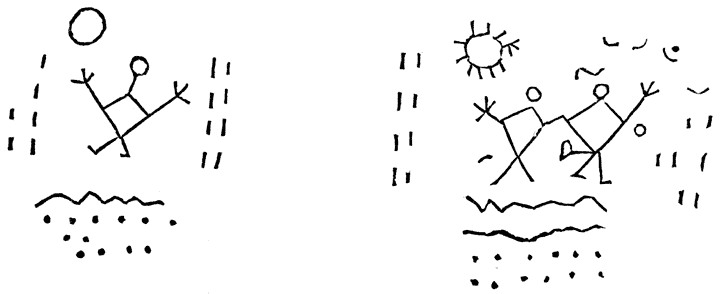
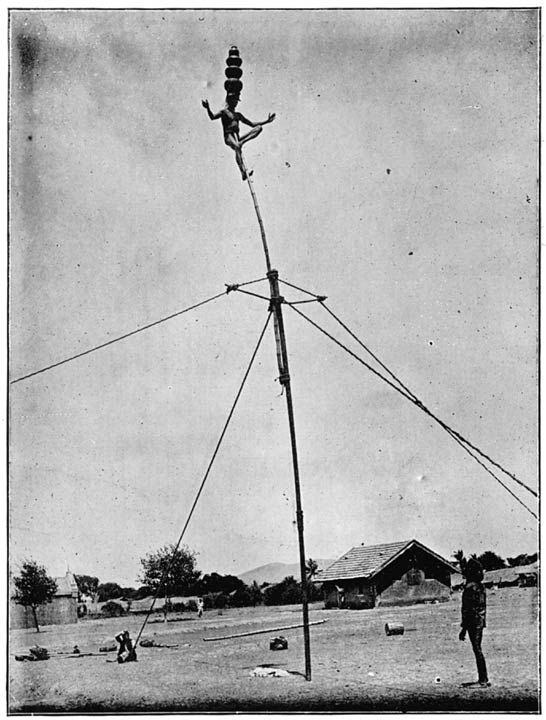
Ārē Dommara acrobat.
The Dommaras are, in the Mysore Census Report, 1901, summed up as being buffoons, tumblers, acrobats, and snakecharmers, who travel from place to place, and earn a precarious living by their exhibitions. In the Madras Census Report, 1901, Domban, Kalaikūttādi (pole-dancer), and Ārya Kūttādi, are given as synonyms of Dommara. The Kūttādi are summed up, in the Tanjore Manual, as vagabond dancers, actors, pantomimists, and marionette exhibitors, who hold a very low position in the social scale, and always perform in public streets and bazaars.
It is noted, in the Nellore Manual, that the Dommaras “are stated by the Nellore Tahsildar to possess mirāsi rights in some villages; that I take to mean that there is, in some villages, a customary contribution for tumblers and mendicants, which, according to Wilson, was made in Mysore the pretext for a tax named Dombar-lingada-vira-kaniki. This tax, under the name Dombar tafrik, was levied in Venkatagiri in 1801.” In the Madura district, Dommaras are found in some villages formerly owned by zamindars, and they call themselves children of the zamindars, by whom they were probably patronised.
Being a criminal class, the Dommaras have a thief’s language of their own, of which the following are examples:—
Bidam vadu, Dommara.
Poothi, policeman.
Marigam, pig.
Goparam, seven.
Dāsa-masa, prostitute.
Kopparam, salt.
Kaljodu, goldsmith.
The Dommaras are said to receive into their community children of other castes, and women of doubtful morals, and to practice the custom of making Basavis (dedicated prostitutes).
The Telugu Dommaras give as their gōtra Salava patchi, the name of a mythological bird. At times of marriage, they substitute a turmeric-dyed string consisting of 101 threads, called bondhu, for the golden tāli or bottu. The marriage ceremonies of the Ārē Dommaras are supervised by an old Basavi woman, and the golden marriage badge is tied round the bride’s neck by a Basavi.
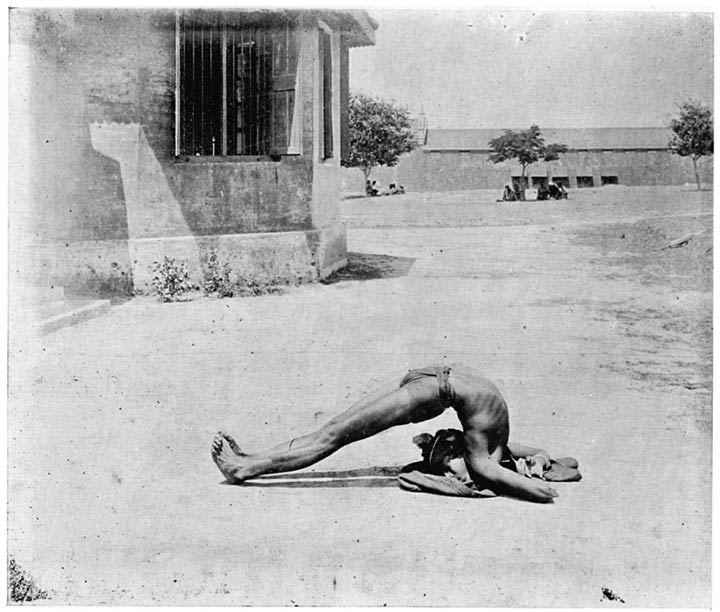
Ārē Dommara acrobat.
A Dommara, whom I interviewed at Coimbatore, carried a cotton bag containing a miscellaneous assortment of rubbish used in his capacity as medicine man and snake-charmer, which included a collection of spurious jackal horns (nari kompu), the hairs round which were stained with turmeric. To prove the genuineness thereof, he showed me not only the horn, but also the feet with nails complete, as evidence that the horns were not made from the nails. Being charged with manufacturing the horns, he swore, by placing his hand on the head of a child who accompanied him, that he was not deceiving me. The largest of the horns in his bag, he gravely informed me, was from a jackal which he dug out of its hole on the last new moon night. The possessors of such horns, he assured me, do not go out with the pack, and rarely leave their holes except to feed on dew, field rats, etc. These spurious horns are regarded as a talisman, and it is believed that he who owns one can command the realisation of every wish. (See Kuruvikkāran.) An iron ring, which the Dommara was wearing on his wrist, was used as a cure for hernia, being heated and applied as a branding agent over the inguinal region. Lamp oil is then rubbed over the burn, and a secret medicine, mixed with fowl’s egg, administered. The ring was, he said, an ancestral heir-loom, and as such highly prized. To cure rheumatism in the big joints, he resorted to an ingenious form of dry cupping. A small incision is made with a piece of broken glass over the affected part, and the skin damped with water. The distal end of a cow’s horn, of which the tip has been removed, and plugged with wax, does duty for the cup. A hole is pierced through the wax with an iron needle, and, the horn being placed over the seat of disease, the air is withdrawn from it by suction with the mouth, and the hole in the wax stopped up. As the air is removed from the cavity of the horn, the skin rises up within it. To remove the horn, it is only necessary to readmit air by once more boring a hole through the wax. In a bad case, as many as three horns may be applied to the affected part. The Pitt Rivers Museum at Oxford possesses dry-cupping apparatus, made of cow horn, from Mirzapur in Northern India and from Natal, and of antelope horn from an unrecorded locality in India. In cases of scorpion sting the Dommara rubbed up patent boluses with human milk or milk of the milk-hedge plant (Euphorbia Tirucalli), and applied them to the part. For chest pains he prescribed red ochre, and for infantile diseases myrabolam (Terminalia) fruits mixed with water. In cases of snake-bite, a black stone, said to be made of various drugs mixed together, and burnt, is placed over the seat of the bite, and will, it was stated, drop off of its own accord as soon as it has absorbed all the poison. It is then put into milk or water to extract the poison, and the fluid is thrown away as being dangerous to life if swallowed. As a remedy for the bite of a mad dog, a plant, which is kept a secret, is mixed with the milk of a white goat, pepper, garlic, and other ingredients, and administered internally. A single dose is said to effect a cure.
At Tarikēri in Mysore, a wandering troupe of Ārē (Marātha) Dommaras performed before me. The women were decorated with jewels and flowers, and carried bells on their ankles. The men had a row of bells attached all round the lower edge of their short drawers. Before the performance commenced, a Pillayar (Ganēsa) was made with cowdung, and saluted. The entertainment took place in the open air amid the beating of drums, whistling, singing, and dialogue. The jests and antics of the equivalent of the circus clown were a source of much joy to the throng of villagers who collected to witness the tamāsha (spectacle). One of the principal performers, in the waits between his turns, played the drum, or took a suck at a hooka (tobacco pipe) which was passed round among the members of the troupe. The entertainment, in which both men and women took part, consisted of various acrobatic feats, turning summersaults and catherine wheels, stilt-walking, and clever feats on the tight rope. Finally a man, climbing up a lofty bamboo pole, spun himself rapidly round and round on the top of it by means of a socket in an iron plate tied to his loin cloth, into which a spike in the pole fitted.
Dondia.—A title of Gaudo.
Donga Oddē.—The name for Oddēs who practice thieving as a profession.
Dongayato.—A sub-division of Gaudo.
Dongrudiya.—A sub-division of Māli.
Dora.—Dora, meaning lord, has been returned as the title of numerous classes, which include Bōya, Ekāri, Jātāpu, Konda Dora, Mutrācha, Patra, Telaga, Velama, and Yānāti. The hill Kois or Koyis of the Godāvari district are known as Koi Dora or Doralu (lords). I am told that, in some parts of the Telugu country, if one hears a native referred to as Dora, he will generally turn out to be a Velama; and that there is the following gradation in the social scale:—
Velama Dora = Velama Esquire.
Kamma Vāru = Mr. Kamma.
Kapu = Plain Kāpu, without an honorific suffix.
In Southern India, Dorai or Durai (Master) is the equivalent of the northern Sāhib, and Dorasāni (Mistress) of Memsāhib.
Dorabidda, or children of chiefs, is the name by which Bōyas, who claim to be descended from Poligars (feudal chiefs) call themselves.
Drāvida.—A sub-division of Kamsala. South Indian Brāhmans are called Drāvidas.
Dūbaduba.—Recorded, at times of census, as an Oriya form of Budubudukala.
Duddu (money).—An exogamous sept of Māla.
For the following note on the Dūdēkulas of the Ceded Districts, I am indebted to Mr. Haji Khaja Hussain. They claim Bava Faqrud-dīn Pīr of Penukonda in the Anantapur district as their patron saint. Large numbers of Muhammadans, including Dūdēkulas, collect at the annual festival (mēla) at his shrine, and offer their homage in the shape of a fatiha. This, meaning opener, is the name of the first chapter of the Korān, which is repeated when prayers are offered for the souls of the departed. For this ceremony a pilau, made of flesh, rice and ghī (clarified butter) is prepared, and the Khāzi repeats the chapter, and offers the food to the soul of the deceased saint or relation.