Volume 2 — J
Reading edition
Jāda.—Jāda or Jāndra, meaning great men, has been recorded as a synonym of Dēvānga and Kurni.
Jaggāli.—The Jaggālis are defined, in the Manual of the Ganjam district, as Uriya workers in leather in Ganjam. It is recorded, in the Madras Census Report, 1901, that “the traditional occupation of this caste was apparently leatherworking, but now it is engaged in cultivation and miscellaneous labour. Its members speak both Oriya and Telugu. They admit outcastes from other communities to their ranks on payment of a small fee. Marriage is either infant or adult, and widows and divorcées may remarry. Sātānis are employed as priests. They eat beef and pork, and drink alcohol. They bury their dead. In some places they work as syces (grooms), and in others as firewood-sellers and as labourers. Pātro and Bēhara are their titles.” It may, I think, be accepted that the Jaggālis are Telugu Mādigas, who have settled in Ganjam, and learnt the Oriya language. It is suggested that the name is derived from the Oriya jagiba, watching, as some are village crop-watchers.
Jaikonda (lizard).—A sept of Dōmb.
It is recorded, in the Madras Census Report, 1891, that “out of a total of 25,716 Jains, as many as 22,273 have returned both caste and sub-division as Jain. The remainder have returned 22 sub-divisions, of which some, such as Digambara and Swetambara, are sectarian rather than caste divisions, but others like Marvādi, Osval, Vellālan, etc., are distinct castes. And the returns also show that some Jains have returned well-known castes as their main castes, for we have Jain Brāhmans, Kshatriyas, Gaudas, Vellālas, etc. The Jain Bants, however, have all returned Jain as their main caste.” At the Madras census, 1901, 27,431 Jains were returned. Though they are found in nearly every district of the Madras Presidency, they occur in the largest number in the following:—
South Canara 9,582
North Arcot 8,128
South Arcot 5,896
At the Mysore census, 1901, 13,578 Jains were returned. It is recorded in the report that “the Digambaras and Swetambaras are the two main divisions of the Jain faith. The root of the word Digambara means space clad or sky clad, i.e., nude, while Swetambara means clad in white. The Swetambaras are found more in Northern India, and are represented but by a small number in Mysore. The Digambaras are said to live absolutely separated from society, and from all worldly ties. These are generally engaged in trade, selling mostly brass and copper vessels, and are scattered all over the country, the largest number of them being found in Shimoga, Mysore, and Hassan districts. Srāvana Belagola, in the Hassan district, is a chief seat of the Jains of the province. Tīrthankaras are the priests of the Jain religion, and are also known as Pitambaras. The Jain Yatis or clergy here belong to the Digambara sect, and cover themselves with a yellow robe, and hence the name Pithambara.” The Dāsa Banajigas of Mysore style themselves Jaina Kshatriya Rāmānujas.
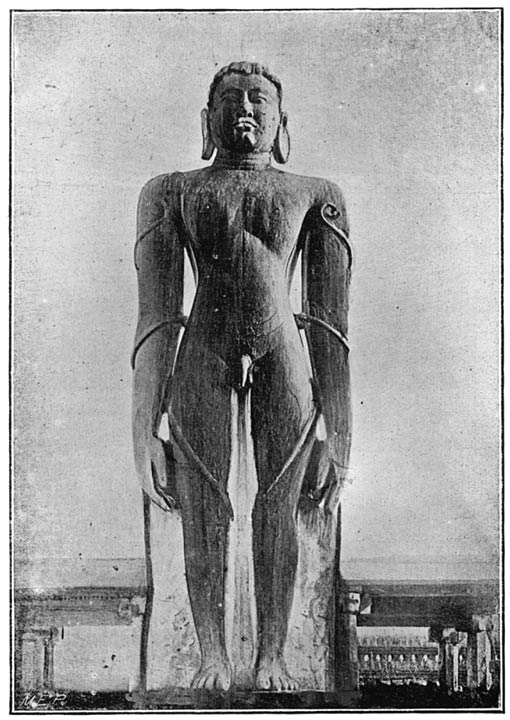
Statue of Gummata at Karkai.
The high priest of the Jain basti at Karkal in 1907 gave as his name Lalitha Kirthi Bhattaraka Pattacharya Variya Jiyaswāmigalu. His full-dress consisted of a red and gold-embroidered Benares body-cloth, red and gold turban, and, as a badge of office, a brush of peacock’s feathers mounted in a gold handle, carried in his hand. On ordinary occasions, he carried a similar brush mounted in a silver handle. The abhishēkam ceremony is performed at Karkal at intervals of many years. A scaffold is erected, and over the colossal statue are poured water, milk, flowers, cocoanuts, sugar, jaggery, sugar-candy, gold and silver flowers, fried rice, beans, gram, sandal paste, nine kinds of precious stones, etc.
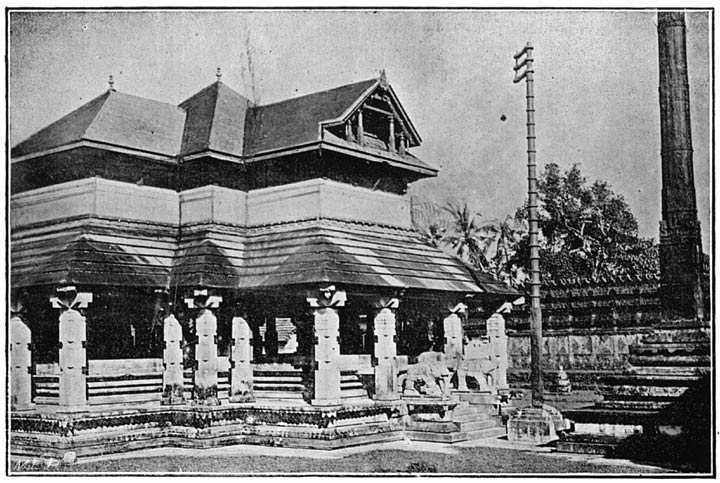
Jain basti at Mudabidure.
“The village of Mūdabidure in the South Canara district,” Dr. Hultzsch writes, “is the seat of a Jaina high priest, who bears the title Chârukirti-Panditâchârya-Svâmin. He resides in a matha, which is known to contain a large library of Jaina manuscripts. There are no less than sixteen Jaina temples (basti) at Mûdabidure. Several of them are elaborate buildings with massive stone roofs, and are surrounded by laterite enclosures. A special feature of this style of architecture is a lofty monolithic column called mânastambha, which is set up in front of seven of the bastis. In two of them a flagstaff (dhvajastambha), which consists of wood covered with copper, is placed between the mânastambha and the shrine. Six of them are called Settarabasti, and accordingly must have been built by Jaina merchants (Setti). The sixteen bastis are dedicated to the following Tîrthankaras:—Chandranatha or Chandraprabha, Nêminâtha, Pârsvanâtha, Âdinâtha, Mallinâtha, Padmaprabha, Anantanâtha, Vardhamâna, and Sântinâtha. In two of these bastis are separate shrines dedicated to all the Tîrthankaras, and in another basti the shrines of two Yakshīs. The largest and finest is the Hosabasti, i.e., the new temple, which is dedicated to Chandranâtha, and was built in A.D. 1429–30. It possesses a double enclosure, a very high mânastambha, and a sculptured gateway. The uppermost storey of the temple consists of wood-work. The temple is composed of the shrine (garbagriha), and three rooms in front of it, viz., the Tîrthakaramandapa, the Gaddigemandapa, and the Chitramandapa. In front of the last-mentioned mandapa is a separate building called Bhairâdêvimandapa, which was built in A.D. 1451–52. Round its base runs a band of sculptures, among which the figure of a giraffe deserves to be noted. The idol in the dark innermost shrine is said to consist of five metals (pancha-lôha), among which silver predominates. The basti next in importance is the Gurugalabasti, where two ancient talipot (srîtâlam) copies of the Jaina Siddhânta are preserved in a box with three locks, the keys of which are in charge of three different persons. The minor bastis contain three rooms, viz., the Garbhagriha, the Tîrthakaramandapa, and the Namaskâramandapa. One of the sights of Mûdabidire is the ruined palace of the Chautar, a local chief who follows the Jaina creed, and is in receipt of a pension from the Government. The principal objects of interest at the palace are a few nicely-carved wooden pillars. Two of them bear representations of the pancha-nârîturaga, i.e., the horse composed of five women, and the nava-nârî-kunjara, i.e., the elephant composed of nine women. These are fantastic animals, which are formed by the bodies of a number of shepherdesses for the amusement of their Lord Krishna. The Jains are divided into two classes, viz., priests (indra) and laymen (srivaka). The former consider themselves as Brâhmanas by caste. All the Jainas wear the sacred thread. The priests dine with the laymen, but do not intermarry with them. The former practice the makkalasantâna, i.e., the inheritance through sons, and the latter aliya-santâna, i.e., the inheritance through nephews. The Jainas are careful to avoid pollution from contact with outcastes, who have to get out of their way in the road, as I noticed myself. A Jaina marriage procession, which I saw passing, was accompanied by Hindu dancing-girls. Near the western end of the street in which most of the Jainas live, a curious spectacle presents itself. From a number of high trees, thousands of flying foxes (fruit-bat, Pteropus medius) are suspended. They have evidently selected the spot as a residence, because they are aware that the Jainas, in pursuance of one of the chief tenets of their religion, do not harm any animals. Following the same street further west, the Jaina burial-ground is approached. It contains a large ruined tank with laterite steps, and a number of tombs of wealthy Jain merchants. These tombs are pyramidal structures of several storeys, and are surmounted by a water-pot (kalasa) of stone. Four of the tombs bear short epitaphs. The Jainas cremate their dead, placing the corpse on a stone in order to avoid taking the life of any stray insect during the process.”
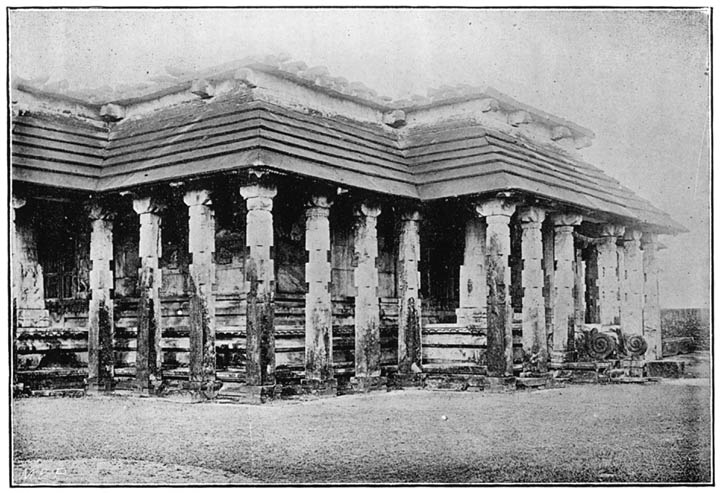
Jain basti at Karkal.
In their ceremonials, e.g., marriage rites, the Jains of South Canara closely follow the Bants. They are worshippers of bhūthas (devils), and, in some houses, a room called padōli is set apart, in which the bhūtha is kept. When they make vows, animals are not killed, but they offer metal images of fowls, goats, or pigs.
It is recorded, in the report on Epigraphy, 1906–1907, that at Eyil in the South Arcot district the Jains asked the Collector for permission to use the stones of the Siva temple for repairing their own. The Collector called upon the Hindus to put the Siva temple in order within a year, on pain of its being treated as an escheat.
On the wall of the mantapam of the golden lotus tank (pōthāmaraī) of the Mīnakshi temple at Madura is a series of frescoes illustrating the persecution of the Jains. For the following account thereof, I am indebted to Mr. K. V. Subramania Aiyar. Srī Gnāna Sammandha Swāmi, who was an avatar or incarnation of Subramaniya, the son of Siva, was the foremost of the sixty-three canonised saints of the Saivaite religion, and a famous champion thereof. He was sent into the world by Siva to put down the growing prevalence of the Jaina heresy, and to re-establish the Saivite faith in Southern India. He entered on the execution of his earthly mission at the age of three, when he was suckled with the milk of spirituality by Parvati, Siva’s consort. He manifested himself first at the holy place Shiyali in the present Tanjore district to a Brāhman devotee named Sivapathābja Hirthaya and his wife, who were afterwards reputed to be his parents. During the next thirteen years, he composed about sixteen thousand thēvaram (psalms) in praise of the presiding deity at the various temples which he visited, and performed miracles. Wherever he went, he preached the Saiva philosophy, and made converts. At this time, a certain Koon (hunch-back) Pāndyan was ruling over the Madura country, where, as elsewhere, Jainism had asserted its influence, and he and all his subjects had become converts to the new faith. The queen and the prime-minister, however, were secret adherents to the cult of Siva, whose temple was deserted and closed. They secretly invited Srī Gnāna Sammandha to the capital, in the hope that he might help in extirpating the followers of the obnoxious Jain religion. He accordingly arrived with thousands of followers, and took up his abode in a mutt or monastery on the north side of the Vaigai river. When the Jain priests, who were eight thousand in number, found this out, they set fire to his residence with a view to destroying him. His disciples, however, extinguished the flames. The saint, resenting the complicity of the king in the plot, willed that the fire should turn on him, and burn him in the form of a virulent fever. All the endeavours of the Jain priests to cure him with medicines and incantations failed. The queen and the prime-minister impressed on the royal patient the virtues of the Saiva saint, and procured his admission into the palace. When Sammandha Swāmi offered to cure the king by simply throwing sacred ashes on him, the Jain priests who were present contended that they must still be given a chance. So it was mutually agreed between them that each party should undertake to cure half the body of the patient. The half allotted to Sammandha was at once cured, while the fever raged with redoubled severity in the other half. The king accordingly requested Sammandha to treat the rest of his body, and ordered the Jaina priests to withdraw from his presence. The touch of Sammandha’s hand, when rubbing the sacred ashes over him, cured not only the fever, but also the hunched back. The king now looked so graceful that he was thenceforward called Sundara (beautiful) Pāndyan. He was re-converted to Saivism, the doors of the Siva temple were re-opened, and the worship of Siva therein was restored. The Jain priests, not satisfied with their discomfiture, offered to establish the merits of their religion in other ways. They suggested that each party should throw the cadjan (palm-leaf) books containing the doctrines of their respective religions into a big fire, and that the party whose books were burnt to ashes should be considered defeated. The saint acceding to the proposal, the books were thrown into the fire, with the result that those flung by Sammandha were uninjured, while no trace of the Jain books remained. Still not satisfied, the Jains proposed that the religious books of both parties should be cast into the flooded Vaigai river, and that the party whose books travelled against the current should be regarded as victorious. The Jains promised Sammandha that, if they failed in this trial, they would become his slaves, and serve him in any manner he pleased. But Sammandha replied: “We have already got sixteen thousand disciples to serve us. You have profaned the name of the supreme Siva, and committed sacrilege by your aversion to the use of his emblems, such as sacred ashes and beads. So your punishment should be commensurate with your vile deeds.” Confident of success, the Jains offered to be impaled on stakes if they lost. The trial took place, and the books of the Saivites travelled up stream. Sammandha then gave the Jains a chance of escape by embracing the Saiva faith, to which some of them became converts. The number thereof was so great that the available supply of sacred ashes was exhausted. Such of the Jains as remained unconverted were impaled on stakes resembling a sūla or trident. It may be noted that, in the Mahābhārata, Rishi Māndaviar is said to have been impaled on a stake on a false charge of theft. And Rāmanūja, the Guru of the Vaishnavites, is also said to have impaled heretics on stakes in the Mysore province. The events recorded in the narrative of Sammandha and the Jains are gone through at five of the twelve annual festivals at the Madura temple. On these occasions, which are known as impaling festival days, an image representing a Jain impaled on a stake is carried in procession. According to a tradition the villages of Mēla Kīlavu and Kīl Kīlavu near Sōlavandān are so named because the stakes (kīlavu) planted for the destruction of the Jains in the time of Tirugnāna extended so far from the town of Madura.
For details of the literature relating to the Jains, I would refer the reader to A. Guérinot’s ‘Essai de Bibliographie Jaina,’ Annales du Musée Guimet, Paris, 1906.
In the city of Madras, gold-washers are to be found working in the foul side drains in front of jewellers’ shops. The Health Officer to the Corporation informs me that he often chases them, and breaks their pots for obstructing public drains in their hunt for pieces of gold and other metals.
For the following note on the gold-washers of Madras, I am indebted to Dr. K. T. Mathew: “This industry is carried on in the city by the Oddars, and was practically monopolised by them till a few years back, when other castes, mostly of the lower orders, stepped in. The Oddars now form a population of several thousands in the city, their chief occupation being conservancy cooly work. The process of gold washing is carried out by women at home, and by the aged and adults in their spare hours. The ashes, sweepings, and refuse from the goldsmiths’ shops are collected on payment of a sum ranging from one rupee to ten rupees per mensem, and are brought in baskets to a convenient place alongside their huts, where they are stored for a variable time. The drain silts from streets where there are a large number of jewellers’ shops are similarly collected, but, in this case, the only payment to be made is a present to the Municipal peon. The materials so collected are left undisturbed for a few days or several months, and this storing away for a time is said to be necessary to facilitate the extraction of the gold, as any immediate attempt to wash the stuff results in great loss in the quantity obtained. From the heap as much as can be taken on an ordinary spade is put into a boat-shaped tub open at one end, placed close to the heap, and so arranged that the waste water from the tub flows away from the heap behind, and collects in a shallow pool in front. The water from the pool is collected in a small chatty (earthen vessel), and poured over the heap in the tub, which is continually stirred up with the other hand. All the lighter stuff in this way flows out of the tub, and all the hard stones are every now and then picked out and thrown away. This process goes on until about a couple of handfuls of dark sand, etc., are left in the tub. To this a small quantity of mercury is added, briskly rubbed for a minute or two, and the process of washing goes on, considerable care being taken to see that no particle of mercury escapes, until at last the mercury, with a great many particles of metallic dust attached, is collected in a small chatty—often a broken piece of a pot. The mercury, with the metallic particles in it, is then well washed with clean water, and put into a tiny bag formed of two layers of a piece of rag. The mass is then gently pressed until all the mercury falls into a chatty below, leaving a small flattened mass of dark substance in the bag, which is carefully collected, and kept in another dry chatty. The washing process is repeated until enough of the dark substance—about a third of a teaspoonful—is collected. This substance is then mixed with powdered common salt and brick-dust, put into a broken piece of a pot, and covered with another piece. The whole is placed in a large earthen vessel, with cow-dung cakes well packed above and below. A blazing fire is soon produced, and kept up till the mass is melted. This mass is carefully removed, and again melted with borax in a hole made in a piece of good charcoal, by blowing through a reed or hollow bamboo, until the gold separates from the mass. The fire is then suddenly quenched, and the piece of gold is separated and removed.”
Jālāri.—The Jālāris are Telugu fishermen, palanquin-bearers, and cultivators in Ganjam and Vizagapatam. The name, Mr. C. Hayavadana Rao writes, is derived from jāla, a net. Some are fresh-water fishermen, while others fish with a cast-net (visuru valalu) from the sea-shore, or on the open sea. They bear the name Gangavamsamu, or people of Ganga, in the same way that a division of the Kabbēra fishing caste is called Gangimakkalu. In caste organisation, ceremonial, etc., the Jālāris coincide with the Mīlas. They are called Noliyas by the Oriyas of Ganjam. They have house-names like other Telugus, and their females do not wear brass bangles, as low-caste Oriya women do.
The Jālāris have two endogamous divisions, called panrendu kotla (twelve posts), and edu kotla (seven posts), in reference to the number of posts for the booth. The former claim superiority over the latter, on the ground that they are illegitimate Jālāris, or recently admitted into the caste.
Like other Telugu castes, the Jālāris have a caste council under the control of a headman called Pilla. In imitation of the Oriyas, they have created an assistant headman called Dolobēhara, and they have the usual caste servant.
In their puberty, marriage and death ceremonies, they closely follow the Vādas and Palles. The prohibitions regarding marriage are of the Telugu form, but, like the Oriya castes, the Jālāris allow a widow to marry her deceased husband’s younger brother. The marriage ceremonies last for three days. On the first day, the pandal (booth), with the usual milk-post, is erected. For every marriage, representatives of the four towns Peddapatnam, Vizagapatam, Bimlipatam, and Revalpatnam, should be invited, and should be the first to receive pān-supāri (betel leaves and areca nuts) after the pandal has been set up. Peddapatnam is the first to be called out, and the respect may be shown to any person from that town. The representatives of the other towns must belong to particular septs, as follows:—
Vizagapatam Buguri sept.
Revalpatnam Jonna sept.
Bimlipatam Sundra sept.
The Jālāris are unable to explain the significance of this “counting towns,” as they call it. Possibly Peddapatnam was their original home, from which particular septs emigrated to other towns. On the second day of the marriage ceremonies, the tying of the sathamānam (marriage badge) takes place. The bridegroom, after going in procession through the streets, enters the house at which the marriage is to be celebrated. At the entrance, the maternal uncle of the bride stands holding in his crossed hands two vessels, one of which contains water, and the other water with jaggery (crude sugar) dissolved in it. The bridegroom is expected to take hold of the vessel containing the sweetened water before he enters, and is fined if he fails to do so. When the bridegroom approaches the pandal, some married women hold a bamboo pole between him and the pandal, and a new earthen pot is carried thrice round the pole. While this is being done, the bride joins the bridegroom, and the couple enter the pandal beneath a cloth held up to form a canopy in front thereof. This ceremonial takes place towards evening, as the marriage badge is tied on the bride’s neck during the night. An interesting feature in connection with the procession is that a pole called digametlu (shoulder-pole), with two baskets tied to the ends, is carried. In one of the baskets a number of sieves and small baskets are placed, and in the other one or more cats. This digametlu is always referred to by the Vādas when they are questioned as to the difference between their marriage ceremonies and those of the Jālāris. Other castes laugh at this custom, and it is consequently dying out.
The Jālāris always marry young girls. One reason assigned for this is “the income to married young girls” at the time of the marriage ceremonies. Two or more married couples are invited to remain at the house in which the marriage takes place, to help the bridal couple in their toilette, and assist at the nalagu, evil eye waving, and other rites. They are rewarded for their services with presents. Another instance of infant marriage being the rule on account of pecuniary gain is found among the Dikshitar Brāhmans of Chidambaram. Only married males have a voice in temple affairs, and receive a share of the temple income. Consequently, boys are sometimes married when they are seven or eight years old. At every Jālāri marriage, meals must be given to the castemen, a rupee to the representatives of the patnams, twelve annas to the headman and his assistant, and three rupees to the Mālas.
Like other Telugu castes, the Jālāris have intipērus (septs), which resemble those of the Vādas. Among them, Jonna and Buguri are common. In their religious observances, the Jālāris closely follow the Vādas.
The Madras Museum possesses a collection of clay and wooden figures, such as are worshipped by the fishing castes at Gopalpūr, and other places on the Ganjam coast. Concerning these, Mr. J. D’A. C. Reilly writes to me as follows. The specimens represent the chief gods worshipped by the fishermen. The Tahsildar of Berhampūr got them made by the potters and carpenters, who usually make such figures for the Gopalpūr fishermen. I have found fishermen’s shrines at several places. Separate families appear to have separate shrines, some consisting of large chatties (earthen pots), occasionally ornamented, and turned upside down, with an opening on one side. Others are made of bricks and chunam (lime). All that I have seen had their opening towards the sea. Two classes of figures are placed in these shrines, viz., clay figures of gods, which are worshipped before fishing expeditions, and when there is danger from a particular disease which they prevent; and wooden figures of deceased relations, which are quite as imaginative as the clay figures. Figures of gods and relations are placed in the same family shrine. There are hundreds of gods to choose from, and the selection appears to be a matter of family taste and tradition. The figures which I have sent were made by a potter at Venkatarayapalle, and painted by a carpenter at Uppulapatti, both villages near Gopalpūr. The Tahsildar tells me that, when he was inspecting them at the Gopalpūr traveller’s bungalow, sixty or seventy fishermen objected to their gods being taken away. He pacified them by telling them that it was because the Government had heard of their devotion to their gods that they wanted to have some of them in Madras. The collection of clay figures includes the following:—
Bengali Babu.—Wears a hat, and rides on a black horse. He blesses the fishermen, secures large hauls of fish for them, and guards them against danger when out fishing.
Sāmalamma.—Wears a red skirt and green coat and protects the fishermen from fever.
Rājamma, a female figure, with a sword in her right hand, riding on a black elephant. She blesses barren women with children, and favours her devotees with big catches when they go out fishing.
Yerenamma, riding on a white horse, with a sword in her right hand. She protects fishermen from drowning, and from being caught by big fish.
Bhāgīrathamma, riding on an elephant, and having eight or twelve hands. She helps fishermen when fishing at night, and protects them against cholera, dysentery, and other intestinal disorders.
Nūkalamma.—Wears a red jacket and green skirt, and protects the fishing community against small-pox.
Orosondi Ammavāru.—Prevents the boats from being sunk or damaged.
Bhāgadēvi.—Rides on a tiger, and protects the community from cholera.
Veyyi Kannula Ammavāru, or the goddess of a thousand eyes, represented by a pot pierced with holes, in which a gingelly (Sesamum) oil light is burnt. She attends to the general welfare of the fisher folk.
Jāli (Acacia arabica).—A gōtra of Kurni.
Jalli.—Jalli, meaning palm tassels put round the neck and horns of bulls, occurs as an exogamous sept of Jōgi. The name occurs further as a sub-division of Kevuto.
Jāmbava.—A synonym of the Mādigas, who claim descent from the rishi Audi Jāmbavādu.
Jambu (Eugenia Jambolana).—An exogamous sept of Oddē.
Jāmbuvar (a monkey king with a bear’s face).—An exogamous sept of Kondaiyamkottai Maravan.
Jamkhānvāla (carpet-maker).—An occupational name for Patnūlkārans and Patvēgars.
Jammi (Prosopis spicigera).—A gōtra of Gollas, members of which may not use the tree. It is further a gōtra of Chembadis. Children of this caste who are named after the caste god Gurappa or Gurunāthadu are taken, when they are five, seven, or nine years old, to a jammi tree, and shaved after it has been worshipped with offerings of cooked food, etc. The jammi or sami tree is regarded as sacred all over India. Some orthodox Hindus, when they pass it, go round it, and salute it, repeating a Sanskrit verse to the effect that “the sami tree removes sins; it is the destroyer of enemies; it was the bearer of the bows and arrows of Arjuna, and the sight of it was very welcome to Rāma.”
The Saluppans say that they have twenty-four gōtras, which are divided into groups of sixteen and eight. Marriage is forbidden between members of the same group, but permitted between members of the sixteen and eight gōtras. Among the names of the gōtras, are the following:—
Vasava. Vamme. Mummudi. Pilli Vankaravan. Makkiduvan. Thallelan. Gendagiri. Madalavan. Piligara. Mukkanda. Vadiya. Thonda. Kōla.
The Janappans of the Telugu country also say that they have only twenty-four gōtras. Some of these are totemistic in character. Thus, members of the Kappala (frog) gōtra owe their name to a tradition that on one occasion, when some of the family were fishing, they caught a haul of big frogs instead of fish. Consequently, members of this gōtra do not injure frogs. Members of the Thonda or Thonda Mahā Rishi gōtra abstain from using the fruit or leaves of the thonda plant (Cephalandra indica). The fruits of this plant are among the commonest of native vegetables. In like manner, members of the Mukkanda sept may not use the fruit of Momordica Charantia. Those of the Vamme gōtra abstain from eating the fish called bombadai, because, when some of their ancestors went to fetch water in the marriage pot, they found a number of this fish in the water collected in the pot. So, too, in the Kōla gōtra, the eating of the fish called kōlasi is forbidden.
In their marriage customs, those who live in the Telugu country follow the Telugu Purānic form, while those who have settled in the Tamil country have adopted some of the marriage rites thereof. There are, however, some points of interest in their marriage ceremonies. On the day fixed for the betrothal, those assembled wait silently listening for the chirping of a lizard, which is an auspicious sign. It is said that the match is broken off, if the chirping is not heard. If the omen proves auspicious, a small bundle of nine to twelve kinds of pulses and grain is given by the bridegroom’s father to the father of the bride. This is preserved, and examined several days after the marriage. If the grain and pulses are in good condition, it is a sign that the newly married couple will have a prosperous career.
There are both Saivites and Vaishnavites among these people, and the former predominate in the southern districts. Most of the Vaishnavites are disciples of Bhatrāzus. The Bhatrāzu priest goes round periodically, collecting his fees. Those among the Saivites who are religiously inclined are disciples of Pandārams of mutts (religious institutions). Those who have settled in the Salem district seem to consider Damayanti and Kāmātchi as the caste deities.
The manufacture of gunny-bags is still carried on by some members of the caste, but they are mainly engaged in trade and agriculture. In the city of Madras, the sale of various kinds of fruits is largely in the hands of the Janappans.
Sāthu vāndlu, meaning a company of merchants or travellers, occurs as a synonym of Janappan.
In the Mysore Census Report, 1901, Janappa is returned as a sub-division of the Gōnigas, who are sack-weavers, and makers of gunny-bags.
Jandāyi (flag).—An exogamous sept of Yānādi.
Janga (calf of the leg).—An exogamous sept of Māla.
Jangal Jāti.—A synonym, denoting jungle folk, of the Kurivikārans or Kāttu Marāthis.
Jangam.—It is noted, in the Madras Census Report, 1901, that “strictly speaking, a Jangam is a priest to the religious sect of Lingāyats, but the term is frequently loosely applied to any Lingāyat, which accounts for the large numbers under this head (102,121). Jangams proper are said to be of two classes, Pattādikāris, who have a definite head-quarters, and Charamūrtis, who go from village to village, preaching the principles of the Lingāyat sect. Many Jangams are priests to Sūdras who are not Lingāyats, others are merely religious beggars, and others of them go in for trade.” In the Census Report, 1891, it is further recorded that “the full name is Jangama Lingāyat, meaning those who always worship a moveable lingam, in contradistinction to the Sthāvara (immoveable) lingam of the temples. Only two of the sub-divisions returned are numerically important, Ganāyata and Sthāvara. The sub-division Sthāvara is curious, for a Sthāvara Jangam is a contradistinction in terms. This sub-division is found only in the two northern districts, and it is possible that the Jangam caste, as there found, is different from the ordinary Jangam, for, in the Vizagapatam District Manual, the Jangams are said to be tailors.” In the Telugu country Lingāyats are called Jangālu.
The Ganta Jangams are so called, because they carry a metal bell (ganta).
Janjapul (sacred thread).—An exogamous sept of Bōya.
Writing to me concerning Malabar at the present day, a correspondent states that “in almost every tāluk we have jungle tribes, who call themselves the men of Janmis. In the old days, when forests were sold, the inhabitants were actually entered in the contract as part of the effects, as, in former times, the landlord sold the adscripti or ascripti glebæ with the land. Now that is not done. However, the relationship exists to the following extent, according to what a Tahsildar (native magistrate) tells me. The tribesmen roam about the forests at will, and each year select a place, which has lain fallow for five years or more for all kinds of cultivation. Sometimes they inform the Janmis that they have done so, sometimes they do not. Then, at harvest time, the Janmi, or his agent, goes up and takes his share of the produce. They never try to deceive the Janmi. He is asked to settle their disputes, but these are rare. They never go to law. The Janmi can call on them for labour, and they give it willingly. If badly treated, as they have been at times by encroaching plainsmen, they run off to another forest, and serve another Janmi. At the Ōnam festival they come with gifts for the Janmi, who stands them a feast. The relation between the jungle folk and the Janmi shows the instinct in a primitive people to have a lord. There seems to be no gain in having a Janmi. His protection is not needed, and he is hardly ever called in to interfere. If they refused to pay the Janmi his dues, he would find it very hard to get them. Still they keep him.” In the middle of the last century, when planters first began to settle in the Malabar Wynād, they purchased the land from the Janmis with the Paniyans living on it, who were practically slaves of the landowners.
The hereditary rights and perquisites claimed, in their villages, by the astrologer, carpenter, goldsmith, washerman, barber, etc., are called Cherujanmam.
Janni.—The name of the caste priests of Jātapus.
Japanese.—At the Mysore census, 1901, two Japanese were returned. They were managers of the silk farm instituted on Japanese methods by Mr. Tata of Bombay in the vicinity of Bangalore.
Jāt.—A few members of this North Indian class of Muhammadans, engaged in trade, have been returned at times of census in Mysore.
Jātapu.—The Jātapus are defined, in the Madras Census Report, 1901, as “a civilised section of the Khonds, who speak Khond on the hills and Telugu on the plains, and are now practically a distinct caste. They consider themselves superior to those Khonds who still eat beef and snakes, and have taken to some of the ways of the castes of the plains.”
For the following note, I am indebted to Mr. C. Hayavadana Rao. The name Jātapu is popularly believed to be an abbreviated form of Konda Jātapu Doralu, or lords of the Khond caste. To this caste the old chiefs of the Pālkonda Zamindāri are said to have belonged. It is divided into a number of septs, such, for example, as:—
Thōrika or Thōyika, who revere the thōrika kōdi, a species of wild fowl.
Kādrika, who revere another species of fowl.
Mamdangi, who revere the bull or cow.
Addāku, who revere the addāku (Bauhinia racemosa), which is used by low-country people for eating-platters.
Konda Gorrē, who revere a certain breed of sheep.
Navalipitta, who revere the peacock.
Arika, who revere the arika (Paspalum scrobiculatum).
Other septs, recorded in the Census Report, 1901, are Koalaka (arrow), Kutraki (wild goat), and Vinka (white ant, Termes).
Marriage is celebrated either before or after a girl reaches puberty. A man may claim his paternal aunt’s daughter as his wife. The marriage ceremonies closely resemble those of the low-country Telugu type. The bride-price, called vōli, is a new cloth for the bride’s mother, rice, various kinds of grain, and liquor. The bride is conducted to the house of the bridegroom, and a feast is held. On the following morning, the kāllagōlla sambramam (toe-nail cutting) ceremony takes place, and, later on, at an auspicious hour, the wrist threads (kankanam) are tied on the wrists of the contracting couple, and their hands joined together. They then bathe, and another feast is held. The remarriage of widows is allowed, and a younger brother may marry the widow of his elder brother. Divorce is permitted, and divorcées may remarry.
The dead are usually buried, but those who die from snake-bite are said to be burnt. Death pollution lasts for three days, during which the caste occupation of cultivating is not carried on. An annual ceremony is performed by each family in honour of the dead. A fowl or goat is killed, a portion of the day’s food collected in a plate, and placed on the roof of the house. Once in twenty years or so, all the castemen join together, and buy a pig or cow, which is sacrificed in honour of the ancestors.
The caste goddess is Jākara Dēvata, who is propitiated with sacrifices of pigs, sheep, and buffaloes. When the crop is gathered in, the first fruits are offered to her, and then partaken of.
The caste headman is called Nāyudu or Sāmanthi, and he is assisted by the Janni, or caste priest, who officiates at ceremonials, and summons council meetings.
The caste titles are Dora, Naiko, and Sāmanto.
Jātikīrtulu.—Recorded, in the Madras Census Report, 1901, as a class of beggars in the Cuddapah district. The name means those who praise the caste, and may have reference to the Bhatrāzus.
Jāti Pillai (children of the caste).—A general name for beggars, who are attached to particular castes, from the members of which they receive alms, and at whose ceremonies they take part by carrying flags in processions, etc. It is their duty to uphold the dignity of the caste by reciting the story of its origin, and singing its praises. As examples of Jāti Pillais, the following may be cited:—
Mailāri attached to Kōmatis.
Vīramushti attached to Bēri Chettis and Kōmatis.
Nōkkan attached to Pallis.
Māstiga attached to Mādigas.
Jaura.—The Jauras are a small Oriya caste, closely allied to the Khodūras, the members of which manufacture lac (jau) bangles and other articles. Lac, it may be noted, is largely used in India for the manufacture of bangles, rings, beads, and other trinkets worn as ornaments by women of the poorer classes. Dhippo (light) and mohiro (peacock) occur as common exogamous septs among the Jauras, and are objects of reverence. The Jauras are mainly Saivites, and Sūramangala and Bimmala are the caste deities. Titles used by members of the caste are Dansē, Sāhu, Dhōv, and Mahapātro.
Javvādi (civet-cat).—An exogamous sept of Mēdara.
Jelakuppa (a fish).—An exogamous sept of Kuruba.
Jēn (honey).—A sub-division of Kurumba.
Jenna.—A title of Oriya castes, e.g., Bolāsi and Kālinji.
Jerribōtula (centipedes).—An exogamous sept of Bōya.
Jetti.—A Telugu caste of professional wrestlers and gymnasts, who, in the Telugu districts, shampoo and rub in ointments to cure nerve pains and other disorders. In Tanjore, though living in a Tamil environment, they speak Telugu. They wear the sacred thread, and consider themselves to be of superior caste, never descending to any degrading work. During the days of the Rājas of Tanjore, they were employed in guarding the treasury and jewel rooms. But, since the death of the late Rāja, most of them have emigrated to Mysore and other Native States, a few only remaining in Tanjore, and residing in the fort.
They are still considered skilful in setting dislocated joints. In a note regarding them in the early part of the last century, Wilks writes as follows. “These persons constitute a distinct caste, trained from their infancy in daily exercises for the express purpose of exhibitions; and perhaps the whole world does not produce more perfect forms than those which are exhibited at these interesting but cruel sports. The combatants, clad in a single garment of light orange-coloured drawers extending half-way down the thigh, have their right arm furnished with a weapon, which, for want of a more appropriate term, we shall name a cæstus, although different from the Roman instruments of that name. It is composed of buffalo horn, fitted to the hand, and pointed with four knobs, resembling very sharp knuckles, and corresponding to their situation, with a fifth of greater prominence at the end nearest the little finger, and at right angles with the other four. This instrument, properly placed, would enable a man of ordinary strength to cleave open the head of his adversary at a blow; but, the fingers being introduced through the weapon, it is fastened across them at an equal distance between the first and second lower joints, in a situation, it will be observed, which does not admit of attempting a severe blow, without the risk of dislocating the first joints of all the fingers. Thus armed, and adorned with garlands of flowers, the successive pairs of combatants, previously matched by the masters of the feast, are led into the arena; their names and abodes are proclaimed; and, after making their prostrations, first to the Rāja seated on his ivory throne, and then to the lattices behind which the ladies of the court are seated, they proceed to the combat, first divesting themselves of the garlands, and strewing the flowers gracefully over the arena. The combat is a mixture of wrestling and boxing, if the latter may be so named. The head is the exclusive object permitted to be struck. Before the end of the contest, both of the combatants may frequently be observed streaming with blood from the crown of the head down to the sand of the arena. When victory seems to have declared itself, or the contest is too severely maintained, the moderators in attendance on the Rāja make a signal for its cessation by throwing down turbans and robes, to be presented to the combatants. The victor frequently goes off the arena in four or five somersaults, to denote that he retires fresh from the contest. The Jettis are divided into five classes, and the ordinary price of victory is promotion to a higher class. There are distinct rewards for the first class, and in their old age they are promoted to be masters of the feast.”
The Jettis of Mysore still have in their possession knuckle-dusters of the type described above, and take part annually in matches during the Dasara festival. A Jetti police constable, whom I saw at Channapatna, had wrestled at Baroda, and at the court of Nepal, and narrated to me with pride how a wrestler came from Madras to Bangalore, and challenged any one to a match. A Jetti engaged to meet him in two matches for Rs. 500 each, and, after going in for a short course of training, walked round him in each encounter, and won the money easily.
Jetti further occurs as the name of an exogamous sept of the Kavarais.
Jew.—It has been said by a recent writer that “there is hardly a more curious, and in some respects one might almost say a more weird sight than the Jew town, which lies beyond the British Settlement at Cochin. Crossing over the lagoon from the beautiful little island of Bolghotty, where the British Residency for the Cochin State nestles in a bower of tropical vegetation, one lands amidst cocoanut trees, opposite to one of the old palaces of the Cochin Rājahs, and, passing through a native bazaar crowded with dark-skinned Malayālis, one turns off abruptly into a long narrow street, where faces as white as those of any northern European race, but Semitic in every feature, transport one suddenly in mind to the Jewish quarter in Jerusalem, or rather perhaps to some ghetto in a Polish city.”
The circumstances under which, and the time when the Jews migrated to the Malabar Coast, are wrapped in obscurity. They themselves are able to give accounts of only isolated incidents, since whatever records they had were lost at the destruction by the Portuguese of their original settlement at Cranganūr in 1565, and by the destruction at a later period of such fragments as remained in their possession in the struggle between the Portuguese and the Dutch, for the Portuguese, suspecting that the Jews had helped the Dutch, plundered their synagogue in Cochin.
“The Jews, who still hold that the Malabar Israelites were in possession of an old copy of the Sepher Thora, say that this copy, and all other documents, got lost on the occasion when the Portuguese destroyed the Jewish quarters, but this is not likely. For, whereas they had time to save their most valuable property according to their own testimony, and to take it to the mountains, they would not have failed to take along with them these documents, which were to them of inestimable value. For it is related that for a new copy of the Pentateuch which at that time was in their synagogue they had so much respect, and took such great care of it, that they even secured this copy, and took it along, and (when they returned) carried it back with great rejoicing, as it was done in olden times with the Ark of the Covenant.”
“Hail and happiness! The King of Kings, His Holiness Srî Bhaskara Ravi Varma, who wields the sceptre in many hundred thousand places, has made this decree on the day that he was pleased to dwell in Muyirikodu in the thirty-sixth year of his reign. We have granted unto Joseph Rabban Anjavannan the [dignity of] Prince, with all the seventy-two rights of ownership. He shall [enjoy] the revenues from female elephants and riding animals, and the income of Anjavannan. He is entitled to be honoured by lamps by day, and to use broad-cloth and sedan chairs, and the umbrella and the drums of the north and trumpets, and little drums, and gates, and garlands over the streets, and wreaths, and so on. We have granted unto him the land tax and weight tax. Moreover, we have by these copper tablets sanctioned that, when the houses of the city have to pay taxes to the palace, he need not pay, and he shall enjoy other privileges like unto these. To Joseph Rabbān, the prince of Anjavannam, and to his descendants, and to his sons and daughters, and to the nephews and sons-in-law of his daughters, in natural succession, so long as the world and moon exist, Anjuvannam shall be his hereditary possession.” It is suggested by Dr. Oppert that Anjuvannam is identical with the fifth or foreign caste.
Concerning the copper-plates, Governor Moens writes thus. “The following translation is by the Jewish merchant Ezechiel Rabby, who was an earnest explorer of anything that had any connection with his nation. After this I will give another translation, which I got from our second interpreter Barend Deventer, who was assisted by an old and literary inhabitant of Malabar; and lastly I will add a third one, which I obtained from our first interpreter Simon of Tongeren, assisted by a heathen scribe of Calicut, in order thus not to allow the Jews to be the judges in their own affair, but rather to enable the reader to judge for himself in this doubtful matter. The first translation runs thus:—
“By the help of God, who created the universe and appoints the kings, and whom I honour, I, Erawi Wanwara, Emperor of Malabar, grant in the 36th year of our happy reign at the court of Moydiricotta—alias Cranganore—this Act of Privileges to the Jew Josep Rabaan, viz., that he may make use of the five colours, spread his religion among the five castes or dynasties, fire salutes on all solemnities, ride on elephants and horses, hold stately processions, make use of cries of honour, and in the day-time of torches, different musical instruments, besides a big drum; that he may walk on roads spread with white linen, hold tournaments with sticks, and sit under a stately curtain. These privileges we give to Josep Rabaan and to the 72 households, provided that the others of this nation must obey the orders of his and their descendants so long as the sun shall shine on the earth. This Act is granted in the presence of the Kings of Trevancore, Tekkenkore, Baddenkenkore, Calicoilan, Aringut, Sammoryn, Palcatchery, and Colastry; written by the secretary Calembi Kelapen in the year 3481 Kalijogam.
“‘The second translation differs in important statements from the first, and would deserve more attention when neutral people of Malabar could be found, who could testify to the credibility of the same; but, notwithstanding the trouble I have taken to find such persons, it has been hitherto in vain. The second translation runs thus:—
“‘In the quiet and happy time of our reign, we, Erawi Wanwara, imitator of (successor to ?) the sceptres, which for many hundreds of thousands of years have reigned in justice and righteousness, the glorious footsteps of whom we follow, now in the second year of our reign, being the 36th year of our residence in the town of Moydiricotta, grant hereby, on the obtained good testimony of the great experience of Joseph Rabaan, that the said person is allowed to wear long dresses of five colours, that he may use carriages together with their appurtenances, and fans which are used by the nobility. He shall have precedence to the five castes, be allowed to burn day-lamps, to walk on spread out linen, to make use of palanquins, Payeng umbrellas, large bent trumpets, drums, staff, and covered seats. We give him charge over the 72 families and their temples, which are found both here and elsewhere, and we renounce our rights on all taxes and duties on both houses. He shall everywhere be allowed to have lodgings. All these privileges and prerogatives, explained in this charter, we grant to Joseph Rabaan head of the five castes, and to his heirs, sons, daughters, children’s children, the sons-in-law married to the daughters, together with their descendants, as long as the sun and moon shall shine; and we grant him also all power over the five castes, as long as the names of their descendants shall last. Witnesses hereof are the Head of the country of Wenaddo named Comaraten Matandden; the head of the country of Wenaaodea named Codei Cheri-canden; the Head of the country of Erala named Mana Bepalamaan; the Head of the country Walonaddo named Trawaren Chaten; the Head of the country Neduwalur named Codei Trawi; besides the first of the lesser rulers of territories of the part of Cusupady Pawagan, namely the heir of Murkom Chaten named Kelokandan; written by the secretary named Gunawendda Wanasen Nayr, Kisapa Kelapa; signed by the Emperor.
“‘The third translation runs as follows:—
“‘In the name of the Most High God, who created the whole world after His own pleasure, and maintains justice and righteousness, I, Erwij Barman, raise my hands, and thank His Majesty for his grace and blessing bestowed on my reign in Cranganore, when residing in the fortress of Muricotta. I have granted for good reasons to my minister Joseph Raban the following privileges; that he may wear five coloured cloths, long dresses, and hang on the shoulders certain cloths; that they may cheer together, make use of drums and tambourines, burn lights during the day, spread cloths on the roads, use palanquins, umbrellas, trumpet torches, burning torches, sit under a throne (?), and act as Head of all the Jews numbering seventy-two houses, who will have to pay him the tolls and taxes of the country, no matter in what part of the country they are living; these privileges I give to Joseph Raban and his descendants, be they males or females, as long as any one of them is alive, and the sun and moon shine on the earth; for this reason I have the same engraved on a copper-plate as an everlasting remembrance. Witnesses are the Kings of Travancore, Berkenkore, Sammorin, Arangolla, Palcatchery, Collastry, and Corambenaddo; written by the secretary Kellapen.
“‘The aforesaid copper-plate is written in the old broken Northern Tamil language, but with different kinds of characters, viz., Sanskrit and Tamil, and is now read and translated by a heathen scribe named Callutil Atsja, who was born at Calicut, and who, during the war, fled from that place, and stays at present on the hills.
“‘When these translations are compared with one another, it will be observed at once that, in the first, the privileges are granted to the Jew Joseph Rabban, and to the 72 Jewish families, whereas, in the second, no trace is found of the word Jew; and Joseph Rabban is, in the third, not called a Jew, but the minister of the king, although he may be taken for a Jew from the context in the course of the translation, for he is there appointed as Head of all the other Jews to the number of 72 houses. It is equally certain that the name of Rabaan is not exclusively proper to the Jews only. Furthermore, the first and last translations grant the above-mentioned privileges not only to Joseph Rabaan, but also to the 72 Jewish families, whereas, according to the second translation, the same are given to Joseph Rabaan, his family and offspring only. The second translation, besides, does not at all mention the freedom granted, and the consent to spread the Jewish religion among the five castes. Thus, it is obvious that these three translations do not agree, that the first and third coincide more with each other than they do with the second; that, for that reason, the first and last translations deserve more to be believed than the second, which stands alone; but that this, for that very reason, does not prove what it, properly speaking, ought to prove, and, whereas I am not acquainted with the Malabar language, I prefer to refrain from giving my opinion on the subject. For hitherto I have been unable to come across, either among the people of Malabar and Canara, or among the literary priests and natives, any one who was clever enough to translate these old characters for the fourth time, notwithstanding the fact that I had sent a copy of these characters to the north and south of Cochin, in order to have them deciphered.
“‘The witnesses who were present at the granting of this charter differ also. The first and third translations, however, seem also to concur more with each other than with the second one. But the discrepancy of the second translation lies in this, that in it not the personal names of the witnesses are recorded, but only their offices or dignities, in which they officiated at that time; whereas the mistake in the first and third translations consists herein, that the witnesses are called kings, and more so of those places by which names these places were called some time after and subsequently when times had changed, and by which names they are still known. The second translation, however, calls them merely heads of the countries, in the same manner as they were known at the time of the Emperor, when these heads were not as yet kings, because these heads bore the title of king and ruler only after the well-known division of the Malabar Empire into four chief kingdoms, and several smaller kingdoms and principalities. It must be admitted, however, that the head of the country of Cochin is, in the first and third translations, not mentioned by that name, although the kingdom of Cochin is in reality one of the four chief kingdoms of Malabar. I add this here for elucidation, in order that one should not wonder, when reading this charter, that inferior heads of countries and districts of the Malabar Empire could be called kings, because the Empire being at that time not as yet divided, they were not kings. It seems, therefore, to have been a free translation, of which the translators of the first and third translations have made use, and which has been pointed out in the second translation.
“‘The other statements of this charter, especially the authority over the five castes, must be explained according to the ancient times, customs, and habits of the people of Malabar, and need not be taken into consideration here. Whether this charter has in reality been granted to the Jews or not, it is certain that not at any time has a Jew had great authority over his co-religionists, and still less over the so-called five castes. Moreover, the property of the Jews has never been free from taxes, notwithstanding the fact that the kings to whom they were subject appointed as a rule as heads of the Jews men of their own nationality. They were known by the name of Moodiliars, who had no other authority than to dispose of small civil disputes, and to impose small fines of money.
“‘There is, however, a peculiarity, which deserves to be mentioned. Although, in the charter, some privileges are granted, which were also given to other people, yet to no one was it ever permitted to fire three salutes at the break of day, or on the day of a marriage feast of one who entered upon the marriage state, without a previous request and special permission. This was always reserved, even to the present day, to the kings of Cochin only. Yet up to now it was always allowed to the Jews without asking first. And it is known that the native kings do not easily allow another to share in outward ceremonies, which they reserve for themselves. If, therefore, the Jews would have arrogated to themselves this privilege without high authority, the kings of Cochin would put a stop to this privilege of this nation, whose residences are situated next to the Cochin palace, but for this reason, I suppose, dare not do so.’”
At Cochin the Jews enjoyed full privileges of citizenship, and were able to preserve the best part of their religious and civil liberty, and to remain here for centuries unseen, unknown, and unsearched by their persecutors. But, in the sixteenth century, they fell victims by turns to the oppression of fanatical Moors and over-zealous Christians. “In 1524, the Mahomedans made an onslaught on the Cranganūr Jews, slew a great number, and drove out the rest to a village to the east; but, when they attacked the Christians, the Nayars of the place retaliated, and in turn drove all the Mahomedans out of Cranganūr. The Portuguese enlarged and strengthened their Cranganūr fort, and compelled the Jews finally to desert their ancient settlement of Anjuvannam.” Thus, with the appearance of a powerful Christian nation on the scene, the Jews experienced the terrors of a new exile and a new dispersion, the desolation of Cranganūr being likened by them to the desolation of Jerusalem in miniature. Some of them were driven to villages adjoining their ruined principality, while others seem to have taken shelter in Cochin and Ernākulam. “Cranganore,” Mr. Adler writes, “was captured by the Mahomedan Sheikh or Zamorin in 1524, and razed to the ground. The Rajah Daniel seems to have previously sent his brother David to Europe to negotiate with the Pope and the Portuguese for an offensive and defensive alliance against the Zamorin. Anyhow, a mysterious stranger, who called himself David Rubbeni, appeared in Rome in March, 1524, and, producing credentials from the Portuguese authorities in India and Egypt, was received with much honour by the Pope, King John of Portugal, and the Emperor Charles the Fifth in turn. After some years he fell a victim to the inquisition, but his failure and non-return to India are more easily explained by the fact that he was too late, and that the State he represented was no longer existent, than by the cheap assumption of all our historians, including Graetz, that he was an impostor with a cock-and-bull story. Whether the famous diary of David Rubbeni is genuine or not is less certain. But I have elsewhere sought to re-establish this long-discredited ambassador, and here limit myself to drawing attention to his name, which seems to have been David Rabbani. To this day David is one of the commonest names among the Cochin Jews, as well as the B’nei Israel, and Rabbani is the name of the ruling family under the copper grant. Its alteration into Rubeni was due to sixteenth century interest in the lost ten tribes, and a consequent desire of identifying the Royal family as sprung from Reuben, the first-born of Israel. Reuben, too, is a favourite name among the B’nei Israel. With the destruction of their capital, the Jews left and migrated, though to no great distance. Within 20 miles south of Cranganore are four other places, all on the Cochin back-water, where the Black Jews still have synagogues. Parūr, Chennan Mangalam, and Māla have each one synagogue, Ernākulam has two, and Cochin three, of which one belongs to the White Jews. The Parūr Jews have also the ruins of another synagogue marked by a Ner Tamid, which they say existed 400 years ago, when there were eighteen Botē Midrash (schools) and 500 Jewish houses. This tradition further confirms the importance of Cranganore before 1524. With the advent of the Dutch, better times ensued for the Jews. The Dutch were bitter foes of the Portuguese and their inquisition, and friends of their enemies. Naturally the Jews were on the side of the Dutch, and, as naturally, had to suffer for their temerity. In 1662 the Dutch attacked the Rānee’s palace at Mattāncheri and besieged the adjoining town of Cochin, but had to retire before Portuguese reinforcements. The Portuguese therefore burnt the synagogue adjoining the palace, because they suspected the Jews, no doubt with justice, of having favoured the Dutch. In the following year, however, ‘the Dutch renewed their attack on Cochin, this time with complete success. The port and town fell into their hands, and with it fell the Portuguese power in India. By a series of treaties, Cochin and Holland became close allies, and the Dutch settlement became firmly established in Cochin.’ The Dutch helped the White Jews to rebuild their synagogue. The Dutch clock is still the pride of Cochin Jewry.”
In regard to the claim of the White Jews to being the only genuine Jews, it may be of interest to record the opinion of a Jew, Rabbi David D’Beth Hithel, who travelled in Cochin in 1832. He says that “the White Jews say of them (the Black Jews) that they are descendants of numerous slaves who were purchased and converted to Judaism, set free and carefully instructed by a rich White Jew some centuries ago. At his cost, they say, were all their old synagogues erected. The Black Jews believe themselves to be the descendants of the first captivity, who were brought to India, and did not return with the Israelites who built the second temple. This account I am inclined to believe correct. Though called Black Jews—they are of somewhat darker complexion than the White Jews—yet they are not of the colour of the natives of the country, or of persons descended from Indian slaves.” This passage bears reference to a tradition current among the Black Jews that they are the descendants of the Jews who were driven out of the land of Israel thirteen years before the destruction of the first temple built by Solomon. They are said to have first come to Calicut, whence they emigrated to Cranganūr.
It is recorded by Governor Moens that “in the Jewish quarters (situated) next to the palace of the king of Cochin at Cochin de Sima there are two synagogues, viz., one for the White Jews, and the other for the Black Jews. The latter have readers of their own tribe, who hold the services, but, when a White Rabbi comes to their synagogue, the honour of conducting the service must be given to him.”
“The dates,” the Rev. J. H. Lord writes, “of the synagogues of the Black Jews altogether antedate those of the White. Thus, the date on the mural slab of the now disused and dilapidated Cochin Angadi synagogue is A.D. 1344 = 563 years ago. That of the Kadavambagom synagogue in Cochin is A.D. 1639, or = 268 years ago. That of the Cochin Theckumbagom synagogue is A.D. 1586, or = 321 years ago; while that of the synagogue of the White Jews is A.D. 1666 or = 241 years ago. Hence the institutions of the Black Jews are the more ancient. The tomb-stone dates of the Black Jews are also far more ancient than those of the White Jews. The earliest date of any tomb-stone of the Black Jews is six hundred years old.”
It is further noted by the Rev. J. H. Lord that “the Black Jews are still the ones who make use of the privileges granted in the copper-plate charter. They still carry a silk umbrella, and lamps lit at day-time, when proceeding to their synagogue on the 8th day after birth of sons. They spread a cloth on the ground, and place ornaments of leaves across the road on occasions when their brides and bridegrooms go to get married, and use then cadanans (mortars which are charged with gunpowder, and fired), and trumpets. After the wedding is over, four silk sunshades, each supported on four poles, are borne, with lamps burning in front, as the bridal party goes home. The Black Jews say that the White Jews use none of these, and never have done so. The White Jews aver that they were accustomed formerly to use such privileges, but have discontinued them.”
In recent years, a distinction appears to have grown up among the Black Jews, so that they now want to be distinguished as Brown Jews and Black Jews, the former claiming to be Meyookhasim or genuine Jews. In this connection, Mr. Adler writes that “the Black Jews are themselves divided into two classes, the Black Jews proper, who are darker, and have no surnames, and the noble, who have family names and legitimate descent, and claim to be the true descendants of the Cranganūr or Singili Jews.”
The White Jews are generally known by the name of Paradēsis (foreigners). This designation is found in some of the Sirkar (State) accounts, and also in a few Theetoorams or Royal writs granted to them. It is argued that they must have been so called at first to distinguish them from the more ancient Israelites. The existence for centuries of three small colonies of Black Jews at Chēnnamangalam and Māla in the Cochin State, and Parūr in Travancore, at a distance of five or six miles from Cranganūr, shows that they must have sought refuge in those places on being hard pressed by the Moors and the Portuguese. There are no White Jews in any of these stations, nor can they point to any vested interests in the tracts about Cranganūr, the most ancient Jewish settlement in the State.
The Jews wear a long tunic of rich colour, a waistcoat buttoned up to the neck, and full white trousers. They go about wearing a skull cap, and put on a turban when they go to the synagogue. The Black Jews dress more or less like the native Mahomedans. Many of them put on shirts, and have skull caps like the Jōnaka Māppilas. They generally wear coloured cloths. The Jews invariably use wooden sandals. These, and their locks brought down in front of the ears, distinguish them from other sections of the population. The Jewesses always wear coloured cloths. Hebrew is still the liturgical language, and is studied as a classic by a few, but the home language is Malayālam. The White Jews celebrate their marriages on Sundays, but the Black Jews still retain the ancient custom of celebrating them on Tuesdays after sunset. Though polygamy is not prohibited, monogamy is the rule. The males generally marry at the age of 20, while the marriageable age for girls is 14 or 15. Marriages are generally celebrated on a grand scale. The festivities continue for seven days in the case of the White Jews, and for fifteen days among the Black Jews, who still make use of some of the ancient privileges granted by the charter of Chēramān Perumāl. The Jews of all sections have adopted a few Hindu customs. Thus, before going to the synagogue for marriage, a tāli (marriage badge) is tied round the bride’s neck by some near female relative of the bridegroom (generally his sister) in imitation of the Hindu custom, amidst the joyful shouts (kurava) of women. Divorce is not effected by a civil tribunal. Marriages are dissolved by the making good the amount mentioned in the kethuba or marriage document. In regard to their funerals, the corpse is washed, but not anointed, and is deposited in the burial-ground, which is called Beth Haim, the house of the living.
Like their brethren in other parts of the world, the Cochin Jews observe the Sabbath feasts and fasts blended intimately with their religion, and practice the rite of circumcision on the eighth day, when the child is also named. The Passover is celebrated by the distribution of unleavened bread, but no kid is killed, nor is blood sprinkled upon the door-post and lintel. The other feasts are the feast of Pentecost, feast of Trumpets, and feast of Tabernacles. The day of atonement, and the anniversary of the destruction of Jerusalem, are observed as fasts. On the day of atonement, the Jews pray in the synagogue from 5 A.M. till 7 P.M. The Jewish fasts commence from 5 P.M. on the day previous to the fast, and end at 7 P.M. next day. Their days begin and end with sunset. The feast of Tabernacles is observed with more pomp and ceremony than other feasts. A pandal, or temporary shed, with a flat roof, covered over with plaited leaves of the cocoanut palm, and decorated with festoons, is put up in the court-yard of, or near every house, beneath which the inmates of the house assemble and take their meals. On the last day of the feast, a large can filled with oil is lit up in front of the synagogue. On that day, the congregation assembles in the synagogue. Persons of both sexes and of all ages meet in the house of prayer, which is gorgeously decorated for the occasion. On this day, when the books are taken outside the synagogue by the male congregation, the females, who are seated in the gallery, come into the synagogue, and, when the books are taken back, they return to their gallery.
The genuine Jews are, as indicated, known as M’yukhasim (those of lineage or aristocracy), while converts from the low castes are called non-M’yukhasim. According to the opinion of Jewish Rabbis, Tabila, or the holy Rabbinical bath, removes the social disabilities of the latter. Those who have had recourse to this bath are free to marry genuine Jews, but respect for caste, or racial prejudice, has invariably stood in the way of such marriages being contracted.
I was present at the Convocation of the Madras University in 1903, when the Chancellor conferred the degree of Bachelor of Arts on the first Jew who had passed the examination.
According to the Cochin Census, 1901, there were 180 White, and 957 Black Jews.
Jhodia.—A sub-division of Poroja.
Jhoria.—A sub-division of Gaudo.
Jīlaga (pith).—An exogamous sept of Dēvānga.
Jilakara (cumin seeds: Cuminum cyminum). An exogamous sept of Balija and Togata.
At Nandyāl in the Kurnool district, I recently saw a Jīnigar, who makes “lacquer” (gesso) fans, trays, large circular table tops, etc., and paintings of Hindu deities and mythological subjects. He made a number of panels used in the dado of Lady Curzon’s boudoir at the circuit house, Delhi. A medal was awarded to him for his gesso ware at the Delhi Exhibition, but it was, in colouring, inferior to that of the collection which was sent to the Indo-Colonial Exhibition in 1886. The “lacquer” ware of Kurnool has been said to be perhaps the finest Indian gesso work produced anywhere. The work turned out at Mandasa in Ganjam is much bolder, and suitable for decoration on a large scale. A similar method of decoration was formerly largely used in Saracenic architectural decoration of interiors in various countries. The patterns of the Kurnool ware are floral, and in slight relief, and the colours are very bright with much gilding. At Nossam, in Ganjam, leather dishmats are painted with pictures of deities and floral designs. Native circular playing-cards, and fans made of palmyra leaves or paper and cloth “lacquered” and painted in brilliant colours, are also made here.
In the Nellore district, the Jīniga-vāndlu make toys, pictures, and models in paper and pith. At Trichinopoly, very elaborate and accurate models of the great Hindu temples, artificial flowers, bullock coaches, etc., are made of the pith of sōla (Æschynomene aspera), which is also used in the construction of sōla topis (sun-hats). The Madras Museum possesses a very quaint pith model of the Rāja of Tanjore in darbar, with performing wrestlers and Dēva-dāsis, made many years ago.
Jinka.—(Indian gazelle, Gazella bennetti).—An exogamous sept of Padma Sālē. The equivalent Jinkala is a sept of Bōya.
Jīra.—In the Bellary district, a Lingāyat who sells flowers calls himself a Jīra, and his caste Jīra kula.
Jīrige (cumin: Cuminum cyminum).—An exogamous sept of Kuruba, and gōtra of Kurni.
Jivāla (an insect).—An exogamous sept of Kuruba.
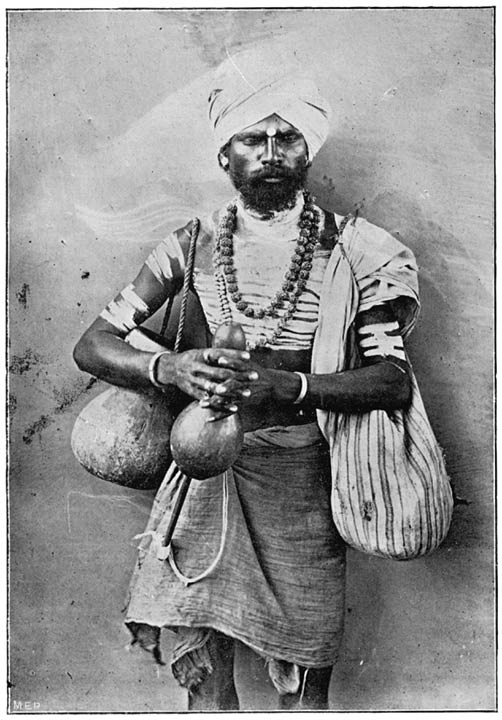
Jōgi mendicant.
In the Tamil country, the Jōgis are called Dhoddiyan or Tottiyan (q.v.), and those who are employed as scavengers are known as Koravas or Oddans. The scavengers do not mix with the rest of the community. Some Jōgis assert that they have to live by begging in consequence of a curse brought on them by Parvati, concerning whose breasts one of their ancestors made some indiscreet remarks. They consider themselves superior to Mālas and Mādigas, but an Oddan (navvy caste) will not eat in the house of a Jōgi. They are said to eat crocodiles, field rats, and cats. There is a tradition that a Jōgi bridegroom, before tying the bottu (marriage badge) on his bride’s neck, had to tie it by means of a string dyed with turmeric round the neck of a female cat. People sometimes object to the catching of cats by Jōgis for food, as the detachment of a single hair from the body of a cat is considered a heinous offence. To overcome the objection, the Jōgi says that he wants the animal for a marriage ceremony. On one occasion, I saw a Mādiga carrying home a bag full of kittens, which, he said, he was going to eat.
The Jōgi mendicants go about, clad in a dirty loin-cloth (often red in colour) and a strip of cloth over the shoulders, with cobras, pythons, or rat snakes in baskets, and carrying a bag slung over the shoulder. The contents of one of these bags, which was examined, were fruits of Mimusops hexandra and flower-spikes of Lippia nodiflora (used for medicine), a snake-charming reed instrument, a piece of cuttle-fish shell, porcupine quills (sold to goldsmiths for brushes), a cocoanut shell containing a powder, narrikombu (spurious jackals’ horns) such as are also manufactured by Kuruvikārans, and two pieces of wood supposed to be an antidote for snake-poisoning. The women go about the streets, decorated with bangles and necklaces of beads, sharks’ vertebræ, and cowry shells, bawling out “Subbamma, Lachchamma,” etc., and will not move on till alms are given to them. They carry a capacious gourd, which serves as a convenient receptacle for stolen articles.
Like other Telugu castes, the Jōgis have exogamous septs or intipēru, of which the following are examples:—
Vagiti, court-yard.
Uluvala, horse-gram.
Jalli, tassels of palmyra leaves put round the necks of bulls.
Vavati (relationship).
Gundra, round.
Bindhollu, brass water-pot.
Cheruku, sugar-cane.
Chappadi, insipid.
Boda Dāsiri, bald-headed mendicant.
Gudi, temple.
At the Mysore census, 1901, Killekyāta, Helava, Jangaliga, and Pākanāti were returned as being Jōgis. A few individuals returned gōtras, such as Vrishabha, Kāverimatha, and Khedrumakula. At the Madras census, Siddaru, and Pāmula (snake) were returned as sub-castes. Pāmula is applied as a synonym for Jōgi, inasmuch as snake-charming is one of their occupations.
The women of the caste are said to be depraved, and prostitution is common. As a proof of chastity, the ordeal of drinking a potful of cow-dung water or chilly-water has to be undergone. If a man, proved guilty of adultery, pleads inability to pay the fine, he has to walk a furlong with a mill-stone on his head.
At the betrothal ceremony, a small sum of money and a pig are given to the bride’s party. The pig is killed, and a feast held, with much consumption of liquor. Some of the features of the marriage ceremony are worthy of notice. The kankanams, or threads which are tied by the maternal uncles to the wrists of the bride and bridegroom, are made of human hair, and to them are attached leaves of Alangium lamarckii and Strychnos Nux-vomica. When the bridegroom and his party proceed to the bride’s hut for the ceremony of tying the bottu (marriage badge), they are stopped by a rope or bamboo screen, which is held by the relations of the bride and others. After a short struggle, money is paid to the men who hold the rope or screen, and the ceremonial is proceeded with. The rope is called vallepu thadu or relationship rope, and is made to imply legitimate connection. The bottu, consisting of a string of black beads, is tied round the bride’s neck, the bride and bridegroom sometimes sitting on a pestle and mortar. Rice is thrown over them, and they are carried on the shoulders of their maternal uncles beneath the marriage pandal (booth). As with the Oddēs and Upparavas, there is a saying that a Jōgi widow may mount the marriage dais (i.e., remarry) seven times.
When a girl reaches puberty, she is put in a hut made by her brother or husband, which is thatched with twigs of Eugenia Jambolana, margosa (Melia Azadirachta), mango (Mangifera Indica), and Vitex Negundo. On the last day of the pollution ceremony the girl’s clothes and the hut are burnt.
The dead are always buried. The corpse is carried to the burial-place, wrapped up in a cloth. Before it is lowered into the grave, all present throw rice over the eyes, and a man of a different sept to the deceased places four annas in the mouth. Within the grave the head is turned on one side, and a cavity scooped out, in which various articles of food are placed. Though the body is not burnt, fire is carried to the grave by the son. Among the Jalli-vallu, a chicken and small quantity of salt are placed in the armpit of the corpse. On the karmāndhiram, or day of the final death ceremonies, cooked rice, vegetables, fruit, and arrack are offered to the deceased. A cloth is spread near the grave, and the son, and other agnates, place food thereon, while naming, one after the other, their deceased ancestors. The food is eaten by Jōgis of septs other than the Jalli-vallu, who throw it into water. If septs other than the Jalli were to do this, they would be fined. Those assembled proceed to a tank or river, and make an effigy in mud, by the side of which an earthen lamp is placed. After the offering of cooked rice, etc., the lamp and effigy are thrown into the water. A man who is celebrating his wife’s death-rites then has his waist-thread cut by another widower while bathing.
The Jōgis worship Peddavādu, Malalamma, Gangamma, Ayyavāru, Rudramma, and Madura Vīrudu.
Some women wear, in addition to the marriage bottu, a special bottu in honour of one of their gods. This is placed before the god and worn by the eldest female of a family, passing on at her death to the next eldest.
Jōgi.—A sub-division of Kudubi.
Jōgi Gurukkal.—See Yōgi Gurukkal.
Jōgi Purusha.—The Purushas or Jōgi Purushas seem to have come into existence in recent times, and to be divided into two distinct classes, one of which has crystallised into a caste, while the other merely follows a cult practiced by several other castes. Those in South Canara, who speak Marāthi and Tulu, say that they form a caste, which will not admit members of other castes into its ranks. There is a head mutt (religious institution) at Kadiri, with subordinate mutts at Halori and Bhuvarasu, all in South Canara. The Jōgi Purushas are disciples of one or other of these mutts. Their special deity is Bairava, but some regard Gorakshanāth as their god. They are initiated into the Bairava cult by their priest. They may lead either a celibate or married life. The celibates should have a hole bored in the middle of the ear, and wear therein a ring of rhinoceros horn or china-clay. Those who wish to lead a married life need not have a hole in the ear, but, at the time of their initiation, a piece of clay is pressed over the spot where the hole should be. All Jōgi Purushas who have become the disciples of a guru (spiritual instructor) of their cult ought to have a brass, copper, or silver pipe, called singanātha, tied on a thread round the neck. Before taking their meals, they are expected to pray to Bairava, and blow the pipe.
The Jōgi Purushas follow the Makkalakattu system of inheritance (in the male line), and, for their marriage ceremonies, engage a Karādi Brāhman. The dead are buried in a sitting posture. The bojja, or final death ceremony, is usually performed on the twelfth day, and a Brāhman priest officiates thereat. The ceremony consists in offering food to the crows, making presents to Brāhmans, and undergoing purificatory rites for the removal of death pollution. If the deceased has been initiated into the Bairava cult, pūja (worship) must be done at the grave every alternate day from the third day till the bojja day.
Some Jōgi Purushas are professional mendicants, while others work as coolies, peons, etc.
Jōnagan.—Jōnagan is given, in the Madras Census Report, 1901, as the name applied to “Musalman traders of partly Hindu parentage. The word is from the Tamil Sōnagan, which means Arabia, and is not strictly the name of any Musalman tribe, but is a loose term applied by the Tamils to Musalmans of mixed descent.” In the Gazetteer of South Arcot, Mr. Francis says that “the term Jōnagan or Sōnagan, meaning a native of Sōnagan or Arabia, is applied by Hindus to both Labbais and Marakkāyars, but it is usually held to have a contemptuous flavour.” According to another version, Jōnagan is applied to sea-fishermen and boatmen, and the more prosperous traders are called Marakkāyars. In a note on the Māppillas of Malabar, Mr. Padmanabha Menon writes that “the Muhammadans generally go by the name of Jōnaga Māppillas. Jōnaka is believed to stand for Yavanaka, i.e., Greek.”
Jōti (light).—An exogamous sept of Bōya.
Jōtinagara.—Jōtinagara (people of the city of light) and Jōtipana are high sounding synonyms of the Canarese oil-pressing Gānigas, who express illuminant oils from seeds. In like manner, the Tamil oil-pressing Vāniyans are known as Jōtinagarattār and Tiru-vilakku Nagarattār (dwellers in the city of holy lamps).
Juda Māppilla.—A name by which the Cochin Jews are known.
Julāha.—A few members of this Muhammadan class of weavers have been returned at times of census.
Jungu (cock’s-comb).—A gōtra of Kurni.
Printed by The Superintendent, Government Press, Madras.