Volume 2 — I
Reading edition
Īchcham (date-palm: Phœnix sylvestris).—Īchcham or Īchanjānār is recorded, in the Tanjore Manual, as a section of Shānān. The equivalent Īchang occurs as a tree or kothu of Kondaiyankōttai Maravans.
Idachēri.—An occupational name for a section of Nāyars, who make and sell dairy produce. The word corresponds to Idaiyan in the Tamil country.
Idaiyan.—The Idaiyans are the great pastoral or shepherd caste of the Tamil country, but some are landowners, and a few are in Government employ. Those whom I examined at Coimbatore were engaged as milkmen, shepherds, cultivators, gardeners, cart-drivers, shopkeepers, constables, family doctors, and mendicants.
In the Madras Census Report, 1871, it is noted that milkmen and cowherds appear to hold a social position of some importance, and even Brāhmans do not disdain to drink milk or curds from their hands. Further, the Census Superintendent, 1901, writes that “the Idaiyans take a higher social position than they would otherwise do, owing to the tradition that Krishna was brought up by their caste, and to the fact that they are the only purveyors of milk, ghī (clarified butter), etc., and so are indispensable to the community. All Brāhmans, except the most orthodox, will accordingly eat butter-milk and butter brought by them. In some places they have the privilege of breaking the butter-pot on the Gōkulāshtami, or Krishna’s birthday, and get a new cloth and some money for doing it. They will eat in the houses of Vellālas, Pallis, and Nattamāns.”
The Idaiyans claim that Timma Rāja, the prime minister of Krishna Dēva Rāya of Vijayanagar, who executed various works in the Chingleput district, was an Idaiyan by caste.
The Idaiyans have returned a large number of divisions, of which the following may be noted:—
Kalkatti and Pāsi. The women, contrary to the usual Tamil custom, have black beads in their tāli-string. The practice is apparently due to the influence of Telugu Brāhman purōhits, as various Telugu castes have glass beads along with the bottu (marriage badge). In like manner, the married Pandamutti Palli women wear a necklace of black beads. According to a legend, pāsi is a pebble found in rivers, from which beads are made. A giant came to kill Krishna when he was playing with the shepherd boys on the banks of a river. He fought the giant with these pebbles, and killed him.
Pāl, milk. Corresponds to the Hālu (milk) division of the Canarese Kuruba shepherd caste.
Pendukkumekki, denoting those who are subservient to their women. A man, on marriage, joins his wife’s family, and he succeeds to the property, not of his father, but of his father-in-law.
Siviyan or Sivāla. An occupational name, meaning palanquin-bearer.
Sangukatti, or those who tie the conch or chank shell (Turbinella rapa). It is narrated that Krishna wanted to marry Rukmani, whose family insisted on marrying her to Sishupālan. When the wedding was about to take place, Krishna carried off Rukmani, and placed a bangle made of chank shell on her wrist.
Pudunāttu or Puthukkanāttar, meaning people of the new country. The Idaiyans claim that, when Krishna settled in Kishkindha, he peopled it with members of their caste.
Perūn (big) Tāli, and Siru (small) Tāli, indicating those whose married women wear a large or small tāli.
Maniyakkāra. Derived from mani, a bell, such as is tied round the necks of cattle, sheep and goats.
Kalla. Most numerous in the area inhabited by the Kallan caste. Possibly an offshoot of this caste, composed of those who have taken to the occupation of shepherds. Like the Kallans, this sub-division has exogamous septs or kīlais, e.g., Dēva (god), Vēndhan (king).
Shōlia. Territorial name denoting inhabitants of the Chōla country.
Ānaikombu, or elephant tusk, which was the weapon used by Krishna and the Yādavas to kill the giant Sakatasura.
Karutthakādu, black cotton country. A sub-division found mostly in Madura and Tinnevelly, where there is a considerable tract of black cotton soil.
The Perumāl Mādukkārans or Perumāl Erudukkārans (see Gangeddu), who travel about the country exhibiting performing bulls, are said to belong to the Pū (flower) Idaiyan section of the Idaiyan caste. This is so named because the primary occupation thereof was, and in some places still is, making garlands for temples.
In the Gazetteer of the Madura district, it is recorded that “Podunāttu (Pudunāttu?) Idaiyans have a tradition that they originally belonged to Tinnevelly, but fled to this district secretly one night in a body in the time of Tirumala Nāyakkan, because the local chief oppressed them. Tirumala welcomed them, and put them under the care of the Kallan headman Pinnai Dēvan, decreeing that, to ensure that this gentleman and his successors faithfully observed the charge, they should always be appointed by an Idaiyan. That condition is observed to this day. In this sub-division a man has the same right to marry his paternal aunt’s daughter as is possessed by the Kallans. But, if the woman’s age is much greater than the boy’s, she is usually married instead to his cousin, or some one else on that side of the family. A Brāhman officiates at weddings, and the sacred fire is used, but the bridegroom’s sister ties the tāli (marriage badge). Divorce and the remarriage of widows are prohibited. The dead, except infants, are burnt. Caste affairs are settled by a headman called the Nāttānmaikāran, who is assisted by an accountant and a peon. All three are elected. The headman has the management of the caste fund, which is utilised in the celebration of festivals on certain days in some of the larger temples of the district. Among these Podunāttus, an uncommon rule of inheritance is in force. A woman who has no male issue at the time of her husband’s death has to return his property to his brother, father, or maternal uncle, but is allotted maintenance, the amount of which is fixed by a caste panchāyat (council). Among the Valasu and Pendukkumekki sub-divisions, another odd form of maintenance subsists. A man’s property descends to his sons-in-law, who live with him, and not to his sons. The sons merely get maintenance until they are married.”
The typical panchāyat (village council) system exists among the Idaiyans, and the only distinguishing feature is the existence of a headman, called Kīthāri or Kīlāri, whose business it is to look after the sheep of the village, to arrange for penning them in the fields. In some places the headman is called Ambalakkāran. In bygone days, those who were convicted of adultery were tied to a post, and beaten.
In some places, when a girl reaches puberty, her maternal uncle, or his sons, build a hut with green cocoanut leaves, which she occupies for sixteen days, when purificatory ceremonies are performed.
The marriage ceremonies vary according to locality, and the following details of one form therefore, as carried out at Coimbatore, may be cited. When a marriage between two persons is contemplated, a red and white flower, tied up in separate betel leaves, are thrown before the idol at a temple. A little child is told to pick up one of the leaves, and, if she selects the one containing the white flower, the omens are considered auspicious, and the marriage will be arranged. On the day of the betrothal, the future bridegroom’s father and other relations go to the girl’s house with presents of a new cloth, fruits, and ornaments. The bride price (pariyam) is paid, and betel exchanged. The bridegroom-elect goes to the girl’s cousins (maternal uncle’s sons), who have a right to marry her, and presents them with four annas and betel. The acceptance of these is a sign that they consent to the marriage. On the marriage day, the bridegroom plants the milk-post, after it has been blessed by a Brāhman purōhit, and is shaved by a barber. The bride and her female relations fetch some earth, and a platform is made out of it in the marriage pandal (booth). The Brāhman makes fire (hōmam), and places a cowdung Pillayar (Ganēsa) in the pandal. The bride then husks some rice therein. The relations of the bride and bridegroom fetch from the potter’s house seven pots called adukupānai, two large pots, called arasānipānai, and seven earthen trays, and place them in front of the platform. The pots are filled with water, and a small bit of gold is placed in each. The bridegroom goes to a Pillayar shrine, and, on his return, the bride’s brother washes his feet, and puts rings on his second toes. The kankanams (wrist-threads) are tied on the wrists of the contracting couple, and the bridegroom takes his seat within the pandal, to which the bride is carried in the arms of one of her maternal uncles, while another carries a torch light placed on a mortar. The bride takes her seat by the side of the bridegroom, and the light is set in front of them. The tāli is taken round to be blessed by those assembled, and handed to the bridegroom, who ties it on the bride’s neck. The couple then put a little earth in each of the seven trays, and sow therein nine kinds of grain. Two vessels, containing milk and whey, are placed before them, and the relations pour a little thereof over their heads. The right hand of the bridegroom is placed on the left hand of the bride, and their hands are tied together by one of the bride’s maternal uncle’s sons. The bride is then carried into the house in the arms of an elder brother of the bridegroom. At the threshold she is stopped by the maternal uncle’s sons, who may beat the man who is carrying her. The bridegroom pays them each four annas, and he and the bride are allowed to enter the house. On the night of the wedding day, they are shut up in a room. During the following days the pots are worshipped. On the seventh day, the ends of the cloths of the newly married couple are tied together, and they bathe in turmeric water. The wrist-threads are removed, they rub oil over each other’s heads, and bathe in a tank. The bride serves food to the bridegroom, and their relations eat off the same leaf, to indicate the union between the two families. Into one of the large pots a gold and silver ring, and into the other an iron style and piece of palm leaf are dropped. The couple perform the pot-searching ceremony, and whichever gets hold of the gold ring or style is regarded as the more clever of the two. The bridegroom places his right foot, and the bride her left foot on a grindstone, and they look at the star Arundathi. The stone represents Ahalliya, the wife of the sage Gautama, who was cursed by her husband for her misconduct with Indra, and turned into a stone, whereas Arundathi was the wife of Vasishta and a model of chastity. The newly married couple, by placing their feet on the stone, indicate their intention of checking unchaste desires, and by looking at Arundathi, of remaining faithful to each other. The bride decorates a small grindstone with a cloth and ornaments, and takes it round to all her relations who are present, and who bless her with a hope that she will have many children.
In the Marava country, a grown-up Idaiyan girl is sometimes married to a boy of ten or twelve. Among some Idaiyans, it is customary for the tāli to be tied by the sister of the bridegroom, and not by the bridegroom, who must not be present when it is done.
It is said that, in some places, like the Gollas, when an Idaiyan bridegroom sets out for the house of his bride, he is seized by his companions, who will not release him till he has paid a piece of gold. In the Madura Manual it is noted that “at an Idaiyan wedding, on the third day, when the favourite amusement of sprinkling turmeric-water over the guests is concluded, the whole party betake themselves to the village tank (pond). A friend of the bridegroom brings a hoe and a basket, and the young husband fills three baskets with earth from the bottom of the tank, while the wife takes them away, and throws the earth behind. They then say ‘We have dug a ditch for charity.’ This practice may probably be explained by remembering that, in arid districts, where the Idaiyans often tend their cattle, the tank is of the greatest importance.”
It is said that the Siviyan and Pendukkumekki sub-divisions take low rank, as the remarriage of widows is freely permitted among them. In the Ramnād territory of the Madura district, the marriage of widows is attributed to compulsion by a Zamindar. According to the story, the Zamindar asked an Idaiyan whether he would marry a widow. The reply was that widows are aruthukattādhavar, i.e., women who will not tie the tāli string again, after snapping it (on the husband’s decease). This was considered impertinent by the Zamindar, as marriage of widows was common among the Maravars. To compel the Idaiyans to resort to widow marriage, he took advantage of the ambiguity of the word aruthukattādhavar, which would also mean those who do not tie up in a bundle after cutting or reaping. At the time of the harvest season, the Zamindar sent his servants to the Idaiyans with orders that they were not to tie up the rice plants in sheaves. This led to severe monetary loss, and the Idaiyans consented reluctantly to widow remarriage.
On the death of a married Idaiyan, at Coimbatore, the corpse is placed in a seated posture. A measure of rice, a lighted lamp, and a cocoanut are placed near it, and burning fire-wood is laid at the door of the house. When the relations and friends have arrived, the body is removed from the house, and placed in a pandal, supported behind by a mortar. The male relations put on the sacred thread, and each brings a pot of water from a tank. The widow rubs oil over the head of the corpse, and some one, placing a little oil in the hands thereof, rubs it over her head. On the way to the burning-ground, a barber carries a fire-brand and a pot, and a washerman carries the mat, cloths, and other articles used by the deceased. When the idukādu, a spot made to represent the shrine of Arichandra who is in charge of the burial or burning ground, is reached, the polluted articles are thrown away, and the bier is placed on the ground. A Paraiyan makes a cross-mark at the four corners of the bier, and the son, who is chief mourner, places a small coin on three of the marks, leaving out the one at the north-east corner. The Paraiyan takes these coins and tears a bit of cloth from the winding-sheet, which is sent to the widow. At the burning-ground, the relations place rice, water, and small coins in the mouth of the corpse. The coins are the perquisite of the Paraiyan. The son, who is clean-shaved, carries a pot of water on his shoulder thrice round the pyre, and, at each turn, the barber makes a hole in it with a chank shell, when the head is reached. Finally the pot is broken near the head. The sacred threads are thrown by those who wear them on the pyre, and the son sets fire to it, and goes away without looking back. The widow meanwhile has broken her tāli string, and thrown it into a vessel of milk, which is set on the spot where the deceased breathed his last. The son, on his return home after bathing, steps across a pestle placed at the threshold. Ārathi (wave offering) is performed, and he worships a lighted lamp within the house. On the following day, rice and Sesbania grandiflora are cooked, and served to the relatives by the widow’s brothers. Next day, milk, ghī (clarified butter), curds, tender cocoanuts, nine kinds of grain, water, and other articles required for worship, are taken to the burning-ground. The smouldering ashes are extinguished with water, and the fragments of the bones are collected, and placed on a leaf. A miniature plough is made, and the spot on which the body was burned is ploughed, and the nine kinds of grain are sown. On his return home, a turban is placed on the head of the son who acted as chief mourner by his maternal uncles. A new cloth is folded, and on it a betel leaf is placed, which is worshipped for sixteen days. On the sixteenth day, a Brāhman makes a human figure with holy grass, which has to be worshipped by the chief mourner not less than twenty-five times, and he must bathe between each act of worship. The bones are then carried in a new earthen pot, and floated on a stream. At night, food is cooked, and, with a new cloth, worshipped. Rice is cooked at the door. A cock is tied to a sacrificial post, called kazhukumaram, set up outside the house, to which the rice is offered. One end of a thread is tied to the post, and the other end to a new cloth, which is worshipped inside the house. The thread is watched till it shakes, and then broken. The door is closed, and the cock is stuck on the pointed tip of the post, and killed. An empty car is carried in procession through the streets, and alms are given to beggars. A widow should remain gōsha (in seclusion) for twelve months after her husband’s death. When a grown-up, but unmarried male or female dies, a human figure, made out of holy grass, is married to the corpse, and some of the marriage rites are performed.
The Idaiyans are Vaishnavites, and the more civilised among them are branded like Vaishnava Brāhmans. Saturday is considered a holy day. Their most important festival is Krishna Jayanti, or Srī Jayanti, in honour of Krishna’s birthday. They show special reverence for the vessels used in dairy operations.
The shepherd can get some fool to serve him.
Like a shepherd who would not give anything, but showed an ewe big with young.
The shepherd destroyed half, and the fool half.
In 1904, an elementary school for Idaiyans, called the Yādava school, was established at Madura.
The usual title of the Idaiyans is Kōnān or Kōn meaning King, but, in the Census Report, 1901, the titles Pillai and Kariyālan are also recorded. In the Census Report, 1891, Idaiya is given as a sub-division of Vakkaiga; and, in the Salem Manual, Idaiyan appears as a synonym of Shānān.
For the following note on the Idaiyans who have settled in Travancore, I am indebted to Mr. N. Subramani Aiyar. They consist of two well-defined sections, namely, the Tamil-speaking Idaiyans, who are but recent immigrants, and largely found in Tevala, Agastisvaram and Shenkotta, and the Malayālam-speaking branch, who are early settlers residing chiefly in Kartikapalli and other taluks of Central Travancore. The Idaiyans are not largely found in Travancore, because a branch of the indigenous Sūdra community, the Idachēri Nāyars, are engaged in the same occupation. They are divided into two classes, viz., Kangayan (shepherds) and Puvandans, who neither interdine nor intermarry. The latter appear to be divided into four classes, Pāsi, Gopālan, Nambi, and Valayitayan. Puvandan is another form of the word Pōndan, which means a palanquin-bearer. It is well known that, in the Tamil country, this was one of the duties of the Idaiyans, as is evident from a sub-division called Sivi or Siviyar (palanquin) existing among them. In the early settlement records of Travancore, they are referred to as Sibis. Many fancy, though incorrectly, that the word means one who collects flowers. As the Sibis were experts in palanquin-bearing, they must have been brought from the Tamil country to serve the mediæval Rājas. At the present day, besides pursuing their traditional occupation, they also engage in agriculture and trade. The position of the Puvandans in society is not low. They are entitled to the services of the Brāhman’s washerman and barber, and they may enter temples, and advance as far as the place to which Nāyars go, except in some parts of Central Travancore. They are flesh-eaters, and the drinking of intoxicating liquor is not prohibited. On ceremonial occasions, women wear the Tamil Idaiya dress, while at other times they adopt the attire of Nāyar women. Their ornaments are foreign, and clearly indicate that they are a Tamil caste. The marriage badge is called sankhu tāli, and a small conch-shaped ornament forms its most conspicuous feature. Besides the ordinary Hindu deities, they worship Mātam, Yakshi, and Maruta. At weddings, the Idaiyan bridegroom holds a sword in his left hand, while he takes hold of the bride by the right hand. Funeral ceremonies are supervised by a barber, who officiates as priest. Corpses are either burnt or buried. Though they appear to observe only eleven days’ death pollution, they cannot enter a temple until the expiry of sixteen days. An anniversary ceremony in memory of the deceased is performed on the new-moon day in the month of Karkātakam (July-August), and, on this day, most members of the caste go to Varkalai to perform the rite. Many purely Tamil names are still preserved in the caste, such as Tambi, Chāmi, Bhagavati, and Chāttu.
Idakottu (those who break).—An exogamous sept of Oddēs, who, during their work as navvies, break stones.
Idangai (left-hand).—Recorded, at times of census, as a division of Dēva-dāsis, who do service for castes belonging to the left-hand section.
Īdiga.—The Telugu toddy-drawers, whose hereditary occupation is the extraction of the juice of the date and palmyra palms, go by different names in different localities. Those, for example, who live in the Salem, North Arcot and Chingleput districts, are called Īdigas or Indras. In the Northern Circars and the Nellore district, they are known as Gamallas or Gamandlas, and in the Cuddapah district as Asilis.
In the Madras Census Report, 1901, it is stated that “it is said that the Īdigas are the descendants of Balijas from Rajahmundry in Godāvari district, and that their occupation separated them into a distinct caste. They are divided into two endogamous sections called either Dandu and Palli, or Pātha (old) and Kotta (new). The headman of the caste is called Gaudu. They employ Brāhmans as purōhits for their ceremonies, and these Brāhmans are received on terms of equality by other Brāhmans. They bury their dead, and observe pollution for twelve days, during which they abstain from eating flesh. The consumption of alcohol is strictly prohibited, and is severely punished by the headman of the caste. They eat with all Balijas, except the Gāzulu section. Their titles are Aiya, Appa, and Gaudu.”
It is noted by Mr. F. Fawcett that “in the northern districts, among the Telugu population, the toddy-drawers use a ladder about eight or nine feet in length, which is placed against the tree, to avoid climbing a third or fourth of it. While in the act of climbing up or down, they make use of a wide band, which is passed round the body at the small of the back, and round the tree. This band is easily fastened with a toggle and eye. The back is protected by a piece of thick soft leather. It gives great assistance in climbing, which it makes easy. All over the southernmost portion of the peninsula, among the Shānāns and Tiyans, the ladder and waist-band are unknown. They climb up and down with their hands and arms, using only a soft grummel of coir (cocoanut fibre) to keep the feet near together.”
The Īdigas claim to be descended from Vyāsa, the traditional compiler of the Mahābhārata. In a note by Mr. F. R. Hemingway on the Īdigas of the Godāvari district, they are said to worship a deity, to whom they annually offer fowls on New Year’s day, and make daily offerings of a few drops of toddy from the first pot taken from the tree. In this district they are commonly called Chetti.
Idiya (pounder).—Recorded, in the Travancore Census Report, 1901, as a division of Konkani Sūdras. The Idiyans prepare rice in a special manner. Paddy is soaked in water, and roasted over a fire. While hot, it is placed in a mortar, and pounded with a pestle. This rice is called avil, which is said to be largely used as a delicacy in Travancore, and to be employed in certain religious ceremonies.
The Idiyans are stated to have left their native land near Cochin, and settled in Travancore at the invitation of a former sovereign. On arrival in the land of their adoption, they were given, free of tax, cocoanut gardens and rice land. In return, they were required to supply, free of charge, the palace of the Mahārājah and the temple of Sri Padmanabhaswāmi at Trivandrum with as much beaten rice (avil) as might be required from time to time.
Īga (fly).—An exogamous sept of Mutrācha. The equivalent Īgala occurs as an exogamous sept of Yānādi.
Ilai (leaf).—Ilai or Ele has been recorded as a sub-division of Tigalas and Toreyas who cultivate the betel vine (Piper betle). Elai Vāniyan occurs as a synonym of Senaikkudaiyans, who are betel leaf sellers in Tinnevelly.
Ilaiyāttakudi.—A sub-division of Nāttukōttai Chetti.
Ilakutiyan.—Recorded, in the Travancore Census Report, 1901, as a sub-division of Nāyar.
Ilampi.—Recorded, in the Travancore Census Report, 1901, as a sub-division of Nāyar.
Ilayatu.—See Elayad.
Illa (of a house).—An exogamous sept of Yānādi.
Illuvellani.—The name, derived from illu, house, and vellani, those who do not go out, of a sub-division of Kammas, whose wives are kept gōsha (in seclusion).
Inaka Mukku Bhatrāzu.—Beggars attached to Padma Sālēs.
Inangan.—See Enangan.
Ina Pulaya.—A sub-division of Pulayans of Travancore.
Indla (house).—An exogamous sept of Chenchu and Mutrācha.
Īndra.—See Īdiga.
Īnichi (squirrel).—A gōtra of Kurni.
Inravar.—A Tamil form of Īndra.
Ippi (Bassia longifolia: mahuā).—An exogamous sept of Panta Reddi. Members of the Ippala gōtra of the Besthas may not touch or use the ippa (or ippi) tree.
Iranderudhu (two bullocks).—A sub-division of Vāniyans, who use two bullocks for their oil-mills.
Irāni (earthen vessel used at marriages).—A gōtra of Kurni.
Their camp generally consists of a few small tents, a few ponies, pack saddles to secure their culinary utensils, their dirty clothes, the leather or gunny bags containing their articles of merchandise; a few fighting cocks, and cages of birds. They are very fond of cock fighting, even on wagers of 10 to 50 rupees on each. They train these cocks specially brought up to fight.” For information concerning the criminal methods of the Irānis, I would refer the reader to Mr. Paupa Rao Naidu’s account thereof.
Iranyavarma.—The name of one of the early Pallava kings, returned at times of census as a caste name by some wealthy Pallis, who also gave themselves the title of Sōlakanar, or descendants of Chōla Kings.
Irattai Sekkān.—A sub-division of Vāniyans, who use two bullocks for their oil-mills.
Iraya.—A name for Cherumans, in Malabar, who are permitted to come as far as the eaves (ira) of their employers’ houses.
Irchakkollan (timber sawyer).—A synonym, in Travancore, of Tacchan (carpenter) Kammālan.
Irkuli.—Irkuli or Irangolli Vellāla, said to mean Vellālas who killed dampness, is a name assumed by some Vannāns.
Irpina (comb).—An exogamous sept of Kamma.
Irulas of the Nīlgiris. In the Kotagiri bazaar, which is an excellent hunting-ground for the anthropologist, may be seen gathered together on market-day Kotas, Badagas, Kanarese, Irulas, Kurumbas, and an occasional Toda from the Kodanād mand. A tribal photograph was taken there, with the result that a deputation subsequently waited on me with a petition to the effect that “We, the undersigned, beg to submit that your honour made photos of us, and has paid us nothing. We, therefore, beg you to do this common act of justice.” The deputation was made happy with a pourboire.
In my hunt after Irulas, which ended in an attack of malarial fever, it was necessary to invoke the assistance and proverbial hospitality of various planters. On one occasion news reached me that a gang of Irulas, collected for my benefit under a promise of substantial remuneration, had arrived at a planter’s bungalow, whither I proceeded. The party included a man who had been “wanted” for some time in connection with the shooting of an elephant on forbidden ground. He, suspecting me of base designs, refused to be measured, on the plea that he was afraid the height-measuring standard was the gallows. Nor would he let me take his photograph, fearing (though he had never heard of Bertillonage) lest it should be used for the purpose of criminal identification. Unhappily a mischievous rumour had been circulated that I had in my train a wizard Kurumba, who would bewitch the Irulas, in order that I might abduct them (for what purpose was not stated).
As the Badagas are the fairest, so the Irulas are the darkest-skinned of the Nīlgiri tribes, on some of whom, as has been said, charcoal would leave a white mark. The name Irula, in fact, means darkness or blackness (irul), whether in reference to the dark jungles in which the Irulas, who have not become domesticated by working as contractors or coolies on planters’ estates, dwell, or to the darkness of their skin, is doubtful. Though the typical Irula is dark-skinned and platyrhine, I have noted some who, as the result of contact metamorphosis, possessed skins of markedly paler hue, and leptorhine noses.
In connection with the shrine on Rangasvāmi peak, the following note is recorded in the Gazetteer of the Nīlgiris. “It is the most sacred hill on all the plateau. Hindu legend says that the god Rangasvāmi used to live at Karaimadai on the plains between Mettupālaiyam and Coimbatore, but quarrelled with his wife, and so came and lived here alone. In proof of the story, two footprints on the rock not far from Arakōd village below the peak are pointed out. This, however, is probably an invention designed to save the hill folk the toilsome journey to Rangasvāmi’s car festival at Karaimadai, which used once to be considered incumbent upon them. In some places, the Badagas and Kotas have gone even further, and established Rangasvāmi Bettus of their own, handy for their own particular villages. On the real Rangasvāmi peak are two rude walled enclosures sacred to the god Ranga and his consort, and within these are votive offerings (chiefly iron lamps and the notched sticks used as weighing machines), and two stones to represent the deities. The hereditary pūjāri is an Irula, and, on the day fixed by the Badagas for the annual feast, he arrives from his hamlet near Nandipuram, bathes in a pool below the summit, and marches to the top shouting ‘Govinda! Govinda!’ The cry is taken up with wild enthusiasm by all those present, and the whole crowd, which includes Badagas, Irulas, and Kurumbas, surrounds the enclosures, while the Irula priest invokes the deities by blowing his conch and beating his drum, and pours oblations over, and decorates with flowers, the two stones which represent them. That night, two stone basins on the summit are filled with ghee and lighted, and the glare is visible for miles around. The ceremonies close with prayers for good rain and fruitfulness among the flocks and herds, a wild dance by the Irula, and the boiling (called pongal, the same word as pongal the Tamil agricultural feast) of much rice in milk. About a mile from Arakōd is an overhanging rock called the kodai-kal or umbrella stone, under which is found a whitish clay. This clay is used by the Irulas for making the Vaishnava marks on their foreheads at this festival.”
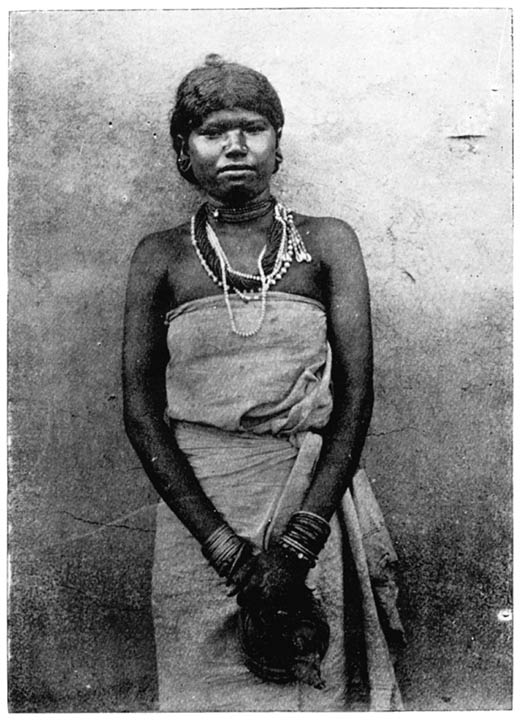
Irula, Nilgiris.
A village near a coffee estate, which I inspected, was, at the time of my visit, in the possession of pariah dogs and nude children, the elder children and adults being away at work. The village was protected against nocturnal feline and other feral marauders by a rude fence, and consisted of rows of single-storied huts, with verandah in front, made of split bamboo and thatched, detached huts, an abundance of fowl-houses, and cucurbitaceous plants twining up rough stages. Surrounding the village were a dense grove of plantain trees, castor-oil bushes, and cattle pens.
When not engaged at work on estates or in the forest, the Irulas cultivate, for their own consumption, rāgi (Eleusine Coracana), sāmai (Panicum miliare), tenai (Setaria italica), tovarai (Cajanus indicus), maize, plantains, etc. They also cultivate limes, oranges, jak fruit (Artocarpus integrifolia), etc. They, like the Kotas, will not attend to cultivation on Saturday or Monday. At the season of sowing, Badagas bring cocoanuts, plantains, milk and ghī (clarified butter), and give them to the Irulas, who, after offering them before their deity, return them to the Badagas.
“The Irulas,” a recent writer observes, “generally possess a small plot of ground near their villages, which they assiduously cultivate with grain, although they depend more upon the wages earned by working on estates. Some of them are splendid cattle-men, that is, in looking after the cattle possessed by some enterprising planter, who would add the sale of dairy produce to the nowadays pitiable profit of coffee planting. The Irula women are as useful as the men in weeding, and all estate work. In fact, planters find both men and women far more industrious and reliable than the Tamil coolies.”
“By the sale of the produce of the forests,” Harkness writes, “such as honey and bees wax, or the fruit of their gardens, the Irulas are enabled to buy grain for their immediate sustenance, and for seed. But, as they never pay any attention to the land after it is sown, or indeed to its preparation further than by partially clearing it of the jungle, and turning it up with the hoe; or, what is more common, scratching it into furrows with a stick, and scattering the grain indiscriminately, their crops are, of course, stunted and meagre. When the corn is ripe, if at any distance from the village, the family to whom the patch or field belongs will remove to it, and, constructing temporary dwellings, remain there so long as the grain lasts. Each morning they pluck as much as they think they may require for the use of that day, kindle a fire upon the nearest large stone or fragment of rock, and, when it is well heated, brush away the embers, and scatter the grain upon it, which, soon becoming parched and dry, is readily reduced to meal, which is made into cakes. The stone is now heated a second time, and the cakes are put on it to bake. Or, where they have met with a stone which has a little concavity, they will, after heating it, fill the hollow with water, and, with the meal, form a sort of porridge. In this way the whole family, their friends, and neighbours, will live till the grain has been consumed. The whole period is one of merry-making. They celebrate Mahri, and invite all who may be passing by to join in the festivities. These families will, in return, be invited to live on the fields of their neighbours. Many of them live for the remainder of the year on a kind of yam, which grows wild, and is called Erula root. To the use of this they accustom their children from infancy.”
The Irulas will not (so they say) eat the flesh of buffaloes or cattle, but will eat sheep and goat, field-rats, fowls, deer, pig (which they shoot), hares (which they snare with skilfully made nets), jungle-fowl, pigeons, and quail (which they knock over with stones).
They informed Mr. Harkness that, “they have no marriage contract, the sexes cohabiting almost indiscriminately; the option of remaining in union, or of separating, resting principally with the female. Some among them, the favourites of fortune, who can afford to spend four or five rupees on festivities, will celebrate their union by giving a feast to all their friends and neighbours; and, inviting the Kurumbars to attend with their pipe and tabor, spend the night in dance and merriment. This, however, is a rare occurrence.” The marriage ceremony, as described to me, is a very simple affair. A feast is held, at which a sheep is killed, and the guests make a present of a few annas to the bridegroom, who ties up the money in a cloth, and, going to the bride’s hut, conducts her to her future home. Widows are permitted to marry again.
When an Irula dies, two Kurumbas come to the village, and one shaves the head of the other. The shorn man is fed, and presented with a cloth, which he wraps round his head. This quaint ceremonial is supposed, in some way, to bring good luck to the departed. Outside the house of the deceased, in which the corpse is kept till the time of the funeral, men and women dance to the music of the Irula band. The dead are buried in a sitting posture, with the legs crossed tailorwise. Each village has its own burial-ground. A circular pit is dug, from the lower end of which a chamber is excavated, in which the corpse, clad in its own clothes, jewelry, and a new cloth, is placed with a lamp and grain. The pit is then filled in, and the position of the grave marked by a stone. On the third day a sheep is said to be killed, and a feast held. The following description of an annual ceremony was given to me. A lamp and oil are purchased, and rice is cooked in the village. They are then taken to the shrine at the burial-ground, offered up on stones, on which some of the oil is poured, and pūja is done. At the shrine, a pūjāri, with three white marks on the forehead, officiates. Like the Badaga Dēvadāri, the Irula pūjāri at times becomes inspired by the god.
The following sub-divisions of the tribe have been described to me:—Poongkaru, Kudagar (people of Coorg), Kalkatti (those who tie stone), Vellaka, Devāla, and Koppilingam. Of these, the first five are considered to be in the relation of brothers, so far as marriage is concerned, and do not intermarry. Members of these five classes must marry into the Koppilingam sub-division. At the census, 1901, Kasuva or Kasuba was returned as a sub-caste. The word means workmen, in allusion to the abandonment of jungle life in favour of working on planters’ estates, and elsewhere.
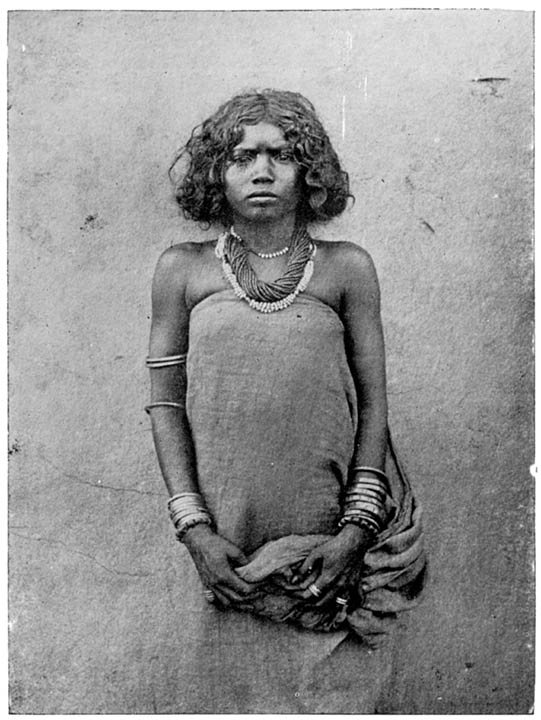
Irula, Nilgiris.
It is recorded by Harkness that “during the winter, or while they are wandering about the forests in search of food, driven by hunger, the families or parties separate from one another. On these occasions the women and young children are often left alone, and the mother, having no longer any nourishment for her infant, anticipates its final misery by burying it alive. The account here given was in every instance corroborated, and in such a manner as to leave no doubt in our minds of its correctness.”
The following notes are abstracted from my case-book.
Man, æt. 30. Sometimes works on a coffee estate. At present engaged in the cultivation of grains, pumpkins, jak-fruit, and plantains. Goes to the bazaar at Mettupalaiyam to buy rice, salt, chillies, oil, etc. Acquires agricultural implements from Kotas, to whom he pays annual tribute in grains or money. Wears brass earrings obtained from Kotas in exchange for vegetables and fruit. Wears turban and plain loin-cloth, wrapped round body and reaching below the knees. Bag containing tobacco and betel slung over shoulder. Skin very dark.
Woman, æt. 30. Hair curly, tied in a bunch behind round a black cotton swab. Wears a plain waist-cloth, and print body-cloth worn square across breasts and reaching below the knees. Tattooed on forehead. A mass of glass bead necklaces. Gold ornament in left nostril. Brass ornament in lobe of each ear. Eight brass bangles on right wrist; two brass and six glass bangles on left wrist. Five brass rings on right first finger; four brass and one tin ring on right forefinger.
Woman, æt. 25. Red cadjan (palm leaf) roll in dilated lobes of ears. Brass and glass bead ornament in helix of right ear. Brass ornament in left nostril. A number of bead necklets, one with young cowry shells pendent, another consisting of a heavy roll of black beads. The latter is very characteristic of Irula female adornment. One steel bangle, eight brass bangles, and one chank-shell bangle on right wrist; three lead, six glass bangles, and one glass bead bangle on left wrist. One steel and one brass ring on left little finger.
Woman, æt. 35. Wears loin-cloth only. Breasts fully exposed. Cap of Badaga pattern on head.
Girl, æt. 8. Lobe of each ear being dilated by a number of wooden sticks like matches.
Average stature 159.8 cm.; nasal index 85 (max. 100).
Irulas of Chingleput, North and South Arcot. The Irulas, or Villiyans (bowmen), who have settled in the town of Chingleput, about fifty miles distant from Madras, have attained to a higher degree of civilisation than the jungle Irulas of the Nīlgiris, and are defined, in the Census Report, 1901, as a semi-Brāhmanised forest tribe, who speak a corrupt Tamil.
Many of the Chingleput Irulas are very dark-skinned, with narrow chests, thin bodies, and flabby muscles, reminding me, in their general aspect, of the Yānādis of Nellore. Clothing is, in the men, reduced to a minimum—dhūti, and langūti of dirty white cotton cloth, or a narrow strip of gaudy Manchester piece-good. The hair is worn long and ragged, or shaved, with kudimi, in imitation of the higher classes. The moustache is slight, and the beard billy-goaty. Some of the men are tattooed with a blue dot on the glabella, or vertical mid-frontal line. For ornaments they have a stick in the helix, or simple ornament in the ear-lobe.
Their chief source of livelihood is husking paddy (rice), but they also gather sticks for sale as firewood in return for pice, rice, and sour fermented rice gruel, which is kept by the higher classes for cattle. This gruel is also highly appreciated by the Yānādis. While husking rice, they eat the bran, and, if not carefully watched, will steal as much of the rice as they can manage to secrete about themselves. As an addition to their plain dietary they catch field (Jerboa) rats, which they dig out with long sticks, after they have been asphyxiated with smoke blown into their tunnels through a small hole in an earthen pot filled with dried leaves, which are set on fire. When the nest is dug out, they find material for a meat and vegetable curry in the dead rats, with the hoarded store of rice or other grain. They feast on the bodies of winged white-ants (Termites), which they search with torch-lights at the time of their seasonal epidemic appearance. Some years ago a theft occurred in my house at night, and it was proved by a plaster cast of a foot-print in the mud produced by a nocturnal shower that one of my gardeners, who did not live on the spot, had been on the prowl. The explanation was that he had been collecting as a food-stuff the carcases of the winged ants, which had that evening appeared in myriads.
Some Irulas are herbalists, and are believed to have the powers of curing certain diseases, snake-poisoning, and the bites of rats and insects.
Occasionally the Irulas collect the leaves of the banyan, Butea frondosa, or lotus, for sale as food-platters, and they will eat the refuse food left on the platters by Brāhmans and other higher classes. They freely enter the houses of Brāhmans and non-Brāhman castes, and are not considered as carrying pollution.
They have no fixed place of abode, which they often change. Some live in low, palmyra-thatched huts of small dimensions; others under a tree, in an open place, in ruined buildings, or the street pials (verandah) of houses. Their domestic utensils consist of a few pots, one or two winnows, scythes, a crow-bar, a piece of flint and steel for making fire, and a dirty bag for tobacco and betel. In making fire, an angular fragment of quartz is held against a small piece of pith, and dexterously struck with an iron implement so that the spark falls on the pith, which can be rapidly blown into a blaze. To keep the children warm in the so-called cold season (with a minimum of 58° to 60°), they put their babies near the fire in pits dug in the ground.
For marital purposes they recognise tribal sub-divisions in a very vague way. Marriage is not a very impressive ceremonial. The bridegroom has to present new cloths to the bride, and his future father- and mother-in-law. The cloth given to the last-named is called the pāl kuli (milk money) for having nursed the bride. Marriage is celebrated on any day, except Saturday. A very modest banquet, in proportion to their slender means, is held, and toddy provided, if the state of the finances will run to it. Towards evening the bride and bridegroom stand in front of the house, and the latter ties the tāli, which consists of a bead necklace with a round brass disc. In the case of a marriage which took place during my visit, the bride had been wearing her new bridal cloth for a month before the event.
The Irulas worship periodically Kanniamma, their tribal deity, and Māri, the general goddess of epidemic disease. The deity is represented by five pots arranged in the form of a square, with a single pot in the centre, filled with turmeric water. Close to these a lamp is lighted, and raw rice, jaggery (crude sugar), rice flour, betel leaves and areca nuts are offered before it. Māri is represented by a white rag flag dyed with turmeric, hoisted on a bamboo in an open space near their dwellings, to which fowls, sheep, and other cooked articles, are offered.
The dead are buried lying flat on the face, with the head to the north, and the face turned towards the east. When the grave has been half filled in, they throw into it a prickly-pear (Opuntia Dillenii) shrub, and make a mound over it. Around this they place a row or two of prickly-pear stems to keep off jackals. No monumental stone is placed over the grave.
By means of the following table a comparison can be readily made between the stature and nasal index of the jungle Shōlagas and Nīlgiri Irulas, and of the more civilised Irulas of Chingleput and Ūrālis of Coimbatore:—
Stature, average. Nasal index, average. Nasal index, maximum. Nasal index, minimum.
Shōlagas 159.3 85·1 107·7 72·8
Irulas, Nilgiris 159·8 84·9 100 72·3
Irulas, Chingleput 159·9 80·3 90·5 70
Ūrālis 159·5 80·1 97·7 65·3
The table shows clearly that, while all the four tribes are of short and uniform stature, the nasal index, both as regards average, maximum and minimum, is higher in the Shōlagas and Irulas of the Nīlgiri jungles than in the more domesticated Irulas of Chingleput and Ūrālis. In brief, the two former, who have mingled less with the outside world, retain the archaic type of platyrhine nose to a greater extent than the two latter. The reduction of platyrhiny, as the result of civilisation and emergence from the jungle to the vicinity of towns, is still further brought out by the following figures relating to the two classes of Irulas, and the Kānikars of Travancore, who still live a jungle life, and those who have removed to the outskirts of a populous town:—
—— Nasal index.
Average. Maximum. Minimum.
Irulas, jungle 84.9 100 72.3
Kānikars, jungle 84.6 105 72.3
Kānikars, domesticated 81.2 90.5 70.8
Irulas, domesticated 80.3 90.5 70
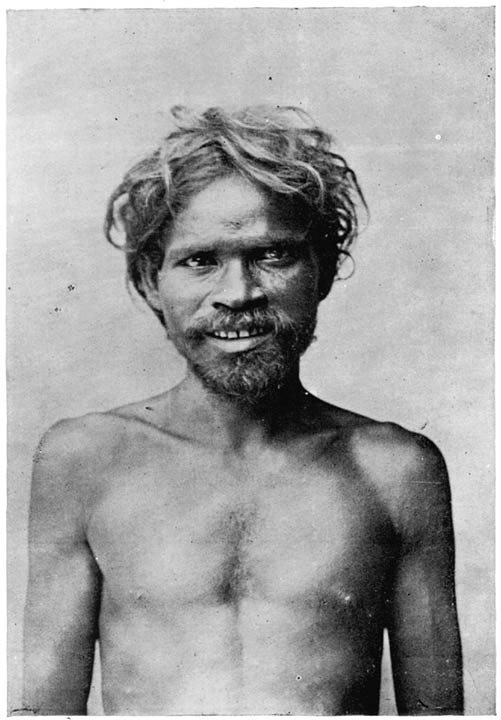
Irula, Chingleput.
There are two classes of Irulas in the North Arcot district, of which one lives in towns and villages, and the other leads a jungle life. Among the latter, as found near Kuppam, there are two distinct divisions, called Īswaran Vagaira and Dharmarāja. The former set up a stone beneath a temporary hut, and worship it by offering cooked rice and cocoanuts on unam (Lettsomia elliptica) leaves. The god Dharmarāja is represented by a vessel instead of a stone, and the offerings are placed in a basket. In the jungle section, a woman may marry her deceased husband’s brother. The dead are buried face upwards, and three stones are set up over the grave.
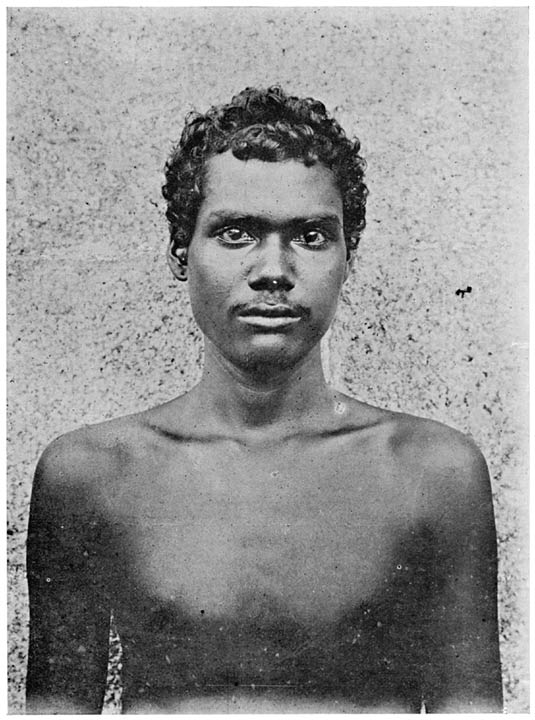
Irula, Chingleput.
As already indicated, the Irulas, like the Yerukalas, indulge in soothsaying. The Yerukala fortune-teller goes about with her basket, cowry shells, and rod, and will carry out the work of her profession anywhere, at any time, and any number of times in a day. The Irula, on the contrary, remains at his home, and will only tell fortunes close to his hut, or near the hut where his gods are kept. In case of sickness, people of all classes come to consult the Irula fortune-teller, whose occupation is known as Kannimar varniththal. Taking up his drum, he warms it over the fire, or exposes it to the heat of the sun. When it is sufficiently dry to vibrate to his satisfaction, Kannimar is worshipped by breaking a cocoanut, and burning camphor and incense. Closing his eyes, the Irula beats the drum, and shakes his head about, while his wife, who stands near him, sprinkles turmeric water over him. After a few minutes, bells are tied to his right wrist. In about a quarter of an hour he begins to shiver, and breaks out in a profuse perspiration. This is a sure sign that he is possessed by Kanniamman. His wife unties his kudumi (tuft of hair), the shaking of the head becomes more violent, he breathes rapidly, and hisses like a snake. His wife praises Kannimar. Gradually the man becomes calmer, and addresses those around him as if he were the goddess, saying, “Oh! children. I have come down on my car, which is decorated with mango flowers, margosa and jasmine. You need fear nothing so long as I exist, and you worship me. This country will be prosperous, and the people will continue to be happy. Ere long my precious car, immersed in the tank (pond) on the hill, will be taken out, and after that the country will become more prosperous,” and so on. Questions are generally put to the inspired man, not directly, but through his wife. Occasionally, even when no client has come to consult him, the Irula will take up his drum towards dusk, and chant the praises of Kannimar, sometimes for hours at a stretch, with a crowd of Irulas collected round him.
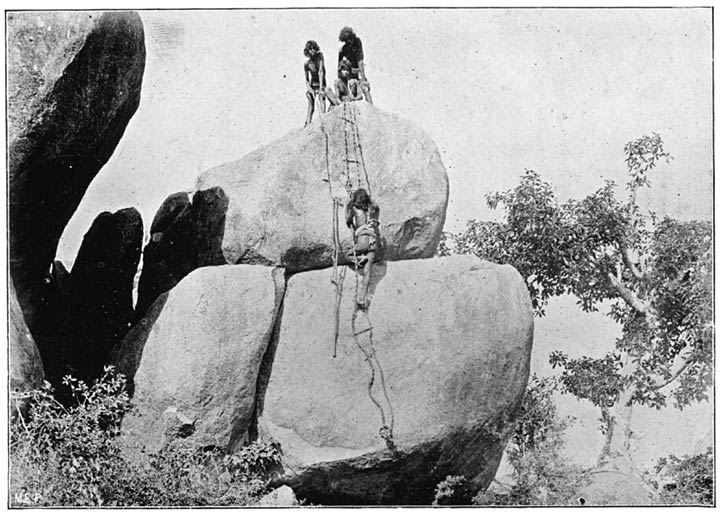
Irulas collecting honey.
The name Shikāri (hunter) is occasionally adopted as a synonym for Irula. And, in South Arcot, some Irulas call themselves Tēn (honey) Vanniyans or Vana (forest) Pallis.
Irula (darkness or night).—An exogamous sept of Kuruba.
Irumpu (iron) Kollan.—A sub-division of Kollan.
Irunūl (two strings).—A division of Mārāns in Travancore, in which the remarriage of widows is permitted.
Iruvu (black ant).—An exogamous sept of Kuruba.
Īsan (god).—A title of Kōliyan.
Īswaran Vagaira.—A division of the Irulas of North Arcot. The name denotes that they belong to the Īswara (Siva) section.
Itattara.—Recorded, in the Travancore Census Report, 1901, as a sub-division of Nāyar.
Izhava.—The Izhavans or Ilavans, and Tiyans, are the Malayālam toddy-drawing castes of Malabar, Cochin and Travancore. The etymology of the name Izhavan is dealt with in the article on Tiyans.
The Izhavas proper are divided into three sub-sections called Pachchili, Pāndi, and Malayālam. The Pachchilis live in the tract of land called Pachchalūr in the Neyyattinkara tāluk between Tiruvellam and Kovalam. They are only a handful in number. The Pāndis are largely found in Trivandrum and Chirayinkil. Most of them take the title of Panikkan. The Malayāla Izhavas are sub-divided into four exogamous groups or illams, named Muttillam, Madampi or Pallichal, Mayanatti, and Chozhi. Pallichal is a place in the Neyyattinkara taluk, and Mayannat in Quilon. The members of the Chozhi illam are believed to have been later settlers. There is another division of these Izhavas called Patikramams, based on a more or less geographical distinction. These are also four in number, and called Pallikkattara, Palattara, Irunkulamgara, and Tenganād, their social precedence being in this order. Pallikkattara is in Chirayinkil, Palattara in Quilon, Irunkulamgara in Trivandrum, and Tenganād in Neyyattinkara. The Palattara section is the most orthodox, and rigorously preserves its endogamous character, though some of the titular dignitaries among the Chovas of Central Travancore have found it possible to contract alliances with them. The divisions of the Illam and Patikkramam are absent among the Chovas. Among these, however, there is a division into Sthani or Melkudi, Tanikudi, and Kizhkudi, the first denoting the titular head, the second the ordinary class, and the third those under communal degradation. Among the last are included the toddy-drawing families, Vaduvans, and Nadis. Vaduvans are the slaves of the Izhavas, and, in ancient days, could be regularly bought and sold by them. Nadis live in Kartikapalli and some other parts of Central Travancore. They are people who have been outcasted from the community for various offences by the headmen, and cannot enter the kitchen of the ordinary Izhavas. They are served for ceremonial purposes not by the regular priests of the Izhavas, but by a distinct outcaste sect like themselves, known as Nadikuruppus. The Izhavattis, who are the priests of the caste, form a distinct sect with special manners and customs. Chānnan, a corruption of the Tamil word, Chanror or chiefmen, is the most important of the titles of the Izhavas. This title was conferred upon distinguished members of the caste as a family honour by some of the ancient sovereigns of the country. Panikkan comes next in rank, and is derived from pani, work. Tantan, from danda meaning punishment or control, is a popular title in some parts. Asan, from Acharya, a teacher, is extremely common. The recipients of this honour were instructors in gymnastics and military exercises to Nāyar and Izhava soldiers in bygone times, and even now ruins of old kalaris or exercise grounds attached to their houses are discernible in many places. Some Izhavas in South Travancore appear to be honoured with the title of Mudaliyar. Many families were invested with similar honours by the ancient ruling houses of Ambalapuzha, Kayenkulam, and Jayasimhanad (Quilon). Even now, some titles are conferred by the Rājah of Idappalli. The wives of these dignitaries are respectively known as Chānnatti, Panikkatti, etc.
The houses of the Izhavas resemble those of the Nāyars in form. Each house is a group of buildings, the most substantial of which, known as the arappura, stands in the centre. On the left side is the vadakkettu or woman’s apartment, including the kitchen. There is a court-yard in front of the arappura, and a little building called kizhakkettu enclosing it on the eastern side. Houses invariably face the east. The main entrance stands a little to the south of the kizhakkettu, to the south of which again is the tozhuttu or cow-shed. These buildings, of course, are found only in rich houses, the poor satisfying themselves with an arappura, a vatakketu, and a tozhuttu. A tekketu is to be seen to the south of the arappura in some cases. This is erected mainly to perpetuate the memory of some deceased member of the family known for learning, piety, or bravery. A pītha or seat, a conch, a cane, and a small bag containing ashes, are secured within. It is kept scrupulously free from pollution, and worship is offered on fixed days to the ancestors. The tekketu is enclosed on all the three sides, except the east. This description of houses in South Travancore, as far as Trivandrum, applies also to buildings erected to the north as far as Quilon, though tekketus are not so largely found as in the south. In some parts here, the southern room of the main buildings is consecrated to the memory of ancestors. In Central Travancore there are big kalaris to the south of the arappura in most of the ancient houses, and antique weapons and images of tutelary divinities are carefully preserved therein.
In dress and ornament, the Izhavas closely resemble the Nāyars. The tattu form of dress is not prevalent among Izhava women. In the wearing of the cloth, the left side comes inside instead of the right in the case of South Travancore Izhava women, though this rule is not without its exceptions. In South Travancore, the ornaments of women differ considerably from those of the north. Here they wear the pampadam or Tamil Sūdra women’s ear ornament, and adorn the wrists with a pair of silver bangles. The nose ornaments mūkkuthi and gnattu have only recently begun to be worn, and are not very popular in Central and North Travancore. This is a point in which Izhavas may be said to differ from the South Travancore Nāyar matrons. The ear ornament of elderly Izhava women in North Travancore is of an antique type called atukkam-samkhu-chakkravum. Women in the rural parts wear a curious neck ornament called anti-minnu. Of late, all ornaments of Nāyar women are being worn by fashionable Izhava females. But Izhava and Nāyar women can be distinguished by the tie of the hair lock, the Izhava women usually bringing it to the centre of the forehead, while the Nāyars place it on one side, generally the left. Tattooing was once prevalent in South Travancore, but is gradually losing favour. It was never in vogue in North Travancore.
The Izhavas eat both fish and flesh. Rabbits, deer, pigs, sheep, porcupines, fowls, doves, guinea-fowls, peacocks, and owls are believed to make popular dishes. The sweetmeat called ariyunta, and the curry known as mutirakkary, are peculiar to the Izhavas, and prepared best by them.
The most important occupation of the Izhavas till recently was the cultivation of palm trees, and the preparation of toddy and arrack. Barbosa, writing in the sixteenth century, states that “their principal employment is to till the palm trees, and gather their fruits; and to carry everything for hire from one point to another, because they are not in the habit of transporting them with beasts of burden, as there are none; and they hew stone, and gain their livelihood by all kinds of labour. Some of them bear the use of arms, and fight in the wars when it is necessary. They carry a staff in their hand of a fathom’s length as a sign of their lineage.” With the progress of culture and enlightenment, the occupation of extracting liquor from the cocoanut palm has ceased to be looked upon with favour, and such families as are now given to that pursuit have come to be regarded as a low division of the Chovas. In some parts of Travancore, the latter do not even enjoy the privilege of commensality with the other Izhavas. Agriculture is a prominent profession, and there are several wealthy and influential landlords in the community. There is also a fair percentage of agricultural labourers. A preliminary rite, called pozhutana sowing, is performed by farmers, who throw three handfuls of rice seed on a clay image representing Ganēsa, and pray that their fields may yield a good harvest. Before the time of reaping, on an auspicious morning, a few sheaves are brought, and hung up in some prominent place in the house. This ceremony is known as nira, and is common to all Hindu castes. At the end of it, the inmates of the house partake of puttari or new rice.
There are a few other customary rites observed by agriculturists, viz.:—
(1) Metiyittu-varuka, or throwing the grains of the first sheaf upon another, and covering it with its straw, this being afterwards appropriated by the chief agricultural labourer present.
(2) Koytu-pitichcha-katta-kotukkuka, or handing over the first sheaves of grain fastened together with Strychnos Nux-vomica leaves to the owner of the field, who is obliged to preserve them till the next harvest season.
(3) Kotuti, or offering of oblations of a few grains dipped in toddy to the spirits of agricultural fields, the Pulaya priest crying aloud ‘Poli, vā, poli, vā,’ meaning literally May good harvest come.
As manufacturers, the Izhavas occupy a position in Travancore. They produce several kinds of cloth, for local consumption in the main, and make mats, tiles, and ropes, with remarkable skill. They are also the chief lemon-grass oil distillers of Travancore. In the professions of medicine and astrology, the Izhavas have largely engaged themselves. While it must be confessed that many of them are utter strangers to culture, there are several who have received a sound education, especially in Sanskrit. On the whole, the Izhavas may be said to be one of the most industrious and prosperous communities on the west coast.
The Izhavas form a pious and orthodox Hindu caste. Though they cannot enter the inner court-yard of temples, they attend there in considerable numbers, and make their pious offerings. Over several temples the Travancore Izhavas have a joint right with the Nāyars. In illustration, the shrines of Saktikulamgara in Karunagappali, and Chettikulangara in Mavelikara, may be mentioned. Over these and other temples, the rights that have been enjoyed from time immemorial by certain Izhava families are respected even at the present day. In most places, the Izhavas have their own temples, with a member of their own or the Izhavatti caste as priest. As no provision had been made in them for daily worship, there was no necessity in early times for the regular employment of priests. The deity usually worshipped was Bhadrakāli, who was believed to help them in their military undertakings. The offerings made to her involved animal sacrifices. The temples are generally low thatched buildings with a front porch, an enclosure wall, and a grove of trees. There are many instances, in which the enclosure wall is absent. The Bhadrakāli cult is gradually losing favour under the teaching of a Vedantic scholar and religious reformer named Nanan Asan. In many Central and South Travancore shrines, images of Subramania have been set up at his instance, and daily worship is offered by bachelor priests appointed by the castemen. An association for the social, material, and religious amelioration of the community, called Narayana Dharma Paripalana Yogam, has been started. Its head-quarters is at Aruvippuram in the Nayyatinkara taluk. Every morning, the sun is specially worshipped by the cultured class. In ancient times, the adoration of Anchu Tampurakkal or the five deities, now identified with the Pāndavas of the Mahābharata, prevailed among these people. This worship is found among the Pulayas also. At Mayyanad in Quilon, there is still an Izhava temple dedicated to these five lords. Women visit shrines on all Mondays and Fridays, with a view to worshipping Gauri, the consort of Siva. Male Izhavas devote the first and last days of a month, as also that on which the star of their nativity falls, to religious worship. The Izhavas of Central Travancore pay homage to a spirit called Kāyalil Daivam, or the deity of backwaters. When a village becomes infected with small-pox or cholera, offerings are made to the Bhadrakāli shrine in that locality. The most important offering goes by the name of Kalam Vaikkuka, or pot placing. A woman of the house of the local Panikkan or chief member fasts, and, bearing a pot containing five nalis (a small measure) of paddy (unhusked rice), proceeds to all the other Izhava houses in the village, accompanied by musical instruments. One woman from every house marches to the shrine with her offering of paddy and a chuckram (nearly half an anna). The priest receives the offerings, converts the paddy into rice, and, depositing a portion of it in each of the pots, hands them back to the votaries on the morning of the next day. Another ceremony performed on such occasions is called Desakuruti, when women fast, and, taking all the food-stuffs necessary, proceed to the temple. After the sacrifice of a goat and fowls by the priest, they make an offering of the food to the deity before dinner. Tūkkam, or suspension, is another propitiatory ceremony. A religious observance, known as Mamachchirappu, finds favour with the Izhavas of Central Travancore in the month of Vrischikam (November-December). Every Izhava bathes in the evening, addresses the deities by their names for about an hour, and then makes an offering of tender cocoanuts, fruits, and fried grain. This takes place according to the convenience of each family from twelve to forty-one days.
The headmen of the Izhava caste are the Chānnans and Panikkans, invested with these titles by the Sovereigns of this State who have been already referred to. The limits of their jurisdiction were generally fixed in the charters received from them by their rulers, and even to-day their authority remains supreme in all social matters. The priests, it may be noted, are only a minor class, having no judicial functions. Chief among the offences against the caste rules may be mentioned non-observance of pollution, illicit connection, non-performance of the tāli-kettu before the age of puberty, non-employment of the village barber and washerman, non-celebration of ceremonies in one’s own village, and so on. The headman comes to know of these through the agency of the village barber or washerman, and also a class of secondary dignitaries known as Kottilpattukar or Nāluvitanmar. In every village, there are four families, invested with this authority in olden times by the rulers of the State on payment of fifty-nine fanams to the royal treasury. They are believed to hold a fourth of the authority that pertains to the chieftain of the village. If, on enquiry, an offence is proved, a fine is imposed on the offender, which he is obliged to pay to the local shrine. If the offence is grave, a feast has to be given by him to the villagers. In cases of failure, the services of the village priest and washerman, and also the barber, are refused, and the culprit becomes ostracised from society. The headman has to be paid a sum of ten chuckrams on all occasions of ceremonies, and the Nāluvitanmar four chuckrams each. There is a movement in favour of educating the priests, and delegating some of the above powers to them.
Three forms of inheritance may be said to prevail among the Izhavas of Travancore, viz.: (1) makkathāyam (inheritance from father to son) in the extreme south; (2) marumakkatāyam (through the female line) in all tāluks to the north of Quilon; (3) a mixture of the two between Neyyatinkara and that tāluk. According to the mixed mode, one’s own children are not left absolutely destitute, but some portion of the property is given them for maintenance, in no case, however, exceeding a half. In families observing the marumakkatāyam law, male and female heirs own equal rights. Partition, though possible when all consent, rarely takes place in practice, the eldest male member holding in his hands the management of the whole property. In Quilon and other places, the widow and her children are privileged to remain in her husband’s house for full one year after his death, and enjoy all the property belonging to him.
On the subject of inheritance, the Rev. S. Mateer writes as follows. “The nepotistic law of inheritance is, to a considerable extent, followed by this caste. Those in the far south being more closely connected with the Tamil people, their children inherit. Amongst the Ilavars in Trevandrum district, a curious attempt is made to unite both systems of inheritance, half the property acquired by a man after his marriage, and during the lifetime of his wife, going to the issue of such marriage, and half to the man’s nepotistic heirs. In a case decided by the Sadr Court, in 1872, the daughter of an Ilavan claimed her share in the movable and immovable property of her deceased father, and to have a sale made by him while alive declared null and void to the extent of her share. As there was another similar heir, the Court awarded the claimant a half share, and to this extent the claim was invalidated. Their rules are thus stated by G. Kerala Varman Tirumulpād:—‘If one marries and gives cloth to an Ilavatti (female), and has issue, of the property acquired by him and her from the time of the union, one-tenth is deducted for the husband’s labour or individual profit; of the remainder, half goes to the woman and her children, and half to the husband and his heirs (anandaravans). The property which an Ilavan has inherited or earned before his marriage devolves solely to his anandaravans, not to his children. If an Ilavatti has continued to live with her husband, and she has no issue, or her children die before obtaining any share of the property, when the husband dies possessing property earned by both, his heirs and she must mutually agree, or the castemen decide what is fair for her support; and the husband’s heir takes the remainder.’”
The marriage of Izhava girls consists of two distinct rites, one before they attain puberty called tāli-kettu, and the other generally after that period, but in some cases before, called sambandham. It is, however, necessary that the girl must have her tāli tied before some one contracts sambandham with her. The tāli-tier may be, but often is not, as among the Nāyars, the future husband of the girl. But, even for him, the relation will not be complete without a formal cloth presentation. The legitimate union for a person is with his maternal uncle’s or paternal aunt’s daughter. Generally there is a separate ceremony called Grihapravesam, or entrance into the house of the bridegroom after sambandham. Widows may contract alliances with other persons after the death of the first husband. In all cases, the Izhava husband takes his wife home, and considers it infra dig. to stay in the house of his father-in-law.
The method of celebrating the tāli-kettu differs in different parts of Travancore. The following is the form popular in Central Travancore. All the elderly members of the village assemble at the house of the girl, and fix a pillar of jack (Artocarpus integrifolia) wood at the south-east corner. On the Kaniyan (astrologer) being three times loudly consulted as to the auspiciousness of the house he gives an affirmative reply, and the guardian of the girl, receiving a silver ring from the goldsmith, hands it over to the Vatti (priest), who ties it on the wooden post. The carpenter, Kaniyan, and goldsmith receive some little presents. The next item in the programme is the preparation of the rice necessary for the marriage, and a quantity of paddy (unhusked rice) is brought by the girl to the pandal ground, and formally boiled in a pot. The pandal (booth) is generally erected on the south side of the house. The chartu, or a chit from the Kaniyan, certifying the auspiciousness of the match and the suitable date for its formal adoption, is taken by the guardian and four Machchampis or Inangans to the headman of the latter. These Machchampis are Izhavas of the village, equal in status to the guardian of the girl. All the preliminary arrangements are now over, and, on the day previous to the marriage, the girl bathes, and, wearing the bleached cloths supplied by the Mannān (washerman), worships the local deity, and awaits the arrival of the bridegroom. In the evening, the wife of the Vatti applies oil to her hair, and after a bath the rite known as Kalati begins, as a preliminary to which a thread passing through a silver ring is tied round her right wrist. Kalati is recitation of various songs by the women of the village before the girl. This is followed by Kānjiramala, or placing the girl before a line of carved wooden images, and songs by the Vatti women. On the following day, the girl is introduced, at the auspicious hour, within the katirmandapa or raised platform decorated with sheaves of corn within the pandal. The minnu or marriage ornament, prepared by the goldsmith, is handed over to the priest, along with two cloths to be worn by the bride and bridegroom. A string is made of thread taken from these cloths, and the minnu attached to it. The mother-in-law of the bridegroom now stands ready at the gate, and, on his arrival, places a garland of flowers round his neck. The new cloths are then presented by the Vatti and his wife to the bridegroom and bride respectively, after some tender cocoanut leaves, emblematic of the established occupation of the caste, are thrust into the bridegroom’s waist by the headman of the village. In former days, a sword took the place of these leaves. The minnu is then tied round the neck of the bride, and all parties, including the parent or guardian, give presents to the bridegroom. The day’s ceremony is then over, and the bridegroom remains at the house of the bride. The string is removed from the bride’s wrist by the Vatti on the fourth day, and the couple bathe. More than one girl may have the tāli tied at the same time, provided that there are separate bridegrooms for them. Only boys from the families of Machchampis can become tāli-tiers.
The sambandham of North and Central Travancore differs from that of South Travancore in some material respects. In the former, on the appointed day, the bridegroom, who is a different person from the tāli-tier, accompanied by his relations and friends, arrives at the bride’s house, and the guardian of the former offers a sum of money to the guardian of the latter. A suit of clothes, with ten chuckrams or ten rāsis (coins), is presented by the bridegroom to the bride, who stands in a room within and receives it, being afterwards dressed by his sister. The money goes by right to her mother, and is known as Ammāyippanam. Now comes the time for the departure of the bride to her husband’s house, when she receives from her guardian a nut-cracker, lime-can, a dish filled with rice, and a mat. A red cloth is thrown over her head, and a few members accompany the party for some distance. In South Travancore, the bridegroom is accompanied, besides others, by a companion, who asks in the midst of the assembly whether they assent to the proposed alliance, and, on their favourable reply, hands over a sum of money as an offering to the local shrine. Another sum is given for the maintenance of the bride, and, in the presence of the guardian, a suit of clothes is given to her by the bridegroom. The wife is, as elsewhere, immediately taken to the husband’s house. This is called Kudivaippu, and corresponds to the Grahapravesam celebrated by Brāhmans.
The following account of marriage among the Izhavas of Malabar is given in the Gazetteer of that district. “A girl may be married before puberty, but the consummation is not supposed to be effected till after puberty, though the girl may live with her husband at once. If the marriage is performed before puberty, the ceremony is apparently combined with the tāli-kettu kalyānam. The bride is fetched from the dēvapura or family chapel with a silk veil over her head, and holding a betel leaf in her right hand in front of her face. She stands in the pandal on a plank, on which there is some rice. On her right stand four enangans of the bridegroom, and on her left four of her own. The elder of the bridegroom’s enangans hands one of the bride’s enangans a bundle containing the tāli, a mundu and pāvā (cloths), some rice, betel leaves, and a coin called mēymēlkanam, which should be of gold and worth at least one rupee. All these are provided by the bridegroom. He next hands the tāli to the bridegroom’s sister, who ties it. After this, all the enangans scatter rice and flowers over the bride. In this caste, the claim of a man to the hand of his paternal aunt’s daughter is recognised in the ceremony called padikkal tada (obstruction at the gate), which consists of a formal obstruction offered by eleven neighbours to the bride’s removal, when she is not so related to her husband They are bought off by a fee of two fanams, and a packet of betel leaf. The girl is then taken to the bridegroom’s house. If very young, she is chaperoned by a female relative. On the fourth day there is a feast at the bridegroom’s house called nālām kalyānam and this concludes the ceremonies. Marriage after puberty is called Pudamari. The ceremonial is the same, but there is no padikkal tada.”
When an Izhava girl reaches puberty, the occasion is one for a four days’ religious ceremonial. On the first day, the Vatti priestess anoints the girl with oil, and after a bath, dresses her in the cloth supplied by the Mannātti (washerwoman). She is then laid on a broad wooden plank, and is supposed not to go out until she bathes on the fourth day. All the female relations of the family present her with sweetmeats. On the seventh day, she is again taken to and from the village tank (pond) with much éclat, and, on her return, she either treads on cloths spread on the floor, or is carried by an elderly woman. After this, she husks a quantity of paddy, and cooks the rice obtained thence. If this ceremony takes place at the house of a headman, the villagers present him with a vessel full of sugared rice.
A two days’ ceremonial, called Pulikudi in north Travancore, and Vayattu Pongala in the south, which corresponds to the Pumsavana of Brāhmans, is observed at the seventh month of pregnancy. On the first day, at twilight in the evening, the pregnant woman, preceded by the priestess, proceeds to the foot of a tamarind tree on the southern side of the compound. Arriving there, she receives a thread seven yards in length, to which a silver ring is attached at one end, and, by means of circumambulation, entwines the tree with the thread. If the thread is by chance or inadvertence broken during this process, the popular belief is that either the mother or the child will die soon. Next day, the thread is unwound from the tree, and a handful of tamarind leaves is given to the woman by her husband. On re-entering the house, tamarind juice is poured through the hands of the husband into those of the wife, who drinks it. The priestess then pours a quantity of oil on the navel of the woman from a betel leaf, and, from the manner in which it flows down, it is believed that she is able to determine the sex of the unborn child. The woman has to lean against a cutting of an ambazham (Spondias mangifera) tree while she is drinking the juice, and this cutting has to be planted in some part of the compound. If it does not grow properly, the adversity of the progeny is considered to be sealed. The husband is given a ring and other presents on this occasion. Women bathe on the third, fifth, and nineteenth day after delivery, and wear the māttu or changed cloth of the Mannātti, in order to be freed from pollution. The name-giving ceremony of the child takes place on the twenty-eighth day. It is decorated with a pair of iron anklets, and a ribbon passed through a few pieces of iron is tied round its waist. It is then held standing on a vessel filled with rice, and, its left ear being closed, a name is muttered by its guardian into the right ear. The first feeding ceremony is observed in the sixth month, when the iron ornaments are removed, and replaced by silver and gold ones. The ear-boring ceremony takes place at an auspicious hour on some day before the child attains its seventh year.
In former times, only the eldest male member of a family was cremated, but no such restriction obtains at the present day. When a member of the community dies, three handfuls of rice are placed in the mouth of the corpse by the eldest heir after a bath, followed by the sons, nephews, and grandsons of the deceased. Every relative throws an unbleached cloth over the corpse, after which it is taken to the burning-ground, where the pyre is lighted by the heir with a consecrated torch handed to him by the priest. A wooden plank is furnished by the carpenter, and an impression of the foot of the deceased smeared with sandal paste is made on it. The name, and date of the death of the deceased, are inscribed thereon, and it has to be carefully preserved in the house of the heir. The record refreshes his memory on occasions of srādh (memorial service), etc. When the cremation is half completed, the contents of a tender cocoanut are placed beside the head of the corpse as an offering, and prayers are muttered. A pot full of water is then borne by the chief mourner on his shoulder thrice round the corpse. As he does so, the priest pricks the pot thrice with an iron instrument. Finally, the pot is broken on the pyre, and the chief mourner returns home without turning back and looking at the corpse. On the second day, an oblation of food (pinda) is offered to the departed. The inmates of the house are fed with conji (rice gruel) on this day by the relatives. The Sanchayana, or collection of bones, takes place on the fifth day. Pollution lasts for fifteen days in Central and North Travancore, but only for ten days in the south. There are some rites, not observed necessarily by all members of the caste, on the forty-first day, and at the end of the first year. Persons who have died of contagious diseases, women who die after conception or on delivery, and children under five years of age, are buried. Pollution is observed only for nine days when children die; and, in the case of men who die of contagious disease, a special group of ceremonies is performed by the sorcerer. Those who are under pollution, besides being forbidden to enter shrines and other sanctuaries, may not read or write, or partake of liquor, butter, milk, ghī, dhal, or jaggery.