SHORT-WINGED CURSORIAL BIRDS (Brevipennes).
Thomas Rymer Jones translation
This order comprises a number of remarkable birds, conspicuous among which are the OSTRICHES, with wings so strangely disproportionate to the size of their bodies as to have given rise to many strange fables amongst the Eastern nations concerning their origin. In North-eastern Asia the legend runs that these huge birds, inflated with pride at their superior size and strength, looked down upon their feathered companions with contempt, and, desirous of exhibiting their powers of flight, upon one occasion made a vain attempt to reach the sun. Phœbus, angry at such presumption, punished their temerity by singeing off their wings, and thus causing them to fall heavily to earth. In so doing they struck their breasts violently upon the ground, and received a mark that, together with the shortness of their pinions, has been reproduced through all successive generations, as a terrible warning against vainglorious aspirations.
Another and more ancient fable represents the Ostrich as the offspring of the camel and some strange feathered occupant of the desert.
The members of this order are birds of great size, with rather short, blunt beaks, in which the orifices of the nostrils are placed at a short distance behind the tip. In one family, however, the bill is comparatively long and slender. The head is moderately large, the neck very long, and the body exceedingly powerful; the wings are extraordinarily short, while the legs, on the contrary, are long and muscular; the large strong foot is furnished with two, three, or four toes. The feathers and quills of the tail are undeveloped, and the rest of the plumage is so lax as to have somewhat the appearance of hair. The sight and hearing of the BREVIPENNES is excellent, but their senses of taste and feeling very deficient. All are shy and cautious in their habits, but on the approach of danger they exhibit but little sagacity in their wild attempts at flight. Amongst themselves they live at peace, except during the period of incubation, and when in captivity show themselves to be almost incapable of attachment.
Africa produces one, America three, and Oceania no fewer than nine species of these birds, whilst in Europe and Asia they are unrepresented. Everywhere they occupy dry, sandy plains or tracts covered with scanty vegetation, and wander over these dreary wastes, either alone or in flocks, in search of the plants and small creatures upon which they subsist. Although not actually voracious in their appetites, no substance, however indigestible, seems to come amiss to them, and a variety of objects are frequently swallowed that their stomachs utterly reject. The incubation of these birds is very remarkable. Some are monogamous, others polygamous; but in all cases, or at least with few exceptions, the male usually undertakes all the parental duties, and behaves in every respect as a "mother" to the young, whilst the female, after depositing her eggs, exhibits but slight interest in her progeny.
THE OSTRICH.
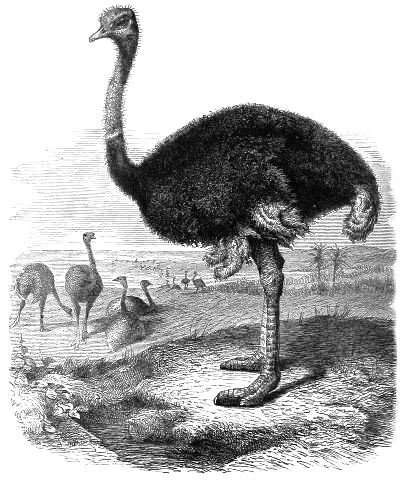
THE OSTRICH (Struthio camelus).
The OSTRICH (Struthio camelus) is at once recognisable by its very powerful body, long and partially bare throat, and small flat head. The moderately long, depressed, and straight bill is rounded at its extremity, and has the open longitudinal nostrils prolonged nearly half-way down the beak. The large brilliant eyes are protected by lashes, and the open uncovered ears lined with a hairy growth. The long legs are bare or only overspread with a few bristles on the thighs, while the tarsi are covered with large scales, and the feet furnished with but two toes: the innermost of which is armed with a large, broad, blunt claw. The wings are furnished with waving plumes, and two bare shafts, not unlike porcupine's quills. In this bird the sternum has no keel, but is simply convex, shield-like, and covered with a callous pad or elastic cushion, having a hard rough surface unclothed with feathers, on which the birds support their bodies when reposing on the ground. The thick curly plumage differs in its coloration according to the sex of the bird. In the male the small rump-feathers are coal-black, the flowing wing and tail feathers of a dazzling whiteness. The colour of the female is a brownish grey, mingled with dirty white. The young resemble the mother after the first moulting. The height of the fully-grown male is eight feet, and his length from the tip of the beak to the end of the tail at least six feet; the weight of the body is about one hundredweight and a half. These large and remarkable birds inhabit the vast deserts and barren steppes of Southern Africa, and were formerly far more numerous than they are now. Lichtenstein, who wrote at the commencement of this century, mentions having seen flocks containing as many as 300 individuals in the country near the Cape, but at the present day they are usually met with in small families, consisting of but one male and from two to four females. In such countries as are not subjected to any violent changes of temperature, they remain from one year to another within a certain limited district, provided it affords them ample means of subsistence, and a large supply of water, which is indispensable. As regards the development of their senses, these birds are very unequally gifted; their power of sight is extensive, whilst their taste and hearing are comparatively deficient. The cry of the Ostrich, which is often uttered at night, is a loud, dolorous, and stridulous sound, and in the stillness of the desert plains may be heard to a great distance. Some have compared it to the roar of the lion, but Dr. Tristram, from whom we borrow the following account of the habits of this bird, describes it as more like the hoarse lowing of an ox in pain. The note of the Ostrich during the day or when feeding he describes as being very different—a sort of hissing chuckle. The beauty of its wings and tail-feathers, which are as highly prized by the Bedouins for the decoration of tombs and of the tents and spear-heads of their sheikhs as they are for head-dresses among Western nations, have caused its chase to be a favourite employment of all desert tribes, and good skins fetch very high prices in the native markets. This bird never approaches settled habitations, and very rarely cultivated lands; it usually selects an open space where it is safe from surprise, and where by its fleetness it "scorneth the horse and his rider."
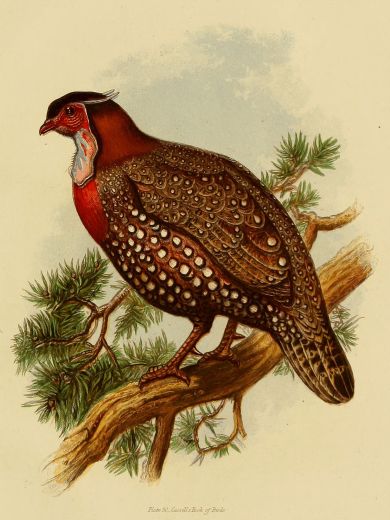
Plate 30. Cassell's Book of Birds
HASTINGS TRAGOPAN ____ CERIORNIS MELANOCEPHALUS
(one third Nat. size)
[See larger version]
"The capture of the Ostrich is the greatest feat of hunting to which the Arab sportsman aspires, and in richness of booty it ranks next to the plunder of a caravan. So wary is the bird, and so open are the vast plains over which it roams, that no ambuscades or artifices can be employed, and the vulgar resource of dogged perseverance is the only mode of pursuit. The horses to be employed undergo a long and painful training: abstinence from water and a diet of dry dates being considered the best means for strengthening their wind. The hunters set forth with small skins of water strapped under their horses' bellies, and a scanty allowance of food for four or five days distributed judiciously about their saddles. The Ostrich generally lives in companies of from four to six individuals, which do not appear to be in the habit, under ordinary circumstances, of wandering more than twenty or thirty miles from their head-quarters. When descried, two or three of the hunters follow the herd, at a gentle gallop, endeavouring merely to keep the birds in sight without alarming them or driving them at full speed, when they would soon be lost to view. The rest of the pursuers leisurely proceed in a direction at right angles to the course which the Ostriches have taken, knowing by experience their habit of running in a circle. Posted on the best look-out they can find, they await for hours the anticipated route of the game, calculating upon intersecting their path. If fortunate enough to detect them, the relay sets upon the now fatigued flock, and frequently succeeds in running one or two down; though a horse or two generally falls exhausted in the pursuit."
The Ostrich when once taken offers no resistance beyond kicking out sideways. Its speed has been calculated, by Dr. Livingstone, at twenty-six miles an hour, and yet the South African Ostrich is smaller than the northern species; Dr. Tristram, who, in the Sahara, measured the stride of the latter when bounding at full speed, found it to be from twenty-two to twenty-eight feet. If Dr. Livingstone's calculation be at all correct, the speed of the Ostrich is unequalled by any other cursorial animal. Portions of plants, grass, seeds, and insects form the principal food of these birds, but nothing that they can by any possibility swallow seems to come amiss to them; even should the object be of such a nature as to be utterly indigestible by their stomachs. Brehm mentions that upon more than one occasion his bunch of keys was thus appropriated by an Ostrich, and cites an instance in which a great variety of small articles made of metal, such as coins, keys, nails, and bullets, together with a considerable quantity of gravel and pebbles, were found upon dissection in the stomach of a single individual. Small quadrupeds and birds they also enjoy amazingly, and an authority, quoted by Brehm, affirms that one of these voracious creatures that was kept about a farm-house, entered the yard, and seeing a fine broad of ducklings running about after their mother, coolly swallowed them one after the other with no more ceremony than if they had been so many oysters. Nor is the thirst of these birds less remarkable, for Anderson assures us that when engaged in drinking they seem so engrossed as to have neither eyes nor ears for anything around them; day by day the same spot is visited in order to obtain water, until regular beaten tracks are formed, that have often misled travellers in the African desert, and caused them to imagine they had discovered the footprints of man. The female Ostrich deposits her numerous eggs in a shallow hollow in the sand, only a few inches deep, but about one yard in diameter; round this a slight wall is scraped together, and against it the numerous eggs are placed upon end, in such a manner as to occupy the least possible space. Several females lay in the same spot, so that it is not uncommon to find as many as thirty, or, according to Livingstone, as forty-five eggs in one nest. During the night the male bird broods, whilst in the daytime the eggs are covered with sand and left exposed to the sun's rays for hours at a time. Several eggs usually lie scattered around the nest; these are supposed to be intended as food for such of the young as first emerge from the shell. Solitary eggs are also left lying at random all over the country, and are named by the Bechuans 'losetla.' It is from this habit, most probably, that want of parental instinct is laid to the charge of the Ostrich; moreover, it is certain that when surprised by man with their young, before the latter are able to run, the parent bird usually scuds off alone and leaves its offspring to their fate. To do otherwise would be self-sacrifice, as it is aware of its inability to defend itself or its poults, and on the open desert it cannot, like other cursorial birds, mislead the pursuer or conceal its brood in herbage. The young are hatched in six or seven weeks, and make their appearance covered, not with feathers, but with a bristle-like growth, somewhat resembling the prickles on the back of a hedgehog. From the day they quit the shell, they not only run easily, but are fully competent to pick up their food from the ground, and within a fortnight are "entirely self-dependent." The following anecdote illustrative of the affection occasionally displayed by the Ostrich for its little family is given by Anderson, who was an eye-witness on the occasion, he and his friend, Mr. Galton, having come upon a male and female escorting a brood of young ones of about the size of Barn-door Fowls:—"The moment the parent birds became aware of our intention, they set off at full speed, the female leading the way, the young following in her wake, and the cock, though at some little distance, bringing up the rear of the family party. It was very touching to observe the anxiety the old birds evinced for the safety of their progeny. Finding that we were quickly gaining upon them, the male at once slackened his pace and diverged somewhat from his course; but seeing that we were not to be diverted from our purpose, he again increased his speed, and with wings drooping so as almost to touch the ground, he hovered round us now in wide circles, and then decreasing the circumference till he came almost within pistol-shot, when he abruptly threw himself on the ground, and struggled desperately to regain his legs, as it appeared, like a bird that has been badly wounded. Having previously fired at him I really thought he was disabled, and made quickly towards him, but this was only a ruse on his part, for on my nearer approach he slowly rose, and began to run in an opposite direction to that of the female, who by this time was considerably ahead with her charge."
The eggs of the Ostrich are of an oval shape, and have a thick, glossy, yellowish white shell, marked with pale yellow. According to Hardy the weight of one fully equals that of twenty-four of the eggs laid by the Domestic Fowl. To travellers in the African deserts these huge eggs form a convenient and portable provision; their flavour is excellent, and the shell so thick that they keep perfectly fresh for a fortnight or three weeks. Tristram mentions having found Ostrich egg omelette a most valuable addition to his desert bill of fare. When two months old the young acquire a plumage similar to that of the adult female; this is retained by both sexes for two years, when the male exhibits black feathers and has attained his full size and strength. The young Ostrich is easily domesticated, and is often kept by the Arabs, living freely with the goats and camels, and showing no disposition to escape. In some villages they are a sort of public property and live in the bazaars, levying contributions for themselves from the fruit-stalls.
The Romans highly esteemed the flesh of the Ostrich, and the pseudo-Emperor Firmius is said to have devoured an entire bird at one meal; the brain was regarded as a choice delicacy, and to provide the Emperor Heliogabalus with a sufficient supper of this luxurious diet, six hundred Ostriches, we are told, lost their lives. They were also introduced into the Circus, and upon one occasion no less than one thousand of them, together with a number of other animals, fell victims to the cruel thirst for excitement that debased the populace of Rome. In all parts of Southern and Central Africa, the flesh, feathers, and eggs of the Ostrich are highly esteemed, and form most valuable articles of traffic. A skin is in some parts worth from forty to one hundred dollars, but the Arabs are in the habit of thinning the feathers so that the trader rarely obtains a specimen on which this tax has not been levied. Anderson describes a foot chase of these birds, witnessed by himself, on the banks of Lake Ngami. On this occasion the flock was entirely surrounded, and the terrified birds driven with loud cries and a variety of strange noises into the water. Moffat also gives an amusing account of another mode adopted by the Bushmen for their destruction. A skin is stuffed with straw so as to form a kind of saddle, and covered with feathers; this is placed upon a man's head, his legs are painted white, and with the head and neck of an Ostrich mounted upon a stick in one hand and his gun in the other, he steals amidst an unsuspecting party, and by imitating their gestures so completely deceives them as to his identity, that they make no attempt to avoid the treacherous intruder. Amongst the many ways employed to cook Ostrich eggs, Burchell mentions that the Hottentots prepare them by boring a small hole at one end; into this they insert a thin twig and stir the contents briskly over a fire of hot ashes; when thus prepared they are excellent.
The NANDUS (Rhea), as the American representatives of the Ostrich are called, closely resemble their African brothers in general formation, but have a somewhat shorter wing, and the foot furnished with three toes. The bill is flat, of the same length as the head, broad at its base, and rounded at its tip, and very similar to that of the Ostrich. The toes are moderately long, connected by a skin at their base, and armed with straight sharp claws, which are compressed at their sides, bluntly rounded at their upper surface, and sharply ridged beneath. The wings are furnished with long plumes and terminated by a spur; the tail-feathers are entirely wanting. The region of the eye, cheek-stripes, and a ring covered with bristles that encircles the ear, are unfeathered and covered with a wrinkled skin; the feathers on the head and throat are small, narrow, and pointed; those on the rump are large, broad, and rounded with a soft flowing web; the eyelids are furnished with large stiff bristles. The male and female are almost alike in colour, but differ in size. We are now acquainted with three members of the above group.
THE TRUE NANDU, OR AMERICAN OSTRICH.
The TRUE NANDU, or AMERICAN OSTRICH (Rhea Americana), has the plumage on the crown of the head, upper throat, nape, and upper breast, and the bristles on the cheek-stripes of a blackish hue; the centre of the throat is yellow, the rest of the neck and cheeks are light lead-grey, and the back, sides of the breast, and wings brownish grey; the other portions of the under side are dirty white. The eyes are pearl-grey, the bare parts of the face flesh-colour; the beak is greyish brown, and the foot grey. The female is distinguishable by the paler tints of her neck and breast. An old female measured by the Prince von Wied was fifty-two inches and two-thirds in length, and seven feet across the span of the wings.
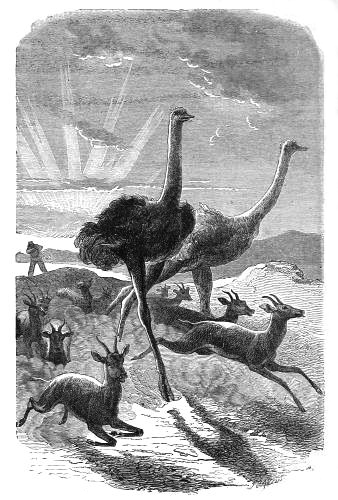
AN OSTRICH HUNT.
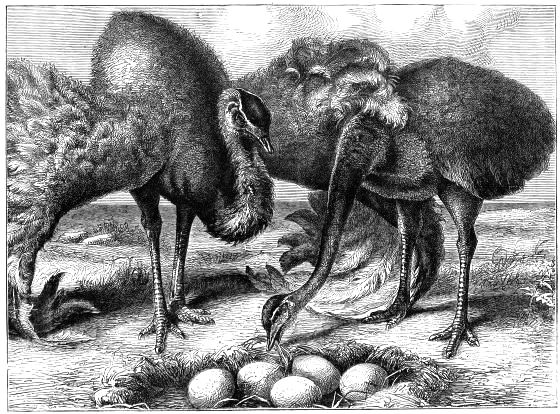
NANDUS (Rhea Americana), WITH NEST AND EGGS.
The American Ostrich ranges south as far as forty-two or forty-three degrees; it is abundant on the plains of La Plata, and, according to Azara, is found in Paraguay. Mr. Darwin saw it within the first range of mountains on the Uspalluta Plain, at an elevation of six or seven thousand feet above the sea; but it does not cross the Cordilleras. At Bahia Blanca the latter observer repeatedly saw three or four come down at low water to the extensive mud-banks, which are then dry, for the sake, as the Gauchos say, of catching small fish. Although this Ostrich is in its habits so shy, wary, and solitary, and although so fleet in its pace, it falls a prey without much difficulty to the Indian or Gaucho, armed with the bolas. When several horsemen appear in a circle it becomes confounded, and does not know which way to escape; it prefers running against the wind, yet at the first start it expands its wings like a vessel that makes all sail. On one fine hot day Mr. Darwin saw several of these birds enter a bed of tall rushes, where they squatted concealed until closely approached.
In Patagonia, at the Bay of San Blas, and at Port Valdes, Mr. King several times saw Nandus swimming from island to island, a distance of about two hundred yards; they ran into the water, both when driven and of their own accord, and swam very slowly, with their necks extended a little forward, only a small part of their bodies appearing above the water. Mr. Darwin likewise on two occasions observed some of these Ostriches swimming across the Santa Cruz River, where it was about four hundred yards wide and its course rapid. The note of the male is described as being deep-toned and hissing, and so peculiar as rather to resemble the noise of some wild beast than the voice of any bird. At Bahia Blanca, in the months of September and October, the eggs of the Nandu were found in extraordinary numbers all over the country. They either lie scattered singly—in which case they are never hatched and are called by the Spaniards huachos—or they are collected together into a shallow excavation which forms the nest. Out of four nests which Mr. Darwin saw, three contained twenty-two eggs each, and the fourth twenty-seven. In one day's hunting on horseback sixty-four eggs were found; forty-four of these were in two nests, and the remaining twenty were scattered huachos. The Gauchos unanimously affirm—and there is no reason to doubt their statement—that the male bird alone hatches the eggs, and for some time afterwards accompanies the young. The male when on the nest lies very close, and may almost be ridden over. It is asserted that at such times they are occasionally very fierce and even dangerous, and that they have been known to attack a man on horseback by trying to kick and leap on him. There can be little doubt that several females deposit their eggs in common; indeed, the Gauchos, says Darwin, "unanimously assert that four or five have been watched and actually seen to go, in the middle of the day, one after another to the same nest."
A family party of Nandus generally consists of a male and from five to seven females, who seem to have possession of a space of ground, from which all intruders in the shape of rivals are resolutely excluded; but when the breeding season is over, several of these families associate together, and it is not an uncommon occurrence to see sixty of them forming one large flock, but they seldom wander very far from their native place. In the autumn they seem to prefer the neighbourhood of streams and marshy ground, where they find fruit and berries, or they wander among the thistles first introduced by the Spaniards, but now extending over thousands of miles of fertile soil; while in the winter time they may be seen associating with cattle, sharing with them the long fine grass.
In swiftness the Nandu is but little behind its African representative. It can easily outrun and tire the best horse, not only by the swiftness of its pace, but by the wonderful skill with which it makes all sorts of windings and short cuts. The length of its usual step is stated by Böcking to be from twenty to four-and-twenty inches. When it raises its outstretched wings but still goes leisurely along, its stride is about three feet and a half; but if pursued and going at full speed each step covers at least five feet, and the movements of its legs are so rapid that it is impossible to count its footsteps. Often during the chase it will suddenly dart off from its direct course, with one wing elevated and the other depressed, at an angle of twenty-five or thirty degrees, and then with fierce speed resume its former direction, springing over ditches or fissures twenty feet across with the utmost ease; but it carefully avoids steep ascents, as over such it makes its way with difficulty.
During the rainy season these birds live principally upon clover, combined with such insects as happen to fall in their way. At a later period they frequent the plains where cattle graze, and feed almost exclusively upon grass; they show, nevertheless, a decided preference for the more nutritious vegetables imported from Europe, and often do considerable damage in the kitchen gardens of the settlers. Their presence, however, is by no means devoid of utility. One of their favourite articles of food consists of the unripe seeds of a plant somewhat resembling the burdock, which, owing to its abundance in some localities, is a serious detriment to the cattle-breeder, seeing that the burrs which it produces get entangled in the manes and tails of horses, or the fleeces of sheep, in which latter case they render the wool absolutely useless, by causing it to become as it were felted into inextricable knots and tangles, and indeed not unfrequently leading to the death of the animal, by producing sores that soon swarm with maggots, and occasion intolerable irritation. Whoever has examined the contents of the stomach of a Nandu, in the month of December, will have some idea of the quantity of these seeds that are thus devoured, and acknowledge that, were it only on account of the services thus rendered to the farmer, the Nandus deserve all the protection which they already enjoy at the hands of intelligent cattle-breeders. At all times of the year, and at all ages, they feed indiscriminately on a great variety of insects, and as the Guachos assert, also upon snakes and other reptiles. Like our Barn-door Fowls, they swallow quantities of small stones to facilitate the process of digestion. They drink but seldom, the moisture derived from dew and rain appearing to satisfy their ordinary wants; nevertheless, when they come to a pond, they may be seen to indulge in a draught, very much after the manner of chickens, scooping up the water with their beaks, and then holding their necks outstretched, and thus allowing it to trickle down their throats.
In the beginning of spring, which in the southern hemisphere is about the month of October, those males which have attained the age of two years, collect around them a seraglio of hen-birds, varying in number from three to seven or more, and immediately begin to drive all rivals from their vicinity, by formidable blows inflicted with their beak and wings. They then at once begin their courtship, by performing, apparently for the gratification of their mates, a remarkable sort of dance; with wings outspread and trailing upon the ground, they stalk hither and thither, or suddenly breaking into a run, dart forward with great speed, beating the air with their wings, and then checking their career, strut about, bowing to the female with ludicrous assumption of dignity, and recommence the same performance. During this exhibition the male invariably gives utterance to a loud bellowing noise, and manifests every indication of being in a state of great excitement. When in their native wilds, the courage and pugnacity which they display at this season is of course expended on their rivals, but when in captivity their anger seems to extend to intruders of every description. Visitors and even their keepers must beware of the formidable blows inflicted with their hard beaks, or sometimes with their feet, as they kick much in the same manner as the African Ostrich. For a very interesting account of the proceedings of these birds during incubation we are indebted to Bodinus. In the case of a pair which bred in the Zoological Gardens of Cologne, he observed that the male, upon whom alone devolves the duty of preparing a nest, did so by continually moving about while sitting in a particular spot, until at length, without any scratching or removal of the soil, a cavity was formed in which the nest, consisting of a little dried grass, roughly arranged, was placed. The female takes no share whatever in the preparation of the nest. In the Pampas, before brooding time, which begins there about the middle of December, solitary eggs, called by the natives "foundlings," are everywhere to be met with; they seem to be produced by females obliged to lay before the male has been able to make preparations for their reception. The nest is generally a shallow excavation in some dry spot of ground beyond the reach of inundation, and usually so placed as to be concealed by thistles and long grass. A very favourable locality is in holes made by the wild cattle, who use them as a kind of dust-bed, wherein they shelter themselves against the attacks of insects, until they have worn them so deep as to be larger than convenient for themselves, but exactly suited to the requirements of the male Nandu. Should, however, no such ready-made excavation present itself, the bird must perforce undertake the necessary labour of clearing a space of ground of the overgrowing vegetation, lining it scantily with dried grass, a ring of which material always surrounds the margin, and thus preparing it for the reception of the eggs. The number of eggs laid by each female has been a subject of much dispute. Azara relates that at times seventy or eighty eggs have been found in a single nest, while Darwin gives forty or fifty as the greatest number. Böcking tells us, on the authority of the Guachos, that fifty eggs have been met with, although he himself never saw more than twenty-three, and gives from thirteen to seventeen as an average number from all the nests he examined. The eggs themselves appear to be very variable in size, some being not much larger than those of a Goose, while others measure five inches in length. Around the nest, in a space extending from its margin to a distance of fifty paces, "foundlings" are always to be met with, and these appear to be fresher than the eggs within the nest. The colour of the eggs is a dull yellowish white, marked with small, greenish yellow dots, placed around the large pores. If exposed to the sun, these colours rapidly fade, insomuch that after a week's exposure the egg-shells are all snow-white.
As soon as the nest has received its full complement, the male alone undertakes the duties of incubation, the hens all retiring to a distance; nevertheless, they generally keep together, and always remain within the territory previously claimed by the master of the family. During the night, and until the morning dew has been dried up, the male never leaves his place upon the nest, but in the daytime he allows himself greater liberty, and may be seen feeding at irregular intervals, that depend upon the brightness of the sky or the temperature of the weather. Towards the commencement of incubation the male Nandu appears rather careless of his charge, and upon the slightest alarm will leave his nest until the danger is past; but at a later period he broods very assiduously, and will sometimes sit still till he is nearly ridden over, springing up suddenly, immediately before the unwary traveller, often frightening a spirited horse, and putting his rider in great danger. Neither does the brood always escape the consequences of such precipitancy, some of the eggs being frequently trodden upon and crushed, or kicked out of the nest by the frantic bird. The affection of the male Nandu for his offspring is, however, more conspicuously visible when a traveller approaches his brooding-place in a more leisurely manner. On such occasions the anxious parent hastens to meet the intruder, with wings outspread and ruffled feathers, limping slowly along and staggering in a zigzag course, using every endeavour to divert the attention of the stranger from the real cause of anxiety.
Although the sitting Nandu is by no means fond of visitors, he will not desert the eggs so long as his nest is not actually disturbed, and has even been known to continue sitting upon the residue after some of the eggs have been taken away. In South America the young Nandus make their appearance from the egg-shell about the beginning of February. Their growth is surprisingly rapid, insomuch, indeed, that chicks of a fortnight old are already a foot and a half high. Even on the third or fourth day after they are hatched it would be difficult for a man to overtake them in running, were it not that when hotly pursued, young birds have a habit of falling flat upon the ground, where they easily escape observation. For about five weeks they follow their father only, but the female parents gradually join the party until the family is complete. By the arrival of autumn, i.e., in April or May, the young birds have exchanged their first clothing of down for a suit of dirty, yellowish grey feathers.
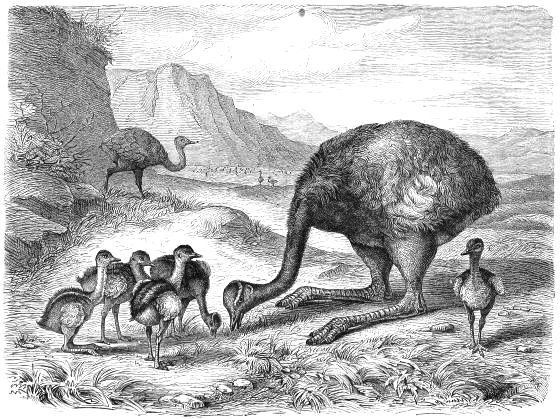
THE TRUE NANDU, OR AMERICAN OSTRICH (Rhea Americana).
In addition to the all-reaching destructiveness of mankind, the great enemy to the Nandus is fire. About the time when these birds are beginning to breed, the herdsmen are in the habit of taking advantage of a high wind, for the purpose of burning the long dry grass upon the vast steppes or prairies, in order to clear them from the last year's straw. Before such a fire as is thus kindled all living beings can only take refuge in the low-lying and wettest portions of the country, and innumerable animals suffer a cruel death. On these occasions the inhabitants of the district collect as a great prize all the Nandus' eggs upon which they can lay their hands. One of these eggs indeed is worth about fifteen Hens' eggs, and is with the natives a very favourite dish. To prepare them, the narrow end is broken open, the white, which is said to have a disagreeable taste, is thrown away, and then having added a little butter, salt, and pepper, the yolk is cooked by being stirred over the fire, using the egg-shell as a saucepan. To boil one of these eggs hard in European fashion, requires forty minutes. They are excellent for all culinary purposes, but unfortunately will not keep. The flesh of the Nandu much resembles horse-flesh in its colour, nevertheless the old birds are a favourite dish among the Indians, while the young are not distasteful even to European palates; they likewise afford a rich supply of oily, semi-fluid fat, which while fresh is much esteemed, and used like butter. Unfortunately, however, it soon becomes rancid, and is then only useful for softening leather; and even for this purpose, in a country so abounding in hides, it is not of much value. Out of the skin covering the neck the Gauchos are in the habit of manufacturing small bags, suitable for many domestic articles, while from the flexible shafts of the feathers, boys construct springes with which they catch water-fowl. The full-grown feathers of the mature bird are likewise used as ornaments to the harness of horses, or are woven into very beautiful rugs, the patterns of which are extremely elegant and varied. Feathers of inferior value are made into bunches for dusting furniture, while the best and largest afford plumes scarcely inferior to those of the Ostrich.
Böcking estimates the duration of the life of the Nandu at fourteen or fifteen years, and believes that many of them die from sheer old age, inasmuch as he has observed individuals (especially in the winter season) at the point of death, but exhibiting no external injury or internal lesion to account for their condition.
With the exception of mankind, these gigantic and swift-footed birds indeed might seem to enjoy an immunity from the attacks of any ordinary assailants. Sometimes the adult may be surprised by a prowling jaguar, or an Eagle may swoop upon the young, and by chance carry off a victim, but such accidents would seem to be of rare occurrence. Perhaps among the most inveterate of their foes are the Spurred Lapwings (Hoplopterus spinosus), whose animosity against these giants of the prairie is positively ludicrous. No sooner does a Nandu approach a pair of these little birds than they set up an intolerable screeching, like Crows on the appearance of a Hawk; they strike at him with their wings, and by the pertinacity of their attacks generally make him glad to get away from such contemptible assailants, who valorously follow him for a little distance, and return with every demonstration of triumph.
The chase of the Rhea is a very favourite exercise. The Indians and the Gauchos hunt them on horseback, kill them with the bolas, or course them with dogs bred for the purpose; indulging in this sport not so much for the sake of the booty as for the purpose of testing the swiftness and endurance of their noble horses, and their own skill in throwing the bolas or the lasso. When a hunting party is announced, numerous well-mounted horsemen assemble, and taking advantage of the wind, approach the birds as closely as they can, at a slow pace, until the moment when the Nandus begin to run, which is the signal for man and horse to exert themselves to the uttermost, and at length an individual is singled out and separated from the flock as the special object of attack. In spite of the swiftness of the poor bird, the Gauchos are soon close at his heels, and the horseman who happens to gain the left side throws his bolas at the devoted victim, which an instant afterwards falls to the ground a mere shapeless mass of feathers, and rolls over killed by the momentum of its own career.
Should the first horseman miss his aim another immediately takes his place, and launches from his hand the terrible weapon. This is repeated by successive riders, until the game is either brought down, or succeeds in reaching some swamp, where the horses are unable to follow.
The name of Nandu is an imitation of the cry of the male during the breeding season. After pairing-time is over the tones are very different, and not easily described. In the neighbourhood of the peaceful settlers who leave them undisturbed, the Nandus become so tame and trustful, that they may be seen associating with tethered horses and milch-cows; indeed, they may be looked upon as half domesticated, as they carelessly graze among the cattle, and scarcely stir out of the way either of dogs or man. Nevertheless, no sooner do they see the Gaucho, who hunts them, than away they go, using every effort to escape, and displaying considerable cunning in avoiding the observation of their enemy. The appearance of a party of Indians puts them into an indescribable state of alarm; they will fly before them for hours together, and even horses and herds of cattle seem to share their dismay and accompany their flight; but if the hunter, creeping upon his hands against the wind, manages to get near a flock of Nandus and, lying flat down, waves a pocket-handkerchief, the curiosity of the birds is at once excited and gradually gets the better of their fear, until the whole flock with their male leader at their head, with outstretched neck approaches within gunshot of their wily enemy. To kill the Nandu with a gun, however, requires a good marksman, as these birds are hard to kill, and will often run a long way after receiving a ball. Should a flock of them be beguiled in the way we have just described and one of them fall and begin to struggle, the rest immediately come to its assistance with most ridiculous gestures, as if they had St. Vitus' dance in their legs and wings, and thus the sportsman is enabled to have a second shot. The report of the gun, moreover, does not frighten them, for if it misses they will come still nearer, as if to satisfy themselves as to what may be the meaning of so much noise. A wounded Nandu follows his companions as far as he can, and when exhausted, steps on one side and is left to his fate. In South America these birds are everywhere to be seen in a state of semi-domestication, having been caught when young, and are allowed to run about without restraint; they seem so much attached to the locality where they have been reared, that towards evening they always come home of their own accord. The Nandu is very generally met with in European zoological gardens, where it requires less attention than any others of the Ostrich race, and provided it has enough to eat, is content with the simplest diet. Moreover, it seems quite able to bear the vicissitudes of climate, and might at least become an ornament to our parks, even were it useless for any other purpose.
THE LONG-BILLED NANDU.
The LONG-BILLED NANDU (Rhea macrorhyncha) is distinguished from the species above described by its dark brown plumage, which on the lower neck is nearly black, and on the upper neck of a whitish grey colour.
THE DWARF NANDU.
The DWARF NANDU (Rhea Darwinii) is smaller than the preceding; its plumage is principally of a light brownish grey, each feather being enlivened by a whitish edge. This species, which is named after Mr. Darwin, was first heard of by him in North Patagonia, where it is called the avestruy petise. The eggs were well known to the Indians, who described them as being a little smaller than those of the Common Rhea, but of a slightly different form, and of a blue tinge. Several of these birds were met with at Santa Cruz in parties of four or five, or in pairs. Unlike the more northern species, they did not spread their wings when starting at full speed.
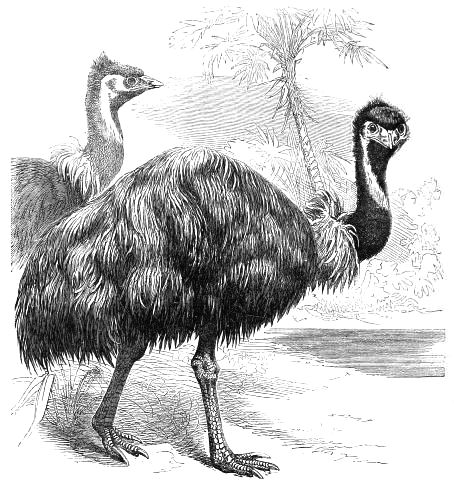
THE EMU (Dromæus Novæ Hollandiæ).
The EMUS (Dromæus), a group of strange and interesting birds inhabiting Australia, form as it were the connecting link between the Ostrich and the Cassowary, nearly resembling the former in their general appearance, but differing from it in the comparative shortness of their legs and neck, and the less prominent development of the hinder parts of the body. The beak is straight, compressed at its sides, round at its extremity, and furnished with a ridge at its culmen; the large nostrils are covered with a skin and situated in the centre of the bill. The wings and tail are but slightly developed, the strong legs are covered with scales, and the foot furnished with three toes armed with powerful claws. At a distance the plumage somewhat resembles hair, the webs of the feathers being all loose and separate; as is the case with the Ostrich, they take their origin by pairs from the same shaft. The wings are clothed with feathers exactly resembling those of the back, which divide from a middle line and fall gracefully over on either side. The entire plumage is of a dull brown, mottled with dirty grey; the feathers on the head and neck becoming gradually shorter, and so thinly placed, that the purplish hue of the skin of the throat and a patch round the ears is perfectly visible. The sexes differ but little in size, and are alike in colour. We have to thank Dr. Bennett for the first full account of these remarkable birds, drawn from observation of several kept about his own house. With their life in a wild state we are unfortunately but little acquainted, except that they frequent the open plains in large flocks, and are especially numerous about Botany Bay and Port Jackson.
THE EMU.
The EMU (Dromæus Novæ-Hollandiæ) is larger than the Nandu, but inferior in size to the Ostrich, its height usually not exceeding six feet. Australian hunters have occasionally killed specimens measuring seven feet to the crown of the head. The coloration of the plumage is principally of a uniform pale brown, of a darker shade on the head, throat, and centre of the back, and paler on the under side. The eye is light brown, the beak horn-grey, and the foot pale brown; the bare parts of the face are of a greyish tinge.
This bird is much valued on account of the clear, bright yellow oil extracted from it. This is obtained by boiling, and employed both for burning and as an excellent liniment in gouty cases.
Dr. Bennett informs us that the natives regard the flesh as a highly luscious treat when cooked with the skin on, and that the fibula or small bone of the leg is employed by them as an ornament.
The flesh of the Emu, according to Mr. Cunningham, resembles beef "both in appearance and taste, and is good and sweet eating; nothing indeed can be more delicate than the flesh of the young. There is, however, but little of it fit for culinary use upon any part except the hind-quarters, which are of such dimensions that the shouldering of two hind legs homewards for a mile's distance proved," he says, "as tiresome a task as he ever encountered in the colony."
Dr. Leichardt "found the flesh of these birds of the greatest service during his overland route from Moreton Bay to Port Essington," in the course of which, but more particularly between the head of the Gulf of Carpentaria and Port Essington, the sight and capture of Emus was almost a daily occurrence; so abundant, in fact, were they, that he saw in the short space of eight miles at least one hundred, in flocks of three, five, ten, and even more at a time. Some curious practices exist with respect to this bird among the natives, and young men and boys are not allowed to feed upon it. The note of the Emu is a low, booming or pumping noise, which is produced in the female by means of the expansion and contraction of a large membranous bag, surrounding an oblong opening through the rings of the trachea; whether this peculiarity of structure is to be found in the male, we are not aware. The Emus pair with tolerable constancy, and the male bird appears to take a large share in the task of incubation. The eggs, which are merely placed in a cavity scooped in a sandy soil, are six or seven in number, and of a beautiful dark green, resembling shagreen in appearance; they are five inches and three-quarters long, by three inches and three-quarters in breadth. The eggs are held in much esteem by the natives, who feed upon them whenever they can be procured.
The nest of the Emu is situated, as we are informed by Dr. Bennett, in a scrub upon the hills, where a space is scraped, similar to those formed by brooding hens. The sticks and leaves, which alone compose the nest, are laid round the cleared spot, and here the eggs are deposited without regard to regularity, the number varying from nine to thirteen. It is a curious circumstance that there is always an odd number. It is now ascertained beyond a doubt that the eggs are hatched by incubation, and not, as was once supposed, by solar heat. They are of large size, and of a beautiful blueish green colour.
THE SPOTTED EMU.
The SPOTTED EMU (Dromæus irroratus) is readily distinguished from the above birds by its comparatively slender build, weaker feet, longer toes, and the spots upon its plumage. This species differs from the Dromæus Novæ-Hollandiæ in having the whole of the body-feathers distinctly marked with narrow transverse bars of light grey and brownish black; the feathers on the back and sides are broader, longer, and less silky in texture than those of the common kind, the latter difference being quite evident to the touch. The upper part of the body and the neck are nearly black, and the feathers appear thicker than those on the same parts in the other species. "Having seen," says Mr. Gould, "adult and youthful examples of this Emu, all bearing the characters which suggested its specific name, I have no doubt of its being distinct from the D. Novæ-Hollandiæ. I am almost equally certain that it is confined to the western division of Australia, and that it represents there the Emu of the eastern coast. Whether the two species incubate in South Australia, and if the present bird extends its range to north and north-west, future research must determine."
The CASSOWARIES (Casuarii) are distinguishable from the group above described by their compact body, short thick neck, low but powerful legs, as also by the helmet that adorns their head, the peculiarity of their plumage, and the formation of their beak and toes. In these birds the bill is straight, compressed at its sides, arched at its culmen, slightly hooked at its tip, and incised at both margins; the small, oval-shaped nostrils are situated at the extremity, and the elevated, compressed helmet at the base of the beak; the neck, which is bare and brightly coloured on its upper portion, is furnished with either one or two lappets; the wings consist of five strong, unwebbed, and rounded shafts; the tail is not developed; the long robust tarsi are covered with hexagonal scales except near the toes, where the scales are transverse. The lateral toes are longer than the middle one, and the outer toe longest of all; the claws are moderate and blunt, that on the centre toe very long and powerful. The plumage resembles hair rather than feathers, the webs being disunited and streaming. Five, or according to Gould six, species of these remarkable birds have been discovered, but with three of them we are almost entirely unacquainted; even the habitat of the C. uniappendiculatus and C. bicarunculatus is uncertain. We also know nothing of the C. Kaupii, the type of the race, except that it was found by Rosenberg in New Guinea, and called by him after Kaup the naturalist.
THE HELMETED CASSOWARY.
The HELMETED CASSOWARY (Casuarius galeatus) is principally black, the face greenish blue, and the back of the head grey; the front of the neck is violet, its sides blue, and its hinder portion bright red. The eye is reddish brown, the beak black, and the foot greyish yellow. The plumage of the young has a brownish tinge; the habitat of this species appears to be confined to the forests on the island of Ceram, where it was discovered by the Dutch traveller, Forster. We are almost entirely ignorant of the habits of these strange birds in their native wilds.
THE MOORUK.
The MOORUK (Casuarius Bennettii). The Mooruk is considerably smaller and shorter than the Cassowary, and has much thicker legs. The helmet rises high at the base and then branches out into two overhanging lobes, the horny part which unites them being lowest in the centre. The back part of this elevated crest is flat, and rises rather obliquely from the head near the occiput. A specimen sent to England by Dr. Bennett, when it first arrived, was rufous mixed with black on the back and under part of the body, and raven-black about the neck and breast; the loose wavy skin of the neck was beautifully coloured with iridescent tints of blueish purple, pink, and an occasional shade of green; and the feet and legs were of a pale ash-colour. It afterwards became generally darker, the bare skin of the fore part of the neck of a more uniform smalt-blue, and the legs somewhat darker in colour. The large strong feet and legs exhibit a remarkable peculiarity in the extremity of the claw of the inner toe, it being nearly three times as large as the other claws. The horny plate on the top of the head resembles mother-of-pearl darkened with blacklead. The form of the bill differs considerably from that of the Emu (Dromæus Novæ-Hollandiæ), being longer and more curved, with a black and leathery cere. Behind the horny head-plate rises a small tuft of black, hair-like feathers which are continued in greater or less number over most parts of the neck.
The Mooruk, according to Gould, lives exclusively in the gullies and humid parts of dense forests, and feeds upon the roots of ferns and plants peculiar to such situations. The first specimen ever seen in Europe was purchased by Dr. George Bennett, so well known from his contributions to science, and sent by him to the Zoological Society of London. The bird was obtained at a native village lying at the foot of two hills, called by navigators the "Mother and Daughter," and situated on that part of the coast of New Britain lying between Cape Palliser and Cape Stephen. In 1858 Dr. Bennett purchased two other specimens brought to Sydney by Captain Devlin, who bought them in New Britain and had had them in his possession for eight months. According to the statement of that gentleman, the natives of that part capture them when very young and rear them by hand. The adults it is impossible to make prisoners, as they are remarkably swift and possess great strength in the legs; on the least alarm they at once dart into thick brushwood, where no human being could follow them, and disappear like magic. We can do no better than give our readers the benefit of Bennett's own graphic and circumstantial account of this Cassowary, which he alone has been at the trouble of training and closely observing:—"My birds," says that naturalist, "when placed in the yard walked about as tame as Turkeys. They approached any one who came into the yard, pecking the hand as if desirous of being fed, and were very docile. They began by pecking at a bone, probably not having tasted any meat for some time, and would not while engaged upon it touch some boiled potatoes which were thrown to them; indeed, we found afterwards that they fed better out of a dish than from the ground—no doubt having been early accustomed to be fed in that manner. They were as familiar as if born and bred among us for years, and did not require time to reconcile them to their new situation, but became sociable and quite at home at once. We found them next day rather too tame, or like spoilt pets, too often in the way. One or both of them would walk into the kitchen, and while one was dodging under the tables and chairs, the other would leap upon the table, keeping the cook in a state of excitement; or they would be heard chirping in the hall, or walk into the library in search of food or information, or walk upstairs, and then be quickly seen descending again, making their peculiar chirping, whistling noise; not a door could be left open but in they walked, familiar with all. They kept the servants constantly on the alert; if one of them went to open a door, on turning round she found a Mooruk behind her, for they seldom went together, but generally wandered apart from each other; if any attempt were made to turn them out by force, they would dart rapidly round the room, dodging about under the tables, chairs, and sofas, and then end by squatting down under a sofa or in a corner, so that it was impossible to remove the bird except by carrying it away; on attempting this, the long, powerful muscular legs would begin kicking and struggling and soon get released, when it would politely walk out of its own accord. I found the best method was to entice them out as if you had something eatable in your hand, when they would follow the direction in which you wished to lead them. The house-maid attempting to turn the bird out of one of the rooms, it gave her a kick and tore her dress. They walked into the stable among the horses, poking their bills into the manger. When writing in my study, a chirping whistling noise is heard. The door, which is ajar, is pushed open, and in walk the Mooruks, who quietly pace round the room inspecting everything, and then as peaceably go out again. If any attempt is made to turn them out, they leap, dart about, and exhibit a wonderful rapidity of movement, which no one would suppose possible from their quiet gait and manner at other times. Even in the very tame state of these birds, I have seen sufficient of them to know that, if they were loose in a wood it would be impossible to catch them, and almost as difficult to shoot them. One day, when apparently frightened at something that occurred, I saw one of them scour round the yard at a swift pace, and speedily disappear under the archway so rapidly that the eye could hardly follow it, upsetting in its progress all the poultry that could not get out of the way. The lower half of the stable door, about four feet high, was kept shut to prevent them going in, but this proved no obstacle, as it was easily leaped over. They never appeared to take any notice of, or to be frightened at the Jabiru, or Gigantic Crane, which was in the same yard, although that sedate, stately bird was not pleased at their intrusion. Having had these birds for a considerable time in my possession," continues Dr. Bennett, "I had ample opportunity of hearing all their cries. I never heard them utter a sound like 'Mooruk,' and am inclined to consider that the name signifies in the native language 'swift,' resembling closely the Malay term 'amuck,' or mad career, and the extraordinarily rapid motions of these birds rather confirm my idea on this subject.
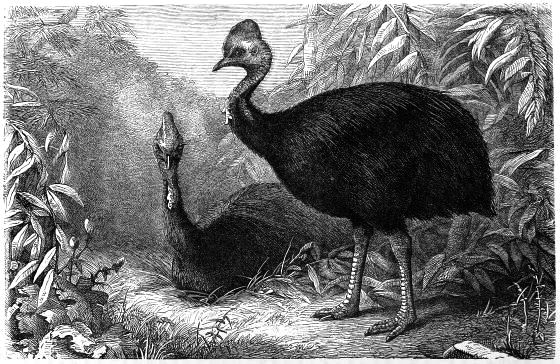
HELMETED CASSOWARY (Casuarius galeatus).
"The chirping sounds of the Mooruk are very peculiar, being modulated according to the urgency of their wants and desires. Sometimes these notes are varied, as if speaking—at one time they are mild, at another very vehement, then rising to a higher and more rapid chirp as if scolding, afterwards becoming plaintive, as if beseeching for something; again loud and rapid, as if impatient at delay; indeed, at a little distance, this modulation of the chirping notes seems as if the birds were holding a conversation, and has a very singular effect. One morning I observed the female Mooruk rolling in the yard upon its back with the feet uppermost, when it suddenly started up, leaping and racing round the enclosure, chirping all the while, kicking the trees and posts, elongating and drawing itself up to its greatest height, then running round the trees and often coming with such violence against them, and kicking so high with both its legs at the same time as to tumble on its back, so that I feared it was seriously hurt, but it rose again and ran about, not having received the least injury. She thus continued kicking and running, all the while keeping in an erect position, until she was apparently exhausted, and then, with open bill and panting, very quietly resumed her tranquil walk about the yard, picking about as usual, as if nothing had happened to disturb her former tranquillity. On the afternoon of the same day the male bird had one of these running and kicking freaks, racing about the yard and attacking any person or fowl who ran away from him; he had a chase after a consequential Bantam Cock, and endeavoured to trample the poor thing under-foot, much to the dismay and horror of this important bird; but I remarked that although he rushed and kicked violently against the trees and had many falls, yet he had a method in his actions—judging from the care he took not to come in contact with the Jabiru, of whom he appeared to entertain a very wholesome dread. Whether he had a natural respect for the bird on account of his serious deportment, or whether it was the formidable, sword-like beak he dreaded, I know not, but when in his most rapid and mad career he approached the Jabiru, he always contrived to avoid him. He seemed to select the fowls, and dispersed them in all directions over the yard. All these wild actions would continue for about half an hour, when he would commence pecking about, and remain as quiet as before.
"One morning when the male bird was in one of these racing humours, some strange fowls wandered into the yard; he immediately attacked them, and did not cease until he had fairly kicked them out, trying also to trample them under foot, and uttering at the same time a peculiar, blowing, snorting, and hissing sound, which I observe is only expressed when he is serious in his attacks. It is curious that he appeared to know our fowls; for although he chased them, he never tried to drive them out of the yard, which he invariably did with the strange poultry. The Bantam Cock was on the top of the wall, out of reach, viewing the kicking scene below among his hens with the greatest astonishment. The Bantam and his hens were not our property, but were tenants next door, and the Mooruk therefore considered himself justified in turning them out. It is common, however, at other times to see our poultry and the Mooruks on the most amiable terms, scraping together, and feeding on the dunghill and in the yard." So extraordinary is the voracity of these strange birds, that no object, however impossible of digestion, comes amiss to them. Dr. Bennett's account of the annoyance his captives gave by indulging this propensity is too amusing to be curtailed.
"The instant the Mooruk saw an egg laid by a hen, he darted upon it, and, breaking the shell, devoured it as if he had been accustomed to eggs all his life. A servant was unpacking a cask; as soon as the birds heard the noise they both ran down to it, and remained there whilst it was unpacked, squatting down on each side most intently watching the process, and occasionally pecking at the straw and contents. When the carpenter was in the yard making some alterations in their cage, previous to their voyage to England, it was very amusing to see them squat down upon their tarsi like dogs, watching the man with the greatest apparent interest in all his actions, enjoying the hammering noise, and occasionally picking up a nail, which was not in this instance swallowed, but again dropped. One of them, however, bolted the oilstone, which so alarmed the man lest the bird had committed suicide, that he hurried to me and informed me of the circumstance, when, to his surprise, I told him if he did not take care they would also swallow his hammer, nails, and chisels. The birds kept close to the man until he left for dinner, resuming their position near him as soon as he returned to work, and not leaving him till he had finished. One morning the male Mooruk was missing, and was found in the bedroom upstairs drinking out of the water-jug. The same bird swallowed a bung-cork which measured one inch and a half in diameter—indeed, both seemed to swallow anything, from butter and eggs to iron bolts, nails, and stones. The servant was starching some muslin cuffs, and having completed one and hung it up to dry, she was about to finish the other, when hearing the bell ring, she squeezed up the cuff, threw it into the starch, and attended to the summons. On her return the cuff was gone, and she could not imagine who had taken it during her brief absence, when she discovered that the Mooruk was the thief, its beak and head being covered with starch. Notwithstanding this propensity to swallow every variety of object, the digestive power of these birds is by no means strong, even such food as unboiled grain or raw potato being rejected whole from the stomach."
Dr. Bennett's male Mooruk measured three feet two inches to the top of the head, and the female three feet. An egg presented by that gentleman to Mr. Gould was five inches and a half long by three and a half broad, the shell a pale buff, covered with pale green corrugations. Another egg, laid in the Gardens of the Zoological Society, was pale grass-green, much smoother, and more finely granulated than that of the Common Cassowary; it measured six inches by nearly four, and weighed twenty-two ounces and a half. The pair of Mooruks whose habits are above described bred in the London Zoological Gardens. According to Dr. Sclater, the incubation lasted seven weeks, the male alone brooding. A single young one was hatched, which was unfortunately destroyed the same day by rats. In 1866 the parents were more successful, and the scientific were delighted with the sight of a young Mooruk hatched in captivity. This pretty and interesting little creature was covered with light, yellowish brown down, and striped with dark brown on its body and legs. The first day of its quitting the shell it could scarcely walk, but on the second used its legs readily, and uttered a cry somewhat resembling that of a chicken. The father, who alone had brooded, at once undertook entire charge of his little treasure, leading it about with the utmost care, guiding it to pick up the food thrown down for it, and at night allowing it to nestle beneath his plumage.
THE AUSTRALIAN CASSOWARY.
The AUSTRALIAN CASSOWARY (Casuarius Australis). This bird stands about five feet high; the head is without feathers, but covered with a blue skin. Like the Emu, it is almost wingless, its wings being mere rudiments. The body is thickly enveloped in dark brown wiry feathers; on the head is a large prominence, or helmet, of bright red colour, and to the neck are attached, like so many bells, six or eight round fleshy balls, of bright blue and scarlet, which give the bird a very beautiful appearance.
This Cassowary has never been brought to Europe, only one specimen having been until recently obtained, which unluckily was lost shortly after its capture. A communication from P. A. Eagle, Esq., with which we have been kindly favoured, will best explain the importance attached by scientific men to the discovery of this Australian species.
"Compared with Asia," says Mr. Eagle, "Australia presents the greatest contrast in its natural productions to be found between any two zoological regions of the earth; and yet the line which separates these two great provinces actually passes between two of the islands forming part of the great volcanic chain running from Sumatra to Timor, namely, the island of Bali on the west, and Lombock on the east, separated from each other by no more than fifteen miles; so that within a two hours' sail, without losing sight of land, you pass from Bali, full of Fruit Thrushes, Woodpeckers, and the general ornithology of Asia, to Lombock, where the Cockatoos, Honey-eaters, Brush Turkeys, and other members of the Australian fauna, appear suddenly in full force. The forests of Australia are destroyed by myriads of timber-boring larvæ of various insects; but on the whole area there is not to be found a single Woodpecker, or any bird to do its office; yet, in the same latitudes, in any other part of the world, Woodpeckers occur in special kinds for each great district in abundance, wherever forest trees grow, their function being to pick out those timber-eating larvæ from the wood. The entire absence of the whole family of True Pheasants and Vultures, found in numbers in any other great region of the earth, is also a striking negative character of the ornithology of Australia; whilst its innumerable Honey-eaters, Cockatoos, and Brush-tongued Lories, found in no other region, give to it an equally marked positive character.
"The very deep sea surrounding Ceram, and other islands which constitute the appendages, as it were, of Asia on one side and Australia on the other, suggests a curious problem to the naturalist as to how they got their inhabitants. Great interest, therefore, attaches to the recent discovery of a Cassowary in Australia, as yet only imperfectly known, and so nearly related to the Cassowary of Ceram that doubts have been expressed as to their distinctness. They are both incapable of flight, the wings being represented by five or six bare, cylindrical, pointed quills, like those of a porcupine, and, consequently, the bird could not fly nor pass from one island to another. The Casuarius Australis was first indicated by Mr. Wall, the naturalist to Kennedy's expedition, who shot a specimen in a gully at Cape York, and a notice of it appeared in 1854 in a Sydney paper; but, as the specimen was lost, much doubt existed as to the species. A bunch of feathers taken from a native hut on the Upper Burdekin, and sent to Dr. Sclater in 1866, again drew attention to the probability of a species of Cassowary inhabiting Australia, but still there was no evidence of the species. In June, 1868, a specimen reached the Zoological Society of London; and Dr. Sclater states that although he had not compared it with the Cassowary of Ceram, it seemed to differ—first, in the form of the crest; secondly, in having thicker tarsi, and the long straight claw of the inner toe more developed; thirdly, by the cobalt-blue colour of the naked skin of the neck and throat. Very recently, however, a young specimen, about two feet long, has been presented to the National Museum of Melbourne, which establishes the fact that it is truly distinct as a species from the so-called Indian Cassowary, and "apparently peculiar to Australia, or at any rate affords no support to the theory of the former union of Australia with the northern islands."
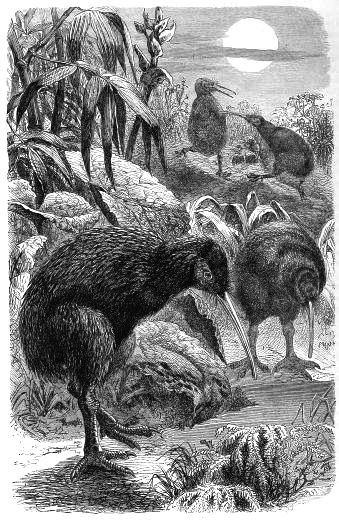
THE KIVI-KIVI (Apteryx Australis).
There is fortunately a young specimen of the Ceram Cassowary nearly of the same size as this young Australian one, and they are both of the same light, rusty brown colour, the Casuarius Australis being rather redder on the head and slightly blacker on the back than the C. galeatus. In neither specimen is the helmet developed. On comparing the two specimens, the tarsi of the Ceram species were found to be rather stronger than those of the C. Australis, and the left inner claw of the Ceram specimen half an inch shorter than the right one, one side agreeing with the Australian species. The little feathers on the two caruncles on the throat are nearly black in C. Australis, but much lighter in C. galeatus. Two distinctive characters are, however, shown by these specimens, not noticed before. The bill of the Australian Cassowary is much more slender than that of the Ceram bird; both mandibles, taken together vertically, being one-third deeper in the Indian species than in the Australian one, while the plumage of the latter is much looser than the former, from having the lateral barbs much fewer or further apart.
There can now be no doubt of the distinctness of the Queensland species, although very closely allied to that with which it has been compared, and also to the Mooruk of New Britain.
According to a correspondent in the Sydney Herald, those who obtained the adult bird state that they saw it running about in companies of seven or eight, in deep valleys at the foot of high hills. The flesh was eaten and found to be excellent—a single leg affording more food than several hungry men could dispose of at a meal. The whole build of this Cassowary is stronger and heavier than that of the Emu; it makes use of its powerful legs in the same manner as that bird. It is described as very wary, but its presence may be at once detected by its utterance of a peculiarly loud note, which is taken up and echoed along the gullies it principally frequents.
The KIVIS (Apteryges) bear but little resemblance to any of the members of their order as yet described. They are distinguishable by their compact body, short thick neck, comparatively short and four-toed foot, the entire absence of the tail, and the merely rudimentary development of the wings. Their plumage consists of long, lancet-shaped, flowing, and glossy feathers, which increase in size from the neck downwards, and have a somewhat loose web. The bill is very long, covered at the base with a long cere, and rather depressed, with the tip of the upper mandible overhanging the lower portion; the small nostrils are situated at the extremity of the beak. The legs are strong and short; the anterior toes long, powerful, and armed with formidable claws; the thick, short, hinder toe does not touch the ground, and is furnished with a still stronger claw resembling the spur of a Barn-door Cock. The tarsi and feet are covered with scales of various sizes.
These birds are strictly a New Zealand family. The first Apteryx seen in England was presented to Dr. Shaw in 1812, and after his death passed into the possession of the Earl of Derby. No other specimen was seen in Europe for more than twenty years, and its existence was therefore doubted by naturalists until 1833, when Mr. Yarrell read a most interesting paper on the subject before the Zoological Society, and established the family among accredited species. These strange birds, which at the first glance somewhat resemble a quadruped in appearance, are, it is said, wholly nocturnal in their habits, searching for food during the night, and moving actively, but with a most uncouth gait (see Plate), from place to place.
THE KIVI-KIVI.
The KIVI-KIVI (Apteryx Australis) has the plumage principally of a greyish brown, which is darkest on the back. The wing-quills are soft and rudimentary, and the face covered with soft hairs. This species is thirty inches long; the bill, from the base of the forehead to the tip, six inches; the reticulated tarsus two inches and a half; and the centre toe, with the claw, three inches and five-eighths. The favourite resorts of this bird, according to Bartlett, are localities densely covered with fern, among which it can readily conceal itself; if very hard pressed by the dogs usually employed in its capture, it takes refuge in crevices of the rocks, hollow trees, and in the deep holes which it excavates in the ground. In the latter chamber-like cavities it is said to construct its nest, which is composed of grasses and dried ferns.
"While undisturbed," says Mr. Short, in a communication to Mr. Yarrell, "the head is carried far back in the shoulders, with the bill pointing to the ground; but when pursued it runs with great swiftness, carrying the head elevated like the Ostrich. It is asserted to be almost exclusively nocturnal in its habits, and it is by torchlight that it is usually hunted by the natives, by whom it is sought after with the utmost avidity, the skins being highly prized for the dresses of the chiefs; indeed, so much are they valued that the natives can rarely be induced to part with them. The feathers are also employed in the construction of artificial flies for the capture of fish, precisely after the European manner. When attacked it defends itself very vigorously, striking rapid and dangerous blows with its powerful feet and sharp spur, with which it is also said to beat the ground in order to disturb the worms upon which it feeds, seizing them with its bill the instant they make their appearance; it also probably feeds upon snails, insects, &c."
"The Apteryx," says Dr. Sclater, "is so scarce a bird even in New Zealand that it can scarcely be expected that we should be well acquainted with its mode of reproduction. His Excellency Sir George Grey has lately sent me an extract from a letter addressed to him by T. E. Manning, Esq., dated Hokianga, on the north-western coast of the Northern Island, February 2nd, 1863. 'Several years ago an old native, who had been a great Kivi hunter in the times when the Kivis were plentiful, told me a strange tale about the manner in which the bird hatches its eggs. I, of course, cannot vouch for the correctness of the story, but think it worth relating; he said that the Kivi did not sit like other birds upon the egg, but under it, first burying the egg in the ground at a considerable depth, and then digging a cave or nest under it, by which about one-third of the lower end was exposed, and so lying under the egg and in contact with the lower end, which came, as it were, through the roof of the nest or burrow. The appearance of the egg, which I propose to send, corroborated this statement, for two-thirds of its length (the small end) was perfectly clean and white, and about one-third the large end was very much discoloured, and very greasy, evidently from contact with the body of the bird. The difference in the colour and condition of the ends of the egg was quite remarkable, and well defined by a circular line passing round the egg.'"
Mr. E. Layard has furnished Mr. Gould with the following information on the same subject forwarded to him by Mr. Webster, also resident at Hokianga:—"A fortnight ago," says that gentleman, "a native, out shooting Pigeons, discovered a Kivi's egg protruding out of a small hole at the root of a kauri tree; removing the egg, he put his arm to the elbow up the hole and got hold of the parent bird. An old native who professes to know something about them states that they lay but one egg at a time. The nest is merely a hole scraped out by the bird, and generally about the roots of a tree, where the ground is dry; the egg is covered with leaves and moss, the decomposition of which evolves heat sufficient to bring forth the young. The process takes six weeks. When hatched, the mother, by instinct, is at hand to attend to her offspring. The egg of the Apteryx is unusually heavy in proportion to the size of the female, being fully fourteen ounces and a half in weight."
MANTELL'S APTERYX.
MANTELL'S APTERYX (Apteryx Mantelli) is smaller than the above bird, the plumage darker and redder, the wing smaller, and formed of strong thick quills, and the face covered with long, straggling hairs; the tarsus is longer, and scutellated in front, and the toes and claws shorter than in the A. Australis. The length of the body is twenty-three inches; the bill measures four, the tarsus two inches and three-quarters, and the centre toe, with claw, two inches and a half. An unmated female, in the London Zoological Gardens, several times laid an egg, in all about nine, and, according to Mr. Layard, manifested a strong desire to sit, placing herself upon the egg, and resisting all attempts to remove her from her position. This Apteryx, and the A. Australis, are regarded by Gould as belonging to the same species.
OWEN'S APTERYX.
OWEN'S APTERYX (Apteryx Owenii) has the face, head, and neck of a dull yellowish brown; the throat somewhat paler; all the upper surface is fulvous, transversely rayed with blackish brown, each individual feather being silvery brown at the base, darker brown in the middle, then crossed by a lunate mark of fulvous, to which succeeds an irregular mark of black, and terminated with fulvous; the feathers of the under surface are paler than on the upper, a circumstance which is caused by each feather being crossed by three rays of fulvous instead of two, and more largely tipped with that colour; the feathers of the thighs resemble those of the back; the bill is dull yellowish horn-colour; the feet and claws fleshy brown. The total length is eighteen inches; bill three inches and five-eighths, breadth at base two inches and a quarter; the middle toe and nail measure two inches and a half, and tarsi two inches and a quarter.
The above description is from a specimen sent to Mr. Gould in 1850; since then he has obtained several others, all of which came from the South Island of New Zealand. This bird, according to Mr. Gould, is rendered conspicuously different from the Apteryx Australis, with which it accords in size, by the irregular transverse barring of the entire plumage, which, together with its extreme density and hair-like appearance, gives it more the resemblance of a mammal than of a bird. It has a shorter, slenderer, and more curved bill, and the feathers also differ in structure, being broader throughout, especially at the tip, and of a loose, decomposed, and hair-like texture.
"In the spurs of the Southern Alps, on Cook's Straits, in the province of Nelson," says Dr. Hochstetter, "that is, in the higher wooded mountain-valleys of the Wairau chain, and westward of Blind Bay, in the wooded mountains between the Motucha and Aorere valleys, this species is still found in great numbers. During my stay in the province of Nelson I had two living examples, a male and a female; they were procured by some natives I sent out for the purpose in the upper wooded valleys of the river Slate, a confluent of the Aorere, in a country elevated from 2,000 to 3,000 feet above the sea-level."
As might naturally be expected, these interesting but defenceless birds are rapidly becoming extinct; a few, however, may still be found in the more unfrequented and thickly-wooded parts of the Northern Island of New Zealand. From the inhabited districts they have been completely extirpated; indeed, Dieffenbach tells us that during the eighteen months of his residence in New Zealand, notwithstanding the liberal rewards promised to the natives, he only succeeded in procuring a single skin, and even that was obtained from a European settler, who said that he procured it from Mongonui Station, to the northward of the Bay of Islands.
Among the localities where the Kivi is still obtainable may be mentioned Little Barrier Island, a small, wooded island in Hauraki Bay, near Auckland, which is evidently the top of a high mountain, rising some 2,383 feet above the level of the sea, and only approachable in the calmest weather.
There seems to be little difficulty in keeping these birds in a state of captivity, and in the Gardens of the London Zoological Society, in the Regent's Park, several specimens have been successfully exhibited. Their cage is simply a dark kennel, having in one corner a sufficient quantity of straw, among which the birds remain carefully hidden during the day. Should their keeper take them forcibly from their retreat, they immediately run back again, as soon as they find themselves at liberty, and eagerly cover themselves as completely as possible. After sunset, however, they become quite lively and active, running about in all directions, and probing the soft earth with their beaks, much after the manner of a Woodcock. They readily devour finely-chopped mutton and earthworms, consuming of the first-mentioned article of diet almost half a pound a day.
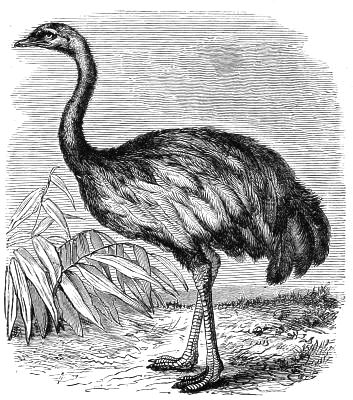
THE NANDU, OR RHEA.
CASSELL, PETTER, AND GALPIN, BELLE SAUVAGE WORKS, LONDON, E.C.