GALLINACEOUS BIRDS (Gallinæ). (continued 2)
Thomas Rymer Jones translation
The first description of the Didunculus was published by Sir William Jardine, in the "Annals and Magazine of Natural History." "We are," he says, "indebted to Lady Harvey, who purchased it at Edinburgh, for a specimen of this bird;" and adds, "We are aware of no existing description, though there is one allusion made to a bird which may turn out to be this. In Mr. Strickland's 'Report on the Present State of Ornithology,' it is stated that in the recent American voyage of discovery Mr. Titian Peale had discovered a new bird allied to the Dodo, which he proposed to name Didunculus."
The subject remained in this state till 1862, when Dr. Bennett communicated his observations on this Pigeon to the Sydney Morning Herald. This communication was subsequently published in the Proceedings of the Zoological Society of London, from which the following account is taken:—
"The Rev. John B. Stair," says Dr. Bennett, who formerly resided for some time at the Navigator group of islands, which are believed to be the exclusive habitat of this singular bird, "informed the Secretary of the Acclimatisation Society of Victoria that it is named by the natives Manua-mea or Red Bird, from the predominant colour of its plumage being chocolate-red. It was formerly numerous, and therefore we may be surprised that it should not have been seen and procured by the early navigators. Now it is nearly extinct. It feeds on plantains, and is partial to the fruit of the soi, a species of Dioscorea, or yam, a twining plant abundant in these islands, and producing a fruit resembling a small potato. In disposition it is exceedingly shy and timid. Like the Ground Pigeons, it roosts on bushes or stumps of trees, and feeds on the ground; it also builds its nest in such situations. During the breeding season both parents aid in the work of incubation, relieve each other with great regularity, and are so intent on the performance of their duty that when sitting on the eggs they may be easily captured by hand. Two living birds were obtained in this way by Mr. Stair. They are also taken by the natives with birdlime or springes, and shot with arrows, the sportsman concealing himself near an open space in which a quantity of the soi, their favourite food, had been placed.
"The first living bird obtained was accidentally killed; the second, when placed in confinement, was sullen, and refused food, but soon became reconciled to captivity, and throve well. The natives fed it upon boiled taro (the root of the Caladium esculentum), rolled into oblong pellets, in the same manner as they fed their pet Wood Pigeons and Doves. The power of wing of most of the Pigeon tribe is very great, a circumstance which also obtains in this bird. It flies through the air with a loud noise, like the Top-knot Pigeon (Lopholaimus antarcticus), of the Illawarra district, and many other of the Australian Pigeons; and Mr. Stair describes it as making so great a noise with its wings on rising, that when heard at a distance it resembles the rumbling of distant thunder, for which it might be mistaken."
In a second communication, made to the same society, by Dr. Bennett, in 1863, he speaks of another living specimen of this rare bird brought to Sidney by Mr. Williams. "It was," he says, "at first rather shy and wild, but afterwards became more tame, and manifested but little fear; this feeling was, however, occasionally exhibited by the utterance of rapid 'coos,' and by fluttering its wings. It is a stupid-looking bird, and has no particular attraction except in the anomalous and extraordinary form of the beak, which cannot fail to attract the attention of the most ordinary observers. The only sound it utters is a quick 'coo-coo-coo,' the beak being always open when the sounds are emitted. The bird was captured about five miles from Apia, in the Island of Upola; it is evident, therefore, that a few still remain there. It is, however, agreed by every one with whom I have conversed who has resided at the Navigators' Islands, that it is nearly extinct, both from being eaten by the natives, as well as owing to the attacks of cats, rats, and other vermin. Its food consisted at first of boiled yams, but it will eat bananas, apples, bread, and boiled potatoes."
In a third paper, read by Dr. Bennett in 1864 at a meeting of the Zoological Society, he says:—"In the contour of the bill, the form and position of the nostrils, and several other characters, the Didunculus differs from any other living species yet known. Although a smaller bird, it approximates in all its characters to the extinct Dodo, and, like it, combines the characters of a rapacious bird with those of the harmless Pigeon. Although the mandibles are powerful, yet the beak is never used as an offensive weapon, for when the hand is placed in the cage, or the bird is seized for removal from one cage to another, it never attempts to bite, but, on the contrary, is so timid that, after fluttering about or running into a dark corner, it soon becomes subdued and is easily taken."
Of a living pair purchased by Dr. Bennett, he says: "They would nibble into minute bits the seeds of loquats, almonds, and hempseed, with the same action as a Parrot when feeding. When I first had them, boiled potatoes and bread formed their diet; the former, being soft, were torn and swallowed in large pieces, but the latter they placed under their feet and tore with their hooked beak into small bits. It was supposed that these birds never drink water; this I soon found to be incorrect. They invariably feed in the light, but will not take food if any one be present. They run with great rapidity, elongating the body and depressing the head, and in the action of running resemble Grouse."
Another specimen, purchased at a high price by Dr. Bennett, was presented by him to the Zoological Gardens, London, where it lived for several months. Its skin is now in the British Museum. Of this bird Dr. Bennett says that, while in his possession, "it never became domesticated, nor evinced the slightest attachment to the lady who fed it; it was the same to her as to strangers." Dr. Bennett does not consider the Didunculus a bird which could be readily reconciled to captivity; "for some time it would be comparatively tame, and then, without any apparent cause to account for the change, it would become very wild." Walpole says that the Didunculus makes its nest on the ground, and that both parents incubate the eggs.
TRUE GALLINACEOUS BIRDS.
The TRUE GALLINACEOUS BIRDS are so named because they present a general resemblance, both in their structure and habits, to our common Barn-door Fowls. They are usually of a moderate or rather large size, and of a stout and somewhat heavy build. They have a small head, often partially or wholly denuded of feathers, and a bill of moderate length, of which the upper mandible is distinctly arched and overhangs the lower, both at the tip and along the margins. As they are all essentially terrestrial in their habits, their legs are always strong and well-developed. The tarsi are stout, and very commonly armed with a spur, or even with two or more such weapons, which are especially developed in the males. The toes are three in front and one behind, the latter being usually small and slightly elevated on the back of the tarsus, but sometimes more elongated, and then placed upon the same level as the other toes, so as to be efficient in grasping. The anterior toes are not very long, but stout, and often united by webs at their base; they are armed with strong, but rather blunt nails, which are of great use in scratching up the ground in search of food—a habit common to most of the species, from which, indeed, many ornithologists give them the name of RASORES, or SCRAPERS. The feathers of the legs are continued down to the articulation of the tarsus, and sometimes extend beyond this point, even to the extremities of the toes. The wings are generally short and weak in comparison with the weight of the body, so that they fly heavily and only to short distances. Their plumage is firm and often adorned with brilliant colours, and parts of it, especially in the males, are frequently developed to an extraordinary extent, sometimes giving them a grotesque appearance. The feathers are remarkable for the great development of the accessory plumules springing from the base of the stem at its junction with the quill.
The members of this order are spread over all parts of the world, but the finest species are inhabitants of the warmer regions. The Gallinæ may be generally described as being the order more especially set apart by their great Creator for the service of man. Hence they are more easily domesticated than any other birds; their flesh is the most palatable, and their fecundity the greatest. They live almost entirely on the ground, which consequently affords them their chief nourishment in the seeds and grains of different plants. Their flesh and eggs are universally wholesome and very nutritious, while their feathers are employed for a variety of uses. They are peculiarly attentive to their offspring; and that the increase should keep pace with the wants of man, they are much more prolific than ordinary birds. They are social, live in societies, and are polygamous. They prefer escaping from danger by running, and only take to flight when compelled by necessity. They are fond of rolling in the dust; some nestle on the ground and live only on plains, while others reside in forests, and always make their nests on trees. The young are usually able to run as soon as they leave the egg, but at night, or on the approach of danger, they shelter themselves under the wing of their mother.
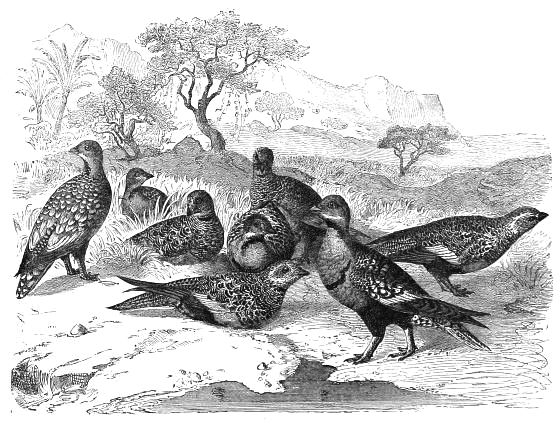
SAND GROUSE.
The SAND GROUSE (Pteroclæ) differ in so many essential particulars from allied groups as to make it necessary to regard them, not merely as forming a family, but a distinct tribe of birds, the peculiarity of whose habits, movements, and plumage render them eminently fit to enjoy life in the desert places and sandy wastes which they frequent. The principal characteristics of the Pteroclæ or Sand Grouse, are a short body, much-arched breast, neck of moderate length, and small, delicate head. The beak is short, slightly arched at its culmen, and compressed at its sides in such a manner as to make it almost round; the lower mandible becomes thicker towards its tip, the nostrils, situated at the base of the bill, and concealed by the feathers on the brow, are open above, and partially covered by a skin. The tarsi and toes are small, the latter in some species connected by a skin as far as the first joint; the hinder toe is very slightly developed or entirely wanting. The claws are short, slightly bent, blunt, and broad; the bones supporting the wings are comparatively short, but the quills very long; the tail is formed of from fourteen to eighteen feathers, and is usually either rounded or wedge-shaped at its extremity; in some species, however, the two centre feathers are of considerable length. The plumage, composed of short, broad, rounded, and very stiff feathers, has a smooth appearance, although in reality it is somewhat lax, and its coloration is such as best accords with the earth or sand of the localities these birds are intended to occupy. The sexes usually differ in the coloration of their plumage; the young at first resemble the mother, but very soon attain their adult garb. The Pteroclæ are only met with in the Eastern Hemisphere, and are particularly numerous in Africa, whilst in Europe, owing to the small extent of their favourite barren tracts, they are comparatively rare. Africa and Asia have their distinct species, which usually remain throughout the entire year in their native lands; owing, however, to their great power of wing, they are capable of flying to a considerable distance, and often make their appearance in countries very remote from each other. One species alone migrates annually.
THE GANGA, OR LARGE SAND GROUSE.
The GANGA, or LARGE SAND GROUSE (Pterocles arenarius), one of the largest members of the group, is of a reddish grey on the head, shading into a somewhat deeper tint at the nape; the mantle is mottled with light or dark yellow and slate-grey, each feather having a round yellow spot at its tip; the throat is ochre-yellow, a band upon its lower portion brownish black; the breast is reddish grey, and has a very clearly defined streak on its surface, which is black or brownish black, as is the belly; the quills are grey or greyish blue, tipped with brownish black above and deep black beneath; the secondaries are white at the roots; some of the feathers on the upper wing-covers are partially of a pure, unspotted ochre-yellow, and those of the lower covers white; the two centre tail-feathers are reddish brown, striped with pale black; the rest are deep grey, tipped with white above, and coal-black on their lower surface. The feathers on the upper tail-covers are mottled like the back, and those on the lower covers spotted black and white; the plumage on the feet is of a dark brownish yellow. The eye is deep brown, the beak dull blueish grey. Both sexes are about thirteen and a half inches long, and from twenty-six to twenty-seven inches broad; the wing measures eight inches and three-quarters, and the tail four inches. The female is of a sandy yellow over the entire back and sides of the throat, each of the mantle feathers being striped with blackish brown, and those on the head, neck, throat, and upper breast marked with small dark spots: the bands upon the throat and breast are comparatively indistinct, and the brown and black belly paler than that of the male bird.
The Ganga is met with in North-western Africa, and occasionally in the most southern countries of Europe; in Asia it is very numerous, appearing regularly in India during the cold season. "This fine Sand Grouse," says Jerdon, "is only a winter visitant to India, arriving towards the end of September and leaving in March. It frequents extensive open sandy plains, flies in vast flocks, being said to be more abundant than P. exustus in those parts where it does occur. Like the others of this tribe, it goes regularly twice a day to certain spots on the banks of rivers or tanks to drink, and it is fond of basking in the sun and rolling on the sand. One writer records that he saw these birds leave their roosting-places among sand-hills about sunrise, and collect in thousands on a hard bare plain, close to where they usually drank, but that they were neither feeding nor drinking at that early hour, and came there, he suggests, for the sake of basking in the early rays of the sun. This species seeks its food on grassy plains and also on stubble-fields, and does so immediately after drinking."
The flight of this Sand Grouse, we are told, is amazingly strong and rapid, and when roused it flies to great distances. In disposition it is generally shy and wary, and difficult to approach closely, from the open nature of the country it affects. It is highly esteemed as a game bird, and much sought after by many sportsmen, as well from the difficulty of the chase as for its qualities on the table. It is stated that, from the closeness and firmness of its plumage, it takes a good gun and heavy shot to bring it down. A writer records the preponderance of one sex in every flock, sometimes seven or eight females and not one male being killed, and vice versâ. The flesh is mixed white and brown on the breast, and although somewhat tough when fresh, and perhaps requiring to be skinned, is considered delicious eating; indeed, one authority states that it is the finest game bird for the table in India. Shooting these Grouse from a hole dug in the ground is said to be a very deadly way of making a good bag. They are caught in the neighbourhood of Peshawur and other places in horse-hair nooses. Adams, when at Peshawur, towards the end of the year, noticed the arrival of this species and also of the P. exustus. Their guttural voices were frequently heard among the sounds giving notice of cold weather. Both kinds were often seen in flocks during the day, and seemed to be regular migrants.
The eggs of this Sand Grouse, usually three, occasionally four in number, are, according to the Arabs, deposited on the sand or bare ground; whilst Adams, on the contrary, maintains that this species excavates a small hole wherein to place the brood, and raises a circle of dry grass around its outer edge.
THE LARGE PIN-TAILED GROUSE, OR KHATA.
The LARGE PIN-TAILED GROUSE, or KHATA (Pterocles alchata), is somewhat smaller than the Ganga, and has the feathers more highly coloured. Like that bird, the plumage is principally of a sandy yellow, the brow and sides of the cheeks being reddish brown, the throat and a delicate line commencing at the eye and passing to the back of the head are black; the nape and the back brownish-greyish green, spotted with yellow; the small wing-covers greyish crimson, their upper feathers striped with reddish brown, then with light yellow, and again with deep brown; the feathers of the larger covers are greyish-greenish yellow, bordered with blackish brown; the lower part of the throat is reddish fawn-colour; the upper breast bright crimson-brown, surrounded above and below by a narrow black line, and the belly white. The quills are grey, with black shafts shading beneath to a deeper tint; the shoulder-feathers are greenish grey above and fawn-grey on the lower surface; most of the tail-feathers are striped grey and yellow on the outer, and grey tipped with white on the inner web; while the long centre pair are greenish grey, marked with faint stripes. The plumage of the female resembles that of her mate, but is readily distinguished by the stripes upon her mantle, a double line upon her throat, enclosing a patch of greyish yellow, and by the white hue of its upper portion. The eye is brown, the beak dark grey, and the foot of a brownish shade. The length of the male is twelve inches and three-quarters, the breadth twenty-two inches and a half; the wing measures seven inches, and the tail five inches. This well-known Sand Grouse inhabits Northern Africa, Western Asia, and the south of Europe, especially Spain, Sicily, and the Levant, and it occasionally penetrates through Central Asia to the Punjaub and Scinde.
"The Khata," says Jerdon, "is a comparatively rare bird in India, only a few finding their way across the Sutlej. I presume that, like P. arenarius, it is migratory to this country, and only found in the cold season." It is a very beautiful bird, and the bill is thicker and stronger than that of any other of the genus.
This species has a peculiar call, resembling the syllables "kaa-kia," and not unlike the cry of the Jackdaw. It flies in flocks of from ten to seventy, or more, and is said to be very shy and wary, and more difficult to approach than the Large Sand Grouse. Its specific appellation is taken from its Arabic name, El-chata or El-katta, which, however, is also applied to P. arenarius. It breeds among rocks in Central and Western Asia, Northern Africa, and the south of Europe, laying four or five eggs of a reddish grey colour, with brownish spots. We are told that it swarms in countless hosts in Palestine, and Mr. Blyth believes, with justice, that this bird, rather than the Coturnix communis, is the "Quail" of the Israelites. Colonel Chesney, indeed, writes of it as "a kind of Quail about the size of a Pigeon, which at times literally darkens the air with its numbers;" and Burckhardt tells us that the number of Khatas in the stony district beyond the Jordan is beyond description; the whole plain seems sometimes to rise and fly off in the air in masses, that appear like large moving clouds. In the mountains of Edom they so abound that two or three are often killed at a time by a stick thrown among them by the Arab boys. At some seasons of the year an ass-load may be taken at one shutting of the clasp-net. "This species," according to Tristram, "abounds in the central and southern districts of the Great Sahara, and in winter may be seen in packs or in large flocks. There is scarcely," he observes, "a bird in nature which surpasses the male Pterocles alchata in softness of colouring or delicacy of pencilling. Alas!" he adds, "that such handsome plumage should clothe such very dry bones. Their flesh being black and hard, is never seen at the table of the Franks, but is nevertheless eaten by the Turks. The Khata lays two or three eggs at a time, merely placing them on the ground. In size they resemble those of a Pigeon, and have a greenish black shell. The Arabs eat them fried in butter."
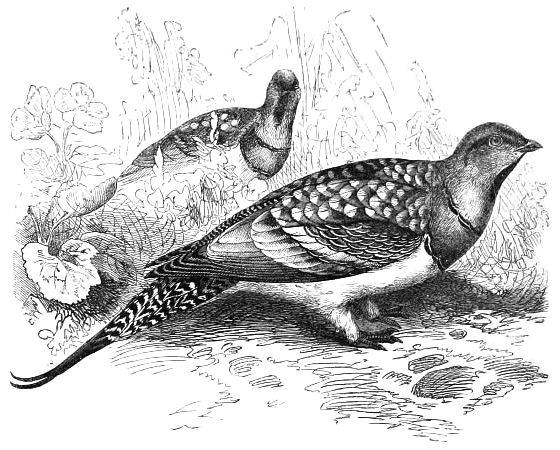
THE KHATA (Pterocles alchata).
THE COMMON SAND GROUSE.
The COMMON SAND GROUSE, or ROCK PIGEON OF INDIA (Pterocles exustus), the third species of this group, is principally of a beautiful reddish cream-colour, shading into bright yellow on the face, cheeks, and wing-covers, and overspread with a bright greenish gloss upon the back; the deep reddish-brown lower breast and belly are divided from the upper portion of the plumage by a narrow black line, which commences at the sides of the throat, and passes across the breast; the lower tail-covers and feathered tarsi are cream-colour, the small feathers of the wing-covers have a line of reddish brown at the tip, the primary quills are black, all except the three outermost having the tip and inner web white; the very long, slender, and sharply-pointed centre pair of tail-feathers are of a yellowish shade, and those at the exterior dark brown, spotted and striped with a paler tint. The eye is dark brown, the bare circle that surrounds it lemon-yellow; the beak and toes are lead-grey. This species is thirteen inches long and twenty-three broad, the wing measures seven and a half, and the tail from five and a half to six inches. The markings upon the back of the female are darker than in the plumage of the male bird; the head, nape, and throat are greyish, darkly spotted; the breast band is paler, the belly striped black and brown. The centre tail-feathers are only a trifle longer than the rest.
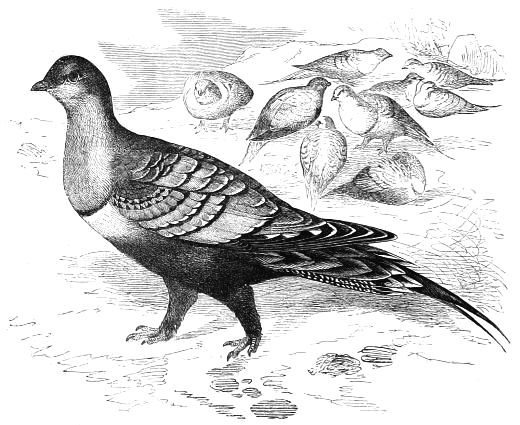
THE COMMON SAND GROUSE (Pterocles exustus).
"This," writes Jerdon, "is the most common and abundant species of Sand Grouse throughout India, being found in every part of the country except the more wooded portions, and never occurring in forest districts. It is therefore quite unknown in Malabar, in the wooded districts of Central India, and in Lower Bengal, and neither this, nor either of the previous species, as far as is known, occur to the eastwards, in Assam, Sylhet, or Burmah. Out of India, it is common through great part of Central and Western Asia and Northern Africa, and, it is stated, has been met with, though rarely, in Europe. This Sand Grouse frequents the bare open plains, whether rocky or otherwise, and is very partial to ploughed lands and bare fallow fields. It feeds chiefly in the morning, and between eight and nine a.m. goes to drink at some river or tank, at which in certain parts of the country thousands assemble, and may then be seen winging their way in larger or smaller parties from all quarters, at a great height, uttering their peculiar, loud, piercing call, which announces their vicinity to the sportsman long before he has seen them. They remain a few minutes at the water's edge, walking about and picking up fragments of sand or gravel, and then fly off as they came. In the hot weather, at all events, if not at all seasons, they drink again about four p.m. When they are seated on bare sand or rock they are most difficult to observe, from the similarity of their colour to that of the ground; sometimes they can be approached with ease near enough to get a good shot, at other times, especially if in large flocks, they are shy and wary. A small flock or single birds can often be approached very close by walking rapidly, not straight, but gradually towards them; in this way I have often walked up to within two or three yards of them. They feed on various hard seeds, especially on those of various Alysicarpi, Desmodium, &c., as well as on grass, seeds, or grain."
These Sand Grouse breed in the Deccan and Southern India from December to May, and in Central India still later. In some parts of the country, as at Mhow and Saugor, most of them leave the district after breeding in July, and do not return till the end of the rains. The eggs are laid on the bare ground, three or four in number, of cylindrical form, nearly equally thick at both ends, of a greenish stone-colour, thickly spotted with grey and brown. This species, if kept long enough, is very excellent eating, though the flesh is somewhat hard and tough, but with a high game flavour. The young birds, when nearly full-grown, are most excellent.
THE STRIPED SAND GROUSE.
The STRIPED SAND GROUSE (Pterocles Lichtensteinii) has the mantle and under side of a light greyish yellow, delicately striped with black; the brow and fore part of the head are whitish, and divided in the centre by a black line, that passes from the base of the bill to the top of the head, which, like the region of the cheek and the throat, is marked with dark spots instead of stripes. The mantle is enlivened by numerous bright yellow, crescent-shaped spots, and the upper breast decorated with a broad band of light brownish yellow, through which pass two lines, the one dark brown and the other light grey; the primaries are deep brown on the outer, and light brown on the inner, web; the secondaries brown at the root, with pure white outer web and black tip; the rounded tail—the centre feathers of which do not exceed the rest in length—is reddish yellow, each feather being delicately striped with black. The eye is dark brown, and the skin around it sulphur-yellow. The beak is dull orange; and the fore parts of the foot are copper-colour. This species is ten inches and two-thirds long, and twenty-one inches and a half broad; the wing measures seven and the tail two inches and a half. The female is without the dark line on the brow, and the reddish brown band upon her breast; her plumage is greyish yellow, striped very uniformly with delicate black lines. The Striped Sand Grouse, which closely resembles its congeners in its habits, is, according to Jerdon, common in Arabia, and occurs as a straggler in Scinde and the Punjaub.
PALLAS'S SAND GROUSE.
PALLAS'S SAND GROUSE (Syrrhaptes paradoxus), the representative of a group inhabiting Asia, is distinguished by the long bristle-like point in which the first wing-quill terminates, and by the shortness of its toes; these latter—three in number—are very broad, and so connected by a fold of skin as to present, when seen from beneath, the appearance of a foot-sole without toes. The claws are broad and strong, and the connecting skin covered with horny warts.
This Sand Grouse is fifteen inches long, without including the longest tail-feathers, and twenty-three inches broad, exclusive of the bristle-like wing-quills; the wing measures seven inches, and the tail four inches and a half, or seven inches inclusive of its central tail-feathers. The female is shorter and more slender than her mate. In this species, the top of the head and a line that commences at the eyes and passes over the sides of the throat are dark grey; the region of the head is separated from the greyish yellow breast by a band formed of delicate black and white lines; the upper belly is brownish black, its lower portion and the feathers of the middle tail-covers light grey; the throat, brow, a broad stripe over the eyes, and the back are clay-yellow, the latter striped with a deeper shade. The quills are dark grey, those at the exterior being bordered with black on the outer, and the rest with grey on the inner web; the shoulder-feathers are of a brownish hue, edged with yellow, and tipped with white, and those on the inner wing-covers yellowish brown, tipped with blackish brown; the plumage on the tarsi is yellowish white. The female is without the band upon her breast, and is of a paler shade upon the face and lower belly; her plumage is also rather spotted than striped.
These singular looking birds, respecting whose habits we have only recently received reliable information, inhabit Southern Europe, Africa, and Asia, living in dry sandy deserts, bare or rocky plains, or bushy or woody grounds, and are especially numerous in the neighbourhood of low hills. They are usually met with singly, or in pairs, except when such as occupy the desert plains resort to water, which they do in flocks. When flushed, they rise with a low chuckling call, fly for a short distance, and then alight. If followed, they run along the ground for a few steps, and with difficulty rise again. "Others, however," Dr. Smith tells us, "fly to a great height and suddenly descend, when they approach the water on their feeding grounds; sometimes this descent is not commenced till they are directly over the spot on which they purpose to alight. On such occasions they are obliged to make a circular or semi-circular sweep, before they can reach the desired locality." Their food consists of hard seeds, bulbs, and insects, mixed with fine gravel. The two eggs which are deposited on the bare ground are elliptical in form, about seventeen or eighteen lines long by twelve or thirteen lines broad at their centre, and have a greenish-greyish yellow shell, marked, dotted, and streaked with various shades of greyish brown; in some instances one end of the egg is decorated with a wreath of spots.
The GROUSE TRIBE (Tetraonidæ) constitute the richest group of the entire order. These birds have a compact body, short neck, small head, and short powerful beak, with a thick base. The foot is short, the tarsus moderate; the wing of medium length, and usually much rounded; the tail is generally straight, but in some instances pointed or incised at its extremity. The thick plumage in most species extends over the entire body, even to the toes; some few also exhibit bare patches of brightly-tinted skin. The sexes are nearly alike in colour. The members of this tribe inhabit almost every latitude of the globe.
The GROUSE PROPER (Tetraones) are recognisable by their powerful, compact bodies, short, or moderate-sized wings, and short straight tail; the latter, however, is occasionally long, and either wedge-shaped or forked at its extremity. The bill is strong, thick, short, and much vaulted, and the foot low and powerful, with more or less well-feathered tarsus. The plumage is thick and rich, the brow and nape often exhibit bare patches, covered with small horny plates of a bright red colour. The toes of some species are covered with a short and remarkable horny growth.
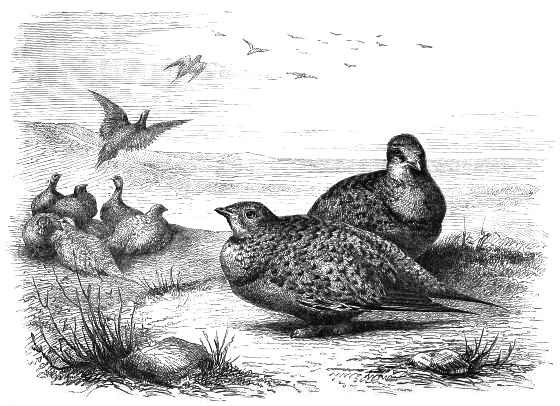
PALLAS'S SAND GROUSE, OR SAND GROUSE OF THE STEPPES.
These birds are met with throughout the whole of Europe, Asia, and North America, but are quite unknown in Africa. All are, without exception, stationary in their habits, and rarely undertake expeditions to any great distance from their native haunts. During the period of incubation they live alone or in pairs, but at other times in parties, which often unite into large flocks. Their food consists of fruits, seeds, the young shoots of plants and trees, insects, and larvæ. Some species are polygamous, but many pair; in the latter case, at least, both males and females assist in rearing the young. Although by no means highly endowed, the Tetraones have their sense of sight and hearing well developed. They walk quickly, but fly heavily, and with much noise, resorting but rarely to this means of progression, and never rising to any height in the air. The increase of these birds is very rapid, the female laying from eight to sixteen eggs, oval in shape, smooth, yellowish, and spotted with brown. No actual nest is prepared for their reception, a slight hollow in the earth, carelessly lined with some soft material, being all that is required for the purpose, provided that the situation is sufficiently retired to secure the safety of the young. We are told by several Swedish naturalists that not only are these birds subject, like their congeners, to many changes of plumage, but that they cast their claws, and at the same time the horny fringes with which their toes are defended.
THE CAPERCALI.
The CAPERCAILLIE, CAPERCAILZIE, or CAPERCALI (Tetrao urogallus), the largest and finest species of the above group, is of a blackish hue on the crown of the head and throat; the nape is deep grey, marked with undulating black lines; the back pale black, powdered with grey and reddish brown; the tail black, spotted here and there with white; the breast glossy steel-green, and the rest of the under side spotted more or less distinctly with black and white. The eye is brown, the bare skin that surrounds it bright red, and the beak greyish white. This noble bird is from two feet two inches to two feet five inches long, its breadth being from four feet four inches to four feet seven inches; the wing measures from fifteen to seventeen, and the tail from thirteen to fourteen inches.
"The Capercali," says Mr. Lloyd, "is to be found in most parts of the Scandinavian peninsula; indeed, as far to the north as the pine-tree flourishes, that is to say, very near to the North Cape itself. These birds are, however, very scarce in the more southern of the Swedish provinces. The favourite haunts of the Capercali are extensive fir-woods. In coppices or small covers they are seldom or never to be found." Professor Nilsson observes that such as breed in the larger forests remain there all the year round, but those on the contrary that breed on the sides of elevated mountains, or in more open parts of the country, in the event of deep snow, usually descend to the lower grounds.
The principal food of the Capercali, when in a state of nature, consists of the leaves and tender shoots of the Scotch fir (Pinus sylvestris). He very rarely feeds upon those of the spruce (Pinus abies). He also eats juniper-berries, blue berries, and other berries common to the northern forests, and also, occasionally in the winter time, the buds of the birch, &c. The young Capercali feed principally at first on ants, worms, and insects.
In the spring of the year, and often when the ground is still deeply covered with snow, the cock stations himself on a pine, and commences his love song, or play, as it is termed in Sweden, to attract the hens about him. This performance is usually carried on from the first dawn of day to sunrise, or from a little after sunset, until darkness has set in. The time, however, more or less depends upon the mildness of the weather, and the advanced state of the season. During his play the neck of the Capercali is stretched out, his tail is raised and spread like a fan, his wings droop, his feathers are ruffled up, and, in short, he much resembles in appearance an angry Turkey-cock. He begins his play with a call, something resembling the words "Peller, peller, peller." These sounds he repeats at first at some little intervals; but, as he proceeds, they increase in rapidity, until at the last, and after perhaps the lapse of a minute or so, he makes a sort of gulp in his throat, and finishes by drawing in his breath. During the continuance of this latter process, which only lasts a few seconds, the head of the Capercali is thrown up, his eyes are partially closed, and his whole appearance would denote that he is worked up into an agony of passion.
"On hearing the call of the cock, the hens, whose cry in some degree resembles the croak of the Raven, or rather, perhaps, the sound of 'gock, gock, gock,' assemble from all parts of the surrounding forest. The male bird now descends from the eminence on which he was perched to the ground, where he and his female friends join company.
"The Capercali does not play indiscriminately over the forest, but has certain stations, which may be called his playing grounds. These, however, are often of some little extent; and here, unless very much persecuted, the call of these birds may be heard in the spring, year after year, for years together. The Capercali does not during his play confine himself to any particular tree, and is seldom met with on the same spot for two days in succession. On these playing grounds several Capercali may occasionally be heard playing at the same time. Old male birds will not permit young birds, or those of the preceding season, to play. Should the old birds, however, be killed, the young ones, in the course of a day or two, usually open their pipes. Combats, as may be supposed, not unfrequently take place on these occasions, though I do not recollect having heard of more than two of these birds being engaged at the same time."
"The Capercali hen makes her nest upon the ground, and lays from six to twelve eggs; these are two inches three lines long, by one inch eight lines in breadth, and of a pale reddish yellow-brown, spotted all over with two shades of darker orange-brown. It is said she sits for four weeks; her young keep with her until the approach of winter, but the cocks separate from the mother before the hens. When the females really commence incubation, they are forsaken by the old males, who skulk about among the brushwood while renewing their plumage, the female alone attending to the hatching and rearing of her progeny."
"Except there be deep snow upon the ground," says Mr. Lloyd, "the Capercali is much upon the ground in the daytime; very commonly, however, he sits in the pines, sometimes on the very uppermost branches. During the night he generally roosts in the trees; but if the winter be very cold, he not unfrequently buries himself in the snow. Considering the large size of the bird, his flight is not particularly heavy or noisy; indeed, I have not only seen the Capercali at a very considerable height in the air, but I have known him to take a flight of several miles at a time. During the winter he is in most instances to be seen perched on the very uppermost branches of the pines."
"The Capercali lives to a considerable age; at least, so we infer from the cocks not attaining their full growth until their third year, or upwards. The old ones may be easily known from their greater bulk, their eagle-like bill, and the more beautiful glossiness of their plumage. The size of these birds, I have reason to suppose, depends in a great degree on the latitude where they are found."
Pennant, in his "British Zoology," speaking of the Capercali, says, "This species is found in no other part of Great Britain than the Highlands of Scotland north of Inverness, and is very rare even in those parts. In our country I have seen one specimen, a male, killed in the woods of Mr. Chisholme, to the north of Inverness."
Of late years successful attempts have been made to restore this bird to Scotland, and in 1836 Mr. Lloyd procured for Sir T. Fowell Buxton forty-nine Capercali, male and female. These he presented to his friend Lord Breadalbane, by whom they were reared with such success that about Taymouth Castle they became as common as the Black Cock, and spread thence over all the more wooded parts of the Highlands as far as Aberdeen, and have grown so tame that a carriage might be driven under the trees on which the hens are perched without their taking the slightest notice.
Although the Capercali is exceedingly shy in its native wilds, it sometimes divests itself of its shyness and approaches people fearlessly; and this, says Mr. Lloyd, in his amusing volume on the "Game Birds of Sweden and Norway," "has occasionally given rise in Sweden to the notion that it is actually 'possessed.'" "About this time last year," Lieutenant Jack relates, "whilst the cottager Anders Pehrsson, of Bengtsbo, in the province of Westmarland, was collecting brushwood in the forest, a Capercali cock, without showing the smallest apprehension, came and alighted on the ground immediately near him. The old belief in Troll-Foglar, or enchanted birds, once so common, and which is still retained by a portion of the peasantry, could not but have its effect on the man from such clear and conclusive evidence. With this crotchet in his head, he therefore hastened to the Klockare, or clerk of the parish, named Pettersson, who was also its oracle, residing at a distance of about an English mile from the spot, and related to him what had happened. Pettersson, who professed not to have the most distant apprehension of the Troll and their emissaries, at once put his gun in order, and, accompanied by Pehrsson, repaired to the spot indicated, which the Capercali had not yet quitted. The Klockare advanced to within a few paces of the bird, and pulled the trigger, but the gun 'clicked.' It was cocked a second and a third time, though with the same result. The flint is now hammered, and fire at length produced, though confined to a flash in the pan. The ardour of the sportsman rose to its highest pitch. How provoking! neither pricker nor other instrument to clear the touch-hole. These had been forgotten in the hurry of departure from home. As a substitute a pointed piece of wood is had recourse to; but it breaks short off in the touch-hole, and only makes matters worse. All this while the Capercali remains motionless, a quiet spectator of the enemy's proceedings. The Klockare, on his part, gazes at the bird, and that with a feeling somewhat akin to awe. He is on the point of sharing his comrade's belief in förtrollning, or enchantment. Once more, however, he musters up courage, and, renewing his endeavours, finally succeeds in clearing the touch-hole; fresh priming is then put in the pan, but when all is in readiness, and he is prepared to discharge his piece, the bird, which hitherto had not budged an inch from the spot, suddenly takes wing. Our Nimrod is just about to give vent to his feelings, and pour maledictions on his villainous weapon, when, to his joy, he sees the bird alight on a tree within an easy distance. To place the gun to his shoulder and fire is now the work of a moment, and to the undisguised delight, not to say astonishment, of both our doughty knights of the chase, the old blunderbuss went off with a loud bang, and the Troll-bird gave up the ghost."
"In Scandinavia," continues Mr. Lloyd, "the Capercali is in considerable request for the table. It is more palatable, however, during the autumnal months, when it lives for the most part on berries and the like, than in the winter, when its food consists of pine-leaves, which give it a somewhat resinous flavour. In Wermeland and the adjacent country it is a standing dish at the last-named season at the houses of the gentry, who usually lay in an ample supply of these birds at the setting in of the frost. On the occasion of births, marriages, and deaths with the peasantry, the Capercali is looked upon as a needful addition to the feast. With them it is eaten either simply boiled or first parboiled and afterwards roasted until hard as a stone, in which state it will keep for weeks or months."
The HEATH COCKS (Lyrurus) represent a group of slenderly-formed birds, possessing short, arched, and rounded wings, the third quill of which exceeds the rest in length. The tail, composed of eighteen feathers, is in the female very slightly excised at its extremity, but in the male is so deeply forked as to present somewhat the form of a lyre. The powerful beak is of moderate size; the foot has its exterior and inner toes of equal length, and is completely covered with feathers. The very glossy plumage exhibited by the members of this group may be regarded as their most distinguishing characteristic, the male in particular being remarkable for the resplendent brilliance that adorns his feathers.
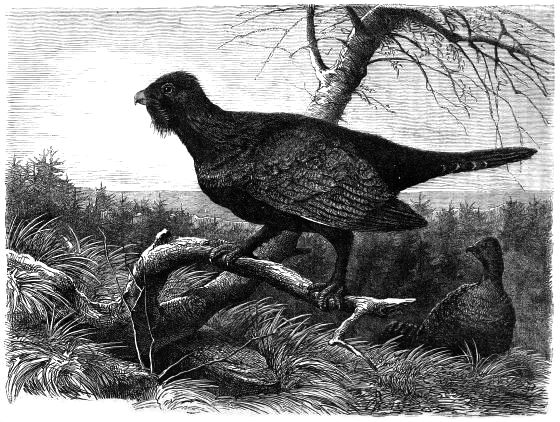
THE CAPERCALI (Tetrao urogallus).
THE BLACK COCK.
The BLACK COCK (Lyrurus tetrix) is principally of a rich black, relieved upon the head, throat, and lower back with a magnificent steel-blue sheen; the wings are enlivened by bands of pure white, the feathers on the lower tail-covers are also of snowy whiteness; the eye is brown, the pupil blueish black, and the beak black; the toes are greyish brown, the eye brown, and a bare patch around the eye bright red. In the female the prevailing colour of the plumage is a mixture of rusty yellow and rusty brown, marked with transverse stripes and spots of black. The length of the male is nearly two feet, and its breadth over three feet; the length of the wing is twelve inches, and that of the tail seven inches. The female is six inches shorter and nine inches narrower than her mate. The young in their first plumage resemble their mother; but in the first moult the black feathers of the young males appear about the sides and breast.
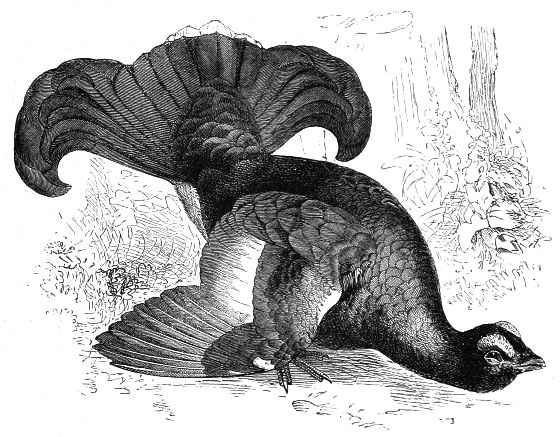
THE BLACK COCK (Lyrurus tetrix).
The Black Cock is generally distributed over the European continent, being found in Germany, Holland, France, and, according to Savi, in Italy. In the north, it is met with in Scandinavia, Russia, Siberia, and Lapland. It is said at one time to have been frequent in Ireland, but has long since disappeared. In England it is met with on heathy hills and forest districts, becoming more plentiful toward the borders of Scotland, and is found in considerable abundance in the mountainous and wooded parts of that country. Its favourite haunts are the low slopes of hills, in which brushwood and coppice alternate with heather and fern, and rocky, well-wooded glens. In spring and summer its food consists of leaf-buds, the tops of heather, berries of various plants growing among the heath, insects, larvæ, and sometimes corn and seeds from the neighbouring fields. In winter this supply is diminished to the tender tops of shoots of birch, fir, and heath, and vaccinia and juniper berries. In spring and summer, these birds live apart in families, but in the autumn and winter remain together in flocks, which, when snow is on the ground, roam from place to place in search of food.
"Unlike the Capercali, which mostly roosts in trees," says Mr. Lloyd, "the Black Cock almost invariably passes the night on the ground, and in the winter, more especially if the cold be intense, it not seldom buries itself in the snow." Nilsson indeed supposes that the bird only makes a hollow in the snow and allows itself to be covered by the falling flakes; but Mr. Lloyd assures us that the bird makes a regular burrow for itself, the depth depending, it is generally believed, on the mildness or severity of the weather. "Scores of times," he says, "when crossing glades and other openings in the forest, where the surface of the snow, to the casual observer, appeared to be as smooth as glass, one or more Black Cocks have suddenly emerged from beneath the snow, almost at my feet, and when expecting every moment others to follow I have carefully looked about me, I never could discover anything beyond the slightest indentation in the snow where the bird had burrowed, the hole itself being filled up by the sides collapsing; and yet perhaps within the next minute half a score of Black Cocks would fly up all around me. That their heads were above the surface previously to their leaving the snow I hold to be impossible, nor can I conceive that even their beaks protruded as others will have it. If air be needful to birds when thus imbedded in the snow, their beak no doubt forms an imperceptible orifice, through which they are enabled to respire."
In addition to his own experiences in the matter, Mr. Lloyd quotes the observations of the amusing though sometimes "marvel-relating" Bishop Oppidam: "In the winter-time the Black Grouse take care of themselves in this manner: they first fill their craw with as much food as it will hold, till it hangs like a bag under their necks, whereby they are provided for something to live on for some time; then they will drop themselves down into the soft snow and do not stay in their first hole, but undermine and burrow in the snow some fathoms from it; and there they make a small opening for their bills, and thus be warm and comfortable."
In the warm days of early spring these birds resort to their pairing ground, for unless they have been disturbed, they frequent the same place year after year. "The places selected at such seasons," says Sir W. Jardine, "are generally elevations, such as the turf enclosure of a former sheep-fold, which has been disused and is now grown over, or some of those beautiful spots of fresh and grassy pasture, which are well known to the inhabitants of a pastoral district. Here, after perhaps many battles have been fought and rivals vanquished, the noble, full-dressed Black Cock takes his stand, commencing at the first dawn of day, and where game is abundant, the hill on every side repeats his humming call; he struts round the spots selected, trailing his wings, inflating his throat and neck, and puffing up the plumage of these parts and the now brilliant wattle above the eyes, raising and expanding his tail and displaying the beautifully contrasting white under tail-covers." (See engraving, p. 185.)
"While the Cock is thus parading to and fro," says Mr. Lloyd, "he frequently vaults high into the air, and in doing this 'slews' his body round, so that on alighting again his head is turned in an opposite direction." This season of admiration does not continue long, the females dispersing to seek a place for their eggs, and the males retreating to the shelter of the brushwood or brakes of fern, they are then seldom seen except early in the morning and evening. The nest of the "Grey Hen," as the female is commonly called, is very simple, being merely a hollow in the ground sheltered by a low bush or tuft of grass; the eggs are from six to twelve in number, about two inches long, and of a yellowish white colour, spotted and dotted with yellowish red. The mother has the entire charge of the young, both during and after incubation, and most zealously does she defend her trust, acutely distinguishing friends from foes, as the following anecdotes from the Zoologist will prove:—
"As Mr. W. S. Hurrel was crossing the hill between Carr Bridge and the Spey, on a fishing excursion, with some of his dogs following, one of them pointed, when a Grey Hen offered to do battle in defence of her brood, and flapping her wings like fanners, she with heroic bravery actually beat her canine antagonist and drove him crest-fallen away. Mr. Bass, M.P., and his friends who have taken the shootings around Carr Bridge are in the habit of giving presents to the herd-boys in the districts in order to engage them to preserve the nests, and if possible guard them from external violence. One of the keepers lately accosted one of these herd-boys, and in answer to several queries on the subject of nests, was told by the boy that in guarding the game from molestation he had no difficulty except with one nest, which was situated in a place much frequented by the cattle, and which he said must have been destroyed unless by some means protected. 'But,' continued the boy, 'I have built a little house of stones and turf about it, and that will prevent the cattle getting at it.' 'But,' said the keeper, 'you will certainly scare away the birds.' 'Oh, no,' replied the boy, 'I have left a little door for the hen to get in and out of, and she sits on her eggs as usual;' which the keeper on visiting the place found to be true."
The Black Cock is pursued with great zest in all countries of which it is a native—in Scandinavia various modes of warfare are resorted to.
"A very common plan of starting the Black Cock, in the winter time," says Mr. Lloyd, speaking of his Scandinavian experiences, "is with the aid of a bulvan, or artificial decoy bird. This is affixed to the top of a long and slender pole, or of two poles tied together, which is then hoisted a little above the top of a birch-tree, standing on an eminence, that it may be seen from a distance. The fowler then conceals himself in a screen constructed of a few fir-boughs, previously prepared for the purpose. Here he patiently awaits the coming of the birds, and when attracted by the bulvan, or driven towards it by people patrolling the country for the purpose, they alight in the tree on which the decoy is placed, or on those in the immediate vicinity, one or other of them usually meets its doom.
"At times two or three individuals take part in this amusement, and if there be several wooded knolls in the same locality, each may be occupied to advantage by a jägare and his bulvan, for as these birds, when alarmed at the shot, keep flying from one bulvan to the other, they are pretty sure of being killed sooner or later."
These bulvans seem to be very rudely constructed, for if a stuffed Black Cock be not procurable for a bulvan, "an imitation one may be made out of an old hat or piece of dark-coloured cloth. Two small patches of red cloth, one on each side of the head, represent the combs over the eyes, and two others of white stuff the white spots on the bird's shoulders. The tail of a veritable Black Cock is usually attached, but should this not be procurable, one made with black cloth, and lined with white, can be substituted in its stead. Legs are not required, the stick to which the bulvan is fastened supplying their place. At times, however, the bulvan is carved out of a piece of wood and afterwards painted." The Black Cock may be domesticated without much trouble, and instances are known of its having bred in captivity. "In the rural districts of Sweden," Mr. Lloyd tells us, "one often sees a caged Black Cock in the houses of the gentry, this bird being greatly admired by every one both for his beauty and for his spel, or song, which, though anything but musical, is wild and pleasing, and during the pairing season almost continual."
THE HYBRID GROUSE.
The HYBRID GROUSE (Tetrao medius). In this remarkable bird, a cross between the Black Cock and Capercali, the entire mantle is black, faintly marked with grey spots and zigzag lines; the upper wing is watered with blackish brown and grey; the secondary quills are enlivened by a brown whitish stripe, and edged with the same shade; the slightly-incised tail is black, occasionally with white tips to its feathers. The under side is black, the head and fore part of the neck gleam with a purple light, the sides of the body are powdered with grey and spotted with white; the plumage of the legs is white, and the tarsus blackish grey; the eye is dark brown; and the beak greyish black. The female sometimes resembles that of the Capercali, sometimes the Grey Hen; but it is smaller than either. The length of the male is from twenty-five to twenty-eight inches; that of his mate twenty-one to twenty-two inches.
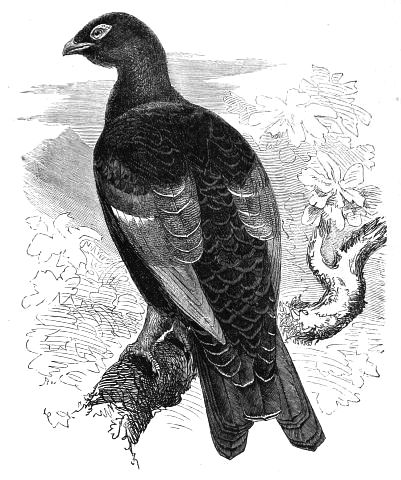
HYBRID GROUSE (Tetrao medius).
The Hybrid Grouse are found wherever the Black Cock and Capercali inhabit the same district, and are particularly numerous in Scandinavia. They closely resemble their parents in general habits, although towards the former of these species they frequently exhibit a very pugnacious spirit during the period of incubation, and constantly do great damage to the sportsmen by attacking and disturbing the Grey Hen when brooding.
"The Capercali," says Mr. Lloyd, "occasionally breed with the Black Grouse, and the produce are in Sweden called Racklehanen. These partake of the leading characters of both species, but their size and colour greatly depend upon whether they have been produced between the Capercali cock and Grey Hen, or vice versâ." Females of these hybrids are much more rare than males, but neither, according to Mr. Lloyd, are common.
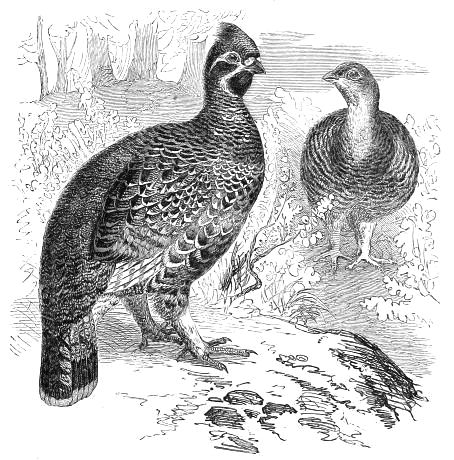
HAZEL GROUSE (Bonasia sylvestris).
Professor Nilsson has given us the following account of one of these birds which he kept in confinement:—"He is more dull than lively. For the most part he will sit for a whole day on his perch in a passive attitude, with his tail hanging down, his feathers somewhat ruffled, and his eyes closed. He is, nevertheless, wild and shy. Towards people who approach his coop he evinces more shyness than malice; but to small animals and birds that come near him, or attempt to purloin his food, he displays an exceedingly angry and spiteful temper. About March, when he puts on his beautiful summer plumage, he is more vicious than usual. Towards the end of that month, or early in April, when the fine weather sets in, he commences his spel (call). In this, however, he never indulges at an early hour in the morning, but only in the daytime, both before and after noon. His moulting season commences about July, and continues for a long period. His food consists of whortle-berries, and other forest berries when obtainable, but he is also fond of apples chopped up small, cabbages, and various vegetables, as well as of barley and the seeds of the spruce pine."
THE HAZEL GROUSE.
The HAZEL GROUSE (Bonasia sylvestris), a third species, represents a group that have their tarsi only partially feathered, and their toes quite bare. These birds have the tail composed of sixteen feathers, and rounded at its extremity, while the plumage on the head is prolonged into a crest. The sexes are very similarly coloured, and of about the same size. The plumage on the mantle is spotted reddish grey and white, most of the feathers being also delicately pencilled with undulating black lines. The reddish grey upper wing is enlivened with white streaks and spots; the throat is spotted brown and white. The quills are greyish brown, dotted with reddish white on the narrow outer web, and the blackish tail-feathers dotted with grey, those in the centre being marked with reddish brown. The eye is rust-brown, the beak black, and the bare part of the foot greyish brown.
The length of the male is from seventeen to eighteen inches, and the breadth from twenty-three to twenty-five inches; the wing measures seven and the tail five inches; the female is about one-fifth or one-sixth smaller than her mate. The habitat of this species extends from the Alps to the extreme north of Europe, and from Scandinavia to Eastern Siberia. Extensive forests of oak, beech, alder, and hazel are the situations it prefers, whilst it almost entirely avoids fir and pine woods; for this reason, it is by no means equally spread over this portion of the European continent, being numerously met with in a large part of Scandinavia, Russia, and Siberia, whilst in Austria, Bavaria, Bohemia, and Silesia it is comparatively rare, and in Northern Germany quite unknown. In certain districts the Hazel Grouse remains within its forest home throughout the entire year, and in others wanders to a short distance in search of berries. These expeditions are made by the male birds alone, and they usually return within a month to their former haunts. Leyen informs us that the retreats chosen by these birds vary with the different seasons of the year—that in May, June, and July they seek the borders of the forest, and in August some retire within the most sheltered nooks of its interior to subsist upon berries, while others wander over the country in the manner above described. In September they again seek the brushwood, and in winter make their home within their favourite forests. In Switzerland they appear to prefer the wooded tracts of the Alps, and are very rarely seen upon the plains that lie beneath. They frequently associate with the Capercali, but often venture higher than that bird. In the more northern parts of Europe, they are also met with in mountainous districts, and in Scandinavia are especially numerous at the foot of the Northern Alps.
The Hazel Grouse is peculiarly quiet and retired in its habits, and has but one mate; its movements upon the ground are rapid, and its power of springing from one point to another when in danger remarkable. Naumann mentions having seen one of these birds leap to a height of fully four feet, in order to snatch some berries from a bush. Whilst running the hen keeps her crest close to her head, whilst that of the male is fully expanded and displayed. Although not much in the habit of having recourse to its wings, the flight of the Hazel Grouse is strong and more rapid than that of the Capercali; in its general character it resembles that of the Partridge.
In Finland, M. Wilhelm von Wright tells us, that the Hazel Hen is found in larger or smaller packs, according to their greater or less abundance in the districts. "It is not for me, of course," says Mr. Lloyd, "to question the accuracy of so good an observer, but singularly enough I myself never heard of more than a single family continuing in company. Sweden, however, is not Finland, and the habits of birds may vary in different countries. The favourite haunts of the Hazel Hen are hilly and wooded districts. In the open country it is never found, but it somewhat varies its ground, according to the season of the year. During summer and autumn one often sees these birds in woods consisting of deciduous trees; but when the leaves begin to fall, they retire to the great pine forests, probably that they may be less exposed to birds of prey.
"Their food in the autumn consists of worms, larvæ, and the various berries with which the Scandinavian forests abound; but in the winter, when the snow lies deep on the ground, they subsist chiefly on the tender tops of the birch and alder, especially the latter. I have then also found in their crops the stalks and tops of the blackberry.
"Even when the Hazel Hen is 'treed,' a practised eye is often required to discover its whereabouts, for it frequently sits so shrouded amongst the branches of an umbrageous pine as not to be readily seen, at least by a casual observer. It is so cunning, moreover, as to regulate its movements by those of the fowler; for whilst he is on the look-out for the bird on one side of the tree, it creeps to the opposite, leaving during its progress little more than its head exposed, and that only for the purpose of keeping the enemy in sight.
"The usual way of shooting the Hazel Hen in Scandinavia is without any dog, and solely with the aid of the so-called hjerp-pipa, or pipe. This implement, which is much less in size than one's finger, is constructed of wood or metal, or, it may be, the 'wing-bone of a Black Cock.' It produces a soft, whistling sound, that may be varied according to the call of the bird. Such a pipe may be readily manufactured. Often, indeed," continues Mr. Lloyd, "when we have accidentally met with a Hazel Hen has my man with his knife alone made one out of a sapling of a pithy tree, and that in the course of a very few minutes.
"Provided with this implement, the sportsman traverses the forest in silence, and when he has succeeded in flushing the brood he, after a time, begins to lacka, when one or other of the birds is pretty sure to respond, or, it may be, fly directly towards him, and in the end he usually succeeds in shooting the whole or greater part of them."
M. Wilhelm von Wright speaks of the Hazel Hen as an exceedingly amusing bird in an aviary. At first it will not eat, but endeavours to hide itself in a corner; the best way is therefore to supply it with food and water and leave it to itself. Red whortle-berries and juniper-berries are the best for it at first, but afterwards it will eat hempseed, barley, buckwheat, and other grain. To induce it to drink, some berries should be put into the vessel containing water; it will also eat meat, raw or boiled. Dry sand should be placed in a box, as it "dusts" itself daily, if provided with this, especially should the sun shine, it makes a hole with its beak in the sand, which it throws over its body. Afterwards it lies first on one side and then on the other, or on its back, with eyes half closed, and often mounts on some part of the coop and whistles.
THE PRAIRIE HEN, OR PINNATED GROUSE.
The PRAIRIE HEN, or PINNATED GROUSE (Tetrao cupido, or Cupidonia Americana), a North American species very nearly related to the above birds, represents a group recognisable by two long tufts, each composed of about eighteen slender feathers, that hang down on each side of the neck and cover bare patches of skin which indicate the position of bladder-like cavities connected with the windpipe and capable of being inflated. The sexes are similarly coloured, but are readily distinguished by the inferior size of the tufts on the head of the female. The feathers on the mantle are black, striped with pale red and white, while those on the under side are striped light brown and white. The quills are greyish brown, with black shafts, and spotted with red on the outer web; the tail-feathers dark greyish brown, tipped with dirty white; the regions of the cheeks and throat are yellowish; the belly is of a whitish shade, and a line under the eye brown; the long throat-feathers that form the tufts are dark brown on the outer and pale yellowish red on the inner web. The eye is reddish brown, the brow bright scarlet, beak dark horn-grey, and bare parts of the foot and throat orange-yellow. This species is eighteen inches long, and its breadth thirty inches; the wing measures five inches and five-sixths, and the tail four inches and a half.
"When I first removed to Kentucky," says Audubon, "the Pinnated Grouse were so abundant that they were held in no higher estimation as food than the most common flesh, and no hunter of Kentucky deigned to shoot them. They were, in fact, looked upon with more abhorrence than the Crows are at present in Massachusetts and Maine, on account of the mischief they committed among the fruit-trees of the orchards during winter when they fed on their buds, whilst in the spring months they picked up the grain in the fields. Children were employed to drive them away with rattles from morning till night, and also caught them in pens and traps of various kinds. In those days during the winter, the Grouse would enter the farm-yard and feed with the poultry, alight on the houses, or walk in the very streets of the villages. I recollect having caught several in a stable at Henderson, where they followed some Wild Turkeys. In the course of the same winter a friend of mine, who was fond of rifle-shooting, killed upwards of forty in one morning, but picked none of them up; so satiated with Grouse was he as well as every member of his family. My own servants preferred the fattest flitch of bacon to their flesh, and not unfrequently laid them aside as unfit for cooking."
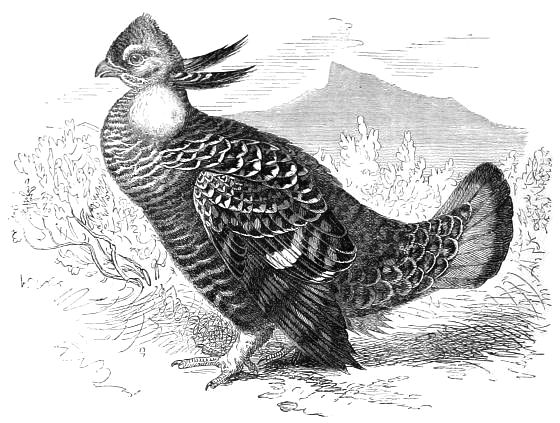
THE PRAIRIE HEN (Cupidonia Americana).
Such an account appears still more strange when we learn that in the same country where sixty years ago they could not have been sold for more than a cent a-piece, scarcely one is now to be found. The Grouse have abandoned the State of Kentucky, and removed (like the Indians) every season further westward to escape from the murderous white man. In the Eastern States where some of them still exist, game-laws have been made for their protection. The Pinnated Grouse selects for its abode wide prairies and treeless land covered only with grass or scattered bushes, and has hence received the name of the Prairie Hen; it does not, however, avoid cultivated land, but readily avails itself of the plentiful supplies of food to be found there. This species is more strictly confined to the ground than any other of its kindred, and seldom ascends the trees or bushes except in search of fruits or berries, or when pressed by severe weather. In winter these birds go on expeditions which have been called migrations, but though these occur with some regularity, their only object is to seek for favourable feeding-places. Even these short journeyings are not always undertaken, but take place in certain winters, so that many sportsmen are under the impression that these birds are non-migratory. This species is less elegant than the Ruffled Grouse, its walk resembling that of the Common Hen, although it carries its head more erect. If surprised it rises at once; but if it perceives the sportsmen from a distance and the spot around it clear, it runs off swiftly to the next high grass, there to conceal itself till danger is past. Audubon describes these birds as running rapidly with wings partially expanded, until suddenly meeting with a large clod they stop, squat, and disappear in a moment. At noon they may be seen near to each other dusting themselves and trimming their feathers. When the mother of a brood is discovered with her young, she ruffles up her feathers and tries every art to allure you from the place. On the larger branches of trees these birds walk with ease; but on smaller ones balance themselves with their wings. They usually roost singly on little risings of the ground, and a few feet apart. Their flight is strong, regular, tolerably rapid, and at times prolonged to several miles distance.
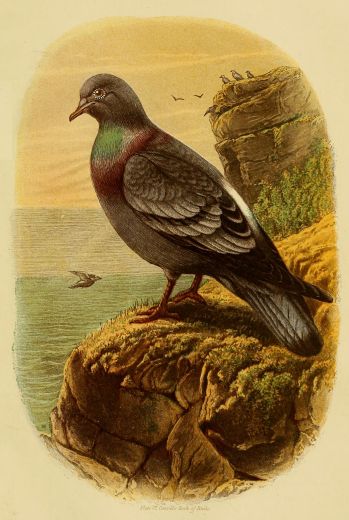
Plate 27. Cassell's Book of Birds
COLUMBA LIVIA ____ ROCK PIGEON
(about one half Nat. size)
[See larger version]
"The Pinnated Grouse," says Audubon, "moves through the air with frequent beats, after which it sails with the wings bent downwards, balancing itself for a hundred yards or more, as if to watch the movements of its pursuer, for at this time they can be easily observed to look behind them as they proceed. They never rise when disturbed without uttering four or five distinct clucks, although at other times they fly off in silence. The ordinary voice of this species nearly resembles that of our domestic fowls, but during the pairing season the male utters a peculiar call.
"The curious notes," continues the same writer, "emitted in the love season are peculiar to the male. When the receptacles of air above alluded to, which in form, colour, and size resemble a small orange, are perfectly inflated, the bird lowers its head to the ground, opens its bill, and sends forth, as it were, the air contained in these bladders in distinctly-separated notes, rolling one after another, from loud to low, and producing a sound like that of a large, muffled drum. This done, the bird immediately erects itself, refills its receptacles by inhalation, and again proceeds with its 'tootings.'" Audubon observed in those Prairie Hens he tamed, that after producing the noise the bags lost their rotundity and assumed the appearance of a burst bladder, but in a few seconds became again inflated. He caught one of these birds and pierced the air-cells with the point of a pin, after which it was unable to "toot" any more. Another bird, of which he punctured one cell only, was unable to inflate that one, but next morning could toot with the other, though not so loudly as before. As soon as the pairing and fighting season is over, the bladders collapse and are concealed beneath the feathers of the ruff. During the winter they are much reduced in size. The bladders and long neck-feathers are seen on the young males before the first winter, and in the spring attain maturity, but they increase in size and beauty for several years.
These birds live both on vegetable food and on insects. During the sowing season they visit corn-fields of various kinds, where they do considerable damage. They feed on the barberry, and various other berries growing on low shrubs, on buds of various plants, and on acorns. "In the western country," says Audubon, "these birds frequent the sumach bushes to feed on their seeds, often in such numbers that I have seen them bent by their weight, and I have counted more than fifty on a single apple-tree, the buds of which they entirely destroyed in a few hours. They also alight on high forest trees on the margins of large rivers. During winter these Grouse congregate in large flocks, but as soon as the snows have melted away, and the first blades of grass issue from the earth, announcing the approach of spring, they separate into parties of fifty or more, their love season commences, and a spot is pitched upon to which they daily resort until incubation is established. Inspired by love, the male birds, before the first glimpse of day lightens the horizon, fly swiftly and singly from their grassy beds to meet, to challenge, and to fight the various rivals led by the same impulse to the arena. The male is at this season arrayed in his full dress, and enacts his part in a manner not surpassed in pomposity by any other bird. Imagine them assembled to the number of twenty by daybreak; see them all strutting in presence of each other; mark their consequential gestures, their looks of disdain, and their angry pride as they pass each other. Their tails are spread out and inclined forwards to meet the expanded feathers of their neck, which now, like stuffed frills, lie supported by the globular, orange-coloured receptacles of air from which their singular booming sounds proceed. Their wings, like those of the Turkey Cock, are stiffened, and declined so as to rub and rustle on the ground as the bird passes rapidly along. Their bodies are depressed towards the ground, the fire of their eyes evinces the pugnacious workings of their minds, their notes fill the air around, and at the very first answer from some coy female the heated blood of the feathered warriors swells every vein, and presently the battle rages. Like Game Cocks, they strike and rise in the air to meet their assailants with greater advantage. Now many close in the encounter; feathers are seen whirling in the agitated air, or falling around them tinged with blood. The weaker begin to give way, and one after another seek refuge in the neighbouring bushes. The remaining few, greatly exhausted, maintain their ground, and withdraw slowly and proudly, as if each claimed the honours of victory. The vanquished and the victors then search for the females, who, believing each to have returned from the field in triumph, receive them with joy. It not unfrequently happens that a male already mated is suddenly attacked by some disappointed rival, who unexpectedly pounces upon him after a flight of considerable length, having been attracted by the cackling of the happy couple. The female invariably squats next to and almost under the breast of her lord, while he, always ready for action, throws himself on his daring antagonist, and chases him away never to return."
In tracts of land in the western country, the Pinnated Grouse may be heard booming and tooting before break of day, and at all hours afterwards until sunset; but in those districts where they have been frequently annoyed by that intruder, man, their meetings are more noiseless, their battles shorter and less frequent, and their fighting-grounds more concealed. Many of the young males fight in the autumn, the females generally joining them to make peace.
The nest is made earlier or later, according to the latitude of the place, between the beginning of April and the end of May. Audubon found a nest in Kentucky finished and containing a few eggs at the first-mentioned date; but he thinks, taking the difference of seasons into consideration, that the average time is about the beginning of May. The nest, which is formed of dry leaves and grass, neatly interwoven, is carefully placed amid the tall grass, or a large tuft in the open ground, or at the foot of a bush. The eggs are from eight to twelve in number, and are of a light colour. The mother sits upon the nest eighteen or nineteen days, and as soon as the young have freed themselves, leads them away from the nest, when the male ceases to associate with her. In autumn the families congregate together in flocks, which at the approach of winter consist of several hundreds. When alarmed, the young squat so closely in the grass as to be quite hidden. "Once," says Audubon, "my horse almost placed his foot on a covey that was in the path. I observed them, and instantly leaped to the ground; but, notwithstanding all my endeavours, the cunning mother saved them by a single cluck. The little fellows rose on the wing for only a few yards. I spent much time in search of them; I could not discover one. I was greatly amused, however, by the arts the mother employed to induce me to leave the spot where they lay concealed."
These birds never have more than one brood during the year; but should the eggs have been destroyed, a second set is laid, generally fewer in number than the first. About the 1st of August the young are nearly as large as the little American Partridge, and are then fit for the table; but they do not become strong in the wing till the middle of October.
The war against these Grouse is carried on in various ways. Some are shot on their breeding-places, others killed with sticks, or caught in nets and snares. "I observed," says Audubon, "that for several nights in succession many of these Grouse slept in a meadow not far distant from my house. This piece of ground was thickly covered with tall grass, and one dark night I thought of amusing myself by trying to catch them. I had a large seine, and took with me several negroes supplied with lanterns and long poles, with the latter of which they bore the net completely off the ground. We entered the meadow in the early part of the night, although it was so dark that without a light, one could hardly have seen an object a yard distant, and spreading out the leaded end of the net, carried the other end forward by means of the poles, at the height of a few feet. I had marked before dark a place in which a great number of the birds had alighted, and now ordered my men to proceed towards it. As the net passed over the first Grouse in the way, the alarmed bird flew directly towards the confining part of the angle, and almost at the same moment a great number of others arose, and, with much noise, followed the same direction. At a signal, the poles were laid flat on the ground, and we secured the prisoners, bagging some dozens. Repeating our experiment three times in succession, we met with equal success; but now we gave up the sport on account of the loud bursts of laughter from the negroes, who could no longer refrain. Leaving the net on the ground, we returned to the house laden with spoil, although I am confident that several hundreds had escaped."
"The Pinnated Grouse," as Audubon further relates, "is easily tamed, and easily kept. It also breeds in confinement. I have often been surprised," he continues, "that it has not been fairly domesticated. While at Henderson I purchased sixty alive that were expressly caught for me within twelve miles of that village, and brought in a bag laid across the back of a horse. I cut the tips of their wings, and turned them loose in a garden and orchard about four acres in extent. Within a week they became tame enough to allow me to approach them without their being frightened. I supplied them with abundance of corn, and they fed besides on vegetables of various kinds. This was in the month of September, and almost all of them were young birds. In the course of the winter they became so gentle as to feed from the hand of my wife, and walked about the garden like so many tame fowls, mingling occasionally with the domestic poultry. I observed that at night each individual made choice of one of the heaps in which a cabbage had grown, and that they invariably turned their breast to the wind, whatever way it happened to blow. When spring returned they strutted, 'tooted,' and fought, as if in the wilds where they had received their birth. Many laid eggs, and a good number of young ones made their appearance; but the Grouse at last proved so destructive to the young vegetables—tearing them up by the roots—that I ordered them to be killed. So brave were some of the male birds that they never flinched in the presence of a Turkey Cock; and now and then would stand against a Dunghill Cock for a pass or two before they would run from him."
The PTARMIGANS (Lagopus) constitute a group of remarkable birds, characterised by their very compact body, medium-sized wings, in which the third quill is the longest, a short, slightly rounded, or straight tail, composed of eighteen feathers, and a small beak. The comparatively small feet have the tarsi and toes covered with hairy feathers. The rich plumage varies in its hues according to the season of the year; the sexes are very similar in their coloration, and the young soon acquire the same tints as their parents. The unusually large claws possessed by the members of this group are shed, like those of their congeners, when the plumage is changed. The Ptarmigans inhabit both America and the Eastern Hemisphere as far northward as vegetation extends, and have occasionally been seen even at 80° north latitude. In a southerly direction they are met with as far as the Alps, the Pyrenees, and the mountains of Central Europe.
These birds live on open ground, and feed upon twigs and leaves of shrubs, berries, grasses, and seeds; their flight is quick, strong, and prolonged. They walk and run very nimbly, and often escape from their pursuers by hiding under shrubs or among heather, when much alarmed they take wing, but even then never resort to the woods for shelter. Their eggs, which are numerous, are spotted with dark brown. The young run about as soon as they leave the egg, and follow their mother in search of food. At the approach of winter several families frequently associate together.
THE WILLOW PTARMIGAN.
The WILLOW PTARMIGAN (Lagopus albus) is about fifteen inches long and twenty-four inches and a half broad; its wing measures seven inches and a half, and the tail four inches and a quarter, the female is one inch shorter and narrower than her mate. During the winter the plumage of this beautiful bird is of a dazzling white, except the fourteen outer tail-feathers, which are black, with white roots and edges; the six largest quills have an oval brownish black streak in the outer web. As the pairing season advances, the head and nape become reddish brown, spotted and streaked with black, the feathers on the shoulders, back, and rump, and those in the centre of the tail are black, edged with white, and have lines of reddish brown or yellow over half their surface; the tail-feathers become paler and lose their light edges. The primary quills remain white as in winter, while the secondaries turn brown; the face and throat are usually of unspotted reddish brown; the head, upper breast, and thighs of a reddish hue, dotted and lined with black; the feathers of the middle part of the breast are black, spotted with reddish brown and white, and those of the belly and legs entirely white. The lower tail-covers are black, marked with reddish brown and yellow, and the corners of the mouth are decorated with white spots. The above colours often vary in their shades, and in the course of the summer become much paler. The female is always lighter in hue than her mate, and acquires her summer plumage before the male. When the feathers begin to darken, the comb on the brow becomes higher and of a reddish tint.
Many observers have assumed that there are two moulting seasons—the first, which occurs in autumn, extends to the whole of the feathers; during the second, which takes place in spring, the smaller feathers alone are changed; but the winter clothing does not immediately replace the summer dress, nor does that at once supersede the winter suit. On this account it has been supposed by some that the Ptarmigan moults four times in the year. American observers, on the contrary, think they have perceived that the smaller feathers at least are not replaced, but simply changed in colour. According to Richardson, "The second change is occasioned, not by the reproduction of feathers, but by the coloured ones becoming white, the process commencing on their tip. This alteration takes place in scattered feathers, which at the same time lengthen, and in a week or ten days the change is complete; spotted specimens undergoing the change may be distinguished from spring ones by the worn state of the tarsal feathers."
This Ptarmigan is spread throughout the northern parts of both the New and Old World, although it is not found everywhere in the same numbers. It is very plentiful in Scandinavia, and also in Finland, and Russia, and common in the eastern coasts of the latter country, and in many parts of Siberia. Radde did not meet with it about the Lake of Baikal or the Amur, and therefore concludes that it does not stay there during the summer; but he found it in Eastern Sayan, at a height of between five and six thousand feet above the sea-level, on wide plains, overgrown with birch bushes. It breeds in the valleys of the Rocky Mountains, and upon the arctic coasts; but collecting in flocks on the approach of winter, it retires southward as the severity of the weather increases. Considerable bodies, however, remain behind, even in the coldest winters. In the year 1819 its earliest appearance at Cumberland House, latitude fifty-four degrees, was in the second week in November, and it returned to the northward again before the beginning of spring.
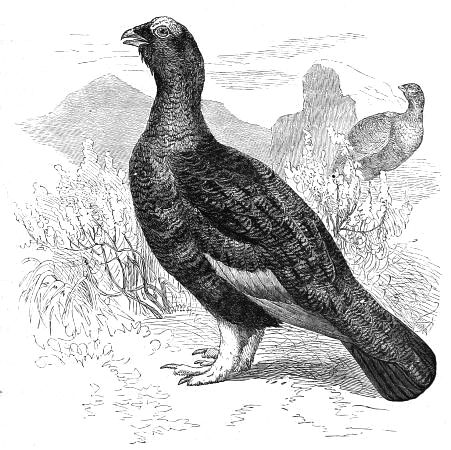
THE WILLOW PTARMIGAN (Lagopus albus). ONE-THIRD NATURAL SIZE.
These Ptarmigans prefer the shelter of birch or willow trees, and where such abound are frequently met with in very large numbers, one pair living close to another, but each holding its own small domain (usually measuring about fifteen paces) with the utmost intrepidity against all intruders; no sooner, however, is the breeding season over than the various families unite into large flocks, and wander over the country to a considerable distance. In disposition this species is lively, and its movements generally restless and rapid, its broad, thickly-feathered feet enabling it to run with equal facility over fresh snow or unsafe moss-covered earth. Whilst in motion the head and tail are usually held down; but when the bird is quite secure from danger, the body is kept much elongated, and the head boldly raised erect. The flight is graceful and light, that of the male accompanied by a loud resonant note as he is about to descend, but the female utters no sound when on the wing. During very severe seasons, or when an enemy is at hand, the Willow Ptarmigan frequently takes refuge in the snow for warmth or shelter; and in very sharp wind, or biting frost, it is not uncommon to see a whole flock snugly buried in a snow-bed, close to each other, with only their heads protruding, to enable them to detect the first sign of danger, in evading which they exhibit a most wonderful instinct. Their food consists of leaves, buds, blossoms, berries, and various kinds of insects; grain of all kinds they also devour. The nest of this species is concealed with great skill in some retired nook, and slightly lined with grass, earth, and feathers. The small pear-shaped eggs are laid at the end of May or beginning of June; they are from twelve to sixteen in number, and have a yellowish shell, thickly covered with reddish-brown dots and streaks. No sooner are the young capable of walking than they are at once led forth to seek their food upon the neighbouring marshes and bogs, as the insects and larvæ of which such localities afford a rich supply are particularly acceptable to the delicate little family. Throughout the whole of the breeding season, many and fierce encounters take place between the male birds, and from ten o'clock in the evening till early morning their loud calls may be heard challenging each other to a trial of strength, which usually continues until the females gently warn their pugnacious partners that it is time to retire to rest.
THE ALPINE OR GREY PTARMIGAN.
The ALPINE or GREY PTARMIGAN (Lagopus Alpinus or mutus)—see Coloured Plate XXVIII.—may be said to vary its plumage every month during the summer. At all seasons, however, the belly, lower tail-covers, exterior wing-covers, quills, and tarsi are white, the tail is black, and the quills streaked with black. About the middle of April other black feathers begin to make their appearance, and the entire plumage becomes, as it were, chequered. By May the head, throat, back, and upper feathers of the wing-covers are more or less variegated with reddish brown and white. As the autumn approaches the feathers gradually change, and by the end of September are of a light grey, dotted with black, and the reddish streaks on the neck and head almost white. In the female these parts are marked with undulating reddish and black lines, the bands being much broader and more clearly defined. In winter the plumage of the male is entirely of a snowy white, except the few black tail-feathers; these latter also show a light border. Occasionally specimens are met with that have retained some of these dark feathers through the cold season.
The Alpine Ptarmigan, or Fjall Ripa, as it is called, is met with in Scotland, and abounds in Scandinavia, in the higher ranges of that peninsula, up to the vicinity of the North Cape.
"The Fjall Ripa," says Professor Rusch, in a letter to Mr. Lloyd, "is found so far south in the province of Christiansand, that its southern limits can certainly be placed in latitude 58° 40´. It occurs wherever the mountains rise above the limits of the dwarf birch, with steep precipices and stone rubble. On mountains in the southern districts of Norway, at the height of 3,000 to 3,500 feet, the sportsman may be tolerably certain of meeting with one pair or more of these birds."
During the year the plumage varies very considerably, being almost in a constant state of moult. By all accounts, this species puts on at least three different dresses in the course of the year. The tail-feathers are always black, and the male has a small black mark from the base of the bill to the temple; but with these exceptions the winter dress of both sexes is white.
The male begins to assume his spring dress about the middle of April, the female a few days later, and usually completes it by the end of May or beginning of June; the information respecting the autumnal moulting is not so precise. In the beginning of September, according to Barth, they have assumed the greater part of their autumnal dress, which about the middle of the same month begins to change into the winter plumage in such a manner that the autumn moulting is simultaneously continued.
The Lagopus Alpinus is not shy in summer, and early in autumn may be approached very closely without taking flight. "Not unfrequently, indeed," says Mr. Lloyd, "the fowler or wayfarer finds himself in the very midst of a brood, without having been previously aware of its presence; but as the season advances the several families 'pack,' and they then become very wary, especially should they have become associated with the Lagopus albus, which is of a much wilder nature, and thus they keep together throughout the winter, and until the month of May, when they separate in pairs. Their favourite resorts are amongst stones and shingle, where they find shelter in bad weather, and from which in their summer plumage they are hardly to be distinguished."
During the summer and autumn they feed on seeds and leaves, especially on those of the crakeberry (Empetrum nigrum), the leaves of which are green all the year round. When heavy storms of snow make these unattainable they devour the tender tops of willow and dwarf birch.
"The easily satisfied appetite of the Lagopus Alpinus," says M. Barth, "coupled with the fact that the crakeberry grows in such profusion everywhere as in many places to cover the whole slope of the fjall, up to near the line of perpetual snow, explains the question why these birds never lack food in the higher regions, where one would least suppose it possible for any living creature to find the wherewithal to sustain existence. The crakeberry plant in some years has so many berries that the ground looks black with them; nevertheless, in those years I never found the berries themselves in the crop of this species, but only the stalks and leaves. After producing fruits in such abundance, the crakeberry plant would seem to require some time for rest, inasmuch as in the succeeding year scarcely a berry is to be seen on it. The Ptarmigan would therefore be very badly off if its taste only permitted it to feed on the berry and not on the stalk—another instance of the wise foresight of Nature. During pairing time the cry of the male is said to resemble the croak of a frog, or the snoring of a man. The female note is a low 'ü-ack, ü-ack.'"