CASSELL'S BOOK OF BIRDS. (continued 3)
Thomas Rymer Jones translation
"This Humming Bird is extremely fond of tubular flowers, and I have often stopped to observe his manœuvres among the blossoms of the trumpet flower. When arrived before a thicket of these in full bloom, he poises or suspends himself on wing for the space of two or three seconds so steadily that his wings become invisible or only like a mist, and you can plainly distinguish the pupil of his eye looking round with great quickness and circumspection; the glossy golden green of his tail and the fire of his throat dazzling in the sun form altogether a most beautiful appearance. When he alights, which he frequently does, he always prefers the dry twigs of a tree or bush, where he dresses and arranges his plumage with great dexterity. His only note is a single chirp, not louder than that of a small cricket or grasshopper, generally uttered while passing from flower to flower, or when engaged in fight with his fellows; for when two males meet at the same bush or flower a battle instantly takes place, and the combatants ascend in the air, chirping, darting, and circling round each other till the eye is no longer able to follow them—the conqueror, however, generally returns to the place to reap the fruit of his victory. I have seen him attack and, for a few moments, tease the King Bird, and have also seen him in his turn assaulted by a humble bee, which he soon put to flight.
"This beautiful and delicate species is extremely susceptible of cold, and if long deprived of the animating influence of the sunbeams droops and soon dies. A very fine male which was brought to me I put into a wire cage, and placed it in a retired, shaded part of the room. After fluttering about for some time, the weather being uncommonly cool, it clung to the wires and seemed in a torpid state for the whole forenoon. No movement of breathing could be perceived on the closest inspection, though at other times this is remarkably observable, the eyes were shut, and when touched with the finger it gave no signs of life or motion. I carried it out into the open air, and placed it directly in the rays of the sun; in a few seconds respiration became very apparent, the bird breathed faster and faster, opened its eyes, and began to look about with as much seeming vivacity as ever. After it had completely recovered it flew off to the top of a pine-tree, where it sat for some time dressing its disordered plumage, and then shot off like a meteor.
"The flight of this Humming Bird from flower to flower greatly resembles that of a bee, but is so much more rapid that the latter appears a mere loiterer in comparison with him. He poises himself on wing, while he thrusts his long, slender, tubular tongue into the flowers in search of food. He sometimes enters a room by the window, examines the bouquets of flowers, and has been known to return regularly every evening for several days together. From the blossoms of the towering tulip-tree, through a thousand intermediate flowers, to those of the humble larkspur, he ranges at will and almost incessantly. About the 20th of September these birds generally retire south, and about November pass the southern boundary of the United States into Florida."
"No sooner," says Audubon, "does the returning sun again introduce the vernal season, and cause millions of plants to expand their leaves and blossoms to his genial beams, than this Humming Bird is seen advancing on fairy wings, carefully visiting every flower-cup, and, like a curious florist, removing from each the injurious insects that would otherwise, ere long, cause their beauteous petals to droop and decay. Poised in the air, it is observed peeping cautiously and with sparkling eye into their innermost recesses, whilst the ethereal motion of the pinions, so rapid and so light, appears to fan and cool the flowers without injury to their fragile texture, and produces a delightful murmuring sound. Its long delicate beak enters the cup of the flower, and the protruded double tongue, delicate, sensitive, and imbued with a glutinous saliva, touches each insect in succession and draws it from its lurking-place to be instantly swallowed. All this is done in a moment, and the bird as it leaves the flower sips so small a portion of its liquid honey that the theft we may suppose is but a benefit to the flower, which is thus relieved from the attacks of its destroyers. The prairie, the fields, the orchards, and the gardens, nay, the deepest shades of the forest, are all visited in their turn, and everywhere the little bird meets with pleasure and with food. Its gorgeous throat in beauty and brilliancy baffles all description. Now it glows with a fiery hue, and again it changes to the deepest velvet-black. The upper parts of its body are of resplendent changing green, and it throws itself through the air with a swiftness and vivacity hardly conceivable; it moves from flower to flower like a gleam of light, upwards and downwards, to the right and to the left. During their migrations they pass through the air in long undulations, raising themselves for some distance at an angle of about 40°, and then falling in a curve; but the smallness of their size precludes the possibility of following them farther than fifty or sixty yards without great difficulty, even with a good glass. They do not alight on the ground, but settle on twigs and branches, where they move sideways in prettily-measured steps, frequently opening and closing their wing, pluming, shaking, and arranging the whole of their apparel with the utmost neatness and activity; they are particularly fond of spreading one wing at a time, and passing each of the quill-feathers through their bill in its full length, when, if the sun be shining, the wing thus plumed is rendered extremely transparent and light. They quit the twig without the slightest difficulty in an instant, and appear to be possessed of superior powers of vision, making directly towards a Marten or Blue Bird when fifty or sixty yards before them, before it seems aware of their approach. Their food consists principally of insects, generally of the coleopterous order, these, together with some equally diminutive flies, being commonly found in their stomachs. The first are procured within the flowers, but many of the latter on the wing. Where is the person," says Audubon, "who, on seeing this lovely little creature moving on humming winglets through the air, suspended as if by magic, flitting from one flower to another with motions as graceful as they are light and airy, pursuing its course and yielding new delight wherever it is seen—where is the person who, on observing this glittering fragment of a rainbow, would not pause, admire, and turn his mind with reverence towards the Almighty Creator, the wonders of whose hand we at every step discover, and of whose sublime conceptions we everywhere observe the manifestation in His admirable system of Creation?"
"When morning dawns, and the blest sun again Lifts his red glories o'er the eastern main, Then through our woodbines, wet with glittering dews, The flower-fed Humming Bird his way pursues, Sips with inserted tube the honied blooms, And chirps his gratitude as round he roams; While richest roses, though in crimson drest, Shrink from the splendour of his gorgeous breast. What heavenly tints in mingling radiance fly! Each rapid movement gives a different dye— Like scales of burnished gold, they dazzling show; Now sink to shade, now like a furnace glow."
The following very interesting account of the demeanour of this delicate and interesting bird in captivity is given by Gould:—"A Trochilus colubris captured for me by some friends pumped the fluid from a little bottle whenever offered it, and in this manner it lived with me a constant companion for several days, travelling in a little, thin gauze bag, distended with whalebone, and suspended to a button of my coat. It was only necessary for me to take the bottle in my hand to induce it to thrust its spiny bill through the gauze, protrude its lengthened tongue down the neck of the bottle, and pump up the fluid till it was satiated; it would then fly to the bottom of its little home, preen its tail and wing feathers, and seem quite content.
"The specimens I brought alive to this country were as docile and fearless as a great moth under similar treatment. The little cage in which they lived was twelve inches long, seven wide, and eight high. In this was placed a diminutive twig, and suspended to the side a glass phial, which I daily supplied with saccharine matter, in the form of sugar or honey and water, with the addition of the yolk of an unboiled egg. Upon this food they appeared to thrive and be happy during the voyage along the seaboard of America and across the Atlantic, until they arrived within the influence of the climate of Europe. The vessel in which I made the passage took a northern course, which carried us over the banks of Newfoundland, and although the cold was rather severe during part of the time, the only effect it appeared to have upon my little pets was to induce a kind of torpidity, from which they were rapidly aroused by placing them in the sunshine, in the bosom, or near a fire. I do assure my readers that I have seen these little creatures cold, stiff, and to all appearance dead, and that from this state they were readily restored by a little attention and removal into light and heat, when they would 'peck up,' flutter their tiny wings, and feast away as if in the best state of health."
The AMETHYST HUMMING BIRDS (Calliphlox) have a delicate, pointed beak, exceeding the head in length; the legs are slender and the toes and claws short, the latter much hooked and sharply pointed. The wings are short; the tail of the male, composed of narrow feathers, is forked at its extremity, whilst that of the female is quite straight.
THE AMETHYST HUMMING BIRD.
The AMETHYST HUMMING BIRD (Calliphlox amethystina) is numerously met with in the interior of Brazil. This resplendent little bird is of a dark metallic green, shaded with pale gold on the back; the neck, cheeks, and throat glow with the brilliant hue of the amethyst, and are divided from the under side by a line of pure white; the breast and belly are blackish grey, shaded with copper-red, the lower tail-covers are light grey, bordered with white, and the quills greyish brown, tinted with violet. The centre tail-feathers are of a metallic green, and those at the exterior greyish brown. The female has a white throat, and her tail edged with reddish yellow; the young resemble their mother. This species is three inches and one-third long and about the same in breadth; the wing measures one inch and a half, the tail of the male one inch and a quarter, while that of the female does not exceed two-thirds of an inch.
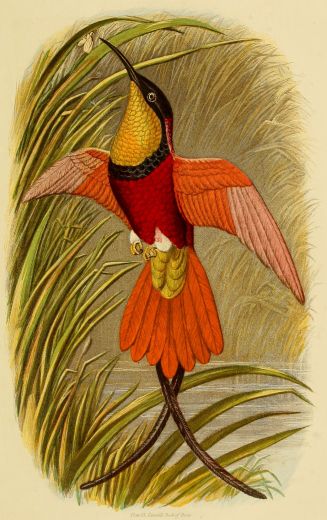
Plate 23. Cassell's Book of Birds
TOPAZA PELLA ____ CRIMSON TOPAZ
(Life size) (Gould)
[See larger version]
According to Mr. Reeves, "the Amethyst inhabits the interior provinces of Bahia, Rio de Janeiro, Novo Fribourgo, and Minos Gerves, but is nowhere very common; it frequents gardens when the orange-trees are in flower, the valleys when the marrioneira is blooming, and the forests when the blossoms elsewhere are no longer inviting. It arrives in Rio in July, is most numerous in September and October, and departs again on the approach of the hot season. Its nest is invariably placed in the highest and driest trees."
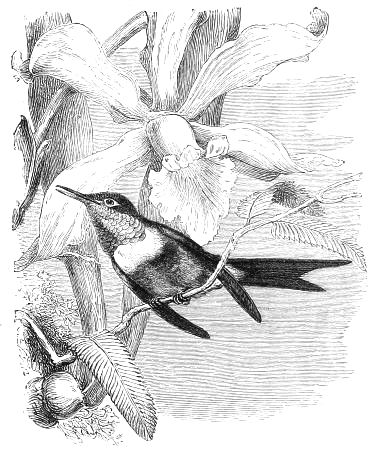
THE AMETHYST HUMMING BIRD (Calliphlox amethystina).
The WOOD-STARS (Calothorax, or Lucifer) are principally distinguishable by the peculiar formation of the male bird's tail, which is much forked, and composed of short, stiff, narrow feathers; in some species the exterior tail-feathers are very short and almost without web. The tail of the female is straight, and her wings of moderate size; the beak is long, thin, and slightly curved.
MULSANT'S WOOD-STAR.
MULSANT'S WOOD-STAR (Calothorax Mulsanti) is a very beautiful species of Humming Bird, inhabiting Columbia and Bolivia; the male is dark green on the back and sides, with a brilliant gloss; the chin, cheek-stripes, lower part of throat, a streak on the centre of the breast and the belly are white, the chin relieved by a violet sheen. The back of the female is lighter than that of her mate, her under side is white, and the lower tail-covers of brownish red; a line on the sides of the throat is deep olive-green, and the tail light brown, tipped with black. The habitat of this species, according to Gould, is confined to the temperate regions of Columbia.
The ELVES (Lophornithes), a most magnificent group of Humming Birds, are recognisable by the remarkable tufts of feathers that adorn, sometimes the head, sometimes the tail of the males of different species. The awl-shaped beak is somewhat flattened at its base; the feet are usually small, the toes short, and the claws long. The plumage of the male is rich and much variegated, while that of the female is very plain.
The PLOVER-CRESTS (Cephalolepis) possess a delicate awl-shaped beak, scarcely equalling the head in length; the toes are short, and armed with long thin claws; the wings are short, the tail comparatively long, and composed of broad feathers. The feathers on the head of the male are prolonged into a crest.
DE LALAND'S PLOVER-CREST.
DE LALAND'S PLOVER-CREST (Cephalolepis Delalandii), a very beautiful species, inhabiting Brazil, is of a pale but very pure metallic green on the back and centre tail-feathers. The crest that adorns the head is bright, light green, becoming darker towards its apex; in old age this plume changes to a steel-blue; the under side is dark grey; a patch that commences at the throat, and covers the breast and centre of the belly, is bright blue; the quills are greyish brown, shaded with violet; the exterior tail-feathers are black, edged with white; the beak is black, and the foot blackish brown. The female and young are without the crest and the blue patch on the breast. The body of this species is three inches and a half long; the wing measures two inches, and the tail one inch. The crest of the male is one inch and two-thirds long.
This graceful species of Humming Bird was first discovered by M. Delaland, in the southern portion of Brazil. Mr. Reeves states that it inhabits Rio de Janeiro, Minos Gerves, and Santa Catherina, but he was unaware whether it remains in those provinces all the year or not. "Of the two nests that I possess," says Mr. Gould, "one is of much more lengthened form than the other, but both are composed of the same materials, namely, fine fibrous roots, moss, lichens, and involucres of a composite plant, the whole matted together with spiders' webs of so fine a kind that they are almost imperceptible. Both had been suspended among the slender twigs of a species of banana."
The COQUETTES (Lophornis) are remarkable for the magnificent collar that adorns their neck, formed of long, narrow, and most delicately-marked feathers; this collar can be raised or laid back at pleasure. The head is usually embellished by a crest; the awl-shaped beak equals the head in length; the wings are small and slender; the tail is composed of broad, long feathers.
THE SPLENDID COQUETTE.
The SPLENDID COQUETTE (Lophornis ornata), a very richly-tinted species, inhabiting Guiana, is of a bronze-green on the rump; the crest is brownish red, and a white line passes over the lower part of the back; the region of the face is green, with a most brilliant lustre; the graduated feathers that form the collar are light reddish brown, spotted with glowing green; the quills are deep purplish brown, and the beak flesh-pink, tipped with brown. The female is much paler, and entirely without the crest, collar, and green about the beak—features that so materially enhance the beauty of the male.
"This glorious little bird," says Gould, "which is strictly an inhabitant of the lowland districts of tropical America, enjoys a somewhat extensive range over the eastern part of that continent, being found from the Caraccas on the north to Brazil on the south, and is particularly numerous in all the intermediate countries of Demerara, Surinam, and Cayenne; it is also equally abundant in the island of Trinidad. Prince Max of Wied states that in Brazil he found it on dry and arid plains, clothed with a scanty and bushy vegetation; and such would seem to be the habit of the bird in Trinidad, since it there flies around the low, flowering shrubs of the open part of the country, rather than in the more wooded or forest districts. The nest is a cup-shaped structure, composed of some cottony material, bound together with cobwebs, and decorated externally with small pieces of lichen and mosses."
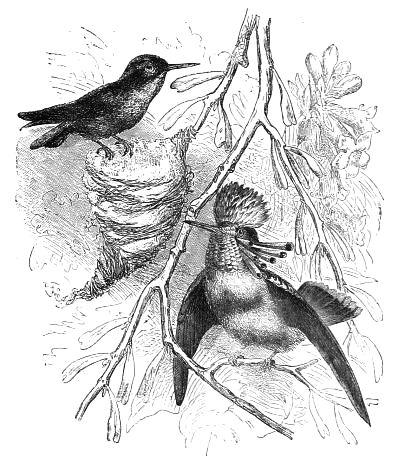
THE SPLENDID COQUETTE (Lephornis ornata).
Mr. Tucker states that "this species frequents the pastures and open places, and visits the flowers of all the small shrubs, but is particularly fond of those of the ipecacuanha plant; and that it is very pugnacious, erecting its crest, throwing out its whiskers, and attacking every Humming Bird that passes within the range of its vision."
The AMAZONS (Bellatrix) have a smaller collar and larger crest than the above group.
THE ROYAL AMAZON.
The ROYAL AMAZON (Bellatrix regina), a beautiful species inhabiting Columbia, closely resembles the bird last described, but with these differences: the rump is a copper-colour and the lower part of the back striped with white; the tail is brown, the quills purplish brown, and the collar emerald green; each of its feathers spotted with red. The crest is formed of long, narrow, bright red feathers, some of which have a deep metallic green spot at the tip.
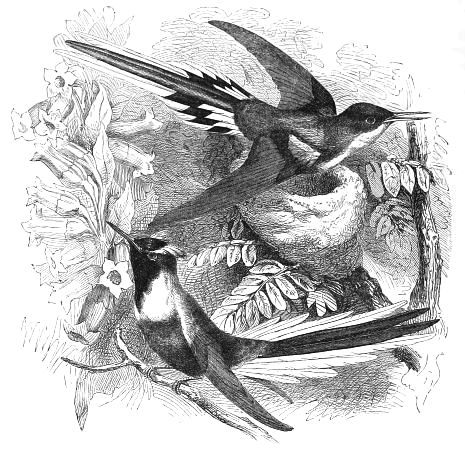
THE HORNED SUN-GEM (Heliactinus cornutus).
The SUN-GEMS (Heliactinus) are distinguishable from the above group by the superior length of the tail and crest; the wing is long and slender, the tail much graduated, and formed of narrow, pointed feathers. The beak is longer than the head, and increases slightly in thickness towards its delicate tip. The feet are small, and the claws short and powerful.
THE HORNED SUN-GEM.
The HORNED SUN-GEM (Heliactinus cornutus) is of a steel-blue on the crown of the head; the collar beautifully shaded, from violet, green, yellow, and orange to red; the throat, neck, and cheeks are deep rich black; the upper breast, centre of the belly, rump, and exterior tail-feathers white, and the quills grey. The female is without the collar and crest, her throat is reddish yellow, and the outer feathers of the tail striped with black at their centre. The beak is black. This species is four inches and a half long, the wing measures two inches, and the tail from two to two and a half inches.
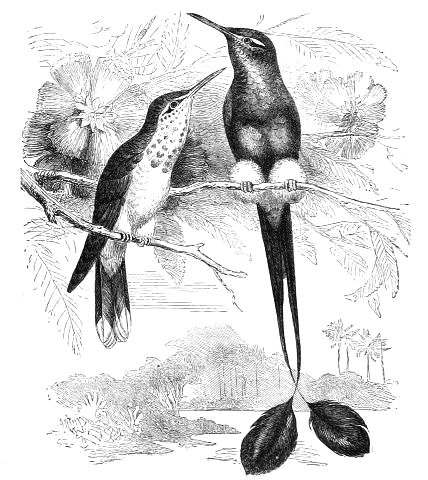
THE WHITE-FOOTED RACKET-TAIL (Steganurus Underwoodii).
"The Horned Sun-gem," says Gould, "is an inhabitant of the mountain ranges of Brazil, particularly those of Minos Gerves, and well does this elegant little bird represent in the air the brilliant that is hidden in the deep primitive rocks over which it flies, fairy-like in form and colour; we might easily imagine that one of the jewels had become vivified, and had taken wing."
We are told by M. Bourcier that "during the dry season it principally frequents the open country in the neighbourhood of marshes, and obtains its food from the small plants which there abound; during the rainy season it re-enters the woods, where it seeks its food among the various orchids."
The SYLPHS (Lesbiæ) are principally distinguished by their long, forked tails.
The RACKET-TAILED SYLPHS (Steganurus) have the outer tail-feathers much prolonged, and almost naked except at their extremities, where the barbs are broadly dilated.
THE WHITE-FOOTED RACKET-TAIL.
The WHITE-FOOTED RACKET-TAIL (Steganurus, or Spathura Underwoodii) is remarkable for the unusual prolongation of the exterior tail-feathers; these are partially denuded of the web, and at the end of the shaft are enlarged into a broad disc; the beak is short and almost straight, and the small tarsus thickly covered with down. The entire mantle, belly, sides, and lower tail-covers are copper-green, the breast and throat brilliant green; the quills are purplish brown, the tail brown, and the disc at the extremity of the exterior feathers black, with a green shade. The length of the male is five inches and a half, the wing measures one inch and three-quarters, and the tail one inch and three-eighths. The female is copper-green on the back, and white, spotted with green, on the under side; the lower tail-covers are brown, and the tail-feathers, which are of almost equal length, are tipped with white.
"This species," says Gould, "enjoys a range of habitat over the Columbian Andes from the 3rd to the 10th degree of north latitude, but appears to be confined to the region ranging between 5,000 and 9,000 feet above the level of the ocean; it is abundant in the neighbourhood of Santa Fé de Bogota, and numerous in Galipan, between La Guayra and the Caraccas. Mr. Dyson informs me that when hovering before a flower the action of its wings is exceedingly rapid, that it produces a loud humming sound, and the large spatules at the end of the outer tail-feathers show very conspicuously, being kept in continual motion by the rapid movements of the bird, and the repeated closing and expanding of its tail; its white-booted legs are equally noticeable. It is strictly an inhabitant of the hills, and loves to examine the flowers growing in the open passes and glades of the forest for its insect food, which it procures from the highest trees, as well as from branches near the ground. During its flight, it passes through the air with arrow-like swiftness, the tail being carried in a horizontal position."
Mr. Gosse gives the following interesting account of one of the many attempts he made to rear two young males of this beautiful species. The subjects of this experiment were not confined in a cage, but kept in a room with doors and windows close shut. "They were lively, but not wild; playful towards each other, and tame with respect to myself, sitting unrestrained for several seconds at a time on my finger. I collected a few flowers, and placed them in a vase on a high shelf, and to these they resorted immediately; but I soon found that they paid attention to none but Asclepias corrassavica. On this, I again went out and gathered a large bunch of asclepias, and was pleased to observe that on the moment of my entering the room one flew to the nosegay and sucked while I held it in my hand. The other soon followed; and then both these lovely creatures were buzzing together within an inch of my face, probing the flowers so eagerly as to allow their bodies to be touched without alarm. These flowers being placed in another glass, they visited each bouquet in turn, now and then flying after each other playfully through the room, or alighting on various objects. Although they occasionally flew against the window, they did not flutter and beat themselves at it; but seemed well content with their lot. As they flew I repeatedly heard them snap their beaks, at which time they doubtless caught minute flies. After some time, one of them suddenly sank down into one corner, and on being taken up seemed dying; it lingered awhile and died. The other continued his vivacity. Perceiving that he exhausted the flowers, I prepared a tube, made of the barrel of a goose-quill, which I inserted into the cork of a bottle, to secure its steadiness and upright position, and filled it with juice of sugar-cane. I then took a large Ipomea, and having cut off the bottom, slipped the flower over the tube so that the quill took the place of the nectary of the flower. The bird flew to it in a moment, clung to the bottle's rim, and bringing his beak perpendicular, thrust it into the tube. It was at once evident that the repast was agreeable, for he continued pumping for several moments; and on his flying off I found the quill emptied. As he had torn off the flower in his eagerness for more, and even followed the fragments as they lay on the table to search them, I re-filled the quill, and put a blossom of the marvel of Peru into it, so that the flower expanded over the top; the little toper found it again, and after drinking freely, withdrew his beak, but the blossom was adhering to it as a sheath. This incumbrance it got rid of, and then returned immediately, and, inserting his beak into the bare quill, finished the contents. It was amusing to see the odd position of his body as he clung to the bottle, with his beak inserted perpendicularly into the cork. Several times in the evening he had recourse to his new fountain, and at length betook himself to a line stretched across the room for repose. He slept, as they all do, with the head not behind the wing, but slightly drawn back on the shoulders. In the morning I found him active before sunrise, having already emptied his quill of syrup. After some hours, he flew through a door I incautiously left open, and, to my great chagrin, escaped.
"Another male that I kept became so familiar, even before I had had him for a day, as to fly to my face, and, perching on my lip or chin, thrust his beak into my mouth and suck up the moisture. He grew so bold and so frequent in his visits as at length to become almost annoying, and so pertinacious as to thrust his protruded tongue into all parts of my mouth, searching between the gum and cheek or beneath the tongue. Occasionally I gratified him by taking into my mouth a little of the syrup, and inviting him by a slight sound which he had learnt to understand. This bird and his companions in captivity early selected his own place for perching, without invading his neighbours'. So strong was this predilection, that on my driving one away from his spot he would flutter round the room, but try to alight there again, and if still prevented would hover near the place as if much distressed. The boldest of these birds was rather pugnacious, occasionally attacking one of his gentler and more confiding companions, who always yielded and fled. After a day or two, however, the persecuted one plucked up courage, and actually played the tyrant in his turn, interdicting his playfellow from sipping at the sweetened cup. Twenty times in succession would the thirsty bird drop down upon the wing to the glass, which stood at the edge of a table immediately beneath that part of a line where both were wont to perch; but no sooner was he poised in front, and about to insert his tongue, than the other would dart down with inconceivable swiftness, and wheeling so as to come up beneath him, would drive him from his repast. He might fly to any part of the room unmolested, but an approach to the cup was the signal for an instant assault. The ill-natured fellow himself took long and frequent draughts.
"When these birds were accustomed to the room, their vivacity was extreme; as manifested in their upright position and quick turns and glances when sitting, which caused their brilliant breasts to flash out from the darkness into sudden lustrous light, like rich gems; and no less by their startings hither and thither, and their most graceful wheelings and evolutions in the air, so rapid that the eye was frequently baffled in attempting to follow their motions."
The COMETS (Sparganura) possess a very remarkably graduated tail, the outer feathers of which are five times as long as those in the centre.
THE SAPPHO COMET.
The SAPPHO COMET (Sparganura Sappho) is bright scarlet on the back, and of a metallic green on the head and under side; the throat, of a lighter shade, is lustrous, and the lower part of the belly light brown; the quills are purplish brown, the tail-feathers brown, very glossy at the base, and bright fiery orange towards the deep brown tip. The female is green on the mantle, and spotted grey on the under side; her tail is short, and its feathers of an uniform light red.
"No combination of gorgeous colouring," says Dr. Tschudi, "can exceed that which is presented in the plumage of this Humming Bird, as it appears and disappears like a dazzling flash of coloured light. It haunts the warm, primeval forests, but is still more frequently found in the pure atmosphere of the ceja-girded montãnas."
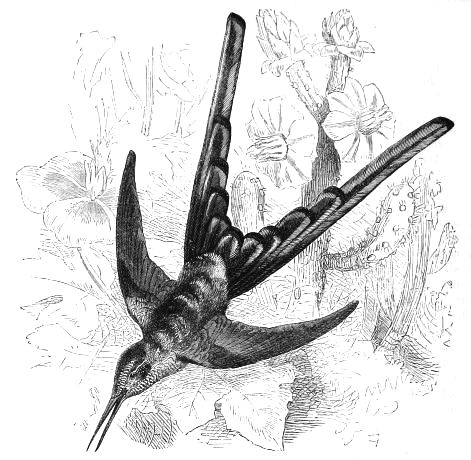
THE SAPPHO COMET (Sparganura Sappho).
"One of the principal summer haunts of this bird," writes M. Bourcier, "is Chuquesaca, in the interior of Bolivia, where it appears when the fruit-trees of the country are in flower, and is met with in the greatest numbers among the flowers of the capulo, a kind of cherry-tree; it also visits the orchards and gardens of the city during the blossoming of the apple-trees. It is by no means shy, and the males are constantly at war, chasing each other with the utmost fury, uttering at the same time a sharp cry, whenever one bird invades another's territory."
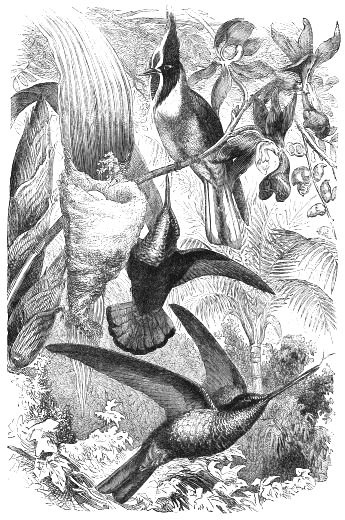
HUMMING BIRDS.
"Soon after the arrival of these birds in Chuquerca," says Bonelli, "the task of incubation commences, and when the summer is over, both the old and young, actuated, as it were, by the same impulse, wend their way southward, to return again when the sun has once more gladdened the earth. The nest is a somewhat loose structure, outwardly composed of interlaced fibres, slight twigs, and moss, and frequently lined with soft hair, like that of the Viscacha (Lagostomus tridactylus), with the lower portion prolonged considerably below the bottom of the cup-shaped interior, which is about an inch and a half in diameter and an inch in depth; the total length of the nest averaging from two inches and a half to three inches. The little structure is placed in situations similar to those selected by the Spotted Flycatcher, namely, against the sides of the gully, supported or entirely sustained by any hanging root or twig that may be best adapted to afford it security; the part of the nest next the wall is much thicker, but of a coarser texture than the circular portions of the structure. The two eggs are oblong in form, of a pure white, and about half an inch in length. The difficulty of shooting these birds is inconceivably great, from the extraordinary turns they make when on the wing: at one instant darting headlong into a flower, at the next describing a circle in the air with such rapidity that the eye, unable to follow the movement, loses sight of it until it again returns to the flowers."
The MASKED HUMMING BIRDS (Microrhamphi) have a short, straight beak, moderately long and broad wings, and long, forked tail, which occasionally varies in its formation. The head and neck are adorned with peculiar tufts of feathers.
THE SHARP-BEARDED MASKED HUMMING BIRD.
The SHARP-BEARDED MASKED HUMMING BIRD (Microrhamphus oxypogon).—"I met with this fine species," says M. Linden, "for the first time in August, 1842, while ascending the Sierra Nevada de Merida, the crests of which are the most elevated of the eastern branch of the Columbian Cordilleras. It inhabits the region immediately beneath the line of perpetual congelation, at an elevation of from 12,000 to 13,000 feet above the level of the sea; it appears to be confined to the region between the 8th and 7th degree of north latitude. It occasionally perches on the scattered shrubs of this icy region, but most frequently on the projecting ledges of the rocks near to the snow. Its flight is swift, but very short. When it leaves the spot upon which it has been perched, it launches itself obliquely downwards, uttering, at the same time, a plaintive whistling sound, which is also occasionally uttered when perched; as far as I can recollect, I never heard it produce the humming sound made by several other members of the group, nor does it partake of their joyous spirit and perpetual activity. Its food appears to consist of minute insects, all the specimens we procured having their stomachs filled with small flies."
"This bird," says Gould, "is never met with at a less elevation than 9,000 feet. It might be thought that such bleak and inclement situations were ill-adapted for so delicate a structure as that of the Humming Bird; but there and there only does it dwell, while the equally lofty paramas of Bogota are the native locality of the nearly-allied species, Oxypogon Guerini. The minute insects which frequent the Alpine flowers of these districts afford abundance of food to these birds, and their bills are beautifully constructed for searching amongst the flowers in which these are found."
THE COLUMBIAN THORNBILL.
The COLUMBIAN THORNBILL (Ramphomicron heteropogon) has only the feathers on the neck prolonged; the beak is sharp and pointed; the wings narrow, and of medium length; the broad tail is deeply forked. The entire mantle is of copper-green, the brow deep, rich green; and the long feathers on the throat of a somewhat metallic green in the centre, and orange-red at the roots and edges; the lower belly is greyish white, quills purplish brown, and tail greenish brown.
"The high lands of Columbia," says Gould, "from Venezuela to some distance north of Santa Fé de Bogota, are the natural habitat of this fine species. It is there very generally spread over the temperate regions of the country, never ascending to the snow-capped hills, nor descending to the hot plains below, but frequenting the warm valleys, where a luxuriant vegetation, teeming with insect life, affords it a never-ceasing supply of nourishment. The comparatively short and feeble bill points out that minute insects constitute its principal food, and as its structure is so similar to the other species of the genus, we may infer that, like them, it tranquilly flits about among the low shrubs in secluded valleys, and does not ascend to the loftier trees."
The HELMET CRESTS (Oxypogon) have a helmet-shaped crest, broad wings, a straight tail, and lustreless plumage.
LINDEN'S HELMET CREST.
LINDEN'S HELMET CREST (Oxypogon Lindeni) is of an uniform pale copper-colour on the mantle and under side; a spot on the brow and sides of the head are black; the sides of the throat and the longest crest and neck-feathers are white; the feathers of the tail are brown, with white shafts. The length of this species is five inches and a half: the wing measures three inches, and tail two and a half. Linden first discovered this very striking bird in the Sierra de Morida, in Columbia, where it was living at an elevation of from 12,000 to 13,000 feet above the level of the sea.
THE LIGHT-BEAKS (Levirostres).
The birds belonging to this order possess in common a moderate-sized or long and sharp beak, which is either quite straight or slightly curved. The legs are extremely small and feeble, rather adapted to a sedentary life than formed for locomotion. The plumage is thick, compact, and usually brilliantly tinted.
The BEE-EATERS (Meropes) comprise some of the most beautiful birds inhabiting the Eastern Hemisphere, and present so many peculiarities as to render their identification easy. Their body is very slender; the beak longer than the head, with both mandibles slightly curved, the upper one a trifle longer than the lower; the culmen, margins, and tip are sharp; the short, small foot has three toes, the exterior of which is connected with that in the centre as far as the second joint, whilst the inner toe is not joined to the latter beyond the first joint; the claws are long, hooked, sharp, and furnished with a prominent ridge on the inner side; the wing, in which the second quill exceeds the rest in length, is long and pointed; the tail is long, either straight, forked, or slightly rounded at its extremity; in some species the centre tail-feathers are twice as long as those at the exterior. The brilliantly variegated plumage is short and thick; the sexes are almost alike in colour, and the young acquire the same hues as their parents within the second year.
One species of Bee-eater is found in Australia; but with this exception all the members of this group inhabit the Eastern Hemisphere. As regards their general habits, the Bee-eaters nearly resemble the Swallows, and, like them, are to be seen darting through the air when the sun is shining, in active pursuit of the insect hosts. Insects afford these pretty birds their principal means of subsistence, and, as their name implies, they eagerly devour large quantities of bees and wasps. The nests of the Bee-eaters are usually placed near together in holes in the ground or sand, and contain from four to seven pure white eggs.
THE COMMON BEE-EATER.
The COMMON BEE-EATER (Merops apiaster) (Coloured Plate XXIV.), one of the largest members of this family, is ten inches long and seventeen broad; the wing measures five inches and one-third, and the tail from four inches to four and a quarter. In this species the brow is white, and top of the head green; the nape, sides of the neck, and centre of the wings are chestnut-brown; the back is yellow, with a greenish gloss; the cheek-stripes, which terminate at the back of the neck, and a line around the pale yellow throat are black; the under side and rump are blue or blueish green; the quills grass-green, blue on their outer web, and tipped with black; the tail-feathers are blueish green, shaded with yellow, the long centre pair are also tipped with black; the eye is bright red, the beak black, and the foot of a reddish hue.
The Merops apiaster is an occasional visitor to this country, and somewhat resembles the Swallows in its habits. Like them, it captures prey on the wing. It devours bees and wasps in large quantities, and that without experiencing the least inconvenience from their sting, which it probably gets rid of by frequently pressing the body between its mandibles, until the sting is either extracted or rendered harmless. In the island of Crete these birds are caught by boys, by means of a cicada attached to a pin or fish-hook fastened to a long thread. In many parts of Europe the flesh is esteemed as an article of food. The voice of this species is rich and pleasing.
"I have had the gratification," says Mr. Thompson, "of seeing the Bee-eater in scenes with which its brilliant plumage was more in harmony than with any in the British Isles. It first excited my admiration when visiting the celebrated grotto of Egeria, near Rome. On approaching the classic spot, several of these birds, in rapid Swift-like flight, swept closely past, uttering their peculiar call, and, with their brilliant colours and graceful form, proved irresistibly attractive. My companions, who, as well as myself, beheld them for the first time, were so greatly struck with the beauty of their plumage, and their bold, sweeping flight, as to term them the presiding deities of the Egerian grotto. Rich as was the spot in historical and poetical associations, it was not less so in pictorial charms. All was in admirable keeping; the picturesque grotto, with its ivy-mantled entrance and gushing spring; the gracefully-reclining, though headless, white marble statue of the nymph; the sides of the grotto covered with the exquisitely-beautiful maiden-hair fern in the richest luxuriance; the wilderness of wild flowers around the exterior attracting the bees on which the Meropses were feeding; and over all the deep blue sky of Rome completing the picture."
The sting-bearing hymenoptera undoubtedly constitute the favourite food of these resplendent birds, and to obtain them, not only are the hives of the honey-bee put under requisition, but the nests of wasps, hornets, and humble-bees are ruthlessly robbed of their inhabitants; indeed, it has been frequently observed that when the Bee-eaters have been fortunate enough to find a wasp's nest, they establish their head-quarters in its immediate neighbourhood, and, during a few hours' sojourn, generally contrive to snap up its numerous occupants one after another until none are left. Nor do these insects alone suffer from their voracity; grasshoppers, crickets, dragon-flies, gadflies, beetles, flies, and even gnats are by no means unacceptable prey, in spite of the dense, indigestible armour in which some of them are encased.
The nest of the Bee-eater is constructed towards the end of May, the locality selected being generally the sandy or clayey bank of some river, in which it excavates a round hole, from two inches to two inches and a half in diameter, apparently by means of its beak and claws, or perhaps with its claws only; from this external opening the hole extends into the bank in a slightly-inclined direction to a distance of from four to six feet, and terminates in a capacious chamber eight or ten inches long, by four to six inches broad, and three or four inches in height. It is upon the floor of this chamber that about the month of June the female lays her eggs, which are four or six in number. It is asserted by some writers that in this chamber a nest is constructed with stems of heather and lined with moss; upon this subject we can only say that in none of the holes examined by us was there the slightest trace of any nest-building materials, but in lieu thereof we always found large quantities of the elytra of beetles and of the wings of bees and other insects heaped together as if to form a kind of cushion, so that the young were not quite upon the bare ground. Whether the male assists the female in the process of incubation is as yet undetermined; but we can vouch for it that both parents most assiduously wait upon and provide food for their callow progeny.
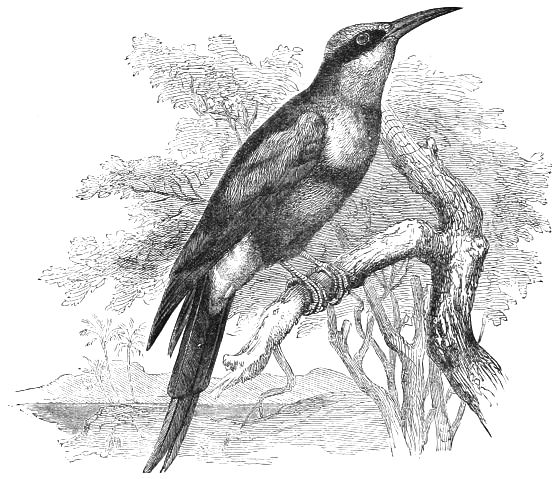
THE BEE-WOLF (Melittotheres nubicus).
THE BEE-WOLF.
The BEE-WOLF (Melittotheres nubicus) is recognisable from its congeners by its comparatively powerful frame, strong beak, and the great length of its centre tail-feathers. The magnificently-tinted plumage of this beautiful bird is deep red on the back, and rose-pink on the under side; the head, throat, rump, and centre tail-covers are blueish green; the cheek-stripe from the corner of the beak, around the eye to the ear, the tips of the exterior and anterior quills, and the extremities of the centre tail-feathers are black. The eye, like that of all Bee-eaters, is light red, the beak black, and the foot brown. This gorgeous species is thirteen inches and a quarter long, the wing measures five inches and three-quarters, and the outer tail-feathers four inches and one-third; the long centre feathers are seven inches long.
The "Bee-wolves" inhabit the eastern coast of Africa, and are very numerous in some parts. Heuglin tells us that in Cordofania he constantly saw them perching on the backs of cattle, and from thence darting down to seize the grasshoppers disturbed by these involuntary assistants as they wander over the plain.
THE BRIDLED BEE-EATER.
The BRIDLED BEE-EATER (Coccolarynx frenatus), a species inhabiting the forests near the Blue River, possesses a delicate, thin beak, a moderate-sized, straight tail, and most glowing and variegated plumage. The upper portions of the body are green, the under side is reddish brown; the brow green and blue intermixed; the throat scarlet; the belly, rump, and under tail-covers are bright blue; the black cheek-stripe, which passes across the eye, is bordered with blue; the eye is bright red, and the beak and foot black. The length of the body is eight inches; the wing measures three inches and one-third, and the tail three inches and a half.
This elegant little bird is very numerous in Central Africa, where it is usually met with in large parties, which rarely fly to any distance above the tree-tops in pursuit of their insect fare, and seize their prey more after the manner of the Flycatchers than of the Swallows. According to our own observations, these birds appear to remain for months together in the vicinity of their settlements of nests. During the Christmas of 1850, whilst anchored in the Blue River, we found at least sixty of the holes employed as nests by this species excavated in a clay bank on the shore; the whole number occupying a space not exceeding thirty-six square feet, and so close together that the entrances were not more than five or six inches apart. The passages to the nest-holes were about an inch and a half in diameter, and from three to four feet deep, terminating in a chamber from six to eight inches long, by four or six broad, and two and a half to three inches high. We found neither building materials nor eggs in these holes, although the birds were constantly creeping in and out of them.
THE SWALLOW BEE-EATER.
The SWALLOW BEE-EATER (Melittophagus hirundinaceus), another species inhabiting Africa, differs from the birds above described in the formation of its very deeply forked tail. The mantle is glossy yellowish green, the lower part of the back and tail being of a somewhat deeper shade; the under side is light green; the throat saffron yellow, and divided from the breast by a line of rich ultramarine blue; the vent and a line that passes from the nostrils over the eyes are deep blue; the cheek-stripes are black. The body of this species is eight inches and a quarter long; the wing measures three inches and a half, and the tail four inches and one-sixth. Le Vaillant, who discovered this beautiful bird in Southern Africa, tells us that it lives in pairs till after the period of incubation, when old and young associate in small parties, previous to the season of migration; they then assemble in very large flocks. The nest resembles those of other Bee-eaters. The eggs, six or seven in number, have a blueish-white shell. We also learn from Vaillant that this brilliant creature exhales a very agreeable odour, resembling the perfume of a fragrant flower.
THE AUSTRALIAN BEE-EATER.
The AUSTRALIAN BEE-EATER (Cosmäerops ornatus) has the back, a line over the eye, and the wing-coverts brownish green; the crown of the head and the nape orange; the wings orange-brown, shading into green at the extremity of the primaries, and tipped with black; the lower part of the back, the rump, and upper tail-covers are cerulean blue, and the tail black, most of its feathers edged with blue; the bridle and a line beneath and behind the eye and ear-coverts are velvety black, beneath this is a line of light blue; the throat is rich yellow, shading into orange at its sides; below the yellow is a broad band of deep black, passing into green on the lower part of the belly; the under tail-coverts are light blue; the eye is brownish red, the beak black, and the leg and foot mealy greenish grey.
The Australian Bee-eater, according to Gould, arrives in New South Wales in August, and departs north in March, during which interval it breeds and rears its young. "Its favourite resorts," says Gould, "are the open, arid, and thinly-timbered forests during the day, and in the evening the banks and sides of rivers, where numbers may be frequently seen in company. It almost invariably selects a dead or leafless branch whereon to perch, and from which it darts forth to capture passing insects, after the manner of the Kingfishers, to which it also assimilates in the upright position it assumes while perched. Its flight somewhat resembles that of the Artami; and though it is capable of being sustained for a lengthened time, the bird more frequently prefers short excursions, and returns to the branch it left. The entrance to the breeding-hole, which is made in the sandy banks of a river, is about the size of a mouse's hole, and continued for a yard in depth. At the end is an excavation of sufficient size for the reception of the parent and the deposition on the sand of four or five beautiful white eggs. The food of this species consists of various insects, principally coleoptera and neuroptera."
The NOCTURNAL BEE-EATERS (Nyctiornis), a group of Indian Bee-eaters, are recognisable by their strong, curved, and moderately-long beak, almost straight and medium-sized wing, in which the fourth quill exceeds the rest in length. The rich, soft plumage takes the form of very peculiar stiff feathers in the region of the throat and breast.
THE SANGROK.
The SANGROK (Nyctiornis Athertonii) is bright green on the mantle, and of a creamy yellow on the under side; the feathers on the crown of the head and chin, and the edges of the dark blueish green neck-feathers are light blueish green; the eye is deep yellow; the beak lead grey, tipped with black; and the feet deep green. This bird is fourteen inches long, and eighteen broad; the wing measures five inches and a half, and the tail six inches.
We learn from Hodgson and Jerdon that the Sangrok occupies the extensive forests of India to an altitude of three or four thousand feet above the sea, and that it leads a solitary life among the trees, from and around the branches of which it obtains the bees, wasps, beetles, and grasshoppers that constitute its principal food. The cry of this species is loud and harsh. According to the natives its eggs are deposited in holes of trees.
The ROLLERS (Coracii) are a race of tolerably large birds, for the most part remarkable on account of the variety of their colours, and the splendour of their plumage. All of them belong to the Eastern Hemisphere. As the leading features whereby this group is distinguished, we may enumerate their moderate-sized, or moderately long beak, which is strong and nearly straight, somewhat broad at its base, but compressed towards the tip, sharp-cutting at the edges, and bent down at the point; the legs are short and feeble, and the toes short. The wings are of moderate length, or long and tolerably broad. The tail is of medium length, sometimes truncate at its extremity, sometimes slightly rounded, and sometimes forked; occasionally, moreover, the two outer feathers are much longer than the rest. The plumage is somewhat harsh and rough, and the shafts of the feathers stiff. The predominant colours are green, blue, cinnamon-brown, and claret-red. The sexes differ but little, and the young very much resemble their parents.
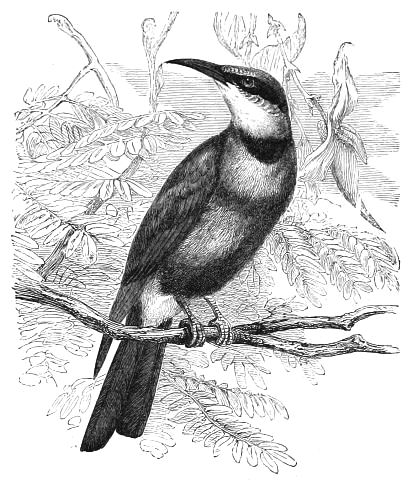
THE AUSTRALIAN BEE-EATER (Cosmäerops ornatus).
These birds generally inhabit dry, flat country, and are met with extensively throughout Europe, Asia, and Africa, but are scarce in Australia. Their usual residence is some solitary tree or high rock from which they can command an extensive field of vision, and in the holes and clefts of which they can build their nests. In such places they may generally be seen on the look-out for insects, which they catch and devour much in the same way as the Bee-eaters; at times they will dart down upon some poor mouse that happens to approach them too nearly, and occasionally they will snap up a lizard or other small game of that description, and will plunder a bird's nest in order to devour the young; but although they thus generally live on animal food, at certain seasons they have no objection to a vegetable diet, and will eat fruit. The flesh of some species is palatable, and they are consequently much sought after in some countries, either as food or on account of the beauty of their feathers.
THE BLUE ROLLER.
The BLUE ROLLER (Coracias garrulus), a species exhibiting the principal characteristics of the above family, has a strong, straight beak of moderate size, broad at its base, slightly curved at the culmen, and hooked at its tip; the tarsus is shorter than the middle toe, the second wing-quill is longer than the rest, and the tail straight at its extremity. A brilliant metallic green predominates in the magnificently-coloured plumage; the back is bright cinnamon-brown, the brow and chin are whitish, the quills are indigo blue above and ultramarine blue beneath, the feathers on the small wing-covers and wings are deep bright blue, the exterior tail-feathers light blue, the rest blueish black, with a light blue outer web. The centre feathers are blueish or greyish green. The eye is brown, the beak black, and the foot dirty yellow. The young are greyish green on the top of the head, nape, and under side, and dull cinnamon-brown on the back; their tail is light blueish green. This species is from twelve to thirteen inches long, and from twenty-seven to twenty-eight broad; the wing measures seven inches and three-quarters, and the tail five inches.
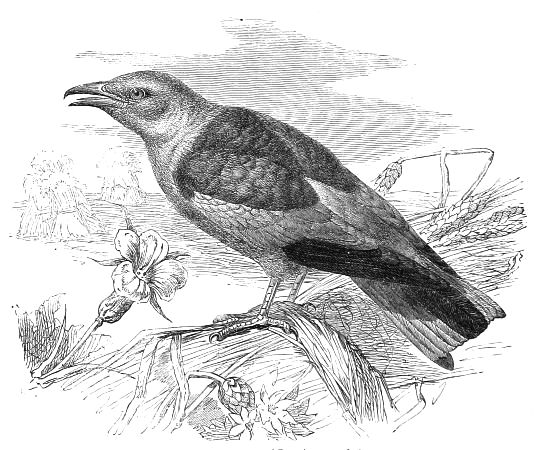
THE BLUE ROLLER (Coracias garrulus).
The Blue Roller inhabits the whole of Europe as far north as Scandinavia, and visits the northern half of the continent of Africa, as also many parts of India during its migrations. In our own country it seems studiously to avoid the vicinity of man; but in more southern regions it is less shy, and consequently more easily made the subject of observation. In its disposition it is exceedingly restless and flighty, and when not restricted, as it is during the brooding season, to a particular locality, it may be seen flying all over the district, sweeping all day long from one tree to another, or perching upon the extremity of some withered bough, or peering out from the very top of a dead tree watching for the approach of prey. In cloudy weather it seems morose and inactive; but during the sunshine it may be seen disporting itself in the air as though in play, ranging round and round, and performing a variety of strange evolutions. Sometimes, for example, it will rise to a considerable height, and then suddenly tumble head over heels down towards the ground, whence it again mounts with toilsome efforts, or, with pigeon-like flight, urges itself forward by rapidly-repeated strokes of its wings, and as it thus moves about with apparently aimless haste, presents a peculiarity of manner that there is no possibility of mistaking. When in a tree, it does not hop about among the branches, but conducts itself in the same way as many other tenuirostral species, always assisting its movements from one bough to another by the help of its wings. It can scarcely be said ever to come upon the ground, but sometimes flies so close to the earth that it might easily be supposed to be running over its surface. Unlike the Bee-eaters, these birds are very quarrelsome and unsociable, biting at any intruder, even of their own species, and quite incapable of living peaceably with any other kind. Their voice corresponds well with their German name of Rake, consisting of a loud, rattling repetition of "raker, raker, raker"—a cry occasionally exchanged for "rak, rak, jack."
These birds live principally upon insects, all sorts of which they greedily devour; sometimes they will have no objection to a mouse, or a bird, a lizard, a frog, or any other small animal. It is a very common opinion that the Blue Roller can dispense with water altogether, that it neither drinks it nor uses it for a bath; and truly any one who has seen it, as we have done, in the midst of the arid plains in which it seems to be most at home, will scarcely feel inclined to doubt the possibility of the statement being well founded.
The usual nesting-place of this Roller is in some hollow tree, and its nest is usually constructed of roots and straw, lined with hair and feathers; in the south of Europe it not unfrequently builds in rifts and chinks in old walls, or even excavates for itself a hole in the ground, much in the same way as the Bee-eaters. The brood consists of from four to six white and polished eggs. Both sexes co-operate in the work of incubation, and so assiduously do they maintain their post when sitting, that they may be sometimes caught with the hand while upon the nest. The young are fed upon insects and grubs. They soon learn to fly, but remain with their parents, and accompany them in their winter migrations.
The DOLLAR BIRDS (Eurystomus) are recognisable by their short, flat beak, which is broad at its sides, rounded at the culmen, and very decidedly hooked; the second wing-quill is the longest; the tail is either short and straight or slightly rounded; the structure of the foot and coloration of the plumage resemble that of the group above described.
THE AUSTRALIAN DOLLAR BIRD.
The AUSTRALIAN DOLLAR BIRD (Eurystomus Australis, or Pacificus) is of a deep brown on the head and neck, the rest of the mantle being sea-green; the region of the cheek is black; the feathers on the throat a bright green; the secondary quills, roots of the outer web of the primaries, and the outer web of the roots of the tail-feathers, are bright blue; and there is a blueish-white spot on the centre of the wing. The eye is dark brown; the eyelids, beak, and legs are red. The length of this species is ten inches; the wing measures six inches and three-quarters, and the tail three inches and a half.
According to Gould, the Dollar Bird appears in New South Wales in the spring, and again retires north as soon as the young are fully grown. On dull days, or at early morning, and in the evening, it is to be seen most actively employed in pursuit of the beetles and other insects on which it subsists.
"When engaged in the capture of insects," says Gould, "it usually perches upon the dead, upright branch of a tree growing beside and overhanging water, where it sits very erect, staring all around until a passing insect attracts its notice, when it suddenly darts off, secures its victim, and returns to the same branch; at other times it may constantly be seen on the wing, mostly in pairs, flying just above the tops of the trees, diving and rising again with rapid turns in the most beautiful manner. During flight, which, when performed at a considerable elevation, is laboured and heavy, the white spot in the centre of each wing, then widely expanded, shows very distinctly; and hence the name of Dollar Bird bestowed on it by the colonists. It is very noisy, particularly in dull weather, when it often emits its peculiar chattering note during flight. The breeding season continues from September to December; the three or four pearl-white eggs are deposited in a tree."
THE ORIENTAL DOLLAR BIRD.
The ORIENTAL DOLLAR BIRD (Eurystomus Orientalis), a nearly-allied Indian species, we are told, passes a great portion of its time in flying from place to place, and hangs, Woodpecker-like, from the trunks of trees whilst in search of the grubs and insects on which it subsists.
The SAW-BILL ROLLERS (Prionites), though in many respects resembling the Blue Rollers, differ from that bird in their superior length of tail and height of tarsus, as well as in the saw-like edges with which the margin of the beak is furnished; the latter is slightly curved, compressed at its sides, and without a hook at its tip; the base of the beak is overgrown with stiff, bristle-like feathers. The wings, in which the fourth or fifth quills are the longest, are short and rounded; the strong, wedge-shaped tail is composed sometimes of ten, sometimes of twelve feathers, placed in pairs of equal length, of which the centre pair are the longest. The plumage is full, soft, and consists of large feathers, thickly covered with down at the roots.
The Saw-bill Rollers occupy the woods and forests of South America, and lead a retired life, either alone or in pairs, and far from the abode of man; their cry, which resembles a note from a flute, is most frequently heard in the morning and evening. Insects afford their principal means of subsistence, and these they obtain in a great measure from the surface of the ground.
THE MOT-MOT.
The MOT-MOT (Prionites momota) is of an olive-green on the back, wing-covers, and legs; the neck, throat, breast, and belly are reddish yellow; the top of the head, cheeks, and bridles black; and the brow and a narrow collar at the back of the head of a brilliant blueish green; the quills are blackish, the secondaries sky-blue on the outer web. The tail, which is composed of twelve feathers, is green above and black beneath; the eye is reddish brown, the beak black, and the foot horn-grey. This species is nineteen inches long; the wing measures six and a half inches, and the tail eleven inches.
According to Burmeister, the Mot-mot inhabits the wooded districts in Northern Brazil; and Schomburghk, who found them very numerous in Guiana, had there an opportunity of observing their habits and mode of life. "Shortly before sunrise," says the last-named writer, "the plaintive and melancholy 'hutu, hutu' of the Saw-billed Roller may be heard among the foliage on the outskirts of the forest, announcing the approach of morning. This remarkable bird seems to avoid all well-lighted places; and, although by no means shy, never appears beyond the outskirts of the forest. It will even allow an intruder to come quite close to its perching-place before it flies off to another twig, where, immediately that it has perched itself, it again begins its well-known notes 'hutu, hutu,' accompanying each syllable with a stroke of its tail somewhat after the manner of our own Wagtail."
When about to construct its nest, the Mot-mot selects a round or oval depression in the side of some hillock, or other elevated spot; and although the male and female regularly relieve each other at short intervals, the monotonous duty of incubation seems by no means agreeable to either; so that after sitting for three or four minutes quietly upon the eggs they begin to turn themselves round, and it is supposed to be by the constant repetition of this movement in a circle that the feathers of their tail become in time quite spoiled and worn away. As to their eggs, Schomburghk gives us no information whatever, nor do we find anything recorded concerning them in the works of other naturalists.
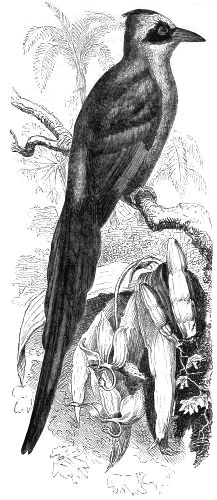
THE MOT-MOT (Prionites momota).
The BROAD-THROATS (Eurylaimus) are small, compact birds, with short, broad beaks, powerful feet, moderate-sized wings, and short or rather long tail. The beak, which is shorter than the head, is broad at its base, slender at the tip, and hooked at its extremity; the gape extends as far as the eyes; the moderate-sized foot has the tarsus a trifle longer than the centre toe, which latter is united with the inner as far as the first joint; the wing, in which the third or fourth quill is the longest, is short and rounded; the tail is usually either rounded or graduated; in some species, however, it is slightly incised; the plumage is of brilliant hues, and the sexes almost alike in colour and markings. These birds inhabit India and the Malay Islands, where they haunt the innermost recesses of deep, dark forests, and carefully avoid the habitations of man.
THE SUMATRAN TROWEL-BEAK.
The SUMATRAN TROWEL-BEAK (Corydon Sumatranus), a species of the above family inhabiting Sumatra and Borneo, represents a group recognisable by their compact and falcon-like body; short, broad beak, the upper mandible of which almost entirely encloses the lower one; and also by their bare, short, strong feet, armed with long toes; short rounded wings, in which the third or fourth quill exceeds the rest in length; and moderate-sized tail, formed of twelve rounded feathers. The dusky plumage, which is soft and thick, is replaced in the region of the beak by a few short bristles; its colour is principally of a pale black; the entire throat pale brownish yellow; the centre of the back bright red; the wings are black, with a few white spots; the tail-feathers pale black, the centre pair of uniform hue, the rest marked with white towards the tip. The eye is brown, the beak and a bare place round the eye are bright red; the foot is blackish brown. This species is nine inches and a half long; the wing measures four, and the tail three inches and a half; the beak is one inch long, and one inch and a quarter broad at its base. We are entirely without particulars as to the life and habits of this bird, except that it frequents moist and shady woods in the vicinity of water, and associates in small parties.
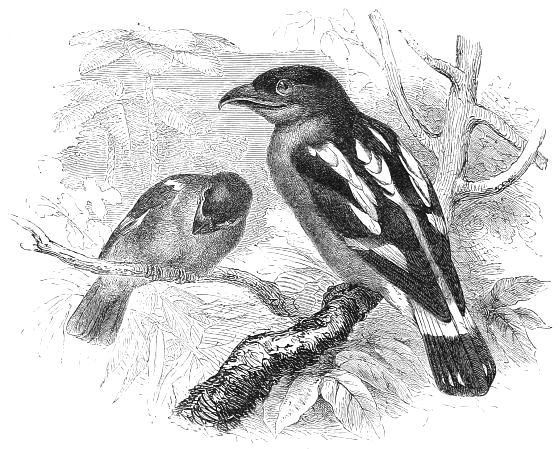
THE JAVA BROAD-THROAT (Eurylaimus Javanicus).
The TRUE BROAD-THROATS (Eurylaimus) are recognisable from the above group by the formation of their beak, which is longer and flatter than that of the last-mentioned species.
THE JAVA BROAD-THROAT.
The JAVA BROAD-THROAT (Eurylaimus Javanicus) is blackish brown on the upper back, lemon-yellow on its lower portion, and greyish crimson on the under side; a stripe between the shoulders, another on the shoulder-covers, and several patches on the outer webs of the quills are lemon-yellow; the tip of the tail is enlivened by a white line; the beak is glossy black, except at the culmen and margins, which are greyish white; the first is yellowish brown. This bird is eight inches and a half long; the wing measures three inches and five-sixths, and the tail two inches and one-third.
According to Raffles, the Java Broad-throat frequents the banks of rivers and the vicinity of water, in search of worms and insects. It makes its nest on a branch overhanging the surface of the water. Helfer informs us that a very similar species occupies the tree-tops in flocks of from thirty to forty birds; and that they are either so fearless or so stupid as to remain on their perch regardless of the shots that are laying their companions dead.
THE RAYA.
The RAYA (Psarisomus Dalhousiæ), a representative of the above birds, is recognisable by its moderate-sized, broad beak, which is decidedly curved at its culmen and hooked at its tip. The short wing is slightly rounded, the tail long and graduated, and the plumage brightly tinted; the mantle is bright blue; the top of the head, except a small blue spot, quite black; the brow, cheek-stripes, a small tuft near the ear, the throat, and a narrow band at the nape are saffron-yellow; the entire under side is of a parrot green; the blackish-brown quills have a blue outer web; the tail-feathers are blue above and glossy blackish brown beneath; the eyes brown, and beak green, with a black culmen; the foot is dusky greenish yellow. The length of this species is fourteen inches; the wing measures four inches, and the tail five inches and a half.
This beautiful bird inhabits India, and, as Jerdon tells us, is met with in the forests of the Himalayas to a height of 6,000 feet above the sea; those he found were engaged in seeking their insect prey upon the trees, either alone or in pairs. The nest, according to the same author, is a large structure, loosely framed of grass and moss. The eggs, two in number, have a white shell.
The TODIES (Todi), a group of American birds, apparently representing the Broad-throats, are remarkable for the very peculiar formation of their beak; and on this account much diversity of opinion has arisen as to the place that should properly be assigned them. All the species with which we are acquainted are small, delicately-built birds, possessing moderate-sized and straight beaks, with both mandibles so flatly compressed that they may literally be described as two thin plates; the margins of the bill are finely incised, and the gape extends as far back as the eyes; the tarsus is slender, and scarcely longer than the middle toe; the toes are unusually long and thin, armed with short, delicate, but very sharp hooked claws; the fourth, fifth, and sixth quills in the short, rounded wings exceed the rest in length; the tail, of moderate length, is broad, and slightly incised. The plumage, which consists of soft, compact feathers, is replaced by bristles in the region of the beak; the tongue, except at its fleshy root, resembles a horny plate, and is as transparent as the barrel of a quill.
THE TODY, OR GREEN FLATBILL.
The TODY, or GREEN FLAT-BILL (Todus viridis), is of a blueish green on the back, and greyish-white on the under side. The throat and upper breast are bright rose red, and the belly pale yellow; the quills are greyish green; the centre tail-feathers green, and those at the exterior grey; the eye is pale grey, the beak reddish horn-grey above, and bright scarlet beneath; the foot flesh-pink or brownish red. This species is four inches and a quarter long, and six and a half broad; the wing measures one inch and four-fifths, and the tail one inch and a half. The sexes closely resemble each other in the coloration of their plumage.
"In all parts of Jamaica," says Gosse, "that I have visited, the Tody is a very common bird. On the summit of Bluefields Mountain, about 3,000 feet above the level of the sea, and particularly where the deserted provision-grounds are overgrown with an almost impenetrable thicket of joint-wood, it is especially abundant. Always conspicuous, from its bright, grass-green coat, and crimson velvet gorget, it is still a very tame bird; yet this seems rather the tameness of indifference than of confidence: it will allow a person to approach very near, and, if disturbed, alight on another twig a few yards distant. We have often captured specimens with an insect-net, and struck them down with a switch; it is not uncommon for the little boys to creep up behind one, and actually to clap the hand over it as it sits, and thus secure it. It is a general favourite, and has received a familiar name—that of Robin Redbreast. There is little resemblance, however, between the European Robin and its West Indian namesake. I have never seen the Tody on the ground; but it hops about the twigs of low trees, searching for minute insects, occasionally uttering a querulous, sibilant note. But more commonly it is seen sitting patiently on a twig, with the head drawn in, the beak pointing upwards, and the lower plumage puffed out, when it appears much larger than it really is. It certainly has an air of stupidity when thus seen; but this abstraction is more apparent than real. If we watch it we shall see that the odd-looking grey eyes are glancing hither and thither, and that ever and anon the bird sallies out upon a short, feeble flight, snaps at something in the air, and returns to his twig to swallow it. I have never seen the Tody eat vegetable food; but I have occasionally found in its stomach, among minute coleopterous and hymenopterous insects, a few small seeds. One of these birds, which I kept in a cage, would snatch worms from me with impudent audacity, and then beat them violently against the perch or sides of the cage, to divide before he swallowed them. One captured in April, on being turned into a room, began immediately to catch flies and other minute insects that flitted about. At this employment he continued incessantly and most successfully all that evening and all the next day, from earliest dawn till dark. He would sit on the edge of the table, on shelves, or on the floor, ever glancing about, now and then flitting up into the air, when the snap of his beak announced a capture, and he returned to his station to eat it; he would peep into the lowest and darkest corners, even under the tables, for the little globose, long-legged spiders, which he would drag from their webs and swallow. He sought these also about the ceilings and walls. I have said that he continued at this employment all day without intermission, and I judge that on the average he made a capture per minute. We may thus form some idea of the immense number of insects destroyed by these and similar birds. Water in a basin was in the room, but I did not see him drink. Though so actively engaged in his own occupation, he cared nothing for the presence of man; he sometimes alighted voluntarily on our heads, shoulders, or fingers, and when sitting would permit me at any time to put my hand over him and take him up, though when in the hand he would struggle to get out. He seemed likely to thrive; but incautiously settling in front of a dove-cage, a surly bald-pate poked his head through the wires, and aimed a blow at the head of the unoffending Tody. She did not appear to mind it at first, but an hour afterwards shivered and died."
"The Green Tody," says Mr. Hill, "is a bird of peculiar structure and habits; he is exclusively an insect-feeder, and burrows in the earth to breed. The subterranean nest is made wherever there is mould easy of excavation; ravines and gullies, whose banks are earthy, and where the water passes rapidly from the surface-soil, are generally selected. The excavation is made by the beak and claws. It is a winding gallery, rounded at the bottom, and terminating in a sufficiently wide lodging, lined with pliant fibres, dry moss, and cotton, placed with much attention to arrangement. Four or five grey, brown-spotted eggs are laid, and the young are fed within the cave till they are full-fledged."
The KINGFISHERS (Alcedines) principally frequent the warmer latitudes. The members of this group possess a powerful body, large head, and short or moderate-sized wings and tail, with a very long, straight, and powerful beak, pointed at its extremity; the small foot is furnished with either three or four toes. The plumage is of most brilliant hues, and varies but little in the sexes, or with the age of the bird.
All the various species of Kingfishers prefer the vicinity of water; and, where fish is to be found, venture to a very considerable altitude when following mountain-streams. Like all such members of the feathered creation as subsist by fishing, they are quiet, indolent, and wary in their habits, seeking their prey either alone or, at most, in pairs. As regards their powers of locomotion, they have little to distinguish them; it is true, they possess a certain skill in diving and swimming, but on the ground or in the air their deportment is extremely clumsy. Of their senses, sight and hearing appear to be highly developed; but, with these exceptions, we must pronounce these birds to hold a very low place in the scale of intelligence, and to exhibit but one attractive quality—that of warm attachment to their eggs and young. Fish, insects, and crabs constitute their principal means of subsistence, and these are principally obtained by diving. The numerous eggs laid by the members of this group are deposited in a hole excavated in the ground, the extreme end of which forms the actual nest.
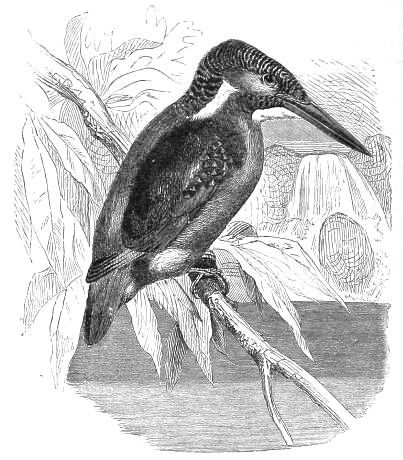
THE EUROPEAN KINGFISHER (Alcedo ispida).
THE EUROPEAN KINGFISHER.
The EUROPEAN KINGFISHER (Alcedo ispida) is recognisable by its long, thin, straight, and powerful beak, which is much compressed at its tip. The foot is small; the centre of the three front toes is connected with the external toe as far as the second, and with the short inner toe to the first joint; the hind toe is very small; the third quill in the short, blunt wing exceeds the rest in length; the tail is formed of twelve small feathers. The thick, compact plumage is very brilliant, with a metallic gloss above, and a silky gloss on the under side. The feathers on the head are prolonged into a crest. As it would be impossible to mistake the European Kingfisher for any other bird, it will suffice to say that the upper portions of the body are greenish blue, and the lower yellowish brown; the eye is deep brown, the beak bright red, and the foot cinnabar-red. The length of this bird is six inches and a half, the breadth ten inches and a half; the wing measures two inches and two-thirds; the length of tail one inch and a half.
This Kingfisher, the only European representative of the above group, is one of the most beautiful of our British birds, and its appearance as it dashes along in the sunshine strikingly brilliant. It is an inhabitant of all parts of Europe, except the extreme north, and is also widely spread over Asia and Africa. This species is always found in the vicinity of water, over which it may be seen shooting along like a little meteor. Its food consists not only of small fishes, but also of aquatic insects and leeches. The appetite of the Kingfisher is voracious, and his manners shy and retiring. Dwelling near sequestered brooks and rivers, he sits for hours together motionless and solitary on some bough overhanging the stream, patiently watching the movements of the smaller fishes which constitute his food, waiting for a favourable moment to dart with the velocity of an arrow upon the first that comes near enough to the surface, and seldom failing in his aim. He returns with it to his former station, on some large stone or branch, where he kills his captive by shifting its position in his bill, so as to grasp it firmly near the tail, and striking its head smartly against the object on which he rests; he then reverses its position and swallows it head foremost; the indigestible parts are afterwards ejected in a manner analogous to that of Owls and other birds of prey. The Kingfisher, however, does not confine himself to this mode of watching in motionless solitude, but should the stream be broad, or no favourable station for espionage present itself, he may be seen poising himself over it at an altitude of ten or fifteen feet, scrutinising the element below for his food, and then plunging upon it with a velocity which often carries him considerably below the surface. For these habits his muscular, wedge-shaped body, increasing gradually from a long, pointed bill, and his sleek plumage, which, whilst it passes freely through the water, is impervious to wet, seem especially to adapt him. His wings are short, but powerful; hence his flight is smooth, even, and exceedingly rapid. Silent, except during the pairing and breeding season, when he occasionally utters a sharp, piercing cry, indicative, perhaps, of attachment, and equally solitary and unsocial in his habits, the Kingfisher dwells alone; seldom consorting with others, or even with his mate, except during the rearing of the young, when both sexes discharge with assiduity the duty of procuring requisite supplies of food. The places selected for incubation are steep and secluded banks, overhanging ponds or rivers, generally at a considerable distance above the surface of the water, and extending two or three feet into the bank. The female, without making a nest, lays five or six eggs, of a beautiful pinky white. As soon as the young are hatched, the parent birds may be seen incessantly passing to and from the hole with food, the ejected remains of which in a short time accumulate around the callow brood. The young do not leave the hole until fully fledged, when, seated on some neighbouring branch, they may be known by their clamorous twitterings as they greet their parents, from whom they impatiently expect supplies of food. They assume at an early age a plumage nearly resembling the adult. The Kingfishers appear to possess habits of partial migration; or, at least in our island, they wander from the interior of the country along the rivers to the coast, and in the autumnal and wintry months frequent the mouths of small rivulets and dykes near the sea.
The PURPLE KINGFISHERS (Ceyx), a group inhabiting India, the Malay and Philippine Islands, and New Guinea, are without the inner toe possessed by the European Kingfisher above described. These birds have hitherto been grouped with the Halcyones on account of the broad base of their beak; but the shortness of their wings and tail, and their general habits, fully justify their introduction in this place.
THE PURPLE KINGFISHER.
The PURPLE KINGFISHER (Ceyx tridactyla), one of the most remarkable members of this family, is of a bright orange, gleaming with peach-colour on the back, and shading from rust-red into chestnut-brown on the neck and sides of breast; the rest of the under side is saffron-yellow. The large wing-covers are deep black, the shoulders and exterior borders of the wings chestnut-brown, the quills blackish brown, with a rust-red edge to the inner web; the tail-feathers are rust-red. This species is five inches long and eight broad; the wing measures two inches and a quarter, and the tail three-quarters of an inch. This beautiful bird is met with over the whole extent of India and Ceylon, but is nowhere numerous. Fish and some of the smaller inhabitants of the water constitute its usual food.
The GREY KINGFISHERS (Ceryle) exhibit, in an eminent degree, the admirable skill with which their bodies have been adapted to the situation they are destined to occupy in the great scheme of creation. Although resembling the True Kingfishers in many particulars, their wings are considerably longer and more pointed than in those birds, and far more available as instruments of locomotion; the long, straight beak is compressed at its sides, and pointed at its tip; the almost lustreless plumage is of comparatively sombre hue, and differs more or less in the sexes. Most of the numerous members of this group inhabit America; some few are met with in Asia and Africa, while Europeans may lay claim to one species that may now be regarded as naturalised, on account of the frequency of its visits to our continent.
THE GREY KINGFISHER.
The GREY KINGFISHER (Ceryle rudis) is chequered blue and white on the mantle, with a white under side, relieved by two black lines upon the breast, and dark spots upon the sides; the top of the head and the cheek-stripes are black, the eyebrows black and white, the white tail-feathers are crossed by a black line near the extremity, the eye and foot are brown, the beak is black. This species is ten inches long and eighteen broad; the wing measures five and the tail three inches. The female has but one black line upon her breast.
The Grey Kingfisher is met with in almost every part of Africa, in Syria, Egypt, Palestine, Persia, and, we believe, in India; in Europe, as far as we can ascertain, it has only been seen in Greece and Dalmatia. Unlike the true Kingfisher, this bird exhibits a most social disposition, and prosecutes its search for food in spots constantly frequented not only by cattle, but by man. The chase after fish is sometimes carried on from the top of a post or projecting branch, sometimes while the bird is hovering over water, into which it plunges headlong at the first appearance of a suitable victim, which is borne off to some favourite perch, and there devoured, after (as is frequently the case) it has been struck repeatedly against the branch or post. When in pursuit of food, the Grey Kingfisher flies over the surface of the water with a Falcon-like motion, rising and sinking rapidly through the air, and varying its movements with equal adroitness and grace. During the daytime it is comparatively quiet, but towards evening begins to disport itself in this manner, accompanying its movements by a loud, shrill, monotonous cry. According to our own experience, the breeding season commences in Egypt about March or April. Tristram informs us that the nests made by this bird in Palestine are placed in settlements formed in the steep banks of rivers. Some which he examined had their entrances not more than four inches above the level of the water; each of these entrance-passages was about three inches and a half deep, and led into the actual nest; a few fish-bones and a little grass had been placed to form a bed, on which the eggs were deposited. The latter vary both in form and colour; those we saw were oval in shape, and pure white.
The ALCYONS (Halcyones) are at once recognisable from the Kingfishers by the superior development of their wings, their greater breadth of beak, and more powerful feet. The plumage is lax and of brilliant hue, and, in some species, rivals that of any member of the feathered creation in gorgeous beauty. Africa, Southern Asia, Australia, and the islands in their vicinity, afford a home to the numerous and varied members of this group; in America and Europe they are unrepresented. All are more or less inhabitants of woodland districts, and but few exhibit a decided preference for the vicinity of water. Unlike the Kingfisher, the Alcyons are active in their habits, and, when winging their way through the air, equal the Bee-eater in agility and grace. But few move with ease upon the ground, or are capable of obtaining their prey by plunging beneath the water; they usually procure the insects, beetles, and grasshoppers on which they mainly subsist by darting down upon them from a chosen lurking-place among the branches of their favourite trees. Some, we are told, will even attack snakes, while others destroy large numbers of other birds' eggs and young. Such as possess sufficient zeal to obtain a few fish or crabs, exhibit but little skill either in swimming or diving after them. The voice of all is loud and peculiar, and, as far as our own observation goes, their intelligence and senses are not highly developed. Their neatly-constructed nest is usually placed in a tree, or hollow in a stone or in the ground. The eggs are pure white and very glossy.
The TREE ALCYONS (Halcyones) are recognisable by their long, straight, broad beak, which in some species turns slightly upwards, their short feet, moderate-sized and rounded wing, with its third quill only a trifle longer than the fourth and fifth, and a comparatively short and rounded tail.
THE RED-BREASTED TREE ALCYON.
The RED-BREASTED TREE ALCYON (Halcyon rufiventris) is black on the mantle, and reddish brown on the under side; the head, back, and sides of the throat are ash-grey; the lower part of the back, the tail, and a large spot on the wings are of a metallic green; the front of the throat is pure white, the breast dirty white, and the cheek-stripes black. When seen from beneath, the wing is of reddish brown, marked with white, and tipped with black; the under side of the tail is similarly coloured; the eye is brown, the beak and feet red. This species is eight inches and a half long; the wing measures three inches and a half, and the tail two inches and a half.
The Halcyon rufiventris is an inhabitant of Western and Central Africa, where, according to our own observations in Eastern Soudan, it principally frequents well-watered and woodland districts, in preference to the scanty growth of brushwood to be found in the vast and arid steppes. The nest usually contains three round, glossy white eggs; these are laid in October or November, and are hatched by the united care of both parents; on the male alone, however, devolves the task of rearing the nestlings.
The WOOD ALCYONS (Todiramphus) have the beak still shorter, broader, and more decidedly turned upwards than in the birds last mentioned; the wing is also somewhat larger, and its second quill almost equals the third in length. The various members of this group principally inhabit Australia and the most extensive of the neighbouring islands; whilst in India, although they are occasionally met with, the species are few and comparatively rare.
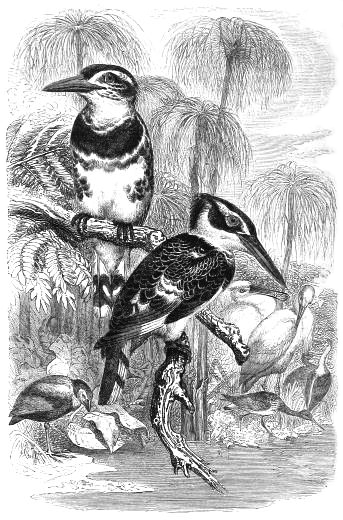
GREY KINGFISHERS (Ceryle rudis).
THE YELLOW-HEADED WOOD ALCYON.
The YELLOW-HEADED WOOD ALCYON (Todiramphus chlorocephalus), a species inhabiting Java, is of a metallic green on the back, and white on the under side; the cheek-stripes, which pass behind the neck and unite on the back, are black; a spot on the sides of the brow, and a line on the nape, are both dirty white; the eye is yellowish, the upper mandible entirely black, the lower one yellowish white at its base, with black tip. This species is nine inches long; the wing measures four inches and a half, and the tail two inches and three-quarters.
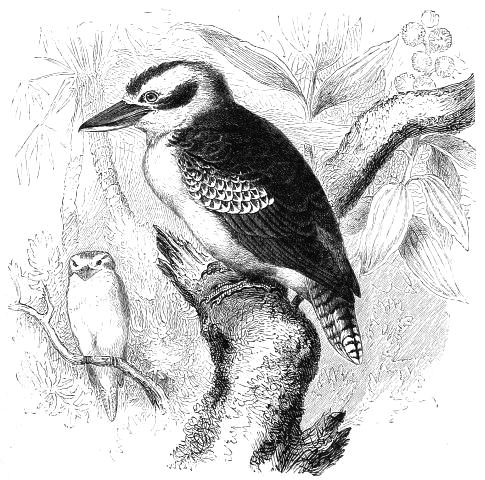
THE LAUGHING JACKASS (Paralcyon gigas, or Dacelo gigantea).
According to Bernstein, this species is one of the commonest of the birds inhabiting Java; and is to be seen on the banks of every river or streamlet that is not at any great distance from trees, and from a projecting stone or branch patiently spying out the approach of any insect or tiny fish. Its flight is usually accompanied by the repeated utterance of its clear loud cry. The nest consists of a bed of dry leaves and moss placed in a hollow in the ground, protected by an overhanging stone. The three or four eggs have a dull white shell.
THE BLUE ALCYON.
The BLUE ALCYON (Cyanalcyon Macleayi), one of the most beautiful birds of Australia, is blackish blue on the head, as far as the nape; the mantle is bright blue; the wings and tail are black, shaded with blue; the entire under side of the roots of the primary and secondary quills, a broad band round the throat, and an oval spot behind the nostrils, are white; the iris is dark brown, the beak black, and the tarsus blackish grey. The female is less brightly coloured than her mate, and has an irregular, broken line of white around her throat. This species is seven inches long; the wing measures six inches and one-sixth, and the tail two and a half inches.
"This beautiful bird," says Gould, "far surpasses any other Australian Kingfisher in the brilliancy of its plumage. Like the other members of the genus to which it belongs, it is rarely if ever seen near water, and evinces so decided a preference for the open forests of the interior of the country that it has obtained the name of the Bush Kingfisher. It is generally dispersed about in pairs, and feeds on small reptiles, insects, and their larvæ. Its usual note is a loud "pee-pee," uttered with considerable rapidity. It incubates in November and December, sometimes forming its nest in the hollow trunks of trees, and at others excavating for itself a hole in the nest of the tree-ants, which present so singular and prominent a feature in the scenery of the country. The nest of these birds is easily discovered, for on the approach of an intruder they at once commence flying about in a very wild manner, uttering a loud, piercing cry of alarm. The eggs, three or four in number, have a pearly white shell, and are round in form."
The GIANT ALCYONS (Paralcyon, or Dacelo) are readily distinguishable, not only from their size, but by their long flat beak, which is broad and flat at its base, straight at the culmen, compressed at its sides, and slightly hooked at the tip of the projecting upper mandible; the tarsi are short, but powerful, and the toes very long and thick; the wings, in which the second and third quills are of almost equal length, are of moderate size, and blunt; the broad tail is also of medium length. The rich, lax plumage is of comparatively quiet hue.
THE LAUGHING JACKASS, OR SETTLER'S CLOCK.
The LAUGHING JACKASS, or SETTLER'S CLOCK (Paralcyon gigas, or Dacelo gigantea), an interesting and very familiar species, inhabiting Australia, is dark brown on the back, and dull yellowish white on the under side; the lower part of the back and wing-covers are of a blueish shade; the tail-covers rust-red, striped with black; the long, pointed feathers on the head have the shafts streaked with brown; the bristle-like ear-feathers are black; the exterior quills are blackish brown, and white at the root; and the tail-feathers rust-red, striped with black, and marked with white at the tips and sides of the inner web. The female is paler in hue, and less decidedly marked upon the head. This bird is from seventeen to eighteen inches long, and more than two feet across the span of the wings; the wing measures eight inches. The tail is seven inches long.
"The Dacelo gigantea," says Gould, "is a bird with which every traveller in New South Wales is acquainted, for, independently of its large size, its voice is so extraordinary as to be unlike that of any other living creature. In its disposition it is by no means shy, and when any new objects are presented to its notice—such as a party traversing the bush, or pitching their tent—it becomes very prying and inquisitive, often perching on the dead branch of some neighbouring tree, and watching with the greatest curiosity the kindling of the fire and the preparation of the meal. Its presence, however, owing to the quietude with which it passes through the forest, and the almost noiseless manner in which it settles, is seldom detected, until it emits its extraordinary gurgling, laughing note, which has obtained for it the name of the 'Laughing Jackass.'" Captain Sturt describes this strange cry as "resembling a chorus of wild spirits." Gould states that this species seldom or never drinks, and is therefore as much at home on arid plains as near the coast or river-banks. "Its food, which is of a mixed character," continues the same writer, "consists of animal substances. Reptiles, insects, and crabs, however, appear to be its favourite diet; it devours lizards with avidity, and it is not uncommon to see it bearing off a snake in its bill, to be eaten at leisure. Unlike most other species, the Dacelo gigantea frequents every variety of situation; the luxuriant brushes extending along the coast, the more thinly-timbered forest, the belts of trees studding the parched plains, and the brushwood of the higher ranges being alike favoured by its presence. Over all these localities it is dispersed, but is nowhere numerous. It breeds during the months of August and September, and generally selects a hole in a large gum-tree for the purpose; making no nest, but depositing its beautiful pearl-white eggs on the decomposed wood at the bottom of the hole. The parent bird defends its young with the greatest courage and daring, darting down upon any intruder who may attempt to ascend the tree, and inflicting severe and even dangerous wounds with its pointed bill. It bears confinement remarkably well, and is one of the most amusing birds for an aviary with which I am acquainted."
The PARADISE ALCYONS (Tanysiptera) are recognisable from the above groups by the unusual length of the centre tail-feathers; the beak, somewhat longer than the head, is conical in form, its upper mandible almost straight, while the lower one curves slightly upwards. In the wing, the fourth quill exceeds the rest in length; the long and graduated tail varies considerably in its formation.