CASSELL'S BOOK OF BIRDS. (continued 4)
Thomas Rymer Jones translation
THE TRUE PARADISE ALCYON.
The TRUE PARADISE ALCYON (Tanysiptera sylvia), one of the most refulgent members of this group, is bright blue on the crown of the head, wings, and two outer tail-feathers; the cheek, back of the throat, and mantle are black; and a triangular patch between the shoulders, the rump, and the two centre flowing tail-feathers pure white. The entire under side is brownish red; the beak and foot are bright red. The body measures ten inches; the wing two inches and two-thirds, and the tail two inches and three-quarters.
Gould tells us that this beautiful bird, which has at present only been met with at Cape York, on the northern coast of Australia, never alights upon the ground, but is usually seen perched upon a bare twig or parasitical plant, from whence it darts upon its insect prey, always returning at once to its perch. Its flight is remarkably rapid. The cry of this species, which resembles the syllables "wee-wee-wee," is usually uttered when the bird is stationary. Owing to its extreme timidity, the Tanysiptera sylvia is extremely difficult to obtain; indeed, the sportsman may follow it for an hour at a time without the chance of a fair shot. According to the natives, the three white eggs laid by the female are deposited in ant-hills.
Two other nearly allied species, the Tanysiptera dea and the Tanysiptera nympha, inhabit New Guinea, the Moluccas, and Philippine Islands.
The SAW-BEAKED ALCYONS (Syma) have a long, thin beak, broad at its base, and compressed at its sides, furnished down two-thirds of its length with numerous strong teeth-like appendages; the upper mandible projects beyond the lower portion of the bill, and terminates in a sharp, slender tip; in the short wing the third and fourth quills are of equal length, and longer than the rest; the tail is of medium size, and very decidedly rounded.
THE PODITTI.
The PODITTI (Syma flavirostris), one of the two species of Saw-beaked Alcyons with which we are acquainted, as inhabiting Australia and New Guinea, is of a brownish red on the top of the head, nape, ear-covers, and sides of throat; the back and wings are dull green, the rump and tail greenish blue, the front of the throat and lower belly yellowish white, and the remainder of the under side yellowish brown; the head is almost encircled by a narrow black line; the pale red bill is blackish brown at its culmen. This species is seven inches and one-sixth long; the wing measures two inches and two-thirds, and the tail two inches and one-sixth.
The SLUGGARDS (Agornithes) are remarkable for the bristle-like feathers that form a kind of beard; an unusually delicate skin, in which the broad, soft, downy feathers grow but loosely; and still more for their indolent and dreamy disposition.
The JACAMARS (Galbulæ) possess a slender body, a long, straight, awl-shaped beak, small delicate feet, with the toes divided into pairs, short wings, and a long tail, composed of strong feathers. The soft, lax plumage, which has a magnificent golden gloss, is replaced by bristles in the region of the beak. The few species of these birds that we are acquainted with occupy the primitive forests of South America, and alike exhibit the same dull and indolent disposition in their manner of life.
The TRUE JACAMARS are recognisable by their long, thin, high beak, which is slightly curved, and furnished with sharp edges; the wings, with their fourth and fifth quills longer than the rest, are comparatively long; the tail, composed of twelve feathers, is long and much graduated; the two outer toes of the foot are united almost to the tip; the hinder toe is very small. The plumage is soft and lax.
THE GREEN JACAMAR.
The GREEN JACAMAR (Galbula viridis) is of a magnificent golden-green on the breast and mantle, the remainder of the under side is rust-red; the throat of the male is white, that of the female yellowish red; the exterior tail-feathers are rust-red, tipped with green; the eye is brown; the long, thin beak, the cheek-stripe, and a bare circle round the eye, are black; the feet a brownish flesh-colour.
The Jacamar is numerously met with in the forests along the entire coast of Brazil, where, like its congeners, it leads an indolent and monotonous existence among the branches of the most retired parts of the woods, or perches on a shady bush overhanging a piece of water. Should an insect approach, it is instantly seized, and the bird at once returns to its resting-place, and relapses into its usual condition of quiet indifference to everything around, often remaining almost motionless for whole hours at a time. The loud, clear voice of the Jacamar consists of but one note, which is frequently repeated. The eggs are deposited, like those of the Kingfisher, in holes in an overhanging bank.
The BUCCOS (Buccones) constitute a group of equally indolent birds, inhabiting South America, and are recognisable by their slightly-curved beak, slender legs (with two of the toes turned backwards), moderate-sized wings, and a short tail composed of twelve feathers. The remarkably lax, soft plumage is of a sombre hue, and replaced by bristles about the region of the beak.
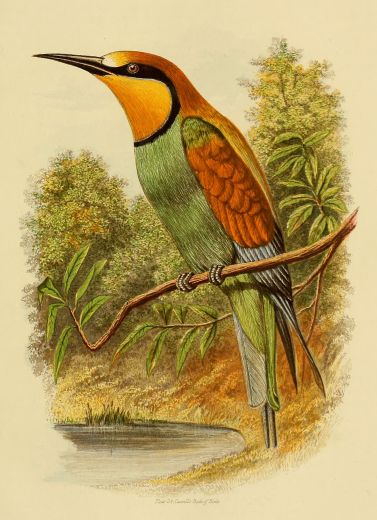
Plate 24. Cassell's Book of Birds
MEROPS APIASTER ____ EUROPEAN BEE-EATER
(over three quarters Nat. size) (Swainson)
[See larger version]
All the members of this group occupy forests, where they live either alone or in pairs; but rarely associating even in small parties, and still more rarely venturing near the dwelling-place of man. Like the Jacamars, these birds are remarkable for their indolence, and the quietude of their manner of life, as they obtain their insect-prey without even leaving the branch on which they are perched. The eggs of some species are deposited in holes excavated by the parents; but, beyond this fact, we are without particulars as to their mode of incubation.
The SLEEPERS (Nystalus) possess a powerful, straight beak—almost as long as the large, thick head—compressed at its sides, and slightly hooked at the projecting upper mandible. The short, thick foot and backs of the toes (the latter not placed in pairs) are covered with large, smooth scales; the wings are short and slender, the tail of medium length, and composed of narrow feathers of almost equal size, if we except the short exterior pair.
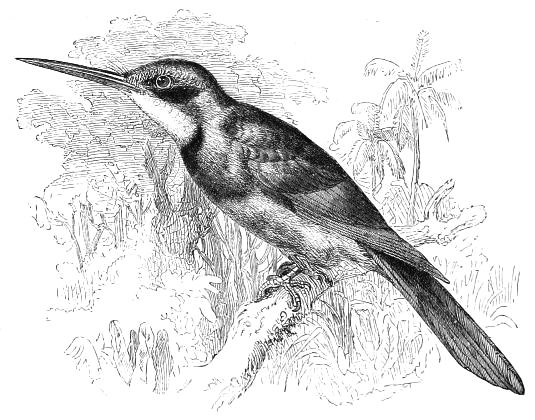
THE GREEN JACAMAR (Galbula viridis).
THE TSCHAKURU.
The TSCHAKURU (Nystalus Chacuru) is of a reddish brown on the top of the head, back, and wings, striped with a blackish shade, the under side is white, a band around the head and the broad cheek-stripes are pure white, the region of the cheek is black, the quills greyish brown, those at the exterior edged and spotted with rust-red; the blackish brown tail-feathers are marked with small, yellowish red spots at the edge. The eye is chestnut-brown, the beak dull cinnabar-red, with deep yellowish base, and greyish black culmen and tip; the foot is greyish brown. This species is eight (according to Ratterer nine) inches and a half long, and eleven inches and three-quarters broad; the wing measures three inches, and the tail two inches and three-quarters.
The Tschakuru frequents tracts covered with a slight growth of trees or bushes; on these it may be seen perching for hours together, perfectly undisturbed by the close observation of the traveller, and is frequently only roused from its state of apparent lethargy by violently shaking the surrounding branches. Insects constitute its means of subsistence, and these are obtained either whilst perching or at a few paces from its favourite seat. Azara informs us that the name of Tschakuru is supposed by the natives to represent its cry; but neither the Prince von Wied nor Burmeister ever heard it utter a sound. According to the latter, the numerous white eggs that form a brood are deposited in the hole of a tree.
The TRAPPISTS (Monasta) are distinguishable from the above groups by their small, slightly-curved beak, with thin, delicate tip, slender legs, long, pointed wings, and moderate-sized tail, formed of narrow feathers. The plumage is soft, and somewhat woolly in texture; the eye is surrounded by a bare circle.
THE DUSKY TRAPPIST, OR BEARDED CUCKOO.
The DUSKY TRAPPIST, or BEARDED CUCKOO (Monasta fusca), is dark brown on the head and back, and yellowish grey on the under side; the lower throat is embellished by a long, pure white crescent, a broad, black band beneath; the quills and tail-feathers are dark greyish brown, the former edged with rust-red on the outer web. The eye is reddish, the beak and foot black. The young are of a paler hue, and the crescent on the breast is shaded with yellow. The length of the body is seven inches and two-thirds, and its breadth twelve inches; the wing measures three inches and one-third, and the tail three inches and one-sixth.
This bird, we learn from the Prince von Wied, is one of the commonest inhabitants of the Brazilian forests. In the neighbourhood of Rio de Janeiro it is also very frequently seen quietly perching beneath a shady bush close to dwelling-houses, or hopping over the ground in pursuit of insects. The "João Doido," or Stupid Jack, as this bird is called by the natives, presents a most striking appearance as he sits perfectly motionless, with his white head thrown into strong relief by the dark foliage, his wide-open eyes alone indicating that he is not in a profound sleep. We are without particulars respecting the incubation of this species. Insects of various kinds compose its food; we found the remains of a butterfly in the stomach of a specimen we examined.
The DREAMERS (Chelidoptera) are distinguished from the Bearded Cuckoos by their short tail and compact plumage.
THE DARK DREAMER.
The DARK DREAMER (Chelidoptera tenebrosa) is of a slaty-black, shaded with blue. The belly is reddish yellow, and the rump white; the eye is dark brown, the beak black, and the foot grey. The length of this bird is eight and the breadth fourteen inches; the wing measures four inches and a half, and the tail two inches.
The Prince von Wied met with this bird in the bushes about Lagoa Santa, and describes it as quiet and solitary in its habits, passing the greatest part of the day in perching almost motionless upon the topmost twigs, and scarcely rousing from its state of drowsy apathy even when approached within a few paces of its resting-place. Occasionally it descends to the ground, but usually obtains its food by capturing such of the winged inhabitants of the air as venture close to its perch, seizing them after the manner of a Flycatcher, and at once returning to its perch. This species is called the "Wood Swallow" by the Brazilians, on account of its somewhat resembling a Swallow both in form and colour, and this resemblance is also noticeable in its peculiar gait. As regards its nidification, the Prince von Wied informs us that in the forests of Botokuden, near the Rio Grande del Belmont, he observed one of these birds enter a hole in a perpendicular sandbank, and, on digging to the depth of a couple of feet, obtained two white eggs, which were laid on a thin stratum of feathers.
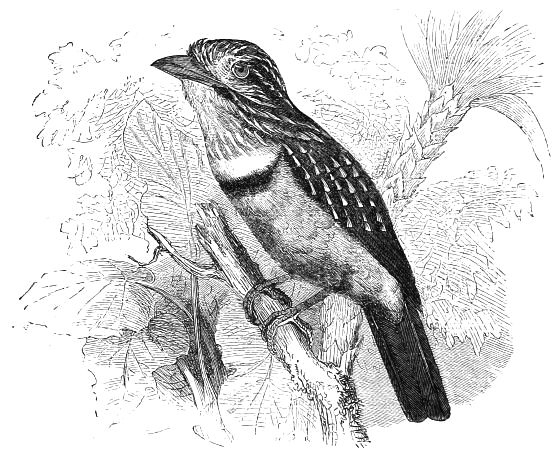
THE DUSKY TRAPPIST, OR BEARDED CUCKOO (Monasta fusca).
The TOURACOS, or TROGONS (Trogones), constitute a numerous group of equally dreamy, but gloriously plumaged birds, inhabiting the tropical zones of both hemispheres. All have a slender, but very thickly-feathered body, short, broad, triangular, and much-curved beak, with a hook at its tip, and occasionally incised at its margins. The small, slender legs are almost entirely covered with feathers; the toes, the innermost of which turns backwards, thus pairing with the hinder toe, are short; the small, much-rounded wings are composed of narrow, stiff-shafted, sickle-shaped quills, pointed at their extremity; the long tail contains twelve feathers; of these, the three outermost are much shorter than the rest. The lax, downy plumage is resplendent with metallic lustre; and the base of the beak covered with a bristle-like growth. The various members of this group are alike remarkable for their dull, indolent disposition, and spend their lives in lazily droning upon the branches of their favourite trees, only rousing themselves to take a short flight in pursuit of a passing insect. Their food principally consists of various kinds of insects, fruit, seeds, or portions of plants; while some appear to be entirely restricted to vegetable diet. Holes in trees are used as receptacles for the eggs, which are from two to four in number, round in shape, with a very light or white shell.
The FIRE TOURACOS (Harpactes), a group of these birds inhabiting Southern Asia, are recognisable by their powerful, much-curved, and smooth-margined beak, their partially-feathered feet, short wings, and long, graduated tail.
THE KARNA, OR MALABAR TROGON.
The KARNA, or MALABAR TROGON (Harpactes fasciatus), a well-known species, is of a chestnut-brown on the upper portion of the body, and black on the head and throat; the feathers of the wing-covers are striped black and white, while the breast and entire under side are of a vivid scarlet; the black throat is divided from the breast by a narrow white band; a line from the back of the eyes to the head is bright red, and a bare patch round the eye of a blueish shade; the centre tail-feathers are reddish brown, and those at the exterior black and white; the eye is dark brown, the beak deep blue, and the foot of a purplish hue. The female is without the black upon the head; her upper secondary quills and the feathers on the wing-covers are black and brown, and her entire under side ochre-yellow. The length of this species is twelve and its breadth sixteen inches; the wing measures five and the tail six inches.
The Malabar Trogon, as we learn from Jerdon, "is found in the forests of Malabar, from the extreme south to about seventeen degrees north latitude, reaching up the Ghâts and hill ranges at least 3,000 feet. It is also found in some of the forests of Central India and in Ceylon. It, however, usually prefers the more elevated situations, at about 2,000 feet or so, and keeps generally to the thickest parts of the wood. It is often to be seen seated motionless on a tree, occasionally flying off to capture an insect on the wing, sometimes returning to the same perch, but oftener taking up a fresh position, and in this way wandering about a good deal. It is usually solitary, sometimes in pairs, and I have seen four or five together. Its food consists of insects, chiefly coleopterous. I am not aware of having heard its note, and certainly have found it generally a silent bird. Trikell, however, says it has a wild, querulous note, like the mewing of a cat. Its Hindustani name is given from its sitting with the head sunk into its shoulders, as if it had no head, or as if dressed in a faquir's kufui."
The FLOWER TOURACOS (Hapaloderma) are distinguished from the above birds by the incised margins of their beaks, and the slenderness of the short, exterior tail-feathers.
THE NARINA.
The NARINA (Hapaloderma narina), the only species of this group with which we are at present acquainted, is of a magnificent golden green on the entire mantle, centre tail-feathers, and throat; the lower breast and belly are deep rose-red, the large wing-covers grey, striped with black, the quills black, with white shafts, and the small wing-covers beautiful golden green; the exterior tail-feathers are white on the outer and blackish on the inner web. In the plumage of the female all these shades are duller than in that of her mate; her brow and throat are brownish red, and her tail-feathers brownish black.
Le Vaillant first discovered the Narina in the extensive forests of Caffraria, Rüppell met with it near the Abyssinian coast, Heuglin at Fossokel and on the White River, and Du Chaillu on the shores of the Zambesi; we, ourselves, were only once lucky enough to see this beautiful bird, and that was a few miles from the coast of the Red Sea. We learn from Jules Verreaux that in Southern Africa the Narina principally frequents the mighty forests east of the Cape of Good Hope. In these retreats it leads a solitary and very sedentary life, only rousing itself to activity morning and evening, in order to procure food. So peculiar is the deportment of this bird as to render its identity quite unmistakable, as it sits bolt upright, with tail hanging negligently down, and head drawn closely in. Its flight is hovering and almost noiseless. During the period of incubation it utters a wailing, resonant cry, which frequently deceives the traveller as to its whereabouts, for the bird possesses the power of ventriloquism to a remarkable degree. Its food consists principally of beetles and flies. According to Le Vaillant, the Narina deposits four round, white eggs in a hollow tree; while Verreaux states that the young are hatched in twenty days, and remain for a considerable time under parental care after they are fully fledged.
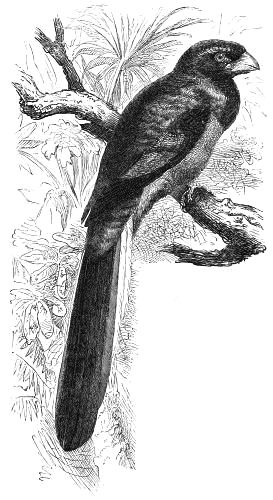
THE NARINA (Hapaloderma narina).
The TROGONS PROPER (Trogon) constitute an American group, recognisable by their broad, high beak, the upper mandible of which is much vaulted, slightly hooked at its extremity, and incised at the margins. The wings are short and blunt, the graduated tail of moderate length, and the plumage lax, soft, and composed of broad feathers.
THE SURUKUA, OR TOURACO.
The SURUKUA, or TOURACO (Trogon Suracua), is a magnificent bird, ten inches and a quarter long, and fourteen and a half broad; the wing measures four inches and a half, and the tail three inches and one-third. The male is blueish black on the head and throat, the back is green, the belly blood-red. The back, throat, and head-feathers gleam with metallic lustre, the feathers on the wing-covers are marked with delicate, undulating lines of black and white, and are edged with white; the centre tail-feathers are blue tipped with black. The next in order are black with a blueish green on the outer web, whilst the fourth and fifth on each side are white at the tip, and the outermost white on the entire exterior web. The eye is deep red, the bare eyelid orange, the beak whitish, and the foot greyish black. The upper part of the female's body is grey, and her under side rose-red.
The Surukua inhabits the primitive forests of Southern Brazil and Northern Paraguay, and passes its life in a state of the utmost inanition, remaining motionless for hours together, upon a branch, and scarcely rousing sufficiently to turn its head at the sight of a passing insect; so complete is this condition of dreamy indolence, that Azara assures us one of these birds may be struck down from its perch with a stick. The flight of this species is soft and owl-like. The eggs are deposited in holes excavated in such nests of the termite as are situated upon trees. Azara mentions having seen a Surukua hanging like a Woodpecker from the moss, as it hollowed out a cavity with its beak, his mate meanwhile remaining quietly perched upon a neighbouring branch, and apparently stimulating her mate to renewed exertions by her gestures and glances; at this period, the constantly-repeated cry of the male resembles the syllables "pio, pio." The eggs, two to four in number, and of a white colour, are laid in September. The flesh of the Surukua is excellent.
THE POMPEO.
The POMPEO (Trogon viridis) is of a splendid steel-blue, shimmering with green on the crown of the head, nape, sides of the throat, and upper breast; the back, shoulders, and upper wing-covers are of a metallic green, shading into blue on the rump; the belly and vent are bright, deep yellow. The exterior feathers of the wing-covers and the quills are black, the latter edged with white; the centre tail-feathers are green, bordered with black towards the extremity. The next in order are black with a green edge; the three outermost are white at the tip and on the exterior web. In the female the back is deep grey, the belly pale yellow, and the feathers of the wing-covers delicately striped with white. The eyes of both sexes are brown, the beak pale greenish white, and foot blackish grey. This species is twelve inches and three-quarters long, and eighteen inches and a half broad; the wing measures five inches and three-quarters, and the tail five inches and one-third.
The Pompeo is commonly met with in the forests of North Brazil and Guiana; and, according to the Prince von Wied, is most numerous in the plantations near the coast, where its short, monotonous cry is to be heard in all directions. The habits of this species closely resemble those of the Surukua. We are told, on the authority of Schomburghk, that the Pompeo consumes seeds and fruit, as well as insects, and that the nest, which is supported upon thin branches or twigs, is very similar to that of the Wild Pigeon; but for the accuracy of this latter statement we cannot vouch. The capture of these birds, which are usually met with in pairs or small parties, is attended with but little difficulty, as they are quite fearless of men; the Brazilians, we are told, are constantly in the habit of obtaining a meal at their expense by an imitation of their call-note, which at once brings down the unsuspecting victim, and thus affords the hunter or traveller an appetising repast.
THE TOCOLORO.
The TOCOLORO (Prionotelus temnurus), a species inhabiting Cuba, differs from all its congeners in the remarkable formation of its graduated tail, the feathers of which become gradually broader towards the tip, where the web takes the form of a crescent. The top of the head, nape, back, and upper breast are pale grey, and the belly a rich cinnabar-red; the quills are brown, striped with white, the feathers of the large wing-covers steel-blue, shaded with white. The centre tail-feathers are of a deep metallic green, the next in order blueish green, and the three outermost tipped with white. The eye is of a brilliant reddish yellow, the foot blackish brown, and the beak deep brown, with bright red lower mandible. The length of the body is ten inches, and the span of the wings fifteen inches, the wings and tail each measure five inches.
The Tocoloro is common in some parts of Cuba, and in its habits closely resembles the members of the group already mentioned. D'Orbigny describes its cry as resembling the syllables "to-corr," long drawn out, the first note being shrill and powerful, while the second is deep and low. Flowers, fruit, and seeds appear to constitute its principal means of subsistence. The period of incubation takes place in April, May, and June; the nest is usually made in holes in trees, those excavated by the Woodpecker being preferred. The eggs are round, pure white, and from three to four in number.
The BEAUTIFUL-TAILED TROGONS (Calurus), as the largest members of this family are called, are at once recognisable by their comparatively broad, flat head and shallow beak, which is compressed and very decidedly-hooked at its tip. The plumage of the wings and tail is remarkably developed, and of great beauty.
THE PEACOCK TROGON.
The PEACOCK TROGON (Trogon calurus) has the central tail-feathers of great length. The feathers of the head, throat, upper breast, and wing-covers are of a bright, metallic green, and gleam with a copper-red and violet lustre; the lower breast, belly, rump, and thighs are purplish red; the inner side of the wings, the quills, and tail are black. The eye is a dull, carmine-red, and the bare patch that surrounds it dark grey; the beak is deep red, tipped and edged with yellow, and the foot brown and yellow. The female resembles her mate, but is somewhat less bright in hue. The length of this bird is fourteen inches and a quarter, and its breadth twenty-two inches and a half. The wing measures seven inches and a quarter, and the tail seven inches; the centre tail-feathers exceed the rest by six inches and a half. Spix first discovered this bird at Rio Negro.
THE BEAUTIFUL TROGON.
The BEAUTIFUL TROGON (Calurus Pharomacrus or C. antisianus)—(See Coloured Plate XXV.)—is recognisable from the Peacock Trogon by a bunch of hair-like feathers on the region of the beak, and by the inferior length of the long feathers on the wing and tail. The coloration of the plumage is almost identical, except that the tail-feathers are quite white underneath, and the beak of a yellowish shade. The body is fourteen inches long; the wing measures seven inches and a half, and the tail six inches and a half. D'Orbigny discovered this bird in Bolivia, where it frequents the vicinity of the rivers.
THE QUESAL, OR RESPLENDENT TROGON.
The QUESAL, or RESPLENDENT TROGON (Calurus paradiseus, or C. resplendens), the most magnificent of all these beautiful birds, is adorned with a helmet-like crest, and possesses a most extraordinary development of the feathers on the shoulders, which droop over the wings and tail. The mantle and upper breast are of a brilliant, golden green. The under side is bright carmine-red. The eye is deep nut-brown, the eyelid black, the beak yellow, with a brownish base; the foot brownish yellow. The female has a smaller crest, and the long feathers in her tail scarcely exceed the other tail-feathers in length. In both sexes the head, throat, and upper breast are dark green; the back, shoulders, and upper tail-covers light green; and the lower breast and belly greyish brown. The rump is bright red, the centre tail-feathers are black, those at the exterior white, marked with black. The length of the body is sixteen inches; the wing measures eight inches and one-third, and the tail eight inches and a half. The longest feathers in the male bird's tail exceed the rest by twenty-five inches.
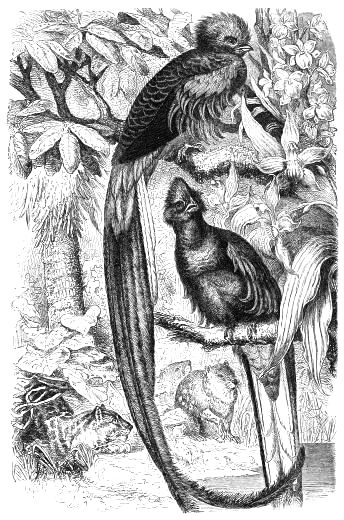
QUESALS, OR RESPLENDENT TROGONS (Calurus paradiseus, or C. resplendens).
The Quesal inhabits Mexico and Central America; and, according to Salvia, is met with in all such woods and forests as are at a height of about 6,000 feet above the level of the sea. In these situations it leads a quiet and dreamy existence, perching lazily in the trees, and scarcely exerting itself to do more than slowly turn its head from side to side, or raise and waft its graceful, drooping plumes. Only in the air, however, is the beauty of the Quesal seen in its full perfection; and as it floats rapidly but gently along, with feathery train outspread, those who have witnessed its elegant movements will admit that amongst all the inhabitants of the Western Hemisphere it is without a rival. The voice of this bird is capable of producing a great variety of sounds; the principal note, however, is a piping tone, which commences softly, and gradually swells into a loud but not unpleasing cry. Fruit and insects appear to form its principal means of subsistence. We learn from Owen that he found a Quesal's eggs deposited in a hollow tree, about six feet from the ground. Salvia is of opinion that the male does not assist in the work of incubation.
THE CUCKOOS.
THE CUCKOOS (Cuculidæ) constitute a very numerous family, characterised by a slender body, wings of moderate length, a long, graduated tail, composed of from eight to twelve feathers, a slightly-curved, short, or medium-sized beak, with sharp margins, and comparatively long, powerful feet furnished with short toes. The coloration of the plumage is too various to admit of any general description.
The HONEY GUIDES (Indicator) are a group of the above birds recognisable by their comparative compactness of build, long wings, short tail, and strong beak. The beak, which does not equal the head in length, is almost straight, and compressed at its hooked tip; the small powerful legs have the tarsi shorter than the outermost of the strong toes; the long and pointed wing, in which the third quill exceeds the rest in length, is usually of considerable breadth; the tail, composed of twelve feathers, is rounded at its sides, and slightly incised at its centre. The plumage is thick and smooth.
The members of this family are for the most part of African origin, only two species being met with elsewhere, namely, in Southern Asia. Everywhere the Honey Guides occupy woodland districts, and live either in pairs or small flocks, which fill the air with their loud and pleasing cries, as they flutter from tree to tree. According to Heuglin, the most peculiar characteristic of these birds is their strange habit of endeavouring to attract the attention either of man or of some of their formidable four-footed neighbours, whenever they have the luck to discover an attractive object, such as a piece of carrion, teeming with a rich supply of insects, or a swarm of bees busy at their work. They are particularly fond of honey, though they frequently pay dearly for their venturesome attempts to rob the combs, being often stung to death by the angry swarm. When this fate attends a marauder, the bees cover the body with a vault of wax, and thus prevent any annoyance from its presence. The flight of the Honey Guides is heavy, and only capable of being sustained for a short distance, but they run upon the trunks and branches of trees with the utmost facility. Like the Cuckoo, the members of this group build no nest, but introduce their eggs into that of some Woodpecker or Oriole.
THE WHITE-BEAKED HONEY GUIDE.
The WHITE-BEAKED HONEY GUIDE (Indicator albirostris) is greyish brown on the mantle, and whitish grey on the under side. The throat is black; the region of the ear undivided, and indicated by a greyish white spot; a portion of the shoulder-feathers is streaked with black; the quills are greyish brown, the wing-covers broadly edged with white, and the shoulders enlivened by a yellow patch; the centre tail-feathers are brown, the next in order brown on the outer and white on the inner web, whilst those at the exterior are white tipped with brown. The body is yellowish white, and the foot brown. The body is six inches and a half in length; the wing measures four inches and a half, and the tail two inches and a half.
This species, which is met with from Southern Africa to sixteen degrees north latitude, subsists almost entirely upon wild honey, and has obtained its name from the fact that it frequently materially assists the natives in their search for the combs by flying before them and constantly uttering its sharp, peculiar cry. In the African deserts it is heard morning and evening, and is eagerly listened for by the natives, who at once reply to it, and hasten to the spot indicated. No sooner does the bird perceive that its summons is responded to than it perches upon the tree that contains the desired hive, and, should its human assistant not hurry fast enough to satisfy its impatience, flies backwards and forwards until the exact spot has been plainly pointed out. During the time occupied by the native in rifling the hive, the Honey Guide remains perched in the vicinity, waiting for the share of the spoil, which the grateful Hottentot never fails to grant it. This remarkable habit is of great service to the poor natives, who regard these birds with especial favour, and are much incensed if they are wantonly killed. According to Hartlaub, the female deposits her one glossy white egg upon the bare ground, and when she has succeeded in finding a strange nest into which it can be introduced, bears it thither, having previously ejected one of the owner's eggs in order to make room for her own offspring. Verreaux informs us that the mother resumes the care of her young in about a month's time, compelling it to leave its foster-parents.
The CUCKOOS (Cuculus) are characterised by a slightly-curved, thin beak, which is broad at its base, and almost equals the head in length; the long wings, in which the third quill is longer than the rest, are narrow and pointed; the long tail, composed of ten feathers, is either wedge-shaped or rounded at its extremity. The short or moderate-sized feet have the toes placed in pairs; the thick plumage is very similarly coloured in the two sexes, but the young differ considerably in appearance from the adult birds.
The members of this family are spread over the whole of the Eastern Hemisphere and New Holland, being particularly numerous in Africa and India, while the more northern portions possess but one species. All, without exception, are inhabitants of the woods, and rarely leave the shelter of their favourite trees, except during the period of migration, or when, as with the more southern species, they are wandering for a short season over the face of the country. In disposition they are timorous, restless, and extremely averse to associate with other birds, indeed, they frequently avoid the society of their own congeners. Their life may be described as an incessant and noisy search for food, in pursuit of which they hurry rapidly from tree to tree and place to place. Insects and larvæ afford them their principal means of subsistence, and hairy caterpillars (avoided by most other birds) are with them favourite tid-bits—the hairs from the bodies of these caterpillars adhere to the coats of the Cuckoo's stomach, and become, as it were, embedded by the process of digestion. Many also consume small reptiles. Some species prepare suitable receptacles for their young; but the greater number deposit their eggs in the nests of other birds.
THE COMMON CUCKOO.
The COMMON CUCKOO (Cuculus canorus) represents a group possessing a slender body, a small, weak, slightly-curved beak, long, pointed wings, a long, rounded tail, short, partially-feathered feet, and plumage of a sombre hue. The male is deep ash-grey, or greyish blue, on the mantle, and greyish white, marked with black, on the under side; the neck, cheeks, throat, and the sides of the neck, as far down as the breast, are pure ash-grey; the quills of the wings leaden black, and those of the tail black, spotted with white. The eye is of a bright yellow; the beak black, but yellowish towards its base; and the foot yellow. The female resembles the male, but has scarcely perceptible reddish stripes on the back and under side of the neck. The length of the male is fourteen inches; breadth twenty-four and a half; length of wing, nine inches; length of tail, seven and three-quarter inches. The female is about an inch shorter.
This Cuckoo frequents almost every part of Europe, Asia, and Africa, and breeds in all northern portions of the Eastern Hemisphere; it only visits India, China, Java, the Sundainu Islands, and South-western Africa in the course of its migrations. In England it usually appears about the middle of April.
The Common Cuckoo may be regarded as the most flighty, restless, and lively member of this sprightly family; from morning till night he is constantly on the move, and is as hungry as he is active and clamorous. His flight is light, elegant, somewhat resembling that of a Falcon; but no sooner has his journey come to an end, than he alights on a thick branch of the nearest tree, and at once begins to look about him in search of food. Should an attractive morsel be in sight, he swoops upon it in an instant, and having caught and devoured it, by a stroke or two of his powerful wings he again returns to the branch he has just quitted, or else flies off to a neighbouring tree, immediately to repeat the same performance. It is, however, only in his powers of flight that the Cuckoo is eminently gifted; he walks upon the ground with difficulty, and is quite unable to climb. In spring-time he is indefatigable in making heard his well-known notes, "Cuckoo, cuckoo," which occasionally he will change to a softly-uttered "Quawawa," or "Haghaghaghag," while the voice of the female somewhat resembles a peculiar laugh or gentle twitter, but poorly represented by the syllables "Kwikwikwik." It was well-known, even to ancient writers, that the female Cuckoo, instead of building a nest for the reception of her progeny, lays her eggs in the nests of other birds, to whom she altogether entrusts the rearing of her young ones.
"The Cuckoo," says Aristotle, "deputes the incubation of her eggs and the nurture of the young ones to which they give birth to the bird in whose nest the eggs happen to be laid. The foster-father, as we are told, throws his own offspring out of their nest and leaves them to die of hunger, while he devotes himself entirely to providing for the young Cuckoo. Others say that he kills his own nestlings to feed the young intruder with their bodies, the young Cuckoo being so beautiful that even the mother who owns the nest despises and sacrifices her own brood on his behalf. Narrators, however, are not quite agreed as to who is the real destroyer of the young birds; some say that it is the old Cuckoo who comes back again to eat the little family of the too hospitable pair, while others assert that it is the young Cuckoo who casts out of the nest all his foster brothers and sisters, leaving them to die of starvation, while others again declare that the young Cuckoo, being the strongest, kills and devours all the rest."
"In thus providing for his children," continues Aristotle, "the Cuckoo does quite right, for he knows what a coward he is, and that he would never be able to defend them; indeed, so cowardly is he that all the little birds amuse themselves by pinching and pecking at him."
It will be at once evident that in the above account of the habits of the Cuckoo there is a great deal of truth, although much that is surmised is devoid of foundation. The main facts that have been established by trustworthy observation relative to the breeding of the Cuckoo are in themselves sufficiently curious, and have no need of fictitious circumstances to make them interesting. They may be briefly stated as follows:—The female Cuckoo undoubtedly deposits her eggs in the nest of some other bird, not of any particular species, but of several; indeed, upwards of fifty have been enumerated as entitled to the honour of rearing the young Cuckoos. Secondly, it has been observed that the eggs of the Cuckoo differ remarkably from each other; indeed, more so than is the case in any other known species; and, moreover, that a Cuckoo's egg taken from the nest in which it has been placed is found strikingly to resemble the eggs laid by the owner of the nest. Thirdly, the Cuckoo only lays a single egg in the selected spot, and this is invariably deposited in a nest already containing eggs belonging to its proper owner.
The behaviour of the females while thus employed in laying their eggs is peculiar. No sooner do these birds arrive in the early spring than the males begin to make the woods resound with their well-known call, where they are soon joined by their mates, of whose coyness under the circumstances they can have little cause for complaint, and as soon as the female has an egg ready for laying, away she flies in search of a nest in which to deposit her burden. On these expeditions she is not accompanied by the male Cuckoo, with whose company, indeed, she seems by no means desirous of being troubled. Her search after a suitable nest is always made on the wing, and her cleverness in finding the object of her journey, however well it may seem to be hidden from observation, is at least remarkable. Quite contrary to her usual shyness, at such times she will unhesitatingly approach quite close to human habitations, and even enter buildings, such as barns and outhouses. If the shape and situation of the discovered nest is such as to allow her to do so, she places herself upon it and lays an egg, but if such is not the case she lays her egg upon the ground, and then taking it in her beak drops it into the nest. Sometimes it happens that she has considerable difficulty in introducing her egg into the nest, owing to the smallness of the aperture, and occasionally the bird has been captured during her endeavours to overcome the difficulty. Sometimes it has happened that two Cuckoos' eggs, of different colours, have been found in the same nest.
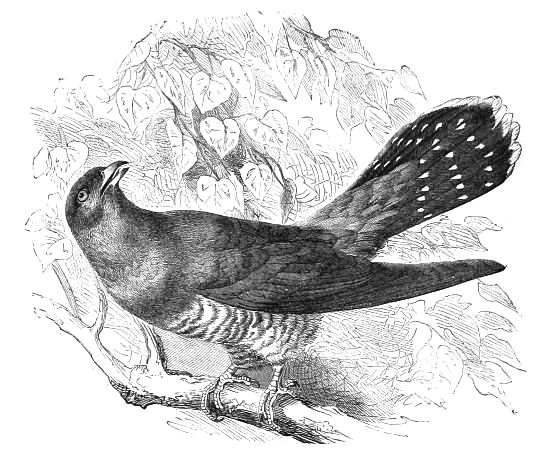
THE CUCKOO (Cuculus canorus).
"It is wonderful to observe," says Bechstein, "what great apparent delight the birds show when they see a female Cuckoo approach their abode. Instead of leaving their eggs, as they do when disturbed by the approach of other animals, they seem quite beside themselves for joy. The little Wren, for example, when brooding over its own eggs, immediately quits its nest on the approach of the Cuckoo, as though to make room to enable her to lay her egg more commodiously. Meanwhile she hops round her with such expressions of delight that her husband at length joins her, and both seem lavish in their thanks for the honour which the great bird confers upon them by selecting their nest for its own use."
Although the above extract sounds very well, with all deference to Herr Bechstein, we are compelled to say that it is unfortunately not true. All the birds that we have seen who have had the very doubtful honour of having a Cuckoo's egg palmed upon them as their own, have seemed to testify in a striking manner their anguish at the threatened occurrence and their unmistakable desire to drive the Cuckoo away. So far from coming as a welcome visitor, the mother Cuckoo comes like a thief in the night; and no sooner has she laid her egg than she hastily takes her departure, as if quite conscious of the unfriendly character of her visit. However this may be, there is no doubt that the foster-parents brood over the Cuckoo's egg with the same assiduity as over their own; and it is only when the eggs of both are hatched that the real character of the intruder begins to show itself, doubtless to the great terror and dismay of the proper owners of the nest.
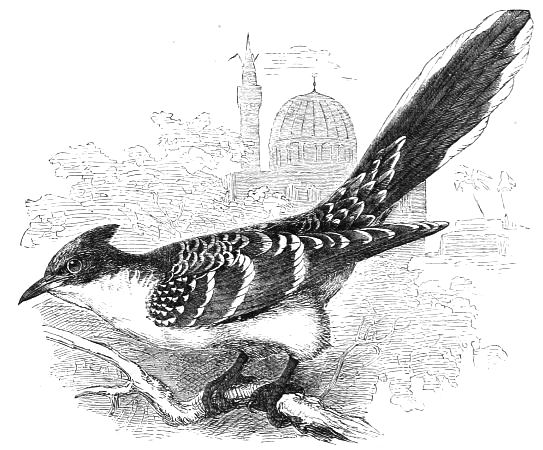
THE JAY CUCKOO (Coccystes glandarius).
"Two Cuckoos and a Hedge Sparrow," writes Dr. Jenner, "were hatched in the same nest this morning. In a few hours after, a combat began between the Cuckoos for the possession of the nest, which continued undetermined until the next afternoon, when one of them, which was somewhat superior in size, turned out the other, together with the young Hedge Sparrow and an unhatched egg. This contest was very remarkable. The combatants alternately appeared to have the advantage, as each carried the other several times to the top of the nest, and then sank down again, oppressed by the weight of its burden, till at length, after various efforts, the strongest prevailed, and was afterwards brought up by the pair of Hedge Sparrows."
"It is wonderful," continues Dr. Jenner, "to see the extraordinary exertions of the young Cuckoo when it is two or three days old, if a bird be put into the nest with it that is too weighty for it to lift out. In this state it seems ever restless and uneasy; but this disposition for throwing out its companions seems to decline from that time till it is about twelve days old, when, as far as I have seen, it ceases entirely. Indeed, the disposition for throwing out eggs appears to cease a few days sooner, for I have frequently seen the young Cuckoo, after it had been hatched nine or ten days, remove a nestling that had been placed in the nest with it, while it suffered an egg, put there at the same time, to remain unmolested. The singularity of its shape is well adapted to these purposes, for, unlike other newly-hatched birds, its back, from the shoulders downwards, is very broad, with a considerable depression in the middle. This depression seems formed by Nature for the design of giving a more secure lodgment to an egg or a young bird, when the Cuckoo is employed in removing either of them from the nest. When it is twelve days old, this cavity is quite filled up, and then the back assumes the shape of nestling birds in general."
The JAY CUCKOOS (Coccystes) are recognisable by their elongate body; thick, broad, curved beak, which is compressed at its sides and almost equals the head in length; strong and comparatively long and partially-feathered feet; moderate-sized wing, in which the fourth quill is the longest; and long, conical tail, composed of narrow feathers, the outermost of which are only half the length of those in the centre. The smooth plumage takes the form of a crest upon the head, and is similarly coloured in both sexes. This group is almost peculiar to the African continent.
THE JAY CUCKOO.
The JAY CUCKOO (Coccystes glandarius) is deep grey on the head, greyish brown on the back, and greyish white on the under side. The throat and upper breast are reddish yellow; and the feathers on the wing-covers and the secondary quills have broad, triangular, white spots at their tips; the eye is deep brown, the beak purplish grey, and the foot greyish green. This species is about fifteen inches long; the wing measures eight, and the tail eight and a half inches.
The Jay Cuckoo is very numerously met with in some parts of Africa, and from thence wanders forth into Europe, appearing occasionally in Greece and Italy. It is often known to breed in Spain. Such of these birds as inhabit Egypt principally frequent the small groups of mimosa that abound in the valley of the Nile, and live in pairs or small parties, according to our own observation, remaining together even during the breeding season. Like its European brother, this species is of a restless and violent temperament, engaging constantly in fierce strife with its male companions during the period of incubation. Its flight is rapid, and so skilful as to enable the bird to penetrate the densest thickets without a moment's hesitation. It rarely descends to the ground, but obtains the insects and caterpillars on which it subsists either while on the wing or when perching among the branches. Its voice, which somewhat resembles that of a Jay, can be heard at a considerable distance, and has a laughing but monotonous sound. The female, like the rest of her congeners, deposits her eggs in another bird's nest. Baedecker describes the egg as of a light blueish green, spotted with grey or brown, and dotted all over with reddish brown; at the broad end the spots take the form of a wreath. In form the eggs are similar to those of other Cuckoos, but in size resemble those of the Jay.
The KOELS (Eudynamys), a small group of Cuckoos inhabiting Southern Asia and Oceania, possess a strong, thick beak, the upper mandible of which is much curved, and hooked at its tip, while the lower portion of the bill is nearly straight. Their feet are strong, their wings of moderate size, the tail long and rounded; the soft plumage is of very uniform hue, that of the male being usually black, and that of the female black spotted with white.
THE KOEL, OR KUIL.
The KOEL, or KUIL (Eudynamys orientalis), is the best known member of the above group. The male is entirely of a glossy greenish black, while the female is of a rich, deep green, spotted with white above, and striped with white on the quills and tail. The under side is white, with black oval markings on the throat, and heart-shaped spots upon the breast. The eye of both is scarlet, the beak pale green, and foot greyish blue. The length of the male is thirteen inches and a half, and the breadth twenty-three inches; while the female measures seventeen inches and a half, and is twenty-four inches across the wings.
"This well-known species," writes Jerdon, "is found throughout India, extending to Ceylon, the Burmese countries, and parts of Malayana, to the Philippines. It frequents groves, gardens, avenues, and open jungles; and feeds almost exclusively, I believe, on fruits of various kinds, especially on those of the banian, peepul, and other figs, also, says Blyth, much on that of the Mimasops elengi. Several of these birds may be often seen on one tree, but they are not gregarious. Mr. Blyth states that they eject from the mouth the large seeds of any fruit that they have eaten. The Koel is by no means a shy bird, but has the usual quick, unobtrusive habits of the ordinary Cuckoos, as it glides about the branches of trees; when it takes wing, however, it is remarkable for the loudness of its cries. About the breeding season the Koel is very noisy, and may then be heard at all times, even during the night, frequently uttering its well-known cry, of 'Ku-il, ku-il,' increasing in vigour and intensity of utterance as it goes on. The male bird has also another note, which Blyth syllables as 'Ho-whee-ho,' or 'Ho-y-o.' When it takes flight it has yet another somewhat melodious and rich liquid call, all thoroughly Cuculine. The female Koel deposits her eggs almost exclusively in the nest of the Common Crow (Corvus culminatus). She generally lays only one egg in each nest, and mostly, but not always, destroys the eggs of the proprietor at the time of depositing her own. It is a popular belief that the Crow discovers the imposture when the young Koel is nearly full grown, and ejects it from her abode; but this I do not think is usually if ever the case, for I have frequently seen Crows feeding the young Koels, even after they have left the nest in which she has placed her eggs, and when the birds are fully grown entices them away, or, if expelled, looks after them and feeds them for a few days, but I greatly doubt if this be the general practice." The egg of the Koel is pale olive-green, with numerous reddish, dusky spots, having a tendency to form a zone at the broad end. The Crows would appear to be desirous of avenging the wrongs they receive from these Cuckoos, for at times we see them pursuing the Koel with the utmost energy. Mr. Frith, as quoted by Blyth, states that one dashed itself against a window and was killed when thus hunted by a Crow. The flight of the Koel is not so quiet and gliding as that of the True Cuckoos, but is performed with more numerous strokes with the wing.
The GOLDEN CUCKOOS (Chrysococcyx), as a most gorgeous group have been appropriately called, inhabit the equatorial regions of Asia, Africa, and Australia. These birds are distinguished by their comparatively small, slender body, long wings, and tail. The beak, which is of medium size, exactly resembles that of the Common Cuckoo; the tarsi are short, and the toes long; the wing is pointed, the tail rounded at its sides, and the compact, large-feathered plumage dyed with hues of more than metallic brilliancy.
THE DIDRIK, OR GOLDEN CUCKOO.
The DIDRIK, or GOLDEN CUCKOO (Chrysococcyx auratus), is of a dazzling metallic green, shaded with copper-red over the entire mantle, the glowing effect being heightened by a blueish effulgence at the tips of some of the feathers. A white stripe passes behind the eye, and the brow is decorated with a white spot; the entire under side is light brownish or yellowish white, of so delicate a shade that exposure to the sun's rays soon renders it almost white. The feathers on the sides, tail, and lower wing-covers are greenish; the secondaries, exterior primaries, and outer tail-feathers deep green, striped with white; the eye is deep yellowish brown (during the breeding season that of the male is deep red), the eyelid coral-red, the beak deep blue, and the foot light greyish blue. The male is seven inches and a half long, and twelve inches and three-quarters across; the wing measures four inches and one-sixth, and the tail three inches and a quarter. The female has a spotted under side, and is somewhat smaller and less gorgeous than her mate. In the young birds the lower parts of the body are shaded with yellow, the breast and throat of a metallic green, the feathers on the back edged and the quills spotted with reddish yellow.
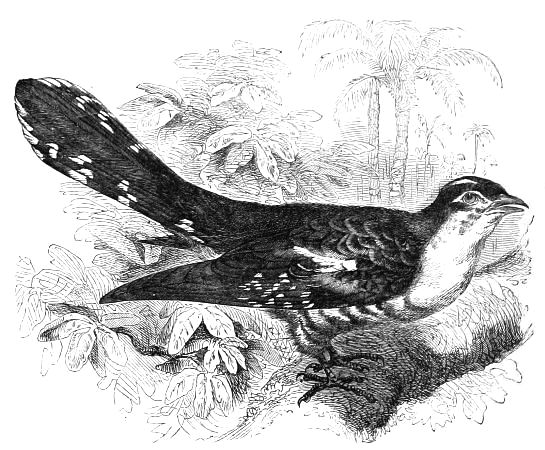
THE DIDRIK, OR GOLDEN CUCKOO (Chrysococcyx auratus).
According to Le Vaillant, the Didrik is numerously met with throughout Southern Africa, where it inhabits the primitive forests, and frequents the loftiest and most densely foliaged trees. Heuglin, who observed this species near the White and Black Nile and in Abyssinia, tells us that it often associates in small parties, and occasionally ventures down upon the trees and hedges that surround the villages, making itself very conspicuous by its loud, flute-like, piping cry and pugnacious propensities. The snow-white eggs of the Golden Cuckoo are always deposited in the nest of another bird.
The GIANT CUCKOOS (Scythrops), a group comprising the largest of all Cuckoos, have derived their name from the formation of their beak, which resembles that of the Toucans, being nearly as long as their head, thick, strong, broad at its base, compressed at its sides, and hooked at the tip. The tarsi are short, and toes powerful; the wing, in which the third quill is the longest, extends almost to the middle of the comparatively short, rounded tail; the latter is formed of ten feathers. The plumage somewhat resembles that of the Common Cuckoo in its coloration; the cheek-stripes and region of the eyes are bare.
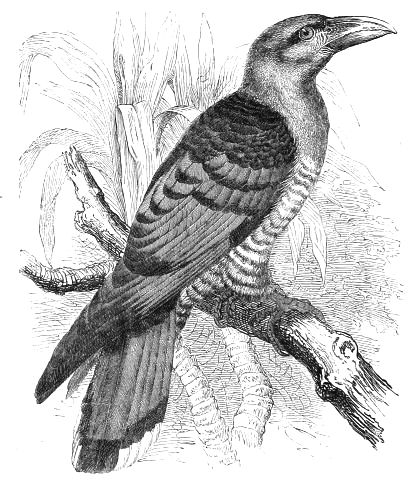
THE GIANT CUCKOO, OR CHANNEL-BILL (Scythrops Novæ Hollandiæ).
THE GIANT CUCKOO, OR CHANNEL-BILL.
The GIANT CUCKOO, or CHANNEL-BILL (Scythrops Novæ Hollandiæ), the only species with which we are acquainted, is grey upon the head, throat, and breast; the mantle, wings, and tail are greenish grey, each feather tipped with blackish brown; the hinder parts are indistinctly striped with greyish brown; the tail-feathers deep grey, the four outermost tipped with white, and decorated with a broad, black stripe, besides other more delicate lines. The eye is brown, the bare patch by which it is surrounded light scarlet, the beak yellowish grey, and the foot olive-brown. The female is somewhat smaller than her mate. The latter exceeds two feet in length; the wing measures thirteen, and the tail ten inches.
The Channel-bill, according to Gould, is a migratory bird in New South Wales, arriving in October and departing again in January; whither it proceeds is not known.
"This bird," says Latham, "is generally seen in the morning and evening, sometimes in small parties of seven or eight, but more often in pairs. Both on the wing and when perched, it makes a loud, screaming noise when a Hawk or other bird of prey is in sight. In the crop and gizzard the seeds of the red-gum and peppermint trees have been found; it is supposed that these are swallowed whole, as the pericarp, or capsule, has been also found in the stomach; exuviæ of beetles have also been seen, but not in any quantity. The tail, which is of nearly the length of the body, is occasionally displayed like a fan, and gives the bird a majestic air. The natives seem to know but little of its habits and haunts; they consider its appearance as an indication of blowing weather, and that its frightful scream is produced by fear. It is not very easily tamed, for Mr. White informs us that he kept one alive for two days, during which time it would eat nothing, but bit at every one who approached it very severely. The habits of this species are probably parasitic, for a young bird given me by Lady Dowling was one of two taken from a branch while being fed by birds not of its own species. The eggs I have seen were of a light stone-colour, marked all over, particularly at the broad end, with irregular patches of reddish brown; many of these were of a darker hue, and appeared as if beneath the surface of the shell."
A young Scythrops introduced into Dr. Bennett's aviary was, he tells us, "placed in a compartment already occupied by a Dacelo gigantea, or Laughing Kingfisher. Doubtless feeling hungry after its journey, it immediately opened its mouth to be fed, when its wants were regularly attended to by the Dacelo, which, with great kindness, took a piece of meat, and, after sufficiently preparing it by beating it about till it was in a tender state, placed it carefully in the gaping mouth of the young Scythrops. This feeding process was continued until the bird was capable of attending to its own wants. In the morning it used to perch on the most elevated resting-place in the aviary, occasionally raising itself, flapping its wings, and then quietly settle down again, after the manner of Hawks when in confinement, and presenting much the appearance of that tribe of birds."
THE BUSH CUCKOOS (Phœnicophæï) possess a slender body, long tail, and small tarsi; the wings are short, the beak of moderate size and very powerful; the region of the eye is bare, and the magnificently tinted plumage of a hairy texture. These birds occupy India and the neighbouring islands, one species alone being met with in Africa. We are, unfortunately, but little acquainted with their habits, and as yet have only ascertained that they frequent the inmost recesses of the forests, and subsist upon insects.
THE KOKIL, OR LARGE, GREEN-BILLED MALKOHA.
The KOKIL, or LARGE, GREEN-BILLED MALKOHA (Zanclostomus tristis), an Indian species, is recognisable by its compressed and curved beak, moderate-sized feet, short toes armed with sharp claws, small, rounded wings, and a long graduated tail; the mantle is deep greyish green, the head and nape of a pure grey; the quills and tail are shaded with green, the feathers of the latter tipped with white; the throat and upper breast are pale grey, the lower breast and an outer circle around the eye white; the eye is deep brown, and the bare line by which it is surrounded a rich scarlet; the beak is apple-green, and foot greenish grey. This species is twenty-three inches long, the wing measures six inches, and the tail sixteen inches and three-quarters.
"This handsome bird," says Jerdon, "is found in Lower Bengal, Central India, and the Northern Circars; also in the warmer valleys of the Himalayas. It extends to Assam, Burmah, and Malacca, where it is very abundant. I have usually seen it solitary, wandering about in the forests, and eating large insects—mantides, crickets, grasshoppers, and also large caterpillars. In Sikim it is only found in the warmer valleys, at a height of about 3,000 feet. The eggs brought to me at Darjeeling were two in number, pure white, and of a long oval form. I did not see the nest, but was told it was a large mass of stick and roots. I took a similar egg from the oviduct of a female I shot. Mr. Blyth remarks that the presence of the Malkoha is often betrayed by its voice, which is a low monosyllabic chuck, often repeated, and delivered commonly when the bird is perched on a tree."
The RAIN CUCKOOS (Coccygi), a family inhabiting America, possess a comparatively powerful body, short wings, and a long tail, composed of twelve feathers; the beak is strong, and the feet in some species so well developed as to enable these birds to run with ease upon the ground. The plumage, which is remarkable for the softness of its texture, is almost alike in the two sexes. The female is somewhat longer than her mate. The members of this family are met with in all parts of America, being especially numerous in the southern portion of that continent. In their habits they much resemble their representatives in the Eastern Hemisphere, and like them lead a retired life in forests and well-wooded districts, subsisting upon insects, hairy caterpillars, and the eggs of their small feathered companions. Unlike the groups already described, these Cuckoos build a nest for the reception of their young, and rarely deposit their eggs in another bird's abode.
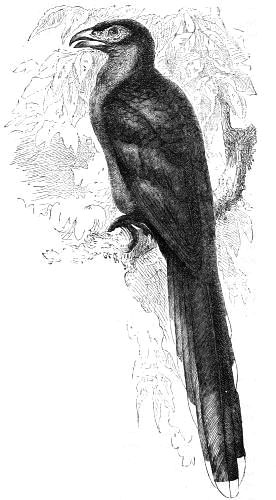
THE KOKIL, OR LARGE GREEN-BILLED MALKOHA (Zanclostomus tristis).
THE RAIN OR YELLOW-BILLED CUCKOO.
The RAIN or YELLOW-BILLED CUCKOO (Coccygus Americanus) represents a group of the above birds characterised by their thin, delicate, compressed, and pointed beak, which is slightly curved, and almost equals the head in length. The feet are short, and wings long. The long graduated tail is composed of ten slender feathers. The plumage of the Rain Cuckoo is entirely of a light greyish brown above, and greyish white on the under side. The exterior quills are bordered with brownish orange, the tail-feathers black, tipped with white, the eye is deep brown, the upper mandible brownish black, and lower one of a yellow shade; the feet are blueish grey. This bird is twelve inches and a half in length; the wing measures five inches and a half, and the tail six inches and three-quarters.
"A stranger who visits the United States," says Wilson, "and passes through our woods in the month of May or June, will sometimes hear, as he traverses the borders of deep, retired, high-timbered hollows, an uncouth guttural sound or note, resembling the syllables 'kowe, kowe,' beginning very slowly, but ending so rapidly that the notes seem to run into each other. He will hear this frequently without being able to discover the bird or animal from which it proceeds, as it is both shy and solitary, always seeking the thickest foliage for concealment. This is produced by the Yellow-billed Cuckoo, which, from its cry, is known in Virginia as the Cow Bird. It is also called the Rain Crow, being observed to be most clamorous immediately before rain."
"The flight of this species," Audubon tells us, "is rapid, silent, and horizontal, as it moves from one tree to another, or across a field or river, and is generally continued amongst the branches of the trees in our woods. When making its way among the boughs, it occasionally inclines the body to either side, so as alternately to show its whole upper or under parts. During its southward migrations, it flies high in the air, and in such loose flocks that the birds seem to follow each other, instead of keeping together. On the other hand, the males arrive singly; the males coming first, and the females a few weeks after. They do not fly in a continued line, but in a broad front. This bird is not abundant anywhere, and yet is found very far north. I have met with it in all the low grounds and damp places in Massachusetts, along the line of Upper Canada, pretty high on the Mississippi and Arkansas, and in every State between these boundary lines. Its appearance in the State of New York takes place before the beginning of May, and at Green Bay not before the middle of that month. A pair here and there seem to appropriate certain tracts to themselves, where they rear their young in peace and plenty. The Yellow-billed Cuckoos feed on insects, such as caterpillars and butterflies, as well as on berries of various kinds, evincing a special predilection for the mulberry. In autumn they eat many grapes, and I have seen them supporting themselves by a momentary action of their wings opposite a bunch, selecting the ripest, when they would seize it and return to a branch, repeating their visits in this manner till satiated. They will also now and then descend to the ground to pick up a wood-snail or a beetle. They are extremely awkward at walking, and move in an ambling manner, or limp along sideways, a clumsiness for which their short legs are an ample excuse. They are seldom seen perched conspicuously on a twig; but, on the contrary, are generally to be found among the thickest boughs and foliage, where they emit their notes until late in the autumn, after which they are discontinued. The nest is simple, composed of a few dry sticks and grass, formed much like that of the Common Dove, and like it fastened to a horizontal branch, often within the reach of man. The bird would appear to make no particular selection as to situation or the nature of the tree, but settles anywhere indiscriminately. The eggs are four or five, of an oval form, and of a bright green colour. Only one brood is reared in the season, unless the first is removed or destroyed. According to Brewer the female commences sitting as soon as her first egg is deposited, it being no uncommon occurrence to find fresh-laid eggs and others containing almost fully developed young in the same nest. At first the young are principally fed on insects. Towards autumn they become very fat, and are fit for being eaten; few people, however, shoot them for the table, excepting the Creoles of Louisiana."
THE RAIN BIRD.
The RAIN BIRD (Saurothera vetula) is remarkable for the very peculiar formation of its long, thin beak, which is almost straight, compressed at its edges, and hooked at its tip. The tarsi are short and slender, the toes long and meagre; the wings, in which the fourth, fifth, and sixth quills are the longest, are of moderate size; and the long, graduated tail is composed of ten rounded feathers. The plumage upon the entire mantle is dark grey, and the under side reddish yellow, shading into light grey on the breast, and into yellowish grey on the lower part of the belly. The ten exterior quills are light brownish red, tipped with greenish brown; the centre tail-feathers are grey, shaded with green; while those on each side are blackish brown, tipped with white. The eye is nut-brown, and the circle by which it is surrounded light scarlet; the beak is blackish, and foot blueish black. The length of this bird is fifteen inches and a half, and its breadth fourteen inches. The wing measures four inches and a half, and its tail six inches and a quarter.
We are informed by Mr. Gosse that "the Rain Bird—sometimes called the 'Tom Fool,' from its silly habit of gratifying its curiosity instead of securing its safety—is little seen except where the woods are high; but it is widely scattered in mountain as well as in lowland. This species is seldom seen to fly, except from tree to tree, more usually leaping in a hurried manner along the branches, or proceeding up the perpendicular bole by short jumps, pausing from time to time to gaze at any intruder, and if driven away flying only a few yards and again peeping as before. When it flies, it generally glides nearly in a straight line, without flapping the wings. It often sits on a branch in a remarkable posture; the head lower than the feet, and the long tail hanging nearly perpendicularly down. When sitting it now and then utters a loud and harsh cackle, unvarying in note, but increasing in the rapidity of its emission. Sometimes this sound is produced during its short flight. All the time of this effusion the beak is held wide open. It may be imitated by repeating the syllables 'ticky, ticky, ticky,' as fast as they can be uttered. The Rain Bird is frequently seen on the ground in morasses and woods, when it proceeds by a succession of bounds, the long tail held somewhat high, and the head low; the tail is jerked forward by the impulse of each pause of motion, and the whole action is like that of the Crotophaga. If held it becomes very fierce, trying with widely-opened beak and expanded tail, to bite, and uttering angry screams. A male that had been knocked down with a stone, on being put into a cage, was outrageous when one's hand was placed near the wires; darting from side to side, now and then snapping at the hand, and snarling all the while, in the tone of an angry puppy. This bird is extremely retentive of life. Sometimes, when a wounded one has come into my possession, I have been distressed at the vain efforts I have made to deprive it of life. In various individuals that I have opened, I found large caterpillars, locusts, phasmata, spiders, phryni-spiders, and, upon one occasion, a whole mouse. Robinson found in one a large green anolis, six inches long, coiled up in a spiral manner, the head being in the centre. He states that it bruises the heads of lizards, and then swallows them head foremost. Mr. Hill kept a Rain Bird for several weeks. It seized cockroaches and other insects when put into its box, and ate fresh meat if chopped small. I have been able to ascertain nothing of the nest, except what the following note may afford:—A young friend informs me that he once observed a Rain Bird carrying 'trash' into the hollow or fork of the divergent limbs of a logwood-tree. Some little while after, passing that way, he observed a nest-like accumulation of similar substances; but as it was beyond reach, he took a long stick to poke it out. In doing so, he pushed out an egg, which was white, with many spots. 'When pairing,' observes Mr. Hill, 'the male bird attracts the female by gracefully displaying his feathers. The long, graduated tail is expanded, the short wings are spread, and the whole plumage is in motion, as the male endeavours, by playful dalliance, to win his mate's attention.'"
The LONG-TAILED CUCKOOS (Pyrrhococcyx) possess a comparatively slender body, and an elongate, slightly-arched, and hooked beak. The legs are strong, the tarsi slender, and the toes of medium size. The wings, in which the fifth quill exceeds the rest in length, are long. The long tail is composed of ten feathers, slightly rounded at their extremities. The plumage is thick, and unusually downy.
THE LONG-TAILED CUCKOO.
The LONG-TAILED CUCKOO (Pyrrhococcyx Cayanus), a well-known member of the above group, is of a light reddish brown over the mantle, and from the breast downwards of a deep grey; the tail-feathers are dark reddish brown above, and black beneath, with white tips. The length of this species is from eighteen to twenty-two inches, according to the size of the tail; the span of the pinions is seventeen inches, their length from five inches and a half to six inches and a half, and the tail from ten to fourteen inches.
This Cuckoo, according to Burmeister, is spread over all the warm portions of America; and in Brazil, where it is very common, comes constantly down into the fields and gardens. Its flight, despite the shortness of the wings, is free and easy; its disposition brisk and active; and its call-note an oft-repeated, penetrating cry. These birds usually live in pairs, but frequently associate in parties while in pursuit of their insect prey. We have no reliable information as to the breeding of this species.
The TICK-EATERS (Crotophagæ), a small but remarkable family, inhabiting Southern and Central America, possess a slender body and very decidedly arched beak, powerful feet, with the toes placed in pairs, moderate-sized wings, and a long, broad, rounded tail, composed of eight feathers. The thick, small-feathered plumage is of sombre hue, and takes the form of bristles in the region of the beak; the cheek-stripes and region of the eyes are bare.
"These birds," says Brown, in his "History of Jamaica," "prefer cultivated places, and more especially land in the neighbourhood of pastures or low shrubberies and swamps. They easily make their way amongst the thickest foliage or grass, by means of their sharp-edged bills, with which they scatter the herbage on each side, in search of grasshoppers and other insects. They have been seen on the dead carcase of a sheep, but whether attracted by the flesh or by the larvæ of insects is uncertain. In the daytime they often associate in flocks of twenty or thirty individuals near small rivulets, seeking for tadpoles, which they greedily devour. At other times they may be seen flying from shrub to shrub, uttering their peculiar note. They live chiefly upon ticks and other small vermin, and constantly jump about cows and oxen in the fields, and the cattle will frequently lie down to benefit by their good offices, if much infested by ticks; but if the beast appear heedless of their proffered attentions, they hop once or twice around it, looking it very earnestly in the face every time they pass, as if they knew it was only necessary for them to be seen to be indulged. They are very noisy birds, and very common in all the pastures of Jamaica. The nests of the Tick-eaters are built in the fork of a tree, or in a bush covered with mistletoe, and made rudely of some coarse materials, chiefly small sticks, totally destitute of any soft lining. The eggs are from five to seven or more in number. The young evince much activity in hopping from branch to branch; long before they are able to fly they leave their nests, and may be seen perched on the top of a shrub or thicket of vines, in company with a congregation of adult birds. When the parents escape from an intruder by taking flight, the young, by long and rapid leaps, reach the ground, and run off very quickly."
The TRUE TICK-EATERS (Crotophaga) have a slender body, small head, short wings, long tail, and high tarsi. The high, much-raised beak is sharp at its margin, and very decidedly hooked at its tip. The outer toe of the high, powerful foot is twice as long as the innermost, whilst the toe that turns backwards is of equal size with the real hinder toe.
THE COROYA.
The COROYA (Crotophaga major) is about the size of a Jay, but more slender, and possessed of a far stronger beak; the latter is longer than the head, and slightly hooked at its extremity; the sides of the bill are not so compressed as in other species; the feathers on the head and nape are very long and pointed, while those on the breast are very broad. The plumage is of a deep steel-blue, shading into violet on the tail and on the breast. The eye is bright light green, its iris surrounded by a narrow circle of yellow; the beak and bare skin about the eye are black, and the feet blackish brown. This species is eighteen inches and two-thirds long, and twenty-two inches and a quarter broad; the wing measures seven inches and two-thirds, and the tail nine inches and five-sixths. The female is not quite so large.
THE ANI, OR SAVANNA BLACKBIRD.
The ANI, or SAVANNA BLACKBIRD (Crotophaga ani), is scarcely larger than the Common Cuckoo. The beak of this bird equals the head in length, and the raised portion of the bill extends over the whole of the upper mandible, which terminates in a decided hook. The entire plumage is blueish black, the feathers on the fore part of the body being enlivened by a violet gloss. The eye is grey, the beak and feet black. The length is thirteen inches and a half, and breadth fifteen inches and a half; the wing measures five inches, and the tail six inches and two-thirds.
"In all open places, particularly savannas which are occupied by cattle or horses," says Gosse, "these birds are seen all day long and all the year round. Familiar and impudent, though very wary, they permit a considerable acquaintance with their manœuvres, while an approach within a limited distance in a moment sets the whole flock upon the wing, with a singular cry, which the negroes please to express by the words 'going awa-a-y,' but which may as well be described, according to the fancy of the hearer, as 'how d'ye,' or 'ani.' The appearance of the bird in its gliding flight is unusual, as in flying it assumes a perfectly straight form, with the long tail in the same line, without flapping the wing, so that it takes the aspect, on a side view, rather of a fish than of a bird. The food of this species, though consisting entirely of insects, is not confined to them; the stomach is usually distended with caterpillars, moths, grasshoppers, and beetles to such a degree that it is wonderful how the mass can have been forced in. I have found these contents mixed up with and stained by the berries of the snake-withe, and in July I have found the stomach crammed with the berries of the fiddle-wood (Cytharaxylon), which had stained the whole inner surface bright crimson. Flocks of these birds were at that time feeding on the glowing clusters, profusely ripe, upon the trees. Stationary insects are their staple food; to obtain these they hop about grassy places, and are often seen to jump or run eagerly after their prey, on which occasions the long tail, continuing the given motion after the body has stopped, is thrown forward in an odd manner, sometimes nearly turning the bird head over heels. It is probably to protect the eyes from the stalks of weeds and blades of grass, in these headlong leaps, that the projecting brows are furnished with a row of very short but stiff bristles; but what purpose was served by the thin and high knife-blade of a beak I was ignorant till informed by Mr. Hill that it enables the bird to open out the soft earth and seek for its insect food; it also facilitates its access to the vermin imbedded in the long hair of animals." "I am assured," he adds, "that if a patch of cow's dung be examined after Crotophagæ have been searching for the larvæ of insects, it will be found furrowed, as if a miniature plough had passed through it. The name of Crotophaga (Tick-eater) is no misnomer, as has been asserted by some who never saw the living bird; almost every one in Jamaica is aware that the Savanna Blackbird feeds on the parasites of cattle. Stationary insects are, however, by no means the only prey of the Crotophaga. In December I have seen little groups of them engaged in the evenings leaping up from the pasture about a yard into the air, after flying insects, which they seemed to catch. Upon one occasion I saw that one of these birds had actually made prey of one of our little nimble lizards (Anolis). Though its usual mode of progression on the ground is by hopping, or rather bounding, the feet being lifted together, this Blackbird is seen to run in a headlong manner for a short distance, moving the feet alternately. He is fond of basking in the morning sun, or in a low tree, with the wings expanded, remaining perfectly still for a considerable time. In the heat of the day, in July and August, many may be seen in the lowland plains, sitting on the fences and logwood hedges, with their beaks wide open, as if gasping for air; at these times they forget their usual loquacity and wariness. Often two or three will perch in the centre of a thick bush overhung with a matted drapery of convolvulus, whence they utter their singular cry, in a calling tone, as if they were playing at hide-and-seek, and requesting their fellows to come and find them. The statement that this Blackbird builds in company, forming an immense nest of basket-work by the united labours of the flock, is universally maintained by the inhabitants of the colony. This nest is said to be usually placed in a high tree, where many parents bring forth and educate a common family. Mr. Hill, whose statements on Jamaican ornithology are worthy of unlimited confidence, observes, 'Some half-dozen of them together build but one nest, which is large and capacious enough for them to resort to in common and rear their young together. They are extremely attentive to the business of incubation, and never quit the nest while sitting without covering the eggs with leaves, to preserve them at an equal temperature.'" "The only instance I ever met with," continues Gosse, "while not conclusive, is rather in favour of this opinion than opposed to it. In July I found a Blackbird's nest in a Bastard Cedar (Guazuma); it was a rather large mass of interwoven twigs, lined with leaves, eight crimson eggs were in the nest, and the shells of many more broken, and scattered beneath the tree. The eggs were about as large as a pullet's, very regularly oval, of a greenish blue, but covered with a coating of white chalky substance, which was much scratched and eroded on them all, and which was displaced with but little force."
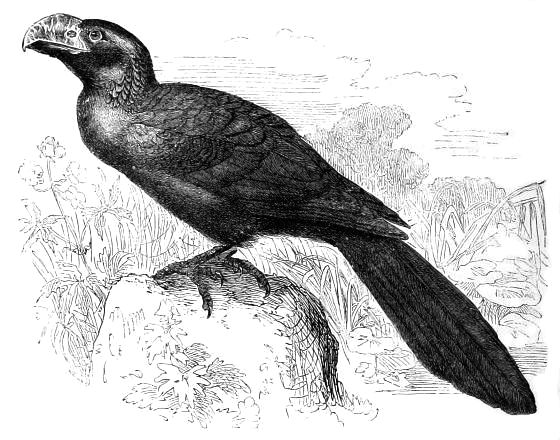
THE ANI, OR SAVANNA BLACKBIRD (Crotophaga ani).
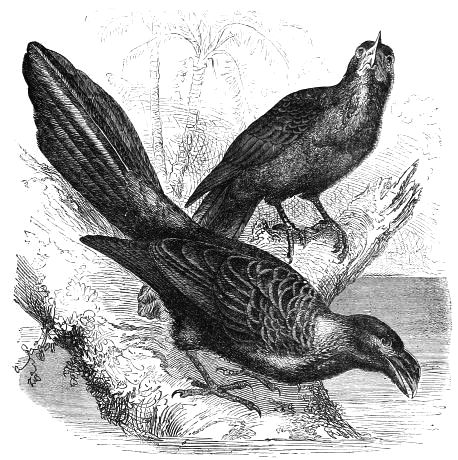
THE WRINKLED-BEAKED TICK-EATER (Crotophaga rugirostris).
The WRINKLED-BEAKED TICK-EATER
The WRINKLED-BEAKED TICK-EATER (Crotophaga rugirostris) is somewhat larger than the Ani; its beak is also longer, and covered with four or five wrinkles or ridges. The plumage is of a dull blueish black; the feathers on the head, throat, and upper breast are edged with violet, and those of the back and belly bordered with a rich metallic green. The eye is greyish brown, the beak and feet are black. This species is fourteen inches long, the wing measures six, and the tail seven inches.
The COUCALS, or SPURRED CUCKOOS (Centropodes), a family of strange birds inhabiting Africa, the East Indies, New Holland, and the Malay Islands, possess a very powerful, short, and much-curved beak, which is compressed at its sides; the tarsi are high, and toes comparatively short; the hinder toe is usually armed with a very long and almost straight spur-like claw; the wings are short and rounded, and the tail (composed of ten feathers) graduated, and either of moderate size or very long. The extremely harsh plumage is similarly coloured in both sexes; the young differ in a striking manner from their parents, and only acquire the same hues as the adults in the third year.
The Coucals frequent thick brushwood, cane plantations, and pasture land, and penetrate the densest masses of vegetation with surprising dexterity, in pursuit of the scorpions, snakes, lizards, insects, and birds' eggs, upon which they principally subsist. Their powers of flight are so limited as only to be employed in cases of extreme danger. The voice consists of various deep sounds, some of which seem produced by ventriloquism. The nests built by this family are carelessly formed, and placed among bushes or canes, or in long grass; in some instances, however, more care is evident in their construction, the upper portion being provided with a cover, and two entrances made in the side, the one for entrance and the other for egress. The brood consists of from three to five white eggs, which are hatched by the united efforts of both parents. The young, when first produced, are remarkably ugly.
THE EGYPTIAN COUCAL.
The EGYPTIAN COUCAL (Centropus Ægypticus), a species inhabiting Africa, possesses a comparatively short tail, and plumage of a reddish brown tint; the head and nape are black, the back and wings chestnut-brown; the tail-feathers greenish black, bordered with white; and all the lower portions of the body of a fallow-grey. The eye is bright purple, the beak black, and foot deep brownish grey. This species is fourteen inches long and sixteen and a half broad; the wing, in which the sixth quill exceeds the rest in length, is five inches and a half, and the tail seven inches and a half.
The Egyptian Coucal is commonly met with in some parts of Egypt, and is by no means rare in other portions of North-eastern Africa; everywhere it frequents the dense woods and forests, or extensive beds of reeds, penetrating the densest thickets with all the wonderful dexterity of the Mouse Birds. Unlike most members of the family, this species leads an indolent and quiet life, frequently perching motionless at the summit of its bushy fastnesses, or hovering over their surface, while watching for its insect prey. Ants, we are told, it frequently consumes in such quantities as to impart a most revolting odour to its body. Like its congeners, the adult Spurred Cuckoo is always met with in company with its mate; while the young, on the contrary, often lead a solitary life for several years before pairing. The nest found by ourselves in the Delta was placed in the bushy crown of an olive-tree, and almost entirely constructed of the husks of maize; the young contained therein were partially fledged, the time of year being the month of June. We could not succeed in obtaining an egg. This Coucal is but seldom captured by the natives, owing to the impracticable nature of its favourite haunts and the uninviting savour of its flesh. We have but once seen it caught.
The CROW PHEASANTS (Centrococcyx), an Indian group of the above birds, are recognisable by their long, graduated tail, and the black markings on the reddish brown wings.
THE HEDGE CROW.
The HEDGE CROW (Centrococcyx viridis) is of a glossy greenish black on the head, nape, upper tail-covers, tail, and entire under side; the back and quills being nut-brown, the latter tipped with bright red. According to Swinhoe, this bird undergoes three changes of plumage, and is during the first year of a light reddish hue, striped with black on the mantle, and white marked here and there with red on the under side. In the second year the feathers on the mantle are brown, with ochre-yellow lines on the shafts; the tail is blackish green, spotted with a reddish shade; the under side of light brownish yellow, each feather striped and spotted with brown; the quills are red, with brown markings. The eye is red, the beak black, and the foot lead-grey. This species is fifteen inches long, the wing measures six inches and a half, and the tail eight inches.
The Centrococcyx viridis is extensively met with throughout India, and in the surrounding islands. In the former country it principally occupies the jungles, in Java low brushwood, and in Formosa such portions of woods or forests as abound with creeping plants. According to Bernstein, it is quiet and solitary in its habits, keeping principally within the shelter of the bushes, and rarely betraying its presence except by the utterance of its very weak cry, which nearly resembles that of the common European Cuckoo. If alarmed, the bird endeavours to escape by running, instead of flying; and only takes to its wings if very sorely pressed, when it flies direct to the interior of the nearest bush. The nests we have seen were most carelessly constructed of the leaves of the alang-alang, and placed either close to the ground, amongst grass and stubble, or between the branches of a low shrub. The eggs we found were usually two or three in number, and had a white and slightly glossy shell; in some instances two of the eggs were large, while the third was comparatively of very small size. We were unable to ascertain what share the female takes in the duty of incubation, as whenever we watched the nests during the day the male bird was always seated thereon. The nestlings at first present a very ridiculous appearance, as their skin is black, and their back and head covered with stiff, hairy, or, more strictly, bristle-like feathers; add to this that their tongue is bright orange, tipped with black, and it may be imagined that the first sight of a nestful of these gaping youngsters somewhat astonishes an uninitiated observer.
The PHEASANT COUCALS (Polophilus), as the Australian representatives of this family are called, are recognisable by their comparative size, and the formation of their short, thick, strong, and decidedly-curved beak.
THE PHEASANT COUCAL.
The PHEASANT COUCAL (Polophilus phasianus) has the general plumage of a dull black, and the wing-covers fallow-brown and black, each feather being marked with a light line upon the shaft; the quills are chestnut-brown, with a double line of black; and the tail-feathers dark brown, with a greenish gloss, and delicately marked with red spots. All the tail-feathers, except those in the centre, are tipped with white. The eye is red, the beak black, and the foot greyish black. In the young birds the back is reddish brown, and the under side fallow-grey; in other respects the plumage resembles that of the adult birds. This species is twenty-four inches long, the wing ten, and the tail twenty-four inches.
"The greater part of the road-line of New South Wales, and the eastern, northern, and north-eastern portions of Australia," writes Gould, "are generally tenanted by these birds, but only in such situations as are favourable to their habits, namely, swampy places among the brushes, abounding with tall grasses and dense herbage, among which they run with facility, and, when necessity prompts, fly to the lower branches of the trees, from which they ascend in a succession of leaps from branch to branch, until they nearly reach the top, whence they fly off to a neighbouring tree. The most western part of New South Wales in which I have heard of their existence is Illawarra, where they are rare, and from whence to Moreton Bay they gradually increase in numbers. The nest, which is placed in a tuft of grass, is of a large size, composed of dried grasses, and is of a domed form, with two small openings, through one of which the head of the female protrudes while sitting, and her tail through the other. At Port Essington the nest is sometimes placed among the lower leaves of the pandanus, but this occurrence seems to be rare, a large tuft of long grass being most frequently selected, as affording better shelter. The eggs are from three to five in number, of a dirty white hue, and nearly round; in some instances they are stained with brown, and have a rough surface, somewhat like the eggs of the Cormorant."
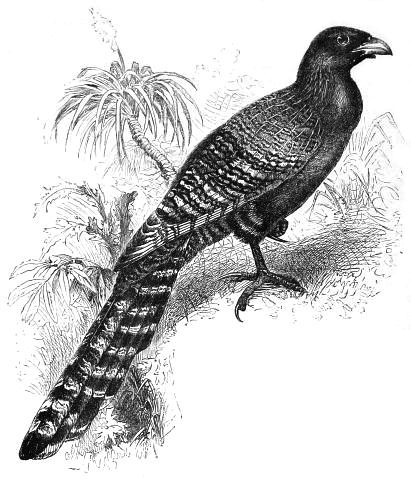
THE PHEASANT COUCAL
(Polophilus phasianus).
The BARBETS (Capitones) possess a strong, conical beak, of moderate size, and much compressed at its tip; short and powerful feet, with the toes placed in pairs; small or medium-sized wings, rounded at their extremity, and a comparatively long tail. The plumage, which is most resplendent, is replaced by bristles in the region of the beak. The members of this family are spread over Asia and Africa, and are brisk and lively birds, associating freely with their congeners, and busily seeking the berries, fruits, and insects, upon which they subsist, from bush to bush and tree to tree, rarely or never descending to the ground. Their flight is rapid, but not sustained to any great distance, owing to the weight of their bodies; almost all have loud, resonant voices, while some species utter something resembling a regular song. The nests of the Barbets are placed in hollow trees, or holes in the ground, but, except this, and the fact that the eggs are white, we are entirely without particulars as to their manner of incubation.
THE PEARL BIRD.
The PEARL BIRD (Trachyphonus margaritatus) represents an African group, possessing a moderate-sized and slender beak, which is slightly arched, and compressed at its tip; the comparatively high feet have the tarsi longer than the centre toe; the fourth quill of the moderately long wing exceeds the rest in length; the tail is of medium length, and rounded at its extremity. The plumage of the back is brown, spotted and marked with white, that of the under side bright glossy yellow, shading into red on the breast; the brow, crown of the head, and, in the male bird, a chain of spots upon the breast, are black; the rump and vent are deep bright red. The eye is dark red, the beak light red, and the foot lead-grey. This species is seven inches long, the wing measures three inches and a half.
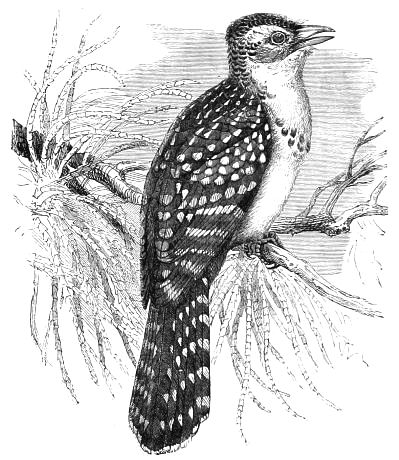
THE PEARL BIRD (Trachyphonus margaritatus).
We have frequently met with these beautiful birds in most parts of North-eastern Africa, where they constantly visit the fields and gardens near the settlements, making themselves particularly conspicuous during the early morning and in the evening, by flying around the tops of the loftiest trees, or by pouring forth their deep but lively notes with an animation that gives the performance almost the effect of a pleasing song. The food of this species consists of seeds, fruit, and insects, in pursuit of which it displays but little skill while climbing about the branches; its flight consists of a hovering, whirring motion, and is seldom long sustained. The oval, pure white eggs obtained by Heuglin, on the 26th of September, were found in holes situated in the side of a bank of earth; in one instance the interior had no lining of any description, and in the other a mere bed of reeds, on which the eggs were deposited. We are unable to state whether these holes are excavated by the parent birds.
THE GOLDEN BARBET.
The GOLDEN BARBET (Xantholæma Indica) represents a group characterised by their short beak, bulging outwards at its sides, slightly-pointed wings, in which the third, fourth, and fifth quills are the longest, and a short, almost straight tail. The plumage of the mantle is green, that of the under side yellow, or greenish white; the feathers on the back and wing-covers are bordered with yellow, and those on the breast striped with green. The brow and a spot on the throat, are glossy scarlet, the latter edged with gold at its lower portion; a band at the nape, the breast, and a stripe upon the chin are black. The eye is deep brown, the beak black, and the foot bright red. The length of this bird is six inches and a half, and its breadth eleven inches; the wing measures three inches and a quarter, and the tail one inch and a half.
"This species of Barbet," writes Jerdon, "is found throughout all India, extending into the Burmese countries, Malayana, Ceylon, and the isles; according to Adams, it is not met with in the Himalayas or in the Punjaub. This bird is very common wherever there is a sufficiency of trees, inhabiting open spaces in the jungles, groves of trees, avenues, and gardens, being very familiar, and approaching close to houses, and not unfrequently perching on the housetop. As far as I have observed, it does not climb like the Woodpecker, but hops about the branches like other perching birds. The Rev. Mr. Philips, however, states that it runs up and down the trees like a Woodpecker, and other observers have asserted that it climbs to its hole; but I confess I have never seen this, and Mr. Blyth is most decidedly of opinion that Barbets never climb. The latter naturalist found that one of these birds which he kept alive would take insects into its mouth and munch them, but swallowed none, and forsook them immediately when fruit was offered. It has a remarkably loud note, which sounds like 'took-took-took,' and this it generally utters when rested at the top of some tree, putting its head at each call first on one side and then on the other. Sundevall states that the call is like a low note on the flute, from the lower G to the second E. This sound, and the motion of the head accompanying it, have given origin to the name 'Coppersmith,' by which this species is known both by natives and Europeans. The sound often appears to come from a different direction to that from which it does really proceed; this appears to me to depend on the direction of the bird's head. Mr. Philips accounts for it by saying that it alters the intensity of its call. Sundervall remarks that 'the same individual always utters the same note, but that two of these birds are seldom heard to make it alike.' When, therefore, two or more individuals are sitting near each other, a not unpleasing music arises from the alternation of the note, each sounding like the tone of a series of bells. The Crimson-breasted Barbet breeds in holes of trees, laying two or more white eggs. A pair bred in my garden at Saugor on the cross-beam of a vinery. The perfectly circular entrance was on the under side of the beam. This nest appeared to me to have been used for several years, and the bird had gone on lengthening the cavity year by year, till the distance from the original entrance was four or five feet; another entrance had then been made, also from below, about two feet and a half from the nest. Quite recently I discovered a nest built by this bird in a hole of a decayed tree-branch, close to a house in a large thoroughfare in Calcutta." The Golden, or Crimson-breasted Barbet, as it is sometimes called, subsists upon the fruit of various plants, but, according to Blyth, has also been known to eat animal food. The eggs are white, and two or more in number.