GALLINACEOUS BIRDS (Gallinæ). (continued 3)
Thomas Rymer Jones translation
The nest is made among stones, or heather and grass. The eggs are yellowish, with brown spots, and are from eight to fourteen in number. The brood is hatched about the middle or end of June, according to the season. The male is said to remain with his mate during the time of incubation, but as soon as the young are hatched he leaves them with their mother and joins his male companions on the upper part of the fjalls, where his family follow him with their mother as soon as they are sufficiently grown; both parents and brood remain together till the approach of winter, when the various families unite in packs. Mr. Lloyd, however, doubts the truth of the generally-believed fact of the partial separation of the male from his family, and thinks that these packs of males may be such as have been unable to obtain mates.
"While the female is sitting," says M. Grouland, "the male always remains in the near vicinity of the nest, to protect her against the attacks of foxes, weasels, and the numerous birds of prey by which she is then often molested. He never separates from her, even after the young are hatched, but accompanies the family everywhere, and evinces the same regard for the mother as for the poults. When meeting a family of Fjall Ripa (the Swedish name for these birds) in the forest, one has an opportunity of witnessing the instinct implanted by Nature in the parents to protect their offspring. Should a person then approach the spot where they are collected, the male, for the purpose of drawing the enemy's attention from them to himself, runs forward to meet him with plaintive cries and outstretched wings, thereby endangering himself to secure the safety of those he holds dearer than life itself."
M. Barth relates that, "When the fowler comes suddenly upon a brood of young Fjall Ripa it is really distressing to see the mother running to and fro before him. Should he remain stationary, her boldness gradually increases, until at length, either from a feeling of her own weakness, or from her fears being dispelled at seeing him make no attempts to injure her, she by degrees retires with the same pitiable mien, and ultimately hides herself behind a bush, waiting for the moment when she may once more venture to call her chicks together. Ofttimes has a female Fjall Ripa approached so near me in the way I have described that I could have killed her with my foot."
The Lagopus Alpinus is pursued by many feathered enemies, and when hard pressed sometimes takes refuge in the hut of the Laplander or among his reindeer. "Of all the genus Tetrao," says Mr. Lloyd, "this species is the least in request in Scandinavia, but if well dressed I have always found it very palatable, and little inferior to the Lagopus albus."
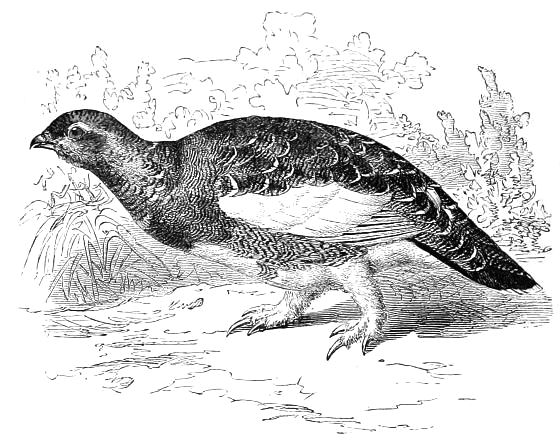
THE ALPINE PTARMIGAN (Lagopus Alpinus), IN SUMMER PLUMAGE. ONE-THIRD NATURAL SIZE.
THE RED GROUSE, BROWN PTARMIGAN, OR GAR COCK.
The RED GROUSE, BROWN PTARMIGAN, or GAR COCK (Lagopus Scoticus), closely resembles the above bird in its general appearance during the summer, but is without the white feathers in the wings, and has the feet covered with plumage of a greyish hue, spotted with brown. The feathers on the head and nape are light reddish brown, spotted with black; those on the back and wing-covers are spotted in the centre with black; the throat-feathers are red, those on the back and belly dark purplish brown, with numerous markings; the quills are dark brown, and the quill-feathers, except the four in its centre (which are striped red and black) are entirely black; the plumage on the legs has a reddish shade and dark markings; the tarsi and toes are covered with whitish feathers. The eye is nut-brown, the beak black, and the powerful claws of a whitish hue. The female is darker than her mate, has white spots on her breast and belly, and some of her wing-feathers tipped with white. This species is fifteen inches long and twenty-six broad; the female is not quite so long.
The Red Grouse is peculiar to Great Britain and Ireland, not having been found in any other part of the world, and is especially abundant in Scotland, inhabiting heathy tracts from the sea-level to a height of 2,000 feet, particularly in the moist peat tracts of the western and northern districts.
"It is pleasant," says Macgillivray, "to hear the bold challenge of the Gar Cock at early dawn on the wild moor, remote from human habitation. I remember with delight the cheering influence of its cry on a cold morning in September, when, wet to the knees and with a sprained ankle, I had passed the night in a peat-bog in the midst of the Grampians, between the sources of the Tummel and the Dee." After expatiating on his misadventures and the reflections to which they gave rise, he continues, "However, morning came at last, and I started up to renew my journey. It was now that I got a view of my lodging, which was an amphitheatre formed of bare craggy hills, covered with fragments of stone and white moss, and separated by patches of peat-bog. Not a house was to be seen, nor a sheep, or so much as a blade of green grass. Not a vestige of life can be found here, thought I; but I was reproved by a cry which startled me. The scarlet crest and bright eye of a Moor Cock were suddenly protruded from a tuft of heather, and I heard with delight the well-known 'kok, kok' of the 'blessed bird,' as the Highlanders call him."
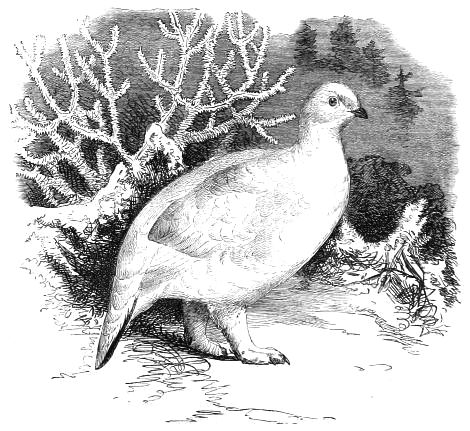
THE ALPINE PTARMIGAN (Lagopus Alpinus), IN WINTER PLUMAGE. ONE-HALF NATURAL SIZE.
"The Brown Ptarmigan," continues our author, "feeds for the most part upon the tops of heath (Calluna vulgaris and Erica cinerea), and also picks the leaves and tender twigs of Vaccinium myrtillus and Empetrum nigrum, with the young heads of Eriophorum vaginatum, shoots of Galium saxatile, Carices, grasses, willows, and other plants. It is also said to eat the berries of Empetrum nigrum, accinium myrtillus, and Vaccinium vitisidæa. In two instances I have found its crop filled with oat-seeds, to which it is said to be very partial, although it rarely ventures upon cultivated land. While feeding, it walks among the heath, selecting the fresh tips of the twigs, which it breaks off nearly of the same size, the largest pieces not exceeding half an inch in length. Along with these substances, fragments of white quartz, from one-twelfth to two-twelfths of an inch in diameter, are found in the crop and gizzard, being introduced for the purpose of aiding the action of the latter in comminuting the food. When the Brown Ptarmigans have filled their crops they repose among the heath or bask under a sunny bank, under the shelter of the shrubs or tufts of herbage. On ordinary occasions this species does not fly much, but keeps concealed among the heath, seldom choosing to rise, unless its enemy comes very near. On the approach of danger it lies close to the ground, when, being of a colour not contrasting strongly with that of the plants around, it is with difficulty perceived by rapacious birds." When traced by a dog, it either runs to some distance or squats at once, and often remains thus concealed for a long time, or again runs and squats. "I have seen them," continues Macgillivray, "run in this manner for four or five hundred yards before they were put up. On such occasions the male is generally the first to rise. He erects himself among the heath, stretches out his neck, utters a loud cackle, and flies off, followed by the female and young, affording by their straightforward, heavy, though strong flight an easy mark to a good shot."
The Red Grouse flies low, heavily, and in a direct course, moving its wings rapidly, sometimes, especially when at full speed, with a whirring sound, and then descending with almost motionless pinions.
"If disturbed when feeding," says Macgillivray, "the male often boldly starts up and utters a loud cackle, which may be imitated by quickly repeating the syllable 'kok' with a deep voice. In spring and summer they are often heard uttering the same sound without being disturbed, either as a call of defiance to their fellows, or as a warning or protection to their mates and young. Early in the morning as well as late in the evening, but occasionally through the day, you may hear on the moors a loud cry, which is easily syllabled into 'Go, go, go, go, go-back, go-back;' although the Celts, naturally imagining the Moor Cock to speak Gaelic, interpret it as signifying, 'Co, co, co, co, mo-claidh, mo-claidh'—that is, 'Who, who (goes there?) my sword! my sword!'" These birds pair early in spring. The nest is made in a hollow of the ground among the heath, and is irregularly formed of bits of twigs, grass, and a few feathers; the eggs, from eight to twelve in number, are oval, and of a yellowish white, yellowish grey, or brownish yellow colour, clouded, blotched, and dotted with blackish and amber brown. The young leave the nest soon after they are hatched, and are tended by both parents, the mother showing much anxiety for her progeny, and endeavouring by affecting lameness to lure any intruder from them. The young are soon able to fly, and all keep together till the end of autumn, when several flocks unite and form a pack, continuing together till spring arrives, when they separate and pair. In the more remote parts of Scotland the Red Grouse is considered a bird of good omen. By its crowing at dawn, the evil spirits of night are thought to be put to flight, or deprived of their power. The flesh of the Red Grouse is dark, and has a peculiar, bitter flavour, but is held in high estimation.
The PARTRIDGES (Perdices), one of the most numerous groups of the order, are comparatively slenderly built birds, with small heads and unfeathered tarsi. The wings, in which the third or fourth quill exceeds the rest in length, are relatively quite as short and rounded, but not so much arched as those of the Tetraones. The tail, composed of from twelve to sixteen feathers, is always short. The somewhat elongated beak is but slightly raised at its culmen, and compressed at its sides. The tarsus is frequently furnished with one, or occasionally with two spurs. The members of this group are without the warty skin above the eyes possessed by the birds above described; in some species, however, bare patches are observable on those parts, and on the throat. The plumage is smooth, and very similarly coloured in both sexes. These birds inhabit all portions of the eastern hemisphere, except its extreme north, and frequent every variety of locality from the coast to a very considerable height on mountain ranges. Some species prefer cultivated lands, while others are found in forests where they may occasionally be seen perched on the branches of trees. Their food consists of insects, grain, and portions of plants. The nest is a mere hole scratched in the dry mould, generally under the shelter of some bush or tuft of grass. The eggs, from twelve to twenty in number, are hatched in three weeks time; the female sits exceedingly close on her nest during this period, especially during the latter part of incubation, and offers a bold resistance to any enemy seeking to plunder her; but if quietly approached, both she and her eggs may be gently removed, and she will hatch them in confinement, departing with her young to the fields as soon as the latter are able to accompany her. The male takes no part in the labour of incubation, but like all birds that pair, he is attentive to his mate, assists her in defending the brood, and uses many arts to lure intruders from the nest. The young are reared on small insects, larvæ, and the eggs of insects; the parents leading them to the places where these are deposited, and scraping away the mould. Multitudes of ants and larvæ are eaten by young Partridges.
The SNOW PARTRIDGES (Tetraogallus) may be regarded as combining the characteristics of both the Ptarmigans and Partridges. Their body is compactly framed, their neck short, the head small, the wing of moderate size, and slightly pointed at the extremity, its second and third quills being longer than the rest. The gently-rounded tail is of medium length; the beak long, broad, and powerful, and the heavy short foot furnished with a blunt spur. The thick plumage is much developed on the tail-covers; a small patch behind the eye is unfeathered.
THE CASPIAN SNOW PARTRIDGE.
The CASPIAN SNOW PARTRIDGE (Tetraogallus Caspius), a member of the above group, inhabiting Persia, is dark grey upon the head, nape, and upper breast; the plumage on the back is varied grey and reddish yellow, and the rest of the under side grey, the shafts of the feathers are streaked longitudinally with reddish yellow. Two dark lines pass from the corners of the lower mandible to the breast. These lines divide three white patches, one on the throat, and one on each side of the face. The feathers on the upper wing-covers are shaded with black and reddish yellow, with a broad red edge at their outer web; the quills are pure white, as are the belly and feathers of the lower tail-covers. The eye is dark brown, the beak pale horn-grey, and the foot reddish yellow. The length is about twenty-four inches.
This species was first described by Gmelin, in 1788-93, in the thirteenth edition of the "Systema Naturæ." Latham, who places it among the true Partridges, says that it inhabits Astrabad, Ghilan, and other parts of Persia.
We are indebted to Mr. Gray, who has made for these birds the separate generic title of Tetraogallus, for the following description of their habits, derived from the St. Petersburg Transactions:—"This species builds on the highest summits of the rocky mountains of the Caucasus. It prefers altogether the region of snow, which it never quits. Thus, when we desired to acclimatise the young chickens of this Partridge in the plains of Kahetia, they have not survived the spring. It runs on the rocks and the ledges of precipices with great agility, and rises with a great cry at the least danger; so that the most skilful sportsman cannot approach within shot except under cover of mists. It lives in societies of from six to ten, becoming the inseparable companion to the goat, on the excrement of which it feeds during the winter months. In autumn it grows very fat, and its flesh resembles that of the Common Partridge. In the crop of this gallinaceous bird I have found a quantity of sand and small stones, mixed with all kinds of seeds of Alpine plants."
The following passage in Layard's "Discoveries in the Ruins of Nineveh and Babylon" seems also to refer to this species:—"A covey of large birds sailed with a rapid swoop, with the whistling sound peculiar to the Partridge kind, from an opposite height, and alighted within a few yards of me. They were the Kabk-i-dered, or the Pur-kak-lik, as they are called by the Turks, a gigantic Partridge, almost the size of a small Turkey, only found in the highest regions of Armenia and Kurdistan."
Prince Charles Bonaparte thought that there was some reason for believing that this species exists on the confines of Europe, and a correspondent of Mr. Gould's observed it among the mountains of Candia, where it was excessively rare, and only to be seen on the peaks of the hills.
In the Zoological Gardens, London, two specimens were received, one in 1842, and another about 1852, both of which lived there for several years.
THE HIMALAYAN SNOW COCK, OR SNOW PHEASANT.
The HIMALAYAN SNOW COCK, or SNOW PHEASANT (Tetraogallus Himalayensis), is grey upon the top of the head, cheeks, and nape. The feathers on the back are of a reddish grey, delicately spotted with black, and streaked with deep reddish brown. The chin, nape, throat, and lower breast are whitish. The upper breast is greyish white, decorated with crescent-shaped black spots. The rest of the feathers are grey, sprinkled with brown, and marked with two brown spots. The sides are paler than the mantle, and the lower covers almost white; the tarsi are dark grey. The eye is surrounded by two brown lines, which unite at the sides of the neck. The primary quills are white, their grey tips spotted with brown. The tail-feathers are of a reddish shade, spotted with black on the outer and grey on the inner web. The eye is deep brown, the bare patch behind it yellow, the beak pale horn-grey, and the foot yellowish red. The male is twenty-nine inches long, and forty broad; the wing measures thirteen, and the tail eight inches. The female does not exceed twenty-four inches in length.
"These fine birds," we learn from Hutton, "are common in the Hazara Mountains, and are called by the Affghans Kank-i-durra, or the Partridge of the Ghâts. They are sometimes sold in the markets of Cabool and Candahar. They rise," he tells us, "in coveys of from ten to twenty, and usually have a sentry perched on some neighbouring rock, to give warning of danger by a low and musical whistle."
The Tetraogallus Himalayensis "is confined," says "Mountaineer," "exclusively to the snowy mountain ranges, or the large spurs jutting from them which are elevated above the limits of forest, but is driven in winter to perform one, and in some places two, annual migrations to the middle regions. In summer it is only seen near the limits of vegetation. In Kunawur it is common at all seasons, from Cheenee upwards; but on the Gangetic hills, from June till August, however much a person wanders about on the highest accessible places, but few are met with, and I have no doubt whatever but that nearly all such as at other seasons frequent this part retire across the snow into Chinese Tartary to breed. About the beginning of September these birds are first seen near the tops of the higher grassy ridges jutting from the snow, and the green slopes above and about the limits of forests. After the first general and severe fall of snow they come down in numbers on to some of the bare exposed hills in the forest regions, and remain there till the end of March. This partial migration is probably made in the night after the fall of snow, as I have invariably found them in their winter quarters early next morning. It requires a deep fall of snow to drive them down, and in some mild winters, except a few odd birds, they do not come at all. The birds on each respective hill seem to have a particular spot for their winter resort, which they return to every year the migration is made. The Snow Pheasant is gregarious, congregating in packs, sometimes to the number of twenty or thirty, but in general not more than from five to ten, several packs inhabiting the same hill. In summer the few which remain on our side are found in single pairs generally; but across the snow, where the great body migrate, I almost always, even then, found several together. They seldom leave the hill on which they are located, but fly backwards and forwards when disturbed.
"The Jer-moonals, as these birds are called in India, never enter forest or jungle, and avoid spots where the grass is long, or where there is underwood of any kind. It is needless to add that they never perch. During the day, if the weather be fine and warm, they sit on the rocks, or rugged part of the hills, without moving much about, except in the morning and evening. When it is cold and cloudy, and in rainy weather, they are very brisk, and are moving about and feeding all day long. When feeding they walk slowly uphill, picking up the tender blades of grass and young shoots of plants, occasionally stopping to snatch up a certain bulbous root of which they seem very fond. If they reach the summit of the hill, after remaining stationary for some time, they fly off to another quarter, alighting some distance down, and again picking their way upwards. When walking, they erect their tails, have a rather ungainly gait, and at a little distance present something the appearance of a large grey Goose. They are partial to feeding on spots where the sheep have been kept at nights when grazing in the summer pastures. These places have been called 'tatters' by the shepherds, and the grass on them keeps green and fresh long after the rest of the hill is dry and brown. They roost on the rocks and shelves of precipices, and return to one spot many successive nights. Their call is a low, soft whistling, occasionally heard at intervals throughout the day, but more generally at daybreak. It is most common in cloudy weather. The first note is considerably prolonged, and followed by a succession of low rapid whistles. This species has by far the most agreeable song of all our game birds. This call is only heard when the bird is at rest. When alarmed and walking away, it sometimes utters, at short intervals, a single low whistle, and when it gets on the wing the whistles are shrill and very rapid. However far it flies, the whistles are continued until it alights, and for a few seconds afterwards, but then slightly changed in tone to a few notes which seem in a strange manner to express satisfaction at being again on the ground. However odd the comparison, I can compare the whistling of these birds, when flying and alighting, to nothing but the different sounds produced by the wings of a flock of Pigeons when flying, and when alighting on some spot where they have to flutter a few seconds before they gain footing."
The Jer-moonals are not remarkably wild or shy. When approached from below, on a person getting within eighty or one hundred yards, they move slowly uphill or slanting across, often turning to look back, and do not go very far unless followed. If approached from above they fly off at once, without walking many yards from the spot. They seldom, in any situation, walk far downhill, and never run, except for a few yards, when about to take wing. The whole flock rise together; their flight is rapid, downwards at first, and then curving, so as to alight on the same level. Where the hill is open and of great extent, it is often continued for upwards of a mile, at a considerable height in the air; when the space is more circumscribed, as is often the case on the hills they frequent in winter, it is of shorter duration, perhaps merely across or into the next ridge. "They feed on the leaves of plants and grass, and occasionally on moss, roots, and flowers; grass forms by far the greater portion of their food: they are very partial to the young blades of wheat and barley, when it is first springing up, and while it remains short, and should there be an isolated patch on the hill where they are, they visit it regularly night and morning. They never, however, come into what may be called the regularly cultivated parts. They are generally exorbitantly fat, but the flesh is not particularly good, and it has often an unpleasant flavour when the bird is killed at a high elevation, probably owing to some of the plants it there feeds upon. Though I have spent many summers on the snowy ranges, I never found the nest or eggs, but in Thibet I often met with broods of young ones newly hatched. There were, however, several old birds, and probably more than one brood of chicks, so I could form no correct idea of the number in one brood. The eggs which have been found by travellers are about the size of those of a Turkey, but like those of the Grouse, are of a more lengthened form; their ground colour is clear light olive, sparingly dotted over with small, light chestnut spots."
The considerable height at which the Snow Pheasants live secures them from many persecutors to whom their congeners are exposed: nevertheless they also have their enemies, for all the larger and stronger Eagles regard them as welcome prey. "The Ring-tailed Eagle," says "Mountaineer," "is an inveterate annoyer of these birds; inhabiting exposed situations where there is nothing to conceal so large a quarry from his sight as he sails along the hill-side above them, they at once arrest his attention, and are driven backwards and forwards by this unrelenting tormentor all day long." They, however, often manage to escape his clutches, for the same author continues: "On the appearance of these birds of prey, which fortunately for them are not very numerous, they seldom wait till one of them makes a stoop, but on the enemy wheeling round near the spot where they are, immediately fly off to another quarter; the Eagle never flies after or attacks them on the wing, so that although he allows them little quiet while near their resort, he only occasionally succeeds in securing one." From man this bird has little to fear, as few persons pursue game at the heights they inhabit, and the hunting propensities of the Eastern nations are not very considerable. According to "Mountaineer" these hardy birds are easily kept in confinement, but (although they will eat grain) would probably not live long without an occasional supply of their natural green food of grass and plants. "They may," he tells us, "be kept without the least trouble in large cages, the bottoms of which, instead of being solid, are made of bars of wood, or iron wire, so that the birds being put out on the grass may feed through the interstices."
The RED-LEGGED PARTRIDGES (Caccabis). This section embraces several European species possessing strong bodies, short necks, and comparatively large heads. The wings, in which the third and fourth quills exceed the rest in length, are of medium size: the tail, composed of from twelve to sixteen feathers, is moderately long, and not completely concealed by its upper covers. The beak is long, but powerful; the foot of medium height, and furnished with a blunt spur or species of horny wart. The thick smooth plumage is principally of a reddish grey, shaded in some instances to slate-grey; the upper breast, part of the throat, and the thighs are brightly coloured. These birds are met with in Southern Europe, Western and Central Asia, Northern and Western Africa, Madeira, and the Canary Islands, everywhere inhabiting such barren or rocky situations as accord with their mottled plumage, and carefully avoiding tree-covered regions.
THE GREEK PARTRIDGE.
The GREEK PARTRIDGE (Caccabis Græca, or C. saxatilis) is of a blueish grey, shaded with red on the breast and mantle; the throat is white; a line encircling the throat, another on the brow, and a small spot on the chin are black; the feathers on the thighs are striped alternately yellowish brown and black; the rest of the under side is reddish yellow; the quills are blackish brown, with yellowish white shafts, and reddish yellow streaks at the edge of the outer web; the exterior tail-feathers are rust-red. The eye is reddish brown, beak coral-red, and foot pale red. The length of the male is from thirteen to fourteen inches, the breadth from nineteen to twenty inches; the wing measures six, and the tail four inches; the female is smaller than her mate.
This bird is met with in Central Europe, but more numerously in the most southern parts of that continent; as also in Turkey, Asia Minor, Palestine, and Arabia: in a westerly direction it would appear to venture but rarely beyond the limits of the Red Sea, and in India and Southern China is represented by an almost identical species. It is a remarkable fact that, whilst such of these Partridges as inhabit Central Europe decidedly prefer sunny, verdure-covered spots lying beneath the snow-boundary of the Alps, those occupying warmer latitudes frequent the open plains and barren lowland tracts.
Tristram tells us that this is the commonest Partridge in the Holy Land: "In every part of the country, whether wooded or bare, it abounds, and its ringing call-note in early morning echoes from cliff to cliff, alike amidst the barrenness of the wilderness of Judea, and in the glens of the forest of Carmel. The male birds will stand erect on a boulder-stone, sending their cheery challenge to some rival across the wady, till the moment they perceive themselves detected; they then drop down from their throne, and scud up the hill faster than any dog, screening themselves from sight by any projecting rock as they run."
According to Lindermayer, the Greek Partridge lays as early as February; in the Alps the female does not brood till the end of May at the earliest, and often as late as July. The nest is a mere hollow in the ground, beneath a low bush, and is slightly lined with moss, heath, or grass. In the south even this trifling preparation for the little family is omitted, and the hen contents herself with making a hole in the sand. The eggs, from twelve to fifteen in number, have a pale, yellowish white shell, delicately streaked with light brown; the mother alone broods, and when her young are strong enough, leads them forth to seek their food in company with her mate. Tschudi tells us that the young display extraordinary alacrity in concealing themselves on the first alarm of danger, and on this account the shooting of these much-esteemed birds is attended with no small difficulty, and frequently tries the sportsman's patience to the utmost.
THE CHUCKORE.
The CHUCKORE PARTRIDGE (Caccabis Chukor), a very nearly allied species, is found throughout the Western Himalayas, passing into Thibet, and in the salt range and alpine regions of the Punjaub, passing into Affghanistan.
"In our part of the hills," says "Mountaineer" (the North-western Himalayas), "the Chuckore is most numerous in the higher inhabited districts, but is found scattered over all the lower and middle ranges. In summer they spread themselves in the grassy hills to breed, and about the middle of September begin to assemble in and around the cultivated fields near the villages, gleaning at first in the grain fields which have been reaped, and afterwards, during winter, in those that have been sown with wheat and barley for the ensuing season, preferring the wheat. A few straggling parties linger on the hill-sides, where they breed, as also in summer many remain to perform the business of incubation in the fields. In autumn and winter they keep in loose scattered flocks, very numerous, sometimes to the number of forty or fifty, or even a hundred. In summer, though not entirely separated, they are seldom seen in large flocks, and a single pair is often met with. They are partial to dry, stony localities, never go into forests, and in the lower hills seem to prefer the grassy hill-sides to the cultivated fields. This may probably be owing to their comparatively fewer numbers, as I have observed that many others of the feathered race are much shyer and more suspicious of man when few in number than those of the same species in places where they are more numerous. Their call is a kind of chuckling, often continued for some time, and by a great many birds at once. It is uttered indiscriminately at various intervals of the day, but most generally when breeding. The Chuckore feeds on grain, roots, and berries, when caught young it becomes quite tame, and will associate with domestic poultry. From the beginning of October Chuckore-shooting is, perhaps, the most pleasant of anything of the kind; in the hills about some of the higher villages ten or twelve brace may be bagged in a few hours."
From a writer in the Bengal Sporting Magazine we learn that "the male is very bold, and is tamed for the purpose of fighting. In a domesticated state he makes no hesitation in offering battle to every animal, and pecks very fiercely, always searching for a tender part; the nose of a dog or the naked feet of the native servants immediately attract his attention, and he soon makes the object of his attack fain to run."
"When reclaimed," says another contributor to the same periodical, "this bird is peculiarly bold, fearless, and entertaining. It trots about the house, and is as familiar as a little dog. It is amusing to see its antipathy to quick motions in others. It will follow a servant who hurries into a room, pecking at his heels, scouring away when he attempts to turn upon it. It is still more persevering against the poor wight who moves backwards and forwards as he pulls the punkah. Half asleep at his task, he is roused by a fierce attack on his legs. He attempts to continue his work, and at the same time to drive away the intruder; but it is of no use, and he is at last obliged to call for assistance to rid him of his persecutor."
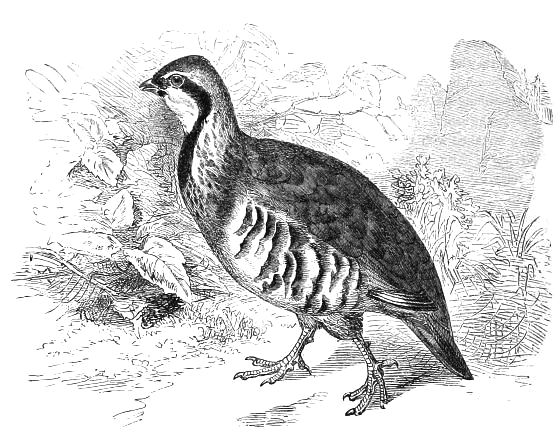
THE RED-LEGGED PARTRIDGE (Caccabis rubra). ONE-THIRD NATURAL SIZE.
THE RED-LEGGED PARTRIDGE.
The RED-LEGGED PARTRIDGE (Caccabis rubra), a species inhabiting South-western Europe, differs from the last-mentioned bird in the deeper shade of the red on its mantle, and in the broad stripe and spots that adorn its neck. The back of the head and nape are bright rust-red, the crown of the head is grey, the breast and upper belly are greyish brown, the under belly and lower tail-covers reddish yellow; the long, light grey feathers on the thighs are marked with whitish red and dark brown streaks, edged with black. A white line, commencing on the brow, passes over the eye to the sides of the throat, the centre of which is pure white. The eye is light brown, the eye-ring cinnabar-red, beak crimson, and foot pale carmine-red. The female is recognisable from her mate by the inferiority of her size, and is without the spur-like wart upon her tarsus. The male is fourteen inches and a half long and twenty broad; his wing measures six and the tail four inches and a half.
This bird inhabits France, Italy, Spain, Portugal, and the Channel Islands, and has been recently introduced into England, where it is now plentiful. It is more wild than the Common Partridge, and stronger on the wing, and will run sturdily before the dogs. It prefers heaths, commons, and waste land, but also frequents turnip fields. The nest is slightly formed of grass and leaves, and placed in a field of corn or grass. "Two or three instances are recorded," says Mr. Yarrell, "in which a nest with eggs were found in the thatch, or upon the top of low stacks."
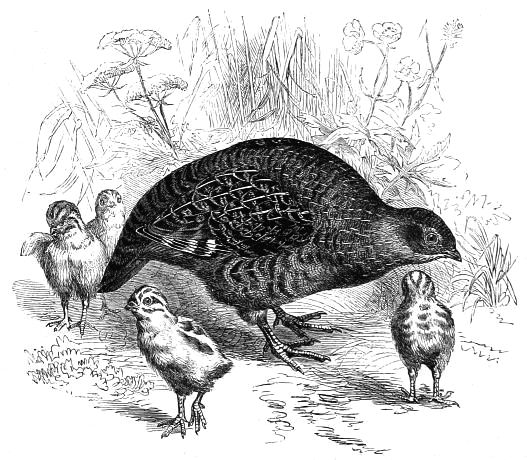
THE COMMON PARTRIDGE (Perdix cinerea, or Starna cinerea). ONE-THIRD NATURAL SIZE.
The eggs are of a reddish yellow-white, spotted and speckled with reddish brown, one inch and seven and a half lines long, and one inch and three lines broad, and from fifteen to eighteen in number. The young leave the nest soon after they are hatched. Their food is the same as that of the Common Partridge.
THE BARBARY PARTRIDGE.
The BARBARY PARTRIDGE (Caccabis petrosa), another member of the above group, is principally recognisable by the reddish brown band, spotted with white, that encircles its throat. The brow and sides of the head are light grey, shading to a blueish tint on the wing; the throat and eyebrows are whitish grey, the breast is of a blueish tint, shaded with grey, the thighs are striped yellowish brown and black; the rest of the under side is blueish grey. Some of the mantle-feathers are marked with reddish grey; the eye, beak, and foot of this bird are similarly coloured to those of its congeners. Its size is somewhat less than that of the species already described. The Barbary Partridge inhabits Greece, Sardinia, and occasionally the South of France; it is numerously met with in North-western Africa. Naturalists are by no means agreed as to the situations it prefers, some informing us that it selects lowland districts or rising ground in the vicinity of corn-fields, whilst on the contrary, Bolle, who is particularly accurate in his observations, states that in the Canary Islands it quite as frequently lives and breeds on rocky heights as in the valleys and open country. This savoury game we are told by the last-mentioned authority, swarms in such numbers on four of the Canary Islands as to be occasionally regarded as an intolerable nuisance. Salvadori informs us that the period of incubation commences early in February, and Bolle, that the eggs, from four to twelve in number, are hatched in twenty-two days. After the breeding season the pairs collect into parties, but if alarmed and separated appear to be at little trouble to seek for and rejoin their former companions.
THE COMMON PARTRIDGE.
The COMMON PARTRIDGE (Perdix cinerea, or Starna cinerea) is distinguishable from the above birds by the coloration of its plumage, by the plates protecting the feet forming two distinct rows both before and behind, by the absence of the spur-like wart on the tarsus, and by the formation of its wing, the third, fourth, and fifth quills of which are longer than the rest; the tail is composed of sixteen or eighteen feathers. In this species the brow, a broad line above and behind the eye, and the sides of the head and throat, are light rust-red, the rest of the head is brown, marked with yellow, and the grey beak is striped with rust-red; the feathers are delicately traced with black zigzag lines, and have light shafts: a broad dark band, varied with black, adorns the breast, and passes along both sides of the belly, where it is interrupted by various rust-red streaks, surrounded by a white line. The white belly has a large horseshoe-shaped brown spot at its centre; the rump-feathers and those in the centre of the tail are streaked with shades of brown; the primary quills are pale brownish black, spotted with reddish yellow. The eye is nut-brown, the eye-space and stripe that passes behind it are both red, the beak is blueish grey, and the foot reddish grey or brown; the female is smaller than her mate, and less pleasing in her colour: her back is darker, and her belly without the brown patch in its centre. The male is twelve inches long and twenty broad, and the wing measures six, and the tail three inches.
The Common Partridge is almost exclusively a European bird. Mr. Gould states that in his extensive observations he has never met with a single species either from Africa or Asia. Temminck, however, tells us that it visits Egypt and the shores of Barbary, and Russian naturalists have included it among the birds found between the Caspian and Black Seas, south of the Caucasus.
In Europe it is extensively distributed in all suitable localities, and inhabits all the level parts of England and Scotland.
It frequents cultivated land and corn-fields, ranging sometimes into neighbouring waste ground covered with furze and broom. It runs with great rapidity when alarmed, but often squats close to the ground and flies off when nearly approached. The food of the Partridge consists of corn, grain of various kinds, peas, seeds, and tender shoots of grass; it also consumes insects and larvæ of many kinds, that would otherwise injure the crops. It feeds principally in the early morning and late in the evening, when coveys of these birds may be met with in fields of corn or stubble, according to the season. During the day they frequent pasture lands, and sun and dust themselves in dry bare places, or bask under hedgerows. In the evening their sharp shrill call-note is heard as they collect together to roost on the ground. The coveys, which assemble in the latter part of the autumn, and keep together during the winter, separate again early in the spring, when pairing-time begins.
The nest is merely a slight hollow in the ground, lined with a few dried leaves, or bits of grass scraped together; it is usually placed beneath a tuft of grass, among standing corn, or even by the road-side.
The eggs are from twelve to twenty, and of a greenish brown tint; occasionally, a greater number are found, but these are not supposed to be the produce of one bird. The female alone broods, guarding her nest with zealous anxiety, but her partner is also on the watch, lest danger should approach.
The following instance of the care of the Partridge for her eggs is related by Mr. Jesse:—"A gentleman living near Spilsby, in Lincolnshire, who was one day riding over his farm superintending his men as they ploughed a piece of fallow land, saw a Partridge glide off her nest so near the foot of one of his plough-horses that he thought the eggs must have been crushed: this, however, was not the case; but he found that the old bird was on the point of hatching, as several of the eggs were beginning to chip. He observed the old bird return to her nest the instant that he left the spot. It was evident that the next round of the plough must bury the nest and eggs in the furrow. His surprise was great, when returning with the plough, he came to the spot and saw the nest indeed, but the eggs and bird were gone. An idea struck him that she had removed her eggs, and he found her before he left the field sitting under the hedge upon twenty-one eggs. The round of ploughing had occupied about twenty minutes, and in this short time she, assisted by the cock bird, had removed the twenty-one eggs to a distance of about forty yards."
Another interesting anecdote is thus related by Mr. Murkwick:—"As I was hunting with an old pointer the dog came upon a brood of very small Partridges, the old bird cried, fluttered, and ran tumbling along, just before the dog's nose, till she had drawn him to a considerable distance, when she took wing and flew still further off, but not out of the field; on this the dog returned to me near the place where the young ones lay concealed in the grass. This the bird no sooner perceived than she flew back again to us, settled before the dog's nose again, and by rolling and tumbling about drew off his attention from her young and thus preserved her brood a second time. I have also seen," continues the same writer, "when a Kite has been hovering over a covey of young Partridges, the old birds fly up at the bird of prey, screaming and fighting with all their might to preserve their brood."
Of the same daring spirit Mr. Selby gives the following remarkable instance:—"A person engaged in a field not far from his residence, had his attention arrested by some objects on the ground, which upon approaching he found to be two Partridges, a male and female, engaged in battle with a Carrion Crow; so successful and so absorbed were they in the issue of the contest, that they actually held the Crow till it was seized and taken from them by the spectator of the scene. Upon search, the young birds (very lately hatched) were found concealed in the grass. It would appear that the Crow (a mortal enemy to all kinds of young game), in attempting to carry off one of these, had been attacked by the parent birds, with the above singular result."
The eggs of Partridges are frequently hatched under a Domestic Hen, and the young reared on ants' eggs, curds, and grits, with a little green food, when old enough they should be fed with grain. They are easily tamed, though it is said they never wholly forget their wild origin. An account is given by Daniell of one of these birds that became an inmate of a clergyman's house, which long after its full growth entered the parlour at breakfast and other times, received food from any hand, and stretched itself before the fire, the warmth of which it seemed to enjoy.
The FRANCOLINS (Francolinus) are distinguishable by their moderately long, powerful, and slightly-hooked beak, and by the two spurs upon their foot. The tail, composed of fourteen feathers, is either quite straight or gently rounded at its extremity; the third or fourth wing-quill exceeds the rest in length. The thick plumage is often much variegated. The male and female are usually alike in size, colour, and markings. These birds inhabit the southern portions of Asia, and are very numerously met with on the continent of Africa. Some species frequent level plains, while others live in forests; when disturbed they conceal themselves in the brushwood in the thickest part of the jungle, not venturing forth again till all danger has disappeared. Should no hiding-place be near, they endeavour to escape by running, and have only recourse to their wings when the danger is very urgent. In their general habits they very much resemble the true Partridges; they breed at the same season, testify the same care and devotion for their young, and are equally prolific. They differ, however, from Partridges, inasmuch as they do not frequent cultivated grounds, but prefer the neighbourhood of woods, where they seem to select damp localities overgrown with reeds. They live upon berries quite as much as upon grain, and seek eagerly for such worms and insects as abound in marshy soil. The African species feed on small bulbous roots which they dig from the ground with their beaks. They are very fond of perching upon trees, especially during the night, and their call is much more harsh and noisy than that of the Partridge. Their flesh is excellent. (See XXIX.—Coloured Plate—Sanguine Francolin, Ithaginis cruentus.)
THE BLACK PARTRIDGE.
The BLACK PARTRIDGE (Francolinus vulgaris) is of a deep black on the brow, cheeks, and breast; the feathers on the back of the head are edged with red, and streaked with white; the ear-feathers are pure white; those on the centre of the throat are reddish brown, and form a broad collar; the mantle-feathers are black, bordered with red, and spotted with white, those of the lower back finely striped black, and more or less spotted and lined with white. The thighs and lower tail-covers have the feathers tipped with brown; the quills are black and red, those at the exterior black and grey at their roots. The eye is brown, the beak black, and the foot yellowish red. This species is from thirteen to fourteen inches long, and twenty broad. The wing measures five inches and three-quarters, and the tail three inches and a half.
Jerdon informs us "that the Black Partridge is found throughout the whole of Northern India, from the Himalayas to the valley of the Ganges, and southwards to Sindh and Guzerat, eastwards through Dacca to Assam, Sylhet, and Tipperah, and on mountains 4,000 feet above the level of the sea." It frequents by preference grass meadows near water, cultivated fields of corn, mustard, or pulse, and any patch of moderately high green herbage, also low jungle, and is not unfrequently flushed in moderately long grass interspersed with bushes, even at some distance from water.
"In the cold weather," says Jerdon, "after the young have flown and separated from their parents, they may be found scattered over a greater expanse of country than during the hot weather and rains, and are often to be found in fields far from water. This Partridge is stated occasionally to perch and roost on trees; but this is certainly a rare habit, at least with this species."
During pairing-time the call of the cock bird may be frequently heard at sunrise, and towards evening. Malesherbes represents it as an agreeable sound, resembling the syllables "Tre-tre-tre."
A Sicilian proverb says that the bird wishes to declare his own value, and that he may be purchased for three coins. This cry has been represented by many different syllables that, however, would scarcely give a correct idea of its sound to those who have not heard it. The Mussulmans say that it repeats the pious words, "Dobhan teri kudrut," others that it calls out, "Lussun, piaz, udruk," or garlic, onions, ginger. Adams represents the cry as "Lohee-wha-which-a-whick," and some one else as "Juk-juk-tee-tar." One writer has compared it to the harsh grating blast of a cracked trumpet; but Jerdon says that it is far from being a loud call, though sufficiently audible for a great distance. This cry is almost always uttered from a slight eminence, such as a bank, ant-hill, or clump of earth, and where the birds are numerous, answering cries may be heard from all sides. These birds generally call much after rain, or after a heavy dew.
The Francolin is not shy, but when it finds itself pursued, runs quickly for two or three minutes, avoiding open ground, before it takes wing; its flight is strong and steady, but slow, and not long continued. When alarmed it usually only rises to the nearest bush, and thence descends again to the ground.
In India, according to Jerdon, the hens brood from May to July. The nest is usually in high grass, sometimes in indigo fields, and occasionally in plantations of sugar-cane. The eggs are ten or twelve, and sometimes even fifteen in number, of a pale blueish white or pale green tint. It is probable that the mother alone broods.
A few years ago many of these birds were shot in Sicily, but now they seem to have almost disappeared from that island. In Syria and Palestine, according to Tristram, "they are found in the rich lowland plains of Gennesaret, Acre, and Phœnicia, concealing themselves in the dense herbage and growing corn, where their singular call can be heard resounding at daybreak from every part of the plain, while not a bird can be seen." In the Bengal Sporting Magazine for 1841, we are told that seventy-five brace were shot by one sportsman in the neighbourhood of Kamal in the Upper Provinces; but it is everywhere more scarce than it was formerly. The flesh of this bird is good, especially when kept for a few days, and eaten cold. The beautiful spotted feathers of the lower plumage were used in some parts of the country to make into capes, but are now scarcely procurable.
The BARE-NECKED PHEASANTS (Pternistes) constitute a group of African Francolins, recognisable by their comparatively slender body, moderately long neck, and small head. The wing (in which the fourth quill exceeds the rest in length) is much rounded, the tail, over which the pinions do not extend, is almost straight at its extremity. The beak is of medium size, the foot high, and armed with a spur.
THE RED-NECKED PHEASANTS.
The RED-NECKED PHEASANTS (Pternistes rubricollis) are principally of a pale greyish brown, almost all the feathers, except those on the head, being decorated with a triangular yellowish white spot, and edged with white. The primary quills are black, bordered with yellow on the outer, and spotted with the same shade on the inner web; the tail-feathers are irregularly striped with yellow and brown. The eye is light brown, the bare circle that surrounds it cinnabar-red; a patch upon the throat is yellow, edged and spotted with black; the beak deep brownish grey, with red base and nostrils; the foot dark brownish grey. The male is sixteen inches long and twenty-five broad; his wing measures seven inches and two-thirds, and the tail four inches; the female is an inch and a half shorter and one inch narrower than her mate.
As far as has been at present ascertained, the habitat of this species extends over all the low-lying country near the African coast, from the northern boundary of Abyssinia to Somali; we have never seen it upon mountains, although it occasionally frequents their immediate vicinity. The Red-necked Pheasant, like other Francolins, is extremely shy, and if disturbed runs with great quickness to a place of security, and only when very hard pressed employs its wings. Its flight is noisy but light, and resembles that of the Lyrurus tetrix; upon the ground, however, it is far more at home than in the air, running over its surface with almost incredible ease and rapidity. Like its congeners, this species has but one mate, and lives on excellent terms with its companions, as several pairs and their young usually keep together, forming small parties. In spite of this usually peaceful mode of life, the males, like the rest of their kind, occasionally indulge in regular pitched battles. Their cry is very similar to that of the Partridge; about April or May the males become much excited, and may be heard calling almost incessantly during the evening hours. A nest found by Brehm in a thick, dark bush near the ground, was formed of leaves and feathers, and contained within its deep walls, six pure white eggs, closely resembling those of a Domestic Fowl. "My attention," he tells us, "was attracted to the nest in the first instance by the movements of the hen, who ran out of the bush at my approach, and placing herself in an open space near me, spread and beat her wings, and by her cries endeavoured to lure me from the spot. I carefully marked the bush that contained the brood and at once pretended to follow the anxious mother, who, after leading me some five hundred paces, suddenly rose and flew back to her home in a series of large curves quite after the manner of the rest of her congeners. The cock was not to be seen, but no doubt was in the immediate vicinity." The flesh of this species is much esteemed, and large numbers are snared for the table. In many European houses it is to be seen caged, yet, though it endures captivity well, it never becomes really tame.
The AMERICAN PARTRIDGES (Odontophori) are delicately-framed birds, possessing a short high beak, compressed at its sides, high, much arched, and furnished at its margin with two strong, tooth-like projections. The moderately long tail is composed of twelve feathers, the external of which are frequently much shortened; the fourth, fifth, and sixth quills of the very decidedly-rounded wings exceed the rest in length; the tarsi are high, without a spur, but the toes are long and furnished with long, sharp claws. The thick plumage is more or less brilliantly coloured and always beautifully marked; some species have a bare patch around the eye. All the members of this group are strictly American, and by far the greater number of them are natives of that portion of the continent lying between 30° north latitude and the equator. Four species are now included in the fauna of North America, and four have been discovered in Brazil; some few extend their range to the larger of the West Indian Islands, and several others inhabit the vast mountain ranges of the Andes.
The American Partridges form a large and well-defined group, distinguishable from the Partridges and Quails of the Old World by the absence of any spur, or spur-like appendage on the tarsi, and by the tooth-like processes in the upper mandible. They are pugnacious in their disposition, seem arboreal in their habits, and deposit their eggs in a depression of the ground or in a very inartificial nest. Their food consists of seeds, berries, fruits, and the tender leaves of grass and other vegetables. Their flesh is white, tender, and well flavoured. In the morning and evening twilight they perch on a low branch near each other, when the males frequently give utterance to their cries, which reverberate through the forest to a great distance. If alarmed when on the ground, they usually hasten to some neighbouring branch, along which they run, and crouching down conceal themselves amongst the foliage.
The female lays from eight to fifteen eggs.
THE CAPUEIRA PARTRIDGE.
The CAPUEIRA PARTRIDGE (Odontophorus dentatus), the largest species of the entire family, represents a group of powerfully-built birds, with comparatively long necks and moderate-sized heads, their short tail, rounded at its extremity, is formed of soft feathers; the short, decidedly-rounded wing has its fifth and sixth quills longer than the rest; the strong, hooked beak is compressed at its sides, and has the high upper mandible much vaulted; the margins of the lower mandible are furnished with two well-defined tooth-like appendages. The tarsi are high, the toes long, armed with sharply-pointed hooked claws, and protected by large horny scales. The plumage, which is alike in the two sexes, is prolonged into a crest on the head; the eye is surrounded by a broad, brightly-coloured skin. This species is yellowish brown on the nape, back, wings, and tail; the crown of the head is brown, and a cheek-stripe that extends to the nape is reddish yellow, dotted with a lighter shade: the feathers on the throat and upper portion of the back are spotted with brown and black, and striped with yellow; those on the shoulders have a large black triangular patch on the inner web. The feathers of the wing-covers have a pale, yellow, heart-shaped spot at their tip, whilst the lower shoulder-feathers and exterior secondaries are edged with reddish yellow on the inner web, and streaked with black, the centre part of each being also varied with reddish grey and brown. The brown primary quills have the outer web dotted with white, and the shaft grey; the secondaries are marked with reddish yellow on the outer web. All the feathers on the hinder parts of the body and tail are of mottled reddish yellow in the centre, with a pale yellow border, and a black spot at the tip; those on the under side are slate-grey, edged with brown. The eye is brown, the bare ring that surrounds it deep flesh-red, the beak black, and the foot greyish red. The female is of paler hue, and the young show more reddish brown in their plumage than the adult male. The length of the body is sixteen inches and a half, the wing measures three inches and a half, and the tail three inches.
This bird is found in suitable localities in most parts of Brazil, from the Rio de la Plata to the Amazon. We are indebted to the Prince of Wied for what we know of its life and habits.
"This species," says the prince, "is called 'Capueira' by the Brazilians. Its habits and mode of life are very similar to those of the Hazel Grouse, or Gelinotte (Bonasia sylvestris). It never frequents the open country, but confines itself entirely to the thick woods. In the early part of the year the 'Capueira' lives in pairs, and after the breeding season the families remain in coveys of from ten to sixteen or more in number. These birds run very quickly, and procure their food among the dry leaves on the ground in the midst of the extensive woods. The stomachs of such as I examined contained fruits, berries, insects, small stones, and a little sand. The part of the country in which I met with them is the eastern portion of Southern Brazil, from Rio de Janeiro to 13° south latitude; by Spix they appear to have been found still farther north. In the vast forests bordering the rivers Mucuri, Alcobaça, Belmonte, and Ilheo they were very common, and we frequently killed them for the sake of their flesh, which is excellent. Their loud and remarkable voice is heard only in the forests, where it reverberates to a great distance. Azara states that the cry is uttered by both sexes, but I believe it is emitted by the male bird only. Like the Domestic Cock in Europe, it frequently aroused us at the break of day, bidding us, as it were, continue our researches among the grand but almost impenetrable forests of that magnificent country. They commenced calling before daybreak, thus affording us ample time for breakfasting, and enabling us to start by the dawn of the young day."
Azara tells us that the voice of the Capueira consists of two notes; but on this point he is incorrect, as it comprises three or four notes, which are frequently and very quickly repeated. Morning and evening the Capueiras perch on a branch in a line, very near to each other, and at this time the male birds frequently give utterance to their cry, which Azara states to resemble the word "uru," but it appeared to me very different. The nest found by me in the woods near the fine lake called Lagoa d'Arara (Macaw Lake) was placed on the ground, and contained from ten to fifteen pure white eggs, which coincides with Sonnini's account; while Azara's assertion that they are of a violet-blue is doubtless a mistake, which may probably have arisen, as M. Temminck suggests, from his having mistaken the eggs of a Tinamou for those of a Capueira. Some travellers have asserted that they have found the nests of this bird on trees, and that they were placed in such situations in order that they might be secure from the attacks of snakes and other enemies; but this is also a mistake, for were such a precaution necessary, it would be adopted by all the birds in the country, whereas numerous species, especially the Tinamous, constantly breed on the ground. The sport afforded by the Capueira very closely resembles that afforded by the Hazel Grouse. When a covey was disturbed by the pointers they flew to the trees, the motion of their wings causing the same rustling sound as those of the Partridge. Occasionally they might be killed very easily; at other times it was very difficult to sight them among the dense foliage of the woods. Their flesh, which is very palatable, forms an excellent article for the table.
THE VIRGINIAN OR AMERICAN PARTRIDGE.
The VIRGINIAN or AMERICAN PARTRIDGE (Ortyx Virginianus) represents a group distinguishable by the following characteristics:—Their body is short and powerful, with the neck and head of medium size; the beak is strong, short, much vaulted, and has the lower mandible incised, the upper mandible terminates in a hook, while the margin of the lower portion near its apex presents two or three distinct notches. The moderate-sized and arched wing has the fourth quill longer than the rest; the rounded tail is composed of twelve feathers, and the foot is protected by rows of smooth, horny plates in front, and covered with small scales at the back and sides. The plumage is glossy, and prolonged into a crest on the head. In the male all the feathers of the mantle are reddish brown, spotted and lined with black and edged with yellow; those on the under side are whitish yellow, striped with reddish brown and marked with black. Two bands, the one white, the other black, pass across the brow; the white throat is separated from the sides of the neck—which is mottled with black, brown, and white, by a black line. The upper wing-covers are principally reddish brown; the dark brown primary quills are bordered with blue on the outer web; the secondaries are irregularly striped with brownish yellow; the centre tail-feathers are greyish yellow, dotted with black; the rest are greyish blue. The eye is reddish, the beak dark brown, and the foot greyish blue. The female has more yellow on the brow and neck, and the rest of her plumage is less clearly marked than that of her mate; the young resemble the mother. This species is nine inches long, and thirteen inches and five-sixths broad; the wing measures four inches and a half, and the tail two inches and a quarter.
Canada forms the northern, the Rocky Mountains the western, and the Gulf of Mexico the southern limit of the range of these birds. They have been introduced into the island of Jamaica, where they thrive, breeding in that warm climate twice in the year. In the southern part of the United States they are stationary, but in the north they make yearly expeditions, which resemble migrations. They are principally met with in open fields, or about fences sheltered by bushes or briars, and they sometimes visit the woods, but are rarely found in the depths of the forest. In their general demeanour they very much resemble our own Partridge. They run nimbly and fly swiftly, making a loud whirring sound with their wings. When chased by dogs they take refuge in the trees, where they remain until danger is past, walking with ease on the branches. Their usual cry is a clear whistle. The love-call of the male consists of three clear notes, the two last being the loudest, and resembling the syllables, "Ah! Bob White!"
"The male," says Audubon, "is seen perched on a fence, stake, or on the low branch of a tree, standing nearly in the same position for hours together, and calling, 'Ah! Bob White,' at every interval of a few minutes. Should he hear the note of a female, he sails directly towards the spot whence it proceeded. Several males may be heard from the different parts of a field, challenging each other, and should they meet on the ground they fight with great courage and obstinacy until the conqueror drives off his antagonist to another field." About the beginning of May the female proceeds to build her nest; this is placed on the ground, close to a tuft of grass, and partly sunk in the earth: it is formed of leaves and fine dry grass, is of a circular form, and covered above, with an opening at the side. The eggs are of a pure white, and rather sharp at the smaller end. Both parents assist in hatching the eggs. When the young are freed from the shell they leave the nest, and are led in search of food by their mother, who shelters them with most assiduous care. If danger threatens, she throws herself across the path of the intruder, beating the ground with her wings as if severely wounded, and uttering notes of alarm to decoy the stranger into pursuit of herself, and give warning to her young to conceal themselves in the high grass till the danger is past, when, having allured her pursuer to a distance, she returns, and leads them safe home. The American Partridge usually rears only one brood in the year, but should this be destroyed she immediately prepares another nest, and even should mischance befall this also, a third batch of eggs is laid. This Partridge has been occasionally employed to hatch the eggs of the Domestic Hen.
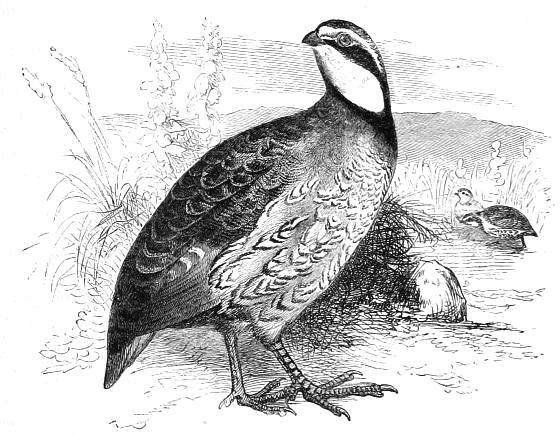
THE VIRGINIAN PARTRIDGE (Ortyx Virginianus). ONE-HALF NATURAL SIZE.
"A friend of mine," says Wilson, "informs me, that of several hens' eggs, which he substituted for those of the Partridge, she brought out the whole; and that for several weeks he occasionally surprised her in various parts of the plantations, with her broods of chickens, on which occasions she exhibited much alarm, and practised her usual manœuvres for their preservation. Even after they were considerably grown and larger than the Partridge herself; she continued to lead them about; but though their notes or call were those of common chickens, their manners had all the shyness, timidity, and alarm of young Partridges: they ran with great rapidity, and squatted in the grass exactly after the manner of the Partridge. Soon after this they disappeared, having probably been destroyed."
In summer the food of these birds consists of insects, berries, and grain, and in the autumn they revel in the fields of buckwheat and Indian corn. When winter comes, and their supplies have disappeared, those in the northern districts commence their southward course, and many perish during these journeys. Early in October the shores of the large rivers are covered with flocks of them, which rove along the margin of the river and cross towards evening, the weaker ones often falling and perishing in the water. After the principal streams have been thus crossed, the flocks distribute themselves about the country, and resume their usual mode of life. During the severity of winter they often suffer from scarcity of food, and will then approach the dwellings of men, and become half domesticated, visiting the barns and mixing with the poultry, to share their food. The eggs of this species have frequently been hatched by the Domestic Hen; two of these birds that had been brought up in this manner, according to Wilson, associated with the cows, followed them to the fields, returned with them in the evening, stood by them while milked, and again returned with them to pasture. These remained during winter, lodging in the stable, but as soon as spring came they disappeared.
Dr. Bachmann attempted to domesticate the American Partridge, and gives us the following account of his proceedings:—"The eggs had been obtained from the fields, and were hatched under a Bantam hen. By confining the young with their foster mother for a few days they soon learned to follow her like young chickens. They were fed for a couple of weeks on curds, but soon began to eat cracked Indian corn and several kinds of millet. They were permitted to stray at large in my garden; but fearing that they might be induced to fly over the enclosure and stray away, I amputated a joint of the wing. There was no difficulty in preserving them during the summer and winter, and they became so very gentle that they were in the habit of following me through the house, and often seated themselves for hours on the table at which I was writing, occasionally playfully pecking at my hand and running off with my pen. At night they nestled in a coop, placed for that purpose in the garden. The cats in the neighbourhood, unfortunately for my experiment, took a fancy to my birds and carried off several, so that at the breeding season my stock was reduced to two females, with a greater number of males; the latter now commenced their not unmusical notes of 'Bob White,' at first low, but increasing in energy and loudness till they were heard throughout the whole neighbourhood. These notes were precisely similar to those of the wild birds, affording a proof that they were natural, and not acquired by an association with others of their own species, as these birds had no opportunity of hearing any other notes than those of the poultry on the premises. As the spring advanced, the males became very pugnacious, and great contests took place between themselves, as well as with the Pigeons and the young poultry that occasionally intruded on their domicile. In May the hens commenced laying, both in one nest, and the eggs were hatched under a Domestic Hen."
Dr. Bachmann was prevented carrying out his experiments further, but other observers have been more fortunate, and have without trouble reared many of these delicate birds in closed rooms. Their great fertility is very favourable to their increase, wherever it is wished that they should be naturalised.
Several attempts have been made to introduce this species into England, and from time to time specimens have been shot in different parts of the country.
The American Partridge is easily caught by means of snares and traps of various descriptions. Many are shot, but they are most frequently netted in the following manner:—A number of persons, furnished with a net, ride along the fences and thickets where the birds resort, one of the party simulating the call of the bird, which is soon answered by a covey; the party approach in an apparently careless manner to ascertain the position and number of the others; and then a horseman furnished with a net gallops a hundred yards in advance, and places it so that his companions can drive the Partridges into it. In this manner fifteen or twenty Partridges may be caught at one driving, but a pair out of each flock usually receive their liberty for fear that the breed should be destroyed.
The CALIFORNIAN PARTRIDGE (Lophortyx Californianus) and GAMBEL'S PARTRIDGE (Lophortyx Gambelii) represent an American group principally remarkable for the crest that adorns their head. These birds have a powerful body, short neck, and moderately large head. The short arched wing is rounded at its extremity, and has its fourth or fifth quills longer than the rest. The tail, composed of twelve feathers, is short and remarkably graduated; the beak is short, strong, and much arched at its culmen; the foot is of medium height, and the thick plumage compact and glossy. At the top of the head rises a crest, formed occasionally of from two to ten, but generally of from four to six feathers; these are slender at the roots, becoming gradually broader towards the tips, which incline forward, and have somewhat the form of a sickle. This crest is much developed in the males. The coloration of the plumage, though by no means gorgeous, is both beautiful and brilliant.
THE CALIFORNIAN PARTRIDGE.
The CALIFORNIAN PARTRIDGE (Lophortyx Californianus) has the feathers on the top of the forehead of a straw-yellow, with dark shafts, these being surrounded by a dark line that passes over the eyes. The crown of the head shows two shades of brown; the long feathers that cover the nape are blueish grey, with black shafts and edges, and two white spots at their tips. The back is olive-brown, the throat black, encircled by a white band, the upper breast is blueish grey, its lower portion yellow, each feather being lighter at the tip, and bordered with black; the feathers on the belly are brownish red, edged with a darker shade, those on the sides brown, with white shafts, and those on the lower tail-covers light yellow, with dark shafts. The quills are brownish grey, the secondaries bordered with a yellowish tint; the tail is pure grey. The eye is dark brown, the beak black, and foot deep lead-colour. The female is of a dull whity-brown on the forehead, and brownish grey on the crown; the throat is yellowish, with dark markings, the breast dull grey; the rest of the plumage resembles that of the male, but is duller and fainter.
The Californian Partridge was first observed during the visit of the unfortunate ship La Perouse to California, since which time it has been found to inhabit in abundance all suitable localities in that country; the accounts of its life and habits are, however, as yet very scanty.
"These beautiful birds," says Gambel, "so extraordinarily plentiful throughout California, assemble in the winter in numerous swarms of more than a thousand individuals, if the woods are able to provide for that number, and are equally plentiful on bushy plains and the declivities of hills. They exhibit great watchfulness and activity, and when pursued run nimbly away into concealment; if suddenly started they take refuge in trees, crouching close to the horizontal branches like squirrels—in which position the great resemblance of their colouring to that of the bark of the tree, makes it very difficult to detect them." The nest is usually placed on the ground at the foot of a tree or beneath a bush. The eggs are generally numerous and placed in a shallow hollow, scooped at the foot of an oak, and spread over with a few leaves and a little dried grass. Gambel found twenty-four eggs in one nest, but thought that possibly they were the produce of two hens—fifteen being the usual number of the brood.
Freyborg, who also observed this bird in its native country, says that it is stationary, or at least wanders only to a short distance, and feeds on grass, seeds, bulbous roots, garlic, plants of various kinds, berries, and insects, preferring thick bushes to any other localities. It seldom moves more than forty or fifty paces, and scarcely ever strays from the shade of the woods to open spots; it holds out for some time before the hounds, and flies to the nearest tree. In the winter it digs long burrows under the snow. In California these birds are shot from the trees with a small rifle, and they are also chased by the help of dogs—their flesh being in great request, and considered to resemble that of the Hazel Grouse (Bonasia sylvestris).
Captain Beechey brought home several of these birds, but the females all died, and of the males which were presented to the Zoological Society, scarcely one survived.
Since this time several others have been imported to different parts of Europe, and two pairs brought by Deschamps laid and hatched a numerous brood—other experimenters have been equally successful.
GAMBEL'S PARTRIDGE.
GAMBEL'S PARTRIDGE (Lophortyx Gambelii) resembles the species last described in its general appearance, but has the black patch on the face larger, and only a very small portion of the brow is white. The back of the head is bright reddish brown, streaked with light yellow. All its hues are brighter and more glossy than those of the Californian Partridge.
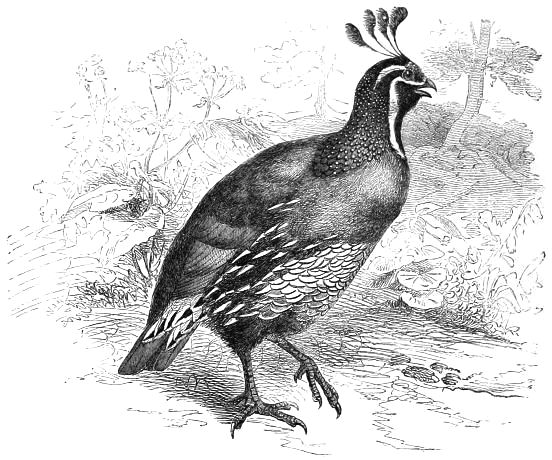
THE CALIFORNIAN PARTRIDGE (Lophortyx Californianus).
"It was late in June," says Coues, "when I arrived in Arizona, where I heard that this Partridge was especially plentiful. In my first day's sporting I stumbled, so to say, over a covey of young poults that were just escaped from the egg, but the nimble little creatures ran and concealed themselves with such wonderful celerity, that I could not catch a single one. I thought that I had mistaken for them the Oreortyx pictus, and wondered to find young ones of these so late in the year. But it was not yet late for Gambel's Partridge, as I found several broods in August only a few days old. In the following year I observed that the old birds had paired by the end of April, and at the beginning of June I saw the first young ones. I would also notice that breeding goes on rapidly in the months of May, June, July, and August, and that probably two or possibly three broods are hatched in one year. The greatest number of poults in one brood are, as far as I could learn, between fifteen and twenty-six, the smallest from six to eight. On the first of October I found some half-grown young, the greater number were already nearly or quite as large as their parents, and so fledged that they might well attract the attention of a sportsman. As long as the young brood require their parents' care they keep together in a small collected flock, and if this is threatened each little chick runs away so quickly and squats in some convenient place that it is very difficult to induce them to rise. If this can be done, the covey fly all close together, but usually quickly alight on low branches of trees or bushes, but often also on the ground, and here they generally sit, sometimes stiffly in a heap, and while they think they are well concealed, allow themselves to be approached within a few paces. Later in the year, when they have reached their full growth, they more seldom take to the trees, become more cautious, and are approached with greater difficulty. The first intimation that a covey is near, is given in a single note, repeated two or three times, then follows a rustling of dry leaves, and the whole troop hasten, as quickly as they may, yet one step farther and then all rise with a whirring noise, and disperse themselves in different directions."
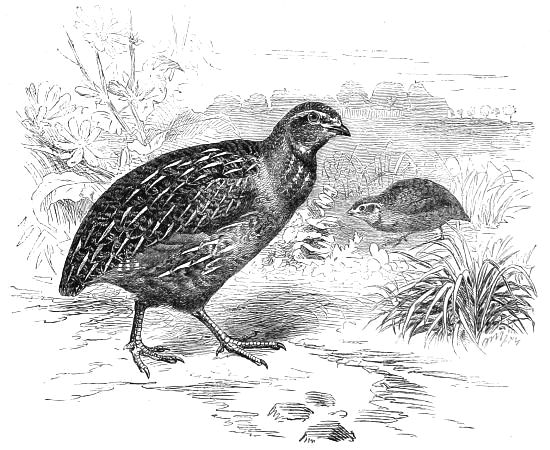
THE COMMON QUAIL (Coturnix communis). ONE-HALF NATURAL SIZE.
With the exception of close fir-woods, without undergrowth, these birds people every locality, but seem to prefer thick bushes, and especially osier holts, on the borders of streams. Dr. Gambel tells us that he saw them in flocks of fifteen or twenty in company with another species in a barren tract, where several podded kinds of Prosopis, with low-spreading branches, afforded them excellent covert, and the seeds of bushy Maluas, Chænopodia, and Artemisia probably served them for food. In this dreary region, where one would suppose it impossible for any creature to subsist, they were running about in small parties, occasionally uttering a low guttural call of recognition; this call is often composed of several notes, and very different from that of the common species. When in flight they emit a sharp whistle, and conspicuously display their long crest.
The QUAILS (Coturnices) are recognisable by their comparatively small size, powerful, compact bodies, proportionately long, pointed wings, and very short, rounded tail, formed of twelve soft feathers, and almost concealed by the long feathers on the rump. The beak is small, and high at its base, the foot short, or of moderate size, without a spur, and the plumage, which completely covers the head, alike in both sexes. These birds are met with over a larger portion of the globe than any other members of the entire order, as they not only inhabit the whole of the Eastern Hemisphere, but are particularly numerous in Australia and the Malay Islands. Unlike other Rasores, the Quails are by no means social, but live strictly in pairs and rarely congregate into flocks, or associate freely with others of their kind, except during the migratory season, at which time they undertake journeys of considerable extent, their long wings enabling them to fly with far less effort or fatigue than do the Perdices. The incubation of this group is also somewhat peculiar, for wherever the means of subsistence are to be found, there they will breed as readily as in their native lands. As regards their general development, the Quails will bear comparison with any of their relations, and far exceed most of them in the rapidity and ease of their movements. In most respects the food of this group is the same as that consumed by other Rasores, although, perhaps, they may be said to eat a less proportion of vegetable matter.
THE COMMON QUAIL.
The COMMON QUAIL (Coturnix communis) is brown, striped with reddish yellow on the upper parts of the body; the head is somewhat darker than the back, the throat reddish brown, and the region of the crop reddish yellow; a pale yellowish line passes from the base of the upper mandible over the eyes and down the sides of the neck across the throat, where it is bounded by two narrow dark brown lines. The blackish brown primary quills are spotted with reddish yellow in such a manner as to form stripes, the first quill has also a narrow yellow border; the reddish yellow tail-feathers have white shafts and are spotted with black at their edges. In the female all these colours are comparatively indistinct, and the reddish brown of the throat but little conspicuous. The eye is light brownish red, the beak horn-grey, and the foot either reddish or pale yellow. The length is seven inches and a half, and the breadth thirteen inches; the wing measures four inches and the tail one inch and three quarters.
This species is found in most parts of the Old World. It arrives on the south coast of Europe and the islands of the Grecian Archipelago in immense flocks about April, and thence spread over Europe.
"The European Quails," says Jerdon, "are found throughout India in considerable numbers during the cold weather, most migrating during the rains and breeding elsewhere, but a few pairs remaining and breeding in various parts of the country, especially towards the west and north-west. The Grey Quail, as it is termed in India, generally rises singly or in pairs, but considerable numbers are found together; and in some localities and in certain seasons it occurs in great profusion, and affords excellent sport to the gunner. It is found in long grass, corn-fields, stubble, and fields of pulse, wandering about, according as crops ripen in different parts of the country. It is less numerous towards the south of India than farther north." In Great Britain it has been considered as a summer visitor; but, according to Yarrell, many instances have latterly been recorded of its occurrence in Ireland, as well as in England, during the winter months.
This Quail is likewise met with abundantly in Syria and Judæa, and there seems to be little doubt of its identity with the Quails so frequently mentioned in the Holy Scriptures. "We have," says Tristram, "a clear proof of the identity of the Common Quail with the Hebrew selac, in its Arabic name, salwa, from a root signifying 'to be fat'—very descriptive of the round, plump form and fat flesh of the Quail. The expression 'as it were two cubits high above the face of the earth' probably refers to the height at which the Quails fly above the ground. There are several expressions in the scriptural account which are borne out by observations of the habits of the Quail. At all times its flight is very low, just skimming the surface of the ground, and especially when fatigued it keeps close, never towering like the Partridge or Sand Grouse. It migrates in vast flocks, and regularly crosses the Arabian desert, flying for the most part at night, and when the birds settle they are so utterly exhausted that they may be captured in any numbers by the hand. Notwithstanding their migratory habits, they instinctively select the shortest sea passages, and avail themselves of any island as a halting-place. Thus in spring and autumn they are slaughtered in numbers on Malta and many of the Greek islands, very few being seen till the period of migration comes round. They also fly with the wind, never facing it like many other birds." "The Israelites 'spread them out' when they had taken them before they were sufficiently refreshed to escape; exactly as Herodotus tells us that the Egyptians were in the habit of doing with Quails—drying them in the sun."
Brehm mentions having been a witness to the arrival of a huge flock of Quails upon the coast of North Africa, and tells us that the weary birds fell at once to the ground completely exhausted by their toilsome journey, and remained there for some minutes as though stupefied. On recovering somewhat, they did not again take wing, but continued their journey apparently on foot. In Africa they occasionally take up their quarters in stubble-fields and cultivated districts, but principally frequent the vast steppes, and wander about singly from spot to spot. During the summer they prefer fruitful plains and the vicinity of corn-fields, carefully avoiding mountains or marshy localities. The popularity of these birds is in a great measure due to the pleasant sound of their clear, resounding cry, which during the breeding season enlivens the whole district in which they live. Upon the ground they move quickly but ungracefully, with tail hanging down and neck drawn in, each step being accompanied by a slight nod of the head. Their flight is very rapid, and occasionally changes to a beautiful hovering motion. Even towards its own species the Quail is extremely unsocial and frequently most pugnacious, displaying the latter quality not only towards its rivals, but to its mate, who is often very roughly treated. The females exhibit a somewhat more amiable disposition, and besides being careful of their own offspring, prove excellent foster-mothers to such young birds as have lost their parents. Whilst the sun is high the Quails remain concealed among the long grass and weeds, and about noon indulge in a sand-bath; the succeeding hours are also spent in a state of quiescence, but the sun has no sooner set, than they become brisk and fully alive to the necessity of going in search of food or picking a quarrel with some rival. At this time their agreeable call may be said to be almost incessant. Seeds, small portions of plants, but principally insects, constitute their usual diet, the process of digestion being assisted by the swallowing of small stones. They do not require much water, the dew affording them in most instances all the moisture they need; for this reason they are rarely met with at any drinking-place. Although insect nourishment is decidedly preferred by the Quail, it has been fed for months together simply on grain and wheat. It would appear that this bird is polygamous, and it is even stated on good authority that it will mate with birds of entirely different species. The nest, formed by the hen of small portions of plants and placed in a corn-field, is not commenced till the beginning of the summer months. The eggs, from eight to fourteen in number, are large and pear-shaped, with a glossy, light brown shell, very variously marked with a deeper shade. The hen broods about twenty days, and testifies such devotion to her precious charge as often to sacrifice her life rather than quit the nest, while her mate goes forth with his companions into the neighbouring fields. The young grow rapidly and soon leave their parents' care, for by the time they are six weeks old they have attained their full size, and can fly well enough to join in the autumn migration. Immense numbers of Quails are annually captured on the shores of the Mediterranean, and the island of Capri so abounded in them that we are told some of its ancient bishops derived the principal part of their revenue from this source. Waterton assures us that no less than 17,000 of these delicate birds have been conveyed to Rome in one day.
The DWARF QUAILS (Excalfactoria), the smallest members of this family, represent a group distinguished from those already described by the rounded form of their wing, in which the third, fourth, and fifth quills are longer than the rest, the first being much shorter than the second; and the unusual difference observable in the plumage of the male and female. According to Latham, the scientific name given to these birds has arisen from a custom the Chinese have of using them to warm their hands upon during the winter. The various species inhabit India, the Malay Islands, and Australia.
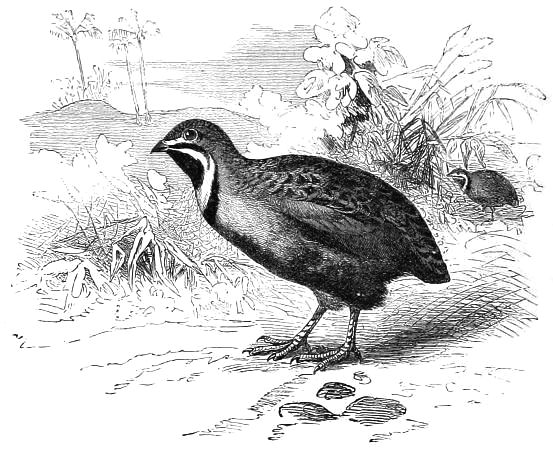
THE CHINESE QUAIL (Excalfactoria Chinensis).
THE CHINESE QUAIL.
The CHINESE QUAIL (Excalfactoria Chinensis) is a very beautiful bird, with the entire mantle of an olive-brown, each feather having a dark and light line on its shaft; the quills of the wing-covers are without these markings, though some few of the shoulder-feathers are striped with deep red. The brow, cheeks, breast, and sides are of a rich, deep grey; the throat is black above, and white, surrounded by a black line, beneath; the centre of the breast, the belly, lower tail-covers, and tail are of a beautiful brownish red. The coloration of the female is less varied in its tints; her chin is merely indicated by a small white patch, and the light brown breast is striped. The eye of both is dark brown, the beak black, and the foot bright yellow. The length of the male is five inches and a quarter, and the breadth nine inches: the tail measures but one inch. The female is not quite so large as her mate.
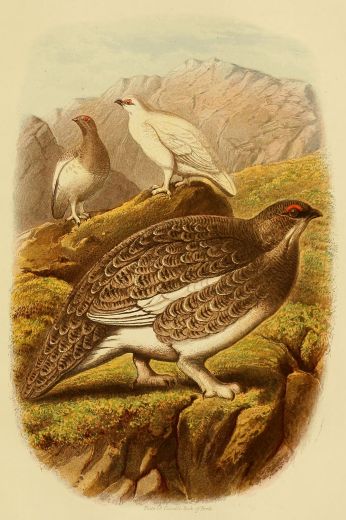
Plate 28. Cassell's Book of Birds
LAGOPUS MUTUS ____ PTARMIGAN
(about one half Nat. size)
[See larger version]
This beautiful little Quail is found all over China, the Malay Islands, and in many parts of India, but is rare in the latter country, except in Bengal and the neighbouring provinces.
"I have killed it," says Jerdon, "only once in the Carnatic. It occurs occasionally in Central India and in the Upper Provinces, as far as Bareilly, but it is rare in all these localities, and perhaps only stragglers find their way so far. In Lower Bengal it is tolerably abundant in low grassy meadows, the borders of indigo-fields, and in the grasses on roadsides; and in Purneah, in the month of July, it was the only Quail I observed."
This species breeds in July, the eggs being pale olive-green. When the young are full-grown they spread themselves all over the country, and this dispersion is greatly assisted and in many parts perhaps caused by the heavy inundations to which great part of the country in Bengal is annually subjected, generally in August and September. In the cold season they are replaced by the Grey Quail and the so-called Rain Quail.
These birds, according to Bernstein, live by preference in thick, extensive wilds, where they are easily hidden between high stalks of plants, but nevertheless visit the fields and pastures in the vicinity of dwellings. Their quiet and retired mode of life makes it difficult to observe their habits. They take wing unwillingly, and avoid danger rather by running or squeezing themselves through sheltering plants than by flight. Their note is gentle, beginning loud and gradually becoming softer, "du, du, du," or "du, du, hi." Their food consists of insects, worms, and a variety of seeds; Bernstein himself kept them on grasshoppers and various insects. He several times found their nest, which was in a little hollow of the ground, scraped by the mother, and in this she prepared her bed of dry grass, stalks, and roots. In none of these nests were there more than six eggs; these are of a greyish olive-green, or olive-brown, more or less thickly sprinkled with numerous olive-brown specks. Bernstein tells us that these birds retain their shyness when tamed, and often injure themselves by beating against their cage; but Swinhoe says that in Canton they are highly esteemed as cage-birds, and may be pretty regularly found in the markets there. Latham informs us that this species, as well as the Common Quail, is used by the Chinese to warm their hands in winter, as may be seen in many drawings and paper-hangings from China, and that many of these birds are made into pies as a delicacy for Europeans during their voyage home. They are caught in China as in Europe by means of a call-pipe.
The BUSH QUAILS (Turnices) are small birds with slender bodies, moderate-sized rounded wings, in which either the first quill is the longest, or the three first are of equal length. Their tail is composed of from ten to twelve narrow, weak feathers, and so small as to be almost entirely concealed beneath the upper and lower tail-covers; the medium-sized, straight, thin beak is high at its culmen and slightly arched towards its tip; the nostrils are situated at either side of the bill, and are partially covered with a small fold of skin; the delicate feet have long tarsi, and usually three or occasionally four toes.
The Bush Quails are spread over the whole of the Eastern Hemisphere, but are quite unknown in the western division of the globe. Australia would, however, appear to be their principal head-quarters, for in that country, according to Gould, they are met with in every part that has as yet been explored, except in the neighbouring islands. Everywhere they select open plains, stony tracts covered with grass, or mountain sides, and in such situations lead a life so retired as to render their capture a work of some difficulty, except during the breeding season. At that time both sexes lay aside their usual shy, quiet deportment, and exhibit the most fierce pugnacity towards all their companions. The strangest part of these encounters is that they are not confined to the males, as is usually the case, the females being fully as jealous and as violent as their mates, and, like them, constantly engage in such furious encounters as nearly to cost them their lives. Owing to this peculiar temperament these birds are trained by the Asiatics as fighting-cocks are in Europe. The nest is composed of grasses, and is placed in a hollow on the surface of the ground, under the shelter of a tussock of grass. The female usually lays four pear-shaped eggs.