GALLINACEOUS BIRDS (Gallinæ).
Thomas Rymer Jones translation
We have now arrived at an important division of the feathered tribes, all the members of which are more or less terrestrial. They generally procure their food from the surface of the ground, upon which they run or walk with facility, and many of them scratch up the earth in search of such nutritive materials as serve for their subsistence. They have, therefore, in conformity with such a mode of life, a short or moderately long beak, which is usually vaulted above. Their body is heavy, and their wings generally short. They all live principally upon grain, and are furnished with a strong muscular gizzard. To this order belong our game birds, and most of our poultry. Their flesh is edible, and supplies us with wholesome and nutritious food, and from the facility with which they are procurable, and the ease with which some are domesticated, are of the utmost importance to mankind.
The members of this division were separated by Cuvier into two sections—the COLUMBÆ, or Pigeons, and the GALLINÆ, properly so called. More recently, however, these sections have been considered as forming two distinct orders, distinguished by the names of the PIGEONS (Gyratores) and the SCRAPERS (Rasores), or TRUE GALLINACEOUS BIRDS.
PIGEONS.
The place which the Pigeons ought to occupy in the zoological system has been a very fertile subject of dispute. Linnæus classed them with the Passeres; Buffon, Pennant, and Latham arrange them as an order by themselves; while Cuvier and others place them in the category of Gallinaceous Birds. The settlement of this question is, indeed, a matter of considerable difficulty, as the habits of the entire race are in many respects very peculiar. Like the Passerine Birds, they associate in pairs during the nuptial season, work together in the construction of their nest, and materially assist in the incubation of their eggs and the care of their progeny, which latter, blind and helpless when they are first hatched, are fed in the nest that forms their cradle, and which they never quit until fully fledged; indeed, for some time afterwards they are unable to supply their own wants, and depend entirely upon the assistance of their parents. The features in which they differ from the Passerine race are, however, equally well marked; these consist in their manner of drinking and of administering food to their young family, in the singularity of their caresses, in the nature of their plumage, and in their vocal capabilities. They neither sing nor utter any cry; their only voice in the adult state consists of a full, rolling sound, generally designated by the term "cooing." Other dissimilarities separate them from the Gallinaceous races, with which they have little in common, either in their instincts, their manner of life, or their mode of pairing. The Gallinæ are almost all of them polygamists, and the females, by laying numerous eggs, produce a covey at a single brood. Moreover, in temperate climates, this happens but once in the year. The Pigeons, on the contrary, are all of them strictly monogamous, and the female lays but two eggs for each sitting, although she has several broods. In the Gallinaceous tribes the male renders no assistance to the female, either in the construction of the nest or in the care of their progeny. The chickens are born with their eyesight perfect, and as soon as they escape from the egg-shell are able to run about, and procure for themselves their own food. The principal distinctive character of the Columbæ is furnished by the structure of the bill. The upper mandible consists of a horny apical portion, which is often of considerable length and strength, but its base is formed by a convex cartilaginous plate, in the anterior portion of which the nostrils are situated. The skin covering the cartilaginous portion is of a soft texture, very different from the rest of the bill. It is sometimes smooth, and clothed with a sort of scurf, but in other cases it is warty, or even developed into a fleshy wattle. This is especially the case in some domesticated varieties of the Pigeon. The Columbæ are provided with short tarsi and moderately long toes, all scutellated. The toes are four in number, three in front and one behind. The anterior toes are not united by a membrane at the base. The hinder toe is placed on the same plane with those in front, and the whole sole of the foot is formed of soft papillated pads, which are usually a good deal wider than the scutellated upper portion of the toes. The wings, which are generally long and pointed, contain ten primary quills, and the tail usually consists of twelve feathers, although in some cases there are sixteen. Another important character distinguishing these birds, as compared with the Gallinæ, is that their feathers are destitute of the plumules, or accessory plumes, which are greatly developed in Gallinaceous Birds. The form of the wing in Pigeons is sufficient to indicate that they are capable of powerful flight, and many of them are remarkable for the speed with which they traverse the air, especially when engaged in their migrations. Most of them are arboreal, and nestle in the holes of trees; others frequent rocks, but all perch with great facility; nevertheless, they generally seek their food upon the ground, and walk or run without difficulty. They are also remarkable for their mode of drinking, in which they differ from all other birds. The general practice of birds in drinking is to take up a small portion of water in the bill, and then, by raising the head, to allow it to run down into the throat. The Pigeons, on the contrary, dip their bills into the water, and hold them there till they have quenched their thirst. These birds are inhabitants of the warmer and temperate regions of the earth, but they are found in most abundance in hot climates, where, also, their plumage attains a brilliancy of which that of our native species gives us but an imperfect idea.
The FRUIT PIGEONS (Trerones) are recognisable by their compact body, short, thick beak, powerful, broad-soled, but short feet, moderate-sized wings, and short tail; the latter is composed of fourteen feathers, and is either slightly cuneiform or straight at its extremity. The plumage, in which green predominates, is always brilliant.
The members of this group inhabit the whole of India, the Malayan Peninsula, Australia, and Africa, and are usually seen in parties of variable number, perched upon fruit-trees. Their movements much resemble those of the Parrots, and their voice, unlike that of most of their congeners, is loud and sweet. Such species of Fruit Pigeons as inhabit India (and probably Africa) place their very loosely-constructed nest at the summit of a lofty tree, and lay two white eggs.
THE PARROT PIGEON.
The PARROT PIGEON (Phalacroteron Abyssinica), a beautiful species of the above group, is powerfully built, with long wings and a short tail; its beak, which is short and strong, has the base bare and the upper mandible hooked at its tip; the short tarsus is almost entirely covered with feathers, and the broad-soled foot furnished with small toes; the wing, in which the second quill is the longest, is pointed, and the tail straight at its extremity. The plumage of this beautiful bird is pale olive-green on the mantle and light yellow on the under side; the head, throat, and breast are greyish green, the shoulders of a rich deep red, the wing-covers of a blackish hue, broadly edged with pale yellow; the quills black, edged with a lighter shade; the dark grey tail is black upon the under portion, from the root to the centre, and from that point to the tip of a silver-grey; the purple-red iris is surrounded by a narrow blue ring; a bare patch which encircles the eye is blueish red, the cere of a dirty coral-red; the white beak is shaded with blue, and tipped with pale red; the foot is deep orange-yellow. The length of this species is twelve and its breadth twenty-one inches; the wing measures six inches and three-quarters, and the tail four inches and a quarter. The female is somewhat smaller in size, but closely resembles her mate in the coloration of the plumage.
This Pigeon has been met with in Great Namaqua Land, Western Africa, and Abyssinia. Temminck informs us that it frequents the settlements of the traders, and is constantly to be seen perching perfectly motionless upon the trees during the heat of the day; at the approach of the rainy season, he tells us, it consorts with others of its species in large flocks, and wanders forth to more southern portions of the continent: our own experience would, however, lead us to condemn the latter statement as erroneous, and, indeed, all recent observations on this point prove that this bird does not migrate. Lofty mimosa-trees, surrounded by bushes of Christ's-thorn, and interlaced with the streaming tendrils of the cissus, are the favourite resorts of such of these birds as inhabit regions where those trees are abundant, while such as occupy the mountain-valleys seek shelter amid the luxuriant foliage of the tamarind-tree, or upon the well-covered branches of the lofty sycamore. Occasionally this species is seen living in pairs, but most usually in small parties of from eight to twenty birds. Even when thus associated, it is easy to distinguish the different couples, as the males constantly perch and fly close to their mates, towards whom they exhibit the utmost tenderness, endeavouring to excite their attention and admiration by agitating their wings, and caressing and tending them with all the devotion exhibited by the Parrot for its mate. The flight of these Pigeons is rapid, and accompanied by a harsh, shrill sound, produced by the violent motion of the wings as they cleave the air. The voice is very unpleasing. Such of these birds as we observed did not utter the cooing note common to many of their congeners. The stomachs of those we shot contained berries of various kinds. Le Vaillant informs us that the Parrot Pigeon deposits her eggs in a bed of moss and dry leaves within a hollow tree, but this statement we believe to be erroneous. Owing to the extreme timidity of these birds, it is exceedingly difficult to obtain specimens.
The DOVES (Columbæ) are distinguishable from the above group by the peculiar form of their delicate, moderate-sized beak, which is covered with a cere at its base, is slightly vaulted, and has a hard, sharp tip. The comparatively high, slender foot is well adapted for walking firmly on the ground; the tail, composed of twelve feathers, is either rounded or straight at its extremity, and the plumage not remarkable for its brilliancy. The members of this group occupy all parts of the globe, Europe being particularly rich in species.
THE RING-DOVE, WOOD PIGEON, OR CUSHAT.
The RING-DOVE, WOOD PIGEON, or CUSHAT (Palumbus torquatus), has a large and strongly-built body, comparatively long tail, and short feet. The plumage of the adult bird is of a deep blue on the head, nape, and throat; the upper part of the back and upper wing-covers are dark greyish blue, and the lower portion of the back and rump light blue; the breast is reddish grey, the centre of the under side light greyish blue, and the lower belly white. The lower part of the throat is decorated on each side with a glossy white spot, and gleams with metallic lustre; the quills are slate-grey and the tail-feathers slate-black, marked with an irregular stripe of lighter shade. The female is recognisable from her mate by the inferiority of her size, and the young birds by their comparatively pale plumage. In all, the eye is pale sulphur-yellow, the beak light yellow, with a red base, and the foot blueish red. The length of the body is sixteen inches and a half, and the breadth twenty-eight inches and a half; the wing measures nine and the tail six inches and a half.
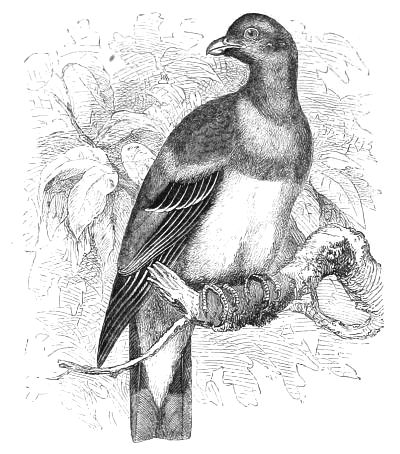
THE PARROT PIGEON (Phalacroteron Abyssinica).
The Ring-dove, so called on account of the white feathers that partially encircle the throat, is the largest of all the wild Pigeons met with in Europe, the warm and temperate portions of which it frequents in large numbers, only visiting such northern countries as Sweden and Norway during the warm seasons. It is particularly fond of fir plantations, and in these its tender, cooing note may be heard during the entire spring and summer. In England these Pigeons resort to woods, coppices, and enclosed ground; and in winter assemble and roost in large parties on the summits of lofty trees, the ash-tree affording them a very favourite gathering-place. Their food consists of young leaves and seeds of various kinds, according to the season of the year. In spring and summer they subsist principally on the tender leaves of growing plants, and often commit great ravages in fields of beans and peas. Spring-sown corn is also attacked by them, both in the grain and the blade; and as soon as young turnips have put forth their second leaves, they, too, become objects of devastation. As the season advances they visit the corn-fields, especially those in the neighbourhood of their native woods, and seek for oily seeds of all kinds with great eagerness. At the approach of autumn they assemble in small flocks, and resort to oak and beech trees, where acorns and beech-mast, swallowed whole, afford them an abundant and nourishing diet. In winter these small flocks unite, and form larger ones, so large, indeed, that it would appear probable that their numbers are considerably augmented by arrivals from colder climates. Both parents assist in making their strange and carelessly constructed abode, which scarcely deserves to be called a nest, being nothing more than a mere platform of twigs, so loosely put together that the brood is distinctly visible through the interstices. The fork of a branch is usually selected as a resting place for the nest. The eggs, two in number, are long, rough-shelled, and of a glossy white; both ends are of equal breadth. The work of incubation is shared by both parents; the father, in such broods as we have observed, taking his place upon the nest from about nine or ten in the morning till three or four in the afternoon. When first hatched the young are fed with pulp from the crops of the adult birds, and, when older with softened seeds. When strong enough to go forth into the world, each parent takes care of a fledgling, and conducts it into the fields to seek for food on its own account. Towards man these birds exhibit much timidity, and if disturbed whilst brooding often desert their eggs.
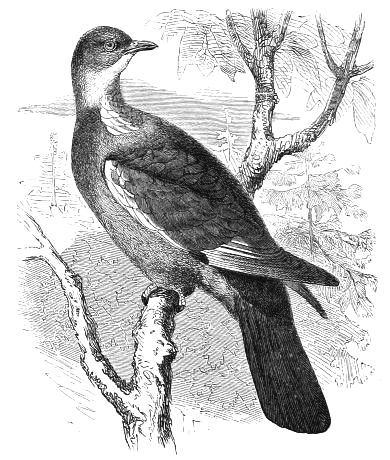
THE RING-DOVE, OR WOOD PIGEON (Palumbus torquatus).
The Ring-dove is easily tamed, but very rarely breeds in captivity; and even when reared from the nest, if set at liberty, it at once seeks its native woods, and never voluntarily returns.
In all ages of the world this Dove has been regarded with especial favour, and, as a sacred symbol, is in some countries regarded with particular reverence.
The Himalayan Cushat differs from the European by the neck-patch being clayey buff instead of white, and much contracted in size, also in the less extent of the white border to the primaries. Mr. Blyth also notices that whilst in European birds the green gloss prevails above the neck-patch, and amethystine below, the reverse is the case in the Asiatic race. This Wood Pigeon has only been found in the North-western Himalayas, near Simla, and in the Alpine Punjaub. It visits the salt range and the plains of the Punjaub during winter.
THE STOCK DOVE.
The STOCK DOVE (Columba œnas) is of a deep blue upon the head, throat, upper wings, lower part of back, and rump; the upper portion of the back is deep greyish blue, the region of the crop rich deep red; the rest of the under side pale blue. The quills and ends of the tail-feathers are slate-blue, the wing is decorated with a dark band, and the neck enlivened by the metallic lustre common to the race of Pigeons. The eye is deep brown, the beak pale yellow, with dark flesh-pink base, powdered with white, and the foot pale red. The young resemble the parent birds, but are duller in their colours. The length of this species is from twelve inches to twelve and a half, and its breadth from twenty-five to twenty-six inches; the wing measures eight inches and a half and the tail five inches.
Many authors have regarded this as the same species as the Rock Dove, or as having but trifling differences. Yarrell, however, considers them to be perfectly distinct, both as to habits, voice, plumage, and the localities which they frequent. "The Stock Dove," says this accurate author, "was called œnas[A] on account of the vinous claret-colour of the plumage of the neck; and Stock Dove, not because it was by some considered to be the origin of our domestic stock, but because it builds in the stocks of trees, particularly such as have been headed down, and have become in consequence rugged and bushy at the top." In more open parts of the country, holes in the ground are selected as breeding-places, especially the burrows of rabbits. When the warreners find the young in a burrow, they fix sticks at the mouth of the hole in such a manner as to prevent the escape of the young, but so as to allow the old birds to feed them. Bishop Stanley refers to this bird's habit of building in holes as illustrative of a passage in Scripture. He says; "In the Eastern countries and the Holy Land, the Wild Pigeons almost invariably prefer such situations to trees, thus confirming the words of the prophet, who speaks of the 'dove that maketh her nest in the sides of the hole's mouth' (Jer. xlviii. 28)."
When the eggs are laid in this manner in deserted burrows, they are either placed on the bare sand or upon a few dried roots, about a yard within the entrance. The Stock Dove also nestles under furze bushes, or in the holes of decayed trees. The eggs are two in number, oval and white, and are laid about the end of March or beginning of April. The food of the Stock Dove is similar to that of the last-mentioned species.
The Columba œnas has not been found in Scotland. On the continent of Europe it is abundant, visiting the central and northern parts during the summer, and it has been seen in Northern Africa. It is also said to be met with in the Deccan. The harsh and somewhat grunting note of this species is usually uttered while the bird is perching, and is accompanied by considerable inflation of the throat. When in flight its movements are very rapid and noisy, the wings producing a rushing sound, which gradually becomes shriller and clearer, but altogether subsides when the gently hovering motion commences that precedes alighting. So strong is the love of the Stock Dove for its favourite retreat, that even if repeatedly alarmed it returns immediately to its place. The period of incubation commences early in spring, and, if not disturbed, the female produces three broods in the season, the first eggs being deposited by the beginning of April. During the whole time his mate is thus busily engaged, the male bird testifies the greatest devotion, keeping close to her, and constantly uttering his cooing note. Many are the quarrels that ensue between the various couples at this period, for, as each requires an unused hole in some tree wherein to deposit a brood, the demand is usually greater than the supply, and as these localities are also much resorted to by such formidable antagonists as Starlings, Woodpeckers, and Jackdaws, the domestic career of a pair of Stock Doves is by no means one of uninterrupted peace and harmony. This constant change of domicile is rendered necessary by the rapid accumulation of the castings from the young, with which the inmates become so soiled that some time elapses after they have left the nest before the feathers are thoroughly purified; fortunately for the building birds, by the following season, insects of various kinds and the busy Woodpecker have cleared away the refuse from the holes, and made them fit for occupation. We are told that the affection of this species for its brood is so strong that it is almost impossible to force the parent birds away, and that a female Stock Dove will remain to be shot rather than desert her eggs.
THE ROCK DOVE.
The ROCK DOVE (Columba livia)—see Coloured Plate XXVII.—is of a pale greyish hue on the mantle and bright blue on the under side; the head is light slate-blue, the throat deep slate-colour, glistening above with bright blueish green, and on its lower portion with a purple gloss; the rump is white. Two black lines pass across the deep grey wings; the tail-feathers are dark bright blue, tipped with black; those at the exterior are white on the outer web. The eye is sulphur-yellow, the beak black, with a light blue base, and the foot deep blueish red. The sexes are alike, and the young somewhat deeper in their colours than the adult birds. This species is thirteen inches long and twenty-three broad; the wing measures eight inches and one-sixth and the tail four inches and one-third.
The Rock Dove in its natural state inhabits rocky sea-coasts, flying only sufficiently inland to procure food. It is spread over a very wide range of country, being met with as far north as the Faroe Islands, and as far southward as Africa. In Great Britain it is found both on the southern coasts of England and in the east and west of Scotland. In the Orkneys it breeds in the crevices of the rocks, the nests being at such a depth that they are quite out of reach. During the day the Doves associate in flocks and search for food, which consists principally of grain and seeds.
The Rock Dove breeds twice in the season, each brood consisting of two young, generally a male and a female. The eggs are white and of a short oval shape, rather pointed at one end. From this species our Dove-cote Pigeons are derived, and they, like their original progenitors, seldom roost or settle on trees.
The nest of the Rock Dove is a mere heap of straw, dry grass, and twigs, with a slight hollow in its centre for the reception of the eggs, which have a glossy, pure white shell. The female alone builds, but is supplied with materials by her devoted mate, who remains constantly near her both day and night. The blind and unusually helpless young are hatched about sixteen or eighteen days after the eggs are laid, and leave the shell within from twenty-four to thirty-six hours of each other. As with their congeners, the nestlings are at first nourished with pulp from the crops of their parents, then with partially digested seeds, and when fledged, with hard seeds, with the addition of tiny pebbles and bits of clay, to assist the still weak gizzard in the work of trituration. When about a month old the young are strong enough to quit the nest in company with their parents, who, however, soon leave them to their own devices, and at once commence their preparations for a second brood.
"The Blue Pigeon, or Rock Dove of India" says Jerdon, "differs from that of Europe only in having an ash-coloured instead of pure white rump. It is one of the most common and abundant birds, congregating throughout the country in large flocks, and breeding wherever they can find suitable spots. They are most partial to large buildings, such as churches, pagodas, mosques, tombs, and the like, frequently entering verandahs of inhabited houses and building in the cornices. Hollows in walls of cities or towns are favourite places, and in some parts of the country they prefer holes in wells. In default of such spots they will breed in crevices and cavities of rocks, caverns, and sea-side cliffs, and are particularly partial to rocky waterfalls. The celebrated falls of Gaissoppa are tenanted by thousands of Blue Pigeons. These Pigeons are held in respect by most Hindoos, and almost venerated by some, insomuch that if a pair build in the house of a native he considers it a favourable omen."
The CUCKOO PIGEONS (Macropygiæ) constitute a group distinguishable by the slender formation of their bodies, their small heads, long tails, and short wings and feet. These birds are all eminently social in their habits, and frequently keep together in large flocks. All subsist principally upon fruit and seeds, and, in order to obtain these, constantly occupy woods and forests, from whence they occasionally venture forth to seek for food in well-planted gardens and orchards.
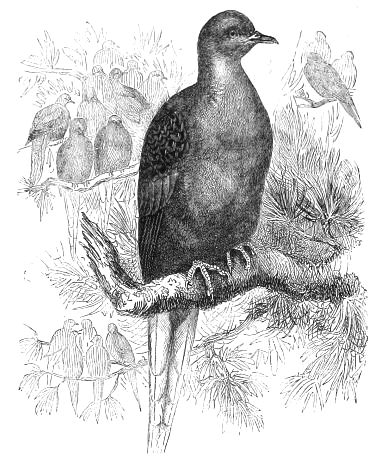
THE PASSENGER PIGEON (Ectopistes migratorius).
THE PASSENGER PIGEON, OR CAROLINA TURTLE-DOVE.
The CAROLINA TURTLE-DOVE, or PASSENGER PIGEON (Ectopistes migratorius), a large and well-known member of the above group, inhabiting North America, is very powerfully built, and has a long neck and small head. The medium-sized beak is slenderly formed, and the wing, in which the second quill exceeds the rest in length, long and pointed; the tail is long and graduated, the tarsus strong, but shorter than the centre toe without its claw. The plumage of the mantle is slate-blue and the under side reddish grey; the sides of the throat gleam with violet; the belly and vent are white, the wings black, edged with white; the centre tail-feathers are black, those at the side light grey, marked with greyish brown and black spots at the base of the inner web. The eye is of a brilliant red, the beak black, and the foot crimson. The female is smaller than her mate, with duller plumage, in which greyish brown predominates; her back and rump are whitish grey, and the centre tail-feathers reddish brown. The length of the male is sixteen inches and a quarter, and his breadth twenty-five inches; the wing measures seven inches and two-thirds, and the tail eight inches and one-sixth. In the female, the length is only fifteen and the breadth twenty-three inches. The Carolina Pigeons inhabit the United States during the summer season, from Canada to Florida, and from the sea-coast to the west of the Mississippi. In the Northern and Middle States they are partially migratory. In North and South Carolina they assemble in flocks during the winter, sometimes of many hundred individuals, but in the spring they return northward, and most frequently fly in pairs, more than three or four being rarely seen together. Their flight is rapid, and generally accompanied by a whistling sound. They frequently circle about, but seldom mount above the trees, visiting the fields for the grain they may be able to glean, and live principally on seeds, acorns, and berries; they are also fond of hempseed and Indian corn. In the winter, when food is scarce, they visit the farmyards, and feed in company with other guests.
The nest is but slightly formed of a few twigs, and lined with dry root-fibres. The eggs, two in number, are snow-white. The young are fed by both parents. More than two broods are seldom produced in the year, sometimes there is only one, but this appears to depend upon the time of laying, which in some parts of the United States begins as early as March, in others not until the middle of May, and on the borders of Lake Superior still later in the year. The usual roosting-places of these birds are among long grass in deserted fields, or dried stalks of corn, amid the stubble, or among the withered foliage of trees. They will return to favourite roosting-grounds from a considerable distance; but though a whole flock often settles in one locality, they seldom roost very near to each other, and if any one approach, even in the darkest night, will at once rise and take flight. The note of the Carolina Turtle Dove is low, plaintive, and repeated at intervals; in the early spring it may be heard among the newly-budding trees of the forest, even at a considerable distance.
"The Passenger Pigeon," writes Audubon, "or, as it is usually named in America, the Wild Pigeon, moves with extreme rapidity, propelling itself by quickly repeated flaps of the wings, which it brings more or less near the body, according to the degree of velocity which is required. Like the Domestic Pigeon, it often flies during the love season in a circling manner, supporting itself with both wings angularly elevated, in which position it keeps them until it is about to alight. Now and then, during these circular flights, the tips of the primary quills of each wing are made to strike against each other, producing a smart rap, which may be heard at a distance of thirty or forty yards. Before alighting, the Wild Pigeon, like the Carolina Parrot and a few other species of birds, breaks the force of its flight by repeated flappings, as if apprehensive of receiving injury from coming too suddenly in contact with the branch or spot of ground on which it intends to settle. I have commenced my description of this species with the above account of its flight because the most important facts connected with its habits relate to its migrations. These are entirely owing to the necessity of procuring food, and are not performed with a view of escaping the severity of a northern latitude, or of seeking a southern one for the purpose of breeding. They, consequently, do not take place at any fixed period or season of the year; indeed, it sometimes happens that a continuance of a sufficient supply of food in one district will keep these birds absent from another for years. I know that in Kentucky they remained for several years constantly, and were nowhere else to be found. They all suddenly disappeared, when the mast was exhausted, and did not return for a long period.
"Their great power of flight enables them to survey and pass over an astonishing extent of country in a very short time. This is proved by facts well known. Thus, Pigeons have been killed in the neighbourhood of New York with their crops full of rice, which they must have collected in the fields of Georgia and Carolina, these districts being the nearest in which they could possibly have procured a supply of that kind of food. As their power of digestion is so great that they will decompose food entirely in twelve hours, they must in this case have travelled between three and four hundred miles in six hours, which shows their average rate of speed to be at about one mile in a minute. A velocity such as this would enable one of these birds, were it so inclined, to visit the European continent in less than three days.
"This great power of flight is seconded by as great a power of vision, which enables them, as they travel at that swift rate, to inspect the country below, discover their food with facility, and thus attain the object for which their journey has been undertaken. This I have also proved to be the case by having observed them, when passing over a sterile district, or one scantily furnished with food suited to them, keep high in the air, flying with an extended front, so as to enable them to survey hundreds of acres at once. On the contrary, when the land is richly covered with food, or the trees abundantly hung with mast, they fly low, in order to discover the part most plentifully supplied."
The innumerable hosts in which the Passenger Pigeon moves, as related by Audubon and Wilson, might seem to be almost fabulous.
"On my way to Frankfort," says the latter writer, "when about one o'clock, the Pigeons which I had observed the greater part of the morning flying northerly began to return in such immense numbers as I had never before witnessed. Coming to an opening by the side of a creek called the Benson, where I had a more uninterrupted view, I was astonished at their appearance. They were flying with great steadiness and rapidity at a height beyond gunshot, in several strata deep, and so close together that could shot have reached them one discharge could not have failed of bringing down several individuals. From right to left, as far as the eye could reach, the breadth of this vast procession extended, seeming everywhere equally crowded. Curious to determine how long this appearance would continue, I took my watch out to note the time, and sat down to observe them. It was then half-past one. I sat for more than an hour, but instead of any diminution of this prodigious procession, it seemed to increase in numbers and rapidity, and, anxious to reach Frankfort before night, I rose and went on. About four o'clock in the afternoon I crossed the Kentucky River, at the town of Frankfort, at which time the living torrent above my head seemed as numerous and as extensive as ever. Long after this I observed them in large bodies, that continued to pass for six or eight minutes, and these again were followed by other detached bodies, all moving in the same direction, till after six in the evening. The great breadth of front which this mighty multitude preserved would seem to intimate a corresponding breadth of their breeding-place."
"In the autumn of 1813," relates Audubon, "I left my house at Henderson, on the banks of the Ohio, on my way to Louisville. In passing over the Barrens, a few miles beyond Hardensburg, I observed the Pigeons flying from north-east to south-west in greater numbers than I had ever seen them before, and feeling an inclination to count the flocks that might pass within reach of my eye in one hour, I dismounted, seated myself on an eminence, and began to mark with my pencil, making a dot for every flock that passed. In a short time, finding the task that I had undertaken impracticable, as the birds poured on in countless multitudes, I rose, and counting the dots that had been put down, found that one hundred and sixty-three had been made in twenty-one minutes. I travelled on, and still met more the farther I proceeded. The air was literally filled with Pigeons; the light of noon-day was obscured as by an eclipse; the dung fell in spots, not unlike melting flakes of snow, and the continued buzz of wings had a tendency to lull my senses to repose.
"While waiting for dinner at Young's Inn, at the confluence of Salt River with the Ohio, I saw at my leisure immense legions still going by, with a front reaching far beyond the Ohio on the west, and the beech-wood forests directly on the east of me. Not a single bird alighted; for not a nut or acorn was that year to be seen in the neighbourhood. They consequently flew so high that different trials to reach them with a rifle proved ineffectual, nor did the reports disturb them in the least. I cannot describe to you the extreme beauty of their aërial evolutions. When a Hawk chanced to press upon the rear of a flock, at once, like a torrent, and with a noise like thunder, they rushed into a compact mass, pressing upon each other towards the centre. In these almost solid masses they darted forward in undulating and angular lines, descended and swept close over the earth with inconceivable velocity, mounted perpendicularly, so as to resemble a vast column, and when high in the air were seen wheeling and twisting within their continued lines, which then resembled the coils of a gigantic serpent.
"Before sunset I reached Louisville, distant from Hardensburg fifty-five miles. The Pigeons were still passing in undiminished numbers, and continued to do so for three days in succession. The people were all in arms. The banks of the Ohio were crowded with men and boys, incessantly shooting at the pilgrims, which there flew lower as they passed the river. Multitudes were thus destroyed. For a week or more the population fed on no other flesh but Pigeons', and talked of nothing but Pigeons.
"It is extremely interesting to see flock after flock performing exactly the same evolutions which had been traced as it were in the air by a preceding flock. Thus, should a Hawk have charged on a group at a certain spot, the angles, curves, and undulations that have been described by the birds in their efforts to escape from the dreaded talons of the plunderer are undeviatingly followed by the next group that comes up. Should the bystander happen to witness one of these affrays, and, struck with the rapidity and elegance of the motions exhibited, feel desirous of seeing them repeated, his wishes will be gratified if he only remain in the place until the next group comes up.
"Perhaps it may not be amiss to make an estimate of the number of Pigeons contained in such a host, and of the amount of food consumed by them. Granting the procession to be a mile broad, which is certainly no exaggeration, and that at a given speed it travels for three hours, we obtain a parallelogram of eighteen square miles, English measure; this, reckoning only two pigeons to the square yard, would give 1,000,115,736,000 individuals in such a flight; and if each Pigeon required daily half a pint of food, the whole multitude would consume 8,712,000 bushels daily. Wilson makes a similar calculation, and arrives at the conclusion that one swarm contains more than 2,000,000,000,000 Pigeons, and requires daily 17,424,000 bushels of corn.
"As soon as the Pigeons discover a sufficiency of food to entice them to alight, they fly round in circles, reviewing the country below. During their evolutions on such occasions, the dense mass which they form exhibits a beautiful appearance as it changes its direction, now displaying a glistening sheet of azure, when the backs of the birds come simultaneously into view, and anon suddenly presenting a mass of rich deep purple. They then pass lower over the woods, and for a moment are lost among the foliage, but again emerge and are seen gliding aloft. They now alight, but the next moment, as if suddenly alarmed, take flight, producing by the flapping of their wings a noise like the roar of distant thunder, and sweep through the forests to see if danger is near. Hunger, however, soon brings them to the ground. When alighted, they are seen industriously throwing up the dead leaves in quest of the fallen mast. The rear ranks are continually rising, passing over the main body, and alighting in front in such rapid succession that the whole flock seems still on the wing. The quantity of ground thus swept is astonishing, and so completely has it been cleared that the gleaner who might follow in their rear would find his labour completely lost. Whilst feeding, their avidity is at times so great that, in attempting to swallow a large acorn or nut, they are seen gaping for a long while as if in the agonies of suffocation.
"On such occasions, when the woods are filled with these Pigeons, they are killed in immense numbers, although no apparent diminution ensues. About the middle of the day, after their repast is finished, they settle on the trees to enjoy rest and digest their food. On the ground they walk with ease, as well as on the branches, frequently jerking their beautiful tail, and moving the neck backwards and forwards in the most graceful manner. As the sun begins to sink beneath the horizon, they depart en masse for the roosting-place, which not unfrequently is hundreds of miles distant, as has been ascertained by persons who have kept an account of their arrival and departure.
"Let us now, kind reader," continues Audubon, "inspect their place of nightly rendezvous. One of these curious places, on the banks of the Green River, in Kentucky, I repeatedly visited. It was, as is always the case, in a portion of the forest where the trees were of great magnitude, and where there is little underwood. I rode through it upwards of forty miles, and, crossing it in different parts, found its average breadth to be more than three miles. My first view of it was about a fortnight subsequent to the period when they had made choice of it, and I arrived there nearly two hours before sunset. Few Pigeons were then to be seen, but a great number of persons, with horses and wagons, guns and ammunition, had already established encampments on the borders. Two farmers from the vicinity of Russelsville, distant more than a hundred miles, had driven upwards of three hundred hogs to be fattened on the Pigeons which were to be slaughtered. Here and there the people employed in plucking and salting what had already been procured were seen sitting in the midst of large piles of these birds. The dung lay several inches deep, covering the whole extent of the roosting-place. Many trees, two feet in diameter, I observed were broken off at a great distance from the ground, and the branches of many of the largest and tallest had given way, as if the forest had been swept by a tornado. Everything proved to me that the number of birds resorting to this part of the forest must be immense, beyond conception. As the period of their arrival approached, their foes anxiously prepared to receive them. Some were furnished with iron pots, containing sulphur, others with torches of pine-knots, many with poles, and the rest with guns. The sun was lost to our view, yet not a Pigeon had arrived. Everything was ready, and all eyes were gazing on the clear sky which appeared in glimpses amidst the tall trees. Suddenly there burst forth a general cry of 'Here they come!' The noise which they made, though yet distant, reminded me of a hard gale at sea, passing through the rigging of a close-reefed vessel. As the birds arrived and passed over me, I felt a current of air that surprised me. Thousands were knocked down by the pole-men. The birds continued to pour in. The fires were lighted, and a magnificent, as well as wonderful and almost terrifying sight presented itself. The Pigeons, arriving by thousands, alighted everywhere one above the other, until solid masses were formed on the branches all round. Here and there the perches gave way under the weight with a crash, and, falling to the ground, destroyed hundreds of birds beneath, forcing down the dense groups with which every stick was loaded. It was a scene of uproar and confusion. I found it quite useless to speak, or even to shout to those persons who were nearest to me. Even the reports of the guns were seldom heard, and I was made aware of the firing only by seeing the shooters re-loading. No one dared to venture within the line of devastation. The hogs had been penned up in due time, the picking up of the dead and wounded being left for the next morning's employment. The Pigeons were constantly coming, and it was past midnight before I perceived a decrease in the number of those that arrived. The uproar continued the whole night, and, as I was anxious to know to what distance the sound reached, I sent off a man accustomed to perambulate the forest, who, returning two hours afterwards, informed me he had heard it distinctly when three miles distant from the spot. Towards the approach of day the noise in some measure subsided; long before objects were distinguishable the Pigeons began to move off in a direction quite different from that in which they had arrived the evening before, and, at sunrise, all that were able to fly had disappeared. The howling of the wolves now reached our ears, and the foxes, lynxes, cougars, bears, racoons, opossums, and polecats were seen sneaking off, while Eagles and Hawks of different species, accompanied by a crowd of Vultures, came to supplant them, and enjoy their share of the spoil.
"It was then that the authors of this devastation began their entry among the dead, the dying, and the mangled. The Pigeons were picked up and piled in heaps, until each had as many as he could possibly dispose of, when the hogs were let loose to feed on the remainder."
Precisely the same slaughter takes place in the nesting-places of the Passenger Pigeon, and Audubon goes on to describe these localities in the following manner:—
"The breeding of the Wild Pigeons, and the places chosen for that purpose, are points of great interest. The time is not much influenced by season, and the place selected is where food is most plentiful and most attainable, and always at a convenient distance from water. Forest trees of great height are those in which the Pigeons form their nests. Thither the countless myriads resort, and prepare to fulfil one of the great laws of nature. At this period the note of the Pigeon is a soft 'coo-coo-coo-coo,' much shorter than that of the domestic species. The common notes resemble the monosyllables 'kee-kee-kee-kee,' the first being the loudest, the others gradually diminishing in power. The male assumes a pompous demeanour, and follows the female, whether on the ground or on the branches, with spread tail and drooping wings. The body is elevated, the throat swells, the eyes sparkle. He continues his note, and now and then rises on the wing, and then flies a few yards to approach the fugitive and timorous female. Like the Domestic Pigeon and other species, they caress each other by billing, in which action the bill of one is introduced transversely into that of the other, and both parties alternately disgorge the contents of their crops by repeated efforts. These preliminary affairs are soon settled, and the Pigeons commence their nests in peace and harmony. They are composed of a few dry twigs, crossing each other, and are supported by forks of the branches. On the same tree from fifty to one hundred nests may frequently be seen; I might say a greater number, were I not anxious that, however wonderful my account of the Wild Pigeon is, you may not feel disposed to refer it to the marvellous. The eggs are two in number, of a broadly elliptical form, and pure white. During incubation the male supplies the female with food. Indeed, the tenderness and affection displayed by these birds towards their mates, are in the highest degree striking. It is a remarkable fact that each brood generally consists of a male and a female. The young are fed by the parents in the manner described above; in other words, the old bird introduces its bill into the mouth of the young one in a transverse manner, or with the back of each mandible opposite the separations of the mandibles of the young bird, and disgorges the contents of its crop. As soon as the young birds are able to shift for themselves they leave their parents, and continue separate until they attain maturity; by the end of six months they are capable of reproducing their species.
"Here, again, the tyrant of creation, man, interferes, disturbing the harmony of this peaceful scene. As the young birds grow up, their enemies, armed with axes, reach the spot, to seize and destroy all they can. The trees are felled and made to fall in such a way that the cutting of one causes the overthrow of another, or shakes the neighbouring trees so much that the young Pigeons or Squabs, as they are named, are violently hurled to the ground. In this manner also immense quantities are destroyed."
Wilson thus describes the breeding-places in detail:—"When the Passenger Pigeons have frequented one of these places for some time, the appearance it exhibits is surprising. The ground is covered to the depth of several inches with their dung; all the tender grass and underwood destroyed; the surface strewed with large limbs of trees broken down by the weight of the birds clustering one above another; and the trees themselves, for thousands of acres, killed as completely as if girdled with an axe. The marks of this desolation remain for years on the spot, and numerous places could be pointed out where, for several years after, scarcely a single vegetable made its appearance. By the Indians such a breeding-place is considered an important source of national profit and supply during the season, and all their active ingenuity is exercised on the occasion.
"Not far from Shelbyville, in the State of Kentucky, there was one of these breeding-places, which stretching through the woods in nearly a north and south direction, was several miles in breadth, and was said to be upwards of forty miles in extent. In this tract almost every tree was furnished with nests, wherever the branches could accommodate them. The Pigeons made their first appearance there about the tenth of April, and left it altogether with their young before the twenty-fifth of May. As soon as the young were fully grown, and before they left the nests, numerous parties of the inhabitants from all parts of the adjacent country came with wagons, axes, beds, and cooking utensils, many of them accompanied by the greater part of their families, and encamped for several days at this immense nursery. Several of them informed me that the noise in the woods was so great as to terrify their horses, and that it was difficult for one person to make another hear without bawling in his ear. The ground was strewed with broken limbs of trees, eggs, and young Squab Pigeons, which had been precipitated from above, and on which herds of hogs were fattening. Hawks, Buzzards, and Eagles were sailing about in great numbers, and seizing the Squabs from their nests at pleasure; while, from twenty feet upwards to the tops of the trees, the view through the woods presented a perpetual tumult of fluttering and crowding Pigeons, their wings roaring like thunder, mingled with the frequent crash of falling timber, for now the axe-men were at work, cutting down those trees that seemed to be most crowded with nests."
Persons unacquainted with these birds might naturally conclude that such dreadful havoc might soon put an end to the species, "but I have satisfied myself," remarks Audubon, "by long observation, that nothing but the gradual diminution of our forests can accomplish their decrease." In 1805 there came into New York schooners laden in bulk with Pigeons caught up the Hudson River, which were sold for a cent apiece. A man in Pennsylvania caught in a clap-net in one day, upwards of five hundred dozens, sweeping sometimes twenty dozen or more at a single haul; and in the month of March, 1830, they were so abundant in the markets of New York that piles of them met the eye in every direction.
The TURTLE DOVES (Turtures) constitute a very numerous section, whose members are all recognisable by their slender body, small head, long wings and tail, and the comparative length of their feet, which enables them to walk over the surface of the ground. The plumage is usually of a reddish hue, and in most species adorned by a broad line around the throat. This band is either black or spotted black and white.
The various members of this group inhabit almost every portion of the globe, Asia and Africa being particularly rich in species. In their habits they resemble other Pigeons, but are readily distinguished from them by the peculiarities of their flight and cry. The Turtle Doves are of a social disposition, and frequently assemble in large flocks, which fly over large tracts of the surrounding country, after the manner of the Passenger Pigeons of North America, described above. Brushwood or groves of low trees are the situations which they principally frequent, though many species also occupy the moist depths of primeval forests, and evidently prefer such localities as are in the immediate vicinity of water. The carelessly-constructed nest is usually placed in low brushwood, at but a little distance from the ground.
THE TURTLE DOVE.
The TURTLE DOVE (Turtur auritus) possesses a slender body, straight beak, slightly compressed at the tips of both mandibles, long, weak-toed feet, long wings, in which the second and third quills exceed the rest in length, and a very decidedly rounded, long tail. The feathers on the back are brownish grey, edged with brown and spotted with black and grey in the centre; the top of the head and nape are light greyish blue, the sides of the throat adorned with four black streaks, bordered with silvery white; the throat, region of the crop, and upper breast are deep red, the rest of the under side is purplish grey, shading gradually into greyish white; the primary quills are blackish grey, the secondaries greyish blue, the shoulder-feathers of a blackish hue, broadly edged with rust-red. The eye is brownish yellow, the eye-ring blueish red, the beak black, and the foot carmine-red. This species is eleven inches long and nineteen and a half broad; the wing measures six and a half and the tail five inches.
The Turtle Dove is spread over the whole continent of Europe, even very far northward, but is not found within the Arctic Circle. In the autumn it visits the shores of the Mediterranean, going still farther southward as the season advances. It feeds on grain and vegetables, frequenting fields of corn and peas. The note is a soft and mournful "coo," often uttered when the bird is on the ground. The Turtle Dove is merely a summer visitor to the British Islands, arriving in April or May. It is more numerous in the southern and midland than in the northern counties, but it has been seen both in Scotland and Ireland. It frequents woods and fir plantations, and also thick hedges of ploughed fields.
The nest of this species is placed in the forked branch of an oak, in a fir-tree, or near the top of a tall thick bush. Both parents sit by turns, the male sometimes feeding his mate, and both combining to procure food for their young. In England, only one brood is produced during the year. In the autumn, the Turtle Doves fly in parties of ten or twelve, departing at the close of the fine season to winter in Africa.
Jerdon tells us that among the Indian species the Ashy Turtle Dove most resembles that of Great Britain.
The INDIAN RING-DOVES (Streptopelcia) have a shorter and less abruptly rounded tail than that possessed by the members of the above group; the line around the neck completely encircles it, and the general coloration of the plumage is of a lighter shade. They are all remarkably beautiful birds.
THE INDIAN RING-DOVE.
The INDIAN RING-DOVE (Streptopelcia risoria) has a somewhat shorter and less decidedly rounded tail than the Turtle Dove. The plumage of this species is principally of creamy yellow, darkest on the back, and with the head, throat, and belly of a light shade; the neck is decorated with a black collar; the quills are of a blackish hue; the eye is light red, the beak black, and the foot carmine-red. The length of this bird is twelve and its breadth twenty inches; the wing measures six inches and a half, and the tail five inches.
The western part of India, Ceylon, Yemen, Arabia, and a great portion of Eastern Africa form the habitat of the Indian Ring-dove. Reichenbach, it is true, discredits the statement of Le Vaillant and other writers who have described this bird as being met with in Africa, and supposes that they mistake for it a nearly-allied species: we can, however, positively assert, on our own experience, that this Ring-dove has been observed not only near Aden, but in Africa, namely, in Samchara and the forests near the Blue River, and that in extraordinary numbers. We are certain we are not mistaken as to the identity of the species, as we killed and closely examined many African specimens in their native haunts, and found them in every respect like such as inhabit Asia.
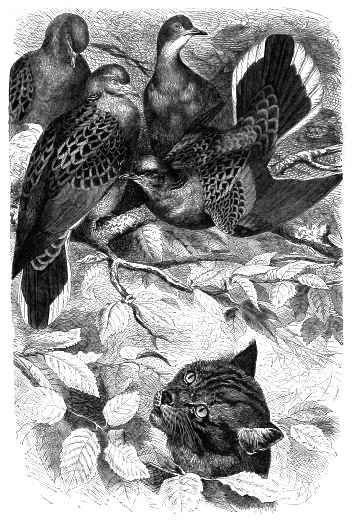
TURTLE DOVES.
This species is generally diffused throughout India, where it frequents hedges and trees in the neighbourhood of cultivated districts, and also low bush or reed jungle; it is also found in Ceylon, but is rare in Malabar and the countries east of the Bay of Bengal. Layard notices its partiality for euphorbia bushes, on which, he says, it generally builds its nest.
Like the other Doves, it breeds in the plains at all seasons, it also appears to ascend the hills near Mussoora to breed there in spring. The "coo," says Blyth, is quite different from that of the domestic Turtle Dove, and may be expressed by "kookoo-koo, kookoo-koo."
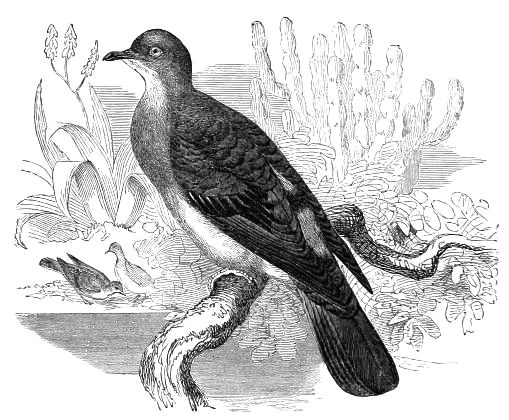
DWARF PIGEON (Chalcopeleia Afra).
THE DWARF PIGEON.
The DWARF PIGEON (Chalcopeleia Afra), a small and delicate species found in Africa, represents a group recognisable by their short, rounded tail, high tarsi, and the very remarkable metallic coloration of the upper secondary quills. In this bird the sombre olive-brown mantle is relieved by a yellowish sheen; the top of the head is grey; the brow and throat are whitish; the under side is reddish grey, with belly of a very pale tint, and black rump. The quills are blackish brown, with cinnamon-red roots and inner web; the metallic patches on the plumage gleam with deep blueish black; the centre tail-feathers are olive-brown, and those at the exterior black. The eye is red, the beak blackish, and the foot yellowish red. This species is seven inches and a quarter long. The wing measures four and the tail three inches.
The Dwarf Pigeon inhabits the southern and eastern parts of Africa, rarely appearing, according to our own observations, farther north than sixteen degrees north latitude. Amongst the forests in the vicinity of the Blue River we met with it constantly, as also in the well-wooded valleys of the Samchara and Abyssinian mountains. In these situations it almost invariably frequents the shelter of thick brushwood, never ascending to the summits of lofty trees, and only quitting its leafy concealment for a few minutes at a time, for the purpose of drinking. The immediate vicinity of water is an indispensable necessity to these birds, and where this is to be found they frequently confine their movements within the limits of a few yards, provided the neighbouring bushes and parasitical plants afford them a constant supply of the various seeds upon which they rely for subsistence. In disposition they are peaceful and unsocial, each pair keeping apart, and never congregating even in small parties. Like most members of this family, the male exhibits the utmost tenderness towards his mate. The nest, which is built indifferently in low bushes close to the ground, on fallen tree trunks, or in hollow trees, resembles that of other Pigeons, but is somewhat stronger, and more neatly built. In Soudan the period of incubation commences with the rainy season. The solitary egg we were able to obtain was found on the fourteenth of January, and had a yellowish white shell.
The GROUND PIGEONS pass their entire lives upon the ground, and are remarkable for the length of their legs. These birds have short or moderate-sized wings, and powerful, high tarsi. The tail is variously formed, being sometimes short, quite straight, slightly rounded, or much prolonged, and wedge-shaped. The members of this group are met with in all parts of the globe except the continent of Europe.
The AMERICAN GROUND PIGEONS (Zenaidæ), as Bonaparte has named such of these birds as inhabit America, have a powerful body, short wings, and long, well-developed legs. The various species comprised in this group are met with in all parts of that continent, but are especially numerous in the south. In their general habits they seem to occupy a position intermediate between Pigeons and Rasoreal Birds, and some of them strikingly resemble certain Partridges.
The SINGING DOVES (Melopeleia) have comparatively long wings, a moderate-sized tail, and plumage much resembling that of the Turtle Dove. The region of the eye is bare. Of these the best known is
THE KUKULI.
The KUKULI (Melopeleia meloda) is a species inhabiting South America. This bird has reddish brown plumage, shaded with yellow. The crown of the head is deep brown; the under breast and belly are of greyish hue; the wings dark brown, bordered with greyish white; the tail-feathers blackish grey tipped with white. Under the ear is an oval black spot, and the sides of the neck are decorated with patches of metallic brilliancy. The eye is blackish blue; the eye-ring, or, rather, broad, bare cheek-stripe, is deep blue; the beak black, and the foot red. This species is twelve inches long. The wing measures six inches and three-quarters.
We are without any detailed account of the life of this Pigeon, but are indebted to Tschudi for a short communication respecting it in his "Travels in Peru." "The Kukuli," he writes, "one of the largest species of Pigeon, is a great favourite in this country, and much kept in cages. Its song, which is monotonous, but very melodious, is continued up from the earliest hours of the morning till mid-day, and is re-commenced at sunset. The song consists merely of a threefold repetition of the syllables 'cu-cu-li.' Some of these birds repeat 'cu-cu-li' more than thrice, and their price increases according to the number of their uninterrupted repetitions, which seldom exceed five or six. In Coackacra, however, I heard one of these birds that repeated its 'cu-cu-li' fourteen times, and the owner would not sell his favourite for a less price than fourteen ounces of gold."
The SPARROW PIGEONS (Pyrgitænas), the smallest members of the entire order, are strongly-built birds, with a short neck and small head. Their wings, in which the second quill is the longest, are of medium length; the tail, composed of twelve feathers, is comparatively short, and rounded at its tip; the short beak is straight and delicate, the foot small, and the tarsus bare.
THE SPARROW PIGEON, OR GROUND DOVE.
The SPARROW PIGEON, or GROUND DOVE, as it is called in North America (Pyrgitænas passerina, or Columba passerina), is principally of a greyish brown, with dark grey crown of head and nape. The rump is dull brownish grey, and the breast whitish; the feathers on the breast and fore part of the throat are edged with deep brown; the quills are dark brown, with brownish red inner web; the tail-feathers black, those at the exterior bordered with white on the outer web; the feathers on the wing-covers are enlivened by round spots of metallic lustre. The eye is bright orange, the beak pale red, deepest in shade at its tip; the foot is reddish brown. The Ground Dove is six inches and a half long, and ten inches and a quarter broad. The wing measures three inches and a quarter, the tail two inches and a third.
This species, which is the smallest, most delicate, and inoffensive of all Doves, is a native of the West Indian Islands and the Southern States of North America. In the northern parts of that continent it visits the country near the coast only during the course of its migrations. In Jamaica, on the contrary, it remains throughout the entire year, living in small parties of from four to twenty birds, and frequenting grassy plains or pasture land.
"The flight of the Ground Dove," says Audubon, "is low, easy, and accompanied by a whistling sound, produced by the action of the wings when the bird is surprised and forced to fly; but it seldom flies more than one hundred yards at a time, and, indeed, is extremely attached to the spot it has selected for the season. You may drive it to the opposite end of a field, and yet in a few hours after it may be found in the place whence you raised it. Although it alights on trees or low bushes, on the branches of which it walks with ease, the ground is its usual resort. There it runs with facility, keeping its tail considerably elevated, as if to prevent it from being soiled. It is also fond of alighting on fences, where it is easily observed, and where it may be heard cooing for half an hour at a time. These Pigeons are met with in groups of four or five, and it is seldom that more than a dozen are seen together. They prefer the thinly-grained, sandy portions of cotton-fields, pea-patches, and such places. In East Florida they are seen in the villages, and resort to the orange-groves about them, where they frequently breed." "I have found them," continues our author, "in the famous Spanish fort of St. Augustine, where I have been surprised to see them rise almost perpendicularly to reach above the parapets, by which they insured their escape. They are easily caught in traps, and in that place are sold for six and a quarter cents each. They readily become domesticated, and, indeed, so very gentle are they that I have seen a pair that have been caught at the time when their young ones were quite small, and placed in an aviary, at once cover their little ones, and continue to nourish them until full grown. They afterwards reared a second brood, and showed great spirit in keeping the Jays and Starlings away from their charge. The Ground Doves were fed on rice and other grain."
The nest of this species is large and compact, the exterior formed of dry twigs, with a lining of grass disposed in a circular form. The eggs, deposited in April, are two in number, and of a pure white; usually two, sometimes three broods, are reared in the season. The male struts before the female after the manner of the Barbary Ringed Dove.
"I met with some of these birds," says Audubon, "on Sandy Island, six miles from Cape Sable. They were so gentle that I approached them within less than two yards. Their nest was placed on the top of a cactus, not more than two feet high." In a wild state these Pigeons feed on various small berries and grass seeds, with which they pick up a considerable quantity of small gravel. They also dust themselves with sand, lying down in it after the manner of Partridges.
The SPARROW-HAWK PIGEONS (Geopeleia) are small, graceful birds, remarkable for their slenderness of form and length of tail. Their wings are short and rounded, the tail graduated, and the plumage striped.
THE STRIPED SPARROW-HAWK PIGEON.
The STRIPED SPARROW-HAWK PIGEON (Geopeleia striata) has light brown plumage; all the feathers on the mantle and under side being striped with black; the brow and throat are dark grey, the belly and rump whitish; the quills and feathers of the centre part of the tail-covers of a metallic brown, delicately sprinkled with black towards their roots, and pure white at their extremities. The eye is light brown, the beak pale, and the foot dark yellow. This species is nine inches long, its wing measures three inches and three-quarters.
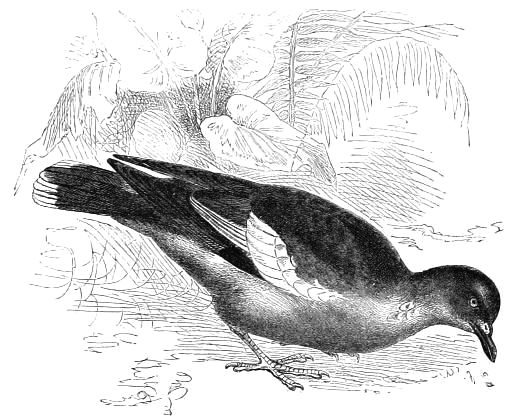
THE KUKULI (Melopeleia meloda).
The Sunda and Molucca Islands must be regarded as the native land of this Pigeon, which is, however, numerously met with not only in the neighbouring countries, but in Europe. In Java it is very highly esteemed as a domestic favourite, its voice being supposed to act as a charm against witchcraft. Many writers speak of this bird as peculiarly interesting when in captivity, but, although it possesses a sweet pleasing voice, we have been unable to discover anything attractive in its habits. Such caged birds as we have observed were extremely quiet, remaining almost motionless throughout the day, and only coming down from their perch to eat or drink.
Plate 26, Cassell's Book of Birds
KAMPHASTOS ERYTHRORHYNCHUS ____ TOUCAN
(over one third Nat. size)
[See larger version]
THE SPECKLED OR WEDGE-TAILED TURTLE DOVE.
The SPECKLED or WEDGE-TAILED TURTLE DOVE (Stictopeleia cuneata) belongs to a group of birds inhabiting the continent of New Holland, distinguishable from the Pigeons above described by their superior length of tail, in which the five outer pairs of feathers are progressively shortened, and by their spotted plumage. The head, throat, and breast are grey; the back and shoulders cinnamon-brown; the feathers on the wing-covers deep grey, and those on the shoulders decorated with two white spots, surrounded by a black line; the belly and feathers on the lower wing-covers are white; the quills brown, with a reddish inner web; the four centre tail-feathers are grey, with black extremities; the rest greenish black at the root and pure white at the tip. The eye is bright red, the bare circle round the eye pale scarlet or greenish yellow; the beak deep olive-brown, and the foot reddish brown, or yellowish. The female is smaller than her mate, and of a more decided brown on the head, throat, and back; the spots on her wing are also fewer, and less clearly defined. The length of this bird is seven inches and three-quarters, the wing measures three inches and a half, and the tail four inches and one-third.
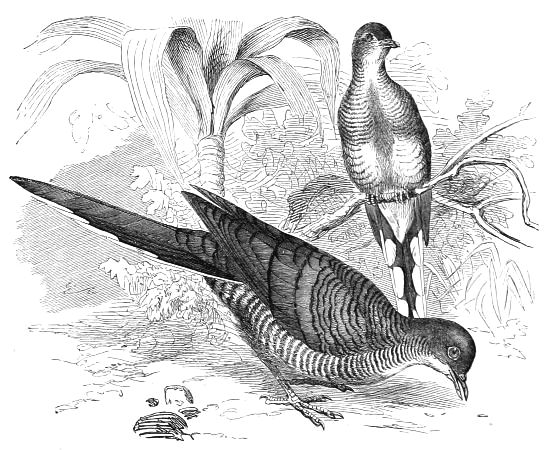
THE STRIPED SPARROW-HAWK PIGEON (Geopeleia striata).
"All that we read or imagine of the softness and innocence of the Dove," says Captain Sturt, "is realised in this beautiful and delicate little bird. It is common on the Murray, and in various parts of the interior of Australia. Two remained with us at the depôt in latitude 39° 40´, longitude 142°, during a greater part of the winter, and on one occasion roosted on my tent-ropes, near a fire. The note of this species is exceedingly plaintive, and, although softer, much resembles the coo of the Turtle Dove."
"The Little Turtle Dove," says Gould, "is more frequently observed on the ground than among the trees. I sometimes met with it in small flocks, but more often in pairs. It runs over the ground with a short bobbing motion of the tail, and while feeding is so remarkably tame as almost to admit of its being taken by the hand; if forced to take wing it merely flies to the nearest tree, and there remains motionless among the branches. I not unfrequently observed it close to the open doors of the huts of the stock-keepers of the interior."
The nest is a frail and beautiful structure, formed of the stalks of a few flowering grasses, crossed and interwoven. "One sent me from Western Australia is composed," says Gilbert, "of a small species of knotted everlasting plant (Composita), and was placed on the overhanging grasses of the Xanthorrhæa. During my first visit to this part of the country, only two situations were known as places of resort to this species, and I did not meet with more than four or five couples; since that period it has become exceedingly abundant, and now a pair or two may occasionally be seen about most of the settlers' houses on the Avon, becoming apparently very tame, and familiarised to man. This bird utters a rather singular note, which at times somewhat resembles the distant crowing of a cock. The term Men-na-brun-ka is applied to it by natives, from a traditionary idea that the bird originally introduced the men-na, a kind of gum which exudes from a species of acacia, and which is one of the favourite articles of food among the natives."
The RUNNING PIGEONS (Geotrygones) are heavy, and powerfully framed, with rounded wings, the first primary quill of which is often much shortened; high, thick tarsi, and short toes. All the species belonging to this group occupy Southern and Central America.
THE PARTRIDGE DOVE.
The PARTRIDGE DOVE (Starnænas cyanocephala), the most remarkable of these birds, has a thick-set body, short wings, the slender, sabre-formed quills of which are pointed at the extremity, the third and fourth being longer than the rest, and a moderately long and rounded tail; the high, broad, and very strong beak is vaulted at its culmen; the feet are long, with thick tarsi and short fleshy toes, armed with large and very decidedly hooked claws. The plumage is dense, and the cheek-stripes bare, overspread with small, oval warts. A beautiful chocolate-brown predominates in the coloration of the feathers, shading into reddish brown on the mantle, and into rich deep red upon the breast. The crown of the head and a few scale-like feathers on the throat are slate-blue; the face, nape, and throat, black; the cheek-stripes, and a line on the lower part of the throat, pure white; the wings dark brown, edged with reddish brown, and shaded with deep grey on the lower side; the centre tail-feathers are chocolate-brown, and those at the sides blackish brown. The eye is dark brown; the beak bright coral-red at the base and greyish blue at the tip; the foot is pale reddish white, with horny plates of deep carmine-red; the toes are deep blueish red, and the skin between them sky-blue. This species is twelve inches long and seventeen broad; the wing and tail each measure five inches.
The island of Cuba must be considered as the native country of these splendid birds, from whence they spread northwards to Florida, southwards to Venezuela. They appear, according to Burmeister, to approach the upper tracts of land near the river Amazon, but do not come farther southwards. It is questionable if they are found in Jamaica. Gosse says, "The Spanish Partridge Dove (Cyanocephala) is not considered as indigenous in Jamaica, though it is frequently imported thither from Cuba." Audubon met with several of them in Florida, and states that "A few of these birds migrate each spring from the island of Cuba to the keys of Florida, but are rarely seen, on account of the deep tangled woods in which they live. Early in May, 1832, while on a shooting excursion, I saw a pair of them on the western side of Key West. They were near the water, picking gravel, but on our approaching them they ran back into the thickets, which were only a few yards distant. Several fishermen and wreckers informed us that they were more abundant on the Mule Keys, but although a large party, including myself, searched these islands for a whole day, not one did we discover there. I saw a pair which I was told had been caught when young on the latter keys, but I could not obtain any other information respecting them than that they were fed upon cracked corn and rice, which answered the purpose well."
Grundlach tells us that the nest of the Partridge Dove is built of twigs and placed amongst the parasitical plants that entwine themselves around the branches of their favourite forest trees. We are without any reliable information concerning the manner of incubation or the appearance of the eggs.
The BRONZE-WINGED PIGEONS (Phapes) also pass a considerable portion of their lives upon the ground, but, unlike the preceding, are furnished with short tarsi and long toes. All are of comparatively large size, and most species powerfully framed, though in some instances their length of tail gives them a somewhat slender appearance. The beak is strong, the wings generally long and pointed, and the tail composed of from fourteen to sixteen feathers of various sizes. The variegated plumage is enlivened by a strong metallic brilliancy. The members of this beautiful group inhabit Oceania.
THE CRESTED BRONZE-WING.
The CRESTED BRONZE-WING (Ocyphaps lophotes), the most striking member of the family, has a slender body, moderately long, pointed wing, and long, graduated tail, formed of fourteen feathers, and wedge-shaped at its extremity. The short beak is hooked at the tip, and the low foot has its centre toe almost as long as the tarsus; the back of the head is decorated with a long, pointed plume. The head, face, breast, and under side are grey; the crest is black, the mantle light olive-brown, shading into red on the sides of the head; the large feathers on the wing-covers are of a glossy, metallic bronze-green, edged with white; the quills brown, narrowly bordered with brownish white, and partially tipped with white; the centre tail-feathers are light brown, the rest of a deeper shade, with a greenish sheen on the outer web and white tips. The eye is orange-red, the bare skin around the eye red, the beak deep olive, with a brown base and black tip, the foot red. The length is thirteen inches and a half, and that of the wing and tail six inches each.
"The chasteness of its colouring," says Mr. Gould, "the extreme elegance of its form, and the graceful crest which flows from its occiput all tend to render this Pigeon one of the most lovely members of its family, and it is therefore to be regretted that owing to its being exclusively an inhabitant of the interior of Australia it can never become an object of general observation. As might be supposed, this bird has attracted the notice of all travellers who have crossed the Blue Mountains." Captain Sturt mentions it as being numerous on the plains of Wellington Valley and in the neighbourhood of the Morumbidgee. "The locality nearest the coast-line that I know it to inhabit is the country near the bend of the river Murray, in South Australia, where it is tolerably abundant. It is numerous on the banks of the Namoi, and is occasionally seen on the Liverpool Plains. It frequently assembles in very large flocks, and when it visits the lagoons or river-sides for water, during the dry seasons, generally selects a single tree, or even a particular branch, on which to congregate before descending simultaneously with its companions to drink."
"Its flight is so rapid as to be unequalled by that of any member of the group to which it belongs. An impetus being given by a few quick flaps of the wing, it goes skimming off, apparently without any further movement of the pinions. Upon alighting on a branch it elevates its tail and throws back its head so as to bring them nearly together, at the same time erecting its crest and showing itself to the utmost advantage."
The nest of this species is built on low trees or bushes, and is very slightly formed of a few twigs. The eggs are white and two in number. According to Captain Sturt, this bird has a particular partiality for the Polygonum geranium, never ascends to higher land if near extensive marshes covered with this plant, and is always found in river-valleys where it grows.
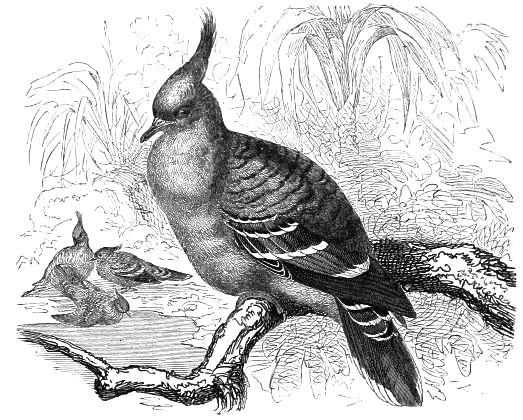
THE CRESTED BRONZE-WING (Ocyphaps lophotes).
The TRUE BRONZE-WINGS (Phaps) are stoutly-framed birds, with long wings and short tails; their beak almost equals the head in length; the powerful tarsus is shorter than the middle toe, and the second and third quills in the pinions are longer than the rest.
THE COMMON BRONZE-WING.
The COMMON BRONZE-WING (Phaps chalcoptera) is brown on the mantle, deep brown at the back of the head, and a rich deep red on the under side, shading into grey on the belly; the brow and a line under the eyes and on the throat are yellowish white; the sides of the throat are grey; the feathers on the wing-covers adorned with oval copper-bronze patches, and two or three of the secondary quills with glossy green spots; the centre tail-feathers are brown, the rest deep grey. The eye is dark reddish brown, the beak blackish grey, and the foot carmine-red. The female is without the light streak upon her brow; her plumage is also greyer, and has fewer bright metallic spots than that of her mate.
The Bronze-winged Pigeon is very generally distributed in all parts of Australia; in some it would seem to be stationary, while in others it is said to be migratory.
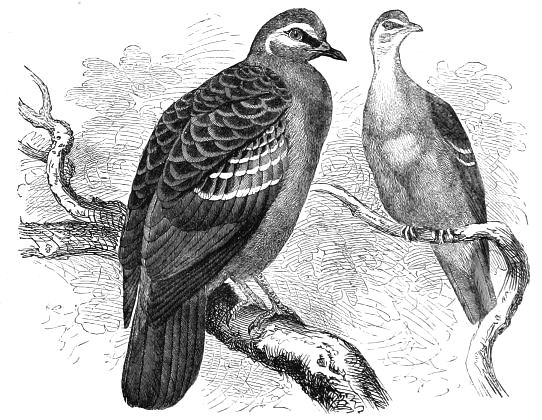
THE BRONZE-WINGED PIGEON (Phaps chalcoptera).
"It is," says Mr. Gould, "a plump, heavy bird, weighing when in good condition fully a pound, and is constantly eaten by every class of persons resident in Australia. Its amazing powers of flight enable it to pass in an incredibly short space of time over a great expanse of country, and just before sunset it may be observed swiftly winging its way over the plains or down the gullies to its drinking-place. During the long drought of 1839-40, when I was encamped at the northern extremity of the Brezi range, I had daily opportunities of observing the arrival of this bird to drink, the only water for miles, as I was assured by the natives, being in the immediate vicinity of my tent, and that merely the scanty supply left in a few small natural basins in the rocks, which had been filled by the rains of many months before. This peculiar situation afforded me an excellent opportunity of observing not only the Bronze-wing, but many other birds inhabiting the neighbourhood. Few if any of the true insectivorous or fissirostral birds came to the water-holes, but on the other hand those species that live upon grain and seeds, particularly the Parrakeets and Honey-eaters (Trichoglossi and Meliphagi), were continually rushing down to the edges of the pools, utterly regardless of my presence, their thirst entirely overcoming their sense of danger. Seldom if ever, however, did the Bronze-wing make its appearance during the heat of the day, but at sundown it arrived with arrow-like swiftness, either singly or in pairs. It did not descend at once to the edge of the pool, but dashed down to the ground at about ten yards distance, remained quiet for a short time, then walked leisurely to the water, and after drinking, winged its way to its roosting-place. With a knowledge, therefore, of the habits of this bird, the weary traveller may always know when he is in the vicinity of water; and however arid the appearance of the country may be, if he observes the Bronze-wing wending its way to a given point, he may be certain to procure a supply of water. When rain has fallen in abundance, and the rivers and lagoons are filled, the case is materially altered; then the Bronze-wing and other birds are not so easily procured."
It is supposed that a partial exodus of these birds takes place from time to time, which Gould thinks very probable. After the termination of the breeding season, both young and old resort to the stubble-fields, and from twenty to thirty brace may be daily killed. This species feeds entirely on the ground, upon a variety of leguminous seeds. It breeds in August and the four succeeding months, and often rears two or more broods. The nest is usually placed on the horizontal branch of an apple or gum tree near the ground, especially on those growing in flat meadow-land in the neighbourhood of water. The nest, which is very frail, is made of small twigs, and of rather hollow form. The two eggs are white, an inch and three-eighths in length, and an inch in breadth.
The QUAIL PIGEONS (Geophaps) differ from the above birds principally in the comparative shortness of their powerful beak, their small, rounded wing, high tarsus, and the bare circle that surrounds the eye. The members of this group inhabit Australia, and breed upon the ground.
THE PARTRIDGE BRONZE-WING.
The PARTRIDGE BRONZE-WING (Geophaps scripta) is light brown on the mantle and breast; the rest of the under side is grey, shading into white, except on the yellowish brown belly. The quills and feathers of the wing-covers have light edges, the outer web of many of the larger feathers gleaming with greenish purple; the throat, upper breast, a broad line from the lower mandible to the eyes, and a spot on the sides of the throat are snow-white, adorned with very peculiar black markings resembling printed letters. The eye is dark brown, the eye-ring blueish grey, the beak black, and the foot deep, rich red. The length is twelve inches; that of the tail five and a half inches.
"This Pigeon," says Gould, "has more than ordinary claims to the attention both of the ornithologist and the epicure, since to the first it is of interest as being a typical example of a minor group of the Columbæ, whose habits and economy are very peculiar, and to the second as a most delicate viand for the table.
"It is to be regretted that a bird possessing such high qualifications as an article of food should be so exclusively a denizen of the plains of the interior of Australia that it is available to few except inland travellers, for it would be of especial interest to the sportsman from its offering a closer resemblance to the Gallinaceæ than any other Pigeon. I sometimes observed it in pairs, but more frequently in small flocks of from four to six in number, which, when approached, instead of seeking safety by flight, ran off with exceeding rapidity in an opposite direction and crouched down either on the bare plain or among any scanty herbage that appeared to offer the best shelter, where they often lay until all but trodden on."
When this Pigeon does rise, it flies with extreme rapidity, making a loud burring noise with the wings, and generally spinning off to another part of the plain, or to the horizontal branch of a tree, on which it immediately squats in the same line as the branch, from which it is not easily distinguished or driven off.
The two eggs are placed on the bare ground without any trace of nest. The nestlings run and fly when only the size of a Quail. The food of this bird principally consists of seeds of grasses and small plants, and in some seasons insects and berries. Water seems quite an essential to its existence; and many writers inform us that it is abundant on such plains as are intersected by rivers and water-holes.
Gould met with this bird on the Liverpool Plains, and as he proceeded on the Lower Namoi its numbers seemed to increase; it is said to be equally abundant on the banks of all rivers between New South Wales and the Murray, in South Australia. Mr. Gould has never observed it in collections from the northern or western parts of that continent; thus it would appear to be limited to the south and east.
The WHITE-FLESHED PIGEONS (Leucosarcia) are recognisable by their powerful, compact build; long, round beak; short, shell-shaped wings; moderate-sized, rounded tail, and very long tarsi.
THE WONGA-WONGA PIGEON.
The WONGA-WONGA PIGEON (Leucosarcia picata) is of a greyish hue on the mantle, and white on the brow, throat, and under side. The sides of the head are light grey; the bridles, a triangular patch and two broad lines on the upper part of the head are black; the feathers on the sides of the belly are decorated with dark, triangular, metallic spots; the anterior wing-feathers are brown, the outer tail-feathers white at the tip, and the feathers of the lower tail-covers dark brown, becoming lighter towards their tips; the eye is dark brown, the beak purplish black, and the foot of a reddish shade. The length of this species is fifteen inches; the wing measures seven inches and a half, and the tail five inches and a quarter.
The Wonga-wonga Pigeon is an inhabitant of Australia, where, however, seeing its value as an article of food, it is by no means so plentiful as could be wished.
"This Pigeon," says Gould, "must always be an object of interest, from its large size, and its white flesh rendering it a great delicacy for the table, in which respect it is second to no member of its family, the only one at all approximating it being the Geophaps scripta. It is to be regretted that a bird possessing so many qualifications should not be generally dispersed over the country, but such is not the case. To look for it on the plains or in any of the open hilly parts would be useless, no other districts than the brushes which stretch along the line of coast of New South Wales, or those clothing the sides of the hills of the interior, being favoured with its presence. The same kind of situations that are suited to the Brush Turkey (Tallegallus Lathami), the Menura, and the Satin Bird are equally adapted to the Wonga-wonga. Its distribution over Australia mainly depends upon whether the surface of the country be or be not clothed with that rich character of vegetation common to the south-eastern portion of the continent. As the length of its tarsi would lead one to expect, this species spends most of its time upon the ground, where it feeds upon the seeds and stones of the fallen fruits of the towering trees under whose shade it dwells, seldom exposing itself to the rays of the sun or seeking the open parts of the forest. While traversing these solitudes, the explorer is frequently startled by the sudden rising of the Wonga-wonga, the noise of whose wings is not very different from that made by the rising of a Pheasant. Its flight is not of long duration, its wings being merely employed to remove it to a sufficient distance to enable it to avoid detection by again descending to the ground or mounting to the branch of a neighbouring tree. I had frequent opportunities", continues Mr. Gould, "of personally observing it at Illawarra, on the low islands at the mouth of the river Hunter, and in the cedar brushes of the Liverpool range. During my encampment in those parts I shot them whenever an opportunity occurred, for the purpose of eating." We have no precise information respecting the nidification of this important bird.
THE HACKLED GROUND PIGEON.
The HACKLED GROUND PIGEON (Callœnas Nicobarica) is a powerfully-built bird, with a strong beak, furnished with a soft, conical excrescence at its base; the feet approximate the gallinaceous type, having stout tarsi and short toes; the long wings when closed extend almost to the tip of the rounded tail, which is composed of twelve broad feathers. The plumage is richly coloured, and so prolonged around the throat as to form a complete mane or collar. The head, throat, entire under side, and wings are blackish green; the feathers on the lower part of the body edged with blue; the longest of the collar-feathers, back, rump, and feathers of wing-covers are grass-green, with a metallic lustre, the shorter collar-feathers being of a glossy golden hue, and those of the tail pure white. The eye is light reddish brown, the beak blackish and the foot reddish purple. The length is fourteen inches, the breadth across the wings twenty-nine inches; the wing measures nine inches and a half, and the tail two inches and two-thirds.
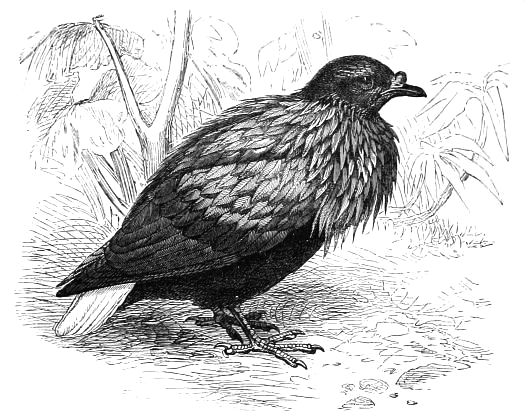
THE HACKLED GROUND PIGEON (Callœnas Nicobarica).
This beautiful bird, according to Jerdon, is met with on the Andaman and Nicobar Islands, the Merqui Archipelago, the Philippines, and Malaya generally, usually preferring to settle upon the small, unoccupied islands. Though, like its congeners, it possesses considerable powers of flight, it seeks the grain and insects that afford it the means of subsistence almost exclusively on the ground, upon which it passes the entire day, only leaving its surface to seek a perch whereon to sleep. We are without particulars respecting the incubation of this Pigeon, except that, like the Partridge, it builds its nest upon the ground.
The CROWNED PIGEONS (Gouræ), as the largest members of the family of Pigeons are called, inhabit New Guinea and the neighbouring islands. These birds exceed the Domestic Fowl in size, and are remarkable for a fan-like crest with which the head is adorned. Their body is stout; their wings, in which the secondary quills exceed the primaries in length, are long and much rounded at the tip; the beak is about half as long as the head, the foot furnished with long tarsi and short toes, and the slaty-blue plumage very soft in texture.
THE CROWNED PIGEON.
The CROWNED PIGEON (Goura coronata) is principally of a slate-blue colour, with chestnut-red shoulders and white stripes on the centre of the wing; the tail-feathers terminate in a white stripe. The eye is yellowish scarlet, the back dull grey, and the foot red, powdered with white. The length of this bird is twenty-eight inches; the wing measures fourteen and a half and the tail ten inches.
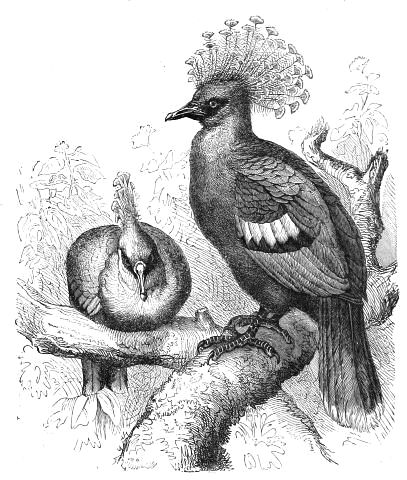
THE VICTORIA CROWNED PIGEON (Goura Victoriæ).
These birds, we learn from Wallace, inhabit the coast of New Guinea in large numbers, as also the Islands of Waigiu, Salawati, and Misool. In their habits they resemble Pheasants, living upon the ground, and wandering about the woods in small parties in search of fallen fruit. If alarmed, they at once take refuge upon the low branch of a tree, and in this situation they also sleep. The nest found by Rosenberg was very loosely constructed, and contained but one fledgling. Large numbers of these birds are exported alive to Java, Amboyna, and Banda, and from thence to Europe; from this practice has arisen the idea that the species is indigenous to those islands. When in confinement the Crowned Pigeons soon become tame, and learn to attach themselves to those who feed them. In the Zoological Gardens in the Regent's Park there are several specimens, whose manners are very curious and interesting.
"Their walk," says the Rev. J. G. Wood, "is quite of a royal character—stately, majestic, and well according with the crown they wear upon their heads. The crest seems always to be held expanded. They have the habit of sunning themselves upon the hot pavement of their prison by lying on one side, laying the head flat on the ground, tucking the lower wing under, and spreading the other over their bodies, so as to form a very shallow tent, each quill-feather being separated from its neighbour and radiating around the body. Sometimes the bird varies this attitude by stretching the other wing to its full length, and holding it from the body at an angle of twenty degrees or so, as if to take advantage of every sunbeam and waft of air. While lying in this unique attitude it might easily pass at a distance for a moss-covered stone, a heap of withered leaves, or a rugged tree-stump, with one broken branch projecting from its side; no one would think of taking it for a bird."
THE VICTORIA CROWNED PIGEON.
The VICTORIA CROWNED PIGEON (Goura Victoriæ), the second member of this group with which we are acquainted, is also principally of a slaty blue colour, but has a reddish brown under side; the wing-stripes are blueish grey, and a broad line at the end of the tail whitish grey. In this bird the feathers that form the crest terminate in small fan-like appendages. The eye is reddish, and the foot flesh-pink. This Pigeon is somewhat larger than the species last described. It inhabits the most southern parts of North Guinea, and is nowhere very numerous.
THE DIDUNCULUS, OR TOOTHED PIGEON.
The DIDUNCULUS, or TOOTHED PIGEON (Didunculus strigirostris), is an extraordinary bird, representing a family of Pigeons possessing a powerful body, moderately long neck, and large head. The beak, which is much higher than it is broad, has the upper mandible arched and hooked at its extremity, its margins being smooth; the tip of the curved under mandible, on the contrary, is furnished with three tooth-like indentations. The tarsus is strong, partially bare, and longer than the centre toe; all the toes are unconnected, and armed with broad hooked claws. The rounded wings extend, when closed, almost to the end of the moderate-sized and slightly-rounded tail. The head, throat, breast, and belly of this species are of a glossy greenish black; the hinder portions of the under side, the wings, tail, and feathers on the lower wing-covers rich, deep chestnut-brown; the quills are greyish black, and all the feathers on the upper part of the mantle decorated with a brilliant green spot at their tips; the lower back, wings, tail, and feathers of the lower tail-covers are of a beautiful dark chestnut-brown, and the quills greyish black. The eye is blackish brown; the bare patch that surrounds it and the cheek-stripes bright orange-red; the beak is also orange-red, with light yellow tip; the feet red, and the claws yellowish white. The length is twelve inches and a half, and breadth twenty-four inches; the wing measures seven inches, and tail three inches.