CASSELL'S BOOK OF BIRDS. (continued 2)
Thomas Rymer Jones translation
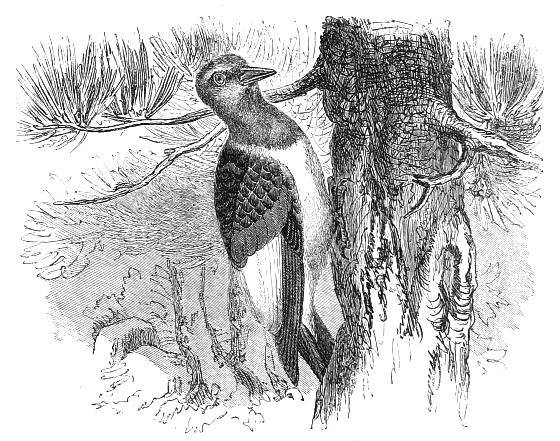
THE RED-HEADED BLACK WOODPECKER (Melanerpes erythrocephalus).
The head and bill of this species are held in great esteem, as a sort of charm or amulet, by many tribes of the American Indians, who ornament their belts with them; and Europeans eagerly purchase them as curiosities. When wounded, this Woodpecker generally ascends the nearest tree in a spiral direction, till it attains the topmost branches, where it hides; but if intercepted and laid hold of, it defends itself desperately, both with its beak and claws, inflicting severe lacerations.
The BLACK WOODPECKERS (Melanerpes) are less remarkable for their size than for the beauty of their plumage. In these birds the body is powerful, the head large, and the neck short. The beak is straight, broader than it is high at the base, its upper mandible is arched, and its margins turned inwards; the distinguishing characteristics of the bill, however, are the four small parallel ridges that commence at the nostrils, and extend as far as the centre of the beak. The tarsus equals the reversible toe and its claw in length; the fourth and fifth wing-quills are of equal size, and longer than the rest; the tail is much rounded; and a small space around the eyes is quite bare. Black, red, and white predominate in the coloration of the plumage. All the various members of this group inhabit North and South America.
THE RED-HEADED BLACK WOODPECKER.
The RED-HEADED BLACK WOODPECKER (Melanerpes erythrocephalus) is of a bright red colour on the head and neck. The mantle, wings, and tail are of a jetty blackness; the hinder quills, rump, and under side pure white. The eye is brown, the beak and feet blueish black. The female is smaller and less brightly coloured than her mate. In the young the head, throat, mantle, and breast are of a greyish brown, marked with blackish brown, crescent-shaped spots. The exterior quills are blackish brown, the inner ones reddish white, striped with blackish brown towards the tip; the tail-feathers are deep brownish black. This species is nine inches long and seventeen broad; the wing measures four inches and five-sixths, and the tail two inches and three-quarters.
"The Red-heads," says Audubon, "may be considered as residents of the Northern States, inasmuch as many of them remain in the southern districts during the whole winter, and breed there in summer; the greater number, however, pass to countries farther south. Their migration takes place at night, is commenced in the middle of September, and is continued for a month or six weeks. They then fly high above the trees, far apart, like a disbanded army, propelling themselves by reiterated flaps of the wing at the end of each successive curve which they describe in their flight. The note which they emit at this time is different from the usual one—sharp and easily heard from the ground, although the birds may be out of sight; this note is continued as if it were necessary for keeping the straggling party in good humour. At dawn of day the whole alight on the tops of the dead trees about the plantations, and remain in search of food until the approach of sunset, when they again, one after the other, mount the air and continue their journey.
"With the exception of the Mocking Bird, I know no species so gay and frolicsome; indeed, their whole life is one of pleasure. They find a superabundance of food everywhere, as well as the best facilities for raising their broods. They do not seem to be much afraid of man, although they have scarcely a more dangerous enemy. When alighted on a fence-stake by the road or in a field, and one approaches them, they gradually move sidewise out of sight, peeping now and then to discover your intention; and when you are just close and opposite, lie still until you are past, when they hop to the top of the stake and rattle upon it with their bill, as if to congratulate themselves upon the success of their cunning. Should you approach within arm's length, the Woodpecker flies to the next stake from you, bends to peep and rattle again, as if to provoke you to a continuance of what seems to him excellent sport. No sooner are the cherries ripe than these birds attack them; and I may safely say that a hundred have been shot on one tree during a single day. Pears, peaches, apples, figs, mulberries, even peas are also thus attacked. They have another bad habit—that of sucking the eggs of small birds, and are often successful in entering the pigeon-houses; the corn as it ripens is laid bare by their bill, when they feed on the top parts of the ear. All this while the Red-heads are full of gaiety. No sooner have they satisfied their hunger than small parties of them assemble in the tops and branches of decayed trees, from which they chase different insects, launching after them for eight or ten yards, at times performing the most singular manœuvres; and on securing their victim return to the tree, where immediately after a cry of exultation is heard. They chase each other in a very amicable manner, in long beautifully-curved sweeps, during which the remarkable variety of their plumage becomes conspicuous. When passing from one tree to another their flight resembles the motion of a swing. They move upwards, sidewise, or backwards without apparent effort, but seldom with the head downwards. Their manner of curving from one tree to another is frequently performed as if they intended to attack a bird of their own species, and it is amusing to see the activity with which the latter baffles his antagonist, as he scrambles sidewise down the tree with astonishing celerity; in the same manner in which one of these birds, suspecting a man armed with a gun, will keep winding round the trunk of a tree, until a good opportunity presents itself for sailing off to another. In this manner a man may follow from one tree to another over a whole field without procuring a shot, unless he watches his opportunity, and fires while the bird is on the wing. On the ground this species is by no means awkward, and hops with perfect ease after the beetles it has espied while perching on a tree or fence.
"It is seldom that a nest newly perforated by these birds is found, as they generally resort to those of preceding years. These holes are found often to the number of ten or a dozen in a single decayed trunk. So few green or living trees are perforated for this purpose by this species that I have never myself seen a single instance. In Louisiana and Kentucky the Red-headed Woodpecker rears two broods every year, in the middle districts more generally only one. The female lays from two to six eggs, which are pure white and translucent, sometimes in holes not six feet from the ground, sometimes as high as possible. The young birds have the upper part of the head at first grey; but towards autumn the red begins to appear. During the first winter the red is richly intermixed with grey, and at the approach of spring scarcely any difference is perceptible between the sexes. The flesh of the Red-head is tough, and smells so strongly of the ants and other insects on which it feeds as to be scarcely eatable. In Kentucky and the Southern States many of these birds are killed in the following manner:—As soon as they have begun to visit an apple or cherry tree a pole is placed along the trunk, passing up among the central branches, and extending six or seven feet beyond the highest twigs. The Red-head alights by preference on the pole, and while its body is close to it a man standing beneath gives the pole a smart blow with the head of an axe, on the opposite side to that on which the Woodpecker is, when, in consequence of the sudden violent vibration produced in the upper part, the bird is thrown off dead."
"So common are these birds," says Wilson, "that wherever there is a tree of the wild cherry covered with ripe fruit there you see them busy amongst the branches; and in passing orchards you may readily know where to find the sweetest apples by observing those trees on or near which a Red-head is skulking; for so excellent a connoisseur is he in fruit that wherever an apple or pear tree is found broached by him it is sure to be the ripest and best flavoured. When alarmed at his work he secures a fine one by striking his bill deep into it, and bears it off into the woods.
"Notwithstanding the care," continues the same writer, "which this bird, in common with the rest of the genus, takes to place its young beyond the reach of enemies, within the hollows of trees, there is one deadly enemy against whose depredations neither the height of the tree nor the depth of the cavity is the least security; this is the black snake (Coluber constrictor), who frequently glides up the trunk of the tree, and, like a skulking savage, creeps into the Woodpecker's peaceful abode, devours the eggs and helpless young, in spite of the cries and flutterings of the parents, and, if the place be large enough, coils himself up in the spot they occupied, where he will often remain for several days. The eager school-boy, often hazarding his neck to reach the Woodpecker's hole, at the triumphant moment when he thinks the nestlings his own, strips his arm, launching it down the cavity, and grasps what he imagines to be the callow young, starts with horror at the sight of a hideous shape, and retreats down the tree with terrified precipitation. Several adventures of this kind have come to my knowledge, and one of them was attended with serious consequences—both snake and boy fell to the ground; and a broken thigh and long confinement cured the youngster of his ambition for robbing Woodpeckers' nests."
THE ANT-EATING BLACK WOODPECKER.
The ANT-EATING BLACK WOODPECKER (Melanerpes formicivorus) is an inhabitant of California and Mexico. Its body is black; the brow, a spot on the exterior quills, the anterior border of the hinder quills, and the rump are white; the top of the head as far as the nape is light red; the throat and a band upon the breast are black; the region of the throat is relieved by the sulphur-yellow feathers, by which the black portion is surrounded; the back and sides are streaked longitudinally with white; the eye is yellow, the beak and feet are black. This species is nine inches long; the wing measures five inches and a quarter, and the tail two and a quarter.
"The Melanerpes formicivorus," Hermann tells us, "is the noisiest and most numerous of all the Woodpeckers inhabiting California. During the summer these birds are constantly to be seen chasing their insect prey about the topmost branches of the trees, and in autumn are equally busy in laying up a store of acorns against the approach of winter. This is accomplished by boring a series of holes in the trunk of a tree, into each of which an acorn is so firmly introduced as to render its extrication a work of difficulty. An oak or pine tree thus pierced often presents the appearance of being studded with a multitude of bronze nails."
The VARIEGATED WOODPECKERS (Picus) constitute a group of small or moderate-sized and compactly-built birds. Their straight beak almost equals the head in length, and is as broad as it is high at the base; the toes are short, and in some species but three in number; in the wing the third quill is the longest; and the tail is conical. The plumage is black, marked with white, and enlivened in some parts by an intermixture of red or yellow. The various members of this group inhabit all those parts of the earth frequented by their congeners, with the exception of Central and Southern Africa.
THE GREAT SPOTTED WOODPECKER.
The GREAT SPOTTED WOODPECKER (Picus major) is black upon the upper portion of the body, of a dull yellowish grey beneath, and the brow indicated by a yellow line. The cheeks, a line on the sides of the throat, the large spots on the shoulders, and some irregular markings on the wings are all white; the back of the head and lower part of the belly are light red; and a black line passes from the base of the beak to the nape. The female is without the red upon the nape; and in the young the top of the head is bright red. The eye of all is brownish red, the beak light grey, and the foot greenish grey.
These well-known birds inhabit the whole of Europe and Siberia, as far as Kamschatka. Woods, forests, and plantations of all kinds are their principal resorts, and they especially delight in fir or pine trees. In these localities each bird appropriates a certain district as its own particular domain, and within this boundary no intruder is permitted to forage; for no sooner does the vigilant proprietor hear the bony tap that indicates a close inspection of his hunting-ground than he sallies forth and encounters the unwelcome visitor, chasing it from tree to tree, until it is glad to retire in search of more hospitable quarters. Nuts and the seeds from fir and pine cones are largely consumed by these birds, who exhibit the utmost adroitness in extricating the latter from their hard covering.
This species, which is found throughout the British Isles, though less common than the Green Woodpecker, "is," says Gosse, "much more strictly an arboreal bird than that species. It climbs with great ease and dexterity, traversing the trunks and limbs of trees in all directions—perpendicularly or horizontally—and digging with great diligence and effect into the bark and wood for insects. In Kensington Gardens, London, where this bird is quite common, it usually keeps about the highest branches of lofty trees, and the loud tappings of its carpentry may frequently be heard; though a fair sight of its person is difficult to obtain, as it dodges from side to side of the trunk or branch on which it happens to be with much cunning and adroitness whenever an observer approaches. It does not, however, confine itself entirely to the tall trees, for it occasionally alights on pollards, as well as on the rails and posts of fences, where, in the accumulated moss and lichen, or in the various holes and crevices, it finds a harvest of spiders, ants, caterpillars, and other insects; while in the season it varies its bill of fare by stealing cherries, plums, and other fruit."
Colonel Montague gives the following instance of the devotion of the female of this species for her young:—"It was with difficulty that the bird was made to quit her eggs; for, notwithstanding a chisel and mallet were used to enlarge the hole, she did not attempt to fly out until the hand was introduced, when she quitted the tree at another opening." The eggs, from five to seven in number, are pure glossy white.
THE HARLEQUIN WOODPECKER.
The HARLEQUIN WOODPECKER (Piculus minor), as the least of all European Woodpeckers is called, differs from its congeners in the comparative shortness of its slightly conical beak, rounded tail, and the very peculiar coloration of its plumage. In the male the brow is yellowish grey, the crown of the head bright red, the upper part of the back entirely black, and the lower portion white, streaked with black; the whole of the wings are striped black and white, and relieved by a black line that passes along the sides of the neck, which it thus divides from the grey belly, which is longitudinally streaked with black at its sides. The centre tail-feathers are black, and those at the exterior of a whitish hue, striped with black. The female is without the red patch on the head; the young resemble the mother, but are somewhat duller in their hues. In all the eye is yellowish brown or fiery red, the beak lead-grey, with black tip and culmen, and the foot dark grey. This species is six inches long, and from eleven to eleven inches and a half broad; the wing measures two inches and three-quarters, and the tail two inches and a quarter.
The habitat of the Harlequin Woodpecker extends over the whole of Europe and Central Asia, and it is, we believe, occasionally seen in North-western Africa. Like its congeners, it does not migrate, but only quits its native woodlands to wander over the face of the country during the spring and autumn. At other seasons it keeps strictly within the limits of a certain spot selected as a home, and which invariably contains a large hollow tree suitable as a sleeping-place.
"In England," says Mr. Gould, "this small Woodpecker is far more abundant than is generally supposed. We have seldom sought for it in vain wherever large trees, particularly elms, grow in sufficient numbers to invite its abode. Near London it is very common, and may be seen by an attentive observer in many of the parks in the neighbourhood. The Lesser Spotted Woodpecker appears to perform a certain daily round, traversing a given extent of district, and returning to the same spot whence it began its route. In its actions it is very lively and alert. Unlike the Large Woodpecker, it frequents the smaller and more elevated branches, which it traverses with the utmost ease and celerity. Should it perceive itself noticed it becomes shy, and retires behind the branches; if, however, closely engaged in searching for food it sometimes is so absorbed as to allow itself to be closely approached without suspending its operations. When spring commences it becomes clamorous and noisy, its call being an oft-repeated note, so closely resembling that of the Wry-neck as to be scarcely distinguishable from it. At other times of the year it is mute, and its presence is only betrayed by the reiterated tap which it makes against the bark of the tree."
Naumann tells us that as this bird retires to rest later than many of the other feathered inhabitants of its favourite groves or orchards, many and fierce battles ensue before it can obtain possession of the particular hole it desires, as Titmice or Sparrows also prefer a warm, snug nook, and are by no means disposed to resign quietly in favour of the would-be intruder. In these encounters, however, might usually overcomes right, and a series of very pointed arguments, in the shape of repeated taps and pecks from the enemy's strong beak, eventually compel the weaker bird to seek a night's lodging elsewhere.
The movements of the Harlequin Woodpecker are brisk and active, and as regards its climbing powers it fully equals any member of its family already described. Towards men it exhibits the utmost confidence, but lives in a state of almost perpetual warfare with its feathered companions. During the breeding season, which commences in May, the male makes himself very conspicuous by the constant utterance of his shrill monotonous cry and his restless activity in contending with supposed rivals, or in his struggles to keep off the inroads of other males upon his chosen nesting-place. This latter spot is always at a considerable height from the ground, in an old oak or lofty fruit tree, whose decayed trunk can be readily penetrated by the beaks of the building pair. The recess bored for the reception of the young is six inches deep, and is entered by an aperture as perfectly circular in form as if it had been cut with a centre-bit. Many of these holes are frequently commenced and abandoned before the requirements of the fastidious parents are satisfied. The brood consists of from five to seven brilliantly white eggs, occasionally sparsely sprinkled with fine red spots. The young are hatched within a fortnight by the united exertions of both birds, and are nourished and tended for a considerable time after they have left the nest. The food of this species appears to consist exclusively of insects, as even during the winter months we have found nothing else in its stomach. Ants, spiders, beetles, and insects' eggs it consumes in enormous quantities, and renders inestimable service to the gardener by the countless hosts of destroying insects which it gleans from fruit-trees of every description.
Bechstein gives the following account of an attempt to tame the Picus medius, a closely-allied species. "I have," he says, "seen one of these Woodpeckers, which was reared by a lady and seemed much attached to her; it had learned to leave its cage and return, knocking hard at the window if shut out. It was very amusing to see it climbing nimbly over its mistress till it had reached her mouth. It then asked her, by light strokes of the wing, for the food she was accustomed to give it; this was generally a little meat. It disappeared one day, without any one knowing what had befallen it."
THE THREE-TOED WOODPECKER.
The THREE-TOED WOODPECKER (Apternus tridactylus), as the most striking of all the European members of this family is called, represents a group recognisable by their straight beak, which is broader than it is high, and equals the head in length. All the three toes are shorter than the tarsus; of these the outermost is the smallest, and the two others of equal length. In the wing the fourth quill is the longest. The centre feathers of the conical tail are furnished with very stiff shafts, and sharply pointed at their tip. The upper portions of the body are black, and the under side dirty white; the brow black, spotted white, and the crown of the head pale golden yellow. A white line, more or less marked with black, passes from the eyes to the middle of the back; the bridles and a second line that terminates at the throat are black; as are the markings on the sides of the belly. The quills and exterior tail-feathers are black, striped with white, and the centre tail-feathers entirely black. The eye is pearl-grey or silver-white, the beak light grey, tipped with black, and the foot dark grey. The female has the crown of the head spotted with white, instead of being yellow as in the male. The length of this species is nine and its breadth fourteen inches; the wing measures four inches and three-quarters, and the tail three inches and three-quarters.
It is at present undecided whether all such of these birds as inhabit Europe are to be regarded as identical; but if it be so the habitat of this species extends over a large portion of both the European and Asiatic continents. In the northern parts of Europe it is met with in the course of its wanderings as far north as sixty degrees north latitude, and is by no means rare; in Scandinavia, Finland, and Russia it is especially numerous, and in the country about the mouth of the Amoor is one of the commonest of birds. North America also possesses a deceptively similar or identical species. Everywhere it frequents well-wooded mountain regions, and closely resembles the Common Variegated Woodpecker in all the various particulars of its habits, movements, and means of subsistence. It is active and restless in its habits, and generally occupies the topmost branches of the trees. Its cry is loud and shrill, somewhat resembling that of some small quadruped when in great pain. Towards noon it is silent, and retires to rest in a quiet spot. Its rapid, gliding, and undulating flight is always accompanied by a succession of loud notes. The nest is usually from twenty to twenty-four inches deep, and is bored in the trunk of a sound tree. One brood of four to six pure white eggs is laid in the season.
The GREEN WOODPECKERS (Gecinus) are readily known by the large size of their elongate body, their slightly conical and curved beak, and short powerful foot, furnished with four toes. The wing, in which the fourth and fifth quills are the longest, is rounded at its extremity, the tongue is of unusual length, and the plumage principally green, of a pale shade on the under side, and marked with undulating lines; the head is occasionally adorned with a brightly-coloured crest.
THE GREEN WOODPECKER.
The GREEN WOODPECKER (Gecinus viridis) is bright green on the upper portions of the body, and pale greyish green on the under side; the face is black, the top of the head and nape greyish blue, shaded with bright red; the wing is light yellow; a line on the cheeks of the male is red, in the female black. The quills are pale brownish black, spotted with yellowish or brownish white, and the tail-feathers pale greyish green, striped with black. The eye is blueish white, the beak dull grey tipped with black, and the foot greenish grey. The young are greyish green, spotted with white on the mantle, and whitish grey spotted with black on the under side; the eye is dark grey. The length of this bird is twelve and its breadth twenty inches; the wing measures seven and the tail four inches and a half.
The Green Woodpecker frequently seeks its insect food upon the ground. This species is met with over the whole of Europe; but though common in the wooded districts of England and Scotland, it is very rare in Ireland.
"Nature," says Mudie, in speaking of this species, "has appointed the Woodpeckers conservators of the wood of old trees, furnished them admirably for their office, and so formed their habits that an ancient tree is an Eden for them, fraught with safety, and redolent of fatness and plenty. So exquisitely are they fitted for their office that the several species vary in tint with the general colour of the trees that they select; if they exhibit an alternation of green moss, yellow lichen, and ruby-tinted cups, with here and there a spot of black, then this, the Green Woodpecker, comes in charge; but if they are covered with the black and white lichens of the Alpine forest, we may look for the spotted race upon the bark. When the renovation of the spring begins to be felt through all nature, the Woodpecker creeps from his hole and tries the trunk till he comes to a hollow place, and upon that he beats the drum in loud and rolling taps, but yet without in the least perforating the tree. The sound swells and sinks, hurries and lingers alternately, so that at a distance it resembles the sound of rustic glee heard through the woodland; if the Woodpecker's mate catches the sound she answers to it, the bargain is concluded, and the business of the season begins; if not, the male glides on to another tree, uttering his short cry, 'Plu-i, plu-i,' and again resumes his serenade. If there happen to be an odd bird in the forest, this call for a mate may occasionally be heard far into the summer. If the tree selected by a pair of Woodpeckers affords no natural hole for the purpose of nidification, they at once set about excavating one with their bills, working so fast that the strokes cannot be counted either by the eye or ear. They know the tree by the sound, and though they will cut through a few layers of perfect wood, they never mine into a tree unless it has begun to decay in the interior. Nature guides them to those trees where their labour is light and they have plenty to eat. In working they proceed as a mason does when he perforates a block of granite with a pointed pick, they thump away with so much rapidity and force that the timber is ground to powder, and they work in a circle no larger than will admit themselves. They generally burrow so deep that no spoiler can reach the eggs in their absence, and further security is afforded by the opening being in some hidden part of the tree. Materials are seldom carried into the nest, the bed for the reception of the little family being formed of the soft powder from the wood. The eggs, from five to seven in number, have a glossy white shell. The young are fledged in June, and creep about their native tree-hole for some time before they are able to fly."
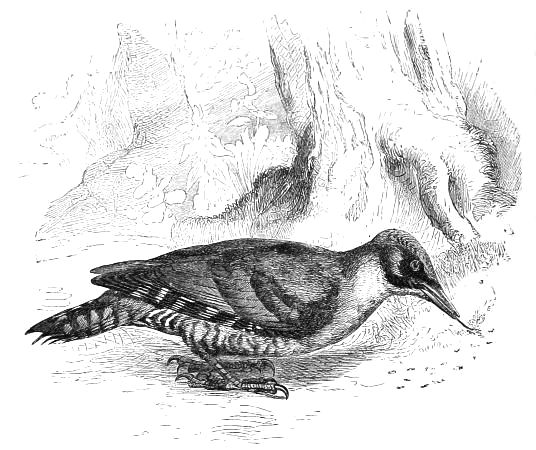
THE GREEN WOODPECKER (Gecinus viridis).
The CUCKOO WOODPECKERS (Colaptes) comprise several species at once recognisable by their decidedly curved beaks and variegated plumage.
THE GOLDEN-WINGED WOODPECKER.
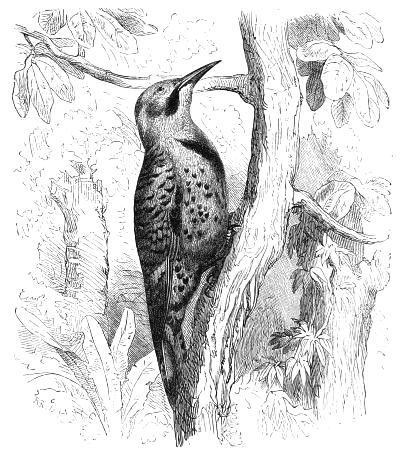
THE GOLDEN-WINGED WOODPECKER (Colaptes auratus).
The GOLDEN-WINGED WOODPECKER (Colaptes auratus) has a long, broad, curved beak, which is compressed at its tip; the tarsus is considerably longer than the exterior toe, and in the wing the fourth and fifth quills exceed the rest in length. All the shafts of the pinion and tail-feathers are bright yellow or red. Upon the back the plumage is of a dull reddish brown, striped with black; the head and nape are grey, the former adorned with a crescent-shaped scarlet patch; the rump is white; the upper tail-covers are yellowish white, the sides of the head and throat greyish red, and the bridles and a streak upon the lower throat black; the rest of the under side is white, spotted with black. The quills are sulphur-yellow, and the tail-feathers bright yellow, with dark tips. The female is without the black cheek-stripes. The body is twelve inches and a half long and sixteen broad; the wing measures six inches and the tail four inches and a half.
This species, which is common in all parts of the United States, where it is known by the name of the Flicker (that word being supposed to resemble its cry), has been described at great length by Audubon. "The flight of these birds," says that graphic writer, "is strong and prolonged; they propel themselves by numerous beats of the wings, with short intervals of sailing. Their migrations are carried on at night, as is known by their note and the whistling of their wings. When passing from one tree to another on wing, they fly in a straight line until when within a few yards of the spot where they intend to alight, when they suddenly raise themselves a few feet and fasten themselves to the bark by their claws and tail. If they intend to settle on a branch they do not previously rise; and in either case no sooner has the bird alighted than it nods its head and utters its well-known note, 'Flicker.' It usually moves sideways on a small branch, keeping itself erect; and with equal ease it climbs by leaps along the trunks of trees or their branches, descends and moves sideways or spirally, keeping at all times its head upward and its tail pressed against the bark as a support. On the ground it also hops with great ease. Insects, seeds, berries, and fruit of various kinds constitute the principal food of these Woodpeckers. No sooner has spring returned than their voice is heard from the tops of high, decayed trees. Their note at this period is merriment itself, as it simulates a prolonged and jovial laugh, heard at a considerable distance. Several males pursue a female, and, to show the force of their love, bow their heads, spread their tails, and move sidewise, backwards, forwards, performing such antics as might induce any one witnessing them to join his laugh to theirs. The female flies to another tree, where she is closely followed by half a dozen of these gay suitors, when again the same ceremony is gone through. No fighting occurs, no jealousy seems to exist among them until a marked preference is shown for one, when the rest proceed in search of another female. Each pair proceeds to excavate the trunk of a tree and make a hole large enough to contain themselves and their young; they both work with great industry and apparent pleasure. Should the male be employed the female keeps close to him, and seems to congratulate him on every chip he throws in the air. They caress each other on the branches, climb about and around the tree with delight, rattle with their bill against the top of the dead boughs, chase all their cousins, the Red-heads, defy the Purple Grakles to enter their nest, feed plentifully on insects, beetles, and larvæ, cackling at intervals, and ere a week be elapsed the female has laid four or five eggs, with a pure, white, transparent shell."
Their flesh is esteemed good by many sportsmen, and they are now and then exposed for sale in the markets of New York and Philadelphia.
THE RED-SHAFTED OR COPPER WOODPECKER.
The RED-SHAFTED or COPPER WOODPECKER (Colaptes Mexicanus), a very similar species, inhabiting the Southern States of North America, Texas, and Mexico, is of a light reddish brown on the top of the head and brow; the upper part of the back is greyish brown, with undulating black markings, and the lower portion white; the tail-feathers are greyish brown with bright orange shafts; the chin and throat are light reddish grey; the breast and belly somewhat deeper in shade, and spotted with black; the throat is encircled by a red collar, and the upper breast decorated with a black line; the chin is also indicated by a reddish line.
The manners of this species much resemble those of the species last described; it is, however, shyer in its habits, and but rarely comes to the ground. In the breeding season the male birds display considerable animosity towards each other, and constantly utter a note resembling the word "Whitto, whitto, whitto." The nest is made in a tree-trunk, and it is not uncommon to hear the eager active couple hammering and bumping away like carpenters until a late hour in the evening. The eggs have a pure white shell.
THE FIELD WOODPECKER.
The FIELD WOODPECKER (Geocolaptes campestris) is an inhabitant of the South American prairies, and represents a group that, unlike those already described, seek their principal food, not upon the trunks of trees, but from the surface of the ground. The Field Woodpecker possesses a slightly-curved bill, of about the same length as the head; its wings are long, pointed, and powerful, their fourth quill longer than the rest; the strong tail is pointed, and the slender foot furnished with very delicate toes. The variegated plumage is not very brightly tinted; the crown of the head and neck are black; the cheeks, throat, and upper breast golden yellow; the back and wings pale yellow, striped with blackish brown; the lower portion of the back, the breast, and belly are whitish yellow, each feather having black markings; the quills are greyish brown, with gold-coloured shafts, the primaries striped with white on the inner web, and the secondaries on both webs. The tail-feathers are blackish brown, those at the exterior streaked with yellow on the outer, and those in the centre on the inner web. The female is somewhat paler in hue than her mate. The eye is bright red, the beak blackish grey, and the foot dull grey.
The SOFT-TAILED WOODPECKERS (Picumnus) constitute a group of very small birds, with long, straight, conical beaks, which are pointed at the tip. The shape of the leg and claw resembles that of the True Woodpecker. The short wings, in which the fourth and fifth quills are the longest, are very blunt and rounded; the tail is composed of twelve soft, rounded feathers, the outermost of which are very short; the plumage is soft, and its feathers few and of unusual size. Most of these birds inhabit South America; Africa possesses one and India three species. We are almost entirely without reliable particulars as to their habits.
THE DWARF WOODPECKER.
The DWARF WOODPECKER (Picumnus minutus) is greyish brown on the mantle; the under side is white, streaked with black; the crown of the head is black, delicately sprinkled with white; the brow of the male is red, that of the female is of the same colour as the rest of the head; and the blackish brown quills are edged with yellow. The tail-feathers are black; those at the exterior have a broad white stripe on the outer, and those in the centre on the inner web. The eye is greyish brown, the beak lead-colour at its base and blackish at the culmen and tip, the foot is lead-grey. This small bird is only three inches and seven lines long and six inches broad; the wing measures one inch and ten lines, and the tail one inch. The Dwarf Woodpecker is met with in all the wooded tracts of coast from Guiana to Paraguay, and is frequently seen in the immediate vicinity of the houses. In summer it lives in pairs, in winter in small parties, that fly to a considerable distance over the surrounding coast.
The WRY-NECKS (Yunx) inhabit the Eastern Hemisphere, and are recognisable by their slender body, long neck, small head, short blunt wing, in which the third quill is the longest, and a broad soft tail of moderate size. The short, straight, conical beak is pointed, and but slightly compressed at its sides; the foot is furnished with four toes placed in pairs; the plumage lax and soft, and the very protrusile tongue of thread-like tenuity.
THE WRY-NECK.
The WRY-NECK (Yunx torquilla) is of a light grey on the upper portion of its body, marked and spotted with a deeper shade; the under side is white, sparsely sprinkled with dark triangular spots; the entire throat is yellow, with undulating markings; a black line passes from the crown of the head to the lower part of the back, and the mantle is decorated with numerous black and brown spots of various shades; the quills are striped with reddish and blackish brown; the tail-feathers are sprinkled with black, and relieved by five narrow, curved stripes; the eye is yellowish brown; the beak and legs greenish yellow. In the young the coloration is paler and the markings less delicate than in the adults; their eye is greyish brown. This species is seven inches long and eleven broad; the wing measures three inches and one-third, and the tail two inches and a half. The actual habitat of the Wry-neck appears to be the central parts of Europe and Asia. In a northerly direction it is found as far as Scandinavia, and during its migrations often wanders as far as Egypt and Eastern Soudan. Jerdon tells us that it is met with throughout all parts of India during the winter.
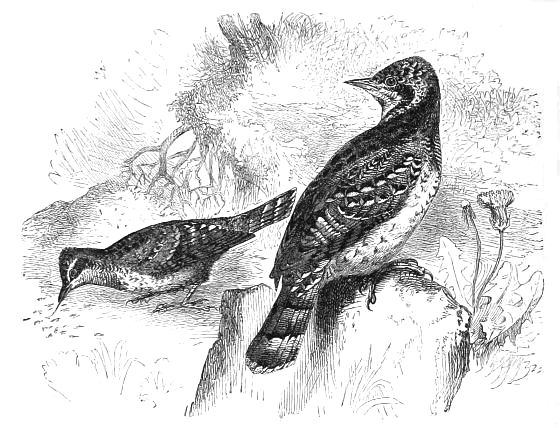
THE WRY-NECK (Yunx torquilla).
The Wry-neck, so called from its strange manner of turning its head, so as to give its neck a twisted appearance, is commonly met with in England, but is rare in Scotland, and, according to Yarrell, has not been met with in Ireland. This species usually resorts to woodland districts, fields, and gardens. "When found in its retreat in the hole of a tree," says the last-mentioned writer, "it makes a loud hissing noise, sets up an elongated crest, and writhing its body and head towards each shoulder alternately, with grotesque contortions, becomes an object of terror to a timid intruder; and the bird, taking advantage of a moment of indecision, darts with the rapidity of lightning from a situation whence escape seemed impossible." Caterpillars and various insects, especially ants, constitute the principal food of these birds. Bechstein states that they will eat elder-berries. The young are easily tamed; and in France are often taken from one tree to another, with a string fastened round the leg, to search the bark for insects.
Colonel Montague thus describes the manner in which a female of this species that he had tamed took its food:—"A quantity of mould with emmets and their eggs was given to it; and it was curious to observe the tongue darted forth and retracted with such velocity and such unerring aim that it never returned without an ant or an egg adhering to it, not transfixed by the horny points, but retained by a peculiar tenacious moisture provided for that purpose. While feeding, the body is kept motionless, only the head being turned from side to side; and the motion of the tongue is so rapid that an ant's egg, which is of a light colour, and therefore more conspicuous than the tongue, has the appearance of moving to the mouth by attraction, as the needle flies to the magnet. The bill is rarely used, except to remove the mould, in order to get more rapidly at the insects where the earth is hollow. The tongue is thrust into all the cavities to rouse the ants, and for this purpose the horny appendage is extremely serviceable as a guide to the tongue."
The following interesting account of an attempt to drive a pair of these birds from the nesting-place they had selected is given by Mr. Salmon, in the Magazine of Natural History:—"I wished to obtain the eggs of the Wry-neck to place in my cabinet, and accordingly watched a pair very closely that had resorted to a garden in the village for the purpose of incubation. I soon ascertained that they had selected a hole in a decayed apple-tree for that purpose, the entrance to which was so small as not to admit my hand. The tree being hollow and decayed near the ground, I reached the nest by putting my arm upwards, and I found on withdrawing the nest that the underneath part of it was composed of moss and hair, having every appearance of being the deserted home of a Redstart; the upper part was made of dry roots. The nest did not contain any eggs, and I returned it by thrusting it up inside the tree. On passing the same way a week afterwards my attention was arrested by observing one of the birds leaving the hole; upon which I gently withdrew the nest, and was gratified to find it contained five most beautifully glossy eggs, the shells of which were perfectly white, and so transparent that the yolks shone through, giving them a delicate pink hue. I replaced the nest and visited it during the ensuing weeks, when, to my astonishment, I found that the birds had not deserted the hole, but the female had six eggs more, which I obtained by thrusting the nest up the tree. Next week I again visited the spot, and found that they still pertinaciously adhered to their domicile, having further laid four eggs more. I repeated the experiment, but not having an opportunity of revisiting the spot until ten days after, I thought at the time that the nest was abandoned, and was not undeceived till I again withdrew the nest, having taken the precaution of endeavouring to frighten off the old bird should she be within, which I found was the case; nevertheless she suffered me to pull the nest to the bottom of the tree before she attempted to escape. There were seven eggs slightly sat upon. It seems to me very extraordinary that the female should allow her nest to be disturbed five times, and the eggs (amounting to twenty-two) to be taken away at different periods within the month, before she finally abandoned the spot she had selected."
HUMMING BIRDS.
THE HUMMING BIRDS (Stridor), a family of most beautiful and fairy-like beings, inhabiting the Western Hemisphere, comprise some of the smallest members of the feathered creation. In these birds the beak is generally long, slender, straight, or curved, usually round, and sharp at the tip; the nostrils are basal, and covered with a large scale; the wings and tail are very variously formed, the latter being always composed of ten feathers; the very short tarsi are most delicately constructed; the long slender toes are covered with small scales, and either partially united or completely free from each other; the sharp-pointed claws frequently exceed the toes in length. The glorious plumage possessed by the members of this most attractive family has been enthusiastically described by many writers, but never more eloquently than by Buffon. "Of all animated beings," says that naturalist, "the Humming Bird is the most elegant in form and brilliant in colour. The stones and metals polished by art are not comparable to this gem of nature; she has placed it in the order of birds, but amongst the tiniest of the race—maxime miranda in minimis—she has loaded it with all the gifts of which she has only imparted a share to other birds—agility, nimbleness, grace, and rich attire, all belong to this little favourite. The emerald, the ruby, and the topaz glitter in her garb, which is never soiled with the dirt of earth, for, leading an aërial life, it rarely touches the turf even for an instant. Always in the air, flying from flower to flower, it shares their freshness and their splendour, imbibes their nectar, and only inhabits those climes in which they are unceasingly renewed. The Humming Bird seems to follow the sun, to advance, to retire with him, and to fly on the wings of the wind in pursuit of an eternal spring."
"Along the whole line of the Andes, which form as it were the backbone of America," writes Gould, in the valuable introduction to his magnificent work on the "Trochilidæ," "at remarkably short intervals occur species of this family of birds of the greatest possible beauty, which are not only specifically but generically distinct from each other. Abundant as the species may be towards the northern and southern portions of the great chain of mountains, they vastly increase in number as we approach the equator. The equatorial regions teem with species and even genera that are not found elsewhere. Between the snow-line of the summit of the towering volcanoes and their bases many zones of temperature occur, each of which has it own especial animal and vegetable life. The Alpine region has its flora, accompanied by insects especially adapted to such situations; and attendant on these are peculiar forms of Humming Birds, which never descend to the hot valleys, and scarcely even to the cooler and more temperate paramos. Many of the higher zones of extinct and existing volcanoes have their own fauna and flora, even in the interior walls of ancient craters, wherever vegetation has gained a footing. Some species of Humming Birds have there, and there only, as yet been discovered. It is the exploration of such situations that has led to the acquisition of so many additional species of this family of birds, which now reach to more than 400. From Santa Fé de Bogota alone many thousands of skins are annually sent to London and Paris. The Indians readily learn the art of preserving them, and as a certain amount of emolument attends the collecting of these objects they often traverse great distances for the purpose of procuring them. Districts stretching more than 100 miles away from Bogota are strictly searched, and hence it is that from these places alone we receive no less than seventy species belonging to this family. In like manner the residents of many parts of Brazil employ their slaves in preparing their skins for the European markets, and many thousands are annually sent from Rio de Janeiro, Bahia, and Pernambuco; the inmates of convents are also supplied with many of the more richly-coloured species for the manufacture of feather flowers. How numerous then must these birds be in their native wilds; and how wonderfully must they keep in check the peculiar kind of insect life upon which they feed!"
In disposition the Humming Birds exhibit a fearlessness and courage quite out of proportion to the delicacy of their structure, and we might cite many instances of the fierce encounters in which they sometimes engage; we must, however, confine ourselves to an extract from Gosse's interesting little book on the birds of Jamaica.
"The pugnacity of the Humming Bird has been often spoken of; two of the same species can scarcely suck flowers from the same bush without a rencontre. I once witnessed a combat between two which was prosecuted with much pertinacity, and protracted to an unusual length. It was in the month of April at Phœnix Park, near Savannah-la-Mer. In the garden were two trees of the kind called Malay apple, one of which was but a yard or two from my window. The genial influence of the spring rains had covered them with a profusion of beautiful blossoms, each consisting of a multitude of crimson stamens with very minute petals, like bunches of crimson tassels, but the last buds were only beginning to open. A Humming Bird had every day and all day long been paying his devoirs to these charming blossoms. On the morning to which I allude another appeared, and the manœuvres of these two tiny creatures became very interesting. They chased each other through the labyrinths of twigs and flowers till, an opportunity occurring, one would dart with seeming fury upon the other, and then, with a loud rustling of their wings, they would twirl together round and round until they nearly came to the earth. It was some time before I could see with any distinctness what took place in these tussles; their twistings were so rapid as to baffle all attempts at discrimination. At length an encounter took place pretty close to me, and I perceived that the beak of the one grasped the beak of the other, and, thus fastened, both whirled round in their perpendicular descent, the point of contact being the centre of the gyrations, till, when another second would have brought them to the ground, they separated, and the one chased the other for about a hundred yards and then returned in triumph to the tree, where, perched on a lofty twig, he chirped monotonously and pertinaciously for a time, I could not help thinking, in defiance. In a few minutes the banished one returned, and began chirping no less provokingly, which soon brought on another chase and another tussle. I am persuaded that these were both hostile encounters, for the one seemed evidently afraid of the other, fleeing when he pursued, though his indomitable spirit would prompt the chirp of defiance, and when resting after a battle I noticed that the vanquished one held his beak open as if panting. Sometimes they would suspend hostilities to suck a few blossoms, but mutual proximity was sure to bring them on again with the same result. In their tortuous and rapid evolutions the light from their ruby necks would flash in the sun with gem-like radiance, and as they now and then hovered motionless, the broadly-expanded tail—the outer feathers of which were crimson-purple, but in the sun's rays transmitted orange-coloured light—added much to their beauty. A little Banana Quit (Certhiola flaveola), that was peeping among the blossoms in his own quiet way, seemed now and then to look with surprise on the combatants; but when the one had driven the other to a longer distance than usual the victor set upon the unoffending Quit, who soon yielded the point, and retired humbly enough to a neighbouring tree. The war—for it was a thorough campaign, a regular succession of battles—lasted fully an hour, and then I was called away from my post of observation. Both of the Humming Birds appeared to be males."
According to Gosse, the Vervain Humming Bird is the only species endowed with a song; this bird warbles very weakly but sweetly for ten minutes at a time during the spring months. The other members of this family at most indulge in a sharp shrill chirp, as they flit from one flower to another.
The GIANT GNOMES (Eustephanus), the largest members of the family, are not conspicuous for the gaiety of their plumage. The structure of their long beak varies considerably; the foot is of moderate size; the wings either long and slender or broad and short; the tail, which is of medium length, is forked at its extremity.
THE GIANT HUMMING BIRD.
The GIANT HUMMING BIRD (Patagona gigas) is pale brown shaded with green on the upper portions of the body; the wings are greyish yellow; the head, upper breast, and back are marked with dark undulating lines; the wings and tail-feathers are dark brown, the latter enlivened by a green gloss. This species is two inches long.
The Giant Humming Bird inhabits the southern parts of Western America, appearing also in the extreme south. During the course of its migrations it has been met with at an altitude of from 12,000 to 14,000 feet above the level of the sea.
"Like others of its family," says Darwin, "it moves from place to place with a rapidity which may be compared to that of the syrphus among dipterous insects, or sphinxes among moths; but whilst hovering over a flower it flaps its wings with a very slow and powerful movement, totally different from that vibrating one common to most of the species which produces the humming noise. I never saw any other bird whose force of wing appeared (as in a butterfly) so powerful in proportion to the weight of its body. When hovering by a flower its tail is constantly expanded and shut, like a fan, the body being kept in a nearly vertical position. This action seems to steady and support the bird between the slow movements of its wings."
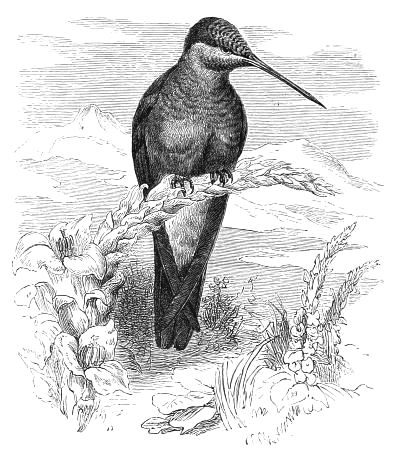
THE GIANT HUMMING BIRD (Patagona gigas).
"This largest of all Humming Birds," observes Gould, "is said to be a bold and vigorous flier, to be quick in all its actions, and to pass from flower to flower with the greatest rapidity; notwithstanding the breadth and volume of its wings, which would seem to be far better adapted for lengthened and continuous progress than for poising in the air, which the bird is in the constant habit of doing while visiting, with little choice, the summer flowers of the forest. It is stated that, unlike the other members of the family, it may frequently be seen perched on some small tree or shrub."
Mr. Cumming states that in Chili the Patagona gigas is strictly migratory; it arrives from the north in August, and after spending three months in that country, during which time it breeds, returns to whence it came. The nest is a somewhat large, cup-shaped structure, composed of mosses, lichens, and similar materials, put together with cobwebs, and placed in the fork of the branch of some tree or shrub, generally on one overhanging a turbulent stream of water. It lays two eggs, which are white, and about three-quarters of an inch from end to end.
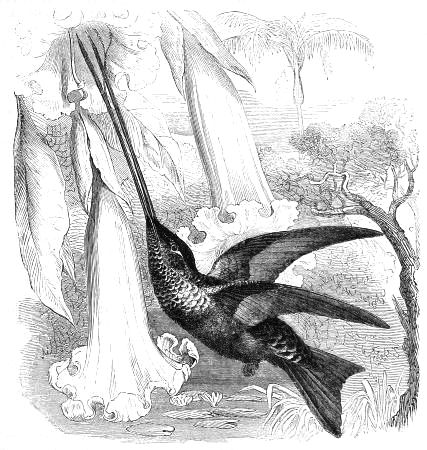
THE SWORD-BILL HUMMING BIRD (Docimastes ensifer).
THE SWORD-BILL HUMMING BIRD.
The SWORD-BILL HUMMING BIRD (Docimastes ensifer) cannot possibly be mistaken for any other species, owing to the extraordinary size of the slightly-curved beak, which fully equals the entire body in length; the wing is short and broad, and the very decidedly forked tail of medium size. The entire mantle is of a beautiful mineral green; the head copper-red; the throat, centre of breast, and under side of a greenish bronze, which shades into light green at the sides. A small white spot is placed behind the eye; the wings are purplish brown; the tail-feathers dark brown, with a metallic green lustre; the beak is blackish brown, and foot yellowish brown. The male is eight inches and a half long (of this measurement four inches belong to the beak); the wing is three inches, and the tail two inches and a half. The female is of paler hue on the beak, and spotted with white and brown on the under side, enlivened by a metallic shimmer on the sides; her entire length is seven inches and a half, the beak measuring but three inches. This new and remarkable species, we are told by Gould, inhabits the magnificent region of Santa Fé de Bogota, and was also seen in the Caracas and Quito by Mr. Hartwig, the celebrated botanist and traveller, who states that he observed it engaged in procuring insects from the lengthened corollas of flower-bells, for exploring which its elongated beak is admirably fitted; affording another instance of the wonderful adaptation of structure to a special purpose so frequently observable in every department of Nature's works.
The GNOMES (Polytmus) are moderately large and powerfully built birds, with strong, medium-sized, and more or less curved beaks; the foot is furnished with short toes and long claws; the wings are slightly curved; the broad tail, which is scarcely longer than the closed pinion, has its two exterior feathers much shortened. The plumage is not remarkable for its brilliancy, being usually of a greenish or brownish shade above, and brown variously spotted beneath; the outer tail-feathers have light tips; the sexes are almost alike in colour.
THE SAW-BILL.
The SAW-BILL (Grypus nævius) is at once recognisable by its straight, powerful beak, which rises high at its base, and is twice the length of the head, and by its broad tail, the two outer feathers of which are short. Upon the back the plumage is of a pale metallic green, glowing with a reddish lustre; the brow and crown of head are dark brown; all the feathers on the mantle, except those on the wing-covers, are edged with reddish yellow; the sides of the neck are yellowish red; a narrow line that passes along the throat, the breast, belly, and rump are yellowish white, each feather striped with black; another pale reddish yellow line passes over the eyes; the quills are black, those at the exterior enlivened by a violet gloss; the centre tail-feathers are green and the outermost reddish yellow; the eye is dark brown; the upper mandible black, and the lower yellowish white; the foot is flesh-pink. The body is five inches and three-quarters long; the wing measures three inches, and the tail one inch and a half.
"The Grypus nævius," says M. Deyrolle, "is common in all the provinces of Santa Caterina, in Brazil, but is more frequently met with in woody situations than elsewhere. Its flight is exceedingly noisy, very vigorous, and capable of being sustained for a great length of time, the bird rarely alighting. Its cry is so loud and piercing as to be heard above everything else, while it flutters round the flowers of various species of orchids, from which it obtains its principal nourishment."
"In all probability," says Gould, "the serrations with which the cutting edges of both mandibles of this bird are furnished are expressly provided to enable it to capture with facility some peculiar kinds of insect food; perhaps spiders and small coleoptera. The nest sent to me by Mr. Reeves is precisely similar in size, form, and situation to those constructed by the members of the genus Phaëtornis, being of a lengthened, pointed form, composed of fine vegetable fibres and mosses, intermingled with which, especially on the lower part, are portions of dead leaves and pieces of lichen attached to the extremities of the leaves of apparently a species of palm."
The velocity with which these Humming Birds glance through the air is extraordinary, and so rapid is the vibration of their wings, that their movement eludes the sight; when hovering before a flower, they seem suspended as if by some magic power.
THE SICKLE-BILLED HUMMING BIRD.
The SICKLE-BILLED HUMMING BIRD (Eutoxeres aquila) principally differs from its congeners in the sickle-shaped formation of its powerful beak and its conical tail. In this species the back is of a glossy greyish green; the head and a small crest by which it is adorned are brownish black, these feathers and those upon the rump being edged with brown; the under side is brownish black, marked on the throat with greyish yellow and on the breast with white spots; the quills are purplish brown, the exterior secondaries tipped with white.
"It is evident," says Gould, "that the bill of this very rare and singular Humming Bird is adapted for some especial purpose, and we may readily infer that it has been expressly formed to enable this species to obtain its food from the deep and remarkably-shaped blossoms of the various orchidaceous and other plants, with curved, tubular flowers, so abundant in the country the bird inhabits, and for exploring which a bill of any other form would be useless." At present nothing is known of its habits.
The SUN BIRDS (Phaëtornis) have a large, long head and slightly-curved beak. Their foot is small and delicate, with partially feathered tarsus and formidable claws; the tail, in which the centre feathers far exceed the rest in length, is long and conical. The plumage is dull, and the sexes alike in colour, the only difference observable being the formation of the tail.
THE CAYENNE HERMIT.
The CAYENNE HERMIT (Phaëtornis superciliosus) is about seven inches long; the wing measures two inches and one-third, and the tail two inches and two thirds. In this species the mantle is of a pure metallic green, and the under side reddish grey; the feathers on the back have reddish yellow borders; a pale reddish yellow line passes above and below the eye; the quills are brown, shaded with violet; the centre tail-feathers, which are twice the length of those at the sides, are of a dull metallic green, shading into black towards the white tip, and edged with reddish yellow; the upper mandible is black, and the lower half of the under one pale yellow; the feet are flesh-pink. The female has quieter plumage and a shorter tail; the latter is but slightly wedge-shaped, and fully two inches less than that of her mate.
"The Phaëtornis superciliosus," says Gould, "is one of the commonest species of the genus, examples having been sent to Europe for at least the last hundred years. Its native countries are Guiana, Cayenne, and Surinam; its range is known to extend towards Brazil, as far as the confluence of the Amazon, but, as I believe, does not advance farther south than Bahia. Open trails covered with shrub or brushwood are the localities it most frequents."
Wallace gives the following graphic description of the movements of the Phaëtornis and some nearly-allied species:—"I have distinctly observed them visit in rapid succession every leaf and flower on a branch, balancing themselves vertically in the air, passing their beak closely over the under surface of each leaf, and thus capturing any small insect that might be upon them. While doing this the two long feathers of their tail have a vibratory motion, serving apparently as a rudder to assist them in performing the delicate operation. I have seen others searching up and down stems and dead sticks in the same manner, every now and then picking off an insect, exactly as a Bush Shrike or Tree Creeper does"—with this exception, that the Humming Bird is constantly on the wing. They also capture insects in the true Fissirostral manner, and may often be seen perched on the dead twig of a lofty tree, the same station that is chosen by the Tyrant Flycatchers and Jacamars, and from which, like those birds, they dart off a short distance, and, after a few whirls and balancings, return to the identical twig they had left. In the evening, after sunset, when the Goatsuckers are beginning their search over the rivers, I have seen Humming Birds come out of the forest and remain a long time on the wing, now stationary, now darting about with the greatest rapidity, imitating in a limited space the varied evolutions of the Goatsuckers, and evidently for the same end and purpose.
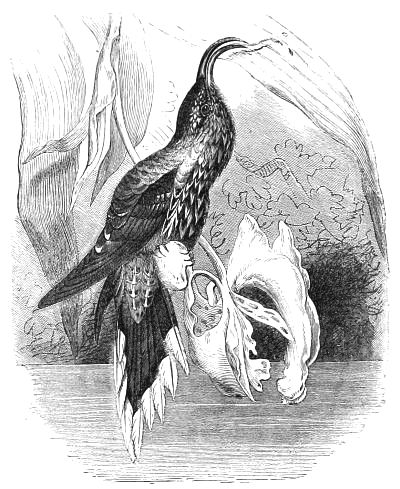
THE SICKLE-BILLED HUMMING BIRD (Eutoxeres aquila).
The MOUNTAIN NYMPHS (Oreotrochilus) are at once recognisable by the very peculiar formation of the wings, in which the shafts of the exterior quills are remarkably broad. The strong, high beak is of medium size, and the short tail almost straight at its extremity, only the outer feathers being slightly rounded. The magnificently-coloured and glossy plumage is blue or green upon the mantle, and of a lighter shade on the under side; the region of the throat is usually edged with the most glowing tints, and the exterior tail-feathers are often white. The sexes vary considerably in their coloration.
THE CHIMBORAZIAN HILL-STAR.
The CHIMBORAZIAN HILL-STAR (Oreotrochilus Chimborazo), one of the most magnificent members of this group, has a powerful body, long, thin, and slightly-curved beak, moderate-sized but strong wings, a broad rounded tail, formed of pointed feathers, and powerful feet, partially covered with down. The sexes differ considerably in appearance. The male is of a resplendent violet on the head and region of the throat, with greyish olive-brown mantle and white belly, shading to yellowish brown at its sides; the centre of the throat is decorated with a long triangular patch of glossy green, divided from the light under side by a line of velvety black; the quills are purplish brown, and the centre tail-feathers dark green, the rest greenish black on the outer and white on the inner web; the beak and feet are black. The female is olive-green on the back, and olive-brown on the under side, slightly marked with a lighter shade; the breast is white, each feather spotted with brown at its tip; the centre tail-feathers are brilliant dark green, the rest light greenish brown, and white towards the root; the two exterior feathers have a white spot on the inner web. The body is four inches and three-quarters long; the tail measures two inches and three-eighths.
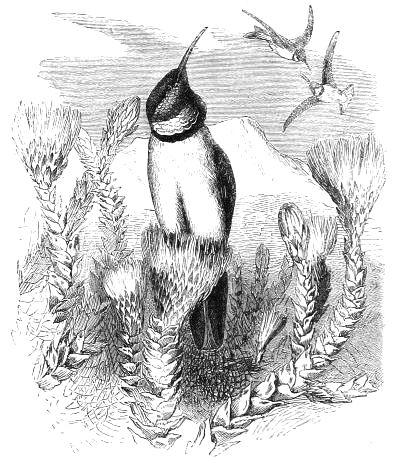
THE CHIMBORAZIAN HILL-STAR (Oreotrochilus Chimborazo).
"This beautiful species," says M. Jules Bourcier, "is exclusively confined to the volcanic mountain, Chimborazo. Here, at an altitude where vegetation ceases, and near the eternal snows, it loves to dwell, the height of its range appearing to be governed by that of the chuquiraga, its favourite shrub, the flowers of which afford it an abundance of nectarian and insect food. It is solitary in its habits, and so pugnacious that it immediately offers battle to intruders on its haunts. The male perches on the extremity of the most elevated branch, and is rarely found near the female, which, unlike her mate, invariably perches near the ground, a circumstance that, combined with her sombre colouring, renders her very difficult of detection. Both sexes retain their greyish green garb during the first year of their existence; the young males may, however, be at all times distinguished by a tolerably well-defined collar of olive-green and brown. The nest is formed of lichens, and is either suspended to or sheltered beneath a ledge of rock. The eggs, two in number, have a white shell."
The SABRE-WINGS (Campylopterus) are at once recognisable from the peculiar shape of the wing, which is broad, with the anterior quills strongly curved, their shafts, in adult birds, becoming suddenly dilated. The tail is large and blunt or broadly rounded at the end, and the powerful beak, which is half as long again as the head, but slightly curved, compressed at its sides, and broader than it is high. The legs are delicate, and the claws long.
DE LATTREI'S SABRE-WING.
DE LATTREI'S SABRE-WING (Campylopterus hemileucurus or Campylopterus De Lattrei) is of a deep blueish black on the head; the wing-covers, back, and rump are green; the quills dark purplish brown; the tail-feathers blueish black, shaded with green; a small white spot is placed above the dark eye; the beak is black, the foot dark brown. The head of the female is bronze-colour, the rest of the mantle glossy green, with a golden shade; the region of the throat and sides of the breast are greenish blue, and the under side grey, with a greenish gloss. This gaily-tinted bird inhabits Mexico and Central America.
"Of all the members of the genus," says Gould, "this species is by far the largest and the most beautifully coloured. It is said to be the boldest of its race, and to be so extremely pugnacious that every bird venturing into the neighbourhood of its territory is furiously attacked and driven away. This peculiar feature in the habits of the race explains the use of the broad and powerful shafts of the primaries, which form so conspicuous a character in the males of the Campylopterus. This bird is strictly a Mexican or Central American species. M. de Lattrei, to whom we are indebted for its discovery, states that it is found in the forests of Jalapa during two months of the year only, that it is known by the name of the 'Luce-fleur-royal,' and that it feeds during the entire day, instead of during any particular hours. He adds that it selects a flowering shrub, which it never quits, and from which it chases with anger all the species of the family that may seem desirous of approaching it. On taking flight it utters a cry."
"The large showy tail of this Humming Bird," says Mr. Salvin, "makes it one of the most conspicuous when on the wing. The females are especially abundant, their ratio to the males being as five to two."
"This beautiful bird," says M. Montes de Oca, "which is generally known in Mexico by the name of the Royal Blue Myrtle-sucker, arrives in the vicinity of Jalapa, Coantepec, and Orizaba in considerable numbers during the months of October and November, and is mostly found feeding from a plant called marapan between the hours of seven and one o'clock. During this time it is seldom seen to alight, and then only for a very short time, but is constantly on the wing, flitting from flower to flower, describing segments of a circle in its flight, and sometimes almost touching the ground. For the remainder of the day very few are to be seen, and I think it probable that they visit the woods for certain kinds of mosquitoes, with which I have often found their stomachs well filled. The pugnacity of this species is very remarkable; it is very seldom that two males meet without an aërial battle. The contest commences with a sharp, choleric shriek, after which, with dilated throats, the feathers of the whole of their bodies erected on end, and their tails outspread, they begin to fight with their bills and wings; the least powerful soon falls to the ground or flies away. I have never known one of these battles last longer than about ten seconds, and in the specimens I have under my notice in cages, their fighting has mostly ended in the splitting of the tongue of one of the two, which then surely dies, from being unable to feed."
The TRUE SABRE-WINGS (Platystylopterus) are recognisable by their comparatively great size and strength, and the unusual development of the shafts of the exterior quills; the tail is straight at its extremity; the beak short and powerful, and almost straight.
THE FAWN-COLOURED SABRE-WING.
The FAWN-COLOURED SABRE-WING (Platystylopterus rufus) is about five inches and a half long, and seven broad. In this species the mantle and central tail-feathers are of a bronze-like green, the under side brownish yellow, and the exterior tail-feathers brownish yellow with a black spot near the tip. This bird is an inhabitant of Guatemala. We are entirely without particulars as to its life and habits.
The JEWEL HUMMING BIRDS (Hypophania) have a powerful and slightly-curved beak and small foot, in some instances covered with down; the wing, which somewhat resembles that of the Oreotrochilus, is sometimes short, sometimes long; in the otherwise short tail two of the feathers are generally much prolonged.
THE CRIMSON TOPAZ HUMMING BIRD.
The CRIMSONV TOPAZ HUMMING BIRD (Topaza pella), one of the most splendid species of this highly bedizened group, has the crown of the head and a line about the throat of velvety blackness; the rump is copper-colour, shading into rich deep red, and glistening with a golden light; the wing-covers are green; the throat is golden in some lights, emerald-green in others, glancing with the yellow radiance of the topaz; the quills are reddish brown; the centre tail-feathers, which project three inches beyond the rest, are chestnut-brown, and those at the exterior reddish brown. The female is principally of a greenish hue, with a red throat, and is far less resplendent than her mate. The length of this bird, including the long tail-feathers, exceeds eight inches.
We learn from Gould that Cayenne, Trinidad, Surinam, and the fluviatile regions of the Lower Amazon are the native habitat of this gorgeous species, which may be regarded, not only as one of the gems of ornithology, but as one of the most beautifully-adorned species of the Trochilida.
Mr. Waterton thus describes the Crimson Topaz in his "Wanderings:" "One species alone never shows his beauty to the sun; and were it not for his lovely shining colours you might almost be tempted to class him with the Goatsuckers, on account of his habits. He is the largest of all the Humming Birds, and is all red and changing gold-green, except the head, which is black. He has two long feathers in the tail, which cross each other, and these have gained him from the Indians the name 'Karabinite,' or 'Ara Humming Bird.' You never find him on the coast, or where the river is salt, or in the heart of the forest, unless fresh water be there. He keeps close by the side of woody fresh water rivers and dark lonely creeks; he leaves his retreat before sunrise to feed on the insects near the water; he returns to it as soon as the sun's rays cause a glare of light; he is sedentary all day long, but comes out again for a short time after sunset." The nest, represented in our woodcut, is deeply cup-shaped, the walls exceedingly thin, and the whole structure composed apparently of fragments of a species of fungus, very much resembling German tinder, bound together by cobwebs or some similar material. The two white eggs are about five-eighths of an inch in length.
THE BLACK-CAPPED HUMMING BIRD.
The BLACK-CAPPED HUMMING BIRD (Aithurus polytmus) has a short, slightly-forked tail, the two outer feathers of which are prolonged six inches beyond the rest. The male has a long tuft over each ear, and is velvety black on the crown of the head; the mantle is green; the under side glossy emerald-green, shading into blueish black on the belly and tail-covers; the quills are purplish black; the tail-feathers deep black, with a greenish shade towards the roots; the eye is deep brown, the beak bright red, tipped with black, and the foot brown; the male is ten inches long, and six broad; his wing measures two inches and three-quarters, and his tail seven inches and a quarter. The female, whose length does not exceed four inches and a half, with wings two inches and a quarter, and the tail one inch and seven-eighths long, is of a copper-green on the mantle, and white beneath; her sides are spotted with green.
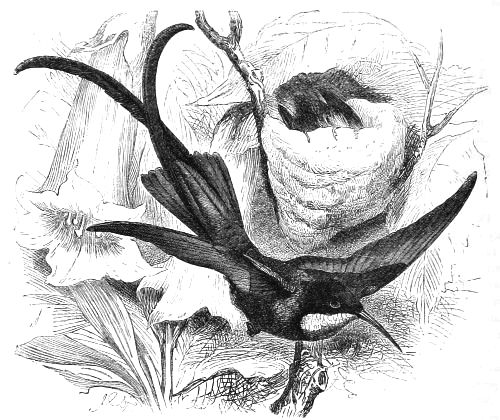
THE CRIMSON TOPAZ HUMMING BIRD (Topaza pella).
"This Humming Bird," says Mr. Gosse, "is the gem of Jamaican ornithology. Its slender form, velvet crest, emerald bosom, and lengthened tail-plumes render it one of the most elegant members of its truly brilliant family. It is a permanent resident in Jamaica, and is not uncommonly seen at all seasons and in all situations. It loves to frequent the margins of roadsides, where it sucks the blossoms of the trees, occasionally descending, however, to the lower shrubs; and is abundant on the summits of the range of mountains known as the Bluefield Ridge. Behind these peaks, which are visible from the sea, at an elevation of half a mile, there runs through the dense woods a narrow path, just passable for a horse, overrun with beautiful ferns of many graceful forms, and always damp and cool. No habitation occurs within several miles, and no cultivation, save the isolated provision grounds of the negroes, which teem with enormous arums, and are hidden from view in the thick woods. The refreshing coolness of the roads, the unbroken solitude, combined with the peculiarity and luxuriance of the vegetation, made it one of my favourite resorts. Not a tree, from the thickness of one's wrist to the gigantic magnitude of the hoary fig and cotton tree, but is clothed with gigantic parasites. Begonias with waxen leaves and ferns with hirsute stems climb up the trunks of enormous bromelias; various orchids, with matted roots and grotesque blossoms, spring from every bough; and long lianas, like the cordage of a ship, depend from the loftiest branches or stretch from tree to tree. Elegant tree-ferns and towering palms are numerous. Here and there the wild plantain waves its long flag-like leaves from amidst the humbler bushes; and in the most obscure corners, over some decaying log, nods the noble spike of a magnificent limed arum. Nothing is flaunting or showy; all is solemn and subdued, but all is exquisitely beautiful. The underwood consists largely of the plant called glass-eye berry, the blossoms of which, though presenting little beauty in form or hue, are eminently attractive to the Long-tailed Humming Bird. These bushes are at no part of the year out of blossom, their scarlet berries appearing at all seasons on the same stalk as the flowers; and here, at any time, one may with tolerable certainty calculate on finding these very lovely birds; but it is in March, April, and May that they abound. I suppose that I have sometimes seen not fewer than a hundred come successively to rifle the blossoms within the space of as many yards in one forenoon. They are, however, in no respects gregarious; though three or four may be seen at one moment hovering round the blossoms of the same shrub, there is no association—each is governed by its individual preference, and each attends to its own affairs. It is worthy of remark that males compose by far the greater portion of the individuals observed at this elevation, while very few females are seen there; whereas in the lowlands this sex outnumbers the other. In March a considerable number are seen to be clad in the livery of the adult male, but without the long tail-feathers, whilst others possess them in various stages of development. These are, I have no doubt, males of the preceding season. It is also common to find one of those lengthened feathers much shorter than the other; and in their aërial encounters with each other a tail-feather is sometimes displaced. The loud sound made by the strong vibration of the wings of the male is more shrill than that produced by those of the female, and indicates the proximity of the bird before the eye has detected it. The male utters an almost incessant chirp, both whilst resting on a twig or feeding from the flowers. They do not invariably probe the blossoms on the wing, but frequently when alighted and sitting with closed pinions; and they often partially sustain themselves whilst feeding by clinging with the feet to a leaf, with the wings expanded and vibrating. When perched, they usually sit in a nearly upright posture, with the head thrown backwards, the beak pointing at a small angle above the horizon, the feet almost hidden by the body being brought into contact with the perch, the tail thrust forward under the belly, and the long feathers crossing each other near their middle."
The nests, which are most numerous in June, are placed in a great variety of situations; that described by Mr. Gosse was "principally composed of silk-cotton, very closely pressed, mixed with the still more glossy cotton of an asclepias, particularly round the edge, the seeds remaining attached to some of the filaments. On the outside the whole structure is quite covered with spiders' webs, crossed and recrossed in every direction, and made to adhere by some viscous substance, evidently applied after the web was placed, probably saliva. Little bits of pale green lichen and fragments of thin laminated bark are stuck here and there on the outside, by means of the webs having been passed over them. The whole forms a very compact cup, one inch and three-quarters deep without, and one inch deep within, the sides about a quarter of an inch thick, the inner margin a little overarching, so as to narrow the opening; the total diameter at the top one inch and a half. The eggs are of a long oval form and pure white, save that when fresh the contents produce a reddish tinge, from the thinness of the shell. The above are the usual form, dimensions, and materials of the nest. Variations, however, often occur from local causes: thus, in one from a rocky situation only moss is used, and the base is prolonged to a point; one now before me is wholly composed of pure silk-cotton, bound profusely with the finest web, undistinguishable except on the closest examination, not a fragment of lichen mars the beautiful uniformity of its appearance; others are studded all over with lichens, and have a peculiar rustic prettiness. Insects constitute the principal food of this species, which obtains them from the flower-cups, and also catches them whilst on the wing."
The WOOD-NYMPHS (Lampornis) possess a straight or moderately-curved beak, which is broad at its base and incised at its extremity; the long toes are armed with short, high, and very decidedly-hooked claws; the wings are slender, and the tail broad, rounded or slightly incised at its extremity. The sexes vary considerably in their coloration.
THE MANGO HUMMING BIRD.
The MANGO HUMMING BIRD (Lampornis mango) represents a group recognisable by their long, flat, broad, and curved beak, and by their short, rounded tail. In this species, which is about four inches and three-quarters long and seven inches and a half broad, with wing measuring two inches and three-quarters and tail one inch and a half, the entire mantle is of metallic green, glistening with a bright copper shade; the greyish black quills gleam with violet, and the centre tail-feathers, which are green shaded with red above, are blueish red beneath, and have a brilliant purplish black border; the exterior tail-feathers are entirely blueish red, with a similar edge. The throat, neck, breast, and upper part of the belly are of rich velvety black, shading into steel-blue at the sides; the lower portion of the belly is of copper-green. The beak of the adult is black, that of the young brown, and the foot black. The female is paler than her mate on the mantle, and white striped with black on the under side; her body is four inches and three-quarters long and seven and a half broad; the wing measures two inches and three-quarters and the tail one inch and a half.
The Mango, we learn from M. Boucier, though one of the most widely-spread members of its family, is only to be met with in hot localities; and whenever it occurs in the interior of a country, it is invariably in the warmest valleys. In disposition it is wild and quarrelsome, for although it lives in societies, several always being together, it is continually engaged in fighting with its companions and in driving away all other birds that approach the trees in which it is breeding. It inhabits Bolivia, Guiana, and Brazil. The adult does not assume its perfect plumage until the end of the second year, and in the interval passes through so many changes that the variety of appearance it presents has given rise to the various names under which these birds have been described; those obtained in Bolivia are a trifle the largest, and have the bands of green and blue at the sides of the neck a little less brilliant; in fact, the hotter the climate in which they dwell the brighter is their general appearance—the black of the throat is more intense, the green on the back and rump finer, and the violet of the tail more lustrous. The flight of this species is very rapid. Mr. Reeves informs us that in Brazil the Lampornis mango is found in Rio Janeiro, Minos Gerves, St. Paul's, Santa Catherina, and Para. The Mango frequents gardens as well as the forests, and is very common in Rio in some seasons and equally scarce at others. The nest, according to Gould, is a round cup-shaped structure, placed near the extremity of a small horizontal branch, and is composed of any cottony or similar material that may be at hand, bound together with cobwebs, and ornamented with numerous small pieces of lichens. The eggs are white, and two in number, half an inch long by three-eighths of an inch in breadth.
"Wishing to keep one of these birds alive," says Mr. Gosse, "I stationed myself near a blossoming papau-tree, one evening, with a gauze ring-net in my hand, with which I darted at one, and though I missed my aim, the attempt so astonished it that it appeared to have lost its presence of mind, so to speak, flitting hurriedly hither and thither for several seconds before it flew away. The next morning I again took my station, and stood quite still; the net being held up close to an inviting branch of blossoms, the Humming Birds came near in their course round the tree, sipped the surrounding flowers, eyeing the net hanging in the air for a moment near the fatal cluster without touching it, and then, arrow-like, darting away. At length one, after surveying the net, passed again round the tree, and in approaching it the second time, and perceiving the strange object not to have moved, he took courage and began to suck. I quite trembled with hope; in one instant the net was struck, and before I could see anything the rustling of his wings within the gauze told me that the little beauty was a captive. I brought him in triumph to the house and caged him; but he was very restless, clinging to the sides and wires, and fluttering violently about. The next morning, having gone out on an excursion for a few hours, I found the poor bird on my return dying, having beaten himself to death. I never again took this species alive."
THE RUBY AND TOPAZ WOOD-NYMPH.
The RUBY AND TOPAZ WOOD-NYMPH (Chrysolampis moschita), a most magnificently-adorned Brazilian Humming Bird, is brown on the crown of the head, with a glowing throat of ruby-red, and upper breast irradiated by a tint that can only be compared to the golden glow of sunrise. The wings gleam with a violet light, and the light brown tail has each feather relieved by a black border. The beak and feet are black. The female and young are metallic green above and grey on the under side. This species is four inches long and five broad, the wing measures two inches and the tail one inch and a half.
The central part of South America affords a home to this most exquisitely-ornamented little bird. "If any one species of this extensive family be better known than any other," says Gould, "it is undoubtedly the Ruby and Topaz Humming Bird, for it is not only one of the earliest discovered, but its beauty is of such a character as to fix at once the attention of every observer. It is also one of the commonest of the entire group, and plays no inconsiderable part in commerce, as the capturing and preparing specimens, which are sent home by thousands, affords considerable employment to the Brazilian slaves and others in its native country; moreover, in Europe and elsewhere, this species always forms a conspicuous object in the groups of birds arranged under glass shades. But, alas! nothing is known as to its manner of life, for though it has been described for more than a hundred years, and its native country repeatedly visited by enterprising explorers, no one of them has placed on record any details as to its habits. It is said to perch occasionally, and spread its large, rounded tail to the fullest extent, like the Peacock. The cup-shaped nest is also known to be composed of cottony material, and decorated externally with leaves and small patches of lichens."
The FLOWER-NYMPHS (Florisugus) are for the most part powerfully formed and large Humming Birds, with a short tail, scarcely exceeding the closed wing in length. The strong beak is not incised, and the sexes differ more or less in their coloration. Some of them appear to be migratory; at least, they would seem to approach the tropic during the colder parts of the year, and to retreat before the returning heat, thus maintaining an equable temperature.
THE BRAZILIAN FAIRY.
The BRAZILIAN FAIRY (Heliothrix auriculata), a species inhabiting Brazil, has an awl-shaped, delicate beak, small feet, furnished with short, curved claws, long, slender wings, and a long tail, formed of narrow feathers; the tail of the female is composed of broad feathers, and rounded at its extremity. In the adult male, the back and sides of the throat are bright copper-green, with a golden shimmer, and the greyish black quills glow with violet; the under side and three exterior tail-feathers are white, whilst those in the centre of the tail gleam with a steel-blue lustre; a line of velvety black commences beneath the eyes, and passes along the body, expanding as it goes, and gradually merging in a blueish border that surrounds it. The male is six inches and three-quarters long, with a tail of two inches and a half; the body of the female measures four inches and a half, and her tail one inch and seven-twelfths.
This beautiful bird is rare in Brazil, and in Guiana is replaced by a very similar species; it has also several representatives in the western parts of South America.
"Mr. Reeves," says Gould, "informs me that this elegant bird inhabits Rio de Janeiro and Minos Gerves, but is nowhere very common; that it is not met with in the immediate vicinity of Rio, but that it arrives in Novo Fribourgo in July and remains till September. During its stay it evinces a decided preference for the flowers of the orange-tree, which doubtless afford it an abundant supply of some peculiar and congenial kind of insect food. Its flight is both powerful and rapid. The nest is of somewhat lengthened form, attached to the side of a small twig, and composed of fine, dry, dark brown vegetable fibres, coated externally with small flakes of pale olive and buff-coloured bark. Another example is of a still more elongated shape, attached on one side to a slender vertical twig, and composed of some cottony material, held together externally by cobwebs and patches of grey lichen."
The FLOWER-SUCKERS (Florisuga) are distinguishable from the groups above described by the formation of their straight beak, which is flat only at its base, and towards its tip rises so considerably as to be higher than it is broad; the powerful feet are feathered on the tarsi, and armed with slightly-curved claws; the wings are long and slender, and the tail broad.
THE PIED JACOBIN.
The PIED JACOBIN (Florisuga atra) is almost entirely of a rich velvety black, with the exception of the vent and legs; the wing-covers are of a dull green, shaded with violet; the centre tail-feathers black with a blueish gloss, whilst those at the exterior are white tipped with black. The female is of duller hue, and has the cheeks and often the entire head rust-red; the feathers on her back are edged with yellowish red; the beak is deep black. This species is four inches and a half long; the wing measures two inches and two-thirds, and the tail one inch and a half.
"The true, if not the restricted habitat of the Pied Jacobin," says Gould, "is the eastern portion of Brazil, over which it is distributed from Pernambuco on the north to Rio de Janeiro on the south, from which latter locality and Bahia great numbers are sent to Europe." We are without particulars as to its life and habits.
The FAIRIES (Trochilus) have a moderate-sized, straight beak, slender, sickle-shaped wings, and very gorgeous plumage, which differs considerably in the two sexes. They are generally seen hovering fairy-like around the blossoms of trees and shrubs, apparently giving the preference to tubular flowers, probably on account of the insects which lurk within them.
THE RUBY-THROATED FAIRY HUMMING BIRD.
The RUBY-THROATED FAIRY HUMMING BIRD (Trochilus colubris) is easily recognisable by its awl-shaped beak, of medium size, and compressed at its base, its short, slender foot, long, narrow wing, and slightly-forked tail. The mantle and centre tail-feathers are green, enlivened with gold; the sides of the neck, throat, and breast are of a brilliant ruby-red, spotted with black; the rest of the under side is greyish white, intermixed with green; the quills and tail-feathers are purplish brown; the eye dark brown, and the beak and foot black. In the male the entire under side is white, and the three exterior tail-feathers relieved by a white spot. The length of the body is three inches and a half, and the breadth four inches and a quarter. This species is found in all the eastern portions of the United States.
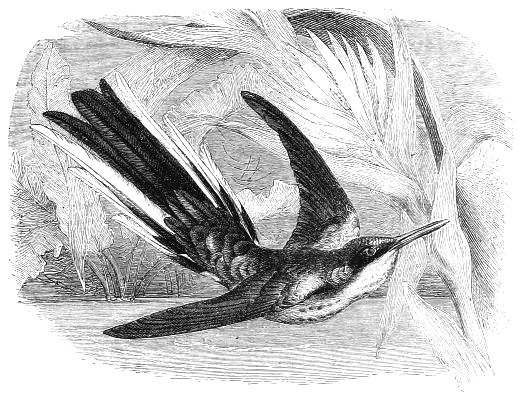
THE BRAZILIAN FAIRY (Heliothrix auriculata).
This beautiful little bird is pre-eminently migratory in its habits, a great portion of its life being spent in passing from north to south, and vice versâ. "The Ruby-throated Humming Bird," says Wilson, "makes its first appearance in Georgia, from the south, about the 23rd of March. As it passes on to the northward, as far as the interior of Canada, where it is seen in great numbers, the wonder is excited how so feebly-constructed and delicate a little creature can make its way over such extensive regions of lakes and forests among so many enemies, all its superiors in strength and size; but its very minuteness, the rapidity of its flight, which almost eludes the eye, and its admirable instinct or reason are its guides and protectors. About the 25th of April it usually arrives in Pennsylvania, and about the 11th of May begins to build its nest. This is generally fixed on the upper side of some horizontal branch, not among the twigs, but where it is attached by the side to an old moss-grown trunk; others may be found fastened on a strong, rank stalk or weed in the gardens, but these cases are rare. The nest, which is usually placed on a branch some ten feet from the ground, is about one inch in diameter, and as much in depth, and the outer coat of one now lying before me is formed of a small species of blueish grey lichen, thickly glued on with the saliva of the bird, giving firmness and consistency to the whole, as well as keeping out moisture. Within this are thickly-matted layers of the fine wings of certain flying seeds, closely laid together, and lastly the downy substance from the great mullein and from the stalks of the common fern lining the whole. The two eggs are pure white, and of equal thickness at both ends. On a person approaching their nest, the little proprietors dart around with a humming sound, passing within a few inches of his head, and should the young be nearly hatched the female will resume her place on the nest, even while the spectator stands within a yard or two of the spot. The precise period of incubation I am unable to give, but the young are accustomed, within a short time of leaving the nest, to thrust their bills into the mouths of their parents and suck out what they have brought them. As I have found their nests as late as the 12th of July, I do not doubt but that they frequently and perhaps usually raise two broods in the season.