GALLINACEOUS BIRDS (Gallinæ). (continued 4)
Thomas Rymer Jones translation
THE BLACK-BREASTED BUSTARD QUAIL.
The BLACK-BREASTED BUSTARD QUAIL (Turnix pugnax), a well-known species of the above group, has the foot furnished with only three toes. The feathers on the mantle are of a dark brown tipped with crescent-shaped black and rust-red spots; the region of the eye, bridles, and cheeks are white, spotted with black; the wings are greyish brown, spotted with black and white; the quills are edged with white on the outer web; the throat is deep black, and the lower breast and belly bright rust-red; the rest of the plumage resembles that of the male. The eye is white, the beak light grey, and the foot dark yellow. This species is six inches long; the wing measures three inches, and the tail one inch. The female is considerably larger than her mate.
This interesting bird, which has long been a domestic favourite with the Hindoos and Malays, is very common in Java, where, as everywhere else, it frequents grassy patches in the forests and jungles, low bushy jungle, or fields of dhal and other thick crops near patches of brushwood; but it is rarely found in barren country, or in cultivated ground where there is no shelter. It feeds on various kinds of grain, small insects, and grasshoppers. The call of the female is a peculiar, loud, purring sound.
"The hen birds," says Jerdon, "are most pugnacious, especially about the breeding season; and this propensity is made use of in the south of India to effect their capture. To this end a small cage with a decoy-bird is used, having a concealed spring compartment made to fall by the snapping of a thread placed between the bars of the cage. This is set on the ground in some thick cover, carefully protected. The decoy-bird begins her loud purring call, which can be heard a long way off, and any females within earshot rapidly run to the spot and commence fighting with the caged bird, striking at the bars. This soon breaks the thread, the spring-cover falls, at the same time ringing a small bell, by which the owner, who remains concealed near at hand, is warned of a capture, and at once runs up, secures his prey, and sets his cage again in another locality. In this way I have known twelve to twenty birds captured in one day in a patch of jungle in the Carnatic, where only I have seen this practice carried on. The birds that are caught in this way are all females, and in most cases are birds laying eggs at the time, for I have frequently known instances of some eight or ten of those captured so far advanced in egg-bearing as to lay their eggs in the bag in which they were carried before the bird-catcher had reached my house."
The eggs, which are usually laid in a hollow in the ground, behind a bush, or sheltered by a stone, are from five to eight in number, of a dull stone-grey or green tint, thickly spotted and freckled with dusky yellowish brown; they are blunt in shape and very large in proportion to the bird. The affection of the male of this species for its offspring would appear to be by no means inferior to that of the mother; for we learn from Swinhoe that upon one occasion, having succeeded in capturing two young Bustard Quails that were almost fully fledged and placed them in a cage, he observed the female parent, as he supposed, clucking like a hen, as it ran and crept about the prisoners in a vain endeavour to lure them out of their strange abode. In order to secure a specimen the bird was shot, and on examination proved to be a male. The Javanese rear this species on rice and small grasshoppers, and train both sexes to fight for their entertainment.
THE AFRICAN BUSH QUAIL.
The AFRICAN BUSH QUAIL (Turnix Africanus, or T. Gibraltariensis), one of the largest members of the group, is about six inches long; the sexes resemble each other in the coloration of their plumage, but the female is of much greater size, and fully one-third heavier than her mate. The dark brown head of the male is enlivened by three yellow streaks, and the back marked with irregular black and brown zigzag lines; the feathers of the wing-covers are yellow, with a black spot on the outer and a reddish yellow spot on the inner web; the throat is white, and the region of the crop reddish brown, each feather being edged with a lighter tint; the sides are reddish brown, with a few dark spots, and shade gradually into the pure white that covers the belly; the outer webs of the quills have light edges; the eye is yellow, the beak yellowish, and the foot lead-grey.
This species is found in many parts of Sicily and Spain, and stragglers are sometimes seen in the plains of Languedoc; it is met with also in the north of Africa, especially among the thickets and dwarf palms of Mount Atlas. Tristram informs us that a nest found in Algeria was most carefully concealed in thick bushes, and contained several eggs, slightly spotted, and of a purplish blue shade.
THE COLLARED PLAIN-WANDERER.
The COLLARED PLAIN-WANDERER (Pedionomus torquatus) has the foot furnished with four toes. The beak, which almost equals the head in length, is straight and compressed at its tip; the wings are short and shell-shaped, with the first, second, and third quills of equal size; the tail is short, the tarsus long, and the hinder toe placed high. In this species the top of the head is reddish brown, spotted with black; the brow and sides of the neck are light fawn-colour, dotted with black; the broad white band on the throat also shows black spots; the mantle-feathers are reddish brown, striped with black, and edged with reddish yellow; the middle breast is red, the rest of the under side fawn-colour, each of the feathers being marked like those on the back, whilst those at the sides exhibit broad irregular black spots; the tail-feathers are striped with blackish brown. The eye is straw-colour, the beak yellow, with black tip, and the foot greenish yellow. The male is four inches and a half long, and his wing three inches and a quarter, whilst his mate, who also surpasses him in the beauty of her markings, is not less than seven inches long; her wing measures three inches and a half, and the tail of both sexes one inch and a quarter.
"The structure of this singular little bird," says Gould, "is peculiarly well adapted for inhabiting the arid and extensive plains that characterise the eastern portion of Australia. The lengthened and courser-like legs of the Collared Plain-Wanderer are admirably suited for running, while its short, round wings are as little fitted for extensive flight. Its general contour suggests the idea of a diminutive Bustard. On its native plains this bird has many singular habits, particularly that of secreting itself among the scanty herbage, or of remaining quiet on the bare ground until it is nearly trodden upon before it will rise, and when it does take wing its flight is more contracted than that of any other bird with which I am acquainted." Sir George Grey states that these birds are migratory; appearing at Adelaide in June, and disappearing about January. While running about they are in the habit of raising themselves in a nearly perpendicular position on the extremities of their toes, so that the hinder part of the foot does not touch the ground, and of taking a wide survey around them.
"While in confinement," says the same observer, "these birds eat pounded wheat, raw boiled rice, bread, and flies; the latter appear to be their favourite food. They soon become perfectly tame. The three in our possession we have had for upwards of four months. The call of those we have in confinement precisely resembles that of the Emu—not the whistle, but the hollow-sounding noise, like that produced by tapping on a cask, which the Emu utters—but is, of course, much fainter."
Gould received from Mr. Strange a fully-developed egg, taken from the ovarium of the female, which in general character resembled those of the Turnices. It was somewhat suddenly contracted at the smaller end. The ground-colour was stone-white, sprinkled with small blotches of umber-brown and vinous grey, the latter tint appearing as if beneath the surface of the shell, the sprinkled markings predominating at the larger end. The egg was one inch and one-eighth long, and seven-eighths of an inch broad.
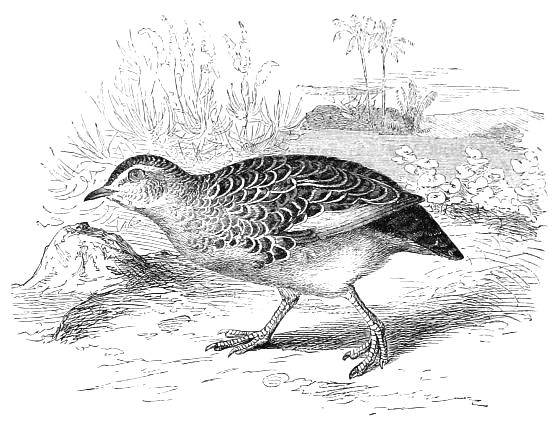
THE AFRICAN BUSH QUAIL (Turnix Africanus, or T. Gibraltariensis).
The Phasianidæ of Brehm comprise not merely the PHEASANTS PROPER, but all nearly allied groups. The members of this important division generally possess a comparatively slender body, medium-sized or short and much rounded wings, and a long or broad tail, composed of from twelve to eighteen feathers. The moderately long bill is much vaulted, with its upper mandible curved over the lower part of the beak, and occasionally prolonged into a sharp, nail-like tip; the rather high foot is furnished with long toes, and in the male is armed with a spur; the partially bare head is sometimes adorned with combs and lappets of skin, and sometimes with horn-like appendages or tufts of feathers. The plumage is glossy and brilliantly coloured. This family is almost entirely confined to the Eastern Hemisphere, only two species being found in America; and even in the Old World their distribution is nearly completely restricted to the warmer part of the Asiatic continent and its dependent islands.
The TUFTED PHEASANTS (Lophophori) constitute a group distinguishable by their short, rounded tail, the feathers of which are not placed as in most other Pheasants, but present a fan-like arrangement.
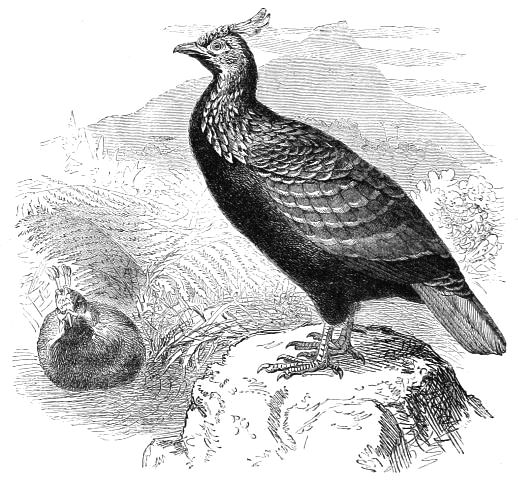
THE MONAUL, OR IMPEYAN PHEASANT (Lophophorus resplendens, refulgens, or Impeyanus).
THE MONAUL, OR IMPEYAN PHEASANT.
The MONAUL, or IMPEYAN PHEASANT (Lophophorus resplendens, refulgens, or Impeyanus), possesses a comparatively powerful body, moderate-sized wings, and a rather long tail, composed of sixteen feathers. The upper mandible is curved and sharply pointed at its tip; the foot is of medium height, that of the male furnished with a spur. The plumage of the male is magnificently coloured and very glossy; the region of the eye is bare, and his head decorated with a crest formed of numerous feathers; these are denuded of web at the roots and very broad at the extremities. The head and throat of this beautiful bird are of a metallic green, the crest is also of that hue, but resplendent with a golden sheen; the nape and upper part of the throat are of such a glossy purple or carmine-red that they gleam with all the brilliancy of the ruby; the lower parts of the throat and back are bronze-green, shaded with gold; the rest of the mantle, the wing and upper tail-covers are brilliant violet or blueish green; some few feathers on the under side are white, but its surface is principally black, shining with green and purple on the centre of the breast, and lustreless on the belly; the quills are black, the tail reddish brown; the eye is brown, the bare place that surrounds it blueish; the beak is dark grey, and the foot greyish green. The length is twenty-six and the breadth thirty-three inches; the wing measures from eleven to eleven and a half inches, and the tail eight inches and a quarter. The female is white upon the throat, the rest of her plumage being pale yellowish brown, spotted, striped, and marked with dark brown. The primary quills are blackish, the secondaries and tail-feathers striped black and brownish yellow. The size of the female is inferior to that of her mate.
We have from the pen of "Mountaineer" a full account of the life of the Monaul, but we cannot help regretting that such an excellent observer should look upon this magnificent species with the eye of a sportsman rather than with that of a naturalist. "The Monaul is found on almost every hill of any elevation, from the first great ridge of the Himalayas above the plains to the limits of the wooded district, and in the interior it is the most numerous of the game-birds. When the hills near Mussooree were first visited by Europeans it was found to be common there, and a few may be still seen on the same ridge eastwards from Landour. In summer, when the rank vegetation which springs up in the forest renders it impossible to see many yards around, few are to be met with, except near the summits of the great ridges jutting from the snow, where in the morning and evening, when they come out to feed, they may be seen in the green glades of the forest and on the green slopes above. At that time no one would imagine they are half so numerous as they really are, but as the cold season approaches, and the rank grass and herbage decay, they begin to collect together. The wood seems full of them, and in some places hundreds may be put up in a day's work. In summer the greater number of males and some of the females ascend to near the limits of the forests, where the hills attain a great elevation, and may often be observed on the grassy slopes a considerable distance above. In autumn they resort to those parts of the forest where the ground is thickly-covered with decayed leaves, and descend lower and lower as winter sets in, and the ground becomes frozen or covered with snow. If the season be severe, and the ground covered to a great depth, they collect in the woods which face south or east, where the snow soon melts in the more exposed parts, or descend much lower down the hill, where it is not so deep, and thaws sufficiently to allow them to lay bare the earth under the bushes and sheltered places. Many, particularly females and young birds, resort to the neighbourhood of the villages situated up in the woods, and may often be seen in numbers in the fields. Still, in the severest weather, when fall after fall has covered the ground to a great depth, many remain in the higher forests during the whole winter; these are almost all males, and probably old birds. In spring all in the lower parts gradually ascend as the snow disappears.
"In the autumnal and winter months numbers are generally collected together in the same quarter of the forest, though often so widely scattered that each bird appears to be alone. Sometimes you may walk for a mile through the wood without seeing one, and suddenly come to some part where, within the compass of a few hundred yards, upwards of a score will get up in succession: at another time, or in another forest, they will be found dispersed over every part—one getting up here, another there, two or three farther on, and so on for miles. The females keep more together than the males; they also descend lower down the hills, and earlier, and more generally leave the sheltered woods for exposed parts, or the vicinity of the villages, on the approach of winter. Both sexes are found separately in considerable numbers. On the lower part or exposed side of the hill, scores of females and young birds may be met without a single old male; while higher up, or on the sheltered side, none but males are to be found. In summer they are more separated, but do not keep strictly in pairs, several being often found together. It may be questioned whether they do pair or not in places where they are at all numerous; if they do, it would appear that the union is dissolved as soon as the female begins to brood, for the male seems to pay no attention whatever to her whilst sitting, or to the young when hatched, and is seldom found with them.
"From April to the commencement of the cold season, the Monaul is rather wild and shy, but this soon gives way to the all-taming influence of winter's frosts and snows; and from October it becomes gradually less so, till it may be said to be quite tame, but as it is often found in places nearly free from underwood, and never attempts to escape observation by concealing itself in the grass or bushes, it is perhaps sooner alarmed and at a greater distance than other Pheasants, and may therefore appear at times a little wild and timid. In spring it often rises a long way in front, and it is difficult to get near it when it again alights, if it does not at once fly too far to follow; but in winter it may often be approached within gunshot on the ground, and when flushed it generally alights on a tree at no great distance, and you may then walk quite close to it before it again takes wing.
"In the forest, when alarmed, it generally rises at once without calling or running far on the ground; but on the open glades, or grassy slopes, or any place where it comes only to feed, it will, if not hard pressed, run or walk slowly, in preference to getting up; and a distant bird, when alarmed by the rising of others, will occasionally begin and continue calling for some time while on the ground. It gets up with a loud fluttering and a rapid succession of shrill whistles, often continued till it alights, when it occasionally commences its ordinary loud and plaintive call, and continues it for some time. In winter, when one or two birds have been flushed, all within hearing soon become alarmed: if they are collected together, they get up in rapid succession; if distantly scattered, bird after bird slowly rises—the shrill call of each alarming others still farther off till all in the immediate neighbourhood have taken wing. When repeatedly disturbed by the sportsmen or shikaries, they often take a longer flight.
"In spring, when the snow has melted in every part of the forest, and they have little difficulty in procuring food, they appear careless about being driven from any particular spot, and often fly a long way; but in winter, when a sufficiency of food is not so easily obtained, they seem more intent on satisfying their hunger, and do not heed so much the appearance of man. The females seem at all times much tamer than the males. The latter have one peculiarity, not common in birds of this order; if intent on making a long flight, an old male, after flying a short way, will often cease flapping his wings, and soar along with a trembling, vibratory motion at a considerable height in the air. At such times, particularly if the sun be shining on his brilliant plumage, he appears to great advantage, and certainly looks one of the most magnificent of the Pheasant tribe."
The call of the Monauls is a loud, plaintive whistle, which is often heard in the forest at daybreak or towards evening, and occasionally at all hours of the day. In severe weather, numbers may be heard calling in different quarters of the wood before they retire to roost. The call has rather a melancholy sound, or it may be that as the shades of a dreary winter's evening begin to close on the snow-covered hills around, the cold and cheerless aspect of nature with which it seems in unison make it appear so. In autumn the Monaul feeds chiefly on a grub or maggot which it finds under decayed leaves; at other times it subsists on roots, leaves, and the young shoots of various shrubs and grasses, or when obtainable, on acorns and other seeds and berries. In winter it often feeds in the wheat and barley fields, but does not touch the grain; roots and maggots seem to be its only inducement for digging amongst it. At all times and in all seasons it is very assiduous in the operation of digging, and continues at it for hours together. In the higher forests, where large open plots occur quite free from trees or underwood, early in the morning or towards evening these localities may often be seen dotted over with Monauls all busily engaged at their favourite occupation.
The Monaul roosts in the larger trees, but in summer, when near or above the limits of the forest, will often sleep on the ground in some steep rocky spot. The female makes her nest under a small overhanging bush or tuft of grass, and lays five eggs of a dull white, speckled with reddish brown; the chicks are hatched about the end of May. By some persons, according to "Mountaineer," the flesh of the Monaul is thought equal to that of the Turkey, while others think it scarcely eatable. In autumn and early winter the females and young birds afford excellent food, but from the commencement of spring they deteriorate in that respect. The same writer tells us that in autumn, when the leaves have fallen from the trees and an extensive view through the wood is allowed, he has frequently stood till twenty or thirty have got up and perched on the branches, and then he has walked up to the different trees and fired at them in succession without disturbing any but those which were quite close to the spot. The Monaul is easily kept in confinement, and in that condition has bred in England; it appears quite capable of enduring the severity of our winter.
LHUYS' PHEASANT.
LHUYS' PHEASANT (Lophophorus Lhuysi). This newly-discovered species, which has received the name of Lophophorus Lhuysi from Geoffrey St. Hilaire, in honour of the French minister of that name, differs from the Monaul chiefly in the ornamentation of its head and tail, the feathers of its crest being acuminate instead of spatulated, and its tail of a greenish bronze adorned with white spots.
This bird inhabits the northern slope of the Great Himalaya range, while the Impeyan Pheasant occupies the southern slope of the same mountains. The female of this species resembles the Hen Monaul.
The TRAGOPANS, or HORNED PHEASANTS (Ceriornis), have a powerful body, moderate-sized wing, and short, broad tail composed of eighteen feathers. The bill is very short and rather weak, while the strong, flat foot is furnished with a spur. Two small, fleshy, horn-like appendages are situated behind the bare patch around the eye, and the naked skin on the throat is prolonged so as to form a pair of pendent lappets. The rich plumage of the male lengthens into a crest at the crown of the head, and is most beautiful both in its hues and markings, whilst that of the female is comparatively of sombre tint.
THE SIKKIM HORNED PHEASANT.
The SIKKIM HORNED PHEASANT (Ceriornis Satyra) is of a bright carmine-red on the brow, crown of the head, nape, and shoulders; a broad band, that passes from the temples to the back of the head, and a narrow line around the lappet at the throat, are also of the same glowing hue; the upper back, breast, and belly are red, enlivened with white spots edged with black; the mantle and upper tail-covers are brown, but each feather is delicately striped with black, and has a black spot at its extremity; some of the feathers on the upper wing-covers are also dotted with red, the dark brown quills are bordered and streaked with dull yellow; the tail-feathers are black, striped with dark brownish yellow.
The eye is deep brown, and the foot yellowish brown; the fleshy appendages and lappets are blue, spotted here and there with orange-yellow. The male is twenty-seven inches long, the wing measures eleven inches and a half, and the tail eleven inches. The plumage of the female is principally brown, darkest on the back, and enlivened by numerous black and red spots and streaks, as well as by the white shafts and dots of the feathers. Her length is only twenty-four inches, and that of her tail ten inches.
This species, which was the first known to naturalists, inhabits the Nepaul and Sikkim Himalayas, being more abundant in the former. "I have," says Jerdon, "seen it in spring at an elevation of about 9,000 feet above the level of the sea; and in winter it descends to between 7,000 and 8,000 feet in the vicinity of Darjeeling, and perhaps lower in the interior. It is frequently snared by the Bhotees and other Hill-men, and brought alive for sale at Darjeeling. Its call, which I have heard in spring, is a low, deep, bellowing cry, sounding like "waa-ung-waa-ung." Its general habits are no doubt similar to those of the C. melanocephala, which have been more accurately described."
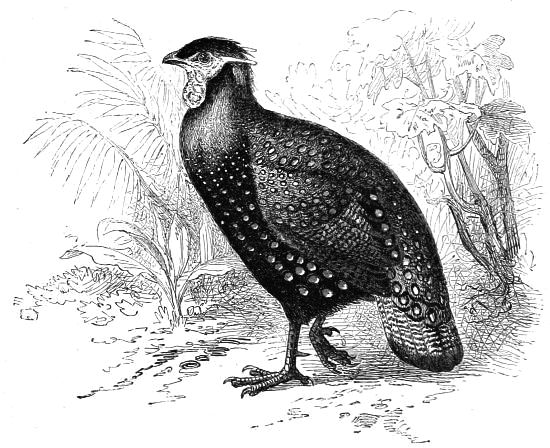
THE SIKKIM HORNED PHEASANT (Ceriornis Satyra).
THE JEWAR, OR WESTERN HORNED PHEASANT.
The JEWAR, or WESTERN HORNED PHEASANT (Ceriornis melanocephala), differs from the species last mentioned principally in the predominance of black in the coloration of the under side. In the male the feathers on the top of the head are black, with red tips; the nape, upper part of the throat, and shoulder are scarlet; the feathers on the mantle dark brown, ornamented with very delicate black lines and, towards their extremities, with small black-edged white spots. The feathers on the breast and belly are black, spotted with white, and slightly shaded with red; the quills are pale black, spotted and edged with brown; the tail is black, striped with brown and white at the ends of the feathers. The eye is nut-brown, the bare patch that surrounds it bright red, while the fleshy horns are pale blue; the lappets on the throat are purple, dotted with light blue at the sides, and bordered with flesh-pink; the beak is horn-grey, and the foot reddish. The male is from twenty-seven to twenty-eight inches long, and from thirty-five to thirty-six broad; the wing measures ten inches and a half; and the tail ten inches. The plumage of the female is varied with different shades of brown and black on the upper parts of the body, and with greyish brown, black, and white on the under side; the back is enlivened by pale yellow markings, and the under side by irregular white spots. The length of the female is twenty-three inches, the breadth thirty-one inches and a half; the wing measures nine inches and a half, and the tail eight inches and a half. (See Coloured Plate XXX.)
These birds are found from the western borders of Nepaul to the extreme North-west Himalayas; they are not very common near Simla and Mussooree, but are more plentiful near Almora.
"Their usual haunts," says "Mountaineer," "are high up, not far from the snows, in dense and gloomy forests, where they live either alone or in small scattered parties. In winter they descend the hills, and then their favourite haunts are in the thickest parts of the forests of oak, chestnut, and morenda pine, where the box-tree is abundant, and where under the forest trees a luxuriant growth of 'ringalt' or the hill bamboo forms an underwood in some places almost impenetrable. They keep in companies of from two or three to ten or a dozen or more, not in compact flocks, but scattered widely over a considerable space of forest, so that many at times get quite separated and are found alone." Jerdon tells us, "that if undisturbed, they generally remain pretty close together, and appear to return year after year to the same spot, even though the ground be covered with snow, for they find their living then upon the trees. If driven away from the forest by an unusually severe storm or any other cause, they may be found at this season in small clumps of trees, wooded ravines, or patches of low brushwood.
"At this season, with the exception of its cry of alarm when disturbed, the Jewar is altogether mute, and is never heard of its own accord to utter a call or note of any kind; unlike the rest of our Pheasants, all of which occasionally crow or call at all seasons. When alarmed it utters a succession of wailing cries, not unlike those of a lamb or kid, like the syllables 'waa, waa, waa,' each syllable uttered slowly and distinctly at first, and more rapidly as the bird is hard pressed and about to take wing. Where not repeatedly disturbed, it is not particularly shy, and seldom takes alarm till a person is in its immediate vicinity, when it creeps slowly through the underwood, or flies up into a tree, in the former case continuing its call till again stationary, and in the latter till it has concealed itself among the branches. If several are together all begin to call at once, and run off in different directions, some mounting into the trees, others running along the ground. When first put up they often alight in one of the nearest trees; but if again flushed the second flight is generally to some distance, and almost always down-hill. Their flight is rapid, and the whirr produced by the wings peculiar, so that even when the bird is not seen it may be distinguished from any other species. Where their haunts are often visited, either by the sportsmen or the villagers, they are more wary, and if such visits are of regular occurrence and continued for any length of time, they become alert in a very high degree; so much so that it is impossible to conceive a forest bird more shy or cunning. They then, as soon as aware of the presence of any one in the forest, after calling once or twice, or without doing so at all, fly up into the trees, which near their haunts are almost always evergreens of the densest foliage, and conceal themselves so artfully among the tangled leaves and branches that unless one has been seen to fly into a particular tree, and it has been well marked down, it is almost impossible to find them. In spring, as the snow begins to melt on the higher parts of the hills, they entirely leave their winter resorts, and gradually separate and spread themselves through the more remote and distant woods, up to the region of birch and white rhododendron, and almost to the extreme limits of forest. Early in April they begin to pair, and the males are then more generally met with than at any other period; they seem to wander about a great deal, are almost always found alone, and often call, at intervals, all day long. When thus calling, the bird is generally perched on the thick branch of a tree, or the trunk of one which has fallen to the ground, or on a large stone; the call is similar to the one they utter when disturbed, but it is much louder and only one single note at a time—a loud energetic 'waa,' not unlike the bleating of a lost goat—and can be heard for upwards of a mile. It is uttered at various intervals, sometimes every five or ten minutes for hours together, and sometimes not more than two or three times during the day; its purport most probably is to invite the females to the place. When the business of incubation is over, the broods, with the parent birds, keep collected together about one spot and descend towards their winter resorts as the season advances; but the forests are so densely crowded with long weeds and grass that they are seldom seen till about November, when these have partially decayed, so as to admit of a view through the wood."
The Jewar feeds chiefly on the leaves of trees and shrubs: of the former the box and oak are the principal ones; of the latter, thugall and a shrub something like privet. It also eats roots, flowers, grubs, insects, acorns, seeds, and berries of various kinds, but in small proportion as compared with leaves; in captivity it will eat almost any kind of grain. Though the most solitary of our Pheasants, and in its native forests perhaps the shyest, it is the most easily reconciled to confinement; even when caught old it soon loses its timidity, eating readily out of the hand, and little difficulty is experienced in rearing it.
"The Jewar," says Jerdon, "roosts in the trees; and in winter, perhaps for warmth, seems to prefer the low evergreens, with closely interwoven leaves and branches, to the larger trees which overshadow them."
We are without particulars respecting the incubation of this species.
The JUNGLE FOWLS (Galli) have a powerful body, short wings, and a moderate-sized graduated tail, consisting of fourteen feathers, placed vertically one above another. The beak is strong, of medium length, arched at its culmen, and curved at the tip of the upper mandible; the high foot is armed with a spur; a fleshy comb rises at the top of the head, and from the lower part of the beak depend soft fleshy wattles; the region of the cheek is bare. The thick, variegated plumage is so prolonged on the upper tail-covers as to conceal the real tail, over which the flowing feathers fall in graceful sickle-shaped curves. India and the Malay Islands seem to be the native abodes of these birds, each species, however, having its peculiar habitat. All the members of the group lead a retired life within the recesses of woods and forests, and for this reason we are but little acquainted with any minute details concerning the habits of many species.
THE KASINTU, OR RED JUNGLE FOWL.
The KASINTU, or RED JUNGLE FOWL (Gallus Bankiva), is a most gorgeous bird, having its head, throat, and the flowing feathers on the nape of glossy golden yellow, those on the back are purplish brown, with bright orange-red centre, and yellowish brown edges; the long feathers of the upper tail-covers are golden yellow, those of the middle wing-covers chestnut brown, shaded with blackish green; the breast-feathers are black, with a golden green lustre; the dark, blackish grey primaries have light borders, the secondaries are rust-red on the outer and black on the inner web; the black tail is glossy at its centre and quite lustreless at its sides. The eye is orange-red, the comb red, the back brownish, and the foot slate-grey. This species is twenty-five inches long; the wing measures eight inches and a half and the tail fourteen inches. The female is smaller than her mate, and carries her tail lower, and in her the comb and fleshy wattles are only indicated. The long neck-feathers are black, edged with whitish yellow, and those of the mantle dotted with brownish black; the under portions of the body are creamy yellow, and the quills and tail brownish black. This beautiful and well-known species, which is generally supposed to be the original stock of our domestic poultry, closely resembles some of the British Dunghill Cocks in plumage, but is considerably less in size. This bird appears to have been domesticated in the East at a very early date, and must have been introduced into Europe in very ancient times. It was well known to the Greeks and Romans, who, like our own people at a very recent period, and many Eastern nations at the present day, delighted in the cruel spectacle of a cock-fight. The Red Jungle Fowl is found from the Himalayas southwards, on the western side of India, at any rate as far as the Vindhean range. On the east it extends through Central India and the Northern Circars, almost to the northern branch of the Godavery. In Central India this fowl is rare, especially towards the west, but it is abundant towards the east, particularly in the Northern Circars. It is found in the Raimahal Hills, as far as the southern bank of the Ganges; but is seldom seen in the range of hills south of Cashmere, and from thence across the Himalayas to Assam, Silhet, Chittagong, and Burmah.
The Jungle Fowls are partial to bamboo jungle, but also inhabit lofty forests and dense thickets. "In travelling through a forest country," says Jerdon, "many are always found near the roads, to which they resort to pick up the grain from the droppings of cattle, &c.; dogs often put them up, when they at once fly on to the nearest trees. When cultivated land is near their haunts they may be seen morning and evening in the fields, often in straggling parties of from ten to twenty."
The breeding season is from January to July, according to the locality. Their eggs, eight in number, are creamy white, and are often laid in a dense thicket, or under a bamboo clump, the hen occasionally scraping together a few leaves or dried grass to form a nest. After the end of the period of incubation, the hackles fall off the neck of the male, and are replaced by short blackish grey feathers.
Jerdon tells us that young birds, if kept for a few days, are very excellent for the table, having a considerable game flavour.
THE JUNGLE FOWL OF CEYLON.
The JUNGLE FOWL OF CEYLON (Gallus Stanleyii). The male of this beautiful bird resembles that of the species last described in its general appearance, but has the breast reddish brown, striped with deep black, moreover, the wing-feathers have no brown patch in their centre. The female closely resembles that of the Gallus Bankiva. "This fowl," says Tennant, "abounds in all the lower parts of the island of Ceylon, but chiefly in the lower range of mountains; and one of the most vivid memorials associated with my journey through the hills, is its loud, clear cry, which sounds like a person calling 'George Joyce.' At early morning it rises amidst mist and dew, giving life to the scenery that has scarcely yet been touched by the sunlight." This species has never as yet bred or survived in captivity, and no living specimens have been successfully transmitted to Europe.
THE JAVANESE JUNGLE FOWL.
The JAVANESE JUNGLE FOWL (Gallus furcatus) is even more gorgeously plumed than those of its family already described. The long blunt feathers on the neck are of a deep metallic green, with a narrow border of velvety black; the long narrow feathers on the upper wing-covers are blackish green, with bright golden green edges; the long rump-feathers are blackish green in the centre, bordered with light yellow; and all the feathers of the tail-covers are of a deep and glossy black. The primary quills are blackish brown; the secondaries brown, with a narrow, reddish yellow edge to the outer web; while the real tail-feathers are of a rich glossy metallic green. The eye is light yellow; the bare face red at its sides, and marked with King's yellow beneath; the lower part of the comb is blue, and its apex violet; the beak is greyish black, with greyish yellow at its base; the foot is light-blueish grey.
The female is considerably smaller than her mate, has her face covered with feathers, and is entirely without either comb or lappets on the throat. Her head and throat are greyish brown, the feathers on the mantle golden green, with greyish brown edges, and delicate golden streaks on the shafts. The secondary quills and large wing-covers are glossy dark grey, marked with yellow; the primaries are greyish brown; the tail-feathers brown, shaded with green, and edged with black. The under side is greyish cream-colour, and the throat white. This beautiful species is a native of Java.
THE SONNERAT JUNGLE FOWL, OR KATAKOLI.
The SONNERAT JUNGLE FOWL, or KATAKOLI (Gallus Sonnerati), differs from all its congeners in the construction of its neck-feathers, which are long, slender, and rounded at their extremities, where the shaft spreads out in such a manner as to form a round horny disc; it then again contracts, and again expands into a second disc. The webs of these feathers are dark grey; the shafts and lower discs pure white, and those at the end bright reddish yellow; the long slender feathers on the mantle are brownish black with light spots, and those of the smaller wing-covers have a webless smooth shaft of a glossy reddish brown; the wing-feathers are grey, with light shafts and edges, those at the exterior bordered and shafted with red and yellow. Some of the quills are dull grey, with light edges and shafts, the rest black, with a greenish lustre; the sickle-shaped feathers of the upper tail-covers gleam with dark green, those on the under side are blackish grey, such as cover the thighs having a reddish or yellow tint at the centre and edges. The eye is light brownish yellow, the comb red, and the beak yellowish grey. This species is twenty-four inches long; the wing measures nine inches and a half, and the tail about fifteen inches. The hen is almost of a uniform dark brown on the mantle, the edges to the feathers being of so pale a tint as merely to give the effect of light shading; the throat and gullet are white, the rest of the under side light yellowish grey, bordered with black; the primary quills are dark brown; the secondaries striped black and brown; the tail-feathers blackish brown, spotted and marked with a still deeper tint.
The Sonnerat Jungle Fowl, or Grey Jungle Fowl, as it is also sometimes called, is found only in Southern India, spreading on the eastern coast to a little north of the Godavery, in Central India to the Pachmarii, and on the west to the Jajpeeple hills. It is found in great abundance on the Malabar coast, especially in the most elevated portions, and ascends to the summit of the Neilgherry Hills. It is also found in the Eastern Ghauts, and in various isolated ranges in different parts of Southern India.
"Like the Red Jungle Fowl," says Jerdon, "it affects bamboo jungles. Early in the morning, throughout the Malabar coast, the bird may be found feeding on the roads; and with dogs you are certain of getting several shots, the birds perching at once on being put up by dogs. The hen lays from February till May, generally producing from seven to ten eggs of a pinky cream-colour. These are usually deposited under a bamboo clump. The call of the Cock is very peculiar, being a broken and imperfect kind of crow, quite unlike that of the Red Jungle Fowl, and quite impossible to describe. When they are taken from the jungles they are also very much wilder, and not so easily domesticated as that species; but cases are known in which they have bred in confinement with hens of the common breed."
The section Phasianus of Brehm constitutes a numerous subdivision of the Phasianidæ, generally recognisable by the elongate body, short neck, and small head; the short, much-rounded wing has the fifth and sixth quills longer than the rest; the tail (composed of from sixteen to eighteen feathers, placed in lengths) is wedge-shaped, and either very long or of moderate size; the slender bill is weak, much arched and hooked at its extremity; the foot is of medium height, smooth and powerful—that of the male is furnished with a spur. The plumage, which covers the entire body except the cheeks and tarsi, is prolonged upon the head, and sometimes on the nape into a crest and flowing collar; the brilliancy of its coloration is, to a certain degree, inferior to that of the Phasianidæ, which we have before described, but it is, nevertheless, striking and beautiful. The female is smaller than her mate, owing to the unusual shortness of her tail; she also differs in the fact that her plumage is sombre and but little variegated.
All the various members of this group were originally natives of Asia, where some species frequent mountain ranges, and never descend from a certain altitude even during the most severe winters, whilst others prefer low-lying districts; they, however, avoid the actual forest, and seek for the shelter of brushwood, shrubs, or hedges, and from thence fly out to search for food in the surrounding country. These birds are stationary in their habits, and at most indulge in short expeditions not exceeding the distance of a few miles from their native haunts.
The MACARTNEY PHEASANTS (Euplocamus) constitute a group possessing a slender body, short neck, small head, short wing, and moderate-sized tail, composed of sixteen feathers. The bill is moderate, the tarsus high, and in the male armed with a spur. The feathers on the neck and rump are not much prolonged, and the former are more or less ragged at their tips; those of the tail are placed in gradations, the centre ones curving both downwards and outwards. The head is decorated with a delicate crest; the cheeks are bare, and covered with a soft velvety skin, which swells to such a size during the period of incubation as to form a comb and short lappets. The plumage of these birds is more remarkable for its brilliant lustre than for the variety of its hues. The female and young differ considerably from the adult male in their appearance.
THE SIAMESE FIREBACK.
The SIAMESE FIREBACK (Euplocamus-Diardigallus-prælatus) is a fine species, with the throat and upper part of the breast and back of a beautiful dark grey; the crown of the head and a narrow band around the bare red cheek are black; the feathers on the centre of the back are bright yellow; those on the rump black, with a broad scarlet edge. The wing-feathers are grey, bordered and marked with a darker shade; those of the tail are lustrous blackish green, and those on the breast deep black, with a green gloss; the crest is composed of from twelve to twenty feathers, having lancet-shaped tips and bare shafts towards their roots.
This bird is a native of Siam, where it is known as the "Kai-pha." Sir Robert Schomburghk saw a living specimen in a collection of animals at a Siamese temple, and purchased it. When in captivity, instead of seeds, it had been fed upon the fry of fishes, prawns, and shrimps; this specimen, when dead, was forwarded to Mr. Gould. Sir Robert Schomburghk was afterwards told by the Prime Minister, or Kalakorne, that this pheasant is found at Rapri, or Raxaburi according to Sir J. Bowring's map, in latitude 31° 33´ north; longitude say 100° east.
Mr. Gould, previously to the receipt of this specimen, had seen a drawing of the bird in the East India Company's collection.
Schomburghk describes some of these birds kept by himself as being readily tamed; their flight resembled that of a Partridge, and their cry, when alarmed, was loud and harsh. Their food consisted of insects, rice in the husk, small bits of plants, bananas, and various other kinds of fruit; the latter diet they evidently preferred.
THE SIKKIM KALEEGE, OR BLACK PHEASANT.
The SIKKIM KALEEGE, BLACK PHEASANT, or KIRRIK (Euplocamus-Gallophasis-melanotus), as it is called in India, has the entire mantle of a glossy black, a part of the throat and the breast are whitish, the belly and feathers on the tail-covers dull brownish black. The eye is brown, the beak greyish yellow, the bare cheek bright red, and the foot grey. The length of this bird is twenty-three and the breadth twenty-eight inches; the wing measures eight inches and three-quarters, and the tail ten inches. The female is somewhat smaller, and is principally of an umber-brown, each feather having a light tip and lines on the shaft; these markings are broader and lighter on the under side and upper wing-covers than on the back; the throat-feathers are light grey, unspotted; and the centre tail-feathers deep brown, marked with light grey; those at the sides are greyish, with a green gloss.
Jerdon tells us the Sikkim Black Pheasant is met with in Nepaul, in some portions of the country being replaced by Gallophasis Horsfieldii. He informs us that about Darjeeling it is the only Pheasant at all common, and is not unfrequently put up on the roadside by dogs, when it at once takes refuge in trees. It is found at an altitude of from 3,000 to nearly 8,000 feet. It walks and runs with its tail semi-erect, and frequents both forests and bushy and grassy ground, coming to the fields and to more open spaces to feed in the morning and evening. Its eggs are occasionally found by the coolies, when weeding the tea-gardens in June and July, and are usually from five to eight in number. Its call sounds something like "koorchi-koorchi," at other times it resembles "kooruk-kooruk."
THE KELITSCH, OR WHITE-CRESTED KALEEGE PHEASANT.
The KELITSCH, or WHITE-CRESTED KALEEGE PHEASANT (Gallophasis albocristatus), has the head, throat, mantle, and tail of a lustrous blueish black; the rump-feathers are dull white, marked with pale black; the crest is white; the long breast-feathers greyish white; and the rest of the under side dark grey. The eye is brown, the bare cheek red, the beak dark grey, and the foot blueish grey. The hen bird is scarcely distinguishable from the female Kirrik.
Of the life and habits of these birds we know but little, except from the writings of "Mountaineer," who has, however, observed and described them with his usual exactness. "The well-known Kaleege," says he, "is most abundant in the lower regions; it is common in the Dhoon at the foot of the hills, in all the lower valleys, and everywhere to an elevation of about 8,000 feet. From this it becomes scarcer, though a few are found still higher. It appears to be more unsuspicious of man than the rest of our Pheasants; it comes much closer to his habitations, and from being so often found near the villages and roadsides, is regarded by all as the most common, though in their respective districts the Monauls are more numerous. In the lower regions it is found in every description of forest from the foot to the summit of the hills, but is most partial to low coppice and jungle, and wooded ravines or hollows. In the interior it frequents the scattered jungle at the borders of the dense forest, thickets near old deserted patches of cultivation, old cow-sheds and the like, coppices near the villages and roads, and, in fact, forest and jungle of every kind except the distant and remote woods, in which it is seldom found. The presence of man, or some trace that he has once been a dweller in the spot, seems as it were necessary to its existence.
"The Kaleege is not very gregarious; three or four are often found together, and ten or twelve may sometimes be put out of one small coppice, but they seem in a great measure independent of each other, much like our English Pheasants. When disturbed, if feeding or on the move, they generally run, and do not often get up unless surprised suddenly and closely, or forced by dogs, or else they lie rather close in thick cover. They are never very shy, and where not unceasingly annoyed by sportsmen or shikarees are as tame as could be wished. In walking up a ravine or hill-side, if put up by dogs a little distance above, they will often fly into the trees close above one's head, and two or three will allow themselves to be quietly knocked over in succession. When flushed from any place where they have sheltered, whether on the ground or aloft, they fly off to some distant cover, and alight on the ground in preference to the tree. Their call is a loud whistling chuckle or chirrup; it may be occasionally heard from the midst of some thicket or coppice at any hour of the day, but is not of frequent occurrence. It is generally uttered when the bird rises, and if it flies into a neighbouring tree is often continued for some time. When flushed by a cat or some small animal, this chuckling is always loud and earnest.
"The Kaleege is very pugnacious, and the males have frequent battles. On one occasion I had shot a male, which lay fluttering on the ground in its death-struggles, when another rushed out of the jungle and attacked it with the greatest fury, though I was standing reloading the gun close by. The male often makes a singular drumming noise with its wings, not unlike the sound produced by shaking a stiff piece of cloth. It is heard only in the pairing season, but whether it is employed to attract the female, or in defiance of his fellows, I cannot say, as I have never seen the birds in the act, though often led to the spot where they were by the sound. It feeds on roots, grubs, insects, seeds, and berries, and the leaves and shoots of shrubs. It is rather difficult to rear in confinement when caught old, and the few chicks I have tried have also soon died, though possibly from want of attention. The Kaleege lays from nine to fourteen eggs—very similar in size to those of the Domestic Hen. They are hatched about the end of May."
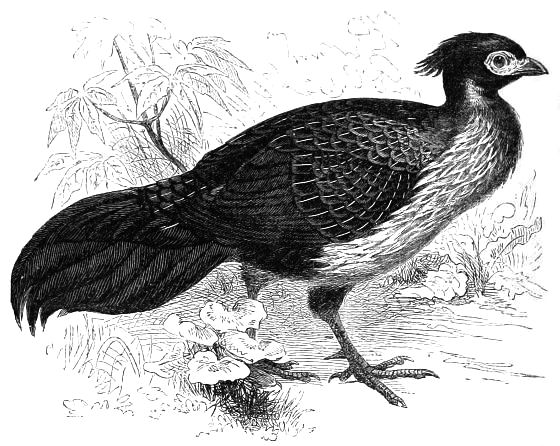
THE KALEEGE, OR BLACK PHEASANT (Euplocamus-Gallophasis-melanotus).
Birds of this species resident in the Zoological Gardens in London have repeatedly bred there.
THE SILVER PHEASANT.
The SILVER PHEASANT (Nycthemerus argentatus, or Euplocamus nycthemerus) differs from the preceding, which in other respects it closely resembles, in the long ragged crest on its head, and the wedge-like form of its tail. The feathers of the latter are placed in heights, those in the centre curving rather towards the sides than downwards. This magnificent bird is white on the nape and mantle, the feathers of the latter being traced with delicate zigzag black lines. The black under side has a steel-blue lustre, the quills are white, edged and streaked with black; the tail-feathers are similarly coloured, their markings becoming gradually broader towards the tips. The long thick crest is glossy black, the bare cheek scarlet, the eye light brown, the beak blueish white, and the foot coral-red. This species is thirty-two inches long.
From the date of its first introduction into Europe the Silver Pheasant has been everywhere regarded as more fitted to be an ornament of our aviaries than a denizen of our woods, and, when so treated, has rewarded us for our pains. It may, indeed, be said to be completely naturalised in a domesticated state, and it could doubtless be established in our woods, were such a measure desirable; but to effect this with success no other species of Pheasants must be kept within its precincts, the pugnacious nature of this tribe of birds not admitting of the near proximity of two species, as the certain result would be a constant succession of battles, almost invariably ending, as is known to be the case when the Domestic Cock and Pheasant meet, in the death of the weaker bird.
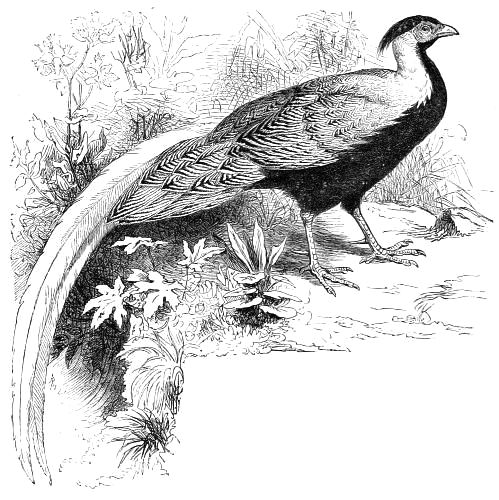
THE SILVER PHEASANT (Nycthemerus argentatus, or Euplocamus nycthemerus).
Our country is not, perhaps, after all, well adapted either for this bird or its near allies, the Euplocami, which have been only recently introduced. The Silver Pheasant has been found to bear confinement well, and with but ordinary care its propagation is usually attended with success. After the autumn moult, its pencilled markings are exceedingly elegant and graceful; as spring advances its rich comb and wattle become enlarged, and of a most vivid scarlet, offering a striking contrast to its delicate pea-green bill. The colouring of the female is altogether sombre, and devoid of that sparkling brilliancy which so eminently adorns her mate, making him conspicuous even among the gayest of his congeners.
The PHEASANTS PROPER (Phasiani) are recognisable by their long tail, the feathers of which are placed vertically, those in the centre being six or eight times as long as those at the sides, while those of the upper tail-covers have ragged or rounded tips. Their head is without a crest, but has a small upright tuft of feathers close to each ear. The plumage of the male is always beautiful, often most brilliant; but that of the female is comparatively sombre, with dark markings. The native countries of these birds are the mountainous parts of Asia, extending even to Japan; some species, however, have become naturalised in the temperate part of Europe. During the day they are found lying concealed in jungles, covers, and long grass, living in divided societies, of different sex. Towards the spring they separate into families, consisting of a male and several females; the party generally taking possession of a certain locality, from which the commander is very particular in driving away all male intruders. When suddenly disturbed, they endeavour to escape by using their legs rather than their wings. Their flight is rapid and noisy when first started, but is sustained only for a short distance. Various kinds of grain and insects form their principal food; these are usually sought for at sunset. They also consume bulbous roots, which are obtained by means of their bill and feet. Their eggs are deposited on long grass, without any kind of nest, and are about ten in number.
THE COMMON PHEASANT.
The COMMON PHEASANT (Phasianus Colchicus) is so variegated as to render an accurate description of its plumage extremely difficult. The head, as well as part of the neck, is green, with a resplendent blue gloss; the lower part of the neck, breast, belly, and sides are reddish brown, glistening with purple, each feather on these parts being edged with glossy black. The feathers on the mantle have white crescent-shaped spots below the border. The flowing, ragged feathers on the rump are dark copper-red, shaded with purple; the quills striped brown and reddish yellow; and the tail-feathers olive-grey, striped with black, and bordered with reddish brown. The eye is reddish yellow, the bare regions round the eye red, the beak light brownish yellow, and the foot reddish grey or lead-colour. This species is from thirty to thirty-two inches long, and from twenty-nine to thirty-one broad; the wing measures nine inches and a half, and the tail sixteen inches. The female is of inferior size, and has the entire plumage of a brownish grey tint, spotted and striped with black and deep reddish brown; the feathers on her back are darker than the rest of the body. The Banded and Isabel Pheasants closely resemble the above bird in their general appearance: but the first is distinguishable therefrom by a narrow white band on the throat, the deeper shade of its colouring, and the comparative paleness of its black markings; whilst the Isabel Pheasant is principally of a light yellowish grey, each feather edged with a deeper shade, the belly, on the contrary, is very dark, sometimes quite black. The females of both these last-mentioned varieties are similar to their mates in the principal hues of their plumage.
The Common Pheasant, which is now naturalised all over the European continent, was originally introduced from Colchis, and derived its name from the river Phasis, in the neighbourhood of which it was especially abundant. In its native country, now called Mingrelia, it is still to be found wild, and of unequalled beauty. This bird, which is spread extensively over England, as far north as Northumberland, prefers woods, especially those of oak or beech, and such as have a growth of long grass and brambles, also damp ground where osiers and reeds abound, and hedgerows, but always lives in the vicinity of wood and water. During the day these Pheasants remain on the ground, moving quietly from bush to bush, as they go in search of food at dawn and sunset. In their progress to their feeding-place they always run, and on this account are very easily taken by wire snares set in the narrow paths that they make in the long grass which they constantly frequent. Towards evening they go to roost on low branches, taking their place near the stem or trunk of the tree. This habit of roosting upon trees is very fatal to their safety, since, being objects of considerable size, readily distinguishable by their long tails, and not easily frightened from the perch, they offer a sure mark during moonlight nights to the poacher's gun. The roosting-place of the male is very easily discovered, for he invariably chuckles when he first "trees," or goes to perch; and the female usually chirps on the same occasion. During summer and the period of moulting the Pheasant rarely perches, but retires for the night to the longest grass or other thick cover, and does not begin to "mount" again until towards the end of September or the beginning of October, having at that time renewed its plumage. Where Pheasants are numerous, the males are generally found associated during the winter separate from the females; and it is not until the end of March that they allow the approach of the latter without signs of displeasure, or at least indifference. At the above-mentioned time, however, the male bird assumes an altered appearance; the scarlet on his cheeks and around his eyes acquires additional depth of colour, and he walks with a more measured step, with his wing let down, and his tail carried in a more erect position. Being polygamous, he now takes possession of a certain "beat," from whence he drives every male intruder, and commences his crowing, which is accompanied by a peculiar clapping of his wings as a note of invitation to the other sex, as well as of defiance to his own. The female makes a very inartificial nest upon the ground, in long grass or thick underwood, and not unfrequently in fields of clover; she lays from ten to fourteen eggs, of a clear yellowish grey-green colour. The young are hatched during the months of June and July, and continue with the hen until they begin to moult and assume the adult plumage; after this period the young males are only to be distinguished from the older birds by the comparative bluntness and shortness of the tarsal spur. Usually when alarmed the Pheasant escapes by running rapidly, and seldom uses its wings, except in cases of very pressing danger.
"An old cock Pheasant," says Mr. Yarrell, "immediately on hearing a dog give tongue in a wood where he is, will foot away to the farthest corner, particularly if the wood be open at bottom, and from thence run one dry ditch or hedgerow after another for half a mile to the next covert; but a hen Pheasant seems to trust to her brown colour to escape detection, and, squatting in any bit of long grass that is near her, often surprises and startles the young shooter not a little by bouncing up with a rattling noise close at his feet. The poor frightened bird is frequently indebted to the sensation thus created for a clear escape. The brown earth-like colour of the plumage of the females of several species of Pheasants seems to be an admirable provision, not only for their individual safety, but for the preservation of the whole race."
In a wild state, the Pheasant feeds on grain, seeds, green leaves, and insects; also on some kinds of bulbs and berries.
THE CHINESE RING-NECKED PHEASANT.
The CHINESE RING-NECKED PHEASANT (Phasianus torquatus) is even more beautiful than its congeners. In this elegant bird the head and part of the throat are green; a line over the eyes and a collar about the throat white; the feathers on the nape almost black near the shaft, with broad yellow borders; and those on the mantle black at the base, with alternate yellow and black streaks, each feather edged with bright red. The long feathers on the rump and upper wing-covers are greenish grey, marked and dotted with red; those on the belly purplish brown, with conical black spots on the shafts, and those on the sides brownish yellow, marked with large round dark spots on the shafts. The quills are greyish brown, striped with greyish yellow, and secondaries reddish grey; the tail-feathers are greenish yellow, streaked with black. The eye is yellowish, the wattle on the cheek red, the beak light grey, and the foot brownish yellow. The size of this species is about that of the Common Pheasant. The hen resembles the female of the latter in her general appearance, but is somewhat redder. China is the native land of this beautiful species, which is there very abundant in wood-covered tracts.
"These birds," says Latham, "were first introduced into England under the name of Barbary Pheasants, by the Duke of Northumberland, and many were bred and turned out at large at Alnwick. Other noblemen and gentlemen have done the same, and thus the breed has become numerous. Birds of this species mix and breed with the Common Pheasant, and thus present much variety in their plumage, some having a well-defined and others a narrow and imperfect ring around the neck; the feathers of the flank, also, do not present the pure colouring either of P. torquatus or of P. Colchicus."
Living specimens of this species have bred so abundantly in the gardens of the Zoological Society that birds and eggs have been transmitted to different parts of the country. The flight of the Chinese Ring-necked Pheasant when started is both rapid and direct, and is often continued to a considerable distance before the bird again enters the cover.
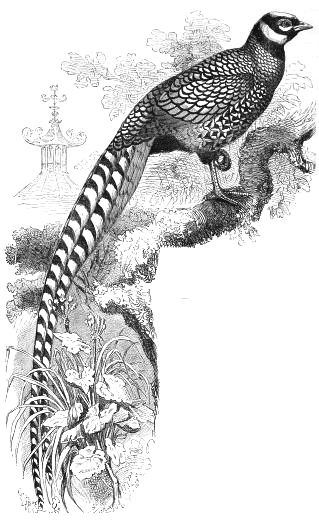
REEVES' PHEASANT (Phasianus Reevesii, or P. veneratus).
THE JAPANESE PHEASANT.
The JAPANESE PHEASANT (Phasianus versicolor) has the head green and the upper part of the neck shaded with blue; the nape and entire under side are dark green, deepening to pale black at the sides and centre of the belly; the mantle-feathers are blackish green, surrounded by a horseshoe-shaped line of reddish yellow, edged with rust-red; the feathers of the upper wing and tail covers are blueish greyish green; the quills brownish grey, with light stripes; and the tail-feathers reddish grey, marked with black. The eye is light brown, the beak whitish grey, and the foot light brownish grey. The male is twenty-seven inches long and twenty-nine broad; the wing measures eight and the tail fifteen inches. The plumage of the hen differs from that of all the species above-mentioned, her feathers having a dark green centre, surrounded by a broad light brownish grey or light yellow border.
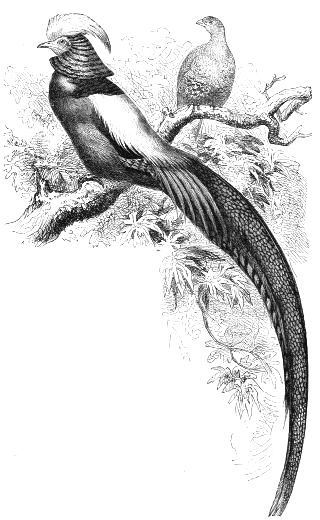
THE GOLDEN PHEASANT (Thaumalea picta).
These Pheasants are natives of Japan. In 1840 a pair of them were purchased by the Earl of Derby, of which the male only arrived at Knowsley; and from this bird and a female of the Common Pheasant have been derived the Green Pheasants, now so numerous in England. In form, habits, and disposition, this species resembles the Common Pheasant more nearly than the Phasianus torquatus, and has less disposition to wander.
SOEMMERRING'S PHEASANT.
SOEMMERRING'S PHEASANT (Phasianus Soemmerringii) is also known under the name of Graphephasianus, on account of its superior length of tail. The plumage of this species is principally copper-red, almost all the feathers having light borders; the centres of the upper wing and breast feathers are blackish brown; those on the rump have their rounded tips edged with golden yellow; the quills are brown, bordered with a paler tint; the eye is yellow, the beak horn-grey, the foot lead-grey. The hen is copper-red, marked with black, each feather edged with grey of various shades; those on the thighs are striped pale red and black; the quills are greyish brown, lightly bordered; the tail-feathers reddish, streaked with black and marked with deep brown; the throat and centre of the belly are light, and the lower belly dark grey.
This Pheasant, with which we became first acquainted through Dr. Siebold and Temminck, received its name from the latter, in honour of Professor Soemmerring, a distinguished naturalist.
Since the year 1860 the living bird has been brought to Europe, and those in the Zoological Gardens, London, produced a brood in June, 1865.
"The female," says Mr. Bartlett, "laid about ten eggs, but only three or four birds were hatched, and these died. The Phasianus Soemmerringii at the Antwerp Gardens also bred, but we are unable to say if the young arrived at maturity. In both places the males exhibited a strong inclination to destroy the females, and we come to the conclusion that the species is ill-adapted to breed in captivity."
REEVES' PHEASANT.
REEVES' PHEASANT (Phasianus Reevesii, or P. veneratus) represents a group, called by Wagler Syrmaticus, remarkable for their great length of tail and unusually variegated plumage. In this species the top of the head, ear-tufts, and a broad line around the throat are pure white; the sides of the head and a wide band across the breast are black, the feathers on the mantle, rump, and upper breast are golden yellow, edged with black; those of the lower breast and side whitish grey, decorated with a slender heart-shaped line, broadly edged with brownish red, and those of the belly brownish black. The feathers of the upper wing-covers are blackish brown, bordered with two lighter shades of brown; the quills are striped golden yellow and brownish black; and the tail-feathers silver-grey, dotted with red spots, surrounded by a black line, and broadly bordered with golden yellow. The eye is reddish, the beak and foot greyish yellow. This species resembles the Silver Pheasant in its general size, but has a streaming tail about six feet in length.
Considerable confusion respecting the nomenclature of this remarkable bird has been occasioned by the late M. Temminck having, in his "Histoire Naturelle Generale des Pigeons et des Gallinacés," assigned its two lengthened tail-feathers to the old Phasianus superbus of Linnæus, an error which he subsequently corrected, when describing and figuring this bird in his "Planches Colorées" as P. veneratus. M. Temminck's error was adopted by Dr. Latham; and hence, while the description of the Barred-tail Pheasant, in his "General History of Birds" (Vol. VIII., p. 190), has reference to the old P. superbus, some of his remarks apply to the present species. It is probable that the bird did not escape the notice of the celebrated Marco Polo, since he states "there be plenty of Feysants and very great, for 1 of them is as big as 2 of ours, with Tayles of eygth, nine, and ten spannes long, from the kingdom of Erguyl or Arguill, the western side of Tartary;" but we question if he ever saw more than the central tail-feathers, which, being held in great estimation, were considered to be suitable presents to foreigners, and hence these feathers found their way to Europe many years before the entire bird. Through Mr. Reeves, after whom this species was named by Dr. Gray, we obtained the sight of the skin of a male, and afterwards some parts of a female. He also brought a female in 1838, and both were living in the Zoological Gardens at the same time, but did not breed. Another, brought from China in 1862, lived at Mr. Kelk's seat, near Edgware, among other Pheasants, at perfect liberty and in excellent health, for two years. Since the Chinese War, living examples have successfully bred in more than one menagerie, both in England and on the Continent.
"The successful introduction of the living birds now in this country," says Mr. Tegetmeier, in the Field for June 7, 1867, "is owing to the combined efforts of Mr. John J. Stone, and Mr. Walter Medhurst, H.M. Consul at Hankow."
Latham saw at Sir Joseph Banks's some drawings taken from a curious collection of ancient porcelain, representing a sham-fight on the water for the Emperor's amusement, supposed to be between his Tartarian and Chinese subjects, personated by the females of his seraglio, the chieftains of the former having one of the barred feathers of this species on each side of the bonnet, and the opponents, or Chinese, having two feathers of a Pheasant of a smaller kind, probably a Golden one; hence he concludes that the present bird is a native of Tartary, and not unlikely to be as common there as the other is in China.
Dr. Bennett, in his "Wanderings in New South Wales," writes as follows:—"In Mr. Beale's splendid aviary and gardens at Macao, the beautiful Phasianus veneratus of Temminck, or P. Reevesii of Gray, now commonly known by the name of Reeves' Pheasant, was seen. It is the Che Kai of the Chinese. The longest tail-feathers of this bird are six feet in length, and are placed in the caps of the players when acting military characters. This I observed in Canton, where some of the beautiful tail-feathers (rather in a dirty condition, like the actors themselves, who in their tawdry dresses reminded me of the sweeps in London on a May-day) were placed erect on each side of their caps as a decoration. The Chinese do not venerate this bird, as was at first supposed, and which may have caused Temminck to bestow upon it the name of Veneratus, but it is superstitiously believed that the blood is possessed of poisonous properties, and that the mandarins, when in expectation of losing their rank and being suddenly put to death by order of the Emperor, preserve some of it upon a handkerchief in a dried state, on sucking which they fall down and instantly expire."
Mr. Beale's first male specimen, obtained in 1801, was kept in a healthy state for thirteen years. After its death he endeavoured to procure others, but did not succeed until 1831, when four specimens were brought from the interior and purchased by him for 130 dollars. These were, I believe, subsequently taken to England by Mr. Reeves.
The GOLDEN PHEASANTS (Thaumalea) are distinguishable from the birds above described by the comparatively small size of their bodies, their slender forms, bushy crest, and very long tail. The neck of the male is adorned with a remarkable collar of feathers that covers the nape, and is broadest under the chin.
THE GOLDEN PHEASANT.
The GOLDEN PHEASANT (Thaumalea picta) is most gorgeously apparelled, with a bright golden crest upon its head, and a rich orange-red collar, in which each feather is edged with deep velvety black; the feathers of the mantle are golden green, bordered with black, those on the lower back and upper tail-covers bright yellow, and those on the face, chin, and sides of throat whitish yellow. The lower neck and under side are a deep saffron-yellow, the wing-covers chestnut-brown, the quills greyish brown, edged with rust-red, the shoulder-feathers dark blue, with light borders, and most of those of the tail decorated with a black network tracery; the long, centre feathers of the upper covers are dark red, the eye is golden yellow, the beak whitish yellow, and the foot brownish. The male is thirty-two inches long and twenty-five broad, the wing measures eight and the tail twenty-two inches. The plumage of the hen is deep rust-red above, shading on the under side into a mixture of red, grey, and yellow; the feathers on the top of the head, throat, and sides, upper secondaries, and centre tail-feathers are striped brownish yellow and black, and the side tail-feathers brown, marked with yellowish grey. A very similar species lately discovered, and called Thaumalea obscura, is distinguishable from the above species, which in other respects it closely resembles, by the comparative darkness of its plumage during all its various changes, and by the inferior length of the tail-feathers.
The Golden Pheasant inhabits Southern Tauria and the eastern part of the desert of Mongolia, advancing in summer up to the Amoor, and also the provinces of Kansu and Setschun in the interior of China, whence, Mr. Swinhoe tells us, living examples are brought into Canton for sale. Latham says that this bird is called in China Kinki, or Kinkee, which signifies Gold-flower Fowl, or Wrought Fowl. It is a hardy bird, and many pairs have been turned loose in our own country with the hope of naturalising it, but unfortunately they have all been shot. According to Gould it bears confinement well, and breeds freely. The sexes change considerably in appearance, and some hens kept for six years by Lady Essex gradually assumed the male feathers.
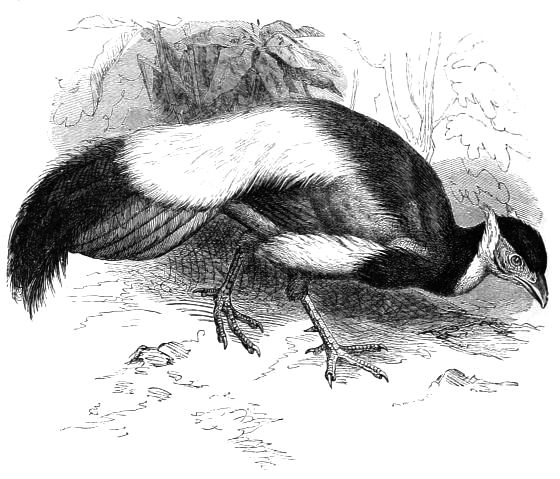
THE CHINESE EARED PHEASANT (Crossoptilon auritum).
LADY AMHERST'S PHEASANT.
The LADY AMHERST'S PHEASANT (Thaumalea Amherstiæ) is a very beautiful bird, having a black and red plume upon its head. The feathers that form the collar are of a silvery hue, with dark edges; the plumage of the neck, upper back, and upper wing-covers is light golden green, bordered with a deeper tint; and that of the lower back shaded golden yellow. The feathers of the upper tail-covers are pale red, spotted and lined with black, those on the under side pure white; the quills are brownish grey, edged with a lighter tint on the outer web; the centre tail-feathers are whitish grey, striped with black and edged with yellow, the rest are brownish grey; the lancet-shaped feathers at the sides of the upper tail-covers are coral-red, the bare patches on the cheeks blue, and the eye golden yellow; the beak is pale, and the foot dark yellow.
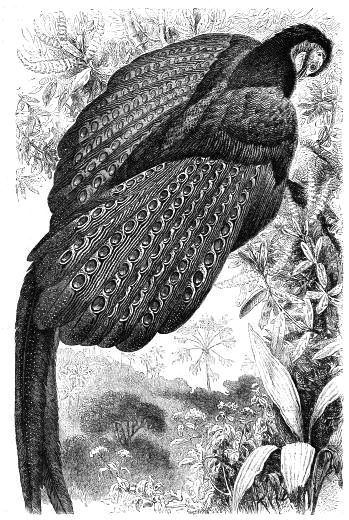
THE ARGUS PHEASANT, OR KUAU (Argus giganteus).
This species was first described by Mr. B. Leadbeater, in a paper read before the Linnæan Society, December 2nd, 1828, and received from him its name in honour of the Countess of Amherst, to whom two males of the species had been presented by Sir Archibald Campbell, who received them from the King of Ava. They came originally from the mountains of Cochin China, and only survived the voyage to England a few weeks.
"It is now believed," says Mr. Gould, "that the bird is an inhabitant of the Chinese province of Yunnan and the adjoining region of Thibet." We have no account of its mode of life or habits.
The EARED PHEASANTS (Crossoptilon), are so called on account of the remarkable tufts of feathers, resembling those of some Owls, situated at the sides of the head. They are also distinguishable from the members of the family already described by their very powerful build and comparatively short tail, the feathers at the extremity of which are discomposed, and overhang the rest.
THE CHINESE EARED PHEASANT.
The CHINESE EARED PHEASANT (Crossoptilon auritum) has the throat and a line that passes from thence to the ear of pure white; the somewhat lax plumage on the head, the nape, upper breast, and back are black, and the mantle-feathers light brownish grey; the rump is yellowish white, and the under side pale greyish yellow; the quills and tail-feathers are yellowish grey, with a dark border to the outer web; the streaming feathers on the upper covers are greyish black. The hen is somewhat smaller than her mate, and has the long feathers less developed.
We are without particulars as to the life and habits of this Pheasant. Lamprey tells us he observed it in the markets of Pekin, and heard that it is found on the mountains to the north of that town. M. Armand David also met with it in July, 1863, in the northern valley of a high mountain, fifteen leagues to the west of Pekin, and was told that it is called Ho-ki, or Gho-ky, by the Chinese. When placed in an aviary these birds soon become gentle and familiar. In their wild state they frequent well-wooded spots on mountains; they perch readily, and carry their tails after the fashion of the Domestic Fowl; their somewhat varied call also much resembles the voice of that bird. The crops of three specimens killed in July were filled with the leaves of cytisus; and those examined in winter contained nuts, kernels, leaves of mugwort, ferns, roots, orchids, coleoptera, worms, and caterpillars. In a paper contributed to the Zoological Society's Proceedings for July, 1866, Mr. Saurin informs us that the hen lays at the end of May; the eggs are larger than those of a Common Fowl, and of a blueish tint. The Chinese rear these Pheasants on a kind of millet-cake; they are also very fond of barley. In 1866 two males of this species were presented to the London Zoological Gardens, and in the same year two hens were purchased from the Jardin d'Acclimatisation of Paris; since that time they have produced several broods, which have been hatched by a Domestic Hen.
THE ARGUS PHEASANT, OR KUAU.
The ARGUS PHEASANT, or KUAU (Argus giganteus). This magnificent species has the feathers on the upper and primary quills unusually prolonged, and broad at the tips; their shafts are soft, and the web of firm, stiff texture; the secondaries, on the contrary, are very short. The moderately long beak is compressed at its sides, slightly vaulted, bare at its base, and hooked at its tip; the long weak foot is without a spur; the tail, composed of twelve feathers, is very long and much graduated, the two centre feathers far exceeding the rest in length; the sides of the head and throat are bare, with the exception of a few black hairs; the brow, top of the head, and back of the head, on the contrary, are covered with a growth of small velvety feathers. The coloration of the plumage is more remarkable for the delicacy of its markings than for the brilliancy of its hues. The short feathers on the crown are deep black, those on the back of the neck striped yellow, and those on the nape and upper back brown, marked and dotted with light yellow. The yellowish brown feathers on the centre of the back are yellowish grey, with round dark brown patches; those on the under side striped and marked with reddish brown, black, and light yellow. The outer web of the secondary quills is entirely greyish red, thickly dotted with spots of shaded brown, whilst the inner web is marked with delicate white dots at its base. The long feathers of the upper wing-covers are of a beautiful dark reddish brown, marked with pale greyish red, dark brown, and yellowish white streaks of tracery, and enlivened by large lustrous round spots or eyes. These eyes are situated on the outer web, and are more perceptible upon the feathers of the second order than on the shoulder. The longest tail-feathers are black, the shafts grey on the inner and reddish brown on the outer side; both sides of the web are decorated with a white spot, surrounded by a black edge; the exterior tail-feathers are similarly coloured, and have their numerous spots placed in rows. Rosenberg tells us that the head and bare parts of the throat are light greyish blue, and the feet red. This fine bird is from five and a half to six feet long; of this measurement four feet are included in the tail. The length of the real wing is seventeen inches: that of its longest feather twenty-eight inches and a half. The hen is much smaller and more quiet in appearance. The feathers on her head are striped black and yellow; those on the upper breast and nape are of a fine reddish brown, marked with black; those on the other parts of the back striped brownish yellow and black; the under side is light brown, with undulating black and yellow lines; the primary quills are brown marbled with black; and the feathers on the upper and lower covers dark reddish brown, marked in a similar manner with a lighter shade.
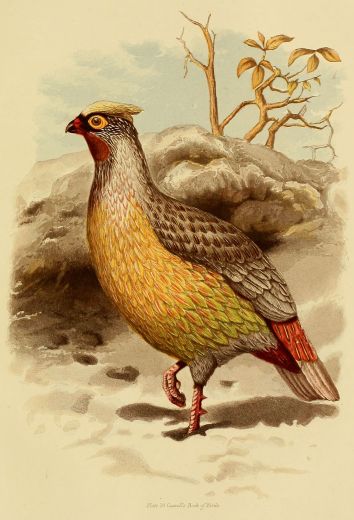
Plate 29. Cassell's Book of Birds
ITHAGINIS CORIENTES ____ SANGUINE FRANCOLIN
(about one half Nat. size)
[See larger version]
The Argus Pheasant is said to be found in the woods of Sumatra, and is called by the natives Coo-ow, or Kuaow. It does not bear long confinement, and seems to have an antipathy to the light, remaining inanimate during the day. When kept in a dark place, however, it appears to be perfectly at ease, and sometimes utters the note or call from which it takes its name. This cry is rather plaintive, and not harsh like that of the Peacock. The flavour of its flesh resembles that of the Common Pheasant.
The PEACOCK PHEASANTS (Polyplectron) constitute a group forming the connecting link between the Argus Pheasants and the Peacocks. They have small, slender bodies; short, decidedly rounded wings, in which the fifth and sixth quills are the longest, and the feathers of the upper covers much prolonged; the tail is long, composed of twelve feathers, broad at its extremity and slightly graduated; the feathers on the upper covers closely resemble those beneath them in form, colour, and markings. The long, thin tarsus is armed with from two to six spurs, the toes are short, and the claws small; the moderate-sized beak is thin, straight, compressed at its sides, slightly curved towards the tip, and covered with feathers at its base. The plumage of the male is enlivened by numerous eyes upon the tail, and occasionally on the mantle and wing-covers.
THE CHINQUIS, OR ASSAM PEACOCK PHEASANT.
The CHINQUIS, or ASSAM PEACOCK PHEASANT (Polyplectron chinquis), the most beautiful of the four species of the above group with which we are acquainted, has the head of a greyish brown, delicately dotted and lined with black; the lower neck, breast, and centre of the belly are brown, striped with brownish black, and spotted with light yellow; the mantle-feathers are greyish yellow, marked with small greyish black lines; each feather being decorated with an ocellus having a green centre and glossy purple border; the feathers of the back, rump, and large tail-covers are pale brown, spotted and marked with brownish yellow, and have a similar green and purple spot, surrounded by a black rim. The eye is bright yellow and the foot black. This species is twenty-two inches long, but of these ten inches are included in the tail. The hen is distinguished by less showy plumage, the slight excrescences that replace the spurs upon her foot, and the shortness of her tail.
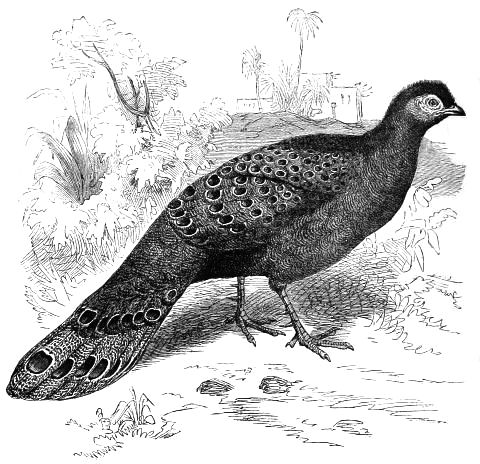
THE CHINQUIS, OR ASSAM PEACOCK PHEASANT (Polyptectron chinquis).
The countries of Assam, Silhet, Arucan, and Tenasserim, as far as Mergui, may be regarded as the habitat of this species, which received from Linnæus, who erroneously believed Thibet to be its native country, the name of the Thibet Peacock; and even now we are but little acquainted with its habits, owing to its shy disposition, and the preference it has for the innermost recesses of dense forests. In "Ornithognomon's" "Game Birds of India" is one of the most interesting of the few notices we possess. "I have never," says the writer, "shot this bird; and, indeed, only once came upon it. This was in a narrow path leading along a ridge about 3,000 feet above the sea, in the mountains on the British side of the Thoungyen River, which separates Tenasserim from Yohan in Siam. It started so suddenly, having apparently been dusting itself in the path, and shot so rapidly across the jungle, through the kud, that had it not left two or three of its feathers behind I should not have known what bird I had flushed. I am not aware of any English sportsman having ever bagged one of these Pheasants; and, indeed, it frequents such inaccessible places as effectually to defy approach. The mountains in the tropics rise to a height of six or eight thousand feet above the sea, and from 6,000 feet downwards are clothed with such a dense mass of trees, thickets, underwood, bamboos, and thorny rattans, all bound together by creepers and tangle, that it would be an hour's labour to cut any one's way through 100 yards of such stuff. I have, however," says the same writer, "kept these Peacock Pheasants in captivity, which they appear to bear tolerably well, but never become thoroughly tame. They were incessantly uttering a soft, low cluck, but emitted at times a cry or crow, being the same cluck loudly and rapidly repeated."
Two males of this species were sent by the Baba Rajendra Malhik to the London Zoological Gardens in 1857, and another pair in 1863, of which the female died; another female was obtained in 1864, which bred several times, and thus many particulars concerning their economy were learned. "Thus we know," says Mr. Sclater, "that two or three broods in a year are produced by the same pair, and are often covered by her tail, that the normal number of eggs is two, and that they are peculiarly delicate in form and colour, assimilating very closely to those of the Golden Pheasant (Thaumalea picta)—they are of a cream-colour, or buffy white, nearly two inches long, by one inch and seven-sixteenths broad."
Mr. Ellis, in his monograph on the Phasianidæ, states that Mr. Bartlett, superintendent of the Zoological Gardens, London, told him that the first time the young of this species were hatched in the Gardens, a Bantam Hen was employed as a foster mother, and the chicks would follow close behind her, never coming in front to take food, so that in scratching the ground she frequently struck them with her feet. The reason for the young keeping behind was not understood, until on a subsequent occasion two chicks were reared by a hen Chinquis, when it was observed that they always kept in the same manner behind the mother, who held her tail widely spread, thus completely covering them, and there they continually remained out of sight, only running forward when called by the hen to pick up some food she had found, and then immediately retreating to their shelter. It was thus rendered evident that the young, in following the Bantam Hen, were simply obeying the instincts of their nature, although the upright tail of their foster mother failed to afford them the protection which they would have found had they been reared by a female of their own species.
The PEACOCKS (Pavones) are distinguished from all other members of their family by the superiority of their size, and the extraordinary development of the feathers of the upper tail-covers. Their bodies are powerful; the neck moderately long, head small, wings short, and legs high; the beak is strong, arched at its culmen and hooked at the tip; and the foot of the male is armed with a spur. The crown of the head is adorned with a crest, formed either of long and slender or short bearded feathers. The region of the eye is bare. These fine birds only attain their full beauty when three years old.
The Peacock is a native of the East Indies and Ceylon, and is represented in Assam, the Sunda Islands, and Japan by the Pavo nigripennis. All the members of this glorious group frequent woods and jungle, preferring mountainous districts. On the Neilgherries and mountains of Southern India the Pavo cristatus is frequently met with at an altitude of 6,000 feet above the level of the sea; but it is not found in the Himalayas.
Williamson tells us that these splendid creatures abound chiefly in well-wooded localities, where there is an extent of long grass for them to range in. They are very thirsty birds, and will only remain where they can have free access to water. "About the passes in the Jungleterry districts," continues the same authority, "I have seen such quantities of Pea Fowls as have absolutely surprised me. Whole woods were covered with their beautiful plumage, to which a rising sun imparted additional brilliancy. The small patches of plain among the long grass, most of them cultivated, and with mustard then in bloom, which induced the birds to feed, added beauty to the scene; and I speak within bounds when I assert that there could not be less than twelve or fifteen hundred Pea Fowls of various sizes within sight of the spot where I stood for more than an hour." When on the wing they fly heavily, generally within an easy shot, but if only winged speedily recover, and if not closely pursued will nine times out of ten disappear. The capture of the Peacock is by no means a safe pursuit, for Williamson tells us that wherever that bird and the spotted deer abound the tiger will generally be a visitor; thus the borders of jungle containing such game are highly dangerous. At the season when the peepul berries and figs are in season their flesh is rather bitter; but when they have fed for a time among corn-fields, the flesh of the young is remarkably sweet and juicy. The nest is formed among thick shrubs or on high garden walls, or even on the roofs of houses. When the young are bred in an elevated situation, they are said to be carried to the ground by the parent on her back. The eggs, from four to six in number, are hatched within thirty days, and within three months of their birth the sex of the young is easily recognisable. When domesticated, the Peahen requires to be kept perfectly undisturbed during the period of incubation, or she will desert her little family.
THE COMMON PEACOCK.
The COMMON PEACOCK (Pavo cristatus) is of a magnificent purplish blue on the head, throat, and upper breast, overspread with glowing green and golden lustre; the green feathers on the back are edged and marked with copper-red; the centre of the back is deep blue, the wing white striped with black, and the under side black; the quills and tail are light brown; the long feathers of the latter, which form the graceful train that renders this bird so conspicuous, being decorated with numerous ocellated spots. The crest-feathers, from twenty to twenty-four in number, are bearded at their tips. The eye is dark brown, and the bare ring that surrounds it whitish; the beak and foot are greyish-brown. The length of this species is from three and a half to four feet; the wing measures eighteen and the tail twenty-four inches. The long train-feathers of the upper tail-covers are from four to four feet and a half in length. The female is nut-brown on the head and upper throat; the feathers on the nape are greenish, edged with whitish brown; those of the mantle light brown, marked with delicate lines; and those on the throat, breast, and belly white; the quills are brown, and the tail-feathers brown tipped with white. The hen is from thirty-six to thirty-eight inches long; her wing measures fifteen and tail from twelve to thirteen inches; her crest is much smaller and darker than that of her mate.
The general form of this magnificent bird is exceedingly elegant; and when he elevates and spreads his gorgeous train to the sun, displaying it in every way, as if conscious of the admiration he is exciting, the beholder is constrained to admit that there is no creature upon which Nature has lavished her powers of adornment with a more unsparing hand. The voice of the Peacock is extremely harsh and disagreeable, closely resembling in sound the word paon, which is its French name. The introduction of this bird into Europe is ascribed to Alexander the Great, but the exact date at which it was first imported into England is unknown.
This Pea-fowl inhabits the whole of India Proper, and is replaced in Assam and the countries to the east by another species. Jerdon tell us, "It frequents forests and jungly places, more especially delighting in hilly and mountainous districts; and in the more open and level country, wooded ravines and river banks are the never-failing resort of some of them. It comes forth to the open glades and fields to feed in the morning and evening, retiring to the jungles for shelter during the heat of the day, and roosting at night on high trees.