THE MISSOURI RIVER JOURNALS 1843 (Continued) (continued 4)
Reading edition
August 10, Thursday. Bell and I took a walk after Rabbits, but saw none. The nine Indians, having received their presents, went off with apparent reluctance, for when you begin to give them, the more they seem to demand. The horseguards brought in another Spermophilus hoodii; after dinner we are going to examine one of their burrows. We have been, and have returned; the three burrows which we dug were as follows: straight downward for three or four inches, and gradually becoming deeper in an oblique slant, to the depth of eight or nine inches, but not more, and none of these holes extended more than six or seven feet beyond this. I was disappointed at not finding nests, or rooms for stores. Although I have said much about Buffalo running, and butchering in general, I have not given the particular manner in which the latter is performed by the hunters of this country,—I mean the white hunters,—and I will now try to do so. The moment that the Buffalo is dead, three or four hunters, their faces and hands often covered with gunpowder, and with pipes lighted, place the animal on its belly, and by drawing out each fore and hind leg, fix the body so that it cannot fall down again; an incision is made near the root of the tail, immediately above the root in fact, and the skin cut to the neck, and taken off in the roughest manner imaginable, downwards and on both sides at the same time. The knives are going in all directions, and many wounds occur to the hands and fingers, but are rarely attended to at this time. The pipe of one man has perhaps given out, and with his bloody hands he takes the one of his nearest companion, who has his own hands equally bloody. Now one breaks in the skull of the bull, and with bloody fingers draws out the hot brains and swallows them with peculiar zest; another has now reached the liver, and is gobbling down enormous pieces of it; whilst, perhaps, a third, who has come to the paunch, is feeding luxuriously on some—to me—disgusting-looking offal. But the main business proceeds. The flesh is taken off from the sides of the boss, or hump bones, from where these bones begin to the very neck, and the hump itself is thus destroyed. The hunters give the name of "hump" to the mere bones when slightly covered by flesh; and it is cooked, and very good when fat, young, and well broiled. The pieces of flesh taken from the sides of these bones are called filets, and are the best portion of the animal when properly cooked. The fore-quarters, or shoulders, are taken off, as well as the hind ones, and the sides, covered by a thin portion of flesh called the depouille, are taken out. Then the ribs are broken off at the vertebræ, as well as the boss bones. The marrow-bones, which are those of the fore and hind legs only, are cut out last. The feet usually remain attached to these; the paunch is stripped of its covering of layers of fat, the head and the backbone are left to the Wolves, the pipes are all emptied, the hands, faces, and clothes all bloody, and now a glass of grog is often enjoyed, as the stripping off the skins and flesh of three or four animals is truly very hard work. In some cases when no water was near, our supper was cooked without our being washed, and it was not until we had travelled several miles the next morning that we had any opportunity of cleaning ourselves; and yet, despite everything, we are all hungry, eat heartily, and sleep soundly. When the wind is high and the Buffaloes run towards it, the hunter's guns very often snap, and it is during their exertions to replenish their pans, that the powder flies and sticks to the moisture every moment accumulating on their faces; but nothing stops these daring and usually powerful men, who the moment the chase is ended, leap from their horses, let them graze, and begin their butcher-like work.
August 11, Friday. The weather has been cold and windy, and the day has passed in comparative idleness with me. Squires returned this afternoon alone, having left Provost and La Fleur behind. They have seen only two Bighorns, a female and her young. It was concluded that, if our boat was finished by Tuesday next, we would leave on Wednesday morning, but I am by no means assured of this, and Harris was quite startled at the very idea. Our boat, though forty feet long, is, I fear, too small. Nous verrons! Some few preparations for packing have been made, but Owen, Harris, and Bell are going out early to-morrow morning to hunt Buffaloes, and when they return we will talk matters over. The activity of Buffaloes is almost beyond belief; they can climb the steep defiles of the Mauvaises Terres in hundreds of places where men cannot follow them, and it is a fine sight to see a large gang of them proceeding along these defiles four or five hundred feet above the level of the bottoms, and from which pathway if one of the number makes a mis-step or accidentally slips, he goes down rolling over and over, and breaks his neck ere the level ground is reached. Bell and Owen saw a bull about three years old that leaped a ravine filled with mud and water, at least twenty feet wide; it reached the middle at the first bound, and at the second was mounted on the opposite bank, from which it kept on bounding, till it gained the top of quite a high hill. Mr. Culbertson tells me that these animals can endure hunger in a most extraordinary manner. He says that a large bull was seen on a spot half way down a precipice, where it had slid, and from which it could not climb upwards, and either could not or would not descend; at any rate, it did not leave the position in which it found itself. The party who saw it returned to the fort, and, on their way back on the twenty-fifth day after, they passed the hill, and saw the bull standing there. The thing that troubles them most is crossing rivers on the ice; their hoofs slip from side to side, they become frightened, and stretch their four legs apart to support the body, and in such situations the Indians and white hunters easily approach, and stab them to the heart, or cut the hamstrings, when they become an easy prey. When in large gangs those in the centre are supported by those on the outposts, and if the stream is not large, reach the shore and readily escape. Indians of different tribes hunt the Buffalo in different ways; some hunt on horseback, and use arrows altogether; they are rarely expert in reloading the gun in the close race. Others hunt on foot, using guns, arrows, or both. Others follow with patient perseverance, and kill them also. But I will give you the manner pursued by the Mandans. Twenty to fifty men start, as the occasion suits, each provided with two horses, one of which is a pack-horse, the other fit for the chase. They have quivers with from twenty to fifty arrows, according to the wealth of the hunter. They ride the pack horse bareback, and travel on, till they see the game, when they leave the pack-horse, and leap on the hunter, and start at full speed and soon find themselves amid the Buffaloes, on the flanks of the herd, and on both sides. When within a few yards the arrow is sent, they shoot at a Buffalo somewhat ahead of them, and send the arrow in an oblique manner, so as to pass through the lights. If the blood rushes out of the nose and mouth the animal is fatally wounded, and they shoot at it no more; if not, a second, and perhaps a third arrow, is sent before this happens. The Buffaloes on starting carry the tail close in between the legs, but when wounded they switch it about, especially if they wish to fight, and then the hunter's horse shies off and lets the mad animal breathe awhile. If shot through the heart, they occasionally fall dead on the instant; sometimes, if not hit in the right place, a dozen arrows will not stop them. When wounded and mad they turn suddenly round upon the hunter, and rush upon him in such a quick and furious manner that if horse and rider are not both on the alert, the former is overtaken, hooked and overthrown, the hunter pitched off, trampled and gored to death. Although the Buffalo is such a large animal, and to all appearance a clumsy one, it can turn with the quickness of thought, and when once enraged, will rarely give up the chase until avenged for the wound it has received. If, however, the hunter is expert, and the horse fleet, they outrun the bull, and it returns to the herd. Usually the greater number of the gang is killed, but it very rarely happens that some of them do not escape. This however is not the case when the animal is pounded, especially by the Gros Ventres, Black Feet, and Assiniboins. These pounds are called "parks," and the Buffaloes are made to enter them in the following manner: The park is sometimes round and sometimes square, this depending much on the ground where it is put up; at the end of the park is what is called a precipice of some fifteen feet or less, as may be found. It is approached by a funnel-shaped passage, which like the park itself is strongly built of logs, brushwood, and pickets, and when all is ready a young man, very swift of foot, starts at daylight covered over with a Buffalo robe and wearing a Buffalo head-dress. The moment he sees the herd to be taken, he bellows like a young calf, and makes his way slowly towards the contracted part of the funnel, imitating the cry of the calf, at frequent intervals. The Buffaloes advance after the decoy; about a dozen mounted hunters are yelling and galloping behind them, and along both flanks of the herd, forcing them by these means to enter the mouth of the funnel. Women and children are placed behind the fences of the funnel to frighten the cattle, and as soon as the young man who acts as decoy feels assured that the game is in a fair way to follow to the bank or "precipice," he runs or leaps down the bank, over the barricade, and either rests, or joins in the fray. The poor Buffaloes, usually headed by a large bull, proceed, leap down the bank in haste and confusion, the Indians all yelling and pursuing till every bull, cow, and calf is impounded. Although this is done at all seasons, it is more general in October or November, when the hides are good and salable. Now the warriors are all assembled by the pen, calumets are lighted, and the chief smokes to the Great Spirit, the four points of the compass, and lastly to the Buffaloes. The pipe is passed from mouth to mouth in succession, and as soon as this ceremony is ended, the destruction commences. Guns shoot, arrows fly in all directions, and the hunters being on the outside of the enclosure, destroy the whole gang, before they jump over to clean and skin the murdered herd. Even the children shoot small, short arrows to assist in the destruction. It happens sometimes however, that the leader of the herd will be restless at the sight of the precipices, and if the fence is weak will break through it, and all his fellows follow him, and escape. The same thing sometimes takes place in the pen, for so full does this become occasionally that the animals touch each other, and as they cannot move, the very weight against the fence of the pen is quite enough to break it through; the smallest aperture is sufficient, for in a few minutes it becomes wide, and all the beasts are seen scampering over the prairies, leaving the poor Indians starving and discomfited. Mr. Kipp told me that while travelling from Lake Travers to the Mandans, in the month of August, he rode in a heavily laden cart for six successive days through masses of Buffaloes, which divided for the cart, allowing it to pass without opposition. He has seen the immense prairie back of Fort Clark look black to the tops of the hills, though the ground was covered with snow, so crowded was it with these animals; and the masses probably extended much further. In fact it is impossible to describe or even conceive the vast multitudes of these animals that exist even now, and feed on these ocean-like prairies.
August 12, Saturday. Harris, Bell, and Owen went after Buffaloes; killed six cows and brought them home. Weather cloudy, and rainy at times. Provost returned with La Fleur this afternoon, had nothing, but had seen a Grizzly Bear. The "Union" was launched this evening and packing, etc., is going on. I gave a memorandum to Jean Baptiste Moncrévier of the animals I wish him to procure for me.
August 13, Sunday. A most beautiful day. About dinner time I had a young Badger brought to me dead; I bought it, and gave in payment two pounds of sugar. The body of these animals is broader than high, the neck is powerfully strong, as well as the fore-arms, and strongly clawed fore-feet. It weighed 8½ lbs. Its measurements were all taken. When the pursuer gets between a Badger and its hole, the animal's hair rises, and it at once shows fight. A half-breed hunter told Provost, who has just returned from Fort Mortimer, that he was anxious to go down the river with me, but I know the man and hardly care to have him. If I decide to take him Mr. Culbertson, to whom I spoke of the matter, told me my only plan was to pay him by the piece for what he killed and brought on board, and that in case he did not turn out well between this place and Fort Clark, to leave him there; so I have sent word to him to this effect by Provost this afternoon. Bell is skinning the Badger, Sprague finishing the map of the river made by Squires, and the latter is writing. The half-breed has been here, and the following is our agreement: "It is understood that François Détaillé will go with me, John J. Audubon, and to secure for me the following quadrupeds—if possible—for which he will receive the prices here mentioned, payable at Fort Union, Fort Clark, or Fort Pierre, as may best suit him.
For each Bighorn male$10.00
For a large Grizzly Bear20.00
For a large male Elk6.00
For a Black-tailed Deer, male or female6.00
For Red Foxes3.00
For small Gray Foxes3.00
For Badgers2.00
For large Porcupine2.00
Independent of which I agree to furnish him with his passage and food, he to work as a hand on board. Whatever he kills for food will be settled when he leaves us, or, as he says, when he meets the Opposition boat coming up to Fort Mortimer." He will also accompany us in our hunt after Bighorns, which I shall undertake, notwithstanding Mr. Culbertson and Squires, who have been to the Mauvaises Terres, both try to dissuade me from what they fear will prove over-fatiguing; but though my strength is not what it was twenty years ago, I am yet equal to much, and my eyesight far keener than that of many a younger man, though that too tells me I am no longer a youth....
The only idea I can give in writing of what are called the "Mauvaises Terres" would be to place some thousands of loaves of sugar of different sizes, from quite small and low, to large and high, all irregularly truncated at top, and placed somewhat apart from each other. No one who has not seen these places can form any idea of these resorts of the Rocky Mountain Rams, or the difficulty of approaching them, putting aside their extreme wildness and their marvellous activity. They form paths around these broken-headed cones (that are from three to fifteen hundred feet high), and run round them at full speed on a track that, to the eye of the hunter, does not appear to be more than a few inches wide, but which is, in fact, from a foot to eighteen inches in width. In some places there are piles of earth from eight to ten feet high, or even more, the tops of which form platforms of a hard and shelly rocky substance, where the Bighorn is often seen looking on the hunter far below, and standing immovable, as if a statue. No one can imagine how they reach these places, and that too with their young, even when the latter are quite small. Hunters say that the young are usually born in such places, the mothers going there to save the helpless little one from the Wolves, which, after men, seem to be their greatest destroyers. The Mauvaises Terres are mostly formed of grayish white clay, very sparsely covered with small patches of thin grass, on which the Bighorns feed, but which, to all appearance, is a very scanty supply, and there, and there only, they feed, as not one has ever been seen on the bottom or prairie land further than the foot of these most extraordinary hills. In wet weather, no man can climb any of them, and at such times they are greasy, muddy, sliding grounds. Oftentimes when a Bighorn is seen on a hill-top, the hunter has to ramble about for three or four miles before he can approach within gunshot of the game, and if the Bighorn ever sees his enemy, pursuit is useless. The tops of some of these hills, and in some cases whole hills about thirty feet high, are composed of a conglomerated mass of stones, sand, and clay, with earth of various sorts, fused together, and having a brick-like appearance. In this mass pumice-stone of various shapes and sizes is to be found. The whole is evidently the effect of volcanic action. The bases of some of these hills cover an area of twenty acres or more, and the hills rise to the height of three or four hundred feet, sometimes even to eight hundred or a thousand; so high can the hunter ascend that the surrounding country is far, far beneath him. The strata are of different colored clays, coal, etc., and an earth impregnated with a salt which appears to have been formed by internal fire or heat, the earth or stones of which I have first spoken in this account, lava, sulphur, salts of various kinds, oxides and sulphates of iron; and in the sand at the tops of some of the highest hills I have found marine shells, but so soft and crumbling as to fall apart the instant they were exposed to the air. I spent some time over various lumps of sand, hoping to find some perfect ones that would be hard enough to carry back to St. Louis; but 't was "love's labor lost," and I regretted exceedingly that only a few fragments could be gathered. I found globular and oval shaped stones, very heavy, apparently composed mostly of iron, weighing from fifteen to twenty pounds; numbers of petrified stumps from one to three feet in diameter; the Mauvaises Terres abound with them; they are to be found in all parts from the valleys to the tops of the hills, and appear to be principally of cedar. On the sides of the hills, at various heights, are shelves of rock or stone projecting out from two to six, eight, or even ten feet, and generally square, or nearly so; these are the favorite resorts of the Bighorns during the heat of the day, and either here or on the tops of the highest hills they are to be found. Between the hills there is generally quite a growth of cedar, but mostly stunted and crowded close together, with very large stumps, and between the stumps quite a good display of grass; on the summits, in some few places, there are table-lands, varying from an area of one to ten or fifteen acres; these are covered with a short, dry, wiry grass, and immense quantities of flat leaved cactus, the spines of which often warn the hunter of their proximity, and the hostility existing between them and his feet. These plains are not more easily travelled than the hillsides, as every step may lead the hunter into a bed of these pests of the prairies. In the valleys between the hills are ravines, some of which are not more than ten or fifteen feet wide, while their depth is beyond the reach of the eye. Others vary in depth from ten to fifty feet, while some make one giddy to look in; they are also of various widths, the widest perhaps a hundred feet. The edges, at times, are lined with bushes, mostly wild cherry; occasionally Buffaloes make paths across them, but this is rare. The only safe way to pass is to follow the ravine to the head, which is usually at the foot of some hill, and go round. These ravines are mostly between every two hills, although like every general rule there are variations and occasionally places where three or more hills make only one ravine. These small ravines all connect with some larger one, the size of which is in proportion to its tributaries. The large one runs to the river, or the water is carried off by a subterranean channel. In these valleys, and sometimes on the tops of the hills, are holes, called "sink holes;" these are formed by the water running in a small hole and working away the earth beneath the surface, leaving a crust incapable of supporting the weight of a man; and if an unfortunate steps on this crust, he soon finds himself in rather an unpleasant predicament. This is one of the dangers that attend the hunter in these lands; these holes eventually form a ravine such as I have before spoken of. Through these hills it is almost impossible to travel with a horse, though it is sometimes done by careful management, and a correct knowledge of the country. The sides of the hills are very steep, covered with the earth and stones of which I have spoken, all of which are quite loose on the surface; occasionally a bunch of wormwood here and there seems to assist the daring hunter; for it is no light task to follow the Bighorns through these lands, and the pursuit is attended with much danger, as the least slip at times would send one headlong into the ravines below. On the sides of these high hills the water has washed away the earth, leaving caves of various sizes; and, in fact, in some places all manner of fantastic forms are made by the same process. Occasionally in the valleys are found isolated cones or domes, destitute of vegetation, naked and barren. Throughout the Mauvaises Terres there are springs of water impregnated with salt, sulphur, magnesia, and many other salts of all kinds. Such is the water the hunter is compelled to drink, and were it not that it is as cold as ice it would be almost impossible to swallow it. As it is, many of these waters operate as cathartics or emetics; this is one of the most disagreeable attendants of hunting in these lands. Moreover, venomous snakes of many kinds are also found here. I saw myself only one copperhead, and a common garter-snake. Notwithstanding the rough nature of the country, the Buffaloes have paths running in all directions, and leading from the prairies to the river. The hunter sometimes, after toiling for an hour or two up the side of one of these hills, trying to reach the top in hopes that when there he will have for a short distance at least, either a level place or good path to walk on, finds to his disappointment that he has secured a point that only affords a place scarcely large enough to stand on, and he has the trouble of descending, perhaps to renew his disappointment in the same way, again and again, such is the deceptive character of the country. I was thus deceived time and again, while in search of Bighorns. If the hill does not terminate in a point it is connected with another hill, by a ridge so narrow that nothing but a Bighorn can walk on it. This is the country that the Mountain Ram inhabits, and if, from this imperfect description, any information can be derived, I shall be more than repaid for the trouble I have had in these tiresome hills. Whether my theory be correct or incorrect, it is this: These hills were at first composed of the clays that I have mentioned, mingled with an immense quantity of combustible material, such as coal, sulphur, bitumen, etc.; these have been destroyed by fire, or (at least the greater part) by volcanic action, as to this day, on the Black Hills and in the hills near where I have been, fire still exists; and from the immense quantities of pumice-stone and melted ores found among the hills, even were there no fire now to be seen, no one could doubt that it had, at some date or other, been there; as soon as this process had ceased, the rains washed out the loose material, and carried it to the rivers, leaving the more solid parts as we now find them; the action of water to this day continues. As I have said, the Bighorns are very fond of resorting to the shelves, or ledges, on the sides of the hills, during the heat of the day, when these places are shaded; here they lie, but are aroused instantly upon the least appearance of danger, and, as soon as they have discovered the cause of alarm, away they go, over hill and ravine, occasionally stopping to look round, and when ascending the steepest hill, there is no apparent diminution of their speed. They will ascend and descend places, when thus alarmed, so inaccessible that it is almost impossible to conceive how, and where, they find a foothold. When observed before they see the hunter, or while they are looking about when first alarmed, are the only opportunities the hunter has to shoot them; for, as soon as they start there is no hope, as to follow and find them is a task not easily accomplished, for where or how far they go when thus on the alert, heaven only knows, as but few hunters have ever attempted a chase. At all times they have to be approached with the greatest caution, as the least thing renders them on the qui vive. When not found on these shelves, they are seen on the tops of the most inaccessible and highest hills, looking down on the hunters, apparently conscious of their security, or else lying down tranquilly in some sunny spot quite out of reach. As I have observed before, the only times that these animals can be shot are when on these ledges, or when moving from one point to another. Sometimes they move only a few hundred yards, but it will take the hunter several hours to approach near enough for a shot, so long are the détours he is compelled to make. I have been thus baffled two or three times. The less difficult hills are found cut up by paths made by these animals; these are generally about eighteen inches wide. These animals appear to be quite as agile as the European Chamois, leaping down precipices, across ravines, and running up and down almost perpendicular hills. The only places I could find that seemed to afford food for them, was between the cedars, as I have before mentioned; but the places where they are most frequently found are barren, and without the least vestige of vegetation. From the character of the lands where these animals are found, their own shyness, watchfulness, and agility, it is readily seen what the hunter must endure, and what difficulties he must undergo to near these "Wild Goats." It is one constant time of toil, anxiety, fatigue, and danger. Such the country! Such the animal! Such the hunting!
August 16. Started from Fort Union at 12 m. in the Mackinaw barge "Union." Shot five young Ducks. Camped at the foot of a high bluff. Good supper of Chickens and Ducks.
Thursday, 17th. Started early. Saw three Bighorns, some Antelopes, and many Deer, fully twenty; one Wolf, twenty-two Swans, many Ducks. Stopped a short time on a bar. Mr. Culbertson shot a female Elk, and I killed two bulls. Camped at Buffalo Bluff, where we found Bear tracks.
Friday, 18th. Fine. Bell shot a superb male Elk. The two bulls untouched since killed. Stopped to make an oar, when I caught four catfish. "Kayac" is the French Missourian's name for Buffalo Bluffs, original French for Moose; in Assiniboin "Tah-Tah," in Blackfoot "Sick-e-chi-choo," in Sioux "Tah-Tah." Fifteen to twenty female Elks drinking, tried to approach them, but they broke and ran off to the willows and disappeared. We landed and pursued them. Bell shot at one, but did not find it, though it was badly wounded. These animals are at times unwary, but at others vigilant, suspicious, and well aware of the coming of their enemies.
Saturday, 19th. Wolves howling, and bulls roaring, just like the long continued roll of a hundred drums. Saw large gangs of Buffaloes walking along the river. Headed Knife River one and a half miles. Fresh signs of Indians, burning wood embers, etc. I knocked a cow down with two balls, and Mr. Culbertson killed her. Abundance of Bear tracks. Saw a great number of bushes bearing the berries of which Mrs. Culbertson has given me a necklace. Herds of Buffaloes on the prairies. Mr. Culbertson killed another cow, and in going to see it I had a severe fall over a partially sunken log. Bell killed a doe and wounded the fawn.
Sunday, 20th. Tamias quadrivittatus runs up trees; abundance of them in the ravine, and Harris killed one. Bell wounded an Antelope. Thousands upon thousands of Buffaloes; the roaring of these animals resembles the grunting of hogs, with a rolling sound from the throat. Mr. C. killed two cows, Sprague killed one bull, and I made two sketches of it after death. The men killed a cow, and the bull would not leave her although shot four times. Stopped by the high winds all this day. Suffered much from my fall.
Monday, 21st. Buffaloes all over the bars and prairies, and many swimming; the roaring can be heard for miles. The wind stopped us again at eight o'clock; breakfasted near the tracks of Bears surrounded by hundreds of Buffaloes. We left our safe anchorage and good hunting-grounds too soon; the wind blew high, and we were obliged to land again on the opposite shore, where the gale has proved very annoying. Bear tracks led us to search for those animals, but in vain. Collected seeds. Shot at a Rabbit, but have done nothing. Saw many young and old Ducks,—Black Mallards and Gadwalls. I shot a bull and broke his thigh, and then shot at him thirteen times before killing. Camped at the same place.
Tuesday, 22d. Left early and travelled about twelve miles. Went hunting Elks. Mr. Culbertson killed a Deer, and he and Squires brought the meat in on their backs. I saw nothing, but heard shots which I thought were from Harris. I ran for upwards of a mile to look for him, hallooing the whole distance, but saw nothing of him. Sent three men who hallooed also, but came back without further intelligence. Bell shot a female Elk and brought in part of the meat. We walked to the Little Missouri and shot the fourth bull this trip. We saw many Ducks. In the afternoon we started again, and went below the Little Missouri, returned to the bull and took his horns, etc. Coming back to the boat Sprague saw a Bear; we went towards the spot; the fellow had turned under the high bank and was killed in a few seconds. Mr. Culbertson shot it first through the neck, Bell and I in the body.
Wednesday, 23d. Provost skinned the Bear. No Prairie-Dogs caught. The wind high and cold. Later two Prairie-Dogs were shot; their notes resemble precisely those of the Arkansas Flycatcher. Left this afternoon and travelled about ten miles. Saw another Bear and closely observed its movements. We saw several drowned Buffaloes, and were passed by Wolves and Passenger Pigeons. Camped in a bad place under a sky with every appearance of rain.
Thursday, 24th. A bad night of wind, very cloudy; left early, as the wind lulled and it became calm. Passed "L'Ours qui danse," travelled about twenty miles, when we were again stopped by the wind. Hunted, but found nothing. The fat of our Bear gave us seven bottles of oil. We heard what some thought to be guns, but I believed it to be the falling of the banks. Then the Wolves howled so curiously that it was supposed they were Indian dogs. We went to bed all prepared for action in case of an attack; pistols, knives, etc., but I slept very well, though rather cold.
Friday, 25th. Fair, but foggy, so we did not start early. I found some curious stones with impressions of shells. It was quite calm, and we passed the two Riccaree winter villages. Many Eagles and Peregrine Falcons. Shot another bull. Passed the Gros Ventre village at noon; no game about the place. "La Main Gauche," an Assiniboin chief of great renown, left seventy warriors killed and thirty wounded on the prairie opposite, the year following the small-pox. The Gros Ventres are a courageous tribe. Reached the Mandan village; hundreds of Indians swam to us with handkerchiefs tied on their heads like turbans. Our old friend "Four Bears" met us on the shore; I gave him eight pounds of tobacco. He came on board and went down with us to Fort Clark, which we reached at four o'clock. Mr. Culbertson and Squires rode out to the Gros Ventre village with "Four Bears" after dark, and returned about eleven; they met with another chief who curiously enough was called "The Iron Bear."
Saturday, 26th. Fine, but a cold, penetrating wind. Started early and landed to breakfast. A canoe passed us with two men from the Opposition. We were stopped by the wind for four hours, but started again at three; passed the Butte Quarré at a quarter past five, followed now by the canoe, as the two fellows are afraid of Indians, and want to come on board our boat; we have not room for them, but will let them travel with us. Landed for the night, and walked to the top of one of the buttes from which we had a fine and very extensive view. Saw a herd of Buffaloes, which we approached, but by accident did not kill a cow. Harris, whom we thought far off, shot too soon and Moncrévier and the rest of us lost our chances. We heard Elks whistling, and saw many Swans. The canoe men camped close to us.
Sunday, 27th. Started early in company with the canoe. Saw four Wolves and six bulls, the latter to our sorrow in a compact group and therefore difficult to attack. They are poor at this season, and the meat very rank, but yet are fresh meat. The wind continued high, but we landed in the weeds assisted by the canoe men, as we saw a gang of cows. We lost them almost immediately though we saw their wet tracks and followed them for over a mile, but then gave up the chase. On returning to the river we missed the boat, as she had been removed to a better landing below; so we had quite a search for her. Mrs. Culbertson worked at the parflèche with Golden Eagle feathers; she had killed the bird herself. Stopped by the wind at noon. Walked off and saw Buffaloes, but the wind was adverse. Bell and Harris, however, killed a cow, a single one, that had been wounded, whether by shot or by an arrow no one can tell. We saw a bull on a sand-bar; the poor fool took to the water and swam so as to meet us. We shot at him about a dozen times, I shot him through one eye, Bell, Harris, and Sprague about the head, and yet the animal made for our boat and came so close that Mr. Culbertson touched him with a pole, when he turned off and swam across the river, but acted as if wild or crazy; he ran on a sand-bar, and at last swam again to the opposite shore, in my opinion to die, but Mr. Culbertson says he may live for a month. We landed in a good harbor on the east side about an hour before sundown. Moncrévier caught a catfish that weighed sixteen pounds, a fine fish, though the smaller ones are better eating.
Monday, 28th. A gale all night and this morning also. We are in a good place for hunting, and I hope to have more to say anon. The men returned and told us of many Bear tracks, and four of us started off. Such a walk I do not remember; it was awful—mire, willows, vines, holes, fallen logs; we returned much fatigued and having seen nothing. The wind blowing fiercely.
Tuesday, 29th. Heavy wind all night. Bad dreams about my own Lucy. Walked some distance along the shores and caught many catfish. Two Deer on the other shore. Cut a cotton-tree to fasten to the boat to break the force of the waves. The weather has become sultry. Beavers during the winter oftentimes come down amid the ice, but enter any small stream they meet with at once. Apple River, or Creek, was formerly a good place for them, as well as Cannon Ball River. Saw a Musk-rat this morning swimming by our barge. Slept on a muddy bar with abundance of mosquitoes.
Wednesday, 30th. Started at daylight. Mr. Culbertson and I went off to the prairies over the most infernal ground I ever saw, but we reached the high prairies by dint of industry, through swamps and mire. We saw two bulls, two calves, and one cow; we killed the cow and the larger calf, a beautiful young bull; returned to the boat through the most abominable swamp I ever travelled through, and reached the boat at one o'clock, thirsty and hungry enough. Bell and all the men went after the meat and the skin of the young bull. I shot the cow, but missed the calf by shooting above it. We started later and made about ten miles before sunset.
Thursday, 31st. Started early; fine and calm. Saw large flocks of Ducks, Geese, and Swans; also four Wolves. Passed Mr. Primeau's winter trading-house; reached Cannon Ball River at half-past twelve. No game; water good-tasted, but warm. Dinner on shore. Saw a Rock Wren on the bluffs here. Saw the prairie on fire, and signs of Indians on both sides. Weather cloudy and hot. Reached Beaver Creek. Provost went after Beavers, but found none. Caught fourteen catfish. Saw a wonderful example of the power of the Buffalo in working through the heavy, miry bottom lands.
Friday, September 1. Hard rain most of the night, and uncomfortably hot. Left our encampment at eight o'clock. Saw Buffaloes and landed, but on approaching them found only bulls; so returned empty-handed to the boat, and started anew. We landed for the night on a large sand-bar connected with the mainland, and saw a large gang of Buffaloes, and Mr. Culbertson and a man went off; they shot at two cows and killed one, but lost her, as she fell in the river and floated down stream, and it was dusk. A heavy cloud arose in the west, thunder was heard, yet the moon and stars shone brightly. After midnight rain came on. The mosquitoes are far too abundant for comfort.
Saturday, September 2. Fine but windy. Went about ten miles and stopped, for the gale was so severe. No fresh meat on board. Saw eight Wolves, four white ones. Walked six miles on the prairies, but saw only three bulls. The wind has risen to a gale. Saw abundance of Black-breasted Prairie Larks, and a pond with Black Ducks. Returned to the pond after dinner and killed four Ducks.
Sunday, 3d. Beautiful, calm, and cold. Left early and at noon put ashore to kill a bull, having no fresh meat on board. He took the wind and ran off. Touched on a bar, and I went overboard to assist in pushing off and found the water very pleasant, for our cold morning had turned into a hot day. Harris shot a Prairie Wolf. At half-past four saw ten or twelve Buffaloes. Mr. Culbertson, Bell, a canoe man, and I, went after them; the cattle took to the river, and we went in pursuit; the other canoe man landed, and ran along the shore, but could not head them. He shot, however, and as the cattle reached the bank we gave them a volley, but uselessly, and are again under way. Bell and Mr. C. were well mired and greatly exhausted in consequence. No meat for another day. Stopped for the night at the mouth of the Moreau River. Wild Pigeons, Sandpipers, but no fish.
Monday, 4th. Cool night. Wind rose early, but a fine morning. Stopped by the wind at eleven. Mr. Culbertson, Bell, and Moncrévier gone shooting. Many signs of Elk, etc., and flocks of Wild Pigeons. A bad place for hunting, but good for safety. Found Beaver tracks, and small trees cut down by them. Provost followed the bank and found their lodge, which he says is an old one. It is at present a mass of sticks of different sizes matted together, and fresh tracks are all around it. To dig them out would have proved impossible, and we hope to catch them in traps to-night. Beavers often feed on berries when they can reach them, especially Buffalo berries [Shepherdia argentea]. Mr. Culbertson killed a buck, and we have sent men to bring it entire. The Beavers in this lodge are not residents, but vagrant Beavers. The buck was brought in; it is of the same kind as at Fort Union, having a longer tail, we think, than the kind found East. Its horns were very small, but it is skinned and in brine. We removed our camp about a hundred yards lower down, but the place as regards wood is very bad. Provost and I went to set traps for Beaver; he first cut two dry sticks eight or nine feet long; we reached the river by passing through the tangled woods; he then pulled off his breeches and waded about with a pole to find the depth of the water, and having found a fit spot he dug away the mud in the shape of a half circle, placed a bit of willow branch at the bottom and put the trap on that. He had two small willow sticks in his mouth; he split an end of one, dipped it in his horn of castoreum, or "medicine," as he calls his stuff, and left on the end of it a good mass of it, which was placed in front of the jaws of the trap next the shore; he then made the chain of the trap secure, stuck in a few untrimmed branches on each side, and there the business ended. The second one was arranged in the same way, except that there was no bit of willow under it. Beavers when caught in shallow water are often attacked by the Otter, and in doing this the latter sometimes lose their own lives, as they are very frequently caught in the other trap placed close by. Mr. Culbertson and Bell returned without having shot, although we heard one report whilst setting the traps. Elks are very numerous here, but the bushes crack and make so much noise that they hear the hunters and fly before them. Bell shot five Pigeons at once. Harris and Squires are both poorly, having eaten too indulgently of Buffalo brains. We are going to move six or seven hundred yards lower down, to spend the night in a more sheltered place. I hope I may have a large Beaver to-morrow.
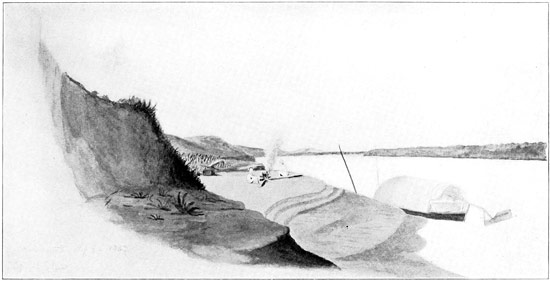
CAMP ON THE MISSOURI. FROM A DRAWING BY ISAAC SPRAGUE.
Tuesday, 5th. At daylight, after some discussion about Beaver lodges, Harris, Bell, Provost, and I, with two men, went to the traps—nothing caught. We now had the lodge demolished outwardly, namely, all the sticks removed, under which was found a hole about two and a half feet in diameter, through which Harris, Bell, and Moncrévier (who had followed us) entered, but found nothing within, as the Beaver had gone to the river. Harris saw it, and also the people at the boat. I secured some large specimens of the cuttings used to build the lodge, and a pocketful of the chips. Before Beavers fell the tree they long for, they cut down all the small twigs and saplings around. The chips are cut above and below, and then split off by the animal; the felled trees lay about us in every direction. We left our camp at half-past five; I again examined the lodge, which was not finished, though about six feet in diameter. We saw a Pigeon Hawk giving chase to a Spotted Sandpiper on the wing. When the Hawk was about to seize the little fellow it dove under water and escaped. This was repeated five or six times; to my great surprise and pleasure, the Hawk was obliged to relinquish the prey. As the wind blew high, we landed to take breakfast, on a fine beach, portions of which appeared as if paved by the hand of man. The canoe men killed a very poor cow, which had been wounded, and so left alone. The wind fell suddenly, and we proceeded on our route till noon, when it rose, and we stopped again. Mr. Culbertson went hunting, and returned having killed a young buck Elk. Dined, and walked after the meat and skin, and took the measurements. Returning, saw two Elks driven to the hills by Mr. Culbertson and Bell. Met Harris, and started a monstrous buck Elk from its couch in a bunch of willows; shot at it while running about eighty yards off, but it was not touched. Meantime Provost had heard us from our dinner camp; loading his rifle he came within ten paces, when his gun snapped. We yet hope to get this fine animal. Harris found a Dove's nest with one young one, and an egg just cracked by the bird inside; the nest was on the ground. Curious all this at this late late season, and in a woody part of the country. Saw a Bat.
Wednesday, 6th. Wind blowing harder. Ransacked the point and banks both below and above, but saw only two Wolves; one a dark gray, the largest I have yet seen. Harris shot a young of the Sharp-tailed Grouse; Bell, three Pigeons; Provost went off to the second point below, about four miles, after Elks; Sprague found another nest of Doves on the ground, with very small young. The common Bluebird was seen, also a Whip-poor-will and a Night-Hawk. Wind high and from the south.
Thursday, 7th. About eleven o'clock last night the wind shifted suddenly to northwest, and blew so violently that we all left the boat in a hurry. Mrs. Culbertson, with her child in her arms, made for the willows, and had a shelter for her babe in a few minutes. Our guns and ammunition were brought on shore, as we were afraid of our boat sinking. We returned on board after a while; but I could not sleep, the motion making me very sea-sick; I went back to the shore and lay down after mending our fire. It rained hard for about two hours; the sky then became clear, and the wind wholly subsided, so I went again to the boat and slept till eight o'clock. A second gale now arose; the sky grew dark; we removed our boat to a more secure position, but I fear we are here for another day. Bell shot a Caprimulgus,[36] so small that I have no doubt it is the one found on the Rocky Mountains by Nuttall, after whom I have named it. These birds are now travelling south. Mr. Culbertson and I walked up the highest hills of the prairie, but saw nothing. The river has suddenly risen two feet, the water rises now at the rate of eight inches in two and a half hours, and the wind has somewhat moderated. The little Whip-poor-will proves an old male, but it is now in moult. Left our camp at five, and went down rapidly to an island four miles below. Mr. Culbertson, Bell, Harris, and Provost went off to look for Elks, but I fear fruitlessly, as I see no tracks, nor do I find any of their beds. About ten o'clock Harris called me to hear the notes of the new Whip-poor-will; we heard two at once, and the sound was thus: "Oh-will, oh-will," repeated often and quickly, as in our common species. The night was beautiful, but cold.
Friday, 8th. Cloudy and remarkably cold; the river has risen 6½ feet since yesterday, and the water is muddy and thick. Started early. The effect of sudden rises in this river is wonderful upon the sand-bars, which are no sooner covered by a foot or so of water than they at once break up, causing very high waves to run, through which no small boat could pass without imminent danger. The swells are felt for many feet as if small waves at sea. Appearances of rain. The current very strong; but we reached Fort Pierre at half-past five, and found all well.
Saturday, 9th. Rain all night. Breakfasted at the fort. Exchanged our boat for a larger one. Orders found here obliged Mr. Culbertson to leave us and go to the Platte River establishment, much to my regret.
Sunday, 10th. Very cloudy. Mr. Culbertson gave me a parflèche[37] which had been presented to him by "L'Ours de Fer," the Sioux chief. It is very curiously painted, and is a record of a victory of the Sioux over their enemies, the Gros Ventres. Two rows of horses with Indians dressed in full war rig are rushing onwards; small black marks everywhere represent the horse tracks; round green marks are shields thrown away by the enemy in their flight, and red spots on the horses, like wafers, denote wounds.
Monday, 11th. Cloudy; the men at work fitting up our new boat. Rained nearly all day, and the wind shifted to every point of the compass. Nothing done.
Tuesday, 12th. Partially clear this morning early, but rained by ten o'clock. Nothing done.
Wednesday, 13th. Rainy again. Many birds were seen moving southwest. Our boat is getting into travelling shape. I did several drawings of objects in and about the fort.
Thursday, 14th. Cloudy and threatening. Mr. Laidlow making ready to leave for Fort Union, and ourselves for our trip down the river. Mr. Laidlow left at half-past eleven, and we started at two this afternoon; landed at the farm belonging to the fort, and procured a few potatoes, some corn, and a pig.
Friday, 15th. A foggy morning. Reached Fort George. Mr. Illingsworth left at half-past ten. Wind ahead, and we were obliged to stop on this account at two. Fresh signs of both Indians and Buffaloes, but nothing killed.
Saturday, 16th. Windy till near daylight. Started early; passed Ebbett's new island. Bell heard Parrakeets. The day was perfectly calm. Found Arvicola pennsylvanica. Landed at the Great Bend for Black-tailed Deer and wood. Have seen nothing worthy our attention. Squires put up a board at our old camp the "Six Trees," which I hope to see again. The Deer are lying down, and we shall not go out to hunt again till near sunset. The note of the Meadow Lark here is now unheard. I saw fully two hundred flying due south. Collected a good deal of the Yucca plant.
Sunday, 17th. We had a hard gale last night with rain for about an hour. This morning was beautiful; we started early, but only ran for two hours, when we were forced to stop by the wind, which blew a gale. Provost saw fresh signs of Indians, and we were told that there were a few lodges at the bottom of the Bend, about two miles below us. The wind is north and quite cold, and the contrast between to-day and yesterday is great. Went shooting, and killed three Sharp-tailed Grouse. Left our camp about three o'clock as the wind abated. Saw ten or twelve Antelopes on the prairie where the Grouse were. We camped about a mile from the spot where we landed in May last, at the end of the Great Bend. The evening calm and beautiful.
Monday, 18th. The weather cloudy and somewhat windy. Started early; saw a Fish Hawk, two Gulls, two White-headed Eagles and abundance of Golden Plovers. The Sharp-tailed Grouse feeds on rose-berries and the seeds of the wild sunflower and grasshoppers. Stopped at twenty minutes past nine, the wind was so high, and warmed some coffee. Many dead Buffaloes are in the ravines and on the prairies. Harris, Bell, and Sprague went hunting, but had no show with such a wind. Sprague outlined a curious hill. The wind finally shifted, and then lulled down. Saw Say's Flycatcher, with a Grosbeak. Saw two of the common Titlark. Left again at two, with a better prospect. Landed at sunset on the west side. Signs of Indians. Wolves howling, and found one dead on the shore, but too far gone to be skinned; I was sorry, as it was a beautiful gray one. These animals feed on wild plums in great quantities. Tried to shoot some Doves for my Fox and Badger, but without success. Pea-vines very scarce.
Tuesday, 19th. Dark and drizzly. Did not start until six. Reached Cedar Island, and landed for wood to use on the boat. Bell went off hunting. Wind north. Found no fit trees and left. Passed the burning cliffs and got on a bar. The weather fine, and wind behind us. Wolves will even eat the frogs found along the shores of this river. Saw five, all gray. At three o'clock we were obliged to stop on account of the wind, under a poor point. No game.
Wednesday, 20th. Wind very high. Tracks of Wild Cats along the shore. The motion of the boat is so great it makes me sea-sick. Sprague saw a Sharp-tailed Grouse. We left at half-past twelve. Saw immense numbers of Pin-tailed Ducks, but could not get near them. Stopped on an island to procure pea-vines for my young Deer, and found plenty. Our camp of last night was only two miles and a half below White River. Ran on a bar and were delayed nearly half an hour. Shot two Blue-winged Teal. Camped opposite Bijou's Hill.
Thursday, 21st. Wind and rain most of the night. Started early. Weather cloudy and cold. Landed to examine Burnt Hills, and again on an island for pea-vines. Fresh signs of Indians. Saw many Antelopes and Mule Deer. At twelve saw a bull on one side of the river, and in a few moments after a herd of ten cattle on the other side. Landed, and Squires, Harris, Bell, and Provost have gone to try to procure fresh meat; these are the first Buffaloes seen since we left Fort Pierre. The hunters only killed one bull; no cows among eleven bulls, and this is strange at this season. Saw three more bulls in a ravine. Stopped to camp at the lower end of great Cedar Island at five o'clock. Fresh signs of Buffaloes and Deer. We cut some timber for oars. Rain set in early in the evening, and it rained hard all night.
Friday, 22d. Raining; left at a quarter past eight, with the wind ahead. Distant thunder. Everything wet and dirty after a very uncomfortable night. We went down the river about a mile, when we were forced to come to on the opposite side by the wind and the rain. Played cards for a couple of hours. No chance to cook or get hot coffee, on account of the heavy storm. We dropped down a few miles and finally camped till next day in the mud, but managed to make a roaring fire. Wolves in numbers howling all about us, and Owls hooting also. Still raining heavily. We played cards till nine o'clock to kill time. Our boat a quagmire.
Saturday, 23d. A cloudy morning; we left at six o'clock. Five Wolves were on a sand-bar very near us. Saw Red-shafted Woodpeckers, and two House Swallows. Have made a good run of about sixty miles. At four this afternoon we took in three men of the steamer "New Haven" belonging to the Opposition, which was fast on the bar, eight miles below. We reached Ponca Island and landed for the night. At dusk the steamer came up, and landed above us, and we found Messrs. Cutting and Taylor, and I had the gratification of a letter from Victor and Johnny, of July 22d.
Sunday, 24th. Cloudy, windy, and cold. Both the steamer and ourselves left as soon as we could see. Saw a Wolf on a bar, and a large flock of White Pelicans, which we took at first for a keel-boat. Passed the Poncas, L'Eau qui Court, Manuel, and Basil rivers by ten o'clock.[38] Landed just below Basil River, stopped by wind. Hunted and shot one Raven, one Turkey Buzzard, and four Wood-ducks. Ripe plums abound, and there are garfish in the creek. Found feathers of the Wild Turkey. Signs of Indians, Elks, and Deer. Provost and the men made four new oars. Went to bed early.
Monday, 25th. Blowing hard all night, and began raining before day. Cold, wet, and misty. Started at a quarter past ten, passed Bonhomme Island at four, and landed for the night at five, fifteen miles below.
Tuesday, 26th. Cold and cloudy; started early. Shot a Pelican. Passed Jack's River at eleven. Abundance of Wild Geese. Bell killed a young White Pelican. Weather fairer but coldish. Sprague killed a Goose, but it was lost. Camped a few miles above the Vermilion River. Harris saw Raccoon tracks on Basil River.
Wednesday, 27th. Cloudy but calm. Many Wood-ducks, and saw Raccoon tracks again this morning. Passed the Vermilion River at half-past seven. My Badger got out of his cage last night, and we had to light a candle to secure it. We reached the Fort of Vermilion at twelve, and met with a kind reception from Mr. Pascal. Previous to this we met a barge going up, owned and commanded by Mr. Tybell, and found our good hunter Michaux. He asked me to take him down, and I promised him $20 per month to St. Louis. We bought two barrels of superb potatoes, two of corn, and a good fat cow. For the corn and potatoes I paid no less than $16.00.
Thursday, 28th. A beautiful morning, and we left at eight. The young man who brought me the calf at Fort George has married a squaw, a handsome girl, and she is here with him. Antelopes are found about twenty-five miles from this fort, but not frequently. Landed fifteen miles below on Elk Point. Cut up and salted the cow. Provost and I went hunting, and saw three female Elks, but the order was to shoot only bucks; a large one started below us, jumped into the river, and swam across, carrying his horns flat down and spread on each side of his back; the neck looked to me about the size of a flour-barrel. Harris killed a hen Turkey, and Bell and the others saw plenty but did not shoot, as Elks were the order of the day. I cannot eat beef after being fed on Buffaloes. I am getting an old man, for this evening I missed my footing on getting into the boat, and bruised my knee and my elbow, but at seventy and over I cannot have the spring of seventeen.
Friday, 29th. Rained most of the night, and it is raining and blowing at present. Crossed the river and have encamped at the mouth of the Iowa River,[39] the boundary line of the Sioux and Omahas. Harris shot a Wolf. My knee too sore to allow me to walk. Stormy all day.
Saturday, 30th. Hard rain all night, the water rose four inches. Found a new species of large bean in the Wild Turkey. Mosquitoes rather troublesome. The sun shining by eight o'clock, and we hope for a good dry day. Whip-poor-wills heard last night, and Night-hawks seen flying. Saw a Long-tailed Squirrel that ran on the shore at the cry of our Badger. Michaux had the boat landed to bring on a superb set of Elk-horns that he secured last week. Abundance of Geese and Ducks. Weather clouding over again, and at two we were struck by a heavy gale of wind, and were obliged to land on the weather shore; the wind continued heavy, and the motion of the boat was too much for me, so I slipped on shore and with Michaux made a good camp, where we rolled ourselves in our blankets and slept soundly.
Sunday, October 1. The wind changed, and lulled before morning, so we left at a quarter past six. The skies looked rather better, nevertheless we had several showers. Passed the [Big] Sioux River at twenty minutes past eleven. Heard a Pileated Woodpecker, and saw Fish Crows. Geese very abundant. Landed below the Sioux River to shoot Turkeys, having seen a large male on the bluffs. Bell killed a hen, and Harris two young birds; these will keep us going some days. Stopped again by the wind opposite Floyd's grave; started again and ran about four miles, when we were obliged to land in a rascally place at twelve o'clock. Had hail and rain at intervals. Camped at the mouth of the Omaha River, six miles from the village. The wild Geese are innumerable. The wind has ceased and stars are shining.
Monday, 2d. Beautiful but cold. The water has risen nine inches, and we travel well. Started early. Stopped at eight by the wind at a vile place, but plenty of Jerusalem artichokes, which we tried and found very good. Started again at three, and made a good run till sundown, when we found a fair camping-place and made our supper from excellent young Geese.
Tuesday, 3d. A beautiful, calm morning; we started early. Saw three Deer on the bank. A Prairie Wolf travelled on the shore beside us for a long time before he found a place to get up on the prairie. Plenty of Sandhill Cranes were seen as we passed the Little Sioux River. Saw three more Deer, another Wolf, two Swans, several Pelicans, and abundance of Geese and Ducks. Passed Soldier River at two o'clock. We were caught by a snag that scraped and tore us a little. Had we been two feet nearer, it would have ruined our barge. We passed through a very swift cut-off, most difficult of entrance. We have run eighty-two miles and encamped at the mouth of the cut-off, near the old bluffs. Killed two Mallards; the Geese and Ducks are abundant beyond description. Brag, Harris' dog, stole and hid all the meat that had been cooked for our supper.
Wednesday, 4th. Cloudy and coldish. Left early and can't find my pocket knife, which I fear I have lost. We were stopped by the wind at Cabané Bluffs, about twenty miles above Fort Croghan; we all hunted, with only fair results. Saw some hazel bushes, and some black walnuts. Wind-bound till night, and nothing done.
Thursday, 5th. Blew hard all night, but a clear and beautiful sunrise. Started early, but stopped by the wind at eight. Bell, Harris, and Squires have started off for Fort Croghan. As there was every appearance of rain we left at three and reached the fort about half-past four. Found all well, and were most kindly received. We were presented with some green corn, and had a quantity of bread made, also bought thirteen eggs from an Indian for twenty-five cents. Honey bees are found here, and do well, but none are seen above this place. I had an unexpected slide on the bank, as it had rained this afternoon; and Squires had also one at twelve in the night, when he and Harris with Sprague came to the boat after having played whist up to that hour.
Friday, 6th. Some rain and thunder last night. A tolerable day. Breakfast at the camp, and left at half-past eight. Our man Michaux was passed over to the officer's boat, to steer them down to Fort Leavenworth, where they are ordered, but we are to keep in company, and he is to cook for us at night. The whole station here is broken up, and Captain Burgwin[40] leaves in a few hours by land with the dragoons, horses, etc. Stopped at Belle Vue at nine, and had a kind reception; bought 6 lbs. coffee, 13 eggs, 2 lbs. butter, and some black pepper. Abundance of Indians, of four different nations. Major Miller, the agent, is a good man for this place. Left again at eleven. A fine day. Passed the Platte and its hundreds of snags, at a quarter past one, and stopped for the men to dine. The stream quite full, and we saw some squaws on the bar, the village was in sight. Killed two Pelicans, but only got one. Encamped about thirty miles below Fort Croghan. Lieutenant Carleton supped with us, and we had a rubber of whist.
Saturday, 7th. Fine night, and fine morning. Started too early, while yet dark, and got on a bar. Passed McPherson's, the first house in the State of Missouri, at eight o'clock. Bell skinned the young of Fringilla harrisi. Lieutenant Carleton came on board to breakfast with us—a fine companion and a perfect gentleman. Indian war-whoops were heard by him and his men whilst embarking this morning after we left. We encamped at the mouth of Nishnebottana, a fine, clear stream. Went to the house of Mr. Beaumont, who has a pretty wife. We made a fine run of sixty or seventy miles.
Sunday, 8th. Cloudy, started early, and had rain by eight o'clock. Stopped twice by the storm, and played cards to relieve the dulness. Started at noon, and ran till half-past four. The wind blowing hard we stopped at a good place for our encampment. Presented a plate of the quadrupeds to Lieut. James Henry Carleton,[41] and he gave me a fine Black Bear skin, and has promised me a set of Elk horns. Stopped on the east side of the river in the evening. Saw a remarkably large flock of Geese passing southward.
Monday, 9th. Beautiful and calm; started early. Bell shot a Gray Squirrel, which was divided and given to my Fox and my Badger. Squires, Carleton, Harris, Bell, and Sprague walked across the Bend to the Black Snake Hills, and killed six Gray Squirrels, four Parrakeets, and two Partridges. Bought butter, eggs, and some whiskey for the men; exchanged knives with the lieutenant. Started and ran twelve miles to a good camp on the Indian side.
Tuesday, 10th. Beautiful morning, rather windy; started early. Great flocks of Geese and Pelicans; killed two of the latter. Reached Fort Leavenworth at four, and, as usual everywhere, received most kindly treatment and reception from Major Morton. Lieutenant Carleton gave me the Elk horns. Wrote to John Bachman, Gideon B. Smith, and a long letter home.
Wednesday, 11th. Received a most welcome present of melons, chickens, bread, and butter from the generous major. Lieutenant Carleton came to see me off, and we parted reluctantly. Left at half-past six; weather calm and beautiful. Game scarce, paw-paws plentiful. Stopped at Madame Chouteau's, where I bought three pumpkins. Stopped at Liberty Landing and delivered the letters of Laidlow to Black Harris. Reached Independence Landing at sundown; have run sixty miles. Found no letters. Steamer "Lebanon" passed upwards at half-past eight.
Thursday, 12th. Beautiful and calm; stopped and bought eggs, etc., at a Mr. Shivers', from Kentucky. Ran well to Lexington, where we again stopped for provisions; ran sixty miles to-day.
Friday, 13th. Heavy white frost, and very foggy. Started early and ran well. Tried to buy butter at several places, but in vain. At Greenville bought coffee. Abundance of Geese and White Pelicans; many Sandhill Cranes. Harris killed a Wood-duck. Passed Grand River; stopped at New Brunswick, where we bought excellent beef at 2½ cents a pound, but very inferior to Buffalo. Camped at a deserted wood yard, after running between sixty and seventy miles.
Saturday, 14th. A windy night, and after eight days' good run, I fear we shall be delayed to-day. Stopped by a high wind at twelve o'clock. We ran ashore, and I undertook to push the boat afloat, and undressing for the purpose got so deep in the mud that I had to spend a much longer time than I desired in very cold water. Visited two farm houses, and bought chickens, eggs, and butter; very little of this last. At one place we procured corn bread. The squatter visited our boat, and we camped near him. He seemed a good man; was from North Carolina, and had a fine family. Michaux killed two Hutchins' Geese,[42] the first I ever saw in the flesh. Ran about twenty miles; steamer "Lebanon" passed us going downwards, one hour before sunset. Turkeys and Long-tailed Squirrels very abundant.
Sunday, 15th. Cold, foggy, and cloudy; started early. Passed Chariton River and village, and Glasgow; bought bread, and oats for my Deer. Abundance of Geese and Ducks. Passed Arrow Rock at eleven. Passed Boonesville, the finest country on this river; Rocheport, with high, rocky cliffs; six miles below which we encamped, having run sixty miles.
Monday, 16th. Beautiful autumnal morning, a heavy white frost and no wind. Started early, before six. The current very strong. Passed Nashville, Marion, and steamer "Lexington" going up. Jefferson City at twelve. Passed the Osage River and saw twenty-four Deer opposite Smith Landing; camped at sundown, and found Giraud, the "strong man." Ran sixty-one miles. Met the steamer "Satan," badly steered. Abundance of Geese and Ducks everywhere.
Tuesday, 17th. Calm and very foggy. Started early and floated a good deal with the strong current. Saw two Deer. The fog cleared off by nine o'clock. Passed the Gasconade River at half-past nine. Landed at Pinckney to buy bread, etc. Buffaloes have been seen mired, and unable to defend themselves, and the Wolves actually eating their noses while they struggled, but were eventually killed by the Wolves. Passed Washington and encamped below it at sundown; a good run.
Wednesday, 18th. Fine and calm; started very early. Passed Mount Pleasant. Landed at St. Charles to purchase bread, etc. Provost became extremely drunk, and went off by land to St. Louis. Passed the Charbonnière River, and encamped about one mile below. The steamer "Tobacco Plant" landed on the shore opposite. Bell and Harris killed a number of Gray Squirrels.
Thursday, 19th. A heavy white frost, foggy, but calm. We started early, the steamer after us. Forced by the fog to stop on a bar, but reached St. Louis at three in the afternoon. Unloaded and sent all the things to Nicholas Berthoud's warehouse. Wrote home.
Left St. Louis October 22, in steamer "Nautilus" for Cincinnati.
Reached home at 3 p.m., November 6th, 1843, and thank God, found all my family quite well.[43]
[Copied from Bell's Journal.[44]]
"August 2. Started at half-past seven this morning; saw several Yellow-legs (Godwits), and some young Blue-winged Teal in the pond in the first prairie. Shot two Curlews; saw two very fine male Elks; they were lying down quite near us, under a bank where they got the wind of us. The Sharp-tailed Grouse are first-rate eating now, as they feed entirely on grasshoppers, and berries of different kinds. Owen climbed a tree to a White-headed Eagle's nest, and drove a young one out, which fell to the ground and was caught alive, and brought to the fort. Is it not very remarkable that Eagles of this species should have their young in the nest at this late season, when in the Floridas I have shot them of the same size in February? Shot at a Wolf, which being wounded, went off about one hundred yards, and yelled like a dog; a very remarkable instance, as all we have killed or wounded, and they have been many, rarely make any sound, and if they do it is simply a snapping at their pursuer. As we went up the Missouri on the 7th instant, I found numbers of Cliff Swallow's nests, with the old ones feeding their young. This is also very late and uncommon at this season. Saw a Peregrine Falcon feeding its young. La Fleur shot two bucks of the White-tailed Deer with two shots, and the meat, which we brought home, proved fat and good. Saw Beaver tracks, and young Green-winged Teals. We saw hills impregnated with sulphur and coal, some of them on fire, and now and then portions of them gave way, by hundreds of tons at a time. In one place I saw a vein of coal on fire; we were following a path close to the foot of a high hill, and at a turn as we looked ahead, we found the way suddenly blocked by the earth falling down from above us, and looking up saw a line of coal, or other dark substance; it was about two feet thick, and about seventy-five feet from the bottom and forty from the top. It was burning very slowly, and in several places, for about fifty yards, emitting whitish smoke, something like sulphur when burning, and turning the earth or rock above, quite red, or of a brick color. It would undermine the earth above, which then fell in large masses, and this was the cause of the obstruction in the path before us. It must have been burning for a long time, as it had already burned some distance along the hill, and hundreds of tons of earth had fallen. In some places I saw banks of clay twenty feet high, quite red, hard in some parts, and in others very scaly and soft, even crumbling to pieces. Where the fire was burning, the clay was red, varying from one to three feet in thickness; no appearance of coal presented itself where the fire had passed along and was extinguished, but very distinct above the fire, and I have no doubt there is a small quantity of sulphur mixed with this coal, or whatever the substance may be. In another place a short distance from these hills, and in a ravine, I also saw some red stones which looked very much as if the corners of a house which had once been there still remained, with the remnants of two sides yet straight. These stones varied from six to twenty inches in thickness, and many of them were square and about eighteen or twenty feet high; we had not time to remain and examine and measure as carefully as I should have liked to do."
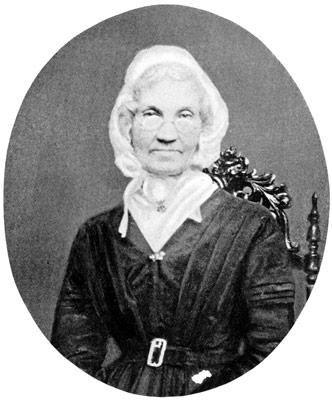
MRS. AUDUBON, 1854. FROM A DAGUERREOTYPE.
Extracts from Mr. Culbertson's Journal, kept at Fort McKenzie, Blackfeet Indian Country in 1834.[45]
"Friday, June 13. Blood Indians started this morning to go to war against the Crows. They had not left long, when the 'Old Bull's Backfat's' son, with his sister, brother, and brother-in-law, returned to the fort, saying they must go back to the camp. After I had given them tobacco and ammunition they all started, but did not get more than two miles from the fort before they were all killed by the Crows, except one, who by some means leaped on one of the Crow horses and fled to the fort. The squaw no doubt was taken prisoner, as in the evening I went out and found the bodies of her husband and brother, but she was not there. On Saturday, the 14th, I went out and brought in the bodies, and had them decently interred. The young man who had escaped was only slightly wounded, and started again for the camp with three Gros Ventres.
"Tuesday, 24th. We were all surprised this evening at the arrival of the squaw who had been taken prisoner, and who had been carried to the Crow village where she was kept tied every night until the one in which she made her escape. During the previous day having it in contemplation to escape, she took the precaution of hiding a knife under her garment of skins, but most unfortunately she went out with one of the Crow squaws, and in stooping, the knife fell out; this was reported, and as a punishment she was stripped of every particle of clothing, and when night came was not tied, as it was not imagined she would leave the cover of the tent. However, she decided nothing should keep her from availing herself of the only opportunity she might ever have; she started with absolutely no covering of any kind, and in this plight she travelled across the prairies, almost without stopping to rest, and with little food, for four days and three nights; unfortunately the weather was unusually cold for the season, as well as wet. She arrived at the fort in a most wretched and pitiable condition, but greatly to the joy and consolation of her relations and friends. She said that after her arrival at the Crow village, they made her dance with the scalps of her brother and husband tied to her hair, and clothed in the bloody shirt of the latter. On Wednesday, 25th, a band of four hundred Crows arrived with the intention of taking the fort by stratagem if they could get the opportunity; but they failed in this, as I would not allow one of them inside the fort, or to come within firing distance of their arms. They used every artifice in their power to persuade me to let in a few of them to smoke the pipe of peace, assuring me that their intentions were good, and that they loved the white people. Finding all this of no avail, they brought their best horses to give to me, for which they did not wish to receive anything more than the privilege of letting some of them come in; but all this was in vain, as I was well aware of their treacherous intentions. I divided my men in the two bastions, with orders to fire upon the first one that might approach during the night, and warned them of my having given such orders, telling them that I did not wish to strike the first blow, but that if they commenced they would go off with small numbers, and sore hearts. There was an American with them who now told me of their intentions, and that they were determined to take the fort. I sent them word by him that we were ready for them if they thought themselves able to do so, and to come and try; but when they saw our cannon pointed towards them, they were not so anxious to make a rush. On the 26th the Crows made another attempt to get in, but after a long and persuasive talk they found that it would not do. They then crossed the river and came on the high bank opposite to the fort, and fired upon us, and while some of them were yet crossing the river I let loose a cannon ball among them, which, if it did no harm, made them move at a quick pace, and after a while they all went off, leaving us without food of any sort; but fortunately on Monday the 30th, a party of Blood Indians came in from the Crows with fifteen horses and considerable meat. The Crows had taken all our horses shortly before, and promised to return them in a few days if I would let them in. I was also informed that they had even brought pack-horses to carry off the goods from the fort after having accomplished the destruction of the building and the massacre of ourselves."
From these extracts the nature of the Indians of these regions may be exemplified a thousand times better, because true, than by all the trashy stuff written and published by Mr. Catlin.
DESCRIPTION OF FORT UNION
By EDWIN T. DENIG. July 30, 1843
"Fort Union, the principal and handsomest trading-post on the Missouri River, is situated on the north side, about six and a half miles above the mouth of the Yellowstone River; the country around it is beautiful, and well chosen for an establishment of the kind. The front of the fort is but a few steps, say twenty-five, from the bank of the Missouri. Behind the fort is a prairie with an agreeable ascent to the commencement of the bluffs, about one and a half miles in width, and two in length, surrounded at the borders with high hills, or bluffs. Above and below, at the distance of two hundred yards commence the points, or bottoms, of the Missouri, which contain great quantities of cottonwood, ash, and elm, supplying the fort with fuel, boat and building timber. The fort itself was begun in the fall of 1829, under the superintendence of Kenneth McKenzie, Esq., an enterprising and enlightened Scotchman, and now a well known and successful merchant in St. Louis. As the immense deal of work about such an undertaking had but few men to accomplish it, it was not wholly completed till after the expiration of four years, and indeed since then has been greatly improved by the other gentlemen who subsequently took charge of the fort. The plan of the fort is laid nearly due north and south, fronting 220 feet and running back 240 feet. This space is enclosed by pickets or palisades of twenty feet high, made of large hewn cottonwood, and founded upon stone. The pickets are fitted into an open framework in the inside, of sufficient strength to counterbalance their weight, and sustained by braces in the form of an X, which reaches in the inside from the pickets to the frame, so as to make the whole completely solid and secure, from either storm or attack. On the southwest and northeast corners, are bastions, built entirely out of stone, and measuring 24 feet square, over 30 feet high, and the wall three feet thick; this is whitewashed. Around the tops of the second stories are balconies with railings, which serve for observatories, and from the tops of the roofs are two flag-staffs 25 feet high, on which wave the proud Eagle of America. Two weathercocks, one a Buffalo bull, the other an Eagle, complete the outsides. In the interior of the northeast bastion are placed opposite their port-holes one three-pounder iron cannon and one brass swivel, both mounted, and usually kept loaded, together with a dozen muskets in case of a sudden attack from the Indians. Balls, cartridges, and other ammunition are always in readiness for the use of the same. The contents of the southeast bastion are similar to those of the other, with the exception of the cannon, having but one small swivel. These and other preparations render the place impregnable to any force without, not furnished with artillery. The principal building in the establishment, and that of the gentleman in charge, or Bourgeois, is now occupied by Mr. Culbertson, one of the partners of the Company. It is 78 feet front by 24 feet depth, and a story and a half high. The front has a very imposing appearance, being neatly weather-boarded, and painted white, and with green window-shutters; it is roofed with shingle, painted red to preserve the wood. In the roof in front are four dormer windows, which serve to give light to the attic. The piazza in front adds much to the comfort and appearance, the posts are all turned, and painted white. It serves as a pleasant retreat from the heat of the day, and is a refreshing place to sleep at night when mosquitoes are plenty. Mr. Audubon, the naturalist, now here upon scientific researches, together with his secretary, Mr. Squires, prefer this hard bed to the more luxurious comforts of feathers and sheets. The interior of this building is handsomely papered and ornamented with portraits and pictures, and portioned off in the following manner. Mr. Culbertson has the principal room, which is large, commodious, and well-furnished; from it he has a view of all that passes within the fort. Next to this is the office, which is devoted exclusively to the business of the Company, which is immense. This department is now under my supervision (viz., E. T. Denig). These two rooms occupy about one-half the building. In the middle is a hall, eight feet wide, which separates these rooms from the other part. In this is the mess-room, which is nearly equal in size to that of Mr. Culbertson. Here the Bourgeois, taking his seat at the head of the table, attends to its honors, and serves out the luxuries this wilderness produces to his visitors and clerks, who are seated in their proper order and rank. The mechanics of the fort eat at the second table. Adjoining this room is the residence of Mr. Denig. In the upper story are at present located Mr. Audubon and his suite. Here from the pencils of Mr. Audubon and Mr. Sprague emanate the splendid paintings and drawings of animals and plants, which are the admiration of all; and the Indians regard them as marvellous, and almost to be worshipped. In the room next to this is always kept a selection of saddlery and harness, in readiness for rides of pleasure, or for those rendered necessary for the protection of the horses which are kept on the prairie, and which suffer from frequent depredations on the part of the Indians, which it is the duty of the men at the fort to ward off as far as possible. The next apartment is the tailor's shop, so placed as to be out of the way of the Indian visitors as much as possible, who, were it at all easy of access, would steal some of the goods which it is necessary to have always on hand. So much for the principal house. On the east side of the fort, extending north and south, is a building, on range, all under one roof, 127 ft. long by 25 ft. deep, and used for the following purposes. A small room at the north end for stores and luggage; then the retail store, in which is kept a fair supply of merchandise, and where all white persons buy or sell. The prices of all goods are fixed by a tariff or stationary value, so that no bargaining or cheating is allowed; this department is now in charge of Mr. Larpenteur. Adjoining this is the wholesale warehouse, in which is kept the principal stock of goods intended for the extensive trade; this room is 57 ft. in length. Next is a small room for the storage of meat and other supplies. At the end is the press room, where all robes, furs, and peltries are stored. The dimensions extend to the top of the roof inside, which roof is perfectly waterproof. It will contain from 2800 to 3000 packs of Buffalo robes. All this range is very strongly put together, weather-boarded outside, and lined with plank within. It has also cellar and garret. Opposite this, on the other side of the fort enclosure, is a similar range of buildings 119 ft. long by 21 ft. wide, perhaps not quite so strongly built, but sufficiently so to suit all purposes. The height of the building is in proportion to that of the pickets; it is one large story high, and shingle-roofed. This is partitioned off into six different apartments of nearly equal size. The first two are appropriated to the use of the clerks who may be stationed at the post. The next is the residence of the hunters, and the remaining three the dwellings of the men in the employ of the Company. An ice-house 24 by 21 ft. is detached from this range, and is well filled with ice during the winter, which supply generally lasts till fall. Here is put all fresh meat in the hot weather, and the fort in the summer season is usually provisioned for ten days. The kitchen is behind the Bourgeois' house on the north side, and about two steps from the end of the hall,—so situated for convenience in carrying in the cooked victuals to the mess-room. Two or three cooks are usually employed therein, at busy times more. The inside frame-work of the fort, which sustains the pickets, forms all around a space about eight feet wide described by the braces or X, and about fifteen feet high. A balcony is built on the top of this, having the summit of the X for its basis, and is formed of sawed plank nailed to cross beams from one brace to another. This balcony affords a pleasant walk all round the inside of the fort, within five feet of the top of the pickets; from here also is a good view of the surrounding neighborhood, and it is well calculated for a place of defence. It is a favorite place from which to shoot Wolves after nightfall, and for standing guard in time of danger. The openings that would necessarily follow from such a construction, under the gallery, are fitted in some places with small huts or houses. Behind the kitchen there are five of such houses, leaving at the same time plenty of space between them and the other buildings. The first of these is a stable for Buffalo calves, which are annually raised here, being caught during the severe storms of winter; the second a hen-house, well lined, plastered, and filled with chickens; third, a very pleasant room intended as an artist's work-room, fourth, a cooper's shop, and then the milk house and dairy. Several houses of the same kind and construction are also built on the west and south sides; one contains coal for the blacksmith, and ten stables, in all 117 ft. long, and 10 ft. wide, with space enough to quarter fifty horses. These are very useful, as the Company have always a number of horses and cattle here. These buildings, it will be understood, do not interfere with the Area or Parade of the fort, and are hardly noticed by a casual observer, but occupy the space under the balcony that would otherwise be useless and void. Fifty more of the same kind could be put up without intruding upon any portion of the fort used for other purposes. On the front side, and west of the gate, is a house 50 by 21 feet, which, being divided into two parts, one half opening into the fort, is used as a blacksmith's, gunsmith's, and tinner's shop; the other part is used as a reception-room for Indians, and opens into the passage, which is made by the double gate. There are two large outside gates to the fort, one each in the middle of the front and rear, and upon the top of the front one is a painting of a treaty of peace between the Indians and whites executed by J. B. Moncrévier, Esq. These gates are 12 ft. wide, and 14 ft. high. At the front there is an inside gate of the same size at the inner end of the Indian reception room, which shuts a passage from the outside gate of 32 ft. in length, and the same width as the gate; the passage is formed of pickets. The outside gate can be left open, and the inside one closed, which permits the Indians to enter the reception room without their having any communication with the fort. Into this room are brought all trading and war parties, until such time as their business is ascertained; there is also behind this room a trade shop, and leading into it a window through which the Indians usually trade, being secure from rain or accident; there is also another window through the pickets to the outside of the fort, which is used in trading when the Indians are troublesome, or too numerous. The Powder Magazine is perhaps the best piece of work, as regards strength and security, that could be devised for a fort like this. The dimensions are 25 by 18 ft.; it is built out of stone, which is a variety of limestone with a considerable quantity of sand in its composition. The walls are 4 ft. thick at the base, and increasing with the curve of the arch become gradually thicker as they rise, so that near the top they are about 6 ft. in thickness. The inside presents a complete semicircular arch, which is covered on the top with stones and gravel to the depth of 18 inches. The whole is covered with a shingle roof through which fire may burn yet with no danger to the powder within. There are two doors, one on the outside, the other a few feet within; the outer one is covered with tin. There are several other small buildings under the balcony, which are used for harness, tool-houses, meat, etc. The space behind the warehouse between that and the pickets, being free from buildings, affords a good horse yard, and some shelter to the horses in bad weather. The area of the fort within the fronts of the houses is 189 ft. long, and 141 ft. wide. In the centre of this arises a flag-staff 63 ft. high. This is surrounded at the base by a railing and panel work in an octagonal form, enclosing a portion of ground 12 ft. in diameter, in which are planted lettuce, radishes, and cress, and which presents at the same time a useful and handsome appearance. By the side of this stands a mounted four-pounder iron cannon. This flag-staff is the glory of the fort, for on high, seen from far and wide, floats the Star Spangled Banner, an immense flag which once belonged to the United States Navy, and gives the certainty of security from dangers, rest to the weary traveller, peace and plenty to the fatigued and hungry, whose eyes are gladdened by the sight of it on arriving from the long and perilous voyages usual in this far western wild. It is customary on the arrivals and departures of the Bourgeois, or of the boats of gentlemen of note, to raise the flag, and by the firing of the cannon show them a welcome, or wish them a safe arrival at their point of destination. When interest and affection are as circumscribed as here, they must necessarily be more intense, and partings are more regretted, being accompanied by dangers to the departing friends, and meetings more cordial, those dangers having been surmounted. The casualties of the country are common to all, and felt the more by the handful, who, far from civilization, friends, or kindred, are associated in those risks and excitements which accrue from a life among savages. About two hundred feet east of Fort Union is an enclosure about 150 ft. square, which is used for hay and other purposes. Two hundred and fifty good cart-loads of hay are procured during the summer and stacked up in this place for winter use of horses and cattle, the winter being so severe and long, and snow so deep that little food is to be found for them on the prairies at that season. There are, at present, in this place thirty head of cattle, forty horses, besides colts, and a goodly number of hogs. A garden on a small scale is attached to the 'old fort' as it is called, which supplies the table with peas, turnips, radishes, lettuce, beets, onions, etc. The large garden, half a mile off and below the fort, contains one and a half acres, and produces most plentiful and excellent crops of potatoes, corn, and every kind of vegetable, but has not been worked this year. In the summer of 1838, Mr. Culbertson had from it 520 bushels of potatoes, and as many other vegetables as he required for the use of the fort. Rainy seasons prove most favorable in this climate for vegetation, but they rarely occur. It is indeed pleasant to know that the enterprising men who commenced, and have continued with untiring perseverance, the enlargement of the Indian trade, and labored hard for the subordination, if not civilization, of the Indians, should occasionally sit down under their own vine and fig-tree, and enjoy at least the semblance of living like their more quiet, though not more useful brothers in the United States."