EPISODES (continued 5)
Reading edition
Scarcely had they effected their escape from the frightful peril which threatened them, when the mass of waters burst forth with a horrible uproar. All eyes were bent towards the huge heaps of logs in the gorge below. The tumultuous burst of the waters instantly swept away every object that opposed their progress, and rushed in foaming waves among the timbers that everywhere blocked up the passage. Presently a slow, heavy motion was perceived in the mass of logs; one might have imagined that some mighty monster lay convulsively writhing beneath them, struggling with a fearful energy to extricate himself from the crushing weight. As the waters rose, this movement increased; the mass of timber extended in all directions, appearing to become more and more entangled each moment; the logs bounced against each other, thrusting aside, demersing, or raising into the air those with which they came in contact; it seemed as if they were waging a war of destruction, such as ancient authors describe the efforts of the Titans, the foamings of whose wrath might to the eye of the painter have been represented by the angry curlings of the waters, while the tremulous and rapid motions of the logs, which at times reared themselves almost perpendicularly, might by the poet have been taken for the shakings of the confounded and discomfited giants.
Now the rushing element filled up the gorge to its brim. The logs, once under way, rolled, reared, tossed, and tumbled amid the foam, as they were carried along. Many of the smaller trees broke across, from others great splinters were sent up, and all were in some degree seamed and scarred. Then in tumultuous majesty swept along the mingled wreck, the current being now increased to such a pitch that the logs, as they were dashed against the rocky shores, resounded like the report of distant artillery, or the angry rumblings of the thunder. Onward it rolls, the emblem of wreck and ruin, destruction and chaotic strife. It seemed to me as if I witnessed the rout of a vast army, surprised, overwhelmed, and overthrown. The roar of the cannon, the groans of the dying, and the shouts of the avengers were thundering through my brain, and amid the frightful confusion of the scene, there came over my spirit a melancholy feeling, which had not entirely vanished at the end of many days.
In a few hours almost all the timber that had lain heaped in the rocky gorge, was floating in the great pond of the millers; and as we walked homeward we talked of the Force of the Waters.
JOURNEY IN NEW BRUNSWICK AND MAINE
The morning after that which we had spent with Sir Archibald Campbell and his delightful family, saw us proceeding along the shores of the St. John River, in the British Province of New Brunswick. As we passed the Government House, our hearts bade its generous inmates adieu; and as we left Fredericton behind, the recollection of the many acts of kindness which we had received from its inhabitants came powerfully on our minds. Slowly advancing over the surface of the translucent stream, we still fancied our ears saluted by the melodies of the unrivalled band of the 43d Regiment. In short, with the remembrance of kindness experienced, the feeling of expectations gratified, the hope of adding to our knowledge, and the possession of health and vigor, we were luxuriating in happiness.
The "Favorite," the bark in which we were, contained not only my whole family, but nearly a score and a half of individuals of all descriptions, so that the crowded state of the cabin soon began to prove rather disagreeable. The boat itself was a mere scow, commanded by a person of rather uncouth aspect and rude manners. Two sorry nags he had fastened to the end of a long tow-line, on the nearer of which rode a negro youth, less than half clad, with a long switch in one hand, and the joined bridles in the other, striving with all his might to urge them on at the rate of something more than two miles an hour. How fortunate it is for one to possess a little of the knowledge of a true traveller! Following the advice of a good and somewhat aged one, we had provided ourselves with a large basket, which was not altogether empty when we reached the end of our aquatic excursion. Here and there the shores of the river were delightful, the space between them and the undulating hills that bounded the prospect being highly cultivated, while now and then the abrupt and rocky banks assumed a most picturesque appearance. Although it was late in September, the mowers were still engaged in cutting the grass, and the gardens of the farmers showed patches of green peas. The apples were still green, and the vegetation in general reminded us that we were in a northern latitude.
Gradually and slowly we proceeded, until in the afternoon we landed to exchange our jaded horses. We saw a house on an eminence, with groups of people assembled round it, but there no dinner could be obtained, because, as the landlord told us, an election was going on. So the basket was had recourse to, and on the greensward we refreshed ourselves with its contents. This done, we returned to the scow, and resumed our stations. As usual in such cases, in every part of the world that I have visited, our second set of horses was worse than the first. However, on we went; to tell you how often the tow-line gave way would not be more amusing to you than it was annoying to us. Once our commander was in consequence plunged into the stream, but after some exertion he succeeded in regaining his gallant bark, when he consoled himself by giving utterance to a volley of blasphemies, which it would as ill become me to repeat, as it would be disagreeable to you to hear. We slept somewhere that night; it does not suit my views of travelling to tell you where.
Before day returned to smile on the "Favorite" we proceeded. Some rapids we came to, when every one, glad to assist her, leaped on shore, and tugged à la cordelle. Some miles farther we passed a curious cataract, formed by the waters of the Pokioke. There Sambo led his steeds up the sides of a high bank, when, lo! the whole party came tumbling down, like so many hogsheads of tobacco rolled from a store-house to the banks of the Ohio. He at the steering oar hoped "the black rascal" had broken his neck, and congratulated himself in the same breath for the safety of the horses, which presently got on their feet. Sambo, however, alert as an Indian chief, leaped on the naked back of one, and showing his teeth, laughed at his master's curses. Shortly after this we found our boat very snugly secured on the top of a rock, midway in the stream, just opposite the mouth of Eel River.
Next day at noon, none injured, but all chop-fallen, we were landed at Woodstock village, yet in its infancy. After dining there we procured a cart, and an excellent driver, and proceeded along an execrable road to Houlton in Maine, glad enough, after all our mishaps, at finding ourselves in our own country. But before I bid farewell to the beautiful river of St. John, I must tell you that its navigation seldom exceeds eight months each year, the passage during the rest being performed on the ice, of which we were told that last season there was an unusual quantity, so much, indeed, as to accumulate, by being jammed at particular spots, to the height of nearly fifty feet above the ordinary level of the river, and that when it broke loose in spring, the crash was awful. All the low grounds along the river were suddenly flooded, and even the elevated plain on which Fredericton stands was covered to the depth of four feet. Fortunately, however, as on the greater streams of the Western and Southern Districts, such an occurrence seldom takes place.
Major Clarke, commander of the United States garrison, received us with remarkable kindness. The next day was spent in a long though fruitless ornithological excursion, for although we were accompanied by officers and men from the garrison, not a bird did any of our party procure that was of any use to us. We remained a few days, however, after which, hiring a cart, two horses, and a driver, we proceeded in the direction of Bangor.
Houlton is a neat village, consisting of some fifty houses. The fort is well situated, and commands a fine view of Mars' Hill, which is about thirteen miles distant. A custom-house has been erected here, the place being on the boundary line of the United States and the British Provinces. The road which was cut by the soldiers of this garrison, from Bangor to Houlton, through the forests, is at this moment a fine turnpike, of great breadth, almost straight in its whole length, and perhaps the best now in the Union. It was incomplete, however, for some miles, so that our travelling over that portion was slow and disagreeable. The rain, which fell in torrents, reduced the newly raised earth to a complete bed of mud, and at one time our horses became so completely mired that, had we not been extricated by two oxen, we must have spent the night near the spot. Jogging along at a very slow pace, we were overtaken by a gay wagoner, who had excellent horses, two of which a little "siller" induced him to join to ours, and we were taken to a tavern, at the "Cross Roads," where we spent the night in comfort. While supper was preparing, I made inquiries respecting birds, quadrupeds, and fishes, and was pleased to hear that many of these animals abounded in the neighborhood. Deer, Bears, Trout, and Grouse were quite plentiful, as was the Great Gray Owl.
When we resumed our journey next morning Nature displayed all her loveliness, and Autumn with her mellow tints, her glowing fruits, and her rich fields of corn, smiled in placid beauty. Many of the fields had not yet been reaped, the fruits of the forests and orchards hung clustering around us, and as we came in view of the Penobscot River, our hearts thrilled with joy. Its broad transparent waters here spread out their unruffled surface, there danced along the rapids, while canoes filled with Indians glided swiftly in every direction, raising before them the timorous waterfowl that had already flocked in from the north. Mountains, which you well know are indispensable in a beautiful landscape, reared their majestic crests in the distance. The Canada Jay leaped gaily from branch to twig; the Kingfisher, as if vexed at being suddenly surprised, rattled loudly as it swiftly flew off; and the Fish Hawk and Eagle spread their broad wings over the waters. All around was beautiful, and we gazed on the scene with delight, as seated on a verdant bank, we refreshed our frames from our replenished stores. A few rare birds were procured here, and the rest of the road being level and firm, we trotted on at a good pace for several hours, the Penobscot keeping company with us.
Now we came to a deep creek, of which the bridge was undergoing repairs, and the people saw our vehicle approach with much surprise. They, however, assisted us with pleasure, by placing a few logs across, along which our horses one after the other were carefully led, and the cart afterwards carried. These good fellows were so averse to our recompensing them for their labor that after some altercation we were obliged absolutely to force what we deemed a suitable reward upon them.
Next day we continued our journey along the Penobscot, the country changing its aspect at every mile, and when we first descried Old Town, that village of saw-mills looked like an island covered with manufactories. The people here are noted for their industry and perseverance, and any one possessing a mill, and attending to his saws, and the floating of the timber into his dams, is sure to obtain a competency in a few years. Speculations in land covered with pine, lying to the north of this place, are carried on to a great extent, and to discover a good tract of such ground many a miller of Old Town undertakes long journeys. Reader, with your leave, I will here introduce one of them.
Good luck brought us into acquaintance with Mr. Gillies, whom we happened to meet in the course of our travels, as he was returning from an exploring tour. About the first of August he formed a party of sixteen persons, each carrying a knapsack and an axe. Their provisions consisted of two hundred and fifty pounds of pilot bread, one hundred and fifty of salt pork, four of tea, two large loaves of sugar, and some salt. They embarked in light canoes twelve miles north of Bangor, and followed the Penobscot as far as Wassataquoik River, a branch leading to the northwest, until they reached the Seboois Lakes, the principal of which lie in a line, with short portages between them. Still proceeding northwest they navigated these lakes, and then turning west, carried their canoes to the great lake Baamchenunsgamook; thence north to Wallaghasquegantook Lake, then along a small stream to the upper Umsaskiss Pond, when they reached the Albagash River which leads into the St. John in about latitude 47°. Many portions of that country had not been visited before even by the Indians, who assured Mr. Gillies of this fact. They continued their travels down the St. John to the Grand Falls, where they met with a portage of half a mile, and having reached Meduxmekeag Creek, a little above Woodstock, the party walked to Houlton, having travelled twelve hundred miles, and described almost an oval over the country by the time they returned to Old Town, on the Penobscot.
While anxiously looking for "lumber-lands," they ascended the eminences around, then climbed the tallest trees, and by means of a good telescope, inspected the pine woods in the distance. And such excellent judges are these persons of the value of the timber which they thus observe, when it is situated at a convenient distance from water, that they never afterwards forget the different spots at all worthy of their attention. They had observed only a few birds and quadrupeds, the latter principally Porcupines. The borders of the lakes and rivers afforded them fruits of various sorts, and abundance of cranberries, while the uplands yielded plenty of wild white onions, and a species of black plum. Some of the party continued their journey in canoes down the St. John, ascended Eel River, and the lake of the same name to Matanemheag River, due southwest of the St. John, and after a few portages fell into the Penobscot.
I had made arrangements to accompany Mr. Gillies on a journey of this kind, when I judged it would be more interesting as well as useful to me to visit the distant country of Labrador.
The road which we followed from Old Town to Bangor was literally covered with Penobscot Indians returning from market. On reaching the latter beautiful town, we found very comfortable lodging in an excellent hotel, and next day we proceeded by the mail to Boston.
A MOOSE HUNT
In the spring of 1833 the Moose were remarkably abundant in the neighborhood of the Schoodiac Lakes; and, as the snow was so deep in the woods as to render it almost impossible for them to escape, many of them were caught. About the 1st of March, 1833, three of us set off on a hunt, provided with snow-shoes, guns, hatchets, and provisions for a fortnight. On the first day we went fifty miles, in a sledge drawn by one horse, to the nearest lake, where we stopped for the night, in the hut of an Indian named Lewis, of the Passamaquoddy tribe, who had abandoned the wandering life of his race, and turned his attention to farming and lumbering. Here we saw the operation of making snow-shoes, which requires more skill than one might imagine. The men generally make the bows to suit themselves, and the women weave in the threads, which are usually made of the skin of the Caribou Deer.
The next day we went on foot sixty-two miles farther, when a heavy rain-storm coming on, we were detained a whole day. The next morning we put on snow-shoes, and proceeded about thirteen miles, to the head of the Musquash Lake, where we found a camp, which had been erected by some lumberers in the winter; and here we established our headquarters. In the afternoon an Indian had driven a female Moose-deer, and two young ones of the preceding year, within a quarter of a mile of our camp, when he was obliged to shoot the old one. We undertook to procure the young alive, and after much exertion succeeded in getting one of them, and shut it up in the shed made for the oxen; but as the night was falling, we were compelled to leave the other in the woods. The dogs having killed two fine Deer that day, we feasted upon some of their flesh, and upon Moose, which certainly seemed to us the most savory meat we had ever eaten, although a keen appetite is very apt to warp one's judgment in such a case. After supper we laid ourselves down before the huge fire we had built up, and were soon satisfied that we had at last discovered the most comfortable mode of sleeping.
In the morning we started off on the track of a Moose, which had been driven from its haunt, or yard, by the Indians the day before; and although the snow was in general five feet deep, and in some places much deeper, we travelled three miles before we came to the spot where the Moose had rested for the night. He had not left this place more than an hour, when we came to it. So we pushed on faster than before, trusting that ere long we should overtake him. We had proceeded about a mile and a half farther, when he took a sudden turn, which threw us off his track, and when we again found it, we saw that an Indian had taken it up, and gone in pursuit of the harassed animal. In a short time we heard the report of a gun, and immediately running up, we saw the Moose, standing in a thicket, wounded, when we brought him down. The animal finding himself too closely pursued, had turned upon the Indian, who fired, and instantly ran into the bushes to conceal himself. It was three years old, and consequently not nearly grown, although already about six feet and a half in height.
It is difficult to conceive how an animal could have gone at such a rate when the snow was so deep, with a thick crust at top. In one place, he had followed the course of a brook, over which the snow had sunk considerably on account of the higher temperature of the water, and we had an opportunity of seeing evidence of the great power which the species possess in leaping over objects that obstruct his way. There were places in which the snow had drifted to so great a height that you would have imagined it impossible for any animal to leap over it, and yet we found that he had done so at a single bound, without leaving the least trace. As I did not measure these snow-heaps, I cannot positively say how high they were, but I am well persuaded that some of them were ten feet.
We proceeded to skin and dress the Moose, and buried the flesh under the snow, where it will keep for weeks. On opening the animal we were surprised to see the great size of the heart and lungs, compared with the contents of the abdomen. The heart was certainly larger than that of any animal which I had seen. The head bears a great resemblance to that of a horse, but the "muffle" is more than twice as large, and when the animal is irritated or frightened, it projects that part much farther than usual. It is stated in some descriptions of the Moose that he is short-winded and tender-footed, but he certainly is capable of long continued and very great exertion, and his feet, for anything that I have seen to the contrary, are as hard as those of any other quadruped. The young Moose was so exhausted and fretted that it offered no opposition to us as we led it to the camp; but in the middle of the night we were awakened by a great noise in the hovel, and found that as it had in some measure recovered from its terror and state of exhaustion, it began to think of getting home, and was now much enraged at finding itself so securely imprisoned. We were unable to do anything with it, for if we merely approached our hands to the openings of the hut, it would spring at us with the greatest fury, roaring and erecting its mane, in a manner that convinced us of the futility of all attempts to save it alive. We threw to it the skin of a Deer, which it tore to pieces in a moment. This individual was a yearling, and about six feet high. When we went to look for the other, which we had left in the woods, we found that he had "taken his back-track" or retraced his steps, and gone to the "beat," about a mile and a half distant, and which it may be interesting to describe.
At the approach of winter, parties of Moose-deer, from two to fifty in number, begin to lessen their range, and proceed slowly to the south side of some hill, where they feed within still narrower limits, as the snow begins to fall. When it accumulates on the ground, the snow, for a considerable space, is divided into well trodden, irregular paths, in which they keep, and browse upon the bushes at the sides, occasionally striking out a new path, so that, by the spring, many of those made at the beginning of winter are obliterated. A "yard" for half a dozen Moose, would probably contain about twenty acres.
A good hunter, although still a great way off, will not only perceive that there is a yard in the vicinity, but can tell the direction in which it lies, and even be pretty sure of the distance. It is by the marks on the trees that he discovers this circumstance; he finds the young maple, and especially the moose-wood and birch, with the bark gnawed off to the height of five or six feet on one side, and the twigs bitten, with the impression of the teeth left in such a manner, that the position of the animal when browsing on them, may be ascertained. Following the course indicated by these marks, the hunter gradually finds them more distinct and frequent, until at length he arrives at the yard; but there he finds no Moose, for long before he reaches the place, their extremely acute smell and hearing warn them of his approach, when they leave the yard, generally altogether, the strongest leading in one track, or in two or three parties. When pursued they usually separate, except the females, which keep with their young, and go before to break the track for them; nor will they leave them under any circumstances until brought down by their ruthless pursuers. The males, especially the old ones, being quite lean at this season, go off at great speed, and unless the snow is extremely deep, soon outstrip the hunters. They usually go in the direction of the wind, making many short turns to keep the scent, or to avoid some bad passage; and although they may sink to the bottom at every step, they cannot be overtaken in less than three or four days. The females, on the contrary, are remarkably fat, and it is not at all unfrequent to find in one of them a hundred pounds of raw tallow. But let us return to the young buck, which had regained the yard.
We found him still more untractable than the female we had left in the hovel; he had trodden down the snow for a small space around him, which he refused to leave, and would spring with great fury at any one who approached the spot too near; and as turning on snow-shoes is not an easy operation, we were content to let him alone, and try to find one in a better situation for capture, knowing that if we did eventually secure him, he would probably, in the struggle injure himself too much to live. I have good reason to believe that the only practicable mode of taking them uninjured, except when they are very young, is, when they are exhausted and completely defenceless, to bind them securely, and keep them so till they have become pacified, and convinced of the uselessness of any attempt at resistance. If allowed to exert themselves as they please, they almost always kill themselves, as we found by experience.
On the following day we again set out, and coming across the tracks of two young bucks, which had been started by the Indians, we pursued them, and in two or three miles, overtook them. As it was desirable to obtain them as near the camp as possible, we attempted to steer them that way. For a while we succeeded very well in our scheme, but at last one of them, after making many ineffectual attempts to get another way, turned upon his pursuer, who, finding himself not very safe, felt obliged to shoot him. His companion, who was a little more tractable, we drove on a short way, but as he had contrived to take many turnings, he could approach us on his back-track too swiftly, so that we were compelled to shoot him also. We "dressed" them, taking with us the tongues and muffles, which are considered the most delicate parts.
We had not walked more than a quarter of a mile, when we perceived some of the indications before mentioned, which we followed for half a mile, when we came across a yard, and going round it, we found where the Moose had left it, though we afterwards learned that we had missed a fine buck, which the dogs, however, discovered later. We soon overtook a female with a young one, and were not long in sight of them when they stood at bay. It is really wonderful how soon they beat down a hard space in the snow to stand upon, when it is impossible for a dog to touch them, as they stamp so violently with their fore-feet that it is certain death to approach them. This Moose had only one calf with her, though the usual number is two, almost invariably a male and a female. We shot them with a ball through the brain.
The Moose bears a considerable resemblance to the horse in his conformation, and in his disposition a still greater, having much of the sagacity as well as viciousness of that animal. We had an opportunity of observing the wonderful acuteness of its hearing and smelling. As we were standing by one, he suddenly erected his ears, and put himself on the alert, evidently aware of the approach of some person. About ten minutes after, one of our party came up, who must have been at the time at least half a mile off, and the wind was from the Moose towards him.
This species of Deer feeds on the hemlock, cedar, fir, or pine, but will not touch the spruce. It also eats the twigs of the maple, birch, and soft shoots of other trees. In the autumn they may be enticed by imitating their peculiar cry, which is described as truly frightful. The hunter gets up into a tree, or conceals himself in some other secure place, and imitates this cry by means of a piece of birch-bark rolled up to give the proper tone. Presently he hears the Moose come dashing along, and when he gets near enough, takes a good aim, and soon despatches him. It is very unsafe to stand within reach of the animal, for he would certainly endeavor to demolish you.
A full-grown male Moose is said to measure nine feet in height, and with his immense branching antlers presents a truly formidable appearance. Like the Virginia Deer, and the male Caribou, they shed their horns every year about the beginning of December. The first year their horns are not dropped in spring. When irritated the Moose makes a great grinding with his teeth, erects his mane, lays back his ears, and stamps with violence. When disturbed he makes a hideous whining noise, much in the manner of the Camel.
In that wild and secluded part of the country, seldom visited but by the Indians, the common Deer were without number, and it was with great difficulty that we kept the dogs with us, as they were continually meeting with "beats." In its habits that species greatly resembles the Moose. The Caribou has a very broad, flat foot, and can spread it on the snow to the fetlock, so as to be able to run on a crust scarcely hard enough to bear a dog. When the snow is soft, they keep in immense droves around the margins of the large lakes to which they betake themselves when pursued, the crust being much harder there than elsewhere. When it becomes more firm, they strike into the woods. As they possess such facility of running on snow, they do not require to make any yards, and consequently have no fixed place in the winter. The speed of this animal is not well known, but I am inclined to believe it much greater than that of the fleetest horse.
In our camp we saw great numbers of Crossbills, Grosbeaks, and various other small birds. Of the first of these were two species which were very tame, and alighted on our hut with the greatest familiarity. We caught five or six at once, under a snow-shoe. The Pine-Martin and Wild Cat were also very abundant.[57]
LABRADOR
When I look back upon the many pleasant hours that I spent with the young gentlemen who composed my party, during our excursions along the coast of sterile and stormy Labrador, I think that a brief account of our employments may prove not altogether uninteresting to my readers.
We had purchased our stores at Boston, with the aid of my generous friend, Dr. Parkman of that city; but unfortunately many things necessary on an expedition like ours were omitted. At Eastport in Maine we therefore laid in these requisites. No traveller, let me say, ought to neglect anything that is calculated to insure the success of his undertaking, or to contribute to his personal comfort, when about to set out on a long and perhaps hazardous voyage. Very few opportunities of replenishing stores of provisions, clothing, or ammunition, occur in such a country as Labrador; and yet, we all placed too much confidence in the zeal and foresight of our purveyors at Eastport. We had abundance of ammunition, excellent bread, meat, and potatoes; but the butter was quite rancid, the oil only fit to grease our guns, the vinegar too liberally diluted with cider, the mustard and pepper deficient in due pungency. All this, however, was not discovered until it was too late to be remedied. Several of the young men were not clothed as hunters should be, and some of the guns were not so good as we could have wished. We were, however, fortunate with respect to our vessel, which was a notable sailer, did not leak, had a good crew, and was directed by a capital seaman.
The hold of the schooner was floored, and an entrance made to it from the cabin, so that in it we had a very good parlor, dining-room, drawing-room, library, etc., all those apartments, however, being comprised in one. An extravagantly elongated deal table ranged along the centre; one of the party had slung his hammock at one end, and in its vicinity slept the cook and a lad who acted as armorer. The cabin was small; but being fitted in the usual manner with side berths, was used for a dormitory. It contained a small table and a stove, the latter of diminutive size, but smoky enough to discomfit a host. We had adopted in a great measure the clothing worn by the American fishermen on that coast, namely, thick blue cloth trousers, a comfortable waistcoat, and a pea-jacket of blanket. Our boots were large, round-toed, strong, and well studded with large nails to prevent sliding on the rocks. Worsted comforters, thick mittens, and round broad-brimmed hats, completed our dress, which was more picturesque than fashionable. As soon as we had an opportunity, the boots were exchanged for Esquimaux mounted moccasins of Seal-skin, impermeable to water, light, easy, and fastening at top about the middle of the thigh to straps, which when buckled over the hips secured them well. To complete our equipment, we had several good boats, one of which was extremely light and adapted for shallow water.
No sooner had we reached the coast and got into harbor, than we agreed to follow certain regulations intended for the general benefit. Every morning the cook was called before three o'clock. At half-past three, breakfast was on the table, and everybody equipped. The guns, ammunition, botanical boxes, and baskets for eggs or minerals were all in readiness. Our breakfast consisted of coffee, bread, and various other materials. At four, all except the cook, and one seaman, went off in different directions, not forgetting to carry with them a store of cooked provisions. Some betook themselves to the islands, others to the deep bays; the latter on landing wandered over the country till noon, when laying themselves down on the rich moss, or sitting on the granite rock, they would rest for an hour, eat their dinner, and talk of their successes or disappointments. I often regret that I did not take sketches of the curious groups formed by my young friends on such occasions, and when, after returning at night, all were engaged in measuring, weighing, comparing, and dissecting the birds we had procured; operations which were carried on with the aid of a number of candles thrust into the necks of bottles. Here one examined the flowers and leaves of a plant, there another explored the recesses of a Diver's gullet, while a third skinned a Gull or a Grouse. Nor was one journal forgotten. Arrangements were made for the morrow, and at twelve we left matters to the management of the cook, and retired to our roosts.
If the wind blew hard, all went on shore, and, excepting on a few remarkably rainy days, we continued our pursuits, much in the same manner during our stay in the country. The physical powers of the young men were considered in making our arrangements. Shattuck and Ingalls went together; the captain and Coolidge were fond of each other, the latter having also been an officer; Lincoln and my son being the strongest and most determined hunters, generally marched by themselves; and I went with one or other of the parties, according to circumstances, although it was by no means my custom to do so regularly, as I had abundance of work on hand in the vessel.
The return of my young companions and the sailors was always looked for with anxiety. On getting on board, they opened their budgets, and laid their contents on the deck, amid much merriment, those who had procured most specimens being laughed at by those who had obtained the rarest, and the former joking the latter in return. A substantial meal always awaited them, and fortunate we were in having a capital cook, although he was a little too fond of the bottle.
Our "Fourth of July" was kept sacred, and every Saturday night the toast of "wives and sweethearts" was the first given, "parents and friends" the last. Never was there a more merry set. Some with the violin and flute accompanied the voices of the rest, and few moments were spent in idleness. Before a month had elapsed, the spoils of many a fine bird hung around the hold; shrubs and flowers were in the press, and I had several drawings finished, some of which you have seen, and of which I hope you will ere long see the remainder. Large jars were filling apace with the bodies of rare birds, fishes, quadrupeds and reptiles, as well as molluscous animals. We had several pets too, Gulls, Cormorants, Guillemots, Puffins, Hawks, and a Raven. In some of the harbors, curious fishes were hooked in our sight, so clear was the water.
We found that camping out at night was extremely uncomfortable, on account of the annoyance caused by flies and mosquitoes, which attacked the hunters in swarms at all times, but more especially when they lay down, unless they enveloped themselves in thick smoke, which is not much more pleasant. Once when camping the weather became very bad, and the party was twenty miles distant from Whapatigan as night threw her mantle over the earth. The rain fell in torrents, the northeast wind blew furiously, and the air was extremely cold. The oars of the boats were fixed so as to support some blankets, and a small fire was with difficulty kindled, on the embers of which a scanty meal was cooked. How different from a camp on the shores of the Mississippi, where wood is abundant, and the air generally not lacking heat, where mosquitoes, although plentiful enough, are not accompanied by Caribou flies, and where the barkings of a joyful Squirrel, or the notes of the Barred Owl, that grave buffoon of our western woods, never fail to gladden the camper as he cuts to the right and left such branches and canes as most easily supply materials for forming a lodging for the night. On the coast of Labrador there are no such things; granite and green moss are spread around, silence like that of the grave envelops all, and when night has closed the dreary scene from your sight, the Wolves, attracted by the scent of the remains of your scanty repast, gather around you. Cowards as they are they dare not venture on a charge; but their howlings effectually banish sleep. You must almost roast your feet to keep them warm, while your head and shoulders are chilled by the blast. When morning comes, she smiles not on you with rosy cheeks, but appears muffled in a gray mantle of cold mist, which shows you that there is no prospect of a fine day. The object of the expedition, which was to procure some Owls that had been observed there by day, was entirely frustrated. At early dawn the party rose stiffened and dispirited, and glad were they to betake themselves to their boats, and return to their floating home.
Before we left Labrador, several of my young friends began to feel the want of suitable clothing. The sailor's ever-tailoring system, was, believe me, fairly put to the test. Patches of various colors ornamented knees and elbows; our boots were worn out; our greasy garments and battered hats were in harmony with our tanned and weather-beaten faces; and, had you met with us, you might have taken us for a squad of wretched vagrants; but we were joyous in the expectation of a speedy return, and exulted at the thoughts of our success.
As the chill blast that precedes the winter's tempest thickened the fogs on the hills and ruffled the dark waters, each successive day saw us more anxious to leave the dreary wilderness of grim rocks and desolate moss-clad valleys. Unfavorable winds prevented us for a while from spreading our white sails; but at last one fair morning smiled on the wintry world, the "Ripley" was towed from the harbor, her tackle trimmed, and as we bounded over the billows, we turned our eyes towards the wilds of Labrador, and heartily bade them farewell forever!
THE EGGERS OF LABRADOR
The distinctive appellation of "eggers" is given to certain persons who follow, principally or exclusively, the avocation of procuring the eggs of wild birds, with the view of disposing of them at some distant port. Their great object is to plunder every nest, wherever they can find it, no matter where, and at whatever risk. They are the pest of the feathered tribes, and their brutal propensity to destroy the poor creatures after they have robbed them, is abundantly gratified whenever an opportunity presents itself.
Much had been said to me respecting these destructive pirates before I visited the coast of Labrador, but I could not entirely credit all their cruelties until I had actually witnessed their proceedings, which were such as to inspire no small degree of horror. But you shall judge for yourself.
See yon shallop, shyly sailing along; she sneaks like a thief wishing, as it were, to shun the very light of heaven. Under the lee of every rocky isle some one at the tiller steers her course. Were his trade an honest one, he would not think of hiding his back behind the terrific rocks that seem to have been placed there as a resort to the myriads of birds that annually visit this desolate region of the earth, for the purpose of rearing their young at a distance from all disturbers of their peace. How unlike the open, the bold, the honest mariner, whose face needs no mask, who scorns to skulk under any circumstances. The vessel herself is a shabby thing; her sails are patched with stolen pieces of better canvas, the owners of which have probably been stranded on some inhospitable coast, and have been plundered, perhaps murdered, by the wretches before us. Look at her again! Her sides are neither painted, nor even pitched; no, they are daubed over, plastered and patched with strips of Seal-skins laid along the seams. Her deck has never been washed or sanded; her hold—for no cabin has she—though at present empty, sends forth an odor pestilential as that of a charnel house. The crew, eight in number, lie sleeping at the foot of their tottering mast, regardless of the repairs needed in every part of her rigging. But see! she scuds along, and as I suspect her crew to be bent on the commission of some evil deed, let us follow her to the first harbor.
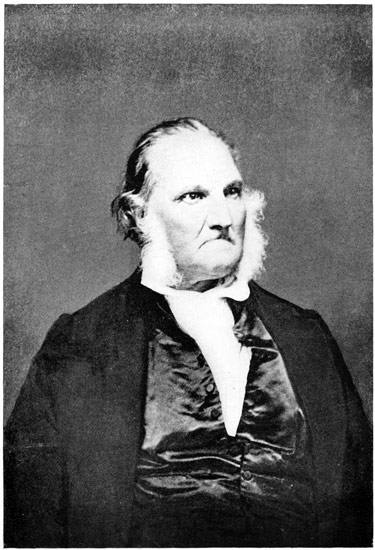
AUDUBON, 1850. FROM A DAGUERREOTYPE. OWNED BY MRS. ELIZABETH BERTHOUD GRIMSHAW.
There rides the filthy thing! The afternoon is half over. Her crew have thrown their boat overboard, they enter and seat themselves, each with a rusty gun. One of them sculls the skiff towards an island for a century past the breeding-place of myriads of Guillemots, which are now to be laid under contribution. At the approach of the vile thieves, clouds of birds rise from the rock and fill the air around, wheeling and screaming over their enemies. Yet thousands remain in an erect posture, each covering its single egg, the hope of both parents. The reports of several muskets loaded with heavy shot are now heard, while several dead and wounded birds fall heavily on the rock, or into the water. Instantly all the sitting birds rise and fly off affrighted to their companions above, and hover in dismay over their assassins, who walk forward exultingly, and with their shouts mingling oaths and execrations. Look at them! See how they crush the chick within its shell, how they trample on every egg in their way with their huge and clumsy boots. Onward they go, and when they leave the isle, not an egg that they can find is left entire. The dead birds they collect and carry to their boat. Now they have regained their filthy shallop; they strip the birds by a single jerk, of their feathery apparel while the flesh is yet warm, and throw them on some coals, where in a short time they are broiled. The rum is produced when the Guillemots are fit for eating, and after stuffing themselves with this oily fare, and enjoying the pleasure of beastly intoxication, over they tumble on the deck of their crazed craft, where they pass the short hours of night in turbid slumber.
The sun now rises above the snow-clad summit of the eastern mount. "Sweet is the breath of morn," even in this desolate land. The gay Bunting erects his white crest, and gives utterance to the joy he feels in the presence of his brooding mate. The Willow Grouse on the rock crows his challenge aloud. Each floweret chilled by the night air expands its pure petals. The gentle breeze shakes from the blades of grass the heavy dew-drops. On the Guillemot isle the birds have again settled, and now renew their loves. Startled by the light of day, one of the eggers springs to his feet and rouses his companions, who stare around them for a while, endeavoring to collect their senses. Mark them, as with clumsy fingers they clear their drowsy eyes! Slowly they rise on their feet. See how the filthy lubbers stretch out their arms, and yawn; you shrink back, for verily "that throat might frighten a shark."
But the master soon recollecting that so many eggs are worth a dollar or a crown, casts his eye towards the rock, marks the day in his memory and gives orders to depart. The light breeze enables them to reach another harbor a few miles distant, one which, like the last, lies concealed from the ocean by some other rocky isle. Arrived there, they re-act the scene of yesterday, crushing every egg they can find. For a week each night is passed in drunkenness and brawls, until, having reached the last breeding-place on the coast, they return, touch at every isle in succession, shoot as many birds as they need, collect the fresh eggs, and lay in a cargo. At every step each ruffian picks up an egg so beautiful that any man with a feeling heart would pause to consider the motive which could induce him to carry it off. But nothing of this sort occurs to the egger, who gathers and gathers until he has swept the rock bare. The dollars alone chink in his sordid mind, and he assiduously plies the trade which no man would ply who had the talents and industry to procure subsistence by honorable means.
With a bark nearly half filled with fresh eggs they proceed to the principal rock, that on which they first landed. But what is their surprise when they find others there helping themselves as industriously as they can! In boiling rage they charge their guns and ply their oars. Landing on the rock they run up to the eggers, who, like themselves, are desperadoes. The first question is a discharge of musketry, the answer another. Now, man to man, they fight like tigers. One is carried to his boat with a fractured skull, another limps with a shot in his leg, and a third feels how many of his teeth have been driven through the hole in his cheek. At last, however, the quarrel is settled; the booty is to be equally divided; and now see them all drinking together. Oaths and curses and filthy jokes are all that you hear; but see, stuffed with food, and reeling with drink, down they drop one by one; groans and execrations from the wounded mingle with the snoring of the heavy sleepers. There let the brutes lie.
Again it is dawn, but no one stirs. The sun is high; one by one they open their heavy eyes, stretch their limbs, yawn, and raise themselves from the deck. But see, here comes a goodly company. A hundred honest fishermen, who for months past have fed on salt meat, have felt a desire to procure some eggs. Gallantly their boats advance, impelled by the regular pull of their long oars. Each buoyant bark displays the flag of its nation. No weapons do they bring, nor anything that can be used as such save their oars and their fists. Cleanly clad in Sunday attire, they arrive at the desired spot, and at once prepare to ascend the rock. The eggers, now numbering a dozen, all armed with guns and bludgeons, bid defiance to the fishermen. A few angry words pass between the parties. One of the eggers, still under the influence of drink, pulls his trigger, and an unfortunate sailor is seen to reel in agony. Three loud cheers fill the air. All at once rush on the malefactors; a horrid fight ensues, the result of which is that every egger is left on the rock beaten and bruised. Too frequently the fishermen man their boats, row to the shallops, and break every egg in the hold.
The eggers of Labrador not only rob the birds in this cruel manner, but also the fishermen, whenever they can find an opportunity; and the quarrels they excite are numberless. While we were on the coast, none of our party ever ventured on any of the islands which these wretches call their own, without being well provided with means of defence. On one occasion, when I was present, we found two eggers at their work of destruction. I spoke to them respecting my visit, and offered them premiums for rare birds and some of their eggs; but although they made fair promises, not one of the gang ever came near the "Ripley."
These people gather all the eider-down they can find; yet so inconsiderate are they, that they kill every bird which comes in their way. The eggs of Gulls, Guillemots, and Ducks are searched for with care; and the Puffins and some other birds they massacre in vast numbers for the sake of their feathers. So constant and persevering are their depredations that these species, which, according to the accounts of the few settlers I saw in the country, were exceedingly abundant twenty years ago, have abandoned their ancient breeding places, and removed much farther north in search of peaceful security. Scarcely, in fact, could I procure a young Guillemot before the eggers left the coast, nor was it until late in July that I succeeded, after the birds had laid three or four eggs each, instead of one, and when, nature having been exhausted, and the season nearly spent, thousands of these birds left the country without having accomplished the purpose for which they had visited it. This war of extermination cannot last many years more. The eggers themselves will be the first to repent the entire disappearance of the myriads of birds that made the coast of Labrador their summer residence, and unless they follow the persecuted tribes to the northward, they must renounce their trade.
THE SQUATTERS OF LABRADOR
Go where you will, if a shilling can there be procured, you may expect to meet with individuals in search of it.
In the course of last summer, I met with several persons, as well as families, whom I could not compare to anything else than what in America we understand by the appellation of "squatters." The methods they employed to accumulate property form the subject of the observations which I now lay before you.
Our schooner lay at anchor in a beautiful basin on the coast of Labrador, surrounded by uncouth granitic rocks, partially covered with stunted vegetation. While searching for birds and other objects I chanced one morning to direct my eye towards the pinnacle of a small island, separated from the mainland by a very narrow channel, and presently commenced inspecting it with my telescope. There I saw a man on his knees with clasped hands, and face inclined heavenwards. Before him was a small monument of unhewn stones, supporting a wooden cross. In a word, reader, the person whom I thus unexpectedly discovered was engaged in prayer. Such an incident in that desolate land was affecting, for there one seldom finds traces of human beings; and the aid of the Almighty, although necessary everywhere, seems there peculiarly required to enable them to procure the means of subsistence. My curiosity having been raised, I betook myself to my boat, landed on the rock, and scrambled to the place, where I found the man still on his knees. When his devotions were concluded, he bowed to me, and addressed me in very indifferent French. I asked him why he had chosen so dreary a spot for his prayers. "Because," answered he, "the sea lies before me, and from it I receive my spring and summer sustenance. When winter approaches, I pray fronting the mountains on the main, as at that period the Caribous come towards the shore, and I kill them, feed on their flesh, and form my bedding of their skins." I thought the answer reasonable, and as I longed to know more of him, followed him to his hut. It was low, and very small, formed of stones plastered with mud to a considerable thickness. The roof was composed of a sort of thatching made of weeds and moss. A large Dutch stove filled nearly one half the place; a small port-hole then stuffed with old rags, served at times instead of a window; the bed was a pile of Deerskins; a bowl, a jug, and an iron pot were placed on a rude shelf; three old and rusty muskets, their locks fastened by thongs, stood in a corner; and his buckshot, powder, and flints, were tied up in bags of skin. Eight Esquimaux dogs yelled and leaped about us. The strong smell that emanated from them, together with the smoke and filth of the apartment, rendered my stay in it extremely disagreeable.
Being a native of France, the good man showed much politeness, and invited me to take some refreshment, when, without waiting for my assent, he took up his bowl, and went off I knew not whither. No sooner had he and his strange dogs disappeared than I went out also, to breathe the pure air, and gaze on the wild and majestic scenery around. I was struck with the extraordinary luxuriance of the plants and grasses that had sprung up on the scanty soil in the little valley which the squatter had chosen for his home. Their stalks and broad blades reached my waist. June had come, and the flies, mosquitoes, and other insects filled the air, and were as troublesome to me as if I had been in a Florida swamp.
The squatter returned, but he was chop-fallen; nay, I thought his visage had assumed a cadaverous hue. Tears ran down his cheeks, and he told me that his barrel of rum had been stolen by the "eggers" or some fishermen. He said that he had been in the habit of hiding it in the bushes, to prevent its being carried away by those merciless thieves, who must have watched him in some of his frequent walks to the spot. "Now," said he, "I can expect none till next spring, and God knows what will become of me in the winter."
Pierre Jean Baptiste Michaux had resided in that part of the world for upwards of ten years. He had run away from the fishing-smack that had brought him from his fair native land, and expected to become rich some day by the sale of the furs, Seal-skins, eider-down, and other articles, which he collected yearly, and sold to the traders who regularly visited his dreary abode. He was of moderate stature, firmly framed, and as active as a Wild Cat. He told me that excepting the loss of his rum, he had never experienced any other cause of sorrow, and that he felt as "happy as a lord."
Before parting with this fortunate mortal, I inquired how his dogs managed to find sufficient food. "Why, sir, during spring and summer they ramble along the shores, where they meet with abundance of dead fish, and in winter they eat the flesh of the Seals which I kill late in autumn, when these animals return from the north. As to myself, everything eatable is good, and when hard pushed, I relish the fare of my dogs, I assure you, as much as they do themselves."
Proceeding along the rugged indentations of the bay with my companions, I reached the settlement of another person, who, like the first, had come to Labrador with the view of making his fortune. We found him after many difficulties; but as our boats turned a long point jutting out into the bay, we were pleased to see several small schooners at anchor, and one lying near a sort of wharf. Several neat-looking houses enlivened the view, and on landing, we were kindly greeted with a polite welcome from a man who proved to be the owner of the establishment. For the rude simplicity of him of the rum-cask, we found here the manners and dress of a man of the world. A handsome fur cap covered his dark brow, his clothes were similar to our own, and his demeanor was that of a gentleman. On my giving my name to him, he shook me heartily by the hand, and on introducing each of my companions to him, he extended the like courtesy to them also. Then, to my astonishment, he addressed me as follows: "My dear sir, I have been expecting you these three weeks, having read in the papers your intention to visit Labrador; and some fishermen told me of your arrival at Little Natasquam. Gentlemen, walk in."
Having followed him to his neat and comfortable mansion, he introduced us to his wife and children. Of the latter there were six, all robust and rosy. The lady, although a native of the country, was of French extraction, handsome, and sufficiently accomplished to make an excellent companion to a gentleman. A smart girl brought us a luncheon, consisting of bread, cheese, and good port wine, to which, having rowed fourteen or fifteen miles that morning, we helped ourselves in a manner that seemed satisfactory to all parties. Our host gave us newspapers from different parts of the world, and showed us his small, but choice collection of books. He inquired after the health of the amiable Captain Bayfield of the Royal Navy, and the officers under him, and hoped they would give him a call.
Having refreshed ourselves, we walked out with him, when he pointed to a very small garden, where a few vegetables sprouted out, anxious to see the sun. Gazing on the desolate country around, I asked him how he had thus secluded himself from the world. For it he had no relish, and although he had received a liberal education, and had mixed with society, he never intended to return to it. "The country around," said he, "is all my own, much farther than you can see. No fees, no lawyers, no taxes are here. I do pretty much as I choose. My means are ample through my own industry. These vessels come here for Seal-skins, Seal-oil, and salmon, and give me in return all the necessaries, and indeed comforts, of the life I love to follow; and what else could the world afford me?" I spoke of the education of his children. "My wife and I teach them all that is useful for them to know, and is not that enough? My girls will marry their countrymen, my sons the daughters of my neighbors, and I hope all of them will live and die in the country!" I said no more, but by way of compensation for the trouble I had given him, purchased from his eldest child a beautiful Fox's skin.
Few birds, he said, came round him in summer, but in winter thousands of Ptarmigans were killed, as well as great numbers of Gulls. He had a great dislike to all fishermen and eggers, and I really believe was always glad to see the departure even of the hardy navigators who annually visited him for the sake of his salmon, Seal-skins, and oil. He had more than forty Esquimaux dogs; and as I was caressing one of them he said, "Tell my brother-in-law at Bras d'Or, that we are all well here, and that, after visiting my wife's father, I will give him a call."
Now, reader, his wife's father resided at the distance of seventy miles down the coast, and, like himself, was a recluse. He of Bras d'Or, was at double that distance; but, when the snows of winter have thickly covered the country, the whole family, in sledges drawn by dogs, travel with ease, and pay their visits, or leave their cards. This good gentleman had already resided there more than twenty years. Should he ever read this article, I desire him to believe that I shall always be grateful to him and his wife for their hospitable welcome.
When our schooner, the "Ripley," arrived at Bras d'Or, I paid a visit to Mr. ——, the brother-in-law, who lived in a house imported from Quebec, which fronted the strait of Belle Isle, and overlooked a small island, over which the eye reached the coast of Newfoundland, whenever it was the wind's pleasure to drive away the fogs that usually lay over both coasts. The gentleman and his wife, we were told, were both out on a walk, but would return in a very short time, which they in fact did, when we followed them into the house, which was yet unfinished. The usual immense Dutch stove formed a principal feature of the interior. The lady had once visited the metropolis of Canada, and seemed desirous of acting the part of a blue-stocking. Understanding that I knew something of the fine arts, she pointed to several of the vile prints hung on the bare walls, which she said were elegant Italian pictures, and continued her encomiums upon them, assuring me that she had purchased them from an Italian, who had come there with a trunk full of them. She had paid a shilling sterling for each, frame included. I could give no answer to the good lady on this subject, but I felt glad to find that she possessed a feeling heart, for one of her children had caught a Siskin, and was tormenting the poor bird, when she rose from her seat, took the little fluttering thing from the boy, kissed it, and gently launched it into the air. This made me quite forget the tattle about the fine arts.
Some excellent milk was poured out for us in clean glasses. It was a pleasing sight, for not a cow had we yet seen in the country. The lady turned the conversation on music, and asked me if I played on any instrument. I answered that I did, but very indifferently. Her forte, she said, was music, of which she was indeed immoderately fond. Her instrument had been sent to Europe to be repaired, but would return that season, when the whole of her children would again perform many beautiful airs; for in fact anybody could use it with ease, as when she or the children felt fatigued, the servant played on it for them. Rather surprised at the extraordinary powers of this family of musicians, I asked what sort of an instrument it was, when she described it as follows: "Gentlemen, my instrument is large, longer than broad, and stands on four legs, like a table. At one end is a crooked handle, by turning which round, either fast or slow, I do assure you we make most excellent music." The lips of my young friends and companions instantly curled, but a glance from me as instantly recomposed their features. Telling the fair one that it must be a hand-organ she used, she laughingly said, "Ah, that is it; it is a hand-organ, but I had forgot the name, and for the life of me could not recollect it."
The husband had gone out to work, and was in the harbor calking an old schooner. He dined with me on board the "Ripley," and proved to be also an excellent fellow. Like his brother-in-law, he had seen much of the world, having sailed nearly round it; and, although no scholar like him, too, he was disgusted with it. He held his land on the same footing as his neighbors, caught Seals without number, lived comfortably and happily, visited his father-in-law and the scholar, by the aid of his dogs, of which he kept a great pack, bartered or sold his commodities, as his relations did, and cared about nothing else in the world. Whenever the weather was fair, he walked with his dame over the moss-covered rocks of the neighborhood; and during winter killed Ptarmigans and Caribous, while his eldest son attended to the traps, and skinned the animals caught in them. He had the only horse that was to be found in that part of the country, as well as several cows; but, above all, he was kind to every one, and every one spoke well of him. The only disagreeable thing about his plantation or settlement, was a heap of fifteen hundred carcasses of skinned Seals, which, at the time when we visited the place, in the month of August, notwithstanding the coolness of the atmosphere, sent forth a stench that, according to the ideas of some naturalists, might have sufficed to attract all the Vultures in the United States.
During our stay at Bras d'Or, the kind-hearted and good Mrs. —— daily sent us fresh milk and butter, for which we were denied the pleasure of making any return.
COD FISHING
Although I had seen, as I thought, abundance of fish along the coasts of the Floridas, the numbers which I found in Labrador quite astonished me. Should your surprise while reading the following statements be as great as mine was while observing the facts related, you will conclude, as I have often done, that Nature's means of providing small animals for the use of larger ones, and vice versa, are as ample as is the grandeur of that world which she has so curiously constructed.
The coast of Labrador is visited by European as well as American fishermen, all of whom are, I believe, entitled to claim portions of fishing-ground assigned to each nation by mutual understanding. For the present, however, I shall confine my observations to those of our own country, who, after all, are probably the most numerous. The citizens of Boston, and many others of our eastern seaports, are those who chiefly engage in this department of our commerce. Eastport in Maine sends out every year a goodly fleet of schooners and "pickaxes" to Labrador, to procure Cod, Mackerel, Halibut, and sometimes Herring, the latter being caught in the intermediate space. The vessels from that port, and others in Maine and Massachusetts, sail as soon as the warmth of spring has freed the gulf of ice, that is, from the beginning of May to that of June.
A vessel of one hundred tons or so is provided with a crew of twelve men, who are equally expert as sailors and fishers, and for every couple of these hardy tars, a Hampton boat is provided, which is lashed on the deck, or hung in stays. Their provision is simple, but of good quality, and it is very seldom that any spirits are allowed, beef, pork and biscuit with water being all they take with them. The men are supplied with warm clothing, waterproof oiled jackets and trousers, large boots, broad-brimmed hats with a round crown, and stout mittens, with a few shirts. The owner or captain furnishes them with lines, hooks, and nets, and also provides the bait best adapted to insure success. The hold of the vessel is filled with casks, of various dimensions, some containing salt, and others for the oil that may be procured.
The bait generally used at the beginning of the season consists of mussels salted for the purpose; but as soon as the capelings reach the coast they are substituted to save expense, and in many instances the flesh of Gannets and other sea-fowl is employed. The wages of fishermen vary from sixteen to thirty dollars per month, according to the qualifications of the individual.
The labor of these men is excessively hard, for, unless on Sunday, their allowance of rest in the twenty-four hours seldom exceeds three. The cook is the only person who fares better in this respect, but he must also assist in curing the fish. He has breakfast, consisting of coffee, bread, and meat, ready for the captain and the whole crew, by three o'clock every morning, excepting Sunday. Each person carries with him his dinner ready cooked, which is commonly eaten on the fishing-grounds.
Thus, at three in the morning, the crew are prepared for their day's labor, and ready to betake themselves to their boats, each of which has two oars and lugsails. They all depart at once, and either by rowing or sailing, reach the banks to which the fishes are known to resort. The little squadron drop their anchors at short distances from each other, in a depth of from ten to twenty feet, and the business is immediately commenced. Each man has two lines, and each stands in one end of the boat, the middle of which is boarded off, to hold the fish. The baited lines have been dropped into the water, one on each side of the boat; their leads have reached the bottom, a fish has taken the hook, and after giving the line a slight jerk, the fisherman hauls up his prize with a continued pull, throws the fish athwart a small round bar of iron placed near his back, which forces open the mouth, while the weight of the body, however small the fish may be, tears out the hook. The bait is still good, and over the side the line again goes, to catch another fish, while that on the left is now drawn up, and the same course pursued. In this manner, a fisher busily plying at each end, the operation is continued until the boat is so laden that her gunwale is brought within a few inches of the surface, when they return to the vessel in harbor, seldom distant more than eight miles from the banks.
During the greater part of the day the fishermen have kept up a constant conversation, of which the topics are the pleasure of finding a good supply of cod, their domestic affairs, the political prospects of the nation, and other matters similarly connected. Now the repartee of one elicits a laugh from the other; this passes from man to man, and the whole flotilla enjoy the joke. The men of one boat strive to outdo those of the others in hauling up the greatest quantity of fish in a given time, and this forms another source of merriment. The boats are generally filled about the same time, and all return together.
Arrived at the vessel, each man employs a pole armed with a bent iron, resembling the prong of a hay-fork, with which he pierces the fish, and throws it with a jerk on deck, counting the number thus discharged with a loud voice. Each cargo is thus safely deposited, and the boats instantly return to the fishing-ground, when, after anchoring, the men eat their dinner, and begin anew. There, good reader, with your leave, I will let them pursue their avocations for a while, as I am anxious that you should witness what is doing on board the vessel.
The captain, four men, and the cook have, in the course of the morning, erected long tables fore and aft the main hatchway; they have taken to the shore most of the salt barrels, and have placed in a row their large empty casks, to receive the livers. The hold of the vessel is quite clear, except a corner where is a large heap of salt. And now the men, having dined precisely at twelve, are ready with their large knives. One begins with breaking off the head of the fish, a slight pull of the hand and a gash with the knife, effecting this in a moment. He slits up its belly, with one hand pushes it aside to his neighbor, then throws overboard the head, and begins to doctor another. The next man tears out the entrails, separates the liver, which he throws into a cask, and casts the rest overboard. A third person dexterously passes his knife beneath the vertebræ of the fish, separates them from the flesh, heaves the latter through the hatchway, and the former into the water.
Now, if you will peep into the hold, you will see the last stage of the process, the salting and packing. Six experienced men generally manage to head, clean, bone, salt, and pack all the fish caught in the morning by the return of the boats with fresh cargoes, when all hands set to work, and clear the deck of the fish. Thus their labors continue till midnight, when they wash their faces and hands, put on clean clothes, hang their fishing apparel on the shrouds, and, betaking themselves to the forecastle, are soon in a sound sleep.
At three the next morning, comes the captain from his berth, rubbing his eyes, and in a loud voice calling, "All hands, ho!" Stiffened in limb, and but half awake, the crew quickly appear on the deck. Their fingers and hands are so cramped and swollen by pulling the lines that it is difficult for them to straighten even a thumb; but this matters little at present, for the cook, who had a good nap yesterday, has risen an hour before them, and prepared their coffee and eatables. Breakfast despatched, they exchange their clean clothes for the fishing apparel, and leap into their boats, which had been washed the previous night, and again the flotilla bounds to the fishing-grounds.
As there may not be less than one hundred schooners or pickaxes in the harbor, three hundred boats resort to the banks each day, and, as each boat may procure two thousand Cods per diem, when Saturday night comes about six hundred thousand fishes have been brought to the harbor. This having caused some scarcity on the fishing-grounds, and Sunday being somewhat of an idle day, the captain collects the salt ashore, and sets sail for some other convenient harbor, which he expects to reach long before sunset. If the weather be favorable, the men get a good deal of rest during the voyage, and on Monday things go on as before.
I must not omit to tell you, reader, that, while proceeding from one harbor to another, the vessel has passed near a rock which is the breeding-place of myriads of Puffins. She has laid to for an hour or so, while part of the crew have landed, and collected a store of eggs, excellent as a substitute for cream, and not less so when hard boiled as food for the fishing-grounds. I may as well inform you also how these adventurous fellows distinguish the fresh eggs from the others. They fill up some large tubs with water, throw in a quantity of eggs, and allow them to remain a minute or so, when those which come to the surface are tossed overboard, and even those that manifest any upward tendency share the same treatment. All that remain at bottom, you may depend upon it, good reader, are perfectly sound, and not less palatable than any that you have ever eaten, or that your best guinea fowl has just dropped in your barn-yard. But let us return to the Codfish.
The fish already procured and salted is taken ashore at the new harbor by part of the crew, whom the captain has marked as the worst hands at fishing. There, on the bare rocks, or on elevated scaffolds of considerable extent, the salted Cod are laid side by side to dry in the sun. They are turned several times a day, and in the intervals the men bear a hand on board at clearing and stowing away the daily produce of the fishing-banks. Towards evening they return to the drying-grounds, and put up the fish in piles resembling so many hay-stacks, disposing those towards the top in such a manner that the rain cannot injure them, and placing a heavy stone on the summit to prevent their being thrown down should it blow hard during the night. You see, reader, that the life of a Labrador fisherman is not one of idleness.
The capelings have approached the shores, and in myriads enter every basin and stream, to deposit their spawn, for now July is arrived. The Cods follow them as the bloodhound follows his prey, and their compact masses literally line the shores. The fishermen now adopt another method; they have brought with them long and deep seines, one end of which is by means of a line fastened to the shore, while the other is, in the usual manner, drawn out in a broad sweep, to inclose as great a space as possible, and hauled on shore by means of a capstan. Some of the men, in boats, support the corked part of the net, and beat the water to frighten the fishes within towards the land, while others, armed with poles, enter the water, hook the fishes, and fling them on the beach, the net being gradually drawn closer as the number of fish diminishes. What do you think, reader, as to the number of Cod secured in this manner in a single haul? Thirty, or thirty thousand? You may form some notion of the matter when I tell you that the young gentlemen of my party, while going along the shores, caught Codfish alive with their hands, and trout of many pounds' weight with a piece of twine and a mackerel-hook hung to their gun-rods; and that, if two of them walked knee-deep along the rocks, holding a handkerchief by the corners, they swept it full of capelings. Should you not trust me in this, I refer you to the fishermen themselves, or recommend you to go to Labrador, where you will give credit to the testimony of your eyes.
The seining of the Codfish, I believe, is not quite lawful, for a great proportion of the codlings which are dragged ashore at last are so small as to be considered useless; and, instead of being returned to the water, as they ought to be, are left on the shore, where they are ultimately eaten by Bears, Wolves, and Ravens. The fish taken along the coast, or on fishing stations only a few miles off, are of small dimensions; and I believe I am correct in saying that few of them weigh more than two pounds when perfectly cured, or exceed six when taken out of the water. The fish are liable to several diseases, and at times are annoyed by parasitic animals, which in a short time render them lean and unfit for use.
Some individuals, from laziness or other causes, fish with naked hooks, and thus frequently wound the Cod, without securing them; in consequence of which the shoals are driven away, to the detriment of the other fishers. Some carry their cargoes to other parts before drying them, while others dispose of them to agents from distant shores. Some have only a pickaxe of fifty tons, while others are owners of seven or eight vessels of equal or larger burden; but whatever be their means, should the season prove favorable, they are generally well repaid for their labor. I have known instances of men who, on their first voyage, ranked as "boys," and in ten years after were in independent circumstances, although they still continue to resort to the fishing; for, said they to me, "How could we be content to spend our time in idleness at home?" I know a person of this class who has carried on the trade for many years, and who has quite a little fleet of schooners, one of which, the largest and most beautifully built, has a cabin as neat and comfortable as any that I have ever seen in a vessel of the same size. This vessel took fish on board only when perfectly cured, or acted as pilot to the rest, and now and then would return home with an ample supply of halibut, or a cargo of prime mackerel. On another occasion, I will offer some remarks on the improvements which I think might be made in the Cod-fisheries of the coast of Labrador.
A BALL IN NEWFOUNDLAND
On our return from the singularly wild and interesting country of Labrador, the "Ripley" sailed close along the northern coast of Newfoundland. The weather was mild and clear, and, while my young companions amused themselves on the deck with the music of various instruments, I gazed on the romantic scenery spread along the bold and often magnificent shores. Portions of the wilds appeared covered with a luxuriance of vegetable growth, far surpassing that of the regions which we had just left, and in some of the valleys I thought I saw trees of moderate size. The number of habitations increased apace, and many small vessels and boats danced on the waves of the coves which we passed. Here a precipitous shore looked like the section of a great mountain, of which the lost half had sunk into the depths of the sea, and the dashing of the waters along its base was such as to alarm the most daring seaman. The huge masses of broken rock impressed my mind with awe and reverence, as I thought of the power that still gave support to the gigantic fragments which everywhere hung, as if by magic, over the sea, awaiting, as it were, the proper moment to fall upon and crush the impious crew of some piratical vessel. There, again, gently swelling hills reared their heads towards the sky, as if desirous of existing within the influence of its azure purity; and I thought the bleatings of Reindeer came on my ear. Dark clouds of Curlews were seen winging their way towards the south, and thousands of Larks and Warblers were flitting through the air. The sight of these birds excited in me a wish that I also had wings to fly back to my country and friends.
Early one morning our vessel doubled the northern cape of the Bay of St. George, and, as the wind was light, the sight of that magnificent expanse of water, which extends inward to the length of eighteen leagues, with a breadth of thirteen, gladdened the hearts of all on board. A long range of bold shores bordered it on one side, throwing a deep shadow over the water, which added greatly to the beauty of the scene. On the other side, the mild beams of the autumnal sun glittered on the water, and whitened the sails of the little barks that were sailing to and fro, like so many silvery Gulls. The welcome sight of cattle feeding in cultivated meadows, and of people at their avocations, consoled us for the labors which we had undergone, and the privations which we had suffered; and, as the "Ripley" steered her course into a snug harbor that suddenly opened to our view, the number of vessels that were anchored there, and a pretty village that presented itself increased our delight.
Although the sun was fast approaching the western horizon when our anchor was dropped, no sooner were the sails furled than we all went ashore. There appeared a kind of curious bustle among the people, as if they were anxious to know who we were; for our appearance, and that of our warlike looking schooner showed that we were not fishermen. As we bore our usual arms and hunting accoutrements, which were half Indian and half civilized, the individuals we met on shore manifested considerable suspicion, which our captain observing, he instantly made a signal, when the star-spangled banner glided to the mast-head, and saluted the flags of France and Britain in kindly greeting. We were welcomed and supplied with abundance of fresh provisions. Glad at once more standing on something like soil, we passed through the village, and walked round it, but as night was falling were quickly obliged to return to our floating home, where, after a hearty supper, we serenaded with repeated glees the peaceful inhabitants of the village.
At early dawn I was on deck admiring the scene of industry that presented itself. The harbor was already covered with fishing-boats employed in procuring mackerel, some of which we appropriated to ourselves. Signs of cultivation were observed on the slopes of the hills, the trees seemed of goodly size, a river made its way between two ranges of steep rocks, and here and there a group of Micmac Indians were searching along the shores for lobsters, crabs, and eels, all of which we found abundant and delicious. A canoe laden with Reindeer meat came alongside, paddled by a pair of athletic Indians, who exchanged their cargo for some of our stores. You would have been amused to see the manner in which these men, and their families on shore cooked the lobsters; they threw them alive into a great wood fire, and as soon as they were broiled devoured them, while yet so hot that none of us could have touched them. When properly cooled, I tasted these roasted lobsters, and found them infinitely better flavored than boiled ones. The country was represented as abounding in game. The temperature was higher by twenty degrees than that of Labrador, and yet I was told that the ice in the bay seldom broke up before the middle of May, and that few vessels attempted to go to Labrador before the 10th of June, when the cod-fishery at once commences.
One afternoon we were visited by a deputation from the inhabitants of the village, inviting our whole party to a ball which was to take place that night, and requesting us to take with us our musical instruments. We unanimously accepted the invitation, which had been made from friendly feelings; and finding that the deputies had a relish for "old Jamaica" we helped them pretty freely to some, which soon showed that it had lost nothing of its energies by having visited Labrador. At ten o'clock, the appointed hour, we landed, and were lighted to the dancing-hall by paper lanterns, one of us carrying a flute, another a violin, and I with a flageolet stuck into my waistcoat pocket.
The hall proved nothing else than the ground-floor of a fisherman's house. We were presented to his wife, who, like her neighbors, was an adept in the piscatory art. She courtesied, not à la Taglioni, it is true, but with a modest assurance, which to me was quite as pleasing as the airiness with which the admired performer just mentioned might have paid her respects. The good woman was rather unprepared, and quite en negligée, as was the apartment, but full of activity, and anxious to arrange things in becoming style. In one hand she held a bunch of candles, in the other a lighted torch, and distributing the former at proper intervals along the walls, she applied the latter to them in succession. This done, she emptied the contents of a large tin vessel into a number of glasses, which were placed on a tea-tray on the only table in the room. The chimney, black and capacious, was embellished with coffee-pots, milk-jugs, cups and saucers, knives and forks, and all the paraphernalia necessary on so important an occasion. A set of primitive wooden stools and benches was placed around, for the reception of the belles of the village, some of whom now dropped in, flourishing in all the rosy fatness produced by an invigorating northern climate, and in decoration vying with the noblest Indian queen of the West. Their stays seemed ready to burst open, and their shoes were equally pressed. Around their necks, brilliant beads mingled with ebony tresses, and their naked arms might have inspired apprehension had they not been constantly employed in arranging flowing ribbons, gaudy flowers, and muslin flounces.
Now arrived one of the beaux, just returned from the fishing, who, knowing all, and being equally known, leaped without ceremony on the loose boards that formed a kind of loft overhead, where he soon exchanged his dripping apparel for a dress suited to the occasion, when he dropped upon the floor, and strutting up and down, bowed and scraped to the ladies, with as much ease, if not elegance, as a Bond Street highly scented exquisite. Others came in by degrees, ready dressed, and music was called for. My son, by way of overture, played "Hail Columbia, happy land," then went on with "La Marseillaise," and ended with "God save the King." Being merely a spectator, I ensconced myself in a corner, by the side of an old European gentleman, whom I found an agreeable and well informed companion, to admire the decorum of the motley assemblage.
The dancers stood in array, little time having been spent in choosing partners, and a Canadian accompanying my son on his Cremona, mirth and joy soon abounded. Dancing is certainly one of the most healthful and innocent amusements; I have loved it a vast deal more than watching for the nibble of a trout, and I have sometimes thought the enjoyment of it softened my nature as much as the pale, pure light of the moon softens and beautifies a winter night. A maiden lady who sat at my side, and who was the only daughter of my talkative companion, relished my remarks on the subject so much that the next set saw her gracing the floor with her tutored feet.
At each pause of the musicians refreshments were handed round by the hostess and her son, and I was not a little surprised to see all the ladies, maids and matrons, swallow, like their sweethearts and husbands, a full glass of pure rum, with evident pleasure. I should perhaps have recollected that, in cold climates, a glass of ardent spirits is not productive of the same effects as in burning latitudes, and that refinement had not yet induced these healthy and robust dames to affect a delicacy foreign to their nature.
It was now late, and knowing how much I had to accomplish next day, I left the party and proceeded to the shore. My men were sound asleep in the boat, but in a few moments I was on board the "Ripley." My young friends arrived towards daylight, but many of the fishermen's sons and daughters kept up the dance, to the music of the Canadian, until after our breakfast was over.
THE BAY OF FUNDY
It was in the month of May that I sailed in the United States revenue cutter, the "Swiftsure," engaged in a cruise in the Bay of Fundy. Our sails were quickly unfurled and spread out to the breeze. The vessel seemed to fly over the surface of the liquid element, as the sun rose in full splendor, while the clouds that floated here and there formed, with their glowing hues, a rich contrast with the pure azure of the heavens above us. We approached apace the island of Grand Menan, of which the stupendous cliffs gradually emerged from the deep with the majestic boldness of her noblest native chief. Soon our bark passed beneath its craggy head, covered with trees, which, on account of the height, seemed scarcely larger than shrubs. The prudent Raven spread her pinions, launched from the cliff, and flew away before us; the Golden Eagle, soaring aloft, moved majestically along in wide circles; the Guillemots sat on their eggs upon the shelving precipices, or plunging into the water, dived, and rose again at a great distance; the broad-breasted Eider Duck covered her eggs among the grassy tufts; on a naked rock the Seal lazily basked, its sleek sides glistening in the sunshine; while shoals of porpoises were swiftly gliding through the waters around us, showing by their gambols that, although doomed to the deep, their life was not devoid of pleasure. Far away stood the bold shores of Nova Scotia, gradually fading in the distance, of which the gray tints beautifully relieved the wing-like sails of many a fishing bark.
Cape after cape, forming eddies and counter currents far too terrific to be described by a landsman, we passed in succession, until we reached a deep cove, near the shores of White Head Island, which is divided from Grand Menan by a narrow strait, where we anchored secure from every blast that could blow. In a short time we found ourselves under the roof of Captain Frankland, the sole owner of the isle, of which the surface contains about fifteen hundred acres. He received us all with politeness and gave us permission to seek out its treasures, which we immediately set about doing, for I was anxious to study the habits of certain Gulls that breed there in great numbers. As Captain Coolidge, our worthy commander, had assured me, we found them on their nests on almost every tree of a wood that covered several acres. What a treat, reader, was it to find birds of this kind lodged on fir-trees, and sitting comfortably on their eggs! Their loud cackling notes led us to their place of resort, and ere long we had satisfactorily observed their habits, and collected as many of themselves and their eggs as we considered sufficient. In our walks we noticed a Rat, the only quadruped found on the island, and observed abundance of gooseberries, currants, raspberries, strawberries, and huckleberries. Seating ourselves on the summit of the rocks, in view of the vast Atlantic, we spread out our stores, and refreshed ourselves with our simple fare.
Now we followed the objects of our pursuit through the tangled woods, now carefully picked our steps over the spongy grounds. The air was filled with the melodious concerts of birds, and all Nature seemed to smile in quiet enjoyment. We wandered about until the setting sun warned us to depart, when, returning to the house of the proprietor, we sat down to an excellent repast, and amused ourselves with relating anecdotes and forming arrangements for the morrow. Our captain complimented us on our success, when we reached the "Swiftsure," and in due time we betook ourselves to our hammocks.
The next morning, a strange sail appearing in the distance, preparations were instantly made to pay her commander a visit. The signal staff of White Head Island displayed the British flag, while Captain Frankland and his men stood on the shore, and as we gave our sails to the wind, three hearty cheers filled the air, and were instantly responded to by us. The vessel was soon approached, but all was found right with her, and squaring our yards, onward we sped, cheerily bounding over the gay billows, until our captain sent us ashore at Eastport.