THE MISSOURI RIVER JOURNALS 1843 (Continued) (continued 3)
Reading edition
July 17, Monday. A beautiful day, with a west wind. Sprague, who is very industrious at all times, drew some flowers, and I have been busy both writing and drawing. In the afternoon Bell went after Rabbits, but saw one only, which he could not get, and Sprague walked to the hills about two miles off, but could not see any portion of the Yellowstone River, which Mr. Catlin has given in his view, as if he had been in a balloon some thousands of feet above the earth. Two men arrived last evening by land from Fort Pierre, and brought a letter, but no news of any importance; one is a cook as well as a hunter, the other named Wolff, a German, and a tinsmith by trade, though now a trapper.
July 18, Tuesday. When I went to bed last night the mosquitoes were so numerous downstairs that I took my bed under my arm and went to a room above, where I slept well. On going down this morning, I found two other persons from Fort Pierre, and Mr. Culbertson very busy reading and writing letters. Immediately after breakfast young McKenzie and another man were despatched on mules, with a letter for Mr. Kipp, and Owen expects to overtake the boat in three or four days. An Indian arrived with a stolen squaw, both Assiniboins; and I am told such things are of frequent occurrence among these sons of nature. Mr. Culbertson proposed that we should take a ride to see the mowers, and Harris and I joined him. We found the men at work, among them one called Bernard Adams, of Charleston, S.C., who knew the Bachmans quite well, and who had read the whole of the "Biographies of Birds." Leaving the men, we entered a ravine in search of plants, etc., and having started an Owl, which I took for the barred one, I left my horse and went in search of it, but could not see it, and hearing a new note soon saw a bird not to be mistaken, and killed it, when it proved, as I expected, to be the Rock Wren; then I shot another sitting by the mouth of a hole. The bird did not fly off; Mr. Culbertson watched it closely, but when the hole was demolished no bird was to be found. Harris saw a Shrike, but of what species he could not tell, and he also found some Rock Wrens in another ravine. We returned to the fort and promised to visit the place this afternoon, which we have done, and procured three more Wrens, and killed the Owl, which proves to be precisely the resemblance of the Northern specimen of the Great Horned Owl, which we published under another name. The Rock Wren, which might as well be called the Ground Wren, builds its nest in holes, and now the young are well able to fly, and we procured one in the act. In two instances we saw these birds enter a hole here, and an investigation showed a passage or communication, and on my pointing out a hole to Bell where one had entered, he pushed his arm in and touched the little fellow, but it escaped by running up his arm and away it flew. Black clouds now arose in the west, and we moved homewards. Harris and Bell went to the mowers to get a drink of water, and we reached home without getting wet, though it rained violently for some time, and the weather is much cooler. Not a word yet from Provost and Squires.
July 19, Wednesday. Squires and Provost returned early this morning, and again I give the former my journal that I may have the account of the hunt in his own words. "As Mr. Audubon has said, he left Provost, Basil, and myself making ready for our voyage down the Yellowstone. The party for the fort were far in the blue distance ere we bid adieu to our camping-ground. We had wished the return party a pleasant ride and safe arrival at the fort as they left us, looking forward to a good supper, and what I now call a comfortable bed. We seated ourselves around some boiled Buffalo hump, which, as has been before said, we took good care to appropriate to ourselves according to the established rule of this country, which is, 'When you can, take the best,' and we had done so in this case, more to our satisfaction than to that of the hunters. Our meal finished, we packed everything we had in the skiff, and were soon on our way down the Yellowstone, happy as could be; Provost acting pilot, Basil oarsman, and your humble servant seated on a Buffalo robe, quietly smoking, and looking on the things around. We found the general appearance of the Yellowstone much like the Missouri, but with a stronger current, and the water more muddy. After a voyage of two hours Charbonneau River made its appearance, issuing from a clump of willows; the mouth of this river we found to be about ten feet wide, and so shallow that we were obliged to push our boat over the slippery mud for about forty feet. This passed, we entered a pond formed by the contraction of the mouth and the collection of mud and sticks thereabouts, the pond so formed being six or eight feet deep, and about fifty feet wide, extending about a mile up the river, which is very crooked indeed. For about half a mile from the Yellowstone the shore is lined with willows, beyond which is a level prairie, and on the shores of the stream just beyond the willows are a few scattered trees. About a quarter of a mile from the mouth of the river, we discovered what we were in search of, the Beaver lodge. To measure it was impossible, as it was not perfect, in the first place, in the next it was so muddy that we could not get ashore, but as well as I can I will describe it. The lodge is what is called the summer lodge; it was comprised wholly of brush, willow chiefly, with a single hole for the entrance and exit of the Beaver. The pile resembled, as much as anything to which I can compare it, a brush heap about six feet high, and about ten or fifteen feet base, and standing seven or eight feet from the water. There were a few Beaver tracks about, which gave us some encouragement. We proceeded to our camping-ground on the edge of the prairie; here we landed all our baggage; while Basil made a fire, Provost and I started to set our traps—the two extremes of hunters, the skilful old one, and the ignorant pupil; but I was soon initiated in the art of setting Beaver traps, and to the uninitiated let me say, 'First, find your game, then catch it,' if you can. The first we did, the latter we tried to do. We proceeded to the place where the greatest number of tracks were seen, and commenced operations. At the place where the path enters the water, and about four inches beneath the surface, a level place is made in the mud, upon which the trap is placed, the chain is then fastened to a stake which is firmly driven in the ground under water. The end of a willow twig is then chewed and dipped in the 'Medicine Horn,' which contains the bait; this consists of castoreum mixed with spices; a quantity is collected on the chewed end of the twig, the stick is then placed or stuck in the mud on the edge of the water, leaving the part with the bait about two inches above the surface and in front of the trap; on each side the bait and about six inches from it, two dried twigs are placed in the ground; this done, all's done, and we are ready for the visit of Monsieur Castor. We set two traps, and returned to our camp, where we had supper, then pitched our tent and soon were sound asleep, but before we were asleep we heard a Beaver dive, and slap his tail, which sounded like the falling of a round stone in the water; here was encouragement again. In the morning (Monday) we examined our traps and found—nothing. We did not therefore disturb the traps, but examined farther up the river, where we discovered other tracks and resolved to set our traps there, as Provost concluded that there was but one Beaver, and that a male. We returned to camp and made a good breakfast on Buffalo meat and coffee, sans salt, sans pepper, sans sugar, sans anything else of any kind. After breakfast Provost shot a doe. In the afternoon we removed one trap, Basil and I gathered some wild-gooseberries which I stewed for supper, and made a sauce, which, though rather acid, was very good with our meat. The next morning, after again examining our traps and finding nothing, we decided to raise camp, which was accordingly done; everything was packed in the skiff, and we proceeded to the mouth of the river. The water had fallen so much since we had entered, as to oblige us to strip, jump in the mud, and haul the skiff over; rich and rare was the job; the mud was about half thigh deep, and a kind of greasy, sticky, black stuff, with a something about it so very peculiar as to be rather unpleasant; however, we did not mind much, and at last got into the Yellowstone, scraped and washed the mud off, and encamped on a prairie about one hundred yards below the Charbonneau. It was near sunset; Provost commenced fishing; we joined him, and in half an hour we caught sixteen catfish, quite large ones. During the day Provost started to the Mauvaises Terres to hunt Bighorns, but returned unsuccessful. He baited his traps for the last time. During his absence thunder clouds were observed rising all around us; we stretched our tent, removed everything inside it, ate our supper of meat and coffee, and then went to bed. It rained some part of the night, but not enough to wet through the tent. The next morning (Tuesday) at daylight, Provost started to examine his traps, while we at the camp put everything in the boat, and sat down to await his return, when we proceeded on our voyage down the Yellowstone to Fort Mortimer, and from thence by land to Fort Union. Nothing of any interest occurred except that we saw two does, one young and one buck of the Bighorns; I fired at the buck which was on a high cliff about a hundred and fifty yards from us; I fired above it to allow for the falling of the ball, but the gun shot so well as to carry where I aimed. The animal was a very large buck; Provost says one of the largest he had seen. As soon as I fired he started and ran along the side of the hill which looked almost perpendicular, and I was much astonished, not only at the feat, but at the surprising quickness with which he moved along, with no apparent foothold. We reached Fort Mortimer about seven o'clock; I left Basil and Provost with the skiff, and I started for Fort Union on foot to send a cart for them. On my way I met Mr. Audubon about to pay a visit to Fort Mortimer; I found all well, despatched the cart, changed my clothes, and feel none the worse for my five days' camping, and quite ready for a dance I hear we are to have to-night."
This morning as I walked to Fort Mortimer, meeting Squires as he has said, well and happy as a Lark, I was surprised to see a good number of horses saddled, and packed in different ways, and I hastened on to find what might be the matter. When I entered the miserable house in which Mr. Collins sleeps and spends his time when not occupied out of doors, he told me thirteen men and seven squaws were about to start for the lakes, thirty-five miles off, to kill Buffaloes and dry their meat, as the last his hunters brought in was already putrid. I saw the cavalcade depart in an E.N.E. direction, remained a while, and then walked back. Mr. Collins promised me half a dozen balls from young animals. Provost was discomfited and crestfallen at the failure of the Beaver hunt; he brought half a doe and about a dozen fine catfish. Mr. Culbertson and I are going to see the mowers, and to-morrow we start on a grand Buffalo hunt, and hope for Antelopes, Wolves, and Foxes.
July 20, Thursday. We were up early, and had our breakfast shortly after four o'clock, and before eight had left the landing of the fort, and were fairly under way for the prairies. Our equipment was much the same as before, except that we had two carts this time. Mr. C. drove Harris, Bell, and myself, and the others rode on the carts and led the hunting horses, or runners, as they are called here. I observed a Rabbit running across the road, and saw some flowers different from any I had ever seen. After we had crossed a bottom prairie, we ascended between the high and rough ravines until we were on the rolling grounds of the plains. The fort showed well from this point, and we also saw a good number of Antelopes, and some young ones. These small things run even faster than the old ones. As we neared the Fox River some one espied four Buffaloes, and Mr. C., taking the telescope, showed them to me, lying on the ground. Our heads and carts were soon turned towards them, and we travelled within half a mile of them, concealed by a ridge or hill which separated them from us. The wind was favorable, and we moved on slowly round the hill, the hunters being now mounted. Harris and Bell had their hats on, but Owen and Mr. Culbertson had their heads bound with handkerchiefs. With the rest of the party I crawled on the ridge, and saw the bulls running away, but in a direction favorable for us to see the chase. On the word of command the horses were let loose, and away went the hunters, who soon were seen to gain on the game; two bulls ran together and Mr. C. and Bell followed after them, and presently one after another of the hunters followed them. Mr. C. shot first, and his bull stopped at the fire, walked towards where I was, and halted about sixty yards from me. His nose was within a few inches of the ground; the blood poured from his mouth, nose, and side, his tail hung down, but his legs looked as firm as ever, but in less than two minutes the poor beast fell on his side, and lay quite dead. Bell and Mr. Culbertson went after the second. Harris took the third, and Squires the fourth. Bell's shot took effect in the buttock, and Mr. Culbertson shot, placing his ball a few inches above or below Bell's; after this Mr. Culbertson ran no more. At this moment Squires's horse threw him over his head, fully ten feet; he fell on his powder-horn and was severely bruised; he cried to Harris to catch his horse, and was on his legs at once, but felt sick for a few minutes. Harris, who was as cool as a cucumber, neared his bull, shot it through the lungs, and it fell dead on the spot. Bell was now seen in full pursuit of his game, and Harris joined Squires, and followed the fourth, which, however, was soon out of my sight. I saw Bell shooting two or three times, and I heard the firing of Squires and perhaps Harris, but the weather was hot, and being afraid of injuring their horses, they let the fourth bull make his escape. Bell's bull fell on his knees, got up again, and rushed on Bell, and was shot again. The animal stood a minute with his tail partially elevated, and then fell dead; through some mishap Bell had no knife with him, so did not bring the tongue, as is customary. Mr. Culbertson walked towards the first bull and I joined him. It was a fine animal about seven years old; Harris's and Bell's were younger. The first was fat, and was soon skinned and cut up for meat. Mr. Culbertson insisted on calling it my bull, so I cut off the brush of the tail and placed it in my hat-band. We then walked towards Harris, who was seated on his bull, and the same ceremony took place, and while they were cutting the animal up for meat, Bell, who said he thought his bull was about three quarters of a mile distant, went off with me to see it; we walked at least a mile and a half, and at last came to it. It was a poor one, and the tongue and tail were all we took away, and we rejoined the party, who had already started the cart with Mr. Pike, who was told to fall to the rear, and reach the fort before sundown; this he could do readily, as we were not more than six miles distant. Mr. Culbertson broke open the head of "my" bull, and ate part of the brains raw, and yet warm, and so did many of the others, even Squires. The very sight of this turned my stomach, but I am told that were I to hunt Buffalo one year, I should like it "even better than dog meat." Mr. Pike did not reach the fort till the next morning about ten, I will say en passant. We continued our route, passing over the same road on which we had come, and about midway between the Missouri and Yellowstone Rivers. We saw more Antelopes, but not one Wolf; these rascals are never abundant where game is scarce, but where game is, there too are the Wolves. When we had travelled about ten miles further we saw seven Buffaloes grazing on a hill, but as the sun was about one hour high, we drove to one side of the road where there was a pond of water, and there stopped for the night; while the hunters were soon mounted, and with Squires they went off, leaving the men to arrange the camp. I crossed the pond, and having ascended the opposite bank, saw the bulls grazing as leisurely as usual. The hunters near them, they started down the hill, and the chase immediately began. One broke from the rest and was followed by Mr. C. who shot it, and then abandoned the hunt, his horse being much fatigued. I now counted ten shots, but all was out of my sight, and I seated myself near a Fox hole, longing for him. The hunters returned in time; Bell and Harris had killed one, but Squires had no luck, owing to his being unable to continue the chase on account of the injury he had received from his fall. We had a good supper, having brought abundance of eatables and drinkables. The tent was pitched; I put up my mosquito-bar under the wagon, and there slept very soundly till sunrise. Harris and Bell wedged together under another bar, Mr. C. went into the tent, and Squires, who is tough and likes to rough it with the hunters, slept on a Buffalo hide somewhere with Moncrévier, one of the most skilful of the hunters. The horses were all hoppled and turned to grass; they, however, went off too far, and had to be sent after, but I heard nothing of all this. As there is no wood on the prairies proper, our fire was made of Buffalo dung, which is so abundant that one meets these deposits at every few feet and in all directions.
July 21, Friday. We were up at sunrise, and had our coffee, after which Lafleur a mulatto, Harris, and Bell went off after Antelopes, for we cared no more about bulls; where the cows are, we cannot tell. Cows run faster than bulls, yearlings faster than cows, and calves faster than any of these. Squires felt sore, and his side was very black, so we took our guns and went after Black-breasted Lark Buntings, of which we saw many, but could not near them. I found a nest of them, however, with five eggs. The nest is planted in the ground, deep enough to sink the edges of it. It is formed of dried fine grasses and roots, without any lining of hair or wool. By and by we saw Harris sitting on a high hill about one mile off, and joined him; he said the bulls they had killed last evening were close by, and I offered to go and see the bones, for I expected that the Wolves had devoured it during the night. We travelled on, and Squires returned to the camp. After about two miles of walking against a delightful strong breeze, we reached the animals; Ravens or Buzzards had worked at the eyes, but only one Wolf, apparently, had been there. They were bloated, and smelt quite unpleasant. We returned to the camp and saw a Wolf cross our path, and an Antelope looking at us. We determined to stop and try to bring him to us; I lay on my back and threw my legs up, kicking first one and then the other foot, and sure enough the Antelope walked towards us, slowly and carefully, however. In about twenty minutes he had come two or three hundred yards; he was a superb male, and I looked at him for some minutes; when about sixty yards off I could see his eyes, and being loaded with buck-shot pulled the trigger without rising from my awkward position. Off he went; Harris fired, but he only ran the faster for some hundred yards, when he turned, looked at us again, and was off. When we reached camp we found Bell there; he had shot three times at Antelopes without killing; Lafleur had also returned, and had broken the foreleg of one, but an Antelope can run fast enough with three legs, and he saw no more of it. We now broke camp, arranged the horses and turned our heads towards the Missouri, and in four and three-quarter hours reached the landing. On entering the wood we again broke branches of service-berries, and carried a great quantity over the river. I much enjoyed the trip; we had our supper, and soon to bed in our hot room, where Sprague says the thermometer has been at 99° most of the day. I noticed it was warm when walking. I must not forget to notice some things which happened on our return. First, as we came near Fox River, we thought of the horns of our bulls, and Mr. Culbertson, who knows the country like a book, drove us first to Bell's, who knocked the horns off, then to Harris's, which was served in the same manner; this bull had been eaten entirely except the head, and a good portion of mine had been devoured also; it lay immediately under "Audubon's Bluff" (the name Mr. Culbertson gave the ridge on which I stood to see the chase), and we could see it when nearly a mile distant. Bell's horns were the handsomest and largest, mine next best, and Harris's the smallest, but we are all contented. Mr. Culbertson tells me that Harris and Bell have done wonders, for persons who have never shot at Buffaloes from on horseback. Harris had a fall too, during his second chase, and was bruised in the manner of Squires, but not so badly. I have but little doubt that Squires killed his bull, as he says he shot it three times, and Mr. Culbertson's must have died also. What a terrible destruction of life, as it were for nothing, or next to it, as the tongues only were brought in, and the flesh of these fine animals was left to beasts and birds of prey, or to rot on the spots where they fell. The prairies are literally covered with the skulls of the victims, and the roads the Buffalo make in crossing the prairies have all the appearance of heavy wagon tracks. We saw young Golden Eagles, Ravens, and Buzzards. I found the Short-billed Marsh Wren quite abundant, and in such localities as it is found eastward. The Black-breasted Prairie-bunting flies much like a Lark, hovering while singing, and sweeping round and round, over and above its female while she sits on the eggs on the prairie below. I saw only one Gadwall Duck; these birds are found in abundance on the plains where water and rushes are to be found. Alas! alas! eighteen Assiniboins have reached the fort this evening in two groups; they are better-looking than those previously seen by us.
July 22, Saturday. Thermometer 99°-102°. This day has been the hottest of the season, and we all felt the influence of this densely oppressive atmosphere, not a breath of air stirring. Immediately after breakfast Provost and Lafleur went across the river in search of Antelopes, and we remained looking at the Indians, all Assiniboins, and very dirty. When and where Mr. Catlin saw these Indians as he has represented them, dressed in magnificent attire, with all sorts of extravagant accoutrements, is more than I can divine, or Mr. Culbertson tell me. The evening was so hot and sultry that Mr. C. and I went into the river, which is now very low, and remained in the water over an hour. A dozen catfish were caught in the main channel, and we have had a good supper from part of them. Finding the weather so warm I have had my bed brought out on the gallery below, and so has Squires. The Indians are, as usual, shut out of the fort, all the horses, young Buffaloes, etc., shut in; and much refreshed by my bath, I say God bless you, and good-night.
July 23, Sunday. Thermometer 84°. I had a very pleasant night, and no mosquitoes, as the breeze rose a little before I lay down; and I anticipated a heavy thunder storm, but we had only a few drops of rain. About one o'clock Harris was called to see one of the Indians, who was bleeding at the nose profusely, and I too went to see the poor devil. He had bled quite enough, and Harris stopped his nostrils with cotton, put cold water on his neck and head—God knows when they had felt it before—and the bleeding stopped. These dirty fellows had made a large fire between the walls of the fort, but outside the inner gates, and it was a wonder that the whole establishment was not destroyed by fire. Before sunrise they were pounding at the gate to be allowed to enter, but, of course, this was not permitted. When the sun had fairly risen, some one came and told me the hill-tops were covered with Indians, probably Blackfeet. I walked to the back gate, and the number had dwindled, or the account been greatly exaggerated, for there seemed only fifty or sixty, and when, later, they were counted, there were found to be exactly seventy. They remained a long time on the hill, and sent a youth to ask for whiskey. But whiskey there is none for them, and very little for any one. By and by they came down the hill leading four horses, and armed principally with bows and arrows, spears, tomahawks, and a few guns. They have proved to be a party of Crees from the British dominions on the Saskatchewan River, and have been fifteen days in travelling here. They had seen few Buffaloes, and were hungry and thirsty enough. They assured Mr. Culbertson that the Hudson's Bay Company supplied them all with abundance of spirituous liquors, and as the white traders on the Missouri had none for them, they would hereafter travel with the English. Now ought not this subject to be brought before the press in our country and forwarded to England? If our Congress will not allow our traders to sell whiskey or rum to the Indians, why should not the British follow the same rule? Surely the British, who are so anxious about the emancipation of the blacks, might as well take care of the souls and bodies of the redskins. After a long talk and smoking of pipes, tobacco, flints, powder, gun-screws and vermilion were placed before their great chief (who is tattooed and has a most rascally look), who examined everything minutely, counting over the packets of vermilion; more tobacco was added, a file, and a piece of white cotton with which to adorn his head; then he walked off, followed by his son, and the whole posse left the fort. They passed by the garden, pulled up a few squash vines and some turnips, and tore down a few of the pickets on their way elsewhere. We all turned to, and picked a quantity of peas, which with a fine roast pig, made us a capital dinner. After this, seeing the Assiniboins loitering about the fort, we had some tobacco put up as a target, and many arrows were sent to enter the prize, but I never saw Indians—usually so skilful with their bows—shoot worse in my life. Presently some one cried there were Buffaloes on the hill, and going to see we found that four bulls were on the highest ridge standing still. The horses being got in the yard, the guns were gathered, saddles placed, and the riders mounted, Mr. C., Harris, and Bell; Squires declined going, not having recovered from his fall, Mr. C. led his followers round the hills by the ravines, and approached the bulls quite near, when the affrighted cattle ran down the hills and over the broken grounds, out of our sight, followed by the hunters. When I see game chased by Mr. Culbertson, I feel confident of its being killed, and in less than one hour he had killed two bulls, Harris and Bell each one. Thus these poor animals which two hours before were tranquilly feeding are now dead; short work this. Harris and Bell remained on the hills to watch the Wolves, and carts being ordered, Mr. C. and I went off on horseback to the second one he had killed. We found it entire, and I began to operate upon it at once; after making what measurements and investigations I desired, I saved the head, the tail, and a large piece of the silky skin from the rump. The meat of three of the bulls was brought to the fort, the fourth was left to rot on the ground. Mr. C. cut his finger severely, but paid no attention to that; I, however, tore a strip off my shirt and bound it up for him. It is so hot I am going to sleep on the gallery again; the thermometer this evening is 89°.
July 24, Monday. I had a fine sleep last night, and this morning early a slight sprinkling of rain somewhat refreshed the earth. After breakfast we talked of going to see if Mr. Culbertson's bull had been injured by the Wolves. Mr. C., Harris, and I went off to the spot by a roundabout way, and when we reached the animal it was somewhat swollen, but untouched, but we made up our minds to have it weighed, coute qui coute. Harris proposed to remain and watch it, looking for Hares meantime, but saw none. The Wolves must be migratory at this season, or so starved out that they have gone elsewhere, as we now see but few. We returned first to the fort, and mustered three men and Bell, for Sprague would not go, being busy drawing a plant, and finding the heat almost insupportable. We carried all the necessary implements, and found Harris quite ready to drink some claret and water which we took for him. To cut up so large a bull, and one now with so dreadful an odor, was no joke; but with the will follows the success, and in about one hour the poor beast had been measured and weighed, and we were once more en route for the fort. This bull measured as follows: from end of nose to root of tail, 131 inches; height at shoulder, 67 inches; at rump, 57 inches; tail vertebræ, 15½ inches, hair in length beyond it 11 inches. We weighed the whole animal by cutting it in parts and then by addition found that this Buffalo, which was an old bull, weighed 1777 lbs. avoirdupois. The flesh was all tainted, and was therefore left for the beasts of prey. Our road was over high hills, and presented to our searching eyes a great extent of broken ground, and here and there groups of Buffaloes grazing. This afternoon we are going to bring in the skeleton of Mr. Culbertson's second bull. I lost the head of my first bull because I forgot to tell Mrs. Culbertson that I wished to save it, and the princess had its skull broken open to enjoy its brains. Handsome, and really courteous and refined in many ways, I cannot reconcile to myself the fact that she partakes of raw animal food with such evident relish. Before our departure, in came six half-breeds, belonging, or attached to Fort Mortimer; and understanding that they were first-rate hunters, I offered them ten dollars in goods for each Bighorn up to eight or ten in number. They have promised to go to-morrow, but, alas! the half-breeds are so uncertain I cannot tell whether they will move a step or not. Mrs. Culbertson, who has great pride in her pure Indian blood, told me with scorn that "all such no-color fellows are lazy." We were delayed in starting by a very heavy gale of wind and hard rain, which cooled the weather considerably; but we finally got off in the wagon, the cart with three mules following, to bring in the skeleton of the Buffalo which Mr. Culbertson had killed; but we were defeated, for some Wolves had been to it, dragged it about twenty-five feet, and gnawed the ends of the ribs and the backbone. The head of Harris's bull was brought in, but it was smaller; the horns alone were pretty good, and they were given to Sprague. On our return Mrs. Culbertson was good enough to give me six young Mallards, which she had caught by swimming after them in the Missouri; she is a most expert and graceful swimmer, besides being capable of remaining under water a long time; all the Blackfoot Indians excel in swimming and take great pride in the accomplishment. We found three of the Assiniboins had remained, one of whom wanted to carry off a squaw, and probably a couple of horses too. He strutted about the fort in such a manner that we watched him pretty closely. Mr. Culbertson took his gun, and a six-barrelled pistol in his pocket; I, my double-barrelled gun, and we stood at the back gate. The fellow had a spear made of a cut-and-thrust sword, planted in a good stick covered with red cloth, and this he never put down at any time; but no more, indeed, do any Indians, who carry all their goods and chattels forever about their persons. The three gentlemen, however, went off about dusk, and took the road to Fort Mortimer, where six half-breeds from the Northeast brought to Fort Mortimer eleven head of cattle, and came to pay a visit to their friends here. All these men know Provost, and have inquired for him. I feel somewhat uneasy about Provost and La Fleur, who have now been gone four full days. The prairie is wet and damp, so I must sleep indoors. The bull we cut up was not a fat one; I think in good condition it would have weighed 2000 lbs.
July 25, Tuesday. We were all rather lazy this morning, but about dinner-time Owen and his man arrived, and told us they had reached Mr. Kipp and his boat at the crossings within about half a mile of Fort Alexander; that his men were all broken down with drawing the cordelle through mud and water, and that they had lost a white horse, which, however, Owen saw on his way, and on the morning of his start from this fort. About the same time he shot a large Porcupine, and killed four bulls and one cow to feed upon, as well as three rattlesnakes. They saw a large number of Buffalo cows, and we are going after them to-morrow morning bright and early. About two hours later Provost and La Fleur, about whom I had felt some uneasiness, came to the landing, and brought the heads and skins attached to two female Antelopes. Both had been killed by one shot from La Fleur, and his ball broke the leg of a third. Provost was made quite sick by the salt water he had drunk; he killed one doe, on which they fed as well as on the flesh of the "Cabris." Whilst following the Mauvaises Terres (broken lands), they saw about twenty Bighorns, and had not the horse on which Provost rode been frightened at the sight of a monstrous buck of these animals, he would have shot it down within twenty yards. They saw from fifteen to twenty Buffalo cows, and we hope some of the hunters will come up with them to-morrow. I have been drawing the head of one of these beautiful female Antelopes; but their horns puzzle me, and all of us; they seem to me as if they were new horns, soft and short; time, however, will prove whether they shed them or not. Our preparations are already made for preserving the skins of the Antelopes, and Sprague is making an outline which I hope will be finished before the muscles of the head begin to soften. Not a word from the six hunters who promised to go after Bighorns on the Yellowstone.
July 26, Wednesday. We were all on foot before daybreak and had our breakfast by an early hour, and left on our trip for Buffalo cows. The wagon was sent across by hauling it through the east channel, which is now quite low, and across the sand-bars, which now reach seven-eighths of the distance across the river. We crossed in the skiff, and walked to the ferry-boat—I barefooted, as well as Mr. Culbertson; others wore boots or moccasins, but my feet have been tender of late, and this is the best cure. Whilst looking about for sticks to support our mosquito bars, I saw a Rabbit standing before me, within a few steps, but I was loaded with balls, and should have torn the poor thing so badly that it would have been useless as a specimen, so let it live. We left the ferry before six, and went on as usual. We saw two Antelopes on entering the bottom prairie, but they had the wind of us, and scampered off to the hills. We saw two Grouse, one of which Bell killed, and we found it very good this evening for our supper. Twelve bulls were seen, but we paid no attention to them. We saw a fine large Hawk, apparently the size of a Red-tailed Hawk, but with the whole head white. It had alighted on a clay hill or bank, but, on being approached, flew off to another, was pursued and again flew away, so that we could not procure it, but I have no doubt that it is a species not yet described. We now crossed Blackfoot River, and saw great numbers of Antelopes. Their play and tricks are curious; I watched many of the groups a long time, and will not soon forget them. At last, seeing we should have no meat for supper, and being a party of nine, it was determined that the first animal seen should be run down and killed. We soon saw a bull, and all agreed to give every chance possible to Squires. Mr. C., Owen, and Squires started, and Harris followed without a gun, to see the chase. The bull was wounded twice by Squires, but no blood came from the mouth, and now all three shot at it, but the bull was not apparently hurt seriously; he became more and more furious, and began charging upon them. Unfortunately, Squires ran between the bull and a ravine quite close to the animal, and it suddenly turned on him; his horse became frightened and jumped into the ravine, the bull followed, and now Squires lost his balance; however, he threw his gun down, and fortunately clung to the mane of his horse and recovered his seat. The horse got away and saved his life, for, from what Mr. C. told me, had he fallen, the bull would have killed him in a few minutes, and no assistance could be afforded him, as Mr. C. and Owen had, at that moment, empty guns. Squires told us all; he had never been so bewildered and terrified before. The bull kept on running, and was shot at perhaps twenty times, for when he fell he had twelve balls in his side, and had been shot twice in the head. Another bull was now seen close by us, and Owen killed it after four shots. Whilst we were cutting up this one, La Fleur and some one else went to the other, which was found to be very poor, and, at this season smelling very rank and disagreeable. A few of the best pieces were cut away, and, as usual, the hunters ate the liver and fat quite raw, like Wolves, and we were now on the move again. Presently we saw seven animals coming towards us, and with the glass discovered there were six bulls and one cow. The hunters mounted in quick time, and away after the cow, which Owen killed very soon. To my surprise the bulls did not leave her, but stood about one hundred yards from the hunters, who were cutting her in pieces; the best parts were taken for dried meat. Had we not been so many, the bulls would, in all probability, have charged upon the butchers, but after a time they went off at a slow canter. At this moment Harris and I were going towards the party thus engaged, when a Swift Fox started from a hole under the feet of Harris' horse. I was loaded with balls, and he also; he gave chase and gained upon the beautiful animal with remarkable quickness. Bell saw this, and joined Harris, whilst I walked towards the butchering party. The Fox was overtaken by Harris, who took aim at it several times, but could not get sight on him, and the little fellow doubled and cut about in such a manner that it escaped into a ravine, and was seen no more. Now who will tell me that no animal can compete with this Fox in speed, when Harris, mounted on an Indian horse, overtook it in a few minutes? We were now in sight of a large band of cows and bulls, but the sun was low, and we left them to make our way to the camping-place, which we reached just before the setting of the sun. We found plenty of water, and a delightful spot, where we were all soon at work unsaddling our horses and mules, bringing wood for fires, and picking service-berries, which we found in great quantities and very good. We were thirty miles from Fort Union, close to the three Mamelles, but must have travelled near fifty, searching for and running down the game. All slept well, some outside and others inside the tent, after our good supper. We had a clear, bright day, with the wind from the westward.
July 27, Thursday. This morning was beautiful, the birds singing all around us, and after our early breakfast, Harris, with La Fleur and Mr. Culbertson, walked to the top of the highest of the three Mamelles; Bell went to skinning the birds shot yesterday,[34] among which was a large Titmouse of the Eastern States, while I walked off a short distance, and made a sketch of the camp and the three Mamelles. I hope to see a fair picture from this, painted by Victor, this next winter, God willing. During the night the bulls were heard bellowing, and the Wolves howling, all around us. Bell had seen evidences of Grizzly Bears close by, but we saw none of the animals. An Antelope was heard snorting early this morning, and seen for a while, but La Fleur could not get it. The snorting of the Antelope is more like a whistling, sneezing sound, than like the long, clear snorting of our common Deer, and it is also very frequently repeated, say every few minutes, when in sight of an object of which the animal does not yet know the nature; for the moment it is assured of danger, it bounds three or four times like a sheep, and then either trots off or gallops like a horse. On the return of the gentlemen from the eminence, from which they had seen nothing but a Hawk, and heard the notes of the Rock Wren, the horses were gathered, and preparations made to go in search of cows. I took my gun and walked off ahead, and on ascending the first hill saw an Antelope, which, at first sight, I thought was an Indian. It stood still, gazing at me about five hundred yards off; I never stirred, and presently it walked towards me; I lay down and lowered my rifle; the animal could not now see my body; I showed it my feet a few times, at intervals. Presently I saw it coming full trot towards me; I cocked my gun, loaded with buck-shot in one barrel and ball in the other. He came within thirty yards of me and stopped suddenly, then turned broadside towards me. I could see his very eyes, his beautiful form, and his fine horns, for it was a buck. I pulled one trigger—it snapped, the animal moved not; I pulled the other, snapped again, and away the Antelope bounded, and ran swiftly from me. I put on fresh caps, and saw it stop after going a few hundred yards, and presently it came towards me again, but not within one hundred and fifty yards, when seeing that it would not come nearer I pulled the trigger with the ball; off it went, and so did the Antelope, which this time went quite out of my sight. I returned to camp and found all ready for a move. Owen went up a hill to reconnoitre for Antelopes and cows; seeing one of the former he crept after it. Bell followed, and at this moment a Hare leaped from the path before us, and stopped within twenty paces. Harris was not loaded with shot, and I only with buck-shot; however, I fired and killed it; it proved to be a large female, and after measuring, we skinned it, and I put on a label "Townsend's Hare, killed a few miles from the three Mamelles, July 27, 1843." After travelling for a good while, Owen, who kept ahead of us, made signs from the top of a high hill that Buffaloes were in sight. This signal is made by walking the rider's horse backwards and forwards several times. We hurried on towards him, and when we reached the place, he pointed to the spot where he had seen them, and said they were travelling fast, being a band of both cows and bulls. The hunters were mounted at once, and on account of Squires' soreness I begged him not to run; so he drove me in the wagon as fast as possible over hills, through plains and ravines of all descriptions, at a pace beyond belief. From time to time we saw the hunters, and once or twice the Buffaloes, which were going towards the fort. At last we reached an eminence from which we saw both the game and the hunters approaching the cattle, preparatory to beginning the chase. It seems there is no etiquette among Buffalo hunters, and this proved a great disappointment to friend Harris, who was as anxious to kill a cow, as he had been to kill a bull. Off went the whole group, but the country was not as advantageous to the pursuers, as to the pursued. The cows separated from the bulls, the latter making their way towards us, and six of them passed within one hundred yards of where I stood; we let them pass, knowing well how savage they are at these times, and turned our eyes again to the hunters. I saw Mr. C. pursuing one cow, Owen another, and Bell a third. Owen shot one and mortally wounded it; it walked up on a hill and stood there for some minutes before falling. Owen killed a second close by the one Mr. C. had now killed, Bell's dropped dead in quite another direction, nearly one mile off. Two bulls we saw coming directly towards us, so La Fleur and I went under cover of the hill to await their approach, and they came within sixty yards of us. I gave La Fleur the choice of shooting first, as he had a rifle; he shot and missed; they turned and ran in an opposite direction, so that I, who had gone some little distance beyond La Fleur, had no chance, and I was sorry enough for my politeness. Owen had shot a third cow, which went part way up a hill, fell, and kicked violently; she, however, rose and again fell, and kept kicking with all her legs in the air. Squires now drove to her, and I walked, followed by Moncrévier, a hunter; seeing Mr. C. and Harris on the bottom below we made signs for them to come up, and they fortunately did, and by galloping to Squires probably saved that young man from more danger; for though I cried to him at the top of my voice, the wind prevented him from hearing me; he now stopped, however, not far from a badly broken piece of ground over which had he driven at his usual speed, which I doubt not he would have attempted, some accident must have befallen him. Harris and Mr. C. rode up to the cow, which expired at that moment. The cow Mr. C. had killed was much the largest, and we left a cart and two men to cut up this, and the first two Owen had killed, and went to the place where the first lay, to have it skinned for me. Bell joined us soon, bringing a tongue with him, and he immediately began operations on the cow, which proved a fine one, and I have the measurements as follows: "Buffalo Cow, killed by Mr. Alexander Culbertson, July 27, 1843. Nose to root of tail, 96 inches. Height at shoulder, 60; at rump, 551⁄2. Length of tail vertebræ, 13; to end of hair, 25; from brisket to bottom of feet, 211⁄2; nose to anterior canthus, 101⁄2; between horns at root, 113⁄8; between tops of ditto, 171⁄8; between nostrils, 21⁄4; length of ditto, 21⁄2; height of nose, 31⁄8; nose to opening of ear, 20; ear from opening to tip, 5; longest hair on head, 14 inches; from angle of mouth to end of under lip, 31⁄2." Whilst we were at this, Owen and Pike were hacking at their cow. After awhile all was ready for departure, and we made for the "coupe" at two o'clock, and expected to have found water to enable us to water our horses, for we had yet some gallons of the Missouri water for our own use. We found the road to the "coupe," which was seen for many, many miles. The same general appearance of country shows throughout the whole of these dreary prairies; up one hill and down on the other side, then across a plain with ravines of more or less depth. About two miles west of the "coupe," Owen and others went in search of water, but in vain; and we have had to cross the "coupe" and travel fully two miles east of it, when we came to a mere puddle, sufficient however, for the night, and we stopped. The carts with the meat, and our effects, arrived after a while; the meat was spread on the grass, the horses and mules hoppled and let go, to drink and feed. All hands collected Buffalo dung for fuel, for not a bush was in sight, and we soon had a large fire. In the winter season this prairie fuel is too wet to burn, and oftentimes the hunters have to eat their meat raw, or go without their supper. Ours was cooked however; I made mine chiefly from the liver, as did Harris; others ate boiled or roasted meat as they preferred. The tent was pitched, and I made a bed for Mr. C. and myself, and guns, etc., were all under cover; the evening was cool, the wind fresh, and no mosquitoes. We had seen plenty of Antelopes; I shot at one twenty yards from the wagon with small shot. Harris killed a Wolf, but we have seen very few, and now I will wish you all good-night; God bless you!
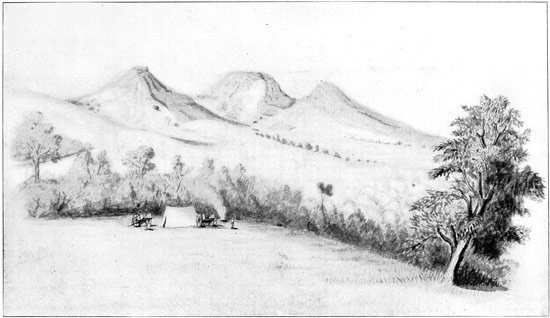
CAMP AT THE THREE MAMELLES. FROM A DRAWING BY AUDUBON, HITHERTO UNPUBLISHED.
July 28, Friday. This morning was cold enough for a frost, but we all slept soundly until daylight, and about half-past three we were called for breakfast. The horses had all gone but four, and, as usual, Owen was despatched for them. The horses were brought back, our coffee swallowed, and we were off, Mr. C. and I, in the wagon. We saw few Antelopes, no Buffalo, and reached the ferry opposite the fort at half-past seven. We found all well, and about eleven Assiniboins, all young men, headed by the son of a great chief called "Le mangeur d'hommes" (the man-eater). The poor wretched Indian whom Harris had worked over, died yesterday morning, and was buried at once. I had actually felt chilly riding in the wagon, and much enjoyed a breakfast Mrs. Culbertson had kindly provided for me. We had passed over some very rough roads, and at breakneck speed, but I did not feel stiff as I expected, though somewhat sore, and a good night's rest is all I need. This afternoon the cow's skin and head, and the Hare arrived, and have been preserved. A half-breed well known to Provost has been here to make a bargain with me about Bighorns, Grizzly Bear, etc., and will see what he and his two sons can do; but I have little or no confidence in these gentry. I was told this afternoon that at Mouse River, about two hundred miles north of this, there are eight hundred carts in one gang, and four hundred in another, with an adequate number of half-breeds and Indians, killing Buffalo and drying their meat for winter provisions, and that the animals are there in millions. When Buffalo bulls are shot from a distance of sixty or seventy yards, they rarely charge on the hunter, and Mr. Culbertson has killed as many as nine bulls from the same spot, when unseen by these terrible beasts. Beavers, when shot swimming, and killed, sink at once to the bottom, but their bodies rise again in from twenty to thirty minutes. Hunters, who frequently shoot and kill them by moonlight, return in the morning from their camping-places, and find them on the margins of the shores where they had shot. Otters do the same, but remain under water for an hour or more.
July 29, Saturday. Cool and pleasant. About one hour after daylight Harris, Bell, and two others, crossed the river, and went in search of Rabbits, but all returned without success. Harris, after breakfast, went off on this side, saw none, but killed a young Raven. During the course of the forenoon he and Bell went off again, and brought home an old and young of the Sharp-tailed Grouse. This afternoon they brought in a Loggerhead Shrike and two Rock Wrens. Bell skinned all these. Sprague made a handsome sketch of the five young Buffaloes belonging to the fort. This evening Moncrévier and Owen went on the other side of the river, but saw nothing. We collected berries of the dwarf cherries of this part, and I bottled some service-berries to carry home.
July 30, Sunday. Weather cool and pleasant. After breakfast we despatched La Fleur and Provost after Antelopes and Bighorns. We then went off and had a battue for Rabbits, and although we were nine in number, and all beat the rose bushes and willows for several hundred yards, not one did we see, although their traces were apparent in several places. We saw tracks of a young Grizzly Bear near the river shore. After a good dinner of Buffalo meat, green peas, and a pudding, Mr. C., Owen, Mr. Pike, and I went off to Fort Mortimer. We had an arrival of five squaws, half-breeds, and a gentleman of the same order, who came to see our fort and our ladies. The princess went out to meet them covered with a fine shawl, and the visitors followed her to her own room. These ladies spoke both the French and Cree languages. At Fort Mortimer we found the hunters from the north, who had returned last evening and told me they had seen nothing. I fear that all my former opinions of the half-breeds are likely to be realized, and that they are all more au fait at telling lies, than anything else; and I expect now that we shall have to make a regular turn-out ourselves, to kill both Grizzly Bears and Bighorns. As we were riding along not far from this fort, Mr. Culbertson fired off the gun given him by Harris, and it blew off the stock, lock, and breech, and it was a wonder it did not kill him, or me, as I was sitting by his side. After we had been at home about one hour, we were all called out of a sudden by the news that the Horse Guards were coming, full gallop, driving the whole of their charge before them. We saw the horses, and the cloud of dust that they raised on the prairies, and presently, when the Guards reached the gates, they told us that they had seen a party of Indians, which occasioned their hurried return. It is now more than one hour since I wrote this, and the Indians are now in sight, and we think they were frightened by three or four squaws who had left the fort in search of "pommes blanches." Sprague has collected a few seeds, but I intend to have some time devoted to this purpose before we leave on our passage downwards. This evening five Indians arrived, among whom is the brother of the man who died a few days ago; he brought a horse, and an Elk skin, which I bought, and he now considers himself a rich man. He reported Buffaloes very near, and to-morrow morning the hunters will be after them. When Buffaloes are about to lie down, they draw all their four feet together slowly, and balancing the body for a moment, bend their fore legs, and fall on their knees first, and the hind ones follow. In young animals, some of which we have here, the effect produced on their tender skin is directly seen, as callous round patches without hair are found; after the animal is about one year old, these are seen no more. I am told that Wolves have not been known to attack men and horses in these parts, but they do attack mules and colts, always making choice of the fattest. We scarcely see one now-a-days about the fort, and yet two miles from here, at Fort Mortimer, Mr. Collins tells me it is impossible to sleep, on account of their howlings at night. When Assiniboin Indians lose a relative by death, they go and cry under the box which contains the body, which is placed in a tree, cut their legs and different parts of the body, and moan miserably for hours at a time. This performance has been gone through with by the brother of the Indian who died here.
July 31, Monday. Weather rather warmer. Mr. Larpenteur went after Rabbits, saw none, but found a horse, which was brought home this afternoon. Mr. C., Harris, Bell, and Owen went after Buffaloes over the hills, saw none, so that all this day has been disappointment to us. Owen caught a Spermophilus hoodii. The brother of the dead Indian, who gashed his legs fearfully this morning, went off with his wife and children and six others, who had come here to beg. One of them had for a letter of recommendation one of the advertisements of the steamer "Trapper," which will be kept by his chief for time immemorial to serve as a pass for begging. He received from us ammunition and tobacco. Sprague collected seeds this morning, and this afternoon copied my sketch of the three Mamelles. Towards sunset I intend to go myself after Rabbits, along the margins of the bushes and the shore. We have returned from my search after Rabbits; Harris and I each shot one. We saw five Wild Geese. Harris lost his snuff-box, which he valued, and which I fear will never be found. Squires to-day proposed to me to let him remain here this winter to procure birds and quadrupeds, and I would have said "yes" at once, did he understand either or both these subjects, or could draw; but as he does not, it would be useless.
August 1, Tuesday. The weather fine, and warmer than yesterday. We sent off four Indians after Rabbits, but as we foolishly gave them powder and shot, they returned without any very soon, having, of course, hidden the ammunition. After breakfast Mr. C. had a horse put in the cart, and three squaws went off after "pommes blanches," and Sprague and I followed in the wagon, driven by Owen. These women carried sticks pointed at one end, and blunt at the other, and I was perfectly astonished at the dexterity and rapidity with which they worked. They place the pointed end within six inches of the plant, where the stem enters the earth, and bear down upon the other end with all their weight and move about to the right and left of the plant until the point of the stick is thrust in the ground to the depth of about seven inches, when acting upon it in the manner of a lever, the plant is fairly thrown out, and the root procured. Sprague and I, who had taken with us an instrument resembling a very narrow hoe, and a spade, having rather despised the simple instruments of the squaws, soon found out that these damsels could dig six or seven, and in some cases a dozen, to our one. We collected some seeds of these plants as well as those of some others, and walked fully six miles, which has rendered my feet quite tender again. Owen told me that he had seen, on his late journey up the Yellowstone, Grouse, both old and young, with a black breast and with a broad tail; they were usually near the margin of a wood. What they are I cannot tell, but he and Bell are going after them to-morrow morning. Just after dinner Provost and La Fleur returned with two male Antelopes, skinned, one of them a remarkably large buck, the other less in size, both skins in capital order. We have taken the measurements of the head of the larger. The timber for our boat has been hauling across the sand-bar ever since daylight, and of course the work will proceed pretty fast. The weather is delightful, and at night, indeed, quite cool enough. I spoke to Sprague last night about remaining here next winter, as he had mentioned his wish to do so to Bell some time ago, but he was very undecided. My regrets that I promised you all so faithfully that I would return this fall are beyond description. I am, as years go, an old man, but I do not feel old, and there is so much of interest here that I forget oftentimes that I am not as young as Owen.
August 2, Wednesday. Bell and Owen started on their tour up the Yellowstone[35] after Cocks of the Plain [Sage Grouse, Centrocercus urophasianus]. Provost and Moncrévier went in the timber below after Deer, but saw none. We had an arrival of six Chippeway Indians, and afterwards about a dozen Assiniboins. Both these parties were better dressed, and looked better off than any previous groups that we have seen at this fort. They brought some few robes to barter, and the traffic was carried on by Mr. Larpenteur in his little shop, through a wicket. On the arrival of the Assiniboins, who were headed by an old man, one of the Chippeways discovered a horse, which he at once not only claimed, but tied; he threw down his new blanket on the ground, and was leading off the horse, when the other Indian caught hold of it, and said that he had fairly bought it, etc. The Chippeway now gave him his gun, powder, and ball, as well as his looking-glass, the most prized of all his possessions, and the Assiniboin, now apparently satisfied, gave up the horse, which was led away by the new (or old) owner. We thought the matter was ended, but Mr. Culbertson told us that either the horse or the Chippeway would be caught and brought back. The latter had mounted a fine horse which he had brought with him, and was leading the other away, when presently a gun was heard out of the fort, and Mr. C. ran to tell us that the horse of the Chippeway had been shot, and that the rider was running as fast as he could to Fort Mortimer. Upon going out we found the horse standing still, and the man running; we went to the poor animal, and found that the ball had passed through the thigh, and entered the belly. The poor horse was trembling like an aspen; he at last moved, walked about, and went to the river, where he died. Now it is curious that it was not the same Assiniboin who had sold the horse that had shot, but another of their party; and we understand that it was on account of an old grudge against the Chippeway, who, by the way, was a surly-looking rascal. The Assiniboins brought eight or ten horses and colts, and a number of dogs. One of the colts had a necklace of "pommes blanches," at the end of which hung a handful of Buffalo calves' hoofs, not more than 3⁄4 inch long, and taken from the calves before birth, when the mothers had been killed. Harris and I took a ride in the wagon over the Mauvaises Terres above the fort, in search of petrified wood, but though we found many specimens, they were of such indifferent quality that we brought home but one. On returning we followed a Wolf path, of which there are hundreds through the surrounding hills, all leading to the fort. It is curious to see how well they understand the best and shortest roads. From what had happened, we anticipated a row among the Indians, but all seemed quiet. Mr. C. gave us a good account of Fort McKenzie. I have been examining the fawn of the Long-tailed Deer of this country, belonging to old Baptiste; the man feeds it regularly, and the fawn follows him everywhere. It will race backwards and forwards over the prairie back of the fort, for a mile or more, running at the very top of its speed; suddenly it will make for the gate, rush through and overwhelm Baptiste with caresses, as if it had actually lost him for some time. If Baptiste lies on the ground pretending to sleep, the fawn pushes with its nose, and licks his face as a dog would, till he awakens.
August 3, Thursday. We observed yesterday that the atmosphere was thick, and indicated the first appearance of the close of summer, which here is brief. The nights and mornings have already become cool, and summer clothes will not be needed much longer, except occasionally. Harris and Sprague went to the hills so much encrusted with shells. We have had some talk about going to meet Bell and Owen, but the distance is too great, and Mr. C. told me he was not acquainted with the road beyond the first twenty-five or thirty miles. We have had a slight shower, and Mr. C. and I walked across the bar to see the progress of the boat. The horse that died near the river was hauled across to the sand-bar, and will make good catfish bate for our fishers. This morning we had another visitation of Indians, seven in number; they were very dirty, wrapped in disgusting Buffalo robes, and were not allowed inside the inner gate, on account of their filthy condition.
August 4, Friday. We were all under way this morning at half-past five, on a Buffalo hunt, that is to say, the residue of us, Harris and I, for Bell was away with Owen, and Squires with Provost after Bighorns, and Sprague at Fort Mortimer. Tobacco and matches had been forgotten, and that detained us for half an hour; but at last we started in good order, with only one cart following us, which carried Pike and Moncrévier. We saw, after we had travelled ten miles, some Buffalo bulls; some alone, others in groups of four or five, a few Antelopes, but more shy than ever before. I was surprised to see how careless the bulls were of us, as some actually gave us chances to approach them within a hundred yards, looking steadfastly, as if not caring a bit for us. At last we saw one lying down immediately in our road, and determined to give him a chance for his life. Mr. C. had a white horse, a runaway, in which he placed a good deal of confidence; he mounted it, and we looked after him. The bull did not start till Mr. C. was within a hundred yards, and then at a gentle and slow gallop. The horse galloped too, but only at the same rate. Mr. C. thrashed him until his hands were sore, for he had no whip, the bull went off without even a shot being fired, and the horse is now looked upon as forever disgraced. About two miles farther another bull was observed lying down in our way, and it was concluded to run him with the white horse, accompanied, however, by Harris. The chase took place, and the bull was killed by Harris, but the white horse is now scorned by every one. A few pieces of meat, the tongue, tail, and head, were all that was taken from this very large bull. We soon saw that the weather was becoming cloudy, and we were anxious to reach a camping-place; but we continued to cross ranges of hills, and hoped to see a large herd of Buffaloes. The weather was hot "out of mind," and we continued till, reaching a fine hill, we saw in a beautiful valley below us seventy to eighty head, feeding peacefully in groups and singly, as might happen. The bulls were mixed in with the cows, and we saw one or two calves. Many bulls were at various distances from the main group, but as we advanced towards them they galloped off and joined the others. When the chase began it was curious to see how much swifter the cows were than the bulls, and how soon they divided themselves into parties of seven or eight, exerting themselves to escape from their murderous pursuers. All in vain, however; off went the guns and down went the cows, or stood bleeding through the nose, mouth, or bullet holes. Mr. C. killed three, and Harris one in about half an hour. We had quite enough, and the slaughter was ended. We had driven up to the nearest fallen cow, and approached close to her, and found that she was not dead, but trying to rise to her feet. I cannot bear to see an animal suffer unnecessarily, so begged one of the men to take my knife and stab her to the heart, which was done. The animals were cut up and skinned, with considerable fatigue. To skin bulls and cows and cut up their bodies is no joke, even to such as are constantly in the habit of doing it. Whilst Mr. Culbertson and the rest had gone to cut up another at some distance, I remained on guard to save the meat from the Wolves, but none came before my companions returned. We found the last cow quite dead. As we were busy about her the rain fell in torrents, and I found my blanket capote of great service. It was now nearly sundown, and we made up our minds to camp close by, although there was no water for our horses, neither any wood. Harris and I began collecting Buffalo-dung from all around, whilst the others attended to various other affairs. The meat was all unloaded and spread on the ground, the horses made fast, the fire burned freely, pieces of liver were soon cooked and devoured, coffee drunk in abundance, and we went to rest.
August 5, Saturday. It rained in the night; but this morning the weather was cool, wind at northwest, and cloudy, but not menacing rain. We made through the road we had come yesterday, and on our way Harris shot a young of the Swift Fox, which we could have caught alive had we not been afraid of running into some hole. We saw only a few bulls and Antelopes, and some Wolves. The white horse, which had gone out as a hunter, returned as a pack-horse, loaded with the entire flesh of a Buffalo cow; and our two mules drew three more and the heads of all four. This morning at daylight, when we were called to drink our coffee, there was a Buffalo feeding within twenty steps of our tent, and it moved slowly towards the hills as we busied ourselves making preparations for our departure. We reached the fort at noon; Squires, Provost, and La Fleur had returned; they had wounded a Bighorn, but had lost it. Owen and Bell returned this afternoon; they had seen no Cocks of the plains, but brought the skin of a female Elk, a Porcupine, and a young White-headed Eagle. Provost tells me that Buffaloes become so very poor during hard winters, when the snows cover the ground to the depth of two or three feet, that they lose their hair, become covered with scabs, on which the Magpies feed, and the poor beasts die by hundreds. One can hardly conceive how it happens, notwithstanding these many deaths and the immense numbers that are murdered almost daily on these boundless wastes called prairies, besides the hosts that are drowned in the freshets, and the hundreds of young calves who die in early spring, so many are yet to be found. Daily we see so many that we hardly notice them more than the cattle in our pastures about our homes. But this cannot last; even now there is a perceptible difference in the size of the herds, and before many years the Buffalo, like the Great Auk, will have disappeared; surely this should not be permitted. Bell has been relating his adventures, our boat is going on, and I wish I had a couple of Bighorns. God bless you all.
August 6, Sunday. I very nearly lost the skin of the Swift Fox, for Harris supposed the animal rotten with the great heat, which caused it to have an odor almost insupportable, and threw it on the roof of the gallery. Bell was so tired he did not look at it, so I took it down, skinned it, and with the assistance of Squires put the coat into pickle, where I daresay it will keep well enough. The weather is thick, and looks like a thunderstorm. Bell, having awaked refreshed by his night's rest, has given me the measurements of the Elk and the Porcupine. Provost has put the skin of the former in pickle, and has gone to Fort Mortimer to see Boucherville and others, to try if they would go after Bighorn to-morrow morning. This afternoon we had an arrival of Indians, the same who were here about two weeks ago. They had been to Fort Clark, and report that a battle had taken place between the Crees and Gros Ventres, and that the latter had lost. Antelopes often die from the severity of the winter weather, and are found dead and shockingly poor, even in the immediate vicinity of the forts. These animals are caught in pens in the manner of Buffaloes, and are despatched with clubs, principally by the squaws. In 1840, during the winter, and when the snow was deep on the prairies and in the ravines by having drifted there, Mr. Laidlow, then at Fort Union, caught four Antelopes by following them on horseback and forcing them into these drifts, which were in places ten or twelve feet deep. They were brought home on a sleigh, and let loose about the rooms. They were so very gentle that they permitted the children to handle them, although being loose they could have kept from them. They were removed to the carpenter's shop, and there one broke its neck by leaping over a turning-lathe. The others were all killed in some such way, for they became very wild, and jumped, kicked, etc., till all were dead. Very young Buffaloes have been caught in the same way, by the same gentleman, assisted by Le Brun and four Indians, and thirteen of these he took down the river, when they became somewhat tamed. The Antelopes cannot be tamed except when caught young, and then they can rarely be raised. Mr. Wm. Sublette, of St. Louis, had one however, a female, which grew to maturity, and was so gentle that it would go all over his house, mounting and descending steps, and even going on the roof of the house. It was alive when I first reached St. Louis, but I was not aware of it, and before I left, it was killed by an Elk belonging to the same gentleman. Provost returned, and said that Boucherville would go with him and La Fleur to-morrow morning early, but I doubt it.
August 7, Monday. Provost, Bell, and La Fleur started after breakfast, having waited nearly four hours for Boucherville. They left at seven, and the Indians were curious to know where they were bound, and looked at them with more interest than we all liked. At about nine, we saw Boucherville, accompanied by five men, all mounted, and they were surprised that Provost had not waited for them, or rather that he had left so early. I gave them a bottle of whiskey, and they started under the whip, and must have overtaken the first party in about two hours. To-day has been warmer than any day we have had for two weeks. Sprague has been collecting seeds, and Harris and I searching for stones with impressions of leaves and fern; we found several. Mr. Denig says the Assiniboins killed a Black Bear on White Earth River, about sixty miles from the mouth; they are occasionally killed there, but it is a rare occurrence. Mr. Denig saw the skin of a Bear at their camp last winter, and a Raccoon was also killed on the Cheyenne River by the Sioux, who knew not what to make of it. Mr. Culbertson has given me the following account of a skirmish which took place at Fort McKenzie in the Blackfoot country, which I copy from his manuscript.
"August 28, 1834. At the break of day we were aroused from our beds by the report of an enemy being in sight. This unexpected news created naturally a confusion among us all; never was a set of unfortunate beings so surprised as we were. By the time that the alarm had spread through the fort, we were surrounded by the enemy, who proved to be Assiniboins, headed by the chief Gauché (the Antelope). The number, as near as we could judge, was about four hundred. Their first attack was upon a few lodges of Piegans, who were encamped at the fort. They also, being taken by surprise, could not escape. We exerted ourselves, however, to save as many as we could, by getting them into the fort. But the foolish squaws, when they started from their lodges, each took a load of old saddles and skins, which they threw in the door, and stopped it so completely that they could not get in, and here the enemy massacred several. In the mean time our men were firing with muskets and shot-guns. Unfortunately for us, we could not use our cannon, as there were a great many Piegans standing between us and the enemy; this prevented us from firing a telling shot on them at once. The engagement continued nearly an hour, when the enemy, finding their men drop very fast, retreated to the bluffs, half a mile distant; there they stood making signs for us to come on, and give them an equal chance on the prairie. Although our force was much weaker than theirs, we determined to give them a trial. At the same time we despatched an expert runner to an encampment of Piegans for a reinforcement. We mounted our horses, and proceeded to the field of battle, which was a perfect level, where there was no chance to get behind a tree, or anything else, to keep off a ball. We commenced our fire at two hundred yards, but soon lessened the distance to one hundred. Here we kept up a constant fire for two hours, when, our horses getting fatigued, we concluded to await the arrival of our reinforcements. As yet none of us were killed or badly wounded, and nothing lost but one horse, which was shot under one of our men named Bourbon. Of the enemy we cannot tell how many were killed, for as fast as they fell they were carried off the field. After the arrival of our reinforcements, which consisted of one hundred and fifty mounted Piegans, we charged and fought again for another two hours, and drove them across the Maria River, where they took another stand; and here Mr. Mitchell's horse was shot under him and he was wounded. In this engagement the enemy had a decided advantage over us, as they were concealed in the bushes, while we were in the open prairie. However, we succeeded in making them retreat from this place back on to a high prairie, but they suddenly rushed upon us and compelled us to retreat across the Maria. Then they had us in their power; but for some reason, either lack of courage or knowledge, they did not avail themselves of their opportunity. They could have killed a great many of us when we rushed into the water, which was almost deep enough to swim our horses; they were close upon us, but we succeeded in crossing before they fired. This foolish move came near being attended with fatal consequences, which we were aware of, but our efforts to stop it were unsuccessful. We, however, did not retreat far before we turned upon them again, with the determination of driving them to the mountains, in which we succeeded. By this time it was so dark that we could see no more, and we concluded to return. During the day we lost seven killed, and twenty wounded. Two of our dead the enemy had scalped. It is impossible to tell how many of the enemy were killed, but their loss must have been much greater than ours, as they had little ammunition, and at the last none. Our Indians took two bodies and burned them, after scalping them. The Indians who were with us in this skirmish deserve but little credit for their bravery, for in every close engagement the whites, who were comparatively few, always were in advance of them. This, however, had one good effect, for it removed the idea they had of our being cowards, and made them believe we were unusually brave. Had it not been for the assistance we gave the Piegans they would have been cut off, for I never saw Indians behave more bravely than the enemy this day; and had they been well supplied with powder and ball they would have done much more execution. But necessity compelled them to spare their ammunition, as they had come a long way, and they must save enough to enable them to return home. And on our side had we been positive they were enemies, even after they had surprised us in the manner they did, we could have killed many of them at first, but thinking that they were a band of Indians coming with this ceremony to trade (which is not uncommon) we did not fire upon them till the balls and arrows came whistling about our heads; then only was the word given, 'Fire!' Had they been bold enough at the onset to have rushed into the fort, we could have done nothing but suffer death under their tomahawks."
Mr. Denig gave me the following "Bear Story," as he heard it from the parties concerned: "In the year 1835 two men set out from a trading-post at the head of the Cheyenne, and in the neighborhood of the Black Hills, to trap Beaver; their names were Michel Carrière and Bernard Le Brun. Carrière was a man about seventy years old, and had passed most of his life in the Indian country, in this dangerous occupation of trapping. One evening as they were setting their traps along the banks of a stream tributary to the Cheyenne, somewhat wooded by bushes and cottonwood trees, their ears were suddenly saluted by a growl, and in a moment a large she Bear rushed upon them. Le Brun, being a young and active man, immediately picked up his gun, and shot the Bear through the bowels. Carrière also fired, but missed. The Bear then pursued them, but as they ran for their lives, their legs did them good service; they escaped through the bushes, and the Bear lost sight of them. They had concluded the Bear had given up the chase, and were again engaged in setting their traps, when Carrière, who was a short distance from Le Brun, went through a small thicket with a trap and came directly in front of the huge, wounded beast, which, with one spring, bounded upon him and tore him in an awful manner. With one stroke of the paw on his face and forehead he cut his nose in two, and one of the claws reached inward nearly to the brain at the root of the nose; the same stroke tore out his right eye and most of the flesh from that side of his face. His arm and side were literally torn to pieces, and the Bear, after handling him in this gentle manner for two or three minutes, threw him upwards about six feet, when he lodged, to all appearance dead, in the fork of a tree. Le Brun, hearing the noise, ran to his assistance, and again shot the Bear and killed it. He then brought what he at first thought was the dead body of his friend to the ground. Little appearance of a human being was left to the poor man, but Le Brun found life was not wholly extinct. He made a travaille and carried him by short stages to the nearest trading-post, where the wounded man slowly recovered, but was, of course, the most mutilated-looking being imaginable. Carrière, in telling the story, says that he fully believes it to have been the Holy Virgin that lifted him up and placed him in the fork of the tree, and thus preserved his life. The Bear is stated to have been as large as a common ox, and must have weighed, therefore, not far from 1500 lbs." Mr. Denig adds that he saw the man about a year after the accident, and some of the wounds were, even then, not healed. Carrière fully recovered, however, lived a few years, and was killed by the Blackfeet near Fort Union.
When Bell was fixing his traps on his horse this morning, I was amused to see Provost and La Fleur laughing outright at him, as he first put on a Buffalo robe under his saddle, a blanket over it, and over that his mosquito bar and his rain protector. These old hunters could not understand why he needed all these things to be comfortable; then, besides, he took a sack of ship-biscuit. Provost took only an old blanket, a few pounds of dried meat, and his tin cup, and rode off in his shirt and dirty breeches. La Fleur was worse off still, for he took no blanket, and said he could borrow Provost's tin cup; but he, being a most temperate man, carried the bottle of whiskey to mix with the brackish water found in the Mauvaises Terres, among which they have to travel till their return. Harris and I contemplated going to a quarry from which the stones of the powder magazine were brought, but it became too late for us to start in time to see much, and the wrong horses were brought us, being both runners; we went, however, across the river after Rabbits. Harris killed a Red-cheeked Woodpecker and shot at a Rabbit, which he missed. We had a sort of show by Moncrévier which was funny, and well performed; he has much versatility, great powers of mimicry, and is a far better actor than many who have made names for themselves in that line. Jean Baptiste told me the following: "About twelve years ago when Mr. McKenzie was the superintendent of this fort, at the season when green peas were plenty and good, Baptiste was sent to the garden about half a mile off, to gather a quantity. He was occupied doing this, when, at the end of a row, to his astonishment, he saw a very large Bear gathering peas also. Baptiste dropped his tin bucket, ran back to the fort as fast as possible, and told Mr. McKenzie, who immediately summoned several other men with guns; they mounted their horses, rode off, and killed the Bear; but, alas! Mr. Bruin had emptied the bucket of peas."
August 8, Tuesday. Another sultry day. Immediately after breakfast Mr. Larpenteur drove Harris and myself in search of geological specimens, but we found none worth having. We killed a Spermophilus hoodii, which, although fatally wounded, entered its hole, and Harris had to draw it out by the hind legs. We saw a family of Rock Wrens, and killed four of them. I killed two at one shot; one of the others must have gone in a hole, for though we saw it fall we could not find it. Another, after being shot, found its way under a flat stone, and was there picked up, quite dead, Mr. Larpenteur accidentally turning the stone up. We saw signs of Antelopes and of Hares (Townsend), and rolled a large rock from the top of a high hill. The notes of the Rock Wren are a prolonged cree-è-è-è. On our return home we heard that Boucherville and his five hunters had returned with nothing for me, and they had not met Bell and his companions. We were told also that a few minutes after our departure the roarings and bellowings of Buffalo were heard across the river, and that Owen and two men had been despatched with a cart to kill three fat cows but no more; so my remonstrances about useless slaughter have not been wholly unheeded. Harris was sorry he had missed going, and so was I, as both of us could have done so. The milk of the Buffalo cow is truly good and finely tasted, but the bag is never large as in our common cattle, and this is probably a provision of nature to render the cows more capable to run off, and escape from their pursuers. Bell, Provost, and La Fleur returned just before dinner; they had seen no Bighorns, and only brought the flesh of two Deer killed by La Fleur, and a young Magpie. This afternoon Provost skinned a calf that was found by one of the cows that Owen killed; it was very young, only a few hours old, but large, and I have taken its measurements. It is looked upon as a phenomenon, as no Buffalo cow calves at this season. The calving time is from about the 1st of February to the last of May. Owen went six miles from the fort before he saw the cattle; there were more than three hundred in number, and Harris and I regretted the more we had not gone, but had been fruitlessly hunting for stones. It is curious that while Harris was searching for Rabbits early this morning, he heard the bellowing of the bulls, and thought first it was the growling of a Grizzly Bear, and then that it was the fort bulls, so he mentioned it to no one. To-morrow evening La Fleur and two men will go after Bighorns again, and they are not to return before they have killed one male, at least. This evening we went a-fishing across the river, and caught ten good catfish of the upper Missouri species, the sweetest and best fish of the sort that I have eaten in any part of the country. Our boat is going on well, and looks pretty to boot. Her name will be the "Union," in consequence of the united exertions of my companions to do all that could be done, on this costly expedition. The young Buffaloes now about the fort have begun shedding their red coats, the latter-colored hair dropping off in patches about the size of the palm of my hand, and the new hair is dark brownish black.
August 9, Wednesday. The weather is cool and we are looking for rain. Squires, Provost, and La Fleur went off this morning after an early breakfast, across the river for Bighorns with orders not to return without some of these wild animals, which reside in the most inaccessible portions of the broken and lofty clay hills and stones that exist in this region of the country; they never resort to the low lands except when moving from one spot to another; they swim rivers well, as do Antelopes. I have scarcely done anything but write this day, and my memorandum books are now crowded with sketches, measurements, and descriptions. We have nine Indians, all Assiniboins, among whom five are chiefs. These nine Indians fed for three days on the flesh of only a single Swan; they saw no Buffaloes, though they report large herds about their village, fully two hundred miles from here. This evening I caught about one dozen catfish, and shot a Spermophilus hoodii, an old female, which had her pouches distended and filled with the seeds of the wild sunflower of this region. I am going to follow one of their holes and describe the same.