THE MISSOURI RIVER JOURNALS 1843 (Continued) (continued 2)
Reading edition
June 23, Friday. We have had a fine, warm day. The hunters of Buffaloes started before daylight, and Squires accompanied them; they are not expected back till sometime to-morrow. Provost went across the river with them, and with the assistance of his bleating whistle, brought several does round him, and a good many Wolves. He killed two does, drew them to a tree, and hung his coat near them while he returned for help to bring them to the fort. The hunters have a belief that a garment hung near game freshly killed will keep the Wolves at bay for a time; but there are exceptions to all rules, as when he returned with the cart, a dozen hungry rascals of Wolves had completely devoured one doe and all but one ham of the other; this he brought to the fort. The does at this season, on hearing the "bleat," run to the spot, supposing, no doubt, that the Wolves have attacked their fawns, and in rushing to the rescue, run towards the hunter, who despatches them without much trouble, unless the woods are thickly overgrown with bushes and brush, when more difficulty is experienced in seeing them, although one may hear them close by; but it is a cruel, deceitful, and unsportsmanlike method, of which I can never avail myself, and which I try to discountenance. Bell was busy all day with skins, and Sprague with flowers, which he delineates finely. Mr. Kipp presented me with a complete dress of a Blackfoot warrior, ornamented with many tufts of Indian hair from scalps, and also with a saddle. After dinner, Harris, who felt poorly all morning, was better, and we went to pay a visit at the Opposition fort. We started in a wagon with an old horse called Peter, which stands fire like a stump. In going, we found we could approach the birds with comparative ease, and we had the good fortune to shoot three of the new Larks. I killed two, and Harris one. When this species starts from the ground, they fly in a succession of undulations, which renders aim at them quite difficult; after this, and in the same manner, they elevate themselves to some considerable height, as if about to sing, and presently pitch towards the ground, where they run prettily, and at times stand still and quite erect for a few minutes; we hope to discover their nests soon. Young Meadow Larks, Red-shafted Woodpeckers, and the Red-cheeked ditto,[29] are abundant. We reached Fort Mortimer in due time; passed first between several sulky, half-starved looking Indians, and came to the gate, where we were received by the "bourgeois,"[30] a young man by the name of Collins, from Hopkinsville, Ky. We found the place in a most miserable condition, and about to be carried away by the falling in of the banks on account of the great rise of water in the Yellowstone, that has actually dammed the Missouri. The current ran directly across, and the banks gave way at such a rate that the men had been obliged already to tear up the front of the fort and remove it to the rear. To-morrow they are to remove the houses themselves, should they stand the coming night, which appeared to me somewhat dubious. We saw a large athletic man who has crossed the mountains twice to the Pacific; he is a Philadelphian, named Wallis, who had been a cook at Fort Union four years, but who had finally deserted, lived for a time with the Crows, and then joined the Opposition. These persons were very polite to us, and invited us to remain and take supper with them; but as I knew they were short of provisions, I would not impose myself upon them, and so, with thanks for their hospitality, we excused ourselves and returned to Fort Union. As we were in search of birds, we saw a small, whitish-colored Wolf trotting across the prairie, which hereabouts is very extensive and looks well, though the soil is poor. We put Peter to a trot and gained on the Wolf, which did not see us until we were about one hundred yards off; he stopped suddenly, and then went off at a canter. Harris gave the whip to Peter, and off we went, evidently gaining rapidly on the beast, when it saw an Indian in its road; taking fright, it dashed to one side, and was soon lost in a ravine. We congratulated ourselves, on reaching the fort, that we had such good fortune as to be able to sup and sleep here, instead of at Fort Mortimer. Bell had taken a walk and brought in a few birds. The prairie is covered with cacti, and Harris and I suffered by them; my feet were badly pricked by the thorns, which penetrated my boots at the junction of the soles with the upper leathers. I have to-day heard several strange stories about Grizzly Bears, all of which I must have corroborated before I fully accept them. The Otters and Musk-rats of this part of the country are smaller than in the States; the first is the worst enemy that the Beaver has.
June 24, Saturday. Bell killed a small Wolf last night, and Harris wounded another. This morning Provost started at daylight, and Bell followed him; but they returned without game. After breakfast Harris went off on horseback, and brought in a Sharp-tailed Grouse. He saw only one Deer, species not identified. Sprague and I went off last, but brought in nothing new. This afternoon I thought would be a fair opportunity to examine the manners of Sprague's Lark on the wing. Bell drove Peter for me, and I killed four Larks; we then watched the flight of several. The male rises by constant undulations to a great height, say one hundred yards or more; and whilst singing its sweet-sounding notes, beats its wings, poised in the air like a Hawk, without rising at this time; after which, and after each burst of singing, it sails in divers directions, forming three quarters of a circle or thereabouts, then rises again, and again sings; the intervals between the singing are longer than those which the song occupies, and at times the bird remains so long in the air as to render it quite fatiguing to follow it with the eye. Sprague thought one he watched yesterday remained in the air about one hour. Bell and Harris watched one for more than half an hour, and this afternoon I gazed upon one, whilst Bell timed it, for thirty-six minutes. We continued on to Fort Mortimer to see its condition, were received as kindly as yesterday, and saw the same persons. It was four o'clock, and the men were all at dinner, having been obliged to wait until this time because they had no meat in the fort, and their hunters had returned only one hour and a half before. We found that the river had fallen about fourteen inches since last evening, and the men would not remove for the present. On our way homeward Bell shot a fifth Lark, and when we reached the ravine I cut out of a tree-stump the nest of an Arctic Bluebird, with six eggs in it, of almost the same size and color as those of the common Bluebird. Sprague had brought a female of his Lark, and her nest containing five eggs; the measurements of these two species I will write out to-morrow. Our Buffalo hunters are not yet returned, and I think that Squires will feel pretty well fatigued when he reaches the fort. Mr. Culbertson presented me with a pair of stirrups, and a most splendid Blackfoot crupper for my saddle. The day has been warm and clear. We caught seven catfish at the river near the fort, and most excellent eating they are, though quite small when compared with the monsters of this species on the Missouri below.
June 25, Sunday. This day has been warm and the wind high, at first from the south, but this afternoon from the north. Little or nothing has been done in the way of procuring birds or game, except that Harris and Mr. Denig brought in several Arkansas Flycatchers. Not a word from the hunters, and therefore they must have gone far before they met Buffaloes. A few more catfish have been caught, and they are truly excellent.
June 26, Monday. The hunters returned this afternoon about three o'clock; i. e., Squires and McKenzie; but the carts did not reach the fort till after I had gone to bed. They have killed three Antelopes, three bull Buffaloes, and one Townsend's Hare, but the last was lost through carelessness, and I am sorry for it. The men had eaten one of the Antelopes, and the two others are fine males; Bell skinned one, and saved the head and the fore-legs of the other. One of them had the tips of the horns as much crooked inwardly (backwards) as the horns of the European Chamois usually are. This afternoon early Provost brought in a Deer of the large kind, and this also was skinned. After this Harris and Bell went off and brought in several Lazuli Finches, and a black Prairie Lark Finch of the species brought from the Columbia by Townsend and Nuttall. We caught several catfish and a very curious sturgeon, of which Sprague took an outline with the camera, and I here give the measurements.... It had run on the shore, and was caught by one of the men. I made a bargain this morning with the hunter Bonaventure Le Brun to procure me ten Bighorns, at $10.00 apiece, or the same price for any number he may get. Mr. Culbertson lent him old Peter, the horse, and I wrote a petit billet to Mr. John Collins, to ask him to have them ferried across the river, as our boat was away on a wood-cutting expedition. As Le Brun did not return, of course he was taken across, and may, perhaps, come back this evening, or early to-morrow morning, with something worth having. At this moment Bell has shot a Wolf from the ramparts, and sadly crippled another, but it made off somehow.
June 27, Tuesday. This morning was quite cool, and the wind from the north. After breakfast Bell and Owen McKenzie went off on horseback on this side of the river, to see how far off the Buffaloes are, and they may probably bring home some game. Sprague and I have been drawing all day yesterday and most of to-day. Provost has been making whistles to call the Deer; later he, Harris, and I, walked to the hills to procure the black root plant which is said to be the best antidote for the bite of the rattlesnake. We found the root and dug one up, but the plant is not yet in bloom. The leaves are long and narrow, and the flowers are said to resemble the dwarf sunflower. Harris shot two of what he calls the Small Shore Lark, male and female; but beyond the size being a little smaller than those found at Labrador, I cannot discover any specific difference. From the top of the hills we saw a grand panorama of a most extensive wilderness, with Fort Union beneath us and far away, as well as the Yellowstone River, and the lake across the river. The hills across the Missouri appeared quite low, and we could see the high prairie beyond, forming the background. Bell and McKenzie returned, having shot a Wolf in a curious manner. On reaching the top of a hill they found themselves close to the Wolf. Bell's horse ran quite past it, but young McKenzie shot and broke one fore-leg, and it fell. Bell then gave his horse to McKenzie, jumped off, ran to the Wolf, and took hold of it by the tail, pulling it towards the horses; but it got up and ran rapidly. Bell fired two shots in its back with a pistol without stopping it, then he ran as fast as he could, shot it in the side, and it fell. Bell says its tail was longer than usual, but it was not measured, and the Wolf was left on the prairie, as they had no means of bringing it in. They saw an Antelope, some Magpies, and a Swift Fox, but no Buffaloes, though they were fifteen miles from the fort. They ran a Long-tailed Deer, and describe its movements precisely as do Lewis and Clark.[31] Between every three or four short leaps came the long leap of fully twenty-five feet, if not more. The Kit or Swift Fox which they saw stood by a bunch of wormwood, and whilst looking at the hunters, was seen to brush off the flies with his paws.
I am now going to take this book to Lewis Squires and ask him to write in it his account of the Buffalo hunt.
(The following is in Mr. Squires' handwriting:)
"By Mr. Audubon's desire I will relate the adventures that befell me in my first Buffalo hunt, and I am in hopes that among the rubbish a trifle, at least, may be obtained which may be of use or interest to him. On the morning of Friday, the 23d, before daylight, I was up, and in a short time young McKenzie made his appearance. A few minutes sufficed to saddle our horses, and be in readiness for our contemplated hunt. We were accompanied by Mr. Bonaventure the younger, one of the hunters of the fort, and two carts to bring in whatever kind of meat might be procured. We were ferried across the river in a flatboat, and thence took our departure for the Buffalo country. We passed through a wooded bottom for about one mile, and then over a level prairie for about one mile and a half, when we commenced the ascent of the bluffs that bound the western side of the Missouri valley; our course then lay over an undulating prairie, quite rough, and steep hills with small ravines between, and over dry beds of streams that are made by the spring and fall freshets. Occasionally we were favored with a level prairie never exceeding two miles in extent. When the carts overtook us, we exchanged our horses for them, and sat on Buffalo robes on the bottom, our horses following on behind us. As we neared the place where the Buffaloes had been killed on the previous hunt, Bonaventure rode alone to the top of a hill to discover, if possible, their whereabouts; but to our disappointment nothing living was to be seen. We continued on our way watching closely, ahead, right and left. Three o'clock came and as yet nothing had been killed; as none of us had eaten anything since the night before, our appetites admonished us that it was time to pay attention to them. McKenzie and Bonaventure began to look about for Antelopes; but before any were 'comeatable,' I fell asleep, and was awakened by the report of a gun. Before we, in the carts, arrived at the spot from whence this report proceeded, the hunters had killed, skinned, and nearly cleaned the game, which was a fine male Antelope. I regretted exceedingly I was not awake when it was killed, as I might have saved the skin for Mr. Audubon, as well as the head, but I was too late. It was now about five o'clock, and one may well imagine I was somewhat hungry. Owen McKenzie commenced eating the raw liver, and offered me a piece. What others can eat, I felt assured I could at least taste. I accordingly took it and ate quite a piece of it; to my utter astonishment, I found it not only palatable but very good; this experience goes far to convince me that our prejudices make things appear more disgusting than fact proves them to be. Our Antelope cut up and in the cart, we proceeded on our 'winding way,' and scarcely had we left the spot where the entrails of the animal remained, before the Wolves and Ravens commenced coming from all quarters, and from places where a minute before there was not a sign of one. We had not proceeded three hundred yards at the utmost, before eight Wolves were about the spot, and others approaching. On our way, both going and returning, we saw a cactus of a conical shape, having a light straw-colored, double flower, differing materially from the flower of the flat cactus, which is quite common; had I had any means of bringing one in, I would most gladly have done so, but I could not depend on the carts, and as they are rather unpleasant companions, I preferred awaiting another opportunity, which I hope may come in a few days. We shot a young of Townsend's Hare, about seven or eight steps from us, with about a dozen shot; I took good care of it until I left the cart on my return to the fort, but when the carts arrived it had carelessly been lost. This I regretted very much, as Mr. Audubon wanted it. It was nearly sunset when Bonaventure discovered a Buffalo bull, so we concluded to encamp for the night, and run the Buffaloes in the morning. We accordingly selected a spot near a pond of water, which in spring and fall is quite a large lake, and near which there was abundance of good pasture; our horses were soon unsaddled and hoppled, a good fire blazing, and some of the Antelope meat roasting on sticks before it. As soon as a bit was done, we commenced operations, and it was soon gone 'the way of all flesh.' I never before ate meat without salt or pepper, and until then never fully appreciated these two luxuries, as they now seemed, nor can any one, until deprived of them, and seated on a prairie as we were, or in some similar situation. On the opposite side of the lake we saw a Grizzly Bear, but he was unapproachable. After smoking our pipes we rolled ourselves in our robes, with our saddles for pillows, and were soon lost in a sound, sweet sleep. During the night I was awakened by a crunching sound; the fire had died down, and I sat up and looking about perceived a Wolf quietly feeding on the remains of our supper. One of the men awoke at the same time and fired at the Wolf, but without effect, and the fellow fled; we neither saw nor heard more of him during the night. By daylight we were all up, and as our horses had not wandered far, it was the work of a few minutes to catch and saddle them. We rode three or four miles before we discovered anything, but at last saw a group of three Buffaloes some miles from us. We pushed on, and soon neared them; before arriving at their feeding-ground, we saw, scattered about, immense quantities of pumice-stone, in detached pieces of all sizes; several of the hills appeared to be composed wholly of it. As we approached within two hundred yards of the Buffaloes they started, and away went the hunters after them. My first intention of being merely a looker-on continued up to this moment, but it was impossible to resist following; almost unconsciously I commenced urging my horse after them, and was soon rushing up hills and through ravines; but my horse gave out, and disappointment and anger followed, as McKenzie and Bonaventure succeeded in killing two, and wounding a third, which escaped. As soon as they had finished them, they commenced skinning and cutting up one, which was soon in the cart, the offal and useless meat being left on the ground. Again the Wolves made their appearance as we were leaving; they seemed shy, but Owen McKenzie succeeded in killing one, which was old and useless. The other Buffalo was soon skinned and in the cart. In the meantime McKenzie and I started on horseback for water. The man who had charge of the keg had let it all run out, and most fortunately none of us had wanted water until now. We rode to a pond, the water of which was very salt and warm, but we had to drink this or none; we did so, filled our flasks for the rest of the party, and a few minutes afterward rejoined them. We started again for more meat to complete our load. I observed, as we approached the Buffaloes, that they stood gazing at us with their heads erect, lashing their sides with their tails; as soon as they discovered what we were at, with the quickness of thought they wheeled, and with the most surprising speed, for an animal apparently so clumsy and awkward, flew before us. I could hardly imagine that these enormous animals could move so quickly, or realize that their speed was as great as it proved to be; and I doubt if in this country one horse in ten can be found that will keep up with them. We rode five or six miles before we discovered any more. At last we saw a single bull, and while approaching him we started two others; slowly we wended our way towards them until within a hundred yards, when away they went. I had now begun to enter into the spirit of the chase, and off I started, full speed, down a rough hill in swift pursuit; at the bottom of the hill was a ditch about eight feet wide; the horse cleared this safely. I continued, leading the others by some distance, and rapidly approaching the Buffaloes. At this prospect of success my feelings can better be imagined than described. I kept the lead of the others till within thirty or forty yards of the Buffaloes, when I began making preparations to fire as soon as I was sufficiently near; imagine, if possible, my disappointment when I discovered that now, when all my hopes of success were raised to the highest pitch, I was fated to meet a reverse as mortifying as success would have been gratifying. My horse failed, and slackened his pace, despite every effort of mine to urge him on; the other hunters rushed by me at full speed, and my horse stopped altogether. I saw the others fire; the animal swerved a little, but still kept on. After breathing my horse a while, I succeeded in starting him up again, followed after them, and came up in time to fire one shot ere the animal was brought down. I think that I never saw an eye so ferocious in expression as that of the wounded Buffalo; rolling wildly in its socket, inflamed as the eye was, it had the most frightful appearance that can be imagined; and in fact, the picture presented by the Buffalo as a whole is quite beyond my powers of description. The fierce eyes, blood streaming from his sides, mouth, and nostrils, he was the wildest, most unearthly-looking thing it ever fell to my lot to gaze upon. His sufferings were short; he was soon cut up and placed in the cart, and we retraced our steps homeward. Whilst proceeding towards our camping-ground for the night, two Antelopes were killed, and placed on our carts. Whenever we approached these animals they were very curious to see what we were; they would run, first to the right, and then to the left, then suddenly run straight towards us until within gun-shot, or nearly so. The horse attracted their attention more than the rider, and if a slight elevation or bush was between us, they were easily killed. As soon as their curiosity was gratified they would turn and run, but it was not difficult to shoot before this occurred. When they turned they would fly over the prairie for about a mile, when they would again stop and look at us. During the day we suffered very much for want of water, and drank anything that had the appearance of it, and most of the water, in fact all of it, was either impregnated with salt, sulphur, or magnesia—most disgusting stuff at any other time, but drinkable now. The worst of all was some rain-water that we were obliged to drink, first placing our handkerchiefs over the cup to strain it, and keep the worms out of our mouths. I drank it, and right glad was I to get even this. We rode about five miles to where we encamped for the night, near a little pond of water. In a few minutes we had a good fire of Buffalo dung to drive away mosquitoes that were in clouds about us. The water had taken away our appetites completely, and we went to bed without eating any supper. Our horses and beds were arranged as on the previous evening. McKenzie and I intended starting for the fort early in the morning. We saw a great many Magpies, Curlews, Plovers, Doves, and numbers of Antelopes. About daylight I awoke and roused McKenzie; a man had gone for the horses, but after a search of two hours returned without finding them; all the party now went off except one man and myself, and all returned without success except Bonaventure, who found an old horse that had been lost since April last. He was despatched on this to the fort to get other horses, as we had concluded that ours were either lost or stolen. As soon as he had gone, one of the men started again in search of the runaways, and in a short time returned with them. McKenzie and I soon rode off. We saw two Grizzly Bears at the lake again. Our homeward road we made much shorter by cutting off several turns; we overtook Bonaventure about four miles from our encampment, and passed him. We rode forty miles to the fort in a trifle over six hours. We had travelled in all about one hundred and twenty miles. Bonaventure arrived two hours after we did, and the carts came in the evening."
Wednesday, June 28. This is an account of Squires' Buffalo hunt, his first one, which he has kindly written in my journal and which I hope some day to publish. This morning was very cloudy, and we had some rain, but from ten o'clock until this moment the weather has been beautiful. Harris shot a handsome though rather small Wolf; I have made a large drawing, and Sprague a fine diminished one, of the rascal. The first news we had this morning was that the ferry flat had been stolen last night, probably by the deserters from the fort who have had the wish to return to St. Louis. Some person outside of the fort threw a large stone at an Indian woman, and her husband fired in the dark, but no one could be found on searching. There is much trouble and discomfort to the managers of such an establishment as this. Provost went shooting, but saw nothing. Young McKenzie and another man were sent to find the scow, but in vain. On their return they said a hunter from Fort Mortimer had brought a Bighorn, and skinned it, and that he would let me have it if I wished. I sent Bell and Squires, and they brought the skin in. It proves to be that of an old female in the act of shedding her winter coat, and I found that she was covered with abundance of downy wool like the Antelopes under similar circumstances. Mr. Larpenteur caught five small catfish, which we ate at breakfast. After dinner Le Brun returned home, but brought only the skin of a young female of the White-tailed Deer, and I was surprised to see that it had the germ of a horn about one inch long; the skin was quite red, and it is saved. A young Elk was brought in good condition, as the hunters here know how to save skins properly; it was too young, however, to take measurements. The horns were in velvet about six inches long. When one sees the powerful bones and muscles of this young animal, one cannot fail to think of the great strength of the creature when mature, and its ability to bear with ease the enormous antlers with which its head is surmounted. The flesh of the Antelope is not comparable with that of the Deer, being dry and usually tough. It is very rarely indeed that a fat Antelope is killed. Bell has been very busy in skinning small birds and animals. We procured a young Red-shafted Woodpecker, killed by an Indian boy with a bow and arrow. Mr. Kipp's "Mackinaw" was launched this evening, and sent across the river with men to relieve the charcoal-burners; she returned immediately and we expect that Mr. Kipp's crew will go off to-morrow about twelve. I was told a curious anecdote connected with a Grizzly Bear, that I will write down; it is as follows: One of the engagés of the Company was forced to run away, having killed an Indian woman, and made his way to the Crow Fort, three hundred miles up the Yellowstone River. When he arrived there he was in sad plight, having his own squaw and one or two children along, who had all suffered greatly with hunger, thirst, and exposure. They were received at the fort, but in a short time, less than a week afterwards, he again ran off with his family, and on foot. The discovery was soon made, and two men were sent after him; but he eluded their vigilance by keeping close in ravines, etc. The men returned, and two others with an Indian were despatched on a second search, and after much travel saw the man and his family on an island, where he had taken refuge from his pursuers. The Buffalo-hide canoe in which he had attempted to cross the river was upset, and it was with difficulty that he saved his wife and children. They were now unable to escape, and when talking as to the best way to secure their return to the fort, the soldiers saw him walk to the body of a dead Buffalo lying on the shore of the island, with the evident intention of procuring some of it for food. As he stooped to cut off a portion, to his utter horror he saw a small Grizzly Bear crawl out from the carcass. It attacked him fiercely, and so suddenly that he was unable to defend himself; the Bear lacerated his face, arms, and the upper part of his body in a frightful manner, and would have killed him, had not the Indian raised his gun and fired at the Bear, wounding him severely, while a second shot killed him. The engagé was too much hurt to make further effort to escape, and one of the Company's boats passing soon after, he and his family were taken back to the fort, where he was kept to await his trial.
June 29, Thursday. It rained hard during the night, but at dawn Provost went shooting and returned to dinner, having shot a doe, which was skinned and the meat saved. He saw a Grouse within a few feet of him, but did not shoot, as he had only a rifle. Bell and I took a long walk, and shot several birds. We both were surprised to find a flock of Cliff Swallows endeavoring to build nests beneath the ledges of a clay bank. Watching the moment when several had alighted against the bank, I fired, and killed three. Previous to this, as I was walking along a ravine, a White Wolf ran past within fifteen or twenty paces of me, but I had only very small shot, and did not care to wound where I could not kill. The fellow went off at a limping gallop, and Bell after it, squatting whenever the Wolf stopped to look at him; but at last the rascal lost himself in a deep ravine, and a few minutes after we saw him emerge from the shrubs some distance off, and go across the prairie towards the river. Bell saw two others afterwards, and if ever there was a country where Wolves are surpassingly abundant, it is the one we now are in. Wolves are in the habit of often lying down on the prairies, where they form quite a bed, working at bones the while. We found a nest of the Prairie Lark, with four eggs. We saw Arctic Bluebirds, Say's Flycatcher and Lazuli Finches. Say's Flycatcher has a note almost like the common Pewee. They fly over the prairies like Hawks, looking for grasshoppers, upon which they pounce, and if they lose sight of them, they try again at another place. We returned home to dinner, and after this a discussion arose connected with the Red-shafted Woodpecker. We determined to go and procure one of the young, and finding that these have pale-yellow shafts, instead of deep orange-red, such as the old birds have, the matter was tested and settled according to my statement. Harris and I went off after the doe killed this morning, and killed another, but as I have now skins enough, the measurements only were taken, and the head cut off, which I intend drawing to-morrow. Harris shot also a Grouse, and a Woodpecker that will prove a Canadensis; he killed the male also, but could not find it, and we found seven young Red-shafted Woodpeckers in one nest. I killed a female Meadow Lark, the first seen in this country by us. Provost told me (and he is a respectable man) that, during the breeding season of the Mountain Ram, the battering of the horns is often heard as far as a mile away, and that at such times they are approached with comparative ease; and there is no doubt that it is during such encounters that the horns are broken and twisted as I have seen them, and not by leaping from high places and falling on their horns, as poetical travellers have asserted. The fact is that when these animals leap from any height they alight firmly on all their four feet. At this season the young are always very difficult to catch, and I have not yet seen one of them. Harris, Bell, and young McKenzie are going Bighorn hunting to-morrow, and I hope they will be successful; I, alas! am no longer young and alert enough for the expedition. We find the mosquitoes very troublesome, and very numerous.
June 30, Friday. The weather was dark, with the wind at the northwest, and looked so like rain that the hunters did not start as they had proposed. Sprague, Harris, and Bell went out, however, after small game. I began drawing at five this morning, and worked almost without cessation till after three, when, becoming fatigued for want of practice, I took a short walk, regretting I could no longer draw twelve or fourteen hours without a pause or thought of weariness. It is now raining quite hard. Mr. Larpenteur went after a large tree to make a ferry-boat, and the new skiff was begun this morning. I sent Provost to Fort Mortimer to see if any one had arrived from below; he found a man had done so last evening and brought letters to Mr. Collins, requesting him to do all he can for us. He also reported that a party of Sioux had had a battle with the Gros Ventres, and had killed three of the latter and a white man who lived with them as a blacksmith. The Gros Ventres, on the other hand, had killed eight of the Sioux and put them to flight. The blacksmith killed two Sioux, and the enemies cut off one leg and one arm, scalped him, and left the mangled body behind them. It is said there is now no person living who can recollect the manner in which the bitter enmity of these two nations originated. The Yellowstone River is again rising fast, and Mr. Kipp will have tough times before he reaches Fort Alexander, which was built by Mr. Alexander Culbertson, our present host, and the Company had it honored by his name. When a herd of Buffaloes is chased, although the bulls themselves run very swiftly off, their speed is not to be compared to that of the cows and yearlings; for these latter are seen in a few minutes to leave the bulls behind them, and as cows and young Buffaloes are preferable to the old males, when the hunters are well mounted they pursue the cows and young ones invariably. Last winter Buffaloes were extremely abundant close to this fort, so much so that while the people were engaged in bringing hay in carts, the Buffaloes during the night came close in, and picked up every wisp that was dropped. An attempt to secure them alive was made by strewing hay in such a manner as to render the bait more and more plentiful near the old fort, which is distant about two hundred yards, and which was once the property of Mr. Sublette and Co.; but as the hogs and common cattle belonging to the fort are put up there regularly at sunset, the Buffaloes ate the hay to the very gates, but would not enter the enclosure, probably on account of the different smells issuing therefrom. At this period large herds slept in front of the fort, but just before dawn would remove across the hills about one mile distant, and return towards night. An attempt was made to shoot them with a cannon—a four-pounder; three were killed and several wounded. Still the Buffaloes came to their sleeping ground at evening, and many were killed during the season. I saw the head of one Mr. Culbertson shot, and the animal must have been of unusual size.
July 1, Saturday. It was still raining when I got up, but a few minutes later the sun was shining through one of our windows, and the wind being at northwest we anticipated a fine day. The ground was extremely wet and muddy, but Harris and Bell went off on horseback, and returned a few minutes after noon. They brought some birds and had killed a rascally Wolf. Bell found the nest of the Arkansas Flycatcher. The nest and eggs, as well as the manners, of this bird resemble in many ways those of our King-bird. The nest was in an elm, twenty or twenty-five feet above the ground, and he saw another in a similar situation. Mr. Culbertson and I walked to the Pilot Knob with a spy-glass, to look at the present condition of Fort Mortimer. This afternoon Squires, Provost, and I walked there, and were kindly received as usual. We found all the people encamped two hundred yards from the river, as they had been obliged to move from the tumbling fort during the rain of last night. Whilst we were there a trapper came in with a horse and told us the following: This man and four others left that fort on the 1st of April last on an expedition after Beavers. They were captured by a party of about four hundred Sioux, who took them prisoners and kept him one day and a half, after which he was released, but his companions were kept prisoners. He crossed the river and found a horse belonging to the Indians, stole it, and reached the fort at last. He looked miserable indeed, almost without a rag of clothing, long hair, filthy beyond description, and having only one very keen, bright eye, which looked as if he was both proud and brave. He had subsisted for the last eleven days on pomme blanche and the thick leaves of the cactus, which he roasted to get rid of the thorns or spines, and thus had fared most miserably; for, previous to the capture of himself and his companions, he had upset his bull canoe and lost his rifle, which to a trapper is, next to life, his dependence. When he was asked if he would have some dinner, he said that he had forgotten the word, but would try the taste of meat again. Mr. Collins was very polite to me, and promised me a hunter for the whole of next week, expressly to shoot Bighorns. I hope this promise may be better kept than that of Mr. Chardon, who told me that should he have one killed within forty miles he would send Alexis back with it at once. We heard some had been killed, but this may not be true; at any rate, men are men all over the world, and a broken promise is not unheard-of. This evening Mr. Culbertson presented me with a splendid dress, as well as one to Harris and one to Bell, and promised one to Sprague, which I have no doubt he will have. Harris and Sprague went off to procure Woodpeckers' nests, and brought the most curious set of five birds that I ever saw, and which I think will puzzle all the naturalists in the world. The first was found near the nest, of which Sprague shot the female, a light-colored Red-shafted Woodpecker. It proved to be of the same color, but had the rudiments of black stripes on the cheeks. Next, Sprague shot an adult yellow-winged male, with the markings principally such as are found in the Eastern States. Harris then shot a young Red-shafted, just fledged, with a black stripe on the cheek. His next shot was a light-colored Red-shafted male, with black cheeks, and another still, a yellow Red-shafted with a red cheek.[32] After all this Mr. Culbertson proposed to run a sham Buffalo hunt again. He, Harris, and Squires started on good horses, went about a mile, and returned full tilt, firing and cracking. Squires fired four times and missed once. Harris did not shoot at all; but Mr. Culbertson fired eleven times, starting at the onset with an empty gun, snapped three times, and reached the fort with his gun loaded. A more wonderful rider I never saw.
July 2, Sunday. The weather was cool and pleasant this morning, with no mosquitoes, which indeed—plentiful and troublesome as they are—Provost tells me are more scarce this season than he ever knew them thus far up the Missouri. Sprague finished his drawing of the doe's head about dinner-time, and it looks well. After dinner he went after the puzzling Woodpeckers, and brought three, all different from each other. Mr. Culbertson, his squaw wife, and I rode to Fort Mortimer, accompanied by young McKenzie, and found Mr. Collins quite ill. We saw the hunters of that fort, and they promised to supply me with Bighorns, at ten dollars apiece in the flesh, and also some Black-tailed Deer, and perhaps a Grizzly Bear. This evening they came to the fort for old Peter and a mule, to bring in their game; and may success attend them! When we returned, Harris started off with Mr. Culbertson and his wife to see the condition of Mr. Collins, to whom he administered some remedies. Harris had an accident that was near being of a serious nature; as he was getting into the wagon, thinking that a man had hold of the reins, which was not the case, his foot was caught between the axle-tree and the wagon, he was thrown down on his arm and side, and hurt to some extent; fortunately he escaped without serious injury, and does not complain much this evening, as he has gone on the ramparts to shoot a Wolf. Sprague saw a Wolf in a hole a few yards from the fort, but said not a word of it till after dinner, when Bell and Harris went there and shot it through the head. It was a poor, miserable, crippled old beast, that could not get out of the hole, which is not more than three or four feet deep. After breakfast we had a hunt after Hares or Rabbits, and Harris saw two of them, but was so near he did not care to shoot at them. Whilst Harris and Mr. Culbertson went off to see Mr. Collins, Mr. Denig and I walked off with a bag and instruments, to take off the head of a three-years-dead Indian chief, called the White Cow. Mr. Denig got upon my shoulders and into the branches near the coffin, which stood about ten feet above ground. The coffin was lowered, or rather tumbled, down, and the cover was soon hammered off; to my surprise, the feet were placed on the pillow, instead of the head, which lay at the foot of the coffin—if a long box may so be called. Worms innumerable were all about it; the feet were naked, shrunk, and dried up. The head had still the hair on, but was twisted off in a moment, under jaw and all. The body had been first wrapped up in a Buffalo skin without hair, and then in another robe with the hair on, as usual; after this the dead man had been enveloped in an American flag, and over this a superb scarlet blanket. We left all on the ground but the head. Squires, Mr. Denig and young Owen McKenzie went afterwards to try to replace the coffin and contents in the tree, but in vain; the whole affair fell to the ground, and there it lies; but I intend to-morrow to have it covered with earth. The history of this man is short, and I had it from Mr. Larpenteur, who was in the fort at the time of his decease, or self-committed death. He was a good friend to the whites, and knew how to procure many Buffalo robes for them; he was also a famous orator, and never failed to harangue his people on all occasions. He was, however, consumptive, and finding himself about to die, he sent his squaw for water, took an arrow from his quiver, and thrusting it into his heart, expired, and was found dead when his squaw returned to the lodge. He was "buried" in the above-mentioned tree by the orders of Mr. McKenzie, who then commanded this fort. Mr. Culbertson drove me so fast, and Harris so much faster, over this rough ground, that I feel quite stiff. I must not forget to say that we had another sham Buffalo chase over the prairie in front of the fort, the riders being Squires, young McKenzie, and Mr. Culbertson; and I was glad and proud to see that Squires, though so inexperienced a hunter, managed to shoot five shots within the mile, McKenzie eleven, and Mr. Culbertson eight. Harris killed an old Wolf, which he thought was larger and fatter than any killed previously. It was very large, but on examination it was found to be poor and without teeth in the upper jaw.
July 3, Monday. We have had a warm night and day; after breakfast we all six crossed the river in the newly built skiff, and went off in divers directions. Provost and I looked thoroughly through the brushwood, and walked fully six miles from the fort; we saw three Deer, but so far were they that it was useless to shoot. Deer-shooting on the prairies is all hazard; sometimes the animals come tripping along within ten yards of you, and at other times not nearer can you get than one hundred and fifty yards, which was the case this day. The others killed nothing of note, and crossed the river back to the fort two hours at least before us; and we shot and bawled out for nearly an hour, before the skiff was sent for us. I took a swim, found the water very pleasant, and was refreshed by my bath. The Bighorn hunters returned this afternoon with a Bighorn, a female, and also a female Black-tailed Deer. I paid them $15 for the two, and they are to start again to-morrow evening, or the next day.
July 4, Tuesday. Although we had some fireworks going on last evening, after I had laid myself down for the night, the anniversary of the Independence of the United States has been almost the quietest I have ever spent, as far as my recollection goes. I was drawing the whole day, and Sprague was engaged in the same manner, painting a likeness of Mr. Culbertson. Harris and Bell went off to try and procure a buck of the Long White-tailed Deer, and returned after dinner much fatigued and hungry enough. Bell had shot at a Deer and wounded it very severely; the poor thing ran on, but soon lay down, for the blood and froth were gushing out of its mouth. Bell saw the buck lying down, and not being an experienced hunter, thought it was dead, and instead of shooting it again, went back to call Harris; when they returned, the Deer was gone, and although they saw it again and again, the Deer outwitted them, and, as I have said, they returned weary, with no Deer. After dinner I spoke to Mr. Culbertson on the subject, and he told me that the Deer could probably be found, but that most likely the Wolves would devour it. He prepared to send young McKenzie with both my friends; the horses were soon saddled, and the three were off at a gallop. The poor buck's carcass was found, but several Wolves and Turkey Buzzards had fared well upon it; the vertebræ only were left, with a few bits of skin and portions of the horns in velvet. These trophies were all that they brought home. It was a superb and very large animal, and I am very sorry for the loss of it, as I am anxious to draw the head of one of such a size as they represent this to have been. They ran after a Wolf, which gave them leg bail. Meanwhile Squires and Provost started with the skiff in a cart to go up the river two miles, cross, and camp on the opposite shore. The weather became very gloomy and chill. In talking with Mr. Culbertson he told me that no wise man would ever follow a Buffalo bull immediately in his track, even in a hunt, and that no one well initiated would ever run after Buffaloes between the herd and another hunter, as the latter bears on the former ever and anon, and places him in imminent danger. Buffalo cows rarely, if ever, turn on the assailant, but bulls oftentimes will, and are so dangerous that many a fine hunter has been gored and killed, as well as his horse.
July 5, Wednesday. It rained the whole of last night and the weather has been bad all day. I am at the Bighorn's head, and Sprague at Mr. Culbertson. Provost and Squires returned drenched and hungry, before dinner. They had seen several Deer, and fresh tracks of a large Grizzly Bear. They had waded through mud and water enough for one day, and were well fatigued. Harris and Bell both shot at Wolves from the ramparts, and as these things are of such common occurrence I will say no more about them, unless we are in want of one of these beasts. Harris and I went over to see Mr. Collins, who is much better; his hunters had not returned. We found the men there mostly engaged in playing cards and backgammon. The large patches of rose bushes are now in full bloom, and they are so full of sweet fragrance that the air is perfumed by them. The weather looks clear towards the north, and I expect a fine to-morrow. Old Provost has been telling me much of interest about the Beavers, once so plentiful, but now very scarce. It takes about seventy Beaver skins to make a pack of a hundred pounds; in a good market this pack is worth five hundred dollars, and in fortunate seasons a trapper sometimes made the large sum of four thousand dollars. Formerly, when Beavers were abundant, companies were sent with as many as thirty and forty men, each with from eight to a dozen traps, and two horses. When at a propitious spot, they erected a camp, and every man sought his own game; the skins alone were brought to the camp, where a certain number of men always remained to stretch and dry them.
July 6, Thursday. The weather has been pleasant, with the wind at northwest, and the prairies will dry a good deal. After breakfast Harris, Bell, and McKenzie went off on horseback. They saw a Red Fox of the country,[33] which is different from those of the States; they chased it, and though it ran slowly at first, the moment it saw the hunters at full gallop, it ran swiftly from them. McKenzie shot with a rifle and missed it. They saw fresh tracks of the small Hare, but not any of the animals themselves. After dinner I worked at Mr. Culbertson's head and dress, and by evening had the portrait nearly finished. At four o'clock Harris, Bell, and Sprague went across the river in the skiff; Sprague to take a view of the fort, the others to hunt. Harris and Bell shot twice at a buck, and killed it, though only one buckshot entered the thigh. Whilst we were sitting at the back gate of the fort, we saw a parcel of Indians coming towards the place, yelling and singing what Mr. Culbertson told me was the song of the scalp dance; we saw through the telescope that they were fourteen in number, with their faces painted black, and that it was a detachment of a war party. When within a hundred yards they all stopped, as if awaiting an invitation; we did not hurry as to this, and they seated themselves on the ground and looked at us, while Mr. Culbertson sent Mr. Denig to ask them to come in by the front gate of the fort, and put them in the Indian house, a sort of camp for the fellows. They all looked miserably poor, filthy beyond description, and their black faces and foully smelling Buffalo robes made them appear to me like so many devils. The leader, who was well known to be a famous rascal, and was painted red, was a tall, well-formed man. The party had only three poor guns, and a few had coarse, common lances; every man had a knife, and the leader was armed with a stick in which were inserted three blades of butcher's-knives; a blow from this weapon would doubtless kill a man. Some of the squaws of the fort, having found that they were Assiniboins, went to meet them; they took one of these, and painted her face black, as a sign of friendship. Most of these mighty warriors had a lump of fresh Buffalo meat slung on his back, which was all traded for by Mr. Larpenteur, who gave them in exchange some dried meat, not worth the notice of Harris's dog, and some tobacco. The report of their expedition is as follows: Their party at first consisted of nearly fifty; they travelled several hundred miles in search of Blackfeet, and having discovered a small troop of them, they hid till the next morning, when at daylight (this is always the time they prefer for an attack) they rushed upon the enemy, surprised them, killed one at the onset, and the rest took to flight, leaving guns, horses, shields, lances, etc., on the ground. The Assiniboins took several guns and seven horses, and the scalp of the dead Indian. It happened that the man they killed had some time ago killed the father of their chief, and he was full of joy. After eating and resting awhile, they followed the trail of the Blackfeet, hoping to again surprise them; but not seeing them, they separated into small parties, and it is one of these parties that is now with us. The chief, to show his pride and delight at killing his enemy, has borrowed a drum; and the company have nearly ever since been yelling, singing, and beating that beastly tambour. Boucherville came to me, and told me that if the swamp over the river was sufficiently dried by to-morrow morning, he would come early with a companion for two horses, and would go after Bighorns. He returned this afternoon from a Buffalo hunt and had killed six. These six animals, all bulls, will suffice for Fort Mortimer only three days. A rascally Indian had stolen his gun and Bighorn bow; the gun he said he could easily replace, but the loss of the bow he regretted exceedingly.
July 7, Friday. This morning the dirty Indians, who could have washed had they so minded, were beating the tambour and singing their miserable scalp song, until Mr. Culbertson ordered the drum taken away, and gave them more tobacco and some vermilion to bedaub their faces. They were permitted to remain about the fort the remainder of the day, and the night coming they will again be sheltered; but they must depart to-morrow morning. After breakfast Sprague worked on the view of the fort. I went on with the portrait of Mr. Culbertson, who is about as bad a sitter as his wife, whose portrait is very successful, notwithstanding her extreme restlessness. After dinner Harris, Bell, and I started on foot, and walked about four miles from the fort; the day was hot, and horseflies and mosquitoes pretty abundant, but we trudged on, though we saw nothing; we had gone after Rabbits, the tracks of which had been seen previously. We walked immediately near the foot of the clay hills which run from about a mile from and above the fort to the Lord knows where. We first passed one ravine where we saw some very curious sandstone formations, coming straight out horizontally from the clay banks between which we were passing; others lay loose and detached; they had fallen down, or had been washed out some time or other. All were compressed in such a manner that the usual form was an oval somewhat depressed in the centre; but, to give you some idea of these formations, I will send you a rough sketch. Those in the banks extended from five to seven feet, and the largest one on the ground measured a little less than ten feet. Bell thought they would make good sharpening-stones, but I considered them too soft. They were all smooth, and the grain was alike in all. We passed two much depressed and very broken ravines, and at last reached the Rabbit ground. Whilst looking at the wild scenery around, and the clay hills on the other side of the Missouri opposite the fort, I thought that if all these were granite, the formation and general appearance would resemble the country of Labrador, though the grandeur and sublimity of the latter far surpass anything that I have seen since I left them forever. I must not forget to say that on our way we passed through some grasses with bearded shafts, so sharp that they penetrated our moccasins and entered our feet and ankles, and in the shade of a stumpy ash-tree we took off our moccasins and drew the spines out. The Lazuli Finches and Arctic Bluebirds sang in our view; but though we beat all the clumps of low bushes where the Rabbits must go in, whether during night or day, we did not start one. We saw a Wolf which ran close by, reached the brow of the hill, and kept where he could watch our every motion; this they do on all possible occasions. We were all very warm, so we rested awhile, and ate some service-berries, which I found good; the gooseberries were small and green, and almost choked Harris with their sharp acidity. On our return, as we were descending the first deep ravine, a Raven flew off close by; it was so near Bell that he had no time to shoot. I followed it and although loaded with No. 6 shot, I drew my trigger and the bird fell dead; only one shot had touched it, but that had passed through the lungs. After we reached the prairie I shot a Meadow Lark, but lost it, as we had unfortunately not taken Bragg (Harris's dog). We saw a patch of wood called in these regions a "Point;" we walked towards it for the purpose of shooting Deer. I was sent to the lower end, Bell took one side, and Harris the other, and the hound we had with us was sent in; no Deer there, however, and we made for the fort, which we reached hot and thirsty enough after our long walk. As soon as I was cooled I took a good swim. I think the Indians hereabouts poor swimmers; they beat the water with their arms, attempting to "nage à la brasse;" but, alas! it is too bad to mention. I am told, however, that there are no good specimens to judge from at the fort, so this is not much of an opinion. It is strange how very scarce snakes of every description are, as well as insects, except mosquitoes and horseflies. Young McKenzie had been sent to seek for the lost ferry-boat, but returned without success; the new one is expected to be put in the water to-morrow evening. Squires and Provost had the skiff carried overland three miles, and they crossed the river in it with the intention to remain hunting until Sunday night.
July 8, Saturday. Mr. Culbertson told me this morning that last spring early, during a snow-storm, he and Mr. Larpenteur were out in an Indian lodge close by the fort, when they heard the mares which had young colts making much noise; and that on going out they saw a single Wolf that had thrown down one of the colts, and was about doing the same with another. They both made towards the spot with their pistols; and, fearing that the Wolf might kill both the colts, fired before reaching the spot, when too far off to take aim. Master Wolf ran off, but both colts bear evidence of his teeth to this day. When I came down this morning early, I was delighted to see the dirty and rascally Indians walking off to their lodge on the other side of the hills, and before many days they will be at their camp enjoying their merriment (rough and senseless as it seems to me), yelling out their scalp song, and dancing. Now this dance, to commemorate the death of an enemy, is a mere bending and slackening of the body, and patting of the ground with both feet at once, in very tolerable time with their music. Our squaws yesterday joined them in this exemplary ceremony; one was blackened, and all the others painted with vermilion. The art of painting in any color is to mix the color desired with grease of one sort or another; and when well done, it will stick on for a day or two, if not longer. Indians are not equal to the whites in the art of dyeing Porcupine quills; their ingredients are altogether too simple and natural to equal the knowledge of chemicals. Mr. Denig dyed a good quantity to-day for Mrs. Culbertson; he boiled water in a tin kettle with the quills put in when the water boiled, to remove the oil attached naturally to them; next they were thoroughly washed, and fresh water boiled, wherein he placed the color wanted, and boiled the whole for a few minutes, when he looked at them to judge of the color, and so continued until all were dyed. Red, yellow, green, and black quills were the result of his labors. A good deal of vegetable acid is necessary for this purpose, as minerals, so they say here, will not answer. I drew at Mr. Culbertson's portrait till he was tired enough; his wife—a pure Indian—is much interested in my work. Bell and Sprague, after some long talk with Harris about geological matters, of which valuable science he knows a good deal, went off to seek a Wolf's hole that Sprague had seen some days before, but of which, with his usual reticence, he had not spoken. Sprague returned with a specimen of rattle-snake root, which he has already drawn. Bell saw a Wolf munching a bone, approached it and shot at it. The Wolf had been wounded before and ran off slowly, and Bell after it. Mr. Culbertson and I saw the race; Bell gained on the Wolf until within thirty steps when he fired again; the Wolf ran some distance further, and then fell; but Bell was now exhausted by the heat, which was intense, and left the animal where it lay without attempting to skin it. Squires and Provost returned this afternoon about three o'clock, but the first alone had killed a doe. It was the first one he had ever shot, and he placed seven buckshot in her body. Owen went off one way, and Harris and Bell another, but brought in nothing. Provost went off to the Opposition camp, and when he returned told me that a Porcupine was there, and would be kept until I saw it; so Harris drove me over, at the usual breakneck pace, and I bought the animal. Mr. Collins is yet poorly, their hunters have not returned, and they are destitute of everything, not having even a medicine chest. We told him to send a man back with us, which he did, and we sent him some medicine, rice, and two bottles of claret. The weather has been much cooler and pleasanter than yesterday.
July 9, Sunday. I drew at a Wolf's head, and Sprague worked at a view of the fort for Mr. Culbertson. I also worked on Mr. Culbertson's portrait about an hour. I then worked at the Porcupine, which is an animal such as I never saw or Bell either. Its measurements are: from nose to anterior canthus of the eye, 15⁄8 in., posterior ditto, 21⁄8; conch of ear, 31⁄2; distances from eyes posteriorly, 21⁄4; fore feet stretched beyond nose, 31⁄2; length of head around, 41⁄8; nose to root of tail, 181⁄2; length of tail vertebræ, 63⁄8; to end of hair, 73⁄4; hind claws when stretched equal to end of tail; greatest breadth of palm, 11⁄4; of sole, 13⁄8; outward width of tail at base, 35⁄8; depth of ditto, 31⁄8; length of palm, 11⁄2; ditto of sole, 17⁄8; height at shoulder, 11; at rump, 101⁄4; longest hair on the back, 87⁄8; breadth between ears, 21⁄4; from nostril to split of upper lip, 3⁄4; upper incisors, 5⁄8; lower ditto, 3⁄4; tongue quite smooth; weight 11 lbs. The habits of this animal are somewhat different from those of the Canadian Porcupine. The one of this country often goes in crevices or holes, and young McKenzie caught one in a Wolf's den, along with the old Wolf and seven young; they climb trees, however.
Provost tells me that Wolves are oftentimes destroyed by wild horses, which he has seen run at the Wolves head down, and when at a proper distance take them by the middle of the back with their teeth, and throw them several feet in the air, after which they stamp upon their bodies with the fore feet until quite dead. I have a bad blister on the heel of my right foot, and cannot walk without considerable pain.
July 10, Monday. Squires, Owen, McKenzie, and Provost, with a mule, a cart, and Peter the horse, went off at seven this morning for Antelopes. Bell did not feel well enough to go with them, and was unable to eat his usual meal, but I made him some good gruel, and he is better now. This afternoon Harris went off on horseback after Rabbits, and he will, I hope, have success. The day has been fine, and cool compared with others. I took a walk, and made a drawing of the beautiful sugar-loaf cactus; it does not open its blossoms until after the middle of the day, and closes immediately on being placed in the shade.
July 11, Tuesday. Harris returned about ten o'clock last night, but saw no Hares; how we are to procure any is more than I can tell. Mr. Culbertson says that it was dangerous for Harris to go so far as he did alone up the country, and he must not try it again. The hunters returned this afternoon, but brought only one buck, which is, however, beautiful, and the horns in velvet so remarkable that I can hardly wait for daylight to begin drawing it. I have taken all the measurements of this perfect animal; it was shot by old Provost. Mr. Culbertson—whose portrait is nearly finished—his wife, and I took a ride to look at some grass for hay, and found it beautiful and plentiful. We saw two Wolves, a common one and a prairie one. Bell is better. Sprague has drawn another cactus; Provost and I have now skinned the buck, and it hangs in the ice-house; the head, however, is untouched.
July 12, Wednesday. I rose before three, and began at once to draw the buck's head. Bell assisted me to place it in the position I wanted, and as he felt somewhat better, while I drew, he finished the skin of the Porcupine; so that is saved. Sprague continued his painting of the fort. Just after dinner a Wolf was seen leisurely walking within one hundred yards of the fort. Bell took the repeating rifle, went on the ramparts, fired, and missed it. Mr. Culbertson sent word to young Owen McKenzie to get a horse and give it chase. All was ready in a few minutes, and off went the young fellow after the beast. I left my drawing long enough to see the pursuit, and was surprised to see that the Wolf did not start off on a gallop till his pursuer was within one hundred yards or so of him, and who then gained rapidly. Suddenly the old sinner turned, and the horse went past him some little distance. As soon as he could be turned about McKenzie closed upon him, his gun flashed twice; but now he was almost à bon touchant, the gun went off—the Wolf was dead. I walked out to meet Owen with the beast; it was very poor, very old, and good for nothing as a specimen. Harris, who had shot at one last night in the late twilight, had killed it, but was not aware of it till I found the villain this morning. It had evidently been dragged at by its brothers, who, however, had not torn it. Provost went over to the other fort to find out where the Buffaloes are most abundant, and did not return till late, so did no hunting. A young dog of this country's breed ate up all the berries collected by Mrs. Culbertson, and her lord had it killed for our supper this evening. The poor thing was stuck with a knife in the throat, after which it was placed over a hot fire outside of the fort, singed, and the hair scraped off, as I myself have treated Raccoons and Opossums. Then the animal was boiled, and I intend to taste one mouthful of it, for I cannot say that just now I should relish an entire meal from such peculiar fare. There are men, however, who much prefer the flesh to Buffalo meat, or even venison. An ox was broken to work this day, and worked far better than I expected. I finished at last Mr. Culbertson's portrait, and it now hangs in a frame. He and his wife are much pleased with it, and I am heartily glad they are, for in conscience I am not; however, it is all I could do, especially with a man who is never in the same position for one whole minute; so no more can be expected. The dog was duly cooked and brought into Mr. Culbertson's room; he served it out to Squires, Mr. Denig, and myself, and I was astonished when I tasted it. With great care and some repugnance I put a very small piece in my mouth; but no sooner had the taste touched my palate than I changed my dislike to liking, and found this victim of the canine order most excellent, and made a good meal, finding it fully equal to any meat I ever tasted. Old Provost had told me he preferred it to any meat, and his subsequent actions proved the truth of his words. We are having some music this evening, and Harris alone is absent, being at his favorite evening occupation, namely, shooting at Wolves from the ramparts.
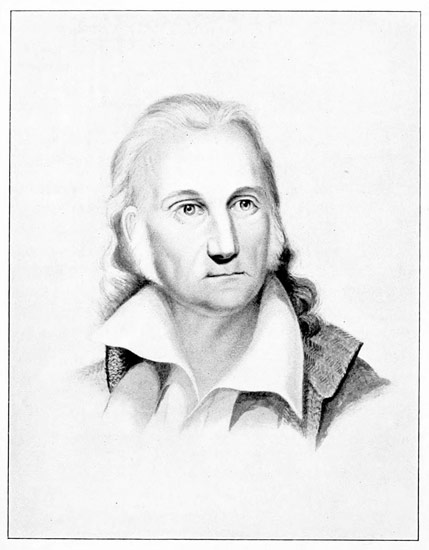
AUDUBON. From the pencil sketch by Isaac Sprague, 1842. In the possession of the Sprague family, Wellesley Hills, Mass.
July 13, Thursday. This has been a cloudy and a sultry day. Sprague finished his drawing and I mine. After dinner Mr. Culbertson, Squires, and myself went off nine miles over the prairies to look at the "meadows," as they are called, where Mr. Culbertson has heretofore cut his winter crop of hay, but we found it indifferent compared with that above the fort. We saw Sharp-tailed Grouse, and what we thought a new species of Lark, which we shot at no less than ten times before it was killed by Mr. Culbertson, but not found. I caught one of its young, but it proved to be only the Shore Lark. Before we reached the meadows we saw a flock of fifteen or twenty Bob-o-link, Emberiza orizivora, and on our return shot one of them (a male) on the wing. It is the first seen since we left St. Louis. We reached the meadows at last, and tied our nag to a tree, with the privilege of feeding. Mr. Culbertson and Squires went in the "meadows," and I walked round the so-called patch. I shot seven Arkansas Flycatchers on the wing. After an hour's walking, my companions returned, but had seen nothing except the fresh tracks of a Grizzly Bear. I shot at one of the White-rumped Hawks, of which I have several times spoken, but although it dropped its quarry and flew very wildly afterwards, it went out of my sight. We found the beds of Elks and their fresh dung, but saw none of these animals. I have forgotten to say that immediately after breakfast this morning I drove with Squires to Fort Mortimer, and asked Mr. Collins to let me have his hunter, Boucherville, to go after Mountain Rams for me, which he promised to do. In the afternoon he sent a man over to ask for some flour, which Mr. Culbertson sent him. They are there in the utmost state of destitution, almost of starvation, awaiting the arrival of the hunters like so many famished Wolves. Harris and Bell went across the river and shot a Wolf under the river bank, and afterwards a Duck, but saw nothing else. But during their absence we have had a fine opportunity of witnessing the agility and extreme strength of a year-old Buffalo bull belonging to the fort. Our cook, who is an old Spaniard, threw his lasso over the Buffalo's horns, and all the men in the fort at the time, hauled and pulled the beast about, trying to get him close to a post. He kicked, pulled, leaped sideways, and up and down, snorting and pawing until he broke loose, and ran, as if quite wild, about the enclosure. He was tied again and again, without any success, and at last got out of the fort, but was soon retaken, the rope being thrown round his horns, and he was brought to the main post of the Buffalo-robe press. There he was brought to a standstill, at the risk of breaking his neck, and the last remnant of his winter coat was removed by main strength, which was the object for which the poor animal had undergone all this trouble. After Harris returned to the fort he saw six Sharp-tailed Grouse. At this season this species have no particular spot where you may rely upon finding them, and at times they fly through the woods, and for a great distance, too, where they alight on trees; when, unless you accidentally see them, you pass by without their moving. After we passed Fort Mortimer on our return we saw coming from the banks of the river no less than eighteen Wolves, which altogether did not cover a space of more than three or four yards, they were so crowded. Among them were two Prairie Wolves. Had we had a good running horse some could have been shot; but old Peter is long past his running days. The Wolves had evidently been feeding on some carcass along the banks, and all moved very slowly. Mr. Culbertson gave me a grand pair of leather breeches and a very handsome knife-case, all manufactured by the Blackfeet Indians.
July 14, Friday. Thermometer 70°-95°. Young McKenzie went off after Antelopes across the river alone, but saw only one, which he could not get near. After breakfast Harris, Squires, and I started after birds of all sorts, with the wagon, and proceeded about six miles on the road we had travelled yesterday. We met the hunter from Fort Mortimer going for Bighorns for me, and Mr. Culbertson lent him a horse and a mule. We caught two young of the Shore Lark, killed seven of Sprague's Lark, but by bad management lost two, either from the wagon, my hat, or Harris's pockets. The weather was exceedingly hot. We hunted for Grouse in the wormwood bushes, and after despairing of finding any, we started up three from the plain, and they flew not many yards to the river. We got out of the wagon and pushed for them; one rose, and Harris shot it, though it flew some yards before he picked it up. He started another, and just as he was about to fire, his gunlock caught on his coat, and off went Mr. Grouse, over and through the woods until out of sight, and we returned slowly home. We saw ten Wolves this morning. After dinner we had a curious sight. Squires put on my Indian dress. McKenzie put on one of Mr. Culbertson's, Mrs. Culbertson put on her own superb dress, and the cook's wife put on the one Mrs. Culbertson had given me. Squires and Owen were painted in an awful manner by Mrs. Culbertson, the Ladies had their hair loose, and flying in the breeze, and then all mounted on horses with Indian saddles and trappings. Mrs. Culbertson and her maid rode astride like men, and all rode a furious race, under whip the whole way, for more than one mile on the prairie; and how amazed would have been any European lady, or some of our modern belles who boast their equestrian skill, at seeing the magnificent riding of this Indian princess—for that is Mrs. Culbertson's rank—and her servant. Mr. Culbertson rode with them, the horses running as if wild, with these extraordinary Indian riders, Mrs. Culbertson's magnificent black hair floating like a banner behind her. As to the men (for two others had joined Squires and McKenzie), I cannot compare them to anything in the whole creation. They ran like wild creatures of unearthly compound. Hither and thither they dashed, and when the whole party had crossed the ravine below, they saw a fine Wolf and gave the whip to their horses, and though the Wolf cut to right and left Owen shot at him with an arrow and missed, but Mr. Culbertson gave it chase, overtook it, his gun flashed, and the Wolf lay dead. They then ascended the hills and away they went, with our princess and her faithful attendant in the van, and by and by the group returned to the camp, running full speed till they entered the fort, and all this in the intense heat of this July afternoon. Mrs. Culbertson, herself a wonderful rider, possessed of both strength and grace in a marked degree, assured me that Squires was equal to any man in the country as a rider, and I saw for myself that he managed his horse as well as any of the party, and I was pleased to see him in his dress, ornaments, etc., looking, however, I must confess, after Mrs. Culbertson's painting his face, like a being from the infernal regions. Mr. Culbertson presented Harris with a superb dress of the Blackfoot Indians, and also with a Buffalo bull's head, for which Harris had in turn presented him with a gun-barrel of the short kind, and well fitted to shoot Buffaloes. Harris shot a very young one of Townsend's Hare, Mr. Denig gave Bell a Mouse, which, although it resembles Mus leucopus greatly, is much larger, and has a short, thick, round tail, somewhat blunted.
July 15, Saturday. We were all up pretty early, for we propose going up the Yellowstone with a wagon, and the skiff on a cart, should we wish to cross. After breakfast all of us except Sprague, who did not wish to go, were ready, and along with two extra men, the wagon, and the cart, we crossed the Missouri at the fort, and at nine were fairly under way—Harris, Bell, Mr. Culbertson, and myself in the wagon, Squires, Provost, and Owen on horseback. We travelled rather slowly, until we had crossed the point, and headed the ponds on the prairie that run at the foot of the hills opposite. We saw one Grouse, but it could not be started, though Harris searched for it. We ran the wagon into a rut, but got out unhurt; however, I decided to walk for a while, and did so for about two miles, to the turning point of the hills. The wheels of our vehicle were very shackling, and had to be somewhat repaired, and though I expected they would fall to pieces, in some manner or other we proceeded on. We saw several Antelopes, some on the prairie which we now travelled on, and many more on the tops of the hills, bounding westward. We stopped to water the horses at a saline spring, where I saw that Buffaloes, Antelopes, and other animals come to allay their thirst, and repose on the grassy margin. The water was too hot for us to drink, and we awaited the arrival of the cart, when we all took a good drink of the river water we had brought with us. After waiting for nearly an hour to allow the horses to bait and cool themselves, for it was very warm, we proceeded on, until we came to another watering-place, a river, in fact, which during spring overflows its banks, but now has only pools of water here and there. We soaked our wheels again, and again drank ourselves. Squires, Provost, and Owen had left sometime before us, but were not out of our sight, when we started, and as we had been, and were yet, travelling a good track, we soon caught up with them. We shot a common Red-winged Starling, and heard the notes of what was supposed to be a new bird by my companions, but which to my ears was nothing more than the Short-billed Marsh Wren of Nuttall. We reached our camping-place, say perhaps twenty miles' distance, by four o'clock, and all things were unloaded, the horses put to grass, and two or three of the party went in "the point" above, to shoot something for supper. I was hungry myself, and taking the Red-wing and the fishing-line, I went to the river close by, and had the good fortune to catch four fine catfish, when, my bait giving out, I was obliged to desist, as I found that these catfish will not take parts of their own kind as food. Provost had taken a bath, and rowed the skiff (which we had brought this whole distance on the cart, dragged by a mule) along with two men, across the river to seek for game on the point opposite our encampment. They returned, however, without having shot anything, and my four catfish were all the fresh provisions that we had, and ten of us partook of them with biscuit, coffee, and claret. Dusk coming on, the tent was pitched, and preparations to rest made. Some chose one spot and some another, and after a while we were settled. Mr. Culbertson and I lay together on the outside of the tent, and all the party were more or less drowsy. About this time we saw a large black cloud rising in the west; it was heavy and lowering, and about ten o'clock, when most of us were pretty nearly sound asleep, the distant thunder was heard, the wind rose to a gale, and the rain began falling in torrents. All were on foot in a few moments, and considerable confusion ensued. Our guns, all loaded with balls, were hurriedly placed under the tent, our beds also, and we all crawled in, in the space of a very few minutes. The wind blew so hard that Harris was obliged to hold the flappers of the tent with both hands, and sat in the water a considerable time to do this. Old Provost alone did not come in, he sat under the shelving bank of the river, and kept dry. After the gale was over, he calmly lay down in front of the tent on the saturated ground, and was soon asleep. During the gale, our fire, which we had built to keep off the myriads of mosquitoes, blew in every direction, and we had to watch the embers to keep them from burning the tent. After all was over, we snugged ourselves the best way we could in our small tent and under the wagon, and slept soundly till daylight. Mr. Culbertson had fixed himself pretty well, but on arising at daylight to smoke his pipe, Squires immediately crept into his comfortable corner, and snored there till the day was well begun. Mr. Culbertson had my knees for a pillow, and also my hat, I believe, for in the morning, although the first were not hurt, the latter was sadly out of shape in all parts. We had nothing for our breakfast except some vile coffee, and about three quarters of a sea-biscuit, which was soon settled among us. The men, poor fellows, had nothing at all. Provost had seen two Deer, but had had no shot, so of course we were in a quandary, but it is now—
July 16, Sunday. The weather pleasant with a fine breeze from the westward, and all eyes were bent upon the hills and prairie, which is here of great breadth, to spy if possible some object that might be killed and eaten. Presently a Wolf was seen, and Owen went after it, and it was not until he had disappeared below the first low range of hills, and Owen also, that the latter came within shot of the rascal, which dodged in all sorts of manners; but Owen would not give up, and after shooting more than once, he killed the beast. A man had followed him to help bring in the Wolf, and when near the river he saw a Buffalo, about two miles off, grazing peaceably, as he perhaps thought, safe in his own dominions; but, alas! white hunters had fixed their eyes upon him, and from that moment his doom was pronounced. Mr. Culbertson threw down his hat, bound his head with a handkerchief, his saddle was on his mare, he was mounted and off and away at a swift gallop, more quickly than I can describe, not towards the Buffalo, but towards the place where Owen had killed the Wolf. The man brought the Wolf on old Peter, and Owen, who was returning to the camp, heard the signal gun fired by Mr. Culbertson, and at once altered his course; his mare was evidently a little heated and blown by the Wolf chase, but both hunters went after the Buffalo, slowly at first, to rest Owen's steed, but soon, when getting within running distance, they gave whip, overhauled the Bison, and shot at it twice with balls; this halted the animal; the hunters had no more balls, and now loaded with pebbles, with which the poor beast was finally killed. The wagon had been sent from the camp. Harris, Bell, and Squires mounted on horseback, and travelled to the scene of action. They met Mr. Culbertson returning to camp, and he told Bell the Buffalo was a superb one, and had better be skinned. A man was sent to assist in the skinning who had been preparing the Wolf which was now cooking, as we had expected to dine upon its flesh; but when Mr. Culbertson returned, covered with blood and looking like a wild Indian, it was decided to throw it away; so I cut out the liver, and old Provost and I went fishing and caught eighteen catfish. I hooked two tortoises, but put them back in the river. I took a good swim, which refreshed me much, and I came to dinner with a fine appetite. This meal consisted wholly of fish, and we were all fairly satisfied. Before long the flesh of the Buffalo reached the camp, as well as the hide. The animal was very fat, and we have meat for some days. It was now decided that Squires, Provost, and Basil (one of the men) should proceed down the river to the Charbonneau, and there try their luck at Otters and Beavers, and the rest of us, with the cart, would make our way back to the fort. All was arranged, and at half-past three this afternoon we were travelling towards Fort Union. But hours previous to this, and before our scanty dinner, Owen had seen another bull, and Harris and Bell joined us in the hunt. The bull was shot at by McKenzie, who stopped its career, but as friend Harris pursued it with two of the hunters and finished it I was about to return, and thought sport over for the day. However, at this stage of the proceedings Owen discovered another bull making his way slowly over the prairie towards us. I was the only one who had balls, and would gladly have claimed the privilege of running him, but fearing I might make out badly on my slower steed, and so lose meat which we really needed, I handed my gun and balls to Owen McKenzie, and Bell and I went to an eminence to view the chase. Owen approached the bull, which continued to advance, and was now less than a quarter of a mile distant; either it did not see, or did not heed him, and they came directly towards each other, until they were about seventy or eighty yards apart, when the Buffalo started at a good run, and Owen's mare, which had already had two hard runs this morning, had great difficulty in preserving her distance. Owen, perceiving this, breathed her a minute, and then applying the whip was soon within shooting distance, and fired a shot which visibly checked the progress of the bull, and enabled Owen to soon be alongside of him, when the contents of the second barrel were discharged into the lungs, passing through the shoulder blade. This brought him to a stand. Bell and I now started at full speed, and as soon as we were within speaking distance, called to Owen not to shoot again. The bull did not appear to be much exhausted, but he was so stiffened by the shot on the shoulder that he could not turn quickly, and taking advantage of this we approached him; as we came near he worked himself slowly round to face us, and then made a lunge at us; we then stopped on one side and commenced discharging our pistols with little or no effect, except to increase his fury with every shot. His appearance was now one to inspire terror had we not felt satisfied of our ability to avoid him. However, even so, I came very near being overtaken by him. Through my own imprudence, I placed myself directly in front of him, and as he advanced I fired at his head, and then ran ahead of him, instead of veering to one side, not supposing that he was able to overtake me; but turning my head over my shoulder, I saw to my horror, Mr. Bull within three feet of me, prepared to give me a taste of his horns. The next instant I turned sharply off, and the Buffalo being unable to turn quickly enough to follow me, Bell took the gun from Owen and shot him directly behind the shoulder blade. He tottered for a moment, with an increased jet of blood from the mouth and nostrils, fell forward on his horns, then rolled over on his side, and was dead. He was a very old animal, in poor case, and only part of him was worth taking to the fort. Provost, Squires, and Basil were left at the camp preparing for their departure after Otter and Beaver as decided. We left them eight or nine catfish and a quantity of meat, of which they took care to secure the best, namely the boss or hump. On our homeward way we saw several Antelopes, some quite in the prairie, others far away on the hills, but all of them on the alert. Owen tried unsuccessfully to approach several of them at different times. At one place where two were seen he dismounted, and went round a small hill (for these animals when startled or suddenly alarmed always make to these places), and we hoped would have had a shot; but alas! no! One of the Antelopes ran off to the top of another hill, and the other stood looking at him, and us perhaps, till Owen (who had been re-mounted) galloped off towards us. My surprise was great when I saw the other Antelope following him at a good pace (but not by bounds or leaps, as I had been told by a former traveller they sometimes did), until it either smelt him, or found out he was no friend, and turning round galloped speedily off to join the one on the lookout. We saw seven or eight Grouse, and Bell killed one on the ground. We saw a Sand-hill Crane about two years old, looking quite majestic in a grassy bottom, but it flew away before we were near enough to get a shot. We passed a fine pond or small lake, but no bird was there. We saw several parcels of Ducks in sundry places, all of which no doubt had young near. When we turned the corner of the great prairie we found Owen's mare close by us. She had run away while he was after Antelopes. We tied her to a log to be ready for him when he should reach the spot. He had to walk about three miles before he did this. However, to one as young and alert as Owen, such things are nothing. Once they were not to me. We saw more Antelope at a distance, here called "Cabris," and after a while we reached the wood near the river, and finding abundance of service-berries, we all got out to break branches of these plants, Mr. Culbertson alone remaining in the wagon; he pushed on for the landing. We walked after him munching our berries, which we found very good, and reached the landing as the sun was going down behind the hills. Young McKenzie was already there, having cut across the point. We decided on crossing the river ourselves, and leaving all behind us except our guns. We took to the ferry-boat, cordelled it up the river for a while, then took to the nearest sand-bar, and leaping into the mud and water, hauled the heavy boat, Bell and Harris steering and poling the while. I had pulled off my shoes and socks, and when we reached the shore walked up to the fort barefooted, and made my feet quite sore again; but we have had a rest and a good supper, and I am writing in Mr. Culbertson's room, thinking over all God's blessings on this delightful day.